Sunday, February 14, 2021

Photo of the Day: Hope's First Image at the Red Planet...

An image of Mars that was taken by the United Arab Emirates' Hope spacecraft the day after it entered orbit around the Red Planet...on February 10, 2021.
Mohammed Bin Rashid Space Centre

Happy Valentine's Day, everyone! Just thought I'd share this photo of Mars that was taken by the Hope spacecraft the day after it successfully entered orbit around the Red Planet. The United Arab Emirates-managed probe was 24,700 kilometers (15,350 miles) above the barren, crimson world when this image was taken. Pretty cool.

Only four days till NASA's Perseverance rover and Ingenuity helicopter hopefully join Hope at the Red Planet. Landing at Mars' Jezero Crater is set to occur at 12:55 PM, Pacific Standard Time (3:55 PM, Eastern Standard Time) on Thursday, February 18. Can't wait! Click on this NASA page to see where Perseverance and Ingenuity are currently located in space.

A computer-generated screenshot showing the Mars 2020 spacecraft's current position from the Red Planet...on February 14, 2021.
NASA / JPL Eyes

Saturday, February 13, 2021

From Perseverance and Dragonfly to Beyond: The Department of Energy Sets Its Sight on Powering Future Interplanetary Voyagers...

A Multi-Mission Radioisotope Thermoelectric Generator...the same nuclear system that will be used to power NASA's Perseverance rover when it safely arrives on the surface of Mars next Thursday, February 18.
Office of Nuclear Energy

Aerojet Rocketdyne Receives Contract for Up to Two More MMRTGs for Future Deep Space Exploration Missions (Press Release - February 12)

LOS ANGELES, Calif. – Aerojet Rocketdyne recently received a contract award to deliver up to two Multi-Mission Radioisotope Thermoelectric Generators (MMRTG) to the U.S. Department of Energy (DOE) for use in future planetary science missions. MMRTGs are radioisotope power systems that have been used as reliable electrical power sources on multiple deep space missions, including NASA’s Perseverance Rover, which will land on Mars on Feb. 18.

Both MMRTGs will be fabricated and tested by Aerojet Rocketdyne and its teammate Teledyne Energy Systems prior to delivery to DOE’s Idaho National Laboratory, where the units will be fueled and readied for launch based on mission timelines.

“While the specific missions each unit will support have not yet been determined, the MMRTG is well suited for a variety of environments,” said Aerojet Rocketdyne CEO and President Eileen P. Drake. “The MMRTG is multi-mission capable, meaning that it can operate on the surface of planets and moons in a planetary atmosphere or in the vacuum of space.”

The MMRTG produces dependable electrical power by converting the heat from plutonium 238 radioactive decay into electricity. A single unit can provide reliable, long-lasting electrical power to a spacecraft or planetary rover, enabling exploration of the deepest corners of the solar system, where the great distance from the Sun dramatically reduces the effectiveness of solar arrays.

The MMRTG will power NASA’s Dragonfly mission to explore Saturn’s moon Titan, and is being considered for the Trident mission to explore Neptune’s largest moon Triton, which is believed to have a liquid ocean.

Source: Aerojet Rocketdyne

****

A computer-generated screenshot showing the Perseverance rover being lowered from its rocket-powered descent stage onto the surface of Mars...which will actually take place next Thursday, February 18.
NASA

An artist's concept of NASA's Dragonfly rotorcraft on the surface of Saturn's moon Titan.
NASA / Johns Hopkins APL

An image of Neptune's moon Triton that was taken by NASA's Voyager 2 spacecraft in August of 1989.
NASA / JPL - Caltech

Friday, February 12, 2021

InSight Update: The Robotic Lander Prepares to Dig In for the Martian Winter...

One of InSight's two large solar panels is completely covered in Martian dust...as seen by a camera on the lander's robotic arm.
NASA / JPL - Caltech

InSight Is Meeting the Challenge of Winter on Dusty Mars (News Release)

As dust collects on the solar panels and winter comes to Elysium Planitia, the team is following a plan to reduce science operations in order to keep the lander safe.

NASA’s InSight lander recently received a mission extension for another two years, giving it time to detect more quakes, dust devils, and other phenomena on the surface of Mars. While the mission team plans to continue collecting data well into 2022, the increasing dustiness of the spacecraft’s solar panels and the onset of the Martian winter led to a decision to conserve power and temporarily limit the operation of its instruments.

InSight was designed to be long-lasting: The stationary lander is equipped with solar panels, each spanning 7 feet (2 meters) across. InSight’s design was informed by that of the solar-powered Spirit and Opportunity rovers, with the expectation that the panels would gradually reduce their power output as dust settled on them but would have ample output to last through the two-year prime mission (completed in November 2020).

Additionally, InSight’s team chose a landing site in Elysium Planitia, a windswept plain on the Red Planet’s equator that receives lots of sunlight. It was hoped that passing dust devils might clean off the panels, which happened many times with Spirit and Opportunity, allowing them to last years past their design lifetime.

But despite InSight detecting hundreds of passing dust devils, none has been close enough to clean off those dinner-table-size panels since they unfurled on Mars in November 2018. Today, InSight’s solar arrays are producing just 27% of their dust-free capacity. That power has to be shared between science instruments, a robotic arm, the spacecraft’s radio, and a variety of heaters that keep everything in working order despite subfreezing temperatures. Since the windiest season of the Martian year has just ended, the team isn’t counting on a cleaning event in the coming months.

Mars is currently moving toward what’s called aphelion, the point in its orbit when it’s farthest away from the Sun. That means the already-weak sunlight on the Martian surface is growing even fainter, reducing power when InSight most needs its heaters to stay warm. Mars will start approaching the Sun again in July 2021, after which the team will begin to resume full science operations.

“The amount of power available over the next few months will really be driven by the weather,” said InSight’s project manager, Chuck Scott of NASA’s Jet Propulsion Laboratory in Southern California. “As part of our extended-mission planning, we developed an operations strategy to keep InSight safe through the winter so that we can resume science operations as solar intensity increases.” JPL leads the InSight mission, though the spacecraft and its solar panels were built by Lockheed Martin Space of Denver, Colorado.

Over the coming weeks and months, InSight scientists will be carefully selecting which instruments need to be switched off each day to preserve power for heaters and energy-intensive activities like radio communication. InSight’s weather sensors are likely to remain off much of the time (resulting in infrequent updates to the mission’s weather page), and all the instruments will have to be powered off for some period around aphelion.

Currently, power levels look strong enough to take the lander through the winter. But solar power generation on Mars is always a little uncertain. The Opportunity rover was forced to shut down after a series of dust storms darkened the Martian sky in 2019, and Spirit did not survive the Martian winter in 2010. If InSight were to run out of power due to a sudden dust storm, it is designed to be able to reboot itself when the sunlight returns if its electronics survived the extreme cold.

Later this week, InSight will be commanded to extend its robotic arm over the panels so a camera can take close-up images of the dust coating. Then the team will pulse the motors that unfurled each panel after landing to try to disturb the dust and see if the wind blows it away. The team considers this to be a long shot but worth the effort.

“The InSight team has put together a strong plan to safely navigate through winter and emerge on the other side ready to complete our extended science mission through 2022,” said Bruce Banerdt of JPL, InSight’s principal investigator. “We’ve got a great vehicle and a top-notch team; I’m looking forward to many more new discoveries from InSight in the future.”

Source: NASA.Gov

Thursday, February 11, 2021

Perseverance Update: T-Minus ONE WEEK Till NASA's Next Robotic Rover and First Interplanetary Aircraft Touches Down on Mars!

A computer-generated screenshot showing the Perseverance rover being lowered from its rocket-powered descent stage onto the surface of Mars...which will actually take place on February 18, 2021.
NASA

As of today, only 7 days remain before NASA's Perseverance rover—with the Ingenuity helicopter riding shotgun on it—touches down on Mars! The Mars 2020 spacecraft will reach the Red Planet on Thursday, February 18...with landing set to take place around 12:55 PM, Pacific Standard Time (3:55 PM, Eastern Standard Time)! I. Can't. Wait. Click on this NASA page to see where Perseverance and Ingenuity are currently located in space!

A computer-generated screenshot showing the Mars 2020 spacecraft's current position from the Red Planet...on February 11, 2021.
NASA / JPL Eyes

An illustration of the Ingenuity helicopter soaring in the Martian air while the Perseverance rover observes from the surface.
NASA / JPL - Caltech

Wednesday, February 10, 2021

Lucy Update: The Trojan Asteroid-bound Spacecraft Continues to Take Shape in Littleton, Colorado...

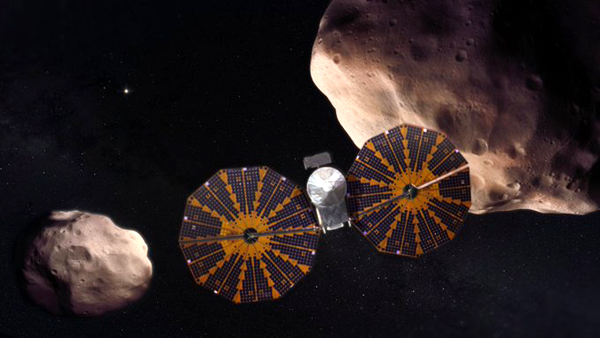
An artist's concept of NASA's Lucy spacecraft venturing past the Trojan asteroid Patroclus and its binary companion Menoetius near Jupiter's orbit.
NASA’s Goddard Space Flight Center / Conceptual Image Lab / Adriana Gutierrez

NASA’s First Mission to the Trojan Asteroids Installs its Final Scientific Instrument (News Release - February 9)

With less than a year to launch, NASA’s Lucy mission’s third and final scientific instrument has been integrated onto the spacecraft.

The spacecraft, which will be the first to explore the Trojan asteroids — a population of small bodies that share an orbit with Jupiter — is in the final stages of the assembly process. Just five months ago, at the beginning of the Assembly, Testing and Launch operations (ATLO) process, the components of the Lucy spacecraft were being built all over the country. Today, a nearly assembled spacecraft sits in the high bay in Lockheed Martin Space in Littleton, Colorado.

“A bit over a year and a half ago, I was excited to hold the first small pieces of metal that were destined to travel to the Trojan asteroids,” says Hal Levison, principal investigator from the Southwest Research Institute. “Now there is an actual spacecraft, nearly ready to go. It is incredible.”

The final instrument, L’Ralph, was built by NASA’s Goddard Space Center in Greenbelt, Maryland, and was received at Lockheed Martin on January 21 and integrated onto the spacecraft on January 26. L’Ralph is the most complicated instrument that will fly on Lucy, as it is actually two instruments in one. The Multispectral Visible Imaging Camera (MVIC), will take visible light color images of the Trojan asteroids. The Linear Etalon Imaging Spectral Array (LEISA), will collect infrared spectra of the asteroids. Both of these components will work together to allow Lucy to determine the composition of the Trojan asteroids and provide insight into the early history of our solar system.

The L’Ralph instrument experienced significant COVID-19 related delays, particularly when construction had to be halted when Goddard was placed under stage 4 COVID restrictions in April of last year. However, both the L’Ralph team at Goddard and the ATLO team at Lockheed Martin rose to the challenge and developed a new schedule that allowed everyone to work safely while keeping the spacecraft on track for its originally planned October 16, 2021 launch.

“The L’Ralph team has done an outstanding job to deliver a fantastic instrument,” says Dennis Reuter, L’Ralph instrument principal investigator, from Goddard. “Doing what they did under normal conditions would have been remarkable. Doing it under the actual conditions that had to be dealt with is amazing.”

L’Ralph has been installed on Lucy’s Instrument Pointing Platform. This platform provides the spacecraft significant flexibility during the encounters — the instruments can point at the Trojan asteroids during the high-speed flybys while the high gain antenna remains pointed at Earth — as well as carrying out fine adjustments and out-of-plane pointing to get the best data possible on these elusive objects.

Lucy’s other two scientific instruments, L’TES and L’LORRI, designed and built at Arizona State University, and Johns Hopkins Applied Physics Laboratory, respectively, as well as the two Terminal Tracking Cameras have already been installed on the platform. Now that L’Ralph is installed, the platform itself will be installed onto the spacecraft bus — making Lucy one step closer to being ready for her 12-year-long journey to the Trojans.

“Lucy ATLO has been tremendously successful and having L’Ralph delivered and integrated onto the Instrument Pointing Platform is a great start to the new year,” said Donya Douglas-Bradshaw, mission project manager from Goddard.

Southwest Research Institute’s Hal Levison and Cathy Olkin are the principal investigator and deputy principal investigator of the Lucy Mission. Goddard provides overall mission management, systems engineering and safety and mission assurance. Lockheed Martin Space is building the spacecraft. Lucy is the 13th mission in NASA’s Discovery Program. NASA’s Marshall Space Flight Center in Huntsville, Alabama, manages the Discovery Program for the agency’s Science Mission Directorate in Washington, D.C.

Source: NASA.Gov

****

A close-up of the L’Ralph instrument that was recently installed onto NASA's Lucy spacecraft as it gears up for launch this October.
NASA / Goddard / Barbara Lambert / Desiree Stover

Tuesday, February 09, 2021

Hope Has Arrived at Mars!

A computer-generated screenshot of the United Arab Emirates' Hope spacecraft entering orbit around Mars.
Mohammed Bin Rashid Space Centre

Congratulations to the United Arab Emirates (UAE) for the successful arrival of its Hope spacecraft at Mars earlier today! This robotic orbiter, which is the centerpiece of the Emirates Mars Mission (EMM), launched from Japan on July 19, 2020...traveling more than 480 million kilometers (298 million miles) across the vastness of space before conducting a 27-minute engine burn that occurred from 7:30 AM to 7:57 AM, Pacific Standard Time (PST), to allow Hope to enter a highly-elliptical orbit around the Red Planet. Confirmation of a successful burn didn't reach mission control at Mohammed Bin Rashid Space Centre, Dubai, till 11 minutes later.


With the Mars Orbit Insertion maneuver now out of the way, the EMM team will prep the spacecraft for science data-gathering activities...which is scheduled to begin in May. What a historic day for the Arab world and space exploration in general! Along with being the only Middle Eastern nation to ever lead an interplanetary mission (as well as being the second country, besides India, to successfully arrive at the Red Planet on the first try), the UAE is the fifth entity—behind the United States, Russia, the European Union and India, respectively—to place a probe into orbit around Mars since the dawn of the Space Age.

A computer-generated screenshot showing the Mars 2020 spacecraft's current position from the Red Planet...on February 9, 2021.
NASA / JPL Eyes

Nine days from now, Hope will hopefully be joined by the Perseverance rover and Ingenuity helicopter when their Mars 2020 spacecraft arrives at the Red Planet! The landing is set to take place at 12:55 PM, PST (3:55 PM, EST), on February 18. Click here to see where NASA's latest Mars explorer currently is in space.

Friday, February 05, 2021

The Blue Ghost Is Heading to the Moon...

An artist's concept of Firefly Aerospace's Blue Ghost lunar lander on the surface of the Moon.
Firefly Aerospace

NASA Selects Firefly Aerospace for Artemis Commercial Moon Delivery in 2023 (Press Release - February 4)

NASA has awarded Firefly Aerospace of Cedar Park, Texas, approximately $93.3 million to deliver a suite of 10 science investigations and technology demonstrations to the Moon in 2023. The delivery, planned for Mare Crisium, a low-lying basin on the Moon’s near side, will investigate a variety of lunar surface conditions and resources. Such investigations will help prepare for human missions to the lunar surface.

The award is part of the agency’s Commercial Lunar Payload Services (CLPS) initiative, in which NASA is securing the service of commercial partners to quickly land science and technology payloads on the lunar surface. The initiative is a key part of NASA’s Artemis program. Firefly Aerospace will be responsible for end-to-end delivery services, including payload integration, launch from Earth, landing on the Moon, and mission operations. This is the sixth award for lunar surface delivery under the CLPS initiative.

“We’re excited another CLPS provider has won its first task order award. With this initiative, we seek to develop ways for new science and technology development utilizing a service-based model,” said Thomas Zurbuchen, associate administrator for science at NASA Headquarters in Washington. “This allows U.S. vendors to not only demonstrate their ability to safely deliver payloads to our celestial neighbor, but also expand this capability for others who want to take advantage of this cutting edge approach to explore the Moon.”

This is the first delivery awarded to Firefly Aerospace, which will provide the lunar delivery service using its Blue Ghost lander, which the company designed and developed at its Cedar Park facility. This facility also will house the integration of NASA and any non-NASA payloads, and also will serve as the company’s mission operations center for the 2023 delivery.

“The payloads we’re sending as part of this delivery service span across multiple areas, from investigating the lunar soil and testing a sample capture technology, to giving us information about the Moon’s thermal properties and magnetic field,” said Chris Culbert, manager of the CLPS initiative at NASA’s Johnson Space Center in Houston.

Mare Crisium, where Firefly Aerospace’s Blue Ghost will land, is a more than 300-mile-wide basin where instruments will gather data to provide insight into the Moon’s regolith – loose, fragmented rock and soil – properties, geophysical characteristics, and the interaction of solar wind and Earth’s magnetic field.

The payloads, collectively expected to total 207 pounds (94 kg) in mass, include:

- The Regolith Adherence Characterization (RAC), which will determine how lunar regolith sticks to a range of materials exposed to the Moon's environment during landing and lander operations. Components will be derived from the Materials International Space Station Experiment (MISSE) facility currently on the International Space Station.

- The Next Generation Lunar Retroreflectors (NGLR), which will serve as a target for lasers on Earth to precisely measure the distance between Earth and the Moon. The retroreflector that will fly on this mission also will provide data that could be used to understand various aspects of the lunar interior and address fundamental physics questions.

- The Lunar Environment Heliospheric X-ray Imager (LEXI), which will capture images of the interaction of Earth's magnetosphere with the flow of charged particles from the Sun, called the solar wind.

- The Reconfigurable, Radiation Tolerant Computer System (RadPC), which aims to demonstrate a radiation-tolerant computing technology. Due to the Moon's lack of atmosphere and magnetic field, radiation from the Sun will be a challenge for electronics. This investigation also will characterize the radiation effects on the lunar surface.

- The Lunar Magnetotelluric Sounder (LMS), which is designed to characterize the structure and composition of the Moon’s mantle by studying electric and magnetic fields. The investigation will make use of a flight-spare magnetometer, a device that measures magnetic fields, originally made for the Mars Atmosphere and Volatile EvolutioN (MAVEN) spacecraft currently orbiting Mars.

- The Lunar Instrumentation for Subsurface Thermal Exploration with Rapidity (LISTER), which is designed to measure heat flow from the interior of the Moon. The probe will attempt to drill 7 to 10 feet (2 to 3 meters) into the lunar regolith to investigate the Moon's thermal properties at different depths.

- The Lunar PlanetVac (LPV), which is designed to acquire lunar regolith from the surface and transfer it to other instruments that would analyze the material or put it in a container that another spacecraft could return to Earth.

- Stereo CAmeras for Lunar Plume Surface Studies (SCALPSS 1.1), which will capture video and still images of the area under the lander from when the engine plume first disturbs the lunar surface through engine shutdown. Long-focal-length cameras will determine the pre-landing surface topography. Photogrammetry will be used to reconstruct the changing surface during landing. Understanding the physics of rocket exhaust on the regolith, and the displacement of dust, gravel, and rocks is critical to understanding how to best avoid kicking up surface materials during the terminal phase of flight/landing on the Moon and other celestial bodies.

- The Electrodynamic Dust Shield (EDS), which will generate a non-uniform electric field using varying high voltage on multiple electrodes. This traveling field, in turn, carries away the particles and has potential applications in thermal radiators, spacesuit fabrics, visors, camera lenses, solar panels, and many other technologies.

- The Lunar GNSS Receiver Experiment (LuGRE), which is based on GPS. LuGRE will continue to extend the reach of GPS signals and, if successful, be the first to discern GPS signals at lunar distances.

The CLPS initiative is a key part of NASA’s Artemis lunar exploration efforts. The science and technology payloads sent to the Moon’s surface as part of the initiative will help lay the foundation for human missions and a sustainable human presence on the lunar surface.

****

Thursday, February 04, 2021

Perseverance Update: Exactly 2 Weeks Remain Before NASA's Next Robotic Rover (and First Interplanetary Chopper) Arrives at Mars!

A computer-generated screenshot showing the Perseverance rover being lowered from its rocket-powered descent stage onto the surface of Mars...which will actually take place on February 18, 2021.
NASA

As of today, only 14 days remain before NASA's Perseverance rover—with the Ingenuity helicopter riding shotgun on it—touches down on Mars! The Mars 2020 spacecraft will reach the Red Planet on Thursday, February 18...with landing set to take place around 12:55 PM, Pacific Standard Time (3:55 PM, Eastern Standard Time)! So stoked. Click on this NASA page to see where Perseverance and Ingenuity are currently located in space!

An illustration of the Ingenuity helicopter soaring in the Martian air while the Perseverance rover observes from the surface.
NASA / JPL - Caltech

Wednesday, February 03, 2021

Peregrine Update: NASA Has Future Flights in Mind for Astrobotic and Other Companies' Lunar Landers...

The full-scale Structural Test Model for Astrobotic's Peregrine lunar lander...which is set to head to the Moon aboard United Launch Alliance's Vulcan Centaur rocket later this year.

Lunar Traffic to Pick Up as NASA Readies for Robotic Commercial Moon Deliveries (News Release)

NASA is working on various science instruments and technology experiments from the agency that will operate on the Moon once American companies on Commercial Lunar Payload Services (CLPS) contracts deliver them to the lunar surface. Through CLPS flights, NASA is buying a complete commercial robotic lunar delivery service and does not provide launch services, own the lander or lead landing operations.

The agency has already purchased space on five upcoming commercial Moon missions and is expected to announce yet another task order award soon. The upcoming award keeps the agency on track for its goal of two CLPS deliveries per year as part of the Artemis program and will round out two deliveries per year 2021 through 2023.

“We’re excited with the incredible progress we’ve already made with our CLPS initiative since its inception just two years ago, and its clear many other customers are eager to take advantage of these new lunar delivery services,” shared Chris Culbert, manager of the CLPS project. “Commercial companies are responsible for vetting any additional payloads and customers for their lander missions. NASA is just a customer like the others, which allows us to focus on the science ahead for the Artemis program.”

Flights this year

Two commercial landers providing the first CLPS services for NASA will soon be kicking up dust on the Moon, one built by Astrobotic and the other Intuitive Machines. They are expected to deliver a combined total of 17 NASA payloads before the end of the year. Payload is a generic term to describe the many different instruments and experiments either attached directly to the lander itself or stowed safely in its trunk until a safe landing. The number of NASA payloads on a CLPS flight will vary depending on the agency’s science and technology objectives among other factors.

Astrobotic and its Peregrine lander are set to ferry 11 NASA instruments and technology demonstrations to the surface to investigate the composition of lunar soil and a host of other environmental factors. Launching on United Launch Alliance’s Vulcan Centaur rocket, Peregrine is targeting later this year to deliver the suite of payloads to Lacus Mortis, a crater on the near side of the Moon.

NASA will deliver its suite of payloads to Astrobotic in the spring. Next, the payloads will be integrated with the lander structure. Once assembly is complete, the lander will undergo a battery of environmental tests before being shipped to Florida for integration with the launch vehicle.

Intuitive Machines will fly its Nova-C lander to Oceanus Procellarum, the largest dark spot on the Moon. The company, which will launch on a SpaceX Falcon 9 rocket, is targeting the fourth quarter of 2021 for its lunar delivery. Six NASA instruments will be delivered to the company this spring to undergo final testing before integration with the lander, including a new navigation and guidance payload to assist with landing.

NASA also added an additional instrument to fly on Nova-C last year, a new fuel gauging technology called Radio Frequency Mass Gauge. Accurately gauging liquid propellant quantity in a low- or zero-gravity environment is critical for spacecraft design and performance, but difficult because the liquid does not settle as it would on Earth. Results will help develop flight systems that could be used on future Artemis missions with crew.

Looking Ahead to 2022, Beyond

Masten Space Systems is working to deliver eight instruments to the lunar surface in 2022 using its XL-1 lander, launched by a SpaceX rocket. NASA and Masten recently selected a landing site on the rim of Haworth Crater, where scientists believe permanently shadowed areas could contain ice near the surface and deeper in reservoirs. Landing just outside Haworth will provide enough solar power to the lander’s solar arrays, while giving the payload instruments access to the crater. The Haworth area is expected to have cold traps of water, methane, ammonia, and carbon dioxide, and other volatiles that could be resources for future human explorers and which will help scientists understand lunar evolution. Several instruments will help assess lunar surface composition and evaluate radiation levels. This summer, Masten will complete a required review of the lander, and NASA will continue to design and build agency payloads for the flight.

Intuitive Machines will fly the agency’s PRIME-1 payload to the Moon next year, which is a precursor instrument to a future water mapping robot – the Volatiles Investigating Polar Exploration Rover or VIPER - in development at NASA’s Johnson Space Center in Houston.

Astrobotic was selected last year to fly NASA’s VIPER rover to the Moon in late 2023 using its new Griffin lander. The company will deliver a mockup of the lander to the agency’s Johnson Space Center in Houston in February for a series of test to ensure the rover and its lander will operate seamlessly together when on the Moon.

The agency is also planning an upcoming announcement to select a provider to deliver a suite of 10 instruments to a non-polar region of the Moon in 2023. Additionally, NASA will announce instrument selections this year under the Payloads and Research Investigations on the Surface of the Moon (PRISM) solicitation for future CLPS flights followed by bidding to deliver them later.

Future NASA payloads delivered to the Moon on CLPS flights could include other rovers, power sources, and science experiments, including the technology demonstrations to be infused into the Artemis program.

“The many science instruments and technology demonstrations that NASA will land on the Moon using the CLPS initiative, will pave the way for scientific research by the Artemis moon walkers,” said Joel Kearns, Deputy Associate Administrator for Exploration of NASA’s Science Mission Directorate.

Source: NASA.Gov

****

An artist's concept of a lunar lander's leg on the Moon's surface.
NASA

Tuesday, February 02, 2021

Psyche Update: The Asteroid-bound Spacecraft Will Head to JPL to Finish Assembly Before Its 2022 Launch from Florida...

An artist's concept of NASA's Psyche spacecraft.
NASA / JPL - Caltech / ASU

NASA’s Psyche Mission Moves Forward, Passing Key Milestone (News Release)

Now just a year and a half from launch, the mission to explore a metal-rich asteroid will soon begin assembling and testing the spacecraft.

NASA’s Psyche mission has passed a critical milestone that moves it a step closer to launch. After an intense review of the mission’s progress in building its science instruments and engineering systems, Psyche won clearance to progress into what NASA calls Phase D of its life cycle – the final phase of operations prior to its scheduled launch in August 2022.

Until now, the mission has focused on planning, designing, and building the body of the spacecraft, its solar-electric propulsion system, the three science instruments, electronics, the power subsystem, and the like. The successful review of those elements means the mission can now begin delivering components to NASA’s Jet Propulsion Laboratory, which manages the mission and will test, assemble, and integrate each piece.

“It’s really the final phase, when all of the puzzle pieces are coming together and we’re getting on the rocket. This is the most intense part of everything that happens on the ground,” said Arizona State University’s Lindy Elkins-Tanton, who as principal investigator for Psyche leads the mission.

Psyche’s target is an intriguing, metal-rich asteroid of the same name, which orbits the Sun in the main asteroid belt between Mars and Jupiter. Scientists think that, unlike rocky or icy asteroids, Psyche is largely iron and nickel and could be the heart of an early planet that lost its outer layers. Exploring the asteroid Psyche (about 140 miles, or 226 kilometers, wide) could lend valuable insight into how Earth and other planets formed.

The Psyche spacecraft will use a magnetometer to detect a potential magnetic field; if the asteroid has one, it’s a strong indicator that it once was the core of an early planet. A multispectral imager will capture images of the surface, as well as gather information about the asteroid’s composition and topography. Spectrometers will analyze the neutrons and gamma rays coming from the surface to reveal the elements that make up the object.

The main structure of the spacecraft, called the Solar Electric Propulsion (SEP) Chassis, was designed and built by Maxar Technologies and is nearly complete. The Maxar team in Palo Alto, California, is preparing to ship it to JPL’s main clean room in March, when assembly, test, and launch operations begin.

Each instrument will then undergo further testing. That includes a laser technology demonstration called Deep Space Optical Communications, led by JPL, which uses a super-efficient method of transmitting data with photons, or fundamental particles of visible light. Also undergoing testing will be the thermal, telecommunications, propulsion, power, avionics, and other engineering subsystems, along with the flight computer.

“The project has made tremendous progress, particularly given the world around us and COVID-19 and dealing with the constraints that imposes,” said JPL’s Henry Stone, the Psyche project manager. “We’re in very good shape. We’re on track and have a plan to go forward to make launch.”

Although engineers and technicians have had to deal with shutdowns forced by the pandemic and to adhere to additional safety protocols for those doing hands-on work on the spacecraft, the project remains on schedule.

“The fact that we can still make this happen and we’re overcoming our challenges feels near-miraculous,” Elkins-Tanton said. “And it’s also an incredible gift to keep us all focused and moving forward in a difficult time. So reaching this milestone has special meaning – not just for this project that we’ve been working on for a decade, but also because of what’s been happening more recently in all of our lives.”

By spring of 2022, the spacecraft will be fully assembled and ready to ship to NASA’s Kennedy Space Center in Cape Canaveral, Florida, where it will launch in August 2022. Psyche will fly by Mars for a gravity assist in May 2023. And in early 2026, it will slip into orbit around the asteroid, where it will spend 21 months gathering data for analysis.

Source: NASA.Gov

****

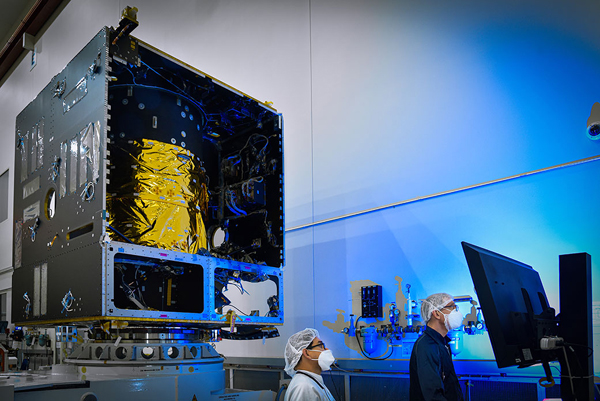
At Maxar Technologies in Palo Alto, California, technicians power on the main body of NASA’s Psyche spacecraft, also known as the Solar Electric Propulsion Chassis, in November of 2020.
Maxar Technologies