Showing posts with label Ingenuity. Show all posts

Monday, July 20, 2026

Image of the Day: Marking Half a Century Since America First Landed on the Red Planet...

NASA's Viking 1 lander successfully touched down on Mars 50 years ago today.

NASA

Today marks 50 years since NASA reached the surface of Mars with the safe landing of its Viking 1 lander. Viking 1's sister craft Viking 2 triumphantly set foot on the Red Planet less than three months later...on September 3, 1976.

Over the next five decades, America would send more robotic probes to the Martian surface: Mars Pathfinder and its Sojourner rover in 1997, the Spirit and Opportunity rovers in 2004, the Phoenix Mars lander in 2008, the Curiosity Mars rover in 2012, the InSight Mars lander in 2018, and the Perseverance Mars rover with its Ingenuity Mars helicopter in 2021.

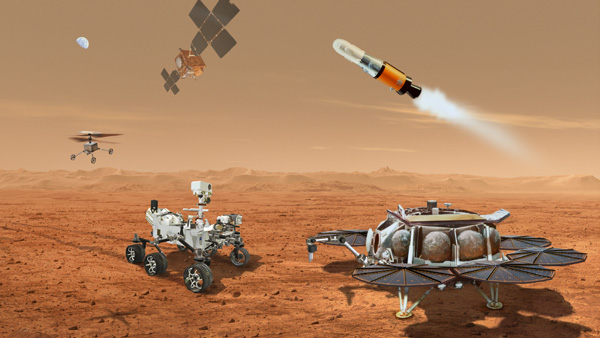
When will the next U.S. Mars landing occur? The Mars Sample Return mission was originally scheduled to launch this year. Alas, that was not meant to be.

Instead, three Mars helicopters dubbed Skyfall will be sent to the Red Planet courtesy of the nuclear-powered Space Reactor-1 Freedom mission in late 2028. Stay tuned!

Wednesday, December 11, 2024

Remembering the Mars Helicopter's Final Flight...

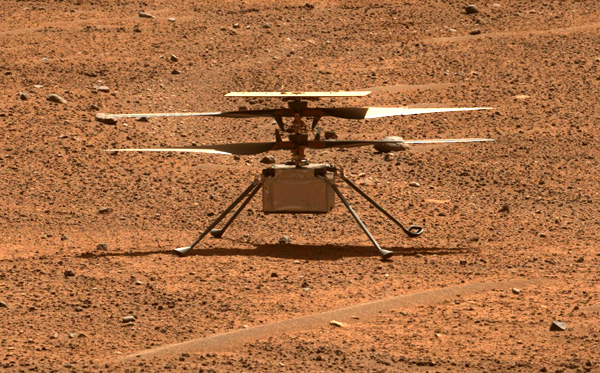
An image of the Ingenuity Mars Helicopter, which sustained damage to its rotor blades, as seen by NASA's Perseverance Mars Rover from a distance...on February 24, 2024.
NASA / JPL - Caltech / LANL / CNES / CNRS

NASA Performs First Aircraft Accident Investigation on Another World (News Release)

The review takes a close look at the final flight of the agency’s Ingenuity Mars Helicopter, which was the first aircraft to fly on another world.

Engineers from NASA’s Jet Propulsion Laboratory in Southern California and AeroVironment are completing a detailed assessment of the Ingenuity Mars Helicopter’s final flight on January 18, 2024, which will be published in the next few weeks as a NASA technical report. Designed as a technology demonstration to perform up to five experimental test flights over 30 days, Ingenuity was the first aircraft on another world. It operated for almost three years, performed 72 flights, and flew more than 30 times farther than planned while accumulating over two hours of flight time.

The investigation concludes that the inability of Ingenuity’s navigation system to provide accurate data during the flight likely caused a chain of events that ended the mission. The report’s findings are expected to benefit future Mars helicopters, as well as other aircraft destined to operate on other worlds.

Final Ascent

Flight 72 was planned as a brief vertical hop to assess Ingenuity’s flight systems and photograph the area. Data from the flight shows Ingenuity climbing to 40 feet (12 meters), hovering and capturing images. It initiated its descent at 19 seconds, and by 32 seconds the helicopter was back on the surface and had halted communications.

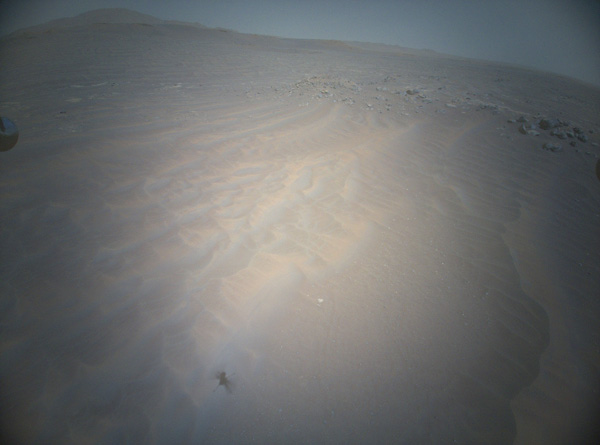
The following day, the mission reestablished communications, and images that came down six days after the flight revealed Ingenuity had sustained severe damage to its rotor blades.

What Happened

“When running an accident investigation from 100 million miles away, you don’t have any black boxes or eyewitnesses,” said Ingenuity’s first pilot, Håvard Grip of JPL. “While multiple scenarios are viable with the available data, we have one we believe is most likely: Lack of surface texture gave the navigation system too little information to work with.”

The helicopter’s vision navigation system was designed to track visual features on the surface using a downward-looking camera over well-textured (pebbly) but flat terrain. This limited tracking capability was more than sufficient for carrying out Ingenuity’s first five flights, but by Flight 72 the helicopter was in a region of Jezero Crater filled with steep, relatively featureless sand ripples.

One of the navigation system’s main requirements was to provide velocity estimates that would enable the helicopter to land within a small envelope of vertical and horizontal velocities. Data sent down during Flight 72 shows that, around 20 seconds after takeoff, the navigation system couldn’t find enough surface features to track.

Photographs taken after the flight indicate that the navigation errors created high horizontal velocities at touchdown. In the most likely scenario, the hard impact on the sand ripple’s slope caused Ingenuity to pitch and roll. The rapid attitude change resulted in loads on the fast-rotating rotor blades beyond their design limits, snapping all four of them off at their weakest point — about a third of the way from the tip.

The damaged blades caused excessive vibration in the rotor system, ripping the remainder of one blade from its root and generating an excessive power demand that resulted in loss of communications.

Down but Not Out

Although Flight 72 permanently grounded Ingenuity, the helicopter still beams weather and avionics test data to the Perseverance rover about once a week. The weather information could benefit future explorers of the Red Planet. The avionics data is already proving useful to engineers working on future designs of aircraft and other vehicles for the Red Planet.

“Because Ingenuity was designed to be affordable while demanding huge amounts of computer power, we became the first mission to fly commercial off-the-shelf cellphone processors in deep space,” said Teddy Tzanetos, Ingenuity’s project manager. “We’re now approaching four years of continuous operations, suggesting that not everything needs to be bigger, heavier and radiation-hardened to work in the harsh Martian environment.”

Inspired by Ingenuity’s longevity, NASA engineers have been testing smaller, lighter avionics that could be used in vehicle designs for the Mars Sample Return campaign. The data is also helping engineers as they research what a future Mars helicopter could look like — and do.

During a Wednesday, December 11, briefing at the American Geophysical Union’s annual meeting in Washington, Tzanetos shared details on the Mars Chopper rotorcraft, a concept that he and other Ingenuity alumni are researching. As designed, Chopper is approximately 20 times heavier than Ingenuity, could fly several pounds of science equipment, and autonomously explore remote Martian locations while traveling up to 2 miles (3 kilometers) in a day. (Ingenuity’s longest flight was 2,310 feet, or 704 meters.)

“Ingenuity has given us the confidence and data to envision the future of flight at Mars,” said Tzanetos.

Source: Jet Propulsion Laboratory

****

An infographic showing how the Ingenuity Mars Helicopter made a rough landing on the 72nd and final flight of its mission...on January 18, 2024.
NASA / JPL - Caltech


Monday, October 28, 2024

A Gorgeous View from Jezero Crater on Mars...

A snapshot of the terrain at Jezero Crater, as seen by NASA's Perseverance Mars rover on September 27, 2024.
NASA / JPL - Caltech / ASU / MSSS

NASA’s Perseverance Rover Looks Back While Climbing Slippery Slope (News Release)

On its way up the side of Jezero Crater, the agency’s latest Red Planet off-roader peers all the way back to its landing site and scopes the path ahead.

NASA’s Perseverance Mars rover is negotiating a steeply sloping route up Jezero Crater’s western wall with the aim of cresting the rim in early December. During the climb, the rover snapped not only a sweeping view of Jezero Crater’s interior, but also imagery of the tracks that it left after some wheel slippage along the way.

Stitched together from 44 frames acquired on September 27, the 1,282nd Martian day of Perseverance’s mission, the image mosaic features many landmarks and Martian firsts that have made the rover’s 3½-year exploration of Jezero so memorable, including the rover’s landing site, the spot where it first found sedimentary rocks, the location of the first sample depot on another planet, and the final airfield for NASA’s Ingenuity Mars Helicopter. The rover captured the view near a location that the team calls “Faraway Rock,” at about the halfway point in its climb up the crater wall.

“The image not only shows our past and present, but also shows the biggest challenge to getting where we want to be in the future,” said Perseverance’s deputy project manager, Rick Welch of NASA’s Jet Propulsion Laboratory in Southern California. “If you look at the right side of the mosaic, you begin to get an idea what we’re dealing with. Mars didn’t want to make it easy for anyone to get to the top of this ridge.”

Visible on the right side of the mosaic is a slope of about 20 degrees. While Perseverance has climbed 20-degree inclines before (both NASA’s Curiosity and Opportunity rovers had crested hills at least 10 degrees steeper), this is the first time it’s traveled that steep a grade on such a slippery surface.

Soft, Fluffy

During much of the climb, the rover has been driving over loosely-packed dust and sand with a thin, brittle crust. On several days, Perseverance covered only about 50% of the distance that it would have on a less slippery surface, and on one occasion, it covered just 20% of the planned route.

“Mars rovers have driven over steeper terrain, and they’ve driven over more slippery terrain, but this is the first time one had to handle both — and on this scale,” said JPL’s Camden Miller, who was a rover planner, or “driver,” for Curiosity and now serves the same role on the Perseverance mission. “For every two steps forward Perseverance takes, we were taking at least one step back. The rover planners saw this was trending toward a long, hard slog, so we got together to think up some options.”

On October 3, they sent commands for Perseverance to test strategies to reduce slippage. First, they had it drive backward up the slope (testing on Earth has shown that under certain conditions the rover’s “rocker-bogie” suspension system maintains better traction during backward driving). Then they tried cross-slope driving (switchbacking) and driving closer to the northern edge of “Summerland Trail,” the name that the mission has given to the rover’s route up the crater rim.

Data from those efforts showed that while all three approaches enhanced traction, sticking close to the slope’s northern edge proved the most beneficial. The rover planners believe the presence of larger rocks closer to the surface made the difference.

“That’s the plan right now, but we may have to change things up the road,” said Miller. “No Mars rover mission has tried to climb up a mountain this big this fast. The science team wants to get to the top of the crater rim as soon as possible because of the scientific opportunities up there. It’s up to us rover planners to figure out a way to get them there.”

Tube Status

In a few weeks, Perseverance is expected to crest the crater rim at a location that the science team calls “Lookout Hill.” From there, it will drive about another quarter-mile (450 meters) to “Witch Hazel Hill.” Orbital data shows that Witch Hazel Hill contains light-toned, layered bedrock.

The team is looking forward to comparing this new site to “Bright Angel,” the area where Perseverance recently discovered and sampled the “Cheyava Falls” rock.

The rover landed on Mars carrying 43 tubes for collecting samples from the Martian surface. So far, Perseverance has sealed and cached 24 samples of rock and regolith (broken rock and dust), plus one atmospheric sample and three witness tubes. Early in the mission’s development, NASA set the requirement for the rover to be capable of caching at least 31 samples of rock, regolith and witness tubes over the course of Perseverance’s mission at Jezero.

The project added 12 tubes, bringing the total to 43. The extras were included in anticipation of the challenging conditions found at Mars that could result in some tubes not functioning as designed.

NASA decided to retire two of the spare empty tubes because accessing them would pose a risk to the rover’s small internal robotic sample-handling arm needed for the task: A wire harness connected to the arm could catch on a fastener on the rover’s frame when reaching for the two empty sample tubes.

With those spares now retired, Perseverance currently has 11 empty tubes for sampling rock and two empty witness tubes.

Source: Jet Propulsion Laboratory

****

Thursday, January 25, 2024

Humanity's First Interplanetary Aircraft Has Flown for the Last Time...

An image taken by NASA's Ingenuity Mars helicopter shows the shadow of one of its rotors that was damaged during Ingenuity's final flight...which occurred on January 18, 2024.
NASA / JPL - Caltech

After Three Years on Mars, NASA’s Ingenuity Helicopter Mission Ends (Press Release)

NASA’s history-making Ingenuity Mars Helicopter has ended its mission at the Red Planet after surpassing expectations and making dozens more flights than planned. While the helicopter remains upright and in communication with ground controllers, imagery of its January 18 flight sent to Earth this week indicates that one or more of its rotor blades sustained damage during landing, and it is no longer capable of flight.

Originally designed as a technology demonstration to perform up to five experimental test flights over 30 days, the first aircraft on another world operated from the Martian surface for almost three years, performed 72 flights, and flew more than 14 times farther than planned while logging more than two hours of total flight time.

“The historic journey of Ingenuity, the first aircraft on another planet, has come to end,” said NASA Administrator Bill Nelson. “That remarkable helicopter flew higher and farther than we ever imagined and helped NASA do what we do best – make the impossible, possible. Through missions like Ingenuity, NASA is paving the way for future flight in our solar system and smarter, safer human exploration to Mars and beyond.”

NASA to Discuss Ingenuity Mission in Media Call Today

In addition to video comments shared from Nelson about the mission’s conclusion, NASA will host a media teleconference at 5 p.m. EST today, Thursday, January 25, to provide an update on the Ingenuity Mars Helicopter.

Audio of the call will stream live on the agency’s website.

Participants in the call are expected to include:

- Lori Glaze, director, Planetary Science Division, NASA’s Science Mission Directorate at the agency’s headquarters in Washington
- Laurie Leshin, director, NASA’s Jet Propulsion Laboratory in Southern California
- Teddy Tzanetos, Ingenuity project manager, NASA JPL

Media who wish to participate by phone can request dial-in information by emailing hq-media@mail.nasa.gov.

Ingenuity landed on Mars February 18, 2021, attached to the belly of NASA’s Perseverance rover and first lifted off the Martian surface on April 19, proving that powered, controlled flight on Mars was possible. After notching another four flights, it embarked on a new mission as an operations demonstration, serving as an aerial scout for Perseverance scientists and rover drivers.

In 2023, the helicopter executed two successful flight tests that further expanded the team’s knowledge of its aerodynamic limits.

“At NASA JPL, innovation is at the heart of what we do,” said Leshin. “Ingenuity is an exemplar of the way we push the boundaries of what’s possible every day. I’m incredibly proud of our team behind this historic technological achievement and eager to see what they’ll invent next.”

Ingenuity’s team planned for the helicopter to make a short vertical flight on January 18 to determine its location after executing an emergency landing on its previous flight. Data shows that, as planned, the helicopter achieved a maximum altitude of 40 feet (12 meters) and hovered for 4.5 seconds before starting its descent at a velocity of 3.3 feet per second (1 meter per second).

However, about 3 feet (1 meter) above the surface, Ingenuity lost contact with the rover, which serves as a communications relay for the rotorcraft. The following day, communications were reestablished and more information about the flight was relayed to ground controllers at NASA JPL.

Imagery revealing damage to the rotor blade arrived several days later. The cause of the communications dropout and the helicopter’s orientation at time of touchdown are still being investigated.

Triumphs, Challenges

Over an extended mission that lasted for almost 1,000 Martian days, more than 33 times longer than originally planned, Ingenuity was upgraded with the ability to autonomously choose landing sites in treacherous terrain, dealt with a dead sensor, cleaned itself after dust storms, operated from 48 different airfields, performed three emergency landings, and survived a frigid Martian winter.

Designed to operate in spring, Ingenuity was unable to power its heaters throughout the night during the coldest parts of winter, resulting in the flight computer periodically freezing and resetting. These power “brownouts” required the team to redesign Ingenuity’s winter operations in order to keep flying.

With flight operations now concluded, the Ingenuity team will perform final tests on helicopter systems and download the remaining imagery and data in Ingenuity's onboard memory. The Perseverance rover is currently too far away to attempt to image the helicopter at its final airfield.

“It’s humbling Ingenuity not only carries onboard a swatch from the original Wright Flyer, but also this helicopter followed in its footsteps and proved flight is possible on another world,” said Ingenuity’s project manager, Teddy Tzanetos of NASA JPL. “The Mars helicopter would have never flown once, much less 72 times, if it were not for the passion and dedication of the Ingenuity and Perseverance teams. History’s first Mars helicopter will leave behind an indelible mark on the future of space exploration and will inspire fleets of aircraft on Mars – and other worlds – for decades to come.”

****

Saturday, January 06, 2024

LEGO® Percy and Ginny Are Now Encased in Acrylic...

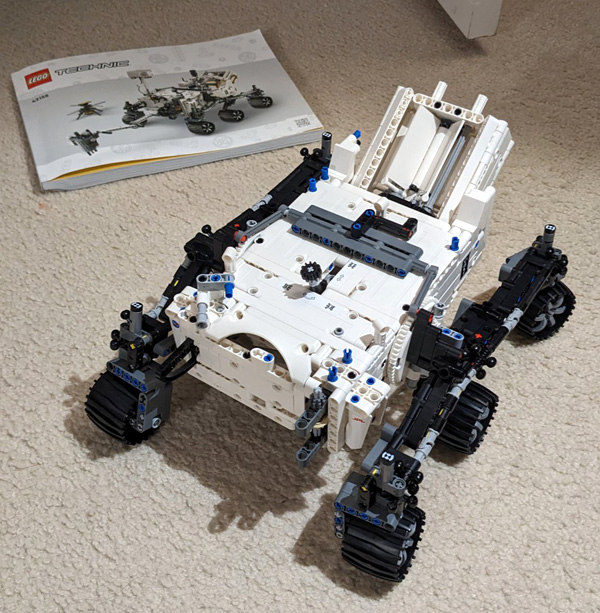
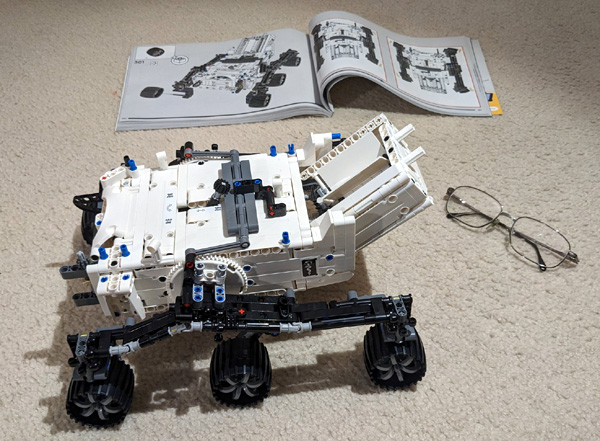
My LEGO® Perseverance Mars rover and Ingenuity Mars helicopter (not visible here) are now protected by a large acrylic case atop a bookshelf at home...on January 6, 2024.
Richard T. Par

As promised in this Blog entry last month, here are photos of my LEGO® Perseverance Mars rover and Ingenuity Mars helicopter now protected by a large acrylic case that I bought online!

The glass box is slightly wider than the bookshelf that Percy and Ginny are displayed on, so I covered those bottom gaps with Scotch™ tape to help prevent dust from getting in.

Hope y'all are having a great weekend!

My LEGO® Perseverance Mars rover and Ingenuity Mars helicopter are now protected by a large acrylic case atop a bookshelf at home...on January 6, 2024.
Richard T. Par

Sunday, December 31, 2023

Photos of the Day: It's LEGO® Percy and Ginny!

My LEGO® Perseverance Mars rover and Ingenuity Mars helicopter on display atop a bookshelf at home...on December 28, 2023.
Richard T. Par

Happy New Year's Eve, everyone! Just thought I'd share these pictures I took of the LEGO® Perseverance Mars rover and Ingenuity Mars helicopter that one of my brothers got me for this Christmas!

It took me less than two days to build Percy and Ginny (which combined consisted of over 1,100 LEGO pieces), and they're now proudly displayed at my home. As you can see, Percy barely fits on top of a bookshelf!

I bought a large acrylic box online that I plan to place Percy and Ginny inside once it arrives at my house. I'll post an image of the two LEGO spacecraft inside the case once they are put on display.

Have a Happy New Year!

Getting ready to put over 1,100 pieces together to form the LEGO® Perseverance Mars rover and Ingenuity Mars helicopter...on December 26, 2023.
Richard T. Par

The status of my LEGO® Perseverance Mars rover...on December 27, 2023.
Richard T. Par

The status of my LEGO® Perseverance Mars rover...on December 27, 2023.
Richard T. Par

My LEGO® Perseverance Mars rover and Ingenuity Mars helicopter on display atop a bookshelf at home...on December 28, 2023.
Richard T. Par

My LEGO® Perseverance Mars rover and Ingenuity Mars helicopter on display atop a bookshelf at home...on December 28, 2023.
Richard T. Par

Tuesday, August 08, 2023

Ginny Takes to the Martian Air for the 53rd and 54th Time Since April 2021...

An image of the Ingenuity Mars helicopter that was taken by NASA's Perseverance rover on August 2, 2023.
NASA / JPL - Caltech / ASU / MSSS

NASA’s Ingenuity Mars Helicopter Flies Again After Unscheduled Landing (News Release - August 7)

The helicopter performed a short hop to help the team better understand why its previous flight was interrupted.

NASA’s Ingenuity Mars helicopter successfully completed its 54th flight on August 3, the first flight since the helicopter cut its July 22 flight short. The 25-second up-and-down hop provided data that could help the Ingenuity team determine why its 53rd flight ended early.

Flight 53 was planned as a 136-second scouting flight dedicated to collecting imagery of the planet’s surface for the Perseverance Mars rover science team. The complicated flight profile included flying north 666 feet (203 meters) at an altitude of 16 feet (5 meters) and a speed of 5.6 mph (2.5 meters per second), then descending vertically to 8 feet (2.5 meters), where it would hover and obtain imagery of a rocky outcrop.

Ingenuity would then climb straight up to 33 feet (10 meters) to allow its hazard divert system to initiate before descending vertically to touch down.

Instead, the helicopter executed the first half of its autonomous journey, flying north at an altitude of 16 feet (5 meters) for 466 feet (142 meters). Then a flight-contingency program was triggered, and Ingenuity automatically landed.

The total flight time was 74 seconds.

“Since the very first flight we have included a program called ‘LAND_NOW’ that was designed to put the helicopter on the surface as soon as possible if any one of a few dozen off-nominal scenarios was encountered,” said Teddy Tzanetos, team lead emeritus for Ingenuity at NASA’s Jet Propulsion Laboratory in Southern California. “During Flight 53, we encountered one of these, and the helicopter worked as planned and executed an immediate landing.”

The Ingenuity team is confident that the early landing was triggered when image frames from the helicopter’s navigation camera didn’t sync up as expected with data from the rotorcraft’s inertial measurement unit. The unit measures Ingenuity’s acceleration and rotational rates – data that makes it possible to estimate where the helicopter is, how fast it is moving, and how it is oriented in space.

This was not the first occasion on which image frames were dropped by the helicopter’s Navcam during a flight. Back on May 22, 2021, multiple image frames were dropped, resulting in excessive pitching and rolling near the end of Flight 6.

After Flight 6, the team updated the flight software to help mitigate the impact of dropped images, and the fix worked well for the subsequent 46 flights. However, on Flight 53 the quantity of dropped navigation images exceeded what the software patch allows.

“While we hoped to never trigger a LAND_NOW, this flight is a valuable case study that will benefit future aircraft operating on other worlds,” said Tzanetos. “The team is working to better understand what occurred in Flight 53, and with Flight 54’s success we’re confident that our baby is ready to keep soaring ahead on Mars.”

Source: Jet Propulsion Laboratory

****

NASA's Perseverance Mars rover is partially visible to the top right of center frame in this image taken by the Ingenuity helicopter...on August 3, 2023.
NASA / JPL - Caltech

Friday, July 21, 2023

Photos of the Day: Snapshots from My Latest Tour at NASA JPL...

A selfie I took with Europa Clipper inside the Spacecraft Assembly Facility at NASA's Jet Propulsion Laboratory near Pasadena, California...on July 20, 2023.

Yesterday, I marked the 54th anniversary of the Apollo 11 Moon landing by attending a tour at NASA's Jet Propulsion Laboratory...which I haven't visited since before the pandemic in early 2019!

The main reason why I went to JPL this time around was to see the Europa Clipper in person. Technicians inside the Spacecraft Assembly Facility are working around the clock to get this robotic probe completed as soon and efficiently as possible.

You can watch the technicians work on Europa Clipper via this live webcam! The unmanned explorer will launch on a six-year journey to Jupiter in October of 2024—courtesy of SpaceX's Falcon Heavy rocket.

It was also great visiting the Space Flight Operations Facility again...as well as seeing full-size replicas of the Perseverance Mars rover, the Ingenuity Mars helicopter and the Mars Ascent Vehicle (MAV) that may or may not send rock samples to an orbiting Martian spacecraft for return back to Earth. Read this latest article about the Mars Sample Return mission to know why I'm not so optimistic about the MAV becoming a reality.

The Europa Clipper should be transported to Cape Canaveral in Florida between May and July of next year to be prepped for launch to Jupiter. I plan on seeing this spacecraft in person one last time before it leaves Southern California...

Whether or not this will be through another tour or the JPL open house (a.k.a. Explore JPL) itself remains to be seen! Happy Friday.

Another photo I took with Europa Clipper inside the Spacecraft Assembly Facility at NASA's Jet Propulsion Laboratory near Pasadena, California...on July 20, 2023.

A snapshot of technicians working on Europa Clipper inside the Spacecraft Assembly Facility at NASA's Jet Propulsion Laboratory near Pasadena, California...on July 20, 2023.

A snapshot of the science instruments and avionics module at the top of the Europa Clipper spacecraft...on July 20, 2023.

A snapshot of technicians working near the bottom of Europa Clipper's propulsion module...on July 20, 2023.

A snapshot of Europa Clipper's high-gain antenna (the large dish covered by a silver tarp) inside the Spacecraft Assembly Facility at NASA's Jet Propulsion Laboratory near Pasadena, California...on July 20, 2023.

Full-size replicas of the Perseverance Mars rover and Ingenuity Mars helicopter on display at NASA's Jet Propulsion Laboratory near Pasadena, California...on July 20, 2023.

A full-size replica of the Mars Ascent Vehicle from NASA's Mars Sample Return mission...which may or may not fly depending on the U.S. Congress.

A snapshot of the Space Flight Operations Facility at NASA's Jet Propulsion Laboratory near Pasadena, California...on July 20, 2023.

Taking a selfie inside the Space Flight Operations Facility at NASA's Jet Propulsion Laboratory near Pasadena, California...on July 20, 2023.

Monday, July 03, 2023

An Interplanetary Chopper Is Ready to Leap into Action Again...

A snapshot of the Ingenuity Mars Helicopter that was taken by NASA's Perseverance rover on April 16, 2023...after the rotorcraft conducted its 50th flight.
NASA / JPL - Caltech / ASU / MSSS

NASA’s Ingenuity Mars Helicopter Phones Home (News Release - June 30)

The intrepid rotorcraft may head skyward again within the next couple of weeks.

The 52nd flight of NASA’s Ingenuity Mars Helicopter is now in the official mission logbook as a success. The flight took place back on April 26, but mission controllers at NASA’s Jet Propulsion Laboratory in Southern California lost contact with the helicopter as it descended towards the surface for a landing.

The Ingenuity team expected the communications dropout because a hill stood between the helicopter’s landing location and the Perseverance rover’s position, blocking communication between the two. The rover acts as a radio relay between the helicopter and mission controllers at JPL.

In anticipation of this loss of communications, the Ingenuity team had already developed re-contact plans for when the rover would drive back within range. Contact was re-established on June 28 when Perseverance crested the hill and could see Ingenuity again.

The goal of Flight 52, a 1,191-foot (363-meter) and 139-second-long flight, was to reposition the helicopter and take images of the Martian surface for the rover’s science team.

“The portion of Jezero Crater the rover and helicopter are currently exploring has a lot of rugged terrain, which makes communications dropouts more likely,” said JPL’s Josh Anderson, the Ingenuity team lead. “The team’s goal is to keep Ingenuity ahead of Perseverance, which occasionally involves temporarily pushing beyond communication limits. We’re excited to be back in communications range with Ingenuity and receive confirmation of Flight 52.”

Sixty-three days is a long time to wait for the results of a flight, but the data coming in indicates all is well with the first aircraft on another world. If the remainder of Ingenuity’s health checks are equally rosy, the helicopter may fly again within the next couple of weeks.

Source: Jet Propulsion Laboratory

Monday, January 09, 2023

Hubble's Successor Receives Accolades for Its On-Orbit Achievements in 2022...

The team that assembled and tested NASA's James Webb Space Telescope takes a group photo at the Northrop Grumman facility in Redondo Beach, California.
Northrop Grumman

NASA’s Webb Telescope Awarded Robert H. Goddard Memorial Trophy (News Release)

The team behind NASA’s James Webb Space Telescope has been selected to receive the 2023 Robert H. Goddard Memorial Trophy, the premier award from the National Space Club and Foundation. This annual award honors an individual, group or program deemed by the Club to have made the most significant contribution to space activity in the previous year.

The award will be presented at the Club’s yearly Dr. Robert H. Goddard Memorial Dinner in Washington on March 10, 2023.

In 2022, the Webb team successfully completed an intricate series of deployments to unfold the observatory into its final configuration in space. They then precisely aligned its mirrors to within nanometers, set up and tested its powerful instruments, and officially began Webb’s mission to explore the infrared universe.

With its optics performing nearly twice as well as the mission required, Webb has already spotted some of the earliest galaxies ever observed, peered through dusty clouds to see stars forming, and provided a more detailed look at the atmospheres of planets outside our solar system than ever before. The Goddard Trophy will recognize the contributions of the team that designed, developed and now operate Webb, including individuals from NASA’s Goddard Space Flight Center, Greenbelt, Maryland; Northrop Grumman, Redondo Beach, California; the Space Telescope Science Institute, Baltimore; and Ball Aerospace, Boulder, Colorado.

The mission was also made possible by many international contributions from partnerships with ESA (European Space Agency) and CSA (Canadian Space Agency).

“Our team designed the James Webb Space Telescope to see the first lights that illuminated our universe,” said Mike Menzel, NASA Mission Systems Engineer for Webb at the Goddard Space Flight Center in Greenbelt, Maryland. “This required the largest ‘first of its kind’ telescope ever put into space along with 50 of the most complex deployments ever attempted to essentially re-build it on-orbit. After all these many years and many engineering challenges our team was struck with awe and wonder at the first images, and the satisfaction of knowing that whatever is out there we will see it.”

Recent winners of the Goddard Memorial Trophy include the teams behind NASA’s Ingenuity Mars Helicopter, New Horizons and Kepler mission.

Webb, an international mission led by NASA with its partners ESA (European Space Agency) and CSA (Canadian Space Agency), is the world’s premier space science observatory. Its design pushed the boundaries of space telescope capabilities to solve mysteries in our solar system, look beyond to distant worlds around other stars, and probe the mysterious structures and origins of our universe and our place in it.

NASA Headquarters, Washington oversees the Webb Telescope mission. NASA Goddard manages Webb for the agency and oversees work on the mission performed by the Space Telescope Science Institute, Northrop Grumman and other mission partners.

In addition to Goddard, several NASA centers contributed to the project, including the agency’s Johnson Space Center in Houston, Jet Propulsion Laboratory in Southern California, Marshall Space Flight Center in Huntsville, Alabama, Ames Research Center in California’s Silicon Valley, and others. Webb’s accomplishments have also recently been recognized by organizations including Aviation Week, Bloomberg Businessweek, Popular Science and TIME.

Source: NASA.Gov

****

An image of M74, also known as the Phantom Galaxy, that was taken by the James Webb Space Telescope.
ESA / Webb, NASA & CSA, J. Lee and the PHANGS-JWST Team. Acknowledgement: J. Schmidt

Wednesday, July 27, 2022

Ingenuity's Legacy Will Live On Through NASA and ESA's Upcoming Joint Mission to the Red Planet...

An Ingenuity-type helicopter will be a component of NASA and ESA's Mars Sample Return mission architecture.
NASA / JPL - Caltech

NASA Will Inspire World When It Returns Mars Samples to Earth in 2033 (Press Release)

NASA has finished the system requirements review for its Mars Sample Return Program, which is nearing completion of the conceptual design phase. During this phase, the program team evaluated and refined the architecture to return the scientifically-selected samples, which are currently in the collection process by NASA’s Perseverance rover in the Red Planet’s Jezero Crater.

The architecture for the campaign, which includes contributions from the European Space Agency (ESA), is expected to reduce the complexity of future missions and increase probability of success.

“The conceptual design phase is when every facet of a mission plan gets put under a microscope,” said Thomas Zurbuchen, associate administrator for science at NASA Headquarters in Washington. “There are some significant and advantageous changes to the plan, which can be directly attributed to Perseverance’s recent successes at Jezero and the amazing performance of our Mars helicopter.”

This advanced mission architecture takes into consideration a recently updated analysis of Perseverance’s expected longevity. Perseverance will be the primary means of transporting samples to NASA’s Sample Retrieval Lander carrying the Mars Ascent Vehicle and ESA’s Sample Transfer Arm.

As such, the Mars Sample Return campaign will no longer include the Sample Fetch Rover or its associated second lander. The Sample Retrieval Lander will include two sample-recovery helicopters, based on the design of the Ingenuity helicopter, which has performed 29 flights at Mars and survived over a year beyond its original planned lifetime. The helicopters will provide a secondary capability to retrieve samples cached on the surface of Mars.

The ESA Earth Return Orbiter and its NASA-provided Capture, Containment, and Return System remain vital elements of the program architecture.

With planned launch dates for the Earth Return Orbiter and Sample Retrieval Lander in fall 2027 and summer 2028, respectively, the samples are expected to arrive on Earth in 2033.

With its architecture solidified during this conceptual design phase, the program is expected to move into its preliminary design phase this October. In this phase, expected to last about 12 months, the program will complete technology development and create engineering prototypes of the major mission components.

This refined concept for the Mars Sample Return campaign was presented to the delegates from the 22 participating states of Europe’s space exploration program, Terrae Novae, in May. At their next meeting in September, the states will consider the discontinuation of the development of the Sample Fetch Rover.

“ESA is continuing at full speed the development of both the Earth Return Orbiter that will make the historic round-trip from Earth to Mars and back again; and the Sample Transfer Arm that will robotically place the sample tubes aboard the Orbiting Sample Container before its launch from the surface of the Red Planet,” said David Parker, ESA director of Human and Robotic Exploration.

The respective contributions to the campaign are contingent upon available funding from the U.S. and ESA participating states. More formalized agreements between the two agencies will be established in the next year.

“Working together on historic endeavors like Mars Sample Return not only provides invaluable data about our place in the universe but brings us closer together right here on Earth,” said Zurbuchen.

The first step in the Mars Sample Return Campaign is already in progress. Since it landed at Jezero Crater on Feb. 18, 2021, the Perseverance rover has collected 11 scientifically-compelling rock core samples and one atmospheric sample.

Bringing Mars samples to Earth would allow scientists across the world to examine the specimens using sophisticated instruments too large and too complex to send to Mars and would enable future generations to study them. Curating the samples on Earth would also allow the science community to test new theories and models as they are developed, much as the Apollo samples returned from the Moon have done for decades. This strategic NASA and ESA partnership will fulfill a solar system exploration goal, a high priority since the 1970s and in the last three National Academy of Sciences Planetary Science Decadal Surveys.

****


Wednesday, April 27, 2022

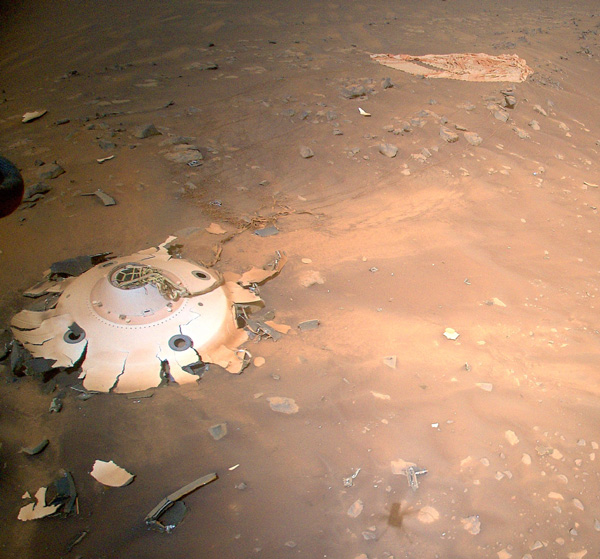
The Ingenuity Helicopter Photographs a Crashed Man-made Flying Saucer on the Surface of Mars...

An April 19 image taken by the Ingenuity helicopter of the backshell and parachute that helped the Perseverance rover safely land on Mars over a year ago.
NASA / JPL - Caltech

NASA’s Mars Helicopter Spots Gear That Helped Perseverance Rover Land (News Release)

Eyeing some of the components that enabled the rover to get safely to the Martian surface could provide valuable insights for future missions.

NASA’s Ingenuity Mars Helicopter recently surveyed both the parachute that helped the agency’s Perseverance rover land on Mars and the cone-shaped backshell that protected the rover in deep space and during its fiery descent toward the Martian surface on Feb. 18, 2021. Engineers with the Mars Sample Return program asked whether Ingenuity could provide this perspective. What resulted were 10 aerial color images taken April 19 during Ingenuity’s Flight 26.

“NASA extended Ingenuity flight operations to perform pioneering flights such as this,” said Teddy Tzanetos, Ingenuity’s team lead at NASA’s Jet Propulsion Laboratory in Southern California. “Every time we’re airborne, Ingenuity covers new ground and offers a perspective no previous planetary mission could achieve. Mars Sample Return’s reconnaissance request is a perfect example of the utility of aerial platforms on Mars.”

Entry, descent, and landing on Mars is fast-paced and stressful, not only for the engineers back on Earth, but also for the vehicle enduring the gravitational forces, high temperatures, and other extremes that come with entering Mars’ atmosphere at nearly 12,500 mph (20,000 kph). The parachute and backshell were previously imaged from a distance by the Perseverance rover.

But those collected by the rotorcraft (from an aerial perspective and closer) provide more detail. The images have the potential to help ensure safer landings for future spacecraft such as the Mars Sample Return Lander, which is part of a multi-mission campaign that would bring Perseverance’s samples of Martian rocks, atmosphere, and sediment back to Earth for detailed analysis.

“Perseverance had the best-documented Mars landing in history, with cameras showing everything from parachute inflation to touchdown,” said JPL’s Ian Clark, former Perseverance systems engineer and now Mars Sample Return ascent phase lead. “But Ingenuity’s images offer a different vantage point. If they either reinforce that our systems worked as we think they worked or provide even one dataset of engineering information we can use for Mars Sample Return planning, it will be amazing. And if not, the pictures are still phenomenal and inspiring.”

In the images of the upright backshell and the debris field that resulted from it impacting the surface at about 78 mph (126 kph), the backshell’s protective coating appears to have remained intact during Mars atmospheric entry. Many of the 80 high-strength suspension lines connecting the backshell to the parachute are visible and also appear intact. Spread out and covered in dust, only about a third of the orange-and-white parachute – at 70.5 feet (21.5 meters) wide, it was the biggest ever deployed on Mars – can be seen, but the canopy shows no signs of damage from the supersonic airflow during inflation. Several weeks of analysis will be needed for a more final verdict.

Flight 26 Maneuvers

Ingenuity’s 159-second flight began at 11:37 a.m. local Mars time April 19, on the one-year anniversary of its first flight. Flying 26 feet (8 meters) above ground level, Ingenuity traveled 630 feet (192 meters) to the southeast and took its first picture. The rotorcraft next headed southwest and then northwest, taking images at pre-planned locations along the route. Once it collected 10 images in its flash memory, Ingenuity headed west 246 feet (75 meters) and landed. Total distance covered: 1,181 feet (360 meters). With the completion of Flight 26, the rotorcraft has logged over 49 minutes aloft and traveled 3.9 miles (6.2 kilometers).

“To get the shots we needed, Ingenuity did a lot of maneuvering, but we were confident because there was complicated maneuvering on flights 10, 12, and 13,” said Håvard Grip, chief pilot of Ingenuity at JPL. “Our landing spot set us up nicely to image an area of interest for the Perseverance science team on Flight 27, near ‘Séítah’ ridge.”

The new area of operations in Jezero Crater’s dry river delta marks a dramatic departure from the modest, relatively flat terrain Ingenuity had been flying over since its first flight. Several miles wide, the fan-shaped delta formed where an ancient river spilled into the lake that once filled Jezero Crater. Rising more than 130 feet (40 meters) above the crater floor and filled with jagged cliffs, angled surfaces, projecting boulders, and sand-filled pockets, the delta promises to hold numerous geologic revelations – perhaps even proof that microscopic life existed on Mars billions of years ago.

Upon reaching the delta, Ingenuity’s first orders may be to help determine which of two dry river channels Perseverance should climb to reach the top of the delta. Along with route-planning assistance, data provided by the helicopter will help the Perseverance team assess potential science targets. Ingenuity may even be called upon to image geologic features too far afield for the rover to reach or to scout landing zones and sites on the surface where sample caches could be deposited for the Mars Sample Return program.

Source: Jet Propulsion Laboratory

****

Tuesday, March 15, 2022

The Mars Helicopter Will Continue to Soar Across Jezero Crater Till Late Summer...

A screenshot of the Ingenuity Mars Helicopter from a video that was taken by Perseverance using the rover's Mastcam-Z instrument...on April 8, 2021.
NASA / JPL - Caltech / ASU

NASA Extends Ingenuity Helicopter Mission (News Release)

With its recent 21st flight complete, the Red Planet rotorcraft is on its way to setting more records during its second year of operations.

NASA has extended flight operations of the Ingenuity Mars Helicopter through September. In the months ahead, history’s first aircraft to operate from the surface of another world will support the Perseverance rover’s upcoming science campaign exploring the ancient river delta of Jezero Crater. Along the way, it will continue testing its own capabilities to support the design of future Mars air vehicles.

The announcement comes on the heels of the rotorcraft’s 21st successful flight, the first of at least three needed for the helicopter to cross the northwest portion of a region known as “Séítah” and reach its next staging area.

“Less than a year ago we didn’t even know if powered, controlled flight of an aircraft at Mars was possible,” said Thomas Zurbuchen, the associate administrator of NASA’s Science Mission Directorate. “Now, we are looking forward to Ingenuity’s involvement in Perseverance’s second science campaign. Such a transformation of mindset in such a short period is simply amazing, and one of the most historic in the annals of air and space exploration.”

Ingenuity’s new area of operations is entirely different from the modest, relatively flat terrain it has been flying over since its first flight last April. Several miles wide and formed by an ancient river, the fan-shaped delta rises more than 130 feet (40 meters) above the crater floor. Filled with jagged cliffs, angled surfaces, projecting boulders, and sand-filled pockets that could stop a rover in its tracks (or upend a helicopter upon landing), the delta promises to hold numerous geologic revelations – perhaps even the proof necessary to determine that microscopic life once existed on Mars billions of years ago.

Upon reaching the delta, Ingenuity’s first orders will be to help determine which of two dry river channels Perseverance should take when it’s time to climb to the top of the delta. Along with routing assistance, data provided by the helicopter will help the Perseverance team assess potential science targets. Ingenuity may even be called upon to image geologic features too far afield (or outside of the rover’s traversable zone), or perhaps scout landing zones and caching sites for the Mars Sample Return program.

“The Jezero river delta campaign will be the biggest challenge the Ingenuity team faces since first flight at Mars,” said Teddy Tzanetos, Ingenuity team lead at NASA’s Jet Propulsion Laboratory in Southern California. “To enhance our chances of success, we have increased the size of our team and are making upgrades to our flight software geared toward improving operational flexibility and flight safety.”

Higher Flights

Several of these upgrades have led to reduced navigation errors during flight, which increases both flight and landing safety. A recent software change already on the rotorcraft frees Ingenuity from its previously programmed maximum altitude of 50 feet (15 meters). The altitude gains could result in incremental increases in both air speed and range. A second upgrade allows Ingenuity to change airspeed as it flies. Another enables it to better understand and adjust to changes in terrain texture during flight. Future software upgrades may include adding terrain elevation maps into the navigation filter and a landing-hazard-avoidance capability.

Before aerial reconnaissance of the delta can begin, Ingenuity has to complete its journey to the area. Scheduled for no earlier than March 19, Ingenuity’s next flight will be a complex journey, about 1,150 feet (350 meters) in length, that includes a sharp bend in its course to avoid a large hill. After that, the team will determine whether two or three more flights will be required to complete the crossing of northwest Séítah.

The first experimental flight on another world took place on April 19, 2021, and lasted 39.1 seconds. After another four flights, six more minutes in the air, and traveling a total distance of 1,637 feet (499 meters), NASA transitioned Ingenuity into an operations demonstration phase, testing its ability to provide an aerial dimension to the Perseverance mission. With the completion of Flight 21, the rotorcraft has logged over 38 minutes aloft and traveled 2.9 miles (4.64 kilometers). As Ingenuity pushes farther into uncharted territory, these numbers will inevitably go up, and previous flight records will more than likely fall.

“This upcoming flight will be my 22nd entry in our logbook,” said Ingenuity chief pilot Håvard Grip of JPL. “I remember thinking when this all started, we’d be lucky to have three entries and immensely fortunate to get five. Now, at the rate we’re going, I’m going to need a second book.”

Source: Jet Propulsion Laboratory

****

An image of a region known as 'Séítah' that was taken by the Ingenuity Mars Helicopter during its 20th flight on February 25, 2022.
NASA / JPL - Caltech

Friday, August 06, 2021

Perseverance Update: Issues Arise as the Mars Rover Sets Out to Collect Its First Rock Specimen...

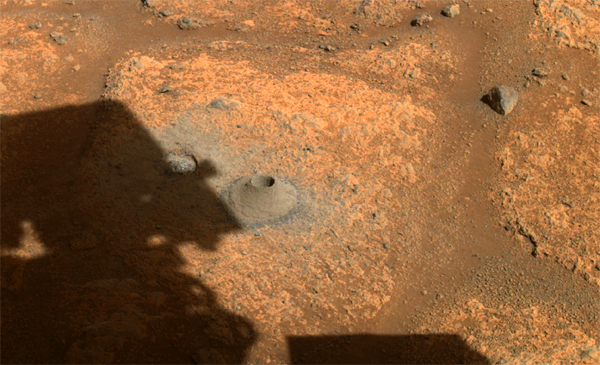
A close-up of the 'paver rock' where NASA's Perseverance Mars rover drilled a hole in preparation for its first rock-sampling attempt...on August 6, 2021.
NASA / JPL - Caltech

NASA’s Perseverance Team Assessing First Mars Sampling Attempt (Press Release)

Data sent to Earth by NASA’s Perseverance rover after its first attempt to collect a rock sample on Mars and seal it in a sample tube indicate that no rock was collected during the initial sampling activity.

The rover carries 43 titanium sample tubes, and is exploring Jezero Crater, where it will be gathering samples of rock and regolith (broken rock and dust) for future analysis on Earth.

“While this is not the ‘hole-in-one’ we hoped for, there is always risk with breaking new ground,” said Thomas Zurbuchen, associate administrator of NASA’s Science Mission Directorate in Washington. “I’m confident we have the right team working this, and we will persevere toward a solution to ensure future success.”

Perseverance’s Sampling and Caching System uses a hollow coring bit and a percussive drill at the end of its 7-foot-long (2-meter-long) robotic arm to extract samples. Telemetry from the rover indicates that during its first coring attempt, the drill and bit were engaged as planned, and post-coring the sample tube was processed as intended.

“The sampling process is autonomous from beginning to end,” said Jessica Samuels, the surface mission manager for Perseverance at NASA’s Jet Propulsion Laboratory in Southern California. “One of the steps that occurs after placing a probe into the collection tube is to measure the volume of the sample. The probe did not encounter the expected resistance that would be there if a sample were inside the tube.”

The Perseverance mission is assembling a response team to analyze the data. One early step will be to use the WATSON (Wide Angle Topographic Sensor for Operations and eNgineering) imager – located at the end of the robotic arm – to take close-up pictures of the borehole. Once the team has a better understanding of what happened, it will be able to ascertain when to schedule the next sample collection attempt.

“The initial thinking is that the empty tube is more likely a result of the rock target not reacting the way we expected during coring, and less likely a hardware issue with the Sampling and Caching System,” said Jennifer Trosper, project manager for Perseverance at JPL. “Over the next few days, the team will be spending more time analyzing the data we have, and also acquiring some additional diagnostic data to support understanding the root cause for the empty tube.”

Previous NASA missions on Mars have also encountered surprising rock and regolith properties during sample collection and other activities. In 2008, the Phoenix mission sampled soil that was "sticky" and difficult to move into onboard science instruments, resulting in multiple tries before achieving success. Curiosity has drilled into rocks that turned out to be harder and more brittle than expected. Most recently, the heat probe on the InSight lander, known as the “mole,” was unable to penetrate the Martian surface as planned.

“I have been on every Mars rover mission since the beginning, and this planet is always teaching us what we don’t know about it,” said Trosper. “One thing I’ve found is, it’s not unusual to have complications during complex, first-time activities.”

First Science Campaign

Perseverance is currently exploring two geologic units containing Jezero Crater’s deepest and most ancient layers of exposed bedrock and other intriguing geologic features. The first unit, called the “Crater Floor Fractured Rough,” is the floor of Jezero. The adjacent unit, named “Séítah” (meaning “amidst the sand” in the Navajo language), has Mars bedrock as well, and is also home to ridges, layered rocks, and sand dunes.

Recently, the Perseverance science team began using color images from the Ingenuity Mars Helicopter to help scout for areas of potential scientific interest and to look for potential hazards. Ingenuity completed its 11th flight Wednesday, Aug. 4, traveling about 1,250 feet (380 meters) downrange of its current location so that it could provide the project aerial reconnaissance of the southern Séítah area.

The rover’s initial science foray, which spans hundreds of sols (or Martian days), will be complete when Perseverance returns to its landing site. At that point, Perseverance will have traveled between 1.6 and 3.1 miles (2.5 and 5 kilometers) and may have filled up to eight of its sample tubes.

Next, Perseverance will travel north, then west, toward the location of its second science campaign: Jezero Crater’s delta region. The delta is the fan-shaped remains of the confluence of an ancient river and a lake within Jezero Crater. The region may be especially rich in carbonate minerals. On Earth, such minerals can preserve fossilized signs of ancient microscopic life and are associated with biological processes.

More About the Mission

A key objective for Perseverance’s mission on Mars is astrobiology, including the search for signs of ancient microbial life. The rover will characterize the planet’s geology and past climate, pave the way for human exploration of the Red Planet, and be the first mission to collect and cache Martian rock and regolith.

Subsequent NASA missions, in cooperation with ESA (European Space Agency), would send spacecraft to Mars to collect these sealed samples from the surface and return them to Earth for in-depth analysis.

The Mars 2020 Perseverance mission is part of NASA’s Moon to Mars exploration approach, which includes Artemis missions to the Moon that will help prepare for human exploration of the Red Planet.

JPL, which is managed for NASA by Caltech in Pasadena, California, built and manages operations of the Perseverance rover.

****

Friday, April 30, 2021

Ingenuity Update: The Mars Helicopter Is Ready to Broaden Its Horizon...

Using a camera on its robotic arm, the Perseverance Mars rover took this selfie with the Ingenuity Mars helicopter next to it...on April 6, 2021.
NASA / JPL - Caltech / MSSS

NASA’s Ingenuity Mars Helicopter to Begin New Demonstration Phase (Press Release)

NASA’s Ingenuity Mars Helicopter has a new mission. Having proven that powered, controlled flight is possible on the Red Planet, the Ingenuity experiment will soon embark on a new operations demonstration phase, exploring how aerial scouting and other functions could benefit future exploration of Mars and other worlds.

This new phase will begin after the helicopter completes its next two flights. The decision to add an operations demonstration is a result of the Perseverance rover being ahead of schedule with the thorough checkout of all vehicle systems since its February 18 landing, and its science team choosing a nearby patch of crater bed for its first detailed explorations. With the Mars Helicopter’s energy, telecommunications, and in-flight navigation systems performing beyond expectation, an opportunity arose to allow the helicopter to continue exploring its capabilities with an operations demonstration, without significantly impacting rover scheduling.

“The Ingenuity technology demonstration has been a resounding success,” said Thomas Zurbuchen, associate administrator for NASA’s Science Mission Directorate. “Since Ingenuity remains in excellent health, we plan to use it to benefit future aerial platforms while prioritizing and moving forward with the Perseverance rover team’s near-term science goals.”

The operations demonstration will begin in about two weeks with the helicopter’s sixth flight. Until then, Ingenuity will be in a transitional phase that includes its fourth and fifth forays into Mars’ crimson skies. Flight four will send the rotorcraft about 436 feet (133 meters) south to collect aerial imagery of a potential new landing zone before returning to land at Wright Brothers Field, the name for the Martian airfield on which Ingenuity’s first flight took place. This 873-foot (266-meter) roundtrip effort would surpass the range, speed, and duration marks achieved on the third flight. Ingenuity was programmed to execute a fourth flight Friday, with a takeoff to take place at 10:46 a.m. EDT (7:46 a.m. PDT, 12:30 p.m. local Mars time) and first data to be returned at 1:39 p.m. EDT (10:39 a.m. PDT). The fifth flight would send Ingenuity on a one-way mission, landing at the new site. If Ingenuity remains healthy after those flights, the next phase can begin.

Change of Course

Ingenuity’s transition from conducting a technology demonstration to an operations demonstration brings with it a new flight envelope. Along with those one-way flights, there will be more precision maneuvering, greater use of its aerial-observation capabilities, and more risk overall.

The change also means Ingenuity will require less support from the Perseverance rover team, which is looking ahead for targets to take rock and sediment samples in search of ancient microscopic life. On April 26 – the mission’s 66th sol, or Martian day – Perseverance drove 33 feet (10 meters) with the goal to identify targets.

“With the short drive, we have already begun our move south toward a location the science team believes is worthy of investigation and our first sampling,” said Ken Farley, project scientist for the Perseverance rover from Caltech in Pasadena, California. “We’ll spend the next couple of hundred sols executing our first science campaign looking for interesting rock outcrop along this 2-kilometer (1.24-mile) patch of crater floor before likely heading north and then west toward Jezero Crater’s fossil river delta.”

With short drives expected for Perseverance in the near term, Ingenuity may execute flights that land near the rover’s current location or its next anticipated parking spot. The helicopter can use these opportunities to perform aerial observations of rover science targets, potential rover routes, and inaccessible features while also capturing stereo images for digital elevation maps. The lessons learned from these efforts will provide significant benefit to future mission planners. These scouting flights are a bonus and not a requirement for Perseverance to complete its science mission.

The cadence of flights during Ingenuity’s operations demonstration phase will slow from once every few days to about once every two or three weeks, and the forays will be scheduled to avoid interfering with Perseverance’s science operations. The team will assess flight operations after 30 sols and will complete flight operations no later than the end of August. That timing will allow the rover team time to wrap up its planned science activities and prepare for solar conjunction – the period in mid-October when Mars and Earth are on opposite sides of the Sun, blocking communications.

“We have so appreciated the support provided by the Perseverance rover team during our technology demonstration phase,” said MiMi Aung, project manager of Ingenuity at NASA’s Jet Propulsion Laboratory (JPL) in Southern California. “Now we have a chance to pay it forward, demonstrating for future robotic and even crewed missions the benefits of having a partner nearby that can provide a different perspective – one from the sky. We are going to take this opportunity and run with it – and fly with it.”

****

Thursday, April 22, 2021

Perseverance Update: One Day After Ingenuity's Momentous Flight on Mars, the Rover Makes History of Its Own...

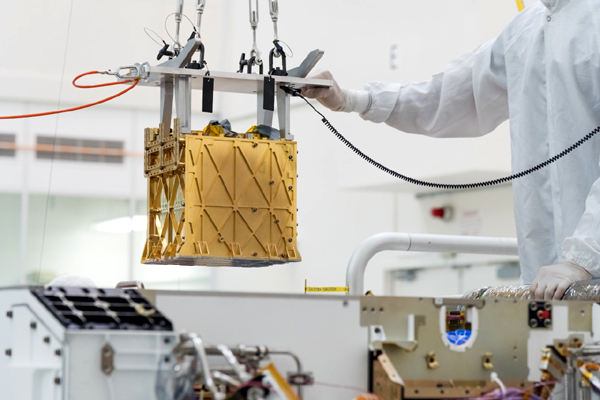
At NASA's Jet Propulsion Laboratory near Pasadena, California, the MOXIE instrument is about to be installed inside the chassis of the Perseverance Mars rover.
NASA / JPL - Caltech

NASA’s Perseverance Mars Rover Extracts First Oxygen from Red Planet (Press Release - April 21)

The growing list of “firsts” for Perseverance, NASA’s newest six-wheeled robot on the Martian surface, includes converting some of the Red Planet’s thin, carbon dioxide-rich atmosphere into oxygen. A toaster-size, experimental instrument aboard Perseverance called the Mars Oxygen In-Situ Resource Utilization Experiment (MOXIE) accomplished the task. The test took place April 20, the 60th Martian day, or sol, since the mission landed Feb. 18.

While the technology demonstration is just getting started, it could pave the way for science fiction to become science fact – isolating and storing oxygen on Mars to help power rockets that could lift astronauts off the planet’s surface. Such devices also might one day provide breathable air for astronauts themselves. MOXIE is an exploration technology investigation – as is the Mars Environmental Dynamics Analyzer (MEDA) weather station – and is sponsored by NASA’s Space Technology Mission Directorate (STMD) and Human Exploration and Operations Mission Directorate.

“This is a critical first step at converting carbon dioxide to oxygen on Mars,” said Jim Reuter, associate administrator for STMD. “MOXIE has more work to do, but the results from this technology demonstration are full of promise as we move toward our goal of one day seeing humans on Mars. Oxygen isn’t just the stuff we breathe. Rocket propellant depends on oxygen, and future explorers will depend on producing propellant on Mars to make the trip home.”

For rockets or astronauts, oxygen is key, said MOXIE’s principal investigator, Michael Hecht of the Massachusetts Institute of Technology’s Haystack Observatory.

To burn its fuel, a rocket must have more oxygen by weight. Getting four astronauts off the Martian surface on a future mission would require approximately 15,000 pounds (7 metric tons) of rocket fuel and 55,000 pounds (25 metric tons) of oxygen. In contrast, astronauts living and working on Mars would require far less oxygen to breathe. “The astronauts who spend a year on the surface will maybe use one metric ton between them,” Hecht said.

Hauling 25 metric tons of oxygen from Earth to Mars would be an arduous task. Transporting a one-ton oxygen converter – a larger, more powerful descendant of MOXIE that could produce those 25 tons – would be far more economical and practical.

Mars’ atmosphere is 96% carbon dioxide. MOXIE works by separating oxygen atoms from carbon dioxide molecules, which are made up of one carbon atom and two oxygen atoms. A waste product, carbon monoxide, is emitted into the Martian atmosphere.

The conversion process requires high levels of heat to reach a temperature of approximately 1,470 degrees Fahrenheit (800 Celsius). To accommodate this, the MOXIE unit is made with heat-tolerant materials. These include 3D-printed nickel alloy parts, which heat and cool the gases flowing through it, and a lightweight aerogel that helps hold in the heat. A thin gold coating on the outside of MOXIE reflects infrared heat, keeping it from radiating outward and potentially damaging other parts of Perseverance.

In this first operation, MOXIE’s oxygen production was quite modest – about 5 grams, equivalent to about 10 minutes worth of breathable oxygen for an astronaut. MOXIE is designed to generate up to 10 grams of oxygen per hour.

This technology demonstration was designed to ensure the instrument survived the launch from Earth, a nearly seven-month journey through deep space, and touchdown with Perseverance on Feb. 18. MOXIE is expected to extract oxygen at least nine more times over the course of a Martian year (nearly two years on Earth).

These oxygen-production runs will come in three phases. The first phase will check out and characterize the instrument’s function, while the second phase will run the instrument in varying atmospheric conditions, such as different times of day and seasons. In the third phase, Hecht said, “we’ll push the envelope” – trying new operating modes, or introducing “new wrinkles, such as a run where we compare operations at three or more different temperatures.”

“MOXIE isn’t just the first instrument to produce oxygen on another world,” said Trudy Kortes, director of technology demonstrations within STMD. It’s the first technology of its kind that will help future missions “live off the land,” using elements of another world’s environment, also known as in-situ resource utilization.

“It’s taking regolith, the substance you find on the ground, and putting it through a processing plant, making it into a large structure, or taking carbon dioxide – the bulk of the atmosphere – and converting it into oxygen,” she said. “This process allows us to convert these abundant materials into useable things: propellant, breathable air, or, combined with hydrogen, water.”

More About Perseverance

A key objective of Perseverance’s mission on Mars is astrobiology, including the search for signs of ancient microbial life. The rover will characterize the planet’s geology and past climate, pave the way for human exploration of the Red Planet, and be the first mission to collect and cache Martian rock and regolith (broken rock and dust).

Subsequent NASA missions, in cooperation with ESA (European Space Agency), would send spacecraft to Mars to collect these sealed samples from the surface and return them to Earth for in-depth analysis.

The Mars 2020 Perseverance mission is part of NASA’s Moon to Mars exploration approach, which includes Artemis missions to the Moon that will help prepare for human exploration of the Red Planet.

NASA’s Jet Propulsion Laboratory in Southern California, which is managed for NASA by Caltech in Pasadena, California, built and manages operations of the Perseverance rover.

****

Monday, April 19, 2021

INGENUITY HAS MADE AVIATION AND INTERPLANETARY HISTORY!

A camera underneath Ingenuity's fuselage took this photo of the helicopter's shadow as the vehicle made its historic first flight on Mars...on April 19, 2021.
NASA / JPL - Caltech

NASA’s Ingenuity Mars Helicopter Succeeds in Historic First Flight (Press Release)

Monday, NASA’s Ingenuity Mars Helicopter became the first aircraft in history to make a powered, controlled flight on another planet. The Ingenuity team at the agency’s Jet Propulsion Laboratory in Southern California confirmed the flight succeeded after receiving data from the helicopter via NASA’s Perseverance Mars rover at 6:46 a.m. EDT (3:46 a.m. PDT).

“Ingenuity is the latest in a long and storied tradition of NASA projects achieving a space exploration goal once thought impossible,” said acting NASA Administrator Steve Jurczyk. “The X-15 was a pathfinder for the space shuttle. Mars Pathfinder and its Sojourner rover did the same for three generations of Mars rovers. We don’t know exactly where Ingenuity will lead us, but today’s results indicate the sky – at least on Mars – may not be the limit.”

The solar-powered helicopter first became airborne at 3:34 a.m. EDT (12:34 a.m. PDT) – 12:33 Local Mean Solar Time (Mars time) – a time the Ingenuity team determined would have optimal energy and flight conditions. Altimeter data indicate Ingenuity climbed to its prescribed maximum altitude of 10 feet (3 meters) and maintained a stable hover for 30 seconds. It then descended, touching back down on the surface of Mars after logging a total of 39.1 seconds of flight. Additional details on the test are expected in upcoming downlinks.

Ingenuity’s initial flight demonstration was autonomous – piloted by onboard guidance, navigation, and control systems running algorithms developed by the team at JPL. Because data must be sent to and returned from the Red Planet over hundreds of millions of miles using orbiting satellites and NASA’s Deep Space Network, Ingenuity cannot be flown with a joystick, and its flight was not observable from Earth in real time.

NASA Associate Administrator for Science Thomas Zurbuchen announced the name for the Martian airfield on which the flight took place.

“Now, 117 years after the Wright brothers succeeded in making the first flight on our planet, NASA’s Ingenuity helicopter has succeeded in performing this amazing feat on another world,” Zurbuchen said. “While these two iconic moments in aviation history may be separated by time and 173 million miles of space, they now will forever be linked. As an homage to the two innovative bicycle makers from Dayton, this first of many airfields on other worlds will now be known as Wright Brothers Field, in recognition of the ingenuity and innovation that continue to propel exploration.”

Ingenuity’s chief pilot, Håvard Grip, announced that the International Civil Aviation Organization (ICAO) – the United Nations’ civil aviation agency – presented NASA and the Federal Aviation Administration with official ICAO designator IGY, call-sign INGENUITY.

These details will be included officially in the next edition of ICAO’s publication Designators for Aircraft Operating Agencies, Aeronautical Authorities and Services. The location of the flight has also been given the ceremonial location designation JZRO for Jezero Crater.

As one of NASA’s technology demonstration projects, the 19.3-inch-tall (49-centimeter-tall) Ingenuity Mars Helicopter contains no science instruments inside its tissue-box-size fuselage. Instead, the 4-pound (1.8-kg) rotorcraft is intended to demonstrate whether future exploration of the Red Planet could include an aerial perspective.

This first flight was full of unknowns. The Red Planet has a significantly lower gravity – one-third that of Earth’s – and an extremely thin atmosphere with only 1% the pressure at the surface compared to our planet. This means there are relatively few air molecules with which Ingenuity’s two 4-foot-wide (1.2-meter-wide) rotor blades can interact to achieve flight. The helicopter contains unique components, as well as off-the-shelf-commercial parts – many from the smartphone industry – that were tested in deep space for the first time with this mission.

“The Mars Helicopter project has gone from ‘blue sky’ feasibility study to workable engineering concept to achieving the first flight on another world in a little over six years,” said Michael Watkins, director of JPL. “That this project has achieved such a historic first is testimony to the innovation and doggedness of our team here at JPL, as well as at NASA’s Langley and Ames Research Centers, and our industry partners. It’s a shining example of the kind of technology push that thrives at JPL and fits well with NASA’s exploration goals.”

Parked about 211 feet (64.3 meters) away at Van Zyl Overlook during Ingenuity’s historic first flight, the Perseverance rover not only acted as a communications relay between the helicopter and Earth, but also chronicled the flight operations with its cameras. The pictures from the rover’s Mastcam-Z and Navcam imagers will provide additional data on the helicopter’s flight.

“We have been thinking for so long about having our Wright brothers moment on Mars, and here it is,” said MiMi Aung, project manager of the Ingenuity Mars Helicopter at JPL. “We will take a moment to celebrate our success and then take a cue from Orville and Wilbur regarding what to do next. History shows they got back to work – to learn as much as they could about their new aircraft – and so will we.”

Perseverance touched down with Ingenuity attached to its belly on Feb. 18. Deployed to the surface of Jezero Crater on April 3, Ingenuity is currently on the 16th sol, or Martian day, of its 30-sol (31-Earth day) flight test window. Over the next three sols, the helicopter team will receive and analyze all data and imagery from the test and formulate a plan for the second experimental test flight, scheduled for no earlier than April 22. If the helicopter survives the second flight test, the Ingenuity team will consider how best to expand the flight profile.

More About Ingenuity

JPL, which built Ingenuity, also manages the technology demonstration project for NASA. It is supported by NASA’s Science, Aeronautics, and Space Technology mission directorates. The agency’s Ames Research Center in California’s Silicon Valley and Langley Research Center in Hampton, Virginia, provided significant flight performance analysis and technical assistance during Ingenuity’s development.

Dave Lavery is the program executive for the Ingenuity Mars Helicopter, MiMi Aung is the project manager, and Bob Balaram is chief engineer.

****