Tuesday, May 19, 2026

The Latest Update on America's Newest Asteroid Explorer...

An image of Mars that was taken by NASA's Psyche spacecraft as it flew past the Red Planet for a gravity assist...on May 15, 2026.
NASA / JPL - Caltech / ASU

NASA’s Psyche Mission Aces Mars Flyby, Targets Metal-Rich Asteroid (News Release)

NASA’s Psyche spacecraft completed its close approach of Mars on May 15, coming within 2,864 miles (4,609 kilometers) of the planet’s surface. This flyby used a gravity assist from Mars to provide a critical boost in speed and to adjust the spacecraft’s orbital plane without using any onboard propellant, sending it on its way towards the metal-rich asteroid Psyche.

The spacecraft is now headed directly towards the asteroid, located in the main asteroid belt between Mars and Jupiter. After the Mars flyby, the flight team analyzed radio signals between the spacecraft and NASA’s Deep Space Network (DSN), the agency’s global system for communicating with interplanetary spacecraft, to confirm that Psyche was on the correct trajectory.

“Although we were confident in our calculations and flight plan, monitoring the DSN’s Doppler signal in real time during the flyby was still exciting,” said Don Han, Psyche’s navigation lead at NASA’s Jet Propulsion Laboratory in Southern California. “We’ve confirmed that Mars gave the spacecraft a 1,000 mile‑per‑hour boost and shifted its orbital plane by about 1 degree relative to the Sun. We are now on course for arrival at the asteroid Psyche in summer 2029.”

Unique Martian view

In the days running up to and during close approach, all of Psyche’s instruments were powered up for calibration efforts, including its imagers, magnetometers, and gamma-ray and neutron spectrometer. The planetary encounter provided the mission a valuable practice run for when it reaches the asteroid Psyche; as a bonus, it captured Mars images from a rare perspective.

Because Psyche approached Mars from a high phase angle, the planet appeared as a thin crescent in the days running up to the close approach, lit by sunlight reflecting off its surface. In observations from the spacecraft’s multispectral imager, the crescent appeared brighter and extended farther around the planet’s disk than anticipated because of the strong scattering of sunlight through the planet’s dusty atmosphere. As Psyche passed from Mars’ nighttime skies to daytime, it took a rapid series of pictures of the surface around the time of closest approach.

“We’ve captured thousands of images of the approach to Mars and of the planet’s surface and atmosphere at close approach. This dataset provides unique and important opportunities for us to calibrate and characterize the performance of the cameras, as well as test the early versions of our image processing tools being developed for use at the asteroid Psyche,” said Jim Bell, the Psyche imager instrument lead at Arizona State University (ASU) in Tempe. “As the spacecraft continues its journey after the flyby, we’ll continue calibration imaging of Mars for the rest of the month as it recedes into the distance.”

Bell also leads the Mastcam-Z imaging investigation on NASA’s Perseverance Mars rover mission team, which was among several missions that provided complementary surface and atmospheric imaging as well as navigation data during the flyby to help with calibration efforts. Other missions involved include NASA’s Mars Reconnaissance Orbiter, 2001 Mars Odyssey orbiter, and Curiosity rover, along with ESA’s (European Space Agency’s) Mars Express and ExoMars Trace Gas Orbiter.

In addition to the imager, early calibration measurements made by Psyche’s magnetometers may have detected Mars’ bow shock as the spacecraft passed the planet. The gamma-ray and neutron spectrometer team was also quickly gathering data to calibrate the instrument by comparing their measurements with the large pool of existing Mars data.

Onward to asteroid Psyche

With Mars in the rearview mirror, the spacecraft will soon resume using its solar-electric propulsion system to make a beeline to the main asteroid belt. When it arrives in August 2029, it will insert itself into orbit around the asteroid Psyche, which is thought to be the partial core of a planetesimal, a building block of an early planet. Through a series of circular orbits that go lower and then higher in altitude around Psyche, which is about 173 miles (280 kilometers) across at its widest point, the spacecraft will map the asteroid and gather science data.

If the asteroid proves to be the metallic core of an ancient planetesimal, it could offer a one-of-a-kind window into the interior of rocky planets like Earth.

“We’ve been anticipating the Mars flyby for years, but now it’s complete. We can thank the Red Planet for giving our spacecraft a critical gravitational slingshot farther into the Solar System,” said Lindy Elkins-Tanton, principal investigator for Psyche at the University of California, Berkeley. “Onward to the asteroid Psyche!”

Source: NASA.Gov

****

Another image of Mars that was taken by NASA's Psyche spacecraft as it flew past the Red Planet for a gravity assist...on May 15, 2026.
NASA / JPL - Caltech / ASU / Thomas Appéré

Thursday, May 14, 2026

The Latest Update on the Future of Deep Space Exploration...

An artist's concept of L3Harris' Next-Generation Radioisotope Thermoelectric Generator.
L3Harris Technologies, Inc.

Getting into the Space Nuclear Power Game with Next-generation Technology (News Release)

Finalized design of Next Gen RTG clears path for deep space missions to outer Solar System.

L3Harris Technologies has finalized the design of a next-generation nuclear-based power source for future NASA deep space missions, marking a crucial advancement in spacecraft power technology.

The Next-Generation Radioisotope Thermoelectric Generator (Next Gen RTG) cleared its critical design review (CDR) on April 2, 2026, paving the way for a new era of outer Solar System exploration.

“Passing the CDR is an important milestone because it validates that our design meets all the technical requirements and can be manufactured,” said Bill Sack, General Manager, RocketWorks and Power Systems at L3Harris. “It also demonstrates we've successfully re-established this critical capability after years of limited production.”

Flight units could power NASA deep space probes starting in the early 2030s, including a proposed Uranus orbiter that would use two Next Gen RTGs for power and for keeping its temperature-sensitive components warm enough to operate in the frigid environment of the outer Solar System. This dual-purpose capability makes RTGs indispensable for such missions.

What is the Next Gen RTG?

RTGs convert heat from the radioactive decay of plutonium-238 into electricity. Necessary for probes that are too far from the Sun to rely on solar power, they have been in use for 60 years. Early versions continue to supply power to NASA’s twin Voyager probes, which were launched in 1977 and are now traveling in interstellar space.

The Next Gen RTG is an evolution of the general-purpose heat source RTGs that supplied power to NASA’s Cassini Saturn orbiter and, more recently, the New Horizons probe, which carried out a Pluto flyby in 2015 and is now exploring the frozen wonders of the Kuiper Belt. Unlike the L3Harris-built Multi-Mission RTGs currently powering NASA's Curiosity and Perseverance Mars rovers, the Next Gen RTGs are optimized for spacecraft operating in the vacuum of space rather than on the surface of a planet.

This distinction is critical for future missions. The vacuum-optimized design allows for more efficient heat rejection and power generation in the deep space environment where missions like the Uranus orbiter will operate. As a result, the Next Gen RTG offers a higher power output at approximately the same weight as the Multi-Mission RTG. With the capability to generate about 250 watts of power at the beginning of its life, each Next Gen RTG will provide reliable, long-duration power for spacecraft exploring the outer reaches of our Solar System.

“The Next Gen RTG represents a significant leap forward in efficiency," added Sack. "We're delivering more power in the same mass envelope, which is critical when every kilogram matters for deep space missions."

Why the Next Gen RTG Matters

The availability of Next Gen RTGs opens the door to a range of ambitious missions that have been on NASA's wish list. Beyond the Uranus orbiter, these power systems could enable:

- Extended missions to Neptune and its moon, Triton
- Kuiper Belt Object explorers that can go beyond the range of the New Horizons spacecraft
- Long-duration missions to the outer planets' moons
- Interstellar precursor missions that push even farther than Voyager 1 and Voyager 2

Restarting Production

The U.S. Department of Energy’s Idaho National Laboratory tapped L3Harris in 2021 to re-establish the key technologies from the heritage system and update the design in response to growing interest in new deep space missions. The contract is expected to end in 2027 with a production readiness review to verify that the next-generation system can be built using the materials and components that have been re-established.

“We are proving we can do it again," said Leo Gard, Space Propulsion & Power Systems Program Manager at L3Harris. “While we didn't build the original generators, we've successfully reconstructed incomplete documentation and identified modern equivalents for obsolete components through creative problem-solving."

A Collaborative Effort

As prime contractor on the Next Gen RTG program, L3Harris is responsible for the main structure and overall system integration. Teledyne Energy Systems Inc. of Hunt Valley, Maryland, makes the thermoelectric couples that convert heat to electricity, while BAE Systems Space and Mission Systems in Boulder, Colorado, is responsible for insulation.

Source: L3Harris Technologies, Inc.

****

A computer-generated illustration I created of the once-proposed Trident flyby mission to Neptune's moon Triton.
L.M. Prockter et al. LPI / JPL / SwRI / Richard T. Par

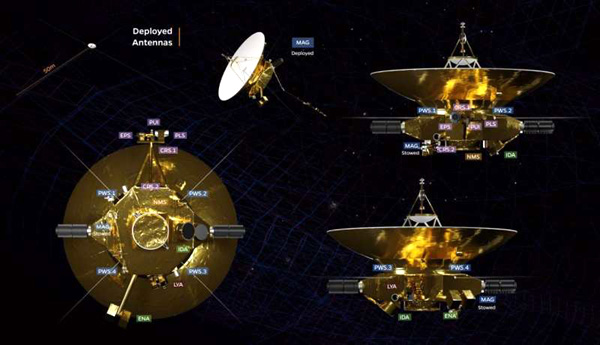
An infographic showing the various science instruments that would fly on a proposed Interstellar Probe spacecraft.
Johns Hopkins University Applied Physics Laboratory

Wednesday, May 13, 2026

An Amazing Celestial Mosaic by Kepler's Successor...

A mosaic of the night sky using images taken by NASA's TESS spacecraft between April 2018 and September 2025...showing 679 exoplanets (blue dots) and 5,165 exoplanetary candidates (orange dots), respectively.
NASA / MIT / TESS and Veselin Kostov (University of Maryland College Park)

NASA’s Planet-Hunting TESS Reveals Dazzling Night Sky (News Release)

NASA’s TESS (Transiting Exoplanet Survey Satellite) has released its most complete view of the starry sky to date, filling in gaps from previous observations. Nearly 6,000 colored dots scattered across the image show the locations of either confirmed or candidate exoplanets — worlds beyond our Solar System — identified by the mission as of September 2025 at the end of TESS’s second extended mission.

“Over the last eight years, TESS has become a fire hose of exoplanet science,” said Rebekah Hounsell, a TESS associate project scientist at the University of Maryland Baltimore County and NASA’s Goddard Space Flight Center in Greenbelt, Maryland. “It’s helped us find planets of all different sizes, from tiny Mercury-like ones to those larger than Jupiter. Some of them are even in the habitable zone, where liquid water might be possible on the surface, an important factor in our search for life beyond Earth.”

The TESS mission scans a wide swath of the sky, called a sector, for about a month at a time using its four cameras. These long stares allow the spacecraft to track the brightness changes of tens of thousands of stars, looking for variations in their light that might come from orbiting planets.

Researchers assembled an all-sky mosaic made of 96 sectors observed between April 2018, when TESS began its work, and September 2025.

The blue dots in the image mark the locations of nearly 700 confirmed planets, as of September 9. This menagerie includes worlds that may be covered by volcanoes, are being destroyed by their stars, or orbit two stars — experiencing double sunrises and sunsets each day. The orange dots represent more than 5,000 candidate planets that are awaiting verification.

To date, scientists have confirmed over 6,270 exoplanets using missions like TESS, NASA’s retired Kepler Space Telescope, and other facilities.

Also captured in the mosaic is the bright plane of our Milky Way galaxy, seen as a glowing arc through the center. The bright white ovals in the lower left are the Large and Small Magellanic Clouds. These satellite galaxies are located 160,000 and 200,000 light-years away, respectively.

“The more we dig into the large TESS dataset, especially using automated algorithms, the more surprises we find,” said Allison Youngblood, the TESS project scientist at NASA Goddard. “In addition to planets, TESS has helped us study rivers of young stars, observe dynamic galactic behavior, and monitor asteroids near Earth. As TESS fills in more of the night sky, there’s no knowing what it might see next.”

Source: NASA.Gov

Tuesday, May 12, 2026

The Latest Update on the Mars 2020 Rover...

A self-portrait of NASA's Perseverance Mars rover at a rocky outcrop nicknamed 'Arathusa'...taken with a camera on Perseverance's robotic arm on March 11, 2026.
NASA / JPL - Caltech / MSSS

NASA’s Perseverance Rover Snaps Selfie in Mars’ Western Frontier (News Release)

The agency’s six-wheeled geologist took a self-portrait during its survey of an ancient landscape that may predate the formation of Jezero Crater itself.

NASA’s Perseverance Mars rover recently took a self-portrait against a sweeping backdrop of ancient Martian terrain at a location that the science team calls “Lac de Charmes.” Assembled from 61 individual images, the selfie shows Perseverance training its mast on a rocky outcrop on which it had just made a circular abrasion patch, with the western rim of Jezero Crater stretching into the background. The selfie was captured on March 11, the 1,797th Martian day, or sol, of the mission, during the rover’s deepest push west beyond the crater.

Perseverance is in its fifth science campaign, known as the Northern Rim Campaign, of its mission on the Red Planet. The Lac de Charmes region represents some of the most scientifically-compelling terrain that the rover has visited.

“We took this image when the rover was in the ‘Wild West’ beyond the Jezero Crater rim — the farthest west we have been since we landed at Jezero a little over five years ago,” said Katie Stack Morgan, Perseverance’s project scientist at NASA’s Jet Propulsion Laboratory in Southern California. “We had just abraded and analyzed the ‘Arathusa’ outcrop, and the rover was sitting in a spot that provided a great view of both the Jezero Rim and the local terrain outside of the crater.”

During abrading, the rover grinds down a portion of the rock’s surface, allowing the science team to analyze what’s inside. The technique enabled the team to determine that the Arathusa outcrop is composed of igneous minerals that likely predate the formation of Jezero Crater. Igneous rocks with large mineral crystals form underground as molten rock cools and solidifies.

Perseverance acquired the selfie — its sixth since landing on Mars in 2021 — using the WATSON (Wide Angle Topographic Sensor for Operations and eNgineering) camera mounted at the end of its robotic arm, which made 62 precision movements over approximately one hour to build the composite image (learn more about how selfies are made).

Significant science

Along with the selfie, Perseverance used Mastcam-Z, located on its mast, to capture a mosaic of the “Arbot” area in Lac de Charmes on April 5, or Sol 1882. Made of 46 images, the panorama offers one of the richest geological vistas of the mission, revealing a windswept landscape of diverse rock textures.

The image provides the team a clear road map for investigating the ridgeline and the area’s ancient rock variety, including what appear to be megabreccia — large fragments (some the size of skyscrapers) hurled by a massive meteorite impact that occurred on the plain called Isidis Planitia about 3.9 billion years ago.

“What I see in this image is excellent exposure of likely the oldest rocks we are going to investigate during this mission,” said Ken Farley, Perseverance’s deputy project scientist at Caltech in Pasadena. “There is a sharp ridgeline visible in the mosaic whose jagged, angular texture contrasts starkly with the rounded boulders in the foreground. We also see a feature that may be a volcanic dike, a vertical intrusion of magma that hardened in place and was left standing as the softer surrounding material eroded away over billions of years.”

The rock color in the mosaic offers less information to the science team than the distinctive textures, which help them differentiate the rock types. Unlike Jezero Crater’s river delta, which is composed of sedimentary rock, some rocks here appear to be extrusive igneous rocks (molten rock that reached the surface as lava flows) and impactites (rocks created or modified by a meteorite impact) believed to have formed before the crater about 4 billion years ago, offering a window into the planet’s deep early crust.

New ballgame, near-marathon distance

“The rover’s study of these really ancient rocks is a whole new ballgame,” said Stack Morgan. “These rocks — especially if they’re from deep in the crust — could give us insights applicable to the entire planet, like whether there was a magma ocean on Mars and what initial conditions eventually made it a habitable planet.”

After studying Arathusa, Perseverance drove northwest to the Arbot area, where it has been analyzing other rocky outcrops. When the team is satisfied with the work accomplished there, the rover will drive south to “Gardevarri,” a site with a notably clear exposure of olivine-bearing rocks. Formed in cooling magma, these types of rocks contain information that can help scientists better understand Mars’ volcanic history and provide context for large-scale geological processes.

From Gardevarri, the rover is expected to head southeast towards a region that the team is calling “Singing Canyon” for more insights into the planet’s early crust.

After more than five years of surface operations, Perseverance has abraded 62 rocks, collected 27 rock cores in its sample tubes (25 sealed, 2 unsealed), and traveled almost 26 miles (42 kilometers) — in other words, just shy of a marathon (26.2 miles, or 42.195 kilometers).

“Having the benefit of four previous rover missions, the Perseverance team has always known our mission was a marathon and not a sprint,” said acting Perseverance project manager Steve Lee at JPL. “We’ve almost reached marathon distance. Our selfie may show that the rover is a bit dusty, but its beauty is more than skin deep. Perseverance is in great shape as we continue our explorations and extend into ultramarathon drive distances.”

Source: Jet Propulsion Laboratory

****

Another self-portrait of NASA's Perseverance Mars rover at the rocky outcrop Arathusa...taken with a camera on Perseverance's robotic arm on March 11, 2026.NASA / JPL - Caltech / MSSS

A mosaic of a rocky area nicknamed 'Arbot' that was taken by NASA's Perseverance Mars rover...on April 5, 2026.NASA / JPL - Caltech / ASU / MSSS

Thursday, April 23, 2026

The Latest Update on America's Next Saturn-bound Robotic Explorer...

Inside a cleanroom at the Johns Hopkins University's Applied Physics Laboratory in Laurel, Maryland, a group of technicians complete a fit check of Dragonfly's top deck onto the rest of the rotorcraft's body...on April 3, 2026.
NASA / Johns Hopkins APL / Ed Whitman

NASA’s Dragonfly Rotorcraft Gets Decked Out, Tested (News Release)

NASA’s Dragonfly rotorcraft is beginning to take shape – literally – with the delivery of the panels that make up the rotorcraft lander’s body. Built from ultra‑lightweight honeycomb panels designed at the Johns Hopkins Applied Physics Laboratory (APL) in Laurel, Maryland, and manufactured by Lockheed Martin Space in Denver, the primary structure is specially designed for the challenges of flight on Saturn’s largest moon Titan.

Each panel uses aluminum face sheets only 0.01 inches thick — much thinner than typically used on spacecraft — to meet the strict mass limits required for powered flight through Titan’s atmosphere. But while the entire frame weighs just 230 pounds, it’s also durable. “The structure is remarkably light and yet strong enough to withstand the intense forces of launch and the entry into Titan’s atmosphere,” said Gordon Maahs, the Dragonfly mechanical systems engineer from APL. “We’ve never built anything like it.”

In early April, the APL team began assembling the fuselage and integrating key structural elements, including the mounting plate and cover for Dragonfly’s power source, a multi-mission radioisotope thermoelectric generator, which will be installed just before launch. Engineers also performed a fit check of the top deck, which carries components of Dragonfly’s telecommunications system.

In May, vibration and static-load tests will be performed on the structure to measure Dragonfly’s response to the dynamic forces of launch (from Earth) and atmospheric entry and landing (on Titan). “The lander is starting to look like Dragonfly,” said Hunter Reeling, Dragonfly’s thermal mechanical integration and test lead from APL. “We’re excited to see the designs coming to life.”

Parachute passes test

In February, the mission achieved a significant milestone with the successful completion of another series of parachute drop tests, key to the development of the parachute decelerator elements of the entry, descent and landing (EDL) system that will decelerate the Dragonfly lander as it descends into Titan’s atmosphere.

Led by Airborne Systems of Santa Ana, California, in coordination with NASA’s Langley Research Center in Hampton, Virginia, and NASA’s Ames Research Center in California’s Silicon Valley, and conducted in Eloy, Arizona, the test marked the first trials of a full-scale parachute system, including both the drogue and main parachutes. These tests on Earth are designed to closely replicate the environment that Dragonfly will encounter within Titan’s atmosphere.

The team plans to conduct another series of similar design-qualification tests in October before building the flight systems.

Preparing to sample Titan’s surface

Dragonfly’s portable chemistry lab, which will study Titan’s surface composition, is in the final stages of integration and testing at NASA’s Goddard Space Flight Center in Greenbelt, Maryland. This payload, called the Dragonfly Mass Spectrometer (DraMS), includes two systems for releasing molecules from samples that Dragonfly will collect: laser desorption and gas chromatography. Once released, the molecules will flow to a mass spectrometer, which will identify them by their masses.

On April 15, engineers completed testing of the laser system, which was integrated within DraMS in February. Using a sample with known compounds, the team confirmed that the laser and mass spectrometer can identify the chemicals in a relevant sample, even in very small amounts.

Over the next few weeks, engineers will install the gas chromatography system into DraMS and carry out similar tests. The gas chromatography system, provided by CNES (Centre National d’Etudes Spatiales), works by heating a sample, releasing molecules, and separating them before analysis. Together, the laser- and gas-analysis systems will help Dragonfly detect compounds across a wide range of sizes.

Dragonfly is scheduled to launch no earlier than 2028 for a six-year voyage to Saturn’s moon Titan, where it will spend three years flying from location to location to explore a range of sites to study the chemistry, geology, and atmosphere of the Earthlike moon and ultimately advance our understanding of life’s chemical origins.

Source: NASA.Gov

****

A drop test for Dragonfly's parachute system is conducted in Eloy, Arizona...on February 11, 2026.
Airborne Systems North America

Wednesday, April 22, 2026

America's Next Great Observatory Is Ready to Fly...

At NASA's Goddard Space Flight Center in Greenbelt, Maryland, the Nancy Grace Roman Space Telescope sits fully assembled inside a cleanroom...and awaits launch that could take place as early as this September.
NASA / Scott Wiessinger

NASA Targets Early September for Roman Space Telescope Launch (News Release)

NASA’s Nancy Grace Roman Space Telescope team is now targeting as soon as early September 2026 for launch, ahead of the agency’s commitment to flight no later than May 2027.

“Roman’s accelerated development is a true success story of what we can achieve when public investment, institutional expertise, and private enterprise come together to take on the near-impossible missions that change the world,” said NASA Administrator Jared Isaacman, who announced the update at a news conference on April 21 at the agency’s Goddard Space Flight Center in Greenbelt, Maryland.

Roman will pair a large field of view with crisp infrared vision to survey deep, vast swaths of sky. While the mission was designed with dark energy, dark matter, and exoplanets in mind, Roman’s unprecedented observational capability will offer practically limitless opportunities for astronomers to explore all kinds of cosmic topics.

By the end of its five-year primary mission, Roman is expected to amass a 20,000-terabyte data archive. Scientists can draw on it to identify and study 100,000 exoplanets, hundreds of millions of galaxies, billions of stars, and rare objects and phenomena — including some that astronomers have never witnessed before.

Roman will launch on a SpaceX Falcon Heavy rocket from Launch Complex 39A at NASA’s Kennedy Space Center in Florida. NASA and SpaceX will share more information about a specific launch date, and the agency will continue to share updates concerning prelaunch preparations as new information becomes available.

The Nancy Grace Roman Space Telescope is managed at NASA’s Goddard Space Flight Center, with participation by NASA’s Jet Propulsion Laboratory and Caltech/IPAC in Southern California, the Space Telescope Science Institute (STScI) in Baltimore, and scientists from various research institutions.

Source: NASA.Gov

Tuesday, April 21, 2026

The Latest Discovery in the Search for Life on the Red Planet...

A self-portrait of NASA's Curiosity Mars rover at a spot nicknamed 'Mary Anning'...taken with a camera on Curiosity's robotic arm on October 25, 2020.
NASA / JPL - Caltech / MSSS

NASA’s Curiosity Finds Organic Molecules Never Seen Before on Mars (News Release)

After years of lab work, the results are in: A rock that NASA’s Curiosity Mars rover drilled and analyzed in 2020 includes the most diverse collection of organic molecules ever found on the Red Planet. Of the 21 carbon-containing molecules identified in the sample, seven of them were detected for the first time on Mars.

Scientists have no way of knowing whether these organic molecules were created by biologic or geologic processes — either path is possible — but their discovery renewed confirmation that ancient Mars had the right chemistry to support life. What’s more, the molecules join a growing list of compounds known to be preserved in rocks even after billions of years of exposure on Mars to radiation, which can break down these molecules over time.

The findings are detailed in a new paper published on Tuesday in Nature Communications.

The rock sample, nicknamed “Mary Anning 3” after an English fossil collector and paleontologist, was collected on a part of Mount Sharp covered by lakes and streams billions of years ago. This oasis surged and dried up multiple times in the planet’s ancient past, eventually enriching the area with clay minerals, which are especially good at preserving organic compounds — carbon-containing molecules that are the building blocks of life and are found throughout the Solar System.

Among the newly-identified molecules is a nitrogen heterocycle, a ring of carbon atoms that includes nitrogen. This kind of molecular structure is considered a predecessor to RNA and DNA, two nucleic acids that are key to genetic information.

“That detection is pretty profound because these structures can be chemical precursors to more complex nitrogen-bearing molecules,” said the paper’s lead author, Amy Williams of the University of Florida in Gainesville. “Nitrogen heterorcycles have never been found before on the Martian surface or confirmed in Martian meteorites.”

Another exciting discovery was benzothiophene, a carbon- and sulfur-bearing molecule that’s been found in many meteorites. These meteorites, along with the organic molecules within them, are thought by some scientists to have seeded prebiotic chemistry across the early Solar System.

Martian chemistry

The new paper complements last year’s finding of the largest organic molecules ever discovered on Mars: long-chain hydrocarbons, including decane, undecane and dodecane.

“This is Curiosity and our team at their best. It took dozens of scientists and engineers to locate this site, drill the sample, and make these discoveries with our awesome robot,” said the mission’s project scientist, Ashwin Vasavada of NASA’s Jet Propulsion Laboratory in Southern California. “This collection of organic molecules once again increases the prospect that Mars offered a home for life in the ancient past.”

Both sets of findings were made with a sophisticated minilab called Sample Analysis at Mars (SAM), located in Curiosity’s belly. A drill on the end of the rover’s robotic arm pulverizes a carefully selected rock sample into powder and then trickles it into SAM, where a high-temperature oven heats the material, releasing gases that instruments in the lab analyze to reveal the rock’s composition.

In addition, SAM can perform “wet chemistry,” dropping samples into a small cup of solvent. The resulting reactions can break apart larger molecules that would be difficult to detect and identify otherwise. While the instrument has several such cups, only two contain tetramethylammonium hydroxide (TMAH), a powerful solution reserved for the highest-value samples.

The Mary Anning 3 sample was the first to be exposed to TMAH.

To verify TMAH’s reactions with otherworldly materials, the paper’s authors also tested the technique on Earth with a piece of the Murchison meteorite, one of the most studied meteorites of all time. More than 4 billion years old, Murchison contains organic molecules that were seeded throughout the early Solar System. A Murchison sample exposed to TMAH was found to break much larger molecules into some of the ones seen in Mary Anning 3, including benzothiophene.

That result verifies that the Martian molecules found in Mary Anning 3 could have been generated from the breakdown of even more complex compounds relevant to life.

Curiosity recently used its second and final TMAH cup while exploring weblike boxwork ridges, which were formed by ancient groundwater. The mission team will be analyzing those results for a future peer-reviewed paper.

Trailblazing for future missions

Built by NASA’s Goddard Space Flight Center in Greenbelt, Maryland, SAM is based on larger, commercial-grade lab instruments. Getting such complex equipment into the rover required engineers to dramatically shrink it down and develop a way for it to run on less power. Scientists had to learn how to heat up SAM’s oven more slowly over longer periods in order to conduct some of these experiments.

“It was a feat just figuring out how to conduct this kind of chemistry for the first time on Mars,” said Charles Malespin, the instrument’s principal investigator at NASA Goddard and a study coauthor. “But now that we’ve had some practice, we’re prepared to run similar experiments on future missions.”

In fact, NASA Goddard has provided several components, including the mass spectrometer, for a next-generation version of SAM, called the Mars Organic Molecular Analyzer, for ESA’s (European Space Agency) Rosalind Franklin Mars rover. A similar instrument, the Dragonfly Mass Spectrometer, will explore Saturn’s moon Titan on NASA’s Dragonfly rotorcraft. Both instruments will be able to perform wet chemistry with the TMAH solvent.

Source: NASA.Gov

****

An annotated close-up of three holes that NASA’s Curiosity Mars rover drilled into a rock at a location nicknamed 'Mary Anning' in October 2020.
NASA / JPL - Caltech / MSSS

Friday, April 17, 2026

The Latest Update on Humanity's Twin Interstellar Probes...

An artist's concept of a Voyager probe traveling through deep space.
Caltech / NASA - JPL

NASA Shuts Off Instrument on Voyager 1 to Keep Spacecraft Operating (News Release)

On April 17, engineers at NASA’s Jet Propulsion Laboratory (JPL) in Southern California sent commands to shut down an instrument aboard Voyager 1 called the Low-energy Charged Particles experiment, or LECP. The nuclear-powered spacecraft is running low on power, and turning off the LECP is considered the best way to keep humanity’s first interstellar explorer going.

The LECP has been operating almost without interruption since Voyager 1 launched in 1977 — almost 49 years. It measures low-energy charged particles, including ions, electrons and cosmic rays originating from our Solar System and galaxy. The instrument has provided critical data about the structure of the interstellar medium, detecting pressure fronts and regions of varying particle density in the space beyond our heliosphere.

The twin Voyagers are the only spacecraft that are far enough from Earth to provide this information.

Like Voyager 2, Voyager 1 relies on a radioisotope thermoelectric generator, a device that converts heat from decaying plutonium into electricity. Both probes lose about 4 watts of power each year. After almost a half-century in space, power margins have grown razor thin, requiring the team to conserve energy by shutting off heaters and instruments while making sure the spacecraft don’t get so cold that their fuel lines freeze.

During a routine, planned roll maneuver on February 27, Voyager 1’s power levels fell unexpectedly. Mission engineers knew that any additional drop in power could trigger the spacecraft’s undervoltage fault protection system, which would shut down components on its own to safeguard the probe, requiring recovery by the flight team — a lengthy process that carries its own risks.

The Voyager team needed to act first.

“While shutting down a science instrument is not anybody’s preference, it is the best option available,” said Kareem Badaruddin, Voyager mission manager at JPL. “Voyager 1 still has two remaining operating science instruments — one that listens to plasma waves and one that measures magnetic fields. They are still working great, sending back data from a region of space no other human-made craft has ever explored. The team remains focused on keeping both Voyagers going for as long as possible.”

Far-out plan

The choice of which instrument to turn off next wasn’t made in the heat of the moment. Years ago, the Voyager science and engineering teams sat down together and agreed on the order in which they would shut off parts of the spacecraft while ensuring that the mission can continue to conduct its unique science. Of the 10 identical sets of instruments that each spacecraft carries, seven have been shut off so far.

For Voyager 1, the LECP was next on that list. The team shut off the LECP on Voyager 2 in March 2025.

Because Voyager 1 is more than 15 billion miles (25 billion kilometers) from Earth, the sequence of commands to shut down the instrument will take 23 or so hours to reach the spacecraft, and the shutdown process itself will take about three hours and 15 minutes to complete. One part of the LECP — a small motor that spins the sensor in a circle to scan in all directions — will remain on. It uses little power (0.5 watts), and keeping it running gives the team the best chance of being able to turn the instrument back on someday if they find extra power.

What comes next

Engineers are confident that shutting down the LECP will give Voyager 1 about a year of breathing room. They are using the time to finalize a more ambitious energy-saving fix for both Voyagers that they call “the Big Bang,” which is designed to further extend Voyager operations. The idea is to swap out a group of powered devices all at once — hence the nickname — turning some things off and replacing them with lower-power alternatives to keep the spacecraft warm enough to continue gathering science data.

The team will implement the Big Bang on Voyager 2 first, which has a little more power to spare and is closer to Earth, making it the safer test subject. Tests are planned for May and June 2026. If they go well, the team will attempt the same fix on Voyager 1 no sooner than July.

If the Big Bang works, there is even a chance that Voyager 1’s LECP could be switched back on.

Source: NASA.Gov

Friday, March 20, 2026

America's Newest X-Plane (Briefly) Goes Airborne for the Second Time...

The X-59 QueSST aircraft embarks on its second flight...this time from California's Edwards Air Force Base on March 20, 2026.
NASA / Jim Ross

NASA’s X-59 Experimental Supersonic Aircraft Makes Second Flight (News Release)

NASA’s quiet supersonic X-59 aircraft made its second flight on Friday, kicking off a series of dozens of test flights in 2026.

Although the flight duration was abbreviated due to a technical issue, the team was able to collect information that will inform future tests.

“Despite the early landing, this is a good day for the team. We collected more data, and the pilot landed safely,” said Cathy Bahm, project manager for NASA’s Low-Boom Flight Demonstrator at NASA’s Armstrong Flight Research Center, in Edwards, California. “We’re looking forward to getting back to flight as soon as possible.”

The aircraft took off at 10:54 a.m. PDT from Edwards Air Force Base, near NASA Armstrong. Several minutes into the flight, pilot Jim “Clue” Less saw a vehicle system warning in the aircraft’s cockpit. Following flight procedures, the aircraft landed at 11:03 a.m. after a return-to-base was called.

“As we like to say, it was just like the simulator – and that’s what we like to hear,” Less said. “This is just the beginning of a long flight campaign.”

The X-59 is designed to fly supersonic – or faster than the speed of sound – while generating only a quiet thump instead of a loud sonic boom. The X-59 is the centerpiece of NASA’s QueSST mission, which is working to make commercial supersonic flight over land a reality.

The aircraft is set to accelerate testing in 2026, demonstrating performance and airworthiness during a process known as envelope expansion, where it will gradually fly faster and higher, on its way to supersonic speeds.

Source: NASA.Gov

Wednesday, March 11, 2026

America's Next Saturn-bound Robotic Explorer Is Officially in Assembly!

Inside a clean room at Johns Hopkins Applied Physics Laboratory in Laurel, Maryland, two technicians attach the engineering model of Dragonfly’s Integrated Electronics Module to the lander’s electrical harness...which is the bundled assembly of wires, cables and connectors that will transmit power and data throughout the rotorcraft.
NASA / Johns Hopkins APL

NASA’s Dragonfly Mission Begins Rotorcraft Integration, Testing Stage (News Release - March 10)

NASA Dragonfly’s integration and testing – the activities involved in assembling the mission’s rotorcraft lander and testing it for the rigors of launch and extreme conditions of space – is officially underway in clean rooms and control rooms at the Johns Hopkins Applied Physics Laboratory (APL) in Laurel, Maryland.

In partnership with teams across government, industry and academia, APL is building the car-sized, nuclear-powered drone for NASA. Dragonfly is scheduled to launch no earlier than 2028 for a six-year voyage to Saturn’s moon Titan, where it will explore a range of diverse sites to study the chemistry, geology and atmosphere of the terrestrial moon and ultimately advance our understanding of life’s chemical origins.

Primary activities during the first weeks of this effort included power and functional testing on two critical components: the Integrated Electronics Module (IEM) and the Power Switching Units (PSUs). Think of the IEM as Dragonfly’s “brain,” containing the spacecraft’s core avionics (such as command and data handling, guidance and navigation, and communications) in a single space-saving and power-efficient box. The IEM and both PSUs were connected to Dragonfly’s wiring system and passed their first power-service checks.

“This milestone essentially marks the birth of our flight system,” said Elizabeth Turtle, Dragonfly principal investigator from APL. “Building a first-of-its kind vehicle to fly across another ocean world in our Solar System pushes us to the edge of what’s possible, but that’s exactly why this stage is so exciting. The team is doing an outstanding job, and every component we install and every test we run brings us one step closer to launching Dragonfly to Titan.”

Much work has led up to this point. The aeroshell and cruise-stage assemblies are moving forward with integration and testing at Lockheed Martin Space in Littleton, Colorado. The team completed a thorough aerodynamic test series in the wind tunnels of NASA’s Langley Research Center in Hampton, Virginia. Testing continues in the Titan Chamber at APL of the foam coating that will insulate the rotorcraft from Titan’s frigid temperatures.

The science payload is coming together at locations around the country and internationally. The flight radio has been delivered, and additional flight systems are scheduled for delivery and testing within the next six months.

Dragonfly integration and testing will continue at APL through this year and into early 2027, when system-level testing is planned at Lockheed Martin. Late next year, the lander returns to APL for final space-environment testing before heading to NASA’s Kennedy Space Center in Florida in spring 2028 for launch aboard a SpaceX Falcon Heavy rocket that summer.

“Starting integration and testing is a huge milestone for the Dragonfly team,” said Annette Dolbow, the Dragonfly integration and test lead at APL. “We’ve spent years designing and refining this amazing rotorcraft on computer screens and in laboratories, and now we get to bring all those elements together and transform Dragonfly into an actual flight system.”

Source: NASA.Gov

****

Technicians conduct power and functional testing on Dragonfly’s Integrated Electronics Module and Power Switching Unit in the clean room at the Johns Hopkins Applied Physics Laboratory in Laurel, Maryland.
NASA / Johns Hopkins APL / Ed Whitman

An artist's concept of NASA's Dragonfly rotorcraft.
NASA / Johns Hopkins APL / Steve Gribben

Tuesday, March 10, 2026

Attended a Mass this morning to mark 40 days since my Mom's passing.

Today marks 40 days since my Mom's passing.

My family attended a Mass this morning to honor her.

Sunday, March 08, 2026

Images of the Day #3: An AI Armored Personnel Carrier...

An AI rendering of an armored personnel carrier that I created using ChatGPT...on March 8, 2026.
Richard T. Par

Just thought I'd share this illustration of an armored personnel carrier (APC) that I conjured in my mind over 15 years ago! I got the idea for this vehicle when I hung out at one of my friends' house and watched as he played the video game Gears of War on his Xbox console. In the level that my friend played in particular, he was battling monsters while driving through a city street using the Armadillo APC—shown at the bottom of this Blog entry.

The adventurous concept of traveling inside an armored ground transport with your fellow soldiers while fighting alien (or even supernatural) creatures is what motivated me to come up with this APC. There are no monsters in the AI images above and below, but this vehicle being depicted driving through an eerie forest at night is meant to give this picture a somewhat ominous feel!

And as with the hybrid ship that I rendered over a week ago, these APC illustrations are based on a sketch I drew earlier today...seen directly below. The APC is meant to have six wheels, but you'll notice that only five are seen in these pictures because the vehicle is depicted from a near-frontal view, and ChatGPT would've had a tricky time rendering two gun turrets that are placed between the three wheels that would be on the port side of the vehicle. I'll probably draw another artwork of this transport showing its side profile...so you can see what I'm talking about.

If this APC existed in real life, it would have a really difficult time traveling on city streets or up narrow mountainside roads considering how wide and heavy it would be. But I don't care about practicality here; I love this APC's design! Happy Sunday.

A sketch of the armored personnel carrier that I drew on March 8, 2026.
Richard T. Par

Another AI rendering of the armored personnel carrier that I created using ChatGPT...on March 8, 2026.
Richard T. Par

An art rendering of the Armadillo vehicle from the Xbox video game GEARS OF WAR.

Friday, March 06, 2026

Images of the Day #2: Ladies in White...

An AI rendering of a lady in white that I created using ChatGPT...on February 23, 2026.
Richard T. Par

Just thought I'd share these illustrations of two ladies in white standing on a hilltop balcony...staring at distant house lights in the dark valley below. Just like the images of the hybrid ship in my previous entry, these pictures were rendered through ChatGPT. Unlike the images of the hybrid ship, these illustrations (which I rendered two days before I created those pictures of the ship) weren't based on a sketch I drew, but very specific descriptions in the prompt that I typed to create these AI images.

So what motivated me to render these particular images, you ask? Just me being a hopeless romantic. The illustration above is more faithful to the vision that was stuck in my head for years while the picture below has better image quality. Carry on!

Another AI rendering of a lady in white that I created using ChatGPT...on February 23, 2026.
Richard T. Par

Thursday, March 05, 2026

Images of the Day: An AI Sea Vessel...

An AI rendering of a hybrid sea vessel that I created using ChatGPT...on February 25, 2026.
Richard T. Par

As mentioned in this Blog entry, I used ChatGPT to create other AI illustrations...not because I've forsaken traditional artwork using mechanical pencils and Crayola markers, but to quickly jot out concepts of different things like ships and military vehicles that have been on my mind for a while.

In the two AI images posted here, you see renderings of a hybrid ship that's part cruise liner and part research vessel.

In the sketch I made that's shown directly below (See? I told you that I didn't eschew traditional drawings for artificial intelligence), you can spot three trapezoid-shaped compartments near the top of the structure at the center of this vessel... Those are hotel rooms. I imagine that adventure-seeking one-percenters would book these rooms—which are basically intended to be penthouse suites.

Behind the center structure is a small submarine (specifically, a deep sea submersible that would be used to explore such locales as the sunken Titanic...but designed much better than OceanGate's Titan sub that made headlines in 2023) that could be deployed during the ship's expeditions. The submarine would obviously not be used for a journey to Antarctica or the Arctic region. I envisioned two submersibles being staged on the deck of this ship, but ChatGPT had difficulty rendering the one sub you see in these illustrations!

This ship would be equipped with its own helicopter (whose size is not to scale with the ship in these images) that could be parked inside the hangar that's visible near the stern of this vessel.

I imagined this ship traveling to such distant locales as Point Nemo—a spot in the South Pacific Ocean that's farthest from any land, located 1,670 miles (2,688 kilometers) from the nearest shore. To make such a trip, this ship would be nuclear-powered (hence the absence of smoke stacks)...like U.S. aircraft carriers and such non-military vessels as some Russian icebreakers! Speaking of icebreakers, this ship would also be one, as depicted by the vessel traveling through a field of ice in the two illustrations of this entry.

Speaking of U.S. aircraft carriers, I imagined this ship to be a floating city like the military vessels, and just as long too! Which is why I used ChatGPT to render multiple versions of this ship until it finally churned out the illustration at the top of this entry. As you can see, the vessel is so lengthy that there are not three but five trapezoidal penthouse suites at the middle of this ship! So cool.

How much would it cost to build this ship and who would operate it, you ask? I have no clue! I'm just amused that ChatGPT was able to bring this concept from my mind to the computer screen (and then sheets of paper, as I intend to print out these illustrations) with a properly-worded prompt.

Have a nice day.

A sketch of the hybrid sea vessel that I drew on February 25, 2026.
Richard T. Par

Another AI rendering of the hybrid sea vessel that I created using ChatGPT...on February 25, 2026.
Richard T. Par

Monday, March 02, 2026

A New Poster for THE BROKEN TABLE...

Just thought I'd share this new poster for my 2020 short film, The Broken Table!

There are no plans to submit my project to any more film festivals or even shoot a sequel (considering the fact that I have no screenplay for one, and my lead actress, MJ, has been residing in her home country of Saudi Arabia since 2020), but I just wanted to use the latest wonders of technology to create new material for the film. Yes, I'm referring to ChatGPT.

Anyways, creating new posters for cinematic work that I did over half a decade ago isn't the only thing I used AI for. More illustrations to come later. Happy Monday!

A new poster for THE BROKEN TABLE.
Richard T. Par

Thursday, February 26, 2026

My family members and relatives wait to enter the chapel for my Mom's funeral...on February 26, 2026.

My Mom was finally laid to rest today. May she forever be at peace.

A video slideshow that I created to celebrate the life of my wonderful Mom is at the bottom of this entry.

My Mom is in her final resting place.

Monday, February 23, 2026

The Latest Update on America's Newest Stealth Bomber...

The newest B-21 Raider soars above California's Mojave Desert as it heads toward Edwards Air Force Base to undergo flight tests...on September 11, 2025.
USAF

DAF Increases B-21 Raider Production Capacity to Deliver Combat Capability Faster (Press Release)

AURORA, Colo. (AFNS) -- The Department of the Air Force and Northrop Grumman Corp. have reached an agreement to expand production capacity for the B-21 Raider, accelerating delivery of the Air Force’s next-generation stealth bomber fleet.

The agreement applies $4.5 billion in funding already authorized and appropriated under the fiscal year 2025 reconciliation legislation. This agreement accelerates the approved acquisition profile by increasing annual production capacity by 25%, compressing delivery timelines while preserving cost and performance discipline.

The B-21 program delivered aircraft on schedule in 2025 and remains on track for aircraft on the ramp at Ellsworth Air Force Base, South Dakota, in 2027. The accelerated production agreement builds on that demonstrated performance, translating program stability into faster fielding of combat capability.

“The B-21 is foundational to our long-range strike capability and to credible deterrence,” said Secretary of the Air Force Troy Meink. “Accelerating production capacity now ensures we deliver operational capability to combatant commanders faster — strengthening our ability to outpace, deter, and, if necessary, defeat emerging threats. This is disciplined execution at the speed the security environment demands.”

Currently executing flight tests, the long-range, penetrating strike aircraft is designed to operate in the most contested environments and hold any target at risk. The B-21 integrates advanced stealth, resilient networking, and a modern, data-driven command and control architecture — ensuring that the Joint Force retains a decisive advantage in an increasingly complex battlespace.

Source: United States Air Force

Sunday, February 22, 2026

Up Next: The Los Angeles Summer Olympics!

Congratulations to Team USA for taking home 33 Olympic medals from the 2026 Milano Cortina Winter Games!

Earlier today, the closing ceremony was held for the Milano Cortina Games at the historic Verona Arena in Italy. This event capped off two weeks of sporting competitions that saw Team USA win a total of 33 medals—12 of them gold, and 8 of those 12 gold medals being won by women! Among these women were stellar figure skater Alysa Liu and veteran alpine skier Mikaela Shiffrin, who earned Olympic gold in women's slalom...her first since she won the giant slalom at the Pyeongchang Winter Games in 2018.

Other Team USA heroes that emerged from the 2026 Games were Alysa Liu's fellow figure skaters Amber Glenn, Ilia Malinin, Madsion Chock, Evan Bates, Ellie Kam and Danny O'Shea; alpine skier Breezy Johnson; freestyle skiers Elizabeth Lemley, Alex Ferreira, Connor Curran, Kaila Kuhn and Christopher Lillis; speed skater Jordan Stolz and monobob pilot Elana Meyers Taylor. And to top things off, the members of the men and women's hockey teams who both bested Canada in their respective gold medal games to take home the hardware. In the case of the men's hockey team, today's win was America's first victory since the "Miracle on Ice" team defeated the Soviets at the 1980 Winter Games in Lake Placid, New York.

With the 2026 Games now in the books, all eyes turn to the LA28 Olympics in Southern California! The Los Angeles Summer Games will actually have events (the majority of them soccer matches) that take place in Northern California as well as other states like Oklahoma, New York, Ohio, Tennessee and Missouri. But the main events such as track and field, gymnastics, swimming, basketball, baseball and flag football will occur in downtown Los Angeles and Los Angeles County, respectively.

The closest competitions to where I reside, in Pomona, will be held in the city of Industry (for mountain biking) and the Pomona Fairgrounds (for cricket)! For personal reasons, I don't wanna think too far ahead (even though 2028 is only two years away), but I'm excited about the prospect of attending Olympic events only 4 to 10 miles from where I live. Hope you guys had a nice weekend!

The closing ceremony for the Milano Cortina Winter Games is held at Verona Arena in Italy...on February 22, 2026.

8 of the 12 gold medals bestowed upon Team USA at the 2026 Milano Cortina Winter Games were won by women!

Some of the unsung heroes of Team USA who went home with medals from the 2026 Milano Cortina Winter Games in Italy.

Alysa Liu became the first American to win an individual gold medal in figure skating since Sarah Hughes...who accomplished the feat at the 2002 Winter Games in Salt Lake City, Utah.

The Team USA women's hockey team bested Canada in overtime to win a gold medal at the 2026 Milano Cortina Winter Games.

The Team USA men's hockey team also bested Canada in overtime to win Olympic gold at the 2026 Milano Cortina Winter Games.

The last time Team USA won an Olympic gold medal in men's hockey was 46 years ago...when the 'Miracle on Ice' team bested the Soviets at the 1980 Lake Placid Games in New York.

The total medal count for the top 10 countries at the 2026 Milano Cortina Winter Games in Italy.

You can now register online to purchase tickets for the 2028 Summer Olympic Games in Los Angeles.

Friday, February 13, 2026

ULA's Newest Launch Vehicle Has Another SRB Anomaly While Completing Its Fourth Flight to Earth Orbit...

United Launch Alliance's fourth Vulcan Centaur rocket lifts off from Cape Canaveral Space Force Station's Space Launch Complex 41 in Florida...on February 12, 2026.
United Launch Alliance

U.S. Space Force’s Space Systems Command and United Launch Alliance Successfully Launch USSF-87 Mission Aboard a Vulcan Rocket (News Release - February 12)

EL SEGUNDO, Calif. – U.S. Space Force’s (USSF) Space Systems Command (SSC) System Delta 80 (SYD 80) and its mission partners successfully completed a National Security Space Launch (NSSL) after a pre-dawn liftoff at 4:22 a.m. EST (1:22 a.m. PST) today aboard a United Launch Alliance (ULA) Vulcan Centaur rocket from Space Launch Complex (SLC)-41 at Cape Canaveral Space Force Station, Florida. This was the second NSSL mission for ULA’s Vulcan rocket.

“We’re proud of everyone and the work they’ve done to make today’s launch a success and increase America’s warfighting capability.” said Mr. Stephen Burke, Vulcan System Program Director.

The Vulcan rocket successfully delivered the mission to the designated orbits despite an observed anomaly early in flight on one of the four solid rocket motors. The USSF SYD 80 team will work closely with ULA per our mission assurance space flightworthiness process before the next Vulcan national security space mission.

The USSF-87 mission included a variety of payloads that will not only advance space technology but also benefit current and future programs of record. The Geosynchronous Space Situational Awareness Program (GSSAP) space system is a capability supporting the U.S. Space Command’s space surveillance operations as a high-performance, dedicated Space Surveillance Network sensor. Built by Northrop-Grumman, it was deployed approximately 6.5 hours after liftoff.

The system was delivered to orbit by ULA’s Vulcan in the “VC4S” configuration, featuring a Centaur V upper stage, four solid rocket motors and a standard payload fairing. It capitalizes on ULA’s industrial base to deliver highly-capable solutions that achieve space dominance for our national security.

In addition to GSSAP, USSF-87 included additional research, development and training systems, which Guardians will use to refine tactics, techniques and procedures for precision on-orbit maneuvers. These systems will also enhance and validate resiliency and protection in geosynchronous orbit.

Systems Delta 80 (SYD 80) -- who directed today’s mission -- executes the U.S. Space Force's core function of Space Access, performing space lift and range control missions in close partnership with the 30th and 45th Space Launch Deltas (SLD 30, SLD 45). Additionally, the Delta develops resilient and ready launch and test infrastructure to expand U.S. economic, technological and scientific leadership. Furthermore, SYD 80 delivers servicing, mobility and logistics capabilities that operate in, from and to the space domain.

Source: Space Systems Command

****


Thursday, February 12, 2026

Europe's Newest Rocket Takes Flight in its Most Powerful Configuration...

The European Space Agency's first Ariane 64 rocket successfully launched from Europe's Spaceport in Kourou, French Guiana...on February 12, 2026 (Kourou Time).

Arianespace Successfully Launches 32 Amazon Leo Satellites with the First Ariane 64 (Press Release)

On February 12, 2026 at 1:45 p.m. local time (4:45 p.m. UTC, 5:45 p.m. CET), Arianespace successfully launched 32 Amazon Leo satellites with Ariane 64 from Europe's Spaceport in French Guiana. The satellites were delivered to a low-Earth orbit, at an altitude of approximately 465 km. The mission lasted 1 hour and 54 minutes, from lift-off to separation of all the satellites.

The mission, called VA267 (LE-01 for Amazon Leo), initiated the first of 18 Ariane 6 launches booked to support the deployment of the Amazon Leo constellation. It also marked the first launch for the constellation performed by a European launcher.

David Cavaillolès, Arianespace's CEO said “Today's successful flight marks a major milestone for Arianespace, for our customer Amazon Leo and for the whole European space sector. With the first flight of Ariane 64, Europe's heavy-lift launcher has demonstrated its ability to deliver the most demanding large-scale constellation missions. We are proud to support Amazon Leo with a reliable, high-performance European launch solution as we begin a series of 18 missions enabling the deployment of their constellation. We thank Amazon Leo for their confidence and are proud to support them as a trusted launch partner.”

Martin Sion, ArianeGroup's CEO announced “This new success is a major milestone for the development of Ariane 6 as it was the first flight in the four-booster version. This successful entry into service once again highlights the quality of the teams at ArianeGroup and its European partners. Now, Europe has two versions of Ariane 6 heavy launcher to meet all of its needs. Our teams are already working to improve the launcher's competitiveness through the development of evolutions that will increase its payload capacity. In 2026, we will therefore accelerate production and integrate major improvements so that Ariane 6 will be even better.”

For this new range of constellation-type missions, Ariane 6 incorporates various adaptations to accommodate the increased payload mass.

Flight VA267, the first launch of Ariane 6 in its four-booster configuration, carried the heaviest payload ever placed into orbit by the European launcher. During this mission, Ariane 6 delivered around 20 metric tons into orbit – about twice the payload capacity of the two-booster Ariane 62 variant. It demonstrates the full-power capability of Ariane 6 and its ability to meet the requirements of large-scale constellation deployments.

Ariane 6 also flew for the first time with its long fairing configuration. During this mission, the 32 Amazon Leo satellites were accommodated under a 20-meter-high fairing, giving the launcher a height of 62 meters.

This flight VA267 is a major milestone for the development of Ariane 6 under the European Space Agency's oversight.

Source: Arianespace

Friday, February 06, 2026

The Winter Games Are Here While the NFL Has Revealed Its 2025 Regular Season MVP...

The opening ceremony for the Milano Cortina Winter Olympic Games is held inside San Siro Stadium at Milan, Italy...on February 6, 2026.
Mike Segar / REUTERS

Earlier today, the opening ceremony for the Milano Cortina Winter Olympic Games was held at San Siro Stadium in Northern Italy, while yesterday, Los Angeles Rams quarterback Matthew Stafford was named as the Most Valuable Player of the National Football League's 2025 regular season.

While it would've been awesome if Stafford could utilize his newly-crowned MVP skills against the New England Patriots (and fellow MVP candidate Drake Maye) in Super Bowl LX two days from now, this was not meant to be as Stafford will have to wait till next season to try to bring the Rams to the Big Game for the second time since 2022. And interestingly, Super Bowl XLI will be played at Inglewood's SoFi Stadium—where Stafford won his first NFL championship almost four years ago.

In regards to the Olympics, the Games will last through February 22...and feature such Team USA favorites as figure skaters Madison Chock and Evan Bates, alpine skier Ryan Cochran-Siegle and snowboarder Chloe Kim vying for another gold or silver medal, respectively. Carry on!

Los Angeles Rams quarterback Matthew Stafford is the NFL's 2025 regular season MVP.

Sunday, February 01, 2026

The Latest Update on the Mars 2020 Mission...

The team for NASA's Perseverance Mars rover used a vision-capable AI to create a safe route over the Red Planet’s surface without the input of human route planners at the Jet Propulsion Laboratory in Southern California.
NASA / JPL - Caltech

NASA’s Perseverance Rover Completes First AI-Planned Drive on Mars (News Release - January 30)

The team for the six-wheeled scientist used a vision-capable AI to create a safe route over the Red Planet’s surface without the input of human route planners.

NASA’s Perseverance Mars rover has completed the first drives on another world that were planned by artificial intelligence. Executed on December 8 and 10, and led by the agency’s Jet Propulsion Laboratory in Southern California, the demonstration used generative AI to create waypoints for Perseverance, a complex decision-making task typically performed manually by the mission’s human rover planners.

“This demonstration shows how far our capabilities have advanced and broadens how we will explore other worlds,” said NASA Administrator Jared Isaacman. “Autonomous technologies like this can help missions to operate more efficiently, respond to challenging terrain, and increase science return as distance from Earth grows. It’s a strong example of teams applying new technology carefully and responsibly in real operations.”

During the demonstration, the team leveraged a type of generative AI called vision-language models to analyze existing data from JPL’s surface mission dataset. The AI used the same imagery and data that human planners rely on to generate waypoints — fixed locations where the rover takes up a new set of instructions — so that Perseverance could safely navigate the challenging Martian terrain.

The initiative was led out of JPL’s Rover Operations Center (ROC) in collaboration with Anthropic, using the company’s Claude AI models.

Progress for Mars, beyond

Mars is on average about 140 million miles (225 million kilometers) away from Earth. This vast distance creates a significant communication lag, making real-time remote operation — or “joy-sticking” — of a rover impossible. Instead, for the past 28 years, over several missions, rover routes have been planned and executed by human “drivers,” who analyze the terrain and status data to sketch a route using waypoints, which are usually spaced no more than 330 feet (100 meters) apart to avoid any potential hazards. Then they send the plans via NASA’s Deep Space Network to the rover, which executes them.

But for Perseverance’s drives on the 1,707th and 1,709th Martian days, or sols, of the mission, the team did something different: Generative AI provided the analysis of the high-resolution orbital imagery from the HiRISE (High Resolution Imaging Science Experiment) camera aboard NASA’s Mars Reconnaissance Orbiter and terrain-slope data from digital elevation models. After identifying critical terrain features — bedrock, outcrops, hazardous boulder fields, sand ripples and the like — it generated a continuous path complete with waypoints.

To ensure that the AI’s instructions were fully compatible with the rover’s flight software, the engineering team also processed the drive commands through JPL’s “digital twin” (virtual replica of the rover), verifying over 500,000 telemetry variables before sending commands to Mars.

On December 8, with generative AI waypoints in its memory, Perseverance drove 689 feet (210 meters). Two days later, it drove 807 feet (246 meters).

“The fundamental elements of generative AI are showing a lot of promise in streamlining the pillars of autonomous navigation for off-planet driving: perception (seeing the rocks and ripples), localization (knowing where we are), and planning and control (deciding and executing the safest path),” said Vandi Verma, a space roboticist at JPL and a member of the Perseverance engineering team. “We are moving towards a day where generative AI and other smart tools will help our surface rovers handle kilometer-scale drives while minimizing operator workload, and flag interesting surface features for our science team by scouring huge volumes of rover images.”

“Imagine intelligent systems not only on the ground at Earth, but also in edge applications in our rovers, helicopters, drones and other surface elements trained with the collective wisdom of our NASA engineers, scientists and astronauts,” said Matt Wallace, manager of JPL’s Exploration Systems Office. “That is the game-changing technology we need to establish the infrastructure and systems required for a permanent human presence on the Moon and take the U.S. to Mars and beyond."

Source: Jet Propulsion Laboratory

****