Showing posts with label DART. Show all posts

Monday, June 01, 2026

The Latest Update on America's Next Saturn-bound Robotic Explorer...

Lockheed Martin engineer Derek Shannon inspects samples of thermal protection material for the Dragonfly heat shield...before they underwent testing at Sandia National Labs’ Solar Thermal Test Facility in Albuquerque, New Mexico.
NASA

NASA’s Dragonfly Flight System Faces Heat (News Release)

In preparation for the journey to reach the surface of Saturn’s largest moon, Titan, the heat shield for NASA’s Dragonfly mission completed thermal-structural testing in the New Mexico desert. Dragonfly team members, including those from NASA’s Ames Research Center in California’s Silicon Valley, the Johns Hopkins Applied Physics Laboratory (APL) in Laurel, Maryland, and Lockheed Martin in Littleton, Colorado, collaborated with personnel at Sandia National Laboratories’ National Solar Thermal Test Facility in Albuquerque, New Mexico, to stress-test Dragonfly’s heat shield materials, ensuring that the rotorcraft will be safely delivered through Titan’s dense atmosphere.

Dragonfly’s thermal protection material, made from carbon fiber and a lightweight resin, performed as expected in combined mechanical and thermal testing, even in cases when it was intentionally marred with defects.

Sandia’s Solar Tower test facility houses an array of hundreds of calibrated mirror-like systems to focus energy from the Sun onto a tower holding the test unit. Operators generated temperatures around 4,500° Fahrenheit (nearly 2,500° Celsius) on segments of Dragonfly’s heat shield material. Tests examined tolerance to thermal radiation as well as the rapid change in temperature that researchers expect Dragonfly to experience.

The Sandia test series involved multiple iterations in conditions like those expected during Dragonfly’s entry into Titan’s atmosphere. Additional testing subjected large samples of the heat-shield material to mechanical and thermal stress to simultaneously simulate the pressure of high-speed atmospheric entry and intense thermal conditions. Thermal testing of the heat-shield’s curved shoulder units was also performed.

“We were pleased to see the heat shield material pass these tests, even with the flaws we intentionally included, like those that might naturally occur during fabrication and integration,” said Milad Mahzari, the Dragonfly entry vehicle thermal protection system lead at NASA Ames.

Dragonfly’s heat shield uses a variation of a NASA-invented material called PICA, or Phenolic Impregnated Carbon Ablator. The original PICA material was used to deliver NASA’s Curiosity and Perseverance rovers to Mars. PICA-D, a new variant of PICA, is planned for flight on Dragonfly and was the focus of this test series.

“We tested the heat shield as a complete system, including the primary PICA-D material, gap fillers, and potential manufacturing defects,” Mahzari said, adding that researchers plan to conduct additional analysis of PICA-D before final construction of the heat shield begins.

Dragonfly rotorcraft integration and testing continues at APL, which designed Dragonfly and leads the mission for NASA. Dragonfly is scheduled to launch in 2028 and reach Titan in 2034 to conduct science across multiple locations, sample surface materials to measure their detailed compositions, and observe geology and meteorology on the only moon in the Solar System known to have a substantial atmosphere.

Communications on board

Work continues to test and integrate Dragonfly’s communications system, including the antennas that will link the rotorcraft to operators back on Earth.

The team recently measured the signal patterns coming from Dragonfly’s largest antenna – its high-gain antenna, or HGA – in an APL test chamber that simulates the space environment. The HGA is a 34.4-inch diameter radial line slot antenna, which uses many small slots working together to create a narrow, focused radio beam.

The technology for this antenna was originally developed for NASA’s DART mission and is also flying on NASA’s twin ESCAPADE spacecraft.

“A simple way to picture the antenna is as a large flat showerhead: energy enters near the center and spreads out through the slots in a controlled pattern,” said Matt Bray, Dragonfly lead antenna designer at APL. “This design provides a low-cost, durable and compact approach to high-efficiency communications in extreme space environments and also provides aerodynamic benefits.”

The HGA, Dragonfly’s primary antenna for transmitting science data, will be attached to the top deck of the lander on a gimbal that allows it to track Earth from various locations on Titan’s surface. It will be covered with Kapton, a thermal insulator, for protection from Titan’s weather and crafted to operate in the moon’s frigid environment, where ambient temperatures are 290° below zero Fahrenheit (179° below zero Celsius).

The HGA will be one of three antennas on Dragonfly designed for operations at Titan. The lander will also fly a medium-gain antenna, primarily as a backup to the HGA, and a low-gain antenna, primarily to transmit status tones during flight as well as for emergency communications.

Source: NASA.Gov

****

Dragonfly lead antenna designer Matt Bray evaluates Dragonfly’s high-gain antenna in a test chamber at the Johns Hopkins Applied Physics Laboratory in Laurel, Maryland.
NASA / Johns Hopkins APL / Ed Whitman

Monday, October 07, 2024

DART's Successor Is on Its Way to Didymos...

A SpaceX Falcon 9 rocket carrying the European Space Agency's Hera spacecraft lifts off from Space Launch Complex 40 at Cape Canaveral Space Force Station in Florida...on October 7, 2024.
SpaceX

Planetary Defence Mission Hera Heading for Deflected Asteroid (News Release)

ESA’s first planetary defence spacecraft has departed planet Earth. The Hera mission is headed to a unique target among the more than 1.3 million known asteroids in our Solar System – the only body to have had its orbit shifted by human action – to solve lingering mysteries associated with its deflection.

By sharpening scientific understanding of the ‘kinetic impact’ technique of asteroid deflection, Hera aims to make Earth safer. The mission is part of a broader ambition to turn terrestrial asteroid impacts into a fully-avoidable class of natural disaster.

Developed as part of ESA’s Space Safety programme and sharing technological heritage with the agency’s Rosetta comet hunter, Hera lifted off on a SpaceX Falcon 9 from Cape Canaveral Space Force Station in Florida, USA, on 7 October at 10:52 local time (16:52 CEST, 14:52 UTC) with its solar arrays deploying about one hour later.

The automobile-sized Hera will carry out the first detailed survey of a ‘binary’ – or double-body – asteroid, 65803 Didymos, which is orbited by a smaller body, Dimorphos. Hera’s main focus will be on the smaller of the two, whose orbit around the larger asteroid was changed by NASA's Double Asteroid Redirection Test (DART) mission, demonstrating asteroid deflection by kinetic impact, in 2022.

“Planetary defence is an inherently international endeavour, and I am really happy to see ESA’s Hera spacecraft at the forefront of Europe’s efforts to help protect Earth. Hera is a bold step in scaling up ESA’s engagement in planetary defence,” said ESA Director General Josef Aschbacher.

Hera will also perform challenging deep-space technology experiments including the deployment of twin shoebox-sized CubeSats to fly closer to the target asteroid, manoeuvring in ultra-low gravity to acquire additional scientific data before eventually landing. The main spacecraft will also attempt ‘self-driving’ navigation around the asteroids based on visual tracking.

The mission’s launch and journey into deep space is being overseen from ESA’s European Space Operations Centre in Darmstadt, Germany.

“Hera is finally on its way to Didymos; today we are writing a new page of space history,” said Hera mission manager Ian Carnelli. “This deep space mission took shape from contract signing to launch in only four years, a testimony to the hard work and dedication of the Hera team across ESA, European industry, science and the Japanese space agency JAXA.”

“But the underlying idea of a planetary defence mission based on one spacecraft impacting an asteroid with a second that gathers data goes back two decades, with a significant contribution made by the late Prof. Andrea Milani, a pioneer in asteroid risk monitoring whose name has been lent to one of Hera’s two onboard CubeSats.”

ESA, together with NASA and other partner agencies, maintains a watch on the sky to identify and track dangerous asteroids. But if an incoming body was spotted, what if anything could be done to stop it?

NASA’s DART mission was created to help answer that question. On 26 September 2022, the DART spacecraft performed humankind’s first asteroid deflection by intentionally crashing into Dimorphos, the Great-Pyramid-sized moonlet of the larger, mountain-sized asteroid Didymos, shifting its orbit.

Based on observations from Earth, DART succeeded in shrinking the orbital period of Dimorphos around Didymos by 33 minutes, nearly 5% of its original value, while also casting a plume of debris thousands of kilometres in space.

But many unknowns remain about the event, which scientists need to resolve in order to help turn this ‘kinetic impact’ method of asteroid deflection into a well-understood and reliably-repeatable planetary defence technique. How big was the crater left by DART’s impact, or did the entire asteroid undergo reshaping? What is the mineralogy, structure and precise mass of Dimorphos?

With a cube-shaped main body measuring approximately 1.6 meters across and flanked by twin 5-meter solar wings, the Hera spacecraft is ESA’s own contribution to this international planetary defence collaboration. Once it reaches the Didymos binary asteroid in two years’ time, the mission will perform a close-up ‘crash scene investigation’ to gather all of the missing knowledge needed.

“Hera’s ability to closely study its asteroid target will be just what is needed for operational planetary defence,” explains Richard Moissl, heading ESA’s Planetary Defence Office. “You can imagine a scenario where a reconnaissance mission is dispatched rapidly, to assess if any follow-up deflection action is needed. We should soon be practicing this again with our Ramses spacecraft, a proposed planetary defence mission to rendezvous with the Apophis asteroid during its close approach to Earth in 2029.”

Around 100 European companies and institutes across 18 ESA Member States have been involved in developing the Hera mission. OHB System AG led the industrial consortium, including responsibility for the overall spacecraft design, development, assembly and testing.

Hera will perform the most detailed exploration yet of a binary asteroid system. Although binaries make up 15% of all known asteroids, none has ever been surveyed in detail. In addition, the Dimorphos asteroid is the smallest body yet visited by a space mission while Didymos is a fast spinner for its size, coming close to the limits of structural stability given its dimensions.

The Milani CubeSat, developed for ESA by Italian industry led by Tyvak International, will survey the mineral makeup of Dimorphos and its surrounding dust, while the Juventas CubeSat, produced by a Luxembourg-led consortium under GOMspace, will perform the first subsurface radar probe of an asteroid. Late in its six-month asteroid survey, Hera will also test out an experimental self-driving mode that will allow it to navigate around the asteroids autonomously based on monitoring of surface features.

ESA Hera mission scientist Michael Kueppers comments: “By the end of Hera’s mission, the Didymos pair should become the best studied asteroids in history, helping to secure Earth from the threat of incoming asteroids.”

Hera Principal Investigator Patrick Michel, Director of Research at CNRS / Observatoire de la Côte d'Azur, adds: “DART’s impact was like the first episode in a cosmic adventure – a spectacular flash seen across space that left scientists with the question: what happened next?”

“Now Hera is on its way in the next episode, to turn the brief glimpses of the Didymos asteroids that the DART mission beamed back to us into a detailed survey, promising us fresh insights into the planetary collision process – which has been one of the primary mechanisms for creating the Solar System as we know it.”

Today’s launch put Hera on a direct-departure trajectory away from Earth, beginning its two-year cruise phase. A scheduled manoeuvre next month will be followed by a swingby of Mars in March 2025, which will give the spacecraft added velocity for its eventual rendezvous with Didymos. During the Mars gravity assist, Hera will perform a survey of martian moon Deimos, deploying its instruments for scientific use for the first time.

The arrival at Didymos is foreseen for autumn 2026, when the asteroid mission will enter its main science and technology demonstration phase.

Source: European Space Agency

****

A video screenshot showing the European Space Agency's Hera spacecraft separating from the Falcon 9 second stage about an hour after launch...on October 7, 2024.
SpaceX

An artist's concept of the Hera spacecraft and its two CubeSats, Milani and Juventas, studying the Didymos binary system.
ESA - Science Office

Thursday, November 02, 2023

A Small Main Belt Asteroid Has Turned Out to be Two...

Binary asteroid Dinkinesh as seen by NASA's Lucy spacecraft...on November 1, 2023.
NASA / Goddard / SwRI / Johns Hopkins APL / NOIRLab

NASA’s Lucy Spacecraft Discovers 2nd Asteroid During Dinkinesh Flyby (News Release)

On November 1, NASA’s Lucy spacecraft flew by not just its first asteroid, but its first two. The first images returned by Lucy reveal that the small main belt asteroid Dinkinesh is actually a binary pair.

“Dinkinesh really did live up to its name; this is marvelous,” said Hal Levison, referring to the meaning of Dinkinesh in the Amharic language, “marvelous.” Levison is principal investigator for Lucy from the Boulder, Colorado, branch of the San-Antonio-based Southwest Research Institute.

“When Lucy was originally selected for flight, we planned to fly by seven asteroids. With the addition of Dinkinesh, two Trojan moons, and now this satellite, we’ve turned it up to 11.”

In the weeks prior to the spacecraft’s encounter with Dinkinesh, the Lucy team had wondered if Dinkinesh might be a binary system, given how Lucy’s instruments were seeing the asteroid’s brightness changing with time. The first images from the encounter removed all doubt.

Dinkinesh is a close binary. From a preliminary analysis of the first available images, the team estimates that the larger body is approximately 0.5 miles (790 meters) at its widest, while the smaller is about 0.15 miles (220 meters) in size.

This encounter primarily served as an in-flight test of the spacecraft, specifically focusing on testing the system that allows Lucy to autonomously track an asteroid as it flies past at 10,000 mph, referred to as the terminal tracking system.

“This is an awesome series of images. They indicate that the terminal tracking system worked as intended, even when the universe presented us with a more difficult target than we expected,” said Tom Kennedy, guidance and navigation engineer at Lockheed Martin in Littleton, Colorado. “It’s one thing to simulate, test and practice. It’s another thing entirely to see it actually happen.”

While this encounter was carried out as an engineering test, the team’s scientists are excitedly poring over the data to glean insights into the nature of small asteroids.

“We knew this was going to be the smallest main belt asteroid ever seen up close,” said Keith Noll, Lucy project scientist from NASA’s Goddard Space Flight Center in Greenbelt, Maryland. “The fact that it is two makes it even more exciting. In some ways these asteroids look similar to the near-Earth asteroid binary Didymos and Dimorphos that DART saw, but there are some really interesting differences that we will be investigating.”

It will take up to a week for the team to downlink the remainder of the encounter data from the spacecraft. The team will use this data to evaluate the spacecraft’s behavior during the encounter and to prepare for the next close-up look at an asteroid, the main belt asteroid Donaldjohanson, in 2025.

Lucy will then be well-prepared to encounter the mission’s main targets, the Jupiter Trojan asteroids, starting in 2027.

Source: NASA.Gov

****

Sunday, September 24, 2023

OSIRIS-REx Has Successfully Brought a Piece of Bennu Back to Earth!

An aerial view of OSIRIS-REx's sample return capsule and its parachute safely sitting on the dirt in the Utah desert...on September 24, 2023.
NASA / Keegan Barber

NASA’s First Asteroid Sample Has Landed, Now Secure in Clean Room (Press Release)

After years of anticipation and hard work by NASA’s OSIRIS-REx (Origins, Spectral Interpretation, Resource Identification and Security – Regolith Explorer) team, a capsule of rocks and dust collected from asteroid Bennu is finally on Earth. It landed at 8:52 a.m. MDT (10:52 a.m. EDT) on Sunday, in a targeted area of the Department of Defense’s Utah Test and Training Range near Salt Lake City.

Within an hour and a half, the capsule was transported by helicopter to a temporary clean room set up in a hangar on the training range, where it is now connected to a continuous flow of nitrogen.

Getting the sample under a “nitrogen purge,” as scientists call it, was one of the OSIRIS-REx team’s most critical tasks today. Nitrogen is a gas that doesn’t interact with most other chemicals, and a continuous flow of it into the sample container inside the capsule will keep out earthly contaminants to leave the sample pure for scientific analyses.

The returned samples collected from Bennu will help scientists worldwide make discoveries to better understand planet formation and the origin of organics and water that led to life on Earth, as well as benefit all of humanity by learning more about potentially hazardous asteroids.

“Congratulations to the OSIRIS-REx team on a picture-perfect mission – the first American asteroid sample return in history – which will deepen our understanding of the origin of our solar system and its formation. Not to mention, Bennu is a potentially hazardous asteroid, and what we learn from the sample will help us better understand the types of asteroids that could come our way,” said NASA Administrator Bill Nelson. “With OSIRIS-REx, Psyche's launch in a couple of weeks, DART’s one year anniversary, and Lucy’s first asteroid approach in November, Asteroid Autumn is in full swing. These missions prove once again that NASA does big things. Things that inspire us and unite us. Things that show nothing is beyond our reach when we work together.”

The Bennu sample – an estimated 8.8 ounces, or 250 grams – will be transported in its unopened canister by aircraft to NASA’s Johnson Space Center in Houston on Monday, September 25. Curation scientists there will disassemble the canister, extract and weigh the sample, create an inventory of the rocks and dust, and, over time, distribute pieces of Bennu to scientists worldwide.

Today’s delivery of an asteroid sample – a first for the U.S. – went according to plan thanks to the massive effort of hundreds of people who remotely directed the spacecraft’s journey since it launched on September 8, 2016. The team then guided it to arrival at Bennu on December 3, 2018, through the search for a safe sample-collection site between 2019 and 2020, sample collection on October 20, 2020, and during the return trip home starting on May 10, 2021.

“Today marks an extraordinary milestone not just for the OSIRIS-REx team but for science as a whole,” said Dante Lauretta, principal investigator for OSIRIS-REx at the University of Arizona, Tucson. “Successfully delivering samples from Bennu to Earth is a triumph of collaborative ingenuity and a testament to what we can accomplish when we unite with a common purpose. But let’s not forget – while this may feel like the end of an incredible chapter, it’s truly just the beginning of another. We now have the unprecedented opportunity to analyze these samples and delve deeper into the secrets of our solar system."

After traveling billions of miles to Bennu and back, the OSIRIS-REx spacecraft released its sample capsule towards Earth’s atmosphere at 6:42 a.m. EDT (4:42 a.m. MDT). The spacecraft was 63,000 miles (102,000 kilometers) from Earth’s surface at the time – about one-third the distance from Earth to the Moon.

Traveling at 27,650 mph (44,500 kph), the capsule pierced the atmosphere at 10:42 a.m. EDT (8:42 a.m. MDT), off the coast of California at an altitude of about 83 miles (133 kilometers). Within 10 minutes, it landed on the military range.

Along the way, two parachutes successfully deployed to stabilize and slow the capsule down to a gentle 11 mph (18 kph) at touchdown.

“The whole team had butterflies today, but that’s the focused anticipation of a critical event by a well-prepared team,” said Rich Burns, project manager for OSIRIS-REx at NASA’s Goddard Space Flight Center in Greenbelt, Maryland. “For us, this was the World Series, ninth inning, bases-loaded moment, and this team knocked it out of the park.”

Radar, infrared and optical instruments in the air and on the ground tracked the capsule to its landing coordinates inside a 36-mile by 8.5-mile (58-kilometer by 14-kilometer) area on the range. Within several minutes, the recovery team was dispatched to the capsule’s location to inspect and retrieve it.

The team found the capsule in good shape at 9:07 a.m. MDT (11:07 a.m. EDT) and then determined that it was safe to approach. Within 70 minutes, they wrapped it up for safe transport to a temporary clean room on the range, where it remains under continuous supervision and a nitrogen purge.

NASA Goddard provides overall mission management, systems engineering, and the safety and mission assurance for OSIRIS-REx. The University of Arizona, Tucson leads the science team and the mission's science observation planning and data processing.

Lockheed Martin Space in Littleton, Colorado, built the spacecraft and provides flight operations. Goddard and KinetX Aerospace are responsible for navigating the OSIRIS-REx spacecraft.

Curation for OSIRIS-REx, including processing the sample when it arrives on Earth, will take place at NASA Johnson. International partnerships on this mission include the OSIRIS-REx Laser Altimeter instrument from CSA (the Canadian Space Agency) and asteroid sample science collaboration with JAXA’s (the Japan Aerospace Exploration Agency) Hayabusa2 mission.

OSIRIS-REx is the third mission in NASA’s New Frontiers Program, managed by NASA’s Marshall Space Flight Center in Huntsville, Alabama, for the agency’s Science Mission Directorate in Washington.

****

OSIRIS-REx's sample return capsule safely sits on the dirt in the Utah desert after re-entering Earth's atmosphere...on September 24, 2023.
NASA

Inside a makeshift clean room at the Utah Test and Training Range, technicians photograph OSIRIS-REx's sample return capsule before they begin disassembling it...on September 24, 2023.
NASA TV

Technicians disassemble OSIRIS-REx's sample return capsule inside a makeshift clean room at the Utah Test and Training Range on September 24, 2023...prior to the capsule being flown to NASA's Johnson Space Center in Houston, Texas, the following day.
NASA / Keegan Barber

Thursday, July 20, 2023

Webb's Predecessor Took a Stunning Image of DART's Target Last Fall...

An image of Dimorphos, plus 37 free-flying boulders that were jettisoned from the asteroid during DART's impact last September, as seen by NASA's Hubble Space Telescope on December 19, 2022.
NASA, ESA, David Jewitt (UCLA); Alyssa Pagan (STScI)

Hubble Sees Boulders Escaping from Asteroid Dimorphos (News Release)

The popular 1954 rock song Shake, Rattle and Roll could be the theme music for the Hubble Space Telescope's latest discovery about what is happening to the asteroid Dimorphos in the aftermath of NASA's DART (Double Asteroid Redirection Test) experiment. DART intentionally impacted Dimorphos on September 26, 2022, slightly changing the trajectory of its orbit around the larger asteroid Didymos.

Astronomers using Hubble's extraordinary sensitivity have discovered a swarm of boulders that were possibly shaken off the asteroid when NASA deliberately slammed the half-ton DART impactor spacecraft into Dimorphos at approximately 14,000 miles per hour.

The 37 free-flung boulders range in size from three feet to 22 feet across, based on Hubble photometry. They are drifting away from the asteroid at little more than a half-mile per hour – roughly the walking speed of a giant tortoise.

The total mass in these detected boulders is about 0.1% the mass of Dimorphos.

"This is a spectacular observation – much better than I expected. We see a cloud of boulders carrying mass and energy away from the impact target. The numbers, sizes and shapes of the boulders are consistent with them having been knocked off the surface of Dimorphos by the impact," said David Jewitt of the University of California at Los Angeles, a planetary scientist who has been using Hubble to track changes in the asteroid during and after the DART impact. "This tells us for the first time what happens when you hit an asteroid and see material coming out up to the largest sizes. The boulders are some of the faintest things ever imaged inside our solar system."

Jewitt says that this opens up a new dimension for studying the aftermath of the DART experiment using the European Space Agency's upcoming Hera spacecraft, which will arrive at the binary asteroid in late 2026. Hera will perform a detailed post-impact survey of the targeted asteroid.

"The boulder cloud will still be dispersing when Hera arrives," said Jewitt. "It's like a very slowly expanding swarm of bees that eventually will spread along the binary pair's orbit around the Sun."

The boulders are most likely not shattered pieces of the diminutive asteroid caused by the impact. They were already scattered across the asteroid's surface, as evident in the last close-up picture taken by the DART spacecraft just two seconds before collision, when it was only seven miles above the surface.

Jewitt estimates that the impact shook off two percent of the boulders on the asteroid's surface. He says the boulder observations by Hubble also give an estimate for the size of the DART impact crater.

"The boulders could have been excavated from a circle of about 160 feet across (the width of a football field) on the surface of Dimorphos," he said. Hera will eventually determine the actual crater size.

Long ago, Dimorphos may have formed from material shed into space by the larger asteroid Didymos. The parent body may have spun up too quickly or could have lost material from a glancing collision with another object, among other scenarios.

The ejected material formed a ring that gravitationally coalesced to form Dimorphos. This would make it a flying rubble pile of rocky debris loosely held together by a relatively weak pull of gravity.

Therefore, the interior is probably not solid, but has a structure more like a bunch of grapes.

It's not clear how the boulders were lifted off the asteroid's surface. They could be part of an ejecta plume that was photographed by Hubble and other observatories.

Or a seismic wave from the impact may have rattled through the asteroid – like hitting a bell with a hammer – shaking lose the surface rubble.

"If we follow the boulders in future Hubble observations, then we may have enough data to pin down the boulders' precise trajectories. And then we’ll see in which directions they were launched from the surface," said Jewitt.

The DART and LICIACube (Light Italian CubeSat for Imaging of Asteroids) teams have also been studying boulders detected in images taken by LICIACube’s LUKE (LICIACube Unit Key Explorer) camera in the minutes immediately following DART's kinetic impact.

The Hubble Space Telescope is a project of international cooperation between NASA and ESA. NASA's Goddard Space Flight Center in Greenbelt, Maryland, manages the telescope.

The Space Telescope Science Institute (STScI) in Baltimore, Maryland, conducts Hubble and Webb science operations. STScI is operated for NASA by the Association of Universities for Research in Astronomy, in Washington, D.C.

Source: NASA.Gov

****

An image of Dimorphos that was taken by NASA's DART spacecraft 11 seconds before it intentionally rammed into the asteroid moonlet...on September 26, 2022.
NASA / Johns Hopkins APL

Thursday, March 02, 2023

DART News: More Info Is Revealed About Last Year's Successful Asteroid-Deflection Mission...

A computer-generated image showing how NASA's DART spacecraft slammed into the surface of asteroid moonlet Dimorphos...on September 26, 2022.
NASA / Johns Hopkins APL

NASA’s DART Data Validates Kinetic Impact as Planetary Defense Method (News Release - March 1)

Since NASA’s Double Asteroid Redirection Test (DART) successfully impacted its target nearly five months ago, on September 26 — altering the orbit of the asteroid moonlet Dimorphos by 33 minutes — the DART team has been hard at work analyzing the data collected from the world’s first planetary defense test mission.

The DART mission employed an asteroid-deflection technique known as a “kinetic impactor,” which in simplest terms means smashing a thing into another thing — in this case, a spacecraft into an asteroid. From the data, the DART investigation team, led by the Johns Hopkins Applied Physics Laboratory (APL) in Laurel, Maryland, found that a kinetic impactor mission like DART can be effective in altering the trajectory of an asteroid, a big step toward the goal of preventing future asteroid strikes on Earth.

These findings were published in four papers in the journal Nature.

“I cheered when DART slammed head-on into the asteroid for the world’s first planetary defense technology demonstration, and that was just the start,” said Nicola Fox, associate administrator for the Science Mission Directorate at NASA Headquarters in Washington. “These findings add to our fundamental understanding of asteroids and build a foundation for how humanity can defend Earth from a potentially hazardous asteroid by altering its course."

The first paper reports DART’s successful demonstration of kinetic impactor technology in detail: reconstructing the impact itself, reporting the timeline leading up to impact, specifying in detail the location and nature of the impact site, and recording the size and shape of Dimorphos.

The authors, led by Terik Daly, Carolyn Ernst and Olivier Barnouin of APL, note DART’s successful autonomous targeting of a small asteroid, with limited prior observations, is a critical first step on the path to developing kinetic impactor technology as a viable operational capability for planetary defense.

Their findings show intercepting an asteroid with a diameter of around half a mile, such as Dimorphos, can be achieved without an advance reconnaissance mission, though advance reconnaissance would give valuable information for planning and predicting the outcome. What is necessary is sufficient warning time — several years at a minimum, but preferably decades.

“Nevertheless,” the authors state in the paper, DART’s success “builds optimism about humanity’s capacity to protect the Earth from an asteroid threat.”

The second paper uses two independent approaches based on Earth-based lightcurve and radar observations. The investigation team, led by Cristina Thomas of Northern Arizona University, arrived at two consistent measurements of the period change from the kinetic impact: 33 minutes, plus or minus one minute.

This large change indicates the recoil from material excavated from the asteroid and ejected into space by the impact (known as ejecta) contributed significant momentum change to the asteroid, beyond that of the DART spacecraft itself.

The key to kinetic impact is that the push to the asteroid comes not only from colliding spacecraft, but also from this ejecta recoil. The authors conclude: “To serve as a proof-of-concept for the kinetic impactor technique of planetary defense, DART needed to demonstrate that an asteroid could be targeted during a high-speed encounter and that the target’s orbit could be changed. DART has successfully done both.”

In the third paper, the investigation team, led by Andrew Cheng of APL, calculated the momentum change transferred to the asteroid as a result of DART’s kinetic impact by studying the change in the orbital period of Dimorphos. They found the impact caused an instantaneous slowing in Dimorphos’ speed along its orbit of about 2.7 millimeters per second — again indicating the recoil from ejecta played a major role in amplifying the momentum change directly imparted to the asteroid by the spacecraft.

That momentum change was amplified by a factor of 2.2 to 4.9 (depending on the mass of Dimorphos), indicating the momentum change transferred because of ejecta production significantly exceeded the momentum change from the DART spacecraft alone.

This finding “[validates] the effectiveness of kinetic impact for preventing future asteroid strikes on the Earth,” the authors conclude.

DART’s scientific value goes beyond validating kinetic impactor as a means of planetary defense. By smashing into Dimorphos, the mission has broken new ground in the study of asteroids.

DART’s impact made Dimorphos an “active asteroid” — a space rock that orbits like an asteroid but has a tail of material like a comet – which is detailed in the fourth paper led by Jian-Yang Li of the Planetary Science Institute.

Although scientists had proposed that some active asteroids are the result of impact events, until now no one had ever observed the activation of an asteroid. The DART mission activated Dimorphos under precisely known and carefully observed impact conditions, enabling the detailed study of the formation of an active asteroid for the first time.

“DART, as a controlled, planetary-scale impact experiment, provides a detailed characterization of the target, the ejecta morphology, and the entire ejecta evolution process,” the authors write. “DART will continue to be the model for studies of newly-discovered asteroids that show activity caused by natural impacts.”

DART’s Legacy Begins

“We are so proud of the DART team and the investigation’s latest results,” said Jason Kalirai, Civil Space Mission Area Executive at APL. “With the core analysis activities starting after the impact of Dimorphos, the results demonstrate how successful the kinetic impactor technique can be — paving the way for a bright future for planetary defense.”

Johns Hopkins APL manages the DART mission for NASA’s Planetary Defense Coordination Office as a project of the agency’s Planetary Missions Program Office. The LICIACube project is managed by ASI Robotic Exploration Mission Office, with industrial contractor Argotec S.r.I. and a scientific team from the National Institute of Astrophysics, Polytechnic University of Milan, the University of Bologna, the University of Naples Parthenope, and CNR-IFAC.

Source: NASA.Gov

****

Tuesday, October 11, 2022

SUCCESS! Humanity Has ONE LESS Way of Becoming Extinct (Presumably)...

An image of asteroid moonlet Dimorphos that was taken by NASA's Hubble Space Telescope on October 8, 2022.
NASA / ESA / STScI / Hubble

NASA Confirms DART Mission Impact Changed Asteroid’s Motion in Space (Press Release)

Analysis of data obtained over the past two weeks by NASA’s Double Asteroid Redirection Test (DART) investigation team shows the spacecraft's kinetic impact with its target asteroid, Dimorphos, successfully altered the asteroid’s orbit. This marks humanity’s first time purposely changing the motion of a celestial object and the first full-scale demonstration of asteroid-deflection technology.

“All of us have a responsibility to protect our home planet. After all, it’s the only one we have,” said NASA Administrator Bill Nelson. “This mission shows that NASA is trying to be ready for whatever the universe throws at us. NASA has proven we are serious as a defender of the planet. This is a watershed moment for planetary defense and all of humanity, demonstrating commitment from NASA's exceptional team and partners from around the world.”

Prior to DART’s impact, it took Dimorphos 11 hours and 55 minutes to orbit its larger parent asteroid, Didymos. Since DART’s intentional collision with Dimorphos on September 26, astronomers have been using telescopes on Earth to measure how much that time has changed. Now, the investigation team has confirmed the spacecraft’s impact altered Dimorphos’ orbit around Didymos by 32 minutes, shortening the 11 hour and 55-minute orbit to 11 hours and 23 minutes. This measurement has a margin of uncertainty of approximately plus or minus 2 minutes.

Before its encounter, NASA had defined a minimum successful orbit period change of Dimorphos as change of 73 seconds or more. This early data show DART surpassed this minimum benchmark by more than 25 times.

“This result is one important step toward understanding the full effect of DART’s impact with its target asteroid” said Lori Glaze, director of NASA’s Planetary Science Division at NASA Headquarters in Washington. “As new data come in each day, astronomers will be able to better assess whether, and how, a mission like DART could be used in the future to help protect Earth from a collision with an asteroid if we ever discover one headed our way.”

The investigation team is still acquiring data with ground-based observatories around the world – as well as with radar facilities at NASA Jet Propulsion Laboratory’s Goldstone planetary radar in California and the National Science Foundation’s Green Bank Observatory in West Virginia. They are updating the period measurement with frequent observations to improve its precision.

Focus now is shifting toward measuring the efficiency of momentum transfer from DART’s roughly 14,000-mile (22,530-kilometer) per hour collision with its target. This includes further analysis of the "ejecta” – the many tons of asteroidal rock displaced and launched into space by the impact. The recoil from this blast of debris substantially enhanced DART’s push against Dimorphos – a little like a jet of air streaming out of a balloon sends the balloon in the opposite direction.

To successfully understand the effect of the recoil from the ejecta, more information of the asteroid’s physical properties, such as the characteristics of its surface and how strong or weak it is, is needed. These issues are still being investigated.

“DART has given us some fascinating data about both asteroid properties and the effectiveness of a kinetic impactor as a planetary defense technology,” said Nancy Chabot, the DART coordination lead from the Johns Hopkins Applied Physics Laboratory (APL) in Laurel, Maryland. “The DART team is continuing to work on this rich dataset to fully understand this first planetary defense test of asteroid deflection.”

For this analysis, astronomers will continue to study imagery of Dimorphos from DART’s terminal approach and from the Light Italian CubeSat for Imaging of Asteroids (LICIACube), provided by the Italian Space Agency, to approximate the asteroid’s mass and shape. Roughly four years from now, the European Space Agency’s Hera project is also planned to conduct detailed surveys of both Dimorphos and Didymos, with a particular focus on the crater left by DART’s collision and a precise measurement of Dimorphos’ mass.

Johns Hopkins APL built and operated the DART spacecraft and manages the DART mission for NASA's Planetary Defense Coordination Office as a project of the agency's Planetary Missions Program Office. Telescopic facilities contributing to the observations used by the DART team to determine this result include: Goldstone, Green Bank Observatory, Swope Telescope at the Las Campanas Observatory in Chile, the Danish Telescope at the La Silla Observatory in Chile, and the Las Cumbres Observatory global telescope network facilities in Chile and in South Africa.

Neither Dimorphos nor Didymos poses any hazard to Earth before or after DART’s controlled collision with Dimorphos.

****


Friday, September 30, 2022

DART's Collision with Asteroid Dimorphos Has Been Photographed by Hubble and Its Successor...

An animated GIF showing DART's impact with asteroid moonlet Dimorphos...as seen by the James Webb Space Telescope on September 26, 2022.
NASA, ESA, CSA, Cristina Thomas (Northern Arizona University), Ian Wong (NASA-GSFC); Joseph DePasquale (STScI)

Webb, Hubble Capture Detailed Views of DART Impact (News Release - September 29)

Two of NASA’s Great Observatories, the James Webb Space Telescope and Hubble Space Telescope, have captured views of a unique NASA experiment designed to intentionally smash a spacecraft into a small asteroid in the world’s first-ever in-space test for planetary defense. These observations of NASA’s Double Asteroid Redirection Test (DART) impact mark the first time that Webb and Hubble simultaneously observed the same celestial target.

On September 26, 2022, at 7:14 pm EDT, DART intentionally crashed into Dimorphos, the asteroid moonlet in the double-asteroid system of Didymos. It was the world’s first test of the kinetic impact mitigation technique, using a spacecraft to deflect an asteroid that poses no threat to Earth, and modifying the object’s orbit. DART is a test for defending Earth against potential asteroid or comet hazards.

The coordinated Hubble and Webb observations are more than just an operational milestone for each telescope – there are also key science questions relating to the makeup and history of our solar system that researchers can explore when combining the capabilities of these observatories.

“Webb and Hubble show what we’ve always known to be true at NASA: We learn more when we work together,” said NASA Administrator Bill Nelson. “For the first time, Webb and Hubble have simultaneously captured imagery from the same target in the cosmos: an asteroid that was impacted by a spacecraft after a seven-million-mile journey. All of humanity eagerly awaits the discoveries to come from Webb, Hubble and our ground-based telescopes – about the DART mission and beyond.”

Observations from Webb and Hubble together will allow scientists to gain knowledge about the nature of the surface of Dimorphos, how much material was ejected by the collision and how fast it was ejected. Additionally, Webb and Hubble captured the impact in different wavelengths of light – Webb in infrared and Hubble in visible. Observing the impact across a wide array of wavelengths will reveal the distribution of particle sizes in the expanding dust cloud, helping to determine whether it threw off lots of big chunks or mostly fine dust. Combining this information, along with ground-based telescope observations, will help scientists to understand how effectively a kinetic impact can modify an asteroid’s orbit.

Webb Captures Impact Site Before and After Collision

Webb took one observation of the impact location before the collision took place, then several observations over the next few hours. Images from Webb’s Near-Infrared Camera (NIRCam) show a tight, compact core, with plumes of material appearing as wisps streaming away from the center of where the impact took place.

Observing the impact with Webb presented the flight operations, planning and science teams with unique challenges, because of the asteroid’s speed of travel across the sky. As DART approached its target, the teams performed additional work in the weeks leading up to the impact to enable and test a method of tracking asteroids moving over three times faster than the original speed limit set for Webb.

“I have nothing but tremendous admiration for the Webb Mission Operations folks that made this a reality,” said principal investigator Cristina Thomas of Northern Arizona University in Flagstaff, Arizona. “We have been planning these observations for years, then in detail for weeks, and I’m tremendously happy this has come to fruition.”

Scientists also plan to observe the asteroid system in the coming months using Webb’s Mid-Infrared Instrument (MIRI) and Webb’s Near-Infrared Spectrograph (NIRSpec). Spectroscopic data will provide researchers with insight into the asteroid’s chemical composition.

Webb observed the impact over five hours total and captured 10 images. The data was collected as part of Webb’s Cycle 1 Guaranteed Time Observation Program 1245 led by Heidi Hammel of the Association of Universities for Research in Astronomy (AURA).

Hubble Images Show Movement of Ejecta After Impact

Hubble also captured observations of the binary system ahead of the impact, then again 15 minutes after DART hit the surface of Dimorphos. Images from Hubble’s Wide Field Camera 3 show the impact in visible light. Ejecta from the impact appear as rays stretching out from the body of the asteroid. The bolder, fanned-out spike of ejecta to the left of the asteroid is in the general direction from which DART approached.

Some of the rays appear to be curved slightly, but astronomers need to take a closer look to determine what this could mean. In the Hubble images, astronomers estimate that the brightness of the system increased by three times after impact and saw that brightness hold steady, even eight hours after impact.

Hubble plans to monitor the Didymos-Dimorphos system 10 more times over the next three weeks. These regular, relatively long-term observations as the ejecta cloud expands and fades over time will paint a more complete picture of the cloud’s expansion from the ejection to its disappearance.

“When I saw the data, I was literally speechless, stunned by the amazing detail of the ejecta that Hubble captured,” said Jian-Yang Li of the Planetary Science Institute in Tucson, Arizona, who led the Hubble observations. “I feel lucky to witness this moment and be part of the team that made this happen.”

Hubble captured 45 images in the time immediately before and following DART’s impact with Dimorphos. The Hubble data was collected as part of Cycle 29 General Observers Program 16674.

“This is an unprecedented view of an unprecedented event,” summarized Andy Rivkin, DART investigation team lead of the Johns Hopkins University Applied Physics Laboratory in Laurel, Maryland.

Source: NASA.Gov

****

An animated GIF showing DART's impact with asteroid moonlet Dimorphos...as seen by the Hubble Space Telescope on September 26, 2022.
Science: NASA, ESA, Jian-Yang Li (PSI); animation: Alyssa Pagan (STScI)

Monday, September 26, 2022

DART News: Humanity Has Finally Avenged the Dinosaurs! Sort of...

An image of Dimorphos that was taken by NASA's DART spacecraft 11 seconds before it intentionally rammed into the asteroid moonlet...on September 26, 2022.
NASA / Johns Hopkins APL

NASA’s DART Mission Hits Asteroid in First-Ever Planetary Defense Test (Press Release)

After 10 months flying in space, NASA’s Double Asteroid Redirection Test (DART) – the world’s first planetary defense technology demonstration – successfully impacted its asteroid target on Monday, the agency’s first attempt to move an asteroid in space. Mission control at the Johns Hopkins Applied Physics Laboratory (APL) in Laurel, Maryland, announced the successful impact at 7:14 p.m. EDT.

As a part of NASA’s overall planetary defense strategy, DART’s impact with the asteroid Dimorphos demonstrates a viable mitigation technique for protecting the planet from an Earth-bound asteroid or comet, if one were discovered.

“At its core, DART represents an unprecedented success for planetary defense, but it is also a mission of unity with a real benefit for all humanity,” said NASA Administrator Bill Nelson. “As NASA studies the cosmos and our home planet, we’re also working to protect that home, and this international collaboration turned science fiction into science fact, demonstrating one way to protect Earth.”

DART targeted the asteroid moonlet Dimorphos, a small body just 530 feet (160 meters) in diameter. It orbits a larger, 2,560-foot (780-meter) asteroid called Didymos. Neither asteroid poses a threat to Earth.

The mission’s one-way trip confirmed that NASA can successfully navigate a spacecraft to intentionally collide with an asteroid to deflect it, a technique known as kinetic impact.

The investigation team will now observe Dimorphos using ground-based telescopes to confirm that DART’s impact altered the asteroid’s orbit around Didymos. Researchers expect the impact to shorten Dimorphos’ orbit by about 1%, or roughly 10 minutes; precisely measuring how much the asteroid was deflected is one of the primary purposes of the full-scale test.

“Planetary Defense is a globally unifying effort that affects everyone living on Earth,” said Thomas Zurbuchen, associate administrator for the Science Mission Directorate at NASA Headquarters in Washington. “Now we know we can aim a spacecraft with the precision needed to impact even a small body in space. Just a small change in its speed is all we need to make a significant difference in the path an asteroid travels.”

The spacecraft’s sole instrument, the Didymos Reconnaissance and Asteroid Camera for Optical navigation (DRACO), together with a sophisticated guidance, navigation and control system that works in tandem with Small-body Maneuvering Autonomous Real Time Navigation (SMART Nav) algorithms, enabled DART to identify and distinguish between the two asteroids, targeting the smaller body.

These systems guided the 1,260-pound (570-kilogram) box-shaped spacecraft through the final 56,000 miles (90,000 kilometers) of space into Dimorphos, intentionally crashing into it at roughly 14,000 miles (22,530 kilometers) per hour to slightly slow the asteroid’s orbital speed. DRACO’s final images, obtained by the spacecraft seconds before impact, revealed the surface of Dimorphos in close-up detail.

Fifteen days before impact, DART’s CubeSat companion Light Italian CubeSat for Imaging of Asteroids (LICIACube), provided by the Italian Space Agency, deployed from the spacecraft to capture images of DART’s impact and the asteroid’s resulting cloud of ejected matter. In tandem with the images returned by DRACO, LICIACube’s images are intended to provide a view of the collision’s effects to help researchers better characterize the effectiveness of kinetic impact in deflecting an asteroid. Because LICIACube doesn’t carry a large antenna, images will be downlinked to Earth one by one in the coming weeks.

“DART’s success provides a significant addition to the essential toolbox we must have to protect Earth from a devastating impact by an asteroid,” said Lindley Johnson, NASA’s Planetary Defense Officer. “This demonstrates we are no longer powerless to prevent this type of natural disaster. Coupled with enhanced capabilities to accelerate finding the remaining hazardous asteroid population by our next Planetary Defense mission, the Near-Earth Object (NEO) Surveyor, a DART successor could provide what we need to save the day.”

With the asteroid pair within 7 million miles (11 million kilometers) of Earth, a global team is using dozens of telescopes stationed around the world and in space to observe the asteroid system. Over the coming weeks, they will characterize the ejecta produced and precisely measure Dimorphos’ orbital change to determine how effectively DART deflected the asteroid. The results will help validate and improve scientific computer models critical to predicting the effectiveness of this technique as a reliable method for asteroid deflection.

“This first-of-its-kind mission required incredible preparation and precision, and the team exceeded expectations on all counts,” said APL Director Ralph Semmel. “Beyond the truly exciting success of the technology demonstration, capabilities based on DART could one day be used to change the course of an asteroid to protect our planet and preserve life on Earth as we know it.”

Roughly four years from now, the European Space Agency’s Hera project will conduct detailed surveys of both Dimorphos and Didymos, with a particular focus on the crater left by DART’s collision and a precise measurement of Dimorphos’ mass.

Johns Hopkins APL manages the DART mission for NASA's Planetary Defense Coordination Office as a project of the agency's Planetary Missions Program Office.

****


Thursday, September 22, 2022

NASA's Asteroid-Deflection Spacecraft Captures a Composite Image of the Gas Giant and Its Galilean Moons...

A composite image of Jupiter and its four Galilean moons (Ganymede, Europa, Io and Callisto) that was taken by NASA's DART spacecraft.
NASA / JHUAPL

DART Tests Autonomous Navigation System Using Jupiter and Europa (News Release)

After capturing images of one of the brightest stars in Earth’s night sky, the Double Asteroid Redirection Test’s (DART) camera recently set its sights on another eye-catching spectacle: Jupiter and its four largest moons.

As NASA’s DART spacecraft cruises toward its highly-anticipated September 26 encounter with the binary asteroid Didymos, the spacecraft’s imager — the Didymos Reconnaissance and Asteroid Camera for Optical navigation, or DRACO — has snapped thousands of pictures of stars. The pictures give the Johns Hopkins University's Applied Physics Laboratory (JHUAPL) team leading the mission for NASA the data necessary to support ongoing spacecraft testing and rehearsals in preparation for the spacecraft’s kinetic impact into Dimorphos, the moon of Didymos. As the only instrument on DART, DRACO will capture images of Didymos and Dimorphos; it will also support the spacecraft's autonomous guidance system — the Small-body Maneuvering Autonomous Real Time Navigation (SMART Nav) — to guide DART to impact.

On July 1 and August 2 the mission operations team pointed the DRACO imager to Jupiter to test the SMART Nav system. The team used it to detect and target Jupiter’s moon Europa as it emerged from behind Jupiter, similar to how Dimorphos will visually separate from the larger asteroid Didymos in the hours leading up to impact. While the test obviously didn’t involve DART colliding with Jupiter or its moons, it did give the JHUAPL-led SMART Nav team the chance to assess how well the SMART Nav system performs in flight. Before this Jupiter test, SMART Nav testing was done via simulations on the ground.

The SMART Nav team gained valuable experience from the test, including for how the SMART Nav team views data from the spacecraft. “Every time we do one of these tests, we tweak the displays, make them a little bit better and a little bit more responsive to what we will actually be looking for during the real terminal event,” said Peter Ericksen, SMART Nav software engineer at JHUAPL.

The DART spacecraft is designed to operate fully autonomously during the terminal approach, but the SMART Nav team will be monitoring how objects are tracked in the scene, including their intensities, number of pixels, and how consistently they’re being identified. Corrective action using preplanned contingencies will only be taken if there are significant and mission-threatening deviations from expectations. With Jupiter and its moons, the team had a chance to better understand how the intensities and number of pixels of objects might vary as the targets move across the detector.

The image above—taken when DART was approximately 16 million miles (26 million km) from Earth with Jupiter approximately 435 million miles (700 million km) away from the spacecraft—is a cropped composite of a DRACO image centered on Jupiter taken during one of these SMART Nav tests. Two brightness and contrast stretches, made to optimize Jupiter and its moons, respectively, were combined to form this view. From left to right are Ganymede, Jupiter, Europa, Io and Callisto.

“The Jupiter tests gave us the opportunity for DRACO to image something in our own solar system,” said Carolyn Ernst, DRACO instrument scientist at JHUAPL. “The images look fantastic, and we are excited for what DRACO will reveal about Didymos and Dimorphos in the hours and minutes leading up to impact!”

DRACO is a high-resolution camera inspired by the imager on NASA's New Horizons spacecraft that returned the first close-up images of the Pluto system and the Kuiper Belt object Arrokoth.

DART was developed and is managed by JHUAPL for NASA's Planetary Defense Coordination Office. DART is the world's first planetary defense test mission, intentionally executing a kinetic impact into Dimorphos to slightly change its motion in space. While no known asteroid poses a threat to Earth, the DART mission will demonstrate that a spacecraft can autonomously navigate to a kinetic impact on a relatively small target asteroid, and that this is a viable technique to deflect a genuinely dangerous asteroid, if one were ever discovered. DART will reach its target on September 26, 2022.

Source: NASA.Gov

Thursday, September 08, 2022

A NASA Spacecraft Remains on a Collision Course with a Near-Earth Object...

An image of asteroid Didymos and its orbiting moonlet Dimorphos that was taken by NASA's DART spacecraft on July 27, 2022.
NASA JPL DART Navigation Team

DART Sets Sights on Asteroid Target (News Release - September 7)

NASA’s Double Asteroid Redirection Test (DART) spacecraft recently got its first look at Didymos, the double-asteroid system that includes its target, Dimorphos. On September 26, DART will intentionally crash into Dimorphos, the asteroid moonlet of Didymos. While the asteroid poses no threat to Earth, this is the world’s first test of the kinetic impact technique, using a spacecraft to deflect an asteroid for planetary defense.

This image of the light from asteroid Didymos and its orbiting moonlet Dimorphos is a composite of 243 images taken by the Didymos Reconnaissance and Asteroid Camera for Optical navigation (DRACO) on July 27, 2022.

From this distance—about 20 million miles away from DART—the Didymos system is still very faint, and navigation camera experts were uncertain whether DRACO would be able to spot the asteroid yet. But once the 243 images DRACO took during this observation sequence were combined, the team was able to enhance it to reveal Didymos and pinpoint its location.

“This first set of images is being used as a test to prove our imaging techniques,” said Elena Adams, the DART mission systems engineer at the Johns Hopkins University Applied Physics Laboratory (APL) in Laurel, Maryland. “The quality of the image is similar to what we could obtain from ground-based telescopes, but it is important to show that DRACO is working properly and can see its target to make any adjustments needed before we begin using the images to guide the spacecraft into the asteroid autonomously.”

Although the team has already conducted a number of navigation simulations using non-DRACO images of Didymos, DART will ultimately depend on its ability to see and process images of Didymos and Dimorphos, once it too can be seen, to guide the spacecraft toward the asteroid, especially in the final four hours before impact. At that point, DART will need to self-navigate to impact successfully with Dimorphos without any human intervention.

“Seeing the DRACO images of Didymos for the first time, we can iron out the best settings for DRACO and fine-tune the software,” said Julie Bellerose, the DART navigation lead at NASA’s Jet Propulsion Laboratory near Pasadena, California. “In September, we’ll refine where DART is aiming by getting a more precise determination of Didymos’ location.”

Using observations taken every five hours, the DART team will execute three trajectory-correction maneuvers over the next three weeks, each of which will further reduce the margin of error for the spacecraft’s required trajectory to impact. After the final maneuver on September 25, approximately 24 hours before impact, the navigation team will know the position of the target Dimorphos within 2 kilometers. From there, DART will be on its own to autonomously guide itself to its collision with the asteroid moonlet.

DRACO has subsequently observed Didymos during planned observations on August 12, August 13 and August 22.

Johns Hopkins University APL manages the DART mission for NASA's Planetary Defense Coordination Office as a project of the agency's Planetary Missions Program Office. DART is the world's first planetary defense test mission, intentionally executing a kinetic impact into Dimorphos to slightly change its motion in space. While the asteroid does not pose any threat to Earth, the DART mission will demonstrate that a spacecraft can autonomously navigate to a kinetic impact on a relatively small asteroid and prove this is a viable technique to deflect an asteroid on a collision course with Earth if one is ever discovered. DART will reach its target on September 26, 2022.

Source: NASA.Gov

Tuesday, April 19, 2022

NASA Is Heading Back to Uranus Next Decade (Hopefully)!

An image of Uranus that was taken by NASA's Voyager 2 spacecraft...on January 17, 1986.
NASA / JPL

Report Identifies Priority Planetary Science Missions, Planetary Defense Efforts, and Strategic Investments for the Next Decade (News Release)

WASHINGTON — A new decadal survey from the National Academies of Sciences, Engineering, and Medicine identifies scientific priorities and opportunities and makes funding recommendations to maximize the advancement of planetary science, astrobiology, and planetary defense in the next 10 years.

The recommendations by the steering committee for the decadal survey draw on input from the scientific community through the advice of six panels, hundreds of white papers, invited speakers, outreach to advisory groups and professional society conferences, and work with mission-design teams.

“This report sets out an ambitious but practicable vision for advancing the frontiers of planetary science, astrobiology, and planetary defense in the next decade,” said Robin Canup, assistant vice president of the Planetary Sciences Directorate at the Southwest Research Institute, and co-chair of the National Academies’ steering committee for the decadal survey. “This recommended portfolio of missions, high-priority research activities, and technology development will produce transformative advances in human knowledge and understanding about the origin and evolution of the solar system, and of life and the habitability of other bodies beyond Earth.”

The report identifies three high-level scientific themes — origins, worlds and processes, and life and habitability — and defines 12 priority science questions to help guide mission selection and research efforts in planetary science and astrobiology.

Origins, Worlds, and Life: A Decadal Strategy for Planetary Science and Astrobiology 2023-2032 recommends NASA missions that are balanced across three cost classes, and considers both ongoing and potential future missions in order to enable a steady stream of new discoveries and support the capability to make major scientific advances. The small-class Discovery program supports principal investigator (PI)-led missions that address focused science objectives with a high launch cadence. Medium-class missions like those in the New Frontiers program are PI-led and address broader science goals. Large-class flagship missions address broad, high-priority science objectives with sophisticated instrument payloads and mission designs.

Priority Flagship Missions

The Uranus Orbiter and Probe (UOP) should be the highest-priority large mission, the report says. The UOP would conduct a multi-year orbital tour to transform knowledge of ice giants in general, and the Uranian system in particular, through flybys and the delivery of an atmospheric probe. The report states that UOP would be programmatically complementary to the flagship missions underway, and that a launch within the 2023-2032 decade is viable on currently available launch vehicles.

The Enceladus Orbilander should be NASA’s second-highest priority large mission, the report says. The Orbilander would search for evidence of life on Enceladus, a moon of Saturn, from orbit and during a two-year landed mission that would perform detailed studies of fresh plume material originating from Enceladus’ interior ocean.

State of the Profession

The state of the profession — including its diversity, equity, inclusivity, and accessibility (DEIA) — is central to the success of the planetary science enterprise. The report encourages the engagement of students from underrepresented communities at secondary and college levels to support and retain them along planetary science and astrobiology pathways, and to create and sustain a diverse planetary science community.

“While scientific understanding is the primary motivation for what our community does, we must also work to boldly address issues concerning our community’s most important resource — the people who propel its planetary science and exploration missions,” said Philip Christensen, Regents Professor in the School of Earth and Space Exploration at Arizona State University, and steering committee co-chair. “Ensuring broad access and participation in the field is essential to maximizing scientific excellence and safeguarding the nation’s continued leadership in space exploration.”

A healthy scientific community needs an environment free of hostility and harassment, the report says. It recommends that NASA’s Planetary Science Division (PSD) implement codes of conduct for its missions, conferences, and field campaigns, and that NASA, NSF, affiliated institutions, and professional societies work to mitigate bias at all levels. This effort should include analysis of decision-making practices and procedures, and engagement with the community to develop creative initiatives to uncover and mitigate bias.

There is a pressing need for data-gathering efforts on the size, identity, and demographics of the planetary science and astrobiology community, as well as a surveying of workplace climate, the report states, as any efforts toward equity and accountability in the community rely on having complete data.

Planetary Defense

Planetary defense is part of an international cooperative effort to detect and track objects that could pose a threat to life on Earth and an element of NASA’s planetary science endeavors concerned with human health and safety. The report’s recommendations focus on enhancing near-Earth object (NEO) detection, tracking, and characterization capabilities; improving NEO modeling, prediction, and information integration; and developing technologies for NEO deflection and disruption missions.

NASA should fully support the development, timely launch, and subsequent operation of the NEO Surveyor, a dedicated, space-based mid-infrared survey, to achieve the highest-priority planetary defense NEO survey goals, the report says. Following the NEO Surveyor and Double Asteroid Redirection Test, the highest-priority planetary defense demonstration mission should be a rapid-response, flyby reconnaissance mission targeted to a challenging NEO of 50 to 100 meters in diameter — which is representative of the population of objects posing the highest probability of a destructive Earth impact. Such a mission should assess the capabilities and limitations of flyby characterization methods to better prepare for a short-warning time NEO threat.

New Frontiers and Discovery Programs

As mission themes for the New Frontiers program, the report recommends that NASA include a Centaur Orbiter and Lander, Ceres sample return, comet surface sample return, Enceladus multiple flyby, Lunar Geophysical Network, Saturn probe, Titan orbiter, and Venus In Situ Explorer. These mission themes were chosen based on how well each would address the priority-science questions identified, and a consideration of programmatic balance, destination class, cost, technical readiness, and scientific merit.

Though the report does not make specific recommendations for small missions, the committee found that the Discovery program has made important scientific contributions and that future missions can address a rich array of science. Therefore, NASA should continue to support Discovery at a high cadence of two missions per announcement of opportunity, in which NASA publicly solicits proposals.

Exploration Programs

Mars and the Moon each provide the opportunity to investigate a wide range of priority-science questions at relatively easy-to-reach destinations, and these justify the Mars Exploration Program (MEP) and the Lunar Discovery Exploration Program (LDEP) as dedicated programs, according to the report. It recommends NASA develop scientific exploration strategies in other areas of broad scientific importance, such as Venus and ocean worlds, that have an increasing number of U.S. missions and international collaboration opportunities.

NASA should maintain the MEP and prioritize the Mars Life Explorer (MLE) as the next medium-class MEP mission. While the Mars Sample Return (MSR) looks for ancient biosignatures, the MLE would seek extant life and assess modern habitability. The prior decadal survey recommended a Mars sample-caching rover as NASA’s top priority flagship mission, which is being implemented as the MSR program. The new decadal survey reaffirms the broad and fundamental scientific importance of MSR, and says the highest scientific priority of NASA’s robotic exploration efforts this decade should be MSR’s completion as soon as practicably possible with no change in scope. However, it cautions that the cost of MSR should not be allowed to undermine the long-term programmatic balance of the planetary portfolio. If costs increase substantially, NASA should take strong efforts to secure a budget augmentation to ensure the success of this strategic mission.

PSD should execute a strategic program to accomplish lunar planetary science and implement a structured, science-led approach to provide scientific requirements for the Artemis program. This effort should have an organizational structure that aligns responsibility, authority, and accountability.The report prioritizes implementation of Endurance-A as the highest-priority medium-class mission for the LDEP. Endurance-A would utilize commercial lunar payload services to deliver a rover that would collect a substantial mass of high-value samples across a long traverse, delivering them to astronauts for return to Earth. This coordinated approach provides a large opportunity to expand the partnership between NASA’s human exploration and scientific efforts at the Moon. The report notes that this coordination will require an organizational structure that empowers PSD and LDEP to provide scientific requirements to the Artemis program.

Funding, Infrastructure, and Technology

The report contains a suite of recommendations aimed at ensuring there is the funding, infrastructure, and technology needed to support the prioritized missions and other research efforts going forward. For example, PSD should progressively ramp up its investment in research and analysis (R&A) activities to a minimum annual-funding level of 10% of its budget. Strong, steady investment in R&A is needed to ensure a maximal return of mission data, that data drives understanding and novel testable hypotheses, and that advances feed into future mission development.

NASA’s level of planetary technology funding has declined over recent years to just 4% and now falls short of recommended levels of investment. The report says PSD should fund technology advancement at an average of 6% to 8% of its budget in order to achieve the significant technology advancements that will be needed to accomplish strategic research and missions prioritized in the report.

NSF-supported, ground-based telescopic observations provide critical data that help in addressing important planetary science questions, and NSF should continue, and if possible expand, funding to support existing and future observatories and related programs.

The study — undertaken by the Planetary Science and Astrobiology Decadal Survey 2023-2032 Steering Committee — was sponsored by NASA and NSF. The National Academies of Sciences, Engineering, and Medicine are private, nonprofit institutions that provide independent, objective analysis and advice to the nation to solve complex problems and inform public policy decisions related to science, technology, and medicine. They operate under an 1863 congressional charter to the National Academy of Sciences, signed by President Lincoln.

Source: NationalAcademies.org

****
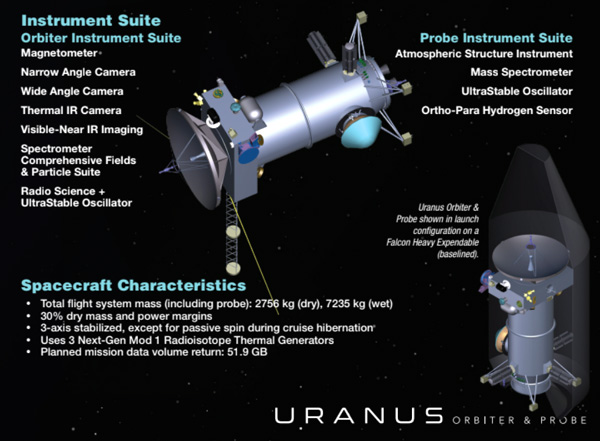
An infographic depicting the Uranus Orbiter & Probe...which could launch to the ice giant aboard SpaceX's Falcon Heavy rocket.

Wednesday, November 24, 2021

On a Collision Course with Dimorphos: NASA's Asteroid-Deflection Mission Begins...

A SpaceX Falcon 9 rocket carrying NASA's DART spacecraft lifts off from Vandenberg Space Force Base's SLC-4E launch pad in California...on November 23, 2021 (Pacific Time).
SpaceX

NASA, SpaceX Launch DART: First Test Mission to Defend Planet Earth (Press Release)

NASA’s Double Asteroid Redirection Test (DART), the world’s first full-scale mission to test technology for defending Earth against potential asteroid or comet hazards, launched Wednesday at 1:21 a.m. EST on a SpaceX Falcon 9 rocket from Space Launch Complex 4-East at Vandenberg Space Force Base in California.

Just one part of NASA’s larger planetary defense strategy, DART – built and managed by the Johns Hopkins Applied Physics Laboratory (APL) in Laurel, Maryland – will impact a known asteroid that is not a threat to Earth. Its goal is to slightly change the asteroid’s motion in a way that can be accurately measured using ground-based telescopes.

DART will show that a spacecraft can autonomously navigate to a target asteroid and intentionally collide with it – a method of deflection called kinetic impact. The test will provide important data to help better prepare for an asteroid that might pose an impact hazard to Earth, should one ever be discovered. LICIACube, a CubeSat riding with DART and provided by the Italian Space Agency (ASI), will be released prior to DART’s impact to capture images of the impact and the resulting cloud of ejected matter. Roughly four years after DART’s impact, ESA’s (European Space Agency) Hera project will conduct detailed surveys of both asteroids, with particular focus on the crater left by DART’s collision and a precise determination of Dimorphos’ mass.

“DART is turning science fiction into science fact and is a testament to NASA’s proactivity and innovation for the benefit of all,” said NASA Administrator Bill Nelson. “In addition to all the ways NASA studies our universe and our home planet, we’re also working to protect that home, and this test will help prove out one viable way to protect our planet from a hazardous asteroid should one ever be discovered that is headed toward Earth.”

At 2:17 a.m., DART separated from the second stage of the rocket. Minutes later, mission operators received the first spacecraft telemetry data and started the process of orienting the spacecraft to a safe position for deploying its solar arrays. About two hours later, the spacecraft completed the successful unfurling of its two, 28-foot-long, roll-out solar arrays. They will power both the spacecraft and NASA’s Evolutionary Xenon Thruster – Commercial ion engine, one of several technologies being tested on DART for future application on space missions.

“At its core, DART is a mission of preparedness, and it is also a mission of unity,” said Thomas Zurbuchen, associate administrator for the Science Mission Directorate at NASA Headquarters in Washington. “This international collaboration involves DART, ASI’s LICIACube, and ESA’s Hera investigations and science teams, which will follow up on this groundbreaking space mission.”

DART’s one-way trip is to the Didymos asteroid system, which comprises a pair of asteroids. DART’s target is the moonlet, Dimorphos, which is approximately 530 feet (160 meters) in diameter. The moonlet orbits Didymos, which is approximately 2,560 feet (780 meters) in diameter.

Since Dimorphos orbits Didymos at much a slower relative speed than the pair orbits the Sun, the result of DART’s kinetic impact within the binary system can be measured much more easily than a change in the orbit of a single asteroid around the Sun.

“We have not yet found any significant asteroid impact threat to Earth, but we continue to search for that sizable population we know is still to be found. Our goal is to find any possible impact, years to decades in advance, so it can be deflected with a capability like DART that is possible with the technology we currently have,” said Lindley Johnson, planetary defense officer at NASA Headquarters. “DART is one aspect of NASA’s work to prepare Earth should we ever be faced with an asteroid hazard. In tandem with this test, we are preparing the Near-Earth Object Surveyor Mission, a space-based infrared telescope scheduled for launch later this decade and designed to expedite our ability to discover and characterize the potentially hazardous asteroids and comets that come within 30 million miles of Earth’s orbit.”

The spacecraft will intercept the Didymos system between Sept. 26 and Oct. 1, 2022, intentionally slamming into Dimorphos at roughly 4 miles per second (6 kilometers per second). Scientists estimate the kinetic impact will shorten Dimorphos’ orbit around Didymos by several minutes. Researchers will precisely measure that change using telescopes on Earth. Their results will validate and improve scientific computer models critical to predicting the effectiveness of the kinetic impact as a reliable method for asteroid deflection.

“It is an indescribable feeling to see something you’ve been involved with since the ‘words on paper’ stage become real and launched into space,” said Andy Cheng, one of the DART investigation leads at Johns Hopkins APL and the individual who came up with the idea of DART. “This is just the end of the first act, and the DART investigation and engineering teams have much work to do over the next year preparing for the main event ─ DART’s kinetic impact on Dimorphos. But tonight we celebrate!”

DART’s single instrument, the Didymos Reconnaissance and Asteroid Camera for Optical navigation (DRACO), will turn on a week from now and provide first images from the spacecraft. DART will continue to travel just outside of Earth’s orbit around the Sun for the next 10 months until Didymos and Dimorphos will be a relatively close 6.8 million miles (11 million kilometers) from Earth.

A sophisticated guidance, navigation, and control system, working together with algorithms called Small-body Maneuvering Autonomous Real Time Navigation (SMART Nav), will enable the DART spacecraft to identify and distinguish between the two asteroids. The system will then direct the spacecraft toward Dimorphos. This process will all occur within roughly an hour of impact.

Johns Hopkins APL manages the DART mission for NASA's Planetary Defense Coordination Office as a project of the agency’s Planetary Missions Program Office. NASA provides support for the mission from several centers, including the Jet Propulsion Laboratory in Southern California, Goddard Space Flight Center in Greenbelt, Maryland, Johnson Space Center in Houston, Glenn Research Center in Cleveland, and Langley Research Center in Hampton, Virginia. The launch is managed by NASA’s Launch Services Program, based at the agency’s Kennedy Space Center in Florida. SpaceX is the launch services provider for the DART mission.

****