Showing posts with label ESCAPADE. Show all posts

Friday, July 24, 2026

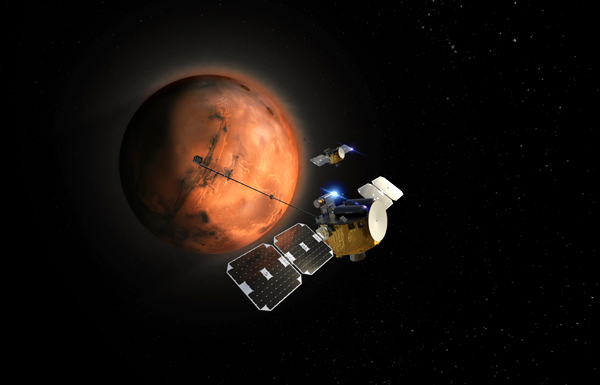
The Latest Update on Rocket Lab's First Interplanetary Spacecraft...

A visible light image of Earth (left) and the Moon as seen by one of NASA's twin ESCAPADE spacecraft from 363,250 miles (584,600 kilometers) away...on July 3, 2026.
NASA / UCB - SSL / NAU - Radiant / Lucint

NASA’s ESCAPADE Snaps Family Portrait of Earth, Moon (News Release)

On July 3, one of NASA’s two Mars-destined ESCAPADE (Escape and Plasma Acceleration and Dynamics Explorers) spacecraft captured photos of Earth and the Moon in visible and thermal infrared light. At the time, the spacecraft was 363,250 miles (584,600 kilometers) from Earth and 115,600 miles (186,100 kilometers) from the Moon, making the Moon appear relatively large.

Taken with the Sun only partly illuminating Earth and the Moon, the visible light image shows the two bodies as crescents, with only around 8% of each face sunlit. Yet in the thermal infrared image, the shadowed hemisphere of Earth is illuminated by its own heat from both the atmosphere and surface, glowing at -10 to -44° Fahrenheit (250 to 280 kelvins). Without the insulating blankets of oceans and atmospheres, the Moon’s far side remains at a much cooler -280° Fahrenheit (100 kelvins).

The ESCAPADE mission used its Visible and Infrared Observation System cameras, provided by Northern Arizona University in Flagstaff, to capture the images, which are more than just road trip photo album snaps.

"We are thrilled that ESCAPADE was able to accommodate these excellent space-qualified cameras which will search for visible Martian aurora and investigate thermal properties of the Martian surface and atmosphere,” said Rob Lillis, the mission’s principal investigator at the University of California, Berkeley. “Since Earth and the Moon are well-known targets, imaging them provides an important calibration check for ESCAPADE’s cameras.”

The ESCAPADE spacecraft, which were built by Rocket Lab, are currently in a “loiter” orbit around Lagrange point 2, a location in space about a million miles from Earth. In November 2026, the spacecraft will fly by Earth to use the planet’s gravity to slingshot their way to Mars. When the spacecraft arrive in September 2027, they will study how a million-mile-per-hour stream of material flowing from the Sun, known as solar wind, interacts with the Martian environment and how that drives atmospheric loss at the Red Planet.

The ESCAPADE mission is funded by NASA’s Heliophysics Division and is part of the NASA Small Innovative Missions for Planetary Exploration program. The UC Berkeley’s Space Sciences Laboratory leads the mission with key partners Rocket Lab; NASA’s Goddard Space Flight Center in Greenbelt, Maryland; Embry-Riddle Aeronautical University; Advanced Space; and Blue Origin.

Source: NASA.Gov

****

An infrared image of Earth and the Moon as seen by one of NASA's twin ESCAPADE spacecraft from 363,250 miles (584,600 kilometers) away...on July 3, 2026.
NASA / UCB - SSL / NAU - Radiant / Lucint

Monday, June 01, 2026

The Latest Update on America's Next Saturn-bound Robotic Explorer...

Lockheed Martin engineer Derek Shannon inspects samples of thermal protection material for the Dragonfly heat shield...before they underwent testing at Sandia National Labs’ Solar Thermal Test Facility in Albuquerque, New Mexico.
NASA

NASA’s Dragonfly Flight System Faces Heat (News Release)

In preparation for the journey to reach the surface of Saturn’s largest moon, Titan, the heat shield for NASA’s Dragonfly mission completed thermal-structural testing in the New Mexico desert. Dragonfly team members, including those from NASA’s Ames Research Center in California’s Silicon Valley, the Johns Hopkins Applied Physics Laboratory (APL) in Laurel, Maryland, and Lockheed Martin in Littleton, Colorado, collaborated with personnel at Sandia National Laboratories’ National Solar Thermal Test Facility in Albuquerque, New Mexico, to stress-test Dragonfly’s heat shield materials, ensuring that the rotorcraft will be safely delivered through Titan’s dense atmosphere.

Dragonfly’s thermal protection material, made from carbon fiber and a lightweight resin, performed as expected in combined mechanical and thermal testing, even in cases when it was intentionally marred with defects.

Sandia’s Solar Tower test facility houses an array of hundreds of calibrated mirror-like systems to focus energy from the Sun onto a tower holding the test unit. Operators generated temperatures around 4,500° Fahrenheit (nearly 2,500° Celsius) on segments of Dragonfly’s heat shield material. Tests examined tolerance to thermal radiation as well as the rapid change in temperature that researchers expect Dragonfly to experience.

The Sandia test series involved multiple iterations in conditions like those expected during Dragonfly’s entry into Titan’s atmosphere. Additional testing subjected large samples of the heat-shield material to mechanical and thermal stress to simultaneously simulate the pressure of high-speed atmospheric entry and intense thermal conditions. Thermal testing of the heat-shield’s curved shoulder units was also performed.

“We were pleased to see the heat shield material pass these tests, even with the flaws we intentionally included, like those that might naturally occur during fabrication and integration,” said Milad Mahzari, the Dragonfly entry vehicle thermal protection system lead at NASA Ames.

Dragonfly’s heat shield uses a variation of a NASA-invented material called PICA, or Phenolic Impregnated Carbon Ablator. The original PICA material was used to deliver NASA’s Curiosity and Perseverance rovers to Mars. PICA-D, a new variant of PICA, is planned for flight on Dragonfly and was the focus of this test series.

“We tested the heat shield as a complete system, including the primary PICA-D material, gap fillers, and potential manufacturing defects,” Mahzari said, adding that researchers plan to conduct additional analysis of PICA-D before final construction of the heat shield begins.

Dragonfly rotorcraft integration and testing continues at APL, which designed Dragonfly and leads the mission for NASA. Dragonfly is scheduled to launch in 2028 and reach Titan in 2034 to conduct science across multiple locations, sample surface materials to measure their detailed compositions, and observe geology and meteorology on the only moon in the Solar System known to have a substantial atmosphere.

Communications on board

Work continues to test and integrate Dragonfly’s communications system, including the antennas that will link the rotorcraft to operators back on Earth.

The team recently measured the signal patterns coming from Dragonfly’s largest antenna – its high-gain antenna, or HGA – in an APL test chamber that simulates the space environment. The HGA is a 34.4-inch diameter radial line slot antenna, which uses many small slots working together to create a narrow, focused radio beam.

The technology for this antenna was originally developed for NASA’s DART mission and is also flying on NASA’s twin ESCAPADE spacecraft.

“A simple way to picture the antenna is as a large flat showerhead: energy enters near the center and spreads out through the slots in a controlled pattern,” said Matt Bray, Dragonfly lead antenna designer at APL. “This design provides a low-cost, durable and compact approach to high-efficiency communications in extreme space environments and also provides aerodynamic benefits.”

The HGA, Dragonfly’s primary antenna for transmitting science data, will be attached to the top deck of the lander on a gimbal that allows it to track Earth from various locations on Titan’s surface. It will be covered with Kapton, a thermal insulator, for protection from Titan’s weather and crafted to operate in the moon’s frigid environment, where ambient temperatures are 290° below zero Fahrenheit (179° below zero Celsius).

The HGA will be one of three antennas on Dragonfly designed for operations at Titan. The lander will also fly a medium-gain antenna, primarily as a backup to the HGA, and a low-gain antenna, primarily to transmit status tones during flight as well as for emergency communications.

Source: NASA.Gov

****

Dragonfly lead antenna designer Matt Bray evaluates Dragonfly’s high-gain antenna in a test chamber at the Johns Hopkins Applied Physics Laboratory in Laurel, Maryland.
NASA / Johns Hopkins APL / Ed Whitman

Wednesday, January 07, 2026

The Latest Update on Rocket Lab's First Interplanetary Spacecraft...

An artist's concept of the Blue and Gold spacecraft, which make up NASA's ESCAPADE mission, flying towards Mars...where the twin spacecraft will actually arrive in September 2027.
Rocket Lab / UC Berkeley

NASA’s Second ESCAPADE Spacecraft Completes Trajectory Maneuver (News Release)

On January 6, the mission operations team for NASA’s ESCAPADE (Escape and Plasma Acceleration and Dynamics Explorers) successfully completed the second trajectory correction maneuver for one of the two spacecraft, after delaying the attempt in December 2025. The other spacecraft completed its first two maneuvers in December as originally planned.

This maneuver sets up the spacecraft for its "loiter" or "Earth-proximity" orbit around a location in space about a million miles from Earth called Lagrange point 2. In November 2026, the twin spacecraft will fly by Earth to use the planet’s gravity to slingshot their way to Mars.

The two ESCAPADE spacecraft will arrive at Mars in September 2027, where they will study how a million-mile-per-hour stream of material flowing from the Sun, known as the solar wind, interacts with the Martian environment and how that drives atmospheric loss at the Red Planet.

Source: NASA.Gov

Monday, November 24, 2025

The Latest Update on New Glenn's Recent Payloads...

Two images showing the side of a solar panel on one of NASA's twin ESCAPADE spacecraft...taken on November 21, 2025.
NASA / UCB - SSL / RL / NAU - Radiant/Lucint

NASA’s Mars-bound ESCAPADE Mission Captures First ‘Selfies’ (News Release)

About a week after its launch, NASA’s ESCAPADE (Escape and Plasma Acceleration and Dynamics Explorers) mission has already captured its first images: a pair of self-portraits showing part of the spacecraft as the twin explorers speed away from Earth.

On November 21, one of the two ESCAPADE spacecraft used its Visible and Infrared Observation System (VISIONS) cameras, provided by Northern Arizona University in Flagstaff, to capture these images, showing part of a solar panel on the spacecraft.

The images prove that the cameras are working well. The visible-light image also suggests that the spacecraft should have the sensitivity to image Martian aurora from orbit. The infrared camera will be used at Mars to better understand how materials on the surface heat up and cool down during Mars’ day-night cycle and over the planet’s seasons.

The second ESCAPADE spacecraft also successfully took its first photos, but it was targeted towards deep space, so the images were simply black.

The twin ESCAPADE spacecraft, built by Rocket Lab and ultimately bound for Mars, launched on November 13 aboard a Blue Origin New Glenn rocket from Cape Canaveral Space Force Station in Florida. Once the ESCAPADE spacecraft reach Mars, they will study how a million-mile-per-hour stream of material flowing from the Sun, known as the solar wind, interacts with the Martian environment and how that drives atmospheric loss at the Red Planet.

Before they head for Mars, though, the two spacecraft are following a “loiter” or “Earth-proximity” orbit around a location in space about a million miles from Earth called Lagrange point 2. In November 2026, they will return to Earth to use our planet’s gravity to slingshot their way to Mars. They will arrive at the Red Planet in September 2027.

Source: NASA.Gov

****

Thursday, November 13, 2025

Blue Origin's Giant Orbital-class Rocket Has Successfully Flown for the Second Time...

A close-up on New Glenn's seven methalox-fueled BE-4 engines as Blue Origin's newest rocket soared into the afternoon sky on its second launch...on November 13, 2025.
Blue Origin

New Glenn Launches NASA’s ESCAPADE, Lands Fully-Reusable Booster (News Release)

Cape Canaveral Space Force Station, Fla. — The New Glenn orbital launch vehicle successfully completed its second mission, deploying NASA’s Escape and Plasma Acceleration and Dynamics Explorers (ESCAPADE) twin spacecraft into the designated loiter orbit, and landing the fully-reusable first stage on Jacklyn in the Atlantic Ocean.

New Glenn’s seven BE-4 engines ignited on Thursday, November 13, 2025, at 3:55:01 PM EST / 20:55:01 UTC from Launch Complex 36 at Cape Canaveral Space Force Station.

“We achieved full mission success today, and I am so proud of the team,” said Dave Limp, CEO, Blue Origin. “It turns out Never Tell Me The Odds had perfect odds—never before in history has a booster this large nailed the landing on the second try. This is just the beginning as we rapidly scale our flight cadence and continue delivering for our customers.”

The ESCAPADE spacecraft will begin their journey to Mars once the planets have returned to the ideal alignment in fall 2026. ESCAPADE will use two identical spacecraft to investigate how the solar wind interacts with Mars’ magnetic environment and how this interaction drives the planet’s atmospheric escape. In addition to deploying the NASA spacecraft, the Viasat HaloNet demonstration onboard New Glenn’s second stage successfully executed the first flight test of Viasat’s telemetry data relay service for NASA’s Communications Services Project.

“Congratulations to Blue Origin, Rocket Lab, UC Berkeley and all of our partners on the successful launch of ESCAPADE," said the acting NASA Administrator, Secretary Sean Duffy. "This heliophysics mission will help reveal how Mars became a desert planet, and how solar eruptions affect the Martian surface. Every launch of New Glenn provides data that will be essential when we launch MK-1 through Artemis.”

New Glenn is foundational to advancing our customers’ critical missions and our own. The vehicle underpins our efforts to establish sustained human presence on the Moon, harness in-space resources, provide multi-mission, multi-orbit mobility through Blue Ring, and establish destinations in low-Earth orbit.

The New Glenn program has several vehicles in production and multiple years of orders. In addition to NASA and Viasat, customers include Amazon’s Project Kuiper, AST SpaceMobile, and several telecommunications providers, among others. The mission marked the vehicle’s second National Security Space Launch (NSSL) certification flight.

Blue Origin is certifying New Glenn with the U.S. Space Force for the NSSL program to meet emerging national security objectives.

"Today was a tremendous achievement for the New Glenn team, opening a new era for Blue Origin and the industry as we look to launch, land, repeat, again and again," said Jordan Charles, Vice President, New Glenn. "We've made significant progress on manufacturing at rate and building ahead of need. Our primary focus remains focused on increasing our cadence and working through our manifest."

Source: Blue Origin

****

Blue Origin's New Glenn rocket successfully sends NASA's twin ESCAPADE spacecraft on a journey to Mars from Launch Complex 36 in Florida...on November 13, 2025.
Blue Origin

Blue Origin's New Glenn rocket successfully sends NASA's twin ESCAPADE spacecraft on a journey to Mars...on November 13, 2025.
Blue Origin

A screenshot of New Glenn's first stage booster, nicknamed 'Never Tell Me The Odds,' sitting on the deck of Blue Origin's drone ship 'Jacklyn' upon the booster's return to Earth...on November 13, 2025.
Blue Origin

New Glenn's first stage booster 'Never Tell Me The Odds' sits on the deck of Blue Origin's drone ship 'Jacklyn' a few hours after the booster returned to Earth...on November 13, 2025.
Blue Origin

New Glenn's first stage booster 'Never Tell Me The Odds' sits on the deck of Blue Origin's drone ship 'Jacklyn' after the booster returned to Earth following a successful launch...on November 13, 2025.
Blue Origin
Blue and Gold, the two spacecraft that make up NASA's ESCAPADE mission, launched to Mars on November 13, 2025.
Rocket Lab

An artist's concept of the Blue and Gold spacecraft, which make up NASA's ESCAPADE mission, flying towards Mars...where the twin spacecraft will actually arrive in September 2027.
Rocket Lab / UC Berkeley

Tuesday, October 08, 2024

The Latest Update on the Mars Sample Return Campaign...

An artist's concept of Rocket Lab's Neutron launch vehicle...which would have an integral part in the company's Mars Sample Return architecture.
Rocket Lab

Rocket Lab Awarded NASA Study Contract to Explore Bringing Rock Samples from Mars to Earth for the First Time (Press Release - October 7)

The study proposes using Rocket Lab’s vertically-integrated technologies to retrieve samples from the Red Planet for the first time in history as part of NASA’s Mars Sample Return Program.

Long Beach, California. Rocket Lab USA, Inc. (Nasdaq: RKLB) (“Rocket Lab” or “the Company”), a global leader in launch services and space systems, today announced that the Company has been selected by NASA to complete a study for retrieving rock samples from the Martian surface and bringing them to Earth for the first time. The mission would fulfill some of the highest priority Solar System exploration goals for the science community – to revolutionize humanity’s understanding of Mars, potentially answer whether life ever existed on the Martian surface, and help prepare for the first human explorers to the Red Planet.

NASA’s Rapid Mission Design Studies for Mars Sample Return solicits industry proposals to carry out rapid studies of mission designs and mission elements capable of delivering samples collected by the Mars Perseverance rover from the surface of Mars to Earth. The results of this study will inform a potential update to NASA’s Mars Sample Return Program and may result in future procurements with industry. Rocket Lab’s study will explore a simplified, end-to-end mission concept that would be delivered for a fraction of the current projected program cost and completed several years earlier than the current expected sample return date in 2040.

“Retrieving samples from Mars is one of the most ambitious and scientifically important endeavors humanity has ever embarked upon. We’ve developed an innovative mission concept to make it happen affordably and on an accelerated schedule,” said Rocket Lab founder and CEO, Sir Peter Beck. “Rocket Lab has been methodically implementing a strategy for cost-effective planetary science in recent years, making us uniquely suited to deliver a low-cost, rapid Mars Sample Return. We’ve demonstrated this strategy by delivering a NASA mission to the Moon, enabling rendezvous and proximity operations in orbit, successfully re-entering a capsule from orbit to Earth, delivering two spacecraft to NASA for a Mars mission, and much more. We look forward to bringing our proven capabilities together to deliver a compelling, innovative mission solution that puts Mars rocks in the hands of scientists sooner.”

Rocket Lab’s proposed mission architecture will be revealed once the study is complete in the coming months.

Source: Rocket Lab

Friday, September 06, 2024

Rocket Lab's First Interplanetary Spacecraft Will Now Head to the Red Planet Next Year...

An artist's concept of the twin ESCAPADE spacecraft, named Blue and Gold, flying towards Mars.
James Rattray / Rocket Lab USA

NASA Stands Down from October Launch for ESCAPADE to Mars (News Release)

NASA announced Friday that it will not fuel the two ESCAPADE (Escape and Plasma Acceleration and Dynamics Explorers) spacecraft at this time, foregoing the mission’s upcoming October launch window. While future launch opportunities are under review, the next possible earliest launch date is spring 2025.

The agency’s decision to stand down was based on a review of launch preparations and discussions with Blue Origin, the Federal Aviation Administration, and Space Launch Delta 45 Range Safety Organization, as well as NASA’s Launch Services Program and Science Mission Directorate. The decision was made to avoid significant cost, schedule and technical challenges associated with potentially removing fuel from the spacecraft in the event of a launch delay, which could be caused by a number of factors.

“This mission can help us study the atmosphere at Mars — key information as we explore farther and farther into our Solar System and need to protect astronauts and spacecraft from space weather,” said Nicky Fox, associate administrator for science at NASA Headquarters in Washington. “We’re committed to seeing ESCAPADE safely into space, and I look forward to seeing it off the ground and on its trip to Mars.”

The alignment of Earth and Mars constrains ESCAPADE’s windows of launch opportunities to the Red Planet. This means that small schedule changes can result in months-long delays in launch. The mission team is analyzing larger planetary window opportunities.

NASA and Blue Origin are discussing an additional opportunity to launch the spacecraft to Mars no earlier than spring 2025.

“This is an important mission for NASA, and it’s critical we have sufficient margin in our prelaunch work to ensure we are ready to fly a tight planetary window,” said Bradley Smith, NASA’s Launch Services Office director at NASA Headquarters.

The ESCAPADE mission will use two identical spacecraft to study how the solar wind interacts with Mars’ magnetic environment, driving the planet’s atmospheric escape. The mission falls under NASA’s Heliophysics Division and is part of NASA's Small Innovative Missions for Planetary Exploration program. The mission is led by the University of California, Berkeley’s Space Sciences Laboratory, with key partners Rocket Lab; NASA’s Goddard Space Flight Center in Greenbelt, Maryland; Embry Riddle Aeronautical University; and Advanced Space LLC.

NASA’s Launch Services Program, based at Kennedy Space Center in Florida, secured the launch service with Blue Origin under the VADR (Venture-class Acquisition of Dedicated and Rideshare) contract.

Source: NASA.Gov

Friday, August 16, 2024

The ESCAPADE Spacecraft Move One Step Closer to Venturing to the Red Planet Later This Year...

An image of Blue and Gold, the two spacecraft that make up the ESCAPADE mission, being prepped for shipment from Rocket Lab's facility in Long Beach, California to NASA's Kennedy Space Center in Florida.
Rocket Lab

Rocket Lab Ships Twin Satellites to Launch Site for NASA Mars Mission (Press Release)

Long Beach, Calif. – Rocket Lab USA, Inc. (Nasdaq: RKLB) (“Rocket Lab” or “the Company”), a global leader in launch services and space systems, has successfully packed and shipped two Mars-bound spacecraft to Cape Canaveral, FL in preparation for launch. These twin spacecraft for the Escape and Plasma Acceleration and Dynamics Explorers (ESCAPADE) heliophysics mission were designed, built, integrated and tested by Rocket Lab for the University of California Berkeley’s Space Science Laboratory and NASA.

The spacecraft, known as Blue and Gold, recently completed comprehensive assembly, integration and test at Rocket Lab’s Spacecraft Production Complex and headquarters in Long Beach, California. Following this milestone, the Rocket Lab team conducted final closeout activities, including the installation of spacecraft solar arrays and multi-layer insulation (MLI) blankets, before they were packaged and shipped to Florida for launch.

Upon arrival at NASA’s Kennedy Space Center (KSC) Launch Complex, Rocket Lab team members will transfer the spacecraft to a cleanroom for post-transport inspections and tests. Following thorough checks, the team will commence preparation for fueling the spacecraft in anticipation of their upcoming launch on Blue Origin’s New Glenn rocket.

“We’ve already been to the Moon for NASA, so we’re excited to build on that and send Rocket Lab technology deeper into the solar system, this time to the Red Planet,” said Rocket Lab founder and CEO Sir Peter Beck. “Our Space Systems team has built a beautiful and highly-capable pair of spacecraft to help NASA and the University of California Berkeley further humanity’s understanding of Mars. We couldn’t be prouder to be an ESCAPADE mission partner enabling science and exploration missions beyond our planet. After a meticulous but speedy build and test phase, we’re excited to have Blue and Gold on their way to the Cape and a step closer to Mars.”

"The successful delivery of the spacecraft to Kennedy Space Center marks a significant milestone and the culmination of over three years of dedicated teamwork from individuals across the project, especially our partners at Rocket Lab,” said Rob Lillis, ESCAPADE Principal Investigator and Associate Director for Planetary Science at the UC Berkeley Space Sciences Laboratory. “Interplanetary spacecraft must be much more resilient than earth satellites, and developing not one, but two of these probes almost from scratch was no small feat. Time and again, Rocket Lab’s agility and tireless efforts have impressed me, exemplified by their frequent 'hero mode' (a saying we have on the project) to troubleshoot and keep the project on course. We couldn’t ask for better partners in this endeavor. Now, we’re thrilled to embark on this first step of our journey to Mars!"

Once launched, the ESCAPADE mission will measure plasma and magnetic fields around the Red Planet. These observations will help scientists unravel the processes that strip atoms from Mars’ magnetosphere and upper atmosphere, offering critical insights into Martian climate evolution.

Source: Rocket Lab

****

An artist's concept of the Blue and Gold spacecraft flying towards Mars.
Rocket Lab

Thursday, February 09, 2023

A Rocket Has Been Chosen for Two Rocket Lab-built Spacecraft Heading to the Red Planet...

An artist's concept of two Photon spacecraft, which make up the ESCAPADE mission, flying towards Mars.
Rocket Lab USA / UC Berkeley

NASA Selects Blue Origin to Launch Mars’ Magnetosphere Study Mission (Press Release)

NASA has awarded Blue Origin, LLC of Kent, Washington a task order to provide launch service for the agency’s Escape and Plasma Acceleration and Dynamics Explorers (ESCAPADE) mission as part of the agency's Venture-Class Acquisition of Dedicated and Rideshare (VADR) launch services contract.

ESCAPADE will launch on Blue Origin’s New Glenn rocket from Space Launch Complex-36 at Cape Canaveral Space Force Station in Florida. Launch is targeted for late 2024.

Blue Origin is one of 13 companies NASA selected for VADR contracts in 2022. NASA’s Launch Services Program, based at the agency’s Kennedy Space Center in Florida, manages the VADR contracts.

As part of VADR, the fixed-price indefinite-delivery/indefinite-quantity contracts have a five-year ordering period with a maximum total value of $300 million across all contracts.

ESCAPADE will study Mars’ magnetosphere – the magnetized area of space around the planet – using two identical small spacecraft, which will provide simultaneous two-point observations. The spacecraft will help provide researchers a better understanding of how the magnetosphere interacts with the solar wind, and how energy and plasma enter and leave the magnetosphere.

Each satellite will carry three instruments: a magnetometer for measuring magnetic field, an electrostatic analyzer to measure ions and electrons, and a Langmuir probe for measuring plasma density and solar extreme ultraviolet flux.

It will take ESCAPADE about 11 months to arrive at Mars after leaving Earth’s orbit, where both spacecraft will spend several months adjusting their orbits before they are in position to best capture data about the magnetosphere. Studying different magnetospheres gives scientists a better understanding of space weather, which can protect both astronauts and satellites as they orbit Earth and explore the solar system.

ESCAPADE is part of the NASA Small Innovative Missions for Planetary Exploration program.

Building on NASA's previous procurement efforts to foster development of new launch vehicles for NASA payloads, VADR provides FAA-licensed commercial launch services for payloads that can tolerate higher risk. By using a lower level of mission assurance, and commercial best practices for launching rockets, these highly-flexible contracts help broaden access to space through lower launch costs.

****

An artist's concept of Blue Origin's New Glenn rocket heading towards space.
Blue Origin

Thursday, June 17, 2021

Two Photons Might Head to the Red Planet Three Years from Now...

An artist's concept of two Photon spacecraft, which make up the ESCAPADE mission, flying towards Mars.
Rocket Lab

Rocket Lab Awarded Subcontract to Design Twin Spacecraft for Mars (Press Release - June 15)

The two Rocket Lab Photon spacecraft for the ESCAPADE mission to Mars are part of NASA’s Small Innovative Missions for Planetary Exploration (SIMPLEx) program

Long Beach, California. Rocket Lab, a global leader in dedicated launch and space systems, has been awarded a subcontract by the University of California Berkeley Space Sciences Laboratory (UCBSSL) to design two Photon spacecraft for a scientific mission to Mars.

The Escape and Plasma Acceleration and Dynamics Explorers (ESCAPADE) mission, led by Rob Lillis at UCBSSL, is a twin-spacecraft science mission that will orbit two spacecraft around Mars to understand the structure, composition, variability, and dynamics of Mars' unique hybrid magnetosphere. The mission will leverage its unique dual viewpoint on the Mars environment to explore how the solar wind strips atmosphere away from Mars to better understand how its climate has changed over time.

ESCAPADE is being developed under NASA’s Small Innovative Missions for Planetary Exploration (SIMPLEx) program in the Science Mission Directorate (SMD). The mission is led by UCBSSL with spacecraft design provided by Rocket Lab. The two spacecraft are planned for launch in 2024 to Mars ridesharing aboard a NASA-provided commercial launch vehicle.

Following an 11-month interplanetary cruise, the two Photons (named Blue and Gold) will insert themselves into elliptical orbits around Mars and conduct a 1-year primary science mission. ESCAPADE’s Photons will use the flight-proven Curie propulsion system to perform Mars orbit insertion and will be equipped with other subsystems that enable planetary science, including star trackers and reaction wheels for precision pointing from Rocket Lab’s Sinclair Interplanetary team, as well as ranging transceivers for deep space navigation.

Rocket Lab founder and CEO, Peter Beck says: “This is a hugely promising mission that will deliver big science in a small package. Planetary science missions have traditionally costed hundreds of millions of dollars and taken up to a decade to come to fruition. Our Photon spacecraft for ESCAPADE will demonstrate a more cost-effective approach to planetary exploration that will increase the science community’s access to our solar system for the better.”

ESCAPADE is one of three missions selected in 2019 by NASA’s SIMPLEx program to conduct compelling planetary science and provide more opportunities for flight experience to the science community. ESCAPADE will undergo a NASA preliminary design review in June and a confirmation review in July determining whether the mission proceeds to implementation and flight.

Source: Rocket Lab

Friday, February 28, 2020

SpaceX Update: Getting 'Psyched' Up for Another Falcon Heavy Flight!

SpaceX's Falcon Heavy rocket lifts off on its maiden flight from Launch Complex 39A at NASA's Kennedy Space Center in Florida...on February 6, 2018.
SpaceX

NASA Awards Launch Services Contract for the Psyche Mission (Press Release)

NASA has selected SpaceX of Hawthorne, California, to provide launch services for the agency’s Psyche mission. The Psyche mission currently is targeted to launch in July 2022 on a Falcon Heavy rocket from Launch Complex 39A at NASA's Kennedy Space Center in Florida.

The total cost for NASA to launch Psyche and the secondary payloads is approximately $117 million, which includes the launch service and other mission related costs.

The Psyche mission will journey to a unique metal-rich asteroid, also named Psyche, which orbits the Sun between Mars and Jupiter. The asteroid is considered unique, as it appears to largely be made of the exposed nickel-iron core of an early planet – one of the building blocks of our solar system.

Deep within rocky, terrestrial planets, including Earth, scientists infer the presence of metallic cores, but these lie unreachably far below the planet’s rocky mantles and crusts. Because we cannot see or measure Earth’s core directly, the mission to Psyche offers a unique window into the violent history of collisions and accretion that created terrestrial planets.

The launch of Psyche will include two secondary payloads: Escape and Plasma Acceleration and Dynamics Explorers (EscaPADE), which will study the Martian atmosphere, and Janus, which will study binary asteroids.

NASA’s Launch Services Program at Kennedy Space Center in Florida will manage the SpaceX launch service. The mission is led by Arizona State University. NASA’s Jet Propulsion Laboratory is responsible for the mission’s overall management, system engineering, integration, testing and mission operations. Maxar Technologies is providing a high-power solar electric propulsion spacecraft chassis.

Source: NASA.Gov

****

An artist's concept of the Psyche spacecraft orbiting a metallic asteroid named Psyche.
NASA / JPL - Caltech