Showing posts with label Blue Origin. Show all posts

Friday, September 04, 2026

Lookin' Ahead to One of the Next American Missions to the Red Planet...

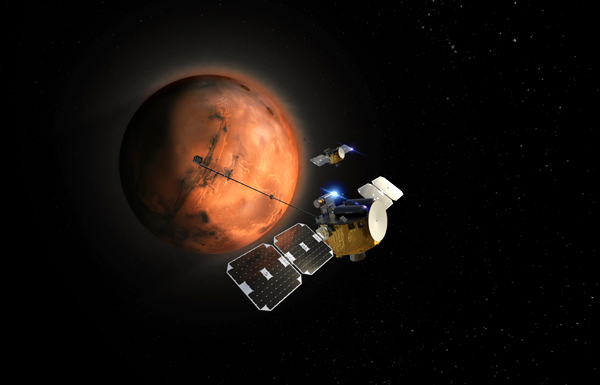
An artist's concept of Blue Origin's Mars Telecommunications Orbiter deploying a payload to the Red Planet.
Blue Origin

NASA Selects Blue Origin as Mars Telecommunications Network Provider (News Release - September 1)

NASA awarded Blue Origin a contract Tuesday to develop the agency’s Mars Telecommunications Network, a next-generation communications system that will enable reliable, high-bandwidth communications and navigation services for current and future Mars missions.

The firm-fixed-price contract has a maximum potential value of approximately $700 million to deliver a high-performance Mars telecommunications orbiter to NASA no later than December 31, 2028.

Blue Origin will design, develop, integrate, launch and operate the network as a part of the agency’s broader space communications and navigation infrastructure. The architecture will consist of a high-performance telecommunications spacecraft orbiting Mars, transmitting science data, imagery, navigation information, and critical mission communications for spacecraft operating on and around the planet.

The award marks a milestone in NASA’s strategy to expand communications and navigation services beyond Earth and the Moon, establishing the foundation for sustained exploration of Mars in the coming decades.

Under the Artemis program, NASA is sending astronauts to explore the Moon and prepare for missions to Mars. Robotic missions will pave the way for human exploration of the Red Planet, and as these missions expand, demand for data will continue to increase. To meet this need, NASA is pursuing a purpose-built network capable of supporting a growing number of missions while providing greater capacity, reliability and operational flexibility.

The selection follows NASA’s request for proposal issued in May. As the agency increasingly taps commercial partners for transportation and communications services in Earth orbit and to develop the Moon Base, the Mars Telecommunications Network initiative similarly seeks to harness private-sector capabilities while enabling NASA to focus on exploration and scientific discovery.

The network, managed by NASA’s Space Communications and Navigation program, is expected to be operational at Mars by 2030 and will support both current and future missions to the Red Planet, as NASA ventures deeper into space.

Source: NASA.Gov

Friday, July 24, 2026

The Latest Update on Rocket Lab's First Interplanetary Spacecraft...

A visible light image of Earth (left) and the Moon as seen by one of NASA's twin ESCAPADE spacecraft from 363,250 miles (584,600 kilometers) away...on July 3, 2026.
NASA / UCB - SSL / NAU - Radiant / Lucint

NASA’s ESCAPADE Snaps Family Portrait of Earth, Moon (News Release)

On July 3, one of NASA’s two Mars-destined ESCAPADE (Escape and Plasma Acceleration and Dynamics Explorers) spacecraft captured photos of Earth and the Moon in visible and thermal infrared light. At the time, the spacecraft was 363,250 miles (584,600 kilometers) from Earth and 115,600 miles (186,100 kilometers) from the Moon, making the Moon appear relatively large.

Taken with the Sun only partly illuminating Earth and the Moon, the visible light image shows the two bodies as crescents, with only around 8% of each face sunlit. Yet in the thermal infrared image, the shadowed hemisphere of Earth is illuminated by its own heat from both the atmosphere and surface, glowing at -10 to -44° Fahrenheit (250 to 280 kelvins). Without the insulating blankets of oceans and atmospheres, the Moon’s far side remains at a much cooler -280° Fahrenheit (100 kelvins).

The ESCAPADE mission used its Visible and Infrared Observation System cameras, provided by Northern Arizona University in Flagstaff, to capture the images, which are more than just road trip photo album snaps.

"We are thrilled that ESCAPADE was able to accommodate these excellent space-qualified cameras which will search for visible Martian aurora and investigate thermal properties of the Martian surface and atmosphere,” said Rob Lillis, the mission’s principal investigator at the University of California, Berkeley. “Since Earth and the Moon are well-known targets, imaging them provides an important calibration check for ESCAPADE’s cameras.”

The ESCAPADE spacecraft, which were built by Rocket Lab, are currently in a “loiter” orbit around Lagrange point 2, a location in space about a million miles from Earth. In November 2026, the spacecraft will fly by Earth to use the planet’s gravity to slingshot their way to Mars. When the spacecraft arrive in September 2027, they will study how a million-mile-per-hour stream of material flowing from the Sun, known as solar wind, interacts with the Martian environment and how that drives atmospheric loss at the Red Planet.

The ESCAPADE mission is funded by NASA’s Heliophysics Division and is part of the NASA Small Innovative Missions for Planetary Exploration program. The UC Berkeley’s Space Sciences Laboratory leads the mission with key partners Rocket Lab; NASA’s Goddard Space Flight Center in Greenbelt, Maryland; Embry-Riddle Aeronautical University; Advanced Space; and Blue Origin.

Source: NASA.Gov

****

An infrared image of Earth and the Moon as seen by one of NASA's twin ESCAPADE spacecraft from 363,250 miles (584,600 kilometers) away...on July 3, 2026.
NASA / UCB - SSL / NAU - Radiant / Lucint

Monday, November 24, 2025

The Latest Update on New Glenn's Recent Payloads...

Two images showing the side of a solar panel on one of NASA's twin ESCAPADE spacecraft...taken on November 21, 2025.
NASA / UCB - SSL / RL / NAU - Radiant/Lucint

NASA’s Mars-bound ESCAPADE Mission Captures First ‘Selfies’ (News Release)

About a week after its launch, NASA’s ESCAPADE (Escape and Plasma Acceleration and Dynamics Explorers) mission has already captured its first images: a pair of self-portraits showing part of the spacecraft as the twin explorers speed away from Earth.

On November 21, one of the two ESCAPADE spacecraft used its Visible and Infrared Observation System (VISIONS) cameras, provided by Northern Arizona University in Flagstaff, to capture these images, showing part of a solar panel on the spacecraft.

The images prove that the cameras are working well. The visible-light image also suggests that the spacecraft should have the sensitivity to image Martian aurora from orbit. The infrared camera will be used at Mars to better understand how materials on the surface heat up and cool down during Mars’ day-night cycle and over the planet’s seasons.

The second ESCAPADE spacecraft also successfully took its first photos, but it was targeted towards deep space, so the images were simply black.

The twin ESCAPADE spacecraft, built by Rocket Lab and ultimately bound for Mars, launched on November 13 aboard a Blue Origin New Glenn rocket from Cape Canaveral Space Force Station in Florida. Once the ESCAPADE spacecraft reach Mars, they will study how a million-mile-per-hour stream of material flowing from the Sun, known as the solar wind, interacts with the Martian environment and how that drives atmospheric loss at the Red Planet.

Before they head for Mars, though, the two spacecraft are following a “loiter” or “Earth-proximity” orbit around a location in space about a million miles from Earth called Lagrange point 2. In November 2026, they will return to Earth to use our planet’s gravity to slingshot their way to Mars. They will arrive at the Red Planet in September 2027.

Source: NASA.Gov

****

Thursday, November 13, 2025

Blue Origin's Giant Orbital-class Rocket Has Successfully Flown for the Second Time...

A close-up on New Glenn's seven methalox-fueled BE-4 engines as Blue Origin's newest rocket soared into the afternoon sky on its second launch...on November 13, 2025.
Blue Origin

New Glenn Launches NASA’s ESCAPADE, Lands Fully-Reusable Booster (News Release)

Cape Canaveral Space Force Station, Fla. — The New Glenn orbital launch vehicle successfully completed its second mission, deploying NASA’s Escape and Plasma Acceleration and Dynamics Explorers (ESCAPADE) twin spacecraft into the designated loiter orbit, and landing the fully-reusable first stage on Jacklyn in the Atlantic Ocean.

New Glenn’s seven BE-4 engines ignited on Thursday, November 13, 2025, at 3:55:01 PM EST / 20:55:01 UTC from Launch Complex 36 at Cape Canaveral Space Force Station.

“We achieved full mission success today, and I am so proud of the team,” said Dave Limp, CEO, Blue Origin. “It turns out Never Tell Me The Odds had perfect odds—never before in history has a booster this large nailed the landing on the second try. This is just the beginning as we rapidly scale our flight cadence and continue delivering for our customers.”

The ESCAPADE spacecraft will begin their journey to Mars once the planets have returned to the ideal alignment in fall 2026. ESCAPADE will use two identical spacecraft to investigate how the solar wind interacts with Mars’ magnetic environment and how this interaction drives the planet’s atmospheric escape. In addition to deploying the NASA spacecraft, the Viasat HaloNet demonstration onboard New Glenn’s second stage successfully executed the first flight test of Viasat’s telemetry data relay service for NASA’s Communications Services Project.

“Congratulations to Blue Origin, Rocket Lab, UC Berkeley and all of our partners on the successful launch of ESCAPADE," said the acting NASA Administrator, Secretary Sean Duffy. "This heliophysics mission will help reveal how Mars became a desert planet, and how solar eruptions affect the Martian surface. Every launch of New Glenn provides data that will be essential when we launch MK-1 through Artemis.”

New Glenn is foundational to advancing our customers’ critical missions and our own. The vehicle underpins our efforts to establish sustained human presence on the Moon, harness in-space resources, provide multi-mission, multi-orbit mobility through Blue Ring, and establish destinations in low-Earth orbit.

The New Glenn program has several vehicles in production and multiple years of orders. In addition to NASA and Viasat, customers include Amazon’s Project Kuiper, AST SpaceMobile, and several telecommunications providers, among others. The mission marked the vehicle’s second National Security Space Launch (NSSL) certification flight.

Blue Origin is certifying New Glenn with the U.S. Space Force for the NSSL program to meet emerging national security objectives.

"Today was a tremendous achievement for the New Glenn team, opening a new era for Blue Origin and the industry as we look to launch, land, repeat, again and again," said Jordan Charles, Vice President, New Glenn. "We've made significant progress on manufacturing at rate and building ahead of need. Our primary focus remains focused on increasing our cadence and working through our manifest."

Source: Blue Origin

****

Blue Origin's New Glenn rocket successfully sends NASA's twin ESCAPADE spacecraft on a journey to Mars from Launch Complex 36 in Florida...on November 13, 2025.
Blue Origin

Blue Origin's New Glenn rocket successfully sends NASA's twin ESCAPADE spacecraft on a journey to Mars...on November 13, 2025.
Blue Origin

A screenshot of New Glenn's first stage booster, nicknamed 'Never Tell Me The Odds,' sitting on the deck of Blue Origin's drone ship 'Jacklyn' upon the booster's return to Earth...on November 13, 2025.
Blue Origin

New Glenn's first stage booster 'Never Tell Me The Odds' sits on the deck of Blue Origin's drone ship 'Jacklyn' a few hours after the booster returned to Earth...on November 13, 2025.
Blue Origin

New Glenn's first stage booster 'Never Tell Me The Odds' sits on the deck of Blue Origin's drone ship 'Jacklyn' after the booster returned to Earth following a successful launch...on November 13, 2025.
Blue Origin
Blue and Gold, the two spacecraft that make up NASA's ESCAPADE mission, launched to Mars on November 13, 2025.
Rocket Lab

An artist's concept of the Blue and Gold spacecraft, which make up NASA's ESCAPADE mission, flying towards Mars...where the twin spacecraft will actually arrive in September 2027.
Rocket Lab / UC Berkeley

Friday, September 19, 2025

Brought Back from Cancellation, Artemis' Robotic Rover Has Found a New Ride to the Lunar Surface...

An artist's concept of NASA's VIPER rover rolling away from Blue Origin's Blue Moon Mark 1 lander on the lunar surface.
Blue Origin

NASA Selects Blue Origin to Deliver VIPER Rover to Moon’s South Pole (News Release)

As part of the agency’s Artemis campaign, NASA has awarded Blue Origin of Kent, Washington, a CLPS (Commercial Lunar Payload Services) task order with an option to deliver a rover to the Moon’s South Pole region. NASA’s VIPER (Volatiles Investigating Polar Exploration Rover) will search for volatile resources, such as ice, on the lunar surface and collect science data to support future exploration at the Moon and Mars.

“NASA is leading the world in exploring more of the Moon than ever before, and this delivery is just one of many ways we’re leveraging U.S. industry to support a long-term American presence on the lunar surface,” said acting NASA Administrator Sean Duffy. “Our rover will explore the extreme environment of the lunar South Pole, traveling to small, permanently shadowed regions to help inform future landing sites for our astronauts and better understand the Moon’s environment – important insights for sustaining humans over longer missions, as America leads our future in space.”

The CLPS task order has a total potential value of $190 million. This is the second CLPS lunar delivery awarded to Blue Origin. Their first delivery – using their Blue Moon Mark 1 (MK1) robotic lander – is targeted for launch later this year to deliver NASA’s Stereo Cameras for Lunar-Plume Surface Studies and Laser Retroreflective Array payloads to the Moon’s South Pole region.

With this new award, Blue Origin will deliver VIPER to the lunar surface in late 2027, using a second Blue Moon MK1 lander, which is in production. NASA previously canceled the VIPER project and has since explored alternative approaches to achieve the agency’s goals of mapping potential off-planet resources, like water.

“NASA is committed to studying and exploring the Moon, including learning more about water on the lunar surface, to help determine how we can harness local resources for future human exploration,” said Nicky Fox, associate administrator, Science Mission Directorate, NASA Headquarters in Washington. “We’ve been looking for creative, cost-effective approaches to accomplish these exploration goals. This private sector-developed landing capability enables this delivery and focuses our investments accordingly – supporting American leadership in space and ensuring our long-term exploration is robust and affordable.”

The task order, called CS-7, has an award base to design the payload-specific accommodations and to demonstrate how Blue Origin’s flight design will off-load the rover to the lunar surface. There is an option on the contract to deliver and safely deploy the rover to the Moon’s surface. NASA will make the decision to exercise that option after the execution and review of the base task and of Blue Origin’s first flight of the Blue Moon MK1 lander.

This unique approach will reduce the agency’s cost and technical risk. The rover has a targeted science window for its 100-day mission that requires a landing by late 2027.

Blue Origin is responsible for the complete landing mission architecture and will conduct design, analysis and testing of a large lunar lander capable of safely delivering the lunar volatiles science rover to the Moon. Blue Origin will also handle end-to-end payload integration, planning and support, and post-landing payload deployment activities. NASA will conduct rover operations and science planning.

“The search for lunar volatiles plays a key role in NASA’s exploration of the Moon, with important implications for both science and human missions under Artemis,” said Joel Kearns, deputy associate administrator for exploration, Science Mission Directorate, NASA Headquarters. “This delivery could show us where ice is most likely to be found and easiest to access, as a future resource for humans. And by studying these sources of lunar water, we also gain valuable insight into the distribution and origin of volatiles across the Solar System, helping us better understand the processes that have shaped our space environment and how our inner Solar System has evolved.”

Through CLPS, American companies continue to demonstrate leadership in commercial space advancing capabilities and accomplishing NASA’s goal for a commercial lunar economy. NASA’s Ames Research Center in California’s Silicon Valley led the VIPER rover development and will lead its science investigations, and NASA’s Johnson Space Center in Houston provided rover engineering development for Ames.

Source: NASA.Gov

****

NASA's VIPER rover is fully assembled at the Johnson Space Center in Houston, Texas.
NASA

Monday, March 31, 2025

Photos of the Day: Blue Ghost in Mini-Brick Form...

My mini-brick Blue Ghost lunar lander is now protected by an acrylic case at home...on March 30, 2025.
Richard T. Par

Just thought I'd end March by sharing these images of the Blue Ghost mini-brick model that I bought from Firefly Aerospace earlier this month!

As mentioned in this entry from my Human Spaceflight Blog, I planned on ordering the Blue Ghost model online if the actual lander successfully touched down on the Moon over four weeks ago. And successfully touched down Blue Ghost did!

Unlike my LEGO® Artemis 1 rocket and Perseverance Mars rover, as well as my Atom Brick New Glenn rocket, Blue Ghost was relatively quick to build—as it 'only' consisted of 196 pieces. Just like my Artemis 1 rocket and the Percy rover, Blue Ghost is now kept dust-free inside an acrylic case that I bought online.

I initially bought a 4.2"x4.2"x4.2" glass case from a local Michaels store...but Blue Ghost barely fits inside this display. So I went to Amazon and purchased a 5"x5"x5" case, and the mini-brick lander fits perfectly in that one! (The 4.2"x4.2"x4.2" case now holds a LEGO Boba Fett figure and Grogu figurine, which you can see in the very last photo of this entry.)

Astrobotic has a mini-brick version of its Griffin lunar lander, which is scheduled to launch no earlier than this December. Just like with Blue Ghost, I intend on waiting to see the outcome of Griffin Mission One before I decide to buy something to commemorate Astrobotic's next Moon flight. Happy Monday!

The package for the mini-brick Blue Ghost lunar lander...courtesy of Firefly Aerospace.
Richard T. Par

My mini-brick Blue Ghost lunar lander after it was completed on March 15, 2025.
Richard T. Par

My mini-brick Blue Ghost lunar lander after it was completed on March 15, 2025.
Richard T. Par

My mini-brick Blue Ghost lunar lander after it was completed on March 15, 2025.
Richard T. Par

My mini-brick Blue Ghost lunar lander now rests atop my LEGO® Artemis 1 rocket at home...on March 15, 2025.
Richard T. Par

Now enclosed inside a small acrylic case, my mini-brick Blue Ghost lunar lander rests atop my LEGO® Artemis 1 rocket at home...on March 30, 2025.
Richard T. Par

Now enclosed inside a small acrylic case, my mini-brick Blue Ghost lunar lander rests atop my LEGO® Artemis 1 rocket at home...on March 30, 2025.
Richard T. Par

A LEGO® Boba Fett figure and Grogu figurine now rest inside an acrylic case that I originally bought for my mini-brick Blue Ghost lunar lander.
Richard T. Par

Monday, March 24, 2025

The Third Blue Ghost Lander Will Carry a Wheeled Passenger to the Moon...

An artist's concept of Firefly Aerospace's Blue Ghost lunar lander and Honeybee Robotics' rover on the surface of the Moon.
Firefly Aerospace

Firefly Aerospace Selects Blue Origin’s Honeybee Robotics to Provide Rover for Lunar Mission to Gruithuisen Domes (Press Release)

Cedar Park, Texas – Firefly Aerospace and Honeybee Robotics, a Blue Origin company, today announced that Honeybee was contracted by Firefly to provide the lunar rover for the company’s recently-awarded NASA task order to explore the Gruithuisen Domes on the Moon’s near side in 2028. Once deployed on the Moon by Firefly’s Blue Ghost lander, Honeybee’s rover will carry NASA instruments to investigate the unique composition of the Gruithuisen Domes – a part of the Moon that has never been explored.

“We’re excited to support Firefly’s mission to the Gruithuisen Domes by providing surface mobility, a key capability for lunar permanence,” said Paul Ebertz, senior vice president of In-Space Systems, Blue Origin. “With this rover, Honeybee Robotics builds on its legacy of advanced robotics and hardware designed for exploration throughout our Solar System.”

During mission operations, Firefly’s Elytra Dark transfer vehicle will first deploy the Blue Ghost lander into lunar orbit and then remain on orbit to provide long-haul communications. Blue Ghost will then land in the Gruithuisen Domes, deploy the Honeybee Robotics rover, and support payload operations for approximately 14 days on the lunar surface.

“Firefly is proud to partner with Honeybee Robotics to help us explore the challenging Gruithuisen Domes terrain on our third mission to the Moon,” said Shea Ferring, Chief Technology Officer at Firefly Aerospace. “The Firefly team has worked closely with Honeybee on two payloads – the Lunar PlanetVac and LISTER subsurface drill – that were successfully operated on our first Blue Ghost mission to the Moon. Their stellar team, robust rover solution, and flight-proven technologies made Honeybee the obvious choice!”

As part of Firefly’s third mission to the Moon, Honeybee’s rover will help investigate the subsurface composition of the Gruithuisen Gamma Dome carrying elements of NASA’s Lunar Vulkan Imaging and Spectroscopy Explorer (Lunar-VISE) suite. Lunar-VISE has multiple instruments, including two cameras attached to Firefly’s Blue Ghost lander that will characterize the landing site and rover traverse as well as an infrared multi-spectral camera system and a spectrometer attached to Honeybee’s rover that will measure gamma ray and neutron emissions.

The rover will travel along the southern edge of the Gruithuisen Gamma Dome and through a boulder field to reach the rim of a recent impact crater. The rover will then traverse back to the lander just before sunset to enable repeat observations of boulder targets at different solar illumination angles.

In total, there are six NASA-sponsored payloads onboard Firefly’s Blue Ghost Mission 3 that aim to uncover the composition and fundamental volcanic processes that formed the domes, in addition to other science investigations and technology demonstrations. This mission will follow Firefly’s first mission to the Moon that successfully landed in Mare Crisium and completed 14 days of surface operations in March 2025. Firefly’s second lunar mission is set to launch in 2026 with operations in lunar orbit and on the far side of the Moon.

Source: Firefly Aerospace

****

An earlier art concept of a Blue Ghost lander, as well as a rover built by an industry provider, that Firefly Aerospace will send to the Moon on its third NASA CLPS mission in 2028.
Firefly Aerospace

An image of the Gruithuisen Domes...taken by NASA's Lunar Reconnaissance Orbiter.
NASA / GSFC / Arizona State University

Friday, September 06, 2024

Rocket Lab's First Interplanetary Spacecraft Will Now Head to the Red Planet Next Year...

An artist's concept of the twin ESCAPADE spacecraft, named Blue and Gold, flying towards Mars.
James Rattray / Rocket Lab USA

NASA Stands Down from October Launch for ESCAPADE to Mars (News Release)
NASA announced Friday that it will not fuel the two ESCAPADE (Escape and Plasma Acceleration and Dynamics Explorers) spacecraft at this time, foregoing the mission’s upcoming October launch window. While future launch opportunities are under review, the next possible earliest launch date is spring 2025.

The agency’s decision to stand down was based on a review of launch preparations and discussions with Blue Origin, the Federal Aviation Administration, and Space Launch Delta 45 Range Safety Organization, as well as NASA’s Launch Services Program and Science Mission Directorate. The decision was made to avoid significant cost, schedule and technical challenges associated with potentially removing fuel from the spacecraft in the event of a launch delay, which could be caused by a number of factors.

“This mission can help us study the atmosphere at Mars — key information as we explore farther and farther into our Solar System and need to protect astronauts and spacecraft from space weather,” said Nicky Fox, associate administrator for science at NASA Headquarters in Washington. “We’re committed to seeing ESCAPADE safely into space, and I look forward to seeing it off the ground and on its trip to Mars.”

The alignment of Earth and Mars constrains ESCAPADE’s windows of launch opportunities to the Red Planet. This means that small schedule changes can result in months-long delays in launch. The mission team is analyzing larger planetary window opportunities.

NASA and Blue Origin are discussing an additional opportunity to launch the spacecraft to Mars no earlier than spring 2025.
“This is an important mission for NASA, and it’s critical we have sufficient margin in our prelaunch work to ensure we are ready to fly a tight planetary window,” said Bradley Smith, NASA’s Launch Services Office director at NASA Headquarters.
The ESCAPADE mission will use two identical spacecraft to study how the solar wind interacts with Mars’ magnetic environment, driving the planet’s atmospheric escape. The mission falls under NASA’s Heliophysics Division and is part of NASA's Small Innovative Missions for Planetary Exploration program. The mission is led by the University of California, Berkeley’s Space Sciences Laboratory, with key partners Rocket Lab; NASA’s Goddard Space Flight Center in Greenbelt, Maryland; Embry Riddle Aeronautical University; and Advanced Space LLC.

NASA’s Launch Services Program, based at Kennedy Space Center in Florida, secured the launch service with Blue Origin under the VADR (Venture-class Acquisition of Dedicated and Rideshare) contract.

Source: NASA.Gov

Friday, August 16, 2024

The ESCAPADE Spacecraft Move One Step Closer to Venturing to the Red Planet Later This Year...

An image of Blue and Gold, the two spacecraft that make up the ESCAPADE mission, being prepped for shipment from Rocket Lab's facility in Long Beach, California to NASA's Kennedy Space Center in Florida.
Rocket Lab

Rocket Lab Ships Twin Satellites to Launch Site for NASA Mars Mission (Press Release)

Long Beach, Calif. – Rocket Lab USA, Inc. (Nasdaq: RKLB) (“Rocket Lab” or “the Company”), a global leader in launch services and space systems, has successfully packed and shipped two Mars-bound spacecraft to Cape Canaveral, FL in preparation for launch. These twin spacecraft for the Escape and Plasma Acceleration and Dynamics Explorers (ESCAPADE) heliophysics mission were designed, built, integrated and tested by Rocket Lab for the University of California Berkeley’s Space Science Laboratory and NASA.

The spacecraft, known as Blue and Gold, recently completed comprehensive assembly, integration and test at Rocket Lab’s Spacecraft Production Complex and headquarters in Long Beach, California. Following this milestone, the Rocket Lab team conducted final closeout activities, including the installation of spacecraft solar arrays and multi-layer insulation (MLI) blankets, before they were packaged and shipped to Florida for launch.

Upon arrival at NASA’s Kennedy Space Center (KSC) Launch Complex, Rocket Lab team members will transfer the spacecraft to a cleanroom for post-transport inspections and tests. Following thorough checks, the team will commence preparation for fueling the spacecraft in anticipation of their upcoming launch on Blue Origin’s New Glenn rocket.

“We’ve already been to the Moon for NASA, so we’re excited to build on that and send Rocket Lab technology deeper into the solar system, this time to the Red Planet,” said Rocket Lab founder and CEO Sir Peter Beck. “Our Space Systems team has built a beautiful and highly-capable pair of spacecraft to help NASA and the University of California Berkeley further humanity’s understanding of Mars. We couldn’t be prouder to be an ESCAPADE mission partner enabling science and exploration missions beyond our planet. After a meticulous but speedy build and test phase, we’re excited to have Blue and Gold on their way to the Cape and a step closer to Mars.”

"The successful delivery of the spacecraft to Kennedy Space Center marks a significant milestone and the culmination of over three years of dedicated teamwork from individuals across the project, especially our partners at Rocket Lab,” said Rob Lillis, ESCAPADE Principal Investigator and Associate Director for Planetary Science at the UC Berkeley Space Sciences Laboratory. “Interplanetary spacecraft must be much more resilient than earth satellites, and developing not one, but two of these probes almost from scratch was no small feat. Time and again, Rocket Lab’s agility and tireless efforts have impressed me, exemplified by their frequent 'hero mode' (a saying we have on the project) to troubleshoot and keep the project on course. We couldn’t ask for better partners in this endeavor. Now, we’re thrilled to embark on this first step of our journey to Mars!"

Once launched, the ESCAPADE mission will measure plasma and magnetic fields around the Red Planet. These observations will help scientists unravel the processes that strip atoms from Mars’ magnetosphere and upper atmosphere, offering critical insights into Martian climate evolution.

Source: Rocket Lab

****

An artist's concept of the Blue and Gold spacecraft flying towards Mars.
Rocket Lab

Friday, June 07, 2024

America and Europe's Next Flagship Mission to the Red Planet Is Still Being Revised...

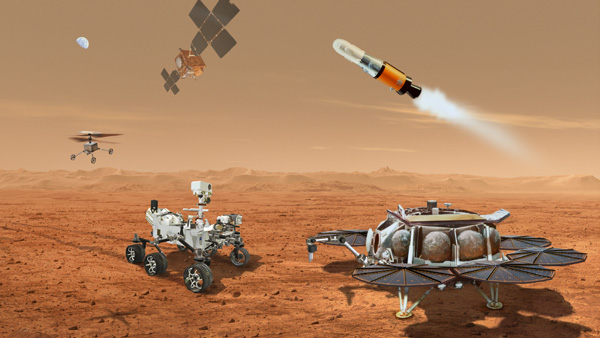
An illustration depicting the joint NASA/ESA Mars Sample Return mission architecture...which will undergo a major revision.
NASA / JPL - Caltech

NASA Exploring Alternative Mars Sample Return Methods (Press Release)

NASA is moving forward with ten studies to examine more affordable and faster methods of bringing samples from Mars’ surface back to Earth as part of the agency’s Mars Sample Return Program. As part of this effort, NASA will award a firm-fixed-price contract for up to $1.5 million to conduct 90-day studies to seven industry proposers.

Additionally, NASA centers, Caltech’s Jet Propulsion Laboratory and Johns Hopkins’ Applied Physics Laboratory are producing studies. Once completed, NASA will assess all studies to consider alterations or enhancements to the Mars Sample Return architecture.

“Mars Sample Return will be one of the most complex missions NASA has undertaken, and it is critical that we carry it out more quickly, with less risk, and at a lower cost,” said Nelson. “I’m excited to see the vision that these companies, centers and partners present as we look for fresh, exciting and innovative ideas to uncover great cosmic secrets from the Red Planet.”

Over the last quarter century, NASA has engaged in a systematic effort to determine the early history of Mars and how it can help us understand the formation and evolution of habitable worlds, including Earth. As part of that effort, Mars Sample Return has been a long-term goal of international planetary exploration for the past two decades.

NASA’s Perseverance rover has been collecting samples for later collection and return to Earth since it landed on Mars in 2021.

The following companies and proposals were selected from among those that responded to an April 15 request for proposals:

- Lockheed Martin in Littleton, Colorado: Lockheed Martin Rapid Mission Design Studies for Mars Sample Return
- SpaceX in Hawthorne, California: Enabling Mars Sample Return With Starship
- Aerojet Rocketdyne in Huntsville, Alabama: A High-Performance Liquid Mars Ascent Vehicle, Using Highly Reliable and Mature Propulsion Technologies, to Improve Program Affordability and Schedule
- Blue Origin in Monrovia, California: Leveraging Artemis for Mars Sample Return
- Quantum Space, in Rockville, Maryland: Quantum Anchor Leg Mars Sample Return Study
- Northrop Grumman in Elkton, Maryland: High TRL MAV Propulsion Trades and Concept Design for MSR Rapid Mission Design
- Whittinghill Aerospace in Camarillo, California: A Rapid Design Study for the MSR Single Stage Mars Ascent Vehicle”

NASA’s Mars Sample Return is a strategic partnership with ESA (the European Space Agency). Returning scientifically-selected samples to Earth for study using the most sophisticated instruments around the world can revolutionize our understanding of Mars and would fulfill one of the highest-priority solar system exploration goals as identified by the National Academies of Science, Engineering and Medicine.

****

Wednesday, June 07, 2023

Peregrine's Launch Vehicle Has Roared to Life for the First Time!

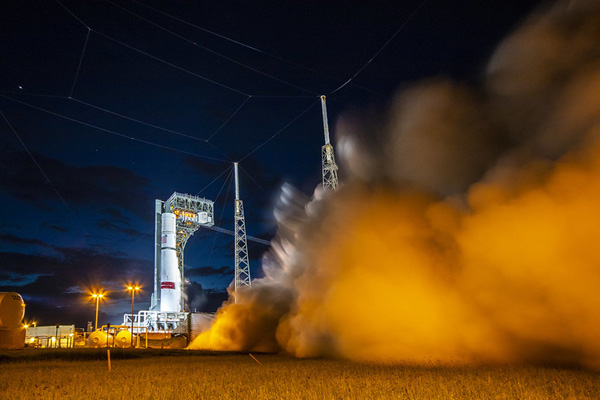
United Launch Alliance's (ULA) Vulcan Centaur rocket ignites its twin BE-4 engines for a Flight Readiness Firing at Cape Canaveral Space Force Station's Space Launch Complex (SLC)-41 in Florida...on June 7, 2023.
United Launch Alliance

A few hours ago, at 9:05 PM, EDT (6:05 PM, PDT), the twin methalox-fueled BE-4 engines on United Launch Alliance's (ULA) Vulcan Centaur rocket came to life at Cape Canaveral Space Force Station's Space Launch Complex (SLC)-41 in Florida.

The two engines, provided by Blue Origin, ignited for the Flight Readiness Firing (FRF) that is the final major step before Vulcan is ready to lift off and send Astrobotic's Peregrine lander to the Moon. The FRF lasted for about six seconds...with engine start-up beginning 4.88 seconds prior to ignition, and the BE-4s reaching full power for two seconds before shutting down.

With a successful FRF now out of the way, ULA is in position to roll Vulcan back into SLC-41's Vertical Integration Facility to be outfitted with its twin solid rocket boosters, and wait for the arrival of Peregrine and other payloads that will ride on Vulcan into space.

However, ULA is still investigating the Centaur V anomaly that occurred at Marshall Space Flight Center (MSFC) in Huntsville, Alabama, about three months ago. The Vulcan Centaur rocket now at SLC-41 looks ready to launch, but won't do so until ULA is confident that the mishap which occurred at MSFC won't have a negative bearing on Vulcan's inaugural mission.

Stay tuned!

ULA's Vulcan Centaur rocket ignites its twin BE-4 engines for a Flight Readiness Firing at Cape Canaveral Space Force Station's SLC-41 in Florida...on June 7, 2023.
United Launch Alliance

ULA's Vulcan Centaur rocket ignites its twin BE-4 engines for a Flight Readiness Firing at Cape Canaveral Space Force Station's SLC-41 in Florida...on June 7, 2023.
United Launch Alliance

ULA's Vulcan Centaur rocket ignites its twin BE-4 engines for a Flight Readiness Firing at Cape Canaveral Space Force Station's SLC-41 in Florida...on June 7, 2023.
United Launch Alliance

Thursday, February 09, 2023

A Rocket Has Been Chosen for Two Rocket Lab-built Spacecraft Heading to the Red Planet...

An artist's concept of two Photon spacecraft, which make up the ESCAPADE mission, flying towards Mars.
Rocket Lab USA / UC Berkeley

NASA Selects Blue Origin to Launch Mars’ Magnetosphere Study Mission (Press Release)

NASA has awarded Blue Origin, LLC of Kent, Washington a task order to provide launch service for the agency’s Escape and Plasma Acceleration and Dynamics Explorers (ESCAPADE) mission as part of the agency's Venture-Class Acquisition of Dedicated and Rideshare (VADR) launch services contract.

ESCAPADE will launch on Blue Origin’s New Glenn rocket from Space Launch Complex-36 at Cape Canaveral Space Force Station in Florida. Launch is targeted for late 2024.

Blue Origin is one of 13 companies NASA selected for VADR contracts in 2022. NASA’s Launch Services Program, based at the agency’s Kennedy Space Center in Florida, manages the VADR contracts.

As part of VADR, the fixed-price indefinite-delivery/indefinite-quantity contracts have a five-year ordering period with a maximum total value of $300 million across all contracts.

ESCAPADE will study Mars’ magnetosphere – the magnetized area of space around the planet – using two identical small spacecraft, which will provide simultaneous two-point observations. The spacecraft will help provide researchers a better understanding of how the magnetosphere interacts with the solar wind, and how energy and plasma enter and leave the magnetosphere.

Each satellite will carry three instruments: a magnetometer for measuring magnetic field, an electrostatic analyzer to measure ions and electrons, and a Langmuir probe for measuring plasma density and solar extreme ultraviolet flux.

It will take ESCAPADE about 11 months to arrive at Mars after leaving Earth’s orbit, where both spacecraft will spend several months adjusting their orbits before they are in position to best capture data about the magnetosphere. Studying different magnetospheres gives scientists a better understanding of space weather, which can protect both astronauts and satellites as they orbit Earth and explore the solar system.

ESCAPADE is part of the NASA Small Innovative Missions for Planetary Exploration program.

Building on NASA's previous procurement efforts to foster development of new launch vehicles for NASA payloads, VADR provides FAA-licensed commercial launch services for payloads that can tolerate higher risk. By using a lower level of mission assurance, and commercial best practices for launching rockets, these highly-flexible contracts help broaden access to space through lower launch costs.

****

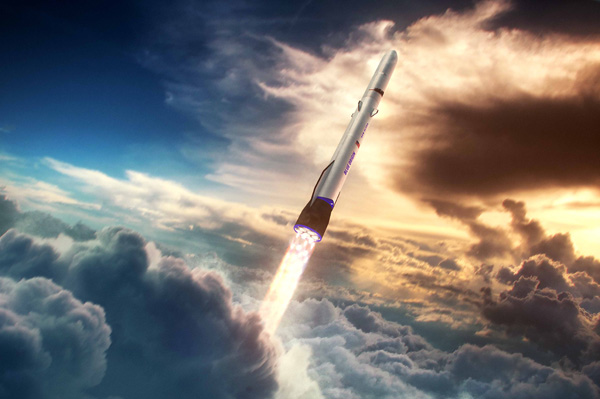
An artist's concept of Blue Origin's New Glenn rocket heading towards space.
Blue Origin

Friday, November 18, 2022

Assembly Complete! Astrobotic's Lunar Lander Has Moved One Step Closer to the Launch Pad...

Assembly is completed on the Peregrine lunar lander inside the cleanroom at Astrobotic's headquarters in Pittsburgh, PA...in November of 2022.
Astrobotic

Peregrine Spacecraft on the Move (Press Release - November 16)

Pittsburgh, PA – Astrobotic announced today that the Peregrine lunar lander has left their headquarters for the last time. The spacecraft is now headed to test facilities for final acceptance testing before its first launch to the Moon in Q1 2023.

Peregrine’s acceptance campaign will subject the spacecraft to a battery of industry-standard tests that will prove Peregrine can endure the launch environment aboard United Launch Alliance’s (ULA) Vulcan Centaur rocket, as well as the harsh environments of space and the lunar surface. These spacecraft-level tests follow years of prototyping, engineering analyses, modeling, simulations and sub-assembly tests that provide high confidence in the fully-assembled vehicle.

“A few years ago, we were an 18-person team with a dream. Today, Astrobotic’s 200+ staff and our payload customers can celebrate as our Peregrine lander continues its historic mission to lead America back to the Moon for the first time in 50 years,” says John Thornton, Astrobotic CEO.

Slated to be the first commercial lunar lander to ever soft-land on the Moon, Peregrine is carrying payloads from NASA’s Commercial Lunar Payload Services initiative that was awarded in 2019. Though Astrobotic had payload customers prior to NASA, that win propelled the Peregrine program forward.

Despite the pandemic slowing supply chains and disrupting workflow during critical program phases, the team managed to progress quickly toward Peregrine’s upcoming delivery to ULA.

“The space industry can move slowly sometimes – but our nimble engineering team proved their dedication and worked around the clock to ensure we met our deadlines,” says Sharad Bhaskaran, Astrobotic’s Peregrine Mission One Director. “There are folks finishing up Peregrine that were here since its inception. We’ve added a dedication plaque with all of our signatures to honor that work– every person is important to achieving our mission to the Moon.”

After acceptance testing, Peregrine will be shipped to Cape Canaveral, Florida for integration with Vulcan Centaur. After launch, Peregrine will separate from the rocket and Astrobotic’s Mission Control Center (AMCC) will then navigate the spacecraft to the Moon for landing.

The AMCC will then complete the mission by supporting lunar surface science operations.

Source: Astrobotic

****

The Peregrine lunar lander is ready to depart from the cleanroom at Astrobotic's headquarters to begin its pre-launch test campaign...on November 15, 2022.
Astrobotic

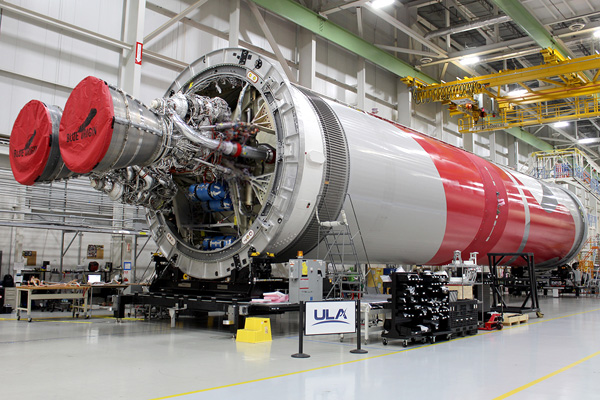
Both BE-4 flight engines, provided by Blue Origin, are now installed on the first Vulcan rocket at United Launch Alliance's factory in Decatur, Alabama...as of November 11, 2022.
Tory Bruno / United Launch Alliance

Both RL10C engines, provided by Aerojet Rocketdyne, are now installed on the Vulcan's Centaur upper stage booster at United Launch Alliance's rocket factory in Decatur, Alabama...as of November 18, 2022.
Tory Bruno / United Launch Alliance

Tuesday, November 01, 2022

Peregrine Update: The Robotic Lander's Ride to the Moon Has Finally Received Its Engines!

Blue Origin's BE-4 Flight Engine #1 is rolled onto the floor at United Launch Alliance's rocket factory in Decatur, Alabama...while BE-4 Flight Engine #2 is already installed on the core stage of the first Vulcan rocket.
Tory Bruno / United Launch Alliance

Blue Origin Completes the Delivery of Flight Engines to ULA for Vulcan’s Initial Launch (News Release - October 31)

Blue Origin completed its delivery of the first BE-4 shipset for United Launch Alliance (ULA), shipping the engines to ULA’s factory in Decatur, Alabama after final acceptance testing.

Each BE-4 engine provides 550,000 pounds of thrust and has completed an extensive development program. This state-of-the-art engine will end reliance on Russian engines and power a new generation of U.S. launch vehicles. Dozens of these engines are now in production to support a large and growing demand for civil, commercial and defense launches.

“We’re excited to see ULA’s Vulcan fly,” said Bob Smith, CEO, Blue Origin. “The BE-4 is a great engine, and we’re proud of Team Blue for achieving this milestone as part of ULA’s team. It’s been a wonderful partnership, and this shipset is the first of many more to come.”

“We are very pleased to receive the first two engines for Vulcan’s inaugural flight,” said Tory Bruno, ULA president and CEO. “Development of this new engine is complete, and the performance of the engine is outstanding. It has been a great team effort working together with our partners at Blue Origin and we can’t wait to see Vulcan fly.”

About Blue Origin’s BE-4 Engine

Blue Origin’s BE-4 is the most powerful liquid natural gas (LNG) fueled, oxygen-rich staged combustion engine made in the U.S., powering the next generation of rocket launch vehicles. The engines are manufactured in Kent, Washington and in Huntsville, Alabama. They are tested in West Texas and at the historic 4670 Test Stand at NASA’s Marshall Space Flight Center in Huntsville.

Source: Blue Origin

****

Construction should soon be wrapping up on the Peregrine lunar lander at Astrobotic's headquarters in Pittsburgh, Pennsylvania.
Astrobotic

Monday, February 15, 2021

Peregrine Update: The Vulcan Centaur Rocket Will Soon Be Ready for Their Inaugural Flight to the Moon Later This Year...

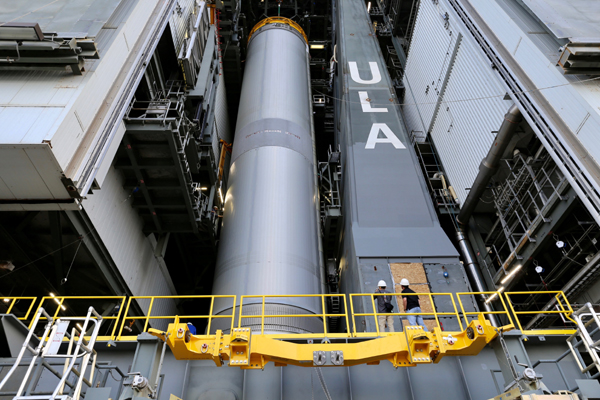
The Pathfinder Tanking Test (PTT) booster for the United Launch Alliance's (ULA) Vulcan Centaur rocket is placed atop its mobile launcher platform inside the Vertical Integration Facility (VIF) at Cape Canaveral Space Force Station (CCSFS) in Florida...on February 15, 2021.
United Launch Alliance

Happy Presidents' Day, fellow Yanks, and a Happy Monday to everyone else! Just thought I'd share these photos that were released by the United Launch Alliance (ULA) earlier today...showing the Pathfinder Tanking Test (PTT) booster for the Vulcan Centaur rocket being lifted onto its mobile launcher platform (MLP) inside the Vertical Integration Facility at Cape Canaveral Space Force Station (CCSFS) in Florida. The PTT vehicle—which will eventually fly next year after it is outfitted with flightworthy BE-4 engines from the Jeff Bezos-owned company Blue Origin—arrived at Port Canaveral near CCSFS last Friday, after an 8-day sea voyage aboard ULA's Rocket Ship that began at the company's manufacturing facility in Decatur, Alabama. Today's activity was known as the Launch Vehicle On Stand (LVOS) operation...with the PTT article about to undergo a series of tests atop its MLP before it is rolled out to the pad at Space Launch Complex (SLC)-41 sometime in the spring to undergo a series of liquid oxygen and liquified natural gas (the rocket fuel that Vulcan Centaur will use) loading procedures.

The full-scale Structural Test Model for Astrobotic's Peregrine lunar lander...which is set to head to the Moon aboard ULA's Vulcan Centaur rocket later this year.

So how is this relevant to Astrobotic's Peregrine lunar lander (shown above), you ask? Well, Peregrine is scheduled to launch to the Moon aboard a Vulcan Centaur later this year...and the commencement of pathfinder activities for this new heavy-lift rocket in Florida is the latest sign that the maiden flight of Astrobotic's four-legged spacecraft is soon underway. Once the LVOS campaign at SLC-41 is complete, the PTT vehicle will be removed from the MLP and replaced with the actual Vulcan Centaur rocket that will send Peregrine to our closest celestial neighbor 239,000 miles away. Assuming the landing goes well, Peregrine will become the first privately-made spacecraft to safely touch down on the lunar surface. And if that's the case, I look forward to posting a Blog entry immediately afterwards to show why I have a personal stake in this exciting mission! Stay tuned.

The PTT booster for ULA's Vulcan Centaur rocket is transported to the VIF at CCSFS in Florida for Launch Vehicle On Stand (LVOS) operations...on February 15, 2021.
United Launch Alliance

LVOS operations commence as the Vulcan Centaur's PTT booster is hoisted into the air prior to being transported into the VIF at CCSFS in Florida...on February 15, 2021.
United Launch Alliance

LVOS operations continue as the Vulcan Centaur's PTT booster continues to be hoisted into the air prior to being transported into the VIF at CCSFS in Florida...on February 15, 2021.
United Launch Alliance

The Vulcan Centaur's PTT booster is now placed in vertical prior to being installed atop its mobile launcher platform inside the VIF at CCSFS in Florida...on February 15, 2021.
United Launch Alliance