Showing posts with label VIPER. Show all posts

Friday, September 19, 2025

Brought Back from Cancellation, Artemis' Robotic Rover Has Found a New Ride to the Lunar Surface...

An artist's concept of NASA's VIPER rover rolling away from Blue Origin's Blue Moon Mark 1 lander on the lunar surface.
Blue Origin

NASA Selects Blue Origin to Deliver VIPER Rover to Moon’s South Pole (News Release)

As part of the agency’s Artemis campaign, NASA has awarded Blue Origin of Kent, Washington, a CLPS (Commercial Lunar Payload Services) task order with an option to deliver a rover to the Moon’s South Pole region. NASA’s VIPER (Volatiles Investigating Polar Exploration Rover) will search for volatile resources, such as ice, on the lunar surface and collect science data to support future exploration at the Moon and Mars.

“NASA is leading the world in exploring more of the Moon than ever before, and this delivery is just one of many ways we’re leveraging U.S. industry to support a long-term American presence on the lunar surface,” said acting NASA Administrator Sean Duffy. “Our rover will explore the extreme environment of the lunar South Pole, traveling to small, permanently shadowed regions to help inform future landing sites for our astronauts and better understand the Moon’s environment – important insights for sustaining humans over longer missions, as America leads our future in space.”

The CLPS task order has a total potential value of $190 million. This is the second CLPS lunar delivery awarded to Blue Origin. Their first delivery – using their Blue Moon Mark 1 (MK1) robotic lander – is targeted for launch later this year to deliver NASA’s Stereo Cameras for Lunar-Plume Surface Studies and Laser Retroreflective Array payloads to the Moon’s South Pole region.

With this new award, Blue Origin will deliver VIPER to the lunar surface in late 2027, using a second Blue Moon MK1 lander, which is in production. NASA previously canceled the VIPER project and has since explored alternative approaches to achieve the agency’s goals of mapping potential off-planet resources, like water.

“NASA is committed to studying and exploring the Moon, including learning more about water on the lunar surface, to help determine how we can harness local resources for future human exploration,” said Nicky Fox, associate administrator, Science Mission Directorate, NASA Headquarters in Washington. “We’ve been looking for creative, cost-effective approaches to accomplish these exploration goals. This private sector-developed landing capability enables this delivery and focuses our investments accordingly – supporting American leadership in space and ensuring our long-term exploration is robust and affordable.”

The task order, called CS-7, has an award base to design the payload-specific accommodations and to demonstrate how Blue Origin’s flight design will off-load the rover to the lunar surface. There is an option on the contract to deliver and safely deploy the rover to the Moon’s surface. NASA will make the decision to exercise that option after the execution and review of the base task and of Blue Origin’s first flight of the Blue Moon MK1 lander.

This unique approach will reduce the agency’s cost and technical risk. The rover has a targeted science window for its 100-day mission that requires a landing by late 2027.

Blue Origin is responsible for the complete landing mission architecture and will conduct design, analysis and testing of a large lunar lander capable of safely delivering the lunar volatiles science rover to the Moon. Blue Origin will also handle end-to-end payload integration, planning and support, and post-landing payload deployment activities. NASA will conduct rover operations and science planning.

“The search for lunar volatiles plays a key role in NASA’s exploration of the Moon, with important implications for both science and human missions under Artemis,” said Joel Kearns, deputy associate administrator for exploration, Science Mission Directorate, NASA Headquarters. “This delivery could show us where ice is most likely to be found and easiest to access, as a future resource for humans. And by studying these sources of lunar water, we also gain valuable insight into the distribution and origin of volatiles across the Solar System, helping us better understand the processes that have shaped our space environment and how our inner Solar System has evolved.”

Through CLPS, American companies continue to demonstrate leadership in commercial space advancing capabilities and accomplishing NASA’s goal for a commercial lunar economy. NASA’s Ames Research Center in California’s Silicon Valley led the VIPER rover development and will lead its science investigations, and NASA’s Johnson Space Center in Houston provided rover engineering development for Ames.

Source: NASA.Gov

****

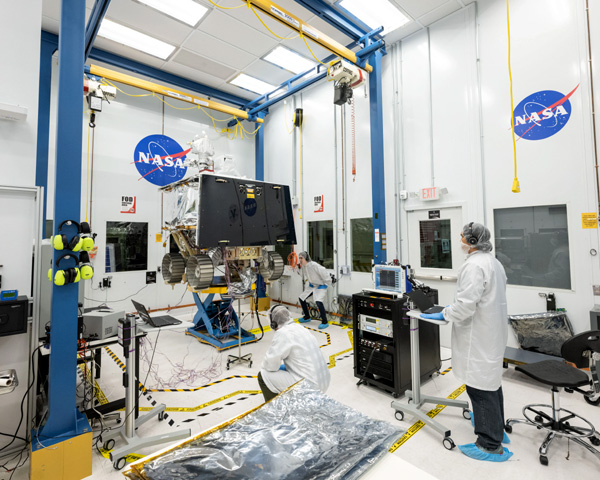
NASA's VIPER rover is fully assembled at the Johnson Space Center in Houston, Texas.
NASA

Wednesday, May 07, 2025

The Launch of the Artemis Lunar Rover Remains Up in the Air...

Despite its rover being fully assembled at the Johnson Space Center in Houston, Texas, NASA's VIPER Moon mission was cancelled on July 17, 2024.
NASA

NASA to Explore Additional Methods to Send VIPER to Moon (News Release)

Following an evaluation of partnership proposals to land a water-seeking robot on the lunar surface, NASA is instead opting to explore alternative approaches to deliver its VIPER (Volatiles Investigating Polar Exploration Rover) rover to the Moon.

NASA announced on Wednesday that it is canceling its Lunar Volatiles Science Partnership Announcement for Partnership Proposals solicitation, which sought opportunities to send VIPER to the Moon at no cost to the government.

“We appreciate the efforts of those who proposed to the Lunar Volatiles Science Partnership Announcement for Partnership Proposals call,” said Nicky Fox, associate administrator, Science Mission Directorate at NASA Headquarters in Washington. “We look forward to accomplishing future volatiles science with VIPER as we continue NASA’s Moon to Mars exploration efforts.”

NASA has been investigating how to get the rover to the Moon after the project was canceled in July 2024. The agency will announce a new strategy for VIPER in the future.

The formal proposal cancellation will post on the government procurement site:

https://sam.gov

Source: NASA.Gov

Monday, February 03, 2025

NASA's Mothballed Lunar Rover May Fly, After All...

Despite its rover being fully assembled at the Johnson Space Center in Houston, Texas, NASA's VIPER Moon mission was cancelled on July 17, 2024.
NASA

NASA Presses Forward Search for VIPER Moon Rover Partner (News Release)

To advance plans of securing a public/private partnership and land and operate NASA’s VIPER (Volatiles Investigating Polar Exploration Rover) mission on the Moon in collaboration with industry, the agency announced on Monday that it is seeking U.S. proposals. As part of the agency’s Artemis campaign, instruments on VIPER will demonstrate U.S. industry’s ability to search for ice on the lunar surface and collect science data.

The Announcement for Partnership Proposal contains proposal instructions and evaluation criteria for a new Lunar Volatiles Science Partnership. Responses are due on Thursday, February 20. After evaluating submissions, any selections by the agency will require respondents to submit a second, more detailed, proposal.

NASA is expected to make a decision on the VIPER mission this summer.

“Moving forward with a VIPER partnership offers NASA a unique opportunity to engage with the private sector,” said Nicky Fox, associate administrator in the Science Mission Directorate at NASA Headquarters in Washington. “Such a partnership provides the opportunity for NASA to collect VIPER science that could tell us more about water on the Moon, while advancing commercial lunar landing capabilities and resource prospecting possibilities.”

This new announcement comes after NASA issued a Request for Information on August 9, 2024, to seek interest from American companies and institutions in conducting a mission using the agency’s VIPER Moon rover after the program was cancelled in July 2024.

Any partnership would work under a Cooperative Research and Development Agreement. This type of partnership allows both NASA and an industry partner to contribute services, technology and hardware to the collaboration.

As part of an agreement, NASA would contribute the existing VIPER rover as-is. Potential partners would need to arrange for the integration and successful landing of the rover on the Moon, conduct a science/exploration campaign, and disseminate VIPER-generated science data. The partner may not disassemble the rover and use its instruments or parts separately from the VIPER mission.

NASA’s selection approach will favor proposals that enable data from the mission’s science instruments to be shared openly with anyone who wishes to use it.

“Being selected for the VIPER partnership would benefit any company interested in advancing their lunar landing and surface operations capabilities,” said Joel Kearns, deputy associate administrator for exploration in the Science Mission Directorate. “This solicitation seeks proposals that clearly describe what is needed to successfully land and operate the rover, and invites industry to propose their own complementary science goals and approaches. NASA is looking forward to partnering with U.S. industry to meet the challenges of performing volatiles science in the lunar environment.”

The Moon is a cornerstone for Solar System science and exoplanet studies. In addition to helping inform where ice exists on the Moon for potential future astronauts, understanding our nearest neighbor helps us understand how it has evolved and what processes shaped its surface.

Source: NASA.Gov

Wednesday, July 17, 2024

So I'm QUITE PISSED at NASA (and Astrobotic) Right Now...

Despite its rover being fully assembled at the Johnson Space Center in Houston, Texas, NASA's VIPER Moon mission has been cancelled...as of July 17, 2024.
NASA

NASA Ends VIPER Project, Continues Moon Exploration (News Release)

Following a comprehensive internal review, NASA announced Wednesday its intent to discontinue development of its VIPER (Volatiles Investigating Polar Exploration Rover) project.

NASA stated cost increases, delays to the launch date, and the risks of future cost growth as the reasons to stand down on the mission. The rover was originally planned to launch in late 2023, but in 2022, NASA requested a launch delay to late 2024 to provide more time for preflight testing of the Astrobotic lander.

Since that time, additional schedule and supply chain delays pushed VIPER’s readiness date to September 2025, and independently its CLPS (Commercial Lunar Payload Services) launch aboard Astrobotic’s Griffin lander has also been delayed to a similar time. Continuation of VIPER would result in an increased cost that threatens cancellation or disruption to other CLPS missions.

NASA has notified Congress of the agency’s intent.

“We are committed to studying and exploring the Moon for the benefit of humanity through the CLPS program,” said Nicola Fox, associate administrator, Science Mission Directorate, NASA Headquarters in Washington. “The agency has an array of missions planned to look for ice and other resources on the Moon over the next five years. Our path forward will make maximum use of the technology and work that went into VIPER, while preserving critical funds to support our robust lunar portfolio.”

Moving forward, NASA is planning to disassemble and reuse VIPER’s instruments and components for future Moon missions. Prior to disassembly, NASA will consider expressions of interest from U.S. industry and international partners by Thursday, August 1, for use of the existing VIPER rover system at no cost to the government.

Interested parties should contact HQ-CLPS-Payload@mail.nasa.gov after 10 a.m. EDT on Thursday, July 18. The project will conduct an orderly close out through spring 2025.

Astrobotic will continue its Griffin Mission One within its contract with NASA, working toward a launch scheduled for no earlier than fall 2025. The landing without VIPER will provide a flight demonstration of the Griffin lander and its engines.

NASA will pursue alternative methods to accomplish many of VIPER’s goals and verify the presence of ice at the lunar South Pole. A future CLPS delivery – the Polar Resources Ice Mining Experiment-1 (PRIME-1) — scheduled to land at the South Pole during the fourth quarter of 2024, will search for water ice and carry out a resource utilization demonstration using a drill and mass spectrometer to measure the volatile content of subsurface materials.

Additionally, future instruments as part of NASA’s crewed missions – for example, the Lunar Terrain Vehicle — will allow for mobile observations of volatiles across the south polar region, as well as provide access for astronauts to the Moon’s permanently shadowed regions for dedicated sample return campaigns. The agency will also use copies of three of VIPER’s four instruments for future Moon landings on separate flights.

The VIPER rover was designed to search Earth’s Moon for ice and other potential resources – in support of NASA’s commitment to study the Moon and help unravel some of the greatest mysteries of our solar system. Through NASA’s lunar initiatives, including Artemis human missions and CLPS, NASA is exploring more of the Moon than ever before using highly-trained astronauts, advanced robotics, U.S. commercial providers and international partners.

Source: NASA.Gov

Tuesday, May 14, 2024

NASA's Artemis Moon Rover Is Almost Fully Assembled...

The wheels on the VIPER lunar rover undergo testing by engineers at NASA's Johnson Space Center in Houston, Texas.
NASA / Helen Arase Vargas

Mission Manager Update: VIPER Rover Approved to Move into Environmental Testing! (News Release)

While NASA’s VIPER team has been focused on building the flight rover that will go to the South Pole of the Moon, the team has also been making preparations for environmental testing of the rover.

In April, the VIPER team passed a System Test Readiness Review, exploring the readiness of the facilities, procedures and staff to move into stress-testing the VIPER rover.

These environmental tests are important because they force our rover to experience the conditions that it will see during launch, landing and in the thermal environment of operating at the lunar South Pole. Specifically, acoustic testing will simulate the harsh, vibrational “rock concert” experience of launch, while thermal-vacuum testing will expose VIPER to the hottest and coldest temperatures that it will see during the mission, all while operating in the vacuum of space.

It’s a tough business, but we have to make sure we’re up for it.

Thanks to this team for the hard efforts to get to this important phase in mission readiness!

Go VIPER!

- Dan Andrews, VIPER Project Manager

Source: NASA.Gov

Monday, April 01, 2024

NASA's Artemis Moon Rover Is Now 88% Assembled...

The mast for the VIPER lunar rover is about to be installed by engineers at NASA's Johnson Space Center in Houston, Texas.
NASA / Helen Arase Vargas

NASA VIPER Robotic Moon Rover Team Raises Its Mighty Mast (News Release)

NASA’s VIPER – short for the Volatiles Investigating Polar Exploration Rover – now stands taller and more capable than ever. And that’s thanks to its mast.

VIPER’s mast, and the suite of instruments affixed to it, looks a lot like the rover’s “neck” and “head.” The mast instruments are designed to help the team of rover drivers and real-time scientists send commands and receive data while the rover navigates around hazardous crater slopes, boulders and places that risk communications blackouts.

The team will use these instruments, along with four science payloads, to scout the lunar South Pole. During its approximately 100-day mission, VIPER seeks to better understand the origin of water and other resources on the Moon, as well as the extreme environment where NASA plans to send astronauts as part of the Artemis campaign.

The tip of VIPER’s mast stands approximately eight feet (2.5 meters) above its wheel rims and is equipped with a pair of stereo navigation cameras, a pair of powerful LED headlights, as well as a low- and high-gain antenna to transmit data to and receive data from the Deep Space Network (DSN) antennas on Earth.

The stereo navigation cameras – the “eyes” of the rover – are mounted to a part of the mast that gimbals, allowing the team to pan them as much as 400 degrees around and tilt them up and down as much as 75 degrees. The VIPER team will use the navigation cameras to take sweeping panoramas of the rover’s surroundings and images to detect and further study surface features such as rocks and craters as small as four inches (10 cm) in diameter – or about the length of a pencil – from as far as 50 feet (15 meters) away.

And because the navigation cameras are mounted up high, it gives the VIPER team a near human-like perspective as the rover explores areas of scientific interest around the Moon’s South Pole.

Due to the extremes of light and darkness found on the Moon, VIPER will be the first planetary rover to have headlights. The headlights will cast a narrow, long-distance beam – much like a car’s high beams – to help the team reveal obstacles or interesting terrain features that would otherwise stay hidden in the shadows.

Positioned next to the rover’s two navigation cameras, the lights feature arrays of blue LEDs that the rover navigation team determined would provide the best visibility given the challenging lighting conditions on the Moon.

In order to transmit large amounts of data across the 240,000 miles (384,000 km) that separate Earth and the Moon, VIPER has a gimballing precision-pointed, high-gain antenna that will send information along a very focused, narrow beam. Its low-gain antenna will also send data but using radio waves at a much lower data rate.

The ability for the antennas to maintain the correct orientation, even while driving, serves a critical function: without it, the rover cannot receive commands while in motion on the Moon and cannot transmit any of its data back to Earth for scientists to achieve their mission goals. All that data is then transferred from the DSN to the Multi-Mission Operations and Control Center at NASA’s Ames Research Center in California’s Silicon Valley, where rover operations are based.

Prior to installation on the rover, engineers put the mast through a variety of testing. This included time in a thermal vacuum chamber to verify that the white coating surrounding the mast insulates as intended.

After the mast’s integration in the clean room at NASA’s Johnson Space Center in Houston, the team also successfully performed check-outs of its components and for the first time sent data through the rover using its antennas.

VIPER is part of the Lunar Discovery and Exploration Program and is managed by the Planetary Science Division of NASA’s Science Mission Directorate at NASA Headquarters in Washington. VIPER will launch to the Moon aboard Astrobotic’s Griffin lunar lander on a SpaceX Falcon Heavy rocket as part of NASA’s Commercial Lunar Payload Services initiative.

VIPER will reach its destination at Mons Mouton near the Moon’s South Pole.

Source: NASA.Gov

****

The mast on the VIPER lunar rover is installed at NASA's Johnson Space Center in Houston, Texas.
NASA / Josh Valcarcel

Thursday, February 29, 2024

Goodnight, Odysseus... Thanks for Putting My Message on the Moon!

A photo of Intuitive Machines' Odysseus lander on the surface of the Moon.
Intuitive Machines

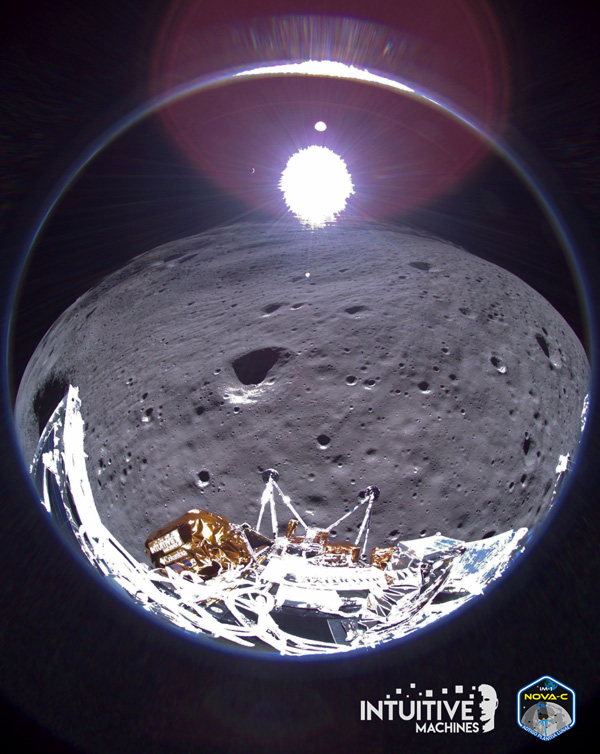
Happy Leap Day, everyone! Just thought I'd share these images that were released by Intuitive Machines this week as its Odysseus ('Odie') lunar lander was put to sleep due to low battery power today...nevertheless completing the successful seven-day IM-1 mission.

This mission was very significant to me. To NASA, this was the United States' first landing on the Moon since Apollo 17 in 1972. To the burgeoning commercial space industry, this was the first privately-built spacecraft to successfully touch down on the lunar surface.

And to myself, Odie's accomplishment marked the conclusion of me waiting around 15 years for a lander mission to come along that would put my virtual presence on the surface of the Moon! NASA's Lunar Reconnaissance Orbiter—which bears a microchip containing my name as well as those of 1.6 million other people—has been revolving around Earth's natural satellite since June of 2009.

But it wouldn't be till IM-1 this month that my dream of looking up at the Moon and thinking about how I had a presence intact on its surface, courtesy of a Lunagram message (shown at the very bottom of this Blog entry) that I submitted to a company named Lunaprise back on Christmas Day of 2020, became a reality.

Much thanks to Intuitive Machines, NASA (whose Commercial Lunar Payload Services initiative for the Artemis program made IM-1 a reality), SpaceX (which flawlessly launched Odie to the Moon on February 15), Lunaprise and the Arch Mission Foundation (which helped provide the NanoFiche disc that contains Lunagrams as well as the Arch Mission's Lunar Library) for giving me the opportunity to be a part of this historic endeavor!

There are other Moon-bound spacecraft, such as NASA's VIPER rover and Firefly's Blue Ghost lander, that will hopefully bring my presence to other locales on the lunar surface over the next two years. But it will be Odysseus, just like NASA's Phoenix lander (which was the first robotic probe to land my name on Mars back in 2008), that will be the lunar explorer I'm most fond of.

Ad Lunam.

A photo of the NanoFiche disc, which contains my Lunagram as part of the Arch Mission Foundation's Lunar Library, attached to the Odysseus lander.
Intuitive Machines

A photo of the Odysseus lander, with the NanoFiche disc attached to its side, before the spacecraft was encapsulated by the twin payload fairings of its SpaceX Falcon 9 rocket.
SpaceX

This final photo that was transmitted by Odysseus to Earth on February 29, 2024, shows the spacecraft as it descended towards the lunar surface for a landing...on February 22, 2024.

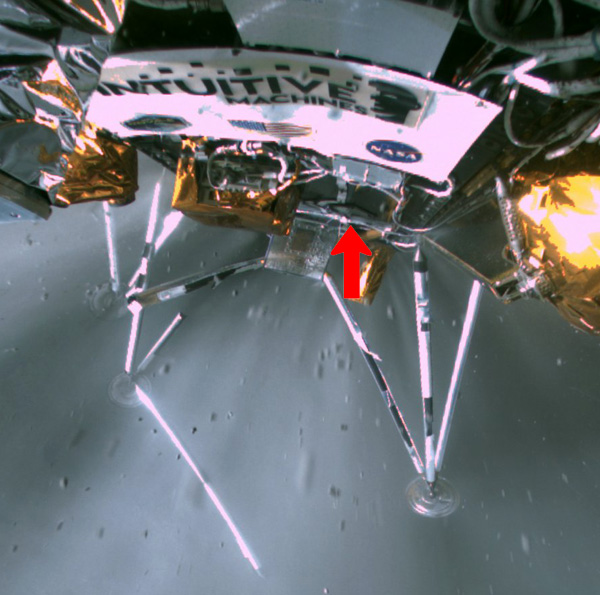
The NanoFiche disc is visible above one of Odysseus' landing legs as the spacecraft touched down on the Moon...on February 22, 2024. The rough landing damaged the leg to the left.
Intuitive Machines

My Lunagram message (with most of its details blurred out) that's now on the surface of the Moon...thanks to the Odysseus spacecraft and the Lunar Library aboard it.

Wednesday, February 28, 2024

A Major Milestone Has Been Reached for NASA's First Artemis Rover...

At NASA's Johnson Space Center in Houston, Texas, the VIPER lunar rover is more than 80% complete...as of February 28, 2024.
NASA

Mission Manager Update: All VIPER Flight Instruments Installed! (News Release)

The VIPER team continues to push forward with the build of the flight rover that’ll go to the surface of the Moon. As of this writing, all of VIPER’s flight instruments are installed, and the rover is more than 80% built!

This is a major accomplishment and shows the great progress being made by the dedicated VIPER team, who are excited to see the rover coming together.

What comes next – the confirmational tests of the rover – will strengthen our confidence in the rover’s ability to survive launch, landing and the challenging environment of the lunar South Pole.

For example, as we assemble and install various subsystems onto the rover, we also perform channelization tests. Channelization tests let us confirm that through our design and build of the rover system – from piece-parts to cable harnesses and connectors, and mechanical installation activities, and even through avionics software – the connections all work.

Now, you might think, “Of course what we installed should work!” but it’s important to remember how complicated these space systems are (and planetary rover systems in particular).

An example of an upcoming channelization test for VIPER is to command the flight vehicle’s high-gain antenna to move in a particular way: Does it actually move in the correct direction and to the correct position? Sometimes we will perform even more complex tests, like sending a command to the NIRVSS instrument to take an image: Is the image taken successful? Is the field of view of the image correct? Did the image make its way into the rover’s avionics for downlink?

We make these determinations now because we don’t want to discover any issues later in the assembly flow that could result in us needing to perform some disassembly to correct matters.

So we test as we go, to decrease risk later when we’re performing whole-rover environmental tests. This way if the rover doesn’t work as expected after one of VIPER’s environmental tests, we know it once worked fine, and that can help us more quickly problem-solve what might have gone wrong.

The pace in which we’ve been working through the build and subsystem checkouts has been blistering lately, and we’ve had a good run of successes.

Go VIPER!

– Dan Andrews, VIPER Project Manager

Source: NASA.Gov

Thursday, January 04, 2024

Fly Your Name Aboard VIPER to the Lunar Surface!

An artist's concept of NASA's VIPER rover on the surface of the Moon.
NASA Ames / Daniel Rutter

NASA Invites Public to Send Names Aboard Artemis Robotic Moon Rover (Press Release)

NASA is inviting people to send their names to the surface of the Moon aboard the agency’s first robotic lunar rover, VIPER – short for Volatiles Investigating Polar Exploration Rover. The rover will embark on a mission to the lunar South Pole to unravel the mysteries of the Moon’s water and better understand the environment where NASA plans to land the first woman and first person of color under its Artemis program.

As part of the Send Your Name with VIPER campaign, NASA will accept names received before 11:59 p.m. EST on March 15. Once collected, the agency will take the names and attach them to the rover.

To add your name, visit:

https://www.nasa.gov/send-your-name-with-viper

The site also enables participants to create and download a virtual souvenir – a boarding pass to the VIPER mission featuring their name – to commemorate the experience. Participants are encouraged to share their requests on social media using the hashtag #SendYourName.

“With VIPER, we are going to study and explore parts of the Moon’s surface no one has ever been to before – and with this campaign, we are inviting the world to be part of that risky yet rewarding journey,” said Nicola Fox, associate administrator, Science Mission Directorate at NASA Headquarters in Washington. “Just think: Our names will ride along as VIPER navigates across the rugged terrain of the lunar South Pole and gathers valuable data that will help us better understand the history of the Moon and the environment where we plan to send Artemis astronauts.”

This campaign is like other NASA projects that have enabled tens of millions of people to send their names to ride along with Artemis I, several Mars spacecraft, and the agency’s upcoming Europa Clipper mission. It draws from the agency’s long tradition of shipping inspirational messages on spacecraft that have explored our solar system and beyond.

“Our VIPER is a game-changer,” said Daniel Andrews, VIPER’s project manager at NASA’s Ames Research Center in California’s Silicon Valley. “It’s the first mission of its kind, expanding our understanding of where lunar resources could be harvested to support a long-term human presence on the Moon.”

In late 2024, Astrobotic Technologies’ Griffin Mission One is scheduled to deliver VIPER to the lunar surface after launching aboard a SpaceX Falcon Heavy rocket from Cape Canaveral Space Force Station in Florida. Once there, VIPER will rely on its solar panels and batteries for its roughly 100-day mission to survive extreme temperatures and challenging lighting conditions, while powering a suite of science instruments designed to gather data about the characteristics and concentrations of lunar ice and other possible resources.

NASA’s VIPER delivery is part of its CLPS (Commercial Lunar Payload Services) initiative under the Artemis program. With CLPS, as well as with human exploration near the lunar South Pole, NASA will establish a long-term cadence of Moon missions in preparation for sending the first astronauts to Mars.

The rover is part of the LDEP (Lunar Discovery and Exploration Program), managed by the Science Mission Directorate at the agency’s headquarters and is executed through the Exploration Science Strategy and Integration Office. In addition to managing the mission, NASA Ames leads the mission’s science, systems engineering, real-time rover surface operations and flight software.

The rover hardware is designed and built by NASA’s Johnson Space Center in Houston, while the instruments are provided by NASA Ames, the agency’s Kennedy Space Center in Florida, and commercial partner Honeybee Robotics in Altadena, California.

****

My participation certificate for NASA's VIPER mission.

Friday, December 29, 2023

NASA's Artemis Moon Rover Is Now 50% Assembled...

An engineer works on the VIPER lunar rover at NASA's Johnson Space Center in Houston, Texas.
NASA / Robert Markowitz

Mission Manager Update: VIPER Flight Rover Half-Built! (News Release)

The VIPER team is hard at work building the flight vehicle that will be going to the surface of the Moon this time next year! In fact, we’re about halfway through the build, and you can interactively watch the process and hear from experts on the team, in various livestreams throughout the process.

All of the science instrument teams have delivered their payloads to the VIPER Systems Integration & Test team, which will install them into the actual flight rover; in fact, all but one is already installed! This was a huge milestone over the past summer, and a frequent sticking point for many flight projects.

I’m happy to have all of the birds in the nest!

We have also taken delivery of most of the key pieces of hardware that we acquired from our various external vendors. This is a very important milestone as well, since a large number of vendors of critical components have been quite behind schedule in their deliveries to the project, due to pandemic-era supply chain issues that continue to reverberate throughout the industry in some unexpected ways.

It is good to have VIPER past this point in development, where we can now focus on bringing everything together into a functioning rover.

So now that we are building the flight article, we are able to see precisely how well our design plans are working in reality. There have been some reveals in the first half of the rover build, which we’ve had to navigate, including connector issues from vendors, where we’ve discovered and corrected some design and Foreign Object Debris issues, which prevented connectors from reliably working.

We’ve also found some unexpected performance characteristics revealed by some vendor hardware, which we have had to then fold into our plans for how we operate VIPER... These issues and solutions are all part of the challenging process of building a flight article, and ensuring that it can survive the very harsh environment of launch, landing and operations on the lunar surface.

Once the team completes the flight rover assembly, the next step will be to test that rover in the kinds of environments it will see on the mission. This activity will be our primary focus in 2024, and our final step prior to delivering VIPER for launch integration.

Go VIPER!

– Dan Andrews, VIPER Project Manager

Source: NASA.Gov

****

An artist's concept of NASA's VIPER rover on the surface of the Moon.
NASA Ames / Daniel Rutter

Friday, August 11, 2023

NASA's Artemis Moon Rover Is Cleared to Proceed Through Full Construction...

The lower chassis plate is the first flight component of the VIPER lunar rover to be constructed...at NASA's Johnson Space Center in Houston, Texas.
NASA

Let’s Get Building! (News Release)

I’m proud to share that the VIPER team successfully passed the agency’s gate review, permitting the team to fully proceed into building our flight rover! This mandatory review requires flight projects to demonstrate their readiness for integration activites, including having procedures, facilities and hardware on hand to start the assembly process.

This is an especially challenging and important review, given the risk potential to the flight hardware, and passing this review officially moves the VIPER mission from design and verification, into assembly and integration, leading up to launch in late 2024.

The VIPER team prepared for this moment for many months now, getting our new clean room up and running, and performance calibration tests in our key facilities, like thermovaccuum chambers, vibration stands and acoustic facilities – some of which have long histories supporting other NASA missions.

We continue to get every bit of prep-work completed, while we wait for delivery of some critical pieces of hardware. As a result, the VIPER team continues to be agile and responsive to changing conditions, daily.

Go VIPER!

- Dan Andrews, VIPER Project Manager

Source: NASA.Gov

****

An artist's concept of NASA's VIPER rover on the surface of the Moon.
NASA Ames / Daniel Rutter

Saturday, July 01, 2023

VIPER's Test Model Continues to Go Through the Paces in California's Silicon Valley...

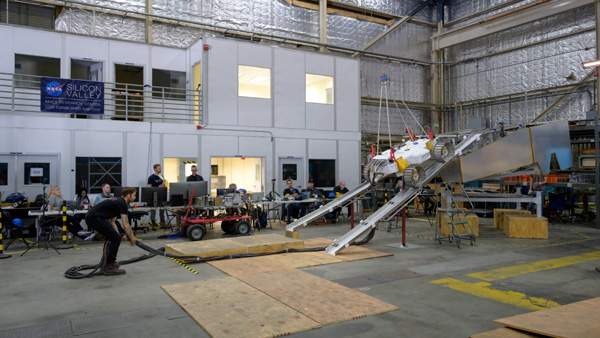
A snapshot of NASA's VIPER lunar rover prototype, known as MGRU3 (Moon Gravitation Representative Unit 3), conducting an egress test at the Ames Research Center in California's Silicon Valley.
NASA / Dominic Hart

NASA’s Moon Rover Prototype Conquers Steep, Scary Lander Exit Test (News Release - June 30)

NASA's VIPER – short for Volatiles Investigating Polar Exploration Rover – recently completed another successful round of rigorous tests of the agency’s first robotic Moon rover’s ability to drive off the Astrobotic Griffin lunar lander and onto the lunar surface. Called an egress, this hours-long operation is one of the most critical and trickiest parts of VIPER's 100-day mission.

It could be even trickier if VIPER’s off-ramps onto the Moon are super steep or tilted due to uneven terrain.

Recent tests using VIPER rover and Griffin lander prototypes conducted at NASA’s Ames Research Center in California’s Silicon Valley were designed to push VIPER’s systems to the limit to ensure that the rover will perform as expected during its science mission. By driving VIPER’s prototype MGRU3 – which stands for the Moon Gravitation Representative Unit 3 – down the lander’s ramps in a series of test configurations in a facility at Ames, engineers came away with a better understanding of how the rover would perform in both normal and unusual scenarios.

Unlike big rigs that deliver cars by rolling them off standardized ramps on trailers, the geometry of the lunar lander’s ramps is designed to vary substantially, depending on what the surface is like when it arrives at its target destination atop the flat-topped lunar mountain Mons Mouton near the Moon’s South Pole. Depending on the terrain around the lander, the angle of the ramps may be especially steep, posing the risk that the rover could lose traction and slip - or one ramp may be steeper than the other, requiring the VIPER real-time operations team to actively compensate for this tricky terrain.

“Through this series, we’ve tested all of the ‘bounding’ cases for VIPER’s egress on the Moon,” said Jasper Wolfe, VIPER egress test lead at Ames. “This included the worst-case high-pitch scenario using the steepest – and scariest – ramps, the worst-case roll scenario using the most uneven ramps, and the worst-case scenario with pitch and roll combined.”

Seen in the photo above is a key moment of the tests, which focused on the physical interface between the rover and the lander. Critical features of the tests included software that specifically handles VIPER’s egress and changes to physical components of both the rover and the lander’s ramps.

The team carefully checked to verify that MGRU3 had adequate clearance and engaged the ramps correctly as it rolled from top to bottom.

“We validated these test cases with MGRU3 to be sure VIPER can do it on the Moon,” said Wolfe.

Completing these tests means that VIPER should be able to successfully exit the lander even if it touches down in a tough spot – a major step forward towards flight.

“With VIPER, we’re doing a lot of firsts,” said Wolfe. “And it’s very exciting to reach this milestone.”

Source: NASA.Gov

Thursday, June 01, 2023

The Latest Update on NASA's Robotic Rover for the Artemis Program...

A snapshot of NASA's VIPER lunar rover prototype, known as MGRU3 (Moon Gravitation Representative Unit 3), at the Ames Research Center's Roverscape in California's Silicon Valley.
NASA / Arno Rogg

Engineers Test VIPER’s Very Nimble Gimbal (News Release)

As VIPER, NASA’s next Moon rover, wheels about atop Mons Mouton – a large flat-topped mountain on the Moon’s South Pole – one small but mighty piece of hardware will be critical for the team of rover drivers and scientists to send it commands, know where it is going, and receive valuable science data: a gimbal-pointed high-gain antenna.

VIPER has both a low-gain and high-gain antenna to transmit data to and receive data from the Deep Space Network (DSN) antennas on Earth. Its low-gain antenna sends radio waves at a low data rate, while its high-gain antenna transfers much more information (over 100 times more).

Data is then transferred from the DSN to the Multi-Mission Operations and Control Center at NASA’s Ames Research Center in California’s Silicon Valley, where rover operations are based.

“Pointing VIPER’s high-gain antenna in the correct orientation is one of the most critical functions the rover has,” said Arno Rogg, rover systems engineer at Ames. “Without its antenna, the rover cannot receive commands while in motion on the Moon and cannot transmit any of its data back to Earth for scientists to achieve their mission goals.”

Why it Matters

VIPER is designed to use distributed computing, which allows engineers to download images and other data from the rover for fast processing, rather than having to rely only on the rover’s slower on-board computing.

“This opens up a process for off-planet science operations that enables us to be super-responsive to the situation on the Moon as it is revealed,” said Dr. Zara Mirmalek, VIPER deputy science operations and integration lead at Ames. “The science team can react in near real-time and influence where the rover moves to meet the mission’s science objectives.”

In order to transmit large amounts of data across the 240,000 miles that separate Earth and the Moon, VIPER will be equipped with an antenna that can send information along a very focused, narrow beam. With the exception of planned stops to take panoramas of its lunar surroundings, to use its drill, wait out occasional communication blackouts or periods of shadow at safe havens, VIPER will constantly be on the move.

The rover will spend most of its time driving and using its suite of spectrometers and cameras to map the location and concentration of lunar water and other volatiles at the surface of areas of scientific interest –– which means it is essential for the rover to be able to constantly and precisely point its antenna while it moves.

“The rover is equipped with different sensors that work together and allow it to know where to point and tell the gimbal to adjust the antenna’s direction as many as 10 times every second, even while the rover might be bouncing over boulders and crater slopes,” said Rogg. “But knowing where to point is extremely complex.”

VIPER uses its onboard computer and a few different sensors to accurately and very frequently calculate its position on the Moon. One sensor is its star tracker – a sensitive camera that takes pictures of the star field above VIPER.

By comparing the pictures to its built-in map of stars, the star tracker can determine which way VIPER is oriented. VIPER also uses a set of gyroscopes to track how quickly the rover is turning.

Using the combined data, the rover commands the gimbal to make fine adjustments to compensate for the rover’s motion in order to keep the antenna always pointed at the Earth.

Flipping the Problem Around

But engineers were faced with a problem: How can such a system be tested on Earth? Their solution? Flip the problem around – and drive a prototype rover in California with an antenna pointed at the Moon.

They recently completed the nighttime tests at the Roverscape at Ames using the latest prototype of the rover, known as Moon Gravitation Representative Unit 3 (MGRU3), and found both antenna and gimbal performed well.

“We found that the Moon stayed dead center even while the prototype performed a sprint drive over the largest rock in our Roverscape, which is one of the most challenging cases,” said Terry Fong, deputy manager of the VIPER rover. “We’re now even more confident the system will work on the Moon.”

Source: NASA.Gov

****

An artist's concept of NASA's VIPER rover on the surface of the Moon.
NASA Ames / Daniel Rutter

Monday, May 15, 2023

Astrobotic Has Begun Work on Its Next Lunar Lander!

A computer-generated image showing NASA's VIPER rover sitting atop Astrobotic's Griffin lander on the surface of the Moon.
Astrobotic

Over the past two weeks, Astrobotic has begun sharing photos of its next Moon lander, Griffin, as it began assembly inside a cleanroom at Astrobotic's headquarters in Pittsburgh, Pennsylvania.

While only two pics of components—Griffin's flight deck and two 'wings' attached to a central cone—have been revealed, this clearly indicates that Astrobotic is on track to fabricate the lander that NASA's VIPER Moon rover will be attached to when they launch aboard SpaceX's Falcon Heavy rocket in late 2024.

Meanwhile, Astrobotic's first lander, Peregrine, continues to share the same cleanroom as Griffin. The company is still waiting for United Launch Alliance (ULA) to give the greenlight to ship Peregrine to Cape Canaveral Space Force Station (CCSFS) in Florida so that it can finally be mated to ULA's Vulcan Centaur rocket.

While the Vulcan Centaur enjoyed a successful Flight Tanking Test last week, the rocket was rolled back to the Vertical Integration Facility at CCSFS' Space Launch Complex (SLC)-41 earlier today so that ULA can make some adjustments to testing procedures before the vehicle rolls back out to its pad at SLC-41 to undergo a Flight Readiness Firing of its two BE-4 main engines. This engine test is scheduled to take place later this week.

Stay tuned!

An image showing Astrobotic engineers working on a component that will form the flight deck of the Griffin lunar lander...as seen on May 2, 2023.
Astrobotic

An image showing two 'wings' and a central cone for the Griffin lunar lander...as seen on May 15, 2023.
Astrobotic


Tuesday, March 14, 2023

The VIPER Lunar Rover Is Finally Taking Shape!

The lower chassis plate is the first flight component of the VIPER lunar rover to be constructed...at NASA's Johnson Space Center in Houston, Texas.
NASA

NASA Begins Building its First Robotic Moon Rover (News Release)

NASA’s first robotic lunar rover is officially coming together and the team building it is over the Moon.

“I’m super excited...it makes me very proud of all the time and effort the team has invested to get this far,” said David Petri, system integration and test lead for the Volatiles Investigating Polar Exploration Rover (VIPER). The team recently began assembling the 1,000-pound rover at NASA’s Johnson Space Center in Houston.

Engineers have affixed the rover’s lower chassis plate and the lower parts of the frame that will support all of VIPER – from the bottom of its wheels to the tip of its headlights. It all now sits atop a set of risers on a specialized lift table in a cleanroom at Johnson.

“We’ve just completed the first few steps integrating rover components that will one day be on the surface of the Moon,” said Petri. “Hardware is coming in from all over the world, including some manufactured at several NASA centers – it’s really ‘go’ time.”

Over the next few months, engineers and technicians will continue the build-up, adding subsystems such as avionics, power, telecommunications, mechanisms, thermal systems and navigation systems onto the rover, including the specialized scientific instruments and drill that will perform the primary objectives of the VIPER mission. Once integration is complete, they will put the completed rover through a series of stressful function, performance and operational tests, followed by vibration, acoustic and thermal-vacuum environmental tests ensuring the rover is mission-ready.

Meanwhile, at NASA’s Ames Research Center in California’s Silicon Valley where the mission is managed, software engineers continue developing and testing the brains of the rover, before it is integrated with the rover hardware. And the VIPER science team continues to simulate the fast-paced science operations in preparation for a target lunar landing date of November 10, 2024.

Scientists chose the date to ensure that VIPER, a solar-powered rover, receives the most sunlight possible as it makes frequent stops to study and explore a portion of the large flat-topped Moon mountain Mons Mouton. Using a target landing date, the rover’s science team can continue planning the best path for the rover to take to maximize science results while outrunning cold and dark shadows.

The successful arrival of the first flight science instruments is just the beginning – with more expected to arrive soon, and many other parts staged in preparation for integration – NASA is on track to deliver VIPER in mid-2024 to Astrobotic of Pittsburgh, ahead of a launch in late-2024. Astrobotic is scheduled to deliver VIPER to the Moon’s South Pole aboard its Griffin lander as part of NASA’s Commercial Lunar Payload Services (CLPS) initiative.

Once on the Moon, VIPER will explore and study the environment to better understand the origin and distribution of lunar water and other potential resources. Such findings could be used to help determine where and how the Moon’s resources can be harvested to sustain humans on the Moon for the Artemis program and future human space exploration in deep space.

Source: NASA.Gov

****

An artist's concept of NASA's VIPER rover on the surface of the Moon.
NASA Ames / Daniel Rutter

Thursday, November 03, 2022

A Major Test Milestone Is Achieved on Peregrine's Path to the Moon...

The OPAL device as seen through a window on the belly of a King Air B200 aircraft.
Dr. Andrew Horchler / Astrobotic

Landing Tech, Terrain Relative Navigation, Validated & Ready for Spaceflight (Press Release)

Pittsburgh, PA – Astrobotic announced today that its terrain relative navigation (TRN) landing suite for lunar landers, Optical Precision Autonomous Landing (OPAL), was fully validated during a week-long terrestrial flight test campaign above the mountains of the northern Mojave Desert in California. The OPAL hardware and flight software was subjected to similar conditions that it will experience during the Peregrine Mission 1 (PM1) lunar landing slated for early 2023.

During the more than 100km terrestrial flight path, the OPAL system repeatedly generated accurate, real-time location estimates by comparing captured images to onboard maps, created in advance from orbital imagery. The accuracy of these location estimates is vital for the TRN landing software to guide a spacecraft safely and precisely to a target landing site on the lunar surface where nothing like GPS is available.

“We are thrilled with the success of this challenging flight test. Our hardware and software captured hundreds of images, detected and matched features in our maps, and successfully produced valid location estimates in flight across the descent trajectories, just as it will at the Moon,” said Dr. Andrew Horchler, Chief Research Scientist at Astrobotic and principal investigator for OPAL.

Throughout this test, OPAL flew aboard a King Air B200 aircraft up to 9km in altitude. The pitch angle and trajectory mimicked Peregrine’s powered descent to the Moon, over a landscape that approximates lunar terrain. During the tests, an Astrobotic engineer rode along to monitor real-time telemetry from OPAL with additional engineers at the test site to analyze and troubleshoot data on the ground.

“This test bolstered our confidence in the accuracy of our OPAL technology. The data obtained in flight suggests that our algorithms have robust functionality even during off-nominal conditions. We see great potential not only in space applications, but also in civil and defense terrestrial GPS-denied applications,” said Horchler.

Lessons learned from this flight test are being implemented into the OPAL system to improve performance for operation during the Astrobotic PM1 mission. OPAL will then be used as part of the precision landing and hazard detection sensor suite for Astrobotic’s Griffin Mission One carrying NASA’s water-hunting VIPER rover to the Moon in late 2024.

Source: Astrobotic

****

The construction status of Astrobotic's Peregrine lunar lander as of November 3, 2022.
Moonshot Museum

The construction status of Astrobotic's Peregrine lunar lander as of November 3, 2022.
Moonshot Museum

Monday, July 18, 2022

VIPER Update: The Launch of NASA's Robotic Rover to the Moon Has Been Delayed by One Year...

An artist's concept of NASA's VIPER rover on the surface of the Moon.
NASA Ames / Daniel Rutter

NASA Replans CLPS Delivery of VIPER to 2024 to Reduce Risk (News Release)

NASA’s Commercial Lunar Payload Services (CLPS) initiative allows rapid acquisition of lunar delivery services from American companies for payloads that advance capabilities for science, exploration or commercial development of the Moon.

Through CLPS, NASA contracted Astrobotic of Pittsburgh to deliver the agency’s Volatiles Investigating Polar Exploration Rover (VIPER) to the lunar surface in search of ice and other potential resources. The measurements returned by VIPER will provide insight into the origin and distribution of water on the Moon and help determine how the Moon’s resources could be harvested for future human space exploration.

While VIPER was originally scheduled for lunar delivery by Astrobotic in November 2023, NASA has requested the Astrobotic and VIPER mission teams to adjust VIPER’s delivery to the Moon’s South Pole to November 2024.

NASA’s decision to pursue a 2024 delivery date results from the agency’s request to Astrobotic for additional ground testing of the company’s Griffin lunar lander, which will deliver VIPER to the lunar surface through CLPS. The additional tests aim to reduce the overall risk to VIPER’s delivery to the Moon. To complete the additional NASA-mandated tests of the Griffin lunar lander, an additional $67.8 million has been added to Astrobotic’s CLPS contract, which now totals $320.4 million.

“Through CLPS, NASA has tasked U.S. companies to perform a very challenging technological feat – to successfully land and operate on the Moon,” said Joel Kearns, deputy associate administrator for exploration in NASA's Science Mission Directorate in Washington. “VIPER is NASA’s largest and most sophisticated science payload to be delivered to the Moon through CLPS, and we've implemented enhanced lander testing for this particular CLPS surface delivery.”

CLPS is a key part of NASA’s Artemis lunar exploration plans. The science and technology payloads sent to the Moon’s surface will help lay the foundation for human missions on and around the Moon. The agency has made seven task order awards to CLPS providers for lunar deliveries in the early 2020s with more delivery awards expected through 2028.

Source: NASA.Gov

****

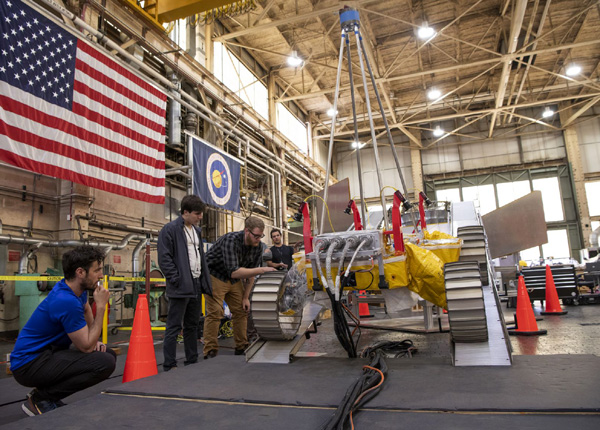
A test unit of the VIPER lunar rover rolls down the ramp of a full-scale replica of Astrobotic's Griffin Moon lander...at NASA's Johnson Space Center in Houston, Texas.
NASA / Johnson Space Center / James Blair

Tuesday, May 31, 2022

Photo of the Day: Developmental Testing Continues for NASA's VIPER Rover Before It Begins Official Assembly Later This Year...

A test version of the VIPER lunar rover rolls down the ramp of Astrobotic's Griffin lander replica at NASA's Glenn Research Center in Cleveland, Ohio.
NASA

NASA Moon Rover Practices Tricky Drive Off Lunar Lander (News Release)

Once it arrives at the Moon's South Pole, NASA's Volatiles Investigating Polar Exploration Rover (VIPER) will need to perform one of the trickiest parts of its 100-day mission: driving off the Astrobotic Griffin lunar lander and onto the Moon's surface. After another successful round of testing this “egress” activity, VIPER is one step closer to being ready for launch.

VIPER has already completed several egress exercises, but recent tests at NASA's Glenn Research Center in Cleveland were the most realistic yet – using the latest prototype lander and a robotic prototype of the Moon rover that will explore and map the lunar surface in search of resources that could sustain astronauts on future Artemis missions.

Since the goal of this test is to ensure VIPER’s able to handle the rollout onto the lunar surface, engineers designed this prototype to be the most realistic model of its mobility systems while stripping down the rover’s heavier components. Because there’s less gravity on the Moon than on Earth, the rover needs to be lighter to more accurately simulate the conditions found on the lunar surface. Using this unique version of VIPER, the team can verify every aspect of the system is working as intended, and that when the real VIPER egresses, everything will go smoothly.

With several mission procedures still being fine-tuned, this won’t be the last time the VIPER team practices driving rover prototypes down the lander’s ramps. Future tests will take place in the Regolith Testbed at NASA's Ames Research Center in California’s Silicon Valley, a facility capable of realistically reproducing the lighting and dusty terrain of the Moon’s environment.

While this test confirmed rover and lander systems are functionally ready to go, future tests will give the rover operations team an opportunity to practice lander egress in conditions as close as possible to what it will be like when they roll out VIPER and leave its first wheel marks on the Moon’s surface through NASA’s Commercial Lunar Payload Services initiative.

Source: NASA.Gov

Thursday, January 27, 2022

Photo of the Day: A Prototype of NASA's Next Robotic Rover Continues to Test Its Ability to Drive Through Lunar Soil...

A test version of the VIPER lunar rover drives through sand at NASA's Glenn Research Center in Cleveland, Ohio.
Jef Janis, NASA Glenn Research Center

A VIPER in the Sand (News Release - January 26)

The test version of NASA’s Volatiles Investigating Polar Exploration Rover, or VIPER, kicks up high sinkage sand-like material while transiting NASA Glenn’s Simulated Lunar Operations Laboratory, or SLOPE bed. In November 2021, the latest test rover visited SLOPE to complete the next iteration of mobility testing, a critical step toward ensuring the rover is ready for its 2023 mission to the Moon’s South Pole to get a close-up view of the location and concentration of ice and other resources.

The latest prototype of the rover, known as Moon Gravitation Representative Unit 3, or MGRU3, has the same wheel design and base size as the rover that will go to the Moon. It also has the flight design motors, gearboxes and joints, as well as the newest version of the flight software.

This test was the third mobility assessment conducted by VIPER at SLOPE to collect critical data on the software mobility controls, the onboard navigation system, and mobility performance over hazards and on loose soil. For over two weeks, the team used the facility’s unique capabilities to drive MGRU3 over various obstacles and up steep slopes. The data collected at Glenn, along with a concurrent wheel-only test at the ProtoInnovations lab in Pittsburgh, will help inform the rover operations and science teams on route planning.

Later this spring, yet an even more flight-like rover will return to SLOPE for verification and validation testing. It is comparable to the final exam where the rover will need to prove it’s capable of meeting design requirements with its hardware, software, and electronics.

VIPER will be delivered to the surface of the Moon in late 2023 by Astrobotic’s Griffin lander as part of NASA’s Commercial Lunar Payload Services initiative.

Source: NASA.Gov

Thursday, January 06, 2022

VIPER Update: NASA's Robotic Rover Moves One Step Closer to Strolling Across the Lunar Surface Later Next Year...

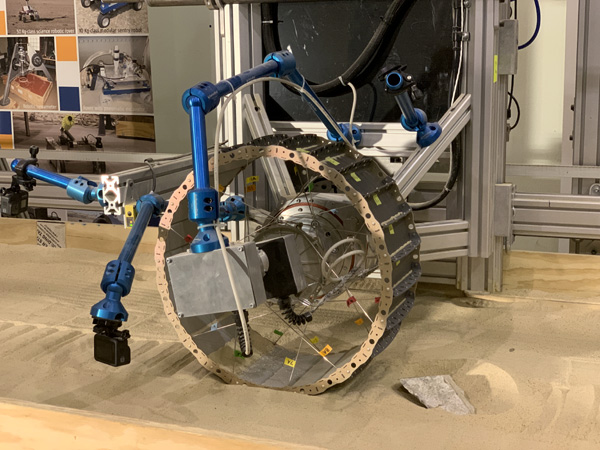
An engineering version of the VIPER lunar rover's wheels undergoes testing at ProtoInnovations in Pittsburgh, Pennsylvania.
ProtoInnovations, LLC

Artemis Moon Rover’s Wheels are Ready to Roll (News Release)

The last thing you need on a trip to the Moon is a flat tire. Luckily, NASA’s water-hunting robot – bound for the lunar surface in 2023 – has no tires! But the all-metal wheels of the Volatiles Investigating Polar Exploration Rover, or VIPER, will have to withstand a whole lot of rocking and rolling as they move across the rugged lunar surface. Before the rover’s design was finalized at its Critical Design Review, the endurance of its wheels had to undergo rigorous testing in the lab. The tests helped solidify plans for the wheels and gave engineers an opportunity to study its movements, in the name of designing even better mobility controls for future rovers.

Using a Moon-mimicking set-up in the lab, the VIPER team tested one of the rover’s wheels over a three-week period. It clocked 25 miles of movement in a high-tech sandbox filled with lunar soil simulant, running through a battery of tests. They simulated slopes, wheel slips, and even the size, shape, and distribution of rocks the rover will encounter on the Moon.

While NASA has considerable experience designing Mars rovers, engineers had to invent new technology for controlling VIPER’s wheels in the unexplored environment of the Moon’s South Pole.

“Lunar regolith is fluffy due to the low gravity and lack of most weathering processes, and the particles are sharp like broken glass,” said Arno Rogg, a rover mobility system engineer at NASA’s Ames Research Center in California’s Silicon Valley. “Rocks of various sizes are scattered everywhere on the Moon’s surface. All that presented some real engineering challenges to designing a lightweight, performant, and robust wheel for the half-ton rover.”

To test if their wheel was ready for the Moon, the team worked with ProtoInnovations of Pittsburgh. The robotics company, which also designed software controls for VIPER’s wheels, is working to improve rover driving ability in unknown and highly variable lunar terrain. Their work is supported by NASA’s Small Business Innovation Research and Small Business Technology Transfer program.

At the ProtoInnovations lab, engineers attached one of VIPER’s wheels to the narrow, 20-foot-long lunar sandbox equipped with measuring devices, cameras, and robotic controls for simulating slipping and sliding. The wheel rolled slowly back and forth under conditions that simulated as closely as possible what it will experience on the Moon.

Well-defined slopes were created in the lunar soil simulant, and the wheel’s tracks were studied after any significant slip. Sensors let the team measure how much the wheel sank into the soil, its traction performance, and how it maneuvered over rocks.

“Simulating on Earth the way the rover will move on the Moon required complicated robotic controls – but that’s what we do,” said Dimi Apostolopoulos, CEO of ProtoInnovations. “Our biggest challenge was picking just the right rocks to stand in for Moon rocks in the test bed.”

Goldilocks Moon Rocks

Actual samples of Moon rocks are, of course, too precious to use for a rover test drive, and the terrestrial stand-ins had to be just right. Too hard or too soft and they’d give a false impression of the challenge the rover will face.

The team secured some of the rare Earth rocks that most closely resemble the Moon's, and, by scaling down real data about the distribution of lunar rocks, learned how many of what size should be used in the test bed. They also learned how to space them so the wheel experienced hitting rocks the way it will during VIPER’s mission.

In all, the wheel was put through 196 scenarios of different rock shapes, heights, and positions the rover is likely to find on the Moon.

“Overall, the wheel’s performance was excellent,” said Rogg. “At the end of the test, both its physical condition and its behavior – looking especially at its traction – were only slightly degraded compared to when we started the test. By driving the wheel more than twice the distance it’s expected to travel on the lunar surface, we reduced the risk of any premature wheel failure occurring on the Moon.”

Minor weaknesses detected in the wheels during testing were addressed by VIPER’s mechanical design team with improvements that went into the rover’s final design. VIPER will be delivered to the surface of the Moon in late 2023 as part of the Commercial Lunar Payload Services initiative.

Source: NASA.Gov

****

An animated GIF showing an engineering version of the VIPER lunar rover's wheels driving over a rock during a test at ProtoInnovations in Pittsburgh, Pennsylvania.
ProtoInnovations, LLC