Hello, World! NASA Shares New Home for Roman Space Telescope Updates (News Release)
We’re kicking off the inaugural Roman blog post with a launch update: NASA’s Nancy Grace Roman Space Telescope is officially slated to launch on August 30, eight months ahead of schedule and even earlier than previously targeted.
With less than three months to go, the Roman team is now finishing up final tasks. Engineers are currently packing Roman up for a voyage from NASA’s Goddard Space Flight Center in Greenbelt, Maryland, down to the agency’s Kennedy Space Center in Florida later this month.
Once at Kennedy, Roman will move into the Payload Hazardous Servicing Facility, where it will undergo a thorough inspection to verify that all of the observatory’s components traveled well. In the weeks leading up to launch, engineers will perform powered testing and launch rehearsals, load about 290 gallons (roughly 1,100 liters) of hydrazine fuel into the tanks, and install the observatory on the adapter for the SpaceX Falcon Heavy rocket that will propel it to its destination in space: the second Sun-Earth Lagrange point, or L2, which is about four times farther away than the Moon is from Earth.
Next, Roman will be encapsulated in a protective fairing, or nose cone, which will shield the telescope during liftoff and its journey through the atmosphere. Roman will then move to a hangar for integration with the SpaceX Falcon Heavy rocket before rolling out to Launch Complex 39A at NASA Kennedy.
All this work will culminate in Roman delivering never-before seen views of the Universe. The observatory will pair a large field of view with crisp infrared vision to survey deep, vast swaths of sky. While the mission was designed with dark energy, dark matter, and planets outside our Solar System in mind, Roman’s unprecedented observational capability will offer practically limitless opportunities for astronomers to explore a broad range of cosmic phenomena.
NASA / MIT / TESS and Veselin Kostov (University of Maryland College Park)
NASA’s Planet-Hunting TESS Reveals Dazzling Night Sky (News Release)
NASA’s TESS(Transiting Exoplanet Survey Satellite) has released its most complete view of the starry sky to date, filling in gaps from previous observations. Nearly 6,000 colored dots scattered across the image show the locations of either confirmed or candidate exoplanets — worlds beyond our Solar System — identified by the mission as of September 2025 at the end of TESS’s second extended mission.
“Over the last eight years, TESS has become a fire hose of exoplanet science,” said Rebekah Hounsell, a TESS associate project scientist at the University of Maryland Baltimore County and NASA’s Goddard Space Flight Center in Greenbelt, Maryland. “It’s helped us find planets of all different sizes, from tiny Mercury-like ones to those larger than Jupiter. Some of them are even in the habitable zone, where liquid water might be possible on the surface, an important factor in our search for life beyond Earth.”
The TESS mission scans a wide swath of the sky, called a sector, for about a month at a time using its four cameras. These long stares allow the spacecraft to track the brightness changes of tens of thousands of stars, looking for variations in their light that might come from orbiting planets.
Researchers assembled an all-sky mosaic made of 96 sectors observed between April 2018, when TESS began its work, and September 2025.
The blue dots in the image mark the locations of nearly 700 confirmed planets, as of September 9. This menagerie includes worlds that may be covered by volcanoes, are being destroyed by their stars, or orbit two stars — experiencing double sunrises and sunsets each day. The orange dots represent more than 5,000 candidate planets that are awaiting verification.
To date, scientists have confirmed over 6,270 exoplanets using missions like TESS, NASA’s retired Kepler Space Telescope, and other facilities.
Also captured in the mosaic is the bright plane of our Milky Way galaxy, seen as a glowing arc through the center. The bright white ovals in the lower left are the Large and Small Magellanic Clouds. These satellite galaxies are located 160,000 and 200,000 light-years away, respectively.
“The more we dig into the large TESS dataset, especially using automated algorithms, the more surprises we find,” said Allison Youngblood, the TESS project scientist at NASA Goddard. “In addition to planets, TESS has helped us study rivers of young stars, observe dynamic galactic behavior, and monitor asteroids near Earth. As TESS fills in more of the night sky, there’s no knowing what it might see next.”
NASA Targets Early September for Roman Space Telescope Launch (News Release)
NASA’s Nancy Grace Roman Space Telescope team is now targeting as soon as early September 2026 for launch, ahead of the agency’s commitment to flight no later than May 2027.
“Roman’s accelerated development is a true success story of what we can achieve when public investment, institutional expertise, and private enterprise come together to take on the near-impossible missions that change the world,” said NASA Administrator Jared Isaacman, who announced the update at a news conference on April 21 at the agency’s Goddard Space Flight Center in Greenbelt, Maryland.
Roman will pair a large field of view with crisp infrared vision to survey deep, vast swaths of sky. While the mission was designed with dark energy, dark matter, and exoplanets in mind, Roman’s unprecedented observational capability will offer practically limitless opportunities for astronomers to explore all kinds of cosmic topics.
By the end of its five-year primary mission, Roman is expected to amass a 20,000-terabyte data archive. Scientists can draw on it to identify and study 100,000 exoplanets, hundreds of millions of galaxies, billions of stars, and rare objects and phenomena — including some that astronomers have never witnessed before.
Roman will launch on a SpaceX Falcon Heavy rocket from Launch Complex 39A at NASA’s Kennedy Space Center in Florida. NASA and SpaceX will share more information about a specific launch date, and the agency will continue to share updates concerning prelaunch preparations as new information becomes available.
The Nancy Grace Roman Space Telescope is managed at NASA’s Goddard Space Flight Center, with participation by NASA’s Jet Propulsion Laboratory and Caltech/IPAC in Southern California, the Space Telescope Science Institute (STScI) in Baltimore, and scientists from various research institutions.
NASA’s TESS(Transiting Exoplanet Survey Satellite) observed the interstellar comet 3I/ATLAS during a special observation run from January 15 to 22. Scientists will use the data to study the comet’s activity and rotation.
Using TESS data from January 15 and January 18 to 19, Daniel Muthukrishna, a research scientist at the Massachusetts Institute of Technology in Cambridge, compiled a series of images into a short video that shows 3I/ATLAS as a bright moving dot with a tail.
The comet’s brightness is around 11.5 in apparent magnitude, or approximately 100 times fainter than what humans can see with the unaided eye.
All of the TESS data from January 15 through 22 are publicly available on the Mikulski Archive for Space Telescopes as of Tuesday. The initially-calibrated measurements from January 15 used for the brightness estimate and the video were posted on January 19.
The TESS spacecraft scans a wide swath of the sky for about a month at a time, looking for variations in the light from distant stars to spot orbiting exoplanets, or worlds beyond our Solar System. This technique also allows TESS to identify and monitor comets and asteroids out to large distances.
The mission’s wide field of view previously happened to observe 3I/ATLAS in May 2025, almost two months before it was discovered. Astronomers looking back at the TESS data were able to identify the faint comet by stacking multiple observations to track its movement.
The recent 3I/ATLAS observations were temporarily interrupted from January 15 to 18 when TESS entered a safe mode following an issue with its solar panels.
NASA Completes Nancy Grace Roman Space Telescope Construction (News Release)
NASA’s next big eye on the cosmos is now fully assembled. On November 25, technicians joined the inner and outer portions of the Nancy Grace Roman Space Telescope in the largest clean room at the agency’s Goddard Space Flight Center in Greenbelt, Maryland.
“Completing the Roman observatory brings us to a defining moment for the agency,” said NASA Associate Administrator Amit Kshatriya. “Transformative science depends on disciplined engineering, and this team has delivered—piece by piece, test by test—an observatory that will expand our understanding of the Universe. As Roman moves into its final stage of testing following integration, we are focused on executing with precision and preparing for a successful launch on behalf of the global scientific community.”
After final testing, Roman will move to the launch site at NASA’s Kennedy Space Center in Florida for launch preparations in summer 2026. Roman is slated to launch by May 2027, but the team is on track for launch as early as fall 2026. A SpaceX Falcon Heavy rocket will send the observatory to its final destination a million miles from Earth.
“With Roman’s construction complete, we are poised at the brink of unfathomable scientific discovery,” said Julie McEnery, Roman’s senior project scientist at NASA Goddard. “In the mission’s first five years, it’s expected to unveil more than 100,000 distant worlds, hundreds of millions of stars, and billions of galaxies. We stand to learn a tremendous amount of new information about the Universe very rapidly after Roman launches.”
Observing from space will make Roman very sensitive to infrared light — light with a longer wavelength than our eyes can see — from far across the cosmos. Pairing its crisp infrared vision with a sweeping view of space will allow astronomers to explore myriad cosmic topics, from dark matter and dark energy to distant worlds and solitary black holes, and conduct research that would take hundreds of years using other telescopes.
“Within our lifetimes, a great mystery has arisen about the cosmos: why the expansion of the Universe seems to be accelerating. There is something fundamental about space and time we don’t yet understand, and Roman was built to discover what it is,” said Nicky Fox, associate administrator, Science Mission Directorate, NASA Headquarters in Washington. “With Roman now standing as a complete observatory, which keeps the mission on track for a potentially early launch, we are a major step closer to understanding the Universe as never before. I couldn’t be prouder of the teams that have gotten us to this point.”
Double vision
Roman is equipped with two instruments: the Wide Field Instrument and Coronagraph Instrument technology demonstration.
The coronagraph will demonstrate new technologies for directly imaging planets around other stars. It will block the glare from distant stars and make it easier for scientists to see the faint light from planets in orbit around them. The Coronagraph aims to photograph worlds and dusty disks around nearby stars in visible light to help us see giant worlds that are older, colder, and in closer orbits than the hot, young super-Jupiters direct imaging has mainly revealed so far.
“The question of ‘Are we alone?’ is a big one, and it’s an equally big task to build tools that can help us answer it,” said Feng Zhao, the Roman Coronagraph Instrument manager at NASA’s Jet Propulsion Laboratory in Southern California. “The Roman Coronagraph is going to bring us one step closer to that goal. It’s incredible that we have the opportunity to test this hardware in space on such a powerful observatory as Roman.”
The coronagraph team will conduct a series of pre-planned observations for three months spread across the mission’s first year-and-a-half of operations, after which the mission may conduct additional observations based on scientific community input.
The Wide Field Instrument is a 288-megapixel camera that will unveil the cosmos all the way from our Solar System to near the edge of the observable Universe. Using this instrument, each Roman image will capture a patch of the sky bigger than the apparent size of a full moon. The mission will gather data hundreds of times faster than NASA’s Hubble Space Telescope, adding up to 20,000 terabytes (20 petabytes) over the course of its five-year primary mission.
“The sheer volume of the data Roman will return is mind-boggling and key to a host of exciting investigations,” said Dominic Benford, Roman’s program scientist at NASA Headquarters.
Survey trifecta
Using the Wide Field Instrument, Roman will conduct three core surveys which will account for 75% of the primary mission. The High-Latitude Wide-Area Survey will combine the powers of imaging and spectroscopy to unveil more than a billion galaxies strewn across a wide swath of space and time. Astronomers will trace the evolution of the Universe to probe dark matter — invisible matter detectable only by how its gravity affects things we can see — and trace the formation of galaxies and galaxy clusters over time.
The High-Latitude Time-Domain Survey will probe our dynamic Universe by observing the same region of the cosmos repeatedly. Stitching these observations together to create movies will allow scientists to study how celestial objects and phenomena change over time periods of days to years. That will help astronomers study dark energy — the mysterious cosmic pressure thought to accelerate the Universe’s expansion — and could even uncover entirely new phenomena that we don’t yet know to look for.
Roman’s Galactic Bulge Time-Domain Survey will look inward to provide one of the deepest views ever of the heart of our Milky Way galaxy. Astronomers will watch hundreds of millions of stars in search of microlensing signals — gravitational boosts of a background star’s light caused by the gravity of an intervening object. While astronomers have mainly discovered star-hugging worlds, Roman’s microlensing observations can find planets in the habitable zone of their star and farther out, including worlds like every planet in our Solar System except Mercury.
Microlensing will also reveal rogue planets—worlds that roam the galaxy untethered to a star — and isolated black holes. The same dataset will reveal 100,000 worlds that transit, or pass in front of, their host stars.
The remaining 25% of Roman’s five-year primary mission will be dedicated to other observations that will be determined with input from the broader scientific community. The first such program, called the Galactic Plane Survey, has already been selected.
Because Roman’s observations will enable such a wide range of science, the mission will have a General Investigator Program designed to support astronomers to reveal scientific discoveries using Roman data. As part of NASA’s commitment to Gold Standard Science, NASA will make all of Roman’s data publicly available with no exclusive use period. This ensures that multiple scientists and teams can use data at the same time, which is important since every Roman observation will address a wealth of science cases.
Roman’s namesake — Dr. Nancy Grace Roman, NASA’s first chief astronomer — made it her personal mission to make cosmic vistas readily accessible to all by paving the way for telescopes based in space.
“The mission will acquire enormous quantities of astronomical imagery that will permit scientists to make groundbreaking discoveries for decades to come, honoring Dr. Roman’s legacy in promoting scientific tools for the broader community,” said Jackie Townsend, Roman’s deputy project manager at NASA Goddard. “I like to think Dr. Roman would be extremely proud of her namesake telescope and thrilled to see what mysteries it will uncover in the coming years.”
The Nancy Grace Roman Space Telescope is managed at NASA’s Goddard Space Flight Center in Greenbelt, Maryland, with participation by NASA’s Jet Propulsion Laboratory in Southern California; Caltech/IPAC in Pasadena, California; the Space Telescope Science Institute in Baltimore; and a science team comprising scientists from various research institutions. The primary industrial partners are BAE Systems Inc. in Boulder, Colorado; L3Harris Technologies in Rochester, New York; and Teledyne Scientific & Imaging in Thousand Oaks, California.
Sixteen Light-Years... That’s how far the Hello From Earth message has traveled since being transmitted from a giant NASA antenna in Australia to the exoplanet Gliese 581d in the summer of 2009.
As of 7 PM California time tonight (12 PM Sydney time on Thursday, August 28), the radio signal containing 25,878 goodwill text messages—including one by me—will have ventured across approximately 94 trillion miles (151 trillion kilometers) of deep space...which, as stated at the very start of this Blog entry, equals a distance of sixteen light-years.
The signal, despite traveling 186,000 miles per second (or 671 million miles per hour, or um, 1 billion kilometers per hour), will still take about 4 years to reach the Gliese 581 star system. Carry on!
Webb Narrows Atmospheric Possibilities for Earth-sized Exoplanet TRAPPIST-1 d (News Release - August 13)
The exoplanet TRAPPIST-1 d intrigues astronomers looking for possible habitable worlds beyond our Solar System because it is similar in size to Earth, rocky, and resides in an area around its star where liquid water on its surface is theoretically possible. But according to a new study using data from NASA’s James Webb Space Telescope, it does not have an Earth-like atmosphere.
“Ultimately, we want to know if something like the environment we enjoy on Earth can exist elsewhere, and under what conditions. While NASA’s James Webb Space Telescope is giving us the ability to explore this question in Earth-sized planets for the first time, at this point we can rule out TRAPPIST-1 d from a list of potential Earth twins or cousins,” said Caroline Piaulet-Ghorayeb of the University of Chicago and Trottier Institute for Research on Exoplanets (IREx) at Université de Montréal, lead author of the study published in The Astrophysical Journal.
Planet TRAPPIST-1 d
The TRAPPIST-1 system is located 40 light-years away and was revealed as the record-holder for most Earth-sized rocky planets around a single star in 2017, thanks to data from NASA’s retired Spitzer Space Telescope and other observatories. Due to that star being a dim, relatively cold red dwarf, the “habitable zone” or “Goldilocks zone” – where the planet’s temperature may be just right, such that liquid surface water is possible – lies much closer to the star than in our Solar System. TRAPPIST-1 d, the third planet from the red dwarf star, lies on the cusp of that temperate zone, yet its distance to its star is only 2 percent of Earth’s distance from the Sun.
TRAPPIST-1 d completes an entire orbit around its star, its year, in only four Earth days.
Webb’s NIRSpec (Near-Infrared Spectrograph) instrument did not detect molecules from TRAPPIST-1 d that are common in Earth’s atmosphere, like water, methane or carbon dioxide. However, Piaulet-Ghorayeb outlined several possibilities for the exoplanet that remain open for follow-up study.
“There are a few potential reasons why we don’t detect an atmosphere around TRAPPIST-1 d. It could have an extremely thin atmosphere that is difficult to detect, somewhat like Mars. Alternatively, it could have very thick, high-altitude clouds that are blocking our detection of specific atmospheric signatures — something more like Venus. Or, it could be a barren rock, with no atmosphere at all,” Piaulet-Ghorayeb said.
The Star TRAPPIST-1
No matter what the case may be for TRAPPIST-1 d, it’s tough being a planet in orbit around a red dwarf star. TRAPPIST-1, the host star of the system, is known to be volatile, often releasing flares of high-energy radiation with the potential to strip off the atmospheres of its small planets, especially those orbiting most closely. Nevertheless, scientists are motivated to seek signs of atmospheres on the TRAPPIST-1 planets because red dwarf stars are the most common stars in our galaxy.
If planets can hold on to an atmosphere here, under waves of harsh stellar radiation, they could, as the saying goes, make it anywhere.
“Webb’s sensitive infrared instruments are allowing us to delve into the atmospheres of these smaller, colder planets for the first time,” said Björn Benneke of IREx at Université de Montréal, a co-author of the study. “We’re really just getting started using Webb to look for atmospheres on Earth-sized planets, and to define the line between planets that can hold onto an atmosphere, and those that cannot.”
The Outer TRAPPIST-1 Planets
Webb observations of the outer TRAPPIST-1 planets are ongoing, which hold both potential and peril. On the one hand, Benneke said, planets e, f, g, and h may have better chances of having atmospheres because they are further away from the energetic eruptions of their host star. However, their distance and colder environment will make atmospheric signatures more difficult to detect, even with Webb’s infrared instruments.
“All hope is not lost for atmospheres around the TRAPPIST-1 planets,” Piaulet-Ghorayeb said. “While we didn’t find a big, bold atmospheric signature at planet d, there is still potential for the outer planets to be holding onto a lot of water and other atmospheric components.”
“As NASA leads the way in searching for life outside our Solar System, one of the most important avenues we can pursue is understanding which planets retain their atmospheres, and why,” said Shawn Domagal-Goldman, acting director of the Astrophysics Division at NASA Headquarters in Washington. “NASA’s James Webb Space Telescope has pushed our capabilities for studying exoplanet atmospheres further than ever before, beyond extreme worlds to some rocky planets – allowing us to begin confirming theories about the kind of planets that may be potentially habitable. This important groundwork will position our next missions, like NASA’s Habitable Worlds Observatory, to answer a universal question: Are we alone?”
NASA’s Webb Finds New Evidence for Planet Around Closest Solar Twin (News Release - August 7)
Astronomers using NASA’s James Webb Space Telescope have found strong evidence of a giant planet orbiting a star in the stellar system closest to our own Sun. At just 4 light-years away from Earth, the Alpha Centauri triple star system has long been a compelling target in the search for worlds beyond our Solar System.
Alpha Centauri, located in the far southern sky, is made up of the binary Alpha Centauri A and Alpha Centauri B, both Sun-like stars, and the faint red dwarf star Proxima Centauri. Alpha Centauri A is the third brightest star in the night sky. While there are three confirmed planets orbiting Proxima Centauri, the presence of other worlds surrounding Alpha Centauri A and Alpha Centauri B has proved challenging to confirm.
Now, Webb’s observations from its Mid-Infrared Instrument (MIRI) are providing the strongest evidence to date of a gas giant orbiting Alpha Centauri A. The results have been accepted in a series of two papers in The Astrophysical Journal Letters.
If confirmed, the planet would be the closest to Earth that orbits in the habitable zone of a Sun-like star. However, because the planet candidate is a gas giant, scientists say it would not support life as we know it.
“With this system being so close to us, any exoplanets found would offer our best opportunity to collect data on planetary systems other than our own. Yet, these are incredibly challenging observations to make, even with the world’s most powerful space telescope, because these stars are so bright, close, and move across the sky quickly,” said Charles Beichman, NASA’s Jet Propulsion Laboratory and the NASA Exoplanet Science Institute at Caltech’s IPAC astronomy center, co-first author on the new papers. “Webb was designed and optimized to find the most distant galaxies in the Universe. The operations team at the Space Telescope Science Institute had to come up with a custom observing sequence just for this target, and their extra effort paid off spectacularly.”
Several rounds of meticulously-planned observations by Webb, careful analysis by the research team, and extensive computer modeling helped determine that the source seen in Webb’s image is likely to be a planet, and not a background object (like a galaxy), foreground object (a passing asteroid), or other detector or image artifact.
The first observations of the system took place in August 2024, using the coronagraphic mask aboard MIRI to block Alpha Centauri A’s light. While extra brightness from the nearby companion star Alpha Centauri B complicated the analysis, the team was able to subtract out the light from both stars to reveal an object over 10,000 times fainter than Alpha Centauri A, separated from the star by about two times the distance between the Sun and Earth.
While the initial detection was exciting, the research team needed more data to come to a firm conclusion. However, additional observations of the system in February 2025 and April 2025 (using Director’s Discretionary Time) did not reveal any objects like the one identified in August 2024.
“We are faced with the case of a disappearing planet! To investigate this mystery, we used computer models to simulate millions of potential orbits, incorporating the knowledge gained when we saw the planet, as well as when we did not,” said PhD student Aniket Sanghi of Caltech in Pasadena, California. Sanghi is a co-first author on the two papers covering the team’s research.
In these simulations, the team took into account both a 2019 sighting of the potential exoplanet candidate by the European Southern Observatory’s Very Large Telescope, the new data from Webb, and considered orbits that would be gravitationally stable in the presence of Alpha Centauri B, meaning that the planet wouldn’t get flung out of the system.
Researchers say a non-detection in the second and third round of observations with Webb isn’t surprising.
“We found that in half of the possible orbits simulated, the planet moved too close to the star and wouldn’t have been visible to Webb in both February and April 2025,” said Sanghi.
Based on the brightness of the planet in the mid-infrared observations and the orbit simulations, researchers say it could be a gas giant approximately the mass of Saturn orbiting Alpha Centauri A in an elliptical path varying between 1 to 2 times the distance between Sun and Earth.
"If confirmed, the potential planet seen in the Webb image of Alpha Centauri A would mark a new milestone for exoplanet imaging efforts," Sanghi says. "Of all the directly-imaged planets, this would be the closest to its star seen so far. It's also the most similar in temperature and age to the giant planets in our Solar System, and nearest to our home, Earth," he says. "Its very existence in a system of two closely-separated stars would challenge our understanding of how planets form, survive and evolve in chaotic environments."
If confirmed by additional observations, the team’s results could transform the future of exoplanet science.
“This would become a touchstone object for exoplanet science, with multiple opportunities for detailed characterization by Webb and other observatories,” said Beichman.
For example, NASA’s Nancy Grace Roman Space Telescope, set to launch by May 2027 and potentially as early as fall 2026, is equipped with dedicated hardware that will test new technologies to observe binary systems like Alpha Centauri in search of other worlds. Roman’s visible light data would complement Webb’s infrared observations, yielding unique insights on the size and reflectivity of the planet.
The James Webb Space Telescope is the world’s premier space science observatory. Webb is solving mysteries in our Solar System, looking beyond to distant worlds around other stars, and probing the mysterious structures and origins of our Universe and our place in it. Webb is an international program led by NASA with its partners, ESA (European Space Agency) and CSA (Canadian Space Agency).
NASA, ESA, CSA, STScI, DSS, A. Sanghi (Caltech), C. Beichman (NExScI, NASA / JPL - Caltech), D. Mawet (Caltech); Image Processing: J. DePasquale (STScI)
NASA, ESA, CSA, Anne-Marie Lagrange (CNRS, UGA), Mahdi Zamani (ESA / Webb)
Likely Saturn-Mass Planet Imaged by NASA Webb Is Lightest Ever Seen (News Release - June 25)
Astronomers using NASA’s James Webb Space Telescope have captured compelling evidence of a planet with a mass similar to Saturn orbiting the young nearby star TWA 7. If confirmed, this would represent Webb’s first direct image discovery of a planet, and the lightest planet ever seen with this technique outside the Solar System.
The international team detected a faint infrared source in the disk of debris surrounding TWA 7 using Webb’s MIRI (Mid-Infrared Instrument). The distance between the source and TWA 7 is estimated to be about 50 times the distance of Earth from the Sun. This matches the expected position of a planet that would explain key features seen in the debris disk.
The results published on Wednesday, June 25, in the journal Nature.
Using MIRI’s coronagraph, the researchers carefully suppressed the bright glare of the host star to reveal faint nearby objects. This technique, called high-contrast imaging, enables astronomers to directly detect planets that would otherwise be lost in the overwhelming light from their host star. After subtracting residual starlight using advanced image processing, a faint infrared source was revealed near TWA 7.
The team ruled out an object in our Solar System that happened to be in the same part of the sky as the source. While there is a very small chance that it is a background galaxy, the evidence strongly points to the source being a previously undiscovered planet.
The source is located in a gap in one of three dust rings that were discovered around TWA 7 by previous ground-based observations. The object’s brightness, color, distance from the star, and position within the ring are consistent with theoretical predictions for a young, cold, Saturn-mass planet that is expected to be sculpting the surrounding debris disk.
"Our observations reveal a strong candidate for a planet shaping the structure of the TWA 7 debris disk, and its position is exactly where we expected to find a planet of this mass," said Anne-Marie Lagrange, CNRS researcher at the Observatoire de Paris-PSL and Université Grenoble Alpes in France, lead author of the paper.
“This observatory enables us to capture images of planets with masses similar to those in the Solar System, which represents an exciting step forward in our understanding of planetary systems, including our own,” added co-author Mathilde Malin of Johns Hopkins University and the Space Telescope Science Institute in Baltimore.
Initial analysis suggests that the object — referred to as TWA 7 b — could be a young, cold planet with a mass around 0.3 times that of Jupiter (about 100 Earth masses, or one Saturn mass) and a temperature near 120° Fahrenheit (47° Celsius). Its location aligns with a gap in the disk, hinting at a dynamic interaction between the planet and its surroundings.
Debris disks filled with dust and rocky material are found around both young and older stars, although they are more easily detected around younger stars as they are brighter. They often feature visible rings or gaps, thought to be created by planets that have formed around the star, but such a planet has yet to be directly detected within a debris disk. If verified, this discovery would mark the first time that a planet has been directly associated with sculpting a debris disk, and could offer the first observational hint of a “trojan disk” — a collection of dust trapped in the planet’s orbit.
TWA 7, also known as CE Antilae, is a young (about 6.4 million years-old) red dwarf star located about 34 light-years away in the TW Hydrae association. Its nearly face-on disk made it an ideal target for Webb’s high-sensitivity mid-infrared observations.
The findings highlight Webb’s ability to explore previously unseen, low-mass planets around nearby stars. Ongoing and future observations will aim to better constrain the properties of the candidate, verify its planetary status, and deepen our understanding of planet formation and disk evolution in young systems.
These observations were taken as part of the Webb observing program 3662.
The James Webb Space Telescope is the world’s premier space science observatory. Webb is solving mysteries in our Solar System, looking beyond to distant worlds around other stars, and probing the mysterious structures and origins of our Universe and our place in it. Webb is an international program led by NASA with its partners, ESA (European Space Agency) and CSA (Canadian Space Agency).
NASA’s James Webb Space Telescope has captured direct images of multiple gas giant planets within an iconic planetary system. HR 8799, a young system 130 light-years away, has long been a key target for planet formation studies.
The observations indicate that the well-studied planets of HR 8799 are rich in carbon dioxide gas. This provides strong evidence that the system’s four giant planets formed much like Jupiter and Saturn, by slowly building solid cores that attract gas from within a protoplanetary disk, a process known as core accretion.
The results also confirm that Webb can infer the chemistry of exoplanet atmospheres through imaging. This technique complements Webb’s powerful spectroscopic instruments, which can resolve the atmospheric composition.
“By spotting these strong carbon dioxide features, we have shown there is a sizable fraction of heavier elements, like carbon, oxygen and iron, in these planets’ atmospheres,” said William Balmer, of Johns Hopkins University in Baltimore. “Given what we know about the star they orbit, that likely indicates they formed via core accretion, which is an exciting conclusion for planets that we can directly see.”
Balmer is the lead author of the study announcing the results published today in The Astrophysical Journal. Balmer and their team’s analysis also includes Webb’s observation of a system 97 light-years away called 51 Eridani.
HR 8799 is a young system about 30 million years old, a fraction of our Solar System’s 4.6 billion years. Still hot from their tumultuous formation, the planets within HR 8799 emit large amounts of infrared light that give scientists valuable data on how they formed.
Giant planets can take shape in two ways: by slowly building solid cores with heavier elements that attract gas, just like the giants in our Solar System, or when particles of gas rapidly coalesce into massive objects from a young star’s cooling disk, which is made mostly of the same kind of material as the star. The first process is called core accretion, and the second is called disk instability. Knowing which formation model is more common can give scientists clues to distinguish between the types of planets they find in other systems.
“Our hope with this kind of research is to understand our own Solar System, life, and ourselves in the comparison to other exoplanetary systems, so we can contextualize our existence,” Balmer said. “We want to take pictures of other solar systems and see how they’re similar or different when compared to ours. From there, we can try to get a sense of how weird our Solar System really is—or how normal.”
Of the nearly 6,000 exoplanets discovered, few have been directly imaged, as even giant planets are many thousands of times fainter than their stars. The images of HR 8799 and 51 Eridani were made possible by Webb’s NIRCam (Near-Infrared Camera) coronagraph, which blocks light from bright stars to reveal otherwise hidden worlds.
This technology allowed the team to look for infrared light emitted by the planets in wavelengths that are absorbed by specific gases. The team found that the four HR 8799 planets contain more heavy elements than previously thought.
The team is paving the way for more detailed observations to determine whether objects that they see orbiting other stars are truly giant planets or objects such as brown dwarfs, which form like stars but don’t accumulate enough mass to ignite nuclear fusion.
“We have other lines of evidence that hint at these four HR 8799 planets forming using this bottom-up approach” said Laurent Pueyo, an astronomer at the Space Telescope Science Institute in Baltimore, who co-led the work. “How common is this for planets we can directly image? We don't know yet, but we're proposing more Webb observations to answer that question.”
“We knew Webb could measure colors of the outer planets in directly-imaged systems,” added Rémi Soummer, director of STScI’s Russell B. Makidon Optics Lab and former lead for Webb coronagraph operations. “We have been waiting for 10 years to confirm that our finely-tuned operations of the telescope would also allow us to access the inner planets. Now the results are in and we can do interesting science with it.”
The NIRCam observations of HR 8799 and 51 Eridani were conducted as part of Guaranteed Time Observations programs 1194 and 1412 respectively.
NASA Presses Forward Search for VIPER Moon Rover Partner (News Release)
To advance plans of securing a public/private partnership and land and operate NASA’s VIPER(Volatiles Investigating Polar Exploration Rover) mission on the Moon in collaboration with industry, the agency announced on Monday that it is seeking U.S. proposals. As part of the agency’s Artemis campaign, instruments on VIPER will demonstrate U.S. industry’s ability to search for ice on the lunar surface and collect science data.
The Announcement for Partnership Proposal contains proposal instructions and evaluation criteria for a new Lunar Volatiles Science Partnership. Responses are due on Thursday, February 20. After evaluating submissions, any selections by the agency will require respondents to submit a second, more detailed, proposal.
NASA is expected to make a decision on the VIPER mission this summer.
“Moving forward with a VIPER partnership offers NASA a unique opportunity to engage with the private sector,” said Nicky Fox, associate administrator in the Science Mission Directorate at NASA Headquarters in Washington. “Such a partnership provides the opportunity for NASA to collect VIPER science that could tell us more about water on the Moon, while advancing commercial lunar landing capabilities and resource prospecting possibilities.”
This new announcement comes after NASA issued a Request for Information on August 9, 2024, to seek interest from American companies and institutions in conducting a mission using the agency’s VIPER Moon rover after the program was cancelled in July 2024.
Any partnership would work under a Cooperative Research and Development Agreement. This type of partnership allows both NASA and an industry partner to contribute services, technology and hardware to the collaboration.
As part of an agreement, NASA would contribute the existing VIPER rover as-is. Potential partners would need to arrange for the integration and successful landing of the rover on the Moon, conduct a science/exploration campaign, and disseminate VIPER-generated science data. The partner may not disassemble the rover and use its instruments or parts separately from the VIPER mission.
NASA’s selection approach will favor proposals that enable data from the mission’s science instruments to be shared openly with anyone who wishes to use it.
“Being selected for the VIPER partnership would benefit any company interested in advancing their lunar landing and surface operations capabilities,” said Joel Kearns, deputy associate administrator for exploration in the Science Mission Directorate. “This solicitation seeks proposals that clearly describe what is needed to successfully land and operate the rover, and invites industry to propose their own complementary science goals and approaches. NASA is looking forward to partnering with U.S. industry to meet the challenges of performing volatiles science in the lunar environment.”
The Moon is a cornerstone for Solar System science and exoplanet studies. In addition to helping inform where ice exists on the Moon for potential future astronauts, understanding our nearest neighbor helps us understand how it has evolved and what processes shaped its surface.
NASA Successfully Integrates Roman Mission’s Telescope, Instruments (News Release - December 12)
NASA’s Nancy Grace Roman Space Telescope team has successfully integrated the mission’s telescope and two instruments onto the instrument carrier, marking the completion of the Roman payload. Now the team at NASA’s Goddard Space Flight Center in Greenbelt, Maryland, will begin joining the payload to the spacecraft.
“We’re in the middle of an exciting stage of mission preparation,” said Jody Dawson, a Roman systems engineer at NASA Goddard. “All the components are now here at Goddard, and they’re coming together in quick succession. We expect to integrate the telescope and instruments with the spacecraft before the year is up.”
Engineers first integrated the Coronagraph Instrument, a technology demonstration designed to image exoplanets — worlds outside of our Solar System — by using a complex suite of masks and active mirrors to obscure the glare of the planets’ host stars.
Then the team integrated the Optical Telescope Assembly, which includes a 7.9-foot (2.4-meter) primary mirror, nine additional mirrors and their supporting structures and electronics. The telescope will focus cosmic light and send it to Roman’s instruments, revealing billions of objects strewn throughout space and time. Roman will be the most stable large telescope ever built, at least 10 times more so than NASA’s James Webb Space Telescope and 100 times more than the agency’s Hubble Space Telescope.
Roman's stability will allow scientists to make measurements at levels of precision that can answer important questions about dark energy, dark matter and worlds beyond our Solar System.
With those components in place, the team then added Roman’s primary instrument. Called the Wide Field Instrument, this 300-megapixel infrared camera will give Roman a deep, panoramic view of the Universe. Through the Wide Field Instrument’s surveys, scientists will be able to explore distant exoplanets, stars, galaxies, black holes, dark energy, dark matter and more.
Thanks to the Wide Field Instrument and the observatory’s efficiency, Roman will be able to image large areas of the sky 1,000 times faster than Hubble with the same sharp, sensitive image quality.
“It would be quicker to list the astronomy topics Roman won’t be able to address than those it will,” said Julie McEnery, the Roman senior project scientist at NASA Goddard. “We’ve never had a tool like this before. Roman will revolutionize the way we do astronomy.”
The telescope and instruments were mounted to Roman’s instrument carrier and precisely aligned in the largest clean room at Goddard, where the observatory is being assembled. Now, the whole assembly is being attached to the Roman spacecraft, which will deliver the observatory to its orbit and enable it to function once there.
At the same time, the mission’s deployable aperture cover — a visor that will shield the telescope from unwanted light — is being joined to the outer barrel assembly, which serves as the telescope’s exoskeleton.
“We’ve had an incredible year, and we’re looking forward to another one!” said Bear Witherspoon, a Roman systems engineer at NASA Goddard. “While the payload and spacecraft undergo a smattering of testing together, the team will work toward integrating the solar panels onto the outer barrel assembly.”
That keeps the observatory on track for completion by fall 2026 and launch no later than May 2027.
The Nancy Grace Roman Space Telescope is managed at NASA’s Goddard Space Flight Center in Greenbelt, Maryland, with participation by NASA’s Jet Propulsion Laboratory and Caltech/IPAC in Southern California, the Space Telescope Science Institute in Baltimore, and a science team comprising scientists from various research institutions. The primary industrial partners are BAE Systems Inc. in Boulder, Colorado; L3Harris Technologies in Rochester, New York; and Teledyne Scientific & Imaging in Thousand Oaks, California.
Earlier today, the National Academies of Sciences, Engineering and Medicine (NASEM) released the long-awaited Solar and Space Physics Decadal Survey...a report that recommended to NASA what type of heliophysics-centric mission the agency should undertake over the next 10 years.
The decadal survey proposed that NASA conduct two flagship-class missions: Links, a satellite constellation that consisted of over two dozen spacecraft flying in different orbits to study Earth's magnetosphere, and the Solar Polar Orbiter—a mission that would see a robotic probe orbiting the Sun's polar regions to observe them from above.
What the decadal survey didn't recommend was an ambitious mission that I've been enthusiastically posting about since early 2021: the Interstellar Probe(IP).
Just like what happened when the Trident Neptune-Triton flyby mission was rejected by NASA in early 2021 in favor of two Venus-bound spacecraft, I'm absolutely disappointed that the Interstellar Probe will not see the light of day. At least within the next decade or so, and in the type of mission profile that the Johns Hopkins University Applied Physics Laboratory—who NASA paid $4 million to study the feasibility of this project and would've built the IP spacecraft itself—proposed in its Mission Concept Report three years ago.
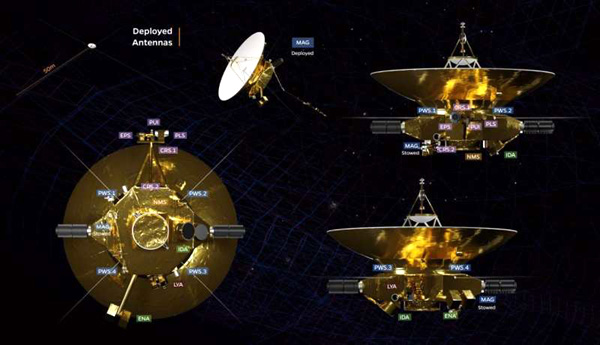
If you've been reading this Blog since at least September of 2005(stop smirking), you'll know just how eager I am to see NASA develop another Pioneer/Voyager/New Horizons-type mission that will fly to the outer Solar System and beyond. Obviously, I was very excited to see what kind of scientific discoveries IP would make during a 15-year journey to interstellar space (on a mission that was designed to last up to 50 years), but it was the dream of putting my name on the spacecraft in a potential public outreach campaign (like what was done with New Horizons back in 2005—when over 430,000 people submitted their names online to be flown on a compact disc aboard the Pluto-bound explorer) that enthralled me about this endeavor.
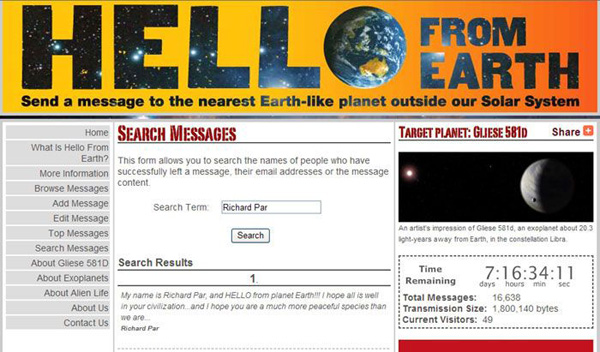
I got to send a message via radio signal to the exoplanet Gliese 581d courtesy of the Hello From Earth campaign in 2009, but to have my name on an actual spacecraft and not in an energy wave traveling through the Milky Way galaxy some day was obviously a more wondrous scenario.
What makes me especially annoyed about this new decadal survey is that the Solar Polar Orbiter is basically a rehash of the NASA and European Space Agency's Ulysses mission which launched in 1990 and studied the Sun till 2008. Unlike Ulysses, however, the Solar Polar Orbiter would be equipped with cameras to photograph the northern and southern regions of our host star.
Big whoop. What's that compared to potentially capturing an image of our entire Solar System from beyond the heliosphere courtesy of the Interstellar Probe?
Seeing as how NASEM wanted NASA to focus on the near-Earth space environment and how solar activity affected it, it's clearly obvious that the decadal survey was influenced by this year's geomagnetic storms that caused auroras to be visible around much of the globe. This is similar to how the 2020 discovery of phosphine in Venus' atmosphere ultimately caused Trident to be rejected in favor of the VERITAS and DAVINCI missions...which NASA doesn't even care to launch to the Evening Star till sometime next decade.
(Trident would've lifted off for Neptune either next year or 2026 had NASA approved it as its next Discovery-class mission.)
Well... It's clearly obvious that the Universe doesn't really want me to put my moniker on a New Horizons-type spacecraft anytime soon. I guess I'll just have to stick with submitting my name to fly on missions within our Solar System instead.
But one thing is certain: I can have a virtual presence on over a hundred spacecraft venturing to destinations as close as Venus (courtesy of Akatsuki) and worlds as distant as Saturn (through Cassini) in our Solar System, and these missions will never make up for me missing out on New Horizons...or having the dream opportunity that is the Interstellar Probe taken from me and everyone else who are enamored by the idea of having their name attached to a manmade object drifting through the cosmos.
Happy Thursday.
Johns Hopkins University Applied Physics Laboratory
Johns Hopkins University Applied Physics Laboratory
So @theNASEM's Heliophysics Decadal Survey is out... The survey recommends near-Earth solar-monitoring missions but apparently not the Interstellar Probe...which is a shame considering that Voyager 1 may be in its final years of operation.https://t.co/k4Q1LioCX2pic.twitter.com/HEe77m3Y7i
I guess all the talk about SLS being cancelled (when this was the launch vehicle mentioned in @JHUAPL's report on Interstellar Probe) made @TheNASEM hesitant about recommending this project.
Hats Off to NASA’s Webb: Sombrero Galaxy Dazzles in New Image (News Release - November 25)
In a new image from NASA’s James Webb Space Telescope, a galaxy named for its resemblance to a broad-brimmed Mexican hat appears more like an archery target.
In Webb’s mid-infrared view of the Sombrero galaxy, also known as Messier 104 (M104), the signature, glowing core seen in visible-light images does not shine, and instead a smooth inner disk is revealed. The sharp resolution of Webb’s MIRI (Mid-Infrared Instrument) also brings into focus details of the galaxy’s outer ring, providing insights into how the dust, an essential building block for astronomical objects in the Universe, is distributed. The galaxy’s outer ring, which appeared smooth like a blanket in imaging from NASA’s retired Spitzer Space Telescope, shows intricate clumps in the infrared for the first time.
Researchers say the clumpy nature of the dust, where MIRI detects carbon-containing molecules called polycyclic aromatic hydrocarbons, can indicate the presence of young star-forming regions. However, unlike some galaxies studied with Webb, including Messier 82, where 10 times as many stars are born than the Milky Way galaxy, the Sombrero galaxy is not a particular hotbed for star formation. The rings of the Sombrero galaxy produce less than one solar mass of stars per year, in comparison to the Milky Way’s roughly two solar masses a year.
Even the supermassive black hole, also known as an active galactic nucleus, at the center of the Sombrero galaxy is rather docile, even at a hefty 9-billion-solar masses. It’s classified as a low-luminosity active galactic nucleus, slowly snacking on infalling material from the galaxy, while sending off a bright, relatively small, jet.
Also within the Sombrero galaxy dwell some 2,000 globular clusters, collections of hundreds of thousands of old stars held together by gravity. This type of system serves as a pseudo laboratory for astronomers to study stars — thousands of stars within one system with the same age, but varying masses and other properties is an intriguing opportunity for comparison studies.
In the MIRI image, galaxies of varying shapes and colors litter the background of space. The different colors of these background galaxies can tell astronomers about their properties, including how far away they are.
The Sombrero galaxy is around 30 million light-years from Earth in the constellation Virgo.
A Bright Future Ahead
Stunning images like this, and an array of discoveries in the study of exoplanets, galaxies through time, star formation and our own Solar System, are still just the beginning. Recently, scientists from all over the world applied for observation time with Webb during its fourth year of science operations, which begins in July 2025.
General Observer time with Webb is more competitive than ever. A record-breaking 2,377 proposals were submitted by the October 15, 2024, deadline, requesting about 78,000 hours of observation time. This is an oversubscription rate, the ratio defining the observation hours requested versus the actual time available in one year of Webb’s operations, of around 9 to 1.
The proposals cover a wide array of science topics, with distant galaxies being among the most requested observation time, followed by exoplanet atmospheres, stars and stellar populations, then exoplanet systems.
The Space Telescope Science Institute manages the proposal and program selection process for NASA. The submissions will now be evaluated by a Telescope Allocation Committee, a group of hundreds of members of the worldwide astronomical community, on a dual-anonymous basis, with selections announced in March 2025.
While time on Webb is limited, data from all of Webb’s programs is publicly archived, immediately after it’s taken, or after a time of exclusive access, in the Mikulski Archive for Space Telescopes (MAST) so that it can be used by anyone in the world.
NASA Successfully Integrates Coronagraph for Roman Space Telescope (News Release - October 28)
The instrument will demonstrate advanced hardware for studying Earth-size planets with the right conditions for life.
NASA’s Nancy Grace Roman Space Telescope team has successfully completed integration of the Roman Coronagraph Instrument onto Roman’s Instrument Carrier, a piece of infrastructure that will hold the mission’s instruments, which will be integrated onto the larger spacecraft at a later date. The Roman Coronagraph is a technology demonstration that scientists will use to take an important step in the search for habitable worlds and, eventually, life beyond Earth.
This integration took place at NASA’s Goddard Space Flight Center in Greenbelt, Maryland, where the space telescope is located and in development. This milestone follows the coronagraph’s arrival at the center earlier this year from NASA’s Jet Propulsion Laboratory in Southern California, where the instrument was developed, built and tested.
The Roman Coronagraph Instrument is a technology demonstration that will launch aboard the Nancy Grace Roman Space Telescope, NASA’s next flagship astrophysics mission. Roman will have a field of view at least 100 times larger than the agency’s Hubble Space Telescope and explore scientific mysteries surrounding dark energy, exoplanets and infrared astrophysics. Roman is expected to launch no later than May of 2027.
The mission’s coronagraph is designed to make direct observations of exoplanets, or planets outside of our Solar System, by using a complex suite of masks and active mirrors to obscure the glare of the planets’ host stars, making the planets visible. Being a technology demonstration means that the coronagraph’s goal is to test this technology in space and showcase its capabilities. The Roman Coronagraph is poised to act as a technological stepping stone, enabling future technologies on missions like NASA’s proposed Habitable Worlds Observatory, which would be the first telescope designed specifically to search for signs of life on exoplanets.
“In order to get from where we are to where we want to be, we need the Roman Coronagraph to demonstrate this technology,” said Rob Zellem, Roman Space Telescope deputy project scientist for communications at NASA Goddard. “We’ll be applying those lessons learned to the next generation of NASA flagship missions that will be explicitly designed to look for Earth-like planets.”
A Major Mission Milestone
The coronagraph was successfully integrated into Roman’s Instrument Carrier, a large grid-like structure that sits between the space telescope’s primary mirror and spacecraft bus, which will deliver the telescope to orbit and enable the telescope’s functionality upon arrival in space. Assembly of the mission’s spacecraft bus was completed in September.
The Instrument Carrier will hold both the coronagraph and Roman’s Wide Field Instrument, the mission’s primary science instrument, which is set to be integrated later this year along with the Roman telescope itself. “You can think of [the Instrument Carrier] as the skeleton of the observatory, what everything interfaces to,” said Brandon Creager, lead mechanical engineer for the Roman Coronagraph at JPL.
The integration process began months ago with mission teams from across NASA coming together to plan the maneuver. Additionally, after its arrival at NASA Goddard, mission teams ran tests to prepare the coronagraph to be joined to the spacecraft bus.
During the integration itself, the coronagraph, which is roughly the size and shape of a baby grand piano (measuring about 5.5 feet, or 1.7 meters across), was mounted onto the Instrument Carrier using what’s called the Horizontal Integration Tool.
First, a specialized adapter developed at JPL was attached to the instrument, and then the Horizontal Integration Tool was attached to the adapter. The tool acts as a moveable counterweight, so the instrument was suspended from the tool as it was carefully moved into its final position in the Instrument Carrier. Then, the attached Horizontal Integration Tool and adapter were removed from the coronagraph.
The Horizontal Integration Tool has previously been used for integrations on NASA’s Hubble and James Webb Space Telescope.
As part of the integration process, engineers also ensured that blanketing layers were in place to insulate the coronagraph within its place in the Instrument Carrier. The coronagraph is designed to operate at room temperature, so insulation is critical to keep the instrument at the right temperature in the cold vacuum of space. This insulation will also provide an additional boundary to block stray light that could otherwise obscure observations.
Following this successful integration, engineers will perform different checks and tests to ensure that everything is connected properly and correctly aligned before moving forward to integrate the Wide Field Instrument and the telescope itself. Successful alignment of the Roman Coronagraph’s optics is critical to the instrument’s success in orbit.
This latest mission milestone is the culmination of an enduring collaboration between a number of Roman partners, but especially between NASA Goddard and JPL.
“It’s really rewarding to watch these teams come together and build up the Roman observatory. That’s the result of a lot of teams, long hours, hard work, sweat and tears,” said Liz Daly, the integrated payload assembly integration and test lead for Roman at Goddard.
“Support and trust were shared across both teams... We were all just one team,” said Gasia Bedrosian, the integration and test lead for the Roman Coronagraph at JPL. Following the integration, “we celebrated our success together,” she added.
Fifteen Light-Years... That’s how far the Hello From Earth message has traveled since being transmitted from a giant NASA antenna in Australia to the exoplanet Gliese 581d in the summer of 2009.
As of 7 PM California time tonight (12 PM Sydney time on Wednesday, August 28), the radio signal containing 25,878 goodwill text messages—including one by me—will have ventured across approximately 88 trillion miles (142 trillion kilometers) of deep space...which, as stated at the very start of this Blog entry, equals a distance of fifteen light-years.
The signal, despite traveling 186,000 miles per second (or 671 million miles per hour, or um, 1 billion kilometers per hour), will still take about 5 years to reach the Gliese 581 star system. Carry on!
Scorching, Seven-Planet System Revealed by New Kepler Exoplanet List (News Release - November 2)
A system of seven sweltering planets has been revealed by continued study of data from NASA’s retired Kepler space telescope: Each one is bathed in more radiant heat from their host star per area than any planet in our solar system. Also unlike any of our immediate neighbors, all seven planets in this system, named Kepler-385, are larger than Earth but smaller than Neptune.
It is one of only a few planetary systems known to contain more than six verified planets or planet candidates. The Kepler-385 system is among the highlights of a new Kepler catalog that contains almost 4,400 planet candidates, including more than 700 multi-planet systems.
“We’ve assembled the most accurate list of Kepler planet candidates and their properties to date,” said Jack Lissauer, a research scientist at NASA’s Ames Research Center in California’s Silicon Valley and lead author on the paper presenting the new catalog. “NASA’s Kepler mission has discovered the majority of known exoplanets, and this new catalog will enable astronomers to learn more about their characteristics.”
At the center of the Kepler-385 system is a Sun-like star about 10% larger and 5% hotter than the Sun. The two inner planets, both slightly larger than Earth, are probably rocky and may have thin atmospheres.
The other five planets are larger – each with a radius about twice the size of Earth’s – and expected to be enshrouded in thick atmospheres.
The ability to describe the properties of the Kepler-385 system in such detail is testament to the quality of this latest catalog of exoplanets. While the Kepler mission’s final catalogs focused on producing lists optimized to measure how common planets are around other stars, this study focuses on producing a comprehensive list that provides accurate information about each of the systems, making discoveries like Kepler-385 possible.
The new catalog uses improved measurements of stellar properties and calculates more accurately the path of each transiting planet across its host star. This combination illustrates that when a star hosts several transiting planets, they typically have more circular orbits than when a star hosts only one or two.
Kepler’s primary observations ceased in 2013 and were followed by the telescope’s extended mission, called K2, which continued until 2018. The data Kepler collected continues to reveal new discoveries about our galaxy.
After the mission already showed us there are more planets than stars, this new study paints a more detailed picture of what each of those planets and their home systems look like, giving us a better view of the many worlds beyond our solar system.
The research article, “Updated Catalog of Kepler Planet Candidates: Focus on Accuracy and Orbital Periods” is forthcoming in The Journal of Planetary Science.
NASA, CSA, ESA, J. Olmsted (STScI), Science: N. Madhusudhan (Cambridge University)
Webb Discovers Methane, Carbon Dioxide in Atmosphere of K2-18 b (News Release)
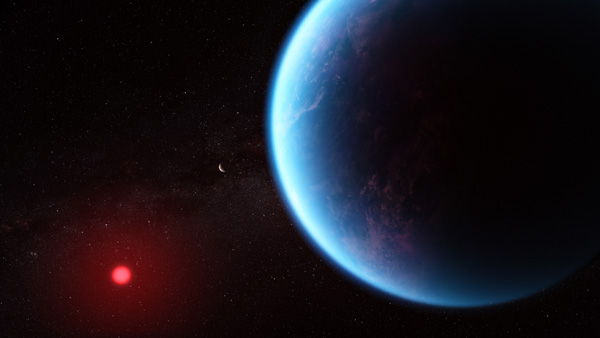
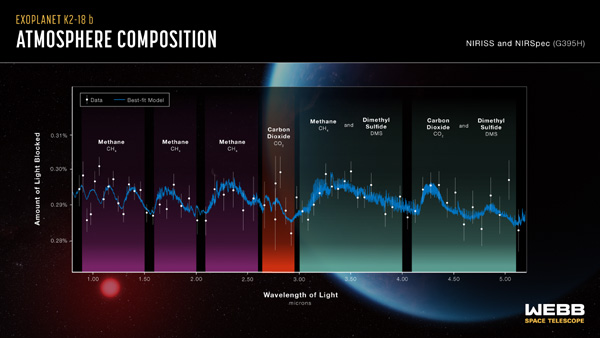
A new investigation with NASA’s James Webb Space Telescope into K2-18 b, an exoplanet 8.6 times as massive as Earth, has revealed the presence of carbon-bearing molecules including methane and carbon dioxide. Webb’s discovery adds to recent studies suggesting that K2-18 b could be a Hycean exoplanet, one which has the potential to possess a hydrogen-rich atmosphere and a water ocean-covered surface.
The first insight into the atmospheric properties of this habitable-zone exoplanet came from observations with NASA’s Hubble Space Telescope, which prompted further studies that have since changed our understanding of the system.
K2-18 b orbits the cool dwarf star K2-18 in the habitable zone and lies 120 light-years from Earth in the constellation Leo. Exoplanets such as K2-18 b, which have sizes between those of Earth and Neptune, are unlike anything in our solar system.
This lack of equivalent nearby planets means that these ‘sub-Neptunes’ are poorly understood, and the nature of their atmospheres is a matter of active debate among astronomers.
The suggestion that the sub-Neptune K2-18 b could be a Hycean exoplanet is intriguing, as some astronomers believe that these worlds are promising environments to search for evidence of life on exoplanets.
"Our findings underscore the importance of considering diverse habitable environments in the search for life elsewhere," explained Nikku Madhusudhan, an astronomer at the University of Cambridge and lead author of the paper announcing these results. "Traditionally, the search for life on exoplanets has focused primarily on smaller rocky planets, but the larger Hycean worlds are significantly more conducive to atmospheric observations."
The abundance of methane and carbon dioxide, and shortage of ammonia, support the hypothesis that there may be a water ocean underneath a hydrogen-rich atmosphere in K2-18 b. These initial Webb observations also provided a possible detection of a molecule called dimethyl sulfide (DMS).
On Earth, DMS is only produced by life. The bulk of the DMS in Earth’s atmosphere is emitted from phytoplankton in marine environments.
The inference of DMS is less robust and requires further validation. “Upcoming Webb observations should be able to confirm if DMS is indeed present in the atmosphere of K2-18 b at significant levels,” explained Madhusudhan.
While K2-18 b lies in the habitable zone, and is now known to harbor carbon-bearing molecules, this does not necessarily mean that the planet can support life. The planet's large size — with a radius 2.6 times the radius of Earth — means that the planet’s interior likely contains a large mantle of high-pressure ice, like Neptune, but with a thinner hydrogen-rich atmosphere and an ocean surface.
Hycean worlds are predicted to have oceans of water. However, it is also possible that the ocean is too hot to be habitable or be liquid.
"Although this kind of planet does not exist in our solar system, sub-Neptunes are the most common type of planet known so far in the galaxy," explained team member Subhajit Sarkar of Cardiff University. “We have obtained the most detailed spectrum of a habitable-zone sub-Neptune to date, and this allowed us to work out the molecules that exist in its atmosphere.”
Characterizing the atmospheres of exoplanets like K2-18 b — meaning identifying their gases and physical conditions — is a very active area in astronomy. However, these planets are outshone — literally — by the glare of their much larger parent stars, which makes exploring exoplanet atmospheres particularly challenging.
The team sidestepped this challenge by analyzing light from K2-18 b's parent star as it passed through the exoplanet's atmosphere. K2-18 b is a transiting exoplanet, meaning that we can detect a drop in brightness as it passes across the face of its host star.
This is how the exoplanet was first discovered in 2015 with NASA’s K2 mission. This means that during transits a tiny fraction of starlight will pass through the exoplanet's atmosphere before reaching telescopes like Webb.
The starlight's passage through the exoplanet's atmosphere leaves traces that astronomers can piece together to determine the gases of the exoplanet's atmosphere.
"This result was only possible because of the extended wavelength range and unprecedented sensitivity of Webb, which enabled robust detection of spectral features with just two transits," said Madhusudhan. "For comparison, one transit observation with Webb provided comparable precision to eight observations with Hubble conducted over a few years and in a relatively narrow wavelength range."
"These results are the product of just two observations of K2-18 b, with many more on the way,” explained team member Savvas Constantinou of the University of Cambridge. “This means our work here is but an early demonstration of what Webb can observe in habitable-zone exoplanets.”
The team’s results were accepted for publication in The Astrophysical Journal Letters.
The team now intends to conduct follow-up research with the telescope's MIRI (Mid-Infrared Instrument) spectrograph that they hope will further validate their findings and provide new insights into the environmental conditions on K2-18 b.
"Our ultimate goal is the identification of life on a habitable exoplanet, which would transform our understanding of our place in the universe," concluded Madhusudhan. "Our findings are a promising step towards a deeper understanding of Hycean worlds in this quest."