Showing posts with label Interstellar Comet. Show all posts

Wednesday, June 03, 2026

Bidding Adieu to a U.S. Mars Orbiter...

A composite image depicting NASA's MAVEN spacecraft in orbit around Mars.
NASA

NASA Says Farewell to MAVEN Mars Mission, Hosts Media Call Today (News Release)

The first mission devoted to observing the Martian atmosphere and its evolution, NASA’s MAVEN (Mars Atmosphere and Volatile Evolution), has ended after more than 11 years in orbit at Mars and a decade beyond its primary, one-year mission. The spacecraft was heard last on December 6, when it experienced an unexpected loss of signal after it passed behind the Red Planet.

NASA will host a media teleconference at 2 p.m. EDT today, Wednesday, June 3, to discuss MAVEN’s achievements.

The agency convened an anomaly review board in February to evaluate recovery efforts and assess the spacecraft’s probable current state. The review board has determined that the MAVEN spacecraft is not recoverable, and it is no longer capable of performing its science and data relay mission, which is consistent with the mission team’s findings.

Telemetry from MAVEN prior to the spacecraft’s passage behind Mars in December showed all subsystems working normally. After the spacecraft emerged, NASA’s Deep Space Network (DSN) did not observe a signal. A brief fragment of telemetry data from analysis of radio signals recorded by the DSN’s open-loop receivers indicated that the spacecraft was in safe mode and rotating at an unusually high rate when it emerged from behind Mars, indicating a disruption in MAVEN’s orbit trajectory.

The review board concluded that due to this rotation, the batteries on the spacecraft had drained, causing the communications system to lose power and rendering MAVEN in an unrecoverable state.

These preliminary findings do not address a potential root cause for the anomaly, which is still being investigated. The review board is expected to provide its final report later this year. NASA has begun the official process of decommissioning the MAVEN mission, following standard procedures to archive the full mission dataset for the science and exploration communities.

“The science MAVEN has given us is key to informing what kind of radiation protection and safety measures we must take before sending humans to Mars,” said Louise Prockter, director of the Planetary Science Division at NASA Headquarters in Washington. “The data collected from MAVEN will continue to provide valuable insight into Mars for decades to come.”

Launched in November 2013, the MAVEN mission explored the Red Planet’s upper atmosphere, ionosphere, and interactions with the Sun to explore the loss of the Martian atmosphere to space. Understanding atmospheric loss gives scientists insight into the history of the planet’s atmosphere and climate, liquid water, and planetary habitability.

“The MAVEN mission has truly advanced our understanding of the Martian atmosphere and evolution. This dataset has had a tremendous impact on the field,” said Shannon Curry, MAVEN’s principal investigator and a researcher at the Laboratory for Atmospheric and Space Physics at the University of Colorado Boulder. “Our science team is exceptionally proud of all of these amazing discoveries.”

Sun’s impact on Mars

One of MAVEN’s first major results was that the erosion of Mars’ atmosphere increases significantly during solar storms. The team studied how the solar wind, which is a stream of charged particles continually streaming from the Sun, and solar storms continually strip away Mars’ atmosphere, as well as how this process played a key role in altering the Martian climate from a potentially habitable world to today’s cold, arid planet. The MAVEN mission made unprecedented strides in advancing our understanding of how the Sun and space weather affect Mars, as it was the only spacecraft that could simultaneously take measurements of both the Sun and the Martian atmospheric response.

Martian light shows

The MAVEN mission discovered several types of auroras that light up when energetic particles plunge into the atmosphere, bombarding gases and making them glow. The MAVEN team showed that protons create new kinds of auroras at Mars. On Earth, proton auroras only occur in very small regions near the poles, whereas at Mars they can occur everywhere.

Mars’ atmosphere sputters into space

To better understand how Mars lost most of its atmosphere, MAVEN measured atmospheric sputtering for the first time at any planet. The team did this by observing argon, which is a noble gas, meaning that it rarely reacts with other constituents in the Martian atmosphere. The only significant way it can be removed is by atmospheric sputtering, a process where ions crash into the Martian atmosphere at high enough speeds that they splash gas molecules out of the atmosphere, much like doing a cannonball into a pool.

The team used 11 years of data to reveal the presence of sputtered argon at high altitudes in the exact locations that the energetic particles crashed into the atmosphere, showing sputtering in real time.

Understanding Mars’ dusty secrets

In 2018, a series of dust storms created a dust cloud so large that it enveloped the Red Planet. The MAVEN team studied how this “global” dust storm affected Mars’ upper atmosphere to understand how these events affected the escape of water to space. It confirmed that heating from dust storms can loft water molecules far higher into the atmosphere than usual, leading to a sudden surge in water lost to space.

Chasing comets

In addition to Martian science, MAVEN contributed to NASA’s effort to observe comet 3I/ATLAS at Mars. Over the course of 10 days last year, the MAVEN team designed a new observing campaign to capture 3I/ATLAS by taking multiple images of the comet in several wavelengths, much like using various filters on a camera. Then it snapped high-resolution UV images to identify the hydrogen coming from the comet.

By studying a combination of these images, scientists can identify a variety of molecules and better understand the comet’s composition and history.

During the mission’s lifetime, MAVEN’s science team produced more than 800 publications, and additional publications are planned.

In addition to science, the MAVEN spacecraft was an instrumental player in NASA’s Mars Relay Network, communicating data from Mars rovers to Earth. It also holds the Solar System record for most data relayed from another planet in a single day.

Audio of today’s media teleconference will stream on the agency’s website at:

https://www.nasa.gov/live

Participants in the teleconference include:

-- Tiffany Morgan, director, Mars Exploration Program, Planetary Science Division, NASA Headquarters
-- Mike Moreau, project manager, MAVEN, NASA’s Goddard Space Flight Center, Greenbelt, Maryland
-- Greg Heckler, deputy program manager for Capability Development, SCaN (Space Communications and Navigation), NASA Headquarters
-- Shannon Curry, MAVEN principal investigator, Laboratory for Atmospheric and Space Physics at the University of Colorado Boulder

To ask questions by phone, media must RSVP no later than 12 p.m. to: sarah.frazier@nasa.gov. NASA’s media accreditation policy is available online.

The MAVEN mission is part of NASA’s Mars Exploration Program portfolio. The mission’s principal investigator is based at the Laboratory for Atmospheric and Space Physics at the University of Colorado Boulder, which is also responsible for managing science operations and public outreach and communications. NASA’s Goddard Space Flight Center in Greenbelt, Maryland, manages the MAVEN mission.

Lockheed Martin Space built the spacecraft and is responsible for mission operations. NASA’s Jet Propulsion Laboratory in Southern California provides navigation and Deep Space Network support.

Source: NASA.Gov

****

My certificate for the MAVEN mission.

Tuesday, January 27, 2026

An Exoplanet-hunting Spacecraft Photographs Our Solar System's Interstellar Visitor...

A video screenshot showing interstellar comet 3I/ATLAS moving across a field of stars...utilizing a series of photos that were taken by NASA's TESS spacecraft between January 15 and January 18 to 19, 2026.
NASA / Daniel Muthukrishna, MIT

NASA’s TESS Reobserves Comet 3I/ATLAS (News Release)

NASA’s TESS (Transiting Exoplanet Survey Satellite) observed the interstellar comet 3I/ATLAS during a special observation run from January 15 to 22. Scientists will use the data to study the comet’s activity and rotation.

Using TESS data from January 15 and January 18 to 19, Daniel Muthukrishna, a research scientist at the Massachusetts Institute of Technology in Cambridge, compiled a series of images into a short video that shows 3I/ATLAS as a bright moving dot with a tail.

The comet’s brightness is around 11.5 in apparent magnitude, or approximately 100 times fainter than what humans can see with the unaided eye.

All of the TESS data from January 15 through 22 are publicly available on the Mikulski Archive for Space Telescopes as of Tuesday. The initially-calibrated measurements from January 15 used for the brightness estimate and the video were posted on January 19.

The TESS spacecraft scans a wide swath of the sky for about a month at a time, looking for variations in the light from distant stars to spot orbiting exoplanets, or worlds beyond our Solar System. This technique also allows TESS to identify and monitor comets and asteroids out to large distances.

The mission’s wide field of view previously happened to observe 3I/ATLAS in May 2025, almost two months before it was discovered. Astronomers looking back at the TESS data were able to identify the faint comet by stacking multiple observations to track its movement.

The recent 3I/ATLAS observations were temporarily interrupted from January 15 to 18 when TESS entered a safe mode following an issue with its solar panels.

Source: NASA.Gov

Friday, December 19, 2025

SOLAR PROBE PLUS Images Our Latest Galactic Visitor...


NRL / NASA / JHUAPL. Movie processed / compiled by Guillermo Stenborg (JHUAPL)

NASA’s Parker Solar Probe Observes Interstellar Comet 3I/ATLAS (News Release)

NASA’s Parker Solar Probe observed interstellar comet 3I/ATLAS from October 18 to November 5, 2025, with its WISPR (Wide-Field Imager for Solar Probe) instrument. The spacecraft snapped around 10 images of the comet per day. During this period, Parker Solar Probe was speeding away from the Sun following its 25th solar flyby on September 15.

In these initial images — which still need to go through final calibration and processing — the comet can be seen heading behind the Sun from Parker’s point of view. At the time, the comet was near its closest point to the Sun, at a distance of about 130 million miles, placing it just outside the orbit of Mars. The images offer a valuable look at the comet over a period when it couldn’t be seen from Earth because it appeared too close to the Sun from Earth’s perspective.

The WISPR team is continuing to process the data to remove stray sunlight and compensate for exposure times, which differed between the images, causing the comet to appear as if it changed brightness. The final images will ultimately help scientists better study this interstellar visitor.

Comet 3I/ATLAS was discovered by the NASA-funded ATLAS (Asteroid Terrestrial-impact Last Alert System) survey telescope in Rio Hurtado, Chile, in July. It is the third known object originating from outside our Solar System discovered passing through our solar neighborhood. Comet 3I/ATLAS was also seen by other NASA heliophysics missions including PUNCH, STEREO and SOHO.

Source: NASA.Gov

****


NRL / NASA / JHUAPL. Movie processed / compiled by Philip Hess (NRL)

Friday, December 05, 2025

HST's Newest Image Of Our Solar System's Latest Galactic Visitor Has Been Released...

A new image of interstellar comet 3I/ATLAS that was taken by NASA's Hubble Space Telescope...on November 30, 2025.
NASA, ESA, STScI, D. Jewitt (UCLA), M.-T. Hui (Shanghai Astronomical Observatory). Image Processing: J. DePasquale (STScI)

NASA’s Hubble Space Telescope Revisits Interstellar Comet (News Release - December 4)

NASA’s Hubble Space Telescope reobserved interstellar comet 3I/ATLAS on November 30, with its Wide Field Camera 3 instrument. At the time, the comet was about 178 million miles (286 million kilometers) from Earth.

Hubble tracked the comet as it moved across the sky. As a result, background stars appear as streaks of light.

Hubble previously observed 3I/ATLAS in July, shortly after its discovery, and a number of NASA missions have since studied the comet as well. Observations are expected to continue for several more months as 3I/ATLAS heads out of the Solar System.

Source: NASA.Gov

****

An annotated version of Hubble's image taken of interstellar comet 3I/ATLAS on November 30, 2025.
NASA, ESA, STScI, D. Jewitt (UCLA), M.-T. Hui (Shanghai Astronomical Observatory). Image Processing: J. DePasquale (STScI)

Wednesday, November 19, 2025

New Images Of Our Solar System's Latest Galactic Visitor Have Been Released...

An image of interstellar comet 3I/ATLAS that was taken by NASA's Mars Reconnaissance Orbiter...on October 2, 2025.
NASA / JPL - Caltech / University of Arizona

View Interstellar Comet 3I/ATLAS Through NASA’s Multiple Lenses (News Release)

NASA is in the midst of an unprecedented Solar System-wide observation campaign, turning its spacecraft and space telescopes to follow comet 3I/ATLAS, the third known interstellar object to pass through our Solar System. Twelve NASA assets have captured and processed imagery of the comet since it was first discovered on July 1, and several others will have opportunities to capture more images as the comet continues to pass through our Solar System.

By observing the comet from so many locations, NASA has an opportunity to learn about the ways that 3I/ATLAS differs from our Solar System’s home-grown comets and give scientists a new window into how the compositions of other systems may differ from our own.

Observations from Mars

The closest imagery of the comet was taken by NASA spacecraft at Mars. Earlier this fall, 3I/ATLAS passed by Mars from a distance of 19 million miles, where it was observed by three NASA spacecraft. The Mars Reconnaissance Orbiter (MRO) captured one of the closest images of the comet, while the MAVEN (Mars Atmosphere and Volatile EvolutioN) orbiter obtained ultraviolet images that will help scientists understand the comet’s make-up.

Meanwhile, the Perseverance rover grabbed a faint glimpse from the surface of Mars.

Sun watchers’ view

Some of NASA’s heliophysics missions have the unique ability to observe areas of the sky near the Sun, which allowed them to track comet 3I/ATLAS as it passed behind our Sun as seen from Earth, making observations with ground-based telescopes impossible. NASA’s STEREO (Solar Terrestrial Relations Observatory) captured images from September 11 to October 2, and the ESA (European Space Agency) and NASA mission SOHO (Solar and Heliospheric Observatory) observed the comet from October 15 to 26. Images from NASA’s PUNCH (Polarimeter to Unify the Corona and Heliosphere) mission, which launched earlier this year, reveal the comet’s tail during observations from September 20 to October 3.

Despite previously observing and discovering thousands of comets, this is the first time that NASA’s heliophysics missions have purposefully observed an object originating in another solar system.

Asteroid explorers

NASA’s Psyche and Lucy spacecraft, currently on their respective outbound journeys to study various asteroid targets throughout the Solar System, were able to observe 3I/ATLAS en route. On September 8 and 9, Psyche acquired four observations of the comet over eight hours from a distance of 33 million miles. These images will help scientists refine the comet’s trajectory.

On September 16, Lucy took a series of images from 240 million miles away. Stacking these images together provides detail on the comet’s coma and tail.

The NASA-funded ATLAS (Asteroid Terrestrial-impact Last Alert System) telescope in Chile discovered 3I/ATLAS on July 1. Later that month it was viewed by NASA’s Hubble Space Telescope. In August, both NASA’s James Webb Telescope and SPHEREx (Spectro-Photometer for the History of the Universe, Epoch of Reionization and Ices Explorer) captured imagery.

Comet 3I/ATLAS will fly closest to Earth about Friday, December 19, at 170 million miles, which is almost twice the distance between the Earth and Sun. NASA spacecraft will continue to observe the comet as it makes its journey through the Solar System, passing the orbit of Jupiter in spring 2026.

Source: NASA.Gov

****

A series of images taken of interstellar comet 3I/ATLAS by NASA's Psyche spacecraft...on September 8 and 9, 2025.
NASA / JPL - Caltech / ASU

Monday, August 25, 2025

Hubble's Successor Captures Images of 3I/ATLAS...

An image of interstellar comet 3I/ATLAS that was taken by NASA's James Webb Space Telescope...on August 6, 2025.
NASA / James Webb Space Telescope

NASA’s Webb Space Telescope Observes Interstellar Comet (News Release)

NASA’s James Webb Space Telescope observed interstellar comet 3I/ATLAS on August 6, with its Near-Infrared Spectrograph instrument. The research team has been analyzing insights from Webb’s data, and a preprint is available online.

Webb is one of NASA’s space telescopes observing this comet, together providing more information about its size, physical properties and chemical makeup. For example, NASA’s Hubble Space Telescope and the recently-launched SPHEREx mission have also observed the comet.

While the comet poses no threat to Earth, NASA’s space telescopes help support the agency’s ongoing mission to find, track and better understand Solar System objects.

Source: NASA.Gov

****

Another image of interstellar comet 3I/ATLAS that was taken by NASA's James Webb Space Telescope...on August 6, 2025.
NASA / James Webb Space Telescope

Another image of interstellar comet 3I/ATLAS that was taken by NASA's James Webb Space Telescope...on August 6, 2025.
NASA / James Webb Space Telescope

Thursday, August 07, 2025

Webb's Predecessor Takes an Image of Galactic Visitor 3I/ATLAS...

An image of interstellar comet 3I/ATLAS that was taken by NASA's Hubble Space Telescope...on July 21, 2025.
NASA, ESA, David Jewitt (UCLA); Image Processing: Joseph DePasquale (STScI)

As NASA Missions Study Interstellar Comet, Hubble Makes Size Estimate (News Release)

A team of astronomers has taken the sharpest-ever picture of the unexpected interstellar comet 3I/ATLAS using the crisp vision of NASA’s Hubble Space Telescope. Hubble is one of many missions across NASA’s fleet of space telescopes slated to observe this comet, together providing more information about its size and physical properties. While the comet poses no threat to Earth, NASA’s space telescopes help support the agency's ongoing mission to find, track and better understand near-Earth objects.

Hubble’s observations allow astronomers to more accurately estimate the size of the comet’s solid, icy nucleus. The upper limit on the diameter of the nucleus is 3.5 miles (5.6 kilometers), though it could be as small as 1,000 feet (320 meters) across, researchers report. Though the Hubble images put tighter constraints on the size of the nucleus compared to previous ground-based estimates, the solid heart of the comet presently cannot be seen directly, even by Hubble.

Observations from other NASA missions including the James Webb Space Telescope, TESS (Transiting Exoplanet Survey Satellite) and the Neil Gehrels Swift Observatory, as well as NASA’s partnership with the W.M. Keck Observatory, will help further refine our knowledge about the comet, including its chemical makeup.

Hubble also captured a dust plume ejected from the Sun-warmed side of the comet, and the hint of a dust tail streaming away from the nucleus. Hubble’s data yields a dust-loss rate consistent with comets that are first detected around 300 million miles from the Sun. This behavior is much like the signature of previously-seen Sun-bound comets originating within our Solar System.

The big difference is that this interstellar visitor originated in some other solar system elsewhere in our Milky Way galaxy.

3I/ATLAS is traveling through our Solar System at a staggering 130,000 miles (209,000 kilometers) per hour, the highest velocity ever recorded for a solar system visitor. This breathtaking sprint is evidence that the comet has been drifting through interstellar space for many billions of years. The gravitational slingshot effect from innumerable stars and nebulae that the comet passed added momentum, ratcheting up its speed.

The longer that 3I/ATLAS was out in space, the higher its speed grew.

“No one knows where the comet came from. It’s like glimpsing a rifle bullet for a thousandth of a second. You can't project that back with any accuracy to figure out where it started on its path,” said David Jewitt of the University of California, Los Angeles, science team leader for the Hubble observations.

The paper will be published in The Astrophysical Journal Letters. It is already available on Astro-ph.

New Evidence for Population of Wandering Space Relics

“This latest interstellar tourist is one of a previously undetected population of objects bursting onto the scene that will gradually emerge,” said Jewitt. “This is now possible because we have powerful sky survey capabilities that we didn't have before. We've crossed a threshold."

This comet was discovered by the NASA-funded Asteroid Terrestrial-impact Last Alert System (ATLAS) on July 1, 2025, at a distance of 420 million miles from the Sun. ATLAS is an asteroid impact early warning system developed by the University of Hawai’i.

In the meantime, other NASA missions will provide new insight into this third interstellar interloper, helping refine our understanding of these objects for the benefit of all. 3I/ATLAS should remain visible to ground-based telescopes through September, after which it will pass too close to the Sun to observe, and is expected to reappear on the other side of the Sun by early December.

Source: NASA.Gov

****

Wednesday, July 02, 2025

A Galactic Visitor Will Soon Fly Through Mars' Orbit...

A diagram showing the trajectory of interstellar comet 3I/ATLAS as it passes through the Solar System.
NASA / JPL - Caltech

NASA Discovers Interstellar Comet Moving Through Solar System (News Release)

On July 1, the NASA-funded ATLAS (Asteroid Terrestrial-impact Last Alert System) survey telescope in Rio Hurtado, Chile, first reported observations of a comet that originated from interstellar space. Arriving from the direction of the constellation Sagittarius, the interstellar comet has been officially named 3I/ATLAS. It is currently located about 420 million miles (670 million kilometers) away.

Since that first report, observations from before the discovery have been gathered from the archives of three different ATLAS telescopes around the world and the Zwicky Transient Facility at the Palomar Observatory in San Diego County, California. These “pre-discovery” observations extend back to June 14. Numerous telescopes have reported additional observations since the object was first reported.

The comet poses no threat to Earth and will remain at a distance of at least 1.6 Astronomical Units (about 150 million miles or 240 million kilometers). It is currently about 4.5 AU (about 416 million miles or 670 million kilometers) from the Sun. 3I/ATLAS will reach its closest approach to the Sun around October 30, at a distance of 1.4 AU (about 130 million miles or 210 million kilometers) — just inside the orbit of Mars.

The interstellar comet’s size and physical properties are being investigated by astronomers around the world. 3I/ATLAS should remain visible to ground-based telescopes through September, after which it will pass too close to the Sun to observe. It is expected to reappear on the other side of the Sun by early December, allowing for renewed observations.

Source: NASA.Gov

Saturday, December 14, 2019

Hubble Photographs Our Newest Interstellar Interloper...

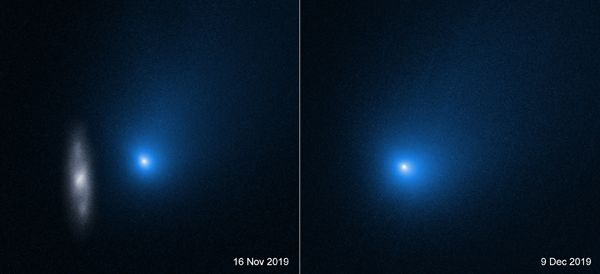
Two images of interstellar comet 2I/Borisov that were taken by NASA's Hubble Space Telescope...on November 16 (left) and December 9, 2019 (right), respectively.
NASA, ESA and D. Jewitt (UCLA)

Interstellar Comet 2I/Borisov Swings Past Sun (News Release - December 12)

When astronomers see something in the universe that at first glance seems like one-of-a-kind, it's bound to stir up a lot of excitement and attention. Enter comet 2I/Borisov. This mysterious visitor from the depths of space is the first identified comet to arrive here from another star. We don't know from where or when the comet started heading toward our Sun, but it won't hang around for long. The Sun's gravity is slightly deflecting its trajectory, but can't capture it because of the shape of its orbit and high velocity of about 100,000 miles per hour.

Telescopes around the world have been watching the fleeting visitor. NASA's Hubble Space Telescope has provided the sharpest views as the comet skirts by our Sun. Since October the space telescope has been following the comet like a sports photographer following horses speeding around a racetrack. Hubble revealed that the heart of the comet, a loose agglomeration of ices and dust particles, is likely no more than about 3,200 feet across, about the length of nine football fields. Though comet Borisov is the first of its kind, no doubt there are many other comet vagabonds out there, plying the space between stars. Astronomers will eagerly be on the lookout for the next mysterious visitor from far beyond.

These two images (above), taken by Hubble, capture comet 2I/Borisov streaking though our solar system and on its way back to interstellar space. It is only the second interstellar object known to have passed through the solar system.

Nov. 16, 2019, Photo (Above Left)

The comet appears in front of a distant background spiral galaxy (2MASX J10500165-0152029). The galaxy's bright central core is smeared in the image because Hubble was tracking the comet. Comet Borisov was approximately 203 million miles from Earth in this exposure. Its tail of ejected dust streaks off to the upper right. The comet has been artificially colored blue to discriminate fine detail in the halo of dust, or coma, surrounding the central nucleus. It also helps to visually separate the comet from the background galaxy.

Dec. 9, 2019, Photo (Above Right)

Hubble revisited the comet shortly after its closest approach to the Sun where it received maximum heating after spending most of its life in frigid interstellar space. The comet also reached a breathtaking maximum speed of about 100,000 miles per hour. Comet Borisov is 185 million miles from Earth in this photo, near the inner edge of the Asteroid Belt but below it. The nucleus, an agglomeration of ices and dust, is still too small to be resolved. The bright central portion is a coma made up of dust leaving the surface. The comet will make its closest approach to Earth in late December at a distance of 180 million miles.

"Hubble gives us the best upper limit of the size of comet Borisov's nucleus, which is the really important part of the comet," said David Jewitt, a UCLA professor of planetary science and astronomy, whose team has captured the best and sharpest look at this first confirmed interstellar comet. "Surprisingly, our Hubble images show that its nucleus is more than 15 times smaller than earlier investigations suggested it might be. Our Hubble images show that the radius is smaller than half a kilometer. Knowing the size is potentially useful for beginning to estimate how common such objects may be in the solar system and our galaxy. Borisov is the first known interstellar comet, and we would like to learn how many others there are."

Crimean amateur astronomer Gennady Borisov discovered the comet on Aug. 30, 2019, and reported the position measurements to the International Astronomical Union's Minor Planet Center in Cambridge, Massachusetts. The Center for Near-Earth Object Studies at NASA's Jet Propulsion Laboratory in Pasadena, California, working with the Minor Planet Center, computed an orbit for the comet, which shows that it came from elsewhere in our Milky Way galaxy, point of origin unknown.

Nevertheless, observations by numerous telescopes show that the comet's chemical composition is similar to the comets found inside our solar system, providing evidence that comets also form around other stars. By the middle of 2020 the comet will have already zoomed past Jupiter's distance of 500 million miles on its way back into the frozen abyss of interstellar space.

The Hubble Space Telescope is a project of international cooperation between ESA (the European Space Agency) and NASA. NASA's Goddard Space Flight Center in Greenbelt, Maryland, manages the telescope. The Space Telescope Science Institute (STScI) in Baltimore conducts Hubble science operations. STScI is operated for NASA by the Association of Universities for Research in Astronomy in Washington, D.C. The Minor Planet Center and the Center for Near-Earth Orbit Studies are projects of NASA’s Near-Earth Object Observations Program of the Planetary Defense Coordination Office at NASA Headquarters.

Source: NASA.Gov