Showing posts with label Psyche. Show all posts

Tuesday, May 19, 2026

The Latest Update on America's Newest Asteroid Explorer...

An image of Mars that was taken by NASA's Psyche spacecraft as it flew past the Red Planet for a gravity assist...on May 15, 2026.
NASA / JPL - Caltech / ASU

NASA’s Psyche Mission Aces Mars Flyby, Targets Metal-Rich Asteroid (News Release)

NASA’s Psyche spacecraft completed its close approach of Mars on May 15, coming within 2,864 miles (4,609 kilometers) of the planet’s surface. This flyby used a gravity assist from Mars to provide a critical boost in speed and to adjust the spacecraft’s orbital plane without using any onboard propellant, sending it on its way towards the metal-rich asteroid Psyche.

The spacecraft is now headed directly towards the asteroid, located in the main asteroid belt between Mars and Jupiter. After the Mars flyby, the flight team analyzed radio signals between the spacecraft and NASA’s Deep Space Network (DSN), the agency’s global system for communicating with interplanetary spacecraft, to confirm that Psyche was on the correct trajectory.

“Although we were confident in our calculations and flight plan, monitoring the DSN’s Doppler signal in real time during the flyby was still exciting,” said Don Han, Psyche’s navigation lead at NASA’s Jet Propulsion Laboratory in Southern California. “We’ve confirmed that Mars gave the spacecraft a 1,000 mile‑per‑hour boost and shifted its orbital plane by about 1 degree relative to the Sun. We are now on course for arrival at the asteroid Psyche in summer 2029.”

Unique Martian view

In the days running up to and during close approach, all of Psyche’s instruments were powered up for calibration efforts, including its imagers, magnetometers, and gamma-ray and neutron spectrometer. The planetary encounter provided the mission a valuable practice run for when it reaches the asteroid Psyche; as a bonus, it captured Mars images from a rare perspective.

Because Psyche approached Mars from a high phase angle, the planet appeared as a thin crescent in the days running up to the close approach, lit by sunlight reflecting off its surface. In observations from the spacecraft’s multispectral imager, the crescent appeared brighter and extended farther around the planet’s disk than anticipated because of the strong scattering of sunlight through the planet’s dusty atmosphere. As Psyche passed from Mars’ nighttime skies to daytime, it took a rapid series of pictures of the surface around the time of closest approach.

“We’ve captured thousands of images of the approach to Mars and of the planet’s surface and atmosphere at close approach. This dataset provides unique and important opportunities for us to calibrate and characterize the performance of the cameras, as well as test the early versions of our image processing tools being developed for use at the asteroid Psyche,” said Jim Bell, the Psyche imager instrument lead at Arizona State University (ASU) in Tempe. “As the spacecraft continues its journey after the flyby, we’ll continue calibration imaging of Mars for the rest of the month as it recedes into the distance.”

Bell also leads the Mastcam-Z imaging investigation on NASA’s Perseverance Mars rover mission team, which was among several missions that provided complementary surface and atmospheric imaging as well as navigation data during the flyby to help with calibration efforts. Other missions involved include NASA’s Mars Reconnaissance Orbiter, 2001 Mars Odyssey orbiter, and Curiosity rover, along with ESA’s (European Space Agency’s) Mars Express and ExoMars Trace Gas Orbiter.

In addition to the imager, early calibration measurements made by Psyche’s magnetometers may have detected Mars’ bow shock as the spacecraft passed the planet. The gamma-ray and neutron spectrometer team was also quickly gathering data to calibrate the instrument by comparing their measurements with the large pool of existing Mars data.

Onward to asteroid Psyche

With Mars in the rearview mirror, the spacecraft will soon resume using its solar-electric propulsion system to make a beeline to the main asteroid belt. When it arrives in August 2029, it will insert itself into orbit around the asteroid Psyche, which is thought to be the partial core of a planetesimal, a building block of an early planet. Through a series of circular orbits that go lower and then higher in altitude around Psyche, which is about 173 miles (280 kilometers) across at its widest point, the spacecraft will map the asteroid and gather science data.

If the asteroid proves to be the metallic core of an ancient planetesimal, it could offer a one-of-a-kind window into the interior of rocky planets like Earth.

“We’ve been anticipating the Mars flyby for years, but now it’s complete. We can thank the Red Planet for giving our spacecraft a critical gravitational slingshot farther into the Solar System,” said Lindy Elkins-Tanton, principal investigator for Psyche at the University of California, Berkeley. “Onward to the asteroid Psyche!”

Source: NASA.Gov

****

Another image of Mars that was taken by NASA's Psyche spacecraft as it flew past the Red Planet for a gravity assist...on May 15, 2026.
NASA / JPL - Caltech / ASU / Thomas Appéré

Wednesday, November 19, 2025

New Images Of Our Solar System's Latest Galactic Visitor Have Been Released...

An image of interstellar comet 3I/ATLAS that was taken by NASA's Mars Reconnaissance Orbiter...on October 2, 2025.
NASA / JPL - Caltech / University of Arizona

View Interstellar Comet 3I/ATLAS Through NASA’s Multiple Lenses (News Release)

NASA is in the midst of an unprecedented Solar System-wide observation campaign, turning its spacecraft and space telescopes to follow comet 3I/ATLAS, the third known interstellar object to pass through our Solar System. Twelve NASA assets have captured and processed imagery of the comet since it was first discovered on July 1, and several others will have opportunities to capture more images as the comet continues to pass through our Solar System.

By observing the comet from so many locations, NASA has an opportunity to learn about the ways that 3I/ATLAS differs from our Solar System’s home-grown comets and give scientists a new window into how the compositions of other systems may differ from our own.

Observations from Mars

The closest imagery of the comet was taken by NASA spacecraft at Mars. Earlier this fall, 3I/ATLAS passed by Mars from a distance of 19 million miles, where it was observed by three NASA spacecraft. The Mars Reconnaissance Orbiter (MRO) captured one of the closest images of the comet, while the MAVEN (Mars Atmosphere and Volatile EvolutioN) orbiter obtained ultraviolet images that will help scientists understand the comet’s make-up.

Meanwhile, the Perseverance rover grabbed a faint glimpse from the surface of Mars.

Sun watchers’ view

Some of NASA’s heliophysics missions have the unique ability to observe areas of the sky near the Sun, which allowed them to track comet 3I/ATLAS as it passed behind our Sun as seen from Earth, making observations with ground-based telescopes impossible. NASA’s STEREO (Solar Terrestrial Relations Observatory) captured images from September 11 to October 2, and the ESA (European Space Agency) and NASA mission SOHO (Solar and Heliospheric Observatory) observed the comet from October 15 to 26. Images from NASA’s PUNCH (Polarimeter to Unify the Corona and Heliosphere) mission, which launched earlier this year, reveal the comet’s tail during observations from September 20 to October 3.

Despite previously observing and discovering thousands of comets, this is the first time that NASA’s heliophysics missions have purposefully observed an object originating in another solar system.

Asteroid explorers

NASA’s Psyche and Lucy spacecraft, currently on their respective outbound journeys to study various asteroid targets throughout the Solar System, were able to observe 3I/ATLAS en route. On September 8 and 9, Psyche acquired four observations of the comet over eight hours from a distance of 33 million miles. These images will help scientists refine the comet’s trajectory.

On September 16, Lucy took a series of images from 240 million miles away. Stacking these images together provides detail on the comet’s coma and tail.

The NASA-funded ATLAS (Asteroid Terrestrial-impact Last Alert System) telescope in Chile discovered 3I/ATLAS on July 1. Later that month it was viewed by NASA’s Hubble Space Telescope. In August, both NASA’s James Webb Telescope and SPHEREx (Spectro-Photometer for the History of the Universe, Epoch of Reionization and Ices Explorer) captured imagery.

Comet 3I/ATLAS will fly closest to Earth about Friday, December 19, at 170 million miles, which is almost twice the distance between the Earth and Sun. NASA spacecraft will continue to observe the comet as it makes its journey through the Solar System, passing the orbit of Jupiter in spring 2026.

Source: NASA.Gov

****

A series of images taken of interstellar comet 3I/ATLAS by NASA's Psyche spacecraft...on September 8 and 9, 2025.
NASA / JPL - Caltech / ASU

Thursday, August 21, 2025

One of America's Newest Asteroid Explorers Takes a Snapshot of our Home Planet and its Natural Satellite...

An image of Earth and our Moon that was taken by NASA's Psyche spacecraft...from a distance of about 180 million miles (290 million kilometers) on July 20 and July 23, 2025, respectively.
NASA / JPL - Caltech / ASU

NASA’s Psyche Captures Images of Earth, Moon (News Release - August 19)

Headed for a metal-rich asteroid of the same name, the Psyche spacecraft successfully calibrated its cameras by looking homeward.

On schedule for its 2029 arrival at the asteroid Psyche, NASA’s Psyche spacecraft recently looked back toward home and captured images of Earth and our Moon from about 180 million miles (290 million kilometers) away. The images were obtained during one of the mission team’s periodic checkouts of the spacecraft’s science instruments.

On July 20 and July 23, the spacecraft’s twin cameras captured multiple long-exposure (up to 10-second) pictures of the two bodies, which appear as dots sparkling with reflected sunlight amid a starfield in the constellation Aries.

The Psyche multispectral imager instrument comprises a pair of identical cameras equipped with filters and telescopic lenses to photograph the asteroid Psyche’s surface in different wavelengths of light. The color and shape of a planetary body’s spectrum can reveal details about what it’s made of. The Moon and the giant asteroid Vesta, for example, have similar kinds of “bumps and wiggles” in their spectra that scientists could potentially also detect at Psyche.

Members of the mission’s science team are interested in Psyche because it will help them better understand the formation of rocky planets with metallic cores, including Earth.

When choosing targets for the imager testing and calibration, scientists look for bodies that shine with reflected sunlight, just as the asteroid Psyche does. They also look at objects that have a spectrum they’re familiar with, so they can compare previous telescopic or spacecraft data from those objects with what Psyche’s instruments observe. Earlier this year, Psyche turned its lenses toward Jupiter and Mars for calibration — each has a spectrum more reddish than the bluer tones of Earth.

That checkout also proved a success.

To determine whether the imager’s performance is changing, scientists also compare data from the different tests. That way, when the spacecraft slips into orbit around Psyche, scientists can be sure that the instrument behaves as expected.

“After this, we may look at Saturn or Vesta to help us continue to test the imagers,” said Jim Bell, the Psyche imager instrument lead at Arizona State University in Tempe. “We’re sort of collecting Solar System ‘trading cards’ from these different bodies and running them through our calibration pipeline to make sure we’re getting the right answers.”

Strong and Sturdy

The imager wasn’t the only instrument that got a successful checkout in late July: The mission team also put the spacecraft’s magnetometer and the gamma-ray and neutron spectrometer through a gamut of tests — something they do every six months.

“We are up and running, and everything is working well,” said Bob Mase, the mission’s project manager at NASA’s Jet Propulsion Laboratory in Southern California. “We’re on target to fly by Mars in May 2026, and we are accomplishing all of our planned activities for cruise.”

That flyby is the spacecraft’s next big milestone, when it will use the Red Planet’s gravity as a slingshot to help the spacecraft get to the asteroid Psyche. That will mark Psyche’s first of two planned loops around the Solar System and 1 billion miles (1.6 billion kilometers) since launching from NASA’s Kennedy Space Center in October 2023.

Source: Jet Propulsion Laboratory

****

An artist's concept of NASA's Psyche spacecraft.
NASA / JPL - Caltech / ASU

Friday, June 20, 2025

One of America's Newest Asteroid Explorers Is Back to Normal Operations...

A computer-animated screenshot showing an ion thruster firing above the chassis of NASA's Psyche spacecraft. I enhanced the brightness of the thrust through Adobe Photoshop.
NASA / JPL - Caltech / Richard T. Par

NASA’s Psyche Spacecraft Resumes Full-Time Propulsion (News Release)

NASA’s Psyche spacecraft resumed full thruster operations on June 16, and the propulsion system is performing as expected after mission engineers switched to a backup propellant line. They will operate the thrusters for the equivalent of three months between now and November to keep the orbiter’s trajectory to the metal-rich asteroid Psyche on track.

Operation of all four electric thrusters had been paused since early April while the mission team investigated an unexpected drop in pressure in the primary xenon propellant line. Through comprehensive testing and analysis, the team narrowed down the potential causes to a valve that may have malfunctioned in the primary line. The switch to the identical backup propellant line in late May restored full functionality to the propulsion system.

“The mission team’s dedication and systematic approach to this investigation exemplifies the best of NASA engineering,” said Bob Mase, Psyche project manager at NASA’s Jet Propulsion Laboratory in Southern California. “Their thorough diagnosis and recovery, using the backup system, demonstrates the value of robust spacecraft design and exceptional teamwork.”

Psyche is propelled by xenon gas, which is ionized by the thrusters to create a gentle push on the spacecraft that builds throughout its journey. The three months’ worth of thrusting will keep the spacecraft on track for its long-planned flyby of Mars in May 2026. The spacecraft will use the planet’s gravity as a slingshot to help it on its way to the asteroid Psyche.

Psyche remains set for an on-time arrival in August 2029 at its target asteroid, located in the main asteroid belt between Mars and Jupiter. The spacecraft launched from NASA’s Kennedy Space Center in Florida in October 2023.

Source: NASA.Gov

Wednesday, May 28, 2025

An Issue with One of America's Newest Asteroid Explorers Has Been Rectified...

A computer-animated screenshot showing an ion thruster firing above the chassis of NASA's Psyche spacecraft. I enhanced the brightness of the thrust through Adobe Photoshop.
NASA / JPL - Caltech / Richard T. Par

NASA’s Psyche Spacecraft Using Backup Fuel Line (News Release)

Engineers with NASA’s Psyche mission have developed a solution to address the decrease in fuel pressure that they detected recently in the spacecraft’s propulsion system: They have successfully switched to a backup fuel line, which is operating as expected.

Powered by two large solar arrays, Psyche’s thrusters ionize and expel xenon gas to gently propel the spacecraft, which gradually picks up speed during its journey. The team paused the four electric thrusters in early April to investigate an unexpected drop in pressure. They determined that a mechanical issue in one of the valves, which open and close to manage the flow of propellant, caused the decrease.

Through extensive testing and diagnostic work, the team concluded that a part inside one of the valves is no longer functioning as expected and is obstructing the flow of xenon to the thrusters. Now that the swap to the backup fuel line is completed, engineers will command the spacecraft’s thrusters to resume firing by mid-June.

The spacecraft was designed with a redundant backup propellant line that is identical to the primary propellant line. Engineers plan to keep the backup line’s valve in the open position to ensure propellant flow and avoid any potential mechanical issues in the future.

The orbiter remains on course to reach the asteroid Psyche as planned in August 2029. The spacecraft launched from NASA’s Kennedy Space Center in Florida in October 2023 and has already flown 628 million miles (1 billion kilometers). In May 2026, Psyche will fly by Mars, using the planet’s gravity as a slingshot to help speed the orbiter along to the metal-rich asteroid that it was built to explore.

Source: NASA.Gov

Wednesday, April 30, 2025

There Is an Issue with One of America's Newest Asteroid Explorers...

An artist's concept of NASA's Psyche spacecraft.
NASA / JPL - Caltech / ASU

NASA’s Psyche Mission Looking Into Propulsion System (News Release - April 29)

Engineers with NASA’s Psyche mission are working to determine what caused a recent decrease in fuel pressure in the spacecraft’s propulsion system. The spacecraft relies on solar electric propulsion, a system that uses energy to generate power for four electric thrusters. The thrusters then propel the spacecraft by expelling charged atoms, or ions, of the neutral gas xenon.

Psyche began firing its thrusters in May 2024. On April 1, the spacecraft detected a pressure drop in the line that feeds the xenon gas to the thrusters, going from 36 pounds per square inch (psi) to about 26 psi. As designed, the orbiter powered off the thrusters in response to the decrease.

The mission team has chosen to defer thrusting while engineers work to understand the pressure decrease. The mission design supports a pause in thrusting until at least mid-June before the spacecraft would see an effect on its trajectory. The electric propulsion system has two identical fuel lines, and the team may decide to switch to the backup fuel line to resume thrusting.

Psyche launched from NASA’s Kennedy Space Center in Florida on October 13, 2023, and is now about 148 million miles (238 million kilometers) from Earth. In spring 2026, the spacecraft’s trajectory will bring it back towards Mars so that it can use the planet’s gravity to slingshot towards the main asteroid belt between Mars and Jupiter. The probe will begin orbiting the asteroid Psyche in 2029.

Source: NASA.Gov

Wednesday, April 09, 2025

The DSN's Canberra Complex Is About to Receive a Big Upgrade in its 6th Decade of Service...

A snapshot of the Deep Space Network's Canberra Deep Space Communication Complex in Australia.
NASA

NASA’s Deep Space Network Starts New Dish, Marks 60 Years in Australia (News Release - April 8)

Canberra joined the global network in 1965 and operates four radio antennas. Now, preparations have begun on its fifth as NASA works to increase the network’s capacity.

NASA’s Deep Space Network facility in Canberra, Australia, celebrated its 60th anniversary on March 19 while also breaking ground on a new radio antenna. The pair of achievements are major milestones for the network, which communicates with spacecraft all over the Solar System using giant dish antennas located at three complexes around the globe.

Canberra’s newest addition, Deep Space Station 33, will be a 112-foot-wide (34-meter-wide) multifrequency beam-waveguide antenna. Buried mostly below ground, a massive concrete pedestal will house cutting-edge electronics and receivers in a climate-controlled room and provide a sturdy base for the reflector dish, which will rotate during operations on a steel platform called an alidade.

“As we look back on 60 years of incredible accomplishments at Canberra, the groundbreaking of a new antenna is a symbol for the next 60 years of scientific discovery,” said Kevin Coggins, deputy associate administrator of NASA’s SCaN (Space Communications and Navigation) Program at NASA Headquarters in Washington. “Building cutting-edge antennas is also a symbol of how the Deep Space Network embraces new technologies to enable the exploration of a growing fleet of space missions.”

When it goes online in 2029, the new Canberra dish will be the last of six parabolic dishes constructed under NASA’s Deep Space Network Aperture Enhancement Program, which is helping to support current and future spacecraft and the increased volume of data they provide. The network’s Madrid facility christened a new dish in 2022, and the Goldstone, California, facility is putting the finishing touches on a new antenna.

Canberra’s Role

The Deep Space Network was officially founded on December 24, 1963, when NASA’s early ground stations, including Goldstone, were connected to the new network control center at the agency’s Jet Propulsion Laboratory in Southern California. Called the Space Flight Operations Facility, that building remains the center through which data from the three global complexes flows.

The Madrid facility joined in 1964, and Canberra went online in 1965, going on to help support hundreds of missions, including the Apollo Moon landings.

“Canberra has played a crucial part in tracking, communicating and collecting data from some of the most momentous missions in space history,” said Kevin Ferguson, director of the Canberra Deep Space Communication Complex. “As the network continues to advance and grow, Canberra will continue to play a key role in supporting humanity’s exploration of the cosmos.”

By being spaced equidistant from one another around the globe, the complexes can provide continual coverage of spacecraft, no matter where they are in the Solar System as Earth rotates. There is an exception, however: Due to Canberra’s location in the Southern Hemisphere, it is the only one that can send commands to, and receive data from, Voyager 2 as it heads south almost 13 billion miles (21 billion kilometers) through interstellar space. More than 15 billion miles (24 billion kilometers) away, Voyager 1 sends its data down to the Madrid and Goldstone complexes, but it, too, can only receive commands via Canberra.

New Technologies

In addition to constructing more antennas like Canberra’s Deep Space Station 33, NASA is looking to the future by also experimenting with laser, or optical, communications to enable significantly more data to flow to and from Earth. The Deep Space Network currently relies on radio frequencies to communicate, but laser operates at a higher frequency, allowing more data to be transmitted.

As part of that effort, NASA is flying the laser-based Deep Space Optical Communications experiment with the agency’s Psyche mission. Since the October 2023 launch, it has demonstrated high-data rates over record-breaking distances and downlinked ultra-high definition streaming video from deep space.

“These new technologies have the potential to boost the science and exploration returns of missions traveling throughout the Solar System,” said Amy Smith, deputy project manager for the Deep Space Network at JPL, which manages the network. “Laser and radio communications could even be combined to build hybrid antennas, or dishes that can communicate using both radio and optical frequencies at the same time. That could be a game changer for NASA.”

Source: Jet Propulsion Laboratory

****

A snapshot of the Space Flight Operations Facility at NASA's Jet Propulsion Laboratory near Pasadena, California...on July 20, 2023.
Richard T. Par

Sunday, December 22, 2024

A New Radio Dish for Space Exploration Is Emerging in the California Desert...

The 133-ton reflector dish for Deep Space Station 23 is about to be attached to its pedestal at NASA's Goldstone Deep Space Communications Complex near Barstow, California...on December 18, 2024.
NASA / JPL - Caltech

NASA’s New Deep Space Network Antenna Has Its Crowning Moment (News Release - December 20)

Deep Space Station 23’s 133-ton reflector dish was recently installed, marking a key step in strengthening NASA’s Deep Space Network.

NASA’s Deep Space Network, an array of giant radio antennas, allows agency missions to track, send commands to, and receive scientific data from spacecraft venturing to the Moon and beyond. NASA is adding a new antenna, bringing the total to 15, to support increased demand for the world’s largest and most sensitive radio frequency telecommunication system.

Installation of the latest antenna took place on December 18, when teams at NASA’s Goldstone Deep Space Communications Complex near Barstow, California, installed the metal reflector framework for Deep Space Station 23, a multifrequency beam-waveguide antenna. When operational in 2026, Deep Space Station 23 will receive transmissions from missions such as Perseverance, Psyche, Europa Clipper, Voyager 1 and a growing fleet of future human and robotic spacecraft in deep space.

“This addition to the Deep Space Network represents a crucial communication upgrade for the agency,” said Kevin Coggins, deputy associate administrator of NASA’s SCaN (Space Communications and Navigation) program. “The communications infrastructure has been in continuous operation since its creation in 1963, and with this upgrade we are ensuring NASA is ready to support the growing number of missions exploring the Moon, Mars and beyond.”

Construction of the new antenna has been under way for more than four years, and during the installation, teams used a crawler crane to lower the 133-ton metal skeleton of the 112-foot-wide (34-meter-wide) parabolic reflector before it was bolted to a 65-foot-high (20-meter-high) alidade, a platform above the antenna’s pedestal that will steer the reflector during operations.

“One of the biggest challenges facing us during the lift was to ensure that 40 bolt-holes were perfectly aligned between the structure and alidade,” said Germaine Aziz, systems engineer, Deep Space Network Aperture Enhancement Program of NASA’s Jet Propulsion Laboratory in Southern California. “This required a meticulous emphasis on alignment prior to the lift to guarantee everything went smoothly on the day.”

Following the main lift, engineers carried out a lighter lift to place a quadripod, a four-legged support structure weighing 16 1/2 tons, onto the center of the upward-facing reflector. The quadripod features a curved subreflector that will direct radio frequency signals from deep space that bounce off the main reflector into the antenna’s pedestal, where the antenna’s receivers are housed.

Engineers will now work to fit panels onto the steel skeleton to create a curved surface to reflect radio frequency signals. Once complete, Deep Space Station 23 will be the fifth of six new beam-waveguide antennas to join the network, following Deep Space Station 53, which was added at the Deep Space Network’s Madrid complex in 2022.

“With the Deep Space Network, we are able to explore the Martian landscape with our rovers, see the James Webb Space Telescope’s stunning cosmic observations, and so much more,” said Laurie Leshin, director of JPL. “The network enables over 40 deep space missions, including the farthest human-made objects in the Universe, Voyager 1 and 2. With upgrades like these, the network will continue to support humanity’s exploration of our Solar System and beyond, enabling groundbreaking science and discovery far into the future.”

NASA’s Deep Space Network is managed by JPL, with the oversight of NASA’s SCaN Program. More than 100 NASA and non-NASA missions rely on the Deep Space Network and Near Space Network, including supporting astronauts aboard the International Space Station and future Artemis missions, monitoring Earth’s weather and the effects of climate change, supporting lunar exploration, and uncovering the Solar System and beyond.

Source: Jet Propulsion Laboratory

****

Thursday, May 23, 2024

America's Newest Asteroid Explorer Is Now Running on Its Ion Engines...

A computer-animated screenshot showing an ion thruster firing above the chassis of NASA's Psyche spacecraft. I enhanced the brightness of the thrust through Adobe Photoshop.
NASA / JPL - Caltech / Richard T. Par

NASA’s Psyche Fires Up Its Sci-Fi-Worthy Thrusters (News Release - May 22)

The spacecraft is already beyond the distance of Mars and is using ion propulsion to accelerate towards a metal-rich asteroid, where it will orbit and collect science data.

NASA’s Psyche spacecraft passed its six-month checkup with a clean bill of health, and there’s no holding back now. Navigators are firing its futuristic-looking electric thrusters, which emit a blue glow, nearly nonstop as the orbiter zips farther into deep space.

The spacecraft launched from NASA’s Kennedy Space Center in Florida atop a SpaceX Falcon Heavy on October 13, 2023. After leaving our atmosphere, Psyche made the most of its rocket boost and coasted beyond the orbit of Mars.

For the next year, the spacecraft will be in what mission planners call “full cruise” mode, when its electric thrusters take over and propel the orbiter towards the asteroid belt. The thrusters work by expelling charged atoms, or ions, of xenon, emitting a brilliant blue glow that trails behind the spacecraft.

They are part of Psyche’s incredibly efficient solar electric propulsion system, which is powered by sunlight. The thrust created by the ionized xenon is gentle, but it does the job.

Even in full cruise mode, the pressure exerted by the thrusters is about what you’d feel holding three quarters in your hand.

The orbiter is now more than 190 million miles (300 million kilometers) away and moving at a velocity of 23 miles per second (37 kilometers per second), relative to Earth. That’s about 84,000 mph (135,000 kph).

Over time, with no atmospheric drag to slow it down, Psyche will accelerate to speeds of up to 124,000 mph (200,000 kph).

The spacecraft will arrive at the metal-rich asteroid Psyche in 2029 and make observations from orbit for about two years. The data it collects will help scientists better understand the formation of rocky planets with metallic cores, including Earth.

Scientists have evidence that the asteroid, which is about 173 miles (280 kilometers) across at its widest point, may be the partial core of a planetesimal, the building block of an early planet.

Clean Bill of Health

The flight team used Psyche’s first 100 days in space to conduct a full checkout of all spacecraft systems. All of the engineering systems are working just as expected, and the three science instruments have been operating without a hitch.

The magnetometer is working so well that it was able to detect an eruption of charged particles from the Sun, as did the gamma-ray and neutron spectrometer. And this past December, the twin cameras on the imaging instrument captured their first images.

“Until this point, we have been powering on and checking out the various pieces of equipment needed to complete the mission, and we can report they are working beautifully,” said Henry Stone, Psyche project manager at NASA’s Jet Propulsion Laboratory in Southern California, which manages the mission. “Now we are on our way and looking forward to an upcoming close flyby of Mars.”

That’s because the spacecraft’s trajectory will bring it back towards the Red Planet in the spring of 2026. The spacecraft will power down the thrusters as it coasts toward Mars, using the planet’s gravity to slingshot itself out.

From Mars, the thrusters return to full cruise mode. Next stop: the asteroid Psyche.

In the meantime, the Deep Space Optical Communications technology demonstration aboard the spacecraft will keep on testing its mettle. The experiment already surpassed expectations when, in April, it transmitted test data from over 140 million miles (226 million kilometers) away at a rate of 267 megabits per second to a downlink station on Earth — a bit rate comparable to broadband internet download speeds.

Source: Jet Propulsion Laboratory

****

Thursday, April 25, 2024

The Psyche Spacecraft Successfully Shoots a Laser Beam Back to Earth from Mars' Distance...

The Deep Space Optical Communications tranceiver as seen aboard NASA's Psyche spacecraft...inside a clean room at the Jet Propulsion Laboratory in California over a year ago.
NASA / JPL - Caltech

NASA’s Optical Comms Demo Transmits Data Over 140 Million Miles (News Release)

NASA’s Deep Space Optical Communications experiment also interfaced with the Psyche spacecraft’s communication system for the first time, transmitting engineering data to Earth.

Riding aboard NASA’s Psyche spacecraft, the agency’s Deep Space Optical Communications technology demonstration continues to break records. While the asteroid-bound spacecraft doesn’t rely on optical communications to send data, the new technology has proven that it’s up to the task.

After interfacing with the Psyche’s radio frequency transmitter, the laser communications demo sent a copy of engineering data from over 140 million miles (226 million kilometers) away, 1½ times the distance between Earth and the Sun.

This achievement provides a glimpse into how spacecraft could use optical communications in the future, enabling higher-data-rate communications of complex scientific information as well as high-definition imagery and video in support of humanity’s next giant leap: sending humans to Mars.

“We downlinked about 10 minutes of duplicated spacecraft data during a pass on April 8,” said Meera Srinivasan, the project’s operations lead at NASA’s Jet Propulsion Laboratory in Southern California. “Until then, we’d been sending test and diagnostic data in our downlinks from Psyche. This represents a significant milestone for the project by showing how optical communications can interface with a spacecraft’s radio frequency comms system.”

The laser communications technology in this demo is designed to transmit data from deep space at rates 10 to 100 times faster than the state-of-the-art radio frequency systems used by deep-space missions today.

After launching on October 13, 2023, the spacecraft remains healthy and stable as it journeys to the main asteroid belt between Mars and Jupiter to visit the asteroid Psyche.

Surpassing Expectations

NASA’s optical communications demonstration has shown that it can transmit test data at a maximum rate of 267 megabits per second (Mbps) from the flight laser transceiver’s near-infrared downlink laser — a bit rate comparable to broadband internet download speeds.

That was achieved on December 11, 2023, when the experiment beamed a 15-second ultra-high-definition video to Earth from 19 million miles away (31 million kilometers, or about 80 times the Earth-Moon distance). The video, along with other test data, including digital versions of Arizona State University’s Psyche Inspired artwork, had been loaded onto the flight laser transceiver before Psyche launched last year.

Now that the spacecraft is more than seven times farther away, the rate at which it can send and receive data is reduced, as expected. During the April 8 test, the spacecraft transmitted test data at a maximum rate of 25 Mbps, which far surpasses the project’s goal of proving at least 1 Mbps was possible at that distance.

The project team also commanded the transceiver to transmit Psyche-generated data optically. While Psyche was transmitting data over its radio frequency channel to NASA’s Deep Space Network (DSN), the optical communications system simultaneously transmitted a portion of the same data to the Hale Telescope at Caltech’s Palomar Observatory in San Diego County, California — the tech demo’s primary downlink ground station.

“After receiving the data from the DSN and Palomar, we verified the optically-downlinked data at JPL,” said Ken Andrews, project flight operations lead at JPL. “It was a small amount of data downlinked over a short time frame, but the fact we’re doing this now has surpassed all of our expectations.”

Fun With Lasers

After Psyche launched, the optical communications demo was initially used to downlink pre-loaded data, including the Taters the cat video. Since then, the project has proven that the transceiver can receive data from the high-power uplink laser at JPL’s Table Mountain facility, near Wrightwood, California.

Data can even be sent to the transceiver and then downlinked back to Earth on the same night, as the project proved in a recent “turnaround experiment.”

This experiment relayed test data — as well as digital pet photographs — to Psyche and back again, a round trip of up to 280 million miles (450 million kilometers). It also downlinked large amounts of the tech demo’s own engineering data to study the characteristics of the optical communications link.

“We’ve learned a great deal about how far we can push the system when we do have clear skies, although storms have interrupted operations at both Table Mountain and Palomar on occasion,” said Ryan Rogalin, the project’s receiver electronics lead at JPL. (Whereas radio frequency communications can operate in most weather conditions, optical communications require relatively clear skies to transmit high-bandwidth data.)

JPL recently led an experiment to combine Palomar, the experimental radio frequency-optical antenna at the DSN’s Goldstone Deep Space Communications Complex in Barstow, California, and a detector at Table Mountain to receive the same signal in concert. “Arraying” multiple ground stations to mimic one large receiver can help boost the deep space signal.

This strategy can also be useful if one ground station is forced offline due to weather conditions; other stations can still receive the signal.

Source: Jet Propulsion Laboratory

Thursday, February 08, 2024

The Psyche Spacecraft Successfully Shoots a Laser Beam at a Radio Dish in the Mojave Desert...

Located at NASA's Deep Space Network station in Goldstone, California, the DSS-13 hybrid antenna has been used to communicate with the asteroid-bound Psyche spacecraft using a near-infrared laser signal since November 2023.
NASA / JPL - Caltech

NASA’s New Experimental Antenna Tracks Deep Space Laser (News Release)

Capable of receiving both radio frequency and optical signals, the DSN’s hybrid antenna has tracked and decoded the downlink laser from DSOC, aboard NASA’s Psyche mission.

An experimental antenna has received both radio frequency and near-infrared laser signals from NASA’s Psyche spacecraft as it travels through deep space. This shows that it’s possible for the giant dish antennas of NASA’s Deep Space Network (DSN), which communicate with spacecraft via radio waves, to be retrofitted for optical, or laser, communications.

By packing more data into transmissions, optical communication will enable new space exploration capabilities while supporting the DSN as demand on the network grows.

The 34-meter (112-foot) radio-frequency-optical-hybrid antenna, called Deep Space Station 13, has tracked the downlink laser from NASA’s Deep Space Optical Communications (DSOC) technology demonstration since November 2023. The tech demo’s flight laser transceiver is riding with the agency’s Psyche spacecraft, which launched on October 13, 2023.

The hybrid antenna is located at the DSN’s Goldstone Deep Space Communications Complex, near Barstow, California, and isn’t part of the DSOC experiment. The DSN, DSOC and Psyche are managed by NASA’s Jet Propulsion Laboratory in Southern California.

“Our hybrid antenna has been able to successfully and reliably lock onto and track the DSOC downlink since shortly after the tech demo launched,” said Amy Smith, DSN deputy manager at JPL. “It also received Psyche’s radio frequency signal, so we have demonstrated synchronous radio and optical frequency deep-space communications for the first time.”

In late 2023, the hybrid antenna downlinked data from 20 million miles (32 million kilometers) away at a rate of 15.63 megabits per second – about 40 times faster than radio frequency communications at that distance. On January 1, 2024, the antenna downlinked a team photograph (shown below) that had been uploaded to DSOC before Psyche’s launch.

Two for One

In order to detect the laser’s photons (quantum particles of light), seven ultra-precise segmented mirrors were attached to the inside of the hybrid antenna’s curved surface. Resembling the hexagonal mirrors of NASA’s James Webb Space Telescope, these segments mimic the light-collecting aperture of a 3.3-foot (1-meter) aperture telescope.

As the laser photons arrive at the antenna, each mirror reflects the photons and precisely redirects them into a high-exposure camera attached to the antenna’s subreflector suspended above the center of the dish.

The laser signal collected by the camera is then transmitted through optical fiber that feeds into a cryogenically-cooled semiconducting nanowire single photon detector. Designed and built by JPL’s Microdevices Laboratory, the detector is identical to the one used at Caltech’s Palomar Observatory, in San Diego County, California, which acts as DSOC’s downlink ground station.

“It’s a high-tolerance optical system built on a 34-meter flexible structure,” said Barzia Tehrani, communications ground systems deputy manager and delivery manager for the hybrid antenna at JPL. “We use a system of mirrors, precise sensors and cameras to actively align and direct laser from deep space into a fiber reaching the detector.”

Tehrani hopes that the antenna will be sensitive enough to detect the laser signal sent from Mars at its farthest point from Earth (2 ½ times the distance from the Sun to Earth). Psyche will be at that distance in June on its way to the main asteroid belt between Mars and Jupiter to investigate the metal-rich asteroid Psyche.

The seven-segment reflector on the antenna is a proof of concept for a scaled-up and more powerful version with 64 segments – the equivalent of a 26-foot (8-meter) aperture telescope – that could be used in the future.

An Infrastructure Solution

DSOC is paving the way for higher-data-rate communications capable of transmitting complex scientific information, video and high-definition imagery in support of humanity’s next giant leap: sending humans to Mars. The tech demo recently streamed the first ultra-high-definition video from deep space at record-setting bitrates.

Retrofitting radio frequency antennas with optical terminals and constructing purpose-built hybrid antennas could be a solution to the current lack of a dedicated optical ground infrastructure. The DSN has 14 dishes distributed across facilities in California, Madrid, and Canberra, Australia.

Hybrid antennas could rely on optical communications to receive high volumes of data and use radio frequencies for less bandwidth-intensive data, such as telemetry (health and positional information).

“For decades, we have been adding new radio frequencies to the DSN’s giant antennas located around the globe, so the most feasible next step is to include optical frequencies,” said Tehrani. “We can have one asset doing two things at the same time; converting our communication roads into highways and saving time, money and resources.”

Source: Jet Propulsion Laboratory

****

The Deep Space Optical Communications (DSOC) tranceiver as seen aboard NASA's Psyche spacecraft...inside a clean room at the Jet Propulsion Laboratory in California almost two years ago.
NASA / JPL - Caltech

This group photo of the Jet Propulsion Laboratory's DSOC project team was downlinked via laser to the DSS-13 antenna from NASA's Psyche spacecraft...on January 1, 2024.
NASA / JPL - Caltech

Tuesday, December 05, 2023

America's Newest Asteroid Explorer Gets Its First Glimpse of Space...

A mosaic consisting of 'first light' images taken by NASA's Psyche spacecraft of a star field within a region of the sky in the constellation Pisces...on December 4, 2023.
NASA / JPL - Caltech / ASU

NASA’s Psyche Delivers First Images and Other Data (News Release)

The mission team has celebrated several successes since its launch from Kennedy Space Center on October 13. The latest is the operation of the spacecraft’s cameras.

NASA’s Psyche spacecraft is on a roll. In the eight weeks since it left Earth on October 13, the orbiter has performed one successful operation after another, powering on scientific instruments, streaming data toward home, and setting a deep-space record with its electric thrusters.

The latest achievement: On Monday, December 4, the mission turned on Psyche’s twin cameras and retrieved the first images – a milestone called “first light.”

Already 16 million miles (26 million kilometers) from Earth, the spacecraft will arrive at its destination – the asteroid Psyche in the main asteroid belt between Mars and Jupiter – in 2029. The team wanted to test all of the science instruments early in the long journey to make sure that they are working as intended, and to ensure that there would be plenty of time to calibrate and adjust them as needed.

The imager instrument, which consists of a pair of identical cameras, captured a total of 68 images, all within a star field in the constellation Pisces. The imager team is using the data to verify proper commanding, telemetry analysis and calibration of the images.

“These initial images are only a curtain-opener,” said Arizona State University’s Jim Bell, the Psyche imager instrument lead. “For the team that designed and operates this sophisticated instrument, first light is a thrill. We start checking out the cameras with star images like these, then in 2026 we’ll take test images of Mars during the spacecraft’s flyby. And finally, in 2029 we’ll get our most exciting images yet – of our target asteroid Psyche. We look forward to sharing all of these visuals with the public.”

The imager takes pictures through multiple color filters, all of which were tested in these initial observations. With the filters, the team will use photographs in wavelengths of light both visible and invisible to the human eye to help determine the composition of the metal-rich asteroid Psyche.

The imager team will also use the data to create 3D maps of the asteroid to better understand its geology, which will give clues about Psyche’s history.

Solar Surprise

Earlier in the mission, in late October, the team powered on the magnetometer, which will provide crucial data to help determine how the asteroid formed. Evidence that the asteroid once had a magnetic field would be a strong indication that the body is a partial core of a planetesimal, a building block of an early planet.

The information could help us better understand how our own planet formed.

Shortly after being powered on, the magnetometer gave scientists an unexpected gift: It detected a solar eruption, a common occurrence called a coronal mass ejection, where the Sun expels large quantities of magnetized plasma. Since then, the team has seen several of these events and will continue to monitor space weather as the spacecraft travels to the asteroid.

The good news is twofold. Data collected so far confirms that the magnetometer can precisely detect very small magnetic fields.

It also confirms that the spacecraft is magnetically “quiet.” The electrical currents powering a probe of this size and complexity have the potential to generate magnetic fields that could interfere with science detections.

Because Earth has its own powerful magnetic field, scientists obtained a much better measurement of the spacecraft magnetic field once it was in space.

In the Zone

On November 8, amid all the work with the science instruments, the team fired up two of the four electric propulsion thrusters, setting a record: the first-ever use of Hall-effect thrusters in deep space. Until now, they’d been used only on spacecraft going as far as lunar orbit.

By expelling charged atoms, or ions, of xenon gas, the ultra-efficient thrusters will propel the spacecraft to the asteroid (a 2.2-billion-mile, or 3.6-billion-kilometer journey) and help it maneuver in orbit.

Less than a week later, on November 14, the technology demonstration built into the spacecraft, an experiment called Deep Space Optical Communications (DSOC), set its own record. DSOC achieved first light by sending and receiving optical data from far beyond the Moon.

The instrument beamed a near-infrared laser encoded with test data from nearly 10 million miles (16 million kilometers) away – the farthest-ever demonstration of optical communications.

The Psyche team has also successfully powered on the gamma-ray detecting component of its third science instrument, the gamma-ray and neutron spectrometer. Next, the instrument’s neutron-detecting sensors will be turned on the week of December 11.

Together, those capabilities will help the team determine the chemical elements that make up the asteroid’s surface material.

Source: Jet Propulsion Laboratory

****

An annotated version of the mosaic consisting of 'first light' images taken by NASA's Psyche spacecraft on December 4, 2023.
NASA / JPL - Caltech / ASU

Thursday, November 16, 2023

America's Newest Asteroid Explorer Has Shot Its Laser at Earth for the First Time...

The Deep Space Optical Communications tranceiver as seen aboard NASA's Psyche spacecraft...inside a clean room at the Jet Propulsion Laboratory in California over a year ago.
NASA / JPL - Caltech

NASA’s Deep Space Optical Comm Demo Sends, Receives First Data (News Release)

DSOC, an experiment that could transform how spacecraft communicate, has achieved ‘first light,’ sending data via laser to and from far beyond the Moon for the first time.

NASA’s Deep Space Optical Communications (DSOC) experiment has beamed a near-infrared laser encoded with test data from nearly 10 million miles (16 million kilometers) away – about 40 times farther than the Moon is from Earth – to the Hale Telescope at Caltech’s Palomar Observatory in San Diego County, California. This is the farthest-ever demonstration of optical communications.

Riding aboard the recently-launched Psyche spacecraft, DSOC is configured to send high-bandwidth test data to Earth during its two-year technology demonstration as Psyche travels to the main asteroid belt between Mars and Jupiter. NASA’s Jet Propulsion Laboratory in Southern California manages both DSOC and Psyche.

The tech demo achieved “first light” in the early hours of November 14 after its flight laser transceiver – a cutting-edge instrument aboard Psyche capable of sending and receiving near-infrared signals – locked onto a powerful uplink laser beacon transmitted from the Optical Communications Telescope Laboratory at JPL’s Table Mountain Facility near Wrightwood, California. The uplink beacon helped the transceiver aim its downlink laser back to Palomar (which is 100 miles, or 130 kilometers, south of Table Mountain) while automated systems on the transceiver and ground stations fine-tuned its pointing.

“Achieving first light is one of many critical DSOC milestones in the coming months, paving the way toward higher-data-rate communications capable of sending scientific information, high-definition imagery and streaming video in support of humanity’s next giant leap: sending humans to Mars,” said Trudy Kortes, director of Technology Demonstrations for the Space Technology Mission Directorate at NASA Headquarters in Washington.

Test data was also sent simultaneously via the uplink and downlink lasers, a procedure known as “closing the link” that is a primary objective for the experiment. While the technology demonstration isn’t transmitting Psyche mission data, it works closely with the Psyche mission-support team to ensure that DSOC operations don’t interfere with those of the spacecraft.

“Tuesday morning’s test was the first to fully incorporate the ground assets and flight transceiver, requiring the DSOC and Psyche operations teams to work in tandem,” said Meera Srinivasan, operations lead for DSOC at JPL. “It was a formidable challenge, and we have a lot more work to do, but for a short time, we were able to transmit, receive and decode some data.”

Before this achievement, the project needed to check the boxes on several other milestones, from removing the protective cover for the flight laser transceiver to powering up the instrument. Meanwhile, the Psyche spacecraft is carrying out its own checkouts, including powering up its propulsion systems and testing instruments that will be used to study the asteroid Psyche when it arrives there in 2028.

First Light and First Bits

With successful first light, the DSOC team will now work on refining the systems that control the pointing of the downlink laser aboard the transceiver. Once achieved, the project can begin its demonstration of maintaining high-bandwidth data transmission from the transceiver to Palomar at various distances from Earth.

This data takes the form of bits (the smallest units of data a computer can process) encoded in the laser’s photons – quantum particles of light. After a special superconducting high-efficiency detector array detects the photons, new signal-processing techniques are used to extract the data from the single photons that arrive at the Hale Telescope.

The DSOC experiment aims to demonstrate data transmission rates 10 to 100 times greater than the state-of-the-art radio frequency systems used by spacecraft today. Both radio and near-infrared laser communications utilize electromagnetic waves to transmit data, but near-infrared light packs the data into significantly tighter waves, enabling ground stations to receive more data.

This will help future human and robotic exploration missions and support higher-resolution science instruments.

“Optical communication is a boon for scientists and researchers who always want more from their space missions, and will enable human exploration of deep space,” said Dr. Jason Mitchell, director of the Advanced Communications and Navigation Technologies Division within NASA’s Space Communications and Navigation (SCaN) program. “More data means more discoveries.”

While optical communication has been demonstrated in low-Earth orbit and out to the Moon, DSOC is the first test in deep space. Like using a laser pointer to track a moving dime from a mile away, aiming a laser beam over millions of miles requires extremely precise “pointing.”

The demonstration also needs to compensate for the time it takes for light to travel from the spacecraft to Earth over vast distances: At Psyche’s farthest distance from our planet, DSOC’s near-infrared photons will take about 20 minutes to travel back (they took about 50 seconds to travel from Psyche to Earth during the November 14 test). In that time, both spacecraft and planet will have moved, so the uplink and downlink lasers need to adjust for the change in location.

“Achieving first light is a tremendous achievement. The ground systems successfully detected the deep space laser photons from DSOC’s flight transceiver aboard Psyche,” said Abi Biswas, project technologist for DSOC at JPL. “And we were also able to send some data, meaning we were able to exchange ‘bits of light’ from and to deep space.”

Source: Jet Propulsion Laboratory

****

Friday, October 13, 2023

America's Newest Asteroid Explorer Has Finally Launched!

A SpaceX Falcon Heavy rocket carrying NASA's Psyche spacecraft lifts off from Launch Complex 39A at the Kennedy Space Center in Florida...on October 13, 2023.
SpaceX

NASA’s Psyche Spacecraft, Optical Comms Demo En Route to Asteroid (Press Release)

NASA’s Psyche spacecraft is on its voyage to an asteroid of the same name, a metal-rich world that could tell us more about the formation of rocky planets. Psyche successfully launched 10:19 a.m. EDT on Friday, aboard a SpaceX Falcon Heavy rocket from Launch Complex 39A at NASA’s Kennedy Space Center in Florida.

Integrated onto the spacecraft is the agency’s Deep Space Optical Communications technology demonstration, a test of deep space laser communications that could support future exploration missions by providing more bandwidth to transmit data than traditional radio frequency communications.

“Congratulations to the Psyche team on a successful launch, the first journey to a metal-rich asteroid,” said NASA Administrator Bill Nelson. “The Psyche mission could provide humanity with new information about planet formation while testing technology that can be used on future NASA missions. As Asteroid Autumn continues, so does NASA’s commitment to exploring the unknown and inspiring the world through discovery.”

Less than five minutes after liftoff, once the rocket’s second stage climbed to a high-enough altitude, the fairings separated from the rocket and returned to Earth. About an hour after launch, the spacecraft separated from the rocket, and ground controllers waited to acquire a signal from the spacecraft.

Shortly after, the Psyche spacecraft commanded itself into a planned safe mode, in which it completes only minimal engineering activities while awaiting further commands from mission controllers on Earth. Psyche established two-way communication at 11:50 a.m. EDT with NASA’s Deep Space Network complex in Canberra, Australia.

Initial telemetry reports show that the spacecraft is in good health.

“I am excited to see the treasure trove of science Psyche will unlock as NASA’s first mission to a metal world,” said Nicola Fox, associate administrator for the Science Mission Directorate at NASA Headquarters in Washington. “By studying asteroid Psyche, we hope to better understand our universe and our place in it, especially regarding the mysterious and impossible-to-reach metal core of our own home planet, Earth.”

By August 2029, the spacecraft will begin to orbit the 173-mile-wide (279-kilometer-wide) asteroid – the only metal-class asteroid ever to be explored. Because of Psyche’s high iron-nickel metal content, scientists think that it may be the partial core of a planetesimal, a building block of an early planet.

The goal is a 26-month science investigation.

“We said ‘goodbye’ to our spacecraft, the center of so many work lives for so many years – thousands of people and a decade,” said Lindy Elkins-Tanton, Psyche principal investigator at Arizona State University in Tempe. “But it’s really not a finish line; it’s a starting line for the next marathon. Our spacecraft is off to meet our asteroid, and we’ll fill another gap in our knowledge – and color in another kind of world in our solar system.”

For its six-year, 2.2-billion-mile (3.6-billion-kilometer) trip to the main asteroid belt between Mars and Jupiter, Psyche relies on solar electric propulsion. The efficient propulsion system works by expelling charged atoms, or ions, of the neutral gas xenon to create a thrust that gently propels the spacecraft.

Along the way, the spacecraft will use Mars’ gravity as a slingshot to speed it along on its journey.

“I’m so proud of the Psyche team, who overcame many challenges on their way to this exciting day,” said Laurie Leshin, the director of NASA’s Jet Propulsion Laboratory (JPL) in Southern California. “Now the real fun begins as we race toward asteroid Psyche to unlock the secrets of how planets form and evolve.”

The first 100 days of the mission are a commissioning phase, called the initial checkout period, to make sure that all flight systems are healthy. Key to the checkout is ensuring that the electric thrusters are ready to begin continuously firing over long stretches of the trajectory.

Active checkout of the science instruments – the magnetometer, the gamma-ray and neutron spectrometer, and the multispectral imager – starts about six weeks from now. During this period, the imager will take its first images for calibration purposes, targeting standard stars and a star cluster at a variety of exposures, with several different filters.

Then the Psyche team will activate an automatic feed of publicly viewable raw images online for the duration of the mission.

The first opportunity to power on the optical communications technology demonstration is expected in about three weeks, when Psyche would be roughly 4.7 million miles (7.5 million kilometers) from Earth. This will be the agency’s first test beyond the Moon of high-data-rate optical, or laser, communications.

While the transceiver is hosted by Psyche, the tech demo will not relay Psyche mission data.

“Launching with Psyche is an ideal platform to demonstrate NASA’s optical communications goal to get high-bandwidth data into deep space,” said Dr. Prasun Desai, acting associate administrator, Space Technology Mission Directorate (STMD) at NASA Headquarters. “It’s exciting to know that, in a few short weeks, Deep Space Optical Communications will begin sending data back to Earth to test this critical capability for the future of space exploration. The insights we learn will help us advance these innovative new technologies and, ultimately, pursue bolder goals in space.”

****

The Deep Space Optical Communications tranceiver as seen aboard NASA's Psyche spacecraft...inside a clean room at the Jet Propulsion Laboratory in California over a year ago.

NASA / JPL - Caltech


Friday, October 06, 2023

Only 6 Days (Weather Permitting) Till America's Next Asteroid Explorer Takes Flight...

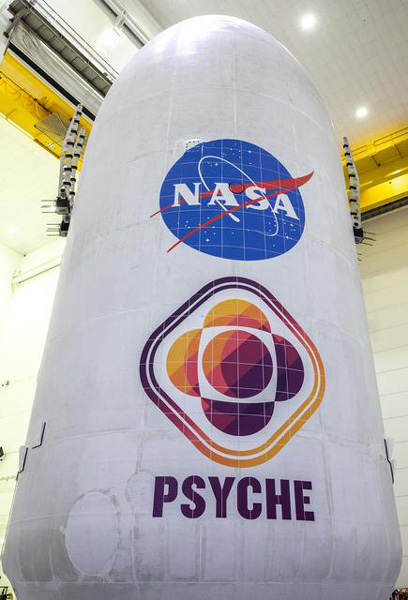
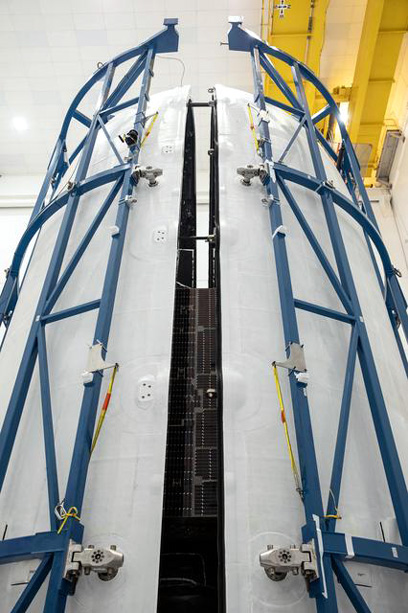
At Astrotech Space Operations Facility in Titusville, Florida, NASA's Psyche spacecraft is encapsulated by the payload fairings of its SpaceX Falcon Heavy rocket...on October 6, 2023.
NASA / Ben Smegelsky

Psyche Transport from Astrotech to LC-39A (Photo Release)

Teams transport NASA's encapsulated Psyche spacecraft from the Astrotech Space Operations Facility in Titusville to Launch Complex 39A at Kennedy Space Center in Florida on Friday, October 6, 2023. Psyche will launch atop a SpaceX Falcon Heavy rocket.

Liftoff is targeted for 10:16 a.m. EDT on Thursday, October 12. Riding with Psyche is a pioneering technology demonstration, NASA's Deep Space Optical Communications (DSOC) experiment.

Source: NASA.Gov

****

At Astrotech Space Operations Facility in Titusville, Florida, NASA's Psyche spacecraft is ready to be encapsulated by the payload fairings of its SpaceX Falcon Heavy rocket...on October 3, 2023.
NASA / Ben Smegelsky

At Astrotech Space Operations Facility in Titusville, Florida, NASA's Psyche spacecraft is encapsulated by the payload fairings of its SpaceX Falcon Heavy rocket...on October 3, 2023.
NASA / Ben Smegelsky

At Astrotech Space Operations Facility in Titusville, Florida, NASA's Psyche spacecraft is encapsulated by the payload fairings of its SpaceX Falcon Heavy rocket...on October 3, 2023.
NASA / Ben Smegelsky

Sunday, September 24, 2023

OSIRIS-REx Has Successfully Brought a Piece of Bennu Back to Earth!

An aerial view of OSIRIS-REx's sample return capsule and its parachute safely sitting on the dirt in the Utah desert...on September 24, 2023.
NASA / Keegan Barber

NASA’s First Asteroid Sample Has Landed, Now Secure in Clean Room (Press Release)

After years of anticipation and hard work by NASA’s OSIRIS-REx (Origins, Spectral Interpretation, Resource Identification and Security – Regolith Explorer) team, a capsule of rocks and dust collected from asteroid Bennu is finally on Earth. It landed at 8:52 a.m. MDT (10:52 a.m. EDT) on Sunday, in a targeted area of the Department of Defense’s Utah Test and Training Range near Salt Lake City.

Within an hour and a half, the capsule was transported by helicopter to a temporary clean room set up in a hangar on the training range, where it is now connected to a continuous flow of nitrogen.

Getting the sample under a “nitrogen purge,” as scientists call it, was one of the OSIRIS-REx team’s most critical tasks today. Nitrogen is a gas that doesn’t interact with most other chemicals, and a continuous flow of it into the sample container inside the capsule will keep out earthly contaminants to leave the sample pure for scientific analyses.

The returned samples collected from Bennu will help scientists worldwide make discoveries to better understand planet formation and the origin of organics and water that led to life on Earth, as well as benefit all of humanity by learning more about potentially hazardous asteroids.

“Congratulations to the OSIRIS-REx team on a picture-perfect mission – the first American asteroid sample return in history – which will deepen our understanding of the origin of our solar system and its formation. Not to mention, Bennu is a potentially hazardous asteroid, and what we learn from the sample will help us better understand the types of asteroids that could come our way,” said NASA Administrator Bill Nelson. “With OSIRIS-REx, Psyche's launch in a couple of weeks, DART’s one year anniversary, and Lucy’s first asteroid approach in November, Asteroid Autumn is in full swing. These missions prove once again that NASA does big things. Things that inspire us and unite us. Things that show nothing is beyond our reach when we work together.”

The Bennu sample – an estimated 8.8 ounces, or 250 grams – will be transported in its unopened canister by aircraft to NASA’s Johnson Space Center in Houston on Monday, September 25. Curation scientists there will disassemble the canister, extract and weigh the sample, create an inventory of the rocks and dust, and, over time, distribute pieces of Bennu to scientists worldwide.

Today’s delivery of an asteroid sample – a first for the U.S. – went according to plan thanks to the massive effort of hundreds of people who remotely directed the spacecraft’s journey since it launched on September 8, 2016. The team then guided it to arrival at Bennu on December 3, 2018, through the search for a safe sample-collection site between 2019 and 2020, sample collection on October 20, 2020, and during the return trip home starting on May 10, 2021.

“Today marks an extraordinary milestone not just for the OSIRIS-REx team but for science as a whole,” said Dante Lauretta, principal investigator for OSIRIS-REx at the University of Arizona, Tucson. “Successfully delivering samples from Bennu to Earth is a triumph of collaborative ingenuity and a testament to what we can accomplish when we unite with a common purpose. But let’s not forget – while this may feel like the end of an incredible chapter, it’s truly just the beginning of another. We now have the unprecedented opportunity to analyze these samples and delve deeper into the secrets of our solar system."

After traveling billions of miles to Bennu and back, the OSIRIS-REx spacecraft released its sample capsule towards Earth’s atmosphere at 6:42 a.m. EDT (4:42 a.m. MDT). The spacecraft was 63,000 miles (102,000 kilometers) from Earth’s surface at the time – about one-third the distance from Earth to the Moon.

Traveling at 27,650 mph (44,500 kph), the capsule pierced the atmosphere at 10:42 a.m. EDT (8:42 a.m. MDT), off the coast of California at an altitude of about 83 miles (133 kilometers). Within 10 minutes, it landed on the military range.

Along the way, two parachutes successfully deployed to stabilize and slow the capsule down to a gentle 11 mph (18 kph) at touchdown.

“The whole team had butterflies today, but that’s the focused anticipation of a critical event by a well-prepared team,” said Rich Burns, project manager for OSIRIS-REx at NASA’s Goddard Space Flight Center in Greenbelt, Maryland. “For us, this was the World Series, ninth inning, bases-loaded moment, and this team knocked it out of the park.”

Radar, infrared and optical instruments in the air and on the ground tracked the capsule to its landing coordinates inside a 36-mile by 8.5-mile (58-kilometer by 14-kilometer) area on the range. Within several minutes, the recovery team was dispatched to the capsule’s location to inspect and retrieve it.

The team found the capsule in good shape at 9:07 a.m. MDT (11:07 a.m. EDT) and then determined that it was safe to approach. Within 70 minutes, they wrapped it up for safe transport to a temporary clean room on the range, where it remains under continuous supervision and a nitrogen purge.

NASA Goddard provides overall mission management, systems engineering, and the safety and mission assurance for OSIRIS-REx. The University of Arizona, Tucson leads the science team and the mission's science observation planning and data processing.

Lockheed Martin Space in Littleton, Colorado, built the spacecraft and provides flight operations. Goddard and KinetX Aerospace are responsible for navigating the OSIRIS-REx spacecraft.

Curation for OSIRIS-REx, including processing the sample when it arrives on Earth, will take place at NASA Johnson. International partnerships on this mission include the OSIRIS-REx Laser Altimeter instrument from CSA (the Canadian Space Agency) and asteroid sample science collaboration with JAXA’s (the Japan Aerospace Exploration Agency) Hayabusa2 mission.

OSIRIS-REx is the third mission in NASA’s New Frontiers Program, managed by NASA’s Marshall Space Flight Center in Huntsville, Alabama, for the agency’s Science Mission Directorate in Washington.

****

OSIRIS-REx's sample return capsule safely sits on the dirt in the Utah desert after re-entering Earth's atmosphere...on September 24, 2023.
NASA

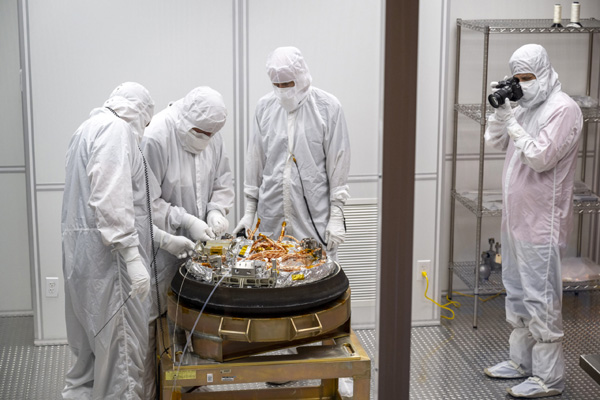
Inside a makeshift clean room at the Utah Test and Training Range, technicians photograph OSIRIS-REx's sample return capsule before they begin disassembling it...on September 24, 2023.
NASA TV

Technicians disassemble OSIRIS-REx's sample return capsule inside a makeshift clean room at the Utah Test and Training Range on September 24, 2023...prior to the capsule being flown to NASA's Johnson Space Center in Houston, Texas, the following day.
NASA / Keegan Barber

Thursday, September 07, 2023

America's Next Asteroid Explorer Is Set to Launch in Less Than 30 Days...

The Psyche spacecraft is prepped for launch inside the Astrotech Space Operations Facility near NASA's Kennedy Space Center in Florida.
NASA / JPL - Caltech

NASA’s Psyche Mission on Track for Liftoff Next Month (News Release - September 6)

Bound for a metal-rich asteroid of the same name, the Psyche mission is targeting October 5 to launch from NASA’s Kennedy Space Center in Florida.

The spacecraft’s solar arrays are folded like an envelope into their stowed position. Xenon gas – fuel for the journey to the asteroid belt – is loaded.

All four thrusters have passed their final tests. Engineers have confirmed the massive high-gain antenna is set to transmit data.

The software is tested and ready. The science instruments – a multispectral imager, magnetometer, and gamma-ray and neutron spectrometer – that will investigate the asteroid Psyche are poised for action.

NASA’s Psyche spacecraft has less than 30 days to go before the opening of its launch period, which runs from Thursday, October 5 through Wednesday, October 25. What the mission learns from the metal-rich asteroid may tell us more about how planets form.

“These missions take so many people and so much meticulous, rigorous, personally-driven work,” said Lindy Elkins-Tanton, principal investigator for Psyche at Arizona State University. “I am ready to be ecstatic. We all are, but we are not ecstatic yet. Let’s launch and establish communications – then we can scream, jump and hug each other!”

Within two weeks, technicians will begin encapsulating the spacecraft in its payload fairing – the cone at the top of the rocket – and the spacecraft will move to SpaceX facilities at NASA’s Kennedy Space Center in Florida. Psyche is set to launch atop a SpaceX Falcon Heavy from the center’s Launch Complex 39A at 10:38 a.m. EDT on October 5.

“It’s getting increasingly real,” said Henry Stone, Psyche’s project manager at NASA’s Jet Propulsion Laboratory in Southern California. “We are counting the days. The team is more than ready to send this spacecraft off on its journey, and it’s very exciting.”

After escaping Earth’s gravity, Psyche will use solar electric propulsion to accomplish its six-year journey to the asteroid. The efficient propulsion system works by accelerating and expelling charged atoms, or ions, of the neutral gas xenon – creating a thrust that gently propels the spacecraft with a force akin to what you’d feel holding a single AA battery in your hand.

Technicians recently loaded 2,392 pounds (1,085 kilograms) of xenon onto the spacecraft over the course of about two weeks.

Measuring roughly 173 miles (279 kilometers) at its widest point, the asteroid Psyche presents a unique opportunity to explore a metal-rich body that may be part of a core of a planetesimal, the building block of an early planet. Once the spacecraft reaches Psyche in the main asteroid belt between Mars and Jupiter, it will spend about 26 months orbiting the asteroid, gathering images and other data that will tell scientists more about its history and what it is made of.

Source: NASA.Gov

****

An artist's concept of NASA's Psyche spacecraft.
NASA / JPL - Caltech / ASU