Showing posts with label TESS. Show all posts

Wednesday, May 13, 2026

An Amazing Celestial Mosaic by Kepler's Successor...

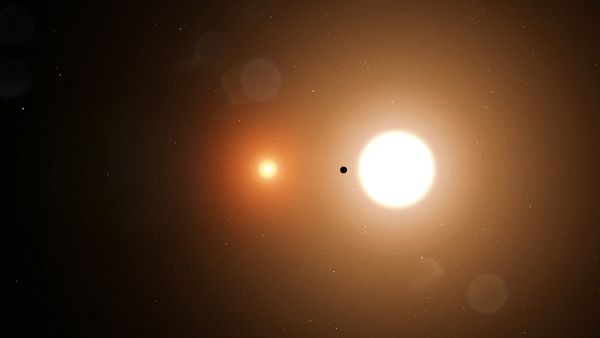
A mosaic of the night sky using images taken by NASA's TESS spacecraft between April 2018 and September 2025...showing 679 exoplanets (blue dots) and 5,165 exoplanetary candidates (orange dots), respectively.
NASA / MIT / TESS and Veselin Kostov (University of Maryland College Park)

NASA’s Planet-Hunting TESS Reveals Dazzling Night Sky (News Release)

NASA’s TESS (Transiting Exoplanet Survey Satellite) has released its most complete view of the starry sky to date, filling in gaps from previous observations. Nearly 6,000 colored dots scattered across the image show the locations of either confirmed or candidate exoplanets — worlds beyond our Solar System — identified by the mission as of September 2025 at the end of TESS’s second extended mission.

“Over the last eight years, TESS has become a fire hose of exoplanet science,” said Rebekah Hounsell, a TESS associate project scientist at the University of Maryland Baltimore County and NASA’s Goddard Space Flight Center in Greenbelt, Maryland. “It’s helped us find planets of all different sizes, from tiny Mercury-like ones to those larger than Jupiter. Some of them are even in the habitable zone, where liquid water might be possible on the surface, an important factor in our search for life beyond Earth.”

The TESS mission scans a wide swath of the sky, called a sector, for about a month at a time using its four cameras. These long stares allow the spacecraft to track the brightness changes of tens of thousands of stars, looking for variations in their light that might come from orbiting planets.

Researchers assembled an all-sky mosaic made of 96 sectors observed between April 2018, when TESS began its work, and September 2025.

The blue dots in the image mark the locations of nearly 700 confirmed planets, as of September 9. This menagerie includes worlds that may be covered by volcanoes, are being destroyed by their stars, or orbit two stars — experiencing double sunrises and sunsets each day. The orange dots represent more than 5,000 candidate planets that are awaiting verification.

To date, scientists have confirmed over 6,270 exoplanets using missions like TESS, NASA’s retired Kepler Space Telescope, and other facilities.

Also captured in the mosaic is the bright plane of our Milky Way galaxy, seen as a glowing arc through the center. The bright white ovals in the lower left are the Large and Small Magellanic Clouds. These satellite galaxies are located 160,000 and 200,000 light-years away, respectively.

“The more we dig into the large TESS dataset, especially using automated algorithms, the more surprises we find,” said Allison Youngblood, the TESS project scientist at NASA Goddard. “In addition to planets, TESS has helped us study rivers of young stars, observe dynamic galactic behavior, and monitor asteroids near Earth. As TESS fills in more of the night sky, there’s no knowing what it might see next.”

Source: NASA.Gov

Tuesday, January 27, 2026

An Exoplanet-hunting Spacecraft Photographs Our Solar System's Interstellar Visitor...

A video screenshot showing interstellar comet 3I/ATLAS moving across a field of stars...utilizing a series of photos that were taken by NASA's TESS spacecraft between January 15 and January 18 to 19, 2026.
NASA / Daniel Muthukrishna, MIT

NASA’s TESS Reobserves Comet 3I/ATLAS (News Release)

NASA’s TESS (Transiting Exoplanet Survey Satellite) observed the interstellar comet 3I/ATLAS during a special observation run from January 15 to 22. Scientists will use the data to study the comet’s activity and rotation.

Using TESS data from January 15 and January 18 to 19, Daniel Muthukrishna, a research scientist at the Massachusetts Institute of Technology in Cambridge, compiled a series of images into a short video that shows 3I/ATLAS as a bright moving dot with a tail.

The comet’s brightness is around 11.5 in apparent magnitude, or approximately 100 times fainter than what humans can see with the unaided eye.

All of the TESS data from January 15 through 22 are publicly available on the Mikulski Archive for Space Telescopes as of Tuesday. The initially-calibrated measurements from January 15 used for the brightness estimate and the video were posted on January 19.

The TESS spacecraft scans a wide swath of the sky for about a month at a time, looking for variations in the light from distant stars to spot orbiting exoplanets, or worlds beyond our Solar System. This technique also allows TESS to identify and monitor comets and asteroids out to large distances.

The mission’s wide field of view previously happened to observe 3I/ATLAS in May 2025, almost two months before it was discovered. Astronomers looking back at the TESS data were able to identify the faint comet by stacking multiple observations to track its movement.

The recent 3I/ATLAS observations were temporarily interrupted from January 15 to 18 when TESS entered a safe mode following an issue with its solar panels.

Source: NASA.Gov

Thursday, August 07, 2025

Webb's Predecessor Takes an Image of Galactic Visitor 3I/ATLAS...

An image of interstellar comet 3I/ATLAS that was taken by NASA's Hubble Space Telescope...on July 21, 2025.
NASA, ESA, David Jewitt (UCLA); Image Processing: Joseph DePasquale (STScI)

As NASA Missions Study Interstellar Comet, Hubble Makes Size Estimate (News Release)

A team of astronomers has taken the sharpest-ever picture of the unexpected interstellar comet 3I/ATLAS using the crisp vision of NASA’s Hubble Space Telescope. Hubble is one of many missions across NASA’s fleet of space telescopes slated to observe this comet, together providing more information about its size and physical properties. While the comet poses no threat to Earth, NASA’s space telescopes help support the agency's ongoing mission to find, track and better understand near-Earth objects.

Hubble’s observations allow astronomers to more accurately estimate the size of the comet’s solid, icy nucleus. The upper limit on the diameter of the nucleus is 3.5 miles (5.6 kilometers), though it could be as small as 1,000 feet (320 meters) across, researchers report. Though the Hubble images put tighter constraints on the size of the nucleus compared to previous ground-based estimates, the solid heart of the comet presently cannot be seen directly, even by Hubble.

Observations from other NASA missions including the James Webb Space Telescope, TESS (Transiting Exoplanet Survey Satellite) and the Neil Gehrels Swift Observatory, as well as NASA’s partnership with the W.M. Keck Observatory, will help further refine our knowledge about the comet, including its chemical makeup.

Hubble also captured a dust plume ejected from the Sun-warmed side of the comet, and the hint of a dust tail streaming away from the nucleus. Hubble’s data yields a dust-loss rate consistent with comets that are first detected around 300 million miles from the Sun. This behavior is much like the signature of previously-seen Sun-bound comets originating within our Solar System.

The big difference is that this interstellar visitor originated in some other solar system elsewhere in our Milky Way galaxy.

3I/ATLAS is traveling through our Solar System at a staggering 130,000 miles (209,000 kilometers) per hour, the highest velocity ever recorded for a solar system visitor. This breathtaking sprint is evidence that the comet has been drifting through interstellar space for many billions of years. The gravitational slingshot effect from innumerable stars and nebulae that the comet passed added momentum, ratcheting up its speed.

The longer that 3I/ATLAS was out in space, the higher its speed grew.

“No one knows where the comet came from. It’s like glimpsing a rifle bullet for a thousandth of a second. You can't project that back with any accuracy to figure out where it started on its path,” said David Jewitt of the University of California, Los Angeles, science team leader for the Hubble observations.

The paper will be published in The Astrophysical Journal Letters. It is already available on Astro-ph.

New Evidence for Population of Wandering Space Relics

“This latest interstellar tourist is one of a previously undetected population of objects bursting onto the scene that will gradually emerge,” said Jewitt. “This is now possible because we have powerful sky survey capabilities that we didn't have before. We've crossed a threshold."

This comet was discovered by the NASA-funded Asteroid Terrestrial-impact Last Alert System (ATLAS) on July 1, 2025, at a distance of 420 million miles from the Sun. ATLAS is an asteroid impact early warning system developed by the University of Hawai’i.

In the meantime, other NASA missions will provide new insight into this third interstellar interloper, helping refine our understanding of these objects for the benefit of all. 3I/ATLAS should remain visible to ground-based telescopes through September, after which it will pass too close to the Sun to observe, and is expected to reappear on the other side of the Sun by early December.

Source: NASA.Gov

****

Thursday, October 03, 2024

The Latest Celestial Discovery by Kepler's Successor...

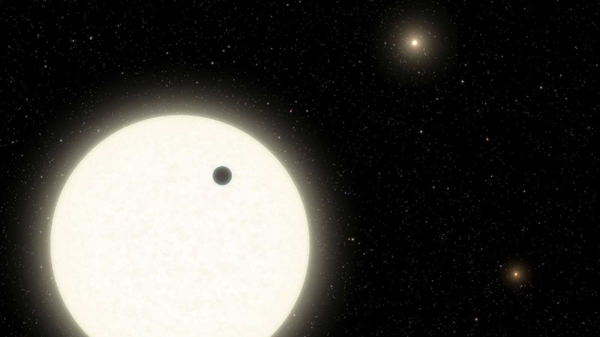
An artist's concept of the stellar triplets TIC 290061484.
NASA GSFC

NASA’s TESS Spots Record-Breaking Stellar Triplets (News Release - October 2)

Professional and amateur astronomers teamed up with artificial intelligence to find an unmatched stellar trio called TIC 290061484, thanks to cosmic “strobe lights” captured by NASA’s TESS (Transiting Exoplanet Survey Satellite).

The system contains a set of twin stars orbiting each other every 1.8 days, and a third star that circles the pair in just 25 days. The discovery smashes the record for shortest outer orbital period for this type of system, set in 1956, which had a third star orbiting an inner pair in 33 days.

“Thanks to the compact, edge-on configuration of the system, we can measure the orbits, masses, sizes and temperatures of its stars,” said Veselin Kostov, a research scientist at NASA’s Goddard Space Flight Center in Greenbelt, Maryland, and the SETI Institute in Mountain View, California. “And we can study how the system formed and predict how it may evolve.”

A paper, led by Kostov, describing the results was published in The Astrophysical Journal on October 2.

Flickers in starlight helped reveal the tight trio, which is located in the constellation Cygnus. The system happens to be almost flat from our perspective. This means that the stars cross right in front of, or eclipse, each other as they orbit.

When that happens, the nearer star blocks some of the farther star’s light.

Using machine learning, scientists filtered through enormous sets of starlight data from TESS to identify patterns of dimming that reveal eclipses. Then, a small team of citizen scientists filtered further, relying on years of experience and informal training to find particularly interesting cases.

These amateur astronomers, who are co-authors on the new study, met as participants in an online citizen science project called Planet Hunters, which was active from 2010 to 2013. The volunteers later teamed up with professional astronomers to create a new collaboration called the Visual Survey Group, which has been active for over a decade.

“We’re mainly looking for signatures of compact multi-star systems, unusual pulsating stars in binary systems, and weird objects,” said Saul Rappaport, an emeritus professor of physics at MIT in Cambridge. Rappaport co-authored the paper and has helped lead the Visual Survey Group for more than a decade. “It’s exciting to identify a system like this because they’re rarely found, but they may be more common than current tallies suggest.”

Many more likely speckle our galaxy, waiting to be discovered.

Partly because the stars in the newfound system orbit in nearly the same plane, scientists say that it’s likely very stable despite their tight configuration (the trio’s orbits fit within a smaller area than Mercury’s orbit around the Sun). Each star’s gravity doesn’t perturb the others too much, like they could if their orbits were tilted in different directions.

But while their orbits will likely remain stable for millions of years, “no one lives here,” Rappaport said. “We think the stars formed together from the same growth process, which would have disrupted planets from forming very closely around any of the stars.” The exception could be a distant planet orbiting the three stars as if they were one.

As the inner stars age, they will expand and ultimately merge, triggering a supernova explosion in around 20 to 40 million years.

In the meantime, astronomers are hunting for triple stars with even shorter orbits. That’s hard to do with current technology, but a new tool is on the way.

Images from NASA’s upcoming Nancy Grace Roman Space Telescope will be much more detailed than TESS’s. The same area of the sky covered by a single TESS pixel will fit more than 36,000 Roman pixels. And while TESS took a wide, shallow look at the entire sky, Roman will pierce deep into the heart of our galaxy where stars crowd together, providing a core sample rather than skimming the whole surface.

“We don’t know much about a lot of the stars in the center of the galaxy except for the brightest ones,” said Brian Powell, a co-author and data scientist at Goddard. “Roman’s high-resolution view will help us measure light from stars that usually blur together, providing the best look yet at the nature of star systems in our galaxy.”

And since Roman will monitor light from hundreds of millions of stars as part of one of its main surveys, it will help astronomers find more triple star systems in which all the stars eclipse each other.

“We’re curious why we haven’t found star systems like these with even shorter outer orbital periods,” said Powell. “Roman should help us find them and bring us closer to figuring out what their limits might be.”

Roman could also find eclipsing stars bound together in even larger groups — half a dozen, or perhaps even more all orbiting each other like bees buzzing around a hive.

“Before scientists discovered triply eclipsing triple star systems, we didn’t expect them to be out there,” said co-author Tamás Borkovits, a senior research fellow at the Baja Observatory of The University of Szeged in Hungary. “But once we found them, we thought, well why not? Roman, too, may reveal never-before-seen categories of systems and objects that will surprise astronomers.”

Source: NASA.Gov

****

An artist's concept of NASA's TESS satellite observing the cosmos.
NASA GSFC

Wednesday, May 17, 2023

A Real-Life Mustafar from STAR WARS Has Been Found Orbiting a Red Dwarf 90 Light-Years Away...

An artist's concept of the exoplanet LP 791-18 d.
NASA’s Goddard Space Flight Center / Chris Smith (KRBwyle)

NASA’s Spitzer, TESS Find Potentially Volcano-Covered Earth-Size World (News Release)

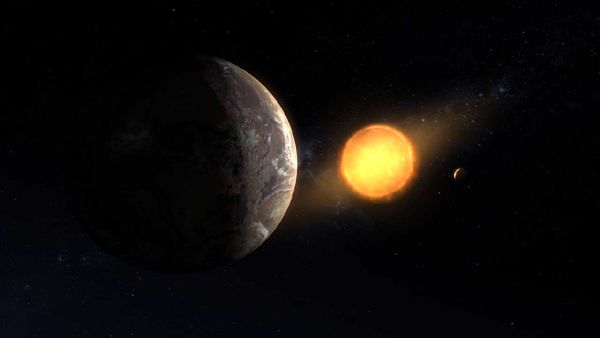
Astronomers have discovered an Earth-size exoplanet, or world beyond our solar system, that may be carpeted with volcanoes. Called LP 791-18 d, the planet could undergo volcanic outbursts as often as Jupiter’s moon Io, the most volcanically-active body in our solar system.

They found and studied the planet using data from NASA’s TESS (Transiting Exoplanet Survey Satellite) and retired Spitzer Space Telescope, as well as a suite of ground-based observatories.

A paper about the planet – led by Merrin Peterson, a graduate of the Trottier Institute for Research on Exoplanets (iREx) based at the University of Montreal – appears in the May 17 edition of the scientific journal Nature.

“LP 791-18 d is tidally locked, which means the same side constantly faces its star,” said Björn Benneke, a co-author and astronomy professor at iREx who planned and supervised the study. “The day side would probably be too hot for liquid water to exist on the surface. But the amount of volcanic activity we suspect occurs all over the planet could sustain an atmosphere, which may allow water to condense on the night side.”

LP 791-18 d orbits a small red dwarf star about 90 light-years away in the southern constellation Crater. The team estimates it’s only slightly larger and more massive than Earth.

Astronomers already knew about two other worlds in the system before this discovery, called LP 791-18 b and c. The inner planet b is about 20% bigger than Earth.

The outer planet c is about 2.5 times Earth’s size and more than seven times its mass.

During each orbit, planets d and c pass very close to each other. Each close pass by the more massive planet c produces a gravitational tug on planet d, making its orbit somewhat elliptical.

On this elliptical path, planet d is slightly deformed every time it goes around the star. These deformations can create enough internal friction to substantially heat the planet’s interior and produce volcanic activity at its surface.

Jupiter and some of its moons affect Io in a similar way.

Planet d sits on the inner edge of the habitable zone, the traditional range of distances from a star where scientists hypothesize liquid water could exist on a planet’s surface. If the planet is as geologically active as the research team suspects, it could maintain an atmosphere.

Temperatures could drop enough on the planet’s night side for water to condense on the surface.

Planet c has already been approved for observing time on the James Webb Space Telescope, and the team thinks planet d is also an exceptional candidate for atmospheric studies by the mission.

“A big question in astrobiology, the field that broadly studies the origins of life on Earth and beyond, is if tectonic or volcanic activity is necessary for life,” said co-author Jessie Christiansen, a research scientist at NASA’s Exoplanet Science Institute at the California Institute of Technology in Pasadena. “In addition to potentially providing an atmosphere, these processes could churn up materials that would otherwise sink down and get trapped in the crust, including those we think are important for life, like carbon.”

Spitzer’s observations of the system were among the last the satellite collected before it was decommissioned in January 2020.

“It is incredible to read about the continuation of discoveries and publications years beyond Spitzer’s end of mission,” said Joseph Hunt, Spitzer project manager at NASA’s Jet Propulsion Laboratory in Southern California. “That really shows the success of our first-class engineers and scientists. Together they built not only a spacecraft but also a data set that continues to be an asset for the astrophysics community.”

TESS is a NASA Astrophysics Explorer mission led and operated by MIT in Cambridge, Massachusetts, and managed by NASA's Goddard Space Flight Center. Additional partners include Northrop Grumman, based in Falls Church, Virginia; NASA’s Ames Research Center in California’s Silicon Valley; the Center for Astrophysics | Harvard & Smithsonian in Cambridge, Massachusetts; MIT’s Lincoln Laboratory; and the Space Telescope Science Institute in Baltimore.

More than a dozen universities, research institutes and observatories worldwide are participants in the mission.

The entire body of scientific data collected by Spitzer during its lifetime is available to the public via the Spitzer data archive, housed at the Infrared Science Archive at IPAC at Caltech in Pasadena, California. NASA’s Jet Propulsion Laboratory, a division of Caltech, managed Spitzer mission operations for the agency’s Science Mission Directorate in Washington.

Science operations were conducted at the Spitzer Science Center at IPAC at Caltech. Spacecraft operations were based at Lockheed Martin Space in Littleton, Colorado.

Source: NASA.Gov

****

The planet Mustafar from STAR WARS: REVENGE OF THE SITH.
Lucasfilm Ltd.

Tuesday, April 18, 2023

On This Day in 2018: A Prolific Spacecraft Launched on Its Mission to Discover New Exoplanets...

An artist's concept of NASA's TESS satellite searching for exoplanets in deep space.
NASA GSFC

NASA’s TESS Celebrates Fifth Year Scanning the Sky for New Worlds (News Release)

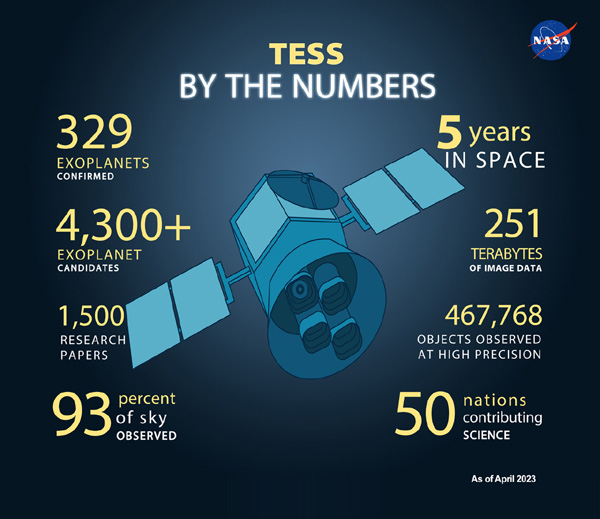
Now in its fifth year in space, NASA’s TESS (Transiting Exoplanet Survey Satellite) remains a rousing success. TESS’s cameras have mapped more than 93% of the entire sky, discovered 329 new worlds and thousands more candidates, and provided new insights into a wide array of cosmic phenomena, from stellar pulsations and exploding stars to supermassive black holes.

Using its four cameras, TESS monitors large swaths of the sky called sectors for about a month at a time. Each sector measures 24 by 96 degrees, about as wide as a person’s hand at arm’s length and stretching from the horizon to the zenith.

The cameras capture a total of 192 million pixels in each full-frame image. During its primary mission, TESS captured one of these images every 30 minutes, but this torrent of data has increased with time.

The cameras now record each sector every 200 seconds.

“The volume of high-quality TESS data now available is quite impressive,” said Knicole Colón, the mission’s project scientist at NASA's Goddard Space Flight Center in Greenbelt, Maryland. “We have more than 251 terabytes just for one of the main data products, called full-frame images. That’s the equivalent of streaming 167,000 movies in full HD.”

“TESS extracts parts of each full-frame image to make cutouts around specific cosmic objects – more than 467,000 of them at the moment – and together they create a detailed record of changing brightness for each one,” said Christina Hedges, lead for the TESS General Investigator Office and a research scientist at both the University of Maryland, Baltimore County and Goddard. “We use these files to produce light curves, a product that graphically shows how a source’s brightness alters over time.”

To find exoplanets, or worlds beyond our solar system, TESS looks for the telltale dimming of a star caused when an orbiting planet passes in front of it. But stars also change brightness for other reasons: exploding as supernovae, erupting in sudden flares, dark star spots on their rotating surfaces and even slight changes due to oscillations driven by internal sound waves.

The rapid, regular observations from TESS enable more detailed study of these phenomena.

Some stars give TESS a trifecta of brightness-changing behavior. One example is AU Microscopii, thought to be about 25 million years-old – a rowdy youngster less than 1% the age of our Sun.

Spotted regions on AU Mic’s surface grow and shrink, and the star’s rotation carries them into and out of sight. The stormy star also erupts with frequent flares.

With all this going on, TESS, with the help of NASA’s now-retired Spitzer Space Telescope, discovered a planet about four times Earth’s size orbiting the star every 8.5 days. Then, in 2022, scientists announced that TESS data revealed the presence of another, smaller world, one almost three times Earth’s size and orbiting every 18.9 days.

These discoveries have made the system a touchstone for understanding how stars and planets form and evolve.

Here are a few more of the mission’s greatest hits:

- TESS has observed hundreds of supernovae and thousands of other candidate transient, or short-lived, events so far.

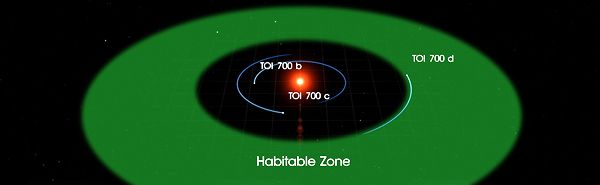
- TOI 700 d was the first planet TESS found that orbits within its star’s habitable zone. That’s the range of orbital distances where liquid water potentially could exist on the planet’s surface.

In January, astronomers announced this Earth-sized world was joined by another, TOI 700 e, that also orbits in the star’s habitable or “Goldilocks” zone.

- The active galaxy ESO 253-3 hosts a 78-million-solar-mass black hole that flares up every 114 days, the first supermassive black hole shown to flare regularly. To understand why, astronomers combined ground-based observations of the flares with data from TESS, NASA’s Swift and NuSTAR telescopes, and the XMM-Newton satellite operated by ESA (the European Space Agency).

The most likely answer, they say, is that a giant star skims close enough to the monster black hole once each orbit that the black hole’s gravity strips away some stellar gas. This material falls inward, creating a flare when it strikes the vast disk of gas surrounding the black hole.

- TESS discovered a trio of hot worlds larger than Earth orbiting a much younger version of our Sun called TOI 451, located about 400 light-years away. The system was found in a newly-discovered “river” of stars called the Pisces-Eridanus stream, which stretches across one-third of the sky.

TESS showed that many of the stars revealed had star spots and rotated rapidly – clear evidence the stream was only 120 million years-old, or one-eighth the age of previous estimates.

New discoveries are waiting to be made within the huge volume of data TESS has already captured. This is a library of observations astronomers will explore for years, but there’s much more to come.

“We’re celebrating TESS’s fifth anniversary at work – and wishing it many happy returns!” Colón said.

TESS is a NASA Astrophysics Explorer mission led and operated by MIT in Cambridge, Massachusetts, and managed by NASA's Goddard Space Flight Center. Additional partners include Northrop Grumman, based in Falls Church, Virginia; NASA’s Ames Research Center in California’s Silicon Valley; the Harvard-Smithsonian Center for Astrophysics in Cambridge, Massachusetts; MIT’s Lincoln Laboratory; and the Space Telescope Science Institute in Baltimore.

More than a dozen universities, research institutes and observatories worldwide are participants in the mission.

Source: NASA.Gov

****

An infographic showing achievements made by NASA's TESS satellite since its launch in 2018.
NASA

Wednesday, January 11, 2023

Hubble's Successor Has Officially Validated the Presence of Its First Alien World!

An artist's concept of the exoplanet LHS 475 b orbiting its red dwarf star.
NASA

NASA’s Webb Confirms Its First Exoplanet (News Release)

Researchers confirmed an exoplanet, a planet that orbits another star, using NASA’s James Webb Space Telescope for the first time. Formally classified as LHS 475 b, the planet is almost exactly the same size as our own, clocking in at 99% of Earth’s diameter.

The research team is led by Kevin Stevenson and Jacob Lustig-Yaeger, both of the Johns Hopkins University Applied Physics Laboratory in Laurel, Maryland.

The team chose to observe this target with Webb after carefully reviewing targets of interest from NASA’s Transiting Exoplanet Survey Satellite (TESS), which hinted at the planet’s existence. Webb’s Near-Infrared Spectrograph (NIRSpec) captured the planet easily and clearly with only two transit observations.

“There is no question that the planet is there. Webb’s pristine data validate it,” said Lustig-Yaeger. “The fact that it is also a small, rocky planet is impressive for the observatory,” Stevenson added.

“These first observational results from an Earth-size, rocky planet open the door to many future possibilities for studying rocky planet atmospheres with Webb,” agreed Mark Clampin, Astrophysics Division director at NASA Headquarters in Washington. “Webb is bringing us closer and closer to a new understanding of Earth-like worlds outside our solar system, and the mission is only just getting started.”

Among all operating telescopes, only Webb is capable of characterizing the atmospheres of Earth-sized exoplanets. The team attempted to assess what is in the planet’s atmosphere by analyzing its transmission spectrum.

Although the data shows that this is an Earth-sized terrestrial planet, they do not yet know if it has an atmosphere. “The observatory’s data are beautiful,” said Erin May, also of the Johns Hopkins University Applied Physics Laboratory. “The telescope is so sensitive that it can easily detect a range of molecules, but we can’t yet make any definitive conclusions about the planet’s atmosphere.”

Although the team can’t conclude what is present, they can definitely say what is not present. “There are some terrestrial-type atmospheres that we can rule out,” explained Lustig-Yaeger. “It can’t have a thick methane-dominated atmosphere, similar to that of Saturn’s moon Titan.”

The team also notes that while it’s possible the planet has no atmosphere, there are some atmospheric compositions that have not been ruled out, such as a pure carbon dioxide atmosphere. “Counterintuitively, a 100% carbon dioxide atmosphere is so much more compact that it becomes very challenging to detect,” said Lustig-Yaeger.

Even more precise measurements are required for the team to distinguish a pure carbon dioxide atmosphere from no atmosphere at all. The researchers are scheduled to obtain additional spectra with upcoming observations this summer.

Webb also revealed that the planet is a few hundred degrees warmer than Earth, so if clouds are detected, it may lead the researchers to conclude that the planet is more like Venus, which has a carbon dioxide atmosphere and is perpetually shrouded in thick clouds. “We’re at the forefront of studying small, rocky exoplanets,” Lustig-Yaeger said. “We have barely begun scratching the surface of what their atmospheres might be like.”

The researchers also confirmed that the planet completes an orbit in just two days, information that was almost instantaneously revealed by Webb’s precise light curve. Although LHS 475 b is closer to its star than any planet in our solar system, its red dwarf star is less than half the temperature of the Sun, so the researchers project it could still have an atmosphere.

The researchers’ findings have opened the possibilities of pinpointing Earth-sized planets orbiting smaller red dwarf stars. “This rocky planet confirmation highlights the precision of the mission’s instruments,” Stevenson said. “And it is only the first of many discoveries that it will make.” Lustig-Yaeger agreed. “With this telescope, rocky exoplanets are the new frontier.”

LHS 475 b is relatively close, at only 41 light-years away, in the constellation Octans.

The team’s results were presented at a press conference of the American Astronomical Society (AAS) on Wednesday, January 11, 2023.

Source: NASA.Gov

****

An infographic showing the spectroscopic data collected by NASA's James Webb Space Telescope that confirmed the existence of exoplanet LHS 475 b.
NASA, ESA, CSA, L. Hustak (STScI); Science: K. Stevenson, J. Lustig-Yaeger, E. May (Johns Hopkins University Applied Physics Laboratory), G. Fu (Johns Hopkins University), and S. Moran (University of Arizona)

Monday, March 21, 2022

The Tally of Alien Worlds in Our Galaxy Has Reached a New Record Today...

An artist's concept of different exoplanets in our galaxy.
NASA / JPL - Caltech

Cosmic Milestone: NASA Confirms 5,000 Exoplanets (News Release)

The count of confirmed exoplanets just ticked past the 5,000 mark, representing a 30-year journey of discovery led by NASA space telescopes.

Not so long ago, we lived in a universe with only a small number of known planets, all of them orbiting our Sun. But a new raft of discoveries marks a scientific high point: More than 5,000 planets are now confirmed to exist beyond our solar system.

The planetary odometer turned on March 21, with the latest batch of 65 exoplanets – planets outside our immediate solar family – added to the NASA Exoplanet Archive. The archive records exoplanet discoveries that appear in peer-reviewed, scientific papers, and that have been confirmed using multiple detection methods or by analytical techniques.

The 5,000-plus planets found so far include small, rocky worlds like Earth, gas giants many times larger than Jupiter, and “hot Jupiters” in scorchingly close orbits around their stars. There are “super-Earths,” which are possible rocky worlds bigger than our own, and “mini-Neptunes,” smaller versions of our system’s Neptune. Add to the mix planets orbiting two stars at once and planets stubbornly orbiting the collapsed remnants of dead stars.

“It’s not just a number,” said Jessie Christiansen, science lead for the archive and a research scientist with the NASA Exoplanet Science Institute at Caltech in Pasadena. “Each one of them is a new world, a brand-new planet. I get excited about every one because we don’t know anything about them.”

We do know this: Our galaxy likely holds hundreds of billions of such planets. The steady drumbeat of discovery began in 1992 with strange new worlds orbiting an even stranger star. It was a type of neutron star known as a pulsar, a rapidly-spinning stellar corpse that pulses with millisecond bursts of searing radiation. Measuring slight changes in the timing of the pulses allowed scientists to reveal planets in orbit around the pulsar.

Finding just three planets around this spinning star essentially opened the floodgates, said Alexander Wolszczan, the lead author on the paper that, 30 years ago, unveiled the first planets to be confirmed outside our solar system.

“If you can find planets around a neutron star, planets have to be basically everywhere,” Wolszczan said. “The planet-production process has to be very robust.”

Wolszczan, who still searches for exoplanets as a professor at Penn State, says we’re opening an era of discovery that will go beyond simply adding new planets to the list. The Transiting Exoplanet Survey Satellite (TESS), launched in 2018, continues to make new exoplanet discoveries. But soon powerful next-generation telescopes and their highly-sensitive instruments, starting with the recently-launched James Webb Space Telescope, will capture light from the atmospheres of exoplanets, reading which gases are present to potentially identify tell-tale signs of habitable conditions.

The Nancy Grace Roman Space Telescope, expected to launch in 2027, will make new exoplanet discoveries using a variety of methods. The ESA (European Space Agency) mission ARIEL, launching in 2029, will observe exoplanet atmospheres; a piece of NASA technology aboard, called CASE, will help zero in on exoplanet clouds and hazes.

“To my thinking, it is inevitable that we’ll find some kind of life somewhere – most likely of some primitive kind,” Wolszczan said. The close connection between the chemistry of life on Earth and chemistry found throughout the universe, as well as the detection of widespread organic molecules, suggests detection of life itself is only a matter of time, he added.

How to Find Other Worlds

The picture didn’t always look so bright. The first planet detected around a Sun-like star, in 1995, turned out to be a hot Jupiter: a gas giant about half the mass of our own Jupiter in an extremely close, four-day orbit around its star. A year on this planet, in other words, lasts only four days.

More such planets appeared in the data from ground-based telescopes once astronomers learned to recognize them – first dozens, then hundreds. They were found using the “wobble” method: tracking slight back-and-forth motions of a star, caused by gravitational tugs from orbiting planets. But still, nothing looked likely to be habitable.

Finding small, rocky worlds more like our own required the next big leap in exoplanet-hunting technology: the “transit” method. Astronomer William Borucki came up with the idea of attaching extremely sensitive light detectors to a telescope, then launching it into space. The telescope would stare for years at a field of more than 170,000 stars, searching for tiny dips in starlight when a planet crossed a star’s face.

That idea was realized in the Kepler Space Telescope.

Borucki, principal investigator of the now-retired Kepler mission, says its launch in 2009 opened a new window on the universe.

“I get a real feeling of satisfaction, and really of awe at what’s out there,” he said. “None of us expected this enormous variety of planetary systems and stars. It’s just amazing.”

Source: Jet Propulsion Laboratory

****

Thursday, January 14, 2021

An Exoplanet Discovery Made by the Kepler Space Telescope Has Been Confirmed by TESS...

An artist's concept of the exoplanet KOI-5Ab orbiting its parent star in the KOI-5 system.
Caltech / R. Hurt (IPAC)

Discovery Alert: A Forgotten Planet Found in a Triple-Star System (News Release - January 12)

Shortly after NASA's Kepler mission began operations back in 2009, the space telescope spotted what was thought to be a planet about half the size of Saturn in a multiple-star system. KOI-5Ab was only the second planet candidate to be found by the mission, and exciting as it was at the time, it was ultimately set aside as Kepler racked up more and more planet discoveries.

By the end of the spacecraft’s operations in 2018, Kepler had discovered a whopping 2,394 exoplanets, or planets orbiting stars beyond our sun, and an additional 2,366 exoplanet candidates that would still need confirmation.

“KOI-5Ab got abandoned because it was complicated, and we had thousands of candidates,” said David Ciardi, chief scientist of NASA's Exoplanet Science Institute. “There were easier pickings than KOI-5Ab, and we were learning something new from Kepler every day, so that KOI-5 was mostly forgotten.”

Now, after a lengthy hunt that spanned many years and many telescopes, Ciardi said he has "resurrected KOI-5Ab from the dead." Thanks to new observations from NASA’s second planet-hunting mission, the Transiting Exoplanet Survey Satellite, or TESS, and a number of ground-based telescopes, Ciardi was finally able to untangle all the evidence surrounding KOI-5Ab and prove its existence. There are some intriguing details about it to mull over.

Most likely a gas giant planet like Jupiter or Saturn in our solar system given its size, KOI-5Ab is unusual in that it orbits a star in a system with two other companion stars, circling on a plane that’s out of alignment with at least one of the stars. The arrangement calls into question how each member in this system formed out of the same swirling clouds of gas and dust. Ciardi, who is located at Caltech in Pasadena, California presented the findings at a virtual meeting of the American Astronomical Society.

Picking up the trail

After its initial detection by Kepler, Ciardi and other researchers picked up the trail on KOI-5Ab as part of a cache of planet candidates they were following up on. Using data from the W. M. Keck Observatory in Hawaii, Caltech's Palomar Observatory near San Diego, and Gemini North in Hawaii, Ciardi and other astronomers determined that KOI-5b appeared to be circling one star in a triple-star system. However, they still couldn’t tease out whether the planet signal was actually an erroneous glitch from one of the two other stars, or, if the planet was real, which of the stars it orbited.

Then, in 2018, TESS came along. Like Kepler, TESS looks for the blinking of starlight that comes when a planet crosses in front of, or transits, a star. TESS observed a portion of Kepler's field of view, including the KOI-5 system. Sure enough, TESS also identified KOI-5Ab as a candidate planet, though TESS calls it TOI-1241b. As Kepler had observed previously, TESS found that the planet orbited its star roughly every five days.

"I thought to myself, 'I remember this target,'" said Ciardi, after seeing the TESS data. “But we still couldn’t determine definitively if the planet was real or if the blip in the data came from another star in the system – it could have been a fourth star.”

Clues in the wobbles

He then went back and re-analyzed all the data, and then searched for new clues from ground-based telescopes. Deploying an alternate technique to Kepler and TESS, the Keck Observatory is often used for follow-up searches of exoplanets by measuring the slight wobble in a star as a planet circles around it and exerts a gravitational tug. Ciardi, teaming up with other scientists through an exoplanet collaboration group called the California Planet Search, looked for any wobbles in Keck’s data on the KOI-5 system. They were able to tease out a wobble produced by the inner companion star orbiting the primary star from the wobble of the apparent planet as it orbits the primary star. Together, the different collections of data from the space- and ground-based telescopes helped confirm that KOI-5Ab is, indeed, a planet orbiting the primary star.

“Bingo – it was there! If it weren't for TESS looking at the planet again, I would never have gone back and done all this detective work," he said. “But it truly did take a lot of sleuthing within data collected from many different telescopes to finally nail down this planet.”

KOI-5Ab orbits Star A, which has a relatively close companion, Star B. Star A and Star B orbit each other every 30 years. A third gravitationally bound star, Star C, orbits stars A and B every 400 years.

A skewed orbit

The combined data set also reveals that the orbital plane of the planet is not aligned with the orbital plane of Star B, the second inner star as might be expected if the stars and planet all formed from the same disk of swirling material. Astronomers are not sure what caused the misalignment of KOI-5Ab but believe that the second star gravitationally kicked the planet during its development, skewing its orbit and causing it to migrate inward. Triple-star systems make up about 10% of all star systems.

This is not the first evidence of planets in double- and triple-star systems. One striking case involves the triple-star system GW Orionis, in which a planet-forming disk has been torn into distinct, misaligned rings, where planets may be forming. Yet despite hundreds of discoveries of planets in multiple-star system, far fewer planets have been observed than in single-star systems. This could be due to an observational bias (single-star planets are easier to detect), or because planet formation is in fact less common in multiple-star systems.

“This research emphasizes the importance of NASA’s full fleet of space telescopes and their synergy with ground-based systems," said Jessie Dotson, the project scientist for the Kepler space telescope at NASA’s Ames Research Center in California’s Silicon Valley. "Discoveries like this one can be a long haul.”

New and future instruments, such as the Palomar Radial Velocity Instrument at the 200-inch Hale Telescope at Palomar, the NASA and National Science Foundation’s NEID instrument in southern Arizona, and the Keck Planet Finder will open up new avenues for learning about exoplanets.

Source: NASA.Gov

****

An infographic depicting the KOI-5 triple-star system.
Caltech / R. Hurt (IPAC)

Tuesday, September 15, 2020

TESS Update: Another Great Discovery by the Exoplanet-Hunting Space Telescope...

An artist's concept of the exoplanet WD 1856 b orbiting the white dwarf star WD 1856+534.
NASA’s Goddard Space Flight Center

NASA Missions Spy First Possible ‘Survivor’ Planet Hugging White Dwarf Star (Press Release)

An international team of astronomers using NASA’s Transiting Exoplanet Survey Satellite (TESS) and retired Spitzer Space Telescope has reported what may be the first intact planet found closely orbiting a white dwarf, the dense leftover of a Sun-like star, only 40% larger than Earth.

The Jupiter-size object, called WD 1856 b, is about seven times larger than the white dwarf, named WD 1856+534. It circles this stellar cinder every 34 hours, more than 60 times faster than Mercury orbits our Sun.

“WD 1856 b somehow got very close to its white dwarf and managed to stay in one piece,” said Andrew Vanderburg, an assistant professor of astronomy at the University of Wisconsin-Madison. “The white dwarf creation process destroys nearby planets, and anything that later gets too close is usually torn apart by the star’s immense gravity. We still have many questions about how WD 1856 b arrived at its current location without meeting one of those fates.”

A paper about the system, led by Vanderburg and including several NASA co-authors, appears in the Sept. 17 issue of Nature and is now available online.

TESS monitors large swaths of the sky, called sectors, for nearly a month at a time. This long gaze allows the satellite to find exoplanets, or worlds beyond our solar system, by capturing changes in stellar brightness caused when a planet crosses in front of, or transits, its star.

The satellite spotted WD 1856 b about 80 light-years away in the northern constellation Draco. It orbits a cool, quiet white dwarf that is roughly 11,000 miles (18,000 kilometers) across, may be up to 10 billion years old, and is a distant member of a triple star system.

When a Sun-like star runs out of fuel, it swells up to hundreds to thousands of times its original size, forming a cooler red giant star. Eventually, it ejects its outer layers of gas, losing up to 80% of its mass. The remaining hot core becomes a white dwarf. Any nearby objects are typically engulfed and incinerated during this process, which in this system would have included WD 1856 b in its current orbit. Vanderburg and his colleagues estimate the possible planet must have originated at least 50 times farther away from its present location.

“We’ve known for a long time that after white dwarfs are born, distant small objects such as asteroids and comets can scatter inward towards these stars. They’re usually pulled apart by a white dwarf's strong gravity and turn into a debris disk,” said co-author Siyi Xu, an assistant astronomer at the international Gemini Observatory in Hilo, Hawaii, which is a program of the National Science Foundation’s NOIRLab. “That’s why I was so excited when Andrew told me about this system. We’ve seen hints that planets could scatter inward, too, but this appears to be the first time we’ve seen a planet that made the whole journey intact.”

The team suggests several scenarios that could have nudged WD 1856 b onto an elliptical path around the white dwarf. This trajectory would have become more circular over time as the star’s gravity stretched the object, creating enormous tides that dissipated its orbital energy.

“The most likely case involves several other Jupiter-size bodies close to WD 1856 b’s original orbit,” said co-author Juliette Becker, a 51 Pegasi b Fellow in planetary science at Caltech (California Institute of Technology) in Pasadena. “The gravitational influence of objects that big could easily allow for the instability you’d need to knock a planet inward. But at this point, we still have more theories than data points.”

Other possible scenarios involve the gradual gravitational tug of the two other stars in the system, red dwarfs G229-20 A and B, over billions of years and a flyby from a rogue star perturbing the system. Vanderburg’s team thinks these and other explanations are less likely because they require finely tuned conditions to achieve the same effects as the potential giant companion planets.

Jupiter-size objects can occupy a huge range of masses, from planets only a few times more massive than Earth to low-mass stars thousands of times Earth’s mass. Others are brown dwarfs, which straddle the line between planet and star. Usually scientists turn to radial velocity observations to measure an object’s mass, which can hint at its composition and nature. This method works by studying how an orbiting object tugs on its star and alters the color of its light. But in this case, the white dwarf is so old that its light has become both too faint and too featureless for scientists to detect noticeable changes.

Instead, the team observed the system in the infrared using Spitzer, just a few months before the telescope was decommissioned. If WD 1856 b were a brown dwarf or low-mass star, it would emit its own infrared glow. This means Spitzer would record a brighter transit than it would if the object was a planet, which would block rather than emit light. When the researchers compared the Spitzer data to visible light transit observations taken with the Gran Telescopio Canarias in Spain’s Canary Islands, they saw no discernable difference. That, combined with the age of the star and other information about the system, led them to conclude that WD 1856 b is most likely a planet no more than 14 times Jupiter’s size. Future research and observations may be able to confirm this conclusion.

Finding a possible world closely orbiting a white dwarf prompted co-author Lisa Kaltenegger, Vanderburg, and others to consider the implications for studying atmospheres of small rocky worlds in similar situations. For example, suppose that an Earth-size planet were located within the range of orbital distances around WD 1856 where water could exist on its surface. Using simulated observations, the researchers show that NASA’s upcoming James Webb Space Telescope could detect water and carbon dioxide on the hypothetical world by observing just five transits.

The results of these calculations, led by Kaltenegger and Ryan MacDonald, both at Cornell University in Ithaca, New York, have been published in The Astrophysical Journal Letters and are available online.

“Even more impressively, Webb could detect gas combinations potentially indicating biological activity on such a world in as few as 25 transits,” said Kaltenegger, the director of Cornell’s Carl Sagan Institute. “WD 1856 b suggests planets may survive white dwarfs’ chaotic histories. In the right conditions, those worlds could maintain conditions favorable for life longer than the time scale predicted for Earth. Now we can explore many new intriguing possibilities for worlds orbiting these dead stellar cores.”

There is currently no evidence suggesting there are other worlds in the system, but it’s possible additional planets exist and haven’t been detected yet. They could have orbits that exceed the time TESS observes a sector or are tipped in a way such that transits don’t occur. The white dwarf is also so small that the possibility of catching transits from planets farther out in the system is very low.

TESS is a NASA Astrophysics Explorer mission led and operated by MIT in Cambridge, Massachusetts, and managed by NASA's Goddard Space Flight Center in Greenbelt, Maryland. Additional partners include Northrop Grumman, based in Falls Church, Virginia, NASA’s Ames Research Center in California’s Silicon Valley, the Harvard-Smithsonian Center for Astrophysics in Cambridge, Massachusetts, MIT’s Lincoln Laboratory, and the Space Telescope Science Institute in Baltimore. More than a dozen universities, research institutes, and observatories worldwide are participants in the mission.

NASA's Jet Propulsion Laboratory (JPL) in Southern California managed the Spitzer mission for the agency's Science Mission Directorate in Washington. Spitzer science data continue to be analyzed by the science community via the Spitzer data archive, located at the Infrared Science Archive housed at the Infrared Processing and Analysis Center (IPAC) at Caltech. Science operations were conducted at the Spitzer Science Center at Caltech. Spacecraft operations were based at Lockheed Martin Space in Littleton, Colorado. Caltech manages JPL for NASA.

****

Monday, June 22, 2020

TESS Update: Another Hot Jupiter Found Beyond Our Own Solar System...

An animated GIF of the 'hot Jupiter' known as HIP 67522 b.
NASA / JPL - Caltech

Young Giant Planet Offers Clues to Formation of Exotic Worlds (News Release)

Jupiter-size planets orbiting close to their stars have upended ideas about how giant planets form. Finding young members of this planet class could help answer key questions.

For most of human history our understanding of how planets form and evolve was based on the eight (or nine) planets in our solar system. But over the last 25 years, the discovery of more than 4,000 exoplanets, or planets outside our solar system, changed all that.

Among the most intriguing of these distant worlds is a class of exoplanets called hot Jupiters. Similar in size to Jupiter, these gas-dominated planets orbit extremely close to their parent stars, circling them in as few as 18 hours. We have nothing like this in our own solar system, where the closest planets to the Sun are rocky and orbiting much farther away. The questions about hot Jupiters are as big as the planets themselves: Do they form close to their stars or farther away before migrating inward? And if these giants do migrate, what would that reveal about the history of the planets in our own solar system?

To answer those questions, scientists will need to observe many of these hot giants very early in their formation. Now, a new study in the Astronomical Journal reports on the detection of the exoplanet HIP 67522 b, which appears to be the youngest hot Jupiter ever found. It orbits a well-studied star that is about 17 million years old, meaning the hot Jupiter is likely only a few million years younger, whereas most known hot Jupiters are more than a billion years old. The planet takes about seven days to orbit its star, which has a mass similar to the Sun's. Located only about 490 light-years from Earth, HIP 67522 b is about 10 times the diameter of Earth, or close to that of Jupiter. Its size strongly indicates that it is a gas-dominated planet.

HIP 67522 b was identified as a planet candidate by NASA's Transiting Exoplanet Survey Satellite (TESS), which detects planets via the transit method: Scientists look for small dips in the brightness of a star, indicating that an orbiting planet has passed between the observer and the star. But young stars tend to have a lot of dark splotches on their surfaces - starspots, also called sunspots when they appear on the Sun - that can look similar to transiting planets. So scientists used data from NASA's recently retired infrared observatory, the Spitzer Space Telescope, to confirm that the transit signal was from a planet and not a starspot. (Other methods of exoplanet detection have yielded hints at the presence of even younger hot Jupiters, but none have been confirmed.)

The discovery offers hope for finding more young hot Jupiters and learning more about how planets form throughout the universe - even right here at home.

"We can learn a lot about our solar system and its history by studying the planets and other things orbiting the Sun," said Aaron Rizzuto, an exoplanet scientist at the University of Texas at Austin who led the study. "But we will never know how unique or how common our solar system is unless we're out there looking for exoplanets. Exoplanet scientists are finding out how our solar system fits in the bigger picture of planet formation in the universe."

Migrating Giants?

There are three main hypotheses for how hot Jupiters get so close to their parent stars. One is that they simply form there and stay put. But it's hard to imagine planets forming in such an intense environment. Not only would the scorching heat vaporize most materials, but young stars frequently erupt with massive explosions and stellar winds, potentially dispersing any newly emerging planets.

It seems more likely that gas giants develop farther from their parent star, past a boundary called the snow line, where it's cool enough for ice and other solid materials to form. Jupiter-like planets are composed almost entirely of gas, but they contain solid cores. It would be easier for those cores to form past the snow line, where frozen materials could cling together like a growing snowball.

The other two hypotheses assume this is the case, and that hot Jupiters then wander closer to their stars. But what would be the cause and timing of the migration?

One idea posits that hot Jupiters begin their journey early in the planetary system's history while the star is still surrounded by the disk of gas and dust from which both it and the planet formed. In this scenario, the gravity of the disk interacting with the mass of the planet could interrupt the gas giant's orbit and cause it to migrate inward.

The third hypothesis maintains that hot Jupiters get close to their star later, when the gravity of other planets around the star can drive the migration. The fact that HIP 67522 b is already so close to its star so early after its formation indicates that this third hypothesis probably doesn't apply in this case. But one young hot Jupiter isn't enough to settle the debate on how they all form.

"Scientists would like to know if there is a dominant mechanism that forms most hot Jupiters," said Yasuhiro Hasegawa, an astrophysicist specializing in planet formation at NASA's Jet Propulsion Laboratory who was not involved in the study. "In the community right now there is no clear consensus about which formation hypothesis is most important for reproducing the population we have observed. The discovery of this young hot Jupiter is exciting, but it's only a hint at the answer. To solve the mystery, we will need more."

TESS is a NASA Astrophysics Explorer mission led and operated by MIT in Cambridge, Massachusetts, and managed by NASA's Goddard Space Flight Center. Additional partners include Northrop Grumman, based in Falls Church, Virginia; NASA's Ames Research Center in California's Silicon Valley; the Harvard-Smithsonian Center for Astrophysics in Cambridge, Massachusetts; MIT's Lincoln Laboratory; and the Space Telescope Science Institute in Baltimore. More than a dozen universities, research institutes and observatories worldwide are participants in the mission.

NASA's Spitzer Space Telescope was retired on Jan. 30, 2020. Science data continues to be analyzed by the science community via the Spitzer data archive located at the Infrared Science Archive housed at IPAC at Caltech in Pasadena, California. JPL managed Spitzer mission operations for NASA's Science Mission Directorate in Washington. Science operations were conducted at the Spitzer Science Center at IPAC at Caltech. Spacecraft operations were based at Lockheed Martin Space in Littleton, Colorado. Caltech manages JPL for NASA.

Rizzuto is a 51 Pegasi b Fellow which is funded by the Heising-Simons Foundation.

Source: Jet Propulsion Laboratory

Thursday, April 16, 2020

Kepler Update: The Exoplanet Hunter Is Still Making Discoveries Almost 2 Years After It Fell Silent in Space...

An artist's concept of the exoplanet Kepler-1649c orbiting its parent star.
NASA / Ames Research Center / Daniel Rutter

Earth-Size, Habitable Zone Planet Found Hidden in Early NASA Kepler Data (News Release - April 15)

A team of transatlantic scientists, using reanalyzed data from NASA’s Kepler space telescope, has discovered an Earth-size exoplanet orbiting in its star's habitable zone, the area around a star where a rocky planet could support liquid water.

Scientists discovered this planet, called Kepler-1649c, when looking through old observations from Kepler, which the agency retired in 2018. While previous searches with a computer algorithm misidentified it, researchers reviewing Kepler data took a second look at the signature and recognized it as a planet. Out of all the exoplanets found by Kepler, this distant world – located 300 light-years from Earth – is most similar to Earth in size and estimated temperature.

This newly revealed world is only 1.06 times larger than our own planet. Also, the amount of starlight it receives from its host star is 75% of the amount of light Earth receives from our Sun – meaning the exoplanet's temperature may be similar to our planet’s, as well. But unlike Earth, it orbits a red dwarf. Though none have been observed in this system, this type of star is known for stellar flare-ups that may make a planet's environment challenging for any potential life.

"This intriguing, distant world gives us even greater hope that a second Earth lies among the stars, waiting to be found,” said Thomas Zurbuchen, associate administrator of NASA’s Science Mission Directorate in Washington. “The data gathered by missions like Kepler and our Transiting Exoplanet Survey Satellite (TESS) will continue to yield amazing discoveries as the science community refines its abilities to look for promising planets year after year."

There is still much that is unknown about Kepler-1649c, including its atmosphere, which could affect the planet's temperature. Current calculations of the planet's size have significant margins of error, as do all values in astronomy when studying objects so far away. But based on what is known, Kepler-1649c is especially intriguing for scientists looking for worlds with potentially habitable conditions.

There are other exoplanets estimated to be closer to Earth in size, such as TRAPPIST-1f and, by some calculations, Teegarden c. Others may be closer to Earth in temperature, such as TRAPPIST-1d and TOI 700d. But there is no other exoplanet that is considered to be closer to Earth in both of these values that also lies in the habitable zone of its system.

"Out of all the mislabeled planets we've recovered, this one's particularly exciting – not just because it's in the habitable zone and Earth-size, but because of how it might interact with this neighboring planet," said Andrew Vanderburg, a researcher at the University of Texas at Austin and first author on the paper released today in The Astrophysical Journal Letters. "If we hadn't looked over the algorithm's work by hand, we would have missed it."

Kepler-1649c orbits its small red dwarf star so closely that a year on Kepler-1649c is equivalent to only 19.5 Earth days. The system has another rocky planet of about the same size, but it orbits the star at about half the distance of Kepler-1649c, similar to how Venus orbits our Sun at about half the distance that Earth does. Red dwarf stars are among the most common in the galaxy, meaning planets like this one could be more common that we previously thought.

Looking for False Positives

Previously, scientists on the Kepler mission developed an algorithm called Robovetter to help sort through the massive amounts of data produced by the Kepler spacecraft, managed by NASA's Ames Research Center in California's Silicon Valley. Kepler searched for planets using the transit method, staring at stars, looking for dips in brightness as planets passed in front of their host stars.

Most of the time, those dips come from phenomena other than planets – ranging from natural changes in a star's brightness to other cosmic objects passing by – making it look like a planet is there when it's not. Robovetter's job was to distinguish the 12% of dips that were real planets from the rest. Those signatures Robovetter determined to be from other sources were labeled "false positives," the term for a test result mistakenly classified as positive.

With an enormous number of tricky signals, astronomers knew the algorithm would make mistakes and would need to be double-checked – a perfect job for the Kepler False Positive Working Group. That team reviews Robovetter's work, going through each false positive to ensure they are truly errors and not exoplanets, ensuring fewer potential discoveries are overlooked. As it turns out, Robovetter had mislabeled Kepler-1649c.

Even as scientists work to further automate analysis processes to get the most science as possible out of any given dataset, this discovery shows the value of double-checking automated work. Even six years after Kepler stopped collecting data from the original Kepler field – a patch of sky it stared at from 2009 to 2013, before going on to study many more regions – this rigorous analysis uncovered one of the most unique Earth-analogs discovered yet.

A Possible Third Planet

Kepler-1649c not only is one of the best matches to Earth in terms of size and energy received from its star, but it provides an entirely new look at its home system. For every nine times the outer planet in the system orbits the host star, the inner planet orbits almost exactly four times. The fact that their orbits match up in such a stable ratio indicates the system itself is extremely stable, and likely to survive for a long time.

Nearly perfect period ratios are often caused by a phenomenon called orbital resonance, but a nine-to-four ratio is relatively unique among planetary systems. Usually resonances take the form of ratios such as two-to-one or three-to-two. Though unconfirmed, the rarity of this ratio could hint to the presence of a middle planet with which both the inner and outer planets revolve in synchronicity, creating a pair of three-to-two resonances.

The team looked for evidence of such a mystery third planet, with no results. However, that could be because the planet is too small to see or at an orbital tilt that makes it impossible to find using Kepler's transit method.

Either way, this system provides yet another example of an Earth-size planet in the habitable zone of a red dwarf star. These small and dim stars require planets to orbit extremely close to be within that zone – not too warm and not too cold – for life as we know it to potentially exist. Though this single example is only one among many, there is increasing evidence that such planets are common around red dwarfs.

"The more data we get, the more signs we see pointing to the notion that potentially habitable and Earth-size exoplanets are common around these kinds of stars," said Vanderburg. "With red dwarfs almost everywhere around our galaxy, and these small, potentially habitable and rocky planets around them, the chance one of them isn't too different than our Earth looks a bit brighter."

Source: NASA.Gov

Tuesday, January 07, 2020

TESS Update #2: Kepler's Successor Finds Its First Potentially-Habitable Exoplanet...

An artist's concept of three exoplanets orbiting within the TOI 700 star system.
NASA's Goddard Space Flight Center / Chris Smith

NASA Planet Hunter Finds its 1st Earth-size Habitable-zone World (News Release - January 6)

NASA’s Transiting Exoplanet Survey Satellite (TESS) has discovered its first Earth-size planet in its star’s habitable zone, the range of distances where conditions may be just right to allow the presence of liquid water on the surface. Scientists confirmed the find, called TOI 700 d, using NASA’s Spitzer Space Telescope and have modeled the planet’s potential environments to help inform future observations.

TOI 700 d is one of only a few Earth-size planets discovered in a star's habitable zone so far. Others include several planets in the TRAPPIST-1 system and other worlds discovered by NASA’s Kepler Space Telescope.

“TESS was designed and launched specifically to find Earth-sized planets orbiting nearby stars,” said Paul Hertz, astrophysics division director at NASA Headquarters in Washington. “Planets around nearby stars are easiest to follow-up with larger telescopes in space and on Earth. Discovering TOI 700 d is a key science finding for TESS. Confirming the planet’s size and habitable zone status with Spitzer is another win for Spitzer as it approaches the end of science operations this January."

TESS monitors large swaths of the sky, called sectors, for 27 days at a time. This long stare allows the satellite to track changes in stellar brightness caused by an orbiting planet crossing in front of its star from our perspective, an event called a transit.

TOI 700 is a small, cool M dwarf star located just over 100 light-years away in the southern constellation Dorado. It’s roughly 40% of the Sun’s mass and size and about half its surface temperature. The star appears in 11 of the 13 sectors TESS observed during the mission’s first year, and scientists caught multiple transits by its three planets.

The star was originally misclassified in the TESS database as being more similar to our Sun, which meant the planets appeared larger and hotter than they really are. Several researchers, including Alton Spencer, a high school student working with members of the TESS team, identified the error.

“When we corrected the star’s parameters, the sizes of its planets dropped, and we realized the outermost one was about the size of Earth and in the habitable zone,” said Emily Gilbert, a graduate student at the University of Chicago. “Additionally, in 11 months of data we saw no flares from the star, which improves the chances TOI 700 d is habitable and makes it easier to model its atmospheric and surface conditions.”

Gilbert and other researchers presented the findings at the 235th meeting of the American Astronomical Society in Honolulu, and three papers — one of which Gilbert led — have been submitted to scientific journals.

The innermost planet, called TOI 700 b, is almost exactly Earth-size, is probably rocky and completes an orbit every 10 days. The middle planet, TOI 700 c, is 2.6 times larger than Earth — between the sizes of Earth and Neptune — orbits every 16 days and is likely a gas-dominated world. TOI 700 d, the outermost known planet in the system and the only one in the habitable zone, measures 20% larger than Earth, orbits every 37 days and receives from its star 86% of the energy that the Sun provides to Earth. All of the planets are thought to be tidally locked to their star, which means they rotate once per orbit so that one side is constantly bathed in daylight.

A team of scientists led by Joseph Rodriguez, an astronomer at the Center for Astrophysics | Harvard & Smithsonian in Cambridge, Massachusetts, requested follow-up observations with Spitzer to confirm TOI 700 d.

“Given the impact of this discovery — that it is TESS’s first habitable-zone Earth-size planet — we really wanted our understanding of this system to be as concrete as possible,” Rodriguez said. “Spitzer saw TOI 700 d transit exactly when we expected it to. It’s a great addition to the legacy of a mission that helped confirm two of the TRAPPIST-1 planets and identify five more.”

The Spitzer data increased scientists’ confidence that TOI 700 d is a real planet and sharpened their measurements of its orbital period by 56% and its size by 38%. It also ruled out other possible astrophysical causes of the transit signal, such as the presence of a smaller, dimmer companion star in the system.

Rodriguez and his colleagues also used follow-up observations from a 1-meter ground-based telescope in the global Las Cumbres Observatory network to improve scientists’ confidence in the orbital period and size of TOI 700 c by 30% and 36%, respectively.

Because TOI 700 is bright, nearby, and shows no sign of stellar flares, the system is a prime candidate for precise mass measurements by current ground-based observatories. These measurements could confirm scientists’ estimates that the inner and outer planets are rocky and the middle planet is made of gas.

Future missions may be able to identify whether the planets have atmospheres and, if so, even determine their compositions.

While the exact conditions on TOI 700 d are unknown, scientists can use current information, like the planet’s size and the type of star it orbits, to generate computer models and make predictions. Researchers at NASA’s Goddard Space Flight Center in Greenbelt, Maryland, modeled 20 potential environments of TOI 700 d to gauge if any version would result in surface temperatures and pressures suitable for habitability.

Their 3D climate models examined a variety of surface types and atmospheric compositions typically associated with what scientists regard to be potentially habitable worlds. Because TOI 700 d is tidally locked to its star, the planet’s cloud formations and wind patterns may be strikingly different from Earth’s.

One simulation included an ocean-covered TOI 700 d with a dense, carbon-dioxide-dominated atmosphere similar to what scientists suspect surrounded Mars when it was young. The model atmosphere contains a deep layer of clouds on the star-facing side. Another model depicts TOI 700 d as a cloudless, all-land version of modern Earth, where winds flow away from the night side of the planet and converge on the point directly facing the star.

When starlight passes through a planet’s atmosphere, it interacts with molecules like carbon dioxide and nitrogen to produce distinct signals, called spectral lines. The modeling team, led by Gabrielle Engelmann-Suissa, a Universities Space Research Association visiting research assistant at Goddard, produced simulated spectra for the 20 modeled versions of TOI 700 d.

“Someday, when we have real spectra from TOI 700 d, we can backtrack, match them to the closest simulated spectrum, and then match that to a model,” Engelmann-Suissa said. “It’s exciting because no matter what we find out about the planet, it’s going to look completely different from what we have here on Earth.”

TESS is a NASA Astrophysics Explorer mission led and operated by MIT in Cambridge, Massachusetts, and managed by NASA's Goddard Space Flight Center. Additional partners include Northrop Grumman, based in Falls Church, Virginia; NASA’s Ames Research Center in California’s Silicon Valley; the Harvard-Smithsonian Center for Astrophysics in Cambridge, Massachusetts; MIT’s Lincoln Laboratory; and the Space Telescope Science Institute in Baltimore. More than a dozen universities, research institutes and observatories worldwide are participants in the mission.

The Jet Propulsion Laboratory in Pasadena, California, manages the Spitzer Space Telescope mission for NASA's Science Mission Directorate in Washington. Science operations are conducted at the Spitzer Science Center at Caltech in Pasadena. Space operations are based at Lockheed Martin Space in Littleton, Colorado. Data are archived at the Infrared Science Archive housed at IPAC at Caltech. Caltech manages JPL for NASA.

The modeling work was funded through the Sellers Exoplanet Environments Collaboration at Goddard, a multidisciplinary collaboration that brings together experts to build comprehensive and sophisticated computer models to better analyze current and future exoplanet observations.

Source: NASA.Gov

****

Monday, January 06, 2020

TESS Update: 2020 Begins with an Amazing Discovery Made by Kepler's Successor...

An artist's concept of the exoplanet TOI 1338 b orbiting its two parent stars.
NASA's Goddard Space Flight Center / Chris Smith

NASA’s TESS Mission Uncovers Its 1st World With Two Stars (News Release)

In 2019, when Wolf Cukier finished his junior year at Scarsdale High School in New York, he joined NASA’s Goddard Space Flight Center in Greenbelt, Maryland, as a summer intern. His job was to examine variations in star brightness captured by NASA’s Transiting Exoplanet Survey Satellite (TESS) and uploaded to the Planet Hunters TESS citizen science project.

“I was looking through the data for everything the volunteers had flagged as an eclipsing binary, a system where two stars circle around each other and from our view eclipse each other every orbit,” Cukier said. “About three days into my internship, I saw a signal from a system called TOI 1338. At first I thought it was a stellar eclipse, but the timing was wrong. It turned out to be a planet.”

TOI 1338 b, as it is now called, is TESS’s first circumbinary planet, a world orbiting two stars. The discovery was featured in a panel discussion on Monday, Jan. 6, at the 235th American Astronomical Society meeting in Honolulu. A paper, which Cukier co-authored along with scientists from Goddard, San Diego State University, the University of Chicago and other institutions, has been submitted to a scientific journal.

The TOI 1338 system lies 1,300 light-years away in the constellation Pictor. The two stars orbit each other every 15 days. One is about 10% more massive than our Sun, while the other is cooler, dimmer and only one-third the Sun’s mass.

TOI 1338 b is the only known planet in the system. It’s around 6.9 times larger than Earth, or between the sizes of Neptune and Saturn. The planet orbits in almost exactly the same plane as the stars, so it experiences regular stellar eclipses.

TESS has four cameras, which each take a full-frame image of a patch of the sky every 30 minutes for 27 days. Scientists use the observations to generate graphs of how the brightness of stars change over time. When a planet crosses in front of its star from our perspective, an event called a transit, its passage causes a distinct dip in the star’s brightness.

But planets orbiting two stars are more difficult to detect than those orbiting one. TOI 1338 b’s transits are irregular, between every 93 and 95 days, and vary in depth and duration thanks to the orbital motion of its stars. TESS only sees the transits crossing the larger star; the transits of the smaller star are too faint to detect.

“These are the types of signals that algorithms really struggle with,” said lead author Veselin Kostov, a research scientist at the SETI Institute and Goddard. “The human eye is extremely good at finding patterns in data, especially non-periodic patterns like those we see in transits from these systems.”

This explains why Cukier had to visually examine each potential transit. For example, he initially thought TOI 1338 b’s transit was a result of the smaller star in the system passing in front of the larger one — both cause similar dips in brightness. But the timing was wrong for an eclipse.

After identifying TOI 1338 b, the research team used a software package called eleanor, named after Eleanor Arroway, the central character in Carl Sagan’s novel “Contact,” to confirm the transits were real and not a result of instrumental artifacts.

“Throughout all of its images, TESS is monitoring millions of stars,” said co-author Adina Feinstein, a graduate student at the University of Chicago. “That’s why our team created eleanor. It’s an accessible way to download, analyze and visualize transit data. We designed it with planets in mind, but other members of the community use it to study stars, asteroids and even galaxies.”

TOI 1338 had already been studied from the ground by radial velocity surveys, which measure motion along our line of sight. Kostov’s team used this archival data to analyze the system and confirm the planet. Its orbit is stable for at least the next 10 million years. The orbit’s angle to us, however, changes enough that the planet transit will cease after November 2023 and resume eight years later.

NASA’s Kepler and K2 missions previously discovered 12 circumbinary planets in 10 systems, all similar to TOI 1338 b. Observations of binary systems are biased toward finding larger planets, Kostov said. Transits of smaller bodies don’t have as big an effect on the stars’ brightness. TESS is expected to observe hundreds of thousands of eclipsing binaries during its initial two-year mission, so many more of these circumbinary planets should be waiting for discovery.

TESS is a NASA Astrophysics Explorer mission led and operated by MIT in Cambridge, Massachusetts, and managed by NASA's Goddard Space Flight Center. Additional partners include Northrop Grumman, based in Falls Church, Virginia; NASA’s Ames Research Center in California’s Silicon Valley; the Harvard-Smithsonian Center for Astrophysics in Cambridge, Massachusetts; MIT’s Lincoln Laboratory; and the Space Telescope Science Institute in Baltimore. More than a dozen universities, research institutes and observatories worldwide are participants in the mission.

Source: NASA.Gov

****

Monday, April 15, 2019

TESS Update: A New Exoplanet Has Been Found by Kepler's Successor...

An artist's concept of NASA's Transiting Exoplanet Survey Satellite floating through deep space.
NASA's Goddard Space Flight Center

NASA’s TESS Discovers its First Earth-size Planet (News Release)

NASA’s Transiting Exoplanet Survey Satellite (TESS) has discovered its first Earth-size world. The planet, HD 21749c, is about 89% Earth’s diameter. It orbits HD 21749, a K-type star with about 70% of the Sun’s mass located 53 light-years away in the southern constellation Reticulum, and is the second planet TESS has identified in the system. The new world is likely rocky and circles very close to its star, completing one orbit in just under eight days. The planet is likely very hot, with surface temperatures perhaps as high as 800 degrees F (427 degrees C).

This is the 10th confirmed planet discovered by TESS, and hundreds of additional candidates are now being studied.

Scientists at the Massachusetts Institute of Technology and the Carnegie Institution for Science analyzed TESS transit data from the first four sectors of TESS observations to detect 11 periodic dips in the star’s brightness. From this, they determined that the star’s light was being partially blocked by a planet about the size of Earth.

The star that HD 21749c orbits is bright and relatively nearby, and therefore well suited to more detailed follow-up studies, which could provide critical information about the planet’s properties, including potentially the first mass measurement of an Earth-size planet found by TESS.

Source: NASA.Gov

Wednesday, February 06, 2019

Photo of the Day: Kepler's Final Glimpse of the Cosmos...

A final image of the cosmos that was taken by NASA's Kepler spacecraft on September 25, 2018.
NASA / Ames Research Center

Kepler’s Final Image Shows A Galaxy Full Of Possibilities (News Release)

NASA’s Kepler space telescope may be retired, but the discoveries continue to rack up for this historic planet-hunting mission. Kepler rang in the new year with several new planet discoveries, including a previously overlooked planet of an unusual size, as well as a super Earth and a Saturn-sized world orbiting a Sun-like star.

In the meantime, the Kepler mission has released its final record of the spacecraft’s full field of view before the depletion of fuel permanently ended its work. NASA retired the spacecraft on Oct. 30, 2018, to a safe orbit.

The “last light” image taken on Sept. 25 represents the final page of the final chapter of Kepler’s remarkable journey of data collection. It bookends the moment of intense excitement nine and a half years earlier when the spacecraft first opened its eye to the skies and captured its “first light” image. Kepler went on to discover more than 2,600 worlds beyond our solar system and statistically proved that our galaxy has even more planets than stars.

The blackened gaps in the center and along the top of the image are the result of earlier random part failures in the camera. Due to the modular design, the losses did not impact the rest of the instrument.

For this final field of view, Kepler’s last observation campaign in its extended mission, the telescope was pointed in the direction of the constellation Aquarius. It caught a glimpse of the renowned TRAPPIST-1 system with its seven rocky planets, at least three of them believed to be temperate worlds. Another target was the GJ 9827 system, a nearby bright star that hosts a planet that is considered an excellent opportunity for follow up observations with other telescopes to study an atmosphere of a faraway world.

Fortuitously, Kepler’s field of view also slightly overlapped with NASA’s new planet-hunter, the Transiting Exoplanet Survey Satellite, or TESS, affording astronomers the chance to compare and improve their understanding of the data received from the two spacecraft. Although Kepler’s transmitters have been turned off and it is no longer collecting science, its data will be mined for many years to come.

NASA's Ames Research Center in California’s Silicon Valley manages the Kepler and K2 missions for NASA’s Science Mission Directorate. NASA's Jet Propulsion Laboratory in Pasadena, California, managed Kepler mission development. Ball Aerospace & Technologies Corporation operated the flight system with support from the Laboratory for Atmospheric and Space Physics at the University of Colorado in Boulder.

Source: NASA.Gov