Showing posts with label Akatsuki. Show all posts

Thursday, September 18, 2025

Japan's Venus Mission Has Ended...

An artist's concept of Japan's Akatsuki spacecraft entering orbit around Venus.
JAXA

Venus Climate Orbiter Akatsuki Operation Completed (News Release)

The Japan Aerospace Exploration Agency (JAXA) conducted the termination procedure for the Venus Climate Orbiter Akatsuki (PLANET-C) starting at 9:00 AM on September 18, 2025 (JST), thereby ending the probe's operations.

Akatsuki was launched from the Tanegashima Space Center on May 21, 2010, aboard the H-IIA Launch Vehicle No. 17. The spacecraft successfully entered Venus orbit in December 2015, becoming Japan's first planetary orbiter beyond Earth. Since then, Akatsuki continuously observed Venus's atmosphere for more than eight years.

The mission’s scientific achievements focussed on planetary meteorology and included the discovery of the largest mountain wave (stationary gravity waves) in the Solar System, the elucidation of the mechanism that maintained high-speed atmospheric circulation (super-rotation) around Venus, and the application of data assimilation techniques (popular in Earth's meteorological research) to Venus for the first time.

Communication with Akatsuki was lost during operations near the end of April 2024, triggered by an incident in a control mode of lower-precision attitude maintenance for a prolonged period. Although recovery operations were conducted to restore communication, there has been no luck so far. Considering the fact that the spacecraft has aged, well exceeding its designed lifetime, and was already in the late-stage operation phase, it has been decided to terminate operations.

We would like to express our deepest gratitude to all of the organizations and individuals who have cooperated and supported the development and operation of Akatsuki.

Source: Japan Aerospace Exploration Agency

****

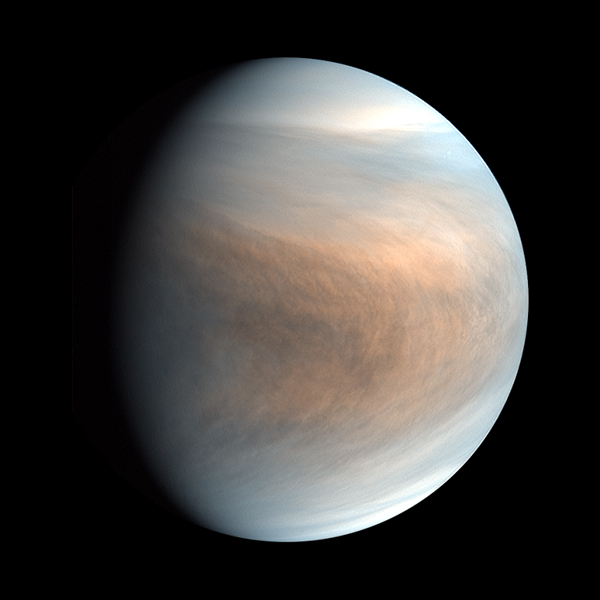
A false-color image of Venus that was taken by Japan's Akatsuki spacecraft.
JAXA / ISAS / Akatsuki Project Team

Thursday, May 15, 2025

A Japanese Solar Sail That Launched in 2010 Has Officially Ended Its Mission...

On June 15, 2010 (Japan Standard Time), a small separation camera was jettisoned from IKAROS to photograph the solar sail in its entirety.
JAXA

End of 15-Year Operation of the Small Scale Solar Powered Sail Demonstration Satellite, IKAROS (News Release)

The Japan Aerospace Exploration Agency (JAXA) will complete operations for the Small Scale Solar Powered Sail Demonstration Satellite, IKAROS (the Interplanetary Kite-craft Accelerated by Radiation Of the Sun) and end the spacecraft's search operations on May 15, 2025. After this date, JAXA will no longer track IKAROS and all operations will end.

IKAROS was launched on May 21, 2010, together with the Venus Climate Orbiter, Akatsuki. IKAROS became the first in the world to successfully demonstrate a solar sail and solar power sail. By December 2011, after achieving all mission goals, the propellant was close to depletion and attitude control was difficult.

IKAROS began to repeatedly enter and exit from hibernation mode (shutdown state).

In order to continue receiving radio signals from IKAROS after the spacecraft woke from hibernation, it was necessary to accurately predict the orbit and attitude movement of the solar sail during the hibernation mode. By searching for IKAROS after waking from hibernation, the validity of this motion model was able to be verified and the accuracy improved. Radio waves were successfully received from IKAROS until the fourth wake-up, but after the spacecraft entered hibernation for the fifth time in May 2015, no radio waves from IKAROS have been detected.

It has been determined that there is only an extremely small possibility of receiving radio signals from IKAROS in the future, and so it has been decided to end operations.

The development, launch and operation of IKAROS was made possible thanks to the support and cooperation of the many participating organizations, and the encouragement from around the world. We are deeply grateful.

Thank you very much.

The achievements of IKAROS will be inherited by a number of upcoming missions. In the area of solar sails, the development of the Powered Innovative Earth-orbiter with Reorientable Inclined Sail (PIERIS) is underway, which aims to demonstrate integrated attitude-orbit control of an ultra-small solar sail. Attitude control using solar pressure torque is currently being carried out or planned for the Extended Mission of the Hayabusa2 spacecraft, the next-generation of small body sample return missions, and other explorations in space.

For solar power sails, thin-film solar cell paddles are being developed for application to outer planetary explorers with the OPENS program, as well as other missions.

Although the operation of IKAROS has ended, our mission through the inherited results of the IKAROS spacecraft, is by no means at an end. We believe that the best way to return the support we have received is the continued development of solar sails and solar power sails. We want to thank everyone once again, and we look forward to your support in the future.

Source: Japan Aerospace Exploration Agency

****

Images showing the aluminum plates bearing the names of 63,248 space enthusiasts...that were installed aboard the IKAROS solar sail on April 6, 2010 (Japan Standard Time).
JAXA

The IKAROS DVD after it was attached to the spacecraft on April 24, 2010 (Japan Standard Time).
JAXA / The Planetary Society (U.S.)

My certificate for the IKAROS solar sail mission.

Thursday, December 05, 2024

Interstellar Probe: The Dream Is Lost (Again)...

An artist's concept of the proposed Interstellar Probe.

Earlier today, the National Academies of Sciences, Engineering and Medicine (NASEM) released the long-awaited Solar and Space Physics Decadal Survey...a report that recommended to NASA what type of heliophysics-centric mission the agency should undertake over the next 10 years.

The decadal survey proposed that NASA conduct two flagship-class missions: Links, a satellite constellation that consisted of over two dozen spacecraft flying in different orbits to study Earth's magnetosphere, and the Solar Polar Orbiter—a mission that would see a robotic probe orbiting the Sun's polar regions to observe them from above.

What the decadal survey didn't recommend was an ambitious mission that I've been enthusiastically posting about since early 2021: the Interstellar Probe (IP).

Just like what happened when the Trident Neptune-Triton flyby mission was rejected by NASA in early 2021 in favor of two Venus-bound spacecraft, I'm absolutely disappointed that the Interstellar Probe will not see the light of day. At least within the next decade or so, and in the type of mission profile that the Johns Hopkins University Applied Physics Laboratory—who NASA paid $4 million to study the feasibility of this project and would've built the IP spacecraft itself—proposed in its Mission Concept Report three years ago.

If you've been reading this Blog since at least September of 2005 (stop smirking), you'll know just how eager I am to see NASA develop another Pioneer/Voyager/New Horizons-type mission that will fly to the outer Solar System and beyond. Obviously, I was very excited to see what kind of scientific discoveries IP would make during a 15-year journey to interstellar space (on a mission that was designed to last up to 50 years), but it was the dream of putting my name on the spacecraft in a potential public outreach campaign (like what was done with New Horizons back in 2005—when over 430,000 people submitted their names online to be flown on a compact disc aboard the Pluto-bound explorer) that enthralled me about this endeavor.

I got to send a message via radio signal to the exoplanet Gliese 581d courtesy of the Hello From Earth campaign in 2009, but to have my name on an actual spacecraft and not in an energy wave traveling through the Milky Way galaxy some day was obviously a more wondrous scenario.

What makes me especially annoyed about this new decadal survey is that the Solar Polar Orbiter is basically a rehash of the NASA and European Space Agency's Ulysses mission which launched in 1990 and studied the Sun till 2008. Unlike Ulysses, however, the Solar Polar Orbiter would be equipped with cameras to photograph the northern and southern regions of our host star.

Big whoop. What's that compared to potentially capturing an image of our entire Solar System from beyond the heliosphere courtesy of the Interstellar Probe?

Seeing as how NASEM wanted NASA to focus on the near-Earth space environment and how solar activity affected it, it's clearly obvious that the decadal survey was influenced by this year's geomagnetic storms that caused auroras to be visible around much of the globe. This is similar to how the 2020 discovery of phosphine in Venus' atmosphere ultimately caused Trident to be rejected in favor of the VERITAS and DAVINCI missions...which NASA doesn't even care to launch to the Evening Star till sometime next decade.

(Trident would've lifted off for Neptune either next year or 2026 had NASA approved it as its next Discovery-class mission.)

Well... It's clearly obvious that the Universe doesn't really want me to put my moniker on a New Horizons-type spacecraft anytime soon. I guess I'll just have to stick with submitting my name to fly on missions within our Solar System instead.

But one thing is certain: I can have a virtual presence on over a hundred spacecraft venturing to destinations as close as Venus (courtesy of Akatsuki) and worlds as distant as Saturn (through Cassini) in our Solar System, and these missions will never make up for me missing out on New Horizons...or having the dream opportunity that is the Interstellar Probe taken from me and everyone else who are enamored by the idea of having their name attached to a manmade object drifting through the cosmos.

Happy Thursday.

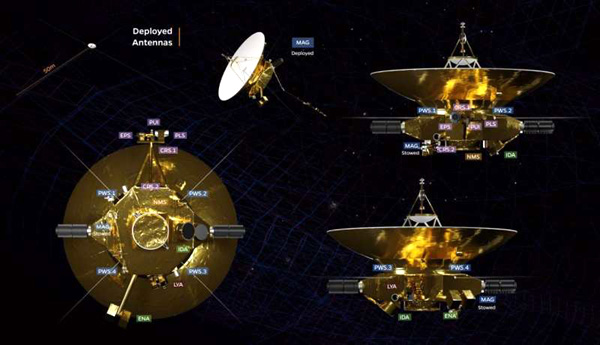
An infographic showing the various science instruments that would've flown on the proposed Interstellar Probe spacecraft.
Johns Hopkins University Applied Physics Laboratory

A video screenshot showing the Interstellar Probe departing from the Sun's heliosphere.
Johns Hopkins University Applied Physics Laboratory


Wednesday, May 29, 2024

Japan's Venus Mission May Soon Be At An End...

An artist's concept of Japan's Akatsuki spacecraft orbiting Venus.
JAXA

Communication Status with the Venus Climate Orbiter, Akatsuki (News Release)

The Japan Aerospace Exploration Agency (JAXA) launched the Venus Climate Orbiter, Akatsuki, in 2010, and the spacecraft entered Venus orbit in 2015. Akatsuki has now been in operation for 14 years, and has achieved high scientific results.

Akatsuki completed regular operations after the project completion review in 2018, and has since been conducting observations as part of the late-stage operations. However, during operations at the end of April 2024, a control mode in which the attitude maintenance accuracy was not high continued for a prolonged period, leading to communication being unable to be established.

Various measures have been taken to restore communication, but this has not been successful so far. The teams are continuing to work on restoration operations to re-establish communication.

We are considering future measures, taking into consideration that Akatsuki is now in the late-stage operation phase, having exceeded the design lifespan of 4.5 years after launch. We will share information as soon as JAXA's policy has been decided.

Source: Japan Aerospace Exploration Agency

****

A false-color image of Venus that was taken by Japan's Akatsuki spacecraft.
JAXA / ISAS / Akatsuki Project Team

Wednesday, February 09, 2022

SOLAR PROBE PLUS Update: Parker Photographs Venus in Never-Before-Seen Detail...

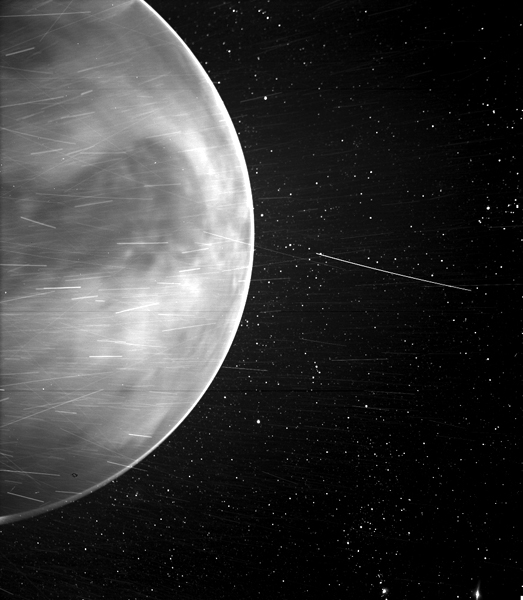
The left image of Venus was taken by the WISPR instrument aboard NASA's Parker Solar Probe, while the right image was taken by NASA's Magellan spacecraft...which orbited Venus from August of 1990 to October of 1994, respectively.
NASA / APL / NRL / Magellan Team / JPL / USGS

Parker Solar Probe Captures its First Images of Venus' Surface in Visible Light, Confirmed (News Release)

NASA’s Parker Solar Probe has taken its first visible-light images of the surface of Venus from space.

Smothered in thick clouds, Venus’ surface is usually shrouded from sight. But in two recent flybys of the planet, Parker used its Wide-Field Imager, or WISPR, to image the entire nightside in wavelengths of the visible spectrum – the type of light that the human eye can see – and extending into the near-infrared.

The images, combined into a video, reveal a faint glow from the surface that shows distinctive features like continental regions, plains, and plateaus. A luminescent halo of oxygen in the atmosphere can also be seen surrounding the planet.

“We’re thrilled with the science insights Parker Solar Probe has provided thus far,” said Nicola Fox, division director for the Heliophysics Division at NASA Headquarters. “Parker continues to outperform our expectations, and we are excited that these novel observations taken during our gravity-assist maneuver can help advance Venus research in unexpected ways.”

Such images of the planet, often called Earth’s twin, can help scientists learn more about Venus’ surface geology, what minerals might be present there, and the planet’s evolution. Given the similarities between the planets, this information can help scientists on the quest to understand why Venus became inhospitable and Earth became an oasis.

“Venus is the third brightest thing in the sky, but until recently we have not had much information on what the surface looked like because our view of it is blocked by a thick atmosphere,” said Brian Wood, lead author on the new study and physicist at the Naval Research Laboratory in Washington, DC. “Now, we finally are seeing the surface in visible wavelengths for the first time from space.”

Unexpected Capabilities

The first WISPR images of Venus were taken in July 2020 as Parker embarked on its third flyby, which the spacecraft uses to bend its orbit closer to the Sun. WISPR was designed to see faint features in the solar atmosphere and wind, and some scientists thought they might be able to use WISPR to image the cloud tops veiling Venus as Parker passed the planet.

“The objective was to measure the speed of the clouds,” said WISPR project scientist Angelos Vourlidas, co-author on the new paper and researcher at Johns Hopkins University Applied Physics Laboratory.

But instead of just seeing clouds, WISPR also saw through to the surface of the planet. The images were so striking that the scientists turned on the cameras again during the fourth pass in February 2021. During the 2021 flyby, the spacecraft’s orbit lined up perfectly for WISPR to image Venus’ nightside in entirety.

“The images and video just blew me away,” Wood said.

Glowing like an Iron from the Forge

Clouds obstruct most of the visible light coming from Venus’ surface, but the very-longest visible wavelengths, which border the near-infrared wavelengths, make it through. On the dayside, this red light gets lost amid the bright sunshine reflected off Venus’ cloud tops, but in the darkness of night, the WISPR cameras were able to pick up this faint glow caused by the incredible heat emanating from the surface.

“The surface of Venus, even on the nightside, is about 860 degrees,” Wood said. “It's so hot that the rocky surface of Venus is visibly glowing, like a piece of iron pulled from a forge.”

As it passed by Venus, WISPR picked up a range of wavelengths from 470 nanometers to 800 nanometers. Some of that light is in the near-infrared – wavelengths that we cannot see, but sense as heat – and some is in the visible range, between 380 nanometers and about 750 nanometers.

Venus in a New Light

In 1975, the Venera 9 lander sent the first tantalizing glimpses of the surface after landing on Venus. Since then, Venus’ surface has been revealed further with radar and infrared instruments, which can peer through the thick clouds by using wavelengths of light invisible to the human eye. NASA’s Magellan mission created the first maps in the 1990s using radar and JAXA’s Akatsuki spacecraft gathered infrared images after reaching orbit around Venus in 2015. The new images from Parker add to these findings by extending the observations to red wavelengths at the edge of what we can see.

The WISPR images show features on the Venusian surface, such as the continental region Aphrodite Terra, the Tellus Regio plateau, and the Aino Planitia plains. Since higher-altitude regions are about 85 degrees Fahrenheit cooler than lower areas, they show up as dark patches amidst the brighter lowlands. These features can also be seen in previous radar images, such as those taken by Magellan.

Beyond looking at surface features, the new WISPR images will help scientists better understand the geology and mineral make-up of Venus. When heated, materials glow at unique wavelengths. By combining the new images with previous ones, scientists now have a wider range of wavelengths to study, which can help identify what minerals are on the surface of the planet. Such techniques have previously been used to study the surface of the Moon. Future missions will continue to expand this range of wavelengths, which will contribute to our understanding of habitable planets.

This information could also help scientists understand the planet’s evolution. While Venus, Earth, and Mars all formed around the same time, they are very different today. The atmosphere on Mars is a fraction of Earth’s while Venus has a much thicker atmosphere. Scientists suspect volcanism played a role in creating the dense Venusian atmosphere, but more data are needed to know how. The new WISPR images might provide clues about how volcanos may have affected the planet’s atmosphere.

In addition to the surface glow, the new images show a bright ring around the edge of the planet caused by oxygen atoms emitting light in the atmosphere. Called airglow, this type of light is also present in Earth’s atmosphere, where it’s visible from space and sometimes from the ground at night.

Flyby Science

While Parker Solar Probe’s primary goal is solar science, the Venusian flybys are providing exciting opportunities for bonus data that wasn’t expected at the mission’s launch.

WISPR has also imaged Venus’ orbital dust ring – a doughnut-shaped track of microscopic particles strewn in the wake of Venus’ orbit around the Sun – and the FIELDS instrument made direct measurements of radio waves in the Venusian atmosphere, helping scientists understand how the upper atmosphere changes during the Sun’s 11-year cycle of activity.

In December 2021, researchers published new findings about the rediscovery of the comet-like tail of plasma streaming out behind Venus, called a “tail ray”. The new results showed this tail of particles extending nearly 5,000 miles out from the Venusian atmosphere. This tail could be how Venus’ water escaped from the planet, contributing to its current dry and inhospitable environment.

While the geometry of the next two flybys likely won’t allow Parker to image the nightside, scientists will continue to use Parker’s other instruments to study Venus’ space environment. In November 2024, the spacecraft will have a final chance to image the surface on its seventh and final flyby.

Source: NASA.Gov

****

Wednesday, February 24, 2021

SOLAR PROBE PLUS Update: Parker Catches a Close-up Glimpse of the Evening Star...

An image of Venus that was taken by the WISPR instrument aboard NASA's Parker Solar Probe...on July 11, 2020.
NASA / Johns Hopkins APL / Naval Research Laboratory / Guillermo Stenborg and Brendan Gallagher

Parker Solar Probe Offers Stunning View of Venus (News Release)

NASA’s Parker Solar Probe captured stunning views of Venus during its close flyby of the planet in July 2020.

Though Parker Solar Probe’s focus is the Sun, Venus plays a critical role in the mission: The spacecraft whips by Venus a total of seven times over the course of its seven-year mission, using the planet’s gravity to bend the spacecraft’s orbit. These Venus gravity assists allow Parker Solar Probe to fly closer and closer to the Sun on its mission to study the dynamics of the solar wind close to its source.

But — along with the orbital dynamics — these passes can also yield some unique and even unexpected views of the inner solar system. During the mission’s third Venus gravity assist on July 11, 2020, the onboard Wide-field Imager for Parker Solar Probe, or WISPR, captured a striking image of the planet’s nightside from 7,693 miles away.

WISPR is designed to take images of the solar corona and inner heliosphere in visible light, as well as images of the solar wind and its structures as they approach and fly by the spacecraft. At Venus, the camera detected a bright rim around the edge of the planet that may be nightglow — light emitted by oxygen atoms high in the atmosphere that recombine into molecules in the nightside. The prominent dark feature in the center of the image is Aphrodite Terra, the largest highland region on the Venusian surface. The feature appears dark because of its lower temperature, about 85 degrees Fahrenheit (30 degrees Celsius) cooler than its surroundings.

That aspect of the image took the team by surprise, said Angelos Vourlidas, the WISPR project scientist from the Johns Hopkins Applied Physics Laboratory (APL) in Laurel, Maryland, who coordinated a WISPR imaging campaign with Japan’s Venus-orbiting Akatsuki mission. “WISPR is tailored and tested for visible light observations. We expected to see clouds, but the camera peered right through to the surface.”

“WISPR effectively captured the thermal emission of the Venusian surface,” said Brian Wood, an astrophysicist and WISPR team member from the U.S. Naval Research Laboratory in Washington, D.C. “It’s very similar to images acquired by the Akatsuki spacecraft at near-infrared wavelengths.”

This surprising observation sent the WISPR team back to the lab to measure the instrument’s sensitivity to infrared light. If WISPR can indeed pick up near-infrared wavelengths of light, the unforeseen capability would provide new opportunities to study dust around the Sun and in the inner solar system. If it can’t pick up extra infrared wavelengths, then these images — showing signatures of features on Venus’ surface — may have revealed a previously unknown “window” through the Venusian atmosphere.

“Either way,” Vourlidas said, “some exciting science opportunities await us.”

For more insight into the July 2020 images, the WISPR team planned a set of similar observations of the Venusian nightside during Parker Solar Probe’s latest Venus flyby on Feb. 20, 2021. Mission team scientists expect to receive and process that data for analysis by the end of April.

“We are really looking forward to these new images,” said Javier Peralta, a planetary scientist from the Akatsuki team, who first suggested a Parker Solar Probe campaign with Akatsuki, which has been orbiting Venus since 2015. “If WISPR can sense the thermal emission from the surface of Venus and nightglow — most likely from oxygen — at the limb of the planet, it can make valuable contributions to studies of the Venusian surface.”

Parker Solar Probe is part of NASA’s Living with a Star program to explore aspects of the Sun-Earth system that directly affect life and society. The Living with a Star program is managed by the agency’s Goddard Space Flight Center in Greenbelt, Maryland, for NASA’s Science Mission Directorate in Washington. Johns Hopkins APL designed, built and operates the spacecraft.

Source: NASA.Gov

Monday, September 14, 2020

Microbial Life in the Venusian Cloud Tops? Yes, Please!

A false-color image of Venus that was taken by Japan's Akatsuki spacecraft.
JAXA / ISAS / Akatsuki Project Team

What a way to start a Monday! Even though life hasn't been confirmed by astronomers in regards to this amazing discovery, it definitely puts Venus at the forefront of space exploration in terms of seeing if the search for life should've also focused on the Morning/Evening Star all along. NASA is planning to select two Discovery-class interplanetary missions next year... Along with the Trident robotic probe that would do a flyby of Neptune's moon Triton early next decade, I'm also rooting for the VERITAS or DAVINCI+ mission—both designed to explore Venus—to be chosen by the U.S. space agency as well! 2021 can't arrive soon enough.

****

Hints of life on Venus (Press Release)

An international team of astronomers, led by Professor Jane Greaves of Cardiff University, today announced the discovery of a rare molecule – phosphine – in the clouds of Venus. On Earth, this gas is only made industrially, or by microbes that thrive in oxygen-free environments.

Astronomers have speculated for decades that high clouds on Venus could offer a home for microbes – floating free of the scorching surface, but still needing to tolerate very high acidity. The detection of phosphine molecules, which consist of hydrogen and phosphorus, could point to this extra-terrestrial ‘aerial’ life. The new discovery is described in a paper in Nature Astronomy.

The team first used the James Clerk Maxwell Telescope (JCMT) in Hawaii to detect the phosphine, and were then awarded time to follow up their discovery with 45 telescopes of the Atacama Large Millimeter/submillimeter Array (ALMA) in Chile. Both facilities observed Venus at a wavelength of about 1 millimetre, much longer than the human eye can see – only telescopes at high altitude can detect this wavelength effectively.

Professor Greaves says, “This was an experiment made out of pure curiosity, really – taking advantage of JCMT’s powerful technology, and thinking about future instruments. I thought we’d just be able to rule out extreme scenarios, like the clouds being stuffed full of organisms. When we got the first hints of phosphine in Venus’ spectrum, it was a shock!”

Naturally cautious about the initial findings, Greaves and her team were delighted to get three hours of time with the more sensitive ALMA observatory. Bad weather added a frustrating delay, but after six months of data processing, the discovery was confirmed.

Team member Dr Anita Richards, of the UK ALMA Regional Centre and the University of Manchester, adds: “To our great relief, the conditions were good at ALMA for follow-up observations while Venus was at a suitable angle to Earth. Processing the data was tricky, though, as ALMA isn’t usually looking for very subtle effects in very bright objects like Venus.”

Greaves adds: “In the end, we found that both observatories had seen the same thing – faint absorption at the right wavelength to be phosphine gas, where the molecules are backlit by the warmer clouds below.”

Professor Hideo Sagawa of Kyoto Sangyo University then used his models for the Venusian atmosphere to interpret the data, finding that phosphine is present but scarce – only about twenty molecules in every billion.

The astronomers then ran calculations to see if the phosphine could come from natural processes on Venus. They caution that some information is lacking – in fact, the only other study of phosphorus on Venus came from one lander experiment, carried by the Soviet Vega 2 mission in 1985.

Massachusetts Institute of Technology scientist Dr William Bains led the work on assessing natural ways to make phosphine. Some ideas included sunlight, minerals blown upwards from the surface, volcanoes, or lightning, but none of these could make anywhere near enough of it. Natural sources were found to make at most one ten thousandth of the amount of phosphine that the telescopes saw.

To create the observed quantity of phosphine on Venus, terrestrial organisms would only need to work at about 10% of their maximum productivity, according to calculations by Dr Paul Rimmer of Cambridge University. Any microbes on Venus will likely be very different to their Earth cousins though, to survive in hyper-acidic conditions.

Earth bacteria can absorb phosphate minerals, add hydrogen, and ultimately expel phosphine gas. It costs them energy to do this, so why they do it is not clear. The phosphine could be just a waste product, but other scientists have suggested purposes like warding off rival bacteria.

Another MIT team-member, Dr Clara Sousa Silva, was also thinking about searching for phosphine as a ‘biosignature’ gas of non-oxygen-using life on planets around other stars, because normal chemistry makes so little of it.

She comments: “Finding phosphine on Venus was an unexpected bonus! The discovery raises many questions, such as how any organisms could survive. On Earth, some microbes can cope with up to about 5% of acid in their environment – but the clouds of Venus are almost entirely made of acid.”

Other possible biosignatures in the Solar System may exist, like methane on Mars and water venting from the icy moons Europa and Enceladus. On Venus, it has been suggested that dark streaks where ultraviolet light is absorbed could come from colonies of microbes. The Akatsuki spacecraft, launched by the Japanese space agency JAXA, is currently mapping these dark streaks to understand more about this “unknown ultraviolet absorber”.

The team believes their discovery is significant because they can rule out many alternative ways to make phosphine, but they acknowledge that confirming the presence of “life” needs a lot more work. Although the high clouds of Venus have temperatures up to a pleasant 30 degrees centigrade, they are incredibly acidic – around 90% sulphuric acid – posing major issues for microbes to survive there. Professor Sara Seager and Dr Janusz Petkowski, also both at MIT, are investigating how microbes could shield themselves inside droplets.

The team are now eagerly awaiting more telescope time, for example to establish whether the phosphine is in a relatively temperate part of the clouds, and to look for other gases associated with life. New space missions could also travel to our neighbouring planet, and sample the clouds in situ to further search for signs of life.

Professor Emma Bunce, President of the Royal Astronomical Society, congratulated the team on their work:

“A key question in science is whether life exists beyond Earth, and the discovery by Professor Jane Greaves and her team is a key step forward in that quest. I’m particularly delighted to see UK scientists leading such an important breakthrough – something that makes a strong case for a return space mission to Venus.”

Science Minister Amanda Solloway said:

"Venus has for decades captured the imagination of scientists and astronomers across the world.”

“This discovery is immensely exciting, helping us increase our understanding of the universe and even whether there could be life on Venus. I am incredibly proud that this fascinating detection was led by some of the UK’s leading scientists and engineers using state of the art facilities built on our own soil.”

Source: Royal Astronomical Society

Thursday, January 10, 2019

Akatsuki Update: The Latest News from Earth's Twin...

FIGURE 1: Images of Venus' lower clouds as captured by the Akatsuki spacecraft's IR2 camera.
JAXA

Giant Pattern Discovered in the Clouds of Planet Venus (Press Release)

Infrared cameras and supercomputer simulations break through Venus' veil

A Japanese research group has identified a giant streak structure among the clouds covering planet Venus based on observation from the spacecraft Akatsuki. The team also revealed the origins of this structure using large-scale climate simulations. The group was led by Project Assistant Professor Hiroki Kashimura (Kobe University, Graduate School of Science) and these findings were published on January 9 in Nature Communications.

Venus is often called Earth’s twin because of their similar size and gravity, but the climate on Venus is very different. Venus rotates in the opposite direction to Earth, and a lot more slowly (about one rotation for 243 Earth days). Meanwhile, about 60 km above Venus’ surface a speedy east wind circles the planet in about 4 Earth days (at 360 km/h), a phenomenon known as atmospheric superrotation.

The sky of Venus is fully covered by thick clouds of sulfuric acid that are located at a height of 45-70 km, making it hard to observe the planet’s surface from Earth-based telescopes and orbiters circling Venus. Surface temperatures reach a scorching 460 degrees Celsius, a harsh environment for any observations by entry probes. Due to these conditions, there are still many unknowns regarding Venus’ atmospheric phenomena.

To solve the puzzle of Venus’ atmosphere, the Japanese spacecraft Akatsuki began its orbit of Venus in December 2015. One of the observational instruments of Akatsuki is an infrared camera “IR2” that measures wavelengths of 2 μm (0.002 mm). This camera can capture detailed cloud morphology of the lower cloud levels, about 50 km from the surface. Optical and ultraviolet rays are blocked by the upper cloud layers, but thanks to infrared technology, dynamic structures of the lower clouds are gradually being revealed.

Before the Akatsuki mission began, the research team developed a program called AFES-Venus for calculating simulations of Venus’ atmosphere. On Earth, atmospheric phenomena on every scale are researched and predicted using numerical simulations, from the daily weather forecast and typhoon reports to anticipated climate change arising from global warming. For Venus, the difficulty of observation makes numerical simulations even more important, but this same issue also makes it hard to confirm the accuracy of the simulations.

AFES-Venus had already succeeded in reproducing superrotational winds and polar temperature structures of the Venus atmosphere. Using the Earth Simulator, a supercomputer system provided by the Japan Agency for Marine-Earth Science and Technology (JAMSTEC), the research team created numerical simulations at a high spatial resolution. However, because of the low quality of observational data before Akatsuki, it was hard to prove whether these simulations were accurate reconstructions.

This study compared detailed observational data of the lower cloud levels of Venus taken by Akatsuki’s IR2 camera with the high-resolution simulations from the AFES-Venus program. The left part of Figure 1 (above) shows the lower cloud levels of Venus captured by the IR2 camera. Note the almost symmetrical giant streaks across the northern and southern hemispheres. Each streak is hundreds of kilometers wide and stretches diagonally almost 10,000 kilometers across. This pattern was revealed for the first time by the IR2 camera, and the team have named it a planetary-scale streak structure. This scale of streak structure has never been observed on Earth, and could be a phenomenon unique to Venus. Using the AFES-Venus high-resolution simulations, the team reconstructed the pattern (Figure 1 right-hand side). The similarity between this structure and the camera observations prove the accuracy of the AFES-Venus simulations.

Next, through detailed analyses of the AFES-Venus simulation results, the team revealed the origin of this giant streak structure. The key to this structure is a phenomenon closely connected to Earth’s everyday weather: polar jet streams. In mid and high latitudes of Earth, a large-scale dynamics of winds (baroclinic instability) forms extratropical cyclones, migratory high-pressure systems, and polar jet streams. The results of the simulations showed the same mechanism at work in the cloud layers of Venus, suggesting that jet streams may be formed at high latitudes. At lower latitudes, an atmospheric wave due to the distribution of large-scale flows and the planetary rotation effect (Rossby wave) generates large vortexes across the equator to latitudes of 60 degrees in both directions (figure 2, left). When jet streams are added to this phenomenon, the vortexes tilt and stretch, and the convergence zone between the north and south winds forms as a streak. The north-south wind that is pushed out by the convergence zone becomes a strong downward flow, resulting in the planetary-scale streak structure (figure 2, right). The Rossby wave also combines with a large atmospheric fluctuation located over the equator (equatorial Kelvin wave) in the lower cloud levels, preserving the symmetry between hemispheres.

This study revealed the giant streak structure on the planetary scale in the lower cloud levels of Venus, replicated this structure with simulations, and suggested that this streak structure is formed from two types of atmospheric fluctuations (waves), baroclinic instability and jet streams. The successful simulation of the planetary-scale streak structure formed from multiple atmospheric phenomena is evidence for the accuracy of the simulations for individual phenomena calculated in this process.

Until now, studies of Venus’ climate have mainly focused on average calculations from east to west. This finding has raised the study of Venus’ climate to a new level in which discussion of the detailed three-dimensional structure of Venus is possible. The next step, through collaboration with Akatsuki and AFES-Venus, is to solve the puzzle of the climate of Earth’s twin Venus, veiled in the thick cloud of sulfuric acid.

Source: Japan Aerospace Exploration Agency
****

FIGURE 2: Diagrams showing how jet streams travel in Venus' atmosphere.
JAXA

Saturday, October 20, 2018

BepiColombo Is Now Headed to the First Rock from the Sun!

A European Ariane 5 rocket carrying the Mercury-bound BepiColombo spacecraft launches from Guiana Space Centre in Kourou, French Guiana...on October 19, 2018 (Pacific Time).
2018 ESA - CNES - Arianespace

At 6:45 PM, Pacific Daylight Time (9:45 PM, Eastern Daylight Time) yesterday, a European Ariane 5 rocket blasted off from Guiana Space Centre in Kourou, French Guiana...sending the BepiColombo spacecraft on a 7-year journey to Mercury. A joint mission by the European Space Agency (ESA) and the Japan Aerospace Exploration Agency (JAXA), BepiColombo will arrive at the planet in early December of 2025...but not before conducting six flybys of Mercury along the way. Comprising BepiColombo are three components: the Mercury Transfer Module (which will propel BepiColombo on its 7-year trip via four ion thrusters), ESA's Mercury Planetary Orbiter (MPO) and JAXA's Mercury Magnetospheric Orbiter (a.k.a. the MIO satellite). It is upon arrival at Mercury around December 5, 2025, that MIO will separate from MPO to enter its own orbit around the desolate world. The BepiColombo mission will last through May 1, 2027—and possibly through May 1, 2028 if it's granted an extended mission.

A snapshot of one of the Mercury Transfer Module's (MTM) twin solar arrays...taken by a camera aboard MTM on October 19, 2018 (Pacific Time).
ESA / BepiColombo / MTM – CC BY-SA 3.0 IGO

Aboard the MIO satellite is a memory card bearing the names and messages of 6,494 people (including one by me), which were submitted online earlier this year. Just as an FYI, Japan allowed folks to send their names and messages to the Moon via the Kaguya orbiter in 2007, and it allowed folks to fly their names and messages to Venus via the IKAROS solar sail in 2010, and the Akatsuki spacecraft in 2015. So Japan is responsible for sending folks like me on a virtual journey to three planetary bodies in our solar system [my name is at Mars courtesy of NASA's Phoenix, Curiosity and MAVEN spacecraft (and the InSight lander next month, hopefully)]! Thanks JAXA. And Godspeed on your voyage, Bepi! Happy Saturday.

My name and message, plus those of 6,493 others, are on a memory card that was placed aboard Japan's MIO satellite that's riding on the BepiColombo spacecraft to Mercury.

A JAXA technician displays the memory card that holds the names and messages of 6,494 people that is flying aboard Japan's MIO satellite to Mercury.
JAXA

A red circle denotes the location of the memory card after it was attached to JAXA's MIO satellite that is now headed to Mercury.
JAXA

A red circle denotes the location of the memory card after it is covered by thermal insulation on JAXA's MIO satellite that is now headed to Mercury.
JAXA

Tuesday, May 24, 2016

Akatsuki Makes a Movie of Venus...

An animated GIF showing Venus' atmosphere as taken in the infrared by the Akatsuki spacecraft...on March 29, 2016 (Japan Standard Time).
JAXA

A Movie of the Venus' Night-Side Produced by IR2 (Press Release - May 23)

This movie is produced from the IR2 2.26-μm images, acquired on 29 March 2016 at a distance of 0.36 million km. Original 4 images were acquired with 4-hour intervals from 16:03 JST (07:03 UT).

In 4 hours, the super-rotating clouds move by ~10 degrees. Such images are numerically derotated to produce intermediate images so that the resultant motion becomes smoother. Deformation, appearance and disappearance of clouds are obvious in this movie. As the mission enters the "nominal" observing phase, we plan to shorten the intervals to 2 hours or even shorter so the high-definition movies will definitely help understanding of the Venus atmosphere.

Source: Japan Aerospace Exploration Agency

Saturday, April 30, 2016

Akatsuki Officially Begins Regular Science Operations!

An image of Venus that was taken by Akatsuki using the spacecraft's Longwave IR camera on March 25, 2016 (Japan Standard Time).
JAXA

Akatsuki Onboard Instruments to Move to Regular Operation‏ (Press Release - April 28)

JAXA decided to shift the operation mode of the five onboard instruments of Akatsuki to the regular operation mode, namely 1μm camera (IR1), 2μm camera (IR2), Longwave IR camera (LIR), Ultraviolet image (UVI), and Ultra-stable Oscillator (USO).

Lightning and airglow camera (LAC) continues to be in the preparation mode for its conditions to be carefully coordinated.

[Message from Project Manager Masato Nakamura]
Thanks to your support, we were able to move the four cameras and the Ultra-sable Oscillator to regular operations. Thank you very much. We continuously acquire data for the world’s leading Venus research while we are aiming at early regular operation of the LAC. Please look forward to the operation and data acquisition of the Venus climate orbiter Akatsuki.

Image (Above): Night side of Venus taken by the IR2.
The night side image shows the whole of Venus, and the image captured the most detailed Venus state. We will closely and precisely study the 3D structure and movement of the Venus atmosphere by combining data of different wavelengths from other cameras.

Source: Japan Aerospace Exploration Agency

Friday, April 01, 2016

Akatsuki To Begin Regular Science Operations This Month...

An image of Venus that was taken by Akatsuki using the spacecraft's Longwave IR camera on December 7, 2015 (Japan Standard Time).
ISAS / JAXA

Akatsuki Regular Observation to Begin in mid-April‏ (Press Release)

Akatsuki has been performing test observations by turning on its onboard observation instruments one by one. The instruments are starting up normally, and we have already conducted successful observations that are equivalent to a “minimum success” (*), thus we will move to regular operations in mid-April.

* Minimum success: The minimum goal for achieving a mission. For Akatsuki, the minimum success is to capture Venus’s all-globe cloud structure by continuously acquiring image data (for every few hours) using some of its onboard cameras from Venus orbit.

Source: Japan Aerospace Exploration Agency

Wednesday, December 09, 2015

It's Official: Akatsuki Is Safely Orbiting Venus!

An image of Venus that was taken by Akatsuki using the spacecraft's ultraviolet camera on December 6, 2015 (Pacific Time)...from a distance of 73,000 km (45,000 miles).
JAXA

Venus Climate Orbiter Akatsuki Inserted Into Venus' Orbit‏ (Press Release)

The Japan Aerospace Exploration Agency (JAXA) successfully inserted the Venus Climate Orbiter Akatsuki into the orbit circling around Venus.

As a result of measuring and calculating the Akatsuki’s orbit after its thrust ejection, the orbiter is now flying on the elliptical orbit at the apoapsis altitude of about 400 km (249 miles) and periapsis altitude of about 440,000 km (273,462 miles) from Venus. The orbit period is 13 days and 14 hours. We also found that the orbiter is flying in the same direction as that of Venus’s rotation.

The Akatsuki is in good health.

We will deploy the three scientific mission instruments namely the 2μm camera (IR2), the Lightning and Airglow Camera (LAC) and the Ultra-Stable oscillator (USO) and check their functions. JAXA will then perform initial observations with the above three instruments along with the three other instruments whose function has already been confirmed, the Ultraviolet Imager (UVI), the Longwave IR camera (LIR), and the 1μm camera (IR1) for about three months. At the same time, JAXA will also gradually adjust the orbit for shifting its elliptical orbit to the period of about nine days. The regular operation is scheduled to start in April, 2016.

Orbit calculation result (as of Dec. 9):

Periapsis altitude: About 400 km (249 miles)

Apoasis altitude: About 440,000 km (273,462 miles)

Inclination: About 3 degrees against Venus’ revolution plane

Period: About 13 days and 14 hours

Source: Japan Aerospace Exploration Agency

****

An image of Venus that was taken by Akatsuki using the spacecraft's one-micron infrared camera on December 6, 2015 (Pacific Time)...from a distance of 68,000 kilometers (42,000 miles).
JAXA

Sunday, December 06, 2015

(It Took 5 Extra Years, But...) Welcome To Venus, Akatsuki!

An artist's concept of the Akatsuki spacecraft firing its thrusters as it enters orbit around Venus.
Go Miyazaki

Venus Climate Orbiter Akatsuki: Result of Attitude Control Engine Thrust Operation for Venus Orbit Insertion (Press Release)

The Japan Aerospace Exploration Agency (JAXA) performed the attitude control engine thrust operation of the Venus Climate Orbiter Akatsuki for its Venus orbit insertion from 8:51 a.m. on December 7 (Japan Standard Time).

As a result of analyzing data transmitted from the orbiter, we confirmed that the thrust emission of the attitude control engine was conducted for about 20 minutes as scheduled.

The orbiter is now in good health. We are currently measuring and calculating its orbit after the operation. It will take a few days to estimate the orbit, thus we will announce the operation result once it is determined.

Source: Japan Aerospace Exploration Agency

****

A screenshot from a simulation depicting the Akatsuki spacecraft entering orbit around Venus.
Real-time simulation courtesy of Lizard-Tail.com

Sunday, September 06, 2015

Oh, China— Just Keep Droppin' the Ball...

An image of China's Yutu rover that was taken by the country's Chang'e 3 lander after the joint spacecraft touched down on the Moon's surface on December 14, 2013.

Ten years ago this month, I posted this lengthy Blog entry highlighting my disappointment when I found out that I missed the opportunity to have my name on a DVD that was placed aboard NASA's New Horizons spacecraft. The disappointment was so great that not only did it bring back my obsession for space exploration in a big way (the last time I was a major space geek was back in 8th grade...21 years ago), but it motivated me to keep track of every future interplanetary missions that NASA and other government space agencies developed that would have the potential of allowing the public to place names on them. It was after losing my chance to fly past Pluto and into interstellar space aboard New Horizons that the Dawn asteroid mission started collecting monikers for its ion propulsion-powered orbiter (Dawn was briefly canceled by NASA due to technical reasons a few weeks later, in October of 2005—but was reinstated in March of 2006). In October of 2006, the Phoenix Mars mission started collecting names via the California-based space advocacy group, The Planetary Society, and a little over a month after that, Japan's space agency (the Japan Aerospace Exploration Agency, or JAXA) collected names to be place on its SELENE spacecraft (eventually renamed to Kaguya) that was destined for the Moon. These three robotic probes were launched in 2007 alone.

An artist's concept of NASA's New Horizons spacecraft traveling past the dwarf planet Pluto and its largest moon, Charon.
NASA / JHU APL / SwRI / Steve Gribben

Jump to 2015, and NASA and JAXA have given me the opportunity to have a virtual presence on more than a dozen missions. Not just Dawn, Phoenix and Kaguya (and Deep Impact, which NASA collected names for back in 2003...that intentionally got obliterated by a comet's nucleus in 2005), but the Lunar Reconnaissance Orbiter, Kepler space telescope, JAXA's Akatsuki Venus orbiter, IKAROS solar sail and asteroid-bound Hayabusa 2 spacecraft, the Curiosity Mars rover, the MAVEN Mars orbiter, the last three space shuttle missions (STS-133, STS-134 and STS-135) in 2011 and even Orion's first space voyage on Exploration Flight Test-1 last year. And next year, cross my fingers, my name plus hundreds of thousands of others will hopefully be soaring towards Mars and asteroid Bennu with NASA's InSight lander and the OSIRIS-REx sample return mission, respectively. Not bad... Not bad at all.

An artist's concept showing the Lunar Reconnaissance Orbiter above the Moon.
NASA

So what does this have to do with China, you ask? Well, not only is having my name aboard a spacecraft that will eventually leave our solar system on my wishlist (or to be blunt: bucket list), but I also think that it would be cool to have my name on the surface of the Moon (intact) as well. JAXA has been proposing a lunar lander (dubbed SELENE-2) that would be the follow-up to its successful Kaguya mission. However, this was back in 2008 (or 2009, I think) and SELENE-2 is nowhere near the assembly stage. It was originally scheduled to launch in 2013, then 2015, and then 2017, but now it's not slated to take flight till 2019 at the earliest. A U.S. lander that would touch down on the Moon's South Pole-Aitken basin was proposed through a competition by NASA's New Frontiers program, but it eventually lost out to the OSIRIS-REx mission that will head to asteroid Bennu in late 2016.

On June 15, 2010 (Japan Standard Time), a small 'separation camera' was jettisoned from IKAROS to photograph the solar sail in its entirety.
JAXA

So again—what does this have to do with China, you ask? Well— China's lunar rover, Yutu, launched and landed on the Moon in December of 2014...as part of the Chang'e 3 mission. Reading about Yutu online was exciting; it would've been more exciting, personally, if I knew that my name briefly strolled around the lunar surface aboard this rover. So now Chang'e 4 is in the planning stages, with another lander and rover slated to head back to the Moon by 2020. And after that, the Chang'e 5 mission...which would collect samples from the Moon's surface and return them to China next decade.

A cropped version of the Curiosity Mars rover's self-portrait, taken with a camera on her robotic arm in late January of 2015.
NASA / JPL - Caltech / MSSS

Admittedly, there's still enough time before Chang'e 4 launches that China could decide to follow in the footsteps of NASA, JAXA and the European Space Agency (which collected names for the Huygens lander that touched down on Saturn's moon Titan in 2005, courtesy of NASA's Cassini orbiter) and allow the public to take part in this mission by collecting names via the World Wide Web. Unfortunately, this is China... A Communist superpower that enjoys grabbing territory in the Pacific Ocean at the expense of its Asian neighbors (including the Philippines; I'm Filipino), improving its technological infrastructure by conducting industrial espionage on the United States, and of course, continuing to have an abysmal human-rights record. (And let's not ignore the recent news about Chinese naval ships milling about off the coast of Alaska.) I'm gonna come out and admit that my opinion for China, despite these negative qualities, would improve if Beijing at least allowed folks (not just its Chinese populace) to submit their monikers to fly on its next mission to the Moon's surface. China is, after all, a fledgling space-faring nation...and has the political will to conduct missions that NASA wants to do but otherwise can't due to those stupid things called budget cuts, continuing resolutions and sequestration.

The USS Anchorage approaches the Orion EFT-1 spacecraft in preparation for the capsule being towed back to the ship for securing aboard the vessel, on December 5, 2014.
NASA

So the gist of this entry: If I can't have my name on a New Horizons-type spacecraft that will venture towards interstellar space anytime soon, then I can at least have my name resting on the lunar surface the same way the first Yutu rover and Apollo hardware from 40-plus years ago still sit peacefully on the Moon's landscape. If JAXA follows through with SELENE 2 and launches it in 2019 (but not before collecting names for it a la Kaguya, Akatsuki, IKAROS and Hayabusa 2), then all is good with Chang'e 4. If not, then I hope China will one day open a webpage that allows Chinese and non-Chinese folks alike to submit their names to be placed aboard Yutu's successor. The same way that NASA is currently collecting names to be placed aboard NASA's InSight lander. The deadline is this Tuesday, September 8, by the way.

That is all. Again, Happy Labor Day weekend to my fellow Yanks!

An image of China's Chang'e 3 lander that was taken by the country's Yutu rover after the joint spacecraft touched down on the Moon's surface on December 14, 2013.

Saturday, August 08, 2015

Akatsuki Update: Less Than Four Months from (Another) Venus Arrival...

An artist's concept of the Akatsuki spacecraft orbiting Venus.
JAXA

Akatsuki: Orbit successfully controlled‏ (Press Release - August 5)

JAXA performed an orbit control maneuver for the Venus Climate Orbiter Akatsuki in late July in preparation for its re-injection into the Venus orbit scheduled for December 7, 2015. According to the analysis of telemetry data acquired up to August 2, the orbit control and correction was successfully conducted as scheduled by 5:30 PM on August 4. (All dates and time are Japan Standard Time.)

Source: Japan Aerospace Exploration Agency

Friday, February 06, 2015

Akatsuki Update: Trying One More Time to Set Sail Around Venus...

An artist's concept of the Akatsuki spacecraft orbiting Venus.
JAXA

Venus Climate Orbiter Akatsuki Re-injection to Venus Orbit and Observation Plan‏ (Press Release)

The Japan Aerospace Exploration Agency has decided the schedule for the Venus Climate Orbiter Akatsuki to be injected into the Venus orbit in the winter of 2015, as well as its observation plan.

After failing to be inserted into the Venus orbit in December 2010, JAXA has been carefully studying another attempt opportunity for the injection when the orbiter meets Venus in the winter of 2015.

After being injected into the orbit, the Akatsuki will observe the atmosphere of Venus, which is often referred to as a twin sister of the Earth, through remote sensing. Its observations are expected to develop "Planetary Meteorology" further by elucidating the atmospheric circulation mechanism and studying the comparison with the Earth.

1. Injection schedule to Venus orbit

Planned date: Dec. 7 (Mon.), 2015 (Japan Standard Time)

2. Observation plan

The observation plan of the Akatsuki is to measure the following with a multiple number of wave lengths from an elliptical orbit around Venus whose period is eight to nine days.

(1) When flying further away from Venus, or about 10 times the radius of Venus from the planet, the Akatsuki will continuously observe Venus as a whole to understand its clouds, deep atmosphere, and surface conditions.

(2) When flying closer to Venus, or less than 10 times the radius of Venus, the orbiter will conduct close-up observations to clarify cloud convection, the distribution of minute undulatory motions and their changes.

(3) When the Akatsuki comes closest to Venus, it will observe the layer structure of clouds and the atmosphere from a lateral direction.

(4) When the orbiter is in the shade of the sun, it will monitor lightning and airglow (night glow.)

(5) The Akatsuki will also observe to capture the atmospheric layer structure and its changes by emitting radio waves that penetrates the atmosphere of Venus and receiving them on the ground.

Source: Japan Aerospace Exploration Agency

Wednesday, May 08, 2013

My Air & Space Wall of Fame...with the SoCal Sports Wall of Fame partially visible.

Photos of the Day... Check out my Air & Space Wall of Fame (which has actually been up since...2005)—which is right next to my SoCal Sports Wall of Fame...


A close-up of my Air & Space Wall of Fame.

Friday, March 04, 2011

A Taurus XL rocket carrying NASA's Glory spacecraft soars skyward after being launched from Vandenberg Air Force Base in California on March 4, 2011.
TitanFan - NASASpaceflight.com

IT WAS BOUND TO HAPPEN... After having my name successfully fly into space onboard the Cassini Saturn orbiter, Deep Impact’s "impactor", the Phoenix Mars Lander, Japan’s Kaguya lunar spacecraft, the Dawn space probe, the Kepler telescope, the Lunar Reconnaissance Orbiter, Japan’s IKAROS solar sail and the Akatsuki spacecraft (even though it failed to enter Venus’ orbit last December), it was inevitable that my name would fail to soar beyond Earth (again) onboard a future space mission. Turns out— Glory was that mission. Much like what happened during the launch of the Orbiting Carbon Observatory (OCO) in 2009, the payload fairing that encapsulated Glory onboard the Taurus XL rocket (which was also used by OCO) failed to separate during flight this morning, preventing the vehicle from gaining sufficient speed to reach Earth orbit...and causing another NASA climate-observing satellite to find its final resting spot at the bottom of the south Pacific Ocean. Awesome. A microchip bearing my name, along with that of 243,200 others, is now—to borrow a line from Godfather: Part 1—sleeping with the fishes. Oh well.

My participation certificate for the Glory mission.

This isn’t the first spacecraft with my name on it to end up underwater. My name was also onboard Russia’s Mars ’96 lander...which also plunged into the Pacific Ocean after experiencing a launch mishap 15 years ago. Spaceflight is definitely risky business. My apologies to the Glory mission team who has to suffer through this devastating setback and the Orbital Sciences team (who was responsible for the Taurus XL) who spent the last 2 years trying to fix the payload fairing issue. That is all.

An artist's concept of the Glory spacecraft in Earth orbit.
NASA

Thursday, December 09, 2010

TRANSFORMERS: DARK OF THE MOON.

TRANSFORMERS 3 Update... In case you’ve been noticing the pattern regarding my last couple of journal entries (and my Blog as a whole for the past 4 years); this month has been very significant in regards to space-related news. From the astrobiology-related discovery that microbes may potentially thrive on deadly arsenic, the successful return of the Orbital Test Vehicle to Earth and the disappointment over Akatsuki at Venus, to yesterday’s historic launch of SpaceX's Falcon 9 and the Dragon spacecraft, any space geek out there would have lots of things to talk about since the beginning of December. And now, space exploration finds itself as a major theme in next year’s summer blockbuster movie, Transformers: Dark of the Moon. It’s apparent in the teaser trailer (and obviously the title), which was released online yesterday and can be viewed below...


The new Dark of the Moon trailer should be shown at the theaters in front of The Chronicles of Narnia: The Voyage of the Dawn Treader this Friday and Tron: Legacy on December 17. So apparently, Neil Armstrong and Buzz Aldrin had 21 minutes during the Apollo 11 mission to explore a derelict spaceship on the lunar surface. Presumably, this spaceship is The Ark—the Autobots’ mothership in the comics and original 1980’s cartoon, as well as the rival vessel to the Decepticons’ Nemesis...which was seen in last year's Transformers: Revenge of the Fallen (during that scene where a resurrected Megatron flies out to an alien planet and reunites with Starscream and The Fallen). And the Transformer that we see at the very end of this trailer is rumored to be Alpha Trion. Even if it ain’t Trion, it sure as heck ain’t Shockwave, the main bad guy in Dark of the Moon. Hopefully, we’ll take our first glimpse of this evil one-eyed purple ‘bot in the next theatrical trailer...or at least on a TV spot during next February’s Super Bowl XLV. That’s not too much to ask for. That is all.

TRANSFORMERS: DARK OF THE MOON.