Thursday, May 14, 2020

Wacky Dream of the Week...

Last night, I had a messed-up dream where I punched the director of Road to Perdition (he looked nothing like Sam Mendes, who actually helmed the 2002 film) a few times in the face for acting rude to Jenna Fischer (who played Pam Beesly in NBC's The Office) at a film screening.

Fischer then complained to me that she got a ticket earlier because the cop thought she was eating an In-N-Out burger while driving. And she also got a flat tire. Happy Thursday!

Tuesday, May 12, 2020

Image of the Day: Perfecting Cell...

My drawing of 'Perfect Cell' from DRAGON BALL Z.

Happy Tuesday, everyone! Just thought I'd share this drawing that I completed today of Cell ("Perfect Cell" to be exact, as he had three variations during the show)...one of the coolest-looking villains in Dragon Ball Z (DBZ)! Much like how I finished that gladiator drawing a week ago to commemorate the 20th anniversary of Gladiator's theatrical release, I completed this latest artwork to recall that later this year will mark 20 years since Super Saiyan Gohan defeated Cell (the YouTube video clip of this is featured below) in the season finale of DBZ when it aired on the Cartoon Network. I was in the Fall Semester of my third year at Cal State Long Beach at the time.

Yup— There are so many other things about the year 2000 to be nostalgic about for me...most of them good, one of them eventually bad. I'll blog about these too if I'm in the mood, or if I have time. Hah! The 'Stay-At-Home' orders for Los Angeles County due to the coronavirus pandemic will be extended through July, so of course I'll have time! Um, knock on wood. Carry on.

Friday, May 08, 2020

THE BROKEN TABLE Is Now Available Online for Viewing!

The newest poster for THE BROKEN TABLE.

Happy Friday, everyone! Just thought I'd share the Vimeo version of my short film The Broken Table...which was officially released online last Tuesday! I've also created the new poster above and incorporated the release date on it. For those of you who take the time to view my project here, hope you like it! I'm proud of the amazing work that my cast and crew did on it during the 3-day production (on October 26, November 2 and 3) last year. Carry on!

Thursday, May 07, 2020

Mars 2020 Update: America's Next Rover Continues to Be Prepped for Flight...

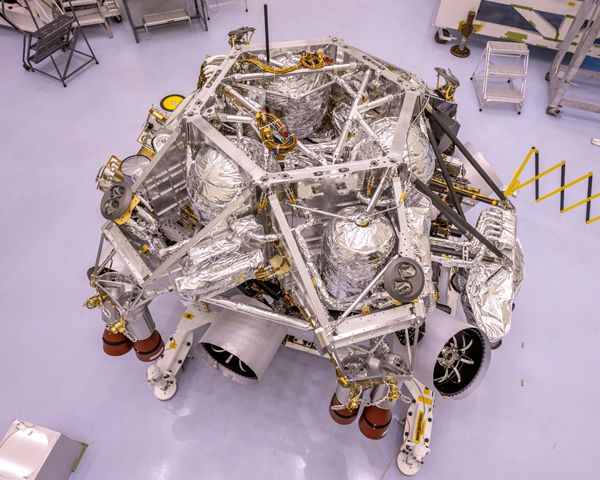
The Perseverance Mars rover is visible underneath its descent stage at NASA's Kennedy Space Center in Florida...on April 29, 2020.
NASA / JPL - Caltech

NASA's Perseverance Rover Spacecraft Put in Launch Configuration (News Release)

Stacking spacecraft components on top of each other is one of the final assembly steps before a mission launches to the Red Planet.

Engineers working on NASA's Perseverance rover mission at the Kennedy Space Center in Florida have begun the process of placing the Mars-bound rover and other spacecraft components into the configuration they'll be in as they ride on top of the United Launch Alliance Atlas V rocket. The launch period for the mission opens on July 17 - just 70 days from now.

Called "vehicle stacking," the process began on April 23 with the integration of the rover and its rocket-powered descent stage. One of the first steps in the daylong operation was to lift the descent stage onto Perseverance so that engineers could connect the two with flight-separation bolts.

When it's time for the rover to touch down on Mars, these three bolts will be released by small pyrotechnic charges, and the spacecraft will execute the sky crane maneuver: Nylon cords spool out through what are called bridle exit guides to lower the rover 25 feet (7.6 meters) below the descent stage. Once Perseverance senses it's on the surface, pyrotechnically-fired blades will sever the cords, and the descent stage flies off. The sky crane maneuver ensures Perseverance will land on the Martian surface free of any other spacecraft components, eliminating the need for a complex deployment procedure.

"Attaching the rover to the descent stage is a major milestone for the team because these are the first spacecraft components to come together for launch, and they will be the last to separate when we reach Mars," said David Gruel, the Perseverance rover assembly, test, and launch operations manager at NASA's Jet Propulsion Laboratory in Southern California, which manages rover operations. "These two assemblies will remain firmly nestled together until they are about 65 feet [20 meters] over the surface of Mars."

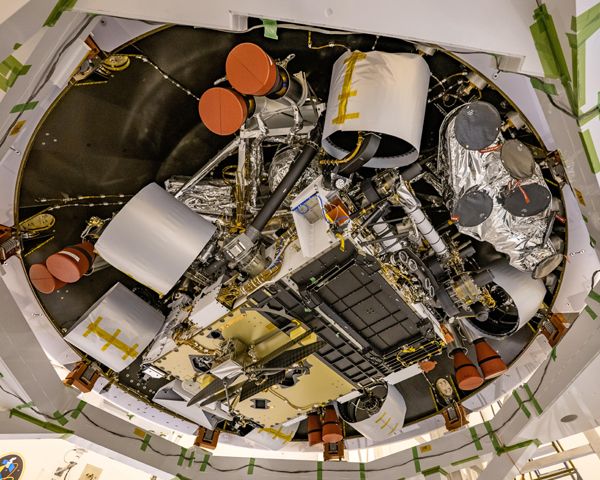
On April 29, the rover and descent stage were attached to the cone-shaped back shell, which contains the parachute and, along with the mission's heat shield, provides protection for the rover and descent stage during Martian atmospheric entry.

Whether they are working on final assembly of the vehicle at Kennedy Space Center, testing software and subsystems at JPL or (as the majority of the team is doing) teleworking due to coronavirus safety precautions, the Perseverance team remains on track to meet the opening of the rover's launch period. No matter what day Perseverance launches, it will land at Mars' Jezero Crater on Feb. 18, 2021.

The Perseverance rover's astrobiology mission will search for signs of ancient microbial life. It will also characterize the planet's climate and geology, collect samples for future return to Earth, and pave the way for human exploration of the Red Planet. The Perseverance rover mission is part of a larger program that includes missions to the Moon as a way to prepare for human exploration of the Red Planet. Charged with returning astronauts to the Moon by 2024, NASA will establish a sustained human presence on and around the Moon by 2028 through NASA's Artemis lunar exploration plans.

Source: Jet Propulsion Laboratory

****

The Ingenuity Mars helicopter is visible on the underside of the Perseverance rover...which, along with its descent stage, are now attached to their back shell at NASA's Kennedy Space Center in Florida.
NASA / JPL - Caltech

Wednesday, May 06, 2020

The U.S. Space Force's Spaceplane Is Set to Soar Once More...

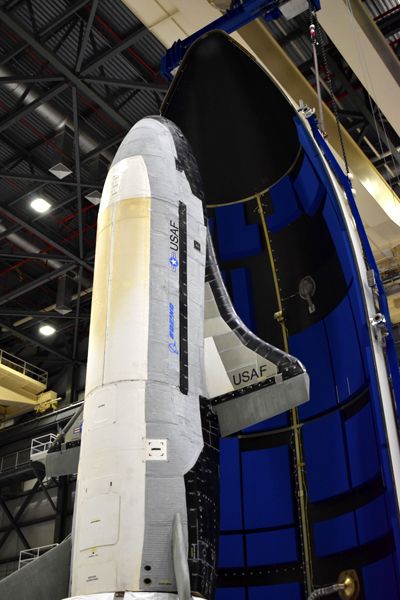
The X-37B Orbital Test Vehicle is about to be encapsulated by the payload fairing of the Atlas V rocket that will launch it into space on May 16, 2020.
Boeing

Next X-37B Orbital Test Vehicle Scheduled to Launch (Press Release)

WASHINGTON (AFNS) -- The Department of the Air Force Rapid Capabilities Office, in partnership with the U.S. Space Force, is scheduled to launch the sixth mission of the X-37B Orbital Test Vehicle (OTV-6) on May 16 from Cape Canaveral Air Force Station, Florida.

The Department of the Air Force continues to push the flight envelope for the X-37B, and will build upon its growing collaboration with experiment partners with its sixth mission.

“In today’s age of electrons, space systems track storms, locate stranded motorists, timestamp credit card transactions, and monitor treaty compliance,” said Secretary of the Air Force Barbara Barrett. “Demonstrating the department’s innovation, this X-37B mission will host more experiments than any prior missions. This launch also demonstrates the department’s collaboration that pushes the boundaries for reusable space systems.”

The ability to test new systems in space and return them to Earth is unique to the X-37B program and enables the U.S. to more efficiently and effectively develop space capabilities necessary to maintain superiority in the space domain.

"The X-37B team continues to exemplify the kind of lean, agile and forward-leaning technology development we need as a nation in the space domain," said U.S. Space Force Chief of Space Operations, Gen. John "Jay" Raymond. "Each launch represents a significant milestone and advancement in terms of how we build, test, and deploy space capabilities in a rapid and responsive manner."

The X-37B remains a Department of the Air Force asset; however, the U.S. Space Force is responsible for the launch, on-orbit operations, and landing.

"This launch is a prime example of integrated operations between the Air Force, Space Force, and government-industry partnerships," said Air Force Chief of Staff Gen. David Goldfein. "The X-37B continues to break barriers in advancing reusable space vehicle technologies and is a significant investment in advancing future space capabilities."

This will be the first X-37B mission to use a service module to host experiments. The service module is an attachment to the aft of the vehicle that allows additional experimental payload capability to be carried to orbit.

"This sixth mission is a big step for the X-37B program," said Mr. Randy Walden, Director and Program Executive Officer for the Department of the Air Force Rapid Capabilities Office. "This will be the first X-37B mission to use a service module to host experiments. The incorporation of a service module on this mission enables us to continue to expand the capabilities of the spacecraft and host more experiments than any of the previous missions."

The mission will deploy the FalconSat-8, a small satellite developed by the U.S. Air Force Academy and sponsored by the Air Force Research Laboratory to conduct several experiments on orbit. The FalconSat-8 is an educational platform that will carry five experimental payloads for USAFA to operate. In addition, two National Aeronautics and Space Administration experiments will be included to study the results of radiation and other space effects on a materials sample plate and seeds used to grow food. Finally, the U.S. Naval Research Laboratory, will transform solar power into radio frequency microwave energy which could then be transmitted to the ground.

"We are excited to return the X-37B to space and conduct numerous on-orbit experiments for both the Air Force and its mission partners," said Lt. Col. Jonathan Keen, the X-37B program manager.

The X-37B program completed its fifth mission in October 2019, landing after 780 days on orbit, extending the total number of days spent on orbit for the spacecraft to 2,865 - or seven years and 10 months.

Source: United States Space Force

****

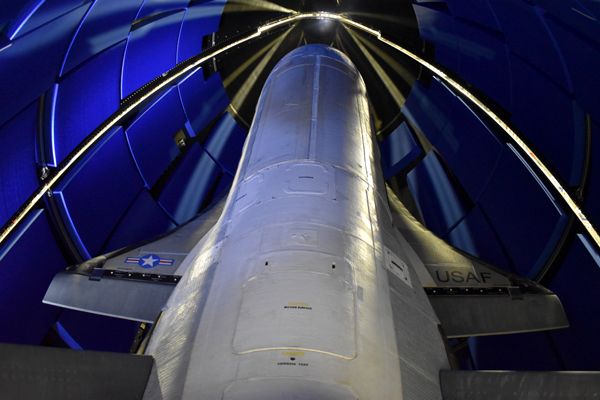
The X-37B Orbital Test Vehicle is about to be encapsulated by the payload fairing of the Atlas V rocket that will launch it into space on May 16, 2020.
Boeing

Tuesday, May 05, 2020

Remembering GLADIATOR Two Decades Later...

Maximus Decimus Meridius (Russell Crowe) and other slaves prepare to re-enact the Battle of Carthage inside the Colosseum...in the Ridley Scott-directed epic GLADIATOR.

20 years ago today, I went to the AMC 20 theater inside Puente Hills Mall to watch Gladiator for the first time. Needless to say, the Ridley Scott-directed Roman epic starring Russell Crowe, Joaquin Phoenix and Connie Nielsen was my favorite movie of 2000...and now one of my favorite flicks of all time. Along with the amazing action sequences—ranging from the opening battle in Germania and the re-enactment of the Battle of Carthage (shown above) to Maximus' (Crowe) final showdown with Emperor Commodus (Phoenix) inside the Colosseum—you also had Hans Zimmer and Lisa Gerrard's hauntingly beautiful music score, and the memorable quotes below:

"What we do in life, echoes in eternity."

"If you find yourself alone, riding in green fields with the Sun on your face, do not be troubled. For you are in Elysium...and you are already dead!"

"Are you
not entertained?!"

"The time for honoring yourself will soon be at an end, your highness."

"Tell me what you've been doing, busy little bee, or I shall strike down those dearest to you. You shall watch as I bathe in their blood."

"Am I
not merciful?!"

"The general who became a slave. The slave who became a gladiator. The gladiator who defied an emperor. Striking story! But now, the people want to know how the story ends."

Granted, I had to Google the exact wording to the 'Elysium,' 'busy little bee' and 'the general who became a slave' quotes...but you get the point. Gladiator was also one of the first movies I talked about when I started this Blog 20 years ago this October! In honor of this Oscar-winning flick, here's a drawing I began 20 years ago that I finally got around to finishing today. If there's a silver lining to staying at home during the coronavirus pandemic, it's that I'm completing projects that I began waaay long time ago. Anyways, carry on—and "on my mark, unleash hell!"

Yup, that was another quote from Gladiator.

A GLADIATOR-inspired drawing that I began 20 years ago and finished today.

Friday, May 01, 2020

Images of the Day: DARKWING DUCK and His Main Nemesis...

An artwork I drew of DARKWING DUCK.

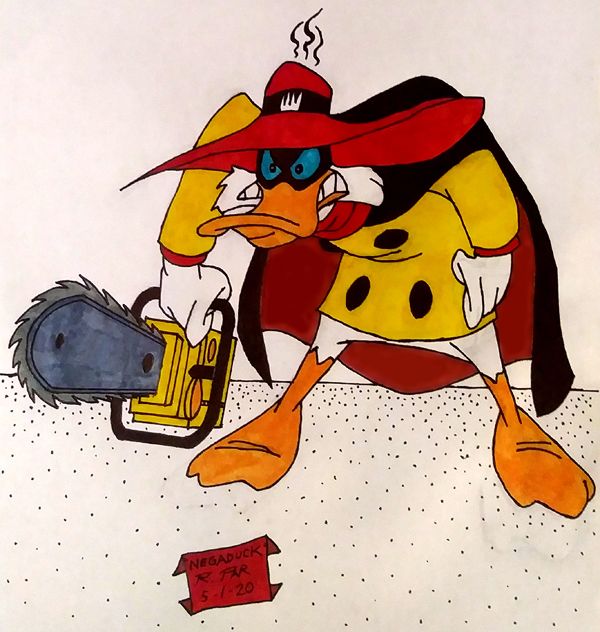
Just thought I'd begin the month of May by sharing this artwork I made of Darkwing Duck—my favorite Disney superhero from back when I was still in elementary school. This is the first illustration I drew during the COVID-19 pandemic era... I'm pretty sure that I'll have lots of time over the next month or so to draw other TV characters from my childhood days. Err, hopefully. *Makes sure that I have an extra face mask and gloves to wear the next time I go out.*

Of course, I can't include an image of Darkwing without also featuring an illustration I made of his arch-nemesis, Negaduck! God, he's so cool. Anyways, Happy Friday...and stay safe and healthy, everyone!

An illustration I drew of DARKWING DUCK's arch-nemesis, Negaduck.

Thursday, April 30, 2020

America's Space Program Joins in the Fight Against the Coronavirus...

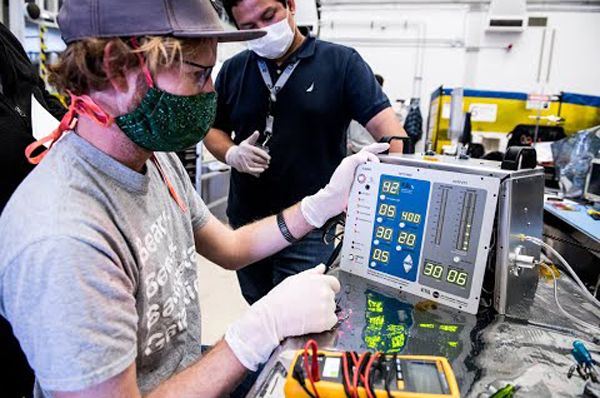
NASA engineers work on the VITAL (Ventilator Intervention Technology Accessible Locally) device that will be used to treat COVID-19 patients.
NASA / JPL - Caltech

NASA-Developed Ventilator Authorized by FDA for Emergency Use (Press Release)

A new high-pressure ventilator developed by NASA engineers and tailored to treat coronavirus (COVID-19) patients today was approved by the Food and Drug Administration (FDA) for use under the FDA’s March 24 ventilator Emergency Use Authorization.

Called VITAL (Ventilator Intervention Technology Accessible Locally), the device was developed by engineers at NASA's Jet Propulsion Laboratory (JPL) in Southern California to free up the nation's limited supply of traditional ventilators so they may be used on patients with the most severe COVID-19 symptoms.

“This FDA authorization is a key milestone in a process that exemplifies the best of what government can do in a time of crisis,” said NASA Administrator Jim Bridenstine. “This ventilator is one of countless examples of how taxpayer investments in space exploration – the skills, expertise and knowledge collected over decades of pushing boundaries and achieving firsts for humanity – translate into advancements that improve life on Earth.”

The Office of Technology Transfer and Corporate Partnerships at Caltech, which manages JPL for NASA, is offering a free license for VITAL and is reaching out to the commercial medical industry to find manufacturers for the device.

"Now that we have a design, we're working to pass the baton to the medical community, and ultimately patients, as quickly as possible," said Fred Farina, chief innovation and corporate partnerships officer at Caltech. "To that end, we are offering the designs for licensing on a royalty-free basis during the time of the pandemic."

The Emergency Use Authorization allows for use of the device specifically for COVID-19 patients, with the aim of addressing the acute demand for ventilators during the coronavirus pandemic. Like all ventilators, VITAL requires patients to be sedated and have an oxygen tube inserted into their airway to breathe.

“Fighting the virus and treating patients during this unprecedented global pandemic requires innovative approaches and action. It also takes an all hands-on deck approach, as demonstrated by the NASA engineers who used their expertise in spacecraft to design a ventilator tailored for very ill coronavirus patients. This example shows what we can do when everyone works together to fight COVID-19,” said FDA Commissioner Stephen Hahn. “We believe today’s action will increase availability of these life-saving medical devices. The FDA will continue to add products to this emergency use authorization, as appropriate, during this pandemic to facilitate an increase in ventilator inventory.”

Prior to the FDA's review, the VITAL prototype passed a critical test April 21 at the Icahn School of Medicine at Mount Sinai in New York. VITAL poses several benefits in the national response to COVID-19. It can be built faster and maintained more easily than a traditional ventilator, and is composed of far fewer parts, many of which are currently available to potential manufacturers through existing supply chains. Its flexible design means it also can be modified for use in field hospitals being set up in convention centers, hotels and other high-capacity facilities across the country and around the globe. Intended to last three or four months, the new device wouldn't replace current hospital ventilators, which can last years and are built to address a broader range of medical issues.

"It's been exhilarating coming up with VITAL's design," said Michelle Easter, a mechatronics engineer at JPL who worked on developing the device. "Now that we have FDA approval, we're looking forward to seeing companies license this technology and share it with the rest of the world."

****

Wednesday, April 29, 2020

Mars 2020 Update: Ingenuity Will Be Joining Perseverance (Safely) on the Red Planet's Surface Next Year...

An animated GIF showing the Ingenuity Mars helicopter flying across the surface of the Red Planet.
NASA / JPL - CalTech

Alabama High School Student Names NASA's Mars Helicopter (Press Release)

Destined to become the first aircraft to attempt powered flight on another planet, NASA's Mars Helicopter officially has received a new name: Ingenuity.

Vaneeza Rupani, a junior at Tuscaloosa County High School in Northport, Alabama, came up with the name and the motivation behind it during NASA's "Name the Rover" essay contest.

"The ingenuity and brilliance of people working hard to overcome the challenges of interplanetary travel are what allow us all to experience the wonders of space exploration," Rupani wrote in her contest submission. "Ingenuity is what allows people to accomplish amazing things, and it allows us to expand our horizons to the edges of the universe."

Rupani's was among 28,000 essays submitted to NASA by K-12 students from every U.S. state and territory recommending names for the the next Mars rover. In March, the agency announced that seventh-grader Alexander Mather's essay earned him the honor of naming the rover Perseverance. But with so many good essays, it seemed fitting to also choose a name for the helicopter that will accompany the rover to Mars. So NASA officials went back to the submitted essays to choose a name for the helicopter. Thomas Zurbuchen, associate administrator of NASA's Science Mission Directorate, made the choice for the rover's name, and NASA Administrator Jim Bridenstine chose the name for the helicopter.

"Ingenuity encapsulates the values that our helicopter tech demo will showcase for everyone when it takes off next year as the first aircraft on another planet’s surface," said Bridenstine. "It took a lot of hard and ingenious work to get the helicopter ready and then placed on the rover, and there’s a lot more going to be required. I was happy we had another great name from the naming contest finalists from which I was able to select something so representative of this exciting part of our next mission to Mars."

"I am proud that NASA’s Mars Helicopter will be named by Vaneeza Rupani of Northport, Alabama," said Sen. Richard Shelby of Alabama. "This is a unique privilege. Ms. Rupani’s essay on why she chose the name 'Ingenuity' highlights her creativity, originality, and intelligence. Her grasp on the importance of exploration is extraordinary, and I am confident that she has a bright future ahead. Congratulations to Ms. Rupani on being selected for this prestigious honor."

High Risk, High Reward

As a technology demonstration, Ingenuity is a high-risk, high-reward experiment. The helicopter will ride to Mars attached to the belly of the Perseverance rover, which is preparing for launch in July or August. For several months following the rover's landing, Ingenuity will remain encapsulated in a protective cover to shield it from debris during entry, descent and landing. When the timing in the rover mission is right, Ingenuity will be deployed to stand and operate on its own on the surface of the Red Planet. If the 4-pound (2-kilogram), solar-powered craft — a combination of specially designed components and off-the-shelf parts — survives the cold Martian nights during its pre-flight checkout, the team will proceed with testing.

If successful during its 30-Martian-day (31-Earth-day) experimental flight test window, the small craft will prove that powered flight can be achieved at Mars, enabling future Mars missions to better utilize second-generation helicopters to add an aerial dimension to their explorations.

The helicopter successfully completed its flight-testing program using the 25-foot space simulation chamber at NASA's Jet Propulsion Laboratory in Southern California. The next flight attempt will be in the actual environment of Mars. And if Ingenuity encounters difficulties, engineers will apply the lessons learned to future technology demonstrations. The science-gathering portion of the Mars 2020 mission will not be impacted.

"In the early days of this project, the feasibility of flying at Mars was questioned," said MiMi Aung, Mars Helicopter project manager at JPL. "But today we have a helicopter down at the launch site, installed on the rover and waiting to board the rocket which will carry us to the Red Planet. Like Vaneeza said in her essay, ingenuity and hard work led us to see beyond what was logical to what was possible. Now Ingenuity will have its chance to fly at Mars."

Along with investigating difficult-to-reach targets, such as cliffs, caves and deep craters, future aircraft could carry small science instruments or act as scouts for human and robotic explorers on Mars or other celestial bodies.

NASA's Perseverance rover and Ingenuity helicopter are currently undergoing final assembly and checkout at the agency's Kennedy Space Center in Florida. They will launch on a United Launch Alliance Atlas V rocket from Space Launch Complex 41 at nearby Cape Canaveral Air Force Station in July and land at Mars' Jezero Crater on Feb. 18, 2021.

Members of the public and media interested in learning more about the Ingenuity helicopter can ask questions on social media using the hashtag #AskNASA. JPL will share some of these questions with Aung, the helicopter project manager, and release a video at 1 p.m. PDT (4 p.m. EDT) today, April 29, with a live moderated chat. The video will premiere at:

https://www.youtube.com/NASAJPL/live

JPL is building and will manage operations of Perseverance and Ingenuity for the agency. NASA's Launch Services Program, based at Kennedy, is responsible for launch management. Lockheed Martin Space in Boulder, Colorado, provided the Mars Helicopter Delivery System. Caltech in Pasadena, California, manages JPL for NASA.

The "Name the Rover" contest partnership was part of a Space Act Agreement in educational and public outreach efforts between NASA, Battelle of Columbus, Ohio, and Future Engineers of Burbank, California. Amazon Web Services is an additional prize provider for the contest.

The Mars 2020 Perseverance rover mission is part of a larger program that includes missions to the Moon as a way to prepare for human exploration of the Red Planet. Through its Artemis program, NASA intends to land the first woman and the next man on the lunar surface in 2024 and establish a sustained human presence on and around the Moon by 2028, using it as a stepping stone to sending astronauts to Mars.

****
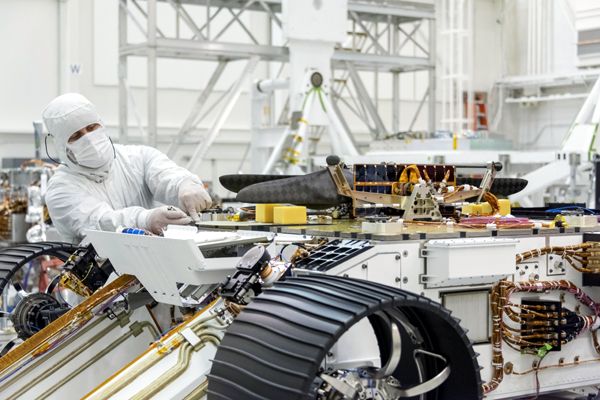
Inside the Spacecraft Assembly Facility at NASA's Jet Propulsion Laboratory near Pasadena, CA, an engineer works on attaching the Ingenuity helicopter to the belly of the Perseverance rover...on August 28, 2019.
NASA / JPL - Caltech

Thursday, April 16, 2020

Kepler Update: The Exoplanet Hunter Is Still Making Discoveries Almost 2 Years After It Fell Silent in Space...

An artist's concept of the exoplanet Kepler-1649c orbiting its parent star.
NASA / Ames Research Center / Daniel Rutter

Earth-Size, Habitable Zone Planet Found Hidden in Early NASA Kepler Data (News Release - April 15)

A team of transatlantic scientists, using reanalyzed data from NASA’s Kepler space telescope, has discovered an Earth-size exoplanet orbiting in its star's habitable zone, the area around a star where a rocky planet could support liquid water.

Scientists discovered this planet, called Kepler-1649c, when looking through old observations from Kepler, which the agency retired in 2018. While previous searches with a computer algorithm misidentified it, researchers reviewing Kepler data took a second look at the signature and recognized it as a planet. Out of all the exoplanets found by Kepler, this distant world – located 300 light-years from Earth – is most similar to Earth in size and estimated temperature.

This newly revealed world is only 1.06 times larger than our own planet. Also, the amount of starlight it receives from its host star is 75% of the amount of light Earth receives from our Sun – meaning the exoplanet's temperature may be similar to our planet’s, as well. But unlike Earth, it orbits a red dwarf. Though none have been observed in this system, this type of star is known for stellar flare-ups that may make a planet's environment challenging for any potential life.

"This intriguing, distant world gives us even greater hope that a second Earth lies among the stars, waiting to be found,” said Thomas Zurbuchen, associate administrator of NASA’s Science Mission Directorate in Washington. “The data gathered by missions like Kepler and our Transiting Exoplanet Survey Satellite (TESS) will continue to yield amazing discoveries as the science community refines its abilities to look for promising planets year after year."

There is still much that is unknown about Kepler-1649c, including its atmosphere, which could affect the planet's temperature. Current calculations of the planet's size have significant margins of error, as do all values in astronomy when studying objects so far away. But based on what is known, Kepler-1649c is especially intriguing for scientists looking for worlds with potentially habitable conditions.

There are other exoplanets estimated to be closer to Earth in size, such as TRAPPIST-1f and, by some calculations, Teegarden c. Others may be closer to Earth in temperature, such as TRAPPIST-1d and TOI 700d. But there is no other exoplanet that is considered to be closer to Earth in both of these values that also lies in the habitable zone of its system.

"Out of all the mislabeled planets we've recovered, this one's particularly exciting – not just because it's in the habitable zone and Earth-size, but because of how it might interact with this neighboring planet," said Andrew Vanderburg, a researcher at the University of Texas at Austin and first author on the paper released today in The Astrophysical Journal Letters. "If we hadn't looked over the algorithm's work by hand, we would have missed it."

Kepler-1649c orbits its small red dwarf star so closely that a year on Kepler-1649c is equivalent to only 19.5 Earth days. The system has another rocky planet of about the same size, but it orbits the star at about half the distance of Kepler-1649c, similar to how Venus orbits our Sun at about half the distance that Earth does. Red dwarf stars are among the most common in the galaxy, meaning planets like this one could be more common that we previously thought.

Looking for False Positives

Previously, scientists on the Kepler mission developed an algorithm called Robovetter to help sort through the massive amounts of data produced by the Kepler spacecraft, managed by NASA's Ames Research Center in California's Silicon Valley. Kepler searched for planets using the transit method, staring at stars, looking for dips in brightness as planets passed in front of their host stars.

Most of the time, those dips come from phenomena other than planets – ranging from natural changes in a star's brightness to other cosmic objects passing by – making it look like a planet is there when it's not. Robovetter's job was to distinguish the 12% of dips that were real planets from the rest. Those signatures Robovetter determined to be from other sources were labeled "false positives," the term for a test result mistakenly classified as positive.

With an enormous number of tricky signals, astronomers knew the algorithm would make mistakes and would need to be double-checked – a perfect job for the Kepler False Positive Working Group. That team reviews Robovetter's work, going through each false positive to ensure they are truly errors and not exoplanets, ensuring fewer potential discoveries are overlooked. As it turns out, Robovetter had mislabeled Kepler-1649c.

Even as scientists work to further automate analysis processes to get the most science as possible out of any given dataset, this discovery shows the value of double-checking automated work. Even six years after Kepler stopped collecting data from the original Kepler field – a patch of sky it stared at from 2009 to 2013, before going on to study many more regions – this rigorous analysis uncovered one of the most unique Earth-analogs discovered yet.

A Possible Third Planet

Kepler-1649c not only is one of the best matches to Earth in terms of size and energy received from its star, but it provides an entirely new look at its home system. For every nine times the outer planet in the system orbits the host star, the inner planet orbits almost exactly four times. The fact that their orbits match up in such a stable ratio indicates the system itself is extremely stable, and likely to survive for a long time.

Nearly perfect period ratios are often caused by a phenomenon called orbital resonance, but a nine-to-four ratio is relatively unique among planetary systems. Usually resonances take the form of ratios such as two-to-one or three-to-two. Though unconfirmed, the rarity of this ratio could hint to the presence of a middle planet with which both the inner and outer planets revolve in synchronicity, creating a pair of three-to-two resonances.

The team looked for evidence of such a mystery third planet, with no results. However, that could be because the planet is too small to see or at an orbital tilt that makes it impossible to find using Kepler's transit method.

Either way, this system provides yet another example of an Earth-size planet in the habitable zone of a red dwarf star. These small and dim stars require planets to orbit extremely close to be within that zone – not too warm and not too cold – for life as we know it to potentially exist. Though this single example is only one among many, there is increasing evidence that such planets are common around red dwarfs.

"The more data we get, the more signs we see pointing to the notion that potentially habitable and Earth-size exoplanets are common around these kinds of stars," said Vanderburg. "With red dwarfs almost everywhere around our galaxy, and these small, potentially habitable and rocky planets around them, the chance one of them isn't too different than our Earth looks a bit brighter."

Source: NASA.Gov