Friday, April 30, 2021

Ingenuity Update: The Mars Helicopter Is Ready to Broaden Its Horizon...

Using a camera on its robotic arm, the Perseverance Mars rover took this selfie with the Ingenuity Mars helicopter next to it...on April 6, 2021.
NASA / JPL - Caltech / MSSS

NASA’s Ingenuity Mars Helicopter to Begin New Demonstration Phase (Press Release)

NASA’s Ingenuity Mars Helicopter has a new mission. Having proven that powered, controlled flight is possible on the Red Planet, the Ingenuity experiment will soon embark on a new operations demonstration phase, exploring how aerial scouting and other functions could benefit future exploration of Mars and other worlds.

This new phase will begin after the helicopter completes its next two flights. The decision to add an operations demonstration is a result of the Perseverance rover being ahead of schedule with the thorough checkout of all vehicle systems since its February 18 landing, and its science team choosing a nearby patch of crater bed for its first detailed explorations. With the Mars Helicopter’s energy, telecommunications, and in-flight navigation systems performing beyond expectation, an opportunity arose to allow the helicopter to continue exploring its capabilities with an operations demonstration, without significantly impacting rover scheduling.

“The Ingenuity technology demonstration has been a resounding success,” said Thomas Zurbuchen, associate administrator for NASA’s Science Mission Directorate. “Since Ingenuity remains in excellent health, we plan to use it to benefit future aerial platforms while prioritizing and moving forward with the Perseverance rover team’s near-term science goals.”

The operations demonstration will begin in about two weeks with the helicopter’s sixth flight. Until then, Ingenuity will be in a transitional phase that includes its fourth and fifth forays into Mars’ crimson skies. Flight four will send the rotorcraft about 436 feet (133 meters) south to collect aerial imagery of a potential new landing zone before returning to land at Wright Brothers Field, the name for the Martian airfield on which Ingenuity’s first flight took place. This 873-foot (266-meter) roundtrip effort would surpass the range, speed, and duration marks achieved on the third flight. Ingenuity was programmed to execute a fourth flight Friday, with a takeoff to take place at 10:46 a.m. EDT (7:46 a.m. PDT, 12:30 p.m. local Mars time) and first data to be returned at 1:39 p.m. EDT (10:39 a.m. PDT). The fifth flight would send Ingenuity on a one-way mission, landing at the new site. If Ingenuity remains healthy after those flights, the next phase can begin.

Change of Course

Ingenuity’s transition from conducting a technology demonstration to an operations demonstration brings with it a new flight envelope. Along with those one-way flights, there will be more precision maneuvering, greater use of its aerial-observation capabilities, and more risk overall.

The change also means Ingenuity will require less support from the Perseverance rover team, which is looking ahead for targets to take rock and sediment samples in search of ancient microscopic life. On April 26 – the mission’s 66th sol, or Martian day – Perseverance drove 33 feet (10 meters) with the goal to identify targets.

“With the short drive, we have already begun our move south toward a location the science team believes is worthy of investigation and our first sampling,” said Ken Farley, project scientist for the Perseverance rover from Caltech in Pasadena, California. “We’ll spend the next couple of hundred sols executing our first science campaign looking for interesting rock outcrop along this 2-kilometer (1.24-mile) patch of crater floor before likely heading north and then west toward Jezero Crater’s fossil river delta.”

With short drives expected for Perseverance in the near term, Ingenuity may execute flights that land near the rover’s current location or its next anticipated parking spot. The helicopter can use these opportunities to perform aerial observations of rover science targets, potential rover routes, and inaccessible features while also capturing stereo images for digital elevation maps. The lessons learned from these efforts will provide significant benefit to future mission planners. These scouting flights are a bonus and not a requirement for Perseverance to complete its science mission.

The cadence of flights during Ingenuity’s operations demonstration phase will slow from once every few days to about once every two or three weeks, and the forays will be scheduled to avoid interfering with Perseverance’s science operations. The team will assess flight operations after 30 sols and will complete flight operations no later than the end of August. That timing will allow the rover team time to wrap up its planned science activities and prepare for solar conjunction – the period in mid-October when Mars and Earth are on opposite sides of the Sun, blocking communications.

“We have so appreciated the support provided by the Perseverance rover team during our technology demonstration phase,” said MiMi Aung, project manager of Ingenuity at NASA’s Jet Propulsion Laboratory (JPL) in Southern California. “Now we have a chance to pay it forward, demonstrating for future robotic and even crewed missions the benefits of having a partner nearby that can provide a different perspective – one from the sky. We are going to take this opportunity and run with it – and fly with it.”

****

Wednesday, April 28, 2021

ONLY 3 DAYS REMAIN for You to Send Your Name to the Moon by Supporting the Iris Lunar Rover!

An artist's concept of the Iris Rover on the surface of the Moon.
Carnegie Mellon University

Just thought I'd re-share this cool crowdfunding campaign where you can send your name to the Moon by donating a generous contribution to the Iris lunar mission! This miniature, student-built rover is set to fly later this year aboard Astrobotic's Peregrine lunar lander...which is hitching a NASA-sponsored ride on the United Launch Alliance's newest rocket, the Vulcan Centaur. The students at Pittsburgh's Carnegie Mellon University (CMU)—which constructed Iris—are looking to gain extra funding to cover the final cost of this mission (which includes paying for vital pre-launch tests of flight components, as well as funding the operational cost of the project's Mission Control itself)...and they're looking to the general public for help in doing so. Their campaign goal is to reach at least $50,000 (they're currently at $39,411), and they have until SATURDAY, MAY 1 to achieve it. It will be up to CMU to decide whether or not the Iris Team can keep the money already donated if they fail to reach their goal.

So here is the link where you can make the dreams of many aspiring college students, who are clearly passionate about space exploration, a reality:

https://crowdfunding.cmu.edu/campaigns/moonshot#/

For your awesome donation—which can be as little as $50—your name will be included with those of other benefactors (like me) on the flash memory aboard the Iris Rover! Ad lunam.

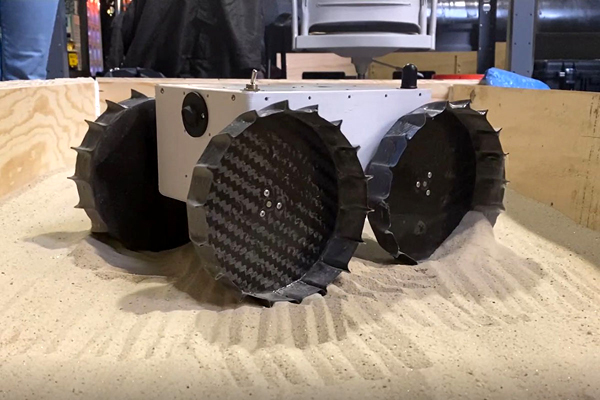
The Iris Rover undergoes testing inside a sandbox at Carnegie Mellon University in Pittsburgh, Pennsylvania.
Carnegie Mellon University

An artist's concept of Astrobotic's Peregrine lander on the surface of the Moon.
Astrobotic

The full-scale Structural Test Model for Astrobotic's Peregrine lander...which is set to head to the Moon aboard United Launch Alliance's Vulcan Centaur rocket later this year.

A screenshot from an animated video depicting the Vulcan Centaur rocket--which will launch the Peregrine lander to the Moon later this year--soaring into space.
United Launch Alliance

The Vulcan Centaur's Pathfinder Tanking Test booster is about to be installed atop its mobile launcher platform inside the Vertical Integration Facility at Cape Canaveral Space Force Station in Florida...on February 15, 2021.
United Launch Alliance

Thursday, April 22, 2021

Perseverance Update: One Day After Ingenuity's Momentous Flight on Mars, the Rover Makes History of Its Own...

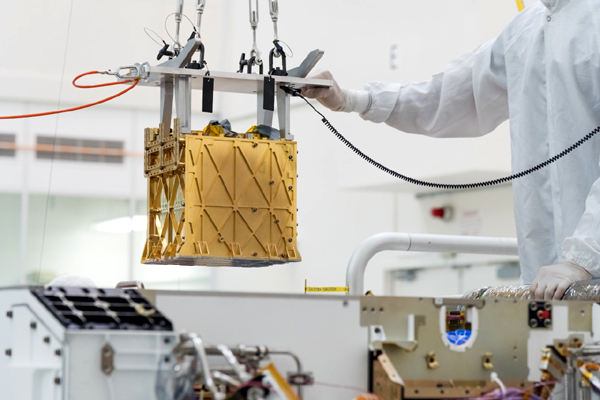
At NASA's Jet Propulsion Laboratory near Pasadena, California, the MOXIE instrument is about to be installed inside the chassis of the Perseverance Mars rover.
NASA / JPL - Caltech

NASA’s Perseverance Mars Rover Extracts First Oxygen from Red Planet (Press Release - April 21)

The growing list of “firsts” for Perseverance, NASA’s newest six-wheeled robot on the Martian surface, includes converting some of the Red Planet’s thin, carbon dioxide-rich atmosphere into oxygen. A toaster-size, experimental instrument aboard Perseverance called the Mars Oxygen In-Situ Resource Utilization Experiment (MOXIE) accomplished the task. The test took place April 20, the 60th Martian day, or sol, since the mission landed Feb. 18.

While the technology demonstration is just getting started, it could pave the way for science fiction to become science fact – isolating and storing oxygen on Mars to help power rockets that could lift astronauts off the planet’s surface. Such devices also might one day provide breathable air for astronauts themselves. MOXIE is an exploration technology investigation – as is the Mars Environmental Dynamics Analyzer (MEDA) weather station – and is sponsored by NASA’s Space Technology Mission Directorate (STMD) and Human Exploration and Operations Mission Directorate.

“This is a critical first step at converting carbon dioxide to oxygen on Mars,” said Jim Reuter, associate administrator for STMD. “MOXIE has more work to do, but the results from this technology demonstration are full of promise as we move toward our goal of one day seeing humans on Mars. Oxygen isn’t just the stuff we breathe. Rocket propellant depends on oxygen, and future explorers will depend on producing propellant on Mars to make the trip home.”

For rockets or astronauts, oxygen is key, said MOXIE’s principal investigator, Michael Hecht of the Massachusetts Institute of Technology’s Haystack Observatory.

To burn its fuel, a rocket must have more oxygen by weight. Getting four astronauts off the Martian surface on a future mission would require approximately 15,000 pounds (7 metric tons) of rocket fuel and 55,000 pounds (25 metric tons) of oxygen. In contrast, astronauts living and working on Mars would require far less oxygen to breathe. “The astronauts who spend a year on the surface will maybe use one metric ton between them,” Hecht said.

Hauling 25 metric tons of oxygen from Earth to Mars would be an arduous task. Transporting a one-ton oxygen converter – a larger, more powerful descendant of MOXIE that could produce those 25 tons – would be far more economical and practical.

Mars’ atmosphere is 96% carbon dioxide. MOXIE works by separating oxygen atoms from carbon dioxide molecules, which are made up of one carbon atom and two oxygen atoms. A waste product, carbon monoxide, is emitted into the Martian atmosphere.

The conversion process requires high levels of heat to reach a temperature of approximately 1,470 degrees Fahrenheit (800 Celsius). To accommodate this, the MOXIE unit is made with heat-tolerant materials. These include 3D-printed nickel alloy parts, which heat and cool the gases flowing through it, and a lightweight aerogel that helps hold in the heat. A thin gold coating on the outside of MOXIE reflects infrared heat, keeping it from radiating outward and potentially damaging other parts of Perseverance.

In this first operation, MOXIE’s oxygen production was quite modest – about 5 grams, equivalent to about 10 minutes worth of breathable oxygen for an astronaut. MOXIE is designed to generate up to 10 grams of oxygen per hour.

This technology demonstration was designed to ensure the instrument survived the launch from Earth, a nearly seven-month journey through deep space, and touchdown with Perseverance on Feb. 18. MOXIE is expected to extract oxygen at least nine more times over the course of a Martian year (nearly two years on Earth).

These oxygen-production runs will come in three phases. The first phase will check out and characterize the instrument’s function, while the second phase will run the instrument in varying atmospheric conditions, such as different times of day and seasons. In the third phase, Hecht said, “we’ll push the envelope” – trying new operating modes, or introducing “new wrinkles, such as a run where we compare operations at three or more different temperatures.”

“MOXIE isn’t just the first instrument to produce oxygen on another world,” said Trudy Kortes, director of technology demonstrations within STMD. It’s the first technology of its kind that will help future missions “live off the land,” using elements of another world’s environment, also known as in-situ resource utilization.

“It’s taking regolith, the substance you find on the ground, and putting it through a processing plant, making it into a large structure, or taking carbon dioxide – the bulk of the atmosphere – and converting it into oxygen,” she said. “This process allows us to convert these abundant materials into useable things: propellant, breathable air, or, combined with hydrogen, water.”

More About Perseverance

A key objective of Perseverance’s mission on Mars is astrobiology, including the search for signs of ancient microbial life. The rover will characterize the planet’s geology and past climate, pave the way for human exploration of the Red Planet, and be the first mission to collect and cache Martian rock and regolith (broken rock and dust).

Subsequent NASA missions, in cooperation with ESA (European Space Agency), would send spacecraft to Mars to collect these sealed samples from the surface and return them to Earth for in-depth analysis.

The Mars 2020 Perseverance mission is part of NASA’s Moon to Mars exploration approach, which includes Artemis missions to the Moon that will help prepare for human exploration of the Red Planet.

NASA’s Jet Propulsion Laboratory in Southern California, which is managed for NASA by Caltech in Pasadena, California, built and manages operations of the Perseverance rover.

****

Wednesday, April 21, 2021

Photos of the Day: I'm FULLY VACCINATED!

Posing with my COVID-19 vaccination record card after I got my second dose of the Pfizer-BioNTech vaccine...on April 21, 2021.

Happy Hump Day, everyone! Just thought I'd share these pics that I took after I got my second dose of Pfizer-BioNTech's COVID-19 vaccine at Cal Poly Pomona earlier today. This comes exactly three weeks after I got my first dose...and just like the first time around, I celebrated this milestone by going to Krispy Kreme to feast on another Original Glazed Doughnut afterwards! (Oh, and I then bought lunch at Chick-fil-A.) If it's anything like the first time around, I'll only wake up with a slight pain at the injection site on my upper right arm the next morning. Knock on wood.

As a reminder, folks 16 years of age and older are now eligible to get vaccinated in the United States! Don't wait! Get your shot and let's end the COVID-19 pandemic once and for all! Overlooking the fact that we'll all need to receive a third dose within the next 12 months—and most likely be vaccinated annually just like what's done with the seasonal flu... Carry on!

Posing with my COVID-19 vaccination record card after I got my second dose of the Pfizer-BioNTech vaccine...on April 21, 2021.

About to enjoy this Original Glazed Doughnut that I got for free from Krispy Kreme...courtesy of my COVID-19 vaccination record card on April 21, 2021.

Monday, April 19, 2021

INGENUITY HAS MADE AVIATION AND INTERPLANETARY HISTORY!

A camera underneath Ingenuity's fuselage took this photo of the helicopter's shadow as the vehicle made its historic first flight on Mars...on April 19, 2021.
NASA / JPL - Caltech

NASA’s Ingenuity Mars Helicopter Succeeds in Historic First Flight (Press Release)

Monday, NASA’s Ingenuity Mars Helicopter became the first aircraft in history to make a powered, controlled flight on another planet. The Ingenuity team at the agency’s Jet Propulsion Laboratory in Southern California confirmed the flight succeeded after receiving data from the helicopter via NASA’s Perseverance Mars rover at 6:46 a.m. EDT (3:46 a.m. PDT).

“Ingenuity is the latest in a long and storied tradition of NASA projects achieving a space exploration goal once thought impossible,” said acting NASA Administrator Steve Jurczyk. “The X-15 was a pathfinder for the space shuttle. Mars Pathfinder and its Sojourner rover did the same for three generations of Mars rovers. We don’t know exactly where Ingenuity will lead us, but today’s results indicate the sky – at least on Mars – may not be the limit.”

The solar-powered helicopter first became airborne at 3:34 a.m. EDT (12:34 a.m. PDT) – 12:33 Local Mean Solar Time (Mars time) – a time the Ingenuity team determined would have optimal energy and flight conditions. Altimeter data indicate Ingenuity climbed to its prescribed maximum altitude of 10 feet (3 meters) and maintained a stable hover for 30 seconds. It then descended, touching back down on the surface of Mars after logging a total of 39.1 seconds of flight. Additional details on the test are expected in upcoming downlinks.

Ingenuity’s initial flight demonstration was autonomous – piloted by onboard guidance, navigation, and control systems running algorithms developed by the team at JPL. Because data must be sent to and returned from the Red Planet over hundreds of millions of miles using orbiting satellites and NASA’s Deep Space Network, Ingenuity cannot be flown with a joystick, and its flight was not observable from Earth in real time.

NASA Associate Administrator for Science Thomas Zurbuchen announced the name for the Martian airfield on which the flight took place.

“Now, 117 years after the Wright brothers succeeded in making the first flight on our planet, NASA’s Ingenuity helicopter has succeeded in performing this amazing feat on another world,” Zurbuchen said. “While these two iconic moments in aviation history may be separated by time and 173 million miles of space, they now will forever be linked. As an homage to the two innovative bicycle makers from Dayton, this first of many airfields on other worlds will now be known as Wright Brothers Field, in recognition of the ingenuity and innovation that continue to propel exploration.”

Ingenuity’s chief pilot, Håvard Grip, announced that the International Civil Aviation Organization (ICAO) – the United Nations’ civil aviation agency – presented NASA and the Federal Aviation Administration with official ICAO designator IGY, call-sign INGENUITY.

These details will be included officially in the next edition of ICAO’s publication Designators for Aircraft Operating Agencies, Aeronautical Authorities and Services. The location of the flight has also been given the ceremonial location designation JZRO for Jezero Crater.

As one of NASA’s technology demonstration projects, the 19.3-inch-tall (49-centimeter-tall) Ingenuity Mars Helicopter contains no science instruments inside its tissue-box-size fuselage. Instead, the 4-pound (1.8-kg) rotorcraft is intended to demonstrate whether future exploration of the Red Planet could include an aerial perspective.

This first flight was full of unknowns. The Red Planet has a significantly lower gravity – one-third that of Earth’s – and an extremely thin atmosphere with only 1% the pressure at the surface compared to our planet. This means there are relatively few air molecules with which Ingenuity’s two 4-foot-wide (1.2-meter-wide) rotor blades can interact to achieve flight. The helicopter contains unique components, as well as off-the-shelf-commercial parts – many from the smartphone industry – that were tested in deep space for the first time with this mission.

“The Mars Helicopter project has gone from ‘blue sky’ feasibility study to workable engineering concept to achieving the first flight on another world in a little over six years,” said Michael Watkins, director of JPL. “That this project has achieved such a historic first is testimony to the innovation and doggedness of our team here at JPL, as well as at NASA’s Langley and Ames Research Centers, and our industry partners. It’s a shining example of the kind of technology push that thrives at JPL and fits well with NASA’s exploration goals.”

Parked about 211 feet (64.3 meters) away at Van Zyl Overlook during Ingenuity’s historic first flight, the Perseverance rover not only acted as a communications relay between the helicopter and Earth, but also chronicled the flight operations with its cameras. The pictures from the rover’s Mastcam-Z and Navcam imagers will provide additional data on the helicopter’s flight.

“We have been thinking for so long about having our Wright brothers moment on Mars, and here it is,” said MiMi Aung, project manager of the Ingenuity Mars Helicopter at JPL. “We will take a moment to celebrate our success and then take a cue from Orville and Wilbur regarding what to do next. History shows they got back to work – to learn as much as they could about their new aircraft – and so will we.”

Perseverance touched down with Ingenuity attached to its belly on Feb. 18. Deployed to the surface of Jezero Crater on April 3, Ingenuity is currently on the 16th sol, or Martian day, of its 30-sol (31-Earth day) flight test window. Over the next three sols, the helicopter team will receive and analyze all data and imagery from the test and formulate a plan for the second experimental test flight, scheduled for no earlier than April 22. If the helicopter survives the second flight test, the Ingenuity team will consider how best to expand the flight profile.

More About Ingenuity

JPL, which built Ingenuity, also manages the technology demonstration project for NASA. It is supported by NASA’s Science, Aeronautics, and Space Technology mission directorates. The agency’s Ames Research Center in California’s Silicon Valley and Langley Research Center in Hampton, Virginia, provided significant flight performance analysis and technical assistance during Ingenuity’s development.

Dave Lavery is the program executive for the Ingenuity Mars Helicopter, MiMi Aung is the project manager, and Bob Balaram is chief engineer.

****

Friday, April 16, 2021

ONLY 14 DAYS REMAIN: Send Your Name to the Moon by Supporting the Iris Lunar Rover!

An artist's concept of the Iris Rover on the surface of the Moon.
Carnegie Mellon University

Just thought I'd share this cool crowdfunding campaign where you can send your name to the Moon by donating a generous contribution to the Iris lunar mission! This miniature, student-built rover is set to fly later this year aboard Astrobotic's Peregrine lunar lander...which is hitching a NASA-sponsored ride on the United Launch Alliance's newest rocket, the Vulcan Centaur. The students at Pittsburgh's Carnegie Mellon University (CMU)—which constructed Iris—are looking to gain extra funding to cover the final cost of this mission (which includes paying for vital pre-launch tests of flight components, as well as funding the operational cost of the project's Mission Control itself)...and they're looking to the general public for help in doing so. Their campaign goal is to reach at least $50,000 (they're currently at $23,332), and they have until SATURDAY, MAY 1 to achieve it. It will be up to CMU to decide whether or not the Iris Team can keep the money already donated if they fail to reach their goal.

So here is the link where you can make the dreams of many aspiring college students, who are clearly passionate about space exploration, a reality:

https://crowdfunding.cmu.edu/campaigns/moonshot#/

For your awesome donation, your name will be included with those of other benefactors (like me) on the flash memory aboard the Iris Rover! Ad lunam.

(And FYI, I went to college at California State University, Long Beach! Class of 2004, baby... Our new mascot is Elbee the Shark.)

The full-scale Structural Test Model for Astrobotic's Peregrine lunar lander...which is set to head to the Moon aboard United Launch Alliance's Vulcan Centaur rocket later this year.

An artist's concept of Astrobotic's Peregrine lander on the surface of the Moon.
Astrobotic

The Vulcan Centaur's Pathfinder Tanking Test booster is about to be installed atop its mobile launcher platform inside the Vertical Integration Facility at Cape Canaveral Space Force Station in Florida...on February 15, 2021.
United Launch Alliance

Thursday, April 15, 2021

New Horizons Update: The Intrepid Robotic Explorer Is About to Achieve Another Distant Accomplishment Two Days from Now...

From its vantage point in the Kuiper Belt, NASA's New Horizons spacecraft took this image in the direction of the distant Voyager 1 robotic probe (whose location is marked with the yellow circle)...on December 25, 2020.
NASA / Johns Hopkins APL / Southwest Research Institute

NASA’s New Horizons Reaches a Rare Space Milestone (News Release)

Now 50 times as far from the Sun as Earth, History-Making Pluto Explorer Photographs Voyager 1’s Location from the Kuiper Belt

In the weeks following its launch in early 2006, when NASA’s New Horizons was still close to home, it took just minutes to transmit a command to the spacecraft, and hear back that the onboard computer received and was ready to carry out the instructions.

As New Horizons crossed the solar system, and its distance from Earth jumped from millions to billions of miles, that time between contacts grew from a few minutes to several hours. And on April 18 at 12:42 UTC (or April 17 at 8:42 p.m. EDT), New Horizons will reach a rare deep-space milepost -- 50 astronomical units from the Sun, or 50 times farther from the Sun than Earth is.

New Horizons is just the fifth spacecraft to reach this great distance, following the legendary Voyagers 1 and 2 and their predecessors, Pioneers 10 and 11. It’s almost 5 billion miles (7.5 billion kilometers) away; a remote region where one of those radioed commands, even traveling at the speed of light, needs seven hours to reach the far-flung spacecraft. Then add seven more hours before its control team on Earth finds out if the message was received.

“It’s hard to imagine something so far away,” said Alice Bowman, the New Horizons mission operations manager at the Johns Hopkins Applied Physics Laboratory in Laurel, Maryland. “One thing that makes this distance tangible is how long it takes for us on Earth to confirm that the spacecraft received our instructions. This went from almost instantaneous to now being on the order of 14 hours. It makes the extreme distance real.”

To mark the occasion, New Horizons recently photographed the star field where one of its long-distance cousins, Voyager 1, appears from New Horizons’ unique perch in the Kuiper Belt. Never before has a spacecraft in the Kuiper Belt photographed the location of an even more distant spacecraft, now in interstellar space. Although Voyager 1 is far too faint to be seen directly in the image, its location is known precisely due to NASA’s radio tracking.

“That’s a hauntingly-beautiful image to me,” said Alan Stern, New Horizons principal investigator from the Southwest Research Institute in Boulder, Colorado.

“Looking back at the flight of New Horizons from Earth to 50 AU almost seems in some way like a dream,” he continued. “Flying a spacecraft across our entire solar system to explore Pluto and the Kuiper Belt had never been done before New Horizons. Most of us on the team have been a part of this mission since it was just an idea, and during that time our kids have grown up, and our parents, and we ourselves, have grown older. But most importantly, we made many scientific discoveries, inspired countless STEM careers, and even made a little history.”

New Horizons was practically designed to make history. Dispatched at 36,400 miles per hour (58,500 kilometers per hour) on Jan. 19, 2006, New Horizons was and is still the fastest human-made object ever launched from Earth. Its gravity-assist flyby of Jupiter in February 2007 not only shaved about three years from its voyage to Pluto, but allowed it to make the best views ever of Jupiter’s faint ring, and capture the first movie of a volcano erupting anywhere in the solar system except Earth.

New Horizons successfully pulled off the first exploration of the Pluto system in July 2015, followed by the farthest flyby in history – and first close-up look at a Kuiper Belt object (KBO) -- with its flight past Arrokoth on New Year’s Day 2019. From its unique perch in the Kuiper Belt, New Horizons is making observations that can’t be made from anywhere else; even the stars look different from the spacecraft’s point of view.

New Horizons team members use giant telescopes like the Japanese Subaru observatory to scan the skies for another potential (and long-shot) KBO flyby target. New Horizons itself remains healthy, collecting data on the solar wind and space environment in the Kuiper Belt, other Kuiper Belt objects, and distant planets like Uranus and Neptune. This summer, the mission team will transmit a software upgrade to boost New Horizons’ scientific capabilities. For future exploration, the spacecraft’s nuclear battery should provide enough power to keep New Horizons operating until the late-2030s.

Source: New Horizons Website

****

The green line marks the path traveled by the New Horizons spacecraft as of 10:00 PM, Pacific Daylight Time, on April 15, 2021. It is 4.6 billion miles, or 49.8 Astronomical Units, from Earth.
ABOVE: The green line marks the path traveled by the New Horizons spacecraft as of 10:00 PM,
Pacific Daylight Time, on April 15, 2021. It is 4.6 billion miles, or 49.8 Astronomical Units (AU),
from Earth. Click
here to view the official webpage showing where New Horizons is in space.

Tuesday, April 13, 2021

VIPER Update: NASA's Lunar Rover and Its Astrobotic Lander Have Just Been Given a Launch Vehicle...

SpaceX's Falcon Heavy rocket lifts off on its maiden flight from Launch Complex 39A at NASA's Kennedy Space Center in Florida...on February 6, 2018.
SpaceX

Astrobotic Selects SpaceX Falcon Heavy Rocket for Griffin-VIPER Moon Mission (Press Release)

Astrobotic announced today its selection of SpaceX’s Falcon Heavy rocket in a competitive commercial procurement to launch its Griffin lunar lander to the Moon in late 2023. Griffin will be carrying NASA’s water-hunting Volatiles Investigating Polar Exploration Rover (VIPER).

“Getting to the Moon isn’t just about building a spacecraft, but having a complete mission solution. SpaceX's Falcon Heavy completes our Griffin Mission 1 (GM1) solution by providing a proven launch vehicle to carry us on our trajectory to the Moon. SpaceX has the team, vehicle, and facilities to make this happen,” says Daniel Gillies, GM1 Director for Astrobotic.

Astrobotic was awarded a task order in 2020 from NASA to deliver VIPER to the south pole of the Moon as part of the agency’s Commercial Lunar Payload Services (CLPS) initiative. After Falcon Heavy launches Griffin on a trajectory to the Moon, Griffin will land on the surface and VIPER will disembark from Griffin’s ramps to survey the surface and subsurface for water ice. These surveys could be the first step toward utilizing resources in the space environment – rather than carting them all from Earth – to enable more affordable and sustainable space exploration. Griffin’s delivery of VIPER will be Astrobotic’s second CLPS delivery, following the company’s Peregrine lander delivery later this year.

“Having previously sat on the other side of the table as a former SpaceX Mission Manager, I am fully aware of SpaceX’s capabilities and processes and am excited to be working with SpaceX on a mission once again. My first exposure to Falcon Heavy was as a SpaceX Mission Integrator on the STP-2 mission and I’m proud to be utilizing that same launch vehicle for Griffin,” says Gillies.

“Gaining a better learning of resources on the Moon is critical to advancing humanity’s reach beyond Earth, and we are honored to support this exciting mission and NASA’s CLPS program,” said SpaceX Senior Director of Commercial Sales Stephanie Bednarek.

Griffin Mission One is targeted to launch in 2023 from SpaceX’s facilities at Launch Complex 39A at Kennedy Space Center in Florida – the same launch site employed for the NASA Space Shuttle program, Commercial Crew Program, and Apollo missions. Work on the Griffin lunar lander is ongoing with qualification testing planned to be completed towards the end of this year.

Source: Astrobotic

****

An artist's concept of NASA's VIPER rover on the surface of the Moon.
NASA Ames / Daniel Rutter

A full-scale mock-up of the Griffin lander and a structural test article for the Peregrine lander...on display at Astrobotic's facility in Pittsburgh, Pennsylvania.
Astrobotic

Sunday, April 11, 2021

Some People Just Have All the Luck!

A Tesla Model X...which one of my old high school friends now owns.
Cars.com photo by Christian Lantry

Found out from one of my old high school friends yesterday that she wrote a book! Congrats to her! It's a children's publication that she apparently worked on during the COVID-19 pandemic. My friend also owns a Tesla Model X, while her husband now works at Facebook in Palo Alto [though I'd say that this is actually a downgrade from him working at Google (also in Silicon Valley) before that, heh]. They also have three adorable kids.

What— Me ENVIOUS? Naaaaw!

Saturday, April 10, 2021

Photo of the Day: The Los Doyers Got Their Rings!

The Los Angeles Dodgers pose with their 2020 World Series championship rings prior to defeating the Washington Nationals, 1-0, at Dodgers Stadium...on April 9, 2021.

Just thought I'd share this pic of the Los Angeles Dodgers posing with their 2020 World Series championship rings prior to playing against the Washington Nationals in front of 15,000 fans at Dodgers Stadium yesterday. The Dodgers won, 1-0, on Friday night...while they defeated Washington, 9-5, on the Dodgers' home field again about 20 minutes ago. Nice.

As for the L.A. Lakers, they're currently in the 5th spot of the NBA's Western Conference after beating the Brooklyn Nets, 126-101, in New York tonight. Not bad considering the fact that LeBron James and Anthony Davis, both still injured, are weeks away from returning and bringing the Lake Show back to championship form. Anyways, back to the Dodgers...