Monday, January 06, 2020

TESS Update: 2020 Begins with an Amazing Discovery Made by Kepler's Successor...

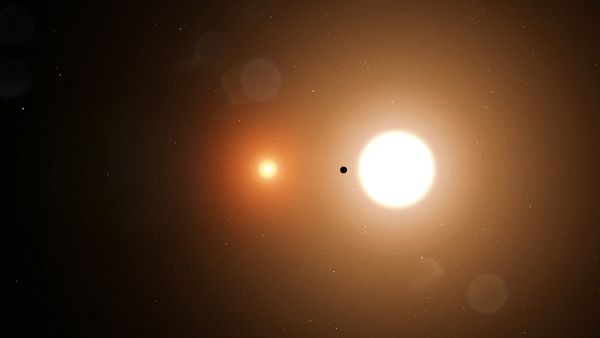
An artist's concept of the exoplanet TOI 1338 b orbiting its two parent stars.
NASA's Goddard Space Flight Center / Chris Smith

NASA’s TESS Mission Uncovers Its 1st World With Two Stars (News Release)

In 2019, when Wolf Cukier finished his junior year at Scarsdale High School in New York, he joined NASA’s Goddard Space Flight Center in Greenbelt, Maryland, as a summer intern. His job was to examine variations in star brightness captured by NASA’s Transiting Exoplanet Survey Satellite (TESS) and uploaded to the Planet Hunters TESS citizen science project.

“I was looking through the data for everything the volunteers had flagged as an eclipsing binary, a system where two stars circle around each other and from our view eclipse each other every orbit,” Cukier said. “About three days into my internship, I saw a signal from a system called TOI 1338. At first I thought it was a stellar eclipse, but the timing was wrong. It turned out to be a planet.”

TOI 1338 b, as it is now called, is TESS’s first circumbinary planet, a world orbiting two stars. The discovery was featured in a panel discussion on Monday, Jan. 6, at the 235th American Astronomical Society meeting in Honolulu. A paper, which Cukier co-authored along with scientists from Goddard, San Diego State University, the University of Chicago and other institutions, has been submitted to a scientific journal.

The TOI 1338 system lies 1,300 light-years away in the constellation Pictor. The two stars orbit each other every 15 days. One is about 10% more massive than our Sun, while the other is cooler, dimmer and only one-third the Sun’s mass.

TOI 1338 b is the only known planet in the system. It’s around 6.9 times larger than Earth, or between the sizes of Neptune and Saturn. The planet orbits in almost exactly the same plane as the stars, so it experiences regular stellar eclipses.

TESS has four cameras, which each take a full-frame image of a patch of the sky every 30 minutes for 27 days. Scientists use the observations to generate graphs of how the brightness of stars change over time. When a planet crosses in front of its star from our perspective, an event called a transit, its passage causes a distinct dip in the star’s brightness.

But planets orbiting two stars are more difficult to detect than those orbiting one. TOI 1338 b’s transits are irregular, between every 93 and 95 days, and vary in depth and duration thanks to the orbital motion of its stars. TESS only sees the transits crossing the larger star; the transits of the smaller star are too faint to detect.

“These are the types of signals that algorithms really struggle with,” said lead author Veselin Kostov, a research scientist at the SETI Institute and Goddard. “The human eye is extremely good at finding patterns in data, especially non-periodic patterns like those we see in transits from these systems.”

This explains why Cukier had to visually examine each potential transit. For example, he initially thought TOI 1338 b’s transit was a result of the smaller star in the system passing in front of the larger one — both cause similar dips in brightness. But the timing was wrong for an eclipse.

After identifying TOI 1338 b, the research team used a software package called eleanor, named after Eleanor Arroway, the central character in Carl Sagan’s novel “Contact,” to confirm the transits were real and not a result of instrumental artifacts.

“Throughout all of its images, TESS is monitoring millions of stars,” said co-author Adina Feinstein, a graduate student at the University of Chicago. “That’s why our team created eleanor. It’s an accessible way to download, analyze and visualize transit data. We designed it with planets in mind, but other members of the community use it to study stars, asteroids and even galaxies.”

TOI 1338 had already been studied from the ground by radial velocity surveys, which measure motion along our line of sight. Kostov’s team used this archival data to analyze the system and confirm the planet. Its orbit is stable for at least the next 10 million years. The orbit’s angle to us, however, changes enough that the planet transit will cease after November 2023 and resume eight years later.

NASA’s Kepler and K2 missions previously discovered 12 circumbinary planets in 10 systems, all similar to TOI 1338 b. Observations of binary systems are biased toward finding larger planets, Kostov said. Transits of smaller bodies don’t have as big an effect on the stars’ brightness. TESS is expected to observe hundreds of thousands of eclipsing binaries during its initial two-year mission, so many more of these circumbinary planets should be waiting for discovery.

TESS is a NASA Astrophysics Explorer mission led and operated by MIT in Cambridge, Massachusetts, and managed by NASA's Goddard Space Flight Center. Additional partners include Northrop Grumman, based in Falls Church, Virginia; NASA’s Ames Research Center in California’s Silicon Valley; the Harvard-Smithsonian Center for Astrophysics in Cambridge, Massachusetts; MIT’s Lincoln Laboratory; and the Space Telescope Science Institute in Baltimore. More than a dozen universities, research institutes and observatories worldwide are participants in the mission.

Source: NASA.Gov

****

Wednesday, December 18, 2019

Photos of the Day: IMPEACHED!!!

The New York Time's front page article on Donald Trump's impeachment...for December 19, 2019.

Today is the day that was over two years in the making. The U.S. House of Representatives officially voted—on two articles that involved the abuse of power and obstruction of justice—to impeach Donald Trump. About damn time! The articles of impeachment will soon be transferred over to the U.S. Senate...which will begin Trump's trial next month.

The Washington Post's front page article on Donald Trump's impeachment...for December 19, 2019.

On the downside, the Senate is currently controlled by the Republican party—so Mitch "Complicit turtle-faced traitorous bastard" McConnell, Lindsey "I am compromised like you wouldn't believe" Graham and all of the other cowardly GOP lackwits will ensure that Trump will be acquitted when the trial reaches the verdict phase. On the upside, though, Trump will forever be lumped together with Bill Clinton, Andrew Johnson and Richard Nixon...even though the latter resigned before he was impeached. So much for your legacy, Trump—and you still have to deal with the criminal charges wrought upon you by the state of New York after your reign of ineptitude inevitably reaches its long-awaited conclusion. You're fired!

HEY LOOK— Trump finally won the popular vote!

Monday, December 16, 2019

NASA's Next X-Plane Moves a Step Closer to Reality...

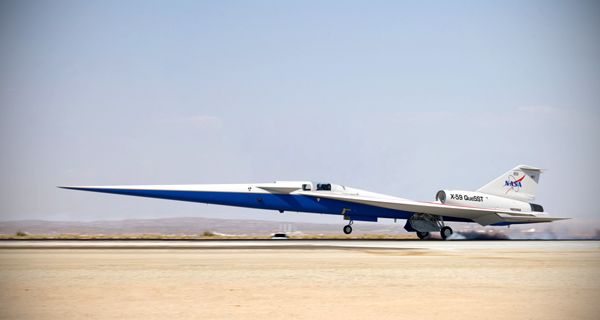
An artist's concept of NASA's X-59 QueSST aircraft landing at Edwards Air Force Base in California.
Lockheed Martin

NASA’s X-59 Quiet Supersonic Research Aircraft Cleared for Final Assembly (Press Release)

NASA’s first large scale, piloted X-plane in more than three decades is cleared for final assembly and integration of its systems following a major project review by senior managers held Thursday at NASA Headquarters in Washington.

The management review, known as Key Decision Point-D (KDP-D), was the last programmatic hurdle for the X-59 Quiet SuperSonic Technology (QueSST) aircraft to clear before officials meet again in late 2020 to approve the airplane’s first flight in 2021.

“With the completion of KDP-D we’ve shown the project is on schedule, it’s well planned and on track. We have everything in place to continue this historic research mission for the nation’s air-traveling public,” said Bob Pearce, NASA’s associate administrator for Aeronautics.

The X-59 is shaped to reduce the loudness of a sonic boom reaching the ground to that of a gentle thump, if it is heard at all. It will be flown above select U.S. communities to generate data from sensors and people on the ground in order to gauge public perception. That data will help regulators establish new rules to enable commercial supersonic air travel over land.

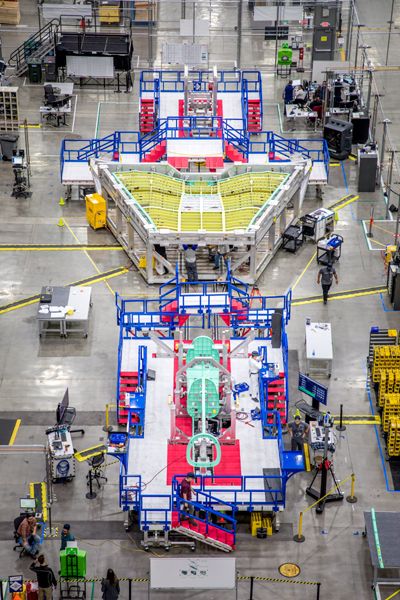
Construction of the X-59, under a $247.5 million cost-plus-incentive-fee contract, is continuing at Lockheed Martin Aeronautics Company’s Skunk Works factory in Palmdale, California.

Three major work areas are actively set up for building the airplane’s main fuselage, wing and empennage. Final assembly and integration of the airplane’s systems – including an innovative cockpit eXternal Visibility System – is targeted for late 2020.

Management of the X-59 QueSST development and construction falls under the Low Boom Flight Demonstrator project, which is part of NASA’s Integrated Aviation Systems Program.

****

Different parts of the X-59's main fuselage begin to take shape at Lockheed Martin's Skunk Works factory in Palmdale, California.
Lockheed Martin

Saturday, December 14, 2019

Hubble Photographs Our Newest Interstellar Interloper...

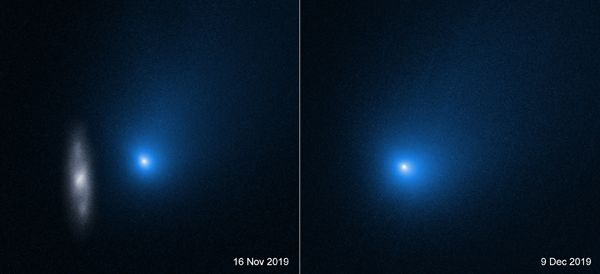
Two images of interstellar comet 2I/Borisov that were taken by NASA's Hubble Space Telescope...on November 16 (left) and December 9, 2019 (right), respectively.
NASA, ESA and D. Jewitt (UCLA)

Interstellar Comet 2I/Borisov Swings Past Sun (News Release - December 12)

When astronomers see something in the universe that at first glance seems like one-of-a-kind, it's bound to stir up a lot of excitement and attention. Enter comet 2I/Borisov. This mysterious visitor from the depths of space is the first identified comet to arrive here from another star. We don't know from where or when the comet started heading toward our Sun, but it won't hang around for long. The Sun's gravity is slightly deflecting its trajectory, but can't capture it because of the shape of its orbit and high velocity of about 100,000 miles per hour.

Telescopes around the world have been watching the fleeting visitor. NASA's Hubble Space Telescope has provided the sharpest views as the comet skirts by our Sun. Since October the space telescope has been following the comet like a sports photographer following horses speeding around a racetrack. Hubble revealed that the heart of the comet, a loose agglomeration of ices and dust particles, is likely no more than about 3,200 feet across, about the length of nine football fields. Though comet Borisov is the first of its kind, no doubt there are many other comet vagabonds out there, plying the space between stars. Astronomers will eagerly be on the lookout for the next mysterious visitor from far beyond.

These two images (above), taken by Hubble, capture comet 2I/Borisov streaking though our solar system and on its way back to interstellar space. It is only the second interstellar object known to have passed through the solar system.

Nov. 16, 2019, Photo (Above Left)

The comet appears in front of a distant background spiral galaxy (2MASX J10500165-0152029). The galaxy's bright central core is smeared in the image because Hubble was tracking the comet. Comet Borisov was approximately 203 million miles from Earth in this exposure. Its tail of ejected dust streaks off to the upper right. The comet has been artificially colored blue to discriminate fine detail in the halo of dust, or coma, surrounding the central nucleus. It also helps to visually separate the comet from the background galaxy.

Dec. 9, 2019, Photo (Above Right)

Hubble revisited the comet shortly after its closest approach to the Sun where it received maximum heating after spending most of its life in frigid interstellar space. The comet also reached a breathtaking maximum speed of about 100,000 miles per hour. Comet Borisov is 185 million miles from Earth in this photo, near the inner edge of the Asteroid Belt but below it. The nucleus, an agglomeration of ices and dust, is still too small to be resolved. The bright central portion is a coma made up of dust leaving the surface. The comet will make its closest approach to Earth in late December at a distance of 180 million miles.

"Hubble gives us the best upper limit of the size of comet Borisov's nucleus, which is the really important part of the comet," said David Jewitt, a UCLA professor of planetary science and astronomy, whose team has captured the best and sharpest look at this first confirmed interstellar comet. "Surprisingly, our Hubble images show that its nucleus is more than 15 times smaller than earlier investigations suggested it might be. Our Hubble images show that the radius is smaller than half a kilometer. Knowing the size is potentially useful for beginning to estimate how common such objects may be in the solar system and our galaxy. Borisov is the first known interstellar comet, and we would like to learn how many others there are."

Crimean amateur astronomer Gennady Borisov discovered the comet on Aug. 30, 2019, and reported the position measurements to the International Astronomical Union's Minor Planet Center in Cambridge, Massachusetts. The Center for Near-Earth Object Studies at NASA's Jet Propulsion Laboratory in Pasadena, California, working with the Minor Planet Center, computed an orbit for the comet, which shows that it came from elsewhere in our Milky Way galaxy, point of origin unknown.

Nevertheless, observations by numerous telescopes show that the comet's chemical composition is similar to the comets found inside our solar system, providing evidence that comets also form around other stars. By the middle of 2020 the comet will have already zoomed past Jupiter's distance of 500 million miles on its way back into the frozen abyss of interstellar space.

The Hubble Space Telescope is a project of international cooperation between ESA (the European Space Agency) and NASA. NASA's Goddard Space Flight Center in Greenbelt, Maryland, manages the telescope. The Space Telescope Science Institute (STScI) in Baltimore conducts Hubble science operations. STScI is operated for NASA by the Association of Universities for Research in Astronomy in Washington, D.C. The Minor Planet Center and the Center for Near-Earth Orbit Studies are projects of NASA’s Near-Earth Object Observations Program of the Planetary Defense Coordination Office at NASA Headquarters.

Source: NASA.Gov

Friday, December 13, 2019

Another Mars 2020 Flight Component Arrives in Cape Canaveral, Florida...

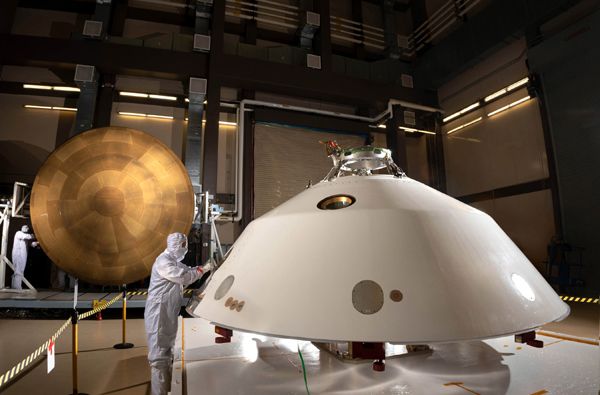
The backshell and heat shield (background) for NASA's Mars 2020 rover...which is scheduled to launch to the Red Planet next July.
Lockheed Martin

Lockheed Martin Delivers Mars 2020 Rover Aeroshell To Launch Site (Press Release)

Heat Shield and Backshell Will Protect NASA's Rover During Descent to Mars

DENVER, Dec. 13, 2019 -- The capsule-shaped aeroshell that will protect NASA's Mars 2020 rover was delivered to NASA's Kennedy Space Center, Florida yesterday. Built by Lockheed Martin, the aeroshell will encapsulate and protect the Mars 2020 rover during its deep space cruise to Mars, and from the intense heat as the entry system descends through the Martian atmosphere to the surface of Mars.

Because of the large mass and unique entry trajectory profile that could create external temperatures up to 3,800 degrees Fahrenheit, the heat shield uses a tiled Phenolic Impregnated Carbon Ablator (PICA) thermal protection system instead of the Mars heritage Super Lightweight Ablator (SLA) 561V. This will only be the second time PICA has flown on a Mars mission.

"Even though we have the experience of building the nearly identical aeroshell for the Curiosity Rover, the almost 15-foot diameter composite structure was just as big a challenge to build and test 10 years later," said Neil Tice, Mars 2020 aeroshell program manager at Lockheed Martin Space. "We've built every Mars aeroshell entry system for NASA of its 40 years of exploring Mars, so we pulled from that experience to build this important system."

Along with the Curiosity mission, this is the largest aeroshell/heat shield ever built for a planetary mission at 4.5 meters (nearly 15 feet) in diameter. In contrast, the aeroshell/heat shield of the InSight lander measured 8.6 feet and Apollo capsule heat shields measured just less than 13 feet.

The backshell and heat shield were transported from Lockheed Martin's Waterton facility in Littleton, Colorado where they were built, to nearby Buckley Air Force Base. They were then loaded onto an Air Force transport plane and flown to NASA's Kennedy Space Center.

Recently, Lockheed Martin integrated the MSL Entry Descent and Landing Instrument (MEDLI2) onto the heat shield and backshell. Provided by NASA's Langley and Ames Research Centers, MEDLI2 will collect temperature and pressure data during the spacecraft's descent through the Martian atmosphere.

The Mars 2020 rover is in testing at NASA's Jet Propulsion Laboratory, Pasadena, California., which manages the Mars 2020 project for the NASA Science Mission Directorate, Washington. The mission will launch in July 2020 and land on Mars in February 2021 at the Jezero Crater.

Source: Lockheed Martin

Thursday, December 12, 2019

Hello, Nightingale: OSIRIS-REx Has Found Its Landing Spot on Asteroid Bennu!

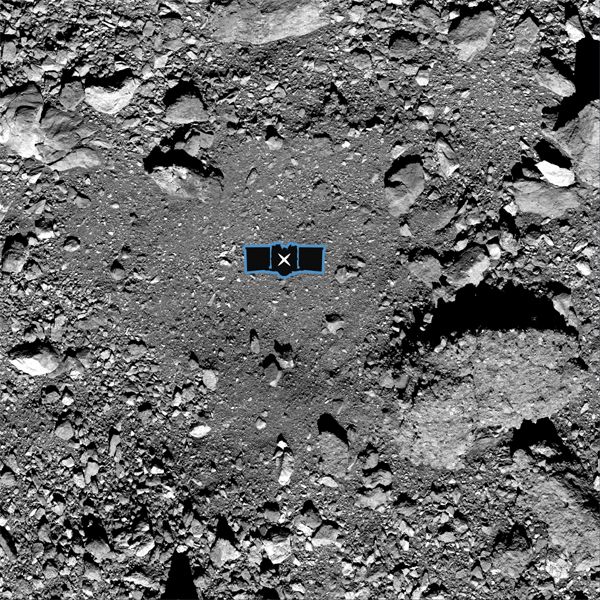
An image of the site on asteroid Bennu's surface (dubbed Nightingale) where NASA's OSIRIS-REx spacecraft will touch down to collect a soil sample in August of 2020.
NASA / Goddard / University of Arizona

X Marks the Spot: NASA Selects Site for Asteroid Sample Collection (Press Release)

After a year scoping out asteroid Bennu’s boulder-scattered surface, the team leading NASA’s first asteroid sample return mission has officially selected a sample collection site.

The Origins, Spectral Interpretation, Resource Identification, Security, Regolith Explorer (OSIRIS-Rex) mission team concluded a site designated “Nightingale” – located in a crater high in Bennu’s northern hemisphere – is the best spot for the OSIRIS-REx spacecraft to snag its sample.

The OSIRIS-REx team spent the past several months evaluating close-range data from four candidate sites in order to identify the best option for the sample collection. The candidate sites – dubbed Sandpiper, Osprey, Kingfisher, and Nightingale – were chosen for investigation because, of all the potential sampling regions on Bennu, these areas pose the fewest hazards to the spacecraft’s safety while still providing the opportunity for great samples to be gathered.

“After thoroughly evaluating all four candidate sites, we made our final decision based on which site has the greatest amount of fine-grained material and how easily the spacecraft can access that material while keeping the spacecraft safe,” said Dante Lauretta, OSIRIS-REx principal investigator at the University of Arizona in Tucson. “Of the four candidates, site Nightingale best meets these criteria and, ultimately, best ensures mission success.”

Site Nightingale is located in a northern crater 230 feet (70 meters) wide. Nightingale’s regolith – or rocky surface material – is dark, and images show that the crater is relatively smooth. Because it is located so far north, temperatures in the region are lower than elsewhere on the asteroid and the surface material is well-preserved. The crater also is thought to be relatively young, and the regolith is freshly exposed. This means the site would likely allow for a pristine sample of the asteroid, giving the team insight into Bennu’s history.

Although Nightingale ranks the highest of any location on Bennu, the site still poses challenges for sample collection. The original mission plan envisioned a sample site with a diameter of 164 feet (50 meters). While the crater that hosts Nightingale is larger than that, the area safe enough for the spacecraft to touch is much smaller – approximately 52 feet (16 meters) in diameter, resulting in a site that is only about one-tenth the size of what was originally envisioned. This means the spacecraft has to very accurately target Bennu’s surface. Nightingale also has a building-size boulder situated on the crater’s eastern rim, which could pose a hazard to the spacecraft while backing away after contacting the site.

The mission also selected site Osprey as a backup sample collection site. The spacecraft has the capability to perform multiple sampling attempts, but any significant disturbance to Nightingale’s surface would make it difficult to collect a sample from that area on a later attempt, making a backup site necessary. The spacecraft is designed to autonomously “wave-off” from the site if its predicted position is too close to a hazardous area. During this maneuver, the exhaust plumes from the spacecraft’s thrusters could potentially disturb the surface of the site, due to the asteroid’s microgravity environment. In any situation where a follow-on attempt at Nightingale is not possible, the team will try to collect a sample from site Osprey instead.

"Bennu has challenged OSIRIS-REx with extraordinarily rugged terrain," said Rich Burns, OSIRIS-REx project manager at NASA’s Goddard Space Flight Center. "The team has adapted by employing a more accurate, though more complex, optical navigation technique to be able to get into these small areas. We'll also arm OSIRIS-REx with the capability to recognize if it is on course to touch a hazard within or adjacent to the site and wave-off before that happens."

With the selection of final primary and backup sites, the mission team will undertake further reconnaissance flights over Nightingale and Osprey, beginning in January and continuing through the spring. Once these flyovers are complete, the spacecraft will begin rehearsals for its first "touch-and-go" sample collection attempt, which is scheduled for August. The spacecraft will depart Bennu in 2021 and is scheduled to return to Earth in September 2023.

NASA’s Goddard Space Flight Center in Greenbelt, Maryland, provides overall mission management, systems engineering, and the safety and mission assurance for OSIRIS-REx. Dante Lauretta of the University of Arizona, Tucson, is the principal investigator, and the University of Arizona also leads the science team and the mission’s science observation planning and data processing. Lockheed Martin Space in Denver built the spacecraft and provides flight operations. Goddard and KinetX Aerospace are responsible for navigating the OSIRIS-REx spacecraft. OSIRIS-REx is the third mission in NASA’s New Frontiers Program, which is managed by NASA’s Marshall Space Flight Center in Huntsville, Alabama, for the agency’s Science Mission Directorate in Washington.

****

Friday, November 15, 2019

Rest In Peace, Mr. Lewis.

My high school British Literature teacher Marcus Lewis. May he rest in peace.

Last week, I found out that one of my former high school teachers, Marcus Lewis, had passed away. Mr. Lewis taught British Literature during my senior year at Bishop Amat Memorial...and was one of my favorite instructors there. I was a senior during the 1997-'98 school year—and I recall that Mr. Lewis would give my Brit Lit class extra credit if we watched the movie Titanic (which was released in theaters on December 19, 1997) and gave him our ticket stubs for proof of viewing afterwards! So cool. Mr. Lewis also worked at a Barnes & Noble bookstore during that time, and was able to buy me the James Cameron's Titanic movie book (which was sold out everywhere else) shown below. Of course I paid him back.

Mr. Lewis' passing took place about eight months after my 8th grade teacher Mrs. Maria Ventura left this world. May they both rest in peace.

The JAMES CAMERON'S TITANIC movie book. Mr. Lewis bought me a copy when he worked at a Barnes & Noble bookstore during the time he taught British Literature in my high school.

Thursday, November 14, 2019

SOLAR PROBE PLUS Update: NASA Releases First Round of Data from the Parker Spacecraft to the Public...

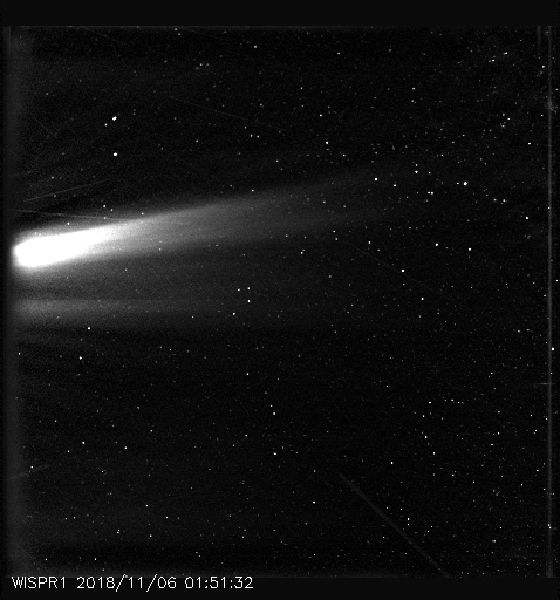
Data from the Wide-field Imager for Solar Probe instrument aboard NASA's Parker Solar Probe captured during the spacecraft’s first solar encounter in November 2018.
NASA / Naval Research Laboratory / Parker Solar Probe

First Parker Solar Probe Science Data Released to Public (News Release - November 12)

On Nov. 12, 2019, NASA’s Parker Solar Probe team released scientific data collected during the spacecraft's first two solar orbits to the general public.

Data can be accessed through the NASA Space Physics Data Facility, the Solar Data Analysis Center, the APL Parker Solar Probe Gateway, and the Science Operation Centers of the four science investigation teams (the University of California, Berkeley; Princeton University; Harvard-Smithsonian Center for Astrophysics; and Naval Research Laboratory.) The newly released data, in the form of data files and graphical displays, is available for interested public users to manipulate, analyze, and plot in any way they choose.

The released encounter data encompasses measurements made during the first two solar encounters, spanning the time between Oct. 31 and Nov. 12, 2018, and March 30 and April 19, 2019, when the spacecraft was within 0.25 AU of the Sun, as well as data collected at farther distances. One AU, or astronomical unit, is about 93 million miles, the average distance between the Sun and Earth.

Science teams led by principal investigators from partner institutions have been busy poring over the wealth of information collected by Parker Solar Probe in preparation for the mission's first science results, to be released later this year. The four instrument suites onboard – FIELDS, ISʘIS, SWEAP, and WISPR – have been observing the characteristics of the solar wind (fields, waves, flows, and particles) in the immediate environment surrounding the Sun, called the corona.

“Parker Solar Probe is crossing new frontiers of space exploration, giving us so much new information about the Sun,” said Parker Solar Probe Project Scientist Nour E. Raouafi, from the Johns Hopkins Applied Physics Laboratory, or APL, in Laurel, Maryland, which manages the mission for NASA. “Releasing this data to the public will allow them not only to contribute to the success of the mission along with the scientific community, but also to raise the opportunity for new discoveries to the next level.”

With three of 24 planned solar orbits under its belt, Parker Solar Probe will continue to get closer to the Sun in the coming years, eventually swooping to within 4 million miles of the Sun's surface, facing heat and radiation like no spacecraft before it. The mission seeks to provide new data on solar activity and how the solar corona works, which contributes significantly to our ability to forecast major space weather events that impact life on Earth. The mission launched in 2018 and is slated to perform its primary science mission until 2025.

Source: Johns Hopkins Applied Physics Laboratory

****

Wednesday, November 13, 2019

Farewell, Asteroid Ryugu: Hayabusa2 Is Now Headed Back to Earth!

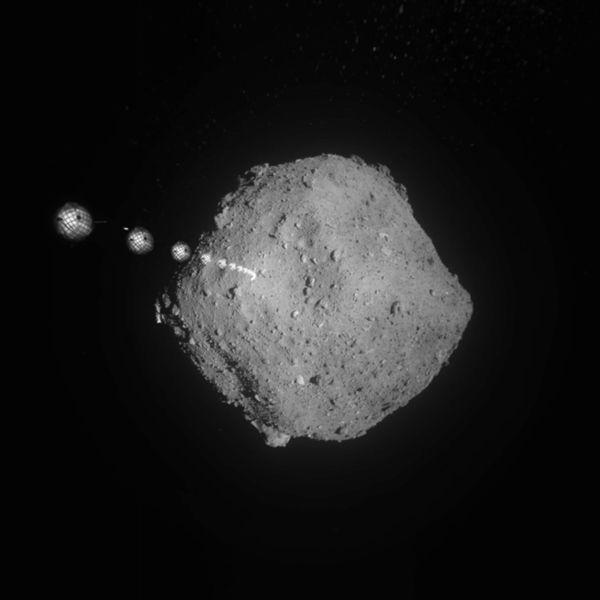
An image overlay showing one of Hayabusa2's target markers falling slowly towards the surface of asteroid Ryugu on September 16, 2019. Four of five markers that launched with Hayabusa2 in 2014 were released onto Ryugu's surface as of November 13, 2019.
JAXA, Chiba Institute of Technology and collaborators

Hayabusa2 Departs from Ryugu (Press Release)

JAXA confirmed Hayabusa2, JAXA's asteroid explorer, left the target asteroid Ryugu.

On November 13, 2019, JAXA operated Hayabusa2 chemical propulsion thrusters for the spacecraft's orbit control. The confirmation of the Hayabusa2 departure made at 10:05 a.m. (Japan Standard Time, JST) was based on the following data analyses:

·The thruster operation of Hayabusa2 occurred nominally
·The velocity leaving from Ryugu is approximately 9.2 cm/s
·The status of Hayabusa2 is normal

We are planning to conduct performance tests of onboard instruments, including the electric propulsion system, for the return to Earth.

Source: Japan Aerospace Exploration Agency

Tuesday, November 12, 2019

New Horizons Update: Ultima Thule Now Has a New Name!

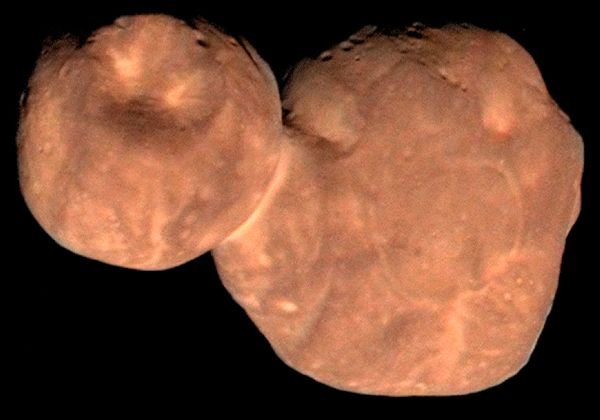
A high-resolution image of the Kuiper Belt object Arrokoth that was taken by NASA's New Horizons spacecraft from 4,109 miles (6,628 kilometers) away...on January 1, 2019.
NASA / Johns Hopkins Applied Physics Laboratory / Southwest Research Institute, National Optical Astronomy Observatory

Far, Far Away in the Sky: New Horizons Kuiper Belt Flyby Object Officially Named 'Arrokoth' (News Release)

In a fitting tribute to the farthest flyby ever conducted by spacecraft, the Kuiper Belt object 2014 MU69 has been officially named Arrokoth, a Native American term meaning “sky” in the Powhatan/Algonquian language.

With consent from Powhatan Tribal elders and representatives, NASA’s New Horizons team – whose spacecraft performed the record-breaking reconnaissance of Arrokoth four billion miles from Earth – proposed the name to the International Astronomical Union and Minor Planets Center, the international authority for naming Kuiper Belt objects. The name was announced at a ceremony today at NASA Headquarters in Washington, DC.

“The name ‘Arrokoth’ reflects the inspiration of looking to the skies and wondering about the stars and worlds beyond our own,” said Alan Stern, New Horizons principal investigator from Southwest Research Institute, Boulder, Colorado. “That desire to learn is at the heart of the New Horizons mission, and we’re honored to join with the Powhatan community and people of Maryland in this celebration of discovery.”

New Horizons launched in January 2006; it then zipped past Jupiter for a gravity boost and scientific studies in February 2007 and conducted an historic first flight through the Pluto system on July 14, 2015. The spacecraft continued its unparalleled voyage on New Year’s 2019 with the exploration of Arrokoth – which the team had nicknamed “Ultima Thule” ­-- a billion miles beyond Pluto, and the farthest flyby ever conducted.

Arrokoth is one of the thousands of known small icy worlds in the Kuiper Belt, the vast “third zone” of the solar system beyond the inner terrestrial planets and the outer gas giant planets. It was discovered in 2014 by a New Horizons team – which included Marc Buie, of the Southwest Research Institute – using the powerful Hubble Space Telescope.

“Data from the newly-named Arrokoth, has given us clues about the formation of planets and our cosmic origins,” said Buie. “We believe this ancient body, composed of two distinct lobes that merged into one entity, may harbor answers that contribute to our understanding of the origin of life on Earth.”

In accordance with IAU naming conventions, the discovery team earned the privilege of selecting a permanent name for the celestial body. The team used this convention to associate the culture of the native peoples who lived in the region where the object was discovered; in this case, both the Hubble Space Telescope (at the Space Telescope Science Institute) and the New Horizons mission (at the Johns Hopkins Applied Physics Laboratory) are operated out of Maryland — a tie to the significance of the Chesapeake Bay region to the Powhatan people.

“We graciously accept this gift from the Powhatan people,” said Lori Glaze, director of NASA’s Planetary Science Division. “Bestowing the name Arrokoth signifies the strength and endurance of the indigenous Algonquian people of the Chesapeake region. Their heritage continues to be a guiding light for all who search for meaning and understanding of the origins of the universe and the celestial connection of humanity.”

The Pamunkey Reservation in King William County, Virginia, is the oldest American Indian reservation in the U.S. -- formed by a treaty with England in the 1600s and finally receiving federal recognition in July 2015. The Pamunkey tribe and its village were significant in the original Powhatan Confederacy; today, Pamunkey tribal members work collaboratively with other Powhatan tribes in Virginia and also have descendants who are members of the Powhatan-Renape Nation in New Jersey. Many direct descendants still live on the Pamunkey reservation, while others have moved to Northern Virginia, Maryland, D.C., New York and New Jersey.

The Johns Hopkins University Applied Physics Laboratory in Laurel, Maryland, designed, built and operates the New Horizons spacecraft, and manages the mission for NASA's Science Mission Directorate. NASA’s Marshall Space Flight Center (MSFC) Planetary Management Office, in Huntsville, Alabama, provides the NASA oversight for the New Horizons. The Southwest Research Institute, based in San Antonio, directs the mission via Principal Investigator Stern, and leads the science team, payload operations and encounter science planning. New Horizons is part of the New Frontiers Program managed by NASA's MSFC.

Source: NASA.Gov