

Friday, January 30, 2026


Tuesday, January 27, 2026
An Exoplanet-hunting Spacecraft Photographs Our Solar System's Interstellar Visitor...

NASA / Daniel Muthukrishna, MIT
NASA’s TESS Reobserves Comet 3I/ATLAS (News Release)
NASA’s TESS (Transiting Exoplanet Survey Satellite) observed the interstellar comet 3I/ATLAS during a special observation run from January 15 to 22. Scientists will use the data to study the comet’s activity and rotation.
Using TESS data from January 15 and January 18 to 19, Daniel Muthukrishna, a research scientist at the Massachusetts Institute of Technology in Cambridge, compiled a series of images into a short video that shows 3I/ATLAS as a bright moving dot with a tail.
The comet’s brightness is around 11.5 in apparent magnitude, or approximately 100 times fainter than what humans can see with the unaided eye.
All of the TESS data from January 15 through 22 are publicly available on the Mikulski Archive for Space Telescopes as of Tuesday. The initially-calibrated measurements from January 15 used for the brightness estimate and the video were posted on January 19.
The TESS spacecraft scans a wide swath of the sky for about a month at a time, looking for variations in the light from distant stars to spot orbiting exoplanets, or worlds beyond our Solar System. This technique also allows TESS to identify and monitor comets and asteroids out to large distances.
The mission’s wide field of view previously happened to observe 3I/ATLAS in May 2025, almost two months before it was discovered. Astronomers looking back at the TESS data were able to identify the faint comet by stacking multiple observations to track its movement.
The recent 3I/ATLAS observations were temporarily interrupted from January 15 to 18 when TESS entered a safe mode following an issue with its solar panels.
Source: NASA.Gov
Friday, January 09, 2026
The Latest Update on America's Next Saturn-bound Robotic Explorer...

NASA
Flight Engineers Give NASA’s Dragonfly Lift (News Release)
In sending a car-sized rotorcraft to explore Saturn’s moon Titan, NASA’s Dragonfly mission will undertake an unprecedented voyage of scientific discovery. And the work to ensure that this first-of-its-kind project can fulfill its ambitious exploration vision is underway in some of the nation’s most advanced space simulation and testing laboratories.
Set for launch in 2028, the Dragonfly rotorcraft is being designed and built at the Johns Hopkins Applied Physics Laboratory (APL) in Laurel, Maryland, with contributions from organizations around the world. On arrival in 2034, Dragonfly will exploit Titan’s dense atmosphere and low gravity to fly to dozens of locations, exploring varied environments from organic equatorial dunes to an impact crater where liquid water and complex organic materials essential to life (at least as we know it) may have existed together.
Aerodynamic testing
When full rotorcraft integration and testing begins in February, the team will tap into a trove of data gathered through critical technical trials conducted over the past three years, including, most recently, two campaigns at the Transonic Dynamics Tunnel (TDT) facility at NASA’s Langley Research Center in Hampton, Virginia.
Over five weeks, from August into September, the team evaluated the performance of Dragonfly’s rotor system – which provides the lift for the lander to fly and enables it to maneuver – in Titan-like conditions, looking at aeromechanical performance factors such as stress on the rotor arms, and effects of vibration on the rotor blades and lander body. In late December, the team also wrapped up a set of aerodynamics tests on smaller-scale Dragonfly rotor models in the TDT.
“When Dragonfly enters the atmosphere at Titan and parachutes deploy after the heat shield does its job, the rotors are going to have to work perfectly the first time,” said Dave Piatak, branch chief for aeroelasticity at NASA Langley. “There’s no room for error, so any concerns with vehicle structural dynamics or aerodynamics need to be known now and tested on the ground. With the Transonic Dynamics Tunnel here at Langley, NASA offers just the right capability for the Dragonfly team to gather this critical data.”
Critical parts
In his three years as an experimental machinist at APL, Cory Pennington has crafted parts for projects dispatched around the globe. But fashioning rotors for a drone to explore another world in our Solar System? That was new – and a little daunting.
“The rotors are some of the most important parts on Dragonfly,” Pennington said. “Without the rotors, it doesn’t fly – and it doesn’t meet its mission objectives at Titan.”
Pennington and team cut Dragonfly’s first rotors on November 1, 2024. They refined the process as they went: starting with waterjet paring of 1,000-pound aluminum blocks, followed by rough machining, cover fitting, vent-hole drilling and hole-threading. After an inspection, the parts were cleaned, sent out for welding and returned for final finishing.
“We didn’t have time or materials to make test parts or extras, so every cut had to be right the first time,” Pennington said, adding that the team also had to find special tools and equipment to accommodate some material changes and design tweaks.
The team was able to deliver the parts a month early. Engineers set up and spin-tested the rotors at APL – attached to a full-scale model representing half of the Dragonfly lander – before transporting the entire package to the TDT at NASA Langley in late July.
“On Titan, we’ll control the speeds of Dragonfly’s different rotors to induce forward flight, climbs, descents and turns,” said Felipe Ruiz, lead Dragonfly rotor engineer at APL.
“It’s a complicated geometry going to a flight environment that we are still learning about. So the wind tunnel tests are one of the most important venues for us to demonstrate the design.”
And the rotors passed the tests.
“Not only did the tests validate the design team’s approach, we’ll use all that data to create high-fidelity representations of loads, forces and dynamics that help us predict Dragonfly’s performance on Titan with a high degree of confidence,” said Rick Heisler, wind tunnel test lead from APL.
Next, the rotors will undergo fatigue and cryogenic trials under simulated Titan conditions, where the temperature is -290° Fahrenheit (-178° Celsius), before building the actual flight rotors.
“We’re not just cutting metal — we’re fabricating something that’s going to another world,” Pennington said. “It’s incredible to know that what we build will fly on Titan.”
Collaboration, innovation
Elizabeth “Zibi” Turtle, Dragonfly principal investigator at APL, says the latest work in the TDT demonstrates the mission’s innovation, ingenuity and collaboration across government and industry.
“The team worked well together, under time pressure, to develop solutions, assess design decisions, and execute fabrication and testing,” she said. “There’s still much to do between now and our launch in 2028, but everyone who worked on this should take tremendous pride in these accomplishments that make it possible for Dragonfly to fly on Titan.”
Dragonfly has been a collaborative effort from the start. Kenneth Hibbard, mission systems engineer from APL, cites the vertical-lift expertise of Penn State University on the initial rotor design, aero-related modeling and analysis, and testing support in the TDT, as well as NASA Langley’s 14-by-22-foot Subsonic Tunnel. Sikorsky Aircraft of Connecticut has also supported aeromechanics and aerodynamics testing and analysis, as well as flight hardware modeling and simulation.
The Johns Hopkins Applied Physics Laboratory (APL) in Laurel, Maryland, leads the Dragonfly mission for NASA in collaboration with several NASA centers, industry partners, academic institutions and international space agencies. Elizabeth “Zibi” Turtle of APL is the principal investigator. Dragonfly is part of NASA’s New Frontiers Program, managed by the Planetary Missions Program Office at NASA Marshall Space Flight Center in Huntsville, Alabama, for the agency’s Science Mission Directorate in Washington.
Source: NASA.Gov
****

NASA
Wednesday, January 07, 2026
The Latest Update on Rocket Lab's First Interplanetary Spacecraft...
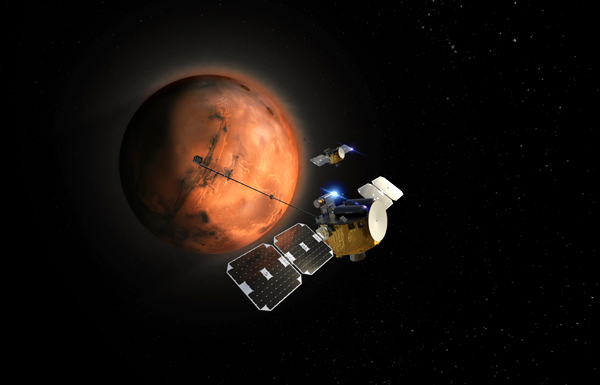
Rocket Lab / UC Berkeley
NASA’s Second ESCAPADE Spacecraft Completes Trajectory Maneuver (News Release)
On January 6, the mission operations team for NASA’s ESCAPADE (Escape and Plasma Acceleration and Dynamics Explorers) successfully completed the second trajectory correction maneuver for one of the two spacecraft, after delaying the attempt in December 2025. The other spacecraft completed its first two maneuvers in December as originally planned.
This maneuver sets up the spacecraft for its "loiter" or "Earth-proximity" orbit around a location in space about a million miles from Earth called Lagrange point 2. In November 2026, the twin spacecraft will fly by Earth to use the planet’s gravity to slingshot their way to Mars.
The two ESCAPADE spacecraft will arrive at Mars in September 2027, where they will study how a million-mile-per-hour stream of material flowing from the Sun, known as the solar wind, interacts with the Martian environment and how that drives atmospheric loss at the Red Planet.
Source: NASA.Gov
Thursday, January 01, 2026
2026 Is Finally Here...
Happy New Year, everyone. Just a reminder that Donald Trump's "One Big Beautiful Bill" (or as I call it, the One Big Bullshit Bill) will begin screwing Americans over in 2026—specifically after the November midterm elections. 17 million individuals in the United States are at risk of losing their healthcare thanks to the demented Pedophile in Chief.
So as a reminder, do everything you can to nullify the effects of this crappy piece of legislation, and completely vote blue 10 months from now! So-called House Speaker Mike Johnson and Steve "Satan" Bannon both predict that the Democrats regaining control of the House of Representatives in the midterms will lead to yet another Trump impeachment, and spell the end of his reign of incompetency and corruption... Let's prove them right.

So as a reminder, do everything you can to nullify the effects of this crappy piece of legislation, and completely vote blue 10 months from now! So-called House Speaker Mike Johnson and Steve "Satan" Bannon both predict that the Democrats regaining control of the House of Representatives in the midterms will lead to yet another Trump impeachment, and spell the end of his reign of incompetency and corruption... Let's prove them right.
Subscribe to:
Comments (Atom)