Monday, July 13, 2026

A Random Post About OBSESSION...

In the hit horror film OBSESSION, all Nikki Freeman (Inde Navarrette) wanted to do was go home for the night and get some sleep...and aspire to become a writer and feel loved out in the world.

This image that I recently saw on YouTube makes me sad. All Nikki Freeman (wonderfully played by Inde Navarrette) wanted to do was go home for the night and get some sleep...and aspire to become a writer and feel loved out in the world. At the end of the hit horror film Obsession, the cowardice of Bear (superbly portrayed by Michael Johnston) and the One Wish Willow tragically turned her into a monster instead.

Nikki Freeman (as both pre-wish Nikki and Freaky Nikki) is one of the most tragic figures to appear on the big screen.

If you would like to hear a 5-hour loop of Nikki's theme track from Rock Burwell's haunting music score for Obsession, click on the video below.

"I wish Nikki Freeman loved me more than anyone in the entire world.”

Nikki Freeman (as both pre-wish Nikki and Freaky Nikki) is one of the most tragic figures to appear on the big screen.

Thursday, July 09, 2026

The Latest Update on America's Next Saturn-bound Robotic Explorer...

The main structure for NASA's Dragonfly rotorcraft undergoes ground vibration tests inside a cleanroom at the Johns Hopkins Applied Physics Laboratory in Laurel, Maryland.
NASA / Johns Hopkins APL / Ed Whitman

NASA’s Dragonfly Clears Key Tests as Titan Rotorcraft Takes Shape (News Release)

NASA’s Dragonfly is starting to look less like a collection of spacecraft parts and more like the rotorcraft that will fly across the surface of Titan, Saturn’s hazy moon.

The mission reached a major milestone on June 29, when the Dragonfly team at the Johns Hopkins Applied Physics Laboratory (APL) in Laurel, Maryland, delivered the nearly 13-foot-long fuselage for the next phase of spacecraft integration ahead of schedule. The delivery followed a roughly month-long process of structural testing of the lander frame assembly, which carried many of the features that give the Dragonfly rotorcraft its unmistakable shape — including its landing skids, the cap for the spacecraft’s power source, and the arms that will eventually hold its eight sets of rotors.

“It was pretty awesome to see the lander, as we designed it, become real,” said Hunter Reeling, Dragonfly thermal-mechanical integration and test lead from APL.

With structural testing complete and the fuselage delivered, the team started integrating the mechanical, thermal and electrical systems on July 1, kicking off the process that will turn the lander into the flying science lab it’s meant to be.

Throughout the month, they’ll populate Dragonfly’s fuselage with the flight bulkheads, as well as the wiring harness, cables and connectors — the electrical “nervous system” that ties Dragonfly’s systems together. Electronics boxes, avionics and science instruments will follow as mission partners across the country complete their own assembly and test campaigns.

“From here, it’s about populating that structure with electronics boxes, instruments, wiring, insulation — everything that will enable its mission,” Reeling said. “It’s all about getting Dragonfly ready to launch.”

Link back home

One of the most visible additions came in May, when the Dragonfly team at APL integrated the mission’s high-gain antenna, the primary system that operators will use to communicate with the rotorcraft and retrieve the science data it collects on Titan.

The high-gain antenna is a 34.4-inch-wide (87.4-centimeter-wide) disc made of electrically-insulating foam sandwiched between two metal plates that contain hundreds of small slots. Together, these slots will narrow and focus the radio beam back to Earth. Adapted from technology originally developed for planetary defense applications, Dragonfly’s high-gain antenna, larger than previously flown systems, is attached to a motorized arm that will raise the antenna when the rotorcraft is stationary and lower it into a locking mechanism before Dragonfly takes off again.

“Every time the lander prepares to fly to another location, we store the antenna so it survives the vibrations created during flight and prevents resonance that could interfere with the rest of the lander,” said Jackson Banbury, Dragonfly telecommunications mechanical and thermal lead at APL.

The antenna and its gimbal are designed and tested to endure the rigors of Titan’s environment, including frigid temperatures averaging around -290° Fahrenheit (-179° Celsius), swirling dust on the surface, and potentially liquid methane rain.

Shaken, sealed, delivered

From May through early June, engineers and technicians at APL put the Dragonfly rotorcraft through vibration and sealing tests designed to show that the fuselage’s structural backbone can withstand the loads of launch, entry through Titan’s atmosphere, and landing on the surface of this ocean world.

For vibration testing, the team installed mass simulators in place of the flight instruments and electronics being built and tested elsewhere. The ground vibration test gave the team a fleeting preview of Dragonfly in the air. Engineers suspended the rotorcraft’s structure a few inches off the ground from long bungee cords, then measured how mechanical vibrations at the rotor locations traveled through the frame to key sensors on the main body.

“Suspended for a few hours during that test – even barely above the floor – was structurally akin to Dragonfly’s first flight,” said Gordon Maahs, the Dragonfly mechanical systems engineer from APL. “It gets the imagination going about what actual flight will look like.”

The test also included a “sit down” configuration, lowering the lander onto protective padding so it rested on its skids while engineers measured how the structure would respond on Titan’s surface.

The sealing test was more unusual. Most planetary spacecraft are built for the vacuum of space or worlds with thin atmospheres. But Dragonfly is headed to Titan, where the surface atmosphere is dense, cold and about 1.5 times the pressure of Earth’s, so engineers needed to understand how well the assembled structure could keep that environment out.

The solution: pressurize Dragonfly’s outer structure to identify any gaps, cracks or holes that could allow air flow in and out of the lander on Titan.

“I’ve never seen a test like it on any other spacecraft,” Maahs said. “We get a total flow rate based off of the sealing test, and that feeds our thermal analysis to determine if we’re sealed enough.”

The results, Maahs added, were “extremely good.”

Source: NASA.Gov

****

An engineer at the Johns Hopkins Applied Physics Laboratory inspects the motorized arm that attaches Dragonfly's high-gain antenna to the rotorcraft's body.
NASA / Johns Hopkins APL / Ed Whitman

Engineers mount the inverted Dragonfly rotorcraft structure to a vibration table inside the vibration test facility at the Johns Hopkins Applied Physics Laboratory.
NASA / Johns Hopkins APL / Ed Whitman

Tuesday, July 07, 2026

NASA's Next Interstellar-bound Probe Is Ready to Get Back to Business...

An artist's concept of NASA's New Horizons spacecraft traveling through the cosmos, with the Milky Way in the backdrop.
NASA / Johns Hopkins APL / Southwest Research Institute / Serge Brunier / Marc Postman / Dan Durda

NASA’s New Horizons Spacecraft Wakes from Hibernation in Good Health (News Release)

Following its longest hibernation period ever of nearly a year, NASA’s New Horizons spacecraft has emerged in good health and is ready to begin transmitting science data gathered in the distant Kuiper Belt far beyond Pluto.

On June 23, flight controllers at the Johns Hopkins Applied Physics Laboratory (APL) in Laurel, Maryland, confirmed New Horizons, acting on stored commands uplinked to its main computer last July, had safely awakened from a 321‑day hibernation period that began August 7. With the spacecraft now approximately 5.9 billion miles (9.5 billion kilometers) from Earth, the radio signals carrying that confirmation took about 8 hours and 52 minutes to reach the APL Mission Operations Center via NASA's Deep Space Network station near Madrid, Spain.

The mission team typically places New Horizons in resource‑saving hibernation mode during long cruise periods. While the spacecraft is hibernating, operators do not send commands or retrieve data, but the spacecraft continues gathering and storing data around the clock from its heliospheric plasma sensors, Solar Wind at Pluto and the Pluto Energetic Particle Spectrometer Science Investigation, as well as its space dust detector, the Venetia Burney Student Dust Counter.

Alice Bowman, the New Horizons mission operations manager at APL, said that the spacecraft reported back to Earth, via the Deep Space Network, with a weekly status beacon. “Every status report through this hibernation period was ‘green,’ meaning all was well aboard New Horizons each and every week,” she said.

As New Horizons resumes active operations, Bowman noted, the team will begin downlinking spacecraft health and safety data, followed by data from the three scientific instruments. In about three weeks, the spacecraft’s onboard Alice ultraviolet spectrograph will look at the hydrogen gas distribution in the outer heliosphere, while the Solar Wind at Pluto, the Pluto Energetic Particle Spectrometer Science Investigation, and the Venetia Burney Student Dust Counter instruments continue their measurements, and the ground team conducts a series of spacecraft and instrument checkouts.

The team is also completing upgrades to the ground‑system software that will make it easier to maintain operations of the spacecraft. Tests are already underway and are expected to continue through the year.

New Horizons is operating on updated autonomy logic designed for operations farther from the Sun and to accommodate the expected reduction in power and the naturally occurring increase in radio‑signal travel time.

The NASA spacecraft’s exploration of this distant region of the Solar System marks the latest step in a journey that began in January 2006 with the fastest launch on record; a flyby of Jupiter in February 2007 that included stunning views of the gas giant and its moons; the first exploration through the Pluto system in July 2015; the first exploration of a Kuiper Belt object, Arrokoth, in January 2019, and unique studies of the Sun’s outer heliosphere and dozens of additional Kuiper Belt objects since then.

Source: NASA.Gov

Monday, July 06, 2026

The Latest Update on a Venerable Japanese Space Probe...

An image of asteroid Torifune that was taken by Japan's Hayabusa2 spacecraft...on July 5, 2026 (Japan Standard Time).
JAXA, The University of Tokyo, Chiba Institute of Technology, Institute of Science Tokyo, AIST, Paris Observatory, IAC

Hayabusa2 Captures Images of Asteroid Torifune (News Release)

The asteroid explorer Hayabusa2 was launched in December 2014 onboard the H-IIA Launch Vehicle No. 26. The mission explored asteroid Ryugu, delivering samples from Ryugu to Earth on 6 December 2020. Since then, the spacecraft returned to deep space on an Extended Mission.

On 5 July 2026 at 18:30 JST (error margin: ±1 second), Hayabusa2 successfully performed a flyby of Torifune, the asteroid selected as the first exploration target of the Extended Mission. (Time is a preliminary estimate.)

Observations with the onboard scientific instruments began in mid-June with the Optical Navigation Camera – Telescopic (ONC-T), which directly imaged Torifune on June 20. Observations with the ONC-T then continued with the primary purpose to support optical-radio hybrid navigation for the spacecraft during the approach to Torifune. From about one hour before the closest approach, observations were also conducted using the NIRS3 (Near-Infrared Spectrometer), TIR (Thermal InfraRed Imager), and LIDAR (Light Detection and Ranging) instruments.

These observations continued until immediately before the closest approach to Torifune but could not be conducted after the spacecraft had passed the asteroid. At present, only part of the data acquired by the scientific instruments has been transmitted to Earth. The remaining data will be transmitted to the ground during future operations.

Source: Japan Aerospace Exploration Agency

****

An infrared image of asteroid Torifune that was taken by Japan's Hayabusa2 spacecraft from 6.2 miles (10 kilometers) away...on July 5, 2026 (Japan Standard Time).
JAXA, Maebashi Institute of Technology, Chiba Institute of Technology, The University of Aizu, Hokkaido University of Education, AIST

Sunday, June 21, 2026

America's Next Great Observatory Is Now at Kennedy Space Center for Flight Preparations!

With the Nancy Grace Roman Space Telescope aboard, NASA's Pegasus barge arrives at Kennedy Space Center in Florida...on June 21, 2026.
NASA / Amber Jean Notvest

NASA’s Next-Generation Telescope Arrives in Florida Ahead of Launch (News Release)

NASA’s Nancy Grace Roman Space Telescope arrived at the agency’s Kennedy Space Center in Florida on June 21, marking the start of final prelaunch preparations before liftoff later this summer.

After teams completed integration and testing on the observatory at NASA’s Goddard Space Flight Center in Greenbelt, Maryland, they loaded Roman into a protective and environmentally-controlled transportation container and drove it to the port of Baltimore. There, the agency’s Pegasus barge safely transported the nearly 18,000-pound (8,200-kilogram) spacecraft down the coast of the Atlantic Ocean to its new home in Florida at the Payload Hazardous Servicing Facility, which recently completed upgrades to prepare for Roman’s arrival.

Technicians met the telescope at NASA Kennedy’s turn basin wharf and offloaded the trailer carrying the observatory from the barge, where they connected it to a truck that transported Roman to the servicing facility.

When the spacecraft arrives at the facility, technicians will complete initial cleaning outside the building before moving the shipping container into the facility’s airlock. Once in the airlock, they will perform additional cleaning to reduce any remaining contaminants from the trip. The facility’s air filtration system will also scrub the air until the team can safely open the inner door.

Once inside the facility, technicians will unbox the spacecraft, raise it to a vertical position in the airlock, and move it into the clean room.

On Monday, June 22, technicians plan to remove the cover from the transport container and move Roman into the high bay. Later, technicians will use large cranes to move Roman to its work platform - called the Pantheon. During the observatory’s time at the processing facility, technicians will perform several tasks, including testing the six solar panels and inspecting Roman’s insulation and thermal blankets to ensure that the observatory is fully protected and flight ready.

Specially-trained team members will load about 290 gallons of hydrazine fuel into the spacecraft’s tanks.

NASA is targeting launch no earlier than Sunday, August 30, on a SpaceX Falcon Heavy rocket from Launch Complex 39A at Kennedy. This puts Roman eight months ahead of schedule.

After launch, Roman will travel to the second Sun-Earth Lagrange point, or L2. There, it will make observations that give astronomers the chance to study an incredible number of new objects. Roman’s wide field of view and rapid survey capabilities will reveal billions of galaxies, hundreds of thousands of new exoplanets, hundreds of blackholes, and will provide vast volumes of daily data for astronomers to study.

The observatory will also map how common different kinds of planets are in our galaxy and help answer big questions about the Universe, like what’s causing its rapid expansion and what distant worlds and cosmic objects look like in infrared light. In addition to its main instrument, which features a 300-megapixel camera, Roman will demonstrate technology designed to block starlight to directly image exoplanets and planet-forming disks.

Alongside Roman, the Pegasus barge also carried a weather cover for the Artemis III SLS (Space Launch System) core stage. The cover will protect the stage thermal systems while it sits at Launch Complex 39B in its short stack configuration. Because schedules aligned, the barge was able to transport NASA’s next flagship astrophysics mission together with the Artemis hardware, maximizing resources to support missions across the agency during the Golden Age of innovation and exploration.

Source: NASA.Gov

****

Monday, June 15, 2026

Marking a Quarter Century Since the 2001 NBA Championship...

On this day 25 years ago, Kobe Bryant and the Los Angeles Lakers won their second straight NBA title in the Kobe-Shaquille O'Neal era. They went 15-1 in the playoffs that spring...sweeping the Portland Trailblazers, Sacramento Kings and San Antonio Spurs before defeating the Philadelphia 76ers in five games during the NBA Finals.

That was an awesome postseason! We'll see what the Lakers do this summer in their attempt to become the kings of the West again. And then going on to win their 18th NBA championship in franchise history.

Kobe Bryant reflects to himself after the Los Angeles Lakers defeated the Philadelphia 76ers in Game 5 of the NBA Finals...winning a second straight championship on June 15, 2001.

Sunday, June 14, 2026

The Drought Has Finally Come to an End for the Big Apple...

The New York Knicks are the 2026 NBA champions.

I was rooting for Victor Wembanyama and the San Antonio Spurs to win it all, but congrats to the New York Knicks for emerging victorious as the NBA champions for the first time in 53 years!

I would've rooted for the Knicks directly had they played against the Oklahoma City Thunder instead. Wemby and Co. blowing that 29-point lead in Game 4 made me want Jalen Brunson, Karl-Anthony Towns, OG Anunoby and the rest of their teammates to finish the job yesterday.

The Spurs will no doubt be the favorites in the West to return to the NBA Finals next year... Let's see if the Knicks break the current 8-year streak of teams (including the Los Angeles Lakers in 2020) not winning a back-to-back championship after Steph Curry and the Golden State Warriors were the last ones to do so in 2017 and '18, respectively. Happy Sunday!

Saturday, June 13, 2026

On This Day in 1996: Cool Things Happened in High School...

A photo I took at Bishop Amat Memorial High School, my alma mater.
Richard T. Par

Just thought I'd point out that today marks 30 years since I had my final exam that concluded 10th grade at my alma mater, Bishop Amat Memorial High School! The test that I took on June 13, 1996 was for my English II class...which I had for 7th period.

So why was this date memorable, you ask? Because of a girl I had a crush on, of course! I won't divulge her (full) name here, but she was the prettiest Filipina in my class—and probably in all of Amat, truthfully—and I was fortunate enough to have managed to be on speaking terms with her for much of sophomore year.

We hugged after the English II exam ended (she was also in my homeroom and 3rd period World History class, respectively), and that was the last time I saw her for almost the next two years. (She ended up transferring to another high school for 11th and 12th grade, but showed up at a birthday party of one Amat classmate in February of '98, and the graduation party of another classmate four months later.) This hug was so big that my brother's friends (they all graduated from Amat two weeks before) found out about it afterwards...and expressed awe at my lucky moment.

That's how significant it was that I was on good terms with Des during the 1995-'96 school year!

Friday, June 12, 2026

Another Update on America's Newest X-Plane...

NASA’s X-59 QueSST aircraft completed its first mission conditions flight above the Mojave Desert in California...on June 12, 2026.
NASA / Lori Losey

NASA’s X-59 Reaches Speed, Altitude for Future Quiet Supersonic Flights (News Release)

NASA’s X-59 experimental aircraft reached a major milestone on Friday, June 12 — flying Mach 1.4 (about 924 mph) and an altitude of 55,000 feet, the conditions required for the aircraft to make future flights critical to its mission.

The X-59 still has months of performance testing ahead, but after those are complete, NASA’s QueSST mission will fly the aircraft over several U.S. communities to collect data on public perception of the quiet sonic thump that it will make at supersonic speeds. Those community overflights will include flights at Mach 1.4 and 55,000 feet.

The milestone comes just days after the X-59’s first supersonic flight. That flight showed the aircraft performed as expected at Mach 1.1, but Friday’s mission conditions flight was an even more critical step for NASA.

The aircraft’s team has steadily expanded the aircraft’s flight envelope by evaluating its performance at a variety of speeds and altitudes, and having its pilots take on a battery of maneuvers.

The X-59 was designed to fly supersonic without causing a loud sonic boom. However, for these early supersonic flights it has been accompanied by a NASA F-15 research aircraft, a traditional supersonic jet that causes booms obscuring any noise that the X-59 makes. During upcoming flights, a shock-sensing probe mounted to the F-15 will gather measurements of the X-59’s shock wave signature, an early measure of its supersonic performance.

After the team conducts more tests at a variety of altitudes and conditions to complete envelope expansion, the X-59 will enter the acoustic validation phase of QueSST. During this phase, researchers will thoroughly measure the aircraft’s supersonic acoustic signature — the quiet thump it’s designed to make — to confirm that it is performing as intended.

Each flight brings NASA one step closer to flying the X-59 over communities and gathering feedback that could help shape the future of commercial supersonic flight over land.

Source: NASA.Gov

Friday, June 05, 2026

America's Newest X-Plane Has Finally Broken the Sound Barrier!

NASA’s X-59 QueSST aircraft completed its first supersonic flight above the Mojave Desert in California...on June 5, 2026.
NASA / Lori Losey

NASA’s X-59 Aircraft Flies Supersonic for First Time (News Release)

NASA’s experimental X-59 aircraft marked a major milestone on Friday, June 5, when it flew faster than the speed of sound for the first time, setting the stage for demonstrating its quiet supersonic capabilities later this year.

NASA test pilot Jim “Clue” Less took off and landed at Edwards Air Force Base in California, reaching a top speed of approximately Mach 1.1 (713 mph) and altitude of 43,400 feet. The X-59’s flight began at 11:08 a.m. PDT and lasted 81 minutes, with the team focusing on flying qualities at both subsonic and then supersonic speeds.

”X-59 is getting ready for its quiet supersonic debut. Since the aircraft’s first flight on October 28, 2025, the team has made tremendous progress, flying 16 times in the last 90 days and getting into a steady test rhythm. In the coming days, we expect to take the next step and push to Mach 1.4,” said NASA Administrator Jared Isaacman. “I’m grateful to the NASA team and Lockheed Martin Skunk Works for their help getting us to this point, and I hope this is the first of many collaborations as we rebuild NASA’s X-plane portfolio.”

The X-59 is designed to fly at supersonic speeds while creating only a quiet thump instead of a loud sonic boom. For this flight, a NASA F‑15 chase plane flew nearby to monitor the X‑59. The loud sonic booms from the F-15 obscured any sound made by the X-59.

This first supersonic flight is a significant milestone, but an event even more critical to the mission is upcoming. In just days, the aircraft is expected to make its first “mission conditions” flight, reaching a cruising speed of Mach 1.4 (925 mph) and altitude of approximately 55,000 feet. The X-59 will also be accompanied by a chase plane for this flight.

This speed and altitude are the base conditions for the X-59 when it will eventually fly over several U.S. communities, enabling NASA to gather data about how people may perceive its quiet thump. NASA will share this data with U.S. and international regulators to help establish new data-driven noise standards to enable a future viable market for supersonic commercial flight over land.

For the last several months, the X-59 has been participating in an ongoing series of flights where the plane has been flying at a wide range of speeds and altitudes – a process known as envelope expansion. These tests are the first phase of the X-59’s flight testing. They are focused on performance and involve chase plane monitoring.

When the X-59 completes this phase it will enter another, focused on its sound profile in order to verify its quiet thump capability.

The X-59 is the centerpiece of NASA’s QueSST mission, which aims to demonstrate quiet supersonic flight and help enable commercial supersonic flight over land worldwide. These advancements will help travelers reach their preferred destinations faster, spending less time in the air.

Through QueSST’s development of the X-59, NASA will also deliver design tools and technology for quiet supersonic airliners that will achieve the high speeds desired by commercial operators without disturbing people on the ground. NASA will validate design tools through ground and flight testing, providing U.S. aircraft manufacturers the ability to explore new quiet supersonic concepts, and provide them with confidence that their resulting designs will meet quiet flight requirements.

Source: NASA.Gov

****

Thursday, June 04, 2026

America's Next Great Observatory Has an Official Launch Date!

At NASA's Goddard Space Flight Center in Greenbelt, Maryland, the Nancy Grace Roman Space Telescope sits fully assembled inside a cleanroom...and awaits launch that's officially scheduled for August 30, 2026.
NASA / Jolearra Tshiteya

Hello, World! NASA Shares New Home for Roman Space Telescope Updates (News Release - June 3)

We’re kicking off the inaugural Roman blog post with a launch update: NASA’s Nancy Grace Roman Space Telescope is officially slated to launch on August 30, eight months ahead of schedule and even earlier than previously targeted.

With less than three months to go, the Roman team is now finishing up final tasks. Engineers are currently packing Roman up for a voyage from NASA’s Goddard Space Flight Center in Greenbelt, Maryland, down to the agency’s Kennedy Space Center in Florida later this month.

Once at Kennedy, Roman will move into the Payload Hazardous Servicing Facility, where it will undergo a thorough inspection to verify that all of the observatory’s components traveled well. In the weeks leading up to launch, engineers will perform powered testing and launch rehearsals, load about 290 gallons (roughly 1,100 liters) of hydrazine fuel into the tanks, and install the observatory on the adapter for the SpaceX Falcon Heavy rocket that will propel it to its destination in space: the second Sun-Earth Lagrange point, or L2, which is about four times farther away than the Moon is from Earth.

Next, Roman will be encapsulated in a protective fairing, or nose cone, which will shield the telescope during liftoff and its journey through the atmosphere. Roman will then move to a hangar for integration with the SpaceX Falcon Heavy rocket before rolling out to Launch Complex 39A at NASA Kennedy.

All this work will culminate in Roman delivering never-before seen views of the Universe. The observatory will pair a large field of view with crisp infrared vision to survey deep, vast swaths of sky. While the mission was designed with dark energy, dark matter, and planets outside our Solar System in mind, Roman’s unprecedented observational capability will offer practically limitless opportunities for astronomers to explore a broad range of cosmic phenomena.

Source: NASA.Gov

Wednesday, June 03, 2026

Bidding Adieu to a U.S. Mars Orbiter...

A composite image depicting NASA's MAVEN spacecraft in orbit around Mars.
NASA

NASA Says Farewell to MAVEN Mars Mission, Hosts Media Call Today (News Release)

The first mission devoted to observing the Martian atmosphere and its evolution, NASA’s MAVEN (Mars Atmosphere and Volatile Evolution), has ended after more than 11 years in orbit at Mars and a decade beyond its primary, one-year mission. The spacecraft was heard last on December 6, when it experienced an unexpected loss of signal after it passed behind the Red Planet.

NASA will host a media teleconference at 2 p.m. EDT today, Wednesday, June 3, to discuss MAVEN’s achievements.

The agency convened an anomaly review board in February to evaluate recovery efforts and assess the spacecraft’s probable current state. The review board has determined that the MAVEN spacecraft is not recoverable, and it is no longer capable of performing its science and data relay mission, which is consistent with the mission team’s findings.

Telemetry from MAVEN prior to the spacecraft’s passage behind Mars in December showed all subsystems working normally. After the spacecraft emerged, NASA’s Deep Space Network (DSN) did not observe a signal. A brief fragment of telemetry data from analysis of radio signals recorded by the DSN’s open-loop receivers indicated that the spacecraft was in safe mode and rotating at an unusually high rate when it emerged from behind Mars, indicating a disruption in MAVEN’s orbit trajectory.

The review board concluded that due to this rotation, the batteries on the spacecraft had drained, causing the communications system to lose power and rendering MAVEN in an unrecoverable state.

These preliminary findings do not address a potential root cause for the anomaly, which is still being investigated. The review board is expected to provide its final report later this year. NASA has begun the official process of decommissioning the MAVEN mission, following standard procedures to archive the full mission dataset for the science and exploration communities.

“The science MAVEN has given us is key to informing what kind of radiation protection and safety measures we must take before sending humans to Mars,” said Louise Prockter, director of the Planetary Science Division at NASA Headquarters in Washington. “The data collected from MAVEN will continue to provide valuable insight into Mars for decades to come.”

Launched in November 2013, the MAVEN mission explored the Red Planet’s upper atmosphere, ionosphere, and interactions with the Sun to explore the loss of the Martian atmosphere to space. Understanding atmospheric loss gives scientists insight into the history of the planet’s atmosphere and climate, liquid water, and planetary habitability.

“The MAVEN mission has truly advanced our understanding of the Martian atmosphere and evolution. This dataset has had a tremendous impact on the field,” said Shannon Curry, MAVEN’s principal investigator and a researcher at the Laboratory for Atmospheric and Space Physics at the University of Colorado Boulder. “Our science team is exceptionally proud of all of these amazing discoveries.”

Sun’s impact on Mars

One of MAVEN’s first major results was that the erosion of Mars’ atmosphere increases significantly during solar storms. The team studied how the solar wind, which is a stream of charged particles continually streaming from the Sun, and solar storms continually strip away Mars’ atmosphere, as well as how this process played a key role in altering the Martian climate from a potentially habitable world to today’s cold, arid planet. The MAVEN mission made unprecedented strides in advancing our understanding of how the Sun and space weather affect Mars, as it was the only spacecraft that could simultaneously take measurements of both the Sun and the Martian atmospheric response.

Martian light shows

The MAVEN mission discovered several types of auroras that light up when energetic particles plunge into the atmosphere, bombarding gases and making them glow. The MAVEN team showed that protons create new kinds of auroras at Mars. On Earth, proton auroras only occur in very small regions near the poles, whereas at Mars they can occur everywhere.

Mars’ atmosphere sputters into space

To better understand how Mars lost most of its atmosphere, MAVEN measured atmospheric sputtering for the first time at any planet. The team did this by observing argon, which is a noble gas, meaning that it rarely reacts with other constituents in the Martian atmosphere. The only significant way it can be removed is by atmospheric sputtering, a process where ions crash into the Martian atmosphere at high enough speeds that they splash gas molecules out of the atmosphere, much like doing a cannonball into a pool.

The team used 11 years of data to reveal the presence of sputtered argon at high altitudes in the exact locations that the energetic particles crashed into the atmosphere, showing sputtering in real time.

Understanding Mars’ dusty secrets

In 2018, a series of dust storms created a dust cloud so large that it enveloped the Red Planet. The MAVEN team studied how this “global” dust storm affected Mars’ upper atmosphere to understand how these events affected the escape of water to space. It confirmed that heating from dust storms can loft water molecules far higher into the atmosphere than usual, leading to a sudden surge in water lost to space.

Chasing comets

In addition to Martian science, MAVEN contributed to NASA’s effort to observe comet 3I/ATLAS at Mars. Over the course of 10 days last year, the MAVEN team designed a new observing campaign to capture 3I/ATLAS by taking multiple images of the comet in several wavelengths, much like using various filters on a camera. Then it snapped high-resolution UV images to identify the hydrogen coming from the comet.

By studying a combination of these images, scientists can identify a variety of molecules and better understand the comet’s composition and history.

During the mission’s lifetime, MAVEN’s science team produced more than 800 publications, and additional publications are planned.

In addition to science, the MAVEN spacecraft was an instrumental player in NASA’s Mars Relay Network, communicating data from Mars rovers to Earth. It also holds the Solar System record for most data relayed from another planet in a single day.

Audio of today’s media teleconference will stream on the agency’s website at:

https://www.nasa.gov/live

Participants in the teleconference include:

-- Tiffany Morgan, director, Mars Exploration Program, Planetary Science Division, NASA Headquarters
-- Mike Moreau, project manager, MAVEN, NASA’s Goddard Space Flight Center, Greenbelt, Maryland
-- Greg Heckler, deputy program manager for Capability Development, SCaN (Space Communications and Navigation), NASA Headquarters
-- Shannon Curry, MAVEN principal investigator, Laboratory for Atmospheric and Space Physics at the University of Colorado Boulder

To ask questions by phone, media must RSVP no later than 12 p.m. to: sarah.frazier@nasa.gov. NASA’s media accreditation policy is available online.

The MAVEN mission is part of NASA’s Mars Exploration Program portfolio. The mission’s principal investigator is based at the Laboratory for Atmospheric and Space Physics at the University of Colorado Boulder, which is also responsible for managing science operations and public outreach and communications. NASA’s Goddard Space Flight Center in Greenbelt, Maryland, manages the MAVEN mission.

Lockheed Martin Space built the spacecraft and is responsible for mission operations. NASA’s Jet Propulsion Laboratory in Southern California provides navigation and Deep Space Network support.

Source: NASA.Gov

****

My certificate for the MAVEN mission.

Tuesday, June 02, 2026

On This Day in 2021: An Exciting Flyby Mission of Neptune and Triton Was Shunned by NASA...

A computer-generated illustration I created of the once-proposed Trident flyby mission to Neptune's moon Triton.
L.M. Prockter et al. LPI / JPL / SwRI / Richard T. Par

So today marks 5 years since the Trident mission—which involved a Voyager 2-type flyby of Neptune and its main moon Triton—was rejected by NASA in favor of two Venus missions for its Discovery program.

Trident was supposed to launch as early as last October and no later than this October. It would've flew past Neptune and Triton in June 2038. What could've been...

Click here to read a full Blog entry on my reaction to Trident's loss in that competition half a decade ago.

Monday, June 01, 2026

The Latest Update on America's Next Saturn-bound Robotic Explorer...

Lockheed Martin engineer Derek Shannon inspects samples of thermal protection material for the Dragonfly heat shield...before they underwent testing at Sandia National Labs’ Solar Thermal Test Facility in Albuquerque, New Mexico.
NASA

NASA’s Dragonfly Flight System Faces Heat (News Release)

In preparation for the journey to reach the surface of Saturn’s largest moon, Titan, the heat shield for NASA’s Dragonfly mission completed thermal-structural testing in the New Mexico desert. Dragonfly team members, including those from NASA’s Ames Research Center in California’s Silicon Valley, the Johns Hopkins Applied Physics Laboratory (APL) in Laurel, Maryland, and Lockheed Martin in Littleton, Colorado, collaborated with personnel at Sandia National Laboratories’ National Solar Thermal Test Facility in Albuquerque, New Mexico, to stress-test Dragonfly’s heat shield materials, ensuring that the rotorcraft will be safely delivered through Titan’s dense atmosphere.

Dragonfly’s thermal protection material, made from carbon fiber and a lightweight resin, performed as expected in combined mechanical and thermal testing, even in cases when it was intentionally marred with defects.

Sandia’s Solar Tower test facility houses an array of hundreds of calibrated mirror-like systems to focus energy from the Sun onto a tower holding the test unit. Operators generated temperatures around 4,500° Fahrenheit (nearly 2,500° Celsius) on segments of Dragonfly’s heat shield material. Tests examined tolerance to thermal radiation as well as the rapid change in temperature that researchers expect Dragonfly to experience.

The Sandia test series involved multiple iterations in conditions like those expected during Dragonfly’s entry into Titan’s atmosphere. Additional testing subjected large samples of the heat-shield material to mechanical and thermal stress to simultaneously simulate the pressure of high-speed atmospheric entry and intense thermal conditions. Thermal testing of the heat-shield’s curved shoulder units was also performed.

“We were pleased to see the heat shield material pass these tests, even with the flaws we intentionally included, like those that might naturally occur during fabrication and integration,” said Milad Mahzari, the Dragonfly entry vehicle thermal protection system lead at NASA Ames.

Dragonfly’s heat shield uses a variation of a NASA-invented material called PICA, or Phenolic Impregnated Carbon Ablator. The original PICA material was used to deliver NASA’s Curiosity and Perseverance rovers to Mars. PICA-D, a new variant of PICA, is planned for flight on Dragonfly and was the focus of this test series.

“We tested the heat shield as a complete system, including the primary PICA-D material, gap fillers, and potential manufacturing defects,” Mahzari said, adding that researchers plan to conduct additional analysis of PICA-D before final construction of the heat shield begins.

Dragonfly rotorcraft integration and testing continues at APL, which designed Dragonfly and leads the mission for NASA. Dragonfly is scheduled to launch in 2028 and reach Titan in 2034 to conduct science across multiple locations, sample surface materials to measure their detailed compositions, and observe geology and meteorology on the only moon in the Solar System known to have a substantial atmosphere.

Communications on board

Work continues to test and integrate Dragonfly’s communications system, including the antennas that will link the rotorcraft to operators back on Earth.

The team recently measured the signal patterns coming from Dragonfly’s largest antenna – its high-gain antenna, or HGA – in an APL test chamber that simulates the space environment. The HGA is a 34.4-inch diameter radial line slot antenna, which uses many small slots working together to create a narrow, focused radio beam.

The technology for this antenna was originally developed for NASA’s DART mission and is also flying on NASA’s twin ESCAPADE spacecraft.

“A simple way to picture the antenna is as a large flat showerhead: energy enters near the center and spreads out through the slots in a controlled pattern,” said Matt Bray, Dragonfly lead antenna designer at APL. “This design provides a low-cost, durable and compact approach to high-efficiency communications in extreme space environments and also provides aerodynamic benefits.”

The HGA, Dragonfly’s primary antenna for transmitting science data, will be attached to the top deck of the lander on a gimbal that allows it to track Earth from various locations on Titan’s surface. It will be covered with Kapton, a thermal insulator, for protection from Titan’s weather and crafted to operate in the moon’s frigid environment, where ambient temperatures are 290° below zero Fahrenheit (179° below zero Celsius).

The HGA will be one of three antennas on Dragonfly designed for operations at Titan. The lander will also fly a medium-gain antenna, primarily as a backup to the HGA, and a low-gain antenna, primarily to transmit status tones during flight as well as for emergency communications.

Source: NASA.Gov

****

Dragonfly lead antenna designer Matt Bray evaluates Dragonfly’s high-gain antenna in a test chamber at the Johns Hopkins Applied Physics Laboratory in Laurel, Maryland.
NASA / Johns Hopkins APL / Ed Whitman

Thursday, May 28, 2026

The Latest Update on America's Newest X-Plane...

NASA’s X-59 QueSST aircraft flies above mountains near NASA’s Armstrong Flight Research Center at Edwards Air Force Base in California...on May 12, 2026.
NASA / Jim Ross

NASA’s X-59 Prepares for First Supersonic Flight (News Release)

NASA’s X-59 quiet supersonic research aircraft is preparing for some of its most significant flights yet. The X-plane is about to begin a new block of test flights that will include its first time flying faster than the speed of sound and other mission-critical objectives.

“What comes next is the first time this one-of-a-kind aircraft will fly supersonic,” said Cathy Bahm, project manager for NASA’s Low Boom Flight Demonstrator. “We are starting toward the mission conditions test point that X-59 was designed for.”

After months of flights, the X-59 team reviewed their progress in late May and now look towards the aircraft’s next series of flight tests, including higher altitudes and faster speeds. This will give engineers a look at how the X-59 handles under required operational conditions for NASA’s QueSST mission to eventually gather data on quiet supersonic flight.

The team expects the X-59 to fly supersonic – over 630 mph – for the first time at approximately 43,000 feet altitude during a series of test flights in early June, a major milestone for the aircraft. After that, it will conduct a “mission conditions” flight, where it will hit Mach 1.4 (925 mph) at approximately 55,000 feet. That speed and altitude are important because they’re NASA’s performance targets for the X-59 to eventually fly over U.S. communities to demonstrate quiet supersonic flight and collect feedback data about the aircraft’s quiet sonic “thump” from the public.

While the X-59 is designed to fly at supersonic speeds without producing a loud sonic boom, these early flights are not yet intended to demonstrate its quiet supersonic capabilities. The X-59 will be accompanied by a traditional supersonic chase plane, so any quiet thump that it produces in the current phase of testing will be obscured by louder, traditional sonic booms from the chase. In supersonic flights this summer, the chase aircraft will also be outfitted with a specialized shock-sensing probe to take initial measurements of the X-59’s shock waves.

Completed flights

The X-59’s first block of flights successfully met several test goals, generating data for its team to analyze. After making its first flight in October 2025, it entered a scheduled period of maintenance before returning to the skies in March 2026. It has since completed 14 additional flights, marking milestones including:

-- Its first gear swing, or the retraction of its landing gear to show off its sleek design for the first time.
-- Reaching altitudes up to 43,000 feet and near supersonic speeds at Mach 0.95, approximately 627 mph.
-- Marking its first dual-flight day and then making those increasingly routine as the X-59 team increased flight cadence.
-- After a period of moving higher and faster, transitioning into lower and slower test flight conditions so engineers could gather information on the X-59’s behavior across a range of flight conditions.

Data collected during the X-59’s first block of test flights helped teams better assess critical systems, including fuel, hydraulics, environmental controls, and the eXternal Vision System, which is the aircraft’s unique series of cameras that feed into a monitor that allows the pilot to see forward instead of using a traditional windshield. Teams monitored how the aircraft behaved during takeoff, landing, and throughout flight. Strain gauges installed throughout the X-59 collected detailed information on the forces that it experienced, and how its structure responded to them.

Next steps

During the X-59’s upcoming flights, pilots will run through test points while engineers watch the aircraft’s performance — but now in supersonic flight conditions.

“Flying at supersonic speeds is a major milestone for the X-59 team,” Bahm said. “Every step of envelope expansion brings us closer to demonstrating the quiet supersonic capability that is at the heart of the QueSST mission. Completing the first mission-conditions flight is especially meaningful – it’s the moment where we begin validating the aircraft in the environment it was designed for.”

In addition to reaching mission condition during this block of flight tests, the X-59 will also achieve its maximum speed of Mach 1.6 (1,218 mph) and altitude of 60,000 feet.

But just because the aircraft can go that fast doesn’t mean it will always fly supersonic. Testing will continue, including a mix of subsonic and lower-altitude flights so the team can continue monitoring it in varied conditions.

“These flights not only deepen our confidence in the X-59’s performance – they mark our progression toward the future phases of the mission that will ultimately help shape the future of supersonic travel,” Bahm said.

All flights so far and in the upcoming test block are part of Phase 1 of the X-59’s QueSST mission, focused on proving the performance and airworthiness of the aircraft. Some of those flights will include early deployment of equipment, including a probe mounted to one of NASA’s F-15 research aircraft that can measure the X-59’s unique shock wave signature.

Data gathered during those early probing flights will allow engineers to prepare for a new stage of work set to begin later this year: QueSST Phase 2, when teams will begin to measure the aircraft’s supersonic flight signature to verify that it’s producing a quiet supersonic thump, as designed.

“Aviation pioneer Otto Lilienthal said, ‘To design a flying machine is nothing. To build one is something. But to fly is everything.’ The 15 X-59 flights we’ve accomplished since March have been everything to this team and the mission,” Bahm said. “Every flight has pushed the boundaries of what’s possible, steadily expanding the envelope and strengthening our confidence in the aircraft.”

But, she said, rather than focusing on past progress, the team is already looking ahead.

“As we look ahead to the upcoming flights, we’re poised to open the envelope even further – moving boldly toward the mission test point this aircraft was built to achieve,” Bahm said. “Flying supersonic and reaching these milestones isn’t just progress; it’s the realization of years of perseverance, innovation and teamwork. Each step brings us closer to Phase 2, and to the future of commercial supersonic flight.”

Source: NASA.Gov

****

Saturday, May 23, 2026

Photos of the Day: STARS ON ICE in Anaheim...

The seven figure skating gold medalists of Team USA at STARS ON ICE in Anaheim...on May 16, 2026.
Richard T. Par

Today marks one week since I went to the Honda Center in Anaheim to watch Stars on Ice...an event that celebrated top athletes in the figure skating world. This occasion featured all of the Team USA members who won gold medals in the sport at this year's Winter Olympic Games!

The top draw of the night was Alysa Liu, who was the first American since Sarah Hughes in 2002 to win an individual gold medal in figure skating. Joining her was Amber Glenn, Isabeau Levito (the three of them form a dynamic skating trio known as the Blade Angels), Ilia Malinin (the "Quad God"), Madison Chock, her husband and skating partner Evan Bates, as well as Ellie Kam and her skating partner Danny O'Shea.

Along with pictures, I've also posted tweets with videos of some of the performances from seven days ago. In case you're wondering why the photos and videos below aren't exactly DSLR or UHD quality, it's because I sat near the top of the nosebleed section at Honda Center for this event!

Anyways, Stars on Ice was very enjoyable. If this is what it feels like to watch top American Olympians in action, then I definitely need to attend a competition or two at the 2028 Los Angeles Summer Olympics!

Of course, it would've helped if I bought tickets to the LA28 Games when they immediately became available over a month ago... Oh well. Happy Saturday!

At the Honda Center in Anaheim to attend STARS ON ICE...on May 16, 2026.
Richard T. Par

STARS ON ICE is about to begin at the Honda Center in Anaheim...on May 16, 2026.
Richard T. Par

Alysa Liu performs her first program of the night at STARS ON ICE in Anaheim...on May 16, 2026.
Richard T. Par

Alysa Liu and Madison Chock after Liu's first program concluded at STARS ON ICE in Anaheim...on May 16, 2026.
Richard T. Par

Ellie Kam and Danny O'Shea perform a program at STARS ON ICE in Anaheim...on May 16, 2026.
Richard T. Par

Madison Chock and Evan Bates acknowledge the crowd after their performance at STARS ON ICE in Anaheim...on May 16, 2026.
Richard T. Par

The 'Blade Angels' (Alysa Liu, Amber Glenn and Isabeau Levito) acknowledge the crowd after their performance at STARS ON ICE in Anaheim...on May 16, 2026.
Richard T. Par

Alysa Liu is about to perform 'Stateside,' her final program of the night at STARS ON ICE in Anaheim...on May 16, 2026.
Richard T. Par

The seven figure skating gold medalists of Team USA at STARS ON ICE in Anaheim...on May 16, 2026.
Richard T. Par

STARS ON ICE concludes at the Honda Center in Anaheim...on May 16, 2026.
Richard T. Par

Posing for a selfie at the Honda Center in Anaheim...on May 16, 2026.


Tuesday, May 19, 2026

The Latest Update on America's Newest Asteroid Explorer...

An image of Mars that was taken by NASA's Psyche spacecraft as it flew past the Red Planet for a gravity assist...on May 15, 2026.
NASA / JPL - Caltech / ASU

NASA’s Psyche Mission Aces Mars Flyby, Targets Metal-Rich Asteroid (News Release)

NASA’s Psyche spacecraft completed its close approach of Mars on May 15, coming within 2,864 miles (4,609 kilometers) of the planet’s surface. This flyby used a gravity assist from Mars to provide a critical boost in speed and to adjust the spacecraft’s orbital plane without using any onboard propellant, sending it on its way towards the metal-rich asteroid Psyche.

The spacecraft is now headed directly towards the asteroid, located in the main asteroid belt between Mars and Jupiter. After the Mars flyby, the flight team analyzed radio signals between the spacecraft and NASA’s Deep Space Network (DSN), the agency’s global system for communicating with interplanetary spacecraft, to confirm that Psyche was on the correct trajectory.

“Although we were confident in our calculations and flight plan, monitoring the DSN’s Doppler signal in real time during the flyby was still exciting,” said Don Han, Psyche’s navigation lead at NASA’s Jet Propulsion Laboratory in Southern California. “We’ve confirmed that Mars gave the spacecraft a 1,000 mile‑per‑hour boost and shifted its orbital plane by about 1 degree relative to the Sun. We are now on course for arrival at the asteroid Psyche in summer 2029.”

Unique Martian view

In the days running up to and during close approach, all of Psyche’s instruments were powered up for calibration efforts, including its imagers, magnetometers, and gamma-ray and neutron spectrometer. The planetary encounter provided the mission a valuable practice run for when it reaches the asteroid Psyche; as a bonus, it captured Mars images from a rare perspective.

Because Psyche approached Mars from a high phase angle, the planet appeared as a thin crescent in the days running up to the close approach, lit by sunlight reflecting off its surface. In observations from the spacecraft’s multispectral imager, the crescent appeared brighter and extended farther around the planet’s disk than anticipated because of the strong scattering of sunlight through the planet’s dusty atmosphere. As Psyche passed from Mars’ nighttime skies to daytime, it took a rapid series of pictures of the surface around the time of closest approach.

“We’ve captured thousands of images of the approach to Mars and of the planet’s surface and atmosphere at close approach. This dataset provides unique and important opportunities for us to calibrate and characterize the performance of the cameras, as well as test the early versions of our image processing tools being developed for use at the asteroid Psyche,” said Jim Bell, the Psyche imager instrument lead at Arizona State University (ASU) in Tempe. “As the spacecraft continues its journey after the flyby, we’ll continue calibration imaging of Mars for the rest of the month as it recedes into the distance.”

Bell also leads the Mastcam-Z imaging investigation on NASA’s Perseverance Mars rover mission team, which was among several missions that provided complementary surface and atmospheric imaging as well as navigation data during the flyby to help with calibration efforts. Other missions involved include NASA’s Mars Reconnaissance Orbiter, 2001 Mars Odyssey orbiter, and Curiosity rover, along with ESA’s (European Space Agency’s) Mars Express and ExoMars Trace Gas Orbiter.

In addition to the imager, early calibration measurements made by Psyche’s magnetometers may have detected Mars’ bow shock as the spacecraft passed the planet. The gamma-ray and neutron spectrometer team was also quickly gathering data to calibrate the instrument by comparing their measurements with the large pool of existing Mars data.

Onward to asteroid Psyche

With Mars in the rearview mirror, the spacecraft will soon resume using its solar-electric propulsion system to make a beeline to the main asteroid belt. When it arrives in August 2029, it will insert itself into orbit around the asteroid Psyche, which is thought to be the partial core of a planetesimal, a building block of an early planet. Through a series of circular orbits that go lower and then higher in altitude around Psyche, which is about 173 miles (280 kilometers) across at its widest point, the spacecraft will map the asteroid and gather science data.

If the asteroid proves to be the metallic core of an ancient planetesimal, it could offer a one-of-a-kind window into the interior of rocky planets like Earth.

“We’ve been anticipating the Mars flyby for years, but now it’s complete. We can thank the Red Planet for giving our spacecraft a critical gravitational slingshot farther into the Solar System,” said Lindy Elkins-Tanton, principal investigator for Psyche at the University of California, Berkeley. “Onward to the asteroid Psyche!”

Source: NASA.Gov

****

Another image of Mars that was taken by NASA's Psyche spacecraft as it flew past the Red Planet for a gravity assist...on May 15, 2026.
NASA / JPL - Caltech / ASU / Thomas Appéré

Thursday, May 14, 2026

The Latest Update on the Future of Deep Space Exploration...

An artist's concept of L3Harris' Next-Generation Radioisotope Thermoelectric Generator.
L3Harris Technologies, Inc.

Getting into the Space Nuclear Power Game with Next-generation Technology (News Release)

Finalized design of Next Gen RTG clears path for deep space missions to outer Solar System.

L3Harris Technologies has finalized the design of a next-generation nuclear-based power source for future NASA deep space missions, marking a crucial advancement in spacecraft power technology.

The Next-Generation Radioisotope Thermoelectric Generator (Next Gen RTG) cleared its critical design review (CDR) on April 2, 2026, paving the way for a new era of outer Solar System exploration.

“Passing the CDR is an important milestone because it validates that our design meets all the technical requirements and can be manufactured,” said Bill Sack, General Manager, RocketWorks and Power Systems at L3Harris. “It also demonstrates we've successfully re-established this critical capability after years of limited production.”

Flight units could power NASA deep space probes starting in the early 2030s, including a proposed Uranus orbiter that would use two Next Gen RTGs for power and for keeping its temperature-sensitive components warm enough to operate in the frigid environment of the outer Solar System. This dual-purpose capability makes RTGs indispensable for such missions.

What is the Next Gen RTG?

RTGs convert heat from the radioactive decay of plutonium-238 into electricity. Necessary for probes that are too far from the Sun to rely on solar power, they have been in use for 60 years. Early versions continue to supply power to NASA’s twin Voyager probes, which were launched in 1977 and are now traveling in interstellar space.

The Next Gen RTG is an evolution of the general-purpose heat source RTGs that supplied power to NASA’s Cassini Saturn orbiter and, more recently, the New Horizons probe, which carried out a Pluto flyby in 2015 and is now exploring the frozen wonders of the Kuiper Belt. Unlike the L3Harris-built Multi-Mission RTGs currently powering NASA's Curiosity and Perseverance Mars rovers, the Next Gen RTGs are optimized for spacecraft operating in the vacuum of space rather than on the surface of a planet.

This distinction is critical for future missions. The vacuum-optimized design allows for more efficient heat rejection and power generation in the deep space environment where missions like the Uranus orbiter will operate. As a result, the Next Gen RTG offers a higher power output at approximately the same weight as the Multi-Mission RTG. With the capability to generate about 250 watts of power at the beginning of its life, each Next Gen RTG will provide reliable, long-duration power for spacecraft exploring the outer reaches of our Solar System.

“The Next Gen RTG represents a significant leap forward in efficiency," added Sack. "We're delivering more power in the same mass envelope, which is critical when every kilogram matters for deep space missions."

Why the Next Gen RTG Matters

The availability of Next Gen RTGs opens the door to a range of ambitious missions that have been on NASA's wish list. Beyond the Uranus orbiter, these power systems could enable:

- Extended missions to Neptune and its moon, Triton
- Kuiper Belt Object explorers that can go beyond the range of the New Horizons spacecraft
- Long-duration missions to the outer planets' moons
- Interstellar precursor missions that push even farther than Voyager 1 and Voyager 2

Restarting Production

The U.S. Department of Energy’s Idaho National Laboratory tapped L3Harris in 2021 to re-establish the key technologies from the heritage system and update the design in response to growing interest in new deep space missions. The contract is expected to end in 2027 with a production readiness review to verify that the next-generation system can be built using the materials and components that have been re-established.

“We are proving we can do it again," said Leo Gard, Space Propulsion & Power Systems Program Manager at L3Harris. “While we didn't build the original generators, we've successfully reconstructed incomplete documentation and identified modern equivalents for obsolete components through creative problem-solving."

A Collaborative Effort

As prime contractor on the Next Gen RTG program, L3Harris is responsible for the main structure and overall system integration. Teledyne Energy Systems Inc. of Hunt Valley, Maryland, makes the thermoelectric couples that convert heat to electricity, while BAE Systems Space and Mission Systems in Boulder, Colorado, is responsible for insulation.

Source: L3Harris Technologies, Inc.

****

A computer-generated illustration I created of the once-proposed Trident flyby mission to Neptune's moon Triton.
L.M. Prockter et al. LPI / JPL / SwRI / Richard T. Par

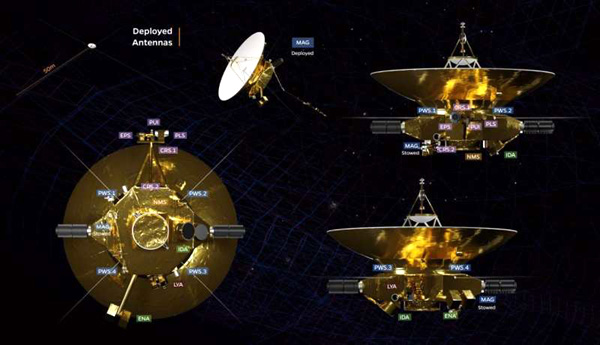
An infographic showing the various science instruments that would fly on a proposed Interstellar Probe spacecraft.
Johns Hopkins University Applied Physics Laboratory

Wednesday, May 13, 2026

An Amazing Celestial Mosaic by Kepler's Successor...

A mosaic of the night sky using images taken by NASA's TESS spacecraft between April 2018 and September 2025...showing 679 exoplanets (blue dots) and 5,165 exoplanetary candidates (orange dots), respectively.
NASA / MIT / TESS and Veselin Kostov (University of Maryland College Park)

NASA’s Planet-Hunting TESS Reveals Dazzling Night Sky (News Release)

NASA’s TESS (Transiting Exoplanet Survey Satellite) has released its most complete view of the starry sky to date, filling in gaps from previous observations. Nearly 6,000 colored dots scattered across the image show the locations of either confirmed or candidate exoplanets — worlds beyond our Solar System — identified by the mission as of September 2025 at the end of TESS’s second extended mission.

“Over the last eight years, TESS has become a fire hose of exoplanet science,” said Rebekah Hounsell, a TESS associate project scientist at the University of Maryland Baltimore County and NASA’s Goddard Space Flight Center in Greenbelt, Maryland. “It’s helped us find planets of all different sizes, from tiny Mercury-like ones to those larger than Jupiter. Some of them are even in the habitable zone, where liquid water might be possible on the surface, an important factor in our search for life beyond Earth.”

The TESS mission scans a wide swath of the sky, called a sector, for about a month at a time using its four cameras. These long stares allow the spacecraft to track the brightness changes of tens of thousands of stars, looking for variations in their light that might come from orbiting planets.

Researchers assembled an all-sky mosaic made of 96 sectors observed between April 2018, when TESS began its work, and September 2025.

The blue dots in the image mark the locations of nearly 700 confirmed planets, as of September 9. This menagerie includes worlds that may be covered by volcanoes, are being destroyed by their stars, or orbit two stars — experiencing double sunrises and sunsets each day. The orange dots represent more than 5,000 candidate planets that are awaiting verification.

To date, scientists have confirmed over 6,270 exoplanets using missions like TESS, NASA’s retired Kepler Space Telescope, and other facilities.

Also captured in the mosaic is the bright plane of our Milky Way galaxy, seen as a glowing arc through the center. The bright white ovals in the lower left are the Large and Small Magellanic Clouds. These satellite galaxies are located 160,000 and 200,000 light-years away, respectively.

“The more we dig into the large TESS dataset, especially using automated algorithms, the more surprises we find,” said Allison Youngblood, the TESS project scientist at NASA Goddard. “In addition to planets, TESS has helped us study rivers of young stars, observe dynamic galactic behavior, and monitor asteroids near Earth. As TESS fills in more of the night sky, there’s no knowing what it might see next.”

Source: NASA.Gov

Tuesday, May 12, 2026

The Latest Update on the Mars 2020 Rover...

A self-portrait of NASA's Perseverance Mars rover at a rocky outcrop nicknamed 'Arathusa'...taken with a camera on Perseverance's robotic arm on March 11, 2026.
NASA / JPL - Caltech / MSSS

NASA’s Perseverance Rover Snaps Selfie in Mars’ Western Frontier (News Release)

The agency’s six-wheeled geologist took a self-portrait during its survey of an ancient landscape that may predate the formation of Jezero Crater itself.

NASA’s Perseverance Mars rover recently took a self-portrait against a sweeping backdrop of ancient Martian terrain at a location that the science team calls “Lac de Charmes.” Assembled from 61 individual images, the selfie shows Perseverance training its mast on a rocky outcrop on which it had just made a circular abrasion patch, with the western rim of Jezero Crater stretching into the background. The selfie was captured on March 11, the 1,797th Martian day, or sol, of the mission, during the rover’s deepest push west beyond the crater.

Perseverance is in its fifth science campaign, known as the Northern Rim Campaign, of its mission on the Red Planet. The Lac de Charmes region represents some of the most scientifically-compelling terrain that the rover has visited.

“We took this image when the rover was in the ‘Wild West’ beyond the Jezero Crater rim — the farthest west we have been since we landed at Jezero a little over five years ago,” said Katie Stack Morgan, Perseverance’s project scientist at NASA’s Jet Propulsion Laboratory in Southern California. “We had just abraded and analyzed the ‘Arathusa’ outcrop, and the rover was sitting in a spot that provided a great view of both the Jezero Rim and the local terrain outside of the crater.”

During abrading, the rover grinds down a portion of the rock’s surface, allowing the science team to analyze what’s inside. The technique enabled the team to determine that the Arathusa outcrop is composed of igneous minerals that likely predate the formation of Jezero Crater. Igneous rocks with large mineral crystals form underground as molten rock cools and solidifies.

Perseverance acquired the selfie — its sixth since landing on Mars in 2021 — using the WATSON (Wide Angle Topographic Sensor for Operations and eNgineering) camera mounted at the end of its robotic arm, which made 62 precision movements over approximately one hour to build the composite image (learn more about how selfies are made).

Significant science

Along with the selfie, Perseverance used Mastcam-Z, located on its mast, to capture a mosaic of the “Arbot” area in Lac de Charmes on April 5, or Sol 1882. Made of 46 images, the panorama offers one of the richest geological vistas of the mission, revealing a windswept landscape of diverse rock textures.

The image provides the team a clear road map for investigating the ridgeline and the area’s ancient rock variety, including what appear to be megabreccia — large fragments (some the size of skyscrapers) hurled by a massive meteorite impact that occurred on the plain called Isidis Planitia about 3.9 billion years ago.

“What I see in this image is excellent exposure of likely the oldest rocks we are going to investigate during this mission,” said Ken Farley, Perseverance’s deputy project scientist at Caltech in Pasadena. “There is a sharp ridgeline visible in the mosaic whose jagged, angular texture contrasts starkly with the rounded boulders in the foreground. We also see a feature that may be a volcanic dike, a vertical intrusion of magma that hardened in place and was left standing as the softer surrounding material eroded away over billions of years.”

The rock color in the mosaic offers less information to the science team than the distinctive textures, which help them differentiate the rock types. Unlike Jezero Crater’s river delta, which is composed of sedimentary rock, some rocks here appear to be extrusive igneous rocks (molten rock that reached the surface as lava flows) and impactites (rocks created or modified by a meteorite impact) believed to have formed before the crater about 4 billion years ago, offering a window into the planet’s deep early crust.

New ballgame, near-marathon distance

“The rover’s study of these really ancient rocks is a whole new ballgame,” said Stack Morgan. “These rocks — especially if they’re from deep in the crust — could give us insights applicable to the entire planet, like whether there was a magma ocean on Mars and what initial conditions eventually made it a habitable planet.”

After studying Arathusa, Perseverance drove northwest to the Arbot area, where it has been analyzing other rocky outcrops. When the team is satisfied with the work accomplished there, the rover will drive south to “Gardevarri,” a site with a notably clear exposure of olivine-bearing rocks. Formed in cooling magma, these types of rocks contain information that can help scientists better understand Mars’ volcanic history and provide context for large-scale geological processes.

From Gardevarri, the rover is expected to head southeast towards a region that the team is calling “Singing Canyon” for more insights into the planet’s early crust.

After more than five years of surface operations, Perseverance has abraded 62 rocks, collected 27 rock cores in its sample tubes (25 sealed, 2 unsealed), and traveled almost 26 miles (42 kilometers) — in other words, just shy of a marathon (26.2 miles, or 42.195 kilometers).

“Having the benefit of four previous rover missions, the Perseverance team has always known our mission was a marathon and not a sprint,” said acting Perseverance project manager Steve Lee at JPL. “We’ve almost reached marathon distance. Our selfie may show that the rover is a bit dusty, but its beauty is more than skin deep. Perseverance is in great shape as we continue our explorations and extend into ultramarathon drive distances.”

Source: Jet Propulsion Laboratory

****

Another self-portrait of NASA's Perseverance Mars rover at the rocky outcrop Arathusa...taken with a camera on Perseverance's robotic arm on March 11, 2026.NASA / JPL - Caltech / MSSS

A mosaic of a rocky area nicknamed 'Arbot' that was taken by NASA's Perseverance Mars rover...on April 5, 2026.NASA / JPL - Caltech / ASU / MSSS