Showing posts with label Voyager spacecraft. Show all posts

Tuesday, June 02, 2026

On This Day in 2021: An Exciting Flyby Mission of Neptune and Triton Was Shunned by NASA...

A computer-generated illustration I created of the once-proposed Trident flyby mission to Neptune's moon Triton.
L.M. Prockter et al. LPI / JPL / SwRI / Richard T. Par

So today marks 5 years since the Trident mission—which involved a Voyager 2-type flyby of Neptune and its main moon Triton—was rejected by NASA in favor of two Venus missions for its Discovery program.

Trident was supposed to launch as early as last October and no later than this October. It would've flew past Neptune and Triton in June 2038. What could've been...

Click here to read a full Blog entry on my reaction to Trident's loss in that competition half a decade ago.

Thursday, May 14, 2026

The Latest Update on the Future of Deep Space Exploration...

An artist's concept of L3Harris' Next-Generation Radioisotope Thermoelectric Generator.
L3Harris Technologies, Inc.

Getting into the Space Nuclear Power Game with Next-generation Technology (News Release)

Finalized design of Next Gen RTG clears path for deep space missions to outer Solar System.

L3Harris Technologies has finalized the design of a next-generation nuclear-based power source for future NASA deep space missions, marking a crucial advancement in spacecraft power technology.

The Next-Generation Radioisotope Thermoelectric Generator (Next Gen RTG) cleared its critical design review (CDR) on April 2, 2026, paving the way for a new era of outer Solar System exploration.

“Passing the CDR is an important milestone because it validates that our design meets all the technical requirements and can be manufactured,” said Bill Sack, General Manager, RocketWorks and Power Systems at L3Harris. “It also demonstrates we've successfully re-established this critical capability after years of limited production.”

Flight units could power NASA deep space probes starting in the early 2030s, including a proposed Uranus orbiter that would use two Next Gen RTGs for power and for keeping its temperature-sensitive components warm enough to operate in the frigid environment of the outer Solar System. This dual-purpose capability makes RTGs indispensable for such missions.

What is the Next Gen RTG?

RTGs convert heat from the radioactive decay of plutonium-238 into electricity. Necessary for probes that are too far from the Sun to rely on solar power, they have been in use for 60 years. Early versions continue to supply power to NASA’s twin Voyager probes, which were launched in 1977 and are now traveling in interstellar space.

The Next Gen RTG is an evolution of the general-purpose heat source RTGs that supplied power to NASA’s Cassini Saturn orbiter and, more recently, the New Horizons probe, which carried out a Pluto flyby in 2015 and is now exploring the frozen wonders of the Kuiper Belt. Unlike the L3Harris-built Multi-Mission RTGs currently powering NASA's Curiosity and Perseverance Mars rovers, the Next Gen RTGs are optimized for spacecraft operating in the vacuum of space rather than on the surface of a planet.

This distinction is critical for future missions. The vacuum-optimized design allows for more efficient heat rejection and power generation in the deep space environment where missions like the Uranus orbiter will operate. As a result, the Next Gen RTG offers a higher power output at approximately the same weight as the Multi-Mission RTG. With the capability to generate about 250 watts of power at the beginning of its life, each Next Gen RTG will provide reliable, long-duration power for spacecraft exploring the outer reaches of our Solar System.

“The Next Gen RTG represents a significant leap forward in efficiency," added Sack. "We're delivering more power in the same mass envelope, which is critical when every kilogram matters for deep space missions."

Why the Next Gen RTG Matters

The availability of Next Gen RTGs opens the door to a range of ambitious missions that have been on NASA's wish list. Beyond the Uranus orbiter, these power systems could enable:

- Extended missions to Neptune and its moon, Triton
- Kuiper Belt Object explorers that can go beyond the range of the New Horizons spacecraft
- Long-duration missions to the outer planets' moons
- Interstellar precursor missions that push even farther than Voyager 1 and Voyager 2

Restarting Production

The U.S. Department of Energy’s Idaho National Laboratory tapped L3Harris in 2021 to re-establish the key technologies from the heritage system and update the design in response to growing interest in new deep space missions. The contract is expected to end in 2027 with a production readiness review to verify that the next-generation system can be built using the materials and components that have been re-established.

“We are proving we can do it again," said Leo Gard, Space Propulsion & Power Systems Program Manager at L3Harris. “While we didn't build the original generators, we've successfully reconstructed incomplete documentation and identified modern equivalents for obsolete components through creative problem-solving."

A Collaborative Effort

As prime contractor on the Next Gen RTG program, L3Harris is responsible for the main structure and overall system integration. Teledyne Energy Systems Inc. of Hunt Valley, Maryland, makes the thermoelectric couples that convert heat to electricity, while BAE Systems Space and Mission Systems in Boulder, Colorado, is responsible for insulation.

Source: L3Harris Technologies, Inc.

****

A computer-generated illustration I created of the once-proposed Trident flyby mission to Neptune's moon Triton.
L.M. Prockter et al. LPI / JPL / SwRI / Richard T. Par

An infographic showing the various science instruments that would fly on a proposed Interstellar Probe spacecraft.
Johns Hopkins University Applied Physics Laboratory

Friday, April 17, 2026

The Latest Update on Humanity's Twin Interstellar Probes...

An artist's concept of a Voyager probe traveling through deep space.
Caltech / NASA - JPL

NASA Shuts Off Instrument on Voyager 1 to Keep Spacecraft Operating (News Release)

On April 17, engineers at NASA’s Jet Propulsion Laboratory (JPL) in Southern California sent commands to shut down an instrument aboard Voyager 1 called the Low-energy Charged Particles experiment, or LECP. The nuclear-powered spacecraft is running low on power, and turning off the LECP is considered the best way to keep humanity’s first interstellar explorer going.

The LECP has been operating almost without interruption since Voyager 1 launched in 1977 — almost 49 years. It measures low-energy charged particles, including ions, electrons and cosmic rays originating from our Solar System and galaxy. The instrument has provided critical data about the structure of the interstellar medium, detecting pressure fronts and regions of varying particle density in the space beyond our heliosphere.

The twin Voyagers are the only spacecraft that are far enough from Earth to provide this information.

Like Voyager 2, Voyager 1 relies on a radioisotope thermoelectric generator, a device that converts heat from decaying plutonium into electricity. Both probes lose about 4 watts of power each year. After almost a half-century in space, power margins have grown razor thin, requiring the team to conserve energy by shutting off heaters and instruments while making sure the spacecraft don’t get so cold that their fuel lines freeze.

During a routine, planned roll maneuver on February 27, Voyager 1’s power levels fell unexpectedly. Mission engineers knew that any additional drop in power could trigger the spacecraft’s undervoltage fault protection system, which would shut down components on its own to safeguard the probe, requiring recovery by the flight team — a lengthy process that carries its own risks.

The Voyager team needed to act first.

“While shutting down a science instrument is not anybody’s preference, it is the best option available,” said Kareem Badaruddin, Voyager mission manager at JPL. “Voyager 1 still has two remaining operating science instruments — one that listens to plasma waves and one that measures magnetic fields. They are still working great, sending back data from a region of space no other human-made craft has ever explored. The team remains focused on keeping both Voyagers going for as long as possible.”

Far-out plan

The choice of which instrument to turn off next wasn’t made in the heat of the moment. Years ago, the Voyager science and engineering teams sat down together and agreed on the order in which they would shut off parts of the spacecraft while ensuring that the mission can continue to conduct its unique science. Of the 10 identical sets of instruments that each spacecraft carries, seven have been shut off so far.

For Voyager 1, the LECP was next on that list. The team shut off the LECP on Voyager 2 in March 2025.

Because Voyager 1 is more than 15 billion miles (25 billion kilometers) from Earth, the sequence of commands to shut down the instrument will take 23 or so hours to reach the spacecraft, and the shutdown process itself will take about three hours and 15 minutes to complete. One part of the LECP — a small motor that spins the sensor in a circle to scan in all directions — will remain on. It uses little power (0.5 watts), and keeping it running gives the team the best chance of being able to turn the instrument back on someday if they find extra power.

What comes next

Engineers are confident that shutting down the LECP will give Voyager 1 about a year of breathing room. They are using the time to finalize a more ambitious energy-saving fix for both Voyagers that they call “the Big Bang,” which is designed to further extend Voyager operations. The idea is to swap out a group of powered devices all at once — hence the nickname — turning some things off and replacing them with lower-power alternatives to keep the spacecraft warm enough to continue gathering science data.

The team will implement the Big Bang on Voyager 2 first, which has a little more power to spare and is closer to Earth, making it the safer test subject. Tests are planned for May and June 2026. If they go well, the team will attempt the same fix on Voyager 1 no sooner than July.

If the Big Bang works, there is even a chance that Voyager 1’s LECP could be switched back on.

Source: NASA.Gov

Tuesday, December 16, 2025

The Latest Update on Firefly Aerospace's Next Blue Ghost Moon Mission...

A full-scale model of Firefly Aerospace’s Blue Ghost Mission 2 lunar lander awaits transport into a clean room for environmental testing at NASA’s Jet Propulsion Laboratory near Pasadena, CA...in September of this year.
NASA / JPL - Caltech

NASA JPL Shakes Things Up Testing Future Commercial Lunar Spacecraft (News Release)

As Firefly Aerospace prepares to follow its successful soft landing on the Moon, an engineering model for its next lander is being put through its paces.

The same historic facilities that some 50 years ago prepared NASA’s twin Voyager probes for their ongoing interstellar odyssey are helping to ready a towering commercial spacecraft for a journey to the Moon. Launches involve brutal shaking and astonishingly loud noises, and testing in these facilities mimics those conditions to help ensure that mission hardware can survive the ordeal. The latest spacecraft to get this treatment are Firefly Aerospace’s Blue Ghost Mission 2 vehicles, set to launch to the Moon’s far side next year.

The Environmental Test Laboratory at NASA’s Jet Propulsion Laboratory in Southern California is where dozens of robotic spacecraft have been subjected to powerful jolts, extended rattling, high-decibel blasts of sound, and frigid and scorching temperatures, among other trials. Constructed in the 1960s and modernized over the years, the facilities have prepared every NASA spacecraft built or assembled at JPL for the rigors of space, from the Ranger spacecraft of the dawning Space Age to the Perseverance Mars rover to Europa Clipper, currently en route to the Jupiter system.

That legacy, and the decades of accumulated experience of the Environmental Test Laboratory team at JPL, is also supporting industry efforts to return to the Moon as part of NASA’s CLPS (Commercial Lunar Payload Services) initiative and its Artemis campaign, which will bring astronauts back to the lunar surface.

In recent months, a full-scale model of Firefly’s uncrewed Blue Ghost Mission 2 spacecraft was put through its paces by the experts in the lab’s vibration and acoustic testing facilities. Lessons learned with this model, called a structural qualification unit, will be applied to upcoming testing of the spacecraft that will fly to the Moon as early as 2026 through NASA’s CLPS.

“There’s a lot of knowledge gained over the years, passed from one generation of JPL engineers to another, that we bring to bear to support our own missions as well as commercial efforts,” said Michel William, a JPL engineer in the Environmental Test Laboratory who led the testing. “The little details that go into getting these tests right — nobody teaches you that in school, and it’s such a critical piece of space launch.”

Testing just right

The Environmental Test Laboratory team led environmental testing for Firefly’s Blue Ghost Mission 1 lander in 2024, and seeing the spacecraft achieve a soft Moon landing in March was a point of pride for them. Firefly’s next CLPS delivery debuts a dual-spacecraft configuration and hosts multiple international payloads, with the company’s Elytra Dark orbital vehicle stacked below the Blue Ghost lunar lander. Standing 22 feet (6.9 meters) high, the full structure is more than three times as tall as the Mission 1 lander.

This fall, a structural qualification model of the full stack was clamped to a “shaker table” inside a clean room at JPL and repeatedly rattled in three directions while hundreds of sensors monitored the rapid movement. Then, inside a separate acoustic testing chamber, giant horns blared at it from openings built into the room’s 16-inch-thick (41-centimeter-thick) concrete walls. The horns use compressed nitrogen gas to pummel spacecraft with up to 153 decibels, noise loud enough to cause permanent hearing loss in a human.

Each type of test involves several increasingly intense iterations. Between rounds, JPL’s dynamics environment experts analyze the data to compare what the spacecraft experienced to computer model predictions. Sometimes a discrepancy leads to hardware modifications, sometimes a tweak to the computer model. Engineers and technicians are careful to push the hardware, but not too far.

“You can either under-test or over-test, and both are bad,” William said. “If you over-test, you can break your hardware. If you under-test, it can break on the rocket. It’s a fine line.”

Since the model isn’t itself launching to the Moon, Firefly’s recent Environmental Test Laboratory visit didn’t include several types of trials that are generally completed only for flight hardware. A launch pad-bound spacecraft would undergo electromagnetic testing to ensure that signals from its electronic parts don’t interfere with one another. And, in what is probably the most well-known environmental test, flight-bound hardware is baked or chilled at extreme temperatures in a thermal vacuum chamber from which all of the air is sucked out.

The multiple thermal vacuum chamber facilities at JPL include two large historic “space simulators” built within NASA’s first few years of existence: a chamber that’s 10 feet in diameter and another that’s 25 feet across.

Qualifying for launch

The completion of Environmental Test Laboratory testing on Firefly’s structural qualification model helps prove that the spacecraft will survive its ride out of Earth’s atmosphere aboard a SpaceX Falcon 9 rocket. Firefly’s Blue Ghost Mission 2 team is now turning its focus to completing assembly and testing of the flight hardware for launch.

Once at the Moon, the Blue Ghost lander will touch down on the far side, delivering its payloads to the surface. Those include LuSEE-Night, a radio telescope that is a joint effort by NASA, the U.S. Department of Energy, and University of California, Berkeley’s Space Sciences Laboratory. A payload developed at JPL called User Terminal will test a compact, low-cost S-band radio communications system that could enable future far-side missions to talk to each other and to relay orbiters.

Meantime, Firefly’s Elytra Dark orbital vehicle will have deployed into lunar orbit ESA’s (European Space Agency’s) Lunar Pathfinder communications satellite — a payload on which NASA is collaborating. Both vehicles will remain in orbit and able to relay data from the far-side surface back to Earth.

“Firefly’s Blue Ghost Mission 2 will deliver both NASA and international commercial payloads to further prove out technologies for Artemis and help enable a long-term presence on the Moon,” said Ray Allensworth, Firefly’s spacecraft program director. “The extensive spacecraft environmental testing we did at JPL for Mission 1 was a critical step in Firefly’s test campaign for our historic lunar mission. Now we’re collaborating again to support a successful repeat on the Moon that will unlock even more insights for future robotic and human missions.”

Source: Jet Propulsion Laboratory

****

Inside a clean room at NASA's Jet Propulsion Laboratory two months ago, engineers and technicians secure a full-scale model of Firefly Aerospace’s Blue Ghost lunar lander atop the Elytra Dark spacecraft that make up the company’s second delivery to the lunar surface.
NASA / JPL - Caltech

Tuesday, August 19, 2025

JWST Update #2: A New Satellite Is Found at the Third Outer Planet in our Solar System...

An image of Uranus and several of its 29 known moons, including the newly-discovered satellite S/2025 U1, that was taken by NASA's James Webb Space Telescope.
NASA, ESA, CSA, STScI, M. El Moutamid (SwRI), M. Hedman (University of Idaho)

New Moon Discovered Orbiting Uranus Using NASA’s Webb Telescope (News Release)

Editor’s Note: This post highlights data from Webb science in progress, which has not yet been through the peer-review process.

Using NASA’s James Webb Space Telescope, a team led by the Southwest Research Institute (SwRI) has identified a previously-unknown moon orbiting Uranus, expanding the planet’s known satellite family to 29. The detection was made during a Webb observation on February 2, 2025.

“This object was spotted in a series of 10 40-minute long-exposure images captured by the Near-Infrared Camera (NIRCam),” said Maryame El Moutamid, a lead scientist in SwRI’s Solar System Science and Exploration Division based in Boulder, Colorado. “It’s a small moon but a significant discovery, which is something that even NASA’s Voyager 2 spacecraft didn’t see during its flyby nearly 40 years ago.”

The newly-discovered moon is estimated to be just six miles (10 kilometers) in diameter, assuming that it has a similar reflectivity (albedo) to Uranus’ other small satellites. That tiny size likely rendered it invisible to Voyager 2 and other telescopes.

“No other planet has as many small inner moons as Uranus, and their complex inter-relationships with the rings hint at a chaotic history that blurs the boundary between a ring system and a system of moons,” said Matthew Tiscareno of the SETI Institute in Mountain View, California, a member of the research team. “Moreover, the new moon is smaller and much fainter than the smallest of the previously-known inner moons, making it likely that even more complexity remains to be discovered.”

The new moon is the 14th member of the intricate system of small moons orbiting inward of the largest moons Miranda, Ariel, Umbriel, Titania and Oberon. (All of the moons of Uranus are named after characters from Shakespeare and Alexander Pope.)

“It’s located about 35,000 miles (56,000 kilometers) from Uranus’ center, orbiting the planet’s equatorial plane between the orbits of Ophelia (which is just outside of Uranus’ main ring system) and Bianca,” said El Moutamid. “Its nearly-circular orbit suggests it may have formed near its current location.”

A name for the newly-found moon will need to be approved by the International Astronomical Union (IAU), the leading authority in assigning official names and designations to astronomical objects.

“Through this and other programs, Webb is providing a new eye on the outer Solar System. This discovery comes as part of Webb’s General Observer program, which allows scientists worldwide to propose investigations using the telescope’s cutting-edge instruments. The NIRCam instrument’s high resolution and infrared sensitivity make it especially adept at detecting faint, distant objects that were beyond the reach of previous observatories,” said El Moutamid.

“Looking forward, the discovery of this moon underscores how modern astronomy continues to build upon the legacy of missions like Voyager 2, which flew past Uranus on January 24, 1986, and gave humanity its first close-up look at this mysterious world. Now, nearly four decades later, the James Webb Space Telescope is pushing that frontier even farther.”

Source: NASA.Gov

****

Monday, July 14, 2025

On This Day in 2015: Remembering New Horizons' Historic Flyby of Pluto and its Moons...

A composite image of Pluto and its largest moon Charon...using photos that were taken by NASA's New Horizons spacecraft on July 14, 2015.
NASA / Johns Hopkins University Applied Physics Laboratory / Southwest Research Institute

So it was 10 years ago today that NASA's New Horizons spacecraft became the first-ever robotic probe to explore the dwarf planet Pluto and its five moons (Charon, Nix, Styx, Kerberos and Hydra) up-close. Even though Pluto has been a dwarf planet since the summer of 2006...when the International Astronomical Union demoted the former ninth planet from the Sun, this flyby completes NASA's robotic investigation of all the classical worlds (Mercury, Venus, Mars, Jupiter, Saturn, Uranus, Neptune and Pluto) in our Solar System. Dozens of other objects have been discovered in the Kuiper Belt region beyond Pluto since then, but the 2015 encounter marked a major milestone in planetary exploration.

New Horizons is now destined to become the third functioning spacecraft to reach interstellar space—behind Voyager 1 and 2. Of course, saying that New Horizons will still be functional when it leaves the heliosphere may be a bit optimistic, as Trump lackey Russ Vought wants New Horizons to be one of the dozens of space missions that gets decommissioned under the White House's crappy budget for fiscal year (FY) 2026. Fortunately, the U.S. Senate and House of Representatives reject the attempt by Vought to impose his PROJECT 2025 nonsense to NASA's venerable planetary science program.

We'll see what happens when the FY 2026 budget supposedly becomes enacted on October 1st. Stay tuned.

Wednesday, May 14, 2025

The Latest Update on Humanity's Most-Distant Interstellar Probe...

An artist's concept of a Voyager spacecraft hurtling through deep space.
NASA / JPL - Caltech

NASA’s Voyager 1 Revives Backup Thrusters Before Command Pause (News Release)

The mission team wanted to fix the thrusters, deemed unusable decades ago, before the radio antenna that sends commands to the probe went offline for upgrades.

Engineers at NASA’s Jet Propulsion Laboratory in Southern California have revived a set of thrusters aboard the Voyager 1 spacecraft that had been considered inoperable since 2004. Fixing the thrusters required creativity and risk, but the team wants to have them available as a backup to a set of active thrusters whose fuel tubes are experiencing a buildup of residue that could cause them to stop working as early as this fall.

In addition, the mission needed to ensure the availability of the long-dormant thrusters before May 4, when the Earth-bound antenna that sends commands to Voyager 1 and its twin Voyager 2 went offline for months of upgrades.

Thruster Clogging

The Voyagers launched in 1977 and are hurtling through interstellar space at around 35,000 mph (56,000 kph). Both spacecraft rely on a set of primary thrusters to gently pivot them up and down as well as to the right and left in order to keep their antennas pointed at Earth so they can send back data and receive commands. Within the primary set of thrusters are other thrusters that control the spacecraft’s roll motion.

Seen from Earth, the roll motion rotates the antenna like a vinyl record to keep each Voyager pointed at a guide star that it uses to orient itself. Both spacecraft have a primary and backup set for these roll movements.

(Another set of thrusters, intended to change the spacecrafts’ trajectory during the flybys of the outer planets, were revived on the spacecraft in 2018 and 2019, but they can’t induce roll motion.)

To manage the clogging tubes in the thrusters, engineers switch between the sets of primary, backup and trajectory thrusters for both Voyagers. But on Voyager 1, the primary roll thrusters stopped working in 2004 after losing power in two small internal heaters. Engineers determined that the broken heaters were likely unfixable and opted to rely solely on Voyager 1’s backup roll thrusters to orient the star tracker.

“I think at that time, the team was OK with accepting that the primary roll thrusters didn’t work, because they had a perfectly good backup,” said Kareem Badaruddin, Voyager mission manager at JPL, which manages the mission for NASA. “And, frankly, they probably didn’t think the Voyagers were going to keep going for another 20 years.”

But without the ability to control the spacecraft’s roll motion, a variety of issues would arise that might threaten the mission, so the engineering team decided to reexamine the 2004 thruster failure. They began to suspect that an unexpected change or disturbance in the circuits that control the heaters’ power supply had effectively flipped a switch to the wrong position. If they could turn the switch back to its original position, the heaters might work again, enabling them to reactivate the primary roll thrusters and use them if the backup roll thrusters that have been used since 2004 become completely clogged.

Communications Pause

The solution required some puzzle-solving. The team would have to turn on the dormant roll thrusters, then try fixing and restarting the heaters. If, during that time, the spacecraft’s star tracker drifted too far from the guide star, the long-dormant roll thrusters would automatically fire (thanks to the spacecraft’s programming).

And if the heaters were still off when they fired, it could trigger a small explosion, so the team needed to get the star tracker pointed as precisely as possible.

It would be a race, and the team faced additional time pressure: From May 4, 2025, through February 2026, Deep Space Station 43 (DSS-43), a 230-foot-wide (70-meter-wide) antenna in Canberra, Australia, that’s part of NASA’s Deep Space Network, would be undergoing upgrades. It would be offline for most of that time, with brief periods of operation in August and December.

Although the Deep Space Network has three complexes equally spaced around the globe (in Goldstone, California, and Madrid, in addition to Australia) to ensure constant contact with spacecraft as Earth rotates, DSS-43 is the only dish with enough signal power to send commands to the Voyagers.

“These antenna upgrades are important for future crewed lunar landings, and they also increase communications capacity for our science missions in deep space, some of which are building on the discoveries Voyager made,” said Suzanne Dodd, Voyager project manager and director of the Interplanetary Network at JPL, which manages the Deep Space Network for NASA. “We’ve been through downtime like this before, so we’re just preparing as much as we can.”

The team wanted to make sure that the long-dormant thrusters would be available when the dish is back online briefly in August, by which time the thrusters currently in use on Voyager 1 might be completely clogged.

The advance work paid off: On March 20, the team watched as the spacecraft executed their commands. Because of Voyager’s distance, the radio signal takes over 23 hours to travel from the spacecraft to Earth, meaning everything that the team saw happening had occurred almost a day earlier. If the test had failed, Voyager might have already been in danger.

But within 20 minutes, the team saw the temperature of the thruster heaters rise dramatically and knew that they had succeeded.

“It was such a glorious moment. Team morale was very high that day,” said Todd Barber, the mission’s propulsion lead at JPL. “These thrusters were considered dead. And that was a legitimate conclusion. It’s just that one of our engineers had this insight that maybe there was this other possible cause and it was fixable. It was yet another miracle save for Voyager.”

Source: Jet Propulsion Laboratory

****

A snapshot of the Deep Space Network's Canberra Deep Space Communication Complex in Australia.
NASA

Wednesday, April 09, 2025

The DSN's Canberra Complex Is About to Receive a Big Upgrade in its 6th Decade of Service...

A snapshot of the Deep Space Network's Canberra Deep Space Communication Complex in Australia.
NASA

NASA’s Deep Space Network Starts New Dish, Marks 60 Years in Australia (News Release - April 8)

Canberra joined the global network in 1965 and operates four radio antennas. Now, preparations have begun on its fifth as NASA works to increase the network’s capacity.

NASA’s Deep Space Network facility in Canberra, Australia, celebrated its 60th anniversary on March 19 while also breaking ground on a new radio antenna. The pair of achievements are major milestones for the network, which communicates with spacecraft all over the Solar System using giant dish antennas located at three complexes around the globe.

Canberra’s newest addition, Deep Space Station 33, will be a 112-foot-wide (34-meter-wide) multifrequency beam-waveguide antenna. Buried mostly below ground, a massive concrete pedestal will house cutting-edge electronics and receivers in a climate-controlled room and provide a sturdy base for the reflector dish, which will rotate during operations on a steel platform called an alidade.

“As we look back on 60 years of incredible accomplishments at Canberra, the groundbreaking of a new antenna is a symbol for the next 60 years of scientific discovery,” said Kevin Coggins, deputy associate administrator of NASA’s SCaN (Space Communications and Navigation) Program at NASA Headquarters in Washington. “Building cutting-edge antennas is also a symbol of how the Deep Space Network embraces new technologies to enable the exploration of a growing fleet of space missions.”

When it goes online in 2029, the new Canberra dish will be the last of six parabolic dishes constructed under NASA’s Deep Space Network Aperture Enhancement Program, which is helping to support current and future spacecraft and the increased volume of data they provide. The network’s Madrid facility christened a new dish in 2022, and the Goldstone, California, facility is putting the finishing touches on a new antenna.

Canberra’s Role

The Deep Space Network was officially founded on December 24, 1963, when NASA’s early ground stations, including Goldstone, were connected to the new network control center at the agency’s Jet Propulsion Laboratory in Southern California. Called the Space Flight Operations Facility, that building remains the center through which data from the three global complexes flows.

The Madrid facility joined in 1964, and Canberra went online in 1965, going on to help support hundreds of missions, including the Apollo Moon landings.

“Canberra has played a crucial part in tracking, communicating and collecting data from some of the most momentous missions in space history,” said Kevin Ferguson, director of the Canberra Deep Space Communication Complex. “As the network continues to advance and grow, Canberra will continue to play a key role in supporting humanity’s exploration of the cosmos.”

By being spaced equidistant from one another around the globe, the complexes can provide continual coverage of spacecraft, no matter where they are in the Solar System as Earth rotates. There is an exception, however: Due to Canberra’s location in the Southern Hemisphere, it is the only one that can send commands to, and receive data from, Voyager 2 as it heads south almost 13 billion miles (21 billion kilometers) through interstellar space. More than 15 billion miles (24 billion kilometers) away, Voyager 1 sends its data down to the Madrid and Goldstone complexes, but it, too, can only receive commands via Canberra.

New Technologies

In addition to constructing more antennas like Canberra’s Deep Space Station 33, NASA is looking to the future by also experimenting with laser, or optical, communications to enable significantly more data to flow to and from Earth. The Deep Space Network currently relies on radio frequencies to communicate, but laser operates at a higher frequency, allowing more data to be transmitted.

As part of that effort, NASA is flying the laser-based Deep Space Optical Communications experiment with the agency’s Psyche mission. Since the October 2023 launch, it has demonstrated high-data rates over record-breaking distances and downlinked ultra-high definition streaming video from deep space.

“These new technologies have the potential to boost the science and exploration returns of missions traveling throughout the Solar System,” said Amy Smith, deputy project manager for the Deep Space Network at JPL, which manages the network. “Laser and radio communications could even be combined to build hybrid antennas, or dishes that can communicate using both radio and optical frequencies at the same time. That could be a game changer for NASA.”

Source: Jet Propulsion Laboratory

****

A snapshot of the Space Flight Operations Facility at NASA's Jet Propulsion Laboratory near Pasadena, California...on July 20, 2023.
Richard T. Par

Wednesday, March 05, 2025

The Latest Update on Humanity's Twin Interstellar Probes...

An artist's concept of a Voyager probe traveling through deep space.
Caltech / NASA - JPL

NASA Turns Off 2 Voyager Science Instruments to Extend Mission (News Release)

The farthest-flung human-made objects will be able to take their science-gathering even farther, thanks to these energy-conserving measures.

Mission engineers at NASA’s Jet Propulsion Laboratory in Southern California turned off the cosmic ray subsystem experiment aboard Voyager 1 on February 25 and will shut off Voyager 2’s low-energy charged particle instrument on March 24. Three science instruments will continue to operate on each spacecraft. The moves are part of an ongoing effort to manage the gradually diminishing power supply of the twin probes.

Launched in 1977, Voyagers 1 and 2 rely on a radioisotope power system that generates electricity from the heat of decaying plutonium. Both lose about 4 watts of power each year.

“The Voyagers have been deep-space rock stars since launch, and we want to keep it that way as long as possible,” said Suzanne Dodd, Voyager project manager at JPL. “But electrical power is running low. If we don’t turn off an instrument on each Voyager now, they would probably have only a few more months of power before we would need to declare end of mission.”

The two spacecraft carry identical sets of 10 science instruments. Some of the instruments, geared toward collecting data during planetary flybys, were turned off after both spacecraft completed their exploration of the Solar System’s gas giants.

The instruments that remained powered on well beyond the last planetary flyby were those that the science team considered important for studying the Solar System’s heliosphere, a protective bubble of solar wind and magnetic fields created by the Sun, and interstellar space, the region outside the heliosphere. Voyager 1 reached the edge of the heliosphere and the beginning of interstellar space in 2012; Voyager 2 reached the boundary in 2018. No other human-made spacecraft has operated in interstellar space.

Last October, to conserve energy, the project turned off Voyager 2’s plasma science instrument, which measures the amount of plasma — electrically charged atoms — and the direction that it is flowing. The instrument had collected only limited data in recent years due to its orientation relative to the direction that plasma flows in interstellar space. Voyager 1’s plasma science instrument had been turned off years ago because of degraded performance.

Interstellar Science Legacy

The cosmic ray subsystem that was shut down on Voyager 1 last week is a suite of three telescopes designed to study cosmic rays, including protons from the galaxy and the Sun, by measuring their energy and flux. Data from those telescopes helped the Voyager science team determine when and where Voyager 1 exited the heliosphere.

Scheduled for deactivation later this month, Voyager 2’s low-energy charged particle instrument measures the various ions, electrons and cosmic rays originating from our Solar System and galaxy. The instrument consists of two subsystems: the low-energy particle telescope for broader energy measurements, and the low-energy magnetospheric particle analyzer for more focused magnetospheric studies.

Both systems use a rotating platform so that the field of view is 360 degrees, and the platform is powered by a stepper motor that provides a 15.7-watt pulse every 192 seconds. The motor was tested to 500,000 steps — enough to guarantee continuous operation through the mission’s encounters with Saturn, which occurred in August 1980 for Voyager 2. By the time it is deactivated on Voyager 2, the motor will have completed more than 8.5 million steps.

“The Voyager spacecraft have far surpassed their original mission to study the outer planets,” said Patrick Koehn, Voyager program scientist at NASA Headquarters in Washington. “Every bit of additional data we have gathered since then is not only valuable bonus science for heliophysics, but also a testament to the exemplary engineering that has gone into the Voyagers — starting nearly 50 years ago and continuing to this day.”

Addition Through Subtraction

Mission engineers have taken steps to avoid turning off science instruments for as long as possible because the science data collected by the twin Voyager probes is unique. With these two instruments turned off, the Voyagers should have enough power to operate for about a year before the team needs to shut off another instrument on both spacecraft.

In the meantime, Voyager 1 will continue to operate its magnetometer and plasma wave subsystem. The spacecraft’s low-energy charged particle instrument will operate through the remainder of 2025 but will be shut off next year.

Voyager 2 will continue to operate its magnetic field and plasma wave instruments for the foreseeable future. Its cosmic ray subsystem is scheduled to be shut off in 2026.

With the implementation of this power conservation plan, engineers believe that the two probes could have enough electricity to continue operating with at least one science instrument into the 2030s. But they are also mindful that the Voyagers have been weathering deep space for 47 years and that unforeseen challenges could shorten that timeline.

Long Distance

Voyager 1 and Voyager 2 remain the most distant human-made objects ever built. Voyager 1 is more than 15 billion miles (25 billion kilometers) away. Voyager 2 is over 13 billion miles (21 billion kilometers) from Earth.

In fact, due to this distance, it takes over 23 hours to get a radio signal from Earth to Voyager 1, and 19½ hours to Voyager 2.

“Every minute of every day, the Voyagers explore a region where no spacecraft has gone before,” said Linda Spilker, Voyager project scientist at JPL. “That also means every day could be our last. But that day could also bring another interstellar revelation. So, we’re pulling out all the stops, doing what we can to make sure Voyagers 1 and 2 continue their trailblazing for the maximum time possible.”

Source: NASA.Gov

Tuesday, February 25, 2025

America's Newest Jupiter-bound Orbiter Will Soon Fly Past the Red Planet for a Gravity Assist...

A computer-animated screenshot showing NASA's Europa Clipper spacecraft about to fly past Mars for a gravity assist.
NASA / JPL - Caltech

NASA’s Europa Clipper Uses Mars to Go the Distance (News Release)

The orbiter bound for Jupiter’s moon Europa will investigate whether the moon is habitable, but it first will get the help of Mars’ gravitational force to get to deep space.

On March 1, NASA’s Europa Clipper will streak just 550 miles (884 kilometers) above the surface of Mars for what’s known as a gravity assist — a maneuver to bend the spacecraft’s trajectory and position it for a critical leg of its long voyage to the Jupiter system. The close flyby offers a bonus opportunity for mission scientists, who will test their radar instrument and thermal imager.

Europa Clipper will be closest to the Red Planet at 12:57 p.m. EST, approaching it at about 15.2 miles per second (24.5 kilometers per second) relative to the Sun. For about 12 hours prior and 12 hours after that time, the spacecraft will use the gravitational pull of Mars to pump the brakes and reshape its orbit around the Sun. As the orbiter leaves Mars behind, it will be traveling at a speed of about 14 miles per second (22.5 kilometers per second).

The flyby sets up Europa Clipper for its second gravity assist — a close encounter with Earth in December 2026 that will act as a slingshot and give the spacecraft a velocity boost. After that, it’s a straightforward trek to the outer Solar System; the probe is set to arrive at Jupiter’s orbit in April 2030.

“We come in very fast, and the gravity from Mars acts on the spacecraft to bend its path,” said Brett Smith, a mission systems engineer at NASA’s Jet Propulsion Laboratory in Southern California. “Meanwhile, we’re exchanging a small amount of energy with the planet, so we leave on a path that will bring us back past Earth.”

Harnessing Gravity

Europa Clipper launched from Kennedy Space Center in Florida on October 14, 2024, via a SpaceX Falcon Heavy rocket, embarking on a 1.8-billion-mile (2.9-billion-kilometer) trip to Jupiter, which is five times farther from the Sun than Earth is. Without the assists from Mars in 2025 and from Earth in 2026, the 12,750-pound (6,000-kilogram) spacecraft would require additional propellant, which adds weight and cost, or it would take much longer to get to Jupiter.

Gravity assists are baked into NASA’s mission planning, as engineers figure out early on how to make the most of the momentum in our Solar System. Famously, the Voyager 1 and Voyager 2 spacecraft, which launched in 1977, took advantage of a once-in-a-lifetime planetary lineup to fly by the gas giants, harnessing their gravity and capturing data about them.

While navigators at JPL, which manages Europa Clipper and Voyager, have been designing flight paths and using gravity assists for decades, the process of calculating a spacecraft’s trajectory in relation to planets that are constantly on the move is never simple.

“It’s like a game of billiards around the Solar System, flying by a couple of planets at just the right angle and timing to build up the energy we need to get to Jupiter and Europa,” said JPL’s Ben Bradley, Europa Clipper mission planner. “Everything has to line up — the geometry of the Solar System has to be just right to pull it off.”

Refining the Path

Navigators sent the spacecraft on an initial trajectory that left some buffer around Mars so that if anything were to go wrong in the weeks after launch, Europa Clipper wouldn’t risk impacting the planet. Then the team used the spacecraft’s engines to veer closer to Mars’ orbit in what are called trajectory correction maneuvers, or TCMs.

Mission controllers have performed three TCMs to set the stage for the Mars gravity assist — in early November, late January and on February 14. They will conduct another TCM about 15 days after the Mars flyby to ensure that the spacecraft is on track and are likely to conduct additional ones — upwards of 200 — throughout the mission, which is set to last until 2034.

Opportunity for Science

While navigators are relying on the gravity assist for fuel efficiency and to keep the spacecraft on their planned path, scientists are looking forward to the event to take advantage of the close proximity to the Red Planet and test two of the mission’s science instruments.

About a day prior to the closest approach, the mission will calibrate the thermal imager, resulting in a multicolored image of Mars in the months following as the data is returned and scientists process the data. And near closest approach, they’ll have the radar instrument perform a test of its operations — the first time that all of its components will be tested together. The radar antennas are so massive, and the wavelengths they produce so long that it wasn’t possible for engineers to test them on Earth before launch.

Source: Jet Propulsion Laboratory

****

Sunday, December 29, 2024

Remembering Jimmy Carter's Contribution to Space Exploration...

As Kennedy Space Center (KSC) Director Lee Scherer looks on, President Jimmy Carter, his wife Rosalynn and their daughter Amy gaze at a scale model of the crawler-transporter that sent space shuttle stacks to KSC's Launch Complex 39 from the Vehicle Assembly Building for flight...in this 1978 photo.
NASA

NASA Administrator Pays Tribute to President Carter (Press Release)

The following is a statement from NASA Administrator Bill Nelson on Sunday’s passing of President Jimmy Carter:

“President Carter was the pinnacle of a public servant, dedicating his life to making our world a better place. He showed us each and every person has the power to make a difference. From providing for those in need, protecting the environment, and championing civil and human rights, President Carter was a good man who always strove to do what was right. He embodied the very best of humanity and his life and legacy are an example to the United States and the world.

“NASA’s Voyager 1, the most distant human-made object from Earth, carries a message from President Carter that captures his core goodness and grace:

“'If one such civilization intercepts Voyager and can understand these recorded contents, here is our message: This is a present from a small distant world, a token of our sounds, our science, our images, our music, our thoughts, and our feelings. We are attempting to survive our time so we may live into yours. We hope someday, having solved the problems we face, to join a community of galactic civilizations. This record represents our hope and our determination, and our good will in a vast and awesome universe.'

“President Carter understood an important truth: that we find common ground when we look to the stars. His words will forever belong to the heavens, and his legacy has forever bettered our country – and our Earth. The NASA family and I are keeping the Carter family close in our thoughts. May President Carter rest in peace.”

Source: NASA.Gov

****


Sunday, December 22, 2024

A New Radio Dish for Space Exploration Is Emerging in the California Desert...

The 133-ton reflector dish for Deep Space Station 23 is about to be attached to its pedestal at NASA's Goldstone Deep Space Communications Complex near Barstow, California...on December 18, 2024.
NASA / JPL - Caltech

NASA’s New Deep Space Network Antenna Has Its Crowning Moment (News Release - December 20)

Deep Space Station 23’s 133-ton reflector dish was recently installed, marking a key step in strengthening NASA’s Deep Space Network.

NASA’s Deep Space Network, an array of giant radio antennas, allows agency missions to track, send commands to, and receive scientific data from spacecraft venturing to the Moon and beyond. NASA is adding a new antenna, bringing the total to 15, to support increased demand for the world’s largest and most sensitive radio frequency telecommunication system.

Installation of the latest antenna took place on December 18, when teams at NASA’s Goldstone Deep Space Communications Complex near Barstow, California, installed the metal reflector framework for Deep Space Station 23, a multifrequency beam-waveguide antenna. When operational in 2026, Deep Space Station 23 will receive transmissions from missions such as Perseverance, Psyche, Europa Clipper, Voyager 1 and a growing fleet of future human and robotic spacecraft in deep space.

“This addition to the Deep Space Network represents a crucial communication upgrade for the agency,” said Kevin Coggins, deputy associate administrator of NASA’s SCaN (Space Communications and Navigation) program. “The communications infrastructure has been in continuous operation since its creation in 1963, and with this upgrade we are ensuring NASA is ready to support the growing number of missions exploring the Moon, Mars and beyond.”

Construction of the new antenna has been under way for more than four years, and during the installation, teams used a crawler crane to lower the 133-ton metal skeleton of the 112-foot-wide (34-meter-wide) parabolic reflector before it was bolted to a 65-foot-high (20-meter-high) alidade, a platform above the antenna’s pedestal that will steer the reflector during operations.

“One of the biggest challenges facing us during the lift was to ensure that 40 bolt-holes were perfectly aligned between the structure and alidade,” said Germaine Aziz, systems engineer, Deep Space Network Aperture Enhancement Program of NASA’s Jet Propulsion Laboratory in Southern California. “This required a meticulous emphasis on alignment prior to the lift to guarantee everything went smoothly on the day.”

Following the main lift, engineers carried out a lighter lift to place a quadripod, a four-legged support structure weighing 16 1/2 tons, onto the center of the upward-facing reflector. The quadripod features a curved subreflector that will direct radio frequency signals from deep space that bounce off the main reflector into the antenna’s pedestal, where the antenna’s receivers are housed.

Engineers will now work to fit panels onto the steel skeleton to create a curved surface to reflect radio frequency signals. Once complete, Deep Space Station 23 will be the fifth of six new beam-waveguide antennas to join the network, following Deep Space Station 53, which was added at the Deep Space Network’s Madrid complex in 2022.

“With the Deep Space Network, we are able to explore the Martian landscape with our rovers, see the James Webb Space Telescope’s stunning cosmic observations, and so much more,” said Laurie Leshin, director of JPL. “The network enables over 40 deep space missions, including the farthest human-made objects in the Universe, Voyager 1 and 2. With upgrades like these, the network will continue to support humanity’s exploration of our Solar System and beyond, enabling groundbreaking science and discovery far into the future.”

NASA’s Deep Space Network is managed by JPL, with the oversight of NASA’s SCaN Program. More than 100 NASA and non-NASA missions rely on the Deep Space Network and Near Space Network, including supporting astronauts aboard the International Space Station and future Artemis missions, monitoring Earth’s weather and the effects of climate change, supporting lunar exploration, and uncovering the Solar System and beyond.

Source: Jet Propulsion Laboratory

****

Thursday, December 05, 2024

Interstellar Probe: The Dream Is Lost (Again)...

An artist's concept of the proposed Interstellar Probe.

Earlier today, the National Academies of Sciences, Engineering and Medicine (NASEM) released the long-awaited Solar and Space Physics Decadal Survey...a report that recommended to NASA what type of heliophysics-centric mission the agency should undertake over the next 10 years.

The decadal survey proposed that NASA conduct two flagship-class missions: Links, a satellite constellation that consisted of over two dozen spacecraft flying in different orbits to study Earth's magnetosphere, and the Solar Polar Orbiter—a mission that would see a robotic probe orbiting the Sun's polar regions to observe them from above.

What the decadal survey didn't recommend was an ambitious mission that I've been enthusiastically posting about since early 2021: the Interstellar Probe (IP).

Just like what happened when the Trident Neptune-Triton flyby mission was rejected by NASA in early 2021 in favor of two Venus-bound spacecraft, I'm absolutely disappointed that the Interstellar Probe will not see the light of day. At least within the next decade or so, and in the type of mission profile that the Johns Hopkins University Applied Physics Laboratory—who NASA paid $4 million to study the feasibility of this project and would've built the IP spacecraft itself—proposed in its Mission Concept Report three years ago.

If you've been reading this Blog since at least September of 2005 (stop smirking), you'll know just how eager I am to see NASA develop another Pioneer/Voyager/New Horizons-type mission that will fly to the outer Solar System and beyond. Obviously, I was very excited to see what kind of scientific discoveries IP would make during a 15-year journey to interstellar space (on a mission that was designed to last up to 50 years), but it was the dream of putting my name on the spacecraft in a potential public outreach campaign (like what was done with New Horizons back in 2005—when over 430,000 people submitted their names online to be flown on a compact disc aboard the Pluto-bound explorer) that enthralled me about this endeavor.

I got to send a message via radio signal to the exoplanet Gliese 581d courtesy of the Hello From Earth campaign in 2009, but to have my name on an actual spacecraft and not in an energy wave traveling through the Milky Way galaxy some day was obviously a more wondrous scenario.

What makes me especially annoyed about this new decadal survey is that the Solar Polar Orbiter is basically a rehash of the NASA and European Space Agency's Ulysses mission which launched in 1990 and studied the Sun till 2008. Unlike Ulysses, however, the Solar Polar Orbiter would be equipped with cameras to photograph the northern and southern regions of our host star.

Big whoop. What's that compared to potentially capturing an image of our entire Solar System from beyond the heliosphere courtesy of the Interstellar Probe?

Seeing as how NASEM wanted NASA to focus on the near-Earth space environment and how solar activity affected it, it's clearly obvious that the decadal survey was influenced by this year's geomagnetic storms that caused auroras to be visible around much of the globe. This is similar to how the 2020 discovery of phosphine in Venus' atmosphere ultimately caused Trident to be rejected in favor of the VERITAS and DAVINCI missions...which NASA doesn't even care to launch to the Evening Star till sometime next decade.

(Trident would've lifted off for Neptune either next year or 2026 had NASA approved it as its next Discovery-class mission.)

Well... It's clearly obvious that the Universe doesn't really want me to put my moniker on a New Horizons-type spacecraft anytime soon. I guess I'll just have to stick with submitting my name to fly on missions within our Solar System instead.

But one thing is certain: I can have a virtual presence on over a hundred spacecraft venturing to destinations as close as Venus (courtesy of Akatsuki) and worlds as distant as Saturn (through Cassini) in our Solar System, and these missions will never make up for me missing out on New Horizons...or having the dream opportunity that is the Interstellar Probe taken from me and everyone else who are enamored by the idea of having their name attached to a manmade object drifting through the cosmos.

Happy Thursday.

An infographic showing the various science instruments that would've flown on the proposed Interstellar Probe spacecraft.
Johns Hopkins University Applied Physics Laboratory

A video screenshot showing the Interstellar Probe departing from the Sun's heliosphere.
Johns Hopkins University Applied Physics Laboratory


Monday, November 11, 2024

The Latest Update on the 'Bulls-Eye Planet'...

An image of Uranus that was taken by NASA's Voyager 2 spacecraft...on January 17, 1986.
NASA / JPL

Mining Old Data From NASA’s Voyager 2 Solves Several Uranus Mysteries (News Release)

NASA’s Voyager 2 flyby of Uranus decades ago shaped scientists’ understanding of the planet but also introduced unexplained oddities. A recent data dive has offered answers.

When NASA’s Voyager 2 spacecraft flew by Uranus in 1986, it provided scientists’ first — and, so far, only — close glimpse of this strange, sideways-rotating outer planet. Alongside the discovery of new moons and rings, baffling new mysteries confronted scientists. The energized particles around the planet defied their understanding of how magnetic fields work to trap particle radiation, and Uranus earned a reputation as an outlier in our Solar System.

Now, new research analyzing the data collected during that flyby 38 years ago has found that the source of that particular mystery is a cosmic coincidence: It turns out that in the days just before Voyager 2’s flyby, the planet had been affected by an unusual kind of space weather that squashed the planet’s magnetic field, dramatically compressing Uranus’ magnetosphere.

“If Voyager 2 had arrived just a few days earlier, it would have observed a completely different magnetosphere at Uranus,” said Jamie Jasinski of NASA’s Jet Propulsion Laboratory in Southern California and lead author of the new work published in Nature Astronomy. “The spacecraft saw Uranus in conditions that only occur about 4% of the time.”

Magnetospheres serve as protective bubbles around planets (including Earth) with magnetic cores and magnetic fields, shielding them from jets of ionized gas — or plasma — that stream out from the Sun in the solar wind. Learning more about how magnetospheres work is important for understanding our own planet, as well as those in seldom-visited corners of our Solar System and beyond.

That’s why scientists were eager to study Uranus’ magnetosphere, and what they saw in the Voyager 2 data in 1986 flummoxed them. Inside the planet’s magnetosphere were electron radiation belts with an intensity second only to Jupiter’s notoriously brutal radiation belts. But there was apparently no source of energized particles to feed those active belts; in fact, the rest of Uranus’ magnetosphere was almost devoid of plasma.

The missing plasma also puzzled scientists because they knew that the five major Uranian moons in the magnetic bubble should have produced water ions, as icy moons around other outer planets do. They concluded that the moons must be inert with no ongoing activity.

Solving the Mystery

So why was no plasma observed, and what was happening to beef up the radiation belts? The new data analysis points to the solar wind. When plasma from the Sun pounded and compressed the magnetosphere, it likely drove plasma out of the system.

The solar wind event would have also briefly intensified the dynamics of the magnetosphere, which would have fed the belts by injecting electrons into them.

The findings could be good news for those five major moons of Uranus: Some of them might be geologically active after all. With an explanation for the temporarily missing plasma, researchers say it’s plausible that the moons may have actually been spewing ions into the surrounding bubble all along.

Planetary scientists are focusing on bolstering their knowledge about the mysterious Uranus system, which the National Academies’ 2023 Planetary Science and Astrobiology Decadal Survey prioritized as a target for a future NASA mission.

JPL’s Linda Spilker was among the Voyager 2 mission scientists glued to the images and other data that flowed in during the Uranus flyby in 1986. She remembers the anticipation and excitement of the event, which changed how scientists thought about the Uranian system.

“The flyby was packed with surprises, and we were searching for an explanation of its unusual behavior. The magnetosphere Voyager 2 measured was only a snapshot in time,” said Spilker, who has returned to the iconic mission to lead its science team as project scientist. “This new work explains some of the apparent contradictions, and it will change our view of Uranus once again.”

Voyager 2, now in interstellar space, is almost 13 billion miles (21 billion kilometers) from Earth.

Source: Jet Propulsion Laboratory

****

Two art concepts showing how Uranus' magnetosphere behaved before and during Voyager 2's flyby of the ice giant in January of 1986.
NASA / JPL - Caltech

Monday, October 14, 2024

America's Next Jupiter-bound Orbiter Has Finally Departed from Earth!

A SpaceX Falcon Heavy rocket carrying NASA's Europa Clipper spacecraft lifts off from Launch Complex 39A at Kennedy Space Center in Florida...on October 14, 2024.
SpaceX

Liftoff! NASA’s Europa Clipper Sails Toward Ocean Moon of Jupiter (Press Release)

NASA’s Europa Clipper has embarked on its long voyage to Jupiter, where it will investigate Europa, a moon with an enormous subsurface ocean that may have conditions to support life. The spacecraft launched at 12:06 p.m. EDT on Monday aboard a SpaceX Falcon Heavy rocket from Launch Complex 39A at NASA’s Kennedy Space Center in Florida.

The largest spacecraft that NASA has ever built for a mission headed to another planet, Europa Clipper is also the first NASA mission dedicated to studying an ocean world beyond Earth. The spacecraft will travel 1.8 billion miles (2.9 billion kilometers) on a trajectory that will leverage the power of gravity assists, first to Mars in four months and then back to Earth for another gravity assist flyby in 2026. After it begins orbiting Jupiter in April 2030, the spacecraft will fly past Europa 49 times.

“Congratulations to our Europa Clipper team for beginning the first journey to an ocean world beyond Earth,” said NASA Administrator Bill Nelson. “NASA leads the world in exploration and discovery, and the Europa Clipper mission is no different. By exploring the unknown, Europa Clipper will help us better understand whether there is the potential for life not just within our Solar System, but among the billions of moons and planets beyond our Sun.”

Approximately five minutes after liftoff, the rocket’s second stage fired up and the payload fairing, or the rocket’s nose cone, opened to reveal Europa Clipper. About an hour after launch, the spacecraft separated from the rocket. Ground controllers received a signal soon after, and two-way communication was established at 1:13 p.m. with NASA’s Deep Space Network facility in Canberra, Australia.

Mission teams celebrated as initial telemetry reports showed that Europa Clipper is in good health and operating as expected.

“We could not be more excited for the incredible and unprecedented science NASA’s Europa Clipper mission will deliver in the generations to come,” said Nicky Fox, associate administrator, Science Mission Directorate at NASA Headquarters in Washington. “Everything in NASA science is interconnected, and Europa Clipper’s scientific discoveries will build upon the legacy that our other missions exploring Jupiter — including Juno, Galileo and Voyager — created in our search for habitable worlds beyond our home planet.”

The main goal of the mission is to determine whether Europa has conditions that could support life. Europa is about the size of our own Moon, but its interior is different. Information from NASA’s Galileo mission in the 1990s showed strong evidence that under Europa’s ice lies an enormous, salty ocean with more water than all of Earth’s oceans combined.

Scientists have also found evidence that Europa may host organic compounds and energy sources under its surface. If the mission determines that Europa is habitable, it may mean there are more habitable worlds in our Solar System and beyond than imagined.

“We’re ecstatic to send Europa Clipper on its way to explore a potentially habitable ocean world, thanks to our colleagues and partners who’ve worked so hard to get us to this day,” said Laurie Leshin, director, NASA’s Jet Propulsion Laboratory in Southern California. “Europa Clipper will undoubtedly deliver mind-blowing science. While always bittersweet to send something we’ve labored over for years off on its long journey, we know this remarkable team and spacecraft will expand our knowledge of our Solar System and inspire future exploration.”

In 2031, the spacecraft will begin conducting its science-dedicated flybys of Europa. Coming as close as 16 miles (25 kilometers) to the surface, Europa Clipper is equipped with nine science instruments and a gravity experiment, including an ice-penetrating radar, cameras and a thermal instrument to look for areas of warmer ice and any recent eruptions of water. As the most sophisticated suite of science instruments that NASA has ever sent to Jupiter, they will work in concert to learn more about the moon’s icy shell, thin atmosphere and deep interior.

To power those instruments in the faint sunlight that reaches Jupiter, Europa Clipper also carries the largest solar arrays NASA has ever used for an interplanetary mission. With arrays extended, the spacecraft spans 100 feet (30.5 meters) from end to end. With propellant loaded, it weighs about 13,000 pounds (5,900 kilograms).

In all, more than 4,000 people have contributed to the Europa Clipper mission since it was formally approved in 2015.

“As Europa Clipper embarks on its journey, I’ll be thinking about the countless hours of dedication, innovation and teamwork that made this moment possible,” said Jordan Evans, project manager at NASA JPL. “This launch isn’t just the next chapter in our exploration of the Solar System; it’s a leap toward uncovering the mysteries of another ocean world, driven by our shared curiosity and continued search to answer the question, ‘are we alone?’”

Source: NASA.Gov

****

A selfie I took with Europa Clipper inside the Spacecraft Assembly Facility at NASA's Jet Propulsion Laboratory near Pasadena, California...on October 18, 2023.

My 'Message in a Bottle' certificate for NASA's Europa Clipper mission.

The inner side of a vault plate (which bears a small green microchip containing the names of 2.6 million people) that was attached to the Europa Clipper spacecraft before it launched to Jupiter's icy moon Europa on October 14, 2024.
NASA / JPL - Caltech

An image of the vault plate after it was attached to the Europa Clipper spacecraft at NASA's Jet Propulsion Laboratory near Pasadena, California, earlier this year.
NASA / JPL - Caltech

A video screenshot showing the Europa Clipper spacecraft separating from the Falcon Heavy second stage over an hour after launch...on October 14, 2024.
SpaceX

Wednesday, October 02, 2024

The Latest Update on Humanity's Second Most-Distant Interstellar Probe...

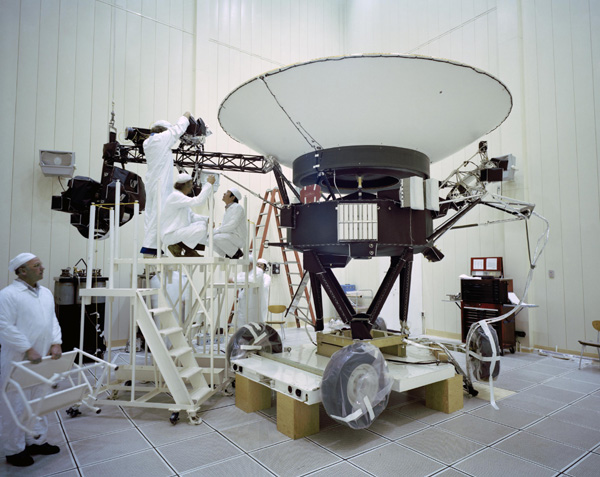
Engineers work on NASA's Voyager 2 spacecraft at the Jet Propulsion Laboratory near Pasadena, California...on March 23, 1977.
NASA / JPL - Caltech
NASA Turns Off Science Instrument to Save Voyager 2 Power (News Release - October 1)

The mission has been working to postpone the shut-off for as long as possible. Four other instruments aboard the interstellar spacecraft continue to operate.

Mission engineers at NASA have turned off the plasma science instrument aboard the Voyager 2 spacecraft due to the probe’s gradually shrinking electrical power supply.

Traveling more than 12.8 billion miles (20.5 billion kilometers) from Earth, the spacecraft continues to use four science instruments to study the region outside our heliosphere, the protective bubble of particles and magnetic fields created by the Sun. The probe has enough power to continue exploring this region with at least one operational science instrument into the 2030s.

Mission engineers have taken steps to avoid turning off a science instrument for as long as possible because the science data collected by the twin Voyager probes is unique. No other human-made spacecraft has operated in interstellar space, the region outside the heliosphere.

The plasma science instrument measures the amount of plasma (electrically-charged atoms) and the direction it is flowing. It has collected limited data in recent years due to its orientation relative to the direction that plasma is flowing in interstellar space.

Both spacecraft are powered by decaying plutonium and lose about 4 watts of power each year. After the twin Voyagers completed their exploration of the giant planets in the 1980s, the mission team turned off several science instruments that would not be used in the study of interstellar space. That gave the spacecraft plenty of extra power until a few years ago.

Since then, the team has turned off all onboard systems not essential for keeping the probes working, including some heaters. In order to postpone having to shut off another science instrument, they also adjusted how Voyager 2’ voltage is monitored.

Monitoring Results

On September 26, engineers issued the command to turn off the plasma science instrument. Sent by NASA’s Deep Space Network, it took 19 hours to reach Voyager 2, and the return signal took another 19 hours to reach Earth.

Mission engineers always carefully monitor changes being made to the 47-year-old spacecraft’s operations to ensure that they don’t generate any unwanted secondary effects. The team has confirmed that the switch-off command was executed without incident and the probe is operating normally.

In 2018, the plasma science instrument proved critical in determining that Voyager 2 left the heliosphere. The boundary between the heliosphere and interstellar space is demarcated by changes in the atoms, particles and magnetic fields that instruments on the Voyagers can detect. Inside the heliosphere, particles from the Sun flow outward, away from our nearest star.

The heliosphere is moving through interstellar space, so at Voyager 2’s position near the front of the solar bubble, the plasma flows in almost the opposite direction of the solar particles.

The plasma science instrument consists of four “cups.” Three cups point in the direction of the Sun and observed the solar wind while inside the heliosphere. A fourth points at a right angle to the direction of the other three and has observed the plasma in planetary magnetospheres, the heliosphere, and now, interstellar space.

When Voyager 2 exited the heliosphere, the flow of plasma into the three cups facing the Sun dropped off dramatically. The most useful data from the fourth cup comes only once every three months, when the spacecraft does a 360-degree turn on the axis pointed toward the Sun. This factored into the mission’s decision to turn this instrument off before others.

The plasma science instrument on Voyager 1 stopped working in 1980 and was turned off in 2007 to save power. Another instrument aboard Voyager 2, called the plasma wave subsystem, can estimate the plasma density when eruptions from the Sun drive shocks through the interstellar medium, producing plasma waves.

The Voyager team continues to monitor the health of the spacecraft and its available resources to make engineering decisions that maximize the mission’s science output.

Source: NASA.Gov

****

An artist's concept of a Voyager probe traveling through deep space.
NASA / JPL - Caltech