Showing posts with label Deep Space Network. Show all posts

Tuesday, August 25, 2026

A New Radio Dish for Space Exploration Has Emerged in the California Desert...

A snapshot of the new Deep Space Station 23 antenna at NASA's Goldstone Deep Space Communications Complex near Barstow, California.
NASA / JPL - Caltech

New Next-Gen Dish Adds Muscle to NASA’s Deep Space Network (News Release)

Deep Space Station 23 at NASA’s Goldstone facility in the California desert is the latest next-generation antenna to be added by the network’s enhancement project.

NASA’s Deep Space Network facility in California is marking the addition of a brand new 34-meter-wide (114-foot-wide) radio frequency antenna to the agency’s deep space communications and navigation system. The network uses giant dish antennas located at three global facilities to support more than 40 spacecraft exploring the Solar System and interstellar space.

The new Deep Space Station 23 (DSS-23) is located at the Goldstone Deep Space Communications Complex, near Barstow, and is managed by NASA’s Jet Propulsion Laboratory in Southern California.

NASA leadership and personnel as well as dignitaries gathered at the complete DSS-23 antenna for a ceremonial ribbon cutting. It’s the latest to be added as part of the Deep Space Network’s Aperture Enhancement Project, which began in 2009 to upgrade and expand the network by adding six new 34-meter multifrequency beam-waveguide antennas. These versatile dishes can enhance many missions operating over different radio frequencies.

“By expanding the Deep Space Network, we are strengthening the communications foundation NASA needs for the bold missions ahead — from exploring more of the Moon than ever before to peering deeper into the Solar System,” said James Kenyon, associate administrator of the Research and Technology Mission Directorate at NASA Headquarters in Washington. “This new antenna will help us deliver on our national goals for space exploration and push beyond the limits of what once seemed impossible.”

After completing a testing campaign from May through July to demonstrate its capabilities, the new DSS-23 began operations on August 3, tracking NASA’s Chandra X-ray Observatory. Since then, it has been communicating with dozens of missions such as NASA’s Mars Reconnaissance Orbiter, Psyche, Juno, Voyager 1 and other robotic spacecraft in deep space.

“The addition of this next-generation antenna brings us closer to a completely modernized network that embraces advanced technology to ensure NASA’s leadership in deep space communications,” said Dave Gallagher, director of JPL. “After over 60 years of continuous operations supporting consequential missions, these upgrades prime the network for a new era of exploration. The teams that designed, planned and built DSS-23 should be proud.”

Enhanced capabilities

Construction of DSS-23 began in February 2020. After the 133-ton metal reflector framework was placed and bolted atop the antenna’s pedestal in December 2024, engineers installed the panels to the framework that reflect radio frequency signals transmitted to and received from spacecraft. Then came the careful process of calibrating the antenna so that it can work in concert with the rest of the network.

It is the fifth antenna at Goldstone (joining three 34-meter antennas and one 70-meter, or 230-foot, antenna) and the fifth enhancement project antenna to join the network, which includes antennas at the DSN’s Goldstone, Madrid, and Canberra, Australia, complexes. Multifrequency beam waveguide antennas direct signals down to a stable, climate-controlled underground room, rather than housing heavy, sensitive electronic equipment on the moving antenna dish. In addition to offering versatility, this design allows easy access for maintenance and upgrades to the system.

“The biggest challenge wasn’t actually constructing the antenna. It was transforming a complex collection of mechanical, electrical, software, radio frequency, and infrastructure systems into a single, mission-ready asset,” said Germaine Aziz, manager of the Deep Space Network Aperture Enhancement Project at JPL. “Every subsystem must be integrated, calibrated, and verified to operate with extraordinary precision and reliability before it can support NASA’s deep space missions.”

The enhancement project will be complete when a sixth enhancement-project antenna, Deep Space Station 33, comes online at the Canberra facility in 2029, bringing the total number of 34-meter antennas across the network to 13. The 34-meter antennas can be arrayed (combined and operated together) to provide an equivalent communications backup for each facility’s single 70-meter antenna, which, after more than 50 years of near-continuous operation, are getting increasingly costly to maintain and repair.

Managed by Caltech for NASA, JPL manages the agency’s Deep Space Network with the oversight of NASA’s SCaN (Space Communications and Navigation) Program within NASA’s Research and Technology Mission Directorate. More than 100 NASA and non-NASA missions rely on the Deep Space Network and Near Space Network. They include missions that support astronauts aboard the International Space Station and future Artemis missions, monitoring Earth, exploring the Moon, and exploring the Solar System and beyond.

Source: Jet Propulsion Laboratory

Thursday, April 03, 2014

Cassini Update...

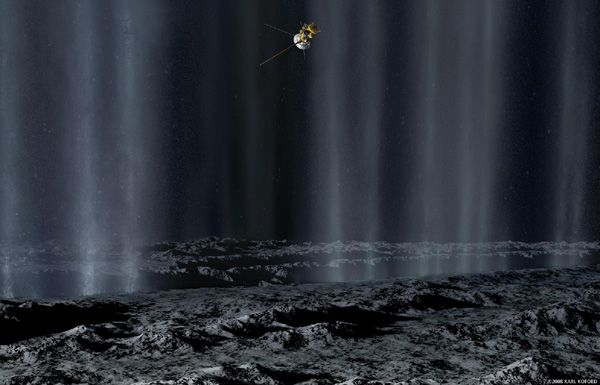
An illustration depicting NASA's Cassini spacecraft flying through water vapor plumes spewing from the surface of Saturn's moon Enceladus.
© 2008 Karl Kofoed

NASA Space Assets Detect Ocean inside Saturn Moon (Press Release)

NASA's Cassini spacecraft and Deep Space Network have uncovered evidence Saturn's moon Enceladus harbors a large underground ocean of liquid water, furthering scientific interest in the moon as a potential home to extraterrestrial microbes.

Researchers theorized the presence of an interior reservoir of water in 2005 when Cassini discovered water vapor and ice spewing from vents near the moon's south pole. The new data provide the first geophysical measurements of the internal structure of Enceladus, consistent with the existence of a hidden ocean inside the moon. Findings from the gravity measurements are in the Friday, April 4 edition of the journal Science.

"The way we deduce gravity variations is a concept in physics called the Doppler Effect, the same principle used with a speed-measuring radar gun," said Sami Asmar of NASA's Jet Propulsion Laboratory in Pasadena, Calif., a coauthor of the paper. "As the spacecraft flies by Enceladus, its velocity is perturbed by an amount that depends on variations in the gravity field that we're trying to measure. We see the change in velocity as a change in radio frequency, received at our ground stations here all the way across the solar system."

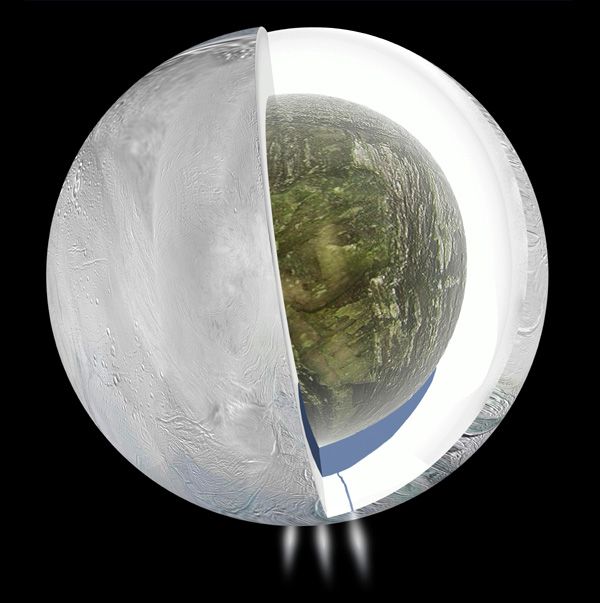
The gravity measurements suggest a large, possibly regional, ocean about 6 miles (10 kilometers) deep, beneath an ice shell about 19 to 25 miles (30 to 40 kilometers) thick. The subsurface ocean evidence supports the inclusion of Enceladus among the most likely places in our solar system to host microbial life. Before Cassini reached Saturn in July 2004, no version of that short list included this icy moon, barely 300 miles (500 kilometers) in diameter.

"This then provides one possible story to explain why water is gushing out of these fractures we see at the south pole," said David Stevenson of the California Institute of Technology, Pasadena, one of the paper's co-authors.

Cassini has flown near Enceladus 19 times. Three flybys, from 2010 to 2012, yielded precise trajectory measurements. The gravitational tug of a planetary body, such as Enceladus, alters a spacecraft's flight path. Variations in the gravity field, such as those caused by mountains on the surface or differences in underground composition, can be detected as changes in the spacecraft's velocity, measured from Earth.

The technique of analyzing a radio signal between Cassini and the Deep Space Network can detect changes in velocity as small as less than one foot per hour (90 microns per second). With this precision, the flyby data yielded evidence of a zone inside the southern end of the moon with higher density than other portions of the interior.

The south pole area has a surface depression that causes a dip in the local tug of gravity. However, the magnitude of the dip is less than expected given the size of the depression, leading researchers to conclude the depression's effect is partially offset by a high-density feature in the region, beneath the surface.

"The Cassini gravity measurements show a negative gravity anomaly at the south pole that however is not as large as expected from the deep depression detected by the onboard camera," said the paper's lead author, Luciano Iess of Sapienza University of Rome. "Hence the conclusion that there must be a denser material at depth that compensates the missing mass: very likely liquid water, which is seven percent denser than ice. The magnitude of the anomaly gave us the size of the water reservoir."

There is no certainty the subsurface ocean supplies the water plume spraying out of surface fractures near the south pole of Enceladus, however, scientists reason it is a real possibility. The fractures may lead down to a part of the moon that is tidally heated by the moon's repeated flexing, as it follows an eccentric orbit around Saturn.

Much of the excitement about the Cassini mission's discovery of the Enceladus water plume stems from the possibility that it originates from a wet environment that could be a favorable environment for microbial life.

"Material from Enceladus' south polar jets contains salty water and organic molecules, the basic chemical ingredients for life," said Linda Spilker, Cassini's project scientist at JPL. "Their discovery expanded our view of the 'habitable zone' within our solar system and in planetary systems of other stars. This new validation that an ocean of water underlies the jets furthers understanding about this intriguing environment."

The Cassini-Huygens mission is a cooperative project of NASA, the European Space Agency and the Italian Space Agency. JPL manages the mission for NASA's Science Mission Directorate in Washington.

Source: Jet Propulsion Laboratory

****

Using data provided by NASA's Cassini spacecraft and the Deep Space Network, this illustration depicts the possible interior of Saturn's moon Enceladus.
NASA / JPL - Caltech

Thursday, August 27, 2009

'HELLO FROM EARTH' banner.

GLIESE 581d, Here I Come... At 7:00 PM, California time today (12:00 PM Sydney time on Friday, August 28), a large radio telescope near Canberra, Australia began transmitting into deep space a signal containing 25,880 text messages gathered by COSMOS Magazine (for its Hello From Earth campaign) earlier this month. The signal is headed for a star system known as Gliese 581, where a potential ocean-covered planet (known as Gliese 581d) could possibly be harboring life. The signal will take 20.3 light-years (119 trillion miles, or 192 trillion kilometers) to reach Gliese 581, meaning it should arrive at the star system around December of 2029, give or take a few months. If advanced alien life forms do detect and decipher our signal, we wouldn't get a response from them till as early as 2051.

An artist's concept of the Gliese 581 star system.

The agency responsible for transmitting the signal was NASA...since the radio telescope [known as Deep Space Station 43 (or DSS-43), which is 70 meters—or 230 feet—in diameter] that was used is part of the worldwide Deep Space Network (DSN) that communicates with interplanetary probes such as Cassini, Dawn, Kepler and the New Horizons spacecraft. According to COSMOS Magazine, the messages were encoded into a binary format (by engineers at NASA's Jet Propulsion Laboratory in Pasadena, California) before being transmitted by the Canberra Deep Space Communications Complex at Tidbinbilla, Australia. They were sent at a 7.145 Gigahertz frequency at 18 kilowatts...meaning the signal is technically slightly more powerful than some of today’s best computer servers. However, the size of the 70-meter DSN telescope amplified the signal...making its strength the equivalent of using the transmitting power of 300 billion cell phones combined (or 300 gigawatts). The transmission will fly through the Gliese 581 star system two times over two hours...since the signal was relayed twice from DSS-43.

(I did the math, and if the two signals were sent into space exactly two hours apart from each other, then the first signal should be traveling around 1.3 billion miles—or 2.2 billion kilometers—ahead of the second one!)

The 70-meter radio telescope, known as DSS-43, at NASA's Canberra Deep Space Communications Complex in Tidbinbilla, Australia.

With the technical aspects of this Blog now out of the way, all I can say about this campaign is that it’s pretty friggin’ cool! And very amusing too...but not in a good way. In terms of it being cool, Hello From Earth somewhat made up for me not being able to get my name on the Pluto-bound New Horizons probe 4 years ago. The opportunity this time around is actually a lot better. Even though my name (and the message I typed) is in the form of an encrypted radio signal and not imprinted on an actual object like a microchip or a compact disc, my name will reach interstellar space a whole lot faster (since it’s traveling at the speed of light) than on a robotic spacecraft using conventional rocket fuel; and the signal will last as long as outbound space probes such as New Horizons and the Pioneer and Voyager spacecraft possibly will. (Assuming, of course, none of these probes collide with an interstellar asteroid or something.) After the signal reaches Gliese 581d, it will still be strong enough to be detected by intelligent life forms up to 100 light-years from Earth. Despite diminishing in strength as time goes by, the artificial nature of this transmission should be detectable up to 10,000 light-years away, before the signal disappears completely. That’s what I call a long shelf life. However, this doesn’t mean that I still can't wait for the day NASA approves another robotic mission like New Horizons that will fly beyond our solar system.

A screenshot of my message on the 'HELLO FROM EARTH' website.

Now...in terms of Hello From Earth being amusing, but not in a good way, if alien beings EVER DO detect and decipher this signal, and they actually speak um, English, then they will most likely be appalled by our transmission. Browse through all the messages on the Hello From Earth website (click on the first link posted at the start of this journal entry), and count to see how many of them actually have proper grammar and spelling. Not much. Granted, folks from all 195 nations (as well as Antarctica and Vatican City) submitted a message...so I really shouldn’t be expecting someone from Brazil, China or Iran to submit something that would imply they would win an English essay contest or something. But still, it’s just mind-boggling to think that extraterrestrials would get their first perception of Earthlings by reading this garbled nonsense. Oh well. Despite all this, I hope that COSMOS Magazine has another opportunity like Hello From Earth next year. After all, there are still more than 350 ‘exoplanets’ out there for us to send badly-worded greetings to. Live long and prosper.


"My name is Richard Par, and HELLO from planet Earth!!! I hope all is well in your civilization...and I hope you are a much more peaceful species than we are..."
Richard Par

August 17, 2009

An artist's concept of the water(?) world Gliese 581d.

Monday, February 04, 2008

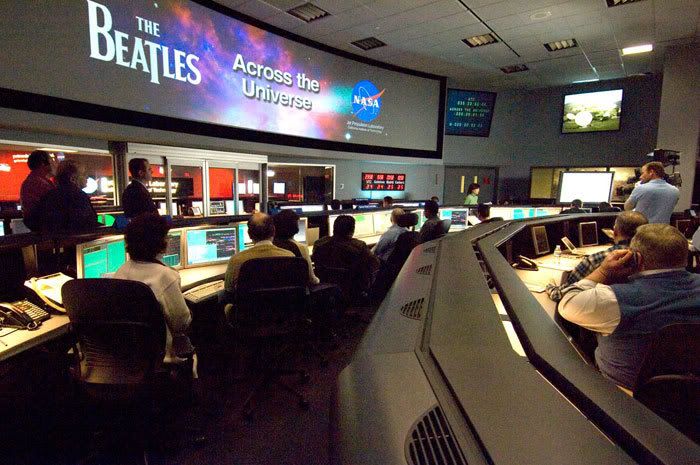
ACROSS THE UNIVERSE: At 4:00 PM, Pacific Standard Time today, NASA sent a transmission of the old Beatle’s song, Across the Universe, to Polaris, the North Star. The reasons why NASA did this were nostalgia-driven; the transmission celebrated the 40th anniversary since the Beatles created this classic song, the 45th anniversary of NASA’s Deep Space Network (a series of large radio dishes in California, Australia and Spain that are used to maintain communication with all the space probes scattered throughout our solar system) and the 50th anniversary since the founding of NASA itself.

The Jet Propulsion Laboratory in Pasadena, California was responsible for beaming the transmission, since JPL runs the Deep Space Network. It took 6 minutes for the song to be radioed up into space, and it’s gonna take 430 years for it to reach Polaris (that's because it's 430 light years, or 4 quadrillion miles, from Earth). And another 430 years for us to get a peaceful or hostile response by whatever alien civilization may be lurking near the North Star. Unless they respond by sending a fleet of spacecraft (a la the 1996 film Independence Day) to Earth first. Just being facetious. That’s all.

On February 4, 2008, folks in Mission Control at NASA's Jet Propulsion Laboratory in Pasadena, Calif. gaze at monitors indicating that a transmission of the Beatles tune 'Across the Universe' was successfully beamed up into space.
NASA JPL