Saturday, October 24, 2020

On This Day in 2000: PARMAN'S PAGE Is Born!

Well technically, my main website itself was created in January of 2000, but today marks 20 years since I began this Earth-shattering Blog (while I was just chillin' in the computer lab at my college alma mater, Cal State Long Beach, on one random school day)! Click here to read my groundbreaking one-liner that started it all...


Who would've thought that the next two decades would be marked by me talking about the Los Angeles Lakers, unrequited crushes on girls I knew in college (and at work. It's a little bit of both), obvious personal achievements like me paying off my current car, and then incessantly copying and pasting press releases from NASA and other space agencies here? Carry on.

Thursday, October 22, 2020

QueSST Update: NASA's Next X-Plane Gets Its Vertical Stabilizer...

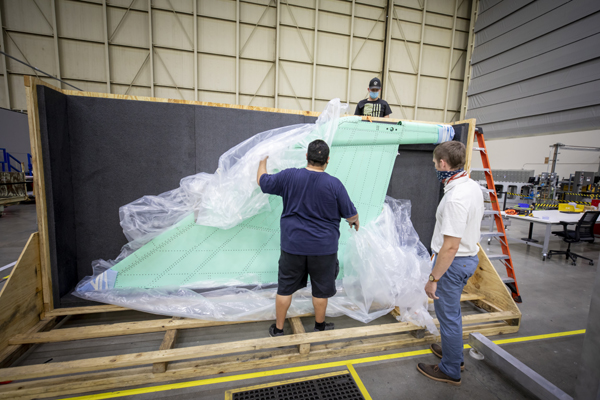
At Lockheed Martin's Skunk Works facility in Palmdale, California, workers uncrate the vertical stabilizer that will fly on NASA's X-59 QueSST aircraft.
Lockheed Martin

Unpacking the Future of Supersonic Air Travel (News Release)

The vertical tail of NASA’s X-59 Quiet SuperSonic Technology airplane is unpacked from its shipping crate after delivery to Lockheed Martin’s Skunk Works facility in Palmdale, California. Assembly is taking shape there in anticipation of the X-59’s first flight some time in mid-2022. Made of an aluminum alloy, the vertical tail’s pale green color comes from a corrosion-protecting coating applied to the bare metal. The structure will be placed atop the single F414-GE-100 jet engine to form the X-59’s tail and contribute to the aircraft’s overall height of 14 feet.

Designed to produce quiet sonic “thumps” when flying supersonic, the X-59 will be flown over select communities to measure public perception of the sound. Results will be given to regulators to use in determining new rules that could allow commercial faster-than-sound air travel over land.

Source: NASA.Gov

****

An artist's concept of NASA's X-59 QueSST aircraft soaring high in the sky.
Lockheed Martin

Tuesday, October 20, 2020

OSIRIS-REx Boops Bennu...

An artist's concept of NASA's OSIRIS-REx spacecraft about to collect a soil sample from the surface of asteroid Bennu.
NASA / Goddard / University of Arizona

NASA’s OSIRIS-REx Spacecraft Successfully Touches Asteroid (Press Release)

NASA’s Origins, Spectral Interpretation, Resource Identification, Security, Regolith Explorer (OSIRIS-REx) spacecraft unfurled its robotic arm Tuesday, and in a first for the agency, briefly touched an asteroid to collect dust and pebbles from the surface for delivery to Earth in 2023.

This well-preserved, ancient asteroid, known as Bennu, is currently more than 200 million miles (321 million kilometers) from Earth. Bennu offers scientists a window into the early solar system as it was first taking shape billions of years ago and flinging ingredients that could have helped seed life on Earth. If Tuesday’s sample collection event, known as “Touch-And-Go” (TAG), provided enough of a sample, mission teams will command the spacecraft to begin stowing the precious primordial cargo to begin its journey back to Earth in March 2021. Otherwise, they will prepare for another attempt in January.

“This amazing first for NASA demonstrates how an incredible team from across the country came together and persevered through incredible challenges to expand the boundaries of knowledge,” said NASA Administrator Jim Bridenstine. “Our industry, academic, and international partners have made it possible to hold a piece of the most ancient solar system in our hands.”

At 1:50 p.m. EDT, OSIRIS-REx fired its thrusters to nudge itself out of orbit around Bennu. It extended the shoulder, then elbow, then wrist of its 11-foot (3.35-meter) sampling arm, known as the Touch-And-Go Sample Acquisition Mechanism (TAGSAM), and transited across Bennu while descending about a half-mile (805 meters) toward the surface. After a four-hour descent, at an altitude of approximately 410 feet (125 meters), the spacecraft executed the “Checkpoint” burn, the first of two maneuvers to allow it to precisely target the sample collection site, known as “Nightingale.”

Ten minutes later, the spacecraft fired its thrusters for the second “Matchpoint” burn to slow its descent and match the asteroid’s rotation at the time of contact. It then continued a treacherous, 11-minute coast past a boulder the size of a two-story building, nicknamed “Mount Doom,” to touch down in a clear spot in a crater on Bennu’s northern hemisphere. The size of a small parking lot, the site Nightingale site is one of the few relatively clear spots on this unexpectedly boulder-covered space rock.

“This was an incredible feat – and today we’ve advanced both science and engineering and our prospects for future missions to study these mysterious ancient storytellers of the solar system,” said Thomas Zurbuchen, associate administrator for NASA’s Science Mission Directorate at the agency’s headquarters in Washington. “A piece of primordial rock that has witnessed our solar system’s entire history may now be ready to come home for generations of scientific discovery, and we can’t wait to see what comes next.”

“After over a decade of planning, the team is overjoyed at the success of today’s sampling attempt,” said Dante Lauretta, OSIRIS-REx principal investigator at the University of Arizona in Tucson. “Even though we have some work ahead of us to determine the outcome of the event – the successful contact, the TAGSAM gas firing, and back-away from Bennu are major accomplishments for the team. I look forward to analyzing the data to determine the mass of sample collected.”

All spacecraft telemetry data indicates the TAG event executed as expected. However, it will take about a week for the OSIRIS-REx team to confirm how much sample the spacecraft collected.

Real-time data indicates the TAGSAM successfully contacted the surface and fired a burst of nitrogen gas. The gas should have stirred up dust and pebbles on Bennu’s surface, some of which should have been captured in the TAGSAM sample collection head. OSIRIS-REx engineers also confirmed that shortly after the spacecraft made contact with the surface, it fired its thrusters and safely backed away from Bennu.

“Today’s TAG maneuver was historic,” said Lori Glaze, Planetary Science Division director at NASA Headquarters in Washington. “The fact that we safely and successfully touched the surface of Bennu, in addition to all the other milestones this mission has already achieved, is a testament to the living spirit of exploration that continues to uncover the secrets of the solar system."

“It’s hard to put into words how exciting it was to receive confirmation that the spacecraft successfully touched the surface and fired one of the gas bottles,” said Michael Moreau, OSIRIS-REx deputy project manager at NASA’s Goddard Space Flight Center in Greenbelt, Maryland. “The team can’t wait to receive the imagery from the TAG event late tonight and see how the surface of Bennu responded to the TAG event.”

The spacecraft carried out TAG autonomously, with pre-programmed instructions from engineers on Earth. Now, the OSIRIS-REx team will begin to assess whether the spacecraft grabbed any material, and, if so, how much; the goal is at least 60 grams, which is roughly equivalent to a full-size candy bar.

OSIRIS-REx engineers and scientists will use several techniques to identify and measure the sample remotely. First, they’ll compare images of the Nightingale site before and after TAG to see how much surface material moved around in response to the burst of gas.

“Our first indication of whether we were successful in collecting a sample will come on October 21 when we downlink the back-away movie from the spacecraft,” Moreau said. “If TAG made a significant disturbance of the surface, we likely collected a lot of material.”

Next, the team will try to determine the amount of sample collected. One method involves taking pictures of the TAGSAM head with a camera known as SamCam, which is devoted to documenting the sample-collection process and determining whether dust and rocks made it into the collector head. One indirect indication will be the amount of dust found around the sample collector head. OSIRIS-REx engineers also will attempt to snap photos that could, given the right lighting conditions, show the inside of the head so engineers can look for evidence of sample inside of it.

A couple of days after the SamCam images are analyzed, the spacecraft will attempt yet another method to measure the mass of the sample collected by determining the change in the spacecraft’s “moment of inertia,” a phrase that describes how mass is distributed and how it affects the rotation of the body around a central axis. This maneuver entails extending the TAGSAM arm out to the side of the spacecraft and slowly spinning the spacecraft about an axis perpendicular to the arm. This technique is analogous to a person spinning with one arm extended while holding a string with a ball attached to the end. The person can sense the mass of the ball by the tension in the string. Having performed this maneuver before TAG, and now after, engineers can measure the change in the mass of the collection head as a result of the sample inside.

“We will use the combination of data from TAG and the post-TAG images and mass measurement to assess our confidence that we have collected at least 60 grams of sample,” said Rich Burns, OSIRIS-REx project manager at Goddard. “If our confidence is high, we'll make the decision to stow the sample on October 30.”

To store the sample, engineers will command the robotic arm to place the sample collector head into the Sample Return Capsule (SRC), located in the body of the spacecraft. The sample arm will then retract to the side of the spacecraft for the final time, the SRC will close, and the spacecraft will prepare for its departure from Bennu in March 2021 — this is the next time Bennu will be properly aligned with Earth for the most fuel-efficient return flight.

If, however, it turns out that the spacecraft did not collect enough sample at Nightingale, it will attempt another TAG maneuver on Jan. 12, 2021. If that occurs, it will touch down at the backup site called “Osprey,” which is another relatively boulder-free area inside a crater near Bennu’s equator.

OSIRIS-REx launched from Cape Canaveral Air Force Station in Florida Sept. 8, 2016. It arrived at Bennu Dec. 3, 2018, and began orbiting the asteroid for the first time on Dec. 31, 2018. The spacecraft is scheduled to return to Earth Sept. 24, 2023, when it will parachute the SRC into Utah's west desert where scientists will be waiting to collect it.

Goddard provides overall mission management, systems engineering and the safety and mission assurance for OSIRIS-REx. Dante Lauretta of the University of Arizona, Tucson, is the principal investigator, and the University of Arizona also leads the science team and the mission’s science observation planning and data processing. Lockheed Martin Space in Denver built the spacecraft and is providing flight operations. Goddard and KinetX Aerospace are responsible for navigating the OSIRIS-REx spacecraft. OSIRIS-REx is the third mission in NASA’s New Frontiers Program, which is managed by NASA’s Marshall Space Flight Center in Huntsville, Alabama, for the agency’s Science Mission Directorate in Washington.

****

An animated GIF showing OSIRIS-REx's robotic sampling arm approaching the surface of asteroid Bennu...on August 11, 2020.
NASA / Goddard / University of Arizona

Sunday, October 11, 2020

The L.A. Lakers are the 2020 NBA Champions!

The Los Angeles Lakers take a group photo after winning the 2020 NBA championship at Walt Disney World in Orlando, Florida...on October 11, 2020.

353 days after their 2019-2020 season began, the Los Angeles Lakers are once again NBA champions! They played stifling defense in a Game 6 where they bested the Miami Heat, 106-93, at Walt Disney World in Orlando, Florida tonight. LeBron James, Anthony Davis, Rajon Rondo, Kentavious Caldwell-Pope, Dwight Howard and Co. accomplished this task 20 years after Shaquille O'Neal and Kobe Bryant won their first championship with the Lakers, and 10 years after Kobe earned his fifth and final NBA title in L.A. Some factoids if you're a fan of the Lake Show:

- The Lakers have won their 17th championship in franchise history, tying the Boston Celtics.

- LeBron James won his fourth Finals MVP trophy while earning his fourth NBA title on his third NBA team (after the Miami Heat in 2012 and 2013, and the Cleveland Cavaliers in 2016).

- Rajon Rondo joins Clyde Lovellette as the only players to win championships with the Lakers and the Celtics. This is Rondo's second title (his first was with the Celtics after they defeated the Lake Show in the 2008 NBA Finals).

- Danny Green won his third championship on his third NBA team (he won a title with the San Antonio Spurs in 2014 and his second title with the Toronto Raptors last year, respectively).

- Kostas Antetokounmpo, the brother of Giannis Antetokounmpo (who plays with the Milwaukee Bucks and won the MVP award for the NBA regular season this year), won a title before Giannis did!

- Dwight Howard won his first championship in Orlando—with the very team that defeated him when he was a player on the Orlando Magic (in the 2009 NBA Finals).

- Alex Caruso's story goes from him beginning his three-year career in the NBA's G League to him starting Game 6 of the 2020 NBA Finals with LeBron James and Anthony Davis... Very impressive.

- Head coach Frank Vogel is now in the same category as Paul Westhead, Pat Riley and Phil Jackson!

And last, but most definitely not least:

- Jeanie Buss is the very first female controlling owner of an NBA team to win a championship. Congrats Jeanie! Your late father Jerry would be proud.

And of course, let's not forget the fact that the Lakers completed their mission of honoring Kobe Bryant, his daughter Gianna and the seven other individuals who perished in the helicopter crash on January 26 with this victory. What a way to cap an NBA season like no other... Much kudos to league commissioner Adam Silver for pulling off the NBA Bubble! Carry on.

Lakers players (and team general manager Rob Pelinka, on the right) gather around the Larry O'Brien Trophy after they won the 2020 NBA championship at Walt Disney World in Orlando, Florida...on October 11, 2020.

Friday, October 09, 2020

Photos of the Day #2: My New MacBook!

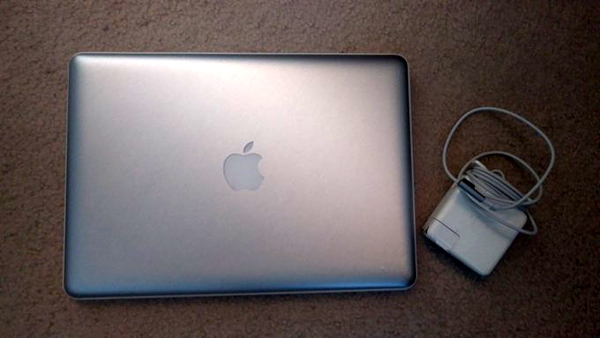
My 13-inch Apple Macbook computer...which I received from an eBay vendor on October 8, 2020.

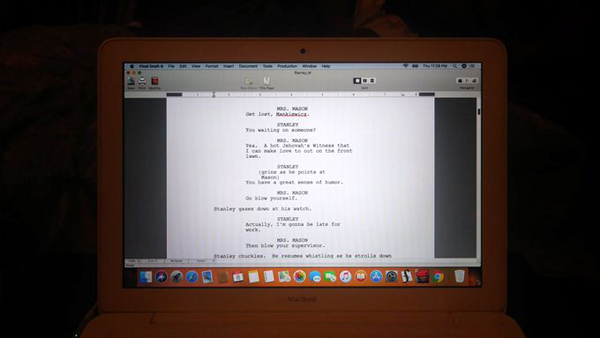
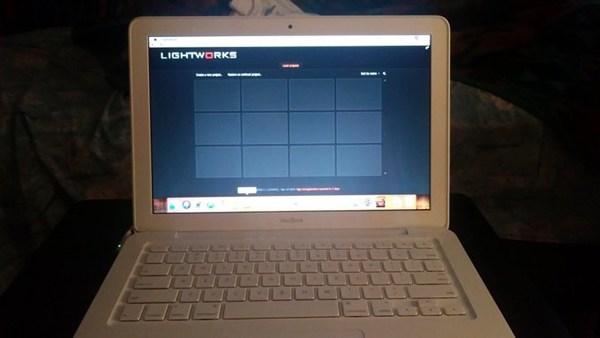
Just thought I'd share these pics that I took of the 13-inch Apple MacBook I ordered on eBay last week...courtesy of one of my brothers, who bought it for me as a birthday gift! The MacBook arrived at my house yesterday morning. Despite the fact that it's used, the laptop is working great! I installed the Final Draft 9 scriptwriting program and the Lightworks video editing software (which I used for my short film The Broken Table) last night. I totally can't wait to do filmmaking things with this computer!

Two of three computers now at my disposal at home. The third unseen laptop was used to edit my short film THE BROKEN TABLE last year.

Of course, the main reason why I wanted to get a Mac was to have access to the external hard drive that I used for my projects back in film school (at Cal State Long Beach) 16 years ago. The hard drive was formatted for the Mac G5 that I edited my film Envious on back in 2004...and unfortunately, I haven't had access to this project's media files since then because I mainly use PC computers. Next week, I'm getting an adapter (which I ordered on Amazon) that will hopefully allow me to connect the Firewire cable of this old hard drive to my MacBook. If it works, then woohoo! Sound-wise, Envious has been incomplete for the past 16 years, and I've been yearning to complete it since then. Once Envious is done, the sky's the limit! Can't wait to see what other video projects I'll create with my Apple computer. Happy Friday!

A snapshot of my Apple MacBook after I installed the Final Draft 9 scriptwriting software on it.

A snapshot of my Apple MacBook after I installed the Lightworks video editing program on it.

Thursday, October 08, 2020

OSIRIS-REx Update: Organic Material Covers Much of Bennu's Surface...

A false-color image of asteroid Bennu showing organic material strewn across most of its surface.
NASA / Goddard / University of Arizona

NASA’s OSIRIS-REx Unlocks More Secrets from Asteroid Bennu (News Release)

NASA’s first asteroid sample return mission now knows much more about the material it’ll be collecting in just a few weeks. In a special collection of six papers published today in the journals Science and Science Advances, scientists on the OSIRIS-REx mission present new findings on asteroid Bennu’s surface material, geological characteristics, and dynamic history. They also suspect that the delivered sample of Bennu may be unlike anything we have in the meteorite collection on Earth.

These discoveries complete the OSIRIS-REx mission’s pre–sample collection science requirements and offer insight into the sample of Bennu that scientists will study for generations to come.

One of the papers, led by Amy Simon from NASA’s Goddard Space Flight Center in Greenbelt, Maryland, shows that carbon-bearing, organic material is widespread on the asteroid’s surface, including at the mission’s primary sample site, Nightingale, where OSIRIS-REx will make its first sample collection attempt on October 20. These findings indicate that hydrated minerals and organic material will likely be present in the collected sample.

This organic matter may contain carbon in a form often found in biology or in compounds associated with biology. Scientists are planning detailed experiments on these organic molecules and expect that the returned sample will help answer complex questions about the origins of water and life on Earth.

“The abundance of carbon-bearing material is a major scientific triumph for the mission. We are now optimistic that we will collect and return a sample with organic material – a central goal of the OSIRIS-REx mission,” said Dante Lauretta, OSIRIS-REx principal investigator at the University of Arizona in Tucson.

Authors of the special collection have also determined that carbonate minerals make up some of the asteroid’s geological features. Carbonate minerals often precipitate from hydrothermal systems that contain both water and carbon dioxide. A number of Bennu’s boulders have bright veins that appear to be made of carbonate – some of which are located near the Nightingale crater, meaning that carbonates might be present in the returned sample.

The study of the carbonates found on Bennu was led by Hannah Kaplan, from Goddard. These findings have allowed scientists to theorize that Bennu’s parent asteroid likely had an extensive hydrothermal system, where water interacted with and altered the rock on Bennu’s parent body. Although the parent body was destroyed long ago, we’re seeing evidence of what that watery asteroid once looked like here – in its remaining fragments that make up Bennu. Some of these carbonate veins in Bennu’s boulders measure up to a few feet long and several inches thick, validating that an asteroid-scale hydrothermal system of water was present on Bennu’s parent body.

Scientists made another striking discovery at site Nightingale: its regolith has only recently been exposed to the harsh space environment, meaning that the mission will collect and return some of the most pristine material on the asteroid. Nightingale is part of a population of young, spectrally red craters identified in a study led by Dani DellaGiustina at the University of Arizona. Bennu’s “colors” (variations in the slope of the visible-wavelength spectrum) are much more diverse than originally anticipated. This diversity results from a combination of different materials inherited from Bennu’s parent body and different durations of exposure to the space environment.

This paper’s findings are a major milestone in an ongoing debate in the planetary science community – how primitive asteroids like Bennu change spectrally as they are exposed to “space weathering” processes, such as bombardment by cosmic rays and solar wind. While Bennu appears quite black to the naked eye, the authors illustrate the diversity of Bennu’s surface by using false-color renderings of multispectral data collected by the MapCam camera. The freshest material on Bennu, such as that found at the Nightingale site, is spectrally redder than average and thus appears red in these images. Surface material turns vivid blue when it has been exposed to space weathering for an intermediate period of time. As the surface material continues to weather over long periods of time, it ultimately brightens across all wavelengths, becoming a less intense blue – the average spectral color of Bennu.

The paper by DellaGiustina et al. also distinguishes two main types of boulders on Bennu’s surface: dark and rough, and (less commonly) bright and smooth. The different types may have formed at different depths in the parent asteroid of Bennu.

Not only do the boulder types differ visually, they also have their own unique physical properties. The paper led by Ben Rozitis from The Open University in the UK shows that the dark boulders are weaker and more porous, whereas the bright boulders are stronger and less porous. The bright boulders also host the carbonates identified by Kaplan and crew, suggesting that the precipitation of carbonate minerals in cracks and pore spaces may be responsible for their increased strength.

However, both boulder types are weaker than scientists expected. Rozitis and colleagues suspect that Bennu’s dark boulders (the weaker, more porous, and more common type) would not survive the journey through Earth’s atmosphere. It’s therefore likely that the returned samples of asteroid Bennu will provide a missing link for scientists, as this type of material is not currently represented in meteorite collections.

Bennu is a diamond-shaped pile of rubble floating in space, but there’s more to it than meets the eye. Data obtained by the OSIRIS-REx Laser Altimeter (OLA) – a science instrument contributed by the Canadian Space Agency – have allowed the mission team to develop a 3D digital terrain model of the asteroid that, at 20 cm resolution, is unprecedented in detail and accuracy. In this paper, led by Michael Daly of York University, scientists explain how detailed analysis of the asteroid’s shape revealed ridge-like mounds on Bennu that extend from pole-to-pole, but are subtle enough that they could be easily missed by the human eye. Their presence has been hinted at before, but their full pole-to-pole extents only became clear when the northern and southern hemispheres were split apart in the OLA data for comparison.

The digital terrain model also shows that Bennu’s northern and southern hemispheres have different shapes. The southern hemisphere appears to be smoother and rounder, which the scientists believe is a result of loose material getting trapped by the region’s numerous large boulders.

Another paper in the special collection, led by Daniel Scheeres of University of Colorado Boulder, examines the gravity field of Bennu, which has been determined by tracking the trajectories of the OSIRIS-REx spacecraft and the particles that are naturally ejected from Bennu’s surface. The use of particles as gravity probes is fortuitous. Prior to the discovery of particle ejection on Bennu in 2019, the team was concerned about mapping the gravity field to the required precision using only spacecraft tracking data. The natural supply of dozens of mini gravity probes allowed the team to vastly exceed their requirements and gain unprecedented insight into the asteroid interior.

The reconstructed gravity field shows that the interior of Bennu is not uniform. Instead, there are pockets of higher and lower density material inside the asteroid. It’s as if there is a void at its center, within which you could fit a couple of football fields. In addition, the bulge at Bennu’s equator is under-dense, suggesting that Bennu’s rotation is lofting this material.

All six publications in the special collection use global and local datasets collected by the OSIRIS-REx spacecraft from Feb. through Oct. 2019. The special collection underscores that sample return missions like OSIRIS-REx are essential to fully understanding the history and evolution of our Solar System.

The mission is less than two weeks away from fulfilling its biggest goal – collecting a piece of a pristine, hydrated, carbon-rich asteroid. OSIRIS-REx will depart Bennu in 2021 and deliver the sample to Earth on Sep. 24, 2023.

NASA’s Goddard Space Flight Center in Greenbelt, Maryland, provides overall mission management, systems engineering, and the safety and mission assurance for OSIRIS-REx. Dante Lauretta of the University of Arizona, Tucson, is the principal investigator, and the University of Arizona also leads the science team and the mission’s science observation planning and data processing. Lockheed Martin Space in Denver built the spacecraft and provides flight operations. Goddard and KinetX Aerospace are responsible for navigating the OSIRIS-REx spacecraft. OSIRIS-REx is the third mission in NASA’s New Frontiers Program, which is managed by NASA’s Marshall Space Flight Center in Huntsville, Alabama, for the agency’s Science Mission Directorate in Washington.
Source: AsteroidMission.org

Wednesday, October 07, 2020

Photo of the Day: Memeing Tonight's Vice Presidential Debate...

Friggin' Twitter... You never let me down when it comes to creating memes that encapsulate the craziness that's been the past four years here in America. Tonight is no different. If you watched this evening's vice presidential debate between U.S. Senator Kamala Harris and Vice President Mike Pence, you'd know what I'm talkin' about.

Only 27 days till Election Day! To my fellow Americans: Vote Early! Vote for Biden/Harris 2020! Carry on.

Current Vice President Mike Pence had a fly on his head and (supposedly) pinkeye during the U.S. vice presidential debate with Senator Kamala Harris on October 7, 2020.

Tuesday, October 06, 2020

Hubble's Successor Continues Its March Towards Launch One Year from This Month...

NASA's James Webb Space Telescope is stowed in its launch configuration prior to undergoing environmental testing at the Northrop Grumman facility in Redondo Beach, California.
NASA / Chris Gunn

NASA’s James Webb Space Telescope Completes Environmental Testing (News Release)

With the completion of its latest series of milestone tests, NASA’s James Webb Space Telescope has now survived all of the harsh conditions associated with a rocket launch to space.

Webb’s recent tests have validated that the fully assembled observatory will endure the deafening noise, and the jarring shakes, rattles and vibrations that the observatory will experience during liftoff. Known as “acoustic” and “sine-vibration” testing, NASA has worked carefully with its international partners to match Webb’s testing environment precisely to what Webb will experience both on launch day, and when operating in orbit.

Though each component of the telescope has been rigorously tested during development, demonstrating that the assembled flight hardware is able to safely pass through a simulated launch environment is a significant achievement for the mission. Completed in two separate facilities within Northrop Grumman’s Space Park in Redondo Beach, California, these tests represent Webb’s final two, in a long series of environmental tests before Webb is shipped to French Guiana for launch.

The next environment Webb will experience is space.

“The successful completion of our observatory environmental tests represent a monumental milestone in the march to launch. Environmental testing demonstrates Webb’s ability to survive the rocket ride to space, which is the most violent portion of its trip to orbit approximately a million miles from earth. The multinational group of individuals responsible for the execution of the acoustic and vibration test is composed of an outstanding and dedicated group of folks who are typical of the entire Webb team,” said Bill Ochs, Webb project manager for NASA Goddard Space Flight Center in Greenbelt, Maryland.

Testing began by first encapsulating the entire telescope in a mobile clean room built to shield it from the outside world. Technicians then carefully guided it to a nearby acoustic testing chamber where it was intentionally blasted by sound pressure levels above 140 decibels, with a spectrum tuned to the specific signature of the Ariane 5 rocket it will ride to space. During the tests nearly 600 individual channels of motion data were carefully observed and recorded. Typical acoustic and vibration tests measure approximately 100 channels of data, but the complex size and shape of the observatory required considerably more measurement to ensure success. The data was then thoroughly analyzed and marked as a complete success.

Upon successful completion of its final acoustics tests, Webb was again packed and transported to a separate facility to simulate the low frequency vibrations that occur during liftoff. While inside Webb was placed on a specialized shaker table capable of precise vertical and horizontal acceleration. Where acoustic testing simulates the high-frequency dynamics of launch, vibration testing covers the lower frequencies experienced. With the combination of the two the entire mechanical environment Webb will experience during launch is accounted for.

“The testing team is an international consortium of structural dynamics experts who are the lead engineers for each piece of hardware on the observatory. The team members are located throughout the USA and Europe, spanning across 9 time zones! They are extremely dedicated to support testing at all hours and days to provide their expertise,” said Sandra Irish, Webb Mechanical Systems Structures Engineer Lead for NASA’s Goddard Space Flight Center in Greenbelt, Maryland. “Through the team’s dedication, hard work, and just pure excitement in being a part of this complex test, it was a complete success! I have known these individuals for many years and it’s been an honor to work with each one of them.”

Webb is now scheduled to move forward into the last full extension of its iconic primary mirror and sunshield followed by a full systems evaluation before being encapsulated in a specialized shipping container for transport to South America. Deploying the observatory after experiencing a simulated launch environment is the best way to replicate the true series of events the observatory will experience during launch, and when performing its complex deployment sequence in space. Initial analysis suggests the observatory passed through observatory level acoustic and vibration testing successfully, but the full verification of flight worthiness will occur after Webb has successfully completed final deployment tests.

Engineers and technicians continue to follow augmented personal safety procedures due to the COVID-19 situation, which is causing significant impact and disruption globally. The team has resumed near-full operations and are now preparing for the final phase of testing prior to shipment to the launch site.

The James Webb Space Telescope is the world’s largest, most powerful, and complex space science telescope ever built. In addition to the groundbreaking science expected from it after launch, Webb has required an improvement in the testing infrastructure and processes involved in validating large complex spacecraft for a life in space. Various facilities around the country had to be enlarged and upgraded to confidently test and prepare a machine as large as Webb for liftoff. Lessons learned from previous space telescope development were invested into Webb, and future space telescopes will be built upon the same collective knowledge. Thousands of scientists, engineers, and technicians contributed to build, test, and integrate Webb. In total, 258 companies, agencies, and universities participated – 142 from the United States, 104 from 12 European nations, and 12 from Canada.

Webb is NASA’s next great space science observatory, which will help in solving the mysteries of our solar system, looking beyond to distant worlds around other stars, and probing the mystifying structures and origins of our universe. Webb is an international program led by NASA, along with its partners ESA (European Space Agency) and the Canadian Space Agency.

Source: NASA.Gov

****

Monday, October 05, 2020

Photos of the Day #2: Doin' My Part to Save U.S. Democracy...

Doing my part to save U.S. democracy...on October 5, 2020.

So earlier today, I mailed my absentee ballot for the U.S. presidential election...two days after I got the ballot in the mail and immediately filled it out. Actually, I delivered my ballot to a vote-by-mail drop box...whose location I obviously won't disclose here (since I don't know when the ballot will be retrieved by election workers). It feels good to do my part in saving U.S. democracy after it's been under chaos by the orange-skinned COVIDIOT In Chief for almost four years.

Anyways, only 29 days till Election Day! To my fellow Americans: Vote Early! Vote for Biden/Harris 2020! That is all.

To my fellow Americans: Vote for Biden/Harris 2020!

Sunday, October 04, 2020

Photos of the Day: Celebrating the Big 4-1 Today...

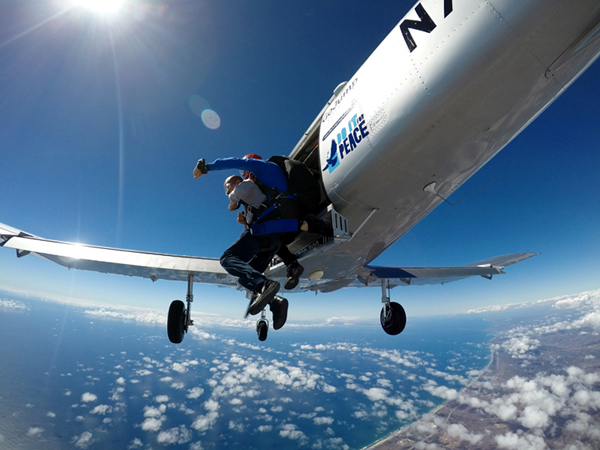
Celebrating my 35th birthday by doing a tandem skydive above Lake Elsinore, California, on October 4, 2014.

To commemorate me turning um, 41 today, just thought I'd share pics from the two skydives that I did to celebrate my 35th and 39th birthdays, respectively. In 2014, I went to Skydive Elsinore to do a tandem jump, while I followed suit at GoJump Oceanside four years later. I was thinking about doing a jump last year to celebrate my 40th birthday, but I didn't have time to do so since I was in the last three weeks of pre-production on my short film, The Broken Table.

So how am I celebrating today, you ask? By staying at home, typing this Blog entry, keeping track of the latest online updates about Trump being hospitalized for COVID-19 (I'm voting for Joe Biden, FYI), and waiting for Game 3 of the NBA Finals to begin at 4:30 PM, Pacific Daylight Time on the ABC Network. Happy Sunday!

LINK #1: Click here for more images from my Lake Elsinore tandem skydive

LINK #2: Click here for more images from my Oceanside tandem skydive

Celebrating my 39th birthday by doing a tandem skydive above Oceanside, California, on October 4, 2018.