Tuesday, July 21, 2015

One Week Since the Pluto Flyby: Nix and Hydra Are Revealed!

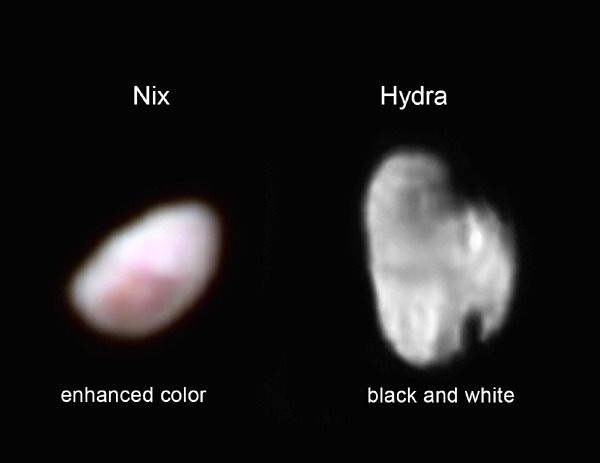
Pluto's small moons Nix and Hydra...as seen by NASA's New Horizons spacecraft on July 14, 2015.
NASA / JHUAPL / SWRI

New Horizons Captures Two of Pluto's Smaller Moons (Press Release)

Pluto has five known moons. In order of distance from Pluto they are: Charon, Styx, Nix, Kerberos, and Hydra.

While Pluto’s largest moon Charon has grabbed most of the lunar spotlight, two of Pluto’s smaller and lesser-known satellites are starting to come into focus via new images from the New Horizons spacecraft. Nix and Hydra – the second and third moons to be discovered – are approximately the same size, but their similarity ends there.

New Horizons’ first color image of Pluto’s moon Nix, in which colors have been enhanced, reveals an intriguing region on the jelly bean-shaped satellite, which is estimated to be 26 miles (42 kilometers) long and 22 miles (36 kilometers) wide.

Although the overall surface color of Nix is neutral grey in the image, the newfound region has a distinct red tint. Hints of a bull’s-eye pattern lead scientists to speculate that the reddish region is a crater. “Additional compositional data has already been taken of Nix, but is not yet downlinked. It will tell us why this region is redder than its surroundings,” said mission scientist Carly Howett, Southwest Research Institute, Boulder, Colorado. She added, “This observation is so tantalizing, I’m finding it hard to be patient for more Nix data to be downlinked.”

Meanwhile, the sharpest image yet received from New Horizons of Pluto’s satellite Hydra shows that its irregular shape resembles the state of Michigan. The new image was made by the Long Range Reconnaissance Imager (LORRI) on July 14, 2015 from a distance of 143,000 miles (231,000 kilometers), and shows features as small as 0.7 miles (1.2 kilometers) across. There appear to be at least two large craters, one of which is mostly in shadow. The upper portion looks darker than the rest of Hydra, suggesting a possible difference in surface composition. From this image, mission scientists have estimated that Hydra is 34 miles (55 kilometers) long and 25 miles (40 kilometers) wide. Commented mission science collaborator Ted Stryk of Roane State Community College in Tennessee, “Before last week, Hydra was just a faint point of light, so it's a surreal experience to see it become an actual place, as we see its shape and spot recognizable features on its surface for the first time.”

Images of Pluto’s most recently discovered moons, Styx and Kerberos, are expected to be transmitted to Earth no later than mid-October.

Nix and Hydra were both discovered in 2005 using Hubble Space Telescope data by a research team led by New Horizons project scientist Hal Weaver, Johns Hopkins University Applied Physics Laboratory, Laurel, Maryland. New Horizons’ findings on the surface characteristics and other properties of Nix and Hydra will help scientists understand the origins and subsequent history of Pluto and its moons.

Source: NASA.Gov

****
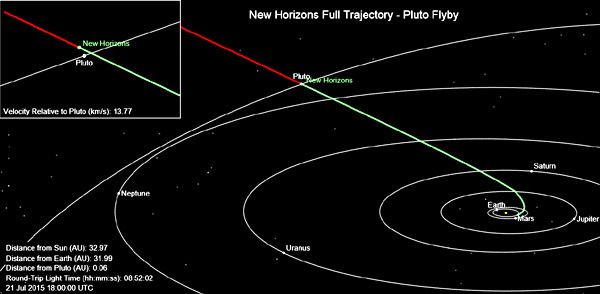
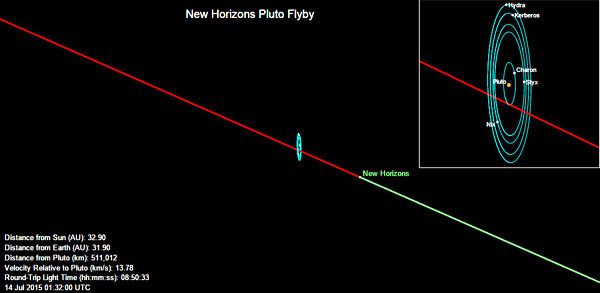
New Horizons' current position near the Pluto system as of 11:00 AM PDT on July 21, 2015.
NASA / Johns Hopkins University Applied Physics Laboratory / Southwest Research Institute

Friday, July 17, 2015

Frozen Tundra on a Dwarf Planet...

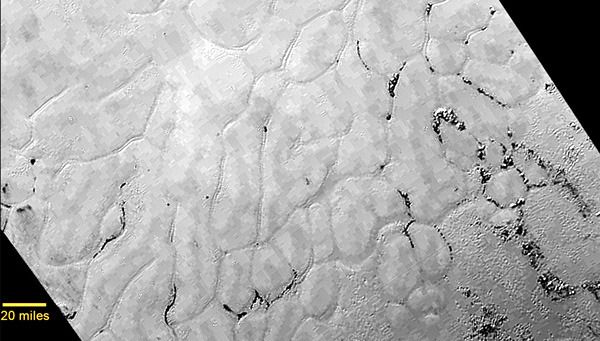
An image of frozen plains, known as Sputnik  Planum, on the surface of Pluto as seen by NASA's New Horizons spacecraft on July 14, 2015.
NASA / JHUAPL / SwRI

NASA’s New Horizons Discovers Frozen Plains in the Heart of Pluto’s ‘Heart’ (Press Release)

In the latest data from NASA’s New Horizons spacecraft, a new close-up image of Pluto reveals a vast, craterless plain that appears to be no more than 100 million years old, and is possibly still being shaped by geologic processes. This frozen region is north of Pluto’s icy mountains, in the center-left of the heart feature, informally named “Tombaugh Regio” (Tombaugh Region) after Clyde Tombaugh, who discovered Pluto in 1930.

“This terrain is not easy to explain,” said Jeff Moore, leader of the New Horizons Geology, Geophysics and Imaging Team (GGI) at NASA’s Ames Research Center in Moffett Field, California. “The discovery of vast, craterless, very young plains on Pluto exceeds all pre-flyby expectations.”

This fascinating icy plains region -- resembling frozen mud cracks on Earth -- has been informally named “Sputnik Planum” (Sputnik Plain) after the Earth’s first artificial satellite. It has a broken surface of irregularly-shaped segments, roughly 12 miles (20 kilometers) across, bordered by what appear to be shallow troughs. Some of these troughs have darker material within them, while others are traced by clumps of hills that appear to rise above the surrounding terrain. Elsewhere, the surface appears to be etched by fields of small pits that may have formed by a process called sublimation, in which ice turns directly from solid to gas, just as dry ice does on Earth.

Scientists have two working theories as to how these segments were formed. The irregular shapes may be the result of the contraction of surface materials, similar to what happens when mud dries. Alternatively, they may be a product of convection, similar to wax rising in a lava lamp. On Pluto, convection would occur within a surface layer of frozen carbon monoxide, methane and nitrogen, driven by the scant warmth of Pluto’s interior.

Pluto’s icy plains also display dark streaks that are a few miles long. These streaks appear to be aligned in the same direction and may have been produced by winds blowing across the frozen surface.

The Tuesday “heart of the heart” image was taken when New Horizons was 48,000 miles (77,000 kilometers) from Pluto, and shows features as small as one-half mile (1 kilometer) across. Mission scientists will learn more about these mysterious terrains from higher-resolution and stereo images that New Horizons will pull from its digital recorders and send back to Earth during the next year.

The New Horizons Atmospheres team observed Pluto’s atmosphere as far as 1,000 miles (1,600 kilometers) above the surface, demonstrating that Pluto’s nitrogen-rich atmosphere is quite extended. This is the first observation of Pluto’s atmosphere at altitudes higher than 170 miles above the surface (270 kilometers).

The New Horizons Particles and Plasma team has discovered a region of cold, dense ionized gas tens of thousands of miles beyond Pluto -- the planet’s atmosphere being stripped away by the solar wind and lost to space.

“This is just a first tantalizing look at Pluto’s plasma environment,” said New Horizons co-investigator Fran Bagenal, University of Colorado, Boulder.

"With the flyby in the rearview mirror, a decade-long journey to Pluto is over --but, the science payoff is only beginning,” said Jim Green, director of Planetary Science at NASA Headquarters in Washington. "Data from New Horizons will continue to fuel discovery for years to come.”

Alan Stern, New Horizons principal investigator from the Southwest Research Institute (SwRI), Boulder, Colorado, added, “We’ve only scratched the surface of our Pluto exploration, but it already seems clear to me that in the initial reconnaissance of the solar system, the best was saved for last."

New Horizons is part of NASA’s New Frontiers Program, managed by the agency’s Marshall Space Flight Center in Huntsville, Alabama. The Johns Hopkins University Applied Physics Laboratory in Laurel, Maryland, designed, built and operates the New Horizons spacecraft and manages the mission for NASA’s Science Mission Directorate. SwRI leads the mission, science team, payload operations and encounter science planning.

Source: NASA.Gov

Wednesday, July 15, 2015

New Horizons Update: One Day After the Flyby!

A close-up image of huge mountains composed of water ice on the surface of Pluto...as seen by NASA's New Horizons spacecraft on July 14, 2015.
NASA / JHUAPL / SwRI

From Mountains to Moons: Multiple Discoveries from NASA’s New Horizons Pluto Mission (Press Release)

Icy mountains on Pluto and a new, crisp view of its largest moon, Charon, are among the several discoveries announced Wednesday by NASA's New Horizons team, just one day after the spacecraft’s first ever Pluto flyby.

"Pluto New Horizons is a true mission of exploration showing us why basic scientific research is so important," said John Grunsfeld, associate administrator for NASA's Science Mission Directorate in Washington. "The mission has had nine years to build expectations about what we would see during closest approach to Pluto and Charon. Today, we get the first sampling of the scientific treasure collected during those critical moments, and I can tell you it dramatically surpasses those high expectations."

“Home run!” said Alan Stern, principal investigator for New Horizons at the Southwest Research Institute (SwRI) in Boulder, Colorado. “New Horizons is returning amazing results already. The data look absolutely gorgeous, and Pluto and Charon are just mind blowing."

A new close-up image of an equatorial region near the base of Pluto’s bright heart-shaped feature shows a mountain range with peaks jutting as high as 11,000 feet (3,500 meters) above the surface of the icy body.

The mountains on Pluto likely formed no more than 100 million years ago -- mere youngsters in a 4.56-billion-year-old solar system. This suggests the close-up region, which covers about one percent of Pluto’s surface, may still be geologically active today.

“This is one of the youngest surfaces we’ve ever seen in the solar system,” said Jeff Moore of the New Horizons Geology, Geophysics and Imaging Team (GGI) at NASA’s Ames Research Center in Moffett Field, California.

Unlike the icy moons of giant planets, Pluto cannot be heated by gravitational interactions with a much larger planetary body. Some other process must be generating the mountainous landscape.

“This may cause us to rethink what powers geological activity on many other icy worlds,” says GGI deputy team leader John Spencer at SwRI.

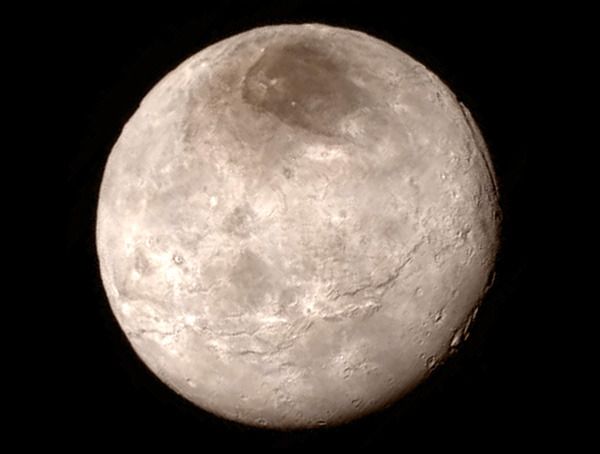
The new view of Charon reveals a youthful and varied terrain. Scientists are surprised by the apparent lack of craters. A swath of cliffs and troughs stretching about 600 miles (1,000 kilometers) suggests widespread fracturing of Charon’s crust, likely the result of internal geological processes. The image also shows a canyon estimated to be 4 to 6 miles (7 to 9 kilometers) deep. In Charon’s north polar region, the dark surface markings have a diffuse boundary, suggesting a thin deposit or stain on the surface.

New Horizons also observed the smaller members of the Pluto system, which includes four other moons: Nix, Hydra, Styx and Kerberos. A new sneak-peek image of Hydra is the first to reveal its apparent irregular shape and its size, estimated to be about 27 by 20 miles (43 by 33 kilometers).

The observations also indicate Hydra's surface is probably coated with water ice. Future images will reveal more clues about the formation of this and the other moon billions of years ago. Spectroscopic data from New Horizons’ Ralph instruments reveal an abundance of methane ice, but with striking differences among regions across the frozen surface of Pluto.

The Johns Hopkins University Applied Physics Laboratory in Laurel, Maryland designed, built and operates the New Horizons spacecraft and manages the mission for NASA’s Science Mission Directorate. SwRI leads the mission, science team, payload operations and encounter science planning. New Horizons is part of NASA’s New Frontiers Program, managed by the agency’s Marshall Space Flight Center in Huntsville, Alabama.

Source: NASA.Gov

****

A close-up image of Pluto's largest moon Charon...as seen by NASA's New Horizons spacecraft on July 14, 2015.
NASA / JHUAPL / SwRI

Tuesday, July 14, 2015

TODAY'S THE DAY: New Horizons' Moment of Triumph Has Arrived!

An image of Pluto that was taken by NASA's New Horizons spacecraft from a distance of 476,000 miles (768,000 kilometers) on July 13, 2015.
NASA / APL / SwRI

NASA's Three-Billion-Mile Journey to Pluto Reaches Historic Encounter (Press Release)

NASA’s New Horizons spacecraft is at Pluto.

After a decade-long journey through our solar system, New Horizons made its closest approach to Pluto Tuesday, about 7,750 miles above the surface -- roughly the same distance from New York to Mumbai, India – making it the first-ever space mission to explore a world so far from Earth.

“I’m delighted at this latest accomplishment by NASA, another first that demonstrates once again how the United States leads the world in space,” said John Holdren, assistant to the President for Science and Technology and director of the White House Office of Science and Technology Policy. “New Horizons is the latest in a long line of scientific accomplishments at NASA, including multiple missions orbiting and exploring the surface of Mars in advance of human visits still to come; the remarkable Kepler mission to identify Earth-like planets around stars other than our own; and the DSCOVR satellite that soon will be beaming back images of the whole Earth in near real-time from a vantage point a million miles away. As New Horizons completes its flyby of Pluto and continues deeper into the Kuiper Belt, NASA's multifaceted journey of discovery continues."

“The exploration of Pluto and its moons by New Horizons represents the capstone event to 50 years of planetary exploration by NASA and the United States," said NASA Administrator Charles Bolden. “Once again we have achieved a historic first. The United States is the first nation to reach Pluto, and with this mission has completed the initial survey of our solar system, a remarkable accomplishment that no other nation can match.”

Per the plan, the spacecraft currently is in data-gathering mode and not in contact with flight controllers at the Johns Hopkins University Applied Physics Laboratory (APL) in Laurel, Maryland. Scientists are waiting to find out whether New Horizons “phones home,” transmitting to Earth a series of status updates that indicate the spacecraft survived the flyby and is in good health. The “call” is expected shortly after 9 p.m. EDT tonight.

The Pluto story began only a generation ago when young Clyde Tombaugh was tasked to look for Planet X, theorized to exist beyond the orbit of Neptune. He discovered a faint point of light that we now see as a complex and fascinating world.

"Pluto was discovered just 85 years ago by a farmer's son from Kansas, inspired by a visionary from Boston, using a telescope in Flagstaff, Arizona,” said John Grunsfeld, associate administrator for NASA's Science Mission Directorate in Washington. "Today, science takes a great leap observing the Pluto system up close and flying into a new frontier that will help us better understand the origins of the solar system.”

New Horizons’ flyby of the dwarf planet and its five known moons is providing an up-close introduction to the solar system's Kuiper Belt, an outer region populated by icy objects ranging in size from boulders to dwarf planets. Kuiper Belt objects, such as Pluto, preserve evidence about the early formation of the solar system.

New Horizons principal investigator Alan Stern of the Southwest Research Institute (SwRI) in Boulder, Colorado, says the mission now is writing the textbook on Pluto.

"The New Horizons team is proud to have accomplished the first exploration of the Pluto system,” Stern said. “This mission has inspired people across the world with the excitement of exploration and what humankind can achieve.”

New Horizons’ almost 10-year, three-billion-mile journey to closest approach at Pluto took about one minute less than predicted when the craft was launched in January 2006. The spacecraft threaded the needle through a 36-by-57 mile (60 by 90 kilometers) window in space -- the equivalent of a commercial airliner arriving no more off target than the width of a tennis ball.

Because New Horizons is the fastest spacecraft ever launched – hurtling through the Pluto system at more than 30,000 mph, a collision with a particle as small as a grain of rice could incapacitate the spacecraft. Once it reestablishes contact Tuesday night, it will take 16 months for New Horizons to send its cache of data – 10 years’ worth -- back to Earth.

New Horizons is the latest in a long line of scientific accomplishments at NASA, including multiple rovers exploring the surface of Mars, the Cassini spacecraft that has revolutionized our understanding of Saturn and the Hubble Space Telescope, which recently celebrated its 25th anniversary. All of this scientific research and discovery is helping to inform the agency’s plan to send American astronauts to Mars in the 2030’s.

“After nearly 15 years of planning, building, and flying the New Horizons spacecraft across the solar system, we’ve reached our goal,” said project manager Glen Fountain at APL. “The bounty of what we’ve collected is about to unfold.”

APL designed, built and operates the New Horizons spacecraft and manages the mission for NASA’s Science Mission Directorate. SwRI leads the mission, science team, payload operations and encounter science planning. New Horizons is part of NASA’s New Frontiers Program, managed by the agency’s Marshall Space Flight Center in Huntsville, Alabama.

Source: NASA.Gov

****

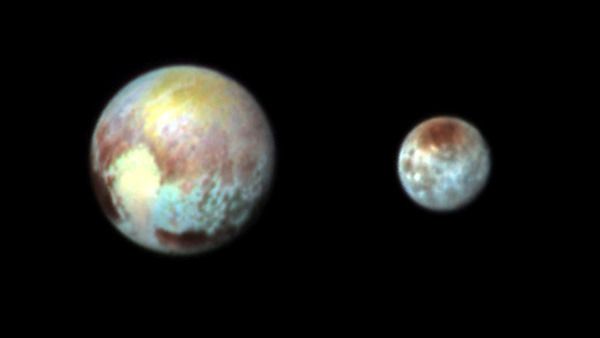
A false-color image of Pluto and Charon that was taken by NASA's New Horizons spacecraft on July 13, 2015.
NASA / Johns Hopkins University Applied Physics Laboratory / Southwest Research Institute

Monday, July 13, 2015

New Horizons Update: T-Minus 1 Day and Counting!

A composite image of Pluto and Charon that was taken by NASA's New Horizons spacecraft from a distance of 1.6 million miles (2.5 million kilometers) on July 12, 2015.
NASA / Johns Hopkins University Applied Physics Laboratory / Southwest Research Institute
The excitement is building! Google posted a new Google doodle to commemorate tomorrow's historic flyby, while the New Horizons flight team itself released the cool composite photo above. And the image at the very bottom of this entry shows where the spacecraft is as it rapidly closes in on the dwarf planet...which should no longer be considered a dwarf planet considering that NASA just revealed that Pluto is much larger than Eris (the icy world that caused Pluto to be demoted back in August of 2006) and every other currently-known object out in the Kuiper Belt. Will you change your tune now, Mike Brown (the astronomer who discovered Eris in 2005) and Neil deGrasse Tyson (the fervent celebrity advocate of dwarf planets who thinks that Pluto should retain this lowly title)?

A screenshot of New Horizons' 'Google doodle.'

New Horizons' current position near the Pluto system as of 6:32 PM PDT on July 13, 2015.
NASA / Johns Hopkins University Applied Physics Laboratory / Southwest Research Institute

Sunday, July 12, 2015

New Horizons Update: T-Minus 2 Days and Counting!

An image of Pluto that was taken by NASA's New Horizons spacecraft from a distance of 2.5 million miles (4 million kilometers) on July 11, 2015.
NASA / Johns Hopkins University Applied Physics Laboratory / Southwest Research Institute
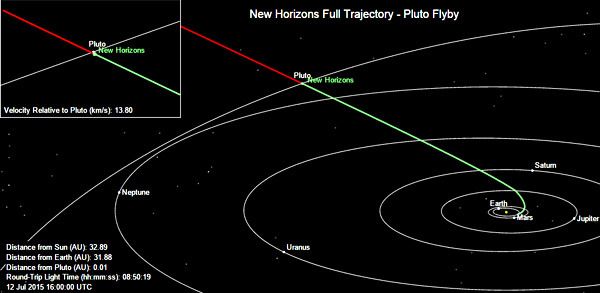
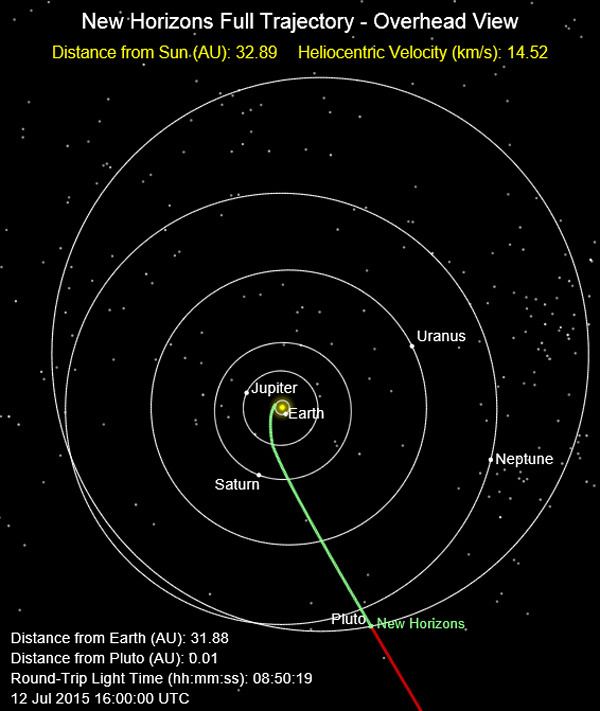
Getting closer and closer... Today marks the first of two days that NASA's New Horizons spacecraft will transmit 'Fail Safe' data and photos to Earth prior to this Tuesday's historic flyby of the dwarf planet Pluto. The Fail Safe data was planned by the flight team just in case New Horizons doesn't survive the July 14 encounter (God forbid). Here's hoping that won't be the case! The three images below show the spacecraft's current location in relation to Pluto and its five moons, as well as the rest of our solar system. The image above was taken yesterday, and shows the side of Pluto that won't be seen again until mankind sends another robotic emissary (I'd also mention astronauts, but let's be realistic here) to the distant world.

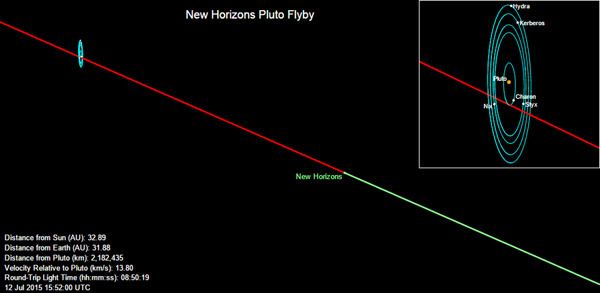
New Horizons' current position near the Pluto system before 9:00 AM, Pacific Daylight Time (PDT), on July 12, 2015.
NASA / Johns Hopkins University Applied Physics Laboratory / Southwest Research Institute

New Horizons' current position near the Pluto system as of 9:00 AM PDT on July 12, 2015.
NASA / Johns Hopkins University Applied Physics Laboratory / Southwest Research Institute
New Horizons' current position in our solar system as of 9:00 AM PDT on July 12, 2015.
NASA / Johns Hopkins University Applied Physics Laboratory / Southwest Research Institute
Friday, July 10, 2015

New Horizons Update: T-Minus 4 Days and Counting!

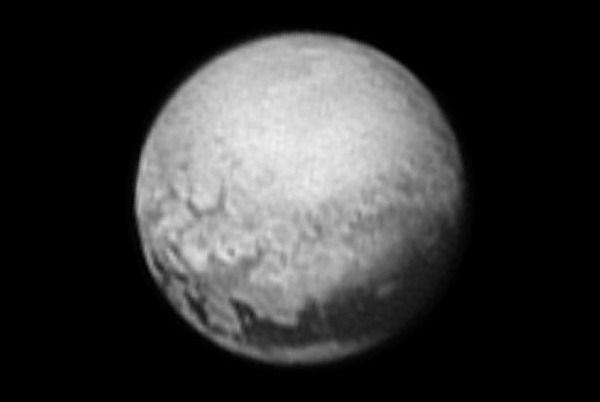
An image of Pluto that was taken by NASA's New Horizons spacecraft from a distance of 3.3 million miles (5.4 million kilometers) on July 9, 2015.
NASA / Johns Hopkins University Applied Physics Laboratory / Southwest Research Institute

New Image of Pluto: 'Houston, We Have Geology' (Press Release)

It began as a point of light. Then, it evolved into a fuzzy orb. Now – in its latest portrait from NASA’s New Horizons spacecraft – Pluto is being revealed as an intriguing new world with distinct surface features, including an immense dark band known as the “whale.”

As the newest black and white image from New Horizons’ Long Range Reconnaissance Imager (LORRI) appeared on the morning of July 10, members of the science team reacted with joy and delight, seeing Pluto as never before. There will no doubt be many similar moments to come. New images and data are being gathered each day as New Horizons speeds closer to a July 14 flyby of Pluto, following a journey of three billion miles.

“We’re close enough now that we’re just starting to see Pluto’s geology,” said New Horizons program scientist Curt Niebur, NASA Headquarters in Washington, who’s keenly interested in the gray area just above the whale’s “tail” feature. “It’s a unique transition region with a lot of dynamic processes interacting, which makes it of particular scientific interest.”

New Horizons’ latest image of Pluto was taken on July 9, 2015 from 3.3 million miles (5.4 million kilometers) away, with a resolution of 17 miles (27 kilometers) per pixel. At this range, Pluto is beginning to reveal the first signs of discrete geologic features. This image views the side of Pluto that always faces its largest moon, Charon, and includes the so-called “tail” of the dark whale-shaped feature along its equator. (The immense, bright feature shaped like a heart had rotated from view when this image was captured.)

“Among the structures tentatively identified in this new image are what appear to be polygonal features; a complex band of terrain stretching east-northeast across the planet, approximately 1,000 miles long; and a complex region where bright terrains meet the dark terrains of the whale,” said New Horizons principal investigator Alan Stern. “After nine and a half years in flight, Pluto is well worth the wait.”

Source: NASA.Gov

****

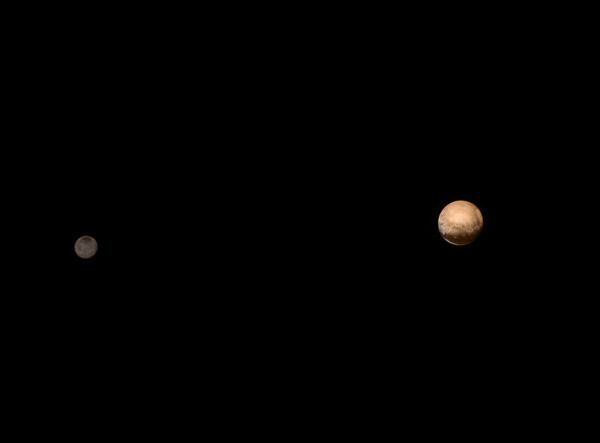
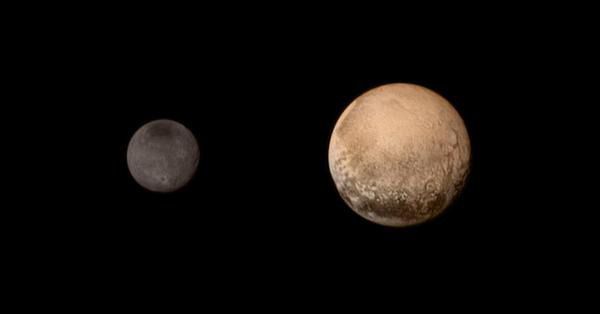
An image of Pluto (right) and Charon (left) that was taken by NASA's New Horizons spacecraft from a distance of 3.7 million miles (6 million kilometers) on July 8, 2015.
NASA / Johns Hopkins University Applied Physics Laboratory / Southwest Research Institute
Tuesday, July 07, 2015

New Horizons Update: T-Minus 7 Days and Counting!

A drawing I made of NASA's New Horizons spacecraft exploring the dwarf planet Pluto and its five moons.

To mark the fact that the historic flyby of Pluto by NASA's New Horizons spacecraft is only one week ago, here's a drawing I made of the distant voyager last week. There was a brief scare during the Fourth of July weekend when New Horizons went into safe mode after its main computer crashed and the probe switched over to its backup computer...but all is well now and the craft is collecting data once again. The final command sequence for next week's Pluto encounter has been transmitted to New Horizons, and the grand piano-sized bot is ready to rewrite science textbooks everywhere come July 14! Sooo stoked.

Work-in-progress photos of the drawing I made of NASA's New Horizons spacecraft exploring the dwarf planet Pluto and its five moons.

Thursday, July 02, 2015

A July 4th Theme at Gale Crater...

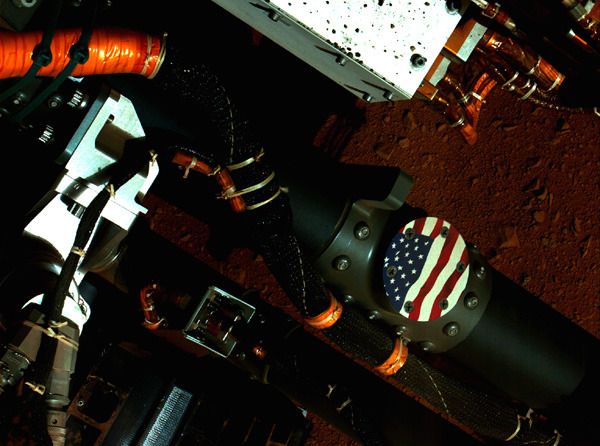
The American flag on the Curiosity Mars rover's robotic arm...as seen by the spacecraft's Mars Hand Lens Imager (MAHLI) on September 19, 2012.
NASA / JPL - Caltech / MSSS

Curiosity's Stars and Stripes (Press Release)

This view of the American flag medallion on NASA's Mars rover Curiosity was taken by the rover's Mars Hand Lens Imager (MAHLI) during the 44th Martian day, or sol, of Curiosity's work on Mars (Sept. 19, 2012). The flag is one of four "mobility logos" placed on the rover's mobility rocker arms.

The circular medallion of the flag is made of anodized aluminum and measures 2.68 inches (68 millimeters) in diameter. The medallion was affixed with bolts to locations on the rocker arms where flight hardware was once considered, but ultimately deemed unnecessary.

The other three medallions adorning the rover's rocker arms are the NASA logo, the JPL logo and the Curiosity mission logo.

The main purpose of Curiosity's MAHLI camera is to acquire close-up, high-resolution views of rocks and soil at the rover's Gale Crater field site. The camera is capable of focusing on any target at distances of about 0.8 inch (2.1 centimeters) to infinity, providing versatility for other uses, such as views of the rover itself from different angles.

Source: NASA.Gov

****

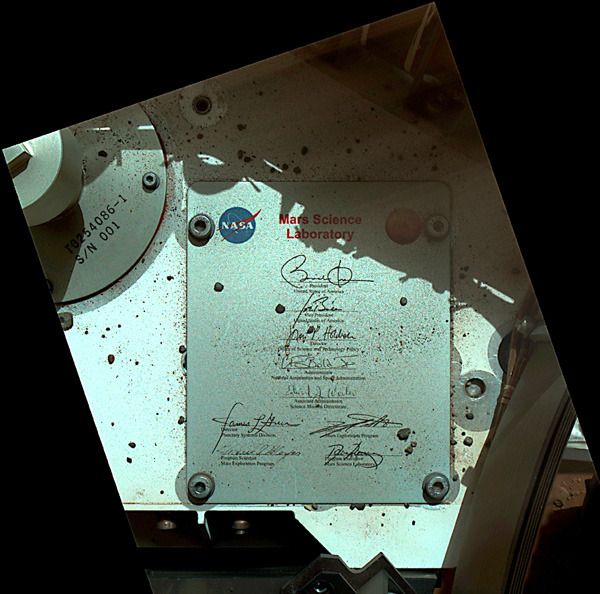
A plaque on the Curiosity Mars rover that features the signatures of President Barack Obama, Vice President Joe Biden and other U.S. public officials...as seen by MAHLI on September 19, 2012.
NASA / JPL - Caltech / MSSS

Wednesday, July 01, 2015

New Horizons Update: T-Minus 13 Days and Counting!

An animated GIF showing Charon revolving around Pluto...as seen from NASA's New Horizons spacecraft between June 23-29, 2015.
NASA / Johns Hopkins University Applied Physics Laboratory / Southwest Research Institute

NASA’s New Horizons Spacecraft Stays the Course to Pluto (Press Release)

NASA’s New Horizons spacecraft is getting a final “all clear” as it speeds closer to its historic July 14 flyby of Pluto and the dwarf planet’s five moons.

After seven weeks of detailed searches for dust clouds, rings, and other potential hazards, the New Horizons team has decided the spacecraft will remain on its original path through the Pluto system instead of making a late course correction to detour around any hazards. Because New Horizons is traveling at 30,800 mph (49,600 kph), a particle as small as a grain of rice could be lethal.

“We’re breathing a collective sigh of relief knowing that the way appears to be clear,” said Jim Green, director of planetary science at NASA. “The science payoff will be richer as we gather data from the optimal flight path, as opposed to having to conduct observations from one of the back-up trajectories.”

Mission scientists have been using the spacecraft’s most powerful telescopic camera, the Long Range Reconnaissance Imager (LORRI), to look for potential hazards, such as small moons, rings, or dust, since mid-May. The decision on whether to keep the spacecraft on its original course or adopt a Safe Haven by Other Trajectory, or "SHBOT" path, had to be made this week since the last opportunity to maneuver New Horizons onto an alternate trajectory is July 4.

“Not finding new moons or rings present is a bit of a scientific surprise to most of us,” said principal investigator Alan Stern of the Southwest Research Institute (SwRI) in Boulder, Colorado. “But as a result, no engine burn is needed to steer clear of potential hazards. We presented these data to NASA for review and received approval to proceed on course and plan. We are ‘go’ for the best of our planned Pluto encounter trajectories.” New Horizons formed a hazard analysis team in 2011, after the discovery of Pluto’s fourth moon, Kerberos, raised concerns the cratering of these moons by small debris from the outer area of the solar system known as the Kuiper Belt, could spread additional hazardous debris into New Horizons’ path. Mission engineers re-tested spare spacecraft blanketing and parts back on Earth to determine how well they would stand up to particle impacts, and scientists modeled the likely formation and locations of rings and debris in the Pluto system. By the time New Horizons’ cameras were close enough to Pluto to start the search last month, the team had already estimated the chances of a catastrophic incident at far less than one percent.
The images used in the latest searches that cleared the mission to stay on its current course were taken June 22, 23 and 26. Pluto and all five of its known moons are visible in the images, but scientists saw no rings, new moons, or hazards of any kind. The hazards team determined that satellites as faint as about 15 times dimmer than Pluto’s faintest known moon, Styx, would have been seen if they existed beyond the orbit of Pluto’s largest and closest moon, Charon.

If any rings do exist, the hazard team determined they must be extremely faint, reflecting less than one 5-millionth of the incoming sunlight.

“The suspense – at least most of it – is behind us,” says John Spencer, of SwRI, who leads the New Horizons hazard analysis team. “As a scientist I’m a bit disappointed that we didn’t spot additional moons to study, but as a New Horizons team member I am much more relieved that we didn’t find something that could harm the spacecraft. New Horizons already has six amazing objects to analyze in this incredible system.”

The Johns Hopkins University Applied Physics Laboratory in Laurel, Maryland, designed, built, and operates the New Horizons spacecraft, and manages the mission for NASA’s Science Mission Directorate. The Southwest Research Institute, based in San Antonio, leads the science team, payload operations and encounter science planning. New Horizons is part of the New Frontiers Program managed by NASA’s Marshall Space Flight Center in Huntsville, Alabama.

Source: New Horizons Website