Showing posts with label Mars Rovers. Show all posts

Monday, October 28, 2024

A Gorgeous View from Jezero Crater on Mars...

A snapshot of the terrain at Jezero Crater, as seen by NASA's Perseverance Mars rover on September 27, 2024.
NASA / JPL - Caltech / ASU / MSSS

NASA’s Perseverance Rover Looks Back While Climbing Slippery Slope (News Release)

On its way up the side of Jezero Crater, the agency’s latest Red Planet off-roader peers all the way back to its landing site and scopes the path ahead.

NASA’s Perseverance Mars rover is negotiating a steeply sloping route up Jezero Crater’s western wall with the aim of cresting the rim in early December. During the climb, the rover snapped not only a sweeping view of Jezero Crater’s interior, but also imagery of the tracks that it left after some wheel slippage along the way.

Stitched together from 44 frames acquired on September 27, the 1,282nd Martian day of Perseverance’s mission, the image mosaic features many landmarks and Martian firsts that have made the rover’s 3½-year exploration of Jezero so memorable, including the rover’s landing site, the spot where it first found sedimentary rocks, the location of the first sample depot on another planet, and the final airfield for NASA’s Ingenuity Mars Helicopter. The rover captured the view near a location that the team calls “Faraway Rock,” at about the halfway point in its climb up the crater wall.

“The image not only shows our past and present, but also shows the biggest challenge to getting where we want to be in the future,” said Perseverance’s deputy project manager, Rick Welch of NASA’s Jet Propulsion Laboratory in Southern California. “If you look at the right side of the mosaic, you begin to get an idea what we’re dealing with. Mars didn’t want to make it easy for anyone to get to the top of this ridge.”

Visible on the right side of the mosaic is a slope of about 20 degrees. While Perseverance has climbed 20-degree inclines before (both NASA’s Curiosity and Opportunity rovers had crested hills at least 10 degrees steeper), this is the first time it’s traveled that steep a grade on such a slippery surface.

Soft, Fluffy

During much of the climb, the rover has been driving over loosely-packed dust and sand with a thin, brittle crust. On several days, Perseverance covered only about 50% of the distance that it would have on a less slippery surface, and on one occasion, it covered just 20% of the planned route.

“Mars rovers have driven over steeper terrain, and they’ve driven over more slippery terrain, but this is the first time one had to handle both — and on this scale,” said JPL’s Camden Miller, who was a rover planner, or “driver,” for Curiosity and now serves the same role on the Perseverance mission. “For every two steps forward Perseverance takes, we were taking at least one step back. The rover planners saw this was trending toward a long, hard slog, so we got together to think up some options.”

On October 3, they sent commands for Perseverance to test strategies to reduce slippage. First, they had it drive backward up the slope (testing on Earth has shown that under certain conditions the rover’s “rocker-bogie” suspension system maintains better traction during backward driving). Then they tried cross-slope driving (switchbacking) and driving closer to the northern edge of “Summerland Trail,” the name that the mission has given to the rover’s route up the crater rim.

Data from those efforts showed that while all three approaches enhanced traction, sticking close to the slope’s northern edge proved the most beneficial. The rover planners believe the presence of larger rocks closer to the surface made the difference.

“That’s the plan right now, but we may have to change things up the road,” said Miller. “No Mars rover mission has tried to climb up a mountain this big this fast. The science team wants to get to the top of the crater rim as soon as possible because of the scientific opportunities up there. It’s up to us rover planners to figure out a way to get them there.”

Tube Status

In a few weeks, Perseverance is expected to crest the crater rim at a location that the science team calls “Lookout Hill.” From there, it will drive about another quarter-mile (450 meters) to “Witch Hazel Hill.” Orbital data shows that Witch Hazel Hill contains light-toned, layered bedrock.

The team is looking forward to comparing this new site to “Bright Angel,” the area where Perseverance recently discovered and sampled the “Cheyava Falls” rock.

The rover landed on Mars carrying 43 tubes for collecting samples from the Martian surface. So far, Perseverance has sealed and cached 24 samples of rock and regolith (broken rock and dust), plus one atmospheric sample and three witness tubes. Early in the mission’s development, NASA set the requirement for the rover to be capable of caching at least 31 samples of rock, regolith and witness tubes over the course of Perseverance’s mission at Jezero.

The project added 12 tubes, bringing the total to 43. The extras were included in anticipation of the challenging conditions found at Mars that could result in some tubes not functioning as designed.

NASA decided to retire two of the spare empty tubes because accessing them would pose a risk to the rover’s small internal robotic sample-handling arm needed for the task: A wire harness connected to the arm could catch on a fastener on the rover’s frame when reaching for the two empty sample tubes.

With those spares now retired, Perseverance currently has 11 empty tubes for sampling rock and two empty witness tubes.

Source: Jet Propulsion Laboratory

****

Saturday, June 10, 2023

On This Day in 2003: Spirit Heads to Mars...

A Delta 2 rocket carrying NASA's Spirit Mars rover launches from Cape Canaveral Air Force Station in Florida...on June 10, 2003.
NASA

It was 20 years ago today that a Delta 2 rocket carrying the first of NASA's twin Mars Exploration Rovers (MERs), Spirit, launched from Cape Canaveral Air Force Station in Florida.

It took Spirit almost seven months to reach the Red Planet...with the golf cart-sized rover successfully touching down at Gusev Crater on January 3, 2004.

Spirit lasted for over 6 years on Mars. Its mission spanned 2,269 days—from landing to last radio contact after the rover became stuck in soft sand at Gusev—before NASA finally pulled the plug on this exciting endeavor.

Fortunately, Spirit's twin robot Opportunity lived on to continue the legacy of the MERs on the surface of the Red Planet. Until 2019, that is.

Monday, August 15, 2022

I Hope JPL's Open House Will Return ASAP So That I Can See the Europa Clipper in Person at the Spacecraft Assembly Facility!

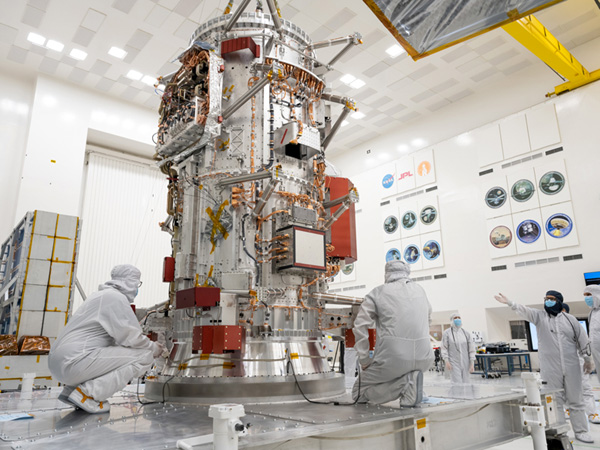
The Europa Clipper is ready to resume construction after being relocated to the Spacecraft Assembly Facility's High Bay 1 at NASA's Jet Propulsion Laboratory near Pasadena, California...as of August 15, 2022.
NASA / JPL - Caltech

NASA's Europa Clipper Spacecraft Kicks Assembly Into High Gear (News Release)

The spacecraft will occupy the main production facility of NASA’s Jet Propulsion Laboratory as it prepares for its 2024 launch to Jupiter’s moon Europa.

The core of NASA’s Europa Clipper spacecraft has taken center stage in the Spacecraft Assembly Facility at the agency’s Jet Propulsion Laboratory in Southern California. Standing 10 feet (3 meters) high and 5 feet (1.5 meters) wide, the craft’s main body will for the next two years be the focus of attention in the facility’s ultra-hygienic High Bay 1 as engineers and technicians assemble the spacecraft for its launch to Jupiter’s moon Europa in October 2024.

Scientists believe the ice-enveloped moon harbors a vast internal ocean that may have conditions suitable for supporting life. During nearly 50 flybys of Europa, the spacecraft’s suite of science instruments will gather data on the moon’s atmosphere, surface, and interior – information that scientists will use to gauge the depth and salinity of the ocean, the thickness of the ice crust, and potential plumes that may be venting subsurface water into space.

Several of Europa Clipper’s science instruments already have been completed and will be installed on the spacecraft at JPL. Most recently, the plasma-detection instrument, called the Plasma Instrument for Magnetic Sounding, and the Europa Imaging System wide-angle camera arrived from the Johns Hopkins Applied Physics Laboratory (APL), in Laurel, Maryland. The thermal-emission imaging instrument, called E-THEMIS, and the ultraviolet spectrograph, Europa-UVS, have already been installed on the spacecraft’s nadir deck, which will support many of the instrument sensors by stabilizing them to ensure they are oriented correctly.

Fabricated at JPL, this key piece of hardware will soon move into the Spacecraft Assembly Facility’s High Bay 1, the same cleanroom where historic missions such as Galileo, Cassini, and all of NASA’s Mars rovers were built.

Also moving soon to High Bay 1 will be the aluminum electronics vault, which will be bolted to the main body of the spacecraft, protecting the electronics inside from Jupiter’s intense radiation. The electronics enable Europa Clipper’s computer to communicate with the spacecraft’s antennae, science instruments, and the subsystems that will keep them alive.

Bright copper cabling snaking around the orbiter’s aluminum core contains thousands of wires and connectors handcrafted at APL. If placed end to end, the cabling would stretch almost 2,100 feet (640 meters) – enough to wrap around a U.S. football field twice.

Inside the core are Europa Clipper’s two propulsion tanks. The fuel and oxidizer they’ll hold will flow to an array of 24 engines, where they will create a controlled chemical reaction to produce thrust in deep space.

By the end of 2022, most of the flight hardware and the remainder of the science instruments are expected to be complete. Then, the next steps will be a wide variety of tests as the spacecraft moves toward its 2024 launch period. After traveling for nearly six years and over 1.8 billion miles (2.9 billion kilometers), it will achieve orbit around Jupiter in 2030.

Source: NASA.Gov

****

Monday, July 04, 2022

On This Day in 1997: A New Era in Mars Exploration Began...

Days after successfully landing in Mars' Ares Vallis region on July 4, 1997, the Sojourner rover studies a large rock located several meters from NASA's Pathfinder spacecraft...which was later renamed the Sagan Memorial Station.
NASA / JPL

Just thought I'd point out that today marks 25 years since America's very first Mars rover, Sojourner, safely touched down on the Red Planet courtesy of NASA's Mars Pathfinder mission.

I was at home when the successful landing of Pathfinder (which would later be renamed the Sagan Memorial Station, after the late astronomer Carl Sagan) occurred...with me watching this event unfold during a live broadcast on CNN Headline News (which is now known as HLN, but still owned by CNN Global/Warner Bros. Discovery) throughout that triumphant day.

This exciting milestone in NASA's Mars Exploration Program occurred less than a month after I completed 11th grade in high school back in 1997. The Pathfinder mission inspired me to draw the illustration below, which would be included in my AP Studio Art portfolio when I began 12th grade at Bishop Amat Memorial (my high school alma mater) less than two months later. Such an exciting time.

Happy 4th of July, fellow Yanks!

A Mars Pathfinder-inspired illustration that I drew back in 1997...for my AP Studio Art class in my senior year at Bishop Amat Memorial High School.

Tuesday, May 17, 2022

InSight Update: The Successful Mars Mission Will Soon Come to an End...

The flight deck and one of the twin solar panels on NASA's InSight Mars lander are completely covered in dust...as of Aprl 24, 2022.
NASA / JPL - Caltech

NASA's InSight Still Hunting Marsquakes as Power Levels Diminish (News Release)

Dusty solar panels and darker skies are expected to bring the Mars lander mission to a close around the end of this year.

NASA’s InSight Mars lander is gradually losing power and is anticipated to end science operations later this summer. By December, InSight’s team expects the lander to have become inoperative, concluding a mission that has thus far detected more than 1,300 marsquakes – most recently, a magnitude 5 that occurred on May 4 – and located quake-prone regions of the Red Planet.

The information gathered from those quakes has allowed scientists to measure the depth and composition of Mars’ crust, mantle, and core. Additionally, InSight (short for Interior Exploration using Seismic Investigations, Geodesy and Heat Transport) has recorded invaluable weather data and studied remnants of Mars’ ancient magnetic field.

“InSight has transformed our understanding of the interiors of rocky planets and set the stage for future missions,” said Lori Glaze, director of NASA’s Planetary Science Division. “We can apply what we’ve learned about Mars’ inner structure to Earth, the Moon, Venus, and even rocky planets in other solar systems.”

InSight landed on Mars Nov. 26, 2018. Equipped with a pair of solar panels that each measures about 7 feet (2.2 meters) wide, it was designed to accomplish the mission’s primary science goals in its first Mars year (nearly two Earth years). Having achieved them, the spacecraft is now into an extended mission, and its solar panels have been producing less power as they continue to accumulate dust.

Because of the reduced power, the team will soon put the lander’s robotic arm in its resting position (called the “retirement pose”) for the last time later this month. Originally intended to deploy the seismometer and the lander’s heat probe, the arm has played an unexpected role in the mission: Along with using it to help bury the heat probe after sticky Martian soil presented the probe with challenges, the team used the arm in an innovative way to remove dust from the solar panels. As a result, the seismometer was able to operate more often than it would have otherwise, leading to new discoveries.

When InSight landed, the solar panels produced around 5,000 watt-hours each Martian day, or sol – enough to power an electric oven for an hour and 40 minutes. Now, they’re producing roughly 500 watt-hours per sol – enough to power the same electric oven for just 10 minutes.

Additionally, seasonal changes are beginning in Elysium Planitia, InSight’s location on Mars. Over the next few months, there will be more dust in the air, reducing sunlight – and the lander’s energy. While past efforts removed some dust, the mission would need a more powerful dust-cleaning event, such as a “dust devil” (a passing whirlwind), to reverse the current trend.

“We’ve been hoping for a dust cleaning like we saw happen several times to the Spirit and Opportunity rovers,” said Bruce Banerdt, InSight’s principal investigator at NASA’s Jet Propulsion Laboratory in Southern California, which leads the mission. “That’s still possible, but energy is low enough that our focus is making the most of the science we can still collect.”

If just 25% of InSight’s panels were swept clean by the wind, the lander would gain about 1,000 watt-hours per sol – enough to continue collecting science. However, at the current rate power is declining, InSight’s non-seismic instruments will rarely be turned on after the end of May.

Energy is being prioritized for the lander’s seismometer, which will operate at select times of day, such as at night, when winds are low and marsquakes are easier for the seismometer to “hear.” The seismometer itself is expected to be off by the end of summer, concluding the science phase of the mission.

At that point, the lander will still have enough power to operate, taking the occasional picture and communicating with Earth. But the team expects that around December, power will be low enough that one day InSight will simply stop responding.

Source: NASA.Gov

****

Thursday, April 21, 2022

Perseverance Update: The Wheeled Robotic Explorer Watched the Martian Moon Phobos Transit the Sun Three Weeks Ago...

A video screenshot of the Martian moon Phobos transiting the Sun...as seen by NASA's Perseverance Mars rover on April 2, 2022.
NASA / JPL - Caltech / ASU / MSSS / SSI

NASA’s Perseverance Rover Captures Video of Solar Eclipse on Mars (News Release - April 20)

The Mastcam-Z camera recorded video of Phobos, one of the Red Planet’s two moons, to study how its orbit is changing over time.

NASA’s Perseverance Mars rover has captured dramatic footage of Phobos, Mars’ potato-shaped moon, crossing the face of the Sun. These observations can help scientists better understand the moon’s orbit and how its gravity pulls on the Martian surface, ultimately shaping the Red Planet’s crust and mantle.

Captured with Perseverance’s next-generation Mastcam-Z camera on April 2, the 397th Martian day, or sol, of the mission, the eclipse lasted a little over 40 seconds – much shorter than a typical solar eclipse involving Earth’s Moon. (Phobos is about 157 times smaller than Earth’s Moon. Mars’ other moon, Deimos, is even smaller.)

The images are the latest in a long history of NASA spacecraft capturing solar eclipses on Mars. Back in 2004, the twin NASA rovers Spirit and Opportunity took the first time-lapse photos of Phobos during a solar eclipse. Curiosity continued the trend with videos shot by its Mastcam camera system.

But Perseverance, which landed in February 2021, has provided the most zoomed-in video of a Phobos solar eclipse yet – and at the highest-frame rate ever. That’s thanks to Perseverance’s next-generation Mastcam-Z camera system, a zoomable upgrade from Curiosity’s Mastcam.

“I knew it was going to be good, but I didn’t expect it to be this amazing,” said Rachel Howson of Malin Space Science Systems in San Diego, one of the Mastcam-Z team members who operates the camera.

Howson noted that although Perseverance first sends lower-resolution thumbnails that offer a glimpse of the images to come, she was stunned by the full-resolution versions: “It feels like a birthday or holiday when they arrive. You know what’s coming, but there is still an element of surprise when you get to see the final product.”

Color also sets this version of a Phobos solar eclipse apart. Mastcam-Z has a solar filter that acts like sunglasses to reduce light intensity. “You can see details in the shape of Phobos’ shadow, like ridges and bumps on the moon’s landscape,” said Mark Lemmon, a planetary astronomer with the Space Science Institute in Boulder, Colorado, who has orchestrated most of the Phobos observations by Mars rovers. “You can also see sunspots. And it’s cool that you can see this eclipse exactly as the rover saw it from Mars.”

As Phobos circles Mars, its gravity exerts small tidal forces on the Red Planet’s interior, slightly deforming rock in the planet’s crust and mantle. These forces also slowly change Phobos’ orbit. As a result, geophysicists can use those changes to better understand how pliable the interior of Mars is, revealing more about the materials within the crust and mantle.

Scientists already know that Phobos is doomed: The moon is getting closer to the Martian surface and is destined to crash into the planet in tens of millions of years. But eclipse observations from the surface of Mars over the last two decades have also allowed scientists to refine their understanding of Phobos’ slow death spiral.

Source: Jet Propulsion Laboratory

****

Tuesday, December 07, 2021

A Flashback to 1996: The First Successful Robotic Rover Heads to the Red Planet...

A Delta 2 rocket carrying NASA's Mars Pathfinder lander and Sojourner rover launches from Cape Canaveral Spaceflight Center in Florida...on December 4, 1996, Eastern Time (December 3, 1996, Pacific Time).
NASA / JPL

I was a junior in high school when Mars Pathfinder departed from Cape Canaveral Spaceflight Center (now Cape Canaveral Space Force Station) in Florida on a 6-plus-month journey to the Red Planet! Good times.

****

25 Years Ago: Mars Pathfinder Launches to Mars to Deploy Sojourner, the First Planetary Rover (News Release)

Mars has fascinated us for centuries. Through the middle of the 20th century, some scientists believed that Mars might be hospitable to some form of life, only to have those hopes seemingly dashed when the early robotic explorers of the 1960s found a Moon-like cratered terrain with a forbiddingly cold and thin atmosphere composed of carbon dioxide. More sophisticated orbiters and landers in the 1970s revealed evidence that water may have once flowed on Mars, but a search for signs of life proved inconclusive at best. Following the six years, between 1976 and 1982, that the Viking spacecraft operated on and in orbit around Mars, robotic exploration of Mars entered a nearly 15-year hiatus, with just a very brief break. The Soviet Fobos 2 probe entered orbit around Mars in January 1989, operating for only two months and not achieving its primary goal of placing a lander and a hopper onto Mars’ larger moon Phobos. In August 1993, the American Mars Observer spacecraft went silent just two days before entering orbit around Mars, likely falling victim to a fuel line rupture that caused a catastrophic failure. The Mars Pathfinder began a new era of continuous robotic Mars exploration.

Favorable launch opportunities to Mars occur every 26 months, and during the late 1996 window, the United States dispatched two spacecraft to the Red Planet – an orbiter called Mars Global Surveyor (MGS) and Mars Pathfinder, a lander that deployed the first rover on Mars. The Jet Propulsion Laboratory (JPL) near Pasadena, California, managed both spacecraft for NASA. The landing of Mars Pathfinder and its Sojourner rover on July 4, 1997, began an uninterrupted period with at least one spacecraft and typically several operating in Mars orbit or on the planet’s surface. This nearly-quarter century of continuous scientific observation is unmatched anywhere else in the solar system except on Earth. The 793-pound Mars Pathfinder deployed the 23-pound Sojourner rover, the first wheeled vehicle operated on another planet in the solar system, that served as the forerunner of later, more advanced rovers including Curiosity and Perseverance, currently operating on the Martian surface. NASA chose to name the rover after Sojourner Truth, an African-American reformist of the Civil War era, inspired by the winning essay submitted by 12-year-old Valerie Ambrose of Bridgeport, Connecticut, to a naming contest organized by JPL and The Planetary Society.

The launch of Mars Pathfinder on a Delta rocket took place on Dec. 4, 1996 (Eastern Time), from Launch Complex 17B at Cape Canaveral Spaceflight Center, now Cape Canaveral Space Force Station, in Florida. Four mid-course corrections refined the spacecraft’s trajectory during its 212-day interplanetary cruise. Although it launched after MGS, Pathfinder arrived at Mars on a faster trajectory – more than two months earlier. The lander was expected to operate for one month, and the rover for one week. For its exploration of the Red Planet’s surface, the Pathfinder and Sojourner together carried four instruments, including:

Mars Pathfinder lander

- the mast-mounted Imager for Mars Pathfinder, including a stereoscopic color camera, a magnetometer for magnetic field measurements, and an anemometer for recording winds;
- the Atmospheric Structure Instrument/Meteorology package to determine the temperature and density of the atmosphere during the entry, descent, and landing, and to take daily weather measurements once on the surface.

Sojourner rover

- the Alpha-Proton X-ray Spectrometer to determine the dominant elements of the rocks and other surface materials at the landing site;
- the three-camera imaging system consisting of two black-and-white and one-color camera.

Upon arrival at Mars on July 4, 1997, Mars Pathfinder began its four-minute entry, descent, and landing sequence, the first U.S. spacecraft to use the approach of utilizing landing airbags. The spacecraft entered the Martian atmosphere at 14,000 mph, protected inside an aeroshell derived from the Viking landers’ design. The aeroshell slowed the spacecraft’s velocity to 830 mph, allowing the deployment of a supersonic parachute that further slowed the craft to 150 mph. The spacecraft then released the forward heat shield, remaining attached to the backshell by a 66-foot tether. At an altitude of one mile, it activated its radar altimeter that precisely timed the next events. At 1,165 feet above the surface, airbags completely surrounding the spacecraft inflated in less than one second and at 322 feet, three solid retrorockets fired to further slow the descent. At 71 feet above the ground, Pathfinder, still cocooned in its airbags, cut itself free and fell to the surface, impacting at 31 mph and bouncing 15 times before finally coming to a rest. After 87 minutes, the airbags deflated and the spacecraft opened like the petals of a flower, exposing its solar arrays, instruments, and the Sojourner rover, still in its stowed position. Following the landing in the Ares Vallis (Valley of Mars), an ancient flood plain in Mars’ northern hemisphere, Mars Pathfinder was redesignated the Carl Sagan Memorial Station, after the late-noted astronomer and planetologist.

During its first full day on the Martian surface, Mars Pathfinder took photographs of its surroundings and completed its first weather recordings. The next day, July 6, Sojourner “stood up” on its six wheels and backed down one of the lander’s two ramps onto the surface, becoming the first wheeled vehicle operated on another planet. By the next day, Sojourner began exploring and analyzing some of the nearby rocks for their composition. Controllers nicknamed notable rocks after cartoon characters, such as Barnacle Bill, Yogi, and Scooby Doo.

For 83 days, 12 times longer than its anticipated 1-week operational lifetime, Sojourner explored the area around the landing site, traveling at a maximum speed of 0.39 inch per second, its movements controlled by engineers at JPL. Overall, the rover traveled a total distance of 330 feet, never venturing more than 39 feet from the Pathfinder lander. It sampled the chemical properties of rocks and soil at 16 different locations near the lander and found that they generally resembled volcanic rocks on Earth.

During their operations, Sojourner returned 550 photographs and Mars Pathfinder 16,500 photographs, not only of the surface but also of clouds and sunsets. In addition, the lander completed 8.5 million measurements of Martian weather, including atmospheric pressure, temperature, and wind speed. Contact was unexpectedly lost with Pathfinder and Sojourner on Sept. 27, 1997, for unknown reasons. Both far exceeded their operational life expectancies and vastly increased our knowledge of Mars. The technologies used in both Mars Pathfinder and Sojourner enabled more sophisticated spacecraft to continue the exploration of Mars in the 21st century.

With special thanks to Erik Conway, JPL Historian.

Source: NASA.Gov

****

Inside Spacecraft Assembly and Encapsulation Facility-2 at NASA's Jet Propulsion Laboratory in California, engineers begin to fold Mars Pathfinder's three solar panels prior to delivering the lander and Sojourner rover to Florida for launch...on October 2, 1996.
NASA

Thursday, August 12, 2021

Dragonfly Update: New Flight Objectives Are Planned for NASA's Titan-bound Quadcopter...

An artist's concept of NASA's Dragonfly rotorcraft on the surface of Saturn's moon Titan.
NASA / Johns Hopkins APL

Dragonfly Mission to Titan Announces Big Science Goals (News Release - August 10)

Among our solar system’s many moons, Saturn’s Titan stands out – it’s the only moon with a substantial atmosphere and liquid on the surface. It even has a weather system like Earth’s, though it rains methane instead of water. Might it also host some kind of life?

NASA’s Dragonfly mission, which will send a rotorcraft relocatable lander to Titan’s surface in the mid-2030s, will be the first mission to explore the surface of Titan, and it has big goals.

On July 19, the Dragonfly science team published “Science Goals and Objectives for the Dragonfly Titan Rotorcraft Relocatable Lander” in The Planetary Science Journal. The paper’s lead author is Jason Barnes, Dragonfly deputy principal investigator and a professor of physics at the University of Idaho.

The goals for Dragonfly include searching for chemical biosignatures; investigating the moon’s active methane cycle; and exploring the prebiotic chemistry currently taking place in Titan’s atmosphere and on its surface.

“Titan represents an explorer’s utopia,” said co-author Alex Hayes, associate professor of astronomy in the College of Arts and Sciences and a Dragonfly co-investigator. “The science questions we have for Titan are very broad because we don’t know much about what is actually going on at the surface yet. For every question we answered during the Cassini mission’s exploration of Titan from Saturn orbit, we gained 10 new ones.”

Though Cassini has been orbiting Saturn for 13 years, the thick methane atmosphere on Titan made it impossible to reliably identify the materials on its surface. While Cassini’s radar enabled scientists to penetrate the atmosphere and identify Earth-like morphologic structures, including dunes, lakes and mountains, the data could not reveal their composition.

“In fact, at the time Cassini was launched we didn’t even know if the surface of Titan was a global liquid ocean of methane and ethane, or a solid surface of water ice and solid organics,” said Hayes, also director of the Cornell Center for Astrophysics and Planetary Science and the Spacecraft Planetary Image Facility in A&S.

The Huygens probe, which landed on Titan in 2005, was designed to either float in a methane/ethane sea or land on a hard surface. Its science experiments were predominantly atmospheric, because they weren’t sure it would survive the landing. Dragonfly will be the first mission to explore the surface of Titan and identify the detailed composition of its organic-rich surface.

“What’s so exciting to me is that we’ve made predictions about what’s going on at the local scale on the surface and how Titan works as a system,” Hayes said, “and Dragonfly’s images and measurements are going to tell us how right or wrong they are.”

Hayes has been working on Titan for almost the entirety of his career. He’s particularly eager to answer some of the questions raised by Cassini in the area of his specialty: planetary surface processes and surface-atmosphere interactions.

“My primary science interests are in understanding Titan as a complex Earth-like world and trying to understand the processes that are driving its evolution,” he said. “That involves everything from the methane cycle’s interactions with the surface and the atmosphere, to the routing of material throughout the surface and potential exchange with the interior.”

Hayes will be contributing significant expertise in another area as well: operational experience from Mars rover missions.

“The Dragonfly mission benefits from and represents the intersection of Cornell’s substantial history with rover operations and Cassini science,” Hayes said. “It brings those two things together by exploring Titan with a relocatable moving craft.”

Cornell astronomers are currently involved in the the Mars Science Laboratory and Mars 2020 missions, and led the Mars Exploration Rovers mission. The lessons learned from these rovers on Mars are being relocated to Titan, Hayes said.

Dragonfly will spend a full Titan day (equivalent to 16 Earth days) in one location conducting science experiments and observations, and then fly to a new location. The science team will need to make decisions about what the spacecraft will do next based on lessons from the previous location – “which is exactly what the Mars rovers have been doing for decades,” Hayes said.

Titan’s low gravity (around one-seventh of Earth’s) and thick atmosphere (four times denser than Earth’s) make it an ideal place for an aerial vehicle. Its relatively quiet atmosphere, with lighter winds than Earth, make it even better. And while the science team doesn’t expect rain during Dragonfly’s flights, Hayes noted that no one really knows the local-scale weather patterns on Titan – yet.

Many of the science questions outlined in the group’s paper address prebiotic chemistry, an area that keenly interests Hayes. Many of the prebiotic chemical compounds that formed on early Earth are also formed in Titan’s atmosphere, and Hayes is eager to see how far down the road of prebiotic chemistry Titan has really gone. Titan’s atmosphere might be a good analogue for what happened on early Earth.

Dragonfly’s search for chemical biosignatures will also be wide-ranging. In addition to examining Titan’s habitability in general, they’ll be investigating potential chemical biosignatures, past or present, from both water-based life to that which might use liquid hydrocarbons as a solvent, such as within its lakes, seas or aquifers.

Source: Cornell University

Monday, April 19, 2021

INGENUITY HAS MADE AVIATION AND INTERPLANETARY HISTORY!

A camera underneath Ingenuity's fuselage took this photo of the helicopter's shadow as the vehicle made its historic first flight on Mars...on April 19, 2021.
NASA / JPL - Caltech

NASA’s Ingenuity Mars Helicopter Succeeds in Historic First Flight (Press Release)

Monday, NASA’s Ingenuity Mars Helicopter became the first aircraft in history to make a powered, controlled flight on another planet. The Ingenuity team at the agency’s Jet Propulsion Laboratory in Southern California confirmed the flight succeeded after receiving data from the helicopter via NASA’s Perseverance Mars rover at 6:46 a.m. EDT (3:46 a.m. PDT).

“Ingenuity is the latest in a long and storied tradition of NASA projects achieving a space exploration goal once thought impossible,” said acting NASA Administrator Steve Jurczyk. “The X-15 was a pathfinder for the space shuttle. Mars Pathfinder and its Sojourner rover did the same for three generations of Mars rovers. We don’t know exactly where Ingenuity will lead us, but today’s results indicate the sky – at least on Mars – may not be the limit.”

The solar-powered helicopter first became airborne at 3:34 a.m. EDT (12:34 a.m. PDT) – 12:33 Local Mean Solar Time (Mars time) – a time the Ingenuity team determined would have optimal energy and flight conditions. Altimeter data indicate Ingenuity climbed to its prescribed maximum altitude of 10 feet (3 meters) and maintained a stable hover for 30 seconds. It then descended, touching back down on the surface of Mars after logging a total of 39.1 seconds of flight. Additional details on the test are expected in upcoming downlinks.

Ingenuity’s initial flight demonstration was autonomous – piloted by onboard guidance, navigation, and control systems running algorithms developed by the team at JPL. Because data must be sent to and returned from the Red Planet over hundreds of millions of miles using orbiting satellites and NASA’s Deep Space Network, Ingenuity cannot be flown with a joystick, and its flight was not observable from Earth in real time.

NASA Associate Administrator for Science Thomas Zurbuchen announced the name for the Martian airfield on which the flight took place.

“Now, 117 years after the Wright brothers succeeded in making the first flight on our planet, NASA’s Ingenuity helicopter has succeeded in performing this amazing feat on another world,” Zurbuchen said. “While these two iconic moments in aviation history may be separated by time and 173 million miles of space, they now will forever be linked. As an homage to the two innovative bicycle makers from Dayton, this first of many airfields on other worlds will now be known as Wright Brothers Field, in recognition of the ingenuity and innovation that continue to propel exploration.”

Ingenuity’s chief pilot, HÃ¥vard Grip, announced that the International Civil Aviation Organization (ICAO) – the United Nations’ civil aviation agency – presented NASA and the Federal Aviation Administration with official ICAO designator IGY, call-sign INGENUITY.

These details will be included officially in the next edition of ICAO’s publication Designators for Aircraft Operating Agencies, Aeronautical Authorities and Services. The location of the flight has also been given the ceremonial location designation JZRO for Jezero Crater.

As one of NASA’s technology demonstration projects, the 19.3-inch-tall (49-centimeter-tall) Ingenuity Mars Helicopter contains no science instruments inside its tissue-box-size fuselage. Instead, the 4-pound (1.8-kg) rotorcraft is intended to demonstrate whether future exploration of the Red Planet could include an aerial perspective.

This first flight was full of unknowns. The Red Planet has a significantly lower gravity – one-third that of Earth’s – and an extremely thin atmosphere with only 1% the pressure at the surface compared to our planet. This means there are relatively few air molecules with which Ingenuity’s two 4-foot-wide (1.2-meter-wide) rotor blades can interact to achieve flight. The helicopter contains unique components, as well as off-the-shelf-commercial parts – many from the smartphone industry – that were tested in deep space for the first time with this mission.

“The Mars Helicopter project has gone from ‘blue sky’ feasibility study to workable engineering concept to achieving the first flight on another world in a little over six years,” said Michael Watkins, director of JPL. “That this project has achieved such a historic first is testimony to the innovation and doggedness of our team here at JPL, as well as at NASA’s Langley and Ames Research Centers, and our industry partners. It’s a shining example of the kind of technology push that thrives at JPL and fits well with NASA’s exploration goals.”

Parked about 211 feet (64.3 meters) away at Van Zyl Overlook during Ingenuity’s historic first flight, the Perseverance rover not only acted as a communications relay between the helicopter and Earth, but also chronicled the flight operations with its cameras. The pictures from the rover’s Mastcam-Z and Navcam imagers will provide additional data on the helicopter’s flight.

“We have been thinking for so long about having our Wright brothers moment on Mars, and here it is,” said MiMi Aung, project manager of the Ingenuity Mars Helicopter at JPL. “We will take a moment to celebrate our success and then take a cue from Orville and Wilbur regarding what to do next. History shows they got back to work – to learn as much as they could about their new aircraft – and so will we.”

Perseverance touched down with Ingenuity attached to its belly on Feb. 18. Deployed to the surface of Jezero Crater on April 3, Ingenuity is currently on the 16th sol, or Martian day, of its 30-sol (31-Earth day) flight test window. Over the next three sols, the helicopter team will receive and analyze all data and imagery from the test and formulate a plan for the second experimental test flight, scheduled for no earlier than April 22. If the helicopter survives the second flight test, the Ingenuity team will consider how best to expand the flight profile.

More About Ingenuity

JPL, which built Ingenuity, also manages the technology demonstration project for NASA. It is supported by NASA’s Science, Aeronautics, and Space Technology mission directorates. The agency’s Ames Research Center in California’s Silicon Valley and Langley Research Center in Hampton, Virginia, provided significant flight performance analysis and technical assistance during Ingenuity’s development.

Dave Lavery is the program executive for the Ingenuity Mars Helicopter, MiMi Aung is the project manager, and Bob Balaram is chief engineer.

****

Thursday, March 25, 2021

Photo of the Day: The Delta 2 Is Now Immortalized at the Rocket Garden in Florida...

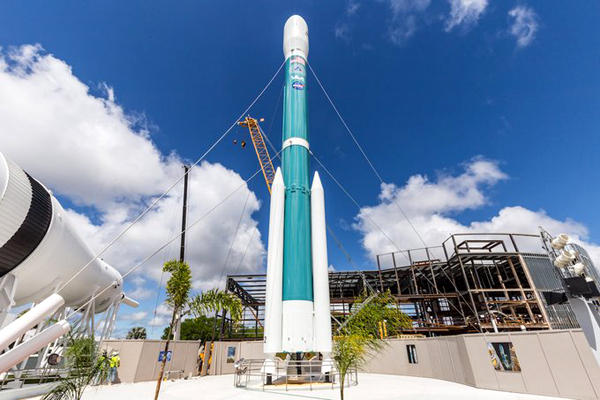
A retired Delta 2 launch vehicle is now on display in the Rocket Garden at the Kennedy Space Center Visitor Complex in Florida...as of March 23, 2021.
United Launch Alliance

Just thought I'd share this image of the Delta 2 rocket that is now on display in the 'Rocket Garden' at the Kennedy Space Center Visitor Complex in Florida! This retired launch vehicle was officially unveiled to the public two days ago...and now joins space shuttle Atlantis on my list of historic vehicles that I want to see when I make another trip to NASA's Kennedy Space Center (KSC) in Florida.

I was planning to re-visit KSC this year to see the Space Launch System (SLS) stand tall at Launch Complex 39B, but 1.) The COVID-19 pandemic gave me second thoughts about flying to Florida—a Republican-run coronavirus hotspot—this year (even when I hopefully get vaccinated next month), 2.) The first launch of SLS on Artemis 1 will most likely be postponed to early 2022 after it took two attempts to conduct a successful Green Run hot fire test at Stennis Space Center in Mississippi, and 3.) I just put the finishing touches on paying off a major credit card debt using my $1,400 stimulus payment last week. (Thank you, President Biden!) But I might change my mind.

So why am I fond of the Delta 2, you ask? It was responsible for launching Mars Pathfinder, the Phoenix Mars lander, the Kepler telescope and the Dawn spacecraft to the cosmos over the past 25 years. Click on this page to know why these missions—among many, many more—mean so much to me! Happy Thursday.

Tuesday, March 23, 2021

Perseverance Update: Aviation History Will Be Made on the Red Planet Early Next Month...

An illustration of the Ingenuity helicopter soaring in the Martian air while the Perseverance rover observes from the surface.
NASA / JPL - Caltech

NASA Ingenuity Mars Helicopter Prepares for First Flight (Press Release)

NASA is targeting no earlier than April 8 for the Ingenuity Mars Helicopter to make the first attempt at powered, controlled flight of an aircraft on another planet. Before the 4-pound (1.8-kilogram) rotorcraft can attempt its first flight, however, both it and its team must meet a series of daunting milestones.

Ingenuity remains attached to the belly of NASA’s Perseverance rover, which touched down on Mars Feb. 18. On March 21, the rover deployed the guitar case-shaped graphite composite debris shield that protected Ingenuity during landing. The rover currently is in transit to the “airfield” where Ingenuity will attempt to fly. Once deployed, Ingenuity will have 30 Martian days, or sols, (31 Earth days) to conduct its test flight campaign.

“When NASA’s Sojourner rover landed on Mars in 1997, it proved that roving the Red Planet was possible and completely redefined our approach to how we explore Mars. Similarly, we want to learn about the potential Ingenuity has for the future of science research,” said Lori Glaze, director of the Planetary Science Division at NASA Headquarters. “Aptly named, Ingenuity is a technology demonstration that aims to be the first powered flight on another world and, if successful, could further expand our horizons and broaden the scope of what is possible with Mars exploration.”

Flying in a controlled manner on Mars is far more difficult than flying on Earth. The Red Planet has significant gravity (about one-third that of Earth’s) but its atmosphere is just 1% as dense as Earth’s at the surface. During Martian daytime, the planet’s surface receives only about half the amount of solar energy that reaches Earth during its daytime, and nighttime temperatures can drop as low as minus 130 degrees Fahrenheit (minus 90 degrees Celsius), which can freeze and crack unprotected electrical components.

To fit within the available accommodations provided by the Perseverance rover, the Ingenuity helicopter must be small. To fly in the Mars environment, it must be lightweight. To survive the frigid Martian nights, it must have enough energy to power internal heaters. The system – from the performance of its rotors in rarified air to its solar panels, electrical heaters, and other components – has been tested and retested in the vacuum chambers and test labs of NASA’s Jet Propulsion Laboratory in Southern California.

“Every step we have taken since this journey began six years ago has been uncharted territory in the history of aircraft,” said Bob Balaram, Mars Helicopter chief engineer at JPL. “And while getting deployed to the surface will be a big challenge, surviving that first night on Mars alone, without the rover protecting it and keeping it powered, will be an even bigger one.”

Deploying the Helicopter

Before Ingenuity takes its first flight on Mars, it must be squarely in the middle of its airfield – a 33-by-33-foot (10-by-10-meter) patch of Martian real estate chosen for its flatness and lack of obstructions. Once the helicopter and rover teams confirm that Perseverance is situated exactly where they want it to be inside the airfield, the elaborate process to deploy the helicopter on the surface of Mars begins.

“As with everything with the helicopter, this type of deployment has never been done before,” said Farah Alibay, Mars Helicopter integration lead for the Perseverance rover. “Once we start the deployment there is no turning back. All activities are closely coordinated, irreversible, and dependent on each other. If there is even a hint that something isn’t going as expected, we may decide to hold off for a sol or more until we have a better idea what is going on.”

The helicopter deployment process will take about six sols (six days, four hours on Earth). On the first sol, the team on Earth will activate a bolt-breaking device, releasing a locking mechanism that helped hold the helicopter firmly against the rover’s belly during launch and Mars landing. The following sol, they will fire a cable-cutting pyrotechnic device, enabling the mechanized arm that holds Ingenuity to begin rotating the helicopter out of its horizontal position. This is also when the rotorcraft will extend two of its four landing legs.

During the third sol of the deployment sequence, a small electric motor will finish rotating Ingenuity until it latches, bringing the helicopter completely vertical. During the fourth sol, the final two landing legs will snap into position. On each of those four sols, the Wide Angle Topographic Sensor for Operations and eNgineering (WATSON) imager will take confirmation shots of Ingenuity as it incrementally unfolds into its flight configuration. In its final position, the helicopter will hang suspended at about 5 inches (13 centimeters) over the Martian surface. At that point, only a single bolt and a couple dozen tiny electrical contacts will connect the helicopter to Perseverance. On the fifth sol of deployment, the team will use the final opportunity to utilize Perseverance as a power source and charge Ingenuity’s six battery cells.

“Once we cut the cord with Perseverance and drop those final five inches to the surface, we want to have our big friend drive away as quickly as possible so we can get the Sun’s rays on our solar panel and begin recharging our batteries,” said Balaram.

On the sixth and final scheduled sol of this deployment phase, the team will need to confirm three things: that Ingenuity’s four legs are firmly on the surface of Jezero Crater, that the rover did, indeed, drive about 16 feet (about 5 meters) away, and that both helicopter and rover are communicating via their onboard radios. This milestone also initiates the 30-sol clock during which time all preflight checks and flight tests must take place.

“Ingenuity is an experimental engineering flight test – we want to see if we can fly at Mars,” said MiMi Aung, project manager for Ingenuity Mars Helicopter at JPL. “There are no science instruments onboard and no goals to obtain scientific information. We are confident that all the engineering data we want to obtain both on the surface of Mars and aloft can be done within this 30-sol window.”

As with deployment, the helicopter and rover teams will approach the upcoming flight test methodically. If the team misses or has questions about an important preflight milestone, they may take one or more sols to better understand the issue. If the helicopter survives the first night of the sequence period on the surface of Mars, however, the team will spend the next several sols doing everything possible to ensure a successful flight, including wiggling the rotor blades and verifying the performance of the inertial measurement unit, as well as testing the entire rotor system during a spin-up to 2,537 rpm (while Ingenuity’s landing gear remain firmly on the surface).

The First Flight Test on Mars

Once the team is ready to attempt the first flight, Perseverance will receive and relay to Ingenuity the final flight instructions from JPL mission controllers. Several factors will determine the precise time for the flight, including modeling of local wind patterns plus measurements taken by the Mars Environmental Dynamics Analyzer (MEDA) aboard Perseverance. Ingenuity will run its rotors to 2,537 rpm and, if all final self-checks look good, lift off. After climbing at a rate of about 3 feet per second (1 meter per second), the helicopter will hover at 10 feet (3 meters) above the surface for up to 30 seconds. Then, the Mars Helicopter will descend and touch back down on the Martian surface.

Several hours after the first flight has occurred, Perseverance will downlink Ingenuity’s first set of engineering data and, possibly, images and video from the rover’s Navigation Cameras and Mastcam-Z. From the data downlinked that first evening after the flight, the Mars Helicopter team expect to be able to determine if their first attempt to fly at Mars was a success.

On the following sol, all the remaining engineering data collected during the flight, as well as some low-resolution black-and-white imagery from the helicopter’s own Navigation Camera, could be downlinked to JPL. The third sol of this phase, the two images taken by the helicopter’s high-resolution color camera should arrive. The Mars Helicopter team will use all information available to determine when and how to move forward with their next test.

“Mars is hard,” said Aung. “Our plan is to work whatever the Red Planet throws at us the very same way we handled every challenge we’ve faced over the past six years – together, with tenacity and a lot of hard work, and a little Ingenuity.”

A Piece of History

While Ingenuity will attempt the first powered, controlled flight on another planet, the first powered, controlled flight on Earth took place Dec. 17, 1903, on the windswept dunes of Kill Devil Hill, near Kitty Hawk, North Carolina. Orville and Wilbur Wright covered 120 feet in 12 seconds during the first flight. The Wright brothers made four flights that day, each longer than the previous.

A small amount of the material that covered one of the wings of the Wright brothers’ aircraft, known as the Flyer, during the first flight is now aboard Ingenuity. An insulative tape was used to wrap the small swatch of fabric around a cable located underneath the helicopter’s solar panel. The Wrights used the same type of material – an unbleached muslin called “Pride of the West” – to cover their glider and aircraft wings beginning in 1901. The Apollo 11 crew flew a different piece of the material, along with a small splinter of wood from the Wright Flyer, to the Moon and back during their iconic mission in July 1969.

****

As seen from a camera on Perseverance's robotic arm, the debris shield protecting the Ingenuity Mars Helicopter is released from the belly of the rover...on March 21, 2021.
NASA / JPL - Caltech

Friday, March 05, 2021

America's Newest Robotic Rover Finally Goes for a Spin on the Red Planet...

An image of tracks created by Perseverance's wheels as the rover drove across the Martial soil for the first time...on March 4, 2021.
NASA / JPL - Caltech

NASA’s Perseverance Drives on Mars’ Terrain for First Time (Press Release)

NASA’s Mars 2020 Perseverance rover performed its first drive on Mars March 4, covering 21.3 feet (6.5 meters) across the Martian landscape. The drive served as a mobility test that marks just one of many milestones as team members check out and calibrate every system, subsystem, and instrument on Perseverance. Once the rover begins pursuing its science goals, regular commutes extending 656 feet (200 meters) or more are expected.

“When it comes to wheeled vehicles on other planets, there are few first-time events that measure up in significance to that of the first drive,” said Anais Zarifian, Mars 2020 Perseverance rover mobility test bed engineer at NASA’s Jet Propulsion Laboratory in Southern California. “This was our first chance to ‘kick the tires’ and take Perseverance out for a spin. The rover’s six-wheel drive responded superbly. We are now confident our drive system is good to go, capable of taking us wherever the science leads us over the next two years.”

The drive, which lasted about 33 minutes, propelled the rover forward 13 feet (4 meters), where it then turned in place 150 degrees to the left and backed up 8 feet (2.5 meters) into its new temporary parking space. To help better understand the dynamics of a retrorocket landing on the Red Planet, engineers used Perseverance’s Navigation and Hazard Avoidance Cameras to image the spot where Perseverance touched down, dispersing Martian dust with plumes from its engines.

More Than Roving

The rover’s mobility system is not the only thing getting a test drive during this period of initial checkouts. On Feb. 26 – Perseverance’s eighth Martian day, or sol, since landing – mission controllers completed a software update, replacing the computer program that helped land Perseverance with one they will rely on to investigate the planet.

More recently, the controllers checked out Perseverance’s Radar Imager for Mars’ Subsurface Experiment (RIMFAX) and Mars Oxygen In-Situ Resource Utilization Experiment (MOXIE) instruments, and deployed the Mars Environmental Dynamics Analyzer (MEDA) instrument’s two wind sensors, which extend out from the rover’s mast. Another significant milestone occurred on March 2, or sol 12, when engineers unstowed the rover’s 7-foot-long (2-meter-long) robotic arm for the first time, flexing each of its five joints over the course of two hours.

“Tuesday’s first test of the robotic arm was a big moment for us,” said Robert Hogg, Mars 2020 Perseverance rover deputy mission manager. “That’s the main tool the science team will use to do close-up examination of the geologic features of Jezero Crater, and then we’ll drill and sample the ones they find the most interesting. When we got confirmation of the robotic arm flexing its muscles, including images of it working beautifully after its long trip to Mars – well, it made my day.”

Upcoming events and evaluations include more detailed testing and calibration of science instruments, sending the rover on longer drives, and jettisoning covers that shield both the adaptive caching assembly (part of the rover’s Sample Caching System) and the Ingenuity Mars Helicopter during landing. The experimental flight test program for the Ingenuity Mars Helicopter will also take place during the rover’s commissioning.

Through it all, the rover is sending down images from the most advanced suite of cameras ever to travel to Mars. The mission’s cameras have already sent about 7,000 images. On Earth, Perseverance’s imagery flows through the powerful Deep Space Network (DSN), managed by NASA’s Space Communications and Navigation (SCaN) program. In space, several Mars orbiters play an equally important role.

“Orbiter support for downlink of data has been a real gamechanger,” said Justin Maki, chief engineer for imaging and the imaging scientist for the Mars 2020 Perseverance rover mission at JPL. “When you see a beautiful image from Jezero, consider that it took a whole team of Martians to get it to you. Every picture from Perseverance is relayed by either the European Space Agency’s Trace Gas Orbiter, or NASA’s MAVEN, Mars Odyssey, or Mars Reconnaissance Orbiter. They are important partners in our explorations and our discoveries.”

The sheer volume of imagery and data already coming down on this mission has been a welcome bounty for Matt Wallace, who recalls waiting anxiously for the first images to trickle in during NASA’s first Mars rover mission, Sojourner, which explored Mars in 1997. On March 3, Wallace became the mission’s new project manager. He replaced John McNamee, who is stepping down as he intended, after helming the project for nearly a decade.

“John has provided unwavering support to me and every member of the project for over a decade,” said Wallace. “He has left his mark on this mission and team, and it has been my privilege to not only call him boss but also my friend.”

Touchdown Site Named

With Perseverance departing from its touchdown site, mission team scientists have memorialized the spot, informally naming it for the late science fiction author Octavia E. Butler. The groundbreaking author and Pasadena, California, native was the first African American woman to win both the Hugo Award and Nebula Award, and she was the first science fiction writer honored with a MacArthur Fellowship. The location where Perseverance began its mission on Mars now bears the name “Octavia E. Butler Landing."

Official scientific names for places and objects throughout the solar system – including asteroids, comets, and locations on planets – are designated by the International Astronomical Union. Scientists working with NASA’s Mars rovers have traditionally given unofficial nicknames to various geological features, which they can use as references in scientific papers.

“Butler’s protagonists embody determination and inventiveness, making her a perfect fit for the Perseverance rover mission and its theme of overcoming challenges,” said Kathryn Stack Morgan, deputy project scientist for Perseverance. “Butler inspired and influenced the planetary science community and many beyond, including those typically under-represented in STEM fields.”

“I can think of no better person to mark this historic landing site than Octavia E. Butler, who not only grew up next door to JPL in Pasadena, but she also inspired millions with her visions of a science-based future,” said Thomas Zurbuchen, NASA associate administrator for science. “Her guiding principle, ‘When using science, do so accurately,’ is what the science team at NASA is all about. Her work continues to inspire today’s scientists and engineers across the globe – all in the name of a bolder, more equitable future for all.”

Butler, who died in 2006, authored such notable works as Kindred, Bloodchild, Speech Sounds, Parable of the Sower, Parable of the Talents, and the Patternist series. Her writing explores themes of race, gender, equality, and humanity, and her works are as relevant today as they were when originally written and published.

More About the Mission

A key objective of Perseverance’s mission on Mars is astrobiology, including the search for signs of ancient microbial life. The rover will characterize the planet’s geology and past climate, pave the way for human exploration of the Red Planet, and be the first mission to collect and cache Martian rock and regolith.

Subsequent NASA missions, in cooperation with ESA (European Space Agency), would send spacecraft to Mars to collect these sealed samples from the surface and return them to Earth for in-depth analysis.

The Mars 2020 Perseverance mission is part of NASA’s Moon to Mars exploration approach, which includes Artemis missions to the Moon that will help prepare for human exploration of the Red Planet.

JPL, which is managed for NASA by Caltech in Pasadena, built and manages operations of the Perseverance rover.

****

Friday, February 12, 2021

InSight Update: The Robotic Lander Prepares to Dig In for the Martian Winter...

One of InSight's two large solar panels is completely covered in Martian dust...as seen by a camera on the lander's robotic arm.
NASA / JPL - Caltech

InSight Is Meeting the Challenge of Winter on Dusty Mars (News Release)

As dust collects on the solar panels and winter comes to Elysium Planitia, the team is following a plan to reduce science operations in order to keep the lander safe.

NASA’s InSight lander recently received a mission extension for another two years, giving it time to detect more quakes, dust devils, and other phenomena on the surface of Mars. While the mission team plans to continue collecting data well into 2022, the increasing dustiness of the spacecraft’s solar panels and the onset of the Martian winter led to a decision to conserve power and temporarily limit the operation of its instruments.

InSight was designed to be long-lasting: The stationary lander is equipped with solar panels, each spanning 7 feet (2 meters) across. InSight’s design was informed by that of the solar-powered Spirit and Opportunity rovers, with the expectation that the panels would gradually reduce their power output as dust settled on them but would have ample output to last through the two-year prime mission (completed in November 2020).

Additionally, InSight’s team chose a landing site in Elysium Planitia, a windswept plain on the Red Planet’s equator that receives lots of sunlight. It was hoped that passing dust devils might clean off the panels, which happened many times with Spirit and Opportunity, allowing them to last years past their design lifetime.

But despite InSight detecting hundreds of passing dust devils, none has been close enough to clean off those dinner-table-size panels since they unfurled on Mars in November 2018. Today, InSight’s solar arrays are producing just 27% of their dust-free capacity. That power has to be shared between science instruments, a robotic arm, the spacecraft’s radio, and a variety of heaters that keep everything in working order despite subfreezing temperatures. Since the windiest season of the Martian year has just ended, the team isn’t counting on a cleaning event in the coming months.

Mars is currently moving toward what’s called aphelion, the point in its orbit when it’s farthest away from the Sun. That means the already-weak sunlight on the Martian surface is growing even fainter, reducing power when InSight most needs its heaters to stay warm. Mars will start approaching the Sun again in July 2021, after which the team will begin to resume full science operations.

“The amount of power available over the next few months will really be driven by the weather,” said InSight’s project manager, Chuck Scott of NASA’s Jet Propulsion Laboratory in Southern California. “As part of our extended-mission planning, we developed an operations strategy to keep InSight safe through the winter so that we can resume science operations as solar intensity increases.” JPL leads the InSight mission, though the spacecraft and its solar panels were built by Lockheed Martin Space of Denver, Colorado.

Over the coming weeks and months, InSight scientists will be carefully selecting which instruments need to be switched off each day to preserve power for heaters and energy-intensive activities like radio communication. InSight’s weather sensors are likely to remain off much of the time (resulting in infrequent updates to the mission’s weather page), and all the instruments will have to be powered off for some period around aphelion.

Currently, power levels look strong enough to take the lander through the winter. But solar power generation on Mars is always a little uncertain. The Opportunity rover was forced to shut down after a series of dust storms darkened the Martian sky in 2019, and Spirit did not survive the Martian winter in 2010. If InSight were to run out of power due to a sudden dust storm, it is designed to be able to reboot itself when the sunlight returns if its electronics survived the extreme cold.

Later this week, InSight will be commanded to extend its robotic arm over the panels so a camera can take close-up images of the dust coating. Then the team will pulse the motors that unfurled each panel after landing to try to disturb the dust and see if the wind blows it away. The team considers this to be a long shot but worth the effort.

“The InSight team has put together a strong plan to safely navigate through winter and emerge on the other side ready to complete our extended science mission through 2022,” said Bruce Banerdt of JPL, InSight’s principal investigator. “We’ve got a great vehicle and a top-notch team; I’m looking forward to many more new discoveries from InSight in the future.”

Source: NASA.Gov

Wednesday, December 02, 2020

NASA's Future Robotic Rover Continues to Go Through Its Developmental Paces...

An animated GIF showing the prototype for NASA's VIPER lunar rover testing its wheels' suspension system.
NASA / David Maurantonio

VIPER’s Many Brains are Better than One (News Release)

If you opened up a robot vacuum, a self-driving car, or even one of NASA’s Mars rovers (which we’re definitely not recommending you do!) you’d find a bunch of processors programmed with software that serve as the robot’s “brains.” All robots have these computerized brains directing their movement and activity, but NASA’s Volatiles Investigating Polar Exploration Rover, or VIPER, will be the first off-world rover to have its brains split in two as it explores the Moon’s surface in search of water ice.

As it drives across the Moon, VIPER will effectively do its thinking from both its on-board flight software as well as from ground software running from mission control on Earth. Using an engineering prototype of the rover, the VIPER team recently began putting the software through its paces on a simulated lunar terrain at NASA’s Ames Research Center in California’s Silicon Valley.

“We use distributed computing all the time when we use our smart phones to run mapping apps that connect to faraway servers and data centers to run the calculations,” said Terry Fong, chief roboticist and VIPER rover deputy at Ames. “Similarly, VIPER will perform much of its data crunching on faster computers on Earth, since we have a relatively fast connection to mission control during all rover operations.”

In November, the team began testing the software’s ability to successfully execute commands with the prototype rover. Using an outdoor robotics research and development facility featuring slopes, boulders, and craters, called the Roverscape, the team had the software take the rover for a test drive. The rover performed a variety of activities, like turning in place, driving in a straight line, recording its position, adjusting the suspension, and keeping its antenna stable while moving to ensure the rover can stay in touch with Earth.

The Moon-Gravity Representative Unit prototype is a stripped-down, engineering test unit that focuses on VIPER’s mechanical system, which is specially designed to allow engineers to test how the rover will drive in lunar gravity, which is one-sixth that of Earth’s.

Because of the Moon’s proximity to Earth, communications delays are only a matter of seconds. VIPER’s engineers are taking advantage of this to download images and other data from the rover for fast processing, rather than having to rely only on the rover’s slower on-board computing, which also reduces the cost to develop the rover.

Faster data processing means the mission operations and science teams can make quick-thinking decisions about the rover’s path and science activities. This will speed up operations, expedite science findings and maximize what they can accomplish during VIPER’s 100-day mission on the Moon’s South Pole.

“In addition to the science and operations benefits, keeping a portion of VIPER’s software running on Earth means engineers can take advantage of the latest and greatest in computer processing, data storage, and networking,” said Hans Utz, VIPER rover software lead engineer with KBR at Ames.

Besides the use of distributed computing, VIPER also will break ground by being NASA’s first planetary rover mission to make extensive use of open-source software, including key components adapted from ROS, the Robotics Operating System, considered the industry-standard in robotics development. Once the mission is over, the VIPER team intends to release the rover’s software for general use. This approach allows for a rapid, agile, and cost-effective way of developing the rover’s software systems that can also benefit future rovers on the Moon and beyond.

VIPER is a collaboration within and beyond the agency. VIPER is part of the Lunar Discovery and Exploration Program and is managed by the Planetary Science Division of NASA’s Science Mission Directorate at NASA Headquarters in Washington. NASA's Ames Research Center in California's Silicon Valley is managing the project, leading the mission’s science, systems engineering, real-time rover surface operations and flight software. The hardware for the rover is being designed and built by NASA's Johnson Space Center in Houston, while the instruments are provided by Ames, NASA's Kennedy Space Center in Florida, and commercial partner Honeybee Robotics in Altadena, California. The spacecraft, lander and launch vehicle that will deliver VIPER to the surface of the Moon will be provided by Astrobotic in Pittsburgh, Pennsylvania, who was selected through NASA’s Commercial Lunar Payload Services, or CLPS initiative, delivering science and technology payloads to and near the Moon.

Source: NASA.Gov

Thursday, July 30, 2020

America's Next Robotic Rover and First Martian Helicopter Are Off to the Red Planet!

An Atlas V rocket carrying NASA's Mars 2020 spacecraft launches from Cape Canaveral Air Force Station in Florida...on July 30, 2020.
NASA / Joel Kowsky

NASA, ULA Launch Mars 2020 Perseverance Rover Mission to Red Planet (Press Release)

NASA's Mars 2020 Perseverance rover mission is on its way to the Red Planet to search for signs of ancient life and collect samples to send back to Earth.

Humanity's most sophisticated rover launched with the Ingenuity Mars Helicopter at 7:50 a.m. EDT (4:50 a.m. PDT) Friday on a United Launch Alliance (ULA) Atlas V rocket from Space Launch Complex 41 at Cape Canaveral Air Force Station in Florida.

"With the launch of Perseverance, we begin another historic mission of exploration," said NASA Administrator Jim Bridenstine. "This amazing explorer's journey has already required the very best from all of us to get it to launch through these challenging times. Now we can look forward to its incredible science and to bringing samples of Mars home even as we advance human missions to the Red Planet. As a mission, as an agency, and as a country, we will persevere."

The ULA Atlas V's Centaur upper stage initially placed the Mars 2020 spacecraft into a parking orbit around Earth. The engine fired for a second time and the spacecraft separated from the Centaur as expected. Navigation data indicate the spacecraft is perfectly on course to Mars.

Mars 2020 sent its first signal to ground controllers via NASA's Deep Space Network at 9:15 a.m. EDT (6:15 a.m. PDT). However, telemetry (more detailed spacecraft data) had not yet been acquired at that point. Around 11:30 a.m. EDT (8:30 a.m. PDT), a signal with telemetry was received from Mars 2020 by NASA ground stations. Data indicate the spacecraft had entered a state known as safe mode, likely because a part of the spacecraft was a little colder than expected while Mars 2020 was in Earth's shadow. All temperatures are now nominal and the spacecraft is out of Earth's shadow.

When a spacecraft enters safe mode, all but essential systems are turned off until it receives new commands from mission control. An interplanetary launch is fast-paced and dynamic, so a spacecraft is designed to put itself in safe mode if its onboard computer perceives conditions are not within its preset parameters. Right now, the Mars 2020 mission is completing a full health assessment on the spacecraft and is working to return the spacecraft to a nominal configuration for its journey to Mars.

The Perseverance rover's astrobiology mission is to seek out signs of past microscopic life on Mars, explore the diverse geology of its landing site, Jezero Crater, and demonstrate key technologies that will help us prepare for future robotic and human exploration.

"Jezero Crater is the perfect place to search for signs of ancient life,” said Thomas Zurbuchen, associate administrator for NASA's Science Mission Directorate at the agency's headquarters in Washington. "Perseverance is going to make discoveries that cause us to rethink our questions about what Mars was like and how we understand it today. As our instruments investigate rocks along an ancient lake bottom and select samples to return to Earth, we may very well be reaching back in time to get the information scientists need to say that life has existed elsewhere in the universe."

The Martian rock and dust Perseverance’s Sample Caching System collects could answer fundamental questions about the potential for life to exist beyond Earth. Two future missions currently under consideration by NASA, in collaboration with ESA (European Space Agency), will work together to get the samples to an orbiter for return to Earth. When they arrive on Earth, the Mars samples will undergo in-depth analysis by scientists around the world using equipment far too large to send to the Red Planet.

An Eye to a Martian Tomorrow

While most of Perseverance's seven instruments are geared toward learning more about the planet's geology and astrobiology, the MOXIE (Mars Oxygen In-Situ Resource Utilization Experiment) instrument's job is focused on missions yet to come. Designed to demonstrate that converting Martian carbon dioxide into oxygen is possible, it could lead to future versions of MOXIE technology that become staples on Mars missions, providing oxygen for rocket fuel and breathable air.

Also future-leaning is the Ingenuity Mars Helicopter, which will remain attached to the belly of Perseverance for the flight to Mars and the first 60 or so days on the surface. A technology demonstrator, Ingenuity's goal is a pure flight test – it carries no science instruments.

Over 30 sols (31 Earth days), the helicopter will attempt up to five powered, controlled flights. The data acquired during these flight tests will help the next generation of Mars helicopters provide an aerial dimension to Mars explorations – potentially scouting for rovers and human crews, transporting small payloads, or investigating difficult-to-reach destinations.

The rover's technologies for entry, descent, and landing also will provide information to advance future human missions to Mars.

"Perseverance is the most capable rover in history because it is standing on the shoulders of our pioneers Sojourner, Spirit, Opportunity, and Curiosity," said Michael Watkins, director of NASA's Jet Propulsion Laboratory in Southern California. "In the same way, the descendants of Ingenuity and MOXIE will become valuable tools for future explorers to the Red Planet and beyond."

About seven cold, dark, unforgiving months of interplanetary space travel lay ahead for the mission – a fact never far from the minds of the Mars 2020 project team.

"There is still a lot of road between us and Mars," said John McNamee, Mars 2020 project manager at JPL. "About 290 million miles of them. But if there was ever a team that could make it happen, it is this one. We are going to Jezero Crater. We will see you there Feb. 18, 2021."

The Mars 2020 Perseverance mission is part of America's larger Moon to Mars exploration approach that includes missions to the Moon as a way to prepare for human exploration of the Red Planet. Charged with sending the first woman and next man to the Moon by 2024, NASA will establish a sustained human presence on and around the Moon by 2028 through NASA's Artemis program.

JPL, which is managed for NASA by Caltech in Pasadena, California, built and will manage operations of the Mars Perseverance rover. NASA's Launch Services Program, based at the agency's Kennedy Space Center in Florida, is responsible for launch management, and ULA provided the Atlas V rocket.

****

A camera onboard the Atlas V's Centaur upper stage captured this view of the Mars 2020 spacecraft separating from the booster to begin its nearly 7-month journey to the Red Planet...on July 30, 2020.
United Launch Alliance

A snapshot of the three microchips bearing the names of 10.9 million people (including Yours Truly) on NASA's Perseverance Mars rover.
NASA

My participation certificate for NASA's Mars 2020 mission.

Friday, July 17, 2020

Mars 2020 Update: Ingenuity's Trip to the Red Planet Begins in Just 13 Days (Hopefully)...

An illustration of the Ingenuity helicopter soaring in the Martian air while the Perseverance rover observes from the surface.
NASA / JPL - Caltech

6 Things to Know About NASA's Ingenuity Mars Helicopter (News Release - July 14)

The first helicopter attempting to fly on another planet is a marvel of engineering. Get up to speed with these key facts about its plans.

When NASA's Mars 2020 Perseverance rover launches from Cape Canaveral Air Force Station in Florida later this summer, an innovative experiment will ride along: the Ingenuity Mars Helicopter. Ingenuity may weigh only about 4 pounds (1.8 kilograms), but it has some outsize ambitions.

"The Wright Brothers showed that powered flight in Earth's atmosphere was possible, using an experimental aircraft," said HÃ¥vard Grip, Ingenuity’s chief pilot at NASA's Jet Propulsion Laboratory in Southern California. "With Ingenuity, we're trying to do the same for Mars."

Here are six things you should know about the first helicopter going to another planet:

1. Ingenuity is a flight test.

Ingenuity is what is known as a technology demonstration – a project that seeks to test a new capability for the first time, with limited scope. Previous groundbreaking technology demonstrations include the Mars Pathfinder rover Sojourner and the tiny Mars Cube One (MarCO) CubeSats that flew by Mars in 2018.

Ingenuity features four specially made carbon-fiber blades, arranged into two rotors that spin in opposite directions at around 2,400 rpm – many times faster than a passenger helicopter on Earth. It also has innovative solar cells, batteries, and other components. Ingenuity doesn't carry science instruments and is a separate experiment from the Mars 2020 Perseverance rover.

2. Ingenuity will be the first aircraft to attempt controlled flight on another planet.

What makes it hard for a helicopter to fly on Mars? For one thing, Mars' thin atmosphere makes it difficult to achieve enough lift. Because the Mars atmosphere is 99% less dense than Earth's, Ingenuity has to be light, with rotor blades that are much larger and spin much faster than what would be required for a helicopter of Ingenuity's mass on Earth.

It can also be bone-chillingly cold at Jezero Crater, where Perseverance will land with Ingenuity attached to its belly in February 2021. Nights there dip down to minus 130 degrees Fahrenheit (minus 90 degrees Celsius). While Ingenuity's team on Earth has tested the helicopter at Martian temperatures and believes it should work on Mars as intended, the cold will push the design limits of many of Ingenuity's parts.

In addition, flight controllers at JPL won't be able to control the helicopter with a joystick. Communication delays are an inherent part of working with spacecraft across interplanetary distances. Commands will need to be sent well in advance, with engineering data coming back from the spacecraft long after each flight takes place. In the meantime, Ingenuity will have a lot of autonomy to make its own decisions about how to fly to a waypoint and keep itself warm.

3. Ingenuity is a fitting name for a robot that is the result of extreme creativity.

High school student Vaneeza Rupani of Northport, Alabama, originally submitted the name Ingenuity for the Mars 2020 rover, before it was named Perseverance, but NASA officials recognized the submission as a terrific name for the helicopter, given how much creative thinking the team employed to get the mission off the ground.

"The ingenuity and brilliance of people working hard to overcome the challenges of interplanetary travel are what allow us all to experience the wonders of space exploration," Rupani wrote. "Ingenuity is what allows people to accomplish amazing things."

4. Ingenuity has already demonstrated feats of engineering.

In careful steps from 2014 to 2019, engineers at JPL demonstrated that it was possible to build an aircraft that was lightweight, able to generate enough lift in Mars' thin atmosphere, and capable of surviving in a Mars-like environment. They tested progressively more advanced models in special space simulators at JPL. In January 2019, the actual helicopter that is riding with Perseverance to the Red Planet passed its final flight evaluation. Failing any one of these milestones would've grounded the experiment.

5. The Ingenuity team will count success one step at a time.

Given the firsts Ingenuity is trying to accomplish, the team has a long list of milestones they'll need to pass before the helicopter can take off and land in the spring of 2021. The team will celebrate each time they meet one. The milestones include:

- Surviving the launch from Cape Canaveral, the cruise to Mars, and landing on the Red Planet
- Safely deploying to the surface from Perseverance's belly
- Autonomously keeping warm through the intensely cold Martian nights
- Autonomously charging itself with its solar panel

And then Ingenuity will make its first flight attempt. If the helicopter succeeds in that first flight, the Ingenuity team will attempt up to four other test flights within a 30-Martian-day (31-Earth-day) window.

6. If Ingenuity succeeds, future Mars exploration could include an ambitious aerial dimension.

Ingenuity is intended to demonstrate technologies needed for flying in the Martian atmosphere. If successful, these technologies could enable other advanced robotic flying vehicles that might be included in future robotic and human missions to Mars. They could offer a unique viewpoint not provided by current orbiters high overhead or by rovers and landers on the ground, provide high-definition images and reconnaissance for robots or humans, and enable access to terrain that is difficult for rovers to reach.

"The Ingenuity team has done everything to test the helicopter on Earth, and we are looking forward to flying our experiment in the real environment at Mars," said MiMi Aung, Ingenuity’s project manager at JPL. "We'll be learning all along the way, and it will be the ultimate reward for our team to be able to add another dimension to the way we explore other worlds in the future."

Source: NASA.Gov

****