Showing posts with label JPL Open House. Show all posts

Friday, July 21, 2023

Photos of the Day: Snapshots from My Latest Tour at NASA JPL...

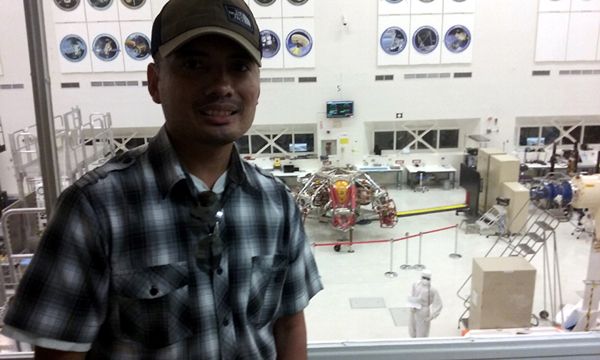
A selfie I took with Europa Clipper inside the Spacecraft Assembly Facility at NASA's Jet Propulsion Laboratory near Pasadena, California...on July 20, 2023.

Yesterday, I marked the 54th anniversary of the Apollo 11 Moon landing by attending a tour at NASA's Jet Propulsion Laboratory...which I haven't visited since before the pandemic in early 2019!

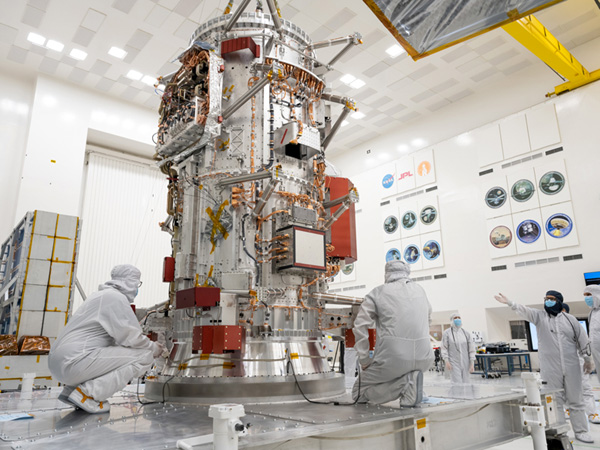
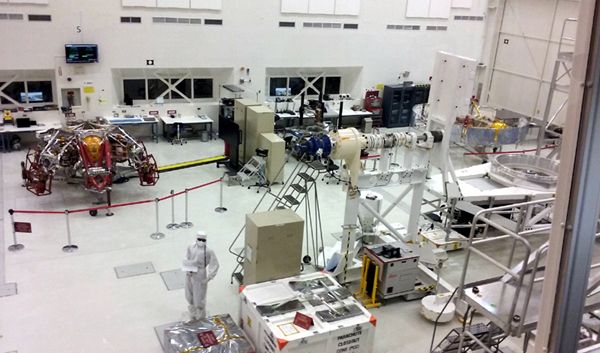
The main reason why I went to JPL this time around was to see the Europa Clipper in person. Technicians inside the Spacecraft Assembly Facility are working around the clock to get this robotic probe completed as soon and efficiently as possible.

You can watch the technicians work on Europa Clipper via this live webcam! The unmanned explorer will launch on a six-year journey to Jupiter in October of 2024—courtesy of SpaceX's Falcon Heavy rocket.

It was also great visiting the Space Flight Operations Facility again...as well as seeing full-size replicas of the Perseverance Mars rover, the Ingenuity Mars helicopter and the Mars Ascent Vehicle (MAV) that may or may not send rock samples to an orbiting Martian spacecraft for return back to Earth. Read this latest article about the Mars Sample Return mission to know why I'm not so optimistic about the MAV becoming a reality.

The Europa Clipper should be transported to Cape Canaveral in Florida between May and July of next year to be prepped for launch to Jupiter. I plan on seeing this spacecraft in person one last time before it leaves Southern California...

Whether or not this will be through another tour or the JPL open house (a.k.a. Explore JPL) itself remains to be seen! Happy Friday.

Another photo I took with Europa Clipper inside the Spacecraft Assembly Facility at NASA's Jet Propulsion Laboratory near Pasadena, California...on July 20, 2023.

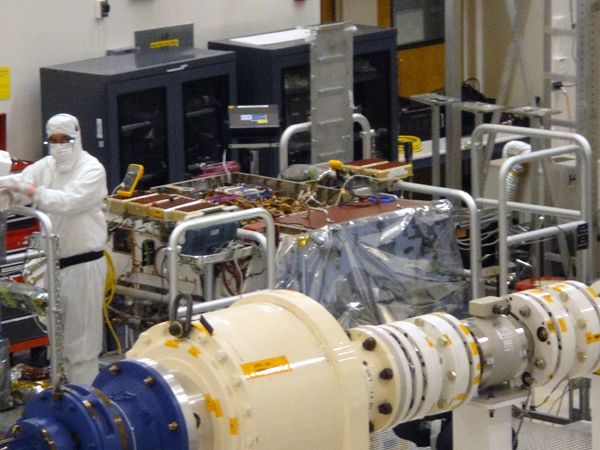
A snapshot of technicians working on Europa Clipper inside the Spacecraft Assembly Facility at NASA's Jet Propulsion Laboratory near Pasadena, California...on July 20, 2023.

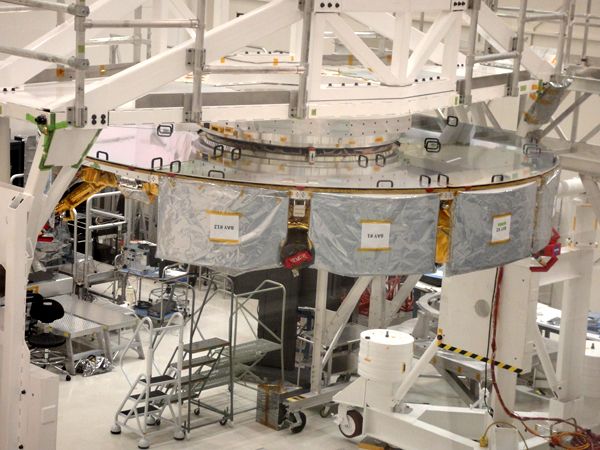
A snapshot of the science instruments and avionics module at the top of the Europa Clipper spacecraft...on July 20, 2023.

A snapshot of technicians working near the bottom of Europa Clipper's propulsion module...on July 20, 2023.

A snapshot of Europa Clipper's high-gain antenna (the large dish covered by a silver tarp) inside the Spacecraft Assembly Facility at NASA's Jet Propulsion Laboratory near Pasadena, California...on July 20, 2023.

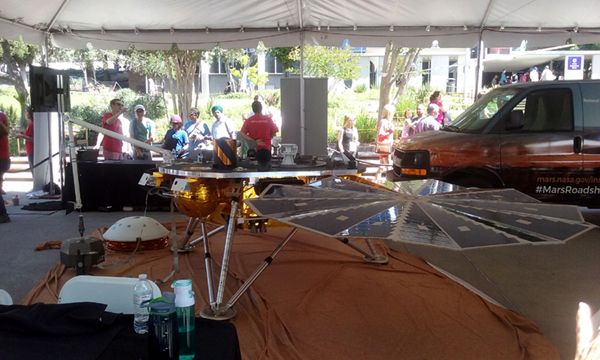
Full-size replicas of the Perseverance Mars rover and Ingenuity Mars helicopter on display at NASA's Jet Propulsion Laboratory near Pasadena, California...on July 20, 2023.

A full-size replica of the Mars Ascent Vehicle from NASA's Mars Sample Return mission...which may or may not fly depending on the U.S. Congress.

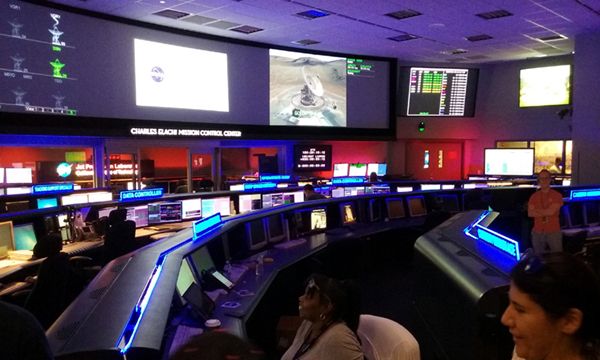
A snapshot of the Space Flight Operations Facility at NASA's Jet Propulsion Laboratory near Pasadena, California...on July 20, 2023.

Taking a selfie inside the Space Flight Operations Facility at NASA's Jet Propulsion Laboratory near Pasadena, California...on July 20, 2023.

Monday, August 15, 2022

I Hope JPL's Open House Will Return ASAP So That I Can See the Europa Clipper in Person at the Spacecraft Assembly Facility!

The Europa Clipper is ready to resume construction after being relocated to the Spacecraft Assembly Facility's High Bay 1 at NASA's Jet Propulsion Laboratory near Pasadena, California...as of August 15, 2022.
NASA / JPL - Caltech

NASA's Europa Clipper Spacecraft Kicks Assembly Into High Gear (News Release)

The spacecraft will occupy the main production facility of NASA’s Jet Propulsion Laboratory as it prepares for its 2024 launch to Jupiter’s moon Europa.

The core of NASA’s Europa Clipper spacecraft has taken center stage in the Spacecraft Assembly Facility at the agency’s Jet Propulsion Laboratory in Southern California. Standing 10 feet (3 meters) high and 5 feet (1.5 meters) wide, the craft’s main body will for the next two years be the focus of attention in the facility’s ultra-hygienic High Bay 1 as engineers and technicians assemble the spacecraft for its launch to Jupiter’s moon Europa in October 2024.

Scientists believe the ice-enveloped moon harbors a vast internal ocean that may have conditions suitable for supporting life. During nearly 50 flybys of Europa, the spacecraft’s suite of science instruments will gather data on the moon’s atmosphere, surface, and interior – information that scientists will use to gauge the depth and salinity of the ocean, the thickness of the ice crust, and potential plumes that may be venting subsurface water into space.

Several of Europa Clipper’s science instruments already have been completed and will be installed on the spacecraft at JPL. Most recently, the plasma-detection instrument, called the Plasma Instrument for Magnetic Sounding, and the Europa Imaging System wide-angle camera arrived from the Johns Hopkins Applied Physics Laboratory (APL), in Laurel, Maryland. The thermal-emission imaging instrument, called E-THEMIS, and the ultraviolet spectrograph, Europa-UVS, have already been installed on the spacecraft’s nadir deck, which will support many of the instrument sensors by stabilizing them to ensure they are oriented correctly.

Fabricated at JPL, this key piece of hardware will soon move into the Spacecraft Assembly Facility’s High Bay 1, the same cleanroom where historic missions such as Galileo, Cassini, and all of NASA’s Mars rovers were built.

Also moving soon to High Bay 1 will be the aluminum electronics vault, which will be bolted to the main body of the spacecraft, protecting the electronics inside from Jupiter’s intense radiation. The electronics enable Europa Clipper’s computer to communicate with the spacecraft’s antennae, science instruments, and the subsystems that will keep them alive.

Bright copper cabling snaking around the orbiter’s aluminum core contains thousands of wires and connectors handcrafted at APL. If placed end to end, the cabling would stretch almost 2,100 feet (640 meters) – enough to wrap around a U.S. football field twice.

Inside the core are Europa Clipper’s two propulsion tanks. The fuel and oxidizer they’ll hold will flow to an array of 24 engines, where they will create a controlled chemical reaction to produce thrust in deep space.

By the end of 2022, most of the flight hardware and the remainder of the science instruments are expected to be complete. Then, the next steps will be a wide variety of tests as the spacecraft moves toward its 2024 launch period. After traveling for nearly six years and over 1.8 billion miles (2.9 billion kilometers), it will achieve orbit around Jupiter in 2030.

Source: NASA.Gov

****

Friday, May 31, 2019

Photos of the Day: Explore JPL...

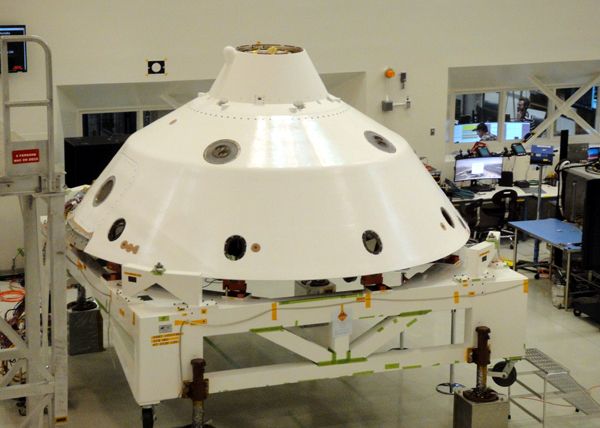
The Mars 2020 rover's aeroshell is on display inside the Spacecraft Assembly Facility at NASA's Jet Propulsion Laboratory near Pasadena, California...during Explore JPL on May 18, 2019.

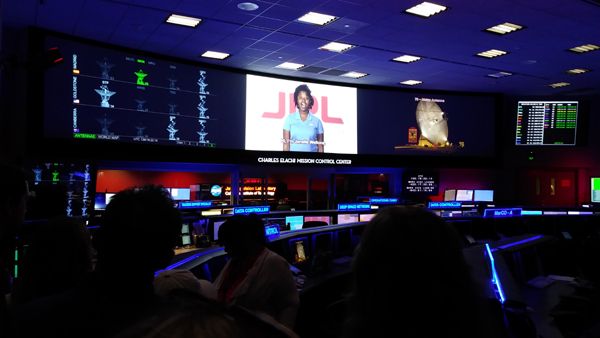
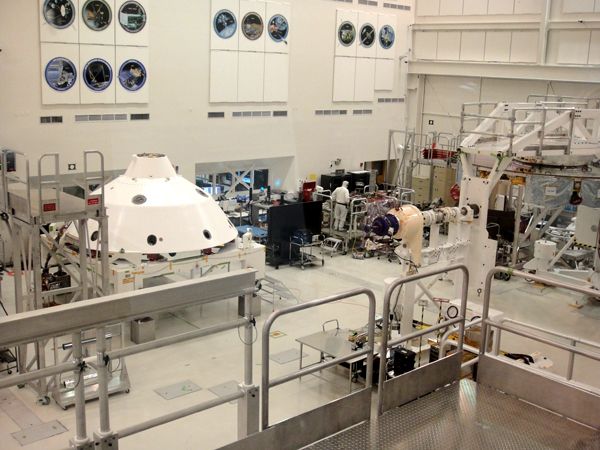
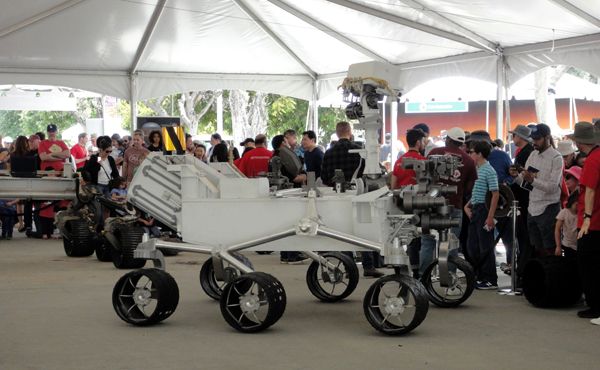
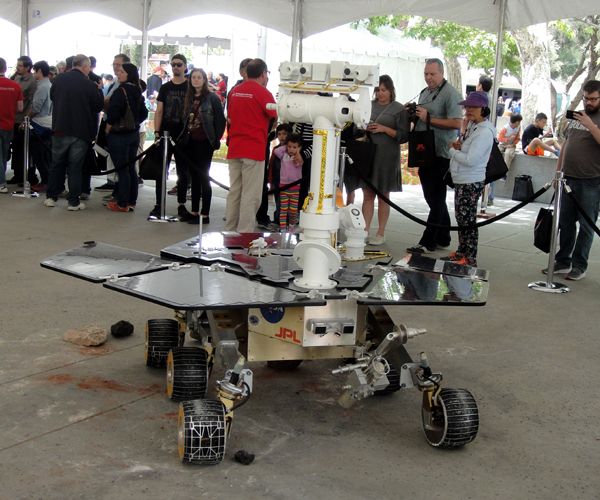
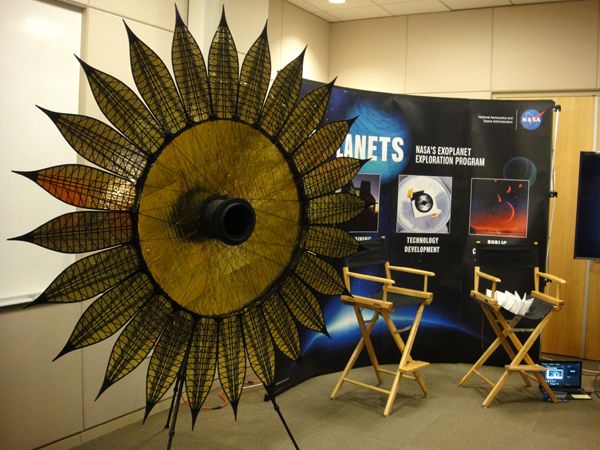
Just thought I'd end this month with these photos that I took at the Jet Propulsion Laboratory's (JPL) annual open house near Pasadena, California on May 18. This marked the third time this year that I visited JPL (the first time being for a public tour back in February, and the second time being for a NASA Social event held in March), so there's really nothing new to share here. (But continue reading, anyway!) Obviously, you have the flight hardware for the Mars 2020 rover on display inside the Spacecraft Assembly Facility (SAF), you have a glimpse of "The Center of the Universe" inside the Space Flight Operations Facility, you have cool snapshots of full-size replicas of the Curiosity and Mars Exploration Rovers in the main courtyard, and you have interesting exhibits pertaining to NASA's search for more (and potentially habitable) exoplanets. Actually, that last one is new to me!

Inside the Space Flight Operations Facility, a.k.a. 'The Center of the Universe,' at NASA's Jet Propulsion Laboratory near Pasadena, California...during Explore JPL on May 18, 2019.

I'm thinking about going back to JPL later this year (to check out the Mars 2020 rover one last time before it's shipped to its launch site at Cape Canaveral Air Force Station in Florida next January or February), but this might be the last time for a while that I visit this cool NASA field center. By the time the next Explore JPL is held next May or June, the Mars 2020 spacecraft will already be on the other side of the country—getting prepped for its July launch to the Red Planet aboard an Atlas V rocket. JPL might be building a neat science instrument or a spacecraft that I haven't heard of at the SAF once Mars 2020 is gone, but I'd rather return to see another high-profile interplanetary space probe undergo construction near the city of Pasadena. That robotic probe I have in mind is none other than the Europa Clipper! But we'll see if the Clipper is even built at JPL, and its launch won't be till 2023 (and the rocket that will send it to Jupiter hasn't been selected yet)...so there are still ways to go before assembly officially begins on this Jovian explorer. Happy Friday.

Mars 2020 flight hardware on display inside the Spacecraft Assembly Facility at NASA's Jet Propulsion Laboratory near Pasadena, California...during Explore JPL on May 18, 2019.

The Mars 2020 rover's cruise stage is on display inside the Spacecraft Assembly Facility at NASA's Jet Propulsion Laboratory near Pasadena, California...during Explore JPL on May 18, 2019.

The Mars 2020 rover itself is on display inside the Spacecraft Assembly Facility at NASA's Jet Propulsion Laboratory near Pasadena, California...during Explore JPL on May 18, 2019.

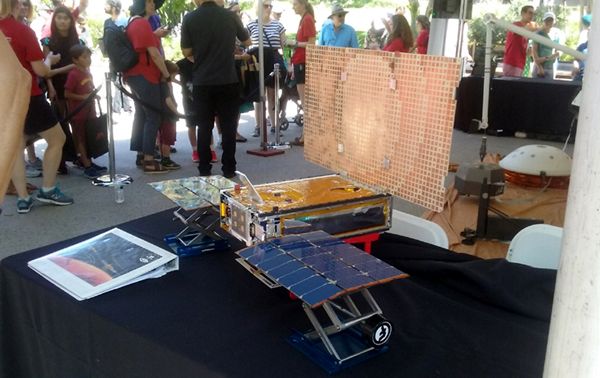
A miniature model of the InSight Mars lander is on display at NASA's Jet Propulsion Laboratory near Pasadena, California...during Explore JPL on May 18, 2019.

A full-size replica of the Mars Cube One spacecraft is on display at NASA's Jet Propulsion Laboratory near Pasadena, California...during Explore JPL on May 18, 2019.

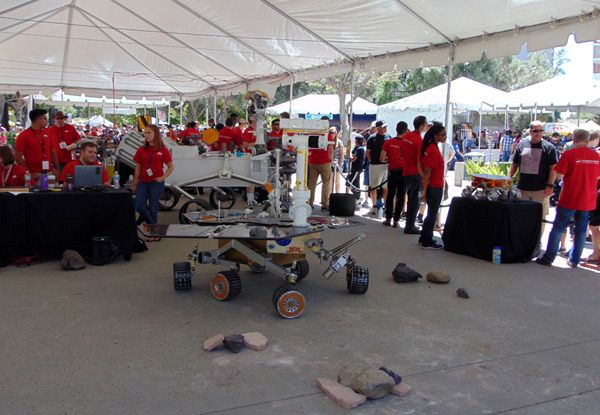
A full-size replica of the Curiosity Mars rover is on display at NASA's Jet Propulsion Laboratory near Pasadena, California...during Explore JPL on May 18, 2019.

A full-size replica of the Mars Exploration Rover is on display at NASA's Jet Propulsion Laboratory near Pasadena, California...during Explore JPL on May 18, 2019.

A snapshot of an exoplanet exhibit at NASA's Jet Propulsion Laboratory near Pasadena, California...during Explore JPL on May 18, 2019.

Sunday, March 31, 2019

Photos of the Day: The "Moon 2 Mars" NASA Social Event at JPL...

My NASA Social group poses inside the main lobby of the Space Flight Operations Facility (SFOF) at the Jet Propulsion Laboratory (JPL) near Pasadena, California...on March 11, 2019.

Just thought I'd end this month with these pics that I took on March 11...during the Moon 2 Mars NASA Social event at the Jet Propulsion Laboratory (JPL) near Pasadena, California. During this event, about 20 other social media users and I watched a televised conference held by NASA Administrator Jim Bridenstine (who was at the Kennedy Space Center in Florida at the time) from inside the von Kármán Auditorium at JPL. During the conference, Bridenstine discussed the 2020 NASA budget (which was just released earlier that morning)—and talked about major NASA projects such as the Space Launch System rocket and Gateway space station that NASA plans to place in orbit around the Moon next decade. The conference was also viewed by social media users who attended the Moon 2 Mars event at several other NASA field centers nationwide, such as Kennedy Space Center and the Langley Research Center in Virginia.

NASA Administrator Jim Bridenstine discusses the 2020 NASA budget during the 'Moon 2 Mars' event at Kennedy Space Center in Florida...on March 11, 2019.

After the conference, our NASA Social group took a tour of difference facilities on the JPL campus. First up was the JPL Museum next door to the von Kármán Auditorium, and then after that, the historic Space Flight Operations Facility (a.k.a. "The Center of the Universe") up the hill. And afterwards, we walked over to the Spacecraft Assembly Facility (SAF) where the Mars 2020 rover continues to be built. And finally, we took a van to the Mars Yard—which is all the way at the top of a hill on the JPL campus. We could've walked to this facility, but we were running low on time (this NASA Social was only from 8:30 AM to 1 PM...and Bridenstine's conference lasted from 11 AM to 12 noon) and had to get there as soon as possible. And our JPL hosts were incredibly generous!

My NASA Social group poses inside the van that shuttled us to the Mars Yard at the top of a hill at JPL...on March 11, 2019.

This marked the second time in a little over a month that I visited JPL (I attended a JPL public tour on February 4...but I apparently forgot to blog about it, heh)! I'll probably be back here in late May—for the annual Explore JPL event (formerly known as the JPL Open House). But first, I need to make sure that I get a ticket (which becomes available on the JPL website on April 6) for it... I'm well aware that I typed 'JPL' five times in this paragraph. Oh wait, make that six. Happy Sunday!

My fellow social media users and I introduce ourselves at the start of the 'Moon 2 Mars' event at JPL...on March 11, 2019.

Inside the SFOF's Mission Control Room (MCR) at JPL...on March 11, 2019.

Posing for a pic at a console inside the MCR at JPL...on March 11, 2019.

Inside the SFOF's Mission Control Center, also known as 'The Center of the Universe', at JPL...on March 11, 2019.

Posing for a pic inside The Center of the Universe...on March 11, 2019.

Components for the Mars 2020 rover are being worked on inside JPL's Spacecraft Assembly Facility (SAF)...on March 11, 2019.

Engineers work on the backshell for the Mars 2020 spacecraft inside the SAF...on March 11, 2019.

Engineers work on the body of the Mars 2020 rover itself inside the SAF...on March 11, 2019.

The engineering model for the Curiosity Mars rover on display at JPL's Mars Yard....on March 11, 2019.

Posing next to the Curiosity Mars rover's engineering model at JPL's Mars Yard...on March 11, 2019.

My NASA Social group takes one last team photo...this time at JPL's Mars Yard on March 11, 2019.

Thursday, November 01, 2018

The Sun Has Set on Dawn's Mission...

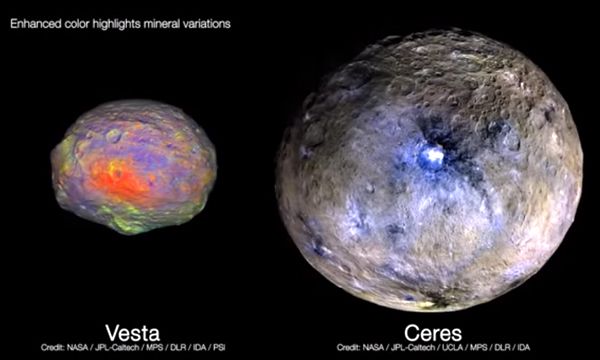
Enhanced color images of asteroid Vesta and dwarf planet Ceres...which were explored by NASA's Dawn spacecraft in 2011 and 2015, respectively.
NASA / JPL - Caltech

NASA’s Dawn Mission to Asteroid Belt Comes to End (Press Release)

NASA’s Dawn spacecraft has gone silent, ending a historic mission that studied time capsules from the solar system’s earliest chapter.

Dawn missed scheduled communications sessions with NASA's Deep Space Network on Wednesday, Oct. 31, and Thursday, Nov. 1. After the flight team eliminated other possible causes for the missed communications, mission managers concluded that the spacecraft finally ran out of hydrazine, the fuel that enables the spacecraft to control its pointing. Dawn can no longer keep its antennae trained on Earth to communicate with mission control or turn its solar panels to the Sun to recharge.

The Dawn spacecraft launched 11 years ago to visit the two largest objects in the main asteroid belt. Currently, it’s in orbit around the dwarf planet Ceres, where it will remain for decades.

“Today, we celebrate the end of our Dawn mission – its incredible technical achievements, the vital science it gave us, and the entire team who enabled the spacecraft to make these discoveries,” said Thomas Zurbuchen, associate administrator of NASA’s Science Mission Directorate in Washington. “The astounding images and data that Dawn collected from Vesta and Ceres are critical to understanding the history and evolution of our solar system.”

Dawn launched in 2007 on a journey that put about 4.3 billion miles (6.9 billion kilometers) on its odometer. Propelled by ion engines, the spacecraft achieved many firsts along the way. In 2011, when Dawn arrived at Vesta, the second largest world in the main asteroid belt, the spacecraft became the first to orbit a body in the region between Mars and Jupiter. In 2015, when Dawn went into orbit around Ceres, a dwarf planet that is also the largest world in the asteroid belt, the mission became the first to visit a dwarf planet and go into orbit around two destinations beyond Earth.

"The fact that my car's license plate frame proclaims, 'My other vehicle is in the main asteroid belt,' shows how much pride I take in Dawn," said Mission Director and Chief Engineer Marc Rayman at NASA's Jet Propulsion Laboratory (JPL). "The demands we put on Dawn were tremendous, but it met the challenge every time. It's hard to say goodbye to this amazing spaceship, but it’s time."

The data Dawn beamed back to Earth from its four science experiments enabled scientists to compare two planet-like worlds that evolved very differently. Among its accomplishments, Dawn showed how important location was to the way objects in the early solar system formed and evolved. Dawn also reinforced the idea that dwarf planets could have hosted oceans over a significant part of their history – and potentially still do.

“In many ways, Dawn’s legacy i­s just beginning,” said Princ­­ipal Investigator Carol Raymond at JPL. “Dawn’s data sets will be deeply mined by scientists working on how planets grow and differentiate, and when and where life could have formed in our solar system. Ceres and Vesta are important to the study of distant planetary systems, too, as they provide a glimpse of the conditions that may exist around young stars.”

Because Ceres has conditions of interest to scientists who study chemistry that leads to the development of life, NASA follows strict planetary protection protocols for the disposal of the Dawn spacecraft. Dawn will remain in orbit for at least 20 years, and engineers have more than 99 percent confidence the orbit will last for at least 50 years.

So, while the mission plan doesn't provide the closure of a final, fiery plunge – the way NASA’s Cassini spacecraft ended last year, for example – at least this is certain: Dawn spent every last drop of hydrazine making science observations of Ceres and radioing them back so we could learn more about the solar system we call home.

The Dawn mission is managed by JPL for NASA's Science Mission Directorate in Washington. Dawn is a project of the directorate's Discovery Program, managed by NASA's Marshall Space Flight Center in Huntsville, Alabama. JPL is responsible for overall Dawn mission science. Northrop Grumman in Dulles, Virginia, designed and built the spacecraft. The German Aerospace Center, Max Planck Institute for Solar System Research, Italian Space Agency and Italian National Astrophysical Institute are international partners on the mission team.

****

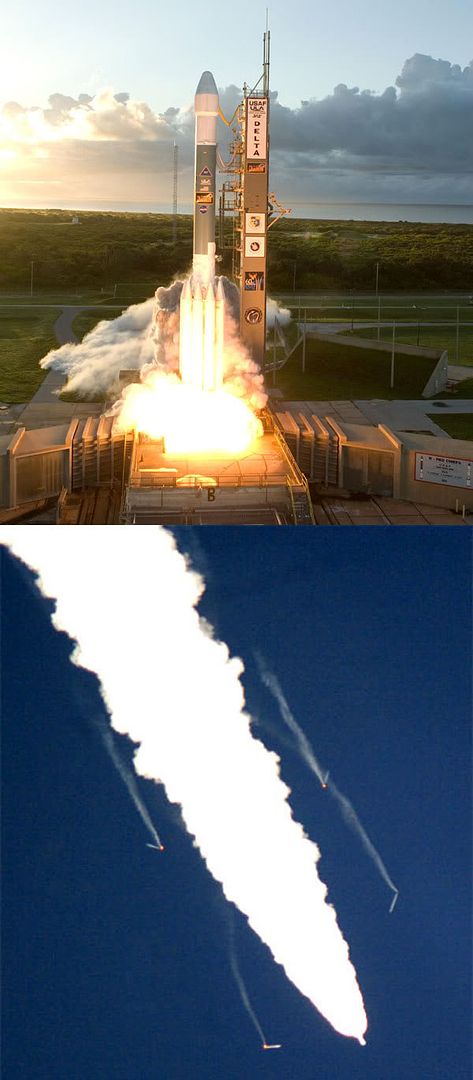
A Delta II rocket carrying the Dawn spacecraft is launched from Cape Canaveral Air Force Station in Florida...on September 27, 2007.
Tony Gray and Robert Murray for NASA / Carleton Bailie for United Launch Alliance

IMAGE 1: A photo taken by me of a microchip on display during the 2007 Open House at NASA's Jet Propulsion Laboratory near Pasadena, California.  IMAGE 2: A technician installs the Dawn microchip onto the spacecraft.  IMAGE 3: The Dawn microchip now secured on the spacecraft.

A certificate commemorating my participation in the 'Send Your Name to the Asteroid Belt' project.

Saturday, June 16, 2018

Photos of the Day #2: Explore JPL...

Posing with the Mars 2020 descent stage behind me inside the Spacecraft Assembly Facility...at Explore JPL on June 9, 2018.

One week ago today, I went back to the Jet Propulsion Laboratory (JPL) near Pasadena, California, to attend its annual open house...which was renamed Explore JPL a few years ago. There was nothing new to see at the lab since I last visited the NASA field center on May 30, but it's all good. It never gets old visiting the historic Space Flight Operations Facility, as well as checking out flight hardware for the Mars 2020 rover inside the Spacecraft Assembly Facility. And even though it was extremely crowded (like it's been for the past six years or so), it's always a thrill to see the amount of people in the general public who take an interest in space exploration. Happy Father's Day weekend!

LINK: Additional photos that I took at the June 2018 Explore JPL event

The Mars 2020 descent and cruise stages (the latter is visible towards the right edge of this photo) on display inside the Spacecraft Assembly Facility...at Explore JPL on June 9, 2018.

A snapshot inside the historic Space Flight Operations Facility at Explore JPL...on June 9, 2018.

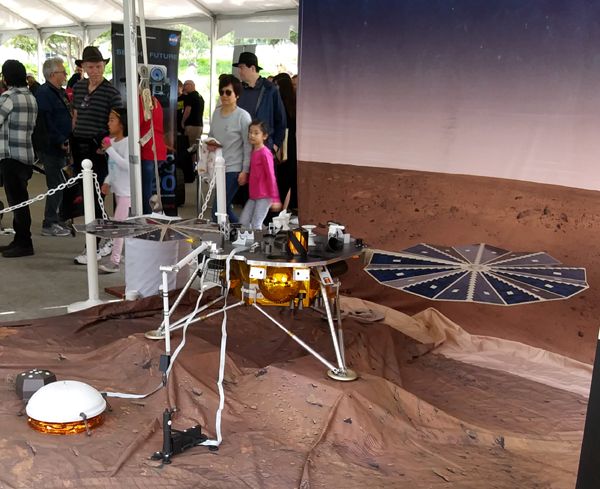
A full-size replica of NASA's Mars-bound InSight lander...on display at Explore JPL on June 9, 2018.

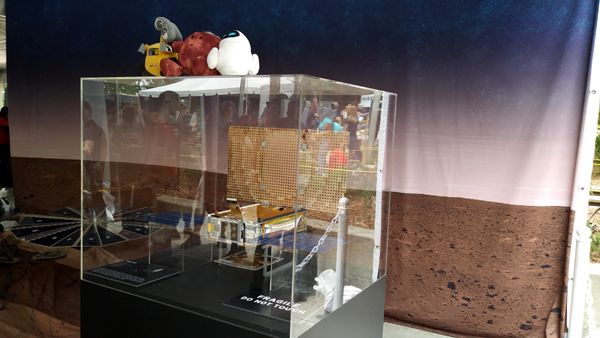
A full-size replica of NASA's Red Planet-bound Mars Cube One spacecraft...on display at Explore JPL on June 9, 2018.

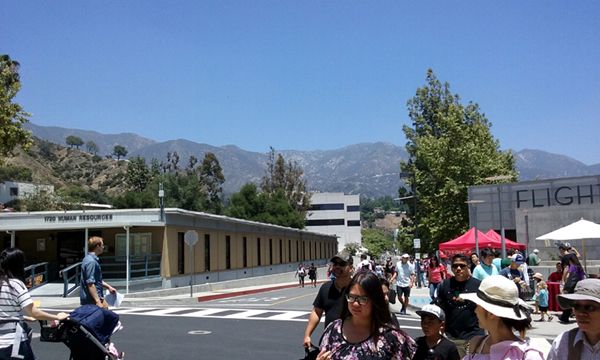
A clear and sunny day to visit NASA's Jet Propulsion Laboratory near Pasadena, California...during Explore JPL on June 9, 2018.

Sunday, June 10, 2018

America's Oldest Active Mars Rover Braces Itself for Severe Weather on the Red Planet...

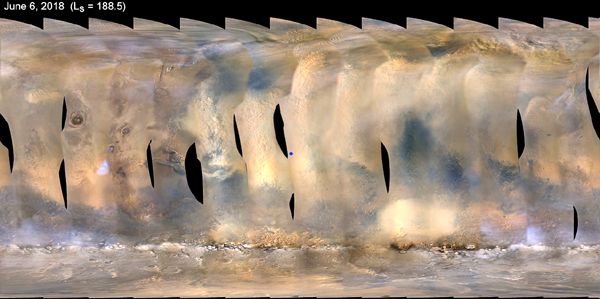
The blue dot in this image shows the location of NASA's Opportunity rover as a giant dust storm (photographed by the Mars Reconnaissance Orbiter) swirls across the surface of the Red Planet...on June 6, 2018.
NASA / JPL - Caltech / MSSS

Opportunity Hunkers Down During Dust Storm (News Release - June 9)

Science operations for NASA's Opportunity rover have been temporarily suspended as it waits out a growing dust storm on Mars.

NASA's Mars Reconnaissance Orbiter first detected the storm on Friday, June 1. As soon as the orbiter team saw how close the storm was to Opportunity, they notified the rover's team to begin preparing contingency plans.

In a matter of days, the storm had ballooned. It now spans more than 7 million square miles (18 million square kilometers) -- an area greater than North America -- and includes Opportunity's current location at Perseverance Valley. More importantly, the swirling dust has raised the atmospheric opacity, or "tau," in the valley in the past few days. This is comparable to an extremely smoggy day that blots out sunlight. The rover uses solar panels to provide power and to recharge its batteries.

Opportunity's power levels had dropped significantly by Wednesday, June 6, requiring the rover to shift to minimal operations.

This isn't Opportunity's first time hunkering down in bad weather: in 2007, a much larger storm covered the planet. That led to two weeks of minimal operations, including several days with no contact from the rover to save power. The project's management prepared for the possibility that Opportunity couldn't balance low levels of power with its energy-intensive survival heaters, which protect its batteries from Mars' extreme cold. It's not unlike running a car in the winter so that the cold doesn't sap its battery charge. There is a risk to the rover if the storm persists for too long and Opportunity gets too cold while waiting for the skies to clear.

Ultimately, the storm subsided and Opportunity prevailed. The Martian cold is believed to have resulted in the loss of Spirit, Opportunity's twin in the Mars Exploration Rover mission, back in 2010. Despite this, both rovers have vastly exceeded expectations: they were only designed to last 90 days each. Opportunity is in its 15th year; the team has operated the rover for more than 50 times longer than originally planned. Full dust storms like this one are not surprising, but are infrequent. They can crop up suddenly but last weeks, even months. During southern summer, sunlight warms dust particles, lifting them higher into the atmosphere and creating more wind. That wind kicks up yet more dust, creating a feedback loop that NASA scientists still seek to understand.

Mars Reconnaissance Orbiter and two other NASA spacecraft orbiting the Red Planet -- Odyssey and MAVEN -- routinely support rovers on the ground.

Source: Jet Propulsion Laboratory

****

Full-size models of the Mars Exploration Rover and Sojourner rover (near the right side of this photo) at JPL...on May 20, 2017.

Wednesday, September 27, 2017

Dawn Update: Marking One Decade Since Its Launch to the Asteroid Belt...

The Dawn spacecraft is launched from Cape Canaveral Air Force Station in Florida on September 27, 2007.
Tony Gray and Robert Murray for NASA / Carleton Bailie for United Launch Alliance

Dawn Mission Celebrates 10 Years in Space (Press Release)

Ten years ago, NASA's Dawn spacecraft set sail for the two most massive bodies in the asteroid belt between Mars and Jupiter: giant asteroid Vesta and dwarf planet Ceres. The mission was designed to deliver new knowledge about these small but intricate worlds, which hold clues to the formation of planets in our solar system.

"Our interplanetary spaceship has exceeded all expectations in the last decade, delivering amazing insights about these two fascinating bodies," said Chris Russell, principal investigator of the Dawn mission, based at the University of California, Los Angeles.

Since its launch on Sept. 27, 2007, Dawn has achieved numerous technical and scientific feats while traveling 4 billion miles (6 billion kilometers). It is the only spacecraft to orbit two extraterrestrial solar system targets. It is also the only spacecraft to orbit a dwarf planet, a milestone it achieved when in entered orbit around Ceres on March 6, 2015. The spacecraft's ion propulsion system enabled Dawn to study each of these worlds from a variety of vantage points and altitudes, creating an impressive scrapbook of 88,000 photos. Additionally, Dawn's suite of instruments enabled it to take a variety of other measurements of Vesta and Ceres, revealing the contrasting compositions and internal structures of these two bodies.
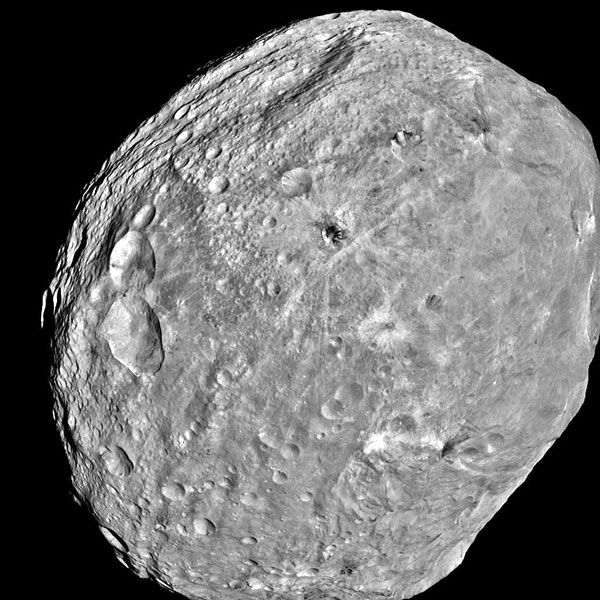
An image of asteroid Vesta that was taken by the Dawn spacecraft on July 24, 2011.
NASA / JPL - Caltech / UCLA / MPS / DLR / IDA

Vesta Highlights

Scientists learned a great deal about Vesta's geological features and composition during Dawn's 14 months of exploration there. A notable discovery was that Rheasilvia, a giant basin in Vesta's southern hemisphere, was even deeper and wider than scientists expected based on telescopic observations from Earth. It spans more than 310 miles (500 kilometers) and pierces about 12 miles (19 kilometers) into Vesta. The center of the crater also hosts a mountain twice the height of Mt. Everest -- the tallest feature seen in Dawn's 1,298 orbits of Vesta.

The massive punch into Vesta that carved out this crater happened about 1 billion years ago and caused huge amounts of material to rain down on the surface. The net result is that the surface of the southern hemisphere of Vesta is younger than the northern hemisphere, which retains a hefty record of craters. The Rheasilvia impact also created dozens of gorges circling Vesta's equator. Canyons there, some of which formed from an earlier impact, measure up to 290 miles (465 kilometers) in length.
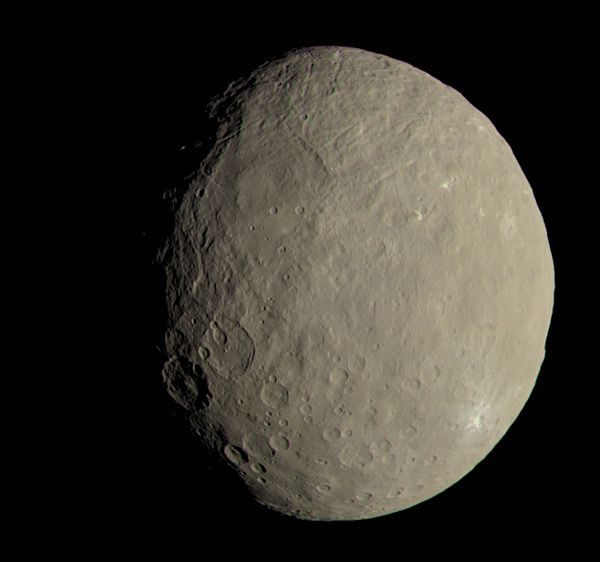
Using data from the Dawn spacecraft's first science orbit in 2015, this image of Ceres approximates how the dwarf planet's colors would appear to the human eye.
NASA / JPL - Caltech / UCLA / MPS / DLR / IDA

Ceres Highlights

One of Dawn's biggest revelations at Ceres is the extremely bright, salty material in Occator Crater that gleams amid an otherwise dark area. What appeared to be a single white blob at a distance turned out to be a smattering of many bright areas called faculae. The central bright area, Cerealia Facula, has a dome at its center with radial fractures across it that appears reddish in enhanced color images. This "bright spot" suggests Ceres was geologically active in the very recent past, when briny water rose to the surface and deposited salts. Just to the east are the Vinalia Faculae, a constellation of less-bright spots distributed along fractures that also intrigue scientists. Ceres hosts more than 300 small bright areas, with some thought to host ice at northern latitudes.

Another huge surprise at Ceres was Ahuna Mons, which scientists believe formed as a cryovolcano, a volcano that erupted with salty water in the past. This "lonely mountain," 3 miles (5 kilometers) high on its steepest side, is unlike anything else on Ceres and remains a thriving research topic. Though both Ahuna Mons and Occator appear dormant, they suggest that liquid water flowed once beneath the surface of Ceres, and may even still be there today, if it is enriched in salts that would lower its freezing point.
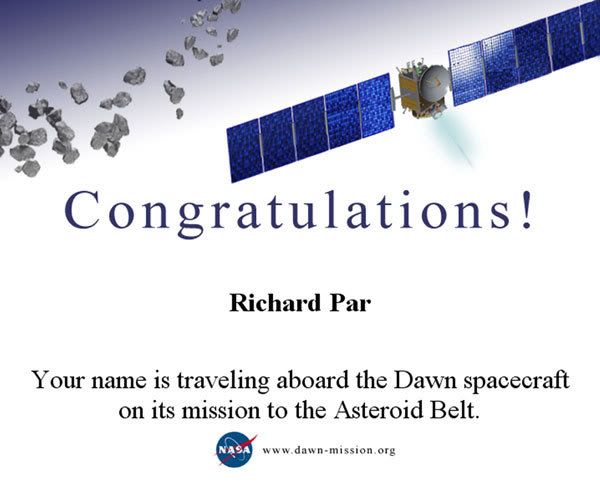
A certificate commemorating my participation in the 'Send Your Name to the Asteroid Belt' project.

Dawn Science Continues

"The science team is still actively exploring the troves of data that Dawn has delivered so far, comparing these two fossils of the early solar system," said Carol Raymond, Dawn deputy principal investigator, based at NASA's Jet Propulsion Laboratory, Pasadena, California.

Since March 2015, Dawn has orbited Ceres 1,595 times. It remains healthy, currently in a 30-day elliptical orbit collecting data on cosmic rays in the vicinity of Ceres.

"This continues to be a mission for everyone who yearns for new knowledge, everyone who is curious about the cosmos, and everyone who is exhilarated by bold adventures into the unknown," said Marc Rayman, mission director and chief engineer, based at JPL.

Dawn's mission is managed by the Jet Propulsion Laboratory for NASA's Science Mission Directorate in Washington. Dawn is a project of the directorate's Discovery Program, managed by NASA's Marshall Space Flight Center in Huntsville, Alabama. UCLA is responsible for overall Dawn mission science. Orbital ATK, Inc., in Dulles, Virginia, designed and built the spacecraft. The German Aerospace Center, the Max Planck Institute for Solar System Research, the Italian Space Agency and the Italian National Astrophysical Institute are international partners on the mission team.

Source: Jet Propulsion Laboratory

****
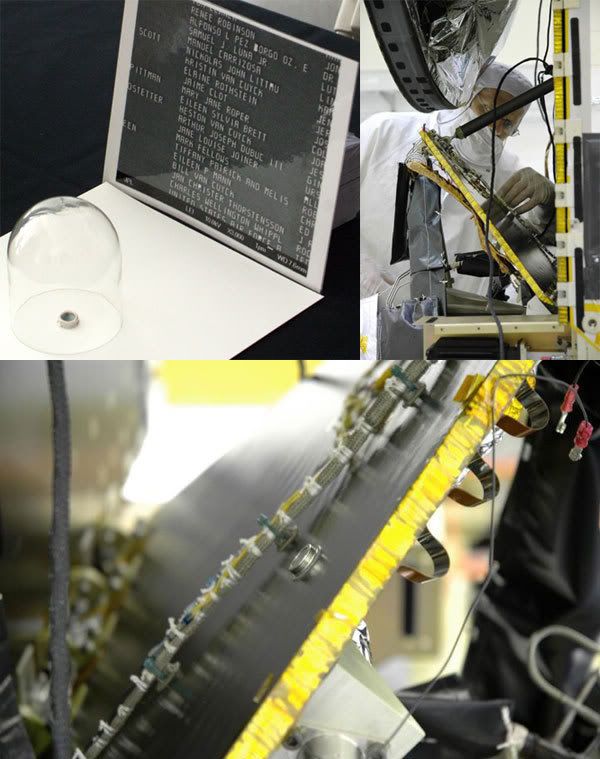
IMAGE 1: A photo taken by me of a microchip on display during the 2007 Open House at NASA's Jet Propulsion Laboratory near Pasadena, California.  IMAGE 2: A technician installs the Dawn microchip onto the spacecraft.  IMAGE 3: The Dawn microchip now secured on the spacecraft.