Showing posts with label Stardust. Show all posts

Thursday, August 14, 2014

Relics from Interstellar Space?

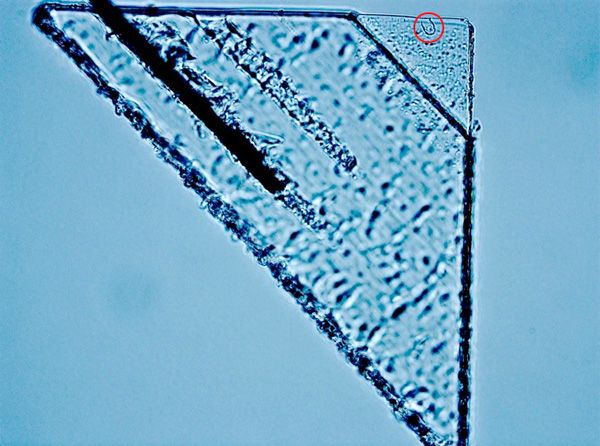
The biggest interstellar dust track discovered in the Stardust aerogel collectors was this 35 micron-long hole produced by a speck of dust that was probably traveling so fast that it disintegrated upon impact.
UC Berkeley / Andrew Westphal

Stardust Team Reports Discovery of First Potential Interstellar Space Particles (Press Release)

Seven rare, microscopic interstellar dust particles that date to the beginnings of the solar system are among the samples collected by scientists who have been studying the payload from NASA's Stardust spacecraft since its return to Earth in 2006. If confirmed, these particles would be the first samples of contemporary interstellar dust.

A team of scientists has been combing through the spacecraft's aerogel and aluminum foil dust collectors since Stardust returned in 2006.The seven particles probably came from outside our solar system, perhaps created in a supernova explosion millions of years ago and altered by exposure to the extreme space environment.

The research report appears in the Aug. 15 issue of the journal Science. Twelve other papers about the particles will appear next week in the journal Meteoritics & Planetary Science.

"These are the most challenging objects we will ever have in the lab for study, and it is a triumph that we have made as much progress in their analysis as we have," said Michael Zolensky, curator of the Stardust laboratory at NASA’s Johnson Space Center in Houston and coauthor of the Science paper.

Stardust was launched in 1999 and returned to Earth on Jan. 15, 2006, at the Utah Test and Training Range, 80 miles west of Salt Lake City. The Stardust Sample Return Canister was transported to a curatorial facility at Johnson where the Stardust collectors remain preserved and protected for scientific study.

Inside the canister, a tennis racket-like sample collector tray captured the particles in silica aerogel as the spacecraft flew within 149 miles of a comet in January 2004. An opposite side of the tray holds interstellar dust particles captured by the spacecraft during its seven-year, three-billion-mile journey.

Scientists caution that additional tests must be done before they can say definitively that these are pieces of debris from interstellar space. But if they are, the particles could help explain the origin and evolution of interstellar dust.

The particles are much more diverse in terms of chemical composition and structure than scientists expected. The smaller particles differ greatly from the larger ones and appear to have varying histories. Many of the larger particles have been described as having a fluffy structure, similar to a snowflake.

Two particles, each only about two microns (thousandths of a millimeter) in diameter, were isolated after their tracks were discovered by a group of citizen scientists. These volunteers, who call themselves "Dusters," scanned more than a million images as part of a University of California, Berkeley, citizen-science project, which proved critical to finding these needles in a haystack.

A third track, following the direction of the wind during flight, was left by a particle that apparently was moving so fast -- more than 10 miles per second (15 kilometers per second) -- that it vaporized. Volunteers identified tracks left by another 29 particles that were determined to have been kicked out of the spacecraft into the collectors.

Four of the particles reported in Science were found in aluminum foils between tiles on the collector tray. Although the foils were not originally planned as dust collection surfaces, an international team led by physicist Rhonda Stroud of the Naval Research Laboratory searched the foils and identified four pits lined with material composed of elements that fit the profile of interstellar dust particles.

Three of these four particles, just a few tenths of a micron across, contained sulfur compounds, which some astronomers have argued do not occur in interstellar dust. A preliminary examination team plans to continue analysis of the remaining 95 percent of the foils to possibly find enough particles to understand the variety and origins of interstellar dust.

Supernovas, red giants and other evolved stars produce interstellar dust and generate heavy elements like carbon, nitrogen and oxygen necessary for life. Two particles, dubbed Orion and Hylabrook, will undergo further tests to determine their oxygen isotope quantities, which could provide even stronger evidence for their extrasolar origin.

Scientists at Johnson have scanned half the panels at various depths and turned these scans into movies, which were then posted online, where the Dusters could access the footage to search for particle tracks.

Once several Dusters tag a likely track, Andrew Westphal, lead author of the Science article, and his team verify the identifications. In the one million frames scanned so far, each a half-millimeter square, Dusters have found 69 tracks, while Westphal has found two. Thirty-one of these were extracted along with surrounding aerogel by scientists at Johnson and shipped to UC Berkeley to be analyzed.

NASA's Jet Propulsion Laboratory, Pasadena, California, manages the Stardust mission for NASA's Science Mission Directorate, Washington. Lockheed Martin Space Systems, Denver, developed and operated the spacecraft.

Source: NASA.Gov

****
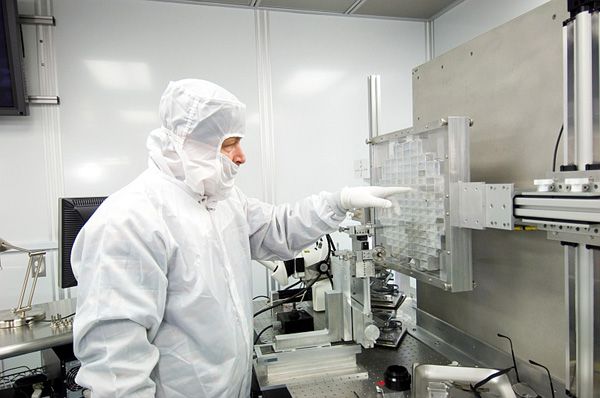
A scientist points at the location of one of the interstellar dust particles that impacted Stardust's aerogel collectors during their journey in space.
Andrew Westphal, UC Berkeley
Thursday, May 05, 2011

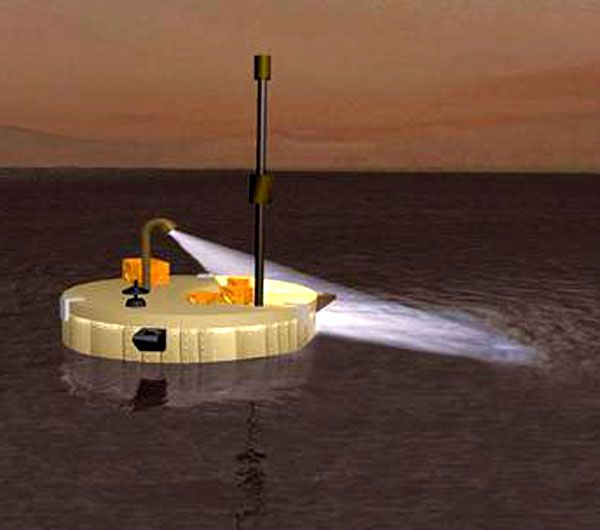
An artist concept of the Titan Mare Explorer (TiME) floating in a sea on Saturn's moon.
NASA


PERSONALLY SPEAKING, I'm hoping it's the Titan Mare Explorer (TiME) that gets chosen in 2016... This mission definitely intrigues me.

****

NASA Selects Investigations for Future Key Missions (Press Release)

PASADENA, Calif. -- NASA has selected three science investigations from which it will pick one potential 2016 mission to look at Mars' interior for the first time; study an extraterrestrial sea on one of Saturn's moons; or study in unprecedented detail the surface of a comet's nucleus. NASA's Jet Propulsion Laboratory, Pasadena, Calif., would lead the Mars investigation.

Each investigation team will receive $3 million to conduct its mission's concept phase or preliminary design studies and analyses. After another detailed review in 2012 of the concept studies, NASA will select one to continue development efforts leading up to launch. The selected mission will be cost-capped at $425 million, not including launch vehicle funding.

NASA's Discovery Program requested proposals for spaceflight investigations in June 2010. A panel of NASA and other scientists and engineers reviewed 28 submissions. The selected investigations could reveal much about the formation of our solar system and its dynamic processes. Three technology developments for possible future planetary missions also were selected.

"NASA continues to do extraordinary science that is re-writing textbooks," said NASA Administrator Charles Bolden. "Missions like these hold great promise to vastly increase our knowledge, extend our reach into the solar system and inspire future generations of explorers."

The planetary missions selected to pursue preliminary design studies are:

-- Geophysical Monitoring Station (GEMS) would study the structure and composition of the interior of Mars and advance understanding of the formation and evolution of terrestrial planets. Bruce Banerdt of NASA's Jet Propulsion Laboratory in Pasadena, Calif., is principal investigator. JPL would manage the project.

The proposed Mars lander would carry three experiments. A seismometer for measuring Mars quakes would yield knowledge about interior materials from the crust to the core. A thermal probe beneath the surface would monitor heat flow from the planet's interior. Radio capability for Doppler tracking of tiny variations in the planet's wobble would provide information about the size and nature of the core. Understanding more about the deep interior of another planet would enable important new comparisons with what is known about Earth's interior.

"We want to know more about how the pieces that formed planets came together in the first place, and about the changes that took place afterwards," Banerdt said. "This would be a mission to understand the formation and evolution of terrestrial planets."

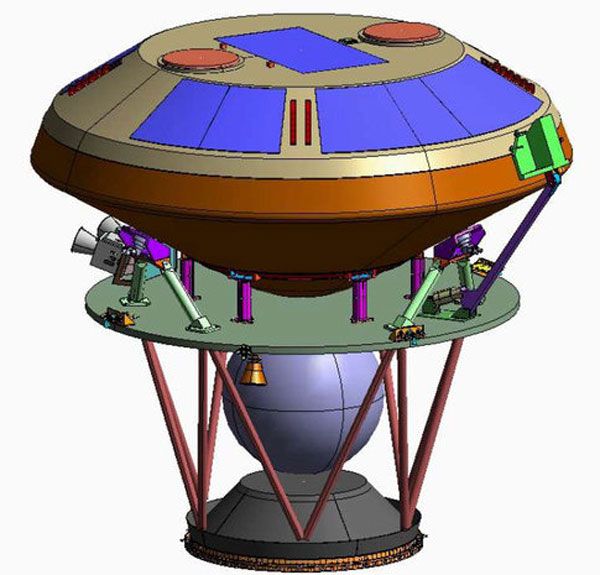
-- Titan Mare Explorer (TiME) would provide the first direct exploration of an ocean environment beyond Earth by landing in, and floating on, a large methane-ethane sea on Saturn's moon Titan. Ellen Stofan of Proxemy Research Inc. in Gaithersburg, Md., is principal investigator. Johns Hopkins University's Applied Physics Laboratory in Laurel, Md., would manage the project.

-- Comet Hopper would study cometary evolution by landing on a comet multiple times and observing its changes as it interacts with the sun. Jessica Sunshine of the University of Maryland in College Park is principal investigator. NASA's Goddard Space Flight Center in Greenbelt, Md., would manage the project.

"This is high science return at a price that's right," said Jim Green, director of NASA's Planetary Science Division in Washington. "The selected studies clearly demonstrate a new era with missions that all touch their targets to perform unique and exciting science."

The three selected technology development proposals will expand the ability to catalog near-Earth objects, or NEOs; enhance the capability to determine the composition of comet ices; and validate a new method to reveal the population of objects in the poorly understood, far-distant part of our solar system. During the next several years, selected teams will receive funding that is determined through contract negotiations to bring their respective technologies to a higher level of readiness. To be considered for flight, teams must demonstrate progress in a future mission proposal competition.

The proposals selected for technology development are:

-- NEOCam would develop a telescope to study the origin and evolution of near-Earth Objects and study the present risk of Earth-impact. It would generate a catalog of objects and accurate infrared measurements to provide a better understanding of small bodies that cross our planet's orbit. Amy Mainzer of JPL is principal investigator.

A space-based telescope, NEOCam would be positioned in a location about four times the distance between Earth and the moon. From this lofty perch, NEOCam could observe the comings and goings of NEOs every day without the impediments to efficient observing like cloud cover and even daylight. The location in space NEOCam would inhabit is also important, because it allows the monitoring of areas of the sky generally inaccessible to ground-based surveys.

"Near-Earth objects are some of the most bountiful, intriguing and least understood of Earth's neighbors," said Amy Mainzer. "With NEOCam, we would get to know these solar system nomads in greater detail."

-- Primitive Material Explorer (PriME) would develop a mass spectrometer that would provide highly precise measurements of the chemical composition of a comet and explore the objects' role in delivering volatiles to Earth. Anita Cochran of the University of Texas in Austin is principal investigator.

-- Whipple: Reaching into the Outer Solar System would develop and validate a technique called blind occultation that could lead to the discovery of various celestial objects in the outer solar system and revolutionize our understanding of the area's structure. Charles Alcock of the Smithsonian Astrophysical Observatory in Cambridge, Mass., is principal investigator.

Created in 1992, the Discovery Program sponsors frequent, cost-capped solar system exploration missions with highly focused scientific goals. The program's 11 missions include MESSENGER, Dawn, Stardust, Deep Impact and Genesis. NASA's Marshall Space Flight Center in Huntsville, Ala., manages the program for the agency's Science Mission Directorate.

Source: Jet Propulsion Laboratory

****

The design of the TiME spacecraft.
NASA

Wednesday, August 08, 2007

A flight spare for the Phoenix DVD.
Courtesy of The Planetary Society (http://www.planetary.org)

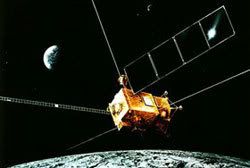
PHOENIX DVD: A MEMORIAL... Now that the Phoenix spacecraft is safely en route to Mars, I think it is okay to mention the significance of some of the 250,000 names that were inscribed onto the disc. Like what was done with the microchip aboard the still-operating Stardust spacecraft—which contains the names of 58,000 soldiers who are also listed on the Vietnam Memorial in Washington, D.C.—the names of those who perished in recent national tragedies are now onboard the Phoenix DVD. The 17 astronauts who lost their lives aboard Apollo I, space shuttles Challenger and Columbia (respectively) have their names on the disc... The names of the 17 sailors who were killed in the 2000 USS Cole bombing near Yemen have also been immortalized on the DVD...and last, but definitely not least, the names of the 2,000-plus victims of September 11, 2001 will also be part of an unofficial memorial on the northern plains of Mars. Unfortunately, due to time constraints (and the fact the list is still growing), the names of the 3,000-plus soldiers who have so far lost their lives in the Iraq war were not submitted for inclusion on the disc.

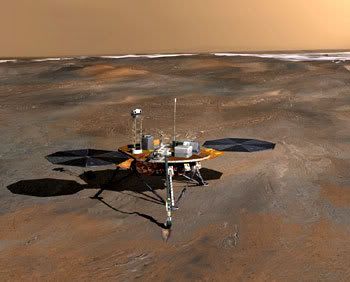
An artist's concept of the Phoenix lander on the Martian northern plain.
NASA JPL

On the other hand, the names of many noteworthy historical figures (obviously not to disrespect the people mentioned above) have also had their names submitted for the DVD. Rosa Parks, Martin Luther King, Jr., Gerald Ford, Pope John Paul II and even Gandhi are on a virtual journey to the Red Planet. On the contemporary showbiz side, Kiefer Sutherland (of the TV show, 24), Hugh Laurie (of the TV drama, House), their co-stars and a few other celebrities (even Lucille Ball and Desi Arnaz of I Love Lucy fame) will hopefully find their names on the fourth planet from the Sun in May of 2008. How do I know about all this? I just do.

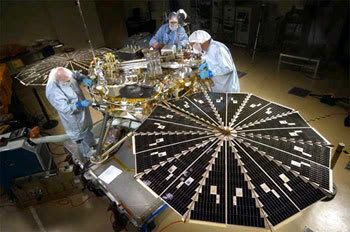
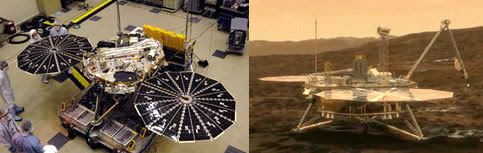
Technicians work on the Phoenix lander at the Lockheed Martin facility in Colorado.
NASA / Lockheed Martin

That's what makes these public outreach efforts by NASA so interesting. Other than having our own names aboard spacecraft that will literally head for the stars, it gives people the opportunity to submit the names of family members, friends, other close acquaintances and respected public individuals for inclusion on what amounts to virtual monuments in deep space. Dawn and Kaguya (a Japanese moon mission formerly called SELENE) will hopefully follow suit next month (though Dawn should’ve already been in space BY NOW. Oh well... Kaguya is scheduled for launch on September 13). In terms of future opportunities to have our names flown to the heavens, the Mars Science Laboratory (MSL) rover will launch in 2009, and the Juno spacecraft will lift off for Jupiter in 2010. Having a public outreach effort for MSL should be a given...as every Mars lander since the 1997 Pathfinder mission have had names of thousands of people included on them [the names that were submitted for the 2001 lander mission (which got cancelled in response to the loss of the 1999 Mars Polar Lander at the Red Planet), which eventually got resurrected as Phoenix, were instead placed on DVDs that are now on the landers for the Spirit and Opportunity rovers...which are still operating on Mars more than three years after they landed in 2004]. Anyways, that is all.

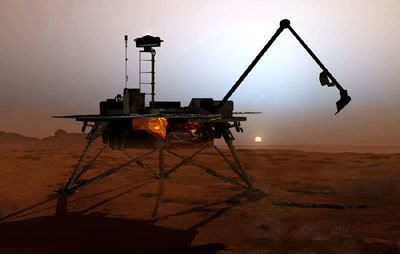
An artist's concept of the Phoenix lander with the Sun setting over the Martian horizon.
NASA JPL

Have a safe journey to the Red Planet, Phoenix...as you are headed for a date with destiny on the Martian northern plains. There, you will slowly be entombed by ice months after you study Mars’ North Pole...and the DVD on your flight deck will await discovery by future astronauts who venture to the Red Planet. Hopefully, that’ll be around 30 years from now, haha. Unless the Vision for Space Exploration completely falters by then. God forbid.

PHOENIX Blog Entries Archive:

May 8, 2007
July 28, 2007
August 3, 2007
August 4, 2007

Tuesday, February 06, 2007

ONLY ONE WEEK LEFT for you to fly your name to Mars onboard Phoenix, and one day left to send your name and a message to the Moon on Japan's SELENE spacecraft. Click on the banner at the top of this page to submit a name for Phoenix, and go HERE to submit a name and a brief message to the Moon as part of the "Wish Upon The Moon" campaign sponsored by The Planetary Society (based in Pasadena, California) and The Planetary Society of Japan. February 6 will be the final day to have your name included in a specially-made, silica-glass DVD to be placed on Phoenix.

UPDATE #1 (February 6): The deadline to submit your name on Phoenix has been extended to February 12...at 12:00 noon, Pacific Standard Time.

UPDATE #2 (February 12): The Phoenix opportunity is now closed as of 5 PM, Pacifc time today, but you still have till February 28 to fly your name aboard SELENE.

UPDATE #3: For some odd reason, apostrophes aren't allowed in the Phoenix and SELENE database, so if you have O'Neal, O'Neill, O'Connor, O'Keefe or any other name with an apostrophe in it, you would instead have to type O Neal, ONeal or O-Neal for your submission to go through. I know, I know... That doesn't make sense. Fortunately, I myself don't have to worry about that problem (last names don't get any simpler than 'Par'). Heheh.

LEFT: NASA's Phoenix spacecraft undergoes testing at the Lockheed Martin facility in Colorado.  RIGHT: Computer rendition of the Phoenix spacecraft on the Martian surface.

NASA's Phoenix spacecraft is scheduled for launch on August 3rd, and will arrive at the Red Planet in May of 2008. Japan’s SELENE probe will launch around July and arrive at the Moon about five days later. Become a member of The Planetary Society if you want to take part in more of these opportunities...since the Society was responsible for sending literally millions of names into space onboard other NASA missions like Cassini (616,420 names), Deep Impact (625,000 names), New Horizons (430,000 names), Stardust (two microchips are carried onboard... One bearing 136,000 names and the other 1 MILLION names) and the Mars Rovers (4 MILLION names on each rover). No, the Society didn’t pay me to type this post. I could use the cash, though.

Artist rendition of Japan's SELENE spacecraft.

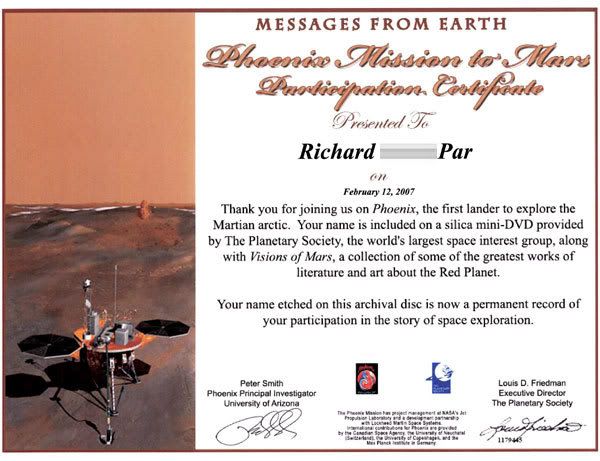
Below are my participation certificates for Phoenix, SELENE and the Dawn mission...which will launch this June and head for asteroids Vesta and Ceres. The "Send Your Name" campaign for Dawn lasted from March to November 4th of last year. Dawn will carry a microchip bearing the names of 360,000 people. That is all.

Space participation certificates for the Phoenix, SELENE and Dawn missions.
Click image above to view the Phoenix certificate.

Saturday, January 28, 2006

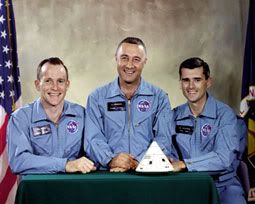
The crew of mission STS-51L.

20 YEARS AGO TODAY... Last week, NASA enjoyed two successes with its unmanned space program when the Stardust capsule returned to Earth bearing dust samples from a comet, and a few days later, the New Horizons spacecraft was launched towards the outer edge of our solar system. Today and yesterday, however, marked the anniversaries of two of the lowest points in our nation's manned space program. Rest in peace to the Challenger crew...as well as the Columbia and Apollo 1 astronauts. This Wednesday marks the 3-year anniversary since the second space shuttle disaster took place. When the shuttle Discovery launches again, hopefully this May, let's hope that that mission officially resumes manned spaceflight for the U.S. We gotta head back to the Moon and then Mars sooner or later...

The crew of mission STS-107.

The crew of Apollo 1.

Sunday, January 15, 2006

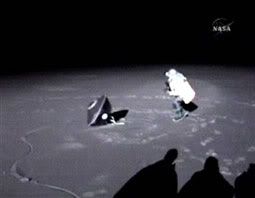
A scientist approaches the Stardust return capsule after it parachuted to the ground around 2:10 AM (Pacific Standard Time) this morning.  The touchdown occurred at the Dugway Proving Ground in Utah.
ABOVE: A scientist approaches the Stardust return capsule after it parachuted to the ground around 2:10 AM (Pacific Standard Time) this morning. The touchdown occurred at the Dugway Proving Ground in Utah.

STARDUST Returns... Congratulations to NASA's Jet Propulsion Laboratory in Pasadena for successfully bringing a space capsule carrying the remains of a malevolent alien species back to Earth. Haha, just kidding! No seriously though— Kudos to the JPL folks for bringing back the first ever material taken from a comet. Launched in 1999, the Stardust spacecraft collected samples from Comet Wild 2 (pronounced "vilt-two"... Those wacky Swiss) in 2004 and spent the rest of that time heading back to Earth. While the Stardust 'mothership' is in a safe permanent orbit around the Sun, the return capsule will be brought back to the Johnson Space Center in Texas this Tuesday so scientists can pry it open and check out the dead alien— err, dust samples collected from the comet. Nice.

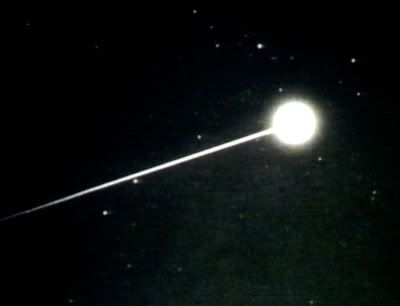
A NASA aircraft took this image of the Stardust capsule re-entering Earth's atmosphere above Utah...at a 'sluggish' speed of 29,000 MPH.
ABOVE: A NASA aircraft took this image of the Stardust capsule
re-entering Earth's atmosphere above Utah...at a 'sluggish' speed of
29,000 MPH. Courtesy of NASA'S Jet Propulsion Laboratory


EDIT: Don't forget that the Season 5 premiere of FOX's 24 airs tonight at 8 PM.

EDIT #2: Whoa, those two episodes were intense! C'mon Jack Bauer, avenge President Palmer's death!! And you gotta regulate on those terrorists at Ontario Airport!! Can't wait for the season premiere's conclusion tomorrow... Of course, my Monday nights will officially be off-limits till May now that everyone's favorite Counter-Terrorist Unit agent is back.


24.