Friday, October 20, 2023

Extending the Lives of Humanity's Two Interstellar Robotic Explorers...

An artist's concept of a Voyager spacecraft venturing through the cosmos.
NASA / JPL - Caltech

NASA’s Voyager Team Focuses on Software Patch, Thrusters (News Release)

The efforts should help extend the lifetimes of the agency’s interstellar explorers.

Engineers for NASA’s Voyager mission are taking steps to help make sure that both spacecraft, launched in 1977, continue to explore interstellar space for years to come.

One effort addresses fuel residue that seems to be accumulating inside narrow tubes in some of the thrusters on the spacecraft. The thrusters are used to keep each spacecraft’s antenna pointed at Earth.

This type of buildup has been observed in a handful of other spacecraft.

The team is also uploading a software patch to prevent the recurrence of a glitch that arose on Voyager 1 last year. Engineers resolved the glitch, and the patch is intended to prevent the issue from occurring again in Voyager 1 or arising in its twin, Voyager 2.

Thruster Buildup

The thrusters on Voyager 1 and Voyager 2 are primarily used to keep the spacecraft antennas pointed at Earth in order to communicate. Spacecraft can rotate in three directions – up and down, to the left and right, and around the central axis, like a wheel.

As they do this, the thrusters automatically fire and reorient the spacecraft to keep their antennas pointed at Earth.

Propellant flows to the thrusters via fuel lines and then passes through smaller lines inside the thrusters called propellant inlet tubes that are 25 times narrower than the external fuel lines. Each thruster firing adds tiny amounts of propellant residue, leading to gradual buildup of material over decades.

In some of the propellant inlet tubes, the buildup is becoming significant. To slow that buildup, the mission has begun letting the two spacecraft rotate slightly farther in each direction before firing the thrusters.

This will reduce the frequency of thruster firings.

The adjustments to the thruster rotation range were made by commands sent in September and October, and they allow the spacecraft to move almost 1 degree farther in each direction than in the past. The mission is also performing fewer, longer firings, which will further reduce the total number of firings done on each spacecraft.

The adjustments have been carefully devised to ensure minimal impact on the mission. While more rotating by the spacecraft could mean bits of science data are occasionally lost – akin to being on a phone call where the person on the other end cuts out occasionally – the team concluded that the plan will enable the Voyagers to return more data over time.

Engineers can’t know for sure when the thruster propellant inlet tubes will become completely clogged, but they expect that with these precautions, this won’t happen for at least five more years, possibly much longer. The team can take additional steps in the coming years to extend the lifetime of the thrusters even more.

“This far into the mission, the engineering team is being faced with a lot of challenges for which we just don’t have a playbook,” said Linda Spilker, project scientist for the mission at NASA’s Jet Propulsion Laboratory in Southern California. “But they continue to come up with creative solutions.”

Patching Things Up

In 2022, the onboard computer that orients the Voyager 1 spacecraft with Earth began to send back garbled status reports, despite otherwise continuing to operate normally. It took mission engineers months to pinpoint the issue.

The attitude articulation and control system (AACS) was misdirecting commands, writing them into the computer memory instead of carrying them out. One of those missed commands wound up garbling the AACS status report before it could reach engineers on the ground.

The team determined that the AACS had entered into an incorrect mode; however, they couldn’t determine the cause and thus aren’t sure if the issue could arise again. The software patch should prevent that.

“This patch is like an insurance policy that will protect us in the future and help us keep these probes going as long as possible,” said JPL’s Suzanne Dodd, Voyager project manager. “These are the only spacecraft to ever operate in interstellar space, so the data they’re sending back is uniquely valuable to our understanding of our local universe.”

Voyager 1 and Voyager 2 have traveled more than 15 billion and 12 billion miles from Earth, respectively. At those distances, the patch instructions will take over 18 hours to travel to the spacecraft.

Because of the spacecraft’s age and communication lag time, there’s some risk that the patch could overwrite essential code or have other unintended effects on the spacecraft. To reduce those risks, the team has spent months writing, reviewing and checking the code.

As an added safety precaution, Voyager 2 will receive the patch first and serve as a testbed for its twin. Voyager 1 is farther from Earth than any other spacecraft, making its data more valuable.

The team will upload the patch and do a readout of the AACS memory to make sure that it’s in the right place on Friday, October 20. If no immediate issues arise, the team will issue a command on Saturday, October 28, to see if the patch is operating as it should.

Source: Jet Propulsion Laboratory

Wednesday, October 18, 2023

More Snapshots of the Europa Clipper During My Second Visit to NASA JPL in 3 Months!

A selfie I took with Europa Clipper inside the Spacecraft Assembly Facility at NASA's Jet Propulsion Laboratory near Pasadena, California...on October 18, 2023.

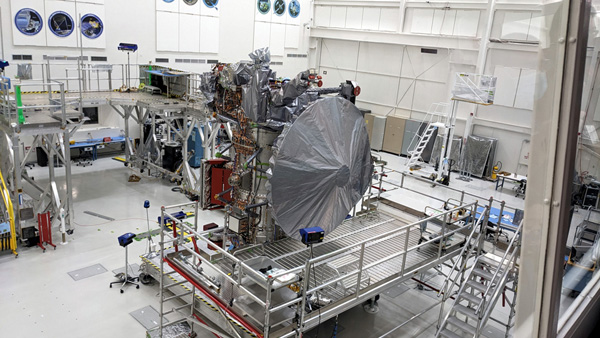
Earlier today, I drove down to NASA's Jet Propulsion Laboratory (JPL) near Pasadena, California, to pay another visit to its Jupiter-bound Europa Clipper spacecraft!

This was my second JPL tour in three months—with the main difference being that Europa Clipper now has its 10-foot-diameter (3-meter-diameter) high-gain antenna installed. Also, there weren't any technicians inside the clean room today...as mission team members were in a separate room testing the spacecraft's electrical systems from their computer workstations.

Eventually, Europa Clipper will leave the clean room to undergo environmental testing such as acoustic testing and a thermal vacuum test inside a special chamber at another location on the JPL campus.

Europa Clipper still has ways to go before it is shipped to NASA's Kennedy Space Center in Florida (courtesy of a U.S. Air Force C-17 aircraft) for an October 2024 launch. Europa Clipper should be sent to Cape Canaveral by next July at the latest.

Stay tuned!

A snapshot I took of Europa Clipper inside the Spacecraft Assembly Facility at NASA's Jet Propulsion Laboratory near Pasadena, California...on October 18, 2023.
Another snapshot I took of Europa Clipper inside the Spacecraft Assembly Facility at NASA's Jet Propulsion Laboratory near Pasadena, California...on October 18, 2023.

Another snapshot I took of Europa Clipper inside the Spacecraft Assembly Facility at NASA's Jet Propulsion Laboratory near Pasadena, California...on October 18, 2023.

Another selfie I took with Europa Clipper inside the Spacecraft Assembly Facility at NASA's Jet Propulsion Laboratory near Pasadena, California...on October 18, 2023.

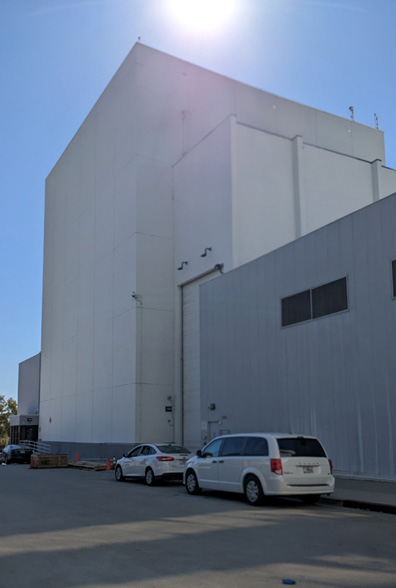
An exterior snapshot I took of the Spacecraft Assembly Facility at NASA's Jet Propulsion Laboratory near Pasadena, California...on October 18, 2023.

Saturday, October 14, 2023

Photos of the Day: The Annular Solar Eclipse...

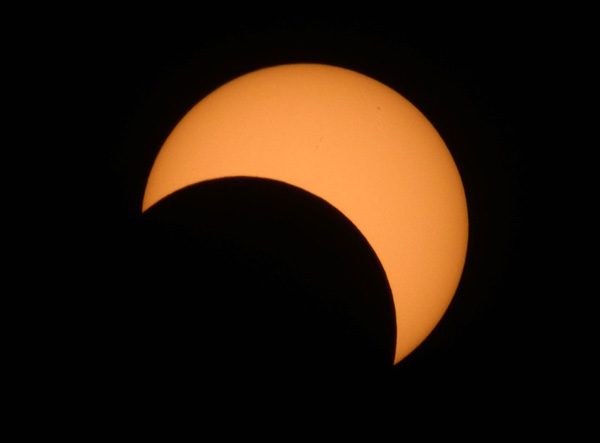
A photo I took of the annular solar eclipse on October 14, 2023.
Richard T. Par

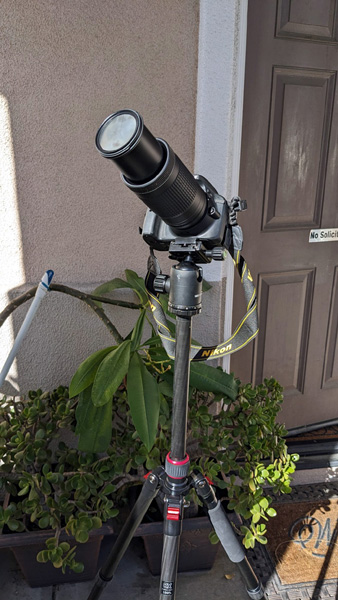
This morning, I stepped outside of my house to take photos of today's much-anticipated annular solar eclipse...using my Nikon D3300 DSLR camera with a solar filter sheet attached to its lens.

The solar filter sheet, which was suggested by one of my brothers (who used it when he traveled out of state to view the Great American Eclipse of 2017), was purchased through this page on Amazon—and custom-fitted so that it could fit inside a UV lens that was placed at the front of my 300mm telephoto lens.

Needless to say, I'm extremely excited about how the pictures turned out! Not only did I get crisp images of the Moon passing in front of the Sun's surface, but I also captured a couple of sunspots on the solar disk!

Today's photos makes me want to travel out of state to be under the path of totality six months from now...when the next Great North American Eclipse occurs on April 8, 2024! I'll think about this some more.

Another photo I took of the annular solar eclipse on October 14, 2023.
Richard T. Par

Another photo I took of the annular solar eclipse on October 14, 2023.
Richard T. Par

More sunspots become visible on the Sun's surface as the annular solar eclipse is about to conclude...on October 14, 2023.
Richard T. Par

More sunspots become visible on the Sun's surface as the annular solar eclipse is about to conclude...on October 14, 2023.
Richard T. Par

My Nikon D3300 DSLR camera is pointed at the Sun for the annular solar eclipse...on October 14, 2023.
Richard T. Par

The annular solar eclipse is visible on the LCD screen of my Nikon D3300 DSLR camera...on October 14, 2023.
Richard T. Par

With a solar filter sheet attached to the front of its telephoto lens, my Nikon D3300 DSLR camera is pointed at the Sun for the annular solar eclipse...on October 14, 2023.
Richard T. Par

Friday, October 13, 2023

America's Newest Asteroid Explorer Has Finally Launched!

A SpaceX Falcon Heavy rocket carrying NASA's Psyche spacecraft lifts off from Launch Complex 39A at the Kennedy Space Center in Florida...on October 13, 2023.
SpaceX

NASA’s Psyche Spacecraft, Optical Comms Demo En Route to Asteroid (Press Release)

NASA’s Psyche spacecraft is on its voyage to an asteroid of the same name, a metal-rich world that could tell us more about the formation of rocky planets. Psyche successfully launched 10:19 a.m. EDT on Friday, aboard a SpaceX Falcon Heavy rocket from Launch Complex 39A at NASA’s Kennedy Space Center in Florida.

Integrated onto the spacecraft is the agency’s Deep Space Optical Communications technology demonstration, a test of deep space laser communications that could support future exploration missions by providing more bandwidth to transmit data than traditional radio frequency communications.

“Congratulations to the Psyche team on a successful launch, the first journey to a metal-rich asteroid,” said NASA Administrator Bill Nelson. “The Psyche mission could provide humanity with new information about planet formation while testing technology that can be used on future NASA missions. As Asteroid Autumn continues, so does NASA’s commitment to exploring the unknown and inspiring the world through discovery.”

Less than five minutes after liftoff, once the rocket’s second stage climbed to a high-enough altitude, the fairings separated from the rocket and returned to Earth. About an hour after launch, the spacecraft separated from the rocket, and ground controllers waited to acquire a signal from the spacecraft.

Shortly after, the Psyche spacecraft commanded itself into a planned safe mode, in which it completes only minimal engineering activities while awaiting further commands from mission controllers on Earth. Psyche established two-way communication at 11:50 a.m. EDT with NASA’s Deep Space Network complex in Canberra, Australia.

Initial telemetry reports show that the spacecraft is in good health.

“I am excited to see the treasure trove of science Psyche will unlock as NASA’s first mission to a metal world,” said Nicola Fox, associate administrator for the Science Mission Directorate at NASA Headquarters in Washington. “By studying asteroid Psyche, we hope to better understand our universe and our place in it, especially regarding the mysterious and impossible-to-reach metal core of our own home planet, Earth.”

By August 2029, the spacecraft will begin to orbit the 173-mile-wide (279-kilometer-wide) asteroid – the only metal-class asteroid ever to be explored. Because of Psyche’s high iron-nickel metal content, scientists think that it may be the partial core of a planetesimal, a building block of an early planet.

The goal is a 26-month science investigation.

“We said ‘goodbye’ to our spacecraft, the center of so many work lives for so many years – thousands of people and a decade,” said Lindy Elkins-Tanton, Psyche principal investigator at Arizona State University in Tempe. “But it’s really not a finish line; it’s a starting line for the next marathon. Our spacecraft is off to meet our asteroid, and we’ll fill another gap in our knowledge – and color in another kind of world in our solar system.”

For its six-year, 2.2-billion-mile (3.6-billion-kilometer) trip to the main asteroid belt between Mars and Jupiter, Psyche relies on solar electric propulsion. The efficient propulsion system works by expelling charged atoms, or ions, of the neutral gas xenon to create a thrust that gently propels the spacecraft.

Along the way, the spacecraft will use Mars’ gravity as a slingshot to speed it along on its journey.

“I’m so proud of the Psyche team, who overcame many challenges on their way to this exciting day,” said Laurie Leshin, the director of NASA’s Jet Propulsion Laboratory (JPL) in Southern California. “Now the real fun begins as we race toward asteroid Psyche to unlock the secrets of how planets form and evolve.”

The first 100 days of the mission are a commissioning phase, called the initial checkout period, to make sure that all flight systems are healthy. Key to the checkout is ensuring that the electric thrusters are ready to begin continuously firing over long stretches of the trajectory.

Active checkout of the science instruments – the magnetometer, the gamma-ray and neutron spectrometer, and the multispectral imager – starts about six weeks from now. During this period, the imager will take its first images for calibration purposes, targeting standard stars and a star cluster at a variety of exposures, with several different filters.

Then the Psyche team will activate an automatic feed of publicly viewable raw images online for the duration of the mission.

The first opportunity to power on the optical communications technology demonstration is expected in about three weeks, when Psyche would be roughly 4.7 million miles (7.5 million kilometers) from Earth. This will be the agency’s first test beyond the Moon of high-data-rate optical, or laser, communications.

While the transceiver is hosted by Psyche, the tech demo will not relay Psyche mission data.

“Launching with Psyche is an ideal platform to demonstrate NASA’s optical communications goal to get high-bandwidth data into deep space,” said Dr. Prasun Desai, acting associate administrator, Space Technology Mission Directorate (STMD) at NASA Headquarters. “It’s exciting to know that, in a few short weeks, Deep Space Optical Communications will begin sending data back to Earth to test this critical capability for the future of space exploration. The insights we learn will help us advance these innovative new technologies and, ultimately, pursue bolder goals in space.”

****

The Deep Space Optical Communications tranceiver as seen aboard NASA's Psyche spacecraft...inside a clean room at the Jet Propulsion Laboratory in California over a year ago.

NASA / JPL - Caltech


Thursday, October 12, 2023

America's Next X-Plane Will Begin Soaring into the Air Next Year...

NASA's X-59 QueSST aircraft sits on the tarmac at Lockheed Martin's Skunk Works facility in Palmdale, California...on June 19, 2023.
Lockheed Martin

NASA Targets 2024 for First Flight of X-59 Experimental Aircraft (News Release)

NASA’s QueSST mission has adjusted the scheduled first flight of its X-59 quiet supersonic aircraft to 2024.

A one-of-a-kind experimental aircraft, the X-59 has required complex engineering from NASA researchers working with prime contractor Lockheed Martin Skunk Works. In addition to the aircraft’s design, the X-59 also combines new technology with systems and components from multiple, established aircraft, such as its landing gear from an F-16 and its life-support system adapted from an F-15.

As part of the demands of developing this unique aircraft, the QueSST team is working through several technical challenges identified over the course of 2023, when the X-59 had been scheduled to make its first flight. Extra time is needed to fully integrate systems into the aircraft and ensure that they work together as expected.

The team is also resolving intermittent issues with some of the safety-redundant computers that control the aircraft’s systems.

QueSST made steady progress towards flight over the past year. The team installed the finishing touches to the X-59’s tail structure, which allowed them to finalize its electrical wiring and proceed to critical ground tests, and moved it from its assembly facility to the flight line to perform structural testing.

The X-59 will demonstrate the ability to fly supersonic, or faster than the speed of sound, while reducing the normally loud sonic boom to a quiet sonic thump. NASA plans to fly the X-59 over several communities to gather data on how people perceive the sound it produces.

The agency will provide that information to U.S. and international regulators to potentially adjust rules that currently prohibit commercial supersonic flight over land.

NASA’s top priorities for any mission are safety and ensuring success. For QueSST, that means not only being sure that the X-59 is safe before it flies, but safe in the long term and reliable during the community test phase.

The aircraft is currently undergoing integrated testing, which must be completed before it flies. Once that stage is complete, the aircraft will continue its journey with a flight readiness review, at which point NASA plans to release a more specific timeline for first flight.

QueSST is a mission with the potential to revolutionize commercial aviation travel by dramatically reducing travel time. Safely and reliably flying the X-59 is critical for NASA to achieve those benefits.

The agency is committed to a thorough review and testing process that results in the success of that mission.

Source: NASA.Gov

****

An artist's concept of NASA's X-59 QueSST aircraft flying over a rural community in the United States.
NASA

Wednesday, October 11, 2023

Amazing Discoveries Made by OSIRIS-REx Have Been Announced Today...

An image of the exterior of OSIRIS-REx's sample collector...showing the regolith from asteroid Bennu that collected atop of it back in late 2020.
NASA / Erika Blumenfeld & Joseph Aebersold

NASA’s Bennu Asteroid Sample Contains Carbon, Water (News Release)

Initial studies of the 4.5-billion-year-old asteroid Bennu sample collected in space and brought to Earth by NASA show evidence of high-carbon content and water, which together could indicate the building blocks of life on Earth may be found in the rock. NASA made the news Wednesday from its Johnson Space Center in Houston where leadership and scientists showed off the asteroid material for the first time since it landed in September.

This finding was part of a preliminary assessment of NASA’s OSIRIS-REx (Origins, Spectral Interpretation, Resource Identification and Security – Regolith Explorer) science team.

“The OSIRIS-REx sample is the biggest carbon-rich asteroid sample ever delivered to Earth and will help scientists investigate the origins of life on our own planet for generations to come,” said NASA Administrator Bill Nelson. “Almost everything we do at NASA seeks to answer questions about who we are and where we come from. NASA missions like OSIRIS-REx will improve our understanding of asteroids that could threaten Earth while giving us a glimpse into what lies beyond. The sample has made it back to Earth, but there is still so much science to come – science like we’ve never seen before.”

Although more work is needed to understand the nature of the carbon compounds found, the initial discovery bodes well for future analyses of the asteroid sample. The secrets held within the rocks and dust from the asteroid will be studied for decades to come, offering insights into how our solar system was formed, how the precursor materials to life may have been seeded on Earth, and what precautions need to be taken to avoid asteroid collisions with our home planet.

Bonus Sample Material

The goal of the OSIRIS-REx sample collection was 60 grams of asteroid material. Curation experts at NASA Johnson, working in new clean rooms built especially for the mission, have spent 10 days so far carefully disassembling the sample return hardware to obtain a glimpse at the bulk sample within.

When the science canister lid was first opened, scientists discovered bonus asteroid material covering the outside of the collector head, canister lid and base. There was so much extra material that it slowed down the careful process of collecting and containing the primary sample.

“Our labs were ready for whatever Bennu had in store for us,” said Vanessa Wyche, director, NASA Johnson. “We’ve had scientists and engineers working side-by-side for years to develop specialized gloveboxes and tools to keep the asteroid material pristine and to curate the samples so researchers now and decades from now can study this precious gift from the cosmos.”

Within the first two weeks, scientists performed “quick-look” analyses of that initial material, collecting images from a scanning electron microscope, infrared measurements, X-ray diffraction and chemical element analysis. X-ray computed tomography was also used to produce a 3D computer model of one of the particles, highlighting its diverse interior.

This early glimpse provided the evidence of abundant carbon and water in the sample.

“As we peer into the ancient secrets preserved within the dust and rocks of asteroid Bennu, we are unlocking a time capsule that offers us profound insights into the origins of our solar system,” said Dante Lauretta, OSIRIS-REx principal investigator, University of Arizona, Tucson. “The bounty of carbon-rich material and the abundant presence of water-bearing clay minerals are just the tip of the cosmic iceberg. These discoveries, made possible through years of dedicated collaboration and cutting-edge science, propel us on a journey to understand not only our celestial neighborhood but also the potential for life’s beginnings. With each revelation from Bennu, we draw closer to unraveling the mysteries of our cosmic heritage.”

For the next two years, the mission’s science team will continue characterizing the samples and conduct the analysis needed to meet the mission’s science goals. NASA will preserve at least 70% of the sample at Johnson for further research by scientists worldwide, including future generations of scientists.

As part of OSIRIS-REx’s science program, a cohort of more than 200 scientists around the world will explore the regolith’s properties, including researchers from many U.S. institutions, NASA partners JAXA (Japan Aerospace Exploration Agency), CSA (Canadian Space Agency) and other scientists from around the world. Additional samples will also be loaned later this fall to the Smithsonian Institution, Space Center Houston and the University of Arizona for public display.

NASA’s Goddard Space Flight Center in Greenbelt, Maryland, provides overall mission management, systems engineering, and the safety and mission assurance for OSIRIS-REx. Lauretta, the principal investigator, leads the science team and the mission’s science observation planning and data processing.

Lockheed Martin Space in Littleton, Colorado, built the spacecraft, provided flight operations and was responsible for capsule recovery. Goddard and KinetX Aerospace were responsible for navigating the OSIRIS-REx spacecraft.

Curation for OSIRIS-REx, including processing the sample when it arrived on Earth, is taking place at NASA Johnson.

OSIRIS-REx is the third mission in NASA’s New Frontiers Program, managed by NASA’s Marshall Space Flight Center in Huntsville, Alabama, for the Science Mission Directorate at NASA Headquarters in Washington.

Source: NASA.Gov

Tuesday, October 10, 2023

The Pentagon Is Preparing for Any Fallout in the Middle East Caused by the Israel-Hamas War...

A file photo showing the aircraft carrier USS Gerald R. Ford being followed by fellow U.S. and Italian naval ships in the Ionian Sea...on August 20, 2023.
U.S. Navy / Mass Communication Specialist 3rd Class Maxwell Orlosky

USS Gerald R. Ford Carrier Strike Group Arrives in the Eastern Mediterranean Sea (News Release)

TAMPA, Fla. - The USS Gerald R. Ford Carrier Strike Group arrives in the Eastern Mediterranean Sea in order to deter any actor seeking to escalate the situation or widen this war. The forces in the area include the U.S. Navy aircraft carrier USS Gerald R. Ford (CVN 78), with its 8 squadrons of attack and support aircraft, and the Ticonderoga-class guided missile cruiser USS Normandy (CG 60), as well as the Arleigh Burke-class guided missile destroyers USS Thomas Hudner (DDG 116), USS Ramage (DDG 61), USS Carney (DDG 64) and USS Roosevelt (DDG 80).

Efforts to increase U.S. posture continue, including the rapid movement into theater of U.S. Air Force F-15s, F-16s and A-10s to augment existing fighter squadrons in the region.

"The arrival of these highly-capable forces to the region is a strong signal of deterrence should any actor hostile to Israel consider trying to take advantage of this situation," said General Michael "Erik" Kurilla, commander, U.S. Central Command.

Source: U.S. Central Command

Friday, October 06, 2023

Only 6 Days (Weather Permitting) Till America's Next Asteroid Explorer Takes Flight...

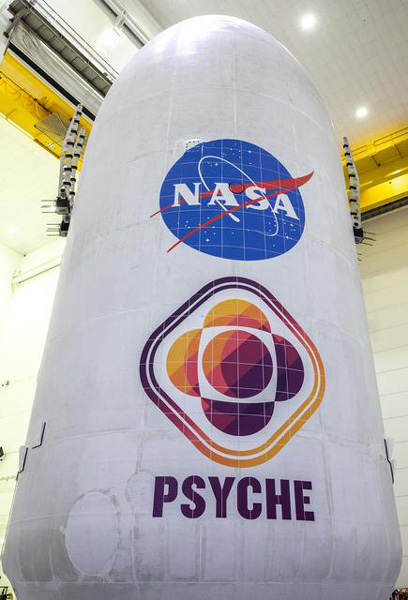
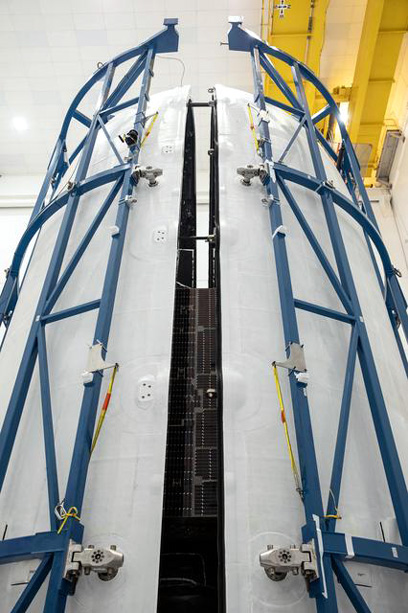
At Astrotech Space Operations Facility in Titusville, Florida, NASA's Psyche spacecraft is encapsulated by the payload fairings of its SpaceX Falcon Heavy rocket...on October 6, 2023.
NASA / Ben Smegelsky

Psyche Transport from Astrotech to LC-39A (Photo Release)

Teams transport NASA's encapsulated Psyche spacecraft from the Astrotech Space Operations Facility in Titusville to Launch Complex 39A at Kennedy Space Center in Florida on Friday, October 6, 2023. Psyche will launch atop a SpaceX Falcon Heavy rocket.

Liftoff is targeted for 10:16 a.m. EDT on Thursday, October 12. Riding with Psyche is a pioneering technology demonstration, NASA's Deep Space Optical Communications (DSOC) experiment.

Source: NASA.Gov

****

At Astrotech Space Operations Facility in Titusville, Florida, NASA's Psyche spacecraft is ready to be encapsulated by the payload fairings of its SpaceX Falcon Heavy rocket...on October 3, 2023.
NASA / Ben Smegelsky

At Astrotech Space Operations Facility in Titusville, Florida, NASA's Psyche spacecraft is encapsulated by the payload fairings of its SpaceX Falcon Heavy rocket...on October 3, 2023.
NASA / Ben Smegelsky

At Astrotech Space Operations Facility in Titusville, Florida, NASA's Psyche spacecraft is encapsulated by the payload fairings of its SpaceX Falcon Heavy rocket...on October 3, 2023.
NASA / Ben Smegelsky

Wednesday, October 04, 2023

Another Privately-made Lunar Lander Continues to Take Shape for Flight Next Year...

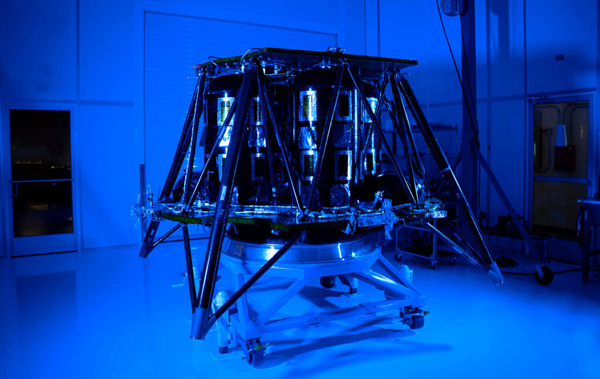
An image of Firefly Aerospace's Blue Ghost lunar lander after its primary structure was completed at Firefly's manufacturing facility in Texas.
Firefly Aerospace

Firefly Aerospace Completes Blue Ghost Lunar Lander Structure Ahead of Moon Landing for NASA (Press Release)

Cedar Park, Texas – Firefly Aerospace, an end-to-end space transportation company, today announced that it completed the development and assembly of its Blue Ghost lander structure and fluid systems, a critical milestone for Firefly’s first lunar mission slated to land on the Moon in 2024 as part of NASA’s Commercial Lunar Payload Services (CLPS) initiative.

This mission is one of three task orders that Firefly has won under NASA CLPS, accounting for more than $230 million in awards.

“The Firefly team is extremely passionate and dedicated to overcoming any challenge knowing the important role these missions will have in paving the way for the future of space exploration and our nation’s growing lunar economy,” said Bill Weber, CEO of Firefly Aerospace. “It’s an exciting accomplishment to see our Blue Ghost lander assembled in Firefly’s Texas spacecraft facility as we get ready to land on the Moon next year.”

Firefly’s ability to rapidly design, build and test its Blue Ghost lunar lander can be credited to its in-house manufacturing and test facilities. The lander’s core components, including the panels, struts, legs, harnesses, avionics, batteries and thrusters, were designed and built in-house using many of the same flight-proven technologies common to all of Firefly’s launch and orbital vehicles.

The team conducted extensive qualification testing on the assembled Blue Ghost structure and each component to ensure that the lander will withstand all launch, transit and landing load cases.

“Firefly is able to have more control over our mission schedules and less dependency on the supply chain thanks to our in-house manufacturing capabilities and facilities that accommodate the development of multiple landers,” said Jana Spruce, Vice President of Spacecraft at Firefly Aerospace. “Our vertically-integrated approach with shared components across our vehicles further enables scaled efficiencies, lower costs and quality assurance that we pass on to our customers.”

Blue Ghost Mission 1 will carry commercial and government payloads, including 10 NASA-sponsored instruments, to Mare Crisium on the Moon’s near side. The payloads support NASA’s goal to build a sustainable lunar presence by conducting several first-of-its-kind demonstrations, including testing regolith sample collection, Global Navigation Satellite System abilities, radiation-tolerant computing and lunar dust mitigation.

Nearly all of the payloads have been processed at Firefly’s facility and successfully passed fit checks and functional checkouts on the lander.

The next major milestones for Blue Ghost Mission 1 include payload integration followed by environmental testing before the mission launches in 2024. Concurrently, Firefly is ramping up for its second lunar mission, Blue Ghost Mission 2, that will first deploy a satellite to lunar orbit and then deliver multiple payloads to the far side of the Moon in 2026.

Mission 2 has remaining capacity to offer payload delivery and orbital services for commercial customers.

Source: Firefly Aerospace

****

Tuesday, October 03, 2023

Images of the Day: Screenshots from AHSOKA...

On the planet Peridea, Grand Admiral Thrawn (Lars Mikkelsen) confronts Sabine Wren (Natasha Liu Bordizzo) for the first time...in Episode 6 of AHSOKA.

With the 8-episode run of the Star Wars Disney+ series Ahsoka now complete as of today, just thought I'd post these random screenshots from some of the chapters in this exciting show!

It's so awesome that Grand Admiral Thrawn, who I first heard about from Timothy Zahn's Heir to the Empire book trilogy (which I read in 9th grade back in 1995), has finally been realized in live-action by Lars Mikkelsen (the brother of Rogue One's Mads Mikkelsen)! Well done.

I never watched the animated series Star Wars Rebels so I'm fairly indifferent to Ezra Bridger (Eman Esfandi) returning to his home galaxy, heh. But I can't wait to see what's in store for him, Thrawn, Hera Syndulla (Mary Elizabeth Winstead), Sabine Wren (Natasha Liu Bordizzo), Shin Hati (Ivanna Sahkno), Anakin Skywalker (Hayden Christensen...showing how awesome he plays the role when he isn't given clunky dialogue like in the prequels) and of course, Ahsoka Tano (Rosario Dawson) herself in the next Jon Favreau/Dave Filoni Star Wars project!

Rest In Peace to Ray Stevenson, who was awesome as Baylan Skoll. Carry on.

The New Republic fleet orbits the capital world of Coruscant in AHSOKA.

In the World Between Worlds, Ahsoka Tano (Rosario Dawson) confronts Anakin Skywalker (Hayden Christensen) in Episode 4 of AHSOKA.

Anakin Skywalker confronts a young Ahsoka Tano (Ariana Greenblatt) in Episode 5 of AHSOKA.

During a Senate hearing on Coruscant, Hera Syndulla (Mary Elizabeth Winstead) is aided by C-3PO (Anthony Daniels) in Episode 7 of AHSOKA.

Now stranded on Peridea after Grand Admiral Thrawn makes his escape back to their home galaxy, Ahsoka Tano and Sabine Wren are watched over by the Force ghost of Anakin Skywalker in the season finale of AHSOKA.