Thursday, September 14, 2023

JWST Takes a Stunning Image of a Herbig-Haro Object...

An image of the celestial object HH 211...as seen by NASA's James Webb Space Telescope.
ESA / Webb, NASA, CSA, T. Ray (Dublin Institute for Advanced Studies)

NASA’s Webb Snaps Supersonic Outflow of Young Star (News Release)

Herbig-Haro (HH) objects are luminous regions surrounding newborn stars, formed when stellar winds or jets of gas spewing from these newborn stars form shock waves colliding with nearby gas and dust at high speeds. This image of HH 211 from NASA’s James Webb Space Telescope reveals an outflow from a Class 0 protostar, an infantile analog of our Sun when it was no more than a few tens of thousands of years old and with a mass only 8% of the present-day Sun (it will eventually grow into a star like the Sun).

Infrared imaging is powerful in studying newborn stars and their outflows, because such stars are invariably still embedded within the gas from the molecular cloud in which they formed. The infrared emission of the star’s outflows penetrates the obscuring gas and dust, making a Herbig-Haro object like HH 211 ideal for observation with Webb’s sensitive infrared instruments.

Molecules excited by the turbulent conditions, including molecular hydrogen, carbon monoxide and silicon monoxide, emit infrared light that Webb can collect to map out the structure of the outflows.

The image showcases a series of bow shocks to the southeast (lower-left) and northwest (upper-right) as well as the narrow bipolar jet that powers them. Webb reveals this scene in unprecedented detail — roughly 5 to 10 times higher spatial resolution than any previous images of HH 211.

The inner jet is seen to “wiggle” with mirror symmetry on either side of the central protostar. This is in agreement with observations on smaller scales and suggests that the protostar may in fact be an unresolved binary star.

Earlier observations of HH 211 with ground-based telescopes revealed giant bow shocks moving away from us (northwest) and moving towards us (southeast) and cavity-like structures in shocked hydrogen and carbon monoxide respectively, as well as a knotty and wiggling bipolar jet in silicon monoxide. Researchers have used Webb’s new observations to determine that the object’s outflow is relatively slow in comparison to more evolved protostars with similar types of outflows.

The team measured the velocities of the innermost outflow structures to be roughly 48-60 miles per second (80 to 100 kilometers per second). However, the difference in velocity between these sections of the outflow and the leading material they’re colliding with — the shockwave — is much smaller.

The researchers concluded that outflows from the youngest stars, like that in the center of HH 211, are mostly made up of molecules, because the comparatively low shock wave velocities are not energetic enough to break the molecules apart into simpler atoms and ions.

Source: NASA.Gov

Tuesday, September 12, 2023

America's Newest Stealth Bomber Is a Step Closer to Becoming Airborne for the Very First Time...

As part of its ground testing before first flight, the B-21 Raider has begun engine runs at Northrop Grumman's facilities in Palmdale, CA.
Northrop Grumman

Northrop Grumman’s B-21 Raider Continues Progression to Flight Test (Press Release)

PALMDALE, Calif. – The U.S. Air Force announced today that the B-21 Raider has commenced engine runs as part of its ground test program at Northrop Grumman’s Palmdale, California, facility. Engine testing is an essential milestone for the program as the world’s first sixth-generation aircraft continues on the path to flight test.

The B-21’s first flight will remain a data-driven event that is monitored by Northrop Grumman and the United States Air Force.

Developed with the next generation of stealth technology, advanced networking capabilities and open systems architecture, the B-21 Raider will serve as the backbone of America’s bomber fleet.

Source: Northrop Grumman

****

The B-21 Raider is parked on the tarmac at Northrop Grumman's facilities in Palmdale, CA.
U.S. Air Force

Monday, September 11, 2023

Hubble's Successor Finds More Evidence of a Potentially Habitable Exoplanet...

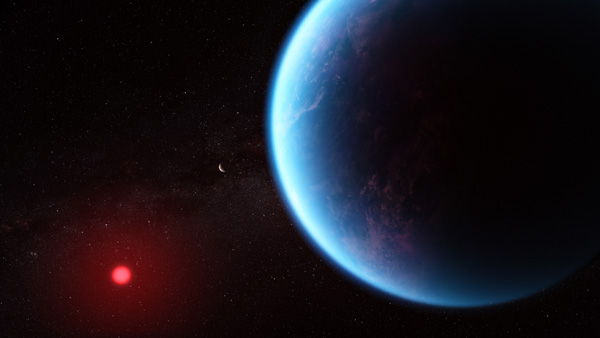
An artist's concept of the exoplanet K2-18 b.
NASA, CSA, ESA, J. Olmsted (STScI), Science: N. Madhusudhan (Cambridge University)

Webb Discovers Methane, Carbon Dioxide in Atmosphere of K2-18 b (News Release)

A new investigation with NASA’s James Webb Space Telescope into K2-18 b, an exoplanet 8.6 times as massive as Earth, has revealed the presence of carbon-bearing molecules including methane and carbon dioxide. Webb’s discovery adds to recent studies suggesting that K2-18 b could be a Hycean exoplanet, one which has the potential to possess a hydrogen-rich atmosphere and a water ocean-covered surface.

The first insight into the atmospheric properties of this habitable-zone exoplanet came from observations with NASA’s Hubble Space Telescope, which prompted further studies that have since changed our understanding of the system.

K2-18 b orbits the cool dwarf star K2-18 in the habitable zone and lies 120 light-years from Earth in the constellation Leo. Exoplanets such as K2-18 b, which have sizes between those of Earth and Neptune, are unlike anything in our solar system.

This lack of equivalent nearby planets means that these ‘sub-Neptunes’ are poorly understood, and the nature of their atmospheres is a matter of active debate among astronomers.

The suggestion that the sub-Neptune K2-18 b could be a Hycean exoplanet is intriguing, as some astronomers believe that these worlds are promising environments to search for evidence of life on exoplanets.

"Our findings underscore the importance of considering diverse habitable environments in the search for life elsewhere," explained Nikku Madhusudhan, an astronomer at the University of Cambridge and lead author of the paper announcing these results. "Traditionally, the search for life on exoplanets has focused primarily on smaller rocky planets, but the larger Hycean worlds are significantly more conducive to atmospheric observations."

The abundance of methane and carbon dioxide, and shortage of ammonia, support the hypothesis that there may be a water ocean underneath a hydrogen-rich atmosphere in K2-18 b. These initial Webb observations also provided a possible detection of a molecule called dimethyl sulfide (DMS).

On Earth, DMS is only produced by life. The bulk of the DMS in Earth’s atmosphere is emitted from phytoplankton in marine environments.

The inference of DMS is less robust and requires further validation. “Upcoming Webb observations should be able to confirm if DMS is indeed present in the atmosphere of K2-18 b at significant levels,” explained Madhusudhan.

While K2-18 b lies in the habitable zone, and is now known to harbor carbon-bearing molecules, this does not necessarily mean that the planet can support life. The planet's large size — with a radius 2.6 times the radius of Earth — means that the planet’s interior likely contains a large mantle of high-pressure ice, like Neptune, but with a thinner hydrogen-rich atmosphere and an ocean surface.

Hycean worlds are predicted to have oceans of water. However, it is also possible that the ocean is too hot to be habitable or be liquid.

"Although this kind of planet does not exist in our solar system, sub-Neptunes are the most common type of planet known so far in the galaxy," explained team member Subhajit Sarkar of Cardiff University. “We have obtained the most detailed spectrum of a habitable-zone sub-Neptune to date, and this allowed us to work out the molecules that exist in its atmosphere.”

Characterizing the atmospheres of exoplanets like K2-18 b — meaning identifying their gases and physical conditions — is a very active area in astronomy. However, these planets are outshone — literally — by the glare of their much larger parent stars, which makes exploring exoplanet atmospheres particularly challenging.

The team sidestepped this challenge by analyzing light from K2-18 b's parent star as it passed through the exoplanet's atmosphere. K2-18 b is a transiting exoplanet, meaning that we can detect a drop in brightness as it passes across the face of its host star.

This is how the exoplanet was first discovered in 2015 with NASA’s K2 mission. This means that during transits a tiny fraction of starlight will pass through the exoplanet's atmosphere before reaching telescopes like Webb.

The starlight's passage through the exoplanet's atmosphere leaves traces that astronomers can piece together to determine the gases of the exoplanet's atmosphere.

"This result was only possible because of the extended wavelength range and unprecedented sensitivity of Webb, which enabled robust detection of spectral features with just two transits," said Madhusudhan. "For comparison, one transit observation with Webb provided comparable precision to eight observations with Hubble conducted over a few years and in a relatively narrow wavelength range."

"These results are the product of just two observations of K2-18 b, with many more on the way,” explained team member Savvas Constantinou of the University of Cambridge. “This means our work here is but an early demonstration of what Webb can observe in habitable-zone exoplanets.”

The team’s results were accepted for publication in The Astrophysical Journal Letters.

The team now intends to conduct follow-up research with the telescope's MIRI (Mid-Infrared Instrument) spectrograph that they hope will further validate their findings and provide new insights into the environmental conditions on K2-18 b.

"Our ultimate goal is the identification of life on a habitable exoplanet, which would transform our understanding of our place in the universe," concluded Madhusudhan. "Our findings are a promising step towards a deeper understanding of Hycean worlds in this quest."

Source: NASA.Gov

****
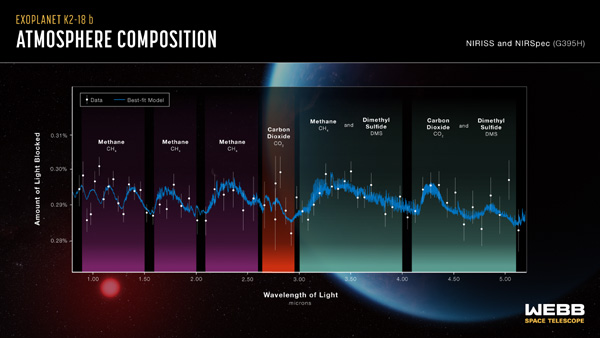
An infographic showing spectroscopic data that NASA's James Webb Space Telescope took of the exoplanet K2-18 b.
NASA, CSA, ESA, R. Crawford (STScI), J. Olmsted (STScI), Science: N. Madhusudhan (Cambridge University)

Sunday, September 10, 2023

On This Day in 1993: Agents Mulder and Scully Begin Searching for the Truth That's Out There...

THE X-FILES made its debut on television 30 years ago...on September 10, 1993.

It was 30 years ago today that The X-Files made its debut on television! I was just starting 8th grade when the sci-fi mystery drama by Chris Carter (a fellow alumnus at my college, Cal State Long Beach) began airing on FOX TV, and was about to complete my fourth year in college when the original 9-season run of The X-Files ended on May 19, 2002.

I watched the first X-Files movie that was shown in theaters back in 1998, but never saw the sequel, The X-Files: I Want to Believe, in 2008. (Based on the Rotten Tomatoes reviews for this film, I didn't miss out on anything!)

And of course, I watched FBI agents Fox Mulder (David Duchovny, who I saw on set when I worked as a background actor on an episode of his SHOWTIME series Californication in Culver City 10 years ago) and Dana Scully (Gillian Anderson) make their return to television for Seasons 10 and 11 of The X-Files between January 2016 and March 2018, respectively.

The X-Files inspired other sci-fi and paranormal TV shows like Fringe and Supernatural over the last two decades—with Supernatural itself employing the monster-of-the-week and mythology episode format during its 15-season run, just like what the Chris Carter series did.

The 1996 hit alien invasion flick Independence Day also paid its respects to The X-Files...though Chris Carter's homage to that summer blockbuster with the '98 X-Files movie (where in one scene, Mulder is seen outside a bar urinating on the poster for Independence Day that's hanging to the side of the building) isn't exactly something that ID4 filmmakers Roland Emmerich and Dean Devlin would find flattering!

The X-Files will always be one of my favorite television programs...along with shows like 24, Prison Break, Supernatural and The Big Bang Theory (which of course, isn't a serialized drama).

Would I watch Season 12 of The X-Files if FOX ever decided to give this trailblazing series one more year? You betcha!

And as a reminder: The truth is out there. Happy Sunday!

Thursday, September 07, 2023

America's Next Asteroid Explorer Is Set to Launch in Less Than 30 Days...

The Psyche spacecraft is prepped for launch inside the Astrotech Space Operations Facility near NASA's Kennedy Space Center in Florida.
NASA / JPL - Caltech

NASA’s Psyche Mission on Track for Liftoff Next Month (News Release - September 6)

Bound for a metal-rich asteroid of the same name, the Psyche mission is targeting October 5 to launch from NASA’s Kennedy Space Center in Florida.

The spacecraft’s solar arrays are folded like an envelope into their stowed position. Xenon gas – fuel for the journey to the asteroid belt – is loaded.

All four thrusters have passed their final tests. Engineers have confirmed the massive high-gain antenna is set to transmit data.

The software is tested and ready. The science instruments – a multispectral imager, magnetometer, and gamma-ray and neutron spectrometer – that will investigate the asteroid Psyche are poised for action.

NASA’s Psyche spacecraft has less than 30 days to go before the opening of its launch period, which runs from Thursday, October 5 through Wednesday, October 25. What the mission learns from the metal-rich asteroid may tell us more about how planets form.

“These missions take so many people and so much meticulous, rigorous, personally-driven work,” said Lindy Elkins-Tanton, principal investigator for Psyche at Arizona State University. “I am ready to be ecstatic. We all are, but we are not ecstatic yet. Let’s launch and establish communications – then we can scream, jump and hug each other!”

Within two weeks, technicians will begin encapsulating the spacecraft in its payload fairing – the cone at the top of the rocket – and the spacecraft will move to SpaceX facilities at NASA’s Kennedy Space Center in Florida. Psyche is set to launch atop a SpaceX Falcon Heavy from the center’s Launch Complex 39A at 10:38 a.m. EDT on October 5.

“It’s getting increasingly real,” said Henry Stone, Psyche’s project manager at NASA’s Jet Propulsion Laboratory in Southern California. “We are counting the days. The team is more than ready to send this spacecraft off on its journey, and it’s very exciting.”

After escaping Earth’s gravity, Psyche will use solar electric propulsion to accomplish its six-year journey to the asteroid. The efficient propulsion system works by accelerating and expelling charged atoms, or ions, of the neutral gas xenon – creating a thrust that gently propels the spacecraft with a force akin to what you’d feel holding a single AA battery in your hand.

Technicians recently loaded 2,392 pounds (1,085 kilograms) of xenon onto the spacecraft over the course of about two weeks.

Measuring roughly 173 miles (279 kilometers) at its widest point, the asteroid Psyche presents a unique opportunity to explore a metal-rich body that may be part of a core of a planetesimal, the building block of an early planet. Once the spacecraft reaches Psyche in the main asteroid belt between Mars and Jupiter, it will spend about 26 months orbiting the asteroid, gathering images and other data that will tell scientists more about its history and what it is made of.

Source: NASA.Gov

****

An artist's concept of NASA's Psyche spacecraft.
NASA / JPL - Caltech / ASU

Wednesday, September 06, 2023

An Instrument on the Perseverance Rover Completes Its Trailblazing Work on the Red Planet...

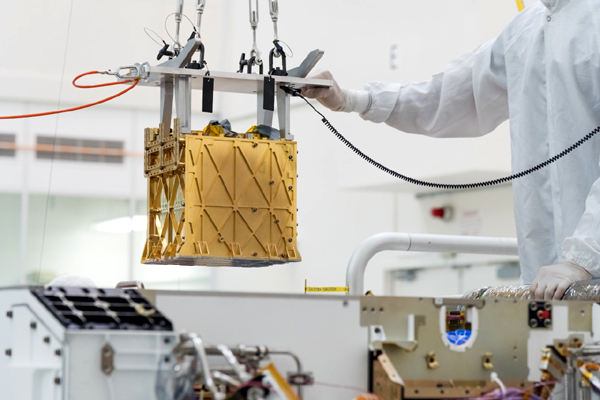
At NASA's Jet Propulsion Laboratory near Pasadena, California, the MOXIE instrument is about to be installed inside the chassis of Perseverance...before the rover launched to Mars in July 2020.
NASA / JPL - Caltech

NASA's Oxygen-Generating Experiment MOXIE Completes Mars Mission (News Release)

Riding with the Perseverance rover, the instrument has proved to be a viable technology for astronauts on Mars to produce oxygen for fuel and breathing.

When the first astronauts land on Mars, they may have the descendants of a microwave-oven-size device to thank for the air they breathe and the rocket propellant that gets them home. That device, called MOXIE (Mars Oxygen In-Situ Resource Utilization Experiment), has generated oxygen for the 16th and final time aboard NASA’s Perseverance rover.

After the instrument proved far more successful than its creators at the Massachusetts Institute of Technology (MIT) expected, MOXIE's operations are concluding.

“MOXIE’s impressive performance shows that it is feasible to extract oxygen from Mars’ atmosphere – oxygen that could help supply breathable air or rocket propellant to future astronauts,” said NASA Deputy Administrator Pam Melroy. “Developing technologies that let us use resources on the Moon and Mars is critical to build a long-term lunar presence, create a robust lunar economy, and allow us to support an initial human exploration campaign to Mars.”

Since Perseverance landed on Mars in 2021, MOXIE has generated a total of 122 grams of oxygen – about what a small dog breathes in 10 hours. At its most efficient, MOXIE was able to produce 12 grams of oxygen an hour – twice as much as NASA’s original goals for the instrument – at 98% purity or better.

On its 16th run, on August 7, the instrument made 9.8 grams of oxygen. MOXIE successfully completed all of its technical requirements and was operated at a variety of conditions throughout a full Mars year, allowing the instrument’s developers to learn a great deal about the technology.

“We’re proud to have supported a breakthrough technology like MOXIE that could turn local resources into useful products for future exploration missions,” said Trudy Kortes, director of technology demonstrations, Space Technology Mission Directorate (STMD) at NASA Headquarters in Washington, which funds the MOXIE demonstration. “By proving this technology in real-world conditions, we’ve come one step closer to a future in which astronauts ‘live off the land’ on the Red Planet.”

MOXIE produces molecular oxygen through an electrochemical process that separates one oxygen atom from each molecule of carbon dioxide pumped in from Mars’ thin atmosphere. As these gases flow through the system, they’re analyzed to check the purity and quantity of the oxygen produced.

First of Its Kind

While many of Perseverance’s experiments are addressing the mission’s primary science goals, MOXIE was focused on future human exploration. MOXIE served as the first-ever demonstration of technology that humans could use to survive on, and leave, the Red Planet.

An oxygen-producing system could help future missions in various ways, but the most important of them would be as a source of rocket propellant, which would be required in industrial quantities to launch rockets with astronauts for their return trip home.

Rather than bringing large quantities of oxygen with them to Mars, future astronauts could live off the land, using materials they find on the planet’s surface to survive. This concept – called in-situ resource utilization, or ISRU – has evolved into a growing area of research.

“MOXIE has clearly served as inspiration to the ISRU community,” said the instrument’s principal investigator, Michael Hecht of MIT. “It showed NASA is willing to invest in these kinds of future technologies. And it has been a flagship that has influenced the exciting industry of space resources.”

Future Focus

The next step wouldn’t be building MOXIE 2.0 – although Hecht and his team have learned a lot about how to design a more efficient version of the instrument. Rather, it would be to create a full-scale system that includes an oxygen generator like MOXIE and a way to liquefy and store that oxygen.

But more than anything, Hecht would like to see other technologies get their turn on Mars. “We have to make decisions about which things need to be validated on Mars,” Hecht said. “I think there are many technologies on that list; I’m very pleased MOXIE was first.”

Source: NASA.Gov

Tuesday, September 05, 2023

India's Resounding Success Has Been Spotted on the Moon's Surface by a U.S. Spacecraft...

An image of India's Vikram Lander on the surface at the Moon's South Polar Region...as seen by NASA's Lunar Reconnaissance Orbiter on August 27, 2023.
NASA's Goddard Space Flight Center / Arizona State University

NASA’s LRO Observes Chandrayaan-3 Landing Site (News Release)

NASA’s LRO – the Lunar Reconnaissance Orbiter – spacecraft imaged the Chandrayaan-3 landing site on the Moon’s surface.

The ISRO (Indian Space Research Organization) Chandrayaan-3 touched down on the Moon on August 23, 2023. The Chandrayaan-3 landing site is located about 600 kilometers from the Moon’s South Pole.

The LROC (short for LRO Camera) acquired an oblique view (42-degree slew angle) of the lander four days later. The bright halo around the vehicle resulted from the rocket plume interacting with the fine-grained regolith (soil).

Visit the ISRO gallery of Chandrayaan-3 images.

Source: NASA.Gov

****

A 3D version of the image that India's Pragyan Rover took of the Vikram Lander on the lunar surface...on August 30, 2023.
ISRO / SAC / LEOS


Sunday, September 03, 2023

Well Done, President Biden and VP Harris!

The Democrats score while Republicans, from the George Dubya era to MAGA, continue to show that they're a detriment to this country.

Now do something about the gas prices, please! Friggin' OPEC.

Another victory for the Biden Administration! Now do something about the gas prices.

Saturday, September 02, 2023

The Buffoonery of MAGA...

Trump was LITERALLY surrendering to law enforcement authorities in Georgia when that mug shot was taken last month. But the MAGA cult doesn't care about that, right?

One of my friends posted this image on Facebook. I'd say that the message on the T-shirt is only inspirational to those who don't know that Trump was literally surrendering to law enforcement folks in Fulton County, Georgia when this mug shot was taken last month.

This is how you know Trump loves the "poorly educated." Of course, this was also indicated by the non-existent election defense fund he created that clueless MAGA folks donated $250 million to after the 2020 election...

Make America Gullible Again! According to Trump... To hell with that guy.

The poorly-educated want Trump back in office after next year's election. The highly-educated need to stop that.

Friday, September 01, 2023

Russia's Latest Failure May Have Been Spotted on the Moon's Surface by a U.S. Spacecraft...

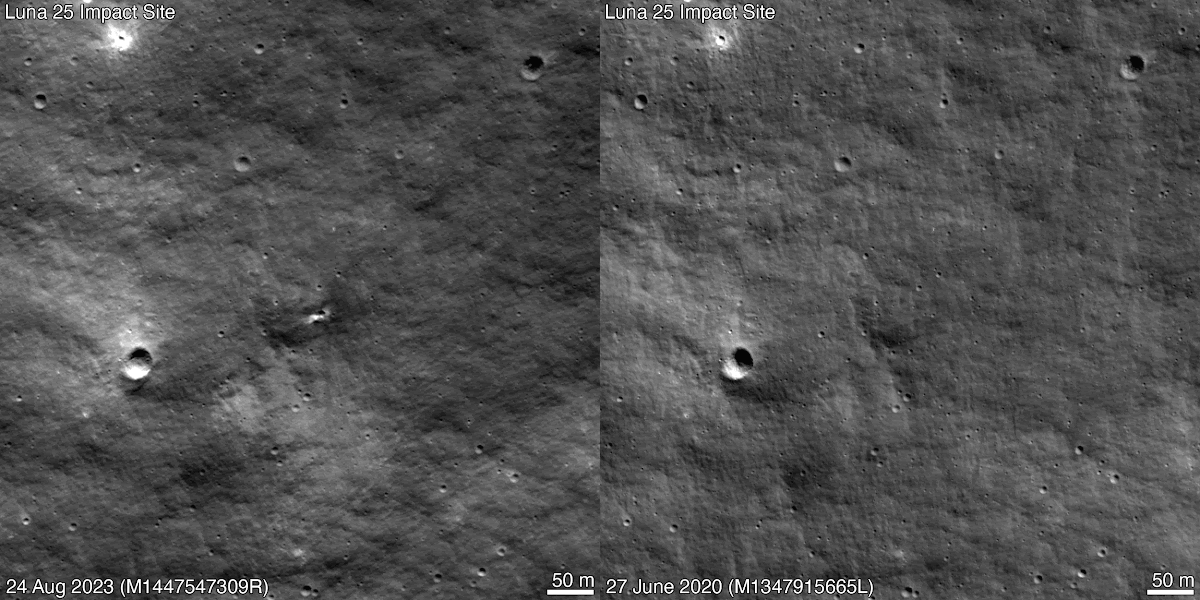
An animated GIF showing the possible impact site of Russia's Luna 25 spacecraft on the surface of the Moon...as seen by NASA's Lunar Reconnaissance Orbiter.
NASA’s Goddard Space Flight Center / Arizona State University

NASA’s LRO Observes Crater Likely from Luna 25 Impact (News Release - August 31)

NASA’s LRO – the Lunar Reconnaissance Orbiter – spacecraft imaged a new crater on the Moon’s surface that is likely the impact site of Russia’s Luna 25 mission.

During its descent, Luna 25 experienced an anomaly that caused it to impact the surface of the Moon on August 19.

Roscosmos, Russia’s space agency, published an estimate of the impact point on August 21. The LROC (short for LRO Camera) team and the LRO Mission Operations team were able to design and send commands to the LRO spacecraft on August 22 to capture images of the site.

The sequence began on August 24 at 2:15 p.m. EDT (18:15 UTC) and was completed about four hours later, at 6:12 p.m. EDT (22:12 UTC). The LROC team compared images taken prior to the impact time and the sequence taken after and found a small new crater.

LRO’s most recent "before" image of the area was captured in June 2022 (frame No. M1410024427R above); thus, the crater formed sometime after that date. Since this new crater is close to the Luna 25 estimated impact point, the LRO team concludes it is likely to be from that mission, rather than a natural impactor.

The new crater is about 10 meters in diameter and is located at 57.865° south latitude and 61.360° east longitude at an elevation of about -360 meters. The impact point was on the steep (greater than 20° grade) inner rim of Pontécoulant G crater, about 400 kilometers short of Luna 25’s intended landing point at 69.545° south, 43.544° east.

Source: NASA.Gov

****

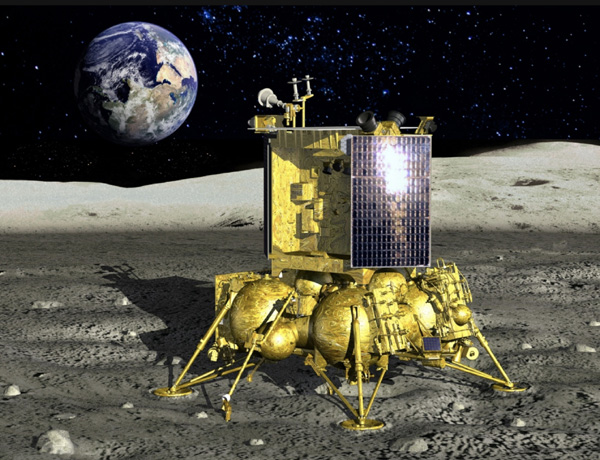
An artist's concept of Russia's Luna 25 spacecraft if it successfully landed on the Moon.
N.P.O. Lavochkin (www.laspace.ru)