Monday, August 31, 2020

Photos of the Day: A Celestial Scenery Above My Neighborhood...

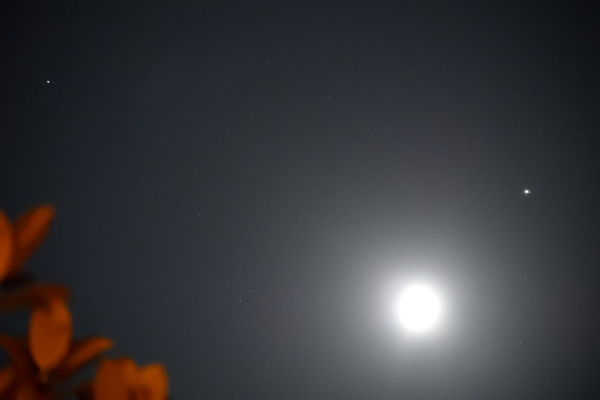
A photo I took of the Moon, Saturn and Jupiter in the night sky...on August 28, 2020.

Last Friday, I went outside to my driveway to take photos of the Moon with Saturn and Jupiter next to it in the night sky. And needless to say, the pictures did not disappoint! For the most part, that is. While I unsuccessfully tried to get an image of the Moon with its lunar surface not overexposed—and with both Saturn and Jupiter still visible (only Jupiter was bright enough to appear in those shots, as seen in the very last photo of this post)—I managed to capture two of Jupiter's four large Galilean satellites in my snapshots! And keep in mind that I was only using my Nikon D3300 DSLR camera (with a 70-300mm telephoto lens attached to it) three days ago. I don't own a telescope.

An annotated version of the photo that I took of the Moon, Saturn and Jupiter...with two of Jupiter's four large Galilean moons visible in this image.

How do I know that those were Jupiter's moons and nothing else, you ask? Well, those two dots next to the Jovian planet were visible in all of the shots similar to the ones I posted in this Blog entry. Also, if these dots were light artifacts caused by my camera itself, then you would think that they would appear next to the Moon, Saturn and/or the nearby stars as well...which they didn't. And lastly, it would just so happen that two random stars appeared side-by-side right next to Jupiter in my images. I don't think so! So I'm confident that those pair of dots are a two-moon combo of Europa, Io, Ganymede or Callisto instead. I love astrophotography! Now I just need to buy an actual telescope... Happy Monday.

Another photo I took of the Moon, Saturn and Jupiter in the night sky...on August 28, 2020.

An image of the Moon and Jupiter that I took on August 28, 2020. The exposure wasn't long enough to make Jupiter's moons stand out in this photo.

Sunday, August 30, 2020

Lucy Update: Construction Officially Begins on the Trojan Asteroid-bound Spacecraft...

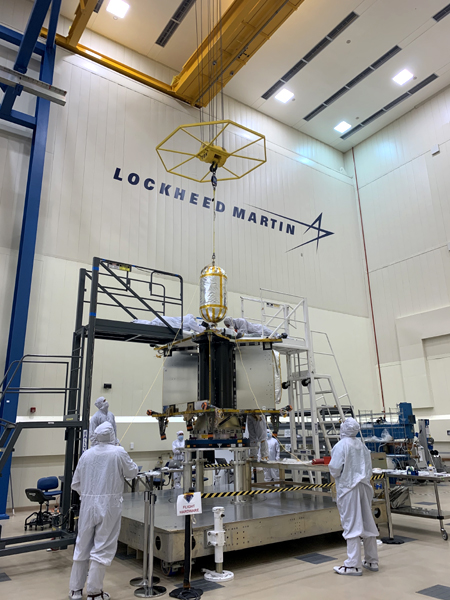
At the Lockheed Martin facility in Denver, Colorado, technicians are about to install the oxygen propellant tank inside NASA's Lucy spacecraft.
Lockheed Martin Space

NASA’s Lucy Mission One Step Closer to Exploring the Trojan Asteroids (News Release - August 28)

NASA’s first mission to explore the Trojan asteroids is one step closer to launch. The Discovery Program’s Lucy mission passed a critical milestone and is officially authorized to transition to its next phase.

This major decision was made after a series of independent reviews of the status of the spacecraft, instruments, schedule and budget. The milestone, known as Key Decision Point-D (KDP-D), represents the official transition from the mission’s development stage to delivery of components, testing, assembly and integration leading to launch. During this part of the mission’s life cycle, known as Phase D, the spacecraft bus (the structure that will carry the science instruments) is completed, the instruments are integrated into the spacecraft and tested, and the spacecraft is shipped to NASA's Kennedy Space Center in Florida for integration with the launch vehicle.

“Each phase of the mission is more exciting than the last,” says Lucy Principal Investigator Hal Levison of Southwest Research Institute in Boulder, CO. “While, of course, Lucy still has several years and a few billion miles to go before we reach our real goal – exploring the never-before-seen Trojan asteroids – seeing this spacecraft come together is just incredible.”

Assembly, Testing and Launch Operations (ATLO) began on schedule last week at Lockheed Martin Space in Littleton, Colorado, despite many unforeseen challenges related to the coronavirus pandemic. The schedule was revised to allow for later integration of components that were delayed due to COVID-19 restrictions.

“This team has been truly incredible,” says Lucy Project Manager Donya Douglas-Bradshaw, from NASA’s Goddard Space Flight Center in Greenbelt, Maryland. “Building a spacecraft is never easy, but seeing the team persevere through all of the challenges that they have encountered is inspiring. We now have a spacecraft structure in the Lockheed Martin high bay and a team ready to install the instruments and components.”

The oxidizer tank has already been integrated with the spacecraft, and the instrument integration starts in October. All spacecraft assembly and testing will be completed by the end of July 2021, when the spacecraft will be shipped to Kennedy Space Center in Cape Canaveral, Florida in preparation for the launch window opening on October 16, 2021. After launch, Lucy will have a long cruise phase before it arrives at its first target. Lucy is flying out to the distance of Jupiter to make close fly-bys past a record-breaking number of asteroids, encountering the first of eight targets in April 2025 and the final binary pair of asteroids in March 2033.

The next major milestone is the Mission Operation Review, scheduled in October 2020, which assesses the project's operational readiness and its progress towards launch.

Southwest Research Institute in Boulder, Colorado, is the principal investigator institution for Lucy. NASA Goddard Space Flight Center in Greenbelt, Maryland provides overall mission management, systems engineering, and safety and mission assurance. Lockheed Martin Space near Denver is building the spacecraft and will perform spacecraft flight operations. Instruments will be provided by Goddard, the Johns Hopkins Applied Physics Laboratory in Laurel, Maryland, and Arizona State University.

Source: NASA.Gov

Saturday, August 29, 2020

Wakanda and Mamba Forever...

Just thought I'd share this photo that I found online showing Chadwick Boseman and Kobe Bryant at the 2018 Academy Awards...when Kobe won an Oscar for his 2017 animated short, Dear Basketball. Boseman sadly passed away yesterday at the age of 43—after battling colon cancer since 2016. 2020 has obviously been a rough year...and it's clearly been a devastating year for the African-American community. From the deaths of Kobe Bryant, George Floyd, Breanna Taylor, Elijah McClain and many others, as well as the recent shooting of Jacob Blake to this evening's tragic news, it definitely seems like fate is testing the resilience of the black community. It would be a cliché to ask for 2021 to be a much better year for people of color (and the whole world, in general), but that's what we need right now.

In the four years that he was battling color cancer, Boseman gave us Black Panther, Captain America: Civil War, Avengers: Infinity War and Endgame, Marshall, 21 Bridges and Da 5 Bloods. Boseman was a true hero for how he showed much perseverance in the face of such adversity. May he join Kobe and many others in an eternal legacy of greatness... Rest In Peace.

Chadwick Boseman and Kobe Bryant pose for a photo at the 2018 Academy Awards...on March 4, 2018.

Friday, August 28, 2020

Hubble's Successor Has Received Its Energy Source...

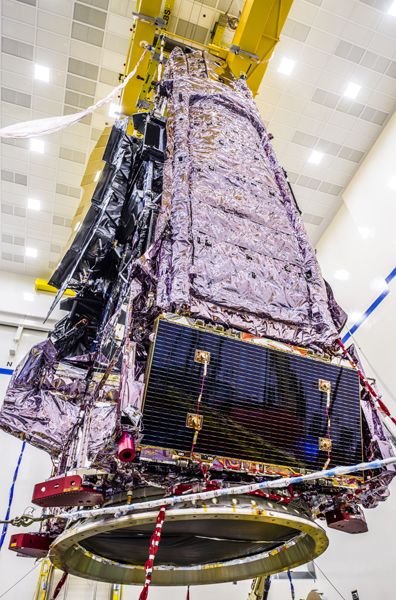
After final installation, the solar array for the James Webb Space Telescope is visible at the bottom of the observatory...at the Northrop Grumman facility in Redondo Beach, California.
NASA / Chris Gunn

NASA’s Webb “Powerhouse” Solar Array Reconnects to the Telescope (News Release - August 27)

One kilowatt is about what it takes to heat up some leftovers in a microwave — or to power the largest and most technically advanced telescope ever built. Thanks to its solar array, NASA’s James Webb Space Telescope will stay energy-efficient more than 1 million miles (1.5 million kilometers) from Earth.

Webb’s 20-foot (6-meter) solar array was recently attached to the main observatory for the final time before launch. The “powerhouse” of the telescope, the array will supply energy to all of the telescope’s scientific instruments and communication and propulsion systems. While Webb will only use 1 kilowatt of power, the solar array is capable of generating nearly double that amount to factor in the gradual wear and tear of a harsh space environment.

The solar array is made up of five panels that are hinged together to easily fold up and stow in Webb’s launch vehicle, the Ariane 5 rocket. When Webb launches in 2021, this deployment will be the first and one of the most critical steps in the observatory’s full deployment process. The telescope’s onboard battery is intended to last only a few hours, up until the solar array unfolds in space and begins converting sunlight into electricity.

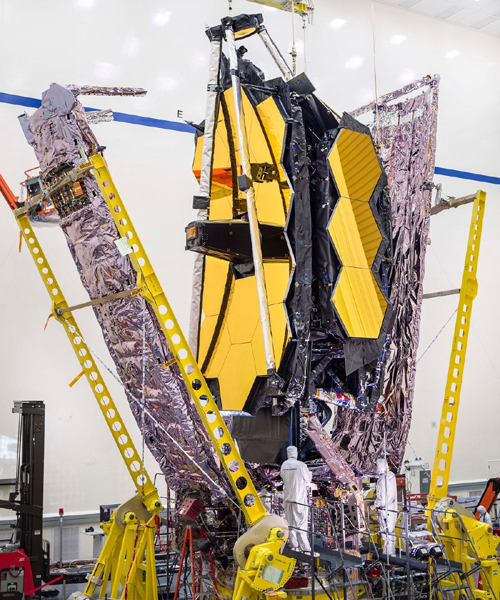
In spring 2019, the array was removed from the spacecraft for deployment testing. To minimize friction and mimic the zero-gravity conditions of deep space, the team conducted tests by hanging the array on its side.

NASA’s James Webb Space Telescope will be the world’s premier space science observatory when it launches. Webb will solve mysteries in our solar system, look beyond to distant worlds around other stars, and probe the mysterious structures and origins of our universe and our place in it. Webb is an international program led by NASA with its partners, ESA (European Space Agency) and the Canadian Space Agency.

Source: NASA.Gov

****

Earlier this year, the solar array for the James Webb Space Telescope was tested at the Northrop Grumman facility in Redondo Beach, California...prior to the array being re-installed on the observatory.
NASA / Chris Gunn

Thursday, August 27, 2020

Flying at the Speed of Light since 2009...

An artist's concept of the Gliese 581 star system.

Eleven Light-Years... That’s how far the Hello From Earth message has traveled since being transmitted from a giant NASA antenna in Australia to the exoplanet Gliese 581d in the summer of 2009. As of 7 PM California time tonight (12 PM Sydney time on Friday, August 28), the radio signal containing 25,878 goodwill text messages—including one by me—will have ventured across approximately 65 trillion miles (104 trillion kilometers) of deep space...which, as stated at the very start of this Blog entry, equals a distance of eleven light-years. The signal, despite traveling 186,000 miles per second (or 671 million miles per hour, or um, 1 billion kilometers per hour), will still take about 9 years to reach the Gliese 581 star system. Carry on!


"My name is Richard Par, and HELLO from planet Earth!!! I hope all is well in your civilization...and I hope you are a much more peaceful species than we are..."
Richard Par

August 17, 2009

Wednesday, August 26, 2020

Hubble's Successor Is Ready for Deep Space Communications (After It Launches Next Year)...

Inside a clean room at the Northrop Grumman facility in Redondo Beach, California, NASA's James Webb Space Telescope undergoes a series of tests after full assembly is completed on the observatory.
NASA / Chris Gunn

Ground Segment Testing a Success for NASA’s James Webb Space Telescope (News Release - August 24)

Testing teams have successfully completed a critical milestone focused on demonstrating that NASA’s James Webb Space Telescope will respond to commands once in space.

Known as a “Ground Segment Test,” this is the first time commands to power on and test Webb’s scientific instruments have been sent to the fully-assembled observatory from its Mission Operations Center at the Space Telescope Science Institute (STScI) in Baltimore, Maryland.

Since reliably communicating with Webb when in space is a mission-critical priority for NASA, tests like these are part of a comprehensive regimen designed to validate and ensure all components of the observatory will function in space with the complex communications networks involved in both sending commands, and downlinking scientific data. This test successfully demonstrated the complete end-to-end flow from planning the science Webb will perform to posting the scientific data to the community archive.

“This was the first time we have done this with both the actual Webb flight hardware and ground system. We’ve performed pieces of this test as the observatory was being assembled, but this is the first ever, and fully successful, end-to-end operation of the observatory and ground segment. This is a big milestone for the project, and very rewarding to see Webb working as expected,” said Amanda Arvai, Deputy Division Head of Mission Operations at STScI in Maryland.

In this test, commands to sequentially turn on, move, and operate each of Webb’s four scientific instruments were relayed from the Mission Operations Center. During the test, the observatory is treated as if it were a million miles away in orbit. To do this, the Flight Operations Team connected the spacecraft to the Deep Space Network, an international array of giant radio antennas that NASA uses to communicate with many spacecraft. However, since Webb isn’t in space yet, special equipment was used to emulate the real radio link that will exist between Webb and the Deep Space Network when Webb is in orbit. Commands were then relayed through the Deep Space Network emulator to the observatory, which is currently inside a Northrop Grumman clean room in Redondo Beach, California.

“This was also the first time we’ve demonstrated the complete cycle for conducting observations with the observatory’s science instruments. This cycle starts with the creation of an observation plan by the ground system which is uplinked to the observatory by the Flight Operations Team. Webb’s science instruments then performed the observations and the data was transmitted back to the Mission Operations Center in Baltimore, where the science was processed and distributed to scientists,” said Arvai.

When Webb is in space, commands will flow from STScI in Baltimore to one of the three Deep Space Network locations—California, Spain, or Australia. Signals will then be sent to the orbiting observatory nearly one million miles away. Additionally the NASA’s Tracking and Data Relay Satellite network, the Space Network in New Mexico, the European Space Agency’s Malindi station in Kenya, and European Space Operations Centre in Germany will also aid in keeping a constant line of communication open with Webb at all times.

To complete the ground segment test a team of nearly 100 people worked together through the course of four consecutive days. Due to staffing restrictions in place due to the coronavirus (COVID-19) pandemic, only seven individuals were present inside the Mission Operations Center, with the rest working remotely to routinely monitor progress. Next up for Webb: observatory level acoustic and sine-vibration testing that will demonstrate that the assembled telescope is capable of surviving the rigors of launch by exposing it to similar conditions.

Webb is NASA’s next great space science observatory, which will help in solving the mysteries of our solar system, looking beyond to distant worlds around other stars, and probing the mystifying structures and origins of our universe. Webb is an international program led by NASA, along with its partners ESA (European Space Agency) and the Canadian Space Agency.

Source: NASA.Gov

****

NASA's James Webb Space Telescope (JWST) undergoes a communications test with DSS 24 at the Deep Space Network in Goldstone, California...on August 26, 2020.
DSN Now - Link: https://eyes.nasa.gov/dsn/dsn.html

Tuesday, August 25, 2020

Images of the Day: A First Look at 'Trident'...

An infographic showing the preliminary design of the Trident spacecraft and its proposed science instruments.
L.M. Prockter et al. LPI / JPL / SwRI

Earlier today, I stumbled upon these images online showing the current design and flight trajectory of the Trident spacecraft...which would launch to Neptune's moon Triton no earlier than October of 2025 and arrive at the icy world in September of 2038. Based on the preliminary look above, Trident would fittingly be a hybrid of the New Horizons and Voyager robotic probes now heading out of our solar system.

All I can say is, I'm even more stoked for this project now! Please select it as one of the two newest Discovery-class missions next year, NASA! The space agency will supposedly make its announcement in April or May of 2021. Let's cross our fingers that another exciting flyby to the outer planets and beyond will be made official next spring... Happy Tuesday!

An infographic showing the proposed flight trajectory of the Trident spacecraft to Neptune's moon Triton.
L.M. Prockter et al. LPI / JPL / SwRI

Monday, August 24, 2020

Happy Kobe Bryant Day!

August 24 is Kobe Bryant Day. Rest In Peace, Mamba.

In remembrance of the Mamba,
Los Angeles County and Orange County—where he and his family lived (in Newport Beach)—dedicated today, 8/24, to the late Kobe Bryant...who would've turned 42 yesterday. 8 is in reference to the jersey number that Kobe wore from his rookie year in 1996-'97 to the end of the 2005-'06 NBA season, while 24 is the jersey number that the Lakers legend wore from the 2006-'07 season till his retirement in 2016. And fittingly, there's a Lakers game tonight! LeBron James, Anthony Davis and Co. will continue their march to honor Kobe's legacy when they take on the Portland Trail Blazers in Game 4 of the first round of the NBA Playoffs at 6 PM, Pacific Daylight Time (9 PM, Eastern Daylight Time). Carry on!

Thursday, August 20, 2020

QueSST Update: NASA's Next X-Plane Gets Its Afterburner...

The F414-GE-100 engine for NASA's X-59 QueSST aircraft underwent testing at GE Aviation in Lynn, Massachusetts...prior to the engine's delivery to Armstrong Flight Research Center in California.
GE Aviation

NASA Takes Delivery of GE Jet Engine for X-59 (News Release)

Mark the big one-of-a-kind engine, designed and built just for NASA, as delivered.

Nearly 13 feet long, three feet in diameter, and packing 22,000 pounds of afterburner-enhanced jet propulsion, the F414-GE-100 engine is now at NASA’s Armstrong Flight Research Center on Edwards Air Force Base in California.

There it will be checked out and inspected before it is transported to nearby Palmdale for eventual installation into NASA’s X-59 Quiet Supersonic Technology airplane, which is now under construction at Lockheed Martin’s Skunk Works factory.

“Taking delivery of the engine from General Electric marks another exciting, huge milestone for us in building the X-59,” said Raymond Castner, the propulsion lead for the X-59 at NASA’s Glenn Research Center in Cleveland.

In fact, two engines were delivered. One to serve as the primary engine and the other to be used as a backup when needed.

“This just adds even more anticipation as we look forward to seeing that big flame come out the back of the aircraft as it takes off for the first time,” Castner said.

Assembled and initially tested at GE Aviation’s Riverworks facility in Lynn, Mass., the engine will power the X-59 on missions to gather information about how the public will react to the quieter sonic booms the aircraft is designed to produce – if they hear anything at all.

Data collected will be shared with federal and international regulators to help them set new rules that may allow supersonic flight over land and enable a whole new market for commercial faster-than-sound air travel.

“It’s important to note that neither the X-59, nor this particular engine, are prototypes for a future commercial supersonic airliner,” Castner said. “This hardware is just for proving the airplane can produce quiet sonic thumps and measure community response.”

Procuring the power

As preliminary designs for the X-59 were put together several years ago, the initial plan was to power the aircraft with the same jet engines used by NASA’s F/A-18 research jets based at Armstrong.

“We had an inventory of spare engines and parts and thought we could use the engines we already owned, but that didn’t pan out,” Castner said.

The problem was the engine – GE’s model F404 – couldn’t generate enough thrust to achieve the flight performance goals for the X-59. As designed, it took two of the engines to power the F/A-18, but the X-59 only had room for a single engine.

Working with GE, the solution was found in adapting the F404’s next-generation improvement, the F414 engine, into a configuration that would both satisfy the X-59’s power needs and physical size.

Anthony Hazlett, GE’s X-59 demo model engineer at the Lynn facility, was responsible for leading the group that came up with the unique engine design for the experimental supersonic airplane.

“We had developed a single-engine version of the F414 for Sweden’s Saab JAS 39E Gripen fighter that we determined would work for the X-59 with some modifications, so we derived a new engine model, the F414-GE-100,” Hazlett said.

“The tried and true guts of the engine, all the turbomachinery, are the same or very similar. But the engine’s external design and the way the engine operates was upgraded.”

That included something as complicated as writing new control systems software so the engine and X-59 could talk to each other, and something as relatively simple as adding plumbing in new places so fuel could flow from the airplane to the engine.

Some assembly required

Although not considered a big deal, another difference between the X-59 engine and the Gripen jet engine it was originated from is the installation method. But that doesn’t mean the process will be any easier.

“There is still a significant chunk of effort that lays in taking something that’s well known and installing it into a new aircraft,” Hazlett said. “So, we’ll have a team from GE present to help Lockheed Martin with the process.”

What’s the difference?

Versions of both the F404 and F414 engines have included track hardware to assist in installing the powerplant. Either the engine is put on a cart and placed at the back of the aircraft to roll it right in, or it’s placed underneath the airplane and a lift is used to raise the engine into place – in both cases using the track hardware as a guide.

But to save weight and space, the X-59’s version of the F414 does not have the tracks, so the engine – which will be placed underneath the aircraft and lifted – will rely on human eyeballs and hands to manually guide it into place.

Once mechanically bolted in place, electrical, fuel, and various other lines will be hooked up and the whole engine/aircraft combination system tested. That will lead to the first time the engine is fired up within the aircraft as it remains in place with brakes on and restraining tethers fastened.

“This whole process will take several months to perform as various tests are scheduled within certain windows that are available to us as assembly on the airplane continues,” Castner said.

Factory fresh

Although the engine is based on the design of the Gripen’s engine – known as the F414-GE-39E – GE did not just take a 39E engine in stock and modify it for NASA to use on the X-59.

“This is a whole brand-new engine birthed from raw metal,” Hazlett said. “The NASA team is getting a new engine straight from the dealership floor.”

As part of that manufacturing process, the engine already has undergone more than eight hours of successful operations on a test stand in Massachusetts to prove it would be capable of supporting the way the X-59 is expected to fly.

A typical fighter mission will see the pilot move the engine throttle a number of times, with short bursts of high power between periods of average thrust. This affects the engine’s overall durability and design lifetime of its parts in a way that is fully understood.

“With the X-59 we looked at how it will be flying, which is different from a fighter. It will have longer duration missions at high altitude with high power – often with the afterburner firing to reach supersonic speeds,” Hazlett said.

Putting the X-59’s engine through its paces at a GE test cell in Lynn showed it could handle the high afterburner usage and demonstrated all other design upgrades, such as the newly-designed control software, would work as expected.

“It’s been a great challenge for our design team to prove our assumptions and boundary conditions are still good, and we’ve met that challenge in every way,” Hazlett said.

With plenty of work to do on other programs, many in support of the U.S. military – and notwithstanding the additional challenges imposed by the COVID-19 pandemic – GE had no problem keeping an appropriate focus on the NASA work to achieve that goal.

The opportunity to work on a NASA X-plane – the first of its kind in three decades – was a big reason.

“X-59 has a mission unparalleled in terms of its cool factor. There’s been no shortage of folks who want to help and work on this program. It’s something that GE is extremely proud to be a part of,” Hazlett said.

From NASA’s perspective, Castner concurs.

“Working with GE to make this engine available has been fantastic. They have been an invaluable partner in all of this. We are very fortunate to have them as part of the team.”

Source: NASA.Gov

****

An artist's concept of NASA's X-59 QueSST aircraft soaring high in the sky.
Lockheed Martin

Wednesday, August 19, 2020

Hayabusa2 Update: The Soil Sample from Asteroid Ryugu Will Officially Land in Australia on December 6!

An artist's concept of Japan's Hayabusa2 spacecraft collecting a soil sample from the surface of asteroid Ryugu.
JAXA

The Hayabusa2 Re-entry Capsule Approved to Land in Australia (Press Release)

On August 10, 2020, JAXA was informed that the Authorisation of Return of Overseas-Launched Space Object (AROLSO) for the re-entry capsule from Hayabusa2 was issued by the Australian Government. The date of the issuance is August 6, 2020.

The Hayabusa2 re-entry capsule will return to Earth in South Australia on December 6, 2020 (Japan Time and Australian Time). The landing site will be the Woomera Prohibited Area. The issuance of the AROLSO gave a major step forward for the capsule recovery.

We will continue careful operation for return of Hayabusa2 and recovery of the capsule, and the operation status will be announced in a timely manner.

Source: Japan Aerospace Exploration Agency

****

An infographic showing how Japan's Hayabusa2 spacecraft will return the soil sample from asteroid Ryugu to Earth.