Wednesday, April 15, 2020

OSIRIS-REx Completes a Major Test Prior to Collecting Soil Samples from Its Celestial Target This Summer...

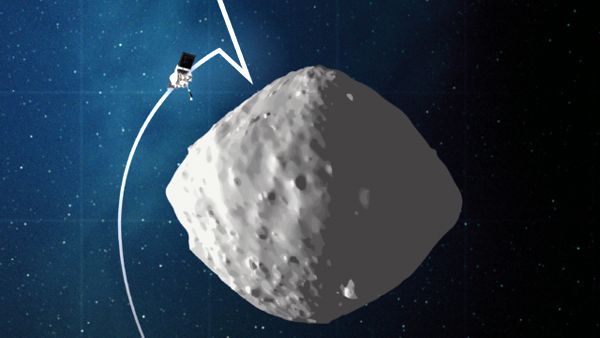
An illustration depicting the trajectory that NASA's OSIRIS-REx spacecraft took during its 'Checkpoint' rehearsal at asteroid Bennu on April 14, 2020.
NASA / Goddard / University of Arizona

One Step Closer to Touching Asteroid Bennu (News Release)

After the successful completion of its “Checkpoint” rehearsal, NASA’s first asteroid-sampling spacecraft is one step closer to touching down on asteroid Bennu. Yesterday, NASA’s OSIRIS-REx spacecraft performed the first practice run of its sample collection sequence, reaching an approximate altitude of 246 feet (75 meters) over site Nightingale before executing a back-away burn from the asteroid. Nightingale, OSIRIS-REx’s primary sample collection site, is located within a crater in Bennu’s northern hemisphere.

The four-hour Checkpoint rehearsal took the spacecraft through the first two of the sampling sequence’s four maneuvers: the orbit departure burn and the Checkpoint burn. Checkpoint is so named because it is the location where the spacecraft autonomously checks its position and velocity before adjusting its trajectory down toward the location of the event’s third maneuver.

Four hours after departing its 0.6-mile (1-km) safe-home orbit, the spacecraft performed the Checkpoint maneuver at an approximate altitude of 410 feet (125 meters) above Bennu’s surface. From there, the spacecraft continued to descend for another nine minutes on a trajectory toward – but not reaching – the location of the sampling event’s third maneuver, the “Matchpoint” burn. Upon reaching an altitude of approximately 246 ft (75 m) – the closest the spacecraft has ever been to Bennu – OSIRIS-REx performed a back-away burn to complete the rehearsal.

During the rehearsal, the spacecraft successfully deployed its sampling arm, the Touch-And-Go Sample Acquisition Mechanism (TAGSAM), from its folded, parked position out to the sample collection configuration. Additionally, some of the spacecraft’s instruments collected science and navigation images and made spectrometry observations of the sample site, as will occur during the sample collection event.

This first rehearsal provided the mission team with practice navigating the spacecraft through both the orbit departure and Checkpoint maneuvers and with an opportunity to verify that the spacecraft’s imaging, navigation and ranging systems operated as expected during the first part of the descent sequence. Checkpoint rehearsal also gave the team confirmation that OSIRIS-REx’s Natural Feature Tracking (NFT) guidance system accurately estimated the spacecraft’s position and speed relative to Bennu as it descended toward the surface.

The mission team has maximized remote work over the last month of preparations for the Checkpoint rehearsal, as part of the COVID-19 response. On the day of rehearsal, a limited number of personnel monitored the spacecraft’s telemetry from Lockheed Martin Space’s facility, NASA’s Goddard Space Flight Center and the University of Arizona, taking appropriate safety precautions, while the rest of the team performed their roles remotely.

“This rehearsal let us verify flight system performance during the descent, particularly the autonomous update and execution of the Checkpoint burn,” said Rich Burns, OSIRIS-REx project manager at NASA’s Goddard Space Flight Center in Greenbelt, Maryland. “Executing this monumental milestone during this time of national crisis is a testament to the professionalism and focus of our team. It speaks volumes about their ‘can-do’ attitude and hopefully will serve as a bit of good news in these challenging times.”

The spacecraft will travel all the way to the asteroid’s surface during its first sample collection attempt, scheduled for Aug. 25. During this event, OSIRIS-REx’s sampling mechanism will touch Bennu’s surface for approximately five seconds, fire a charge of pressurized nitrogen to disturb the surface and collect a sample before the spacecraft backs away. The spacecraft is scheduled to return the sample to Earth on Sept. 24, 2023.

NASA’s Goddard Space Flight Center in Greenbelt, Maryland, provides overall mission management, systems engineering, and the safety and mission assurance for OSIRIS-REx. Dante Lauretta of the University of Arizona, Tucson, is the principal investigator, and the University of Arizona also leads the science team and the mission’s science observation planning and data processing. Lockheed Martin Space in Denver built the spacecraft and provides flight operations. Goddard and KinetX Aerospace are responsible for navigating the OSIRIS-REx spacecraft. OSIRIS-REx is the third mission in NASA’s New Frontiers Program, which is managed by NASA’s Marshall Space Flight Center in Huntsville, Alabama, for the agency’s Science Mission Directorate in Washington.

Source: AsteroidMission.org

****

Wednesday, April 08, 2020

Robotic Spacecraft Will Soon Pave the Way for Crewed Missions to the Lunar Surface...

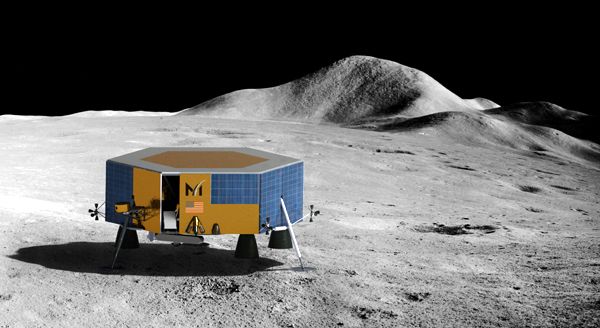
An artist's concept of Masten's XL-1 lander on the surface of the Moon.
Masten Space Systems

NASA Awards Contract to Deliver Science, Tech to Moon Ahead of Human Missions (Press Release)

NASA has selected Masten Space Systems of Mojave, California, to deliver and operate eight payloads – with nine science and technology instruments – to the Moon’s South Pole in 2022, to help lay the foundation for human expeditions to the lunar surface beginning in 2024.

The payloads, which include instruments to assess the composition of the lunar surface, test precision landing technologies, and evaluate the radiation on the Moon, are being delivered under NASA’s Commercial Lunar Payload Services (CLPS) initiative as part of the agency’s Artemis program.

As the country and the world face the challenges of the COVID-19 pandemic, NASA is leveraging virtual presence and communications tools to safely make progress on these important lunar exploration activities, and to award this lunar surface delivery as it was scheduled prior to the pandemic.

“Under our Artemis program, we are going to the Moon with all of America,” said NASA Administrator Jim Bridenstine. “Commercial industry is critical to making our vision for lunar exploration a reality. The science and technology we are sending to the lunar surface ahead of our crewed missions will help us understand the lunar environment better than we ever have before. These CLPS deliveries are on the cutting edge of our work to do great science and support human exploration of the Moon. I’m happy to welcome another of our innovative companies to the group that is ready to start taking our payloads to the Moon as soon as possible.”

The $75.9 million award includes end-to-end services for delivery of the instruments, including payload integration, launch from Earth, landing on the Moon’s surface, and operation for at least 12 days. Masten Space Systems will land these payloads on the Moon with its XL-1 lander.

“The Moon provides great scientific value, and these payloads will advance what we know and help define and improve the science astronauts can do,” said Thomas Zurbuchen, associate administrator of NASA’s Science Mission Directorate (SMD). “Our commercial Moon delivery efforts are seeking to demonstrate how frequent and affordable access to the lunar surface benefits both science and exploration.”

The payloads that will be delivered have been developed predominantly from the two recent NASA Provided Lunar Payloads (NPLP) and Lunar Surface Instrument and Technology Payloads (LSITP) solicitations.

The nine instruments to be delivered are:

- Lunar Compact Infrared Imaging System (L-CIRiS) will deploy a radiometer – a device that measures infrared wavelengths of light – to explore the Moon's surface composition, map its surface temperature distribution, and demonstrate the instrument's feasibility for future lunar resource utilization activities.

- Linear Energy Transfer Spectrometer (LETS) is a sensor that will measure the radiation environment on the Moon’s surface. The payload also is being flown on a CLPS flight to the Moon in 2021.

- Heimdall is a flexible camera system for conducting lunar science on commercial vehicles. This innovation includes a single digital video recorder and four cameras: a wide-angle descent imager, a narrow-angle regolith imager, and two wide-angle panoramic imagers. This camera system is intended to model the properties of the Moon's regolith – the soil and other material that make up the top layer of the lunar surface – and characterize and map geologic features. Other goals for this instrument include characterizing potential landing or trafficability hazards.

- MoonRanger is a small robotic rover that weighs less than 30 pounds and will demonstrate communications and mapping technologies. It will demonstrate the ability to move quickly across long distances on the lunar surface with autonomous navigation and without the ability to communicate with Earth in real time. It is a technology that could enable exploration of destinations that are far from lunar landing sites.

- The MoonRanger will carry the Neutron Spectrometer System, which will measure the concentration of hydrogen in the Moon’s regolith – a possible indication of the existence of buried water.

- Mass Spectrometer Observing Lunar Operations (MSolo) is a device to measure potentially accessible resources on the Moon’s surface. It will identify gases coming off a lander during touchdown on the lunar surface to help scientists understand what elements are coming from the lunar surface and which ones are introduced by a lander itself.

- Near-Infrared Volatile Spectrometer System (NIRVSS) is a tool to measure surface composition and temperature. The instrument will characterize the variability of the lunar soils and detect volatiles such as methane, carbon dioxide, ammonia and water.

- Laser Retroreflector Array (LRA) is a series of eight small mirrors to measure distance and support landing accuracy. It requires no power or communications from the lander and can be detected by future spacecraft orbiting or landing on the Moon.

- Sample Acquisition, Morphology Filtering, and Probing of Lunar Regolith (SAMPLR) is a robotic arm that will collect samples of lunar regolith and demonstrate the use of a robotic scoop that can filter and isolate particles of different sizes. The sampling technology makes use of a flight spare from the Mars Exploration Rover project.

NASA has contracted with 14 American companies to deliver science and technology to the lunar surface through competed task orders. The agency plans to issue at least two such task orders per year through which the companies can propose to take payloads to the Moon. Under the Artemis program, early commercial deliveries of payloads to the lunar surface missions enable NASA to perform science experiments, test technologies and demonstrate capabilities to further explore the Moon and prepare for human missions.

“I am very pleased to award our next delivery service task order to Masten Space Systems,” said Steven Clarke, deputy associate administrator for exploration in SMD. “With the first delivery in 2022, we are continuing to execute our strategy of providing two delivery opportunities per year of science investigations and technology demonstration payloads to the lunar surface.”

In May 2019, NASA selected two CLPS providers, Astrobotic and Intuitive Machines, who are each making progress toward sending payloads to the Moon next year. In February, NASA asked the 14 companies to provide proposals to fly the Volatiles Investigating Polar Exploration Rover (VIPER), which will be the first rover on the Moon that will look for and map the distribution of water and other important volatiles at one of the lunar poles. In addition to these deliveries and the delivery to be made by Masten Space Systems, payloads for a fifth lunar delivery are in development, and NASA will soon be initiating a new series of payload acquisitions for targeted science investigations for years to come.

****

Tuesday, April 07, 2020

VIPER Update: Developmental Testing Continues on NASA's New Robotic Lunar Rover...

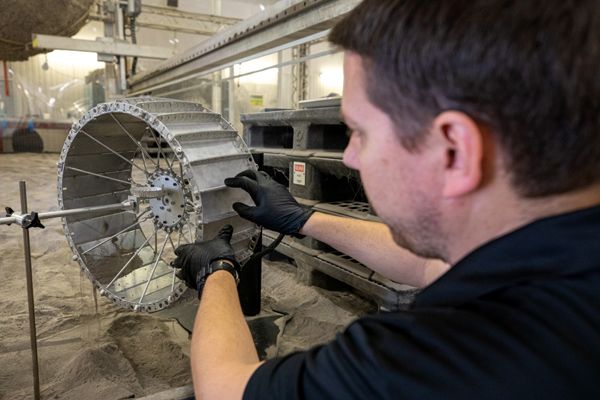
A robotics engineer at NASA's Kennedy Space Center in Florida prepares to conduct a dust test on a replica of the VIPER lunar rover's wheel...on March 17, 2020.
NASA

When the Moon Dust Settles, It Won’t Settle in VIPER’s Wheels (News Release)

Moon dust is a formidable adversary – the grains are as fine as powder and as sharp as tiny shards of glass. During the Apollo 17 mission to the Moon, the astronauts lamented how the dust found its way into everything, coating their spacesuits and jamming the shoulder joints, getting inside their lunar habitat and even causing symptoms of a temporary "lunar dust hay fever” in astronaut Harrison Schmitt. Those symptoms fortunately went away quickly – but the problem of Moon dust remains for future missions.

NASA’s new Moon rover, the Volatiles Investigating Polar Exploration Rover, has been running tests to ensure its wheel module components are dust-proof in advance of going to the Moon in 2023. VIPER’s job is to hunt for water resources at the Moon’s South Pole, creating the first resource maps for human space exploration before astronauts arrive under NASA’s Artemis program in 2024.

But that dust, though.

The grating grains in question were formed by millions of years of meteorite impacts that repeatedly crushed and melted rocks, creating tiny shards of glass and mineral fragments. Because the Moon has no atmosphere to speak of, there’s no wind or weather to cause erosion, so the grains never lose their rough edges. When lunar dust gets inside moving parts, like those in a rover’s wheel, it’s so abrasive that it can damage the mechanisms. And the more joints you have in a system, the more places you have for dust to creep in. VIPER’s required agility means it has a lot of joints.

No one is quite sure what to expect from the soil in the polar regions the rover will explore. Will it be compacted? Or fluffy, like ash? To work around that uncertainty, VIPER needs to be agile. Each of the rover’s four wheel modules were designed with both an active suspension and independent steering. This means VIPER can drive sideways or diagonally and even spin in a circle. The rover can move in any direction without changing which way it’s facing, so its science objectives and solar panel charging can be optimized. And, if it encounters really soft soils, it will be able to twist and turn and pull itself out, like a turtle on the beach.

To ensure the dirt stays out during this dance, the VIPER team recently tested one part of their mitigation method in a dust chamber at NASA’s Johnson Space Center in Houston. The dust chamber is an open-topped box, 20 by 20 by 34 inches, with clear acrylic walls. Inside, there is simulated lunar soil and a robot mounted on one wall. Its job is to move a VIPER wheel module – including driving, steering and suspension components – through its full range of motion. The whole wheel unit is shrouded in a flexible, protective cover that will both insulate it from the cold on the Moon and seal it against dust. Only the axle protrudes from this “sock”, where the wheel will attach.

During the test, two fans circulated lunar dust within the box to create a really challenging, dusty environment. The fans were repositioned every hour to ensure VIPER’s wheel was exposed to dust from every angle. This method allowed the team to perform a stringent test, throwing even more at their design than the rover could likely ever stir up during the mission.

When the test was over and the dust had settled, it was all outside VIPER’s wheel. None of it had snuck in through the sock, confirming that its seams and the connections sealing the sock to the wheel hardware had worked.

And that’s only the first line of defense against dust. Researchers at NASA’s Kennedy Space Center in Florida are also testing the various seals for the electric motors that drive VIPER’s wheels. Each motor is protected by three types: a winding labyrinth seal, a flexible felt seal and a spring-loaded Teflon seal. The rover will be equipped with heaters to keep the extremities of the system warmer than minus 112 degrees Fahrenheit, even when the lunar environment gets much colder. The tests at Kennedy will verify the seals’ performance after they reach this low and warm back up to their normal operating temperature of about minus 40 degrees Fahrenheit. For this, a prototype of VIPER’s wheel motor will be operated inside another test chamber, one that simulates multiple conditions the rover will experience on the Moon, including exposure to the vacuum of space, extreme temperatures and, of course, all that dust.

Source: NASA.Gov

Saturday, April 04, 2020

The Mamba Will Officially Become a Hall of Famer...

Kobe Bryant ended his 20-year NBA career by dropping 60 points against the Utah Jazz at STAPLES Center...on April 13, 2016.
Photo courtesy of LA Lakers - Facebook.com

Kobe Bryant, Tim Duncan, Kevin Garnett Headline Nine-Member 2020 Hall of Fame Class (Press Release)

SPRINGFIELD, Mass. -- Today on ESPN, the Naismith Memorial Basketball Hall of Fame announced the nine honorees in the Class of 2020 presented by Fifty-Five South Ventures. The Class of 2020 will be enshrined in Springfield, Massachusetts, the Birthplace of Basketball, on Saturday, August 29, 2020.

As previously announced, in light of the unique circumstance surrounding the Class of 2020, the Naismith Memorial Basketball Hall of Fame Election Process Committee suspended the Direct Election Categories for one year with the exception of the International Committee. This year’s distinguished class includes honorees from the North American committee, Women’s Committee and International Committee. To be elected, North American and Women’s Committee finalists must receive 18 of 24 votes from the Honors Committee for election into the Naismith Memorial Basketball Hall of Fame.

The Class of 2020 includes: 18-time NBA All-Star and five-time NBA champion Kobe Bryant, 15-time NBA All-Star and three-time NBA Finals MVP Tim Duncan, 15-time NBA All-Star and nine-time NBA All-Defensive First Team selection Kevin Garnett, four-time National Coach of the Year Eddie Sutton, two-time NBA Champion coach Rudy Tomjanovich, 10-time WNBA All-Star and four-time Olympic gold medalist Tamika Catchings, three-time NCAA National Championship Coach of Baylor Kim Mulkey, five-time Division II National Coach of the Year Barbara Stevens and longtime FIBA executive Patrick Baumann.

“The Class of 2020 is undoubtedly one of the most historic of all time and the talent and social influence of these nine honorees is beyond measure,” said John L. Doleva, President and CEO of the Naismith Memorial Basketball Hall of Fame. “In 2020, the basketball community has suffered the unimaginable loss of iconic figures Commissioner David Stern and Kobe Bryant, as well as the game itself due to COVID-19. We have also banded together like never before in appreciation of the game and those who have made it the uniting force it is today. Today we thank the Class of 2020 for all they have done for the game of basketball and we look forward to celebrating them at Enshrinement in August.”

The Class of 2020 Enshrinement festivities will begin at Mohegan Sun on Friday, August 28th with the newly formatted Enshrinement Tip-Off Celebration and Awards Gala. The Class of 2020 and over 50 returning Hall of Famers will then journey to Springfield, Mass. for the annual celebratory events taking place at the newly renovated Naismith Memorial Basketball Hall of Fame and Springfield Symphony Hall on the 29th. The second day of events in Springfield will include a special community-focused Celebration Day on the 30th.

Source: NBA.com

****

Kobe Bryant ended his 20-year NBA career by dropping 60 points against the Utah Jazz at STAPLES Center...on April 13, 2016.
Photo courtesy of LA Lakers - Facebook.com

Friday, April 03, 2020

Photos of the Day: Perseverance Is Ready to Roll on the Red Planet...

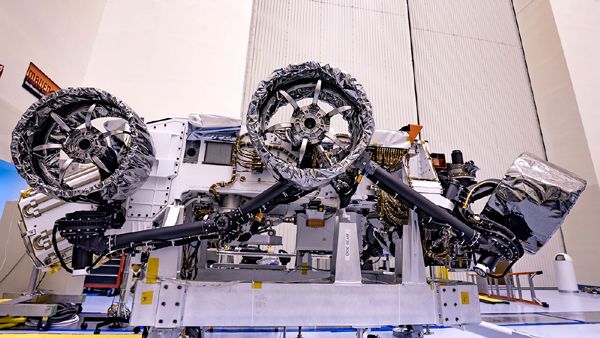
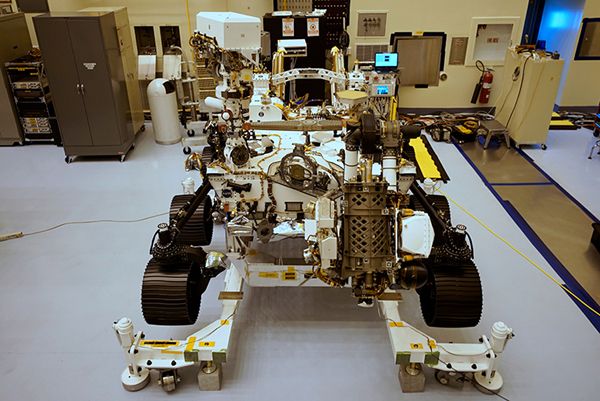
At NASA's Kennedy Space Center in Florida, Perseverance's six flight wheels are attached to the Mars rover.
NASA

NASA's Perseverance Mars Rover Gets Its Wheels and Air Brakes (News Release)

After the rover was shipped from JPL to Kennedy Space Center, the team is getting closer to finalizing the spacecraft for launch later this summer.

Final assembly and testing of NASA's Perseverance rover continues at Kennedy Space Center in Florida as the July launch window approaches. In some of the last steps required prior to stacking the spacecraft components in the configuration they'll be in atop the Atlas V rocket, the rover's wheels and parachute have been installed.

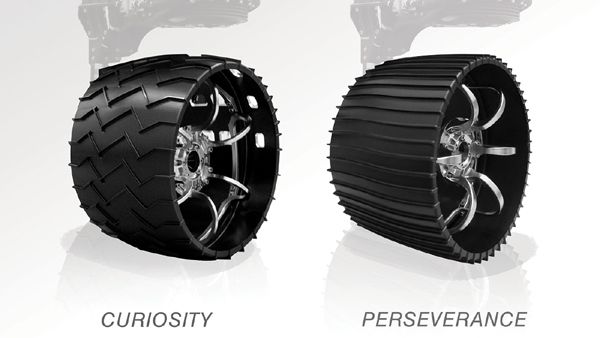
Perseverance received its six flight wheels on March 30, 2020. While the rover took a test drive last December, it was on "flight spares" that wouldn't be making the trip to Mars. Designed for the kind of off-roading Perseverance will perform on the Red Planet, the wheels are re-engineered versions of the ones NASA's Curiosity has been using on its traverses of Mount Sharp.

Machined out of a block of flight-grade aluminum and equipped with titanium spokes, each wheel is slightly larger in diameter and narrower than Curiosity's, with skins that are almost a millimeter thicker. They also feature new treads, or grousers: In place of Curiosity's 24 chevron-pattern treads are 48 gently curved ones. Extensive testing in the Mars Yard at NASA's Jet Propulsion Laboratory, which built the rover and manages operations, has shown these treads better withstand the pressure from sharp rocks and grip just as well or better than Curiosity's when driving on sand.

The Parachute

The job of adding Perseverance's parachute to the back shell, where the rover will be stowed on the journey to the Red Planet, took several days and was finished on March 26. Tasked with slowing the heaviest payload in the history of Mars exploration from Mach 1.7 to about 200 mph (320 kph) during the rover's landing on Feb. 18, 2021, the 194 pounds (88 kilograms) of nylon, Technora and Kevlar fibers are packed so tightly into a 20-inch-wide (50-centimeter-wide) aluminum cylinder that it is as dense as oak wood. When deployed at about 7 miles (11 kilometers) above the Martian surface, the chute will take about a half-second to fully inflate its 70.5-foot-wide (21.5-meter-wide) canopy.

The Perseverance rover is a robotic scientist weighing 2,260 pounds (1,025 kilograms). It will search for signs of past microbial life, characterize the planet's climate and geology, collect samples for future return to Earth, and pave the way for human exploration of the Red Planet. No matter what day Perseverance launches during its July 17-Aug. 5 launch period, it will land on Mars' Jezero Crater on Feb. 18, 2021.

Perseverance is part of a larger program that includes missions to the Moon as a way to prepare for human exploration of the Red Planet. Charged with returning astronauts to the Moon by 2024, NASA will establish a sustained human presence on and around the Moon by 2028 through NASA's Artemis lunar exploration plans.

Source: Jet Propulsion Laboratory

****

An image comparing the wheel of the Curiosity Mars rover to that of Perseverance.
NASA / JPL - Caltech

Tuesday, March 31, 2020

Photo of the Day: Hubble's Successor Unveils Its Giant Eye on the Ground...

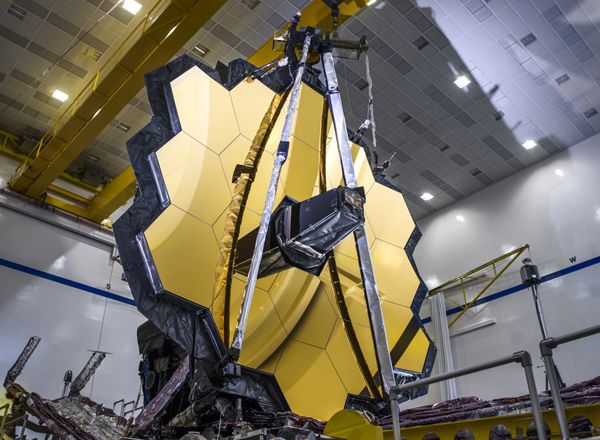
The primary mirror on NASA's James Webb Space Telescope is fully deployed during a ground test at Northrop Grumman in Redondo Beach, California.
NASA / Chris Gunn

NASA’s James Webb Space Telescope Full Mirror Deployment a Success (News Release)

In a recent test, NASA’s James Webb Space Telescope fully deployed its primary mirror into the same configuration it will have when in space.

As Webb progresses towards liftoff in 2021, technicians and engineers have been diligently checking off a long list of final tests the observatory will undergo before being packaged for delivery to French Guiana for launch. Performed in early March, this procedure involved commanding the spacecraft’s internal systems to fully extend and latch Webb’s iconic 21 feet 4-inch (6.5 meter) primary mirror, appearing just like it would after it has been launched to orbit. The observatory is currently in a cleanroom at Northrop Grumman Space Systems in Redondo Beach, California.

The difficulty and complexity of performing tests for Webb has increased significantly, now that the observatory has been fully assembled. Special gravity offsetting equipment was attached to Webb’s mirror to simulate the zero-gravity environment its mechanisms will have to operate in. Tests like these help safeguard mission success by physically demonstrating that the spacecraft is able to move and unfold as intended. The Webb team will deploy the observatory’s primary mirror only once more on the ground, just before preparing it for delivery to the launch site.

A telescope’s sensitivity, or how much detail it can see, is directly related to the size of the mirror that collects light from the objects being observed. A larger surface area collects more light, just like a larger bucket collects more water in a rain shower than a small one. Webb’s mirror is the biggest of its kind that NASA has ever built.

In order to perform groundbreaking science, Webb’s primary mirror needs to be so large that it cannot fit inside any rocket available in its fully extended form. Like the art of origami, Webb is a collection of movable parts employing applied material science that have been specifically designed to fold themselves to a compact formation that is considerably smaller than when the observatory is fully deployed. This allows it to just barely fit within a 16-foot (5-meter) payload fairing, with little room to spare.

“Deploying both wings of the telescope while part of the fully assembled observatory is another significant milestone showing Webb will deploy properly in space. This is a great achievement and an inspiring image for the entire team,” said Lee Feinberg, optical telescope element manager for Webb at NASA’s Goddard Space Flight Center in Greenbelt, Maryland.

The evolving novel coronavirus COVID-19 situation is causing significant impact and disruption globally. Given these circumstances, Webb’s Northrop Grumman team in California has resumed integration and testing work with reduced personnel and shifts until the Deployable Tower Assembly set up in April. The project will then shut down integration and testing operations due to the lack of required NASA onsite personnel related to the COVID-19 situation. The project will reassess over the next couple of weeks and adjust decisions as the situation continues to unfold.

The James Webb Space Telescope will be the world’s premier space science observatory when it launches in 2021. Webb will solve mysteries in our solar system, look beyond to distant worlds around other stars, and probe the mysterious structures and origins of our universe and our place in it. Webb is an international program led by NASA with its partners, ESA (European Space Agency) and the Canadian Space Agency.

Source: NASA.Gov

****

Monday, March 30, 2020

Europe and Japan's Mercury-Bound Spacecraft Will Soon Fly Past a Pandemic-Ravaged Earth...

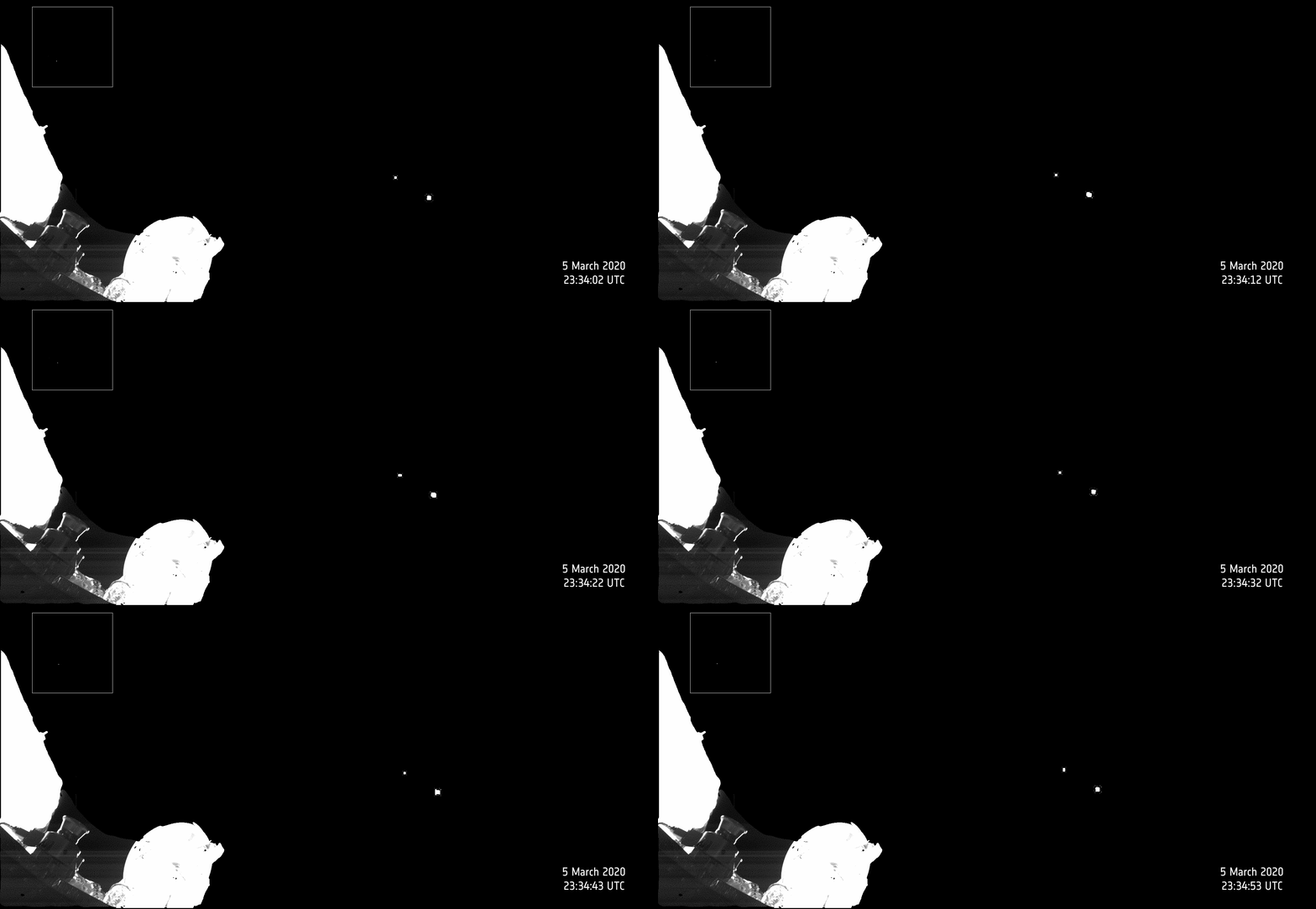
Earth and the Moon as seen from Europe and Japan's BepiColombo spacecraft earlier this month.
ESA / BepiColombo / MTM

ESA to Conduct BepiColombo Flyby Amid Coronavirus Crisis (Press Release)

Controllers at ESA’s mission control centre are preparing for a gravity-assist flyby of the European-Japanese Mercury explorer BepiColombo. The manoeuvre, which will see the mission adjust its trajectory by harnessing Earth’s gravitational pull as it swings past the planet, will be performed amid restrictions ESA has implemented in response to the coronavirus pandemic.

BepiColombo, launched in October 2018, is currently orbiting the Sun at a similar distance as Earth. On 10 April, at about 06:25 am (CEST), the spacecraft will approach Earth at the distance of only 12,700 km, which is less than half the altitude of Europe’s Galileo navigational satellites. The manoeuvre will slow down the BepiColombo spacecraft and bend its trajectory towards the centre of the Solar System, thus tightening its orbit around the Sun.

“This is the last time we will see BepiColombo from Earth,” says Joe Zender, BepiColombo Deputy Project Scientist at ESA. “After that it will head deeper into the inner Solar System.”

Mission scientists plan to use the flyby to test some of the 11 instruments aboard ESA’s Mercury Planetary Orbiter (MPO), one of the European components of the mission, which travels to the innermost planet of the Solar System together with the Mercury Magnetospheric Orbiter (Mio) of the Japan Aerospace Exploration Agency (JAXA). The two science orbiters are stacked on top of the ESA-made Mercury Transfer Module (MTM), with Mio sitting atop hidden behind a protective sunshield. The transfer module obscures the view of some of the MPO instruments, but the scientists expect to be able to obtain data from eight of the 11 science payloads. Mio’s view is mostly blocked by the sunshield, but some of its sensors will also be switched on during the flyby.

The operation, however, will be performed with limited personnel at ESA’s European Space Operations Centre (ESOC) in Darmstadt, Germany, where engineers will have to comply with social distancing rules presently in place all over Europe as a response to the coronavirus pandemic.

“The Earth swing-by is a phase where we need daily contact with the spacecraft,” says Elsa Montagnon, BepiColombo Spacecraft Operations Manager at ESA. “This is something that we cannot postpone. The spacecraft will swing by Earth independently in any case.”

The coronavirus threat forces the team to work with minimal face to face interaction while ensuring all steps in the process are properly covered.

“During the critical two weeks prior to the closest approach, we need to upload safety commands to prepare the spacecraft for unexpected problems,” says Christoph Steiger, BepiColombo Deputy Spacecraft Operations Manager. “For example, we need to prepare the transfer module for the 34 minute-long eclipse when its solar panels will not be exposed to sunlight to prevent battery discharge.”

Operations can still be conducted as planned, he adds, but will require more effort and attention than in a normal situation.

ESA’s BepiColombo Project Scientist Johannes Benkhoff hopes that, despite the challenging circumstances, the science teams will be able to switch on the MPO instruments to test and calibrate them.

“For example, the PHEBUS spectroscope will use the Moon as a calibration target to then produce better data once at Mercury,” says Johannes. “We also want to make some measurements of the solar wind and its interaction with Earth’s magnetic field. The main purpose of having the instruments on at this stage, however, is testing and calibration. If we can use the data for some scientific investigation, it will be a bonus.”

BepiColombo also carries three GoPro-style ‘selfie’ cameras, mounted on the transfer module, that will be taking photographs as the spacecraft approaches Earth. The scientists activated the cameras in early March and took a few snaps of the Earth-Moon system as viewed by BepiColombo from its position hurtling towards the Earth.

“We will see the Earth approaching and getting bigger,” says Joe. “When it reaches the nearest point, we will take a few images, and then we are planning to capture a whole sequence of photographs over several hours looking at the Earth-Moon system as it gets smaller and smaller until we lose it completely.”

Frank Budnik, ESA’s BepiColombo Flight Dynamics manager, adds: “As long as all team members are healthy and the spacecraft continues to perform nominally, everything can proceed as planned.”

The Earth flyby on 10 April is only the first of nine gravity assist manoeuvres awaiting BepiColombo during its 7-year journey to Mercury. In October, the spacecraft will perform the first of two flybys at Venus. The final six orbit-tightening manoeuvres will use the gravity of BepiColombo’s destination, Mercury.

BepiColombo will arrive at Mercury in late 2025. The science mission will commence three months later, after Mio and the MPO separate from the transfer module and enter their respective target orbits. Together, the two orbiters will help scientists shed light on the evolution of Mercury, the least explored of the four rocky planets in the Solar System and the one closest to the Sun.

Learning about Mercury’s composition, the geological processes on its surface and the environment around it will help scientists answer some fundamental questions not only about Mercury, but also about the formation and evolution of the entire Solar System.

Amateur astronomers equipped with small telescopes will be able to observe BepiColombo during the flyby, if located in southern latitudes. Observers in southern Europe might be able to spot the spacecraft briefly. The best view, however, will only be possible from the southern hemisphere.

Source: European Space Agency

Thursday, March 26, 2020

Headin' Back to Mars (Hopefully)!

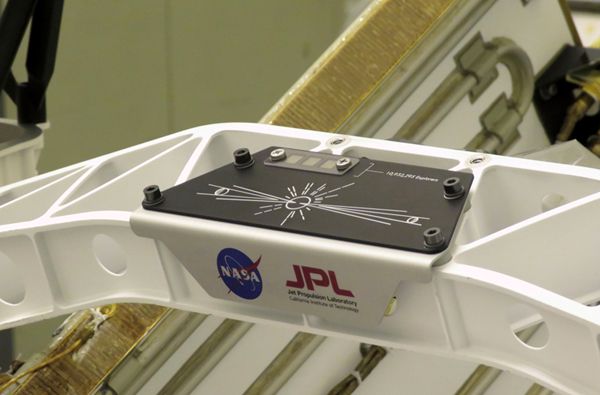
A placard containing three microchips bearing the names of 10.9 million people is attached to the Perseverance Mars rover at NASA's Kennedy Space Center in Florida.
NASA / JPL - Caltech

10.9 Million Names Now Aboard NASA's Perseverance Mars Rover (News Release)

As part of NASA's 'Send Your Name to Mars' campaign, they've been stenciled onto three microchips along with essays from NASA's 'Name the Rover' contest. Next stop: Mars.

NASA's "Send Your Name to Mars" campaign invited people around the world to submit their names to ride aboard the agency's next rover to the Red Planet. Some 10,932,295 people did just that. The names were stenciled by electron beam onto three fingernail-sized silicon chips, along with the essays of the 155 finalists in NASA's "Name the Rover" contest. The chips were then attached to an aluminum plate on NASA's Perseverance Mars rover at Kennedy Space Center in Florida on March 16. Scheduled to launch this summer, Perseverance will land at Jezero Crater on Feb. 18, 2021.

The three chips share space on the anodized plate with a laser-etched graphic depicting Earth and Mars joined by the star that gives light to both. While commemorating the rover that connects the two worlds, the simple illustration also pays tribute to the elegant line art of the plaques aboard the Pioneer spacecraft and golden records carried by Voyagers 1 and 2. Affixed to the center of the rover's aft crossbeam, the plate will be visible to cameras on Perseverance's mast.

Currently, the coronavirus has not impacted the Mars Perseverance rover launch schedule. The installation was one of numerous recent activities performed by the Perseverance assembly, test and launch operations team. On March 21, the team began reconfiguring the rover so it can ride atop the Atlas V rocket. Steps included stowing the robotic arm, lowering and locking in place the remote sensing mast and high-gain antenna, and retracting its legs and wheels.

The Perseverance rover is a robotic scientist weighing just under 2,300 pounds (1,043 kilograms). It will search for signs of past microbial life, characterize Mars' climate and geology, collect samples for future return to Earth, and help pave the way for human exploration of the Red Planet.

JPL, a division of Caltech in Pasadena, is building and will manage operations of the Mars Perseverance rover for NASA. The agency's Launch Services Program, based at the agency's Kennedy Space Center in Florida, is responsible for launch management. The Mars 2020 project with its Perseverance rover is part of a larger program that includes missions to the Moon as a way to prepare for human exploration of the Red Planet. Charged with returning astronauts to the Moon by 2024, NASA will establish a sustained human presence on and around the Moon by 2028 through NASA's Artemis lunar exploration plans.

Source: Jet Propulsion Laboratory

****

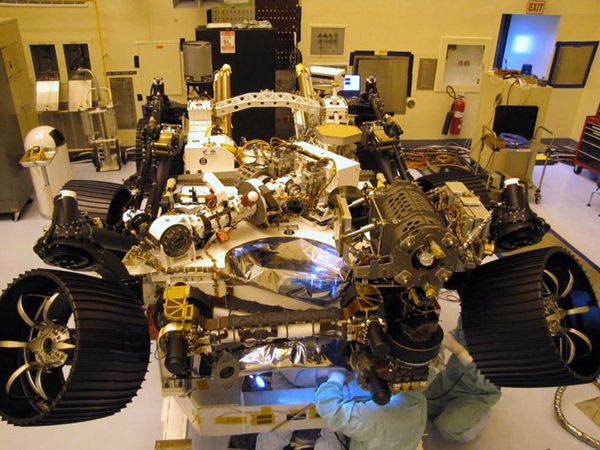
The Perseverance Mars rover undergoes launch processing at NASA's Kennedy Space Center in Florida.
NASA / JPL - Caltech

Wednesday, March 11, 2020

Now That the COVID-19 Outbreak Has Become a Pandemic...

HEALTH TIPS: How to avoid getting the novel coronavirus...

- Wash your hands completely and often. Use soap and water for at least 20 seconds.

- Use an alcohol-based hand sanitizing rub (must have at least 60% alcohol).

- Avoid touching your eyes, nose and mouth with unwashed hands.

- Cover your mouth and nose when you cough or sneeze by coughing/sneezing into a tissue or inside of your elbow.

- Immediately throw away tissues in a trash can after use.

- Keep a safe distance of at least 6 feet between yourself and others. Stay home as much as possible.

- Clean highly touched surfaces thoroughly using soap and water.

- Stay home when you are sick except for getting medical care. Follow your doctor’s instructions.

- Avoid shaking hands.

- Avoid close contact with people who are sick.

- And lastly, DO NOT hoard supplies like toilet paper, gloves and/or face masks from supermarkets and other stores!

Social distance, everyone! And stay safe.

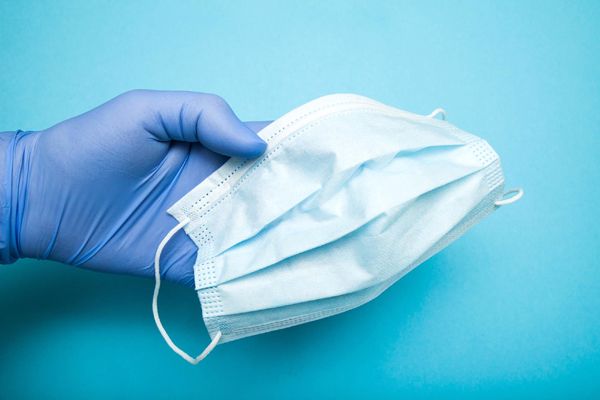
Wearing a face mask and gloves might become very important during this coronavirus pandemic...

Thursday, March 05, 2020

Meet PERSEVERANCE: The Mars 2020 Rover Finally Has An Official Name!

The Perseverance Mars rover undergoes launch processing at NASA's Kennedy Space Center in Florida.
NASA

Virginia Middle School Student Earns Honor of Naming NASA's Next Mars Rover (News Release)

NASA chose seventh-grader from Virginia as winner of the agency's "Name the Rover" essay contest. Alexander Mather's entry for "Perseverance" was voted tops among 28,000 entries.

NASA's next Mars rover has a new name - Perseverance.

The name was announced Thursday by Thomas Zurbuchen, associate administrator of the Science Mission Directorate, during a celebration at Lake Braddock Secondary School in Burke, Virginia. Zurbuchen was at the school to congratulate seventh grader Alexander Mather, who submitted the winning entry to the agency's "Name the Rover" essay contest, which received 28,000 entries from K-12 students from every U.S. state and territory.

"Alex's entry captured the spirit of exploration," said Zurbuchen. "Like every exploration mission before, our rover is going to face challenges, and it's going to make amazing discoveries. It's already surmounted many obstacles to get us to the point where we are today - processing for launch. Alex and his classmates are the Artemis Generation, and they're going to be taking the next steps into space that lead to Mars. That inspiring work will always require perseverance. We can't wait to see that nameplate on Mars."

Perseverance is the latest in a long line of Red Planet rovers to be named by school-age children, from Sojourner in 1997 to the Spirit and Opportunity rovers, which landed on Mars in 2004, to Curiosity, which has been exploring Mars since 2012. In each case, the name was selected following a nationwide contest.

The contest that resulted in Alex's winning entry of Perseverance began Aug. 28, 2019. Nearly 4,700 volunteer judges - educators, professionals and space enthusiasts from around the country - reviewed submissions to help narrow the pool down to 155 semifinalists. Once that group was whittled down to nine finalists, the public had five days to weigh in on their favorites, logging more than 770,000 votes online, with the results submitted to NASA for consideration. The nine finalists also talked with a panel of experts, including Lori Glaze, director of NASA's Planetary Science Division; NASA astronaut Jessica Watkins; rover driver Nick Wiltsie at NASA's Jet Propulsion Laboratory in California; and Clara Ma, who, as a sixth-grade student in 2009, named Curiosity.

Up until two years ago, Mather was more interested in video games than space. That all changed in the summer of 2018, when he visited Space Camp in Alabama. From his first glimpse of a Saturn V - the rocket that launched the Apollo astronauts to the Moon half a century ago - Mather became a bona fide space enthusiast, checking NASA.gov daily, consuming astronaut autobiographies and even 3D-printing flyable model rockets. When the call went out for students to propose a name for NASA's new Mars rover, Mather knew he wanted to contribute.

"This was a chance to help the agency that put humans on the Moon and will soon do it again," said Mather. "This Mars rover will help pave the way for human presence there, and I wanted to try and help in any way I could. Refusal of the challenge was not an option."

Along with forever being associated with the mission, Mather will also receive an invitation to travel with his family to Cape Canaveral Air Force Station in Florida to witness the rover begin its journey when it launches this summer. While Mather has received NASA's grand prize in this competition, NASA also is acknowledging the valuable contributions of the semifinalists whose entries were among the top ones considered.

"They came so far, and their expressive submissions helped make this naming contest the biggest and best in NASA history," said Glaze, who also attended the event Thursday. "So, we decided to send them a little farther - 314 million miles farther. All 155 semifinalists' proposed rover names and essays have been stenciled onto a silicon chip with lines of text smaller than one-thousandth the width of a human hair and will be flown to Mars aboard the rover."

NASA's Perseverance rover is a robotic scientist weighing just under 2,300 pounds (1,043 kilograms). Managed for the agency by JPL, the rover's astrobiology mission includes searching for signs of past microbial life. It also will characterize the planet's climate and geology, and collect samples of Martian rocks and dust for a future Mars Sample Return mission to Earth while paving the way for human exploration of the Red Planet.

"When word went out during the naming event here at JPL, I took a moment to look around the auditorium," said John McNamee, project manager of the Mars 2020 Perseverance rover mission at JPL. "I saw all these dedicated men and women who for years have invested the full measure of their intellect and stamina into the most technologically advanced rover mission in history - and I saw a lot of smiling faces and high-fives. Perseverance? You bet, that is a worthy name that we can be proud of as the first leg of a sample return campaign."

Perseverance currently is undergoing final assembly and checkout at NASA's Kennedy Space Center in Florida. It's targeted to land at Mars' Jezero Crater a little after 3:40 p.m. EST (12:40 p.m. PST) Feb. 18, 2021.

The rover naming contest partnership was part of a Space Act Agreement in educational and public outreach efforts between NASA, Battelle of Columbus, Ohio, and Future Engineers of Burbank, California. Amazon Web Services is an additional prize provider for the Mars 2020 naming contest and will provide Alex and his family a trip to see the launch.

Mars 2020 is part of a larger program that includes missions to the Moon as a way to prepare for human exploration of the Red Planet. Charged with landing the first woman and the next man on the Moon by 2024, NASA will establish a sustained human presence on and around the Moon by 2028 through NASA's Artemis program.

Source: Jet Propulsion Laboratory

****

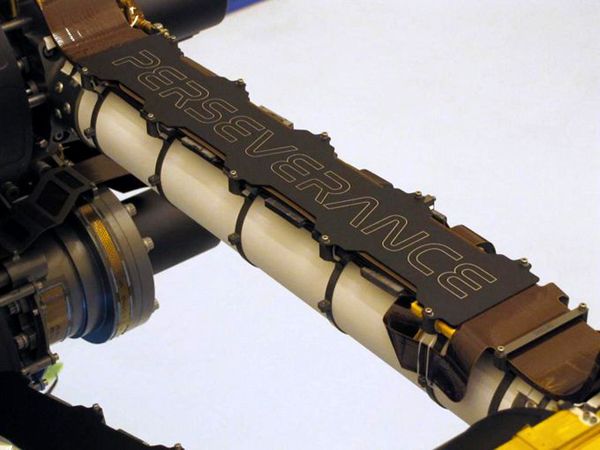
The nameplate for the Perseverance Mars rover is attached to the spacecraft's robotic arm at NASA's Kennedy Space Center in Florida.
NASA