Earlier today, the U.S. House of Representatives unanimously passed (at 420-0) a non-binding resolution calling for the Department of Justice to publicly release Robert Mueller's report on the Trump-Russia investigation once it is completed. Shortly afterwards, however, Republican senator Lindsey Graham vowed to block the resolution from being taken up in the U.S. Senate...citing that the measure should be voted on only if a special counsel was appointed to investigate Hillary Clinton's e-mails as well. This is despite the fact that Hillary was cleared of any wrongdoing by the FBI before the 2016 presidential election, and Hillary has been out of public office since that time.
House-passed Mueller resolution should be amended to include appointment of a Special Counsel to:
*) Investigate alleged misconduct around the handling of the Clinton email investigation.
*) Investigate the abuse of the FISA warrant process against Mr. Carter Page.
All I can say is...how is it that a good man like Jeopardy host Alex Trebek is dealing with stage 4 pancreatic cancer, and yet a traitorous, compromised piece of shit like Lindsey Graham will continue to live on and tweet stupid crap like the post above? Note to Graham: What does Donald Trump (and Vladimir Putin) have on you, douchebag? Were you that achin' to become Trump's patsy after your good friend (and true American) John McCain passed away last year? You're despicable. Since Paul Ryan is no longer in office, and I can't talk trash about him anymore, I now devote the caption below to you, asshole...
Opportunity's Parting Shot Was a Beautiful Panorama (News Release)
Over 29 days last spring, NASA's Mars Exploration Rover Opportunity documented this 360-degree panorama from multiple images taken at what would become its final resting spot in Perseverance Valley. Located on the inner slope of the western rim of Endeavour Crater, Perseverance Valley is a system of shallow troughs descending eastward about the length of two football fields from the crest of Endeavour's rim to its floor.
"This final panorama embodies what made our Opportunity rover such a remarkable mission of exploration and discovery," said Opportunity project manager John Callas of NASA's Jet Propulsion Laboratory in Pasadena, California. "To the right of center you can see the rim of Endeavor Crater rising in the distance. Just to the left of that, rover tracks begin their descent from over the horizon and weave their way down to geologic features that our scientists wanted to examine up close. And to the far right and left are the bottom of Perseverance Valley and the floor of Endeavour crater, pristine and unexplored, waiting for visits from future explorers."
The trailblazing mission ended after nearly 15 years of exploring the surface of Mars, but its legacy will live on. Opportunity's scientific discoveries contributed to our unprecedented understanding of the planet's geology and environment, laying the groundwork for future robotic and human missions to the Red Planet.
The panorama is composed of 354 individual images provided by the rover's Panoramic Camera (Pancam) from May 13 through June 10, or sols (Martian days) 5,084 through 5,111. This view combines images taken through three different Pancam filters. The filters admit light centered on wavelengths of 753 nanometers (near-infrared), 535 nanometers (green) and 432 nanometers (violet).
A few frames (bottom left) remain black and white, as the solar-powered rover did not have the time to record those locations using the green and violet filters before a severe Mars-wide dust storm swept in on June 2018.
The gallery includes the last images Opportunity obtained during its mission (black-and-white thumbnail images from the Pancam that were used to determine how opaque the sky was on its last day) and also the last piece of data the rover transmitted (a "noisy," incomplete full-frame image of a darkened sky).
After eight months of effort and sending more than a thousand commands in an attempt to restore contact with the rover, NASA declared Opportunity's mission complete on Feb. 13, 2019.
JPL, a division of the California Institute of Technology in Pasadena, managed the Mars Exploration Rover Project for NASA's Science Mission Directorate in Washington.
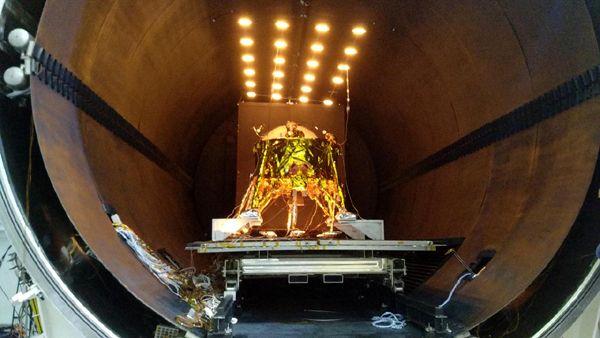
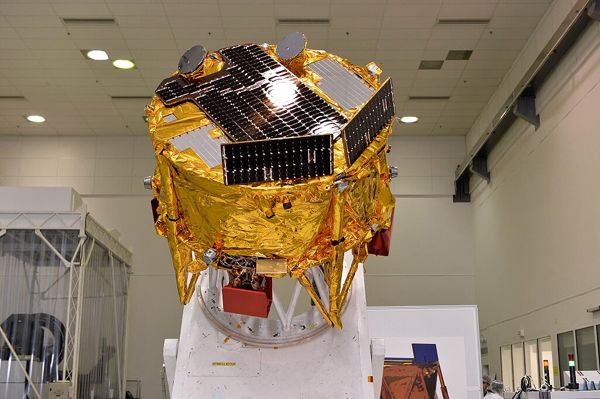
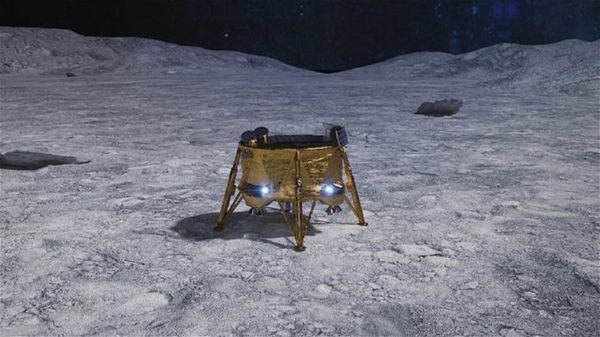
Just thought I'd share this cool pic taken by Israel's Beresheet lunar lander on March 3...from a distance of 37,600 kilometers (23,369 miles) from Earth. As of today, the 4-legged spacecraft is now 270,000 kilometers (167,806 miles) from our home planet—after firing its main engine for 152 seconds to bring its elliptical orbit ever so closer to the Moon.
Beresheet is set to touch down on the Moon's surface on April 11...exactly one week after the craft enters lunar orbit.
Gabriel Perez Diaz / Instituto de Astrofísica de Canarias
Discovery Alert! Kepler's First Planet Candidate Confirmed, 10 Years Later (News Release - March 5)
Despite being the very first planet candidate discovered by NASA’s Kepler space telescope, Kepler-1658b had a rocky road to confirmation. The initial estimate of the planet’s host star was off, so the sizes of both the star and Kepler-1658b were vastly underestimated. It was later marked as a false positive — that is, scientists thought the data did not really point to a planet — when the numbers didn’t quite add up for the effects seen on its star for a body of that size. Kepler-1658b moved from planet candidate to false positive and back until new software was used to refine the data and reclassify it, changing it from a data anomaly to possible planet.
Fortuitously, a team at the University of Hawaii was poised to step in at just the right time. As part of her first year research project, lead author Ashley Chontos, a graduate student with the university’s Institute for Astronomy, went back through Kepler data looking for targets to reanalyze in 2017.
“Our new analysis, which uses stellar sound waves observed in the Kepler data to characterize the star, demonstrated that the star is in fact three times larger than previously thought. This in turn means that the planet is three times larger, revealing that Kepler-1658b is actually a hot Jupiter,” Chontos said. With this refined analysis, everything pointed to it being a real planet. Next came confirmation.
“We alerted Dave Latham (a senior astronomer at the Smithsonian Astrophysical Observatory, and co-author on the paper) and his team collected the necessary spectroscopic data to unambiguously show that Kepler-1658b is a planet,” said Dan Huber, co-author and astronomer at the University of Hawaii. “As one of the pioneers of exoplanet science and a key figure behind the Kepler mission, it was particularly fitting to have Dave be part of this confirmation.”
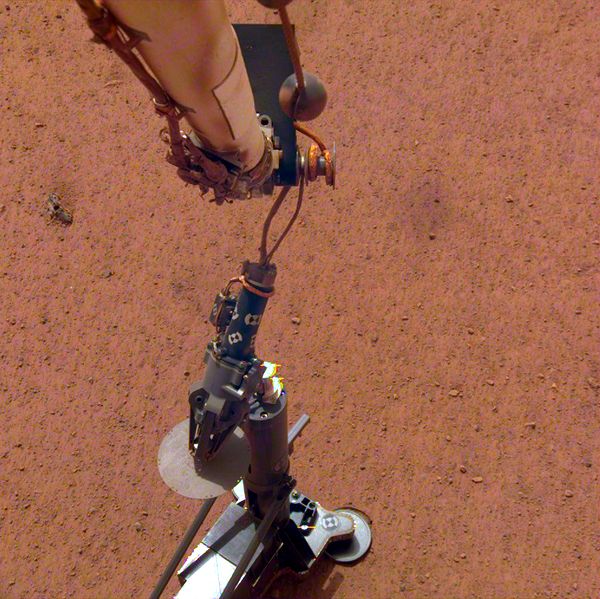
Mars InSight Lander's 'Mole' Pauses Digging (News Release)
NASA's Mars InSight lander has a probe designed to dig up to 16 feet (5 meters) below the surface and measure heat coming from inside the planet. After beginning to hammer itself into the soil on Thursday, Feb. 28, the 16-inch-long (40-centimeter-long) probe — part of an instrument called the Heat and Physical Properties Package, or HP3 — got about three-fourths of the way out of its housing structure before stopping. No significant progress was seen after a second bout of hammering on Saturday, March 2. Data suggests the probe, known as a "mole," is at a 15-degree tilt.
Scientists suspect it hit a rock or some gravel. The team had hoped there would be relatively few rocks below ground, given how few appear on the surface beside the lander. Even so, the mole was designed to push small rocks aside or wend its way around them. The instrument, which was provided for InSight by the German Aerospace Center (DLR), did so repeatedly during testing before InSight launched.
"The team has decided to pause the hammering for now to allow the situation to be analyzed more closely and jointly come up with strategies for overcoming the obstacle," HP3 Principal Investigator Tilman Spohn of DLR wrote in a blog post. He added that the team wants to hold off from further hammering for about two weeks.
Data show that the probe itself continues to function as expected: After heating by about 18 degrees Fahrenheit, it measures how quickly that heat dissipates in the soil. This property, known as thermal conductivity, helps calibrate sensors embedded in a tether trailing from the back of the mole. Once the mole is deep enough, these tether sensors can measure Mars' natural heat coming from inside the planet, which is generated by radioactive materials decaying and energy left over from Mars' formation.
The team will be conducting further heating tests this week to measure the thermal conductivity of the upper surface. They will also use a radiometer on InSight's deck to measure temperature changes on the surface. Mars' moon Phobos will pass in front of the Sun several times this week; like a cloud passing overhead, the eclipse will darken and cool the ground around InSight.
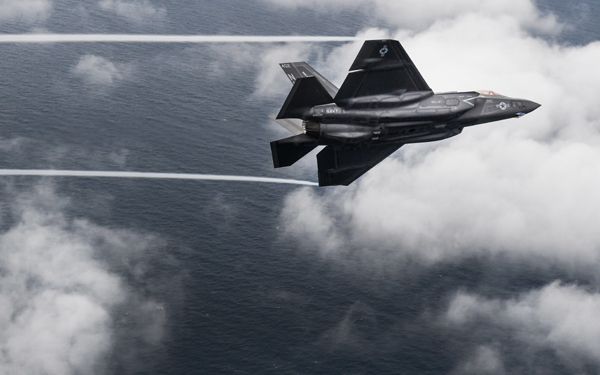
U.S. Navy photo by Chief Mass Communication Specialist Shannon E. Renfroe / Released
F-35C Achieves Initial Operational Capability (Press Release - February 28)
SAN DIEGO (NNS) -- The Commander, Naval Air Forces and the U.S. Marine Corps Deputy Commandant for Aviation jointly announced that the aircraft carrier variant of the Joint Strike Fighter, the F-35C Lightning II, met all requirements and achieved Initial Operational Capability (IOC).
The Feb. 28 announcement comes shortly after the Department of the Navy’s first F-35C squadron, Strike Fighter Squadron (VFA) 147, completed aircraft carrier qualifications aboard USS Carl Vinson(CVN 70) and received Safe-For-Flight Operations Certification.
In order to declare IOC, the first operational squadron must be properly manned, trained and equipped to conduct assigned missions in support of fleet operations. This includes having 10 Block 3F, F-35C aircraft, requisite spare parts, support equipment, tools, technical publications, training programs and a functional Autonomic Logistic Information System (ALIS).
Additionally, the ship that supports the first squadron must possess the proper infrastructure, qualifications and certifications. Lastly, the Joint Program Office, industry, and Naval Aviation must demonstrate that all procedures, processes and policies are in place to sustain operations.
“The F-35C is ready for operations, ready for combat and ready to win,” said Commander Naval Air Forces, Vice Admiral DeWolfe Miller. “We are adding an incredible weapon system into the arsenal of our Carrier Strike Groups that significantly enhances the capability of the joint force.”
Naval Air Station (NAS) Lemoore is the home-base for the Navy’s Joint Strike Fighter Wing, Navy F-35C fleet squadrons and the Fleet Replacement Squadron (FRS), VFA-125 that trains Navy and Marine Corps CVN-based Joint Strike Fighter pilots. To accommodate the F-35C program at NAS Lemoore, several facilities were built or remodeled to facilitate specific F-35C requirements with regard to maintenance and training, including a Pilot Fit Facility, Centralized Engine Repair Facility, Pilot Training Center and a newly-remodeled hangar. Future projects are planned as additional Navy squadrons transition into the F-35C. The Marine Corps plans to transition four F-35C squadrons that will be assigned to Carrier Air Wings for deployments.
“We’re very proud of what our Sailors have accomplished in the Joint Strike Fighter community,” said CAPT Max McCoy, commodore of the U.S. Navy’s Joint Strike Fighter Wing. “Their commitment to mission delivered fifth generation capability to the carrier air wing, making us more combat effective than ever before. We will continue to learn and improve ways to maintain and sustain F-35C as we prepare for first deployment. The addition of F-35C to existing Carrier Air Wing capability ensures that we can fight and win in contested battlespace now and well into the future.”
Meanwhile, Rear Admiral Dale Horan, director, USN F-35C Fleet Integration Office said, “The F-35C will revolutionize capability and operating concepts of aircraft carrier-based naval aviation using advanced technologies to find, fix and assess threats and, if necessary, track, target and engage them in all contested environments,” adding “This accomplishment represents years of hard work on the part of the F-35 Joint Program Office and Naval Aviation Enterprise. Our focus has now shifted to applying lessons learned from this process to future squadron transitions, and preparing VFA-147 for their first overseas deployment.”
The mission-ready F-35C is the latest addition to U.S. Navy’s Carrier Air Wing. With its stealth technology, state-of-the-art avionics, advanced sensors, weapons capacity and range, the aircraft carrier-based F-35C provides unprecedented air superiority, interdiction, suppression of enemy air defenses and close-air-support as well as advanced command and control functions through fused sensors. These state-of-the art capabilities provide pilots and combatant commanders unrivaled battlespace awareness and lethality. The F-35C is the final U.S. Joint Strike Fighter variant to declare IOC and follows the USAF’s F-35A and USMC’s F-35B. IOC declaration is a significant milestone.
Just thought I'd end this month with these pictures that I took at Barnes & Noble in L.A.'s The Grove on February 2...when Gina Rodriguez (of the hit CW TV show Jane the Virgin and the recent dramatic thriller Miss Bala—which I posted a brief entry about on my Film Blog) made an appearance to promote the new book Who in the World Is Carmen Sandiego?(which is based on the Netflix animated series where Ms. Rodriguez voices the titular character). Ms. Rodriguez was so awesome and sweet in person; she was stoked when I told her that I watched Miss Bala at the theater the day before (and gave me a high-five in response)! I was so caught up in the moment while talking to Rodriguez that I almost walked away before taking a photo with her... It's a good thing that the professional photographer who took pictures of Gina posing with her fans at the signing stopped and reminded me before it was too late! Heh.
Anyways, for those of you who are fans of Jane the Virgin (I worked as a background actor on a few episodes of the show over the years), the fifth and final season premieres on The CW on March 27. Happy Thursday!
NASA / Johns Hopkins Applied Physics Laboratory / Southwest Research Institute, National Optical Astronomy Observatory
New Horizons Spacecraft Returns Its Sharpest Views of Ultima Thule (News Release - February 22)
The mission team called it a "stretch goal" – just before closest approach, precisely pointing the cameras on NASA's New Horizons spacecraft to snap the sharpest possible pictures of the Kuiper Belt object nicknamed Ultima Thule, its New Year's flyby target and the farthest object ever explored.
Now that New Horizons has sent those stored flyby images back to Earth, the team can enthusiastically confirm that its ambitious goal was met.
These new images of Ultima Thule – obtained by the telephoto Long-Range Reconnaissance Imager (LORRI) just six-and-a-half minutes before New Horizons’ closest approach to the object (officially named 2014 MU69) at 12:33 a.m. EST on Jan. 1, 2019 – offer a resolution of about 110 feet (33 meters) per pixel. Their combination of high spatial resolution and a favorable viewing angle gives the team an unprecedented opportunity to investigate the surface, as well as the origin and evolution, of Ultima Thule, which is thought to be the most primitive object ever encountered by a spacecraft.
"Bullseye!” said New Horizons Principal Investigator Alan Stern, of the Southwest Research Institute (SwRI). “Getting these images required us to know precisely where both tiny Ultima and New Horizons were — moment by moment – as they passed one another at over 32,000 miles per hour in the dim light of the Kuiper Belt, a billion miles beyond Pluto. This was a much tougher observation than anything we had attempted in our 2015 Pluto flyby.
“These 'stretch goal' observations were risky, because there was a real chance we'd only get part or even none of Ultima in the camera's narrow field of view,” Stern continued. “But the science, operations and navigation teams nailed it, and the result is a field day for our science team! Some of the details we now see on Ultima Thule’s surface are unlike any object ever explored before.”
The higher resolution brings out a many surface features that weren’t readily apparent in earlier images. Among them are several bright, enigmatic, roughly circular patches of terrain. In addition, many small, dark pits near the terminator (the boundary between the sunlit and dark sides of the body) are better resolved. “Whether these features are craters produced by impactors, sublimation pits, collapse pits, or something entirely different, is being debated in our science team,” said John Spencer, deputy project scientist from SwRI.
Project Scientist Hal Weaver, of the Johns Hopkins Applied Physics Laboratory, noted that the latest images have the highest spatial resolution of any New Horizons has taken – or may ever take – during its entire mission. Swooping within just 2,200 miles (3,500 kilometers), New Horizons flew approximately three times closer to Ultima than it zipped past its primary mission target, Pluto, in July 2015.
Ultima is a smaller object than Pluto, but the Ultima flyby was done with the highest navigation precision ever achieved by any spacecraft before. This unprecedented precision was achieved thanks to the ground-based occultation campaigns from 2017 and 2018 conducted in Argentina, Senegal, South Africa and Colombia, as well as the European Space Agency’s Gaia mission, which provided the locations of the stars that were used during the occultation campaigns.
Look for these and other LORRI images on the New Horizons LORRI website this week. Raw images from the camera are posted to the site each Friday.
Mission operations manager Alice Bowman, of APL, reports that the spacecraft continues to operate flawlessly. New Horizons is nearly 4.13 billion miles (6.64 billion kilometers) from Earth; at that distance, radio signals, traveling at light speed, reach the large antennas of NASA’s Deep Space Network six hours and nine minutes after New Horizons sends them. Follow New Horizons on its trek through the Kuiper Belt.
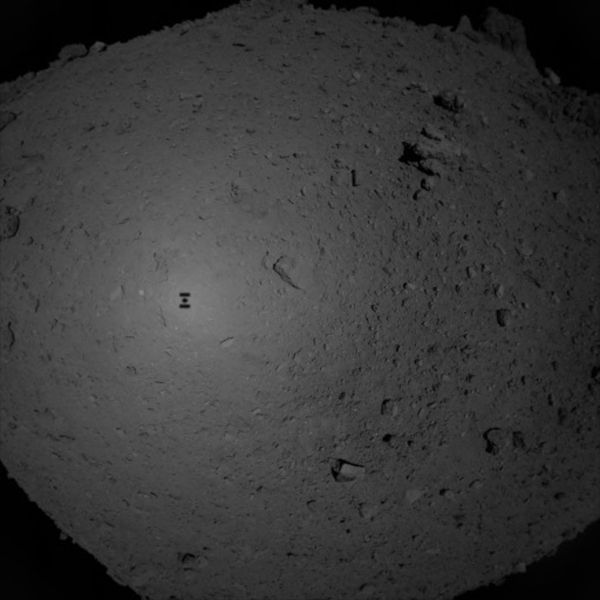
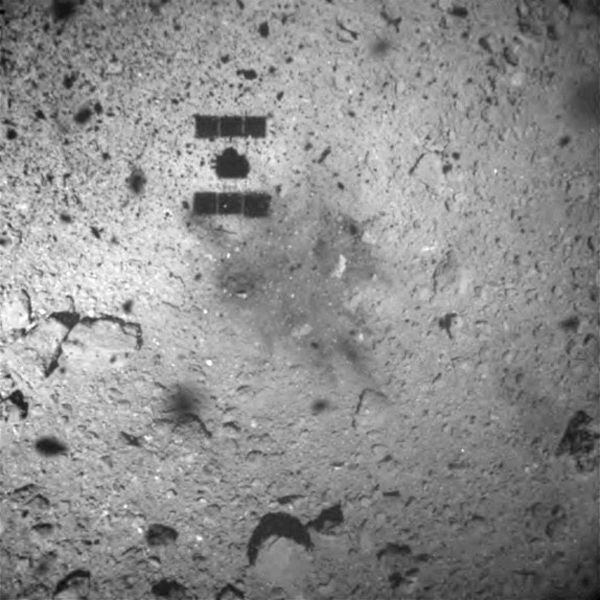
Hayabusa2 Latest Status, the Successful First Touchdown (Press Release)
The National Research and Development Agency's Japan Aerospace Exploration Agency (JAXA) executed the asteroid explorer Hayabusa2 operation to touch down on the surface of the target asteroid Ryugu for sample retrieval.
Data analysis from Hayabusa2 confirms that the sequence of operation proceeded, including shooting a projectile into the asteroid to collect its sample material. The Hayabusa2 spacecraft is in nominal state. This marks the Hayabusa2's successful touchdown on Ryugu.
NASA Administrator Statement on Israeli Moon Mission (Press Release)
The following is a statement from NASA Administrator Jim Bridenstine on Thursday’s launch of Israel’s first mission beyond Earth’s orbit. SpaceIL’s lander blasted off from Cape Canaveral Air Force Station in Florida, and now is on its way to becoming the first commercial lander to reach the Moon’s surface.
“Congratulations to SpaceIL and the Israel Space Agency. This is a historic step for all nations and commercial space as we look to extend our collaborations beyond low-Earth orbit and on to the Moon.
“In July, I was in Israel and was very impressed with their commitment to expanding their role in the world’s space community. As we better understand Israel’s capabilities and the innovative work of their private industry, we know they’ll be an even stronger international partner in the future, one vital to the success of extending commercial space to the Moon and eventually on to Mars and beyond. There are terrific opportunities awaiting Israel and all of us in advancing the space frontier.”
The Beresheet spacecraft will enter lunar orbit on April 4, and land on the surface of the Moon a week later on April 11.