Monday, August 18, 2014

Another Star Wars-Related Entry, Yo...

My fan logo for STAR WARS: EPISODE VII - EMPIRE OF RUIN.

Based on the rumors that I've read online, I'm convinced that a good title for Star Wars: Episode VII would be Empire of Ruin. The Empire still exists in the Galaxy 30 years after the events of Return of the Jedi (as proven with updated Stormtrooper helmets that leaked on the Web a while ago), and there is talk online that a possible villain for the J.J. Abrams-directed flick may be a Sith (Lord or Inquisitor?) named Darth Ruin. The Empire still alive and kicking + Darth Ruin running the show = Empire of Ruin. Also, this simple name is consistent with the three-worded monikers of The Phantom Menace and A New Hope that completed the titles for Episodes I and IV, respectively. Carry on.

An illustration of Darth Ruin.

Saturday, August 16, 2014

Image of the Day: The Sith Live On!

Normally, I'd post this type of info on my Film Notes page, but since this Blog has been a haven for spoilerific Star Wars news since Attack of the Clones and Revenge of the Sith almost a decade ago, just thought I'd share it here instead. To get more details on what you're looking at here, go to the Making Star Wars website. Known as the Sith Inquisitor, this villain will apparently be the main antagonist of Star Wars: Episode VII...which makes me even more stoked to see the film when it gets released in theaters nationwide on December 18, 2015. As excited as I am to see Stormtroopers grace the big screen again, I'm more eager to see a lightsaber-welding baddie wearing a black cloak wreaking havoc against Luke Skywalker and the rest of the Galaxy once more. This illustration, if legit, only validates my excitement. Sorry Jedi—but the Dark Side of the Force is much cooler!

An illustration that supposedly depicts the Sith Inquisitor from STAR WARS: EPISODE VII.

Thursday, August 14, 2014

Relics from Interstellar Space?

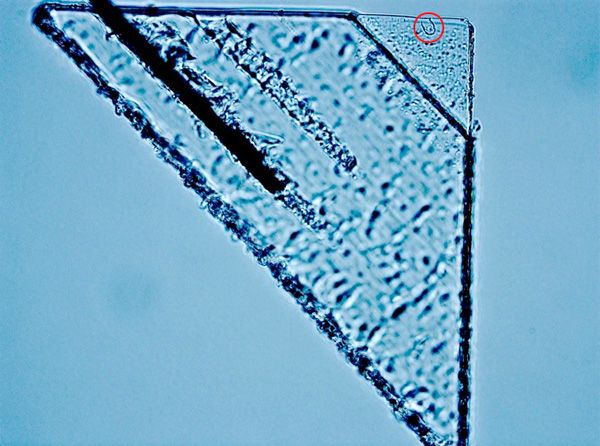
The biggest interstellar dust track discovered in the Stardust aerogel collectors was this 35 micron-long hole produced by a speck of dust that was probably traveling so fast that it disintegrated upon impact.
UC Berkeley / Andrew Westphal

Stardust Team Reports Discovery of First Potential Interstellar Space Particles (Press Release)

Seven rare, microscopic interstellar dust particles that date to the beginnings of the solar system are among the samples collected by scientists who have been studying the payload from NASA's Stardust spacecraft since its return to Earth in 2006. If confirmed, these particles would be the first samples of contemporary interstellar dust.

A team of scientists has been combing through the spacecraft's aerogel and aluminum foil dust collectors since Stardust returned in 2006.The seven particles probably came from outside our solar system, perhaps created in a supernova explosion millions of years ago and altered by exposure to the extreme space environment.

The research report appears in the Aug. 15 issue of the journal Science. Twelve other papers about the particles will appear next week in the journal Meteoritics & Planetary Science.

"These are the most challenging objects we will ever have in the lab for study, and it is a triumph that we have made as much progress in their analysis as we have," said Michael Zolensky, curator of the Stardust laboratory at NASA’s Johnson Space Center in Houston and coauthor of the Science paper.

Stardust was launched in 1999 and returned to Earth on Jan. 15, 2006, at the Utah Test and Training Range, 80 miles west of Salt Lake City. The Stardust Sample Return Canister was transported to a curatorial facility at Johnson where the Stardust collectors remain preserved and protected for scientific study.

Inside the canister, a tennis racket-like sample collector tray captured the particles in silica aerogel as the spacecraft flew within 149 miles of a comet in January 2004. An opposite side of the tray holds interstellar dust particles captured by the spacecraft during its seven-year, three-billion-mile journey.

Scientists caution that additional tests must be done before they can say definitively that these are pieces of debris from interstellar space. But if they are, the particles could help explain the origin and evolution of interstellar dust.

The particles are much more diverse in terms of chemical composition and structure than scientists expected. The smaller particles differ greatly from the larger ones and appear to have varying histories. Many of the larger particles have been described as having a fluffy structure, similar to a snowflake.

Two particles, each only about two microns (thousandths of a millimeter) in diameter, were isolated after their tracks were discovered by a group of citizen scientists. These volunteers, who call themselves "Dusters," scanned more than a million images as part of a University of California, Berkeley, citizen-science project, which proved critical to finding these needles in a haystack.

A third track, following the direction of the wind during flight, was left by a particle that apparently was moving so fast -- more than 10 miles per second (15 kilometers per second) -- that it vaporized. Volunteers identified tracks left by another 29 particles that were determined to have been kicked out of the spacecraft into the collectors.

Four of the particles reported in Science were found in aluminum foils between tiles on the collector tray. Although the foils were not originally planned as dust collection surfaces, an international team led by physicist Rhonda Stroud of the Naval Research Laboratory searched the foils and identified four pits lined with material composed of elements that fit the profile of interstellar dust particles.

Three of these four particles, just a few tenths of a micron across, contained sulfur compounds, which some astronomers have argued do not occur in interstellar dust. A preliminary examination team plans to continue analysis of the remaining 95 percent of the foils to possibly find enough particles to understand the variety and origins of interstellar dust.

Supernovas, red giants and other evolved stars produce interstellar dust and generate heavy elements like carbon, nitrogen and oxygen necessary for life. Two particles, dubbed Orion and Hylabrook, will undergo further tests to determine their oxygen isotope quantities, which could provide even stronger evidence for their extrasolar origin.

Scientists at Johnson have scanned half the panels at various depths and turned these scans into movies, which were then posted online, where the Dusters could access the footage to search for particle tracks.

Once several Dusters tag a likely track, Andrew Westphal, lead author of the Science article, and his team verify the identifications. In the one million frames scanned so far, each a half-millimeter square, Dusters have found 69 tracks, while Westphal has found two. Thirty-one of these were extracted along with surrounding aerogel by scientists at Johnson and shipped to UC Berkeley to be analyzed.

NASA's Jet Propulsion Laboratory, Pasadena, California, manages the Stardust mission for NASA's Science Mission Directorate, Washington. Lockheed Martin Space Systems, Denver, developed and operated the spacecraft.

Source: NASA.Gov

****

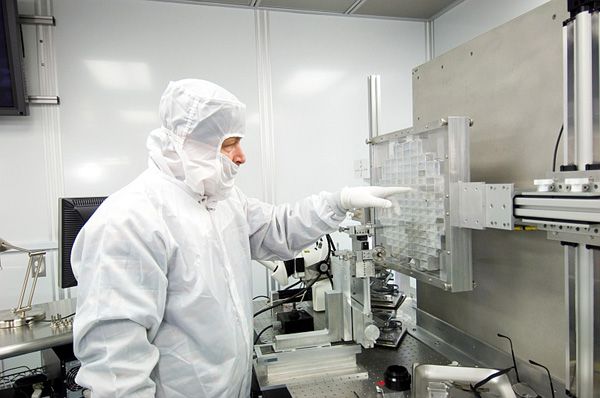
A scientist points at the location of one of the interstellar dust particles that impacted Stardust's aerogel collectors during their journey in space.
Andrew Westphal, UC Berkeley

Tuesday, August 12, 2014

Photos of the Day...

A photo that my friend Sarina took with her Fujifilm X100S camera, on August 6, 2014.

Just thought I'd share these pics that my friend Sarina took with a new camera that she recently bought (a Fujifilm X100S). FYI, these images were taken during an impromptu photo shoot... I would've wore a different shirt and shaved if this was planned, heh. From what another buddy told me on Facebook, aspiring actors (which I'm not, technically) typically dish out hundreds of bucks to get these high-quality photos as their headshots; it doesn't hurt that one of my high school pals is now a professional photographer (five years and counting, I believe)! One of these images now graces my IMDb page.

A photo that my friend Sarina took with her Fujifilm X100S camera, on August 6, 2014.

A photo that my friend Sarina took with her Fujifilm X100S camera, on August 6, 2014.

A photo that my friend Sarina took with her Fujifilm X100S camera, on August 6, 2014.

Sunday, August 10, 2014

Cool Space Stuff That Happened Above Hawaii...

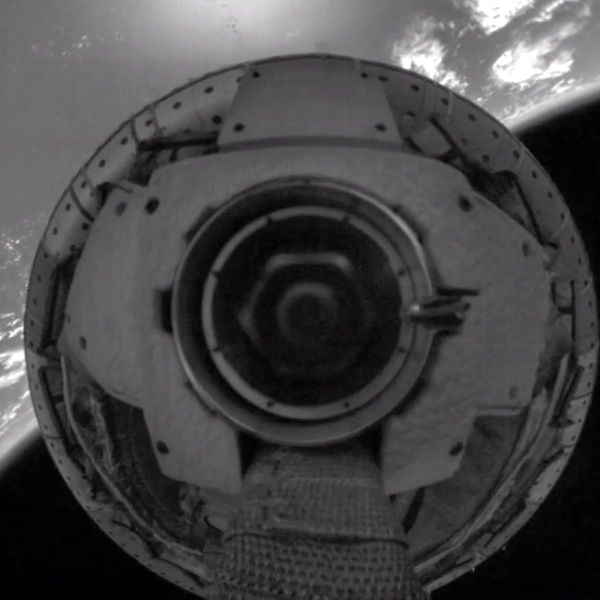
A high-speed camera shot of NASA's Low-Density Supersonic Decelerator (LDSD) soaring high above Hawaii...on June 28, 2014.
NASA / JPL - Caltech

Ride Shotgun With NASA Saucer As It Flies to Near Space (Press Release - August 8)

NASA's Low-Density Supersonic Decelerator (LDSD) project successfully flew a rocket-powered, saucer-shaped test vehicle into near-space in late June from the U.S. Navy's Pacific Missile Range Facility on Kauai, Hawaii. The goal of this experimental flight test, the first of three planned for the project, was to determine if the balloon-launched, rocket-powered, saucer-shaped, design could reach the altitudes and airspeeds needed to test two new breakthrough technologies destined for future Mars missions.

Carried as payload during the shakeout flight were two cutting-edge technologies scheduled to be tested next year aboard this same type of test vehicle. The Supersonic Inflatable Aerodynamic Decelerator (SIAD) is a large, doughnut-shaped air brake that deployed during the flight, helping slow the vehicle from 3.8 to 2 times the speed of sound. The second, the Supersonic Disksail Parachute, is the largest supersonic parachute ever flown. It has more than double the area of the parachute which was used for the Mars Science Laboratory (MSL) mission that carried the Curiosity rover to the surface of Mars.

"A good test is one where there are no surprises but a great test is one where you are able to learn new things, and that is certainly what we have in this case." said Ian Clark, principal investigator for LDSD at NASA's Jet Propulsion Laboratory in Pasadena, California. "Our test vehicle performed as advertised. The SIAD and ballute, which extracted the parachute, also performed beyond expectations. We also got significant insight into the fundamental physics of parachute inflation. We are literally re-writing the books on high-speed parachute operations, and we are doing it a year ahead of schedule."

Hitching a ride aboard the 7,000-pound saucer were several high-definition video cameras. The arresting imagery is providing the engineers and scientists on the LDSD project with never before seen insights into the dynamics involved with flying such a vehicle at high altitudes and Mach numbers.

"As far as I am concerned, whenever you get to ride shotgun on a rocket-powered flying saucer, it is a good day," said Clark. "We hope the video will show everyone how beautiful and awesome the test was, and to just to give folks an insight into what experimental flight test is all about."

The high-resolution images and video clips taken during the LDSD test flight are available at:

http://go.usa.gov/N5zm

The LDSD cross-cutting demonstration mission tested breakthrough technologies that will enable large payloads to be safely landed on the surface of Mars and allow access to more of the planet's surface by enabling landings at higher altitude sites.

NASA's Space Technology Mission Directorate funds the LDSD mission, a cooperative effort led by NASA's Jet Propulsion Laboratory in Pasadena, California. NASA's Technology Demonstration Mission program manages LDSD at NASA's Marshall Space Flight Center in Huntsville, Alabama. NASA's Wallops Flight Facility in Wallops Island, Virginia, coordinated support with the Pacific Missile Range Facility, provided the core electrical systems for the test vehicle, and coordinated the balloon and recovery services for the LDSD test.

Source: Jet Propulsion Laboratory

****

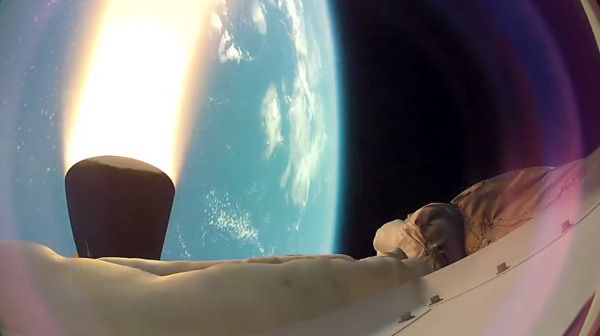
A high-def camera shot of NASA's LDSD rocketing high above Hawaii...on June 28, 2014.
NASA / JPL - Caltech

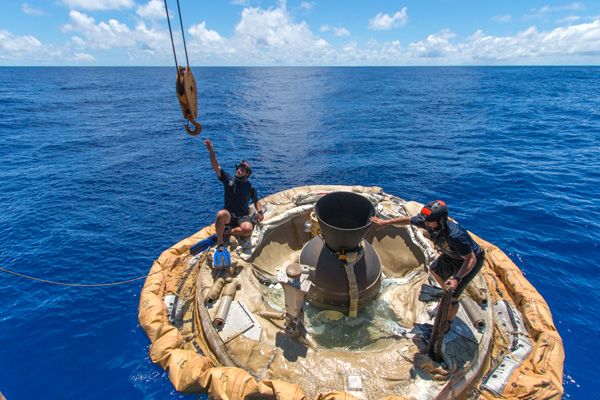
Divers recover NASA's LDSD off the coast of the U.S. Navy's Pacific Missile Range Facility in Hawaii...on June 28, 2014.
NASA / JPL - Caltech

Friday, August 08, 2014

New Horizons Update: A Dwarf Planet in Motion...

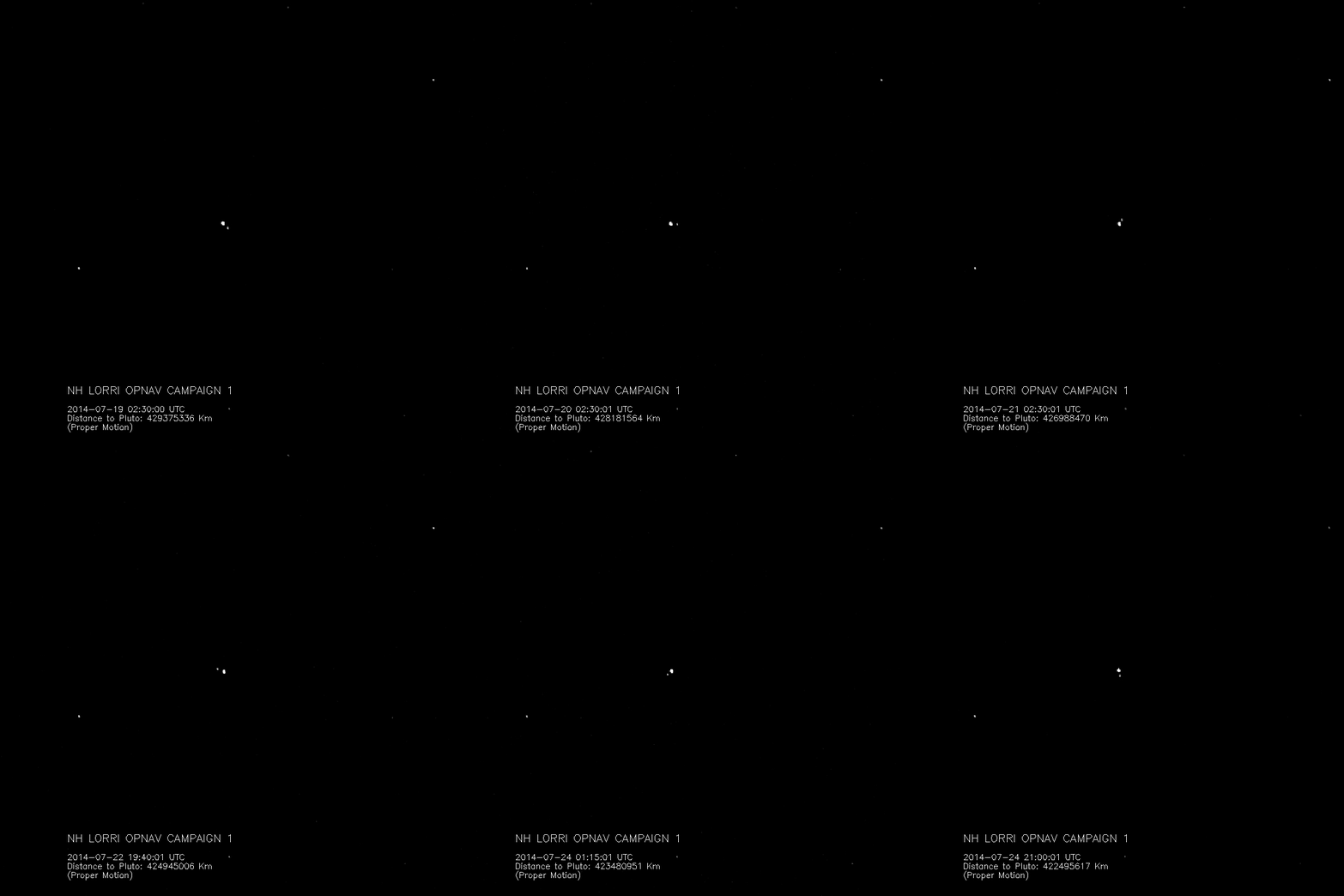
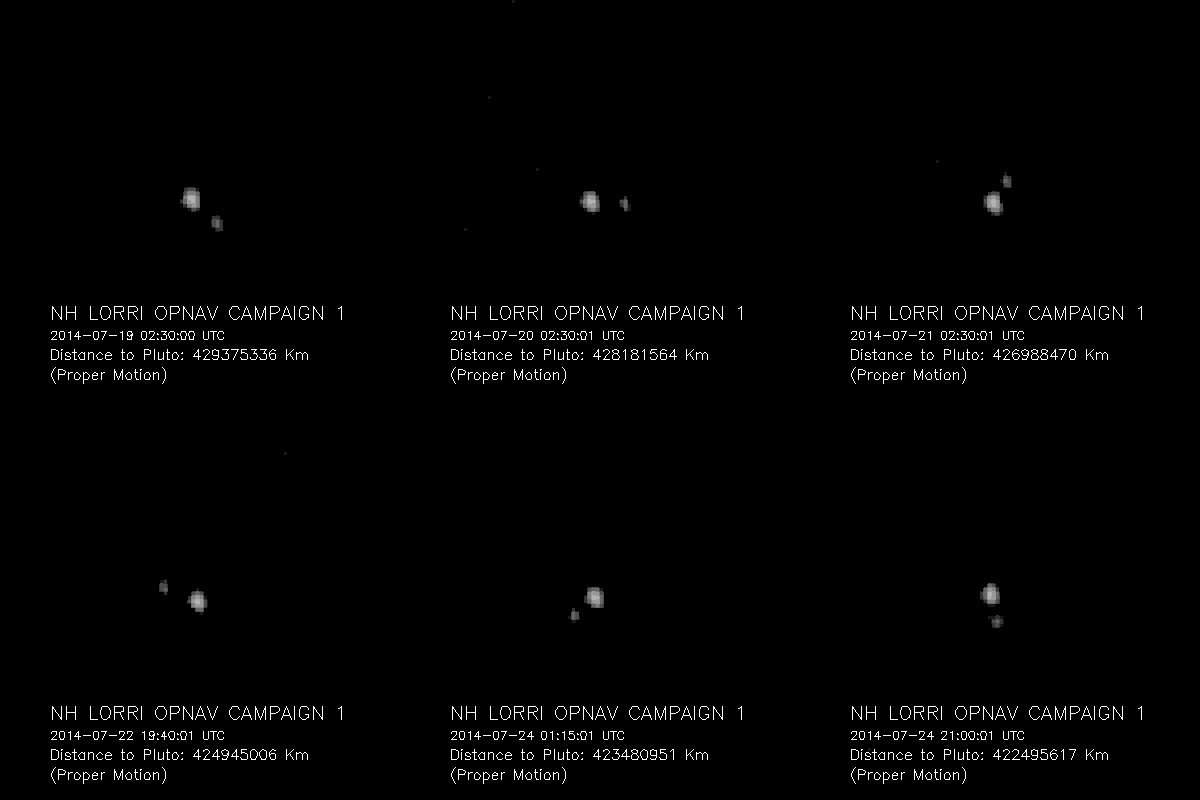
An animated GIF showing Charon orbiting Pluto...as seen from NASA's New Horizons spacecraft between July 19-24, 2014.
NASA / Johns Hopkins University Applied Physics Laboratory / Southwest Research Institute

New Horizons Spies Charon Orbiting Pluto (Press Release - August 7)

Like explorers of old peering through a shipboard telescope for a faint glimpse of their destination, NASA’s New Horizons spacecraft is taking a distant look at the Pluto system – in preparation for its historic encounter with the planet and its moons next summer.

“Filmed” with New Horizons’ best onboard telescope – the Long Range Reconnaissance Imager (LORRI) – this movie covers Pluto and almost one full rotation of its largest moon, Charon. The 12 images that make up the movie were taken July 19-24, from a distance ranging from about 267 million to 262 million miles (429 million to 422 million kilometers). Charon is orbiting approximately 11,200 miles (about 18,000 kilometers) above Pluto’s surface.

New Horizons snapped this image sequence as part of the mission’s first optical navigation campaign. The mission team uses these “op nav” images – which focus on Pluto’s position against a backdrop of stars – to fine-tune the distance that New Horizons will fly past Pluto and its moons. New Horizons is aiming for a precise close-approach point near Pluto in July 2015, so these and images to come – which help navigators and mission designers to get a better fix on Pluto’s position – are critical to planning the encounter operations.

Pluto’s four smaller satellites (Nix, Hydra, Styx and Kerberos) are too faint to be seen in these distant images, but will begin to appear in images taken next year as the spacecraft speeds closer to its target.

“The image sequence showing Charon revolving around Pluto set a record for close range imaging of Pluto—they were taken from 10 times closer to the planet than the Earth is,” says New Horizons mission Principal Investigator Alan Stern, of the Southwest Research Institute, Boulder, Colo. “But we’ll smash that record again and again, starting in January, as approach operations begin.

“We are really excited to see our target and its biggest satellite in motion from our own perch,” he adds, “less than a year from the historic encounter ahead!”

As August begins, New Horizons is near the end of its final pre-Pluto annual systems checkout and instrument calibration before Pluto arrival. The New Horizons mission operations team at the Johns Hopkins Applied Physics Laboratory in Laurel, Maryland, will put the spacecraft back into hibernation on August 29 – just four days after New Horizons crosses the orbit of Neptune on August 25.

That final “rest” lasts only until December 6, when New Horizons will stay wake for two years of Pluto encounter preparations, flyby operations, and data downlinks. Distant-encounter operations begin January 4, 2015.

Source: New Horizons Website

****

Another animated GIF showing Charon orbiting Pluto...as seen from NASA's New Horizons spacecraft between July 19-24, 2014.
NASA / Johns Hopkins University Applied Physics Laboratory / Southwest Research Institute

Wednesday, August 06, 2014

Welcome To Your New Home, Rosetta!

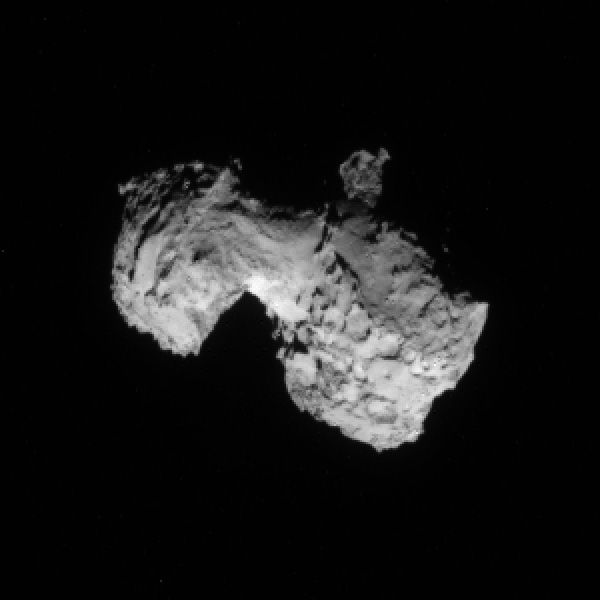
An image of comet 67P/Churyumov-Gerasimenko's nucleus, as seen by ESA's Rosetta spacecraft on August 3, 2014.

Rosetta Arrives at Comet Destination (Press Release)

After a decade-long journey chasing its target, ESA’s Rosetta has today become the first spacecraft to rendezvous with a comet, opening a new chapter in Solar System exploration.

Comet 67P/Churyumov–Gerasimenko and Rosetta now lie 405 million kilometres from Earth, about half way between the orbits of Jupiter and Mars, rushing towards the inner Solar System at nearly 55,000 kilometres per hour.

The comet is in an elliptical 6.5-year orbit that takes it from beyond Jupiter at its furthest point, to between the orbits of Mars and Earth at its closest to the Sun. Rosetta will accompany it for over a year as they swing around the Sun and back out towards Jupiter again.

Comets are considered to be primitive building blocks of the Solar System and may have helped to ‘seed’ Earth with water, perhaps even the ingredients for life. But many fundamental questions about these enigmatic objects remain, and through a comprehensive, in situ study of the comet, Rosetta aims to unlock the secrets within.

The journey to the comet was not straightforward, however. Since its launch in 2004, Rosetta had to make three gravity-assist flybys of Earth and one of Mars to help it on course to its rendezvous with the comet. This complex course also allowed Rosetta to pass by asteroids Å teins and Lutetia, obtaining unprecedented views and scientific data on these two objects.

“After ten years, five months and four days travelling towards our destination, looping around the Sun five times and clocking up 6.4 billion kilometres, we are delighted to announce finally ‘we are here’,” says Jean-Jacques Dordain, ESA’s Director General.

“Europe’s Rosetta is now the first spacecraft in history to rendezvous with a comet, a major highlight in exploring our origins. Discoveries can start.”

Today saw the last of a series of ten rendezvous manoeuvres that began in May to adjust Rosetta’s speed and trajectory gradually to match those of the comet. If any of these manoeuvres had failed, the mission would have been lost, and the spacecraft would simply have flown by the comet.

“Today’s achievement is a result of a huge international endeavour spanning several decades,” says Alvaro Giménez, ESA’s Director of Science and Robotic Exploration.

“We have come an extraordinarily long way since the mission concept was first discussed in the late 1970s and approved in 1993, and now we are ready to open a treasure chest of scientific discovery that is destined to rewrite the textbooks on comets for even more decades to come.”

The comet began to reveal its personality while Rosetta was on its approach. Images taken by the OSIRIS camera between late April and early June showed that its activity was variable. The comet’s ‘coma’ – an extended envelope of gas and dust – became rapidly brighter and then died down again over the course of those six weeks.

In the same period, first measurements from the Microwave Instrument for the Rosetta Orbiter, MIRO, suggested that the comet was emitting water vapour into space at about 300 millilitres per second.

Meanwhile, the Visible and Infrared Thermal Imaging Spectrometer, VIRTIS, measured the comet’s average temperature to be about –70ºC, indicating that the surface is predominantly dark and dusty rather than clean and icy.

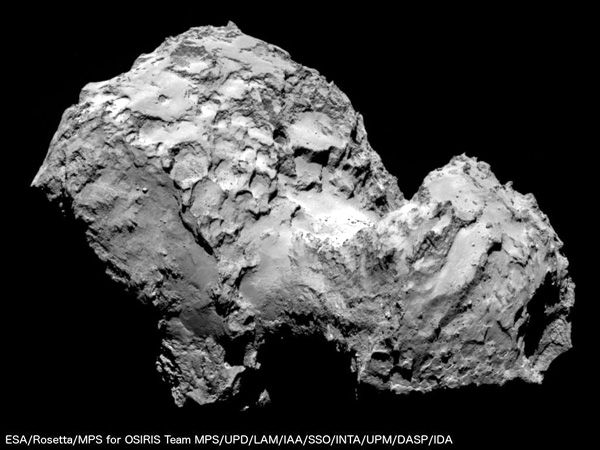
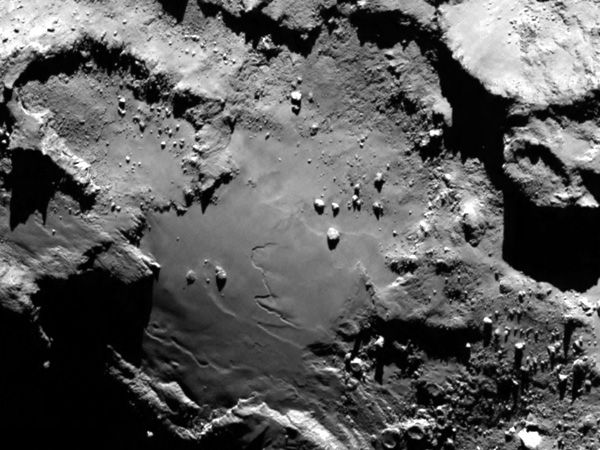
Then, stunning images taken from a distance of about 12,000 km began to reveal that the nucleus comprises two distinct segments joined by a ‘neck’, giving it a duck-like appearance. Subsequent images showed more and more detail – the most recent, highest-resolution image was downloaded from the spacecraft earlier today and will be available this afternoon.

“Our first clear views of the comet have given us plenty to think about,” says Matt Taylor, ESA’s Rosetta project scientist.

“Is this double-lobed structure built from two separate comets that came together in the Solar System’s history, or is it one comet that has eroded dramatically and asymmetrically over time? Rosetta, by design, is in the best place to study one of these unique objects.”

Today, Rosetta is just 100 km from the comet’s surface, but it will edge closer still. Over the next six weeks, it will describe two triangular-shaped trajectories in front of the comet, first at a distance of 100 km and then at 50 km.

At the same time, more of the suite of instruments will provide a detailed scientific study of the comet, scrutinising the surface for a target site for the Philae lander.

Eventually, Rosetta will attempt a close, near-circular orbit at 30 km and, depending on the activity of the comet, perhaps come even closer.

“Arriving at the comet is really only just the beginning of an even bigger adventure, with greater challenges still to come as we learn how to operate in this unchartered environment, start to orbit and, eventually, land,” says Sylvain Lodiot, ESA’s Rosetta spacecraft operations manager.

As many as five possible landing sites will be identified by late August, before the primary site is identified in mid-September. The final timeline for the sequence of events for deploying Philae – currently expected for 11 November – will be confirmed by the middle of October.

“Over the next few months, in addition to characterising the comet nucleus and setting the bar for the rest of the mission, we will begin final preparations for another space history first: landing on a comet,” says Matt.

“After landing, Rosetta will continue to accompany the comet until its closest approach to the Sun in August 2015 and beyond, watching its behaviour from close quarters to give us a unique insight and realtime experience of how a comet works as it hurtles around the Sun.”

Source: European Space Agency

****
An image of comet 67P/Churyumov-Gerasimenko's nucleus, as seen by ESA's Rosetta spacecraft on August 6, 2014.
ESA / Rosetta / MPS for OSIRIS Team MPS / UPD / LAM / IAA / SSO / INTA / UPM / DASP / IDA

Tuesday, August 05, 2014

Two (Earth) Years on the Red Planet and Counting...

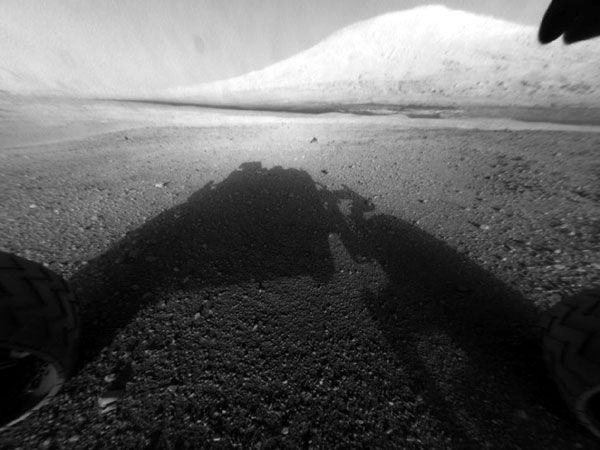
An image of Curiosity's shadow with Mount Sharp in the background...taken by one of the rover's hazard-avoidance cameras on August 5, 2012.
NASA / JPL - Caltech

Two Years Ago, Curiosity Rover Lands on Mars, Captures Image of Mount Sharp (Press Release)

This image was captured by NASA's Mars rover Curiosity shortly after it landed on the Red Planet on the evening of Aug. 5, 2012 PDT (morning of Aug. 6 EDT), near the foot of a mountain three miles tall and 96 miles in diameter inside Gale Crater. The image shows the rover's main science target, Mount Sharp. The rover's shadow can be seen in the foreground, and the dark bands beyond are dunes. Rising up in the distance is Mount Sharp, whose peak is 3.4 miles (5.5 kilometers) high, taller than Mt. Whitney in California. The actual summit is not visible from this vantage point -- the highest elevation seen in this view is about 2.5 miles (4 kilometers) above the rover.

On June 24, 2014, Curiosity completed one Martian year -- 687 Earth days -- having accomplished the mission's main goal of determining whether Mars once offered environmental conditions favorable for microbial life. One of Curiosity's first major findings after landing in August 2012 was an ancient riverbed at its landing site. Nearby, at an area known as Yellowknife Bay, the mission met its main goal of determining whether the Martian Gale Crater ever was habitable for simple life forms. The answer, a historic "yes," came from two mudstone slabs that the rover sampled with its drill. Analysis of these samples revealed the site was once a lakebed with mild water, the essential elemental ingredients for life, and a type of chemical energy source used by some microbes on Earth. If Mars had living organisms, this would have been a good home for them.

Source: NASA.Gov

****

Sunday, August 03, 2014

Only Four Months Left Till 2015!

Just thought I'd celebrate the fact that two-thirds of 2014 is now behind us and the Year of New Horizons (which arrives at the dwarf planet Pluto next July), Dawn (which arrives at the dwarf planet Ceres next February), Star Wars: Episode VII, Jurassic World and Avengers: Age of Ultron will soon be at hand. Marking this milestone with a meme that has absolutely nothing to do with what I just typed above...

I'm pretty sure that Ricky Bobby of TALLADEGA NIGHTS isn't a heavy drinker... Not.

Friday, August 01, 2014

Europe's Date with a Comet...

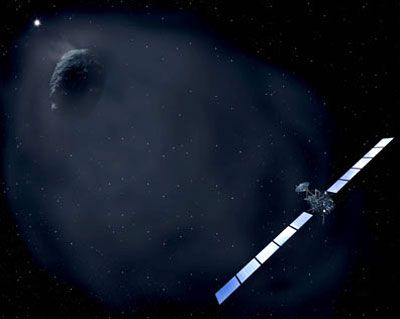
An artist's concept of ESA's Rosetta spacecraft approaching comet 67P/Churyumov-Gerasimenko.
ESA

How Rosetta Arrives at a Comet (Press Release)

After travelling nearly 6.4 billion kilometres through the Solar System, ESA’s Rosetta is closing in on its target. But how does a spacecraft actually arrive at a comet?

The journey began on 2 March 2004 when Rosetta was launched on an Ariane 5 from Europe’s Spaceport in Kourou, French Guiana.

Since then, Rosetta has looped around the Sun five times, picking up speed through three gravity-assist swingbys at Earth and one at Mars, to enter an orbit similar to that of its destination: comet 67P/Churyumov–Gerasimenko.

This icy target is in an elliptical 6.5-year solar circuit that takes it from beyond the orbit of Jupiter at its furthest point, and between the orbits of Mars and Earth at its closest to the Sun.

Rosetta’s goal is to match the pace of the comet – currently some 55 000 km/h – and travel alongside it to within just 1 m/s between them, roughly equivalent to a walking pace.

Since early May, Rosetta’s controllers have been pacing it through a tightly planned series of manoeuvres designed to slow its speed with respect to the comet by about 2800 km/h, or 775 m/s, to ensure its arrival on 6 August.

Flight Dynamics Experts Play Crucial Role

ESA’s experts are playing a crucial role, having worked extensively behind the scenes to develop a series of ten orbit-correction manoeuvres that use Rosetta’s thrusters to match the spacecraft’s speed and direction with that of the comet.

“Our team is responsible for predicting and determining Rosetta’s orbit, and we work with the flight controllers to plan the thruster burns,” says Frank Dreger, Head of Flight Dynamics at ESA’s Space Operations Centre, ESOC, in Darmstadt, Germany.

The burns were carried out every two weeks in May and June and, after a short test, the three subsequent manoeuvres were some of the longest ever performed by an ESA spacecraft – exceeding seven hours.

These first burns dramatically reduced Rosetta’s speed with respect to the comet by 668 m/s of the necessary 775 m/s required by 6 August, when Rosetta will ‘arrive’ at a distance of just 100 km from the comet.

Throughout July, the burns were made on a weekly basis, and will culminate in two short orbit insertion burns set for 3 and 6 August.

Obeying Orbital Mechanics

“If any glitches in space or on ground had delayed the recent burns, orbital mechanics dictate that we’d only have had a matter of a few days to fix the problem, replan the burn and carry it out, otherwise we would have run the risk of missing the comet,” says Trevor Morley, a flight dynamics specialist at ESOC.

The team’s job is far from over once Rosetta arrives. As the pioneering craft draws ever nearer, the physical properties of the comet will become increasingly important for determining Rosetta’s eventual path around it.

“On top of a good physical model of the comet nucleus, we also need a good ‘coma’ model that tells us the density and velocity of particles being emitted from the comet,” says fellow specialist Frank Budnik at ESOC.

“We expect the spacecraft to be affected by the surrounding coma in addition to the comet body’s gravitational pull, and these all play into calculating the orbits and the thruster burns required to keep Rosetta near the comet.”

As the comet moves closer to the Sun during 2015, it will heat up and become more active, throwing out increasing quantities of gas and dust. Combined with the low gravity, this ever-changing activity will make for hugely challenging operations, trying to keep the spacecraft close enough to the comet to do good science, while ensuring that it remains safe.

But first: save the date for 6 August, when Rosetta is set to become the first spacecraft in history to attempt to rendezvous with a comet.

Source: European Space Agency

****

An image of comet 67P/Churyumov-Gerasimenko's nucleus, as seen by ESA's Rosetta spacecraft on August 3, 2014.
ESA / Rosetta / NAVCAM