

Friday, January 30, 2026


Tuesday, January 27, 2026
An Exoplanet-hunting Spacecraft Photographs Our Solar System's Interstellar Visitor...

NASA / Daniel Muthukrishna, MIT
NASA’s TESS Reobserves Comet 3I/ATLAS (News Release)
NASA’s TESS (Transiting Exoplanet Survey Satellite) observed the interstellar comet 3I/ATLAS during a special observation run from January 15 to 22. Scientists will use the data to study the comet’s activity and rotation.
Using TESS data from January 15 and January 18 to 19, Daniel Muthukrishna, a research scientist at the Massachusetts Institute of Technology in Cambridge, compiled a series of images into a short video that shows 3I/ATLAS as a bright moving dot with a tail.
The comet’s brightness is around 11.5 in apparent magnitude, or approximately 100 times fainter than what humans can see with the unaided eye.
All of the TESS data from January 15 through 22 are publicly available on the Mikulski Archive for Space Telescopes as of Tuesday. The initially-calibrated measurements from January 15 used for the brightness estimate and the video were posted on January 19.
The TESS spacecraft scans a wide swath of the sky for about a month at a time, looking for variations in the light from distant stars to spot orbiting exoplanets, or worlds beyond our Solar System. This technique also allows TESS to identify and monitor comets and asteroids out to large distances.
The mission’s wide field of view previously happened to observe 3I/ATLAS in May 2025, almost two months before it was discovered. Astronomers looking back at the TESS data were able to identify the faint comet by stacking multiple observations to track its movement.
The recent 3I/ATLAS observations were temporarily interrupted from January 15 to 18 when TESS entered a safe mode following an issue with its solar panels.
Source: NASA.Gov
Friday, January 09, 2026
The Latest Update on America's Next Saturn-bound Robotic Explorer...

NASA
Flight Engineers Give NASA’s Dragonfly Lift (News Release)
In sending a car-sized rotorcraft to explore Saturn’s moon Titan, NASA’s Dragonfly mission will undertake an unprecedented voyage of scientific discovery. And the work to ensure that this first-of-its-kind project can fulfill its ambitious exploration vision is underway in some of the nation’s most advanced space simulation and testing laboratories.
Set for launch in 2028, the Dragonfly rotorcraft is being designed and built at the Johns Hopkins Applied Physics Laboratory (APL) in Laurel, Maryland, with contributions from organizations around the world. On arrival in 2034, Dragonfly will exploit Titan’s dense atmosphere and low gravity to fly to dozens of locations, exploring varied environments from organic equatorial dunes to an impact crater where liquid water and complex organic materials essential to life (at least as we know it) may have existed together.
Aerodynamic testing
When full rotorcraft integration and testing begins in February, the team will tap into a trove of data gathered through critical technical trials conducted over the past three years, including, most recently, two campaigns at the Transonic Dynamics Tunnel (TDT) facility at NASA’s Langley Research Center in Hampton, Virginia.
Over five weeks, from August into September, the team evaluated the performance of Dragonfly’s rotor system – which provides the lift for the lander to fly and enables it to maneuver – in Titan-like conditions, looking at aeromechanical performance factors such as stress on the rotor arms, and effects of vibration on the rotor blades and lander body. In late December, the team also wrapped up a set of aerodynamics tests on smaller-scale Dragonfly rotor models in the TDT.
“When Dragonfly enters the atmosphere at Titan and parachutes deploy after the heat shield does its job, the rotors are going to have to work perfectly the first time,” said Dave Piatak, branch chief for aeroelasticity at NASA Langley. “There’s no room for error, so any concerns with vehicle structural dynamics or aerodynamics need to be known now and tested on the ground. With the Transonic Dynamics Tunnel here at Langley, NASA offers just the right capability for the Dragonfly team to gather this critical data.”
Critical parts
In his three years as an experimental machinist at APL, Cory Pennington has crafted parts for projects dispatched around the globe. But fashioning rotors for a drone to explore another world in our Solar System? That was new – and a little daunting.
“The rotors are some of the most important parts on Dragonfly,” Pennington said. “Without the rotors, it doesn’t fly – and it doesn’t meet its mission objectives at Titan.”
Pennington and team cut Dragonfly’s first rotors on November 1, 2024. They refined the process as they went: starting with waterjet paring of 1,000-pound aluminum blocks, followed by rough machining, cover fitting, vent-hole drilling and hole-threading. After an inspection, the parts were cleaned, sent out for welding and returned for final finishing.
“We didn’t have time or materials to make test parts or extras, so every cut had to be right the first time,” Pennington said, adding that the team also had to find special tools and equipment to accommodate some material changes and design tweaks.
The team was able to deliver the parts a month early. Engineers set up and spin-tested the rotors at APL – attached to a full-scale model representing half of the Dragonfly lander – before transporting the entire package to the TDT at NASA Langley in late July.
“On Titan, we’ll control the speeds of Dragonfly’s different rotors to induce forward flight, climbs, descents and turns,” said Felipe Ruiz, lead Dragonfly rotor engineer at APL.
“It’s a complicated geometry going to a flight environment that we are still learning about. So the wind tunnel tests are one of the most important venues for us to demonstrate the design.”
And the rotors passed the tests.
“Not only did the tests validate the design team’s approach, we’ll use all that data to create high-fidelity representations of loads, forces and dynamics that help us predict Dragonfly’s performance on Titan with a high degree of confidence,” said Rick Heisler, wind tunnel test lead from APL.
Next, the rotors will undergo fatigue and cryogenic trials under simulated Titan conditions, where the temperature is -290° Fahrenheit (-178° Celsius), before building the actual flight rotors.
“We’re not just cutting metal — we’re fabricating something that’s going to another world,” Pennington said. “It’s incredible to know that what we build will fly on Titan.”
Collaboration, innovation
Elizabeth “Zibi” Turtle, Dragonfly principal investigator at APL, says the latest work in the TDT demonstrates the mission’s innovation, ingenuity and collaboration across government and industry.
“The team worked well together, under time pressure, to develop solutions, assess design decisions, and execute fabrication and testing,” she said. “There’s still much to do between now and our launch in 2028, but everyone who worked on this should take tremendous pride in these accomplishments that make it possible for Dragonfly to fly on Titan.”
Dragonfly has been a collaborative effort from the start. Kenneth Hibbard, mission systems engineer from APL, cites the vertical-lift expertise of Penn State University on the initial rotor design, aero-related modeling and analysis, and testing support in the TDT, as well as NASA Langley’s 14-by-22-foot Subsonic Tunnel. Sikorsky Aircraft of Connecticut has also supported aeromechanics and aerodynamics testing and analysis, as well as flight hardware modeling and simulation.
The Johns Hopkins Applied Physics Laboratory (APL) in Laurel, Maryland, leads the Dragonfly mission for NASA in collaboration with several NASA centers, industry partners, academic institutions and international space agencies. Elizabeth “Zibi” Turtle of APL is the principal investigator. Dragonfly is part of NASA’s New Frontiers Program, managed by the Planetary Missions Program Office at NASA Marshall Space Flight Center in Huntsville, Alabama, for the agency’s Science Mission Directorate in Washington.
Source: NASA.Gov
****

NASA
Wednesday, January 07, 2026
The Latest Update on Rocket Lab's First Interplanetary Spacecraft...
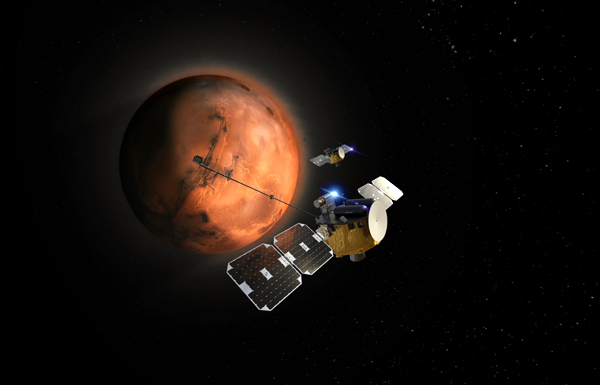
Rocket Lab / UC Berkeley
NASA’s Second ESCAPADE Spacecraft Completes Trajectory Maneuver (News Release)
On January 6, the mission operations team for NASA’s ESCAPADE (Escape and Plasma Acceleration and Dynamics Explorers) successfully completed the second trajectory correction maneuver for one of the two spacecraft, after delaying the attempt in December 2025. The other spacecraft completed its first two maneuvers in December as originally planned.
This maneuver sets up the spacecraft for its "loiter" or "Earth-proximity" orbit around a location in space about a million miles from Earth called Lagrange point 2. In November 2026, the twin spacecraft will fly by Earth to use the planet’s gravity to slingshot their way to Mars.
The two ESCAPADE spacecraft will arrive at Mars in September 2027, where they will study how a million-mile-per-hour stream of material flowing from the Sun, known as the solar wind, interacts with the Martian environment and how that drives atmospheric loss at the Red Planet.
Source: NASA.Gov
Thursday, January 01, 2026
2026 Is Finally Here...
Happy New Year, everyone. Just a reminder that Donald Trump's "One Big Beautiful Bill" (or as I call it, the One Big Bullshit Bill) will begin screwing Americans over in 2026—specifically after the November midterm elections. 17 million individuals in the United States are at risk of losing their healthcare thanks to the demented Pedophile in Chief.
So as a reminder, do everything you can to nullify the effects of this crappy piece of legislation, and completely vote blue 10 months from now! So-called House Speaker Mike Johnson and Steve "Satan" Bannon both predict that the Democrats regaining control of the House of Representatives in the midterms will lead to yet another Trump impeachment, and spell the end of his reign of incompetency and corruption... Let's prove them right.

So as a reminder, do everything you can to nullify the effects of this crappy piece of legislation, and completely vote blue 10 months from now! So-called House Speaker Mike Johnson and Steve "Satan" Bannon both predict that the Democrats regaining control of the House of Representatives in the midterms will lead to yet another Trump impeachment, and spell the end of his reign of incompetency and corruption... Let's prove them right.
Wednesday, December 31, 2025
The Final Post of 2025: A Beautiful Image by the Mars Science Laboratory Rover...

NASA / JPL - Caltech
Curiosity Sends a Postcard From Mount Sharp’s Boxwork Region (News Release)
NASA’s Curiosity Mars rover used its black-and-white navigation cameras to capture panoramas at two times of day on November 18, 2025, spanning periods that occurred on both the 4,722nd and 4,723rd Martian days, or sols, of the mission. The panoramas were captured at 4:15 p.m. on Sol 4,722 and 8:20 a.m. on Sol 4,723 (both at local Mars time), then merged together. Color was later added for an artistic interpretation of the scene with blue representing the morning panorama and yellow representing the afternoon one.
The resulting “postcard” is similar to ones that the rover took in June 2023 and November 2021. Adding color to these kinds of merged images helps different details stand out in the landscape.
The scene captured in this postcard shows Curiosity at the top of a ridge referred to as a boxwork formation. These formations crisscross a region in the lower foothills of Mount Sharp, a 3-mile-tall (5-kilometer-tall) mountain which Curiosity has been climbing since 2014.
Curiosity used the drill on the end of its robotic arm to collect a rock sample from the top of this ridge at a spot nicknamed “Nevado Sajama.” This view looks north across the boxwork formations and downslope of Mount Sharp towards the floor of Gale Crater, a vast impact crater that the mountain is located within. The crater’s rim can be seen far in the distant horizon, approximately 25 miles (40 kilometers) away.
Wheel tracks are visible in the hollow behind Curiosity, where a sample was also drilled at a spot nicknamed “Valle de la Luna.”
The boxwork formations are believed to have been created billions of years ago when water on ancient Mars dripped through rock cracks, carrying minerals with them. The minerals hardened after the water dried up; eons later, wind sandblasted the softer rock around these hardened minerals, exposing the ridges that Curiosity is exploring today. These ridges may reveal more about the planet’s watery past.
Curiosity was built by NASA’s Jet Propulsion Laboratory, which is managed by Caltech in Pasadena, California. JPL leads the mission on behalf of NASA’s Science Mission Directorate in Washington as part of NASA’s Mars Exploration Program portfolio.
Source: NASA.Gov
Tuesday, December 23, 2025
The Latest Update on the U.S. Mars Orbiter Gone AWOL...

NASA
NASA Works MAVEN Spacecraft Issue Ahead of Solar Conjunction (News Release)
NASA is continuing efforts to recontact its MAVEN (Mars Atmosphere and Volatile EvolutioN) spacecraft, which was last heard from on December 6. In partnership with NASA’s Deep Space Network (DSN), the MAVEN team has sent commands for spacecraft recovery and is monitoring the network for a spacecraft signal.
The MAVEN team also continues to analyze tracking data fragments recovered from a December 6 radio science campaign. This information is being used to create a timeline of possible events and identify likely root cause of the issue. As part of that effort, on December 16 and 20, NASA’s Curiosity team used the rover’s Mastcam instrument in an attempt to image MAVEN’s reference orbit, but MAVEN was not detected.
Additional analysis will continue, but planned monitoring will be affected by the upcoming solar conjunction.
Mars solar conjunction – a period when Mars and Earth are on opposite sides of the Sun – begins on Monday, December 29, and NASA will not have contact with any Mars mission until Friday, January 16. Once the solar conjunction window is over, NASA plans to resume its efforts to reestablish communications with MAVEN.
Source: NASA.Gov
Friday, December 19, 2025
SOLAR PROBE PLUS Images Our Latest Galactic Visitor...
NRL / NASA / JHUAPL. Movie processed / compiled by Guillermo Stenborg (JHUAPL)
NASA’s Parker Solar Probe Observes Interstellar Comet 3I/ATLAS (News Release)
NASA’s Parker Solar Probe observed interstellar comet 3I/ATLAS from October 18 to November 5, 2025, with its WISPR (Wide-Field Imager for Solar Probe) instrument. The spacecraft snapped around 10 images of the comet per day. During this period, Parker Solar Probe was speeding away from the Sun following its 25th solar flyby on September 15.
In these initial images — which still need to go through final calibration and processing — the comet can be seen heading behind the Sun from Parker’s point of view. At the time, the comet was near its closest point to the Sun, at a distance of about 130 million miles, placing it just outside the orbit of Mars. The images offer a valuable look at the comet over a period when it couldn’t be seen from Earth because it appeared too close to the Sun from Earth’s perspective.
The WISPR team is continuing to process the data to remove stray sunlight and compensate for exposure times, which differed between the images, causing the comet to appear as if it changed brightness. The final images will ultimately help scientists better study this interstellar visitor.
Comet 3I/ATLAS was discovered by the NASA-funded ATLAS (Asteroid Terrestrial-impact Last Alert System) survey telescope in Rio Hurtado, Chile, in July. It is the third known object originating from outside our Solar System discovered passing through our solar neighborhood. Comet 3I/ATLAS was also seen by other NASA heliophysics missions including PUNCH, STEREO and SOHO.
Source: NASA.Gov
****
NRL / NASA / JHUAPL. Movie processed / compiled by Philip Hess (NRL)
Thursday, December 18, 2025
The Latest Update on SOLAR PROBE PLUS...

NASA's Goddard Space Flight Center
NASA’s Parker Solar Probe Completes 26th Closest Approach to Sun (News Release)
NASA’s Parker Solar Probe completed its 26th close approach to the Sun on December 13, again matching its record distance of 3.8 million miles (6.2 million kilometers) from the solar surface.
The spacecraft checked in with flight controllers at the Johns Hopkins Applied Physics Laboratory (APL) in Laurel, Maryland — where Parker Solar Probe was also designed and built — Thursday, transmitting a beacon tone indicating that its systems were operating normally. The spacecraft was out of contact with Earth and operating autonomously during the close approach.
The spacecraft also equaled its record-setting speed of 430,000 mph (687,000 kph) — a mark that, like the distance, was set and subsequently matched during close approaches on December 24, 2024; March 22; June 19; and September 16. Parker Solar Probe will remain in this orbit around the Sun and continue making observations. The next steps for the mission in late 2026 and beyond are formally under NASA review.
During this solar encounter from December 8 through December 18, Parker’s four scientific instrument packages gathered data from inside the Sun’s atmosphere, or corona. The flyby, as the fifth at this distance and speed, is allowing the spacecraft to conduct unrivaled measurements of the solar wind and solar activity while the Sun is in an active phase of its 11-year cycle.
Parker will begin returning detailed telemetry on its status on Friday, December 19, with science data transmission for this solar encounter set to start on Thursday, January 15, 2026. Parker’s observations of the solar wind and solar events, such as coronal mass ejections and the aftermaths of flares, are critical to advancing humankind’s understanding of the Sun and the phenomena that drive high-energy space weather events that pose risks to astronauts, satellites, air travel, and even power grids on Earth. Understanding the fundamental physics of space weather enables more reliable prediction of astronaut safety during future deep-space missions to the Moon and Mars.
Parker Solar Probe was developed as a part of NASA’s Living With a Star (LWS) program to explore aspects of the Sun-Earth system that directly affect life and society. The LWS program is managed by the agency’s Goddard Space Flight Center in Greenbelt, Maryland, for NASA’s Science Mission Directorate in Washington. Johns Hopkins APL manages Parker Solar Probe for NASA and designed, built and operates the mission.
Source: NASA.Gov
Wednesday, December 17, 2025
A Milestone for the Mars 2020 Mission...

NASA / JPL - Caltech / ASU / MSSS
NASA’s Perseverance Mars Rover Ready to Roll for Miles in Years Ahead (News Release)
After nearly five years on Mars, NASA’s Perseverance rover has traveled almost 25 miles (40 kilometers), and the mission team has been busy testing the rover’s durability and gathering new science findings on the way to a new region nicknamed “Lac de Charmes,” where it will be searching for rocks to sample in the coming year.
Like its predecessor Curiosity, which has been exploring a different region of Mars since 2012, Perseverance was made for the long haul. NASA’s Jet Propulsion Laboratory in Southern California, which built Perseverance and leads the mission, has continued testing the rover’s parts here on Earth to make sure the six-wheeled scientist will be strong for years to come. This past summer, JPL certified that the rotary actuators that turn the rover’s wheels can perform optimally for at least another 37 miles (60 kilometers); comparable brake testing is underway as well.
Over the past two years, engineers have extensively evaluated nearly all of the vehicle’s subsystems in this way, concluding that they can operate until at least 2031.
“These tests show the rover is in excellent shape,” said Perseverance’s deputy project manager, Steve Lee of JPL, who presented the results on Wednesday at the American Geophysical Union’s annual meeting, the largest gathering of planetary scientists in the United States. “All the systems are fully capable of supporting a very long-term mission to extensively explore this fascinating region of Mars.”
Perseverance has been driving through Mars’ Jezero Crater, the site of an ancient lake and river system, where it has been collecting scientifically compelling rock core samples. In fact, in September, the team announced that a sample from a rock nicknamed “Cheyava Falls” contains a potential fingerprint of past microbial life.
More efficient roving
In addition to a hefty suite of six science instruments, Perseverance packs more autonomous capabilities than past rovers. A paper published recently in IEEE Transactions on Field Robotics highlights an autonomous planning tool called Enhanced Autonomous Navigation, or ENav. The software looks up to 50 feet (15 meters) ahead for potential hazards, then chooses a path without obstacles and tells Perseverance’s wheels how to steer there.
Engineers at JPL meticulously plan each day of the rover’s activities on Mars. But once the rover starts driving, it’s on its own and sometimes has to react to unexpected obstacles in the terrain. Past rovers could do this to some degree, but not if these obstacles were clustered near each other.
Past rovers also couldn’t react as far in advance, resulting in the vehicles driving slower while approaching sand pits, rocks and ledges. In contrast, ENav’s algorithm evaluates each rover wheel independently against the elevation of terrain, trade-offs between different routes, and “keep-in” or “keep-out” areas marked by human operators for the path ahead.
“More than 90% of Perseverance’s journey has relied on autonomous driving, making it possible to quickly collect a diverse range of samples,” said JPL autonomy researcher Hiro Ono, a paper lead author. “As humans go to the Moon and even Mars in the future, long-range autonomous driving will become more critical to exploring these worlds.”
New science
A paper published Wednesday in Science details what Perseverance discovered in the “Margin Unit,” a geologic area at the margin, or inner edge, of Jezero Crater. The rover collected three samples from that region. Scientists think that these samples may be particularly useful for showing how ancient rocks from Mars’ deep interior interacted with water and the atmosphere, helping create conditions supportive for life.
From September 2023 to November 2024, Perseverance ascended 1,312 feet (400 meters) of the Margin Unit, studying rocks along the way — especially those containing the mineral olivine. Scientists use minerals as timekeepers because crystals within them can record details about the precise moment and conditions in which they formed.
Jezero Crater and the surrounding area holds large reserves of olivine, which forms at high temperatures, typically deep within a planet, and offers a snapshot of what was going on in the planet’s interior. Scientists think the Margin Unit’s olivine was made in an intrusion, a process where magma pushes into underground layers and cools into igneous rock. In this case, erosion later exposed that rock to the surface, where it could interact with water from the crater’s ancient lake and carbon dioxide, which was abundant in the planet’s early atmosphere.
Those interactions form new minerals called carbonates, which can preserve signs of past life, along with clues as to how Mars’ atmosphere changed over time.
“This combination of olivine and carbonate was a major factor in the choice to land at Jezero Crater,” said the new paper’s lead author, Perseverance science team member Ken Williford of Blue Marble Space Institute of Science in Seattle. “These minerals are powerful recorders of planetary evolution and the potential for life.”
Together, the olivine and carbonates record the interplay between rock, water and atmosphere inside the crater, including how each changed over time. The Margin Unit’s olivine appeared to have been altered by water at the base of the unit, where it would have been submerged. But the higher Perseverance went, the more the olivine bore textures associated with magma chambers, like crystallization, and fewer signs of water alteration.
As Perseverance leaves the Margin Unit behind for Lac de Charmes, the team will have the chance to collect new olivine-rich samples and compare the differences between the two areas.
Source: NASA.Gov
****
Subscribe to:
Posts (Atom)