Tuesday, November 25, 2025

A Robotic Probe Bound for Asteroid Apophis Once Again Flies Past Our Home Planet...

A snapshot of Earth that NASA’s OSIRIS-APEX spacecraft took from 2,136 miles (3,438 kilometers) away...on September 23, 2025.
NASA / Goddard / University of Arizona

NASA’s OSIRIS-APEX Spacecraft Slingshots Past Earth (News Release)

At 1:00 p.m. EDT on Tuesday, September 23, NASA’s OSIRIS-APEX (Origins, Spectral Interpretation, Resource Identification and Security – Apophis Explorer) spacecraft flew within 2,136 miles (3,438 kilometers) of Earth.

During approach and as OSIRIS-APEX passed Earth, it looked home, capturing images and data of our home planet to help calibrate its science instruments.

During the spacecraft’s primary mission, the StowCam instrument was used to verify that the capsule full of sample from asteroid Bennu was safely stowed and prepared to journey back to Earth. Now, StowCam provides a view of the instrument panel, including the OSIRIS-REx Laser Altimeter, provided by CSA (Canadian Space Agency) to create detailed 3D topographical maps of Bennu.

NASA’s Goddard Space Flight Center in Greenbelt, Maryland, provides overall mission management, systems engineering, and the safety and mission assurance for OSIRIS-APEX. Dani Mendoza DellaGiustina of the University of Arizona, Tucson, is the principal investigator. The university leads the science team and the mission’s science observation planning and data processing.

Lockheed Martin Space in Littleton, Colorado, built the spacecraft and provides flight operations. NASA Goddard and KinetX Aerospace are responsible for navigating the OSIRIS-APEX spacecraft. International partnerships on this mission include the spacecraft’s laser altimeter instrument from CSA.

OSIRIS-APEX (previously named OSIRIS-REx) is the third mission in NASA’s New Frontiers Program, managed by NASA’s Marshall Space Flight Center in Huntsville, Alabama, for the agency’s Science Mission Directorate in Washington.

Source: NASA.Gov

****

A screenshot of Earth and NASA’s OSIRIS-APEX spacecraft that was taken from 2,136 miles (3,438 kilometers) away...on September 23, 2025.
NASA / Goddard / University of Arizona / Lockheed Martin

Monday, November 24, 2025

The Latest Update on New Glenn's Recent Payloads...

Two images showing the side of a solar panel on one of NASA's twin ESCAPADE spacecraft...taken on November 21, 2025.
NASA / UCB - SSL / RL / NAU - Radiant/Lucint

NASA’s Mars-bound ESCAPADE Mission Captures First ‘Selfies’ (News Release)

About a week after its launch, NASA’s ESCAPADE (Escape and Plasma Acceleration and Dynamics Explorers) mission has already captured its first images: a pair of self-portraits showing part of the spacecraft as the twin explorers speed away from Earth.

On November 21, one of the two ESCAPADE spacecraft used its Visible and Infrared Observation System (VISIONS) cameras, provided by Northern Arizona University in Flagstaff, to capture these images, showing part of a solar panel on the spacecraft.

The images prove that the cameras are working well. The visible-light image also suggests that the spacecraft should have the sensitivity to image Martian aurora from orbit. The infrared camera will be used at Mars to better understand how materials on the surface heat up and cool down during Mars’ day-night cycle and over the planet’s seasons.

The second ESCAPADE spacecraft also successfully took its first photos, but it was targeted towards deep space, so the images were simply black.

The twin ESCAPADE spacecraft, built by Rocket Lab and ultimately bound for Mars, launched on November 13 aboard a Blue Origin New Glenn rocket from Cape Canaveral Space Force Station in Florida. Once the ESCAPADE spacecraft reach Mars, they will study how a million-mile-per-hour stream of material flowing from the Sun, known as the solar wind, interacts with the Martian environment and how that drives atmospheric loss at the Red Planet.

Before they head for Mars, though, the two spacecraft are following a “loiter” or “Earth-proximity” orbit around a location in space about a million miles from Earth called Lagrange point 2. In November 2026, they will return to Earth to use our planet’s gravity to slingshot their way to Mars. They will arrive at the Red Planet in September 2027.

Source: NASA.Gov

****

Thursday, November 20, 2025

The Latest Celestial Image by JWST...

An image that NASA's James Webb Space Telescope took of Apep, a star system consisting of two rare Wolf-Rayet stars and a supermassive third star.
NASA, ESA, CSA, STScI; Science: Yinuo Han (Caltech), Ryan White (Macquarie University); Image Processing: Alyssa Pagan (STScI)

Webb First to Show 4 Dust Shells ‘Spiraling’ Apep, Limits Long Orbit (News Release - November 19)

NASA’s James Webb Space Telescope has delivered a first of its kind: a crisp mid-infrared image of a system of four serpentine spirals of dust, one expanding beyond the next in precisely the same pattern. (The fourth is almost transparent, at the edges of Webb’s image.) Observations taken prior to Webb only detected one shell, and while the existence of outer shells was hypothesized, searches using ground-based telescopes were unable to uncover any. These shells were emitted over the last 700 years by two aging Wolf-Rayet stars in a system known as Apep, a nod to the Egyptian god of chaos.

Webb’s image combined with several years of data from the European Southern Observatory’s Very Large Telescope (VLT) in Chile narrowed down how often the pair swing by one another: once every 190 years. Over each incredibly long orbit, they pass closely for 25 years and form dust.

Webb also confirmed that there are three stars gravitationally bound to one another in this system. The dust ejected by the two Wolf-Rayet stars is “slashed” by a third star, a massive supergiant, which carves holes into each expanding cloud of dust from its wider orbit. (All three stars are shown as a single bright point of light in Webb’s image.)

“Looking at Webb’s new observations was like walking into a dark room and switching on the light — everything came into view,” said Yinuo Han, the lead author of a new paper in The Astrophysical Journal and postdoctoral researcher at Caltech in Pasadena, California. “There is dust everywhere in Webb’s image, and the telescope shows that most of it was cast off in repetitive, predictable structures.” Han’s paper coincides with the publication of Ryan White’s paper in The Astrophysical Journal, a PhD student at Macquarie University in Sydney, Australia.

Han, White, and their co-authors refined the Wolf-Rayet stars’ orbit by combining precise measurements of the ring location from Webb’s image with the speed of the shells’ expansion from observations taken by the VLT over eight years.

“This is a one-of-a-kind system with an incredibly rare orbital period,” White said. “The next longest orbit for a dusty Wolf-Rayet binary is about 30 years. Most have orbits between two and 10 years.”

When the two Wolf-Rayet stars approach and pass one another, their strong stellar winds collide and mix, forming and casting out heaps of carbon-rich dust for a quarter century at a time. In similar systems, dust is shot out over mere months, like the shells in Wolf-Rayet 140.

High-speed ‘skirmish’

The dust-producing Wolf-Rayet stars in Apep aren’t exactly on a tranquil cruise. They are whipping through space and sending out dust at 1,200 to 2,000 miles per second (2,000 to 3,000 kilometers per second).

That dust is also very dense. The specific makeup of the dust is another reason why Webb was able to observe so much more: It largely consists of amorphous carbon. “Carbon dust grains retain a higher temperature even as they coast far away from the star,” Han said.

While the exceptionally tiny dust grains are considered warm in space, the light they emit is also extremely faint, which is why it can only be detected from space by Webb’s MIRI (Mid-Infrared Instrument).

Slicing dust

To find the holes that the third star has cut like a knife through the dust, look for the central point of light and trace a V shape from about 10 o’clock to 2 o’clock. “The cavity is more or less in the same place in each shell and looks like a funnel,” White said.

“I was shocked when I saw the updated calculations play out in our simulations,” he said. “Webb gave us the ‘smoking gun’ to prove the third star is gravitationally bound to this system.” Researchers have known about the third star since the VLT observed the brightest innermost shell and the stars in 2018, but Webb’s observations led to an updated geometric model, clinching the connection.

“We solved several mysteries with Webb,” Han said. “The remaining mystery is the precise distance to the stars from Earth, which will require future observations.”

Future of Apep

The two Wolf-Rayet stars were initially more massive than their supergiant companion, but have shed most of their mass. It’s likely that both Wolf-Rayet stars are between 10 and 20 times the mass of the Sun, and that the supergiant is 40 or 50 times as massive compared to the Sun.

Eventually, the Wolf-Rayet stars will explode as supernovae, quickly sending their contents into space. Either may also emit a gamma-ray burst, one of the most powerful events in the Universe, before possibly becoming a black hole.

Wolf-Rayet stars are incredibly rare in the Universe. Only a thousand are estimated to exist in our Milky Way galaxy, which contains hundreds of billions of stars overall. Of the few hundred Wolf-Rayet binaries that have been observed to date, Apep is the only example that contains two Wolf-Rayet stars of these types in our galaxy — most only have one.

The James Webb Space Telescope is the world’s premier space science observatory. Webb is solving mysteries in our Solar System, looking beyond to distant worlds around other stars, and probing the mysterious structures and origins of our Universe and our place in it. Webb is an international program led by NASA with its partners, ESA (European Space Agency) and CSA (Canadian Space Agency).

Source: NASA.Gov

Wednesday, November 19, 2025

New Images Of Our Solar System's Latest Galactic Visitor Have Been Released...

An image of interstellar comet 3I/ATLAS that was taken by NASA's Mars Reconnaissance Orbiter...on October 2, 2025.
NASA / JPL - Caltech / University of Arizona

View Interstellar Comet 3I/ATLAS Through NASA’s Multiple Lenses (News Release)

NASA is in the midst of an unprecedented Solar System-wide observation campaign, turning its spacecraft and space telescopes to follow comet 3I/ATLAS, the third known interstellar object to pass through our Solar System. Twelve NASA assets have captured and processed imagery of the comet since it was first discovered on July 1, and several others will have opportunities to capture more images as the comet continues to pass through our Solar System.

By observing the comet from so many locations, NASA has an opportunity to learn about the ways that 3I/ATLAS differs from our Solar System’s home-grown comets and give scientists a new window into how the compositions of other systems may differ from our own.

Observations from Mars

The closest imagery of the comet was taken by NASA spacecraft at Mars. Earlier this fall, 3I/ATLAS passed by Mars from a distance of 19 million miles, where it was observed by three NASA spacecraft. The Mars Reconnaissance Orbiter (MRO) captured one of the closest images of the comet, while the MAVEN (Mars Atmosphere and Volatile EvolutioN) orbiter obtained ultraviolet images that will help scientists understand the comet’s make-up.

Meanwhile, the Perseverance rover grabbed a faint glimpse from the surface of Mars.

Sun watchers’ view

Some of NASA’s heliophysics missions have the unique ability to observe areas of the sky near the Sun, which allowed them to track comet 3I/ATLAS as it passed behind our Sun as seen from Earth, making observations with ground-based telescopes impossible. NASA’s STEREO (Solar Terrestrial Relations Observatory) captured images from September 11 to October 2, and the ESA (European Space Agency) and NASA mission SOHO (Solar and Heliospheric Observatory) observed the comet from October 15 to 26. Images from NASA’s PUNCH (Polarimeter to Unify the Corona and Heliosphere) mission, which launched earlier this year, reveal the comet’s tail during observations from September 20 to October 3.

Despite previously observing and discovering thousands of comets, this is the first time that NASA’s heliophysics missions have purposefully observed an object originating in another solar system.

Asteroid explorers

NASA’s Psyche and Lucy spacecraft, currently on their respective outbound journeys to study various asteroid targets throughout the Solar System, were able to observe 3I/ATLAS en route. On September 8 and 9, Psyche acquired four observations of the comet over eight hours from a distance of 33 million miles. These images will help scientists refine the comet’s trajectory.

On September 16, Lucy took a series of images from 240 million miles away. Stacking these images together provides detail on the comet’s coma and tail.

The NASA-funded ATLAS (Asteroid Terrestrial-impact Last Alert System) telescope in Chile discovered 3I/ATLAS on July 1. Later that month it was viewed by NASA’s Hubble Space Telescope. In August, both NASA’s James Webb Telescope and SPHEREx (Spectro-Photometer for the History of the Universe, Epoch of Reionization and Ices Explorer) captured imagery.

Comet 3I/ATLAS will fly closest to Earth about Friday, December 19, at 170 million miles, which is almost twice the distance between the Earth and Sun. NASA spacecraft will continue to observe the comet as it makes its journey through the Solar System, passing the orbit of Jupiter in spring 2026.

Source: NASA.Gov

****

A series of images taken of interstellar comet 3I/ATLAS by NASA's Psyche spacecraft...on September 8 and 9, 2025.
NASA / JPL - Caltech / ASU

Friday, November 14, 2025

A New Celestial Image by Hubble's Successor...

An image of the Red Spider Nebula that was taken by the James Webb Space Telescope.
ESA / Webb, NASA & CSA, J. H. Kastner (Rochester Institute of Technology)

The Red Spider Nebula, Caught by Webb (News Release)

This new NASA/ESA/CSA James Webb Space Telescope Picture of the Month features a cosmic creepy-crawly called NGC 6537 — the Red Spider Nebula. Using its Near-InfraRed Camera (NIRCam), Webb has revealed never-before-seen details in this picturesque planetary nebula with a rich backdrop of thousands of stars.

Planetary nebulae like the Red Spider Nebula form when ordinary stars like the Sun reach the end of their lives. After ballooning into cool red giants, these stars shed their outer layers and cast them into space, exposing their white-hot cores. Ultraviolet light from the central star ionises the cast-off material, causing it to glow.

The planetary nebula phase of a star’s life is as fleeting as it is beautiful, lasting only a few tens of thousands of years.

The central star of the Red Spider Nebula is visible in this image, glowing just brighter than the webs of dusty gas that surround it. The surprising nature of the nebula’s tremendously hot and luminous central star has been revealed by Webb’s NIRCam. In optical-wavelength images, such as from the NASA/ESA Hubble Space Telescope, the star appears faint and blue.

But in the NIRCam images, it shows up as red; thanks to its sensitive near-infrared capabilities, Webb has revealed a shroud of hot dust surrounding the central star. This hot dust likely orbits the central star, in a disc structure.

Though only a single star is visible in the Red Spider’s heart, a hidden companion star may lurk there as well. A stellar companion could explain the nebula’s shape, including its characteristic narrow waist and wide outflows. This hourglass shape is seen in other planetary nebulae such as the Butterfly Nebula, which Webb also recently observed.

Webb’s new view of the Red Spider Nebula reveals for the first time the full extent of the nebula’s outstretched lobes, which form the ‘legs’ of the spider. These lobes, shown in blue, are traced by light emitted from H2 molecules, which contain two hydrogen atoms bonded together. Stretching over the entirety of NIRCam’s field of view, these lobes are shown to be closed, bubble-like structures that each extend about 3 light-years.

Outflowing gas from the centre of the nebula has inflated these massive bubbles over thousands of years.

Gas is also actively jetting out from the nebula’s centre, as these new Webb observations show. An elongated purple ‘S’ shape centred on the heart of the nebula follows the light from ionised iron atoms. This feature marks where a fast-moving jet has emerged from near the nebula’s central star and collided with material that was previously cast away by the star, sculpting the rippling structure of the nebula seen today.

The observations used to create this image come from Webb GO programme #4571 (PI: J. Kastner) as part of a joint Chandra-JWST observing programme, which aims to understand how bipolar planetary nebulae like the Red Spider Nebula are shaped by the outflows and jets that emerge from the stars at their cores.

Source: European Space Agency

Thursday, November 13, 2025

Blue Origin's Giant Orbital-class Rocket Has Successfully Flown for the Second Time...

A close-up on New Glenn's seven methalox-fueled BE-4 engines as Blue Origin's newest rocket soared into the afternoon sky on its second launch...on November 13, 2025.
Blue Origin

New Glenn Launches NASA’s ESCAPADE, Lands Fully-Reusable Booster (News Release)

Cape Canaveral Space Force Station, Fla. — The New Glenn orbital launch vehicle successfully completed its second mission, deploying NASA’s Escape and Plasma Acceleration and Dynamics Explorers (ESCAPADE) twin spacecraft into the designated loiter orbit, and landing the fully-reusable first stage on Jacklyn in the Atlantic Ocean.

New Glenn’s seven BE-4 engines ignited on Thursday, November 13, 2025, at 3:55:01 PM EST / 20:55:01 UTC from Launch Complex 36 at Cape Canaveral Space Force Station.

“We achieved full mission success today, and I am so proud of the team,” said Dave Limp, CEO, Blue Origin. “It turns out Never Tell Me The Odds had perfect odds—never before in history has a booster this large nailed the landing on the second try. This is just the beginning as we rapidly scale our flight cadence and continue delivering for our customers.”

The ESCAPADE spacecraft will begin their journey to Mars once the planets have returned to the ideal alignment in fall 2026. ESCAPADE will use two identical spacecraft to investigate how the solar wind interacts with Mars’ magnetic environment and how this interaction drives the planet’s atmospheric escape. In addition to deploying the NASA spacecraft, the Viasat HaloNet demonstration onboard New Glenn’s second stage successfully executed the first flight test of Viasat’s telemetry data relay service for NASA’s Communications Services Project.

“Congratulations to Blue Origin, Rocket Lab, UC Berkeley and all of our partners on the successful launch of ESCAPADE," said the acting NASA Administrator, Secretary Sean Duffy. "This heliophysics mission will help reveal how Mars became a desert planet, and how solar eruptions affect the Martian surface. Every launch of New Glenn provides data that will be essential when we launch MK-1 through Artemis.”

New Glenn is foundational to advancing our customers’ critical missions and our own. The vehicle underpins our efforts to establish sustained human presence on the Moon, harness in-space resources, provide multi-mission, multi-orbit mobility through Blue Ring, and establish destinations in low-Earth orbit.

The New Glenn program has several vehicles in production and multiple years of orders. In addition to NASA and Viasat, customers include Amazon’s Project Kuiper, AST SpaceMobile, and several telecommunications providers, among others. The mission marked the vehicle’s second National Security Space Launch (NSSL) certification flight.

Blue Origin is certifying New Glenn with the U.S. Space Force for the NSSL program to meet emerging national security objectives.

"Today was a tremendous achievement for the New Glenn team, opening a new era for Blue Origin and the industry as we look to launch, land, repeat, again and again," said Jordan Charles, Vice President, New Glenn. "We've made significant progress on manufacturing at rate and building ahead of need. Our primary focus remains focused on increasing our cadence and working through our manifest."

Source: Blue Origin

****

Blue Origin's New Glenn rocket successfully sends NASA's twin ESCAPADE spacecraft on a journey to Mars from Launch Complex 36 in Florida...on November 13, 2025.
Blue Origin

Blue Origin's New Glenn rocket successfully sends NASA's twin ESCAPADE spacecraft on a journey to Mars...on November 13, 2025.
Blue Origin

A screenshot of New Glenn's first stage booster, nicknamed 'Never Tell Me The Odds,' sitting on the deck of Blue Origin's drone ship 'Jacklyn' upon the booster's return to Earth...on November 13, 2025.
Blue Origin

New Glenn's first stage booster 'Never Tell Me The Odds' sits on the deck of Blue Origin's drone ship 'Jacklyn' a few hours after the booster returned to Earth...on November 13, 2025.
Blue Origin

New Glenn's first stage booster 'Never Tell Me The Odds' sits on the deck of Blue Origin's drone ship 'Jacklyn' after the booster returned to Earth following a successful launch...on November 13, 2025.
Blue Origin
Blue and Gold, the two spacecraft that make up NASA's ESCAPADE mission, launched to Mars on November 13, 2025.
Rocket Lab

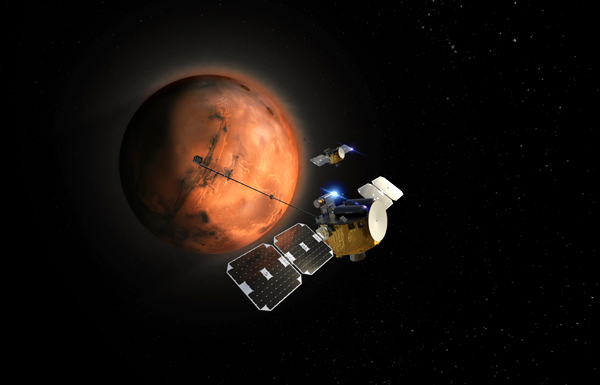
An artist's concept of the Blue and Gold spacecraft, which make up NASA's ESCAPADE mission, flying towards Mars...where the twin spacecraft will actually arrive in September 2027.
Rocket Lab / UC Berkeley

Monday, November 03, 2025

My SoCal Sports Wall of Fame, Updated!

My SoCal Sports Wall of Fame.

Even though the Los Angeles Times was one day late in publishing coverage for Game 7 of the World Series in its newspaper (just like what happened last year), that didn't stop me from adhering to a tradition started in mid-2000 (when Shaquille O'Neal and Kobe Bryant won their first NBA title with the Lakers) and displaying today's Dodgers-celebrating printed edition on my wall at home!

Yesterday, I woke up at 4:00 in the morning to buy the L.A. Times paper—at a 7-Eleven over 15 miles from my house. The donut shop that I went to last year no longer carries the L.A. Times (only a Chinese newspaper that costs $1.00 per copy), and another 7-Eleven that I was planning to buy the commemorative edition from didn't have the paper delivered yet...supposedly (7-Eleven clerks are giving me the impression that they don't tell the truth). There were, I think, four copies of today's L.A. Times left at the 7-Eleven I eventually went to.

And in case you're wondering— no, I didn't go to today's championship parade in downtown Los Angeles. This is the second straight Dodgers celebration that I couldn't attend because I had a doctor's appointment in the late afternoon. I definitely intend on going to the parade if they manage to three-peat next year!

Go Dodger Blue.

Today's Los Angeles Times newspaper before it was displayed on my wall.

Saturday, November 01, 2025

THE DODGERS ARE BACK 2 BACK CHAMPIONS!

The Los Angeles Dodgers are the 2025 World Series champions!

Over a year after they beat the New York Yankees in five games to win their second World Series championship since 2020, the Los Angeles Dodgers were once again at the top of the baseball world when they defeated the Toronto Blue Jays, 5-4, in a thrilling Game 7 tonight!

The Dodgers' victory is the first time in 25 years since a Major League Baseball team won back-to-back titles...the last time being when the Yankees were able to three-peat from 1998 to 2000. This is also the first time since 2009 that an MLB team reached the Fall Classic in two consecutive years—with the Philadelphia Phillies winning against the Tampa Bay Rays in 2008 but losing to the Yankees the following year. The Dodgers are also the first team to clinch back-to-back World Series championships on the road since the Cincinnati Reds pulled off the feat in 1975 and '76, respectively!

In regards to team stats, Mookie Betts now has four rings...from the 2018, 2020, 2024 and this year's World Series, respectively. Clayton Kershaw enters retirement as a 3-time World Series champion, while Shohei Ohtani went from winning zero titles during his six years with the Anaheim—err, Los Angeles Angels to securing two championships in his first two seasons in the City of Angels. And last but not least, Yoshinobu Yamamoto—who was given a $325 million contract to play with the Dodgers (and earned it by pitching two complete games this postseason, and was able to secure L.A.'s victory in the last three innings of Game 7)—is the 2025 World Series Most Valuable Player!

(Yamamoto is the second Japanese-born baseball player, behind the Yankees' designated hitter Hideki Matsui in 2009, to become a World Series MVP.)

The Dodgers' championship parade will take place in downtown Los Angeles this Monday. Assuming that Mark Walter (who officially owns the Los Angeles Lakers as well) and Co. keep dishin' out the money to get topnotch talent (like pitchers Blake Snell and Tyler Glasnow...who both played on the Rays when they lost to the Dodgers in 2020) to play at Chavez Ravine, then Dodgers fans can expect more celebrations in the years to come.

Go Dodger Blue!

The Los Angeles Dodgers take a group photo at Rogers Centre following their thrilling Game 7 victory over the Toronto Blue Jays in the World Series...on November 1, 2025 (Pacific Time).

Dodgers starting pitcher Yoshinobu Yamamoto is the 2025 World Series Most Valuable Player.

Clayton Kershaw has ended his 18-year tenure as the Dodgers' veteran pitcher with a third World Series championship.

The Los Angeles Dodgers are the 2025 World Series champions!

The final bracket for the 2025 MLB postseason.