Showing posts with label Juno. Show all posts

Tuesday, August 25, 2026

A New Radio Dish for Space Exploration Has Emerged in the California Desert...

A snapshot of the new Deep Space Station 23 antenna at NASA's Goldstone Deep Space Communications Complex near Barstow, California.
NASA / JPL - Caltech

New Next-Gen Dish Adds Muscle to NASA’s Deep Space Network (News Release)

Deep Space Station 23 at NASA’s Goldstone facility in the California desert is the latest next-generation antenna to be added by the network’s enhancement project.

NASA’s Deep Space Network facility in California is marking the addition of a brand new 34-meter-wide (114-foot-wide) radio frequency antenna to the agency’s deep space communications and navigation system. The network uses giant dish antennas located at three global facilities to support more than 40 spacecraft exploring the Solar System and interstellar space.

The new Deep Space Station 23 (DSS-23) is located at the Goldstone Deep Space Communications Complex, near Barstow, and is managed by NASA’s Jet Propulsion Laboratory in Southern California.

NASA leadership and personnel as well as dignitaries gathered at the complete DSS-23 antenna for a ceremonial ribbon cutting. It’s the latest to be added as part of the Deep Space Network’s Aperture Enhancement Project, which began in 2009 to upgrade and expand the network by adding six new 34-meter multifrequency beam-waveguide antennas. These versatile dishes can enhance many missions operating over different radio frequencies.

“By expanding the Deep Space Network, we are strengthening the communications foundation NASA needs for the bold missions ahead — from exploring more of the Moon than ever before to peering deeper into the Solar System,” said James Kenyon, associate administrator of the Research and Technology Mission Directorate at NASA Headquarters in Washington. “This new antenna will help us deliver on our national goals for space exploration and push beyond the limits of what once seemed impossible.”

After completing a testing campaign from May through July to demonstrate its capabilities, the new DSS-23 began operations on August 3, tracking NASA’s Chandra X-ray Observatory. Since then, it has been communicating with dozens of missions such as NASA’s Mars Reconnaissance Orbiter, Psyche, Juno, Voyager 1 and other robotic spacecraft in deep space.

“The addition of this next-generation antenna brings us closer to a completely modernized network that embraces advanced technology to ensure NASA’s leadership in deep space communications,” said Dave Gallagher, director of JPL. “After over 60 years of continuous operations supporting consequential missions, these upgrades prime the network for a new era of exploration. The teams that designed, planned and built DSS-23 should be proud.”

Enhanced capabilities

Construction of DSS-23 began in February 2020. After the 133-ton metal reflector framework was placed and bolted atop the antenna’s pedestal in December 2024, engineers installed the panels to the framework that reflect radio frequency signals transmitted to and received from spacecraft. Then came the careful process of calibrating the antenna so that it can work in concert with the rest of the network.

It is the fifth antenna at Goldstone (joining three 34-meter antennas and one 70-meter, or 230-foot, antenna) and the fifth enhancement project antenna to join the network, which includes antennas at the DSN’s Goldstone, Madrid, and Canberra, Australia, complexes. Multifrequency beam waveguide antennas direct signals down to a stable, climate-controlled underground room, rather than housing heavy, sensitive electronic equipment on the moving antenna dish. In addition to offering versatility, this design allows easy access for maintenance and upgrades to the system.

“The biggest challenge wasn’t actually constructing the antenna. It was transforming a complex collection of mechanical, electrical, software, radio frequency, and infrastructure systems into a single, mission-ready asset,” said Germaine Aziz, manager of the Deep Space Network Aperture Enhancement Project at JPL. “Every subsystem must be integrated, calibrated, and verified to operate with extraordinary precision and reliability before it can support NASA’s deep space missions.”

The enhancement project will be complete when a sixth enhancement-project antenna, Deep Space Station 33, comes online at the Canberra facility in 2029, bringing the total number of 34-meter antennas across the network to 13. The 34-meter antennas can be arrayed (combined and operated together) to provide an equivalent communications backup for each facility’s single 70-meter antenna, which, after more than 50 years of near-continuous operation, are getting increasingly costly to maintain and repair.

Managed by Caltech for NASA, JPL manages the agency’s Deep Space Network with the oversight of NASA’s SCaN (Space Communications and Navigation) Program within NASA’s Research and Technology Mission Directorate. More than 100 NASA and non-NASA missions rely on the Deep Space Network and Near Space Network. They include missions that support astronauts aboard the International Space Station and future Artemis missions, monitoring Earth, exploring the Moon, and exploring the Solar System and beyond.

Source: Jet Propulsion Laboratory

Monday, July 07, 2025

ANOTHER TRUMP FAILURE: The Planetary Society Has Something to Say About Russ Vought's Stupid Attack on the U.S. Space Program...

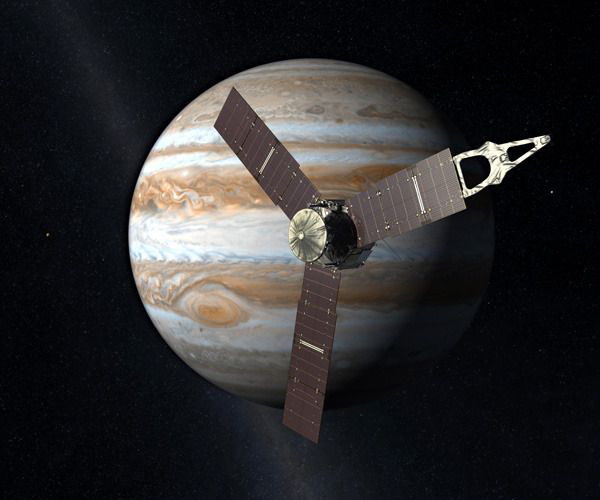
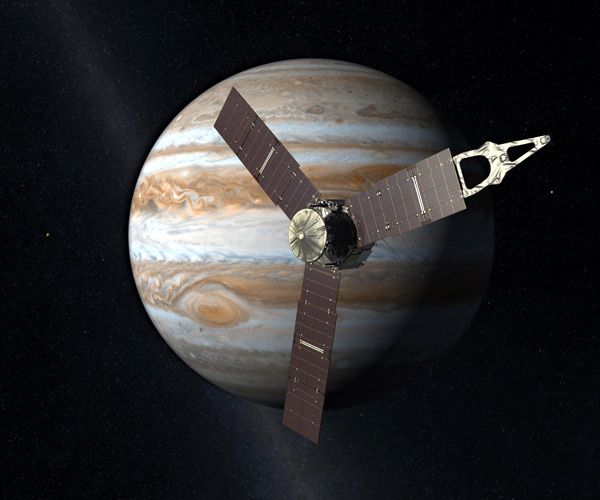
An artist's concept of the Jupiter-orbiting Juno spacecraft...which might be decommissioned thanks to the White House's 2026 budget proposal for NASA.
NASA / JPL - Caltech

Every Living NASA Science Chief Unites in Opposition to Unprecedented Budget Cuts (Press Release)

Seven former leaders of NASA’s Science program urge Congress to reject the wasteful 47% cuts proposed in the White House’s FY 2026 budget proposal

Pasadena, CA — In a joint statement, every living former head of NASA's Science Mission Directorate SMD — the agency's top science leadership position — has condemned the White House's proposed 47% cuts to NASA science activities in the White House’s fiscal year (FY) 2026 budget proposal. This letter has been transmitted to the leadership of the House and Senate appropriations committees.

The letter, publicly released today, warns that the White House’s budget proposal would “walk away from dozens of current, extraordinarily successful and productive science missions” and halt nearly all future investments in exploration and innovation. The signatories — John Grunsfeld, Alphonso Diaz, Lennard Fisk, Wesley Huntress, Alan Stern, Edward Weiler and Thomas Zurbuchen — each served as Associate Administrator for NASA's science program. They are calling on Congress to preserve U.S. leadership in space exploration and reject the unprecedented cuts to space science concocted by the White House’s Budget Director, Russ Vought.

“NASA science endeavors are exercises in long-term national commitment that pay dividends to the American people,” they write. “Given the scale of the proposed cuts, their long-term consequences, and the potential loss of human knowledge and inspiration, we unanimously urge Congress to reject the proposed cuts.”

Together, the signatories span nearly four decades of NASA’s scientific leadership serving under every administration from Reagan to Biden.

The full letter can be read here.

Source: The Planetary Society

****

An excerpt of the letter that was sent to the House and Senate appropriations committees...asking Congress to reject the White House's 2026 budget proposal for NASA.
The Planetary Society

Tuesday, May 13, 2025

Hubble's Successor Captures New Images of our Solar System's Largest World...

Two images of Jupiter that were taken by NASA's James Webb Space Telescope...with the photo on the left showing a close-up view of auroras at the planet's north polar region.
NASA, ESA, CSA, STScI, Ricardo Hueso (UPV), Imke de Pater (UC Berkeley), Thierry Fouchet (Observatory of Paris), Leigh Fletcher (University of Leicester), Michael H. Wong (UC Berkeley), Joseph DePasquale (STScI), Jonathan Nichols (University of Leicester), Mahdi Zamani (ESA/Webb)

NASA’s Webb Reveals New Details, Mysteries in Jupiter’s Aurora (News Release - May 12)

NASA’s James Webb Space Telescope has captured new details of the auroras on our Solar System’s largest planet. The dancing lights observed on Jupiter are hundreds of times brighter than those seen on Earth. With Webb’s advanced sensitivity, astronomers have studied the phenomena to better understand Jupiter’s magnetosphere.

Auroras are created when high-energy particles enter a planet’s atmosphere near its magnetic poles and collide with atoms or molecules of gas. On Earth these are known as the Northern and Southern Lights. Not only are the auroras on Jupiter huge in size, they are also hundreds of times more energetic than those in Earth’s atmosphere.

Earth’s auroras are caused by solar storms — when charged particles from the Sun rain down on the upper atmosphere, energize gases, and cause them to glow in shades of red, green and purple.

Jupiter has an additional source for its auroras: The strong magnetic field of the gas giant grabs charged particles from its surroundings. This includes not only the charged particles within the solar wind but also the particles thrown into space by its orbiting moon Io, known for its numerous and large volcanoes. Io’s volcanoes spew particles that escape the moon’s gravity and orbit Jupiter.

A barrage of charged particles unleashed by the Sun also reaches the planet. Jupiter’s large and powerful magnetic field captures all of the charged particles and accelerates them to tremendous speeds. These speedy particles slam into the planet’s atmosphere at high energies, which excites the gas and causes it to glow.

Now, Webb’s unique capabilities are providing new insights into the auroras on Jupiter. The telescope’s sensitivity allows astronomers to capture fast-varying auroral features. New data was captured with Webb’s NIRCam (Near-Infrared Camera) on December 25, 2023, by a team of scientists led by Jonathan Nichols from the University of Leicester in the United Kingdom.

“What a Christmas present it was – it just blew me away!” shared Nichols. “We wanted to see how quickly the auroras change, expecting them to fade in and out ponderously, perhaps over a quarter of an hour or so. Instead, we observed the whole auroral region fizzing and popping with light, sometimes varying by the second.”

In particular, the team studied emission from the trihydrogen cation (H3+), which can be created in auroras. They found that this emission is far more variable than previously believed. The observations will help develop scientists’ understanding of how Jupiter’s upper atmosphere is heated and cooled.

The team also uncovered some unexplained observations in their data.

“What made these observations even more special is that we also took pictures simultaneously in the ultraviolet with NASA’s Hubble Space Telescope,” added Nichols. “Bizarrely, the brightest light observed by Webb had no real counterpart in Hubble’s pictures. This has left us scratching our heads. In order to cause the combination of brightness seen by both Webb and Hubble, we need to have a combination of high quantities of very low-energy particles hitting the atmosphere, which was previously thought to be impossible. We still don’t understand how this happens.”

The team now plans to study this discrepancy between the Hubble and Webb data and to explore the wider implications for Jupiter’s atmosphere and space environment. They also intend to follow up this research with more Webb observations, which they can compare with data from NASA’s Juno spacecraft to better explore the cause of the enigmatic bright emission.

These results were published today in the journal Nature Communications.

The James Webb Space Telescope is the world’s premier space science observatory. Webb is solving mysteries in our Solar System, looking beyond to distant worlds around other stars, and probing the mysterious structures and origins of our Universe and our place in it. Webb is an international program led by NASA with its partners, ESA (European Space Agency) and CSA (Canadian Space Agency).

Source: NASA.Gov

****

Monday, October 14, 2024

America's Next Jupiter-bound Orbiter Has Finally Departed from Earth!

A SpaceX Falcon Heavy rocket carrying NASA's Europa Clipper spacecraft lifts off from Launch Complex 39A at Kennedy Space Center in Florida...on October 14, 2024.
SpaceX

Liftoff! NASA’s Europa Clipper Sails Toward Ocean Moon of Jupiter (Press Release)

NASA’s Europa Clipper has embarked on its long voyage to Jupiter, where it will investigate Europa, a moon with an enormous subsurface ocean that may have conditions to support life. The spacecraft launched at 12:06 p.m. EDT on Monday aboard a SpaceX Falcon Heavy rocket from Launch Complex 39A at NASA’s Kennedy Space Center in Florida.

The largest spacecraft that NASA has ever built for a mission headed to another planet, Europa Clipper is also the first NASA mission dedicated to studying an ocean world beyond Earth. The spacecraft will travel 1.8 billion miles (2.9 billion kilometers) on a trajectory that will leverage the power of gravity assists, first to Mars in four months and then back to Earth for another gravity assist flyby in 2026. After it begins orbiting Jupiter in April 2030, the spacecraft will fly past Europa 49 times.

“Congratulations to our Europa Clipper team for beginning the first journey to an ocean world beyond Earth,” said NASA Administrator Bill Nelson. “NASA leads the world in exploration and discovery, and the Europa Clipper mission is no different. By exploring the unknown, Europa Clipper will help us better understand whether there is the potential for life not just within our Solar System, but among the billions of moons and planets beyond our Sun.”

Approximately five minutes after liftoff, the rocket’s second stage fired up and the payload fairing, or the rocket’s nose cone, opened to reveal Europa Clipper. About an hour after launch, the spacecraft separated from the rocket. Ground controllers received a signal soon after, and two-way communication was established at 1:13 p.m. with NASA’s Deep Space Network facility in Canberra, Australia.

Mission teams celebrated as initial telemetry reports showed that Europa Clipper is in good health and operating as expected.

“We could not be more excited for the incredible and unprecedented science NASA’s Europa Clipper mission will deliver in the generations to come,” said Nicky Fox, associate administrator, Science Mission Directorate at NASA Headquarters in Washington. “Everything in NASA science is interconnected, and Europa Clipper’s scientific discoveries will build upon the legacy that our other missions exploring Jupiter — including Juno, Galileo and Voyager — created in our search for habitable worlds beyond our home planet.”

The main goal of the mission is to determine whether Europa has conditions that could support life. Europa is about the size of our own Moon, but its interior is different. Information from NASA’s Galileo mission in the 1990s showed strong evidence that under Europa’s ice lies an enormous, salty ocean with more water than all of Earth’s oceans combined.

Scientists have also found evidence that Europa may host organic compounds and energy sources under its surface. If the mission determines that Europa is habitable, it may mean there are more habitable worlds in our Solar System and beyond than imagined.

“We’re ecstatic to send Europa Clipper on its way to explore a potentially habitable ocean world, thanks to our colleagues and partners who’ve worked so hard to get us to this day,” said Laurie Leshin, director, NASA’s Jet Propulsion Laboratory in Southern California. “Europa Clipper will undoubtedly deliver mind-blowing science. While always bittersweet to send something we’ve labored over for years off on its long journey, we know this remarkable team and spacecraft will expand our knowledge of our Solar System and inspire future exploration.”

In 2031, the spacecraft will begin conducting its science-dedicated flybys of Europa. Coming as close as 16 miles (25 kilometers) to the surface, Europa Clipper is equipped with nine science instruments and a gravity experiment, including an ice-penetrating radar, cameras and a thermal instrument to look for areas of warmer ice and any recent eruptions of water. As the most sophisticated suite of science instruments that NASA has ever sent to Jupiter, they will work in concert to learn more about the moon’s icy shell, thin atmosphere and deep interior.

To power those instruments in the faint sunlight that reaches Jupiter, Europa Clipper also carries the largest solar arrays NASA has ever used for an interplanetary mission. With arrays extended, the spacecraft spans 100 feet (30.5 meters) from end to end. With propellant loaded, it weighs about 13,000 pounds (5,900 kilograms).

In all, more than 4,000 people have contributed to the Europa Clipper mission since it was formally approved in 2015.

“As Europa Clipper embarks on its journey, I’ll be thinking about the countless hours of dedication, innovation and teamwork that made this moment possible,” said Jordan Evans, project manager at NASA JPL. “This launch isn’t just the next chapter in our exploration of the Solar System; it’s a leap toward uncovering the mysteries of another ocean world, driven by our shared curiosity and continued search to answer the question, ‘are we alone?’”

Source: NASA.Gov

****

A selfie I took with Europa Clipper inside the Spacecraft Assembly Facility at NASA's Jet Propulsion Laboratory near Pasadena, California...on October 18, 2023.

My 'Message in a Bottle' certificate for NASA's Europa Clipper mission.

The inner side of a vault plate (which bears a small green microchip containing the names of 2.6 million people) that was attached to the Europa Clipper spacecraft before it launched to Jupiter's icy moon Europa on October 14, 2024.
NASA / JPL - Caltech

An image of the vault plate after it was attached to the Europa Clipper spacecraft at NASA's Jet Propulsion Laboratory near Pasadena, California, earlier this year.
NASA / JPL - Caltech

A video screenshot showing the Europa Clipper spacecraft separating from the Falcon Heavy second stage over an hour after launch...on October 14, 2024.
SpaceX

Monday, March 04, 2024

A New Discovery at Jupiter's Most Famous Ocean Moon Bodes Well for the Europa Clipper Mission...

An image of Jupiter's icy moon Europa that was taken by NASA's Juno spacecraft from a distance of 220 miles (354 kilometers)...on September 29, 2022.
Image data: NASA / JPL - Caltech / SwRI / MSSS Image processing: Kevin M. Gill CC BY 3.0

NASA’s Juno Mission Measures Oxygen Production at Europa (News Release)

The ice-covered Jovian moon generates 1,000 tons of oxygen every 24 hours – enough to keep a million humans breathing for a day.

Scientists with NASA’s Juno mission to Jupiter have calculated the rate of oxygen being produced at the Jovian moon Europa to be substantially less than most previous studies. Published on March 4 in Nature Astronomy, the findings were derived by measuring hydrogen outgassing from the icy moon’s surface using data collected by the spacecraft’s Jovian Auroral Distributions Experiment (JADE) instrument.

The paper’s authors estimate that the amount of oxygen produced to be around 26 pounds every second (12 kilograms per second). Previous estimates range from a few pounds to over 2,000 pounds per second (over 1,000 kilograms per second).

Scientists believe that some of the oxygen produced in this manner could work its way into the moon’s subsurface ocean as a possible source of metabolic energy.

With an equatorial diameter of 1,940 miles (3,100 kilometers), Europa is the fourth largest of Jupiter’s 95 known moons and the smallest of the four Galilean satellites. Scientists believe that a vast internal ocean of salty water lurks beneath its icy crust, and they are curious about the potential for life-supporting conditions to exist below the surface.

It is not just the water that has astrobiologists’ attention: The Jovian moon’s location plays an important role in biological possibilities as well. Europa’s orbit places it right in the middle of the gas giant’s radiation belts.

Charged, or ionized, particles from Jupiter bombard the icy surface, splitting water molecules in two to generate oxygen that might find its way into the moon’s ocean.

“Europa is like an ice ball slowly losing its water in a flowing stream. Except, in this case, the stream is a fluid of ionized particles swept around Jupiter by its extraordinary magnetic field,” said JADE scientist Jamey Szalay from Princeton University in New Jersey. “When these ionized particles impact Europa, they break up the water-ice molecule by molecule on the surface to produce hydrogen and oxygen. In a way, the entire ice shell is being continuously eroded by waves of charged particles washing up upon it.”

Capturing the Bombardment

As Juno flew within 220 miles (354 kilometers) of Europa at 2:36 p.m. PDT on September 29, 2022, JADE identified and measured hydrogen and oxygen ions that had been created by the bombarding charged particles and then “picked up” by Jupiter’s magnetic field as it swept past the moon.

“Back when NASA’s Galileo mission flew by Europa, it opened our eyes to the complex and dynamic interaction Europa has with its environment. Juno brought a new capability to directly measure the composition of charged particles shed from Europa’s atmosphere, and we couldn’t wait to further peek behind the curtain of this exciting water world,” said Szalay. “But what we didn’t realize is that Juno’s observations would give us such a tight constraint on the amount of oxygen produced in Europa’s icy surface.”

Juno carries 11 state-of-the-art science instruments designed to study the Jovian system, including nine charged-particle and electromagnetic-wave sensors for studying Jupiter’s magnetosphere.

“Our ability to fly close to the Galilean satellites during our extended mission allowed us to start tackling a breadth of science, including some unique opportunities to contribute to the investigation of Europa’s habitability,” said Scott Bolton, Juno’s principal investigator from the Southwest Research Institute in San Antonio. “And we’re not done yet. More moon flybys and the first exploration of Jupiter’s close ring and polar atmosphere are yet to come.”

Oxygen production is one of many facets that NASA’s Europa Clipper mission will investigate when it arrives at Jupiter in 2030. The mission has a sophisticated payload of nine science instruments to determine if Europa has conditions that could be suitable for life.

Now Bolton and the rest of the Juno mission team are setting their sights on another Jovian world, the volcano-festooned moon Io. On April 9, the spacecraft will come within about 10,250 miles (16,500 kilometers) of its surface.

The data that Juno gathers will add to findings from past Io flybys, including two extremely close approaches of about 932 miles (1,500 kilometers) on December 30, 2023, and February 3, 2024.

Source: Jet Propulsion Laboratory

****

An artist's concept of NASA's Europa Clipper spacecraft flying above Jupiter's icy moon Europa.
NASA / JPL - Caltech

Friday, December 30, 2022

NASA Continues to Test Hardware for the Dragonfly Rotorcraft That Will Explore Saturn's Largest Moon...

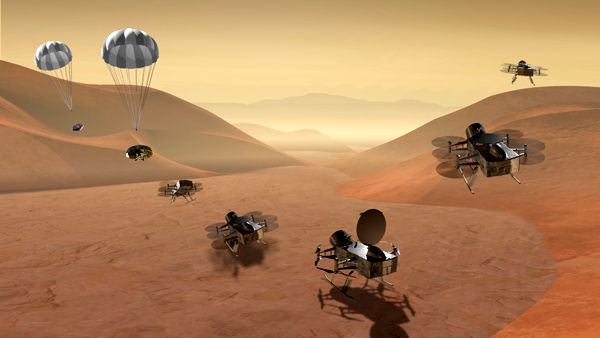
An artist's concept of NASA's Dragonfly rotorcraft...whose design was recently updated.
NASA / Johns Hopkins APL / Steve Gribben

Rotors for Mission to Titan Tested at Langley’s Transonic Dynamics Tunnel (News Release - December 20)

NASA explores the unknown in space, bringing the secrets of our solar system home so we can apply that information for the benefit of humanity. In that spirit, NASA will explore Titan, Saturn’s largest moon, to help advance humanity’s search for the building blocks of life in the universe.

A key component of the 8-rotor Dragonfly vehicle that will make that journey to Titan recently underwent testing at the Transonic Dynamics Tunnel (TDT) at NASA’s Langley Research Center in Hampton, Virginia.

Similar to a drone, Dragonfly will traverse Titan’s dense, nitrogen-rich atmosphere, then land on, sample and examine various sites. Dragonfly will have four pairs of rotors, each with two rotors in coaxial configuration, meaning one rotor above the other.

It’s similar to, but significantly larger than, a typical terrestrial drone, as the vehicle is over 12 feet both nose to tail and at the widest points, rotor tip-to-tip.

Researchers at Langley and from the Johns Hopkins Applied Physics Laboratory (APL) conducted a number of tests on a coaxial pair of rotors at the TDT meant to validate computer models. The large test section enabled the use of full-scale flight representative hardware, and the ability to fill the tunnel with heavy gas allowed the hardware to be tested at Titan-representative aerodynamic loads.

Researchers simulated expected conditions for hover, descent and climb, and assessed aerodynamic loads for each rotor at a variety of wind speeds, rotor shaft angles and rotor throttle settings. Researchers also conducted tests with one rotor operating and the other stationary to assess failure modes.

Sensors and accelerometers on the test article measured the loads and accelerations created by each rotor under various wind speeds, orientations and rotor speeds. Preliminary analysis of the data indicates that CFD predictions of rotor performance and power requirements are valid, and similar predictions for operation on Titan are within expected mission tolerances.

“The testing at this one-of-a-kind facility was a crucial early step toward bringing this exciting mission to fruition,” said Richard Heisler, wind tunnel test lead for Dragonfly at APL, which is designing and building the rotorcraft and manages the mission for NASA. “The data we collected at the TDT will give us a much clearer picture of how we can expect Dragonfly’s rotors to perform in Titan’s alien atmosphere.”

Dragonfly is scheduled to launch in 2027 and reach Titan by 2034, when it will begin what is expected to be a 3-year mission to explore and shed light on the complex chemistry on the exotic moon and ocean world. It was selected in June 2019 as part of NASA’s New Frontiers program, which includes the New Horizons mission to Pluto and the Kuiper Belt, Juno to Jupiter, and OSIRIS-REx to the asteroid Bennu.

Dragonfly is led by Principal Investigator Elizabeth Turtle at APL, which is located in Laurel, Maryland.

Source: NASA.Gov

****

Inside the Transonic Dynamics Tunnel at NASA’s Langley Research Center in Virginia, researchers assess the full-scale replicas of rotor blades that will fly on the Dragonfly spacecraft to Saturn's moon Titan.
NASA / Harlen Capen

Thursday, September 29, 2022

An Ocean World Gets Its First Close-Up in Over 20 Years...

An image segment of Europa's surface that was taken by NASA's Juno spacecraft from an altitude of 219 miles (352 kilometers)...on September 29, 2022.
NASA / JPL - Caltech / SWRI / MSSS

NASA’s Juno Shares First Image From Flyby of Jupiter’s Moon Europa (News Release)

Observations from the spacecraft’s pass of the moon provided the first close-up in over two decades of this ocean world, resulting in remarkable imagery and unique science.

The first picture NASA’s Juno spacecraft took as it flew by Jupiter’s ice-encrusted moon Europa has arrived on Earth. Revealing surface features in a region near the moon’s equator called Annwn Regio, the image was captured during the solar-powered spacecraft’s closest approach, on Thursday, September 29, at 2:36 a.m. PDT (5:36 a.m. EDT), at a distance of about 219 miles (352 kilometers).

This is only the third close pass in history below 310 miles (500 kilometers) altitude and the closest look any spacecraft has provided at Europa since January 3, 2000, when NASA’s Galileo came within 218 miles (351 kilometers) of the surface.

Europa is the sixth-largest moon in the solar system, slightly smaller than Earth’s moon. Scientists think a salty ocean lies below a miles-thick ice shell, sparking questions about potential conditions capable of supporting life underneath Europa’s surface.

This segment of the first image of Europa [above] taken during this flyby by the spacecraft’s JunoCam (a public-engagement camera) zooms in on a swath of Europa’s surface north of the equator. Due to the enhanced contrast between light and shadow seen along the terminator (the nightside boundary), rugged terrain features are easily seen, including tall shadow-casting blocks, while bright and dark ridges and troughs curve across the surface. The oblong pit near the terminator might be a degraded impact crater.

With this additional data about Europa’s geology, Juno’s observations will benefit future missions to the Jovian moon, including the agency’s Europa Clipper. Set to launch in 2024, Europa Clipper will study the moon’s atmosphere, surface and interior, with its main science goal being to determine whether there are places below Europa’s surface that could support life.

As exciting as Juno’s data will be, the spacecraft only had a two-hour window to collect it, racing past the moon with a relative velocity of about 14.7 miles per second (23.6 kilometers per second).

“It’s very early in the process, but by all indications Juno’s flyby of Europa was a great success,” said Scott Bolton, Juno principal investigator from Southwest Research Institute in San Antonio. “This first picture is just a glimpse of the remarkable new science to come from Juno’s entire suite of instruments and sensors that acquired data as we skimmed over the moon’s icy crust.”

During the flyby, the mission collected what will be some of the highest-resolution images of the moon (0.6 miles, or 1 kilometer, per pixel) and obtained valuable data on Europa’s ice shell structure, interior, surface composition and ionosphere, in addition to the moon’s interaction with Jupiter’s magnetosphere.

“The science team will be comparing the full set of images obtained by Juno with images from previous missions, looking to see if Europa’s surface features have changed over the past two decades,” said Candy Hansen, a Juno co-investigator who leads planning for the camera at the Planetary Science Institute in Tucson, Arizona. “The JunoCam images will fill in the current geologic map, replacing existing low-resolution coverage of the area.”

Juno’s close-up views and data from its Microwave Radiometer (MWR) instrument will provide new details on how the structure of Europa’s ice varies beneath its crust. Scientists can use all this information to generate new insights into the moon, including data in the search for regions where liquid water may exist in shallow subsurface pockets.

Building on Juno’s observations and previous missions such as Voyager 2 and Galileo, NASA’s Europa Clipper mission, slated to arrive at Europa in 2030, will study the moon’s atmosphere, surface and interior – with a goal to investigate habitability and better understand its global subsurface ocean, the thickness of its ice crust and search for possible plumes that may be venting subsurface water into space.

The close flyby modified Juno’s trajectory, reducing the time it takes to orbit Jupiter from 43 to 38 days. The flyby also marks the second encounter with a Galilean moon during Juno’s extended mission. The mission explored Ganymede in June 2021 and is scheduled to make close flybys of Io, the most volcanic body in the solar system, in 2023 and 2024.

Source: NASA.Gov

****

An enhanced image of Europa that was taken by NASA's Juno spacecraft on September 29, 2022.

Thursday, September 01, 2022

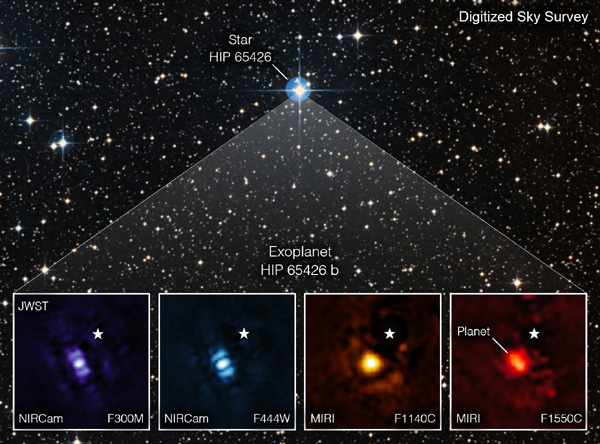
Hubble's Successor Captures a Photo of An Exoplanet Located 356 Light-Years Away...

An annotated image of the star HIP 65426 and its planet HIP 65426 b...as seen by the James Webb Space Telescope.
NASA / ESA / CSA, A Carter (UCSC), the ERS 1386 team, and A. Pagan (STScI)

NASA’s Webb Takes Its First-Ever Direct Image of Distant World (News Release)

For the first time, astronomers have used NASA’s James Webb Space Telescope to take a direct image of a planet outside our solar system. The exoplanet is a gas giant, meaning it has no rocky surface and could not be habitable.

The image, as seen through four different light filters, shows how Webb’s powerful infrared gaze can easily capture worlds beyond our solar system, pointing the way to future observations that will reveal more information than ever before about exoplanets.

“This is a transformative moment, not only for Webb but also for astronomy generally,” said Sasha Hinkley, associate professor of physics and astronomy at the University of Exeter in the United Kingdom, who led these observations with a large international collaboration. Webb is an international mission led by NASA in collaboration with its partners, ESA (European Space Agency) and CSA (Canadian Space Agency).

The exoplanet in Webb’s image, called HIP 65426 b, is about six to 12 times the mass of Jupiter, and these observations could help narrow that down even further. It is young as planets go — about 15 to 20 million years old, compared to our 4.5-billion-year-old Earth.

Astronomers discovered the planet in 2017 using the SPHERE instrument on the European Southern Observatory’s Very Large Telescope in Chile and took images of it using short infrared wavelengths of light. Webb’s view, at longer infrared wavelengths, reveals new details that ground-based telescopes would not be able to detect because of the intrinsic infrared glow of Earth’s atmosphere.

Researchers have been analyzing the data from these observations and are preparing a paper they will submit to journals for peer review. But Webb’s first capture of an exoplanet already hints at future possibilities for studying distant worlds.

Since HIP 65426 b is about 100 times farther from its host star than Earth is from the Sun, it is sufficiently distant from the star that Webb can easily separate the planet from the star in the image.

Webb’s Near-Infrared Camera (NIRCam) and Mid-Infrared Instrument (MIRI) are both equipped with coronagraphs, which are sets of tiny masks that block out starlight, enabling Webb to take direct images of certain exoplanets like this one. NASA’s Nancy Grace Roman Space Telescope, slated to launch later this decade, will demonstrate an even more advanced coronagraph.

“It was really impressive how well the Webb coronagraphs worked to suppress the light of the host star,” Hinkley said.

Taking direct images of exoplanets is challenging because stars are so much brighter than planets. The HIP 65426 b planet is more than 10,000 times fainter than its host star in the near-infrared, and a few thousand times fainter in the mid-infrared.

In each filter image, the planet appears as a slightly differently shaped blob of light. That is because of the particulars of Webb’s optical system and how it translates light through the different optics.

“Obtaining this image felt like digging for space treasure,” said Aarynn Carter, a postdoctoral researcher at the University of California, Santa Cruz, who led the analysis of the images. “At first all I could see was light from the star, but with careful image processing I was able to remove that light and uncover the planet.”

While this is not the first direct image of an exoplanet taken from space – the Hubble Space Telescope has captured direct exoplanet images previously – HIP 65426 b points the way forward for Webb’s exoplanet exploration.

“I think what’s most exciting is that we’ve only just begun,” Carter said. “There are many more images of exoplanets to come that will shape our overall understanding of their physics, chemistry, and formation. We may even discover previously unknown planets, too.”

– Elizabeth Landau, NASA Headquarters

Source: NASA.Gov

****

Tuesday, August 16, 2022

Astrobotic's Moon Lander Successfully Conducts a Communications Test with NASA Relay Stations...

The Peregrine lunar lander, which is still undergoing construction, sits inside a cleanroom at Astrobotic's headquarters in Pittsburgh, PA...on April 20, 2022.
Astrobotic / Keystone Space Collaborative

NASA’s Deep Space Network Ground Testing with Peregrine a Success (Press Release)

Pittsburgh, PA – Last month, the Deep Space Network (DSN) from NASA’s Jet Propulsion Laboratory (JPL) successfully completed an end-to-end communications test with Astrobotic’s Peregrine lunar lander. These tests demonstrated compatibility with space-to-ground communications that will occur during Peregrine’s mission to the Moon.

After the Peregrine spacecraft separates from United Launch Alliance's (ULA) Vulcan Centaur rocket, Peregrine will be utilizing DSN’s 34-meter dishes at Canberra, Australia; Madrid, Spain; and Goldstone, California. These dishes are the same suite used to communicate with the James Webb Space Telescope, as well as historic missions such as New Horizons, Solar Parker Probe, InSight, Juno, and MAVEN.

”Our team has completed a major test with the DSN global network and Astrobotic’s communication systems including flight avionics, ground support software, and mission ops infrastructure. We successfully passed commands, received telemetry, and determined ranging performance. The sense of accomplishment was palpable when the screens of our Mission Control center were illuminated by real telemetry coming from our spacecraft,” said Eduardo Lugo, Astrobotic Lead RF Engineer.

Testing with Peregrine and DSN was conducted over two weeks, culminating in confirmation that Peregrine can successfully transmit data and receive commands through DSN and to Astrobotic’s Mission Control Center in Pittsburgh, Pennsylvania.

“This success marks a major program milestone for Peregrine mission as well as for Astrobotic as a company. Confirming the technical capabilities of our team and our custom-built avionics and communications systems in a sophisticated, system-level spacecraft test was a tremendous success. Seeing the entire team overcome test challenges felt close to flying the actual mission. This is a great accomplishment for our historic trip to the Moon,” says Ander Solorzano, Astrobotic’s Lead Systems Engineer and one of the Flight Directors for Peregrine Mission One.

Peregrine’s progress continues as its Space Robotics team also successfully integrated the OPAL Terrain Relative Navigation (TRN) compute hardware and associated camera to Peregrine’s flight decks. TRN is designed to enable precise and safe landings on the Moon, Mars, and beyond. The system will be leveraged again on Astrobotic’s Griffin Mission One. In addition to TRN, all twenty-four of Peregrine’s payloads have also been integrated with its flight decks.

The Peregrine spacecraft continues its final assembly at Astrobotic’s headquarters and is currently on schedule for final environmental testing before delivery to the launch site in Cape Canaveral, Florida.

Source: Astrobotic

****

At Astrobotic's headquarters in Pittsburgh, Pennsylvania, the Astrobotic and NASA Jet Propulsion Laboratory teams pose in front of a NASA Deep Space Network trailer following a successful communications test with Astrobotic's Peregrine lunar lander last month.
Astrobotic

Monday, July 26, 2021

Europa Isn't the Only Moon of Jupiter That Continues to Tantalize Scientists with Signs of an Underground Ocean...

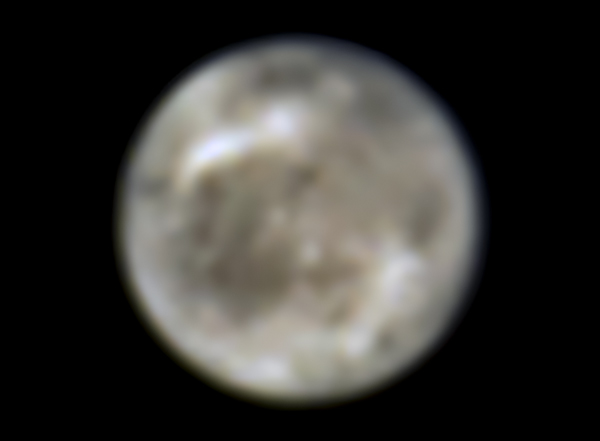
An image of Jupiter's moon Ganymede that was taken by NASA's Hubble Space Telescope half a billion miles (over 600 million kilometers) away...in 1996.
NASA, ESA, John Spencer (SwRI Boulder)

Hubble Finds First Evidence of Water Vapor at Jupiter’s Moon Ganymede (News Release)

For the first time, astronomers have uncovered evidence of water vapor in the atmosphere of Jupiter's moon Ganymede. This water vapor forms when ice from the moon's surface sublimates -- that is, turns from solid to gas.

Scientists used new and archival datasets from NASA's Hubble Space Telescope to make the discovery, published in the journal Nature Astronomy.

Previous research has offered circumstantial evidence that Ganymede, the largest moon in the solar system, contains more water than all of Earth's oceans. However, temperatures there are so cold that water on the surface is frozen solid. Ganymede's ocean would reside roughly 100 miles below the crust; therefore, the water vapor would not represent the evaporation of this ocean.

Astronomers re-examined Hubble observations from the last two decades to find this evidence of water vapor.

In 1998, Hubble's Space Telescope Imaging Spectrograph took the first ultraviolet (UV) images of Ganymede, which revealed colorful ribbons of electrified gas called auroral bands, and provided further evidence that Ganymede has a weak magnetic field.

The similarities in these UV observations were explained by the presence of molecular oxygen (O2). But some observed features did not match the expected emissions from a pure O2 atmosphere. At the same time, scientists concluded this discrepancy was likely related to higher concentrations of atomic oxygen (O).

As part of a large observing program to support NASA's Juno mission in 2018, Lorenz Roth of the KTH Royal Institute of Technology in Stockholm, Sweden led the team that set out to measure the amount of atomic oxygen with Hubble. The team's analysis combined the data from two instruments: Hubble's Cosmic Origins Spectrograph in 2018 and archival images from the Space Telescope Imaging Spectrograph (STIS) from 1998 to 2010.

To their surprise, and contrary to the original interpretations of the data from 1998, they discovered there was hardly any atomic oxygen in Ganymede's atmosphere. This means there must be another explanation for the apparent differences in these UV aurora images.

Roth and his team then took a closer look at the relative distribution of the aurora in the UV images. Ganymede's surface temperature varies strongly throughout the day, and around noon near the equator it may become sufficiently warm that the ice surface releases (or sublimates) some small amounts of water molecules. In fact, the perceived differences in the UV images are directly correlated with where water would be expected in the moon's atmosphere.

"So far only the molecular oxygen had been observed," explained Roth. "This is produced when charged particles erode the ice surface. The water vapor that we measured now originates from ice sublimation caused by the thermal escape of water vapor from warm icy regions."

This finding adds anticipation to ESA (European Space Agency)'s upcoming mission, JUICE, which stands for JUpiter ICy moons Explorer. JUICE is the first large-class mission in ESA's Cosmic Vision 2015-2025 program. Planned for launch in 2022 and arrival at Jupiter in 2029, it will spend at least three years making detailed observations of Jupiter and three of its largest moons, with particular emphasis on Ganymede as a planetary body and potential habitat.

Ganymede was identified for detailed investigation because it provides a natural laboratory for analysis of the nature, evolution and potential habitability of icy worlds in general, the role it plays within the system of Galilean satellites, and its unique magnetic and plasma interactions with Jupiter and its environment.

"Our results can provide the JUICE instrument teams with valuable information that may be used to refine their observation plans to optimize the use of the spacecraft," added Roth.

Right now, NASA's Juno mission is taking a close look at Ganymede and recently released new imagery of the icy moon. Juno has been studying Jupiter and its environment, also known as the Jovian system, since 2016.

Understanding the Jovian system and unravelling its history, from its origin to the possible emergence of habitable environments, will provide us with a better understanding of how gas giant planets and their satellites form and evolve. In addition, new insights will hopefully be found on the habitability of Jupiter-like exoplanetary systems.

The Hubble Space Telescope is a project of international cooperation between NASA and ESA (European Space Agency). NASA's Goddard Space Flight Center in Greenbelt, Maryland, manages the telescope. The Space Telescope Science Institute (STScI) in Baltimore, Maryland, conducts Hubble science operations. STScI is operated for NASA by the Association of Universities for Research in Astronomy in Washington, D.C.

Source: NASA.Gov

****

Wednesday, June 16, 2021

It's Been 14 Days Since We Lost Triton to Venus...

An image of Neptune's moon Triton that was taken by NASA's Voyager 2 spacecraft in August of 1989.
NASA / JPL - Caltech

So today marks two weeks since NASA rejected the Trident flyby to Neptune's moon Triton as its next Discovery-class mission, and I'm still fuming. What makes me even more angry—and perplexed—is the fact that one aerospace contractor, Aerojet Rocketdyne, received a contract four months ago to build flight hardware that was no doubt intended for Trident. Aeroject was to have assembled two Multi-Mission Radioisotope Thermoelectric Generators (MMRTGs, which are used by the Curiosity and Perseverance Mars rovers, as well as Dragonfly during its upcoming investigation of Saturn's moon Titan) for a future mission...which, as indicated in the schematics posted at the end of this Blog entry, were very likely meant for Trident.

The schematics below show that Trident was to have been powered by two MMRTGs—the exact number of Plutonium 238-fueled generators that Aerojet was hired to construct. The Io Volcanic Observer, the other Discovery-class finalist that came up short two weeks ago, would've used large solar array wings to generate electricity...just like Juno and the Europa Clipper orbiters. VERITAS and DAVINCI+ (this will be one of those rare instances where I begrudgingly mention the names of those two dreaded Venus-bound missions here) will not need to rely on nuclear power since they're heading to a hellish world (that has no real future for crewed space exploration) located only 67 million miles from the Sun.

So what gives? Methinks that NASA initially chose Trident, but then changed its mind in the four months leading up to the disappointing June 2 announcement. Why, you ask? We'll never find out. But I'll never let this go until NASA gives us another exciting journey to the outer Solar System and beyond. And by beyond I obviously mean another flyby mission... Eris, Sedna, Makemake and the rest of those unexplored dwarf planets beyond Pluto beckon! Carry on.

Schematics for the Trident spacecraft...if it was built.

Wednesday, June 09, 2021

Juno Update: Check Out the First New Close-up Photos of Our Solar System's Largest Moon in 21 Years...

A black & white image of Jupiter's moon Ganymede that NASA's Juno spacecraft took with its JunoCam imager...on June 7, 2021.
NASA / JPL - Caltech / SwRI / MSSS

See the First Images NASA’s Juno Took As It Sailed by Ganymede (News Release - June 8)

The spacecraft flew closer to Jupiter’s largest moon than any other in more than two decades, offering dramatic glimpses of the icy orb.

The first two images from NASA Juno’s June 7, 2021, flyby of Jupiter’s giant moon Ganymede have been received on Earth. The photos – one from the Jupiter orbiter’s JunoCam imager and the other from its Stellar Reference Unit star camera – show the surface in remarkable detail, including craters, clearly distinct dark and bright terrain, and long structural features possibly linked to tectonic faults.

“This is the closest any spacecraft has come to this mammoth moon in a generation,” said Juno Principal Investigator Scott Bolton of the Southwest Research Institute in San Antonio. “We are going to take our time before we draw any scientific conclusions, but until then we can simply marvel at this celestial wonder.”

Using its green filter, the spacecraft’s JunoCam visible-light imager captured almost an entire side of the water-ice-encrusted moon. Later, when versions of the same image come down incorporating the camera’s red and blue filters, imaging experts will be able to provide a color portrait of Ganymede. Image resolution is about 0.6 miles (1 kilometer) per pixel.

In addition, Juno’s Stellar Reference Unit, a navigation camera that keeps the spacecraft on course, provided a black-and-white picture of Ganymede’s dark side (the side opposite the Sun) bathed in dim light scattered off Jupiter. Image resolution is between 0.37 to 0.56 miles (600 to 900 meters) per pixel.

“The conditions in which we collected the dark side image of Ganymede were ideal for a low-light camera like our Stellar Reference Unit,” said Heidi Becker, Juno’s radiation monitoring lead at JPL. “So this is a different part of the surface than seen by JunoCam in direct sunlight. It will be fun to see what the two teams can piece together.”

The spacecraft will send more images from its Ganymede flyby in the coming days, with JunoCam’s raw images being made available here.

The solar-powered spacecraft’s encounter with the Jovian moon is expected to yield insights into its composition, ionosphere, magnetosphere, and ice shell while also providing measurements of the radiation environment that will benefit future missions to the Jovian system.

Source: Jet Propulsion Laboratory

****

A black & white image of Ganymede that was taken with a navigation camera aboard the Juno spacecraft...on June 7, 2021.
NASA / JPL - Caltech / SwRI

A 1996 image of Ganymede that was taken by NASA's Galileo spacecraft...which made one last flyby of the Jovian moon in early 2000 before its mission ended three years later.
NASA / JPL

Friday, January 08, 2021

InSight and Juno Have Received a New Lease on Life...

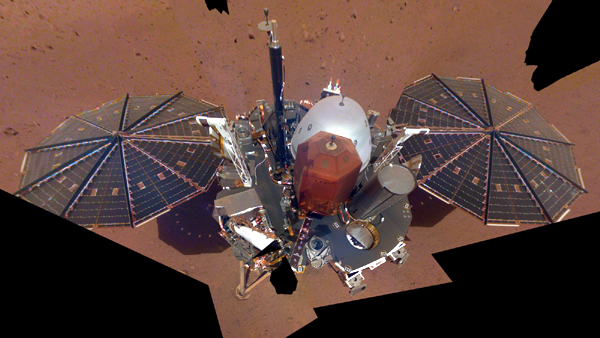
A composite image of the InSight lander that was taken with a camera on its robotic arm after the spacecraft touched down on Mars in late November of 2018.
NASA / JPL

NASA Extends Exploration for Two Planetary Science Missions (News Release)

The missions – Juno and InSight – have each increased our understanding of our solar system, as well as spurred new sets of diverse questions.

As NASA prepares to send astronauts back to the Moon and on to Mars, the agency’s quest to seek answers about our solar system and beyond continues to inform those efforts and generate new discoveries. The agency has extended the missions of two spacecraft, following an external review of their scientific productivity.

The missions – Juno and InSight – have each increased our understanding of our solar system, as well as spurred new sets of diverse questions.

An independent review panel, composed of experts with backgrounds in science, operations, and mission management, found the Juno and InSight missions have “produced exceptional science” and recommended NASA continue both missions.

The Juno spacecraft and its mission team have made discoveries about Jupiter’s interior structure, magnetic field, and magnetosphere, and have found its atmospheric dynamics to be far more complex than scientists previously thought. Extended through September 2025, or its end of life (whichever comes first), the mission will not only continue key observations of Jupiter, but also will expand its investigations to the larger Jovian system including Jupiter’s rings and large moons, with targeted observations and close flybys planned of the moons Ganymede, Europa, and Io.

The InSight mission is extended for two years, running through December 2022. InSight’s spacecraft and team deployed and operated its highly sensitive seismometer to expand our understanding of Mars’ crust and mantle. Searching for and identifying Marsquakes, the mission team collected data clearly demonstrating the robust tectonic activity of the Red Planet, and enhanced our knowledge of the planet’s atmospheric dynamics, magnetic field, and interior structure. InSight’s extended mission will focus on producing a long-duration, high quality seismic dataset. Continued operation of its weather station and burial of the seismic tether using the spacecraft’s Instrument Deployment Arm (IDA), will contribute to the quality of this seismic dataset. The extended mission may continue deployment (at low priority) of the spacecraft’s Heat Probe and Physical Properties instrument (HP3), which remains close to the surface.

“The Senior Review has validated that these two planetary science missions are likely to continue to bring new discoveries, and produce new questions about our solar system,” said Lori Glaze, director of the planetary science division at NASA Headquarters in Washington. “I thank the members of the Senior Review panel for their comprehensive analysis and thank the mission teams as well, who will now continue to provide exciting opportunities to refine our understanding of the dynamic science of Jupiter and Mars."

Extended missions leverage NASA’s large investments, allowing continued science operations at a cost far lower than developing a new mission. In some cases, the extensions allow missions to continue to acquire valuable long-duration datasets, while in other cases, they allow missions to visit new targets, with entirely new science goals.

NASA’s Planetary Science Division currently operates more than a dozen spacecraft across the solar system.

Source: NASA.Gov

****

An artist's concept of NASA's Juno spacecraft (which launched from Cape Canaveral Air Force Station in Florida on August 5, 2011) orbiting Jupiter.
NASA / JPL - Caltech

Thursday, June 27, 2019

Dragonfly Is Officially Heading to Titan!

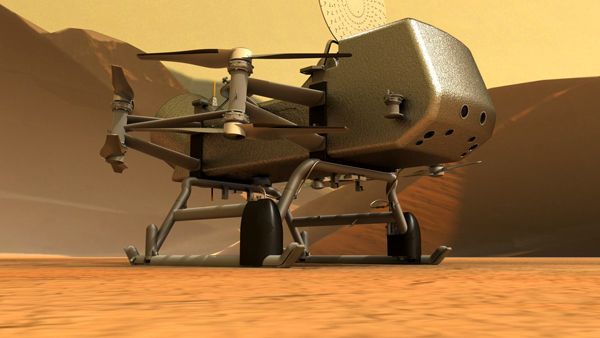
An artist's concept of the Dragonfly rotorcraft on the surface of Saturn's moon Titan.
Johns Hopkins APL

NASA Selects Flying Mission to Study Titan for Origins, Signs of Life (Press Release)

NASA has announced that our next destination in the solar system is the unique, richly organic world Titan. Advancing our search for the building blocks of life, the Dragonfly mission will fly multiple sorties to sample and examine sites around Saturn’s icy moon.

Dragonfly will launch in 2026 and arrive in 2034. The rotorcraft will fly to dozens of promising locations on Titan looking for prebiotic chemical processes common on both Titan and Earth. Dragonfly marks the first time NASA will fly a multi-rotor vehicle for science on another planet; it has eight rotors and flies like a large drone. It will take advantage of Titan’s dense atmosphere – four times denser than Earth’s – to become the first vehicle ever to fly its entire science payload to new places for repeatable and targeted access to surface materials.

Titan is an analog to the very early Earth, and can provide clues to how life may have arisen on our planet. During its 2.7-year baseline mission, Dragonfly will explore diverse environments from organic dunes to the floor of an impact crater where liquid water and complex organic materials key to life once existed together for possibly tens of thousands of years. Its instruments will study how far prebiotic chemistry may have progressed. They also will investigate the moon’s atmospheric and surface properties and its subsurface ocean and liquid reservoirs. Additionally, instruments will search for chemical evidence of past or extant life.

“With the Dragonfly mission, NASA will once again do what no one else can do,” said NASA Administrator Jim Bridenstine. “Visiting this mysterious ocean world could revolutionize what we know about life in the universe. This cutting-edge mission would have been unthinkable even just a few years ago, but we’re now ready for Dragonfly’s amazing flight.”

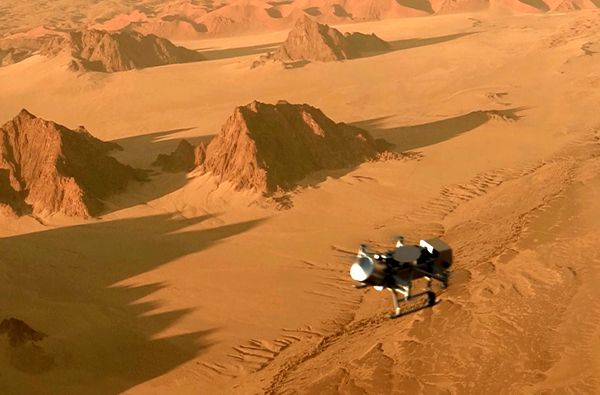
Dragonfly took advantage of 13 years’ worth of Cassini data to choose a calm weather period to land, along with a safe initial landing site and scientifically interesting targets. It will first land at the equatorial “Shangri-La” dune fields, which are terrestrially similar to the linear dunes in Namibia in southern Africa and offer a diverse sampling location. Dragonfly will explore this region in short flights, building up to a series of longer “leapfrog” flights of up to 5 miles (8 kilometers), stopping along the way to take samples from compelling areas with diverse geography. It will finally reach the Selk impact crater, where there is evidence of past liquid water, organics – the complex molecules that contain carbon, combined with hydrogen, oxygen, and nitrogen – and energy, which together make up the recipe for life. The lander will eventually fly more than 108 miles (175 kilometers) – nearly double the distance traveled to date by all the Mars rovers combined.

“Titan is unlike any other place in the solar system, and Dragonfly is like no other mission,” said Thomas Zurbuchen, NASA’s associate administrator for Science at the agency’s Headquarters in Washington. “It’s remarkable to think of this rotorcraft flying miles and miles across the organic sand dunes of Saturn’s largest moon, exploring the processes that shape this extraordinary environment. Dragonfly will visit a world filled with a wide variety of organic compounds, which are the building blocks of life and could teach us about the origin of life itself.”

Titan has a nitrogen-based atmosphere like Earth. Unlike Earth, Titan has clouds and rain of methane. Other organics are formed in the atmosphere and fall like light snow. The moon’s weather and surface processes have combined complex organics, energy, and water similar to those that may have sparked life on our planet.

Titan is larger than the planet Mercury and is the second largest moon in our solar system. As it orbits Saturn, it is about 886 million miles (1.4 billion kilometers) away from the Sun, about 10 times farther than Earth. Because it is so far from the Sun, its surface temperature is around -290 degrees Fahrenheit (-179 degrees Celsius). Its surface pressure is also 50 percent higher than Earth’s.

Dragonfly was selected as part of the agency’s New Frontiers program, which includes the New Horizons mission to Pluto and the Kuiper Belt, Juno to Jupiter, and OSIRIS-REx to the asteroid Bennu. Dragonfly is led by Principal Investigator Elizabeth Turtle, who is based at Johns Hopkins University’s Applied Physics Laboratory in Laurel, Maryland. New Frontiers supports missions that have been identified as top solar system exploration priorities by the planetary community. The program is managed by the Planetary Missions Program Office at NASA’s Marshall Space Flight Center in Huntsville, Alabama, for the agency’s Planetary Science Division in Washington.
“The New Frontiers program has transformed our understanding of the solar system, uncovering the inner structure and composition of Jupiter’s turbulent atmosphere, discovering the icy secrets of Pluto’s landscape, revealing mysterious objects in the Kuiper belt, and exploring a near-Earth asteroid for the building blocks of life,” said Lori Glaze, director of NASA’s Planetary Science Division. “Now we can add Titan to the list of enigmatic worlds NASA will explore.”

****

An artist's concept of the Dragonfly rotorcraft flying above the surface of Saturn's moon Titan.
Johns Hopkins APL


Sunday, August 05, 2018

This Day In Space...

An artist's concept of NASA's Juno spacecraft (which launched from Cape Canaveral Air Force Station in Florida on August 5, 2011) orbiting Jupiter.
NASA / JPL - Caltech

Today marks a few milestones for NASA deep-space missions and the first human to set foot on the Moon:

- The Juno spacecraft launched from Cape Canaveral Air Force Station in Florida on a five-year journey to Jupiter seven years ago today...

- The Curiosity Mars rover touched down on Gale Crater at the Red Planet six years ago today...

- The InSight Mars lander, which launched from Vandenberg Air Force Base in California on May 5, reached the halfway point of its journey to the Red Planet (where it will touch down on Cyber Monday, November 26) as of today...

- Apollo 11 astronaut Neil Armstrong was born in Wapakoneta, Ohio, and would've turned 88 today.

Carry on!

EDIT (August 23): InSight reached the halfway point of its journey to Mars as of August 6.

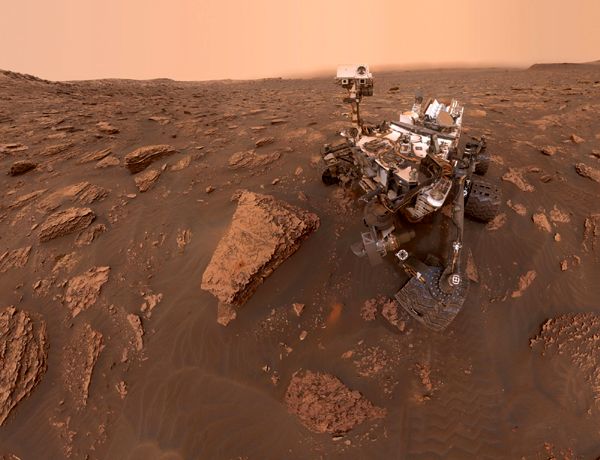
A self-portrait of NASA's Curiosity Mars rover (which landed on the Red Planet on August 5, 2012), taken with a camera on her robotic arm on June 15, 2018.
NASA / JPL - Caltech / MSSS

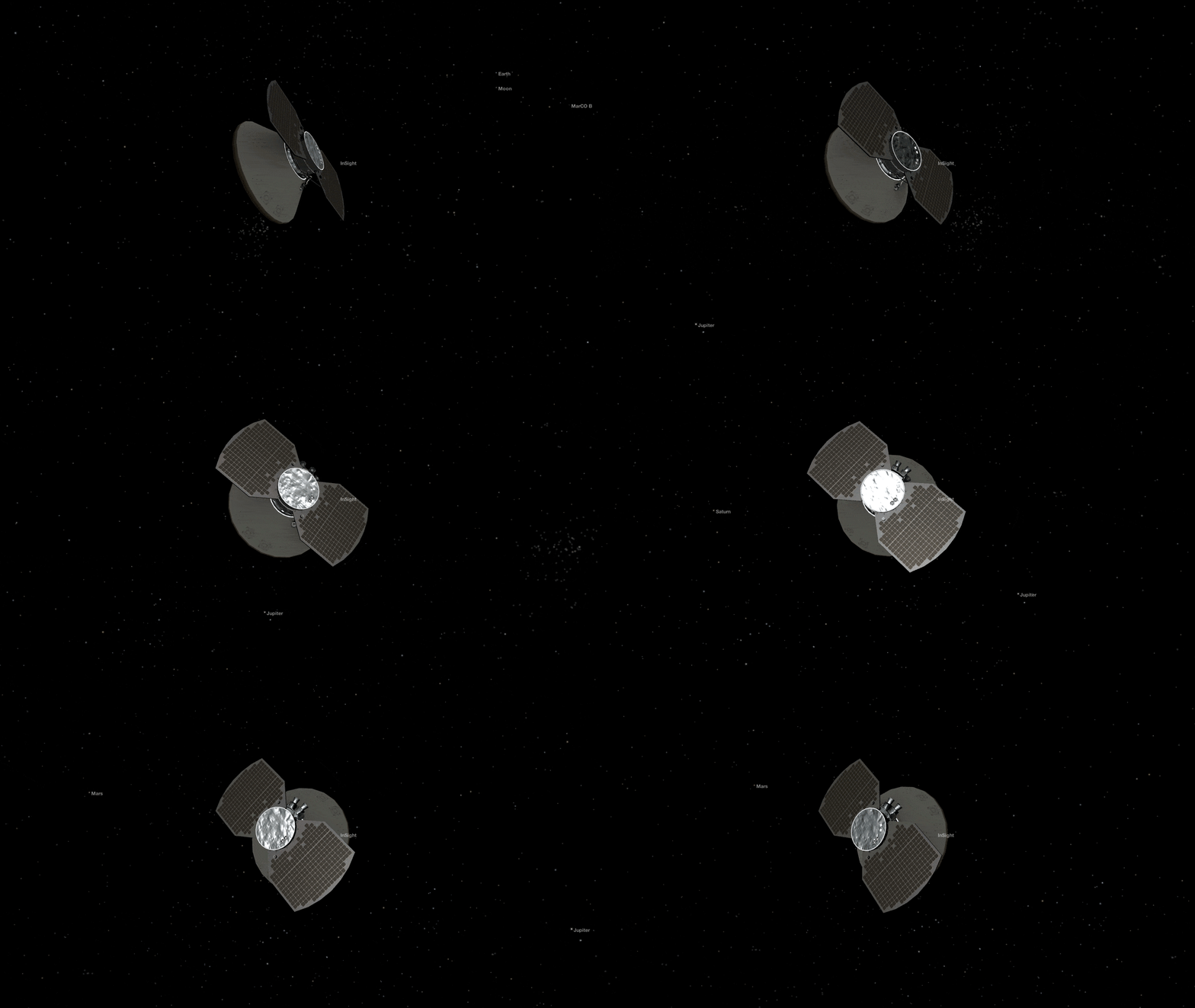
An animated GIF depicting NASA's InSight Mars lander (which reached the halfway point of its journey to the Red Planet as of August 5, 2018) cruising through deep space.
NASA / JPL - CalTech

Neil Armstrong (who was born on August 5, 1930) poses for a photo by fellow Apollo 11 crew member Buzz Aldrin inside the Eagle Lunar Module, on July 20, 1969.
NASA / Edwin E. Aldrin, Jr.

Wednesday, December 20, 2017

I'm VERY Excited for the Dragonfly Mission to Titan!

An artist's concept of the Dragonfly drone spacecraft designed to study the surface of Saturn's moon Titan.
NASA

NASA Invests in Concept Development for Missions to Comet, Saturn Moon Titan (Press Release)

NASA has selected two finalist concepts for a robotic mission planned to launch in the mid-2020s: a comet sample return mission and a drone-like rotorcraft that would explore potential landing sites on Saturn’s largest moon, Titan.

The agency announced the concepts Wednesday, following an extensive and competitive peer review process. The concepts were chosen from 12 proposals submitted in April under a New Frontiers program announcement of opportunity.

“This is a giant leap forward in developing our next bold mission of science discovery,” said Thomas Zurbuchen, associate administrator for NASA’s Science Mission Directorate in Washington. “These are tantalizing investigations that seek to answer some of the biggest questions in our solar system today.”

The finalists are:

Comet Astrobiology Exploration Sample Return (CAESAR)

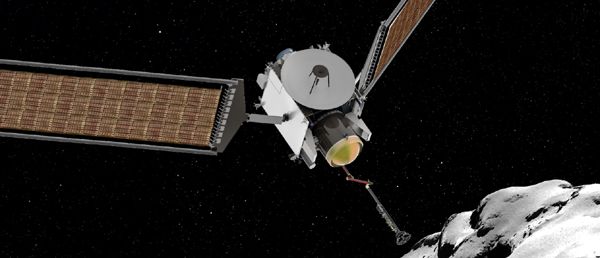
The CAESAR mission seeks to return a sample from 67P/Churyumov-Gerasimenko, a comet that was successfully explored by the European Space Agency’s Rosetta spacecraft, to determine its origin and history. Led by Steve Squyres of Cornell University in Ithaca, New York, CAESAR would be managed by NASA’s Goddard Space Flight Center in Greenbelt, Maryland.

Dragonfly

Dragonfly is a drone-like rotorcraft that would explore the prebiotic chemistry and habitability of dozens of sites on Saturn’s moon Titan, an ocean world in our solar system. Elizabeth Turtle from the Johns Hopkins University Applied Physics Laboratory (APL) in Laurel, Maryland, is the lead investigator, with APL providing project management.
The CAESAR and Dragonfly missions will receive funding through the end of 2018 to further develop and mature their concepts. NASA plans to select one of these investigations in the spring of 2019 to continue on to subsequent mission phases.

The selected mission will be the fourth in NASA’s New Frontiers portfolio, a series of principal investigator-led planetary science investigations that fall under a development cost cap of approximately $850 million. Its predecessors are the New Horizons mission to Pluto and a Kuiper Belt Object known as 2014 MU69, the Juno mission to Jupiter, and OSIRIS-REx, which will rendezvous with and return a sample of the asteroid Bennu.

NASA also announced the selection of two mission concepts that will receive technology development funds to prepare them for future mission competitions.

The concepts selected for technology development are:

Enceladus Life Signatures and Habitability (ELSAH)

The ELSAH mission concept will receive funds to develop cost-effective techniques that limit spacecraft contamination and thereby enable life detection measurements on cost-capped missions. The principal investigator is Chris McKay of NASA’s Ames Research Center in California’s Silicon Valley, and the managing NASA center is Goddard.

Venus In situ Composition Investigations (VICI)

Led by Lori Glaze at Goddard, the VICI mission concept will further develop the Venus Element and Mineralogy Camera to operate under the harsh conditions on Venus. The instrument uses lasers on a lander to measure the mineralogy and elemental composition of rocks on the surface of Venus.

The call for concepts was limited to six mission themes: comet surface sample return, lunar south pole-Aitken Basin sample return, ocean worlds (Titan and/or Enceladus), Saturn probe, Trojan asteroid tour and rendezvous, and Venus in situ explorer.

New Frontiers Program investigations address NASA’s planetary science objectives as described in the 2014 NASA Strategic Plan and the 2014 NASA Science Plan. The program is managed by the Planetary Missions Program Office at NASA’s Marshall Space Flight Center in Huntsville, Alabama, for the agency’s Planetary Science Division in Washington.

Source: NASA.Gov

****

An artist's concept of the CAESAR spacecraft retrieving a sample from the surface of 67P/Churyumov–Gerasimenko...the comet explored by Europe's Rosetta orbiter from August 2014 to September 2016.
NASA

Friday, August 04, 2017

Photo of the Day: A Jovian (Anti-)Cyclone...

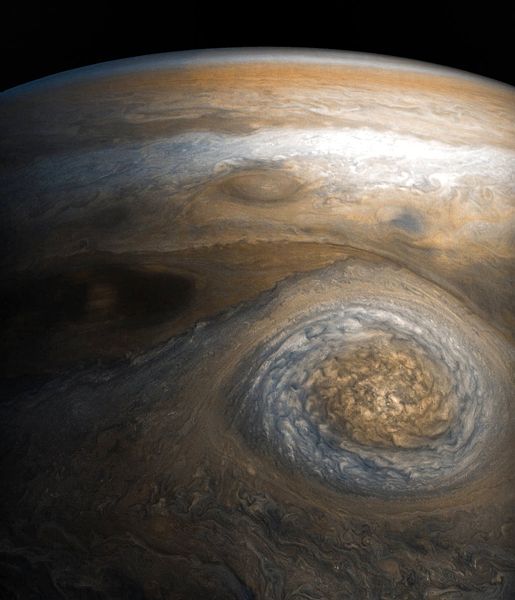
An image of a storm on Jupiter that was taken by NASA's Juno spacecraft...on July 10, 2017.
NASA / JPL - Caltech / SwRI / MSSS / Gerald Eichstädt / Seán Doran

Jupiter Storm of the High North (News Release - August 3)

A dynamic storm at the southern edge of Jupiter’s northern polar region dominates this Jovian cloudscape, courtesy of NASA’s Juno spacecraft.

This storm is a long-lived anticyclonic oval named North North Temperate Little Red Spot 1 (NN-LRS-1); it has been tracked at least since 1993, and may be older still. An anticyclone is a weather phenomenon where winds around the storm flow in the direction opposite to that of the flow around a region of low pressure. It is the third largest anticyclonic oval on the planet, typically around 3,700 miles (6,000 kilometers) long. The color varies between red and off-white (as it is now), but this JunoCam image shows that it still has a pale reddish core within the radius of maximum wind speeds.

Citizen scientists Gerald Eichstädt and Seán Doran processed this image using data from the JunoCam imager. The image has been rotated so that the top of the image is actually the equatorial regions while the bottom of the image is of the northern polar regions of the planet.

The image was taken on July 10, 2017 at 6:42 p.m. PDT (9:42 p.m. EDT), as the Juno spacecraft performed its seventh close flyby of Jupiter. At the time the image was taken, the spacecraft was about 7,111 miles (11,444 kilometers) from the tops of the clouds of the planet at a latitude of 44.5 degrees.

Source: NASA.Gov

Wednesday, July 12, 2017

Juno Update: The "Eye of Jupiter" Up-Close...

An enhanced color image of Jupiter's Great Red Spot that was taken by NASA's Juno spacecraft on July 10, 2017.
NASA / JPL - Caltech / SwRI / MSSS / Kevin Gill

NASA’s Juno Spacecraft Spots Jupiter’s Great Red Spot (News Release)

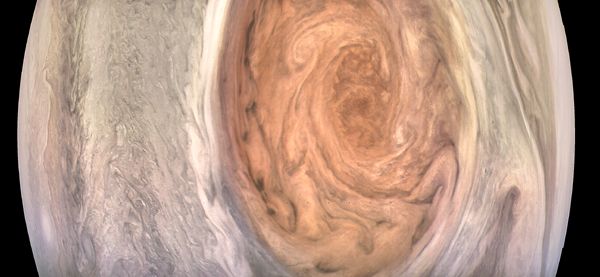
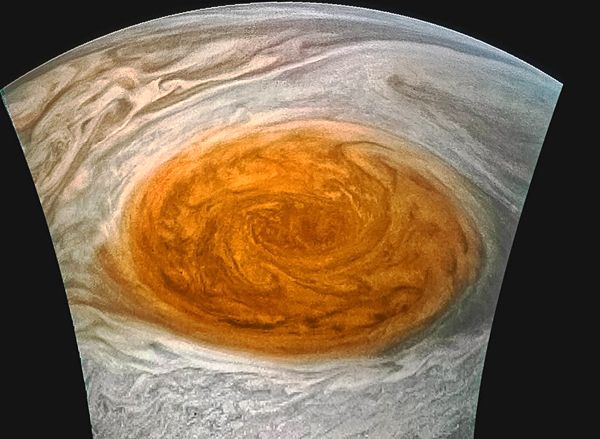
Images of Jupiter’s Great Red Spot reveal a tangle of dark, veinous clouds weaving their way through a massive crimson oval. The JunoCam imager aboard NASA's Juno mission snapped pics of the most iconic feature of the solar system’s largest planetary inhabitant during its Monday (July 10) flyby. The images of the Great Red Spot were downlinked from the spacecraft’s memory on Tuesday and placed on the mission’s JunoCam website Wednesday morning.
“For hundreds of years scientists have been observing, wondering and theorizing about Jupiter’s Great Red Spot,” said Scott Bolton, Juno principal investigator from the Southwest Research Institute in San Antonio. “Now we have the best pictures ever of this iconic storm. It will take us some time to analyze all the data from not only JunoCam, but Juno’s eight science instruments, to shed some new light on the past, present and future of the Great Red Spot.”

As planned by the Juno team, citizen scientists took the raw images of the flyby from the JunoCam site and processed them, providing a higher level of detail than available in their raw form. The citizen-scientist images, as well as the raw images they used for image processing, can be found at:

https://www.missionjuno.swri.edu/junocam/processing

“I have been following the Juno mission since it launched,” said Jason Major, a JunoCam citizen scientist and a graphic designer from Warwick, Rhode Island. “It is always exciting to see these new raw images of Jupiter as they arrive. But it is even more thrilling to take the raw images and turn them into something that people can appreciate. That is what I live for.”

Measuring in at 10,159 miles (16,350 kilometers) in width (as of April 3, 2017) Jupiter's Great Red Spot is 1.3 times as wide as Earth. The storm has been monitored since 1830 and has possibly existed for more than 350 years. In modern times, the Great Red Spot has appeared to be shrinking.

All of Juno's science instruments and the spacecraft's JunoCam were operating during the flyby, collecting data that are now being returned to Earth. Juno's next close flyby of Jupiter will occur on Sept. 1.

Juno reached perijove (the point at which an orbit comes closest to Jupiter's center) on July 10 at 6:55 p.m. PDT (9:55 p.m. EDT). At the time of perijove, Juno was about 2,200 miles (3,500 kilometers) above the planet's cloud tops. Eleven minutes and 33 seconds later, Juno had covered another 24,713 miles (39,771 kilometers), and was passing directly above the coiling, crimson cloud tops of the Great Red Spot. The spacecraft passed about 5,600 miles (9,000 kilometers) above the clouds of this iconic feature.

Juno launched on Aug. 5, 2011, from Cape Canaveral, Florida. During its mission of exploration, Juno soars low over the planet's cloud tops -- as close as about 2,100 miles (3,400 kilometers). During these flybys, Juno is probing beneath the obscuring cloud cover of Jupiter and studying its auroras to learn more about the planet's origins, structure, atmosphere and magnetosphere.

Early science results from NASA's Juno mission portray the largest planet in our solar system as a turbulent world, with an intriguingly complex interior structure, energetic polar aurora, and huge polar cyclones.

“These highly-anticipated images of Jupiter’s Great Red Spot are the ‘perfect storm’ of art and science. With data from Voyager, Galileo, New Horizons, Hubble and now Juno, we have a better understanding of the composition and evolution of this iconic feature,” said Jim Green, NASA’s director of planetary science. “We are pleased to share the beauty and excitement of space science with everyone.”
JPL manages the Juno mission for the principal investigator, Scott Bolton, of Southwest Research Institute in San Antonio. The Juno mission is part of the New Frontiers Program managed by NASA's Marshall Space Flight Center in Huntsville, Alabama, for the Science Mission Directorate. Lockheed Martin Space Systems, Denver, built the spacecraft. JPL is a division of Caltech in Pasadena.

Source: NASA.Gov

****

Another enhanced color image of Jupiter's Great Red Spot that was taken by NASA's Juno spacecraft on July 10, 2017.
NASA / JPL - Caltech / SwRI / MSSS / Jason Major