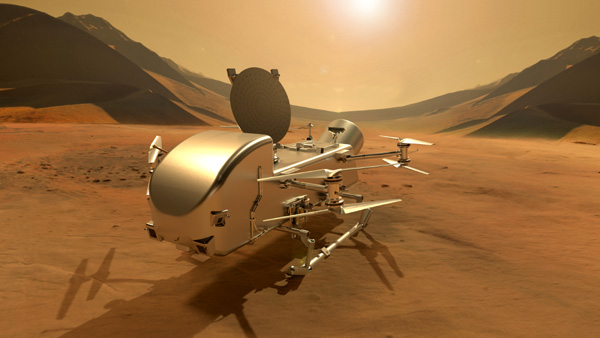
Showing posts with label Dragonfly. Show all posts

Wednesday, September 02, 2026

The Latest Update on America's Next Saturn-bound Robotic Explorer...

The electrical harness aboard NASA's Dragonfly rotorcraft consists of approximately 17,315 feet of conductor wire and 374 connectors, and weighs about 100 pounds.
NASA / Johns Hopkins APL / Ed Whitman

NASA’s Dragonfly Gets Wired Up While Titan Landing Area Is Named (News Release)

Peeking into the clean room at the Johns Hopkins Applied Physics Laboratory (APL) in Laurel, Maryland, it might be one of the first things you notice about NASA’s Dragonfly: the dozens of silver cables snaking around and through the structure of the in-progress, Titan-bound rotorcraft.

Collectively, these bundles of wires, cables, and connectors make up the spacecraft’s electrical harness. It’s Dragonfly’s nervous system, fitted to securely transmit power and data between the lander’s computers, actuators, sensors, scientific instruments, and battery.

“The harness doesn’t do anything by itself, but it is necessary for everything else to function,” said Jackie Perry, Dragonfly lander harness lead at APL, which is responsible for designing, building and operating the rotorcraft for NASA. “It’s critical hardware that exists only to serve the rest of the lander. We can’t do anything without it.”

Perry’s small team of engineers and technicians reached a major milestone in July when it installed the harness on the flight fuselage. “Once the flight structure was delivered and the remote interface units and temperature sensors were installed, we were able to start laying the harness,” Perry said.

The wiring harness is typically one of the first components delivered to a spacecraft. Dragonfly passed its critical design review in 2022; fabrication began in late 2024 and finished about a year later. The wire is silver-coated copper, insulated in a heat-resistant, durable polymer coating and wrapped with aluminum, which is then attached to plastic and metal connectors.

Dragonfly is scheduled to launch in summer 2028 and reach Saturn’s moon Titan in late 2034.

Dragonfly’s operating environment on Titan poses some unique challenges. Because of the rotorcraft’s thermos bottle design – insulated to retain heat from its nuclear power source and stay warm in Titan’s extremely cold conditions – the harness had to be designed to route under a layer of thick foam insulation on the outside of the lander and accommodate the circulation of that warm air through the inside. The rotorcraft’s high power demands require both 4- and 8-gauge wire, Perry said, yet the harness has to be flexible enough to weave through a packed interior that includes the flight system and instrument boxes, as well as a nearly 300-pound battery.

The team will continue connecting the harness to science instruments and other flight components as they’re delivered to APL for integration and additional testing.

Titan target area lands name

The International Astronomical Union (IAU), the global body responsible for officially designating objects in space, has approved a name for the large dune field where Dragonfly will land on Titan: Ahmakiq Undae. The region consists of dunes and interdune areas to the south of Selk Crater, extending to the edge of a range of hills or mountains.

In the Mayan tradition, people appealed to the spirit Ahmakiq (pronounced “ah-mahk-eek”) to stop strong winds from damaging their crops. The name literally translates to the “one who locks up the wind,” and aligns with the IAU convention of naming dune fields – or undae, in Latin after gods and goddesses of wind. The Dragonfly team chose Ahmakiq from a list of IAU suggestions.

Once Dragonfly reaches Titan, the rotorcraft will conduct a 3.3-year primary mission, exploring diverse environments from organic dunes to deposits associated with an impact crater – Selk Crater – where liquid water and complex organic materials key to life once existed together. Scientific analysis indicates that the impact that formed Selk melted the icy bedrock, potentially creating a large temporary pool that could have remained liquid for hundreds to thousands of years under an insulating ice layer, like winter ponds on Earth.

Source: NASA.Gov

****

Highlighted in purple, Ahmakiq Undae has a diameter of approximately 500 miles (810 kilometers) and sits near the roughly 50-mile (80-kilometer) diameter Selk impact crater, to the upper right.
NASA / Jason Barnes

Thursday, July 09, 2026

The Latest Update on America's Next Saturn-bound Robotic Explorer...

The main structure for NASA's Dragonfly rotorcraft undergoes ground vibration tests inside a cleanroom at the Johns Hopkins Applied Physics Laboratory in Laurel, Maryland.
NASA / Johns Hopkins APL / Ed Whitman

NASA’s Dragonfly Clears Key Tests as Titan Rotorcraft Takes Shape (News Release)

NASA’s Dragonfly is starting to look less like a collection of spacecraft parts and more like the rotorcraft that will fly across the surface of Titan, Saturn’s hazy moon.

The mission reached a major milestone on June 29, when the Dragonfly team at the Johns Hopkins Applied Physics Laboratory (APL) in Laurel, Maryland, delivered the nearly 13-foot-long fuselage for the next phase of spacecraft integration ahead of schedule. The delivery followed a roughly month-long process of structural testing of the lander frame assembly, which carried many of the features that give the Dragonfly rotorcraft its unmistakable shape — including its landing skids, the cap for the spacecraft’s power source, and the arms that will eventually hold its eight sets of rotors.

“It was pretty awesome to see the lander, as we designed it, become real,” said Hunter Reeling, Dragonfly thermal-mechanical integration and test lead from APL.

With structural testing complete and the fuselage delivered, the team started integrating the mechanical, thermal and electrical systems on July 1, kicking off the process that will turn the lander into the flying science lab it’s meant to be.

Throughout the month, they’ll populate Dragonfly’s fuselage with the flight bulkheads, as well as the wiring harness, cables and connectors — the electrical “nervous system” that ties Dragonfly’s systems together. Electronics boxes, avionics and science instruments will follow as mission partners across the country complete their own assembly and test campaigns.

“From here, it’s about populating that structure with electronics boxes, instruments, wiring, insulation — everything that will enable its mission,” Reeling said. “It’s all about getting Dragonfly ready to launch.”

Link back home

One of the most visible additions came in May, when the Dragonfly team at APL integrated the mission’s high-gain antenna, the primary system that operators will use to communicate with the rotorcraft and retrieve the science data it collects on Titan.

The high-gain antenna is a 34.4-inch-wide (87.4-centimeter-wide) disc made of electrically-insulating foam sandwiched between two metal plates that contain hundreds of small slots. Together, these slots will narrow and focus the radio beam back to Earth. Adapted from technology originally developed for planetary defense applications, Dragonfly’s high-gain antenna, larger than previously flown systems, is attached to a motorized arm that will raise the antenna when the rotorcraft is stationary and lower it into a locking mechanism before Dragonfly takes off again.

“Every time the lander prepares to fly to another location, we store the antenna so it survives the vibrations created during flight and prevents resonance that could interfere with the rest of the lander,” said Jackson Banbury, Dragonfly telecommunications mechanical and thermal lead at APL.

The antenna and its gimbal are designed and tested to endure the rigors of Titan’s environment, including frigid temperatures averaging around -290° Fahrenheit (-179° Celsius), swirling dust on the surface, and potentially liquid methane rain.

Shaken, sealed, delivered

From May through early June, engineers and technicians at APL put the Dragonfly rotorcraft through vibration and sealing tests designed to show that the fuselage’s structural backbone can withstand the loads of launch, entry through Titan’s atmosphere, and landing on the surface of this ocean world.

For vibration testing, the team installed mass simulators in place of the flight instruments and electronics being built and tested elsewhere. The ground vibration test gave the team a fleeting preview of Dragonfly in the air. Engineers suspended the rotorcraft’s structure a few inches off the ground from long bungee cords, then measured how mechanical vibrations at the rotor locations traveled through the frame to key sensors on the main body.

“Suspended for a few hours during that test – even barely above the floor – was structurally akin to Dragonfly’s first flight,” said Gordon Maahs, the Dragonfly mechanical systems engineer from APL. “It gets the imagination going about what actual flight will look like.”

The test also included a “sit down” configuration, lowering the lander onto protective padding so it rested on its skids while engineers measured how the structure would respond on Titan’s surface.

The sealing test was more unusual. Most planetary spacecraft are built for the vacuum of space or worlds with thin atmospheres. But Dragonfly is headed to Titan, where the surface atmosphere is dense, cold and about 1.5 times the pressure of Earth’s, so engineers needed to understand how well the assembled structure could keep that environment out.

The solution: pressurize Dragonfly’s outer structure to identify any gaps, cracks or holes that could allow air flow in and out of the lander on Titan.

“I’ve never seen a test like it on any other spacecraft,” Maahs said. “We get a total flow rate based off of the sealing test, and that feeds our thermal analysis to determine if we’re sealed enough.”

The results, Maahs added, were “extremely good.”

Source: NASA.Gov

****

An engineer at the Johns Hopkins Applied Physics Laboratory inspects the motorized arm that attaches Dragonfly's high-gain antenna to the rotorcraft's body.
NASA / Johns Hopkins APL / Ed Whitman

Engineers mount the inverted Dragonfly rotorcraft structure to a vibration table inside the vibration test facility at the Johns Hopkins Applied Physics Laboratory.
NASA / Johns Hopkins APL / Ed Whitman

Monday, June 01, 2026

The Latest Update on America's Next Saturn-bound Robotic Explorer...

Lockheed Martin engineer Derek Shannon inspects samples of thermal protection material for the Dragonfly heat shield...before they underwent testing at Sandia National Labs’ Solar Thermal Test Facility in Albuquerque, New Mexico.
NASA

NASA’s Dragonfly Flight System Faces Heat (News Release)

In preparation for the journey to reach the surface of Saturn’s largest moon, Titan, the heat shield for NASA’s Dragonfly mission completed thermal-structural testing in the New Mexico desert. Dragonfly team members, including those from NASA’s Ames Research Center in California’s Silicon Valley, the Johns Hopkins Applied Physics Laboratory (APL) in Laurel, Maryland, and Lockheed Martin in Littleton, Colorado, collaborated with personnel at Sandia National Laboratories’ National Solar Thermal Test Facility in Albuquerque, New Mexico, to stress-test Dragonfly’s heat shield materials, ensuring that the rotorcraft will be safely delivered through Titan’s dense atmosphere.

Dragonfly’s thermal protection material, made from carbon fiber and a lightweight resin, performed as expected in combined mechanical and thermal testing, even in cases when it was intentionally marred with defects.

Sandia’s Solar Tower test facility houses an array of hundreds of calibrated mirror-like systems to focus energy from the Sun onto a tower holding the test unit. Operators generated temperatures around 4,500° Fahrenheit (nearly 2,500° Celsius) on segments of Dragonfly’s heat shield material. Tests examined tolerance to thermal radiation as well as the rapid change in temperature that researchers expect Dragonfly to experience.

The Sandia test series involved multiple iterations in conditions like those expected during Dragonfly’s entry into Titan’s atmosphere. Additional testing subjected large samples of the heat-shield material to mechanical and thermal stress to simultaneously simulate the pressure of high-speed atmospheric entry and intense thermal conditions. Thermal testing of the heat-shield’s curved shoulder units was also performed.

“We were pleased to see the heat shield material pass these tests, even with the flaws we intentionally included, like those that might naturally occur during fabrication and integration,” said Milad Mahzari, the Dragonfly entry vehicle thermal protection system lead at NASA Ames.

Dragonfly’s heat shield uses a variation of a NASA-invented material called PICA, or Phenolic Impregnated Carbon Ablator. The original PICA material was used to deliver NASA’s Curiosity and Perseverance rovers to Mars. PICA-D, a new variant of PICA, is planned for flight on Dragonfly and was the focus of this test series.

“We tested the heat shield as a complete system, including the primary PICA-D material, gap fillers, and potential manufacturing defects,” Mahzari said, adding that researchers plan to conduct additional analysis of PICA-D before final construction of the heat shield begins.

Dragonfly rotorcraft integration and testing continues at APL, which designed Dragonfly and leads the mission for NASA. Dragonfly is scheduled to launch in 2028 and reach Titan in 2034 to conduct science across multiple locations, sample surface materials to measure their detailed compositions, and observe geology and meteorology on the only moon in the Solar System known to have a substantial atmosphere.

Communications on board

Work continues to test and integrate Dragonfly’s communications system, including the antennas that will link the rotorcraft to operators back on Earth.

The team recently measured the signal patterns coming from Dragonfly’s largest antenna – its high-gain antenna, or HGA – in an APL test chamber that simulates the space environment. The HGA is a 34.4-inch diameter radial line slot antenna, which uses many small slots working together to create a narrow, focused radio beam.

The technology for this antenna was originally developed for NASA’s DART mission and is also flying on NASA’s twin ESCAPADE spacecraft.

“A simple way to picture the antenna is as a large flat showerhead: energy enters near the center and spreads out through the slots in a controlled pattern,” said Matt Bray, Dragonfly lead antenna designer at APL. “This design provides a low-cost, durable and compact approach to high-efficiency communications in extreme space environments and also provides aerodynamic benefits.”

The HGA, Dragonfly’s primary antenna for transmitting science data, will be attached to the top deck of the lander on a gimbal that allows it to track Earth from various locations on Titan’s surface. It will be covered with Kapton, a thermal insulator, for protection from Titan’s weather and crafted to operate in the moon’s frigid environment, where ambient temperatures are 290° below zero Fahrenheit (179° below zero Celsius).

The HGA will be one of three antennas on Dragonfly designed for operations at Titan. The lander will also fly a medium-gain antenna, primarily as a backup to the HGA, and a low-gain antenna, primarily to transmit status tones during flight as well as for emergency communications.

Source: NASA.Gov

****

Dragonfly lead antenna designer Matt Bray evaluates Dragonfly’s high-gain antenna in a test chamber at the Johns Hopkins Applied Physics Laboratory in Laurel, Maryland.
NASA / Johns Hopkins APL / Ed Whitman

Thursday, April 23, 2026

The Latest Update on America's Next Saturn-bound Robotic Explorer...

Inside a cleanroom at the Johns Hopkins University's Applied Physics Laboratory in Laurel, Maryland, a group of technicians complete a fit check of Dragonfly's top deck onto the rest of the rotorcraft's body...on April 3, 2026.
NASA / Johns Hopkins APL / Ed Whitman

NASA’s Dragonfly Rotorcraft Gets Decked Out, Tested (News Release)

NASA’s Dragonfly rotorcraft is beginning to take shape – literally – with the delivery of the panels that make up the rotorcraft lander’s body. Built from ultra‑lightweight honeycomb panels designed at the Johns Hopkins Applied Physics Laboratory (APL) in Laurel, Maryland, and manufactured by Lockheed Martin Space in Denver, the primary structure is specially designed for the challenges of flight on Saturn’s largest moon Titan.

Each panel uses aluminum face sheets only 0.01 inches thick — much thinner than typically used on spacecraft — to meet the strict mass limits required for powered flight through Titan’s atmosphere. But while the entire frame weighs just 230 pounds, it’s also durable. “The structure is remarkably light and yet strong enough to withstand the intense forces of launch and the entry into Titan’s atmosphere,” said Gordon Maahs, the Dragonfly mechanical systems engineer from APL. “We’ve never built anything like it.”

In early April, the APL team began assembling the fuselage and integrating key structural elements, including the mounting plate and cover for Dragonfly’s power source, a multi-mission radioisotope thermoelectric generator, which will be installed just before launch. Engineers also performed a fit check of the top deck, which carries components of Dragonfly’s telecommunications system.

In May, vibration and static-load tests will be performed on the structure to measure Dragonfly’s response to the dynamic forces of launch (from Earth) and atmospheric entry and landing (on Titan). “The lander is starting to look like Dragonfly,” said Hunter Reeling, Dragonfly’s thermal mechanical integration and test lead from APL. “We’re excited to see the designs coming to life.”

Parachute passes test

In February, the mission achieved a significant milestone with the successful completion of another series of parachute drop tests, key to the development of the parachute decelerator elements of the entry, descent and landing (EDL) system that will decelerate the Dragonfly lander as it descends into Titan’s atmosphere.

Led by Airborne Systems of Santa Ana, California, in coordination with NASA’s Langley Research Center in Hampton, Virginia, and NASA’s Ames Research Center in California’s Silicon Valley, and conducted in Eloy, Arizona, the test marked the first trials of a full-scale parachute system, including both the drogue and main parachutes. These tests on Earth are designed to closely replicate the environment that Dragonfly will encounter within Titan’s atmosphere.

The team plans to conduct another series of similar design-qualification tests in October before building the flight systems.

Preparing to sample Titan’s surface

Dragonfly’s portable chemistry lab, which will study Titan’s surface composition, is in the final stages of integration and testing at NASA’s Goddard Space Flight Center in Greenbelt, Maryland. This payload, called the Dragonfly Mass Spectrometer (DraMS), includes two systems for releasing molecules from samples that Dragonfly will collect: laser desorption and gas chromatography. Once released, the molecules will flow to a mass spectrometer, which will identify them by their masses.

On April 15, engineers completed testing of the laser system, which was integrated within DraMS in February. Using a sample with known compounds, the team confirmed that the laser and mass spectrometer can identify the chemicals in a relevant sample, even in very small amounts.

Over the next few weeks, engineers will install the gas chromatography system into DraMS and carry out similar tests. The gas chromatography system, provided by CNES (Centre National d’Etudes Spatiales), works by heating a sample, releasing molecules, and separating them before analysis. Together, the laser- and gas-analysis systems will help Dragonfly detect compounds across a wide range of sizes.

Dragonfly is scheduled to launch no earlier than 2028 for a six-year voyage to Saturn’s moon Titan, where it will spend three years flying from location to location to explore a range of sites to study the chemistry, geology, and atmosphere of the Earthlike moon and ultimately advance our understanding of life’s chemical origins.

Source: NASA.Gov

****

A drop test for Dragonfly's parachute system is conducted in Eloy, Arizona...on February 11, 2026.
Airborne Systems North America

Tuesday, April 21, 2026

The Latest Discovery in the Search for Life on the Red Planet...

A self-portrait of NASA's Curiosity Mars rover at a spot nicknamed 'Mary Anning'...taken with a camera on Curiosity's robotic arm on October 25, 2020.
NASA / JPL - Caltech / MSSS

NASA’s Curiosity Finds Organic Molecules Never Seen Before on Mars (News Release)

After years of lab work, the results are in: A rock that NASA’s Curiosity Mars rover drilled and analyzed in 2020 includes the most diverse collection of organic molecules ever found on the Red Planet. Of the 21 carbon-containing molecules identified in the sample, seven of them were detected for the first time on Mars.

Scientists have no way of knowing whether these organic molecules were created by biologic or geologic processes — either path is possible — but their discovery renewed confirmation that ancient Mars had the right chemistry to support life. What’s more, the molecules join a growing list of compounds known to be preserved in rocks even after billions of years of exposure on Mars to radiation, which can break down these molecules over time.

The findings are detailed in a new paper published on Tuesday in Nature Communications.

The rock sample, nicknamed “Mary Anning 3” after an English fossil collector and paleontologist, was collected on a part of Mount Sharp covered by lakes and streams billions of years ago. This oasis surged and dried up multiple times in the planet’s ancient past, eventually enriching the area with clay minerals, which are especially good at preserving organic compounds — carbon-containing molecules that are the building blocks of life and are found throughout the Solar System.

Among the newly-identified molecules is a nitrogen heterocycle, a ring of carbon atoms that includes nitrogen. This kind of molecular structure is considered a predecessor to RNA and DNA, two nucleic acids that are key to genetic information.

“That detection is pretty profound because these structures can be chemical precursors to more complex nitrogen-bearing molecules,” said the paper’s lead author, Amy Williams of the University of Florida in Gainesville. “Nitrogen heterorcycles have never been found before on the Martian surface or confirmed in Martian meteorites.”

Another exciting discovery was benzothiophene, a carbon- and sulfur-bearing molecule that’s been found in many meteorites. These meteorites, along with the organic molecules within them, are thought by some scientists to have seeded prebiotic chemistry across the early Solar System.

Martian chemistry

The new paper complements last year’s finding of the largest organic molecules ever discovered on Mars: long-chain hydrocarbons, including decane, undecane and dodecane.

“This is Curiosity and our team at their best. It took dozens of scientists and engineers to locate this site, drill the sample, and make these discoveries with our awesome robot,” said the mission’s project scientist, Ashwin Vasavada of NASA’s Jet Propulsion Laboratory in Southern California. “This collection of organic molecules once again increases the prospect that Mars offered a home for life in the ancient past.”

Both sets of findings were made with a sophisticated minilab called Sample Analysis at Mars (SAM), located in Curiosity’s belly. A drill on the end of the rover’s robotic arm pulverizes a carefully selected rock sample into powder and then trickles it into SAM, where a high-temperature oven heats the material, releasing gases that instruments in the lab analyze to reveal the rock’s composition.

In addition, SAM can perform “wet chemistry,” dropping samples into a small cup of solvent. The resulting reactions can break apart larger molecules that would be difficult to detect and identify otherwise. While the instrument has several such cups, only two contain tetramethylammonium hydroxide (TMAH), a powerful solution reserved for the highest-value samples.

The Mary Anning 3 sample was the first to be exposed to TMAH.

To verify TMAH’s reactions with otherworldly materials, the paper’s authors also tested the technique on Earth with a piece of the Murchison meteorite, one of the most studied meteorites of all time. More than 4 billion years old, Murchison contains organic molecules that were seeded throughout the early Solar System. A Murchison sample exposed to TMAH was found to break much larger molecules into some of the ones seen in Mary Anning 3, including benzothiophene.

That result verifies that the Martian molecules found in Mary Anning 3 could have been generated from the breakdown of even more complex compounds relevant to life.

Curiosity recently used its second and final TMAH cup while exploring weblike boxwork ridges, which were formed by ancient groundwater. The mission team will be analyzing those results for a future peer-reviewed paper.

Trailblazing for future missions

Built by NASA’s Goddard Space Flight Center in Greenbelt, Maryland, SAM is based on larger, commercial-grade lab instruments. Getting such complex equipment into the rover required engineers to dramatically shrink it down and develop a way for it to run on less power. Scientists had to learn how to heat up SAM’s oven more slowly over longer periods in order to conduct some of these experiments.

“It was a feat just figuring out how to conduct this kind of chemistry for the first time on Mars,” said Charles Malespin, the instrument’s principal investigator at NASA Goddard and a study coauthor. “But now that we’ve had some practice, we’re prepared to run similar experiments on future missions.”

In fact, NASA Goddard has provided several components, including the mass spectrometer, for a next-generation version of SAM, called the Mars Organic Molecular Analyzer, for ESA’s (European Space Agency) Rosalind Franklin Mars rover. A similar instrument, the Dragonfly Mass Spectrometer, will explore Saturn’s moon Titan on NASA’s Dragonfly rotorcraft. Both instruments will be able to perform wet chemistry with the TMAH solvent.

Source: NASA.Gov

****

An annotated close-up of three holes that NASA’s Curiosity Mars rover drilled into a rock at a location nicknamed 'Mary Anning' in October 2020.
NASA / JPL - Caltech / MSSS

Wednesday, March 11, 2026

America's Next Saturn-bound Robotic Explorer Is Officially in Assembly!

Inside a clean room at Johns Hopkins Applied Physics Laboratory in Laurel, Maryland, two technicians attach the engineering model of Dragonfly’s Integrated Electronics Module to the lander’s electrical harness...which is the bundled assembly of wires, cables and connectors that will transmit power and data throughout the rotorcraft.
NASA / Johns Hopkins APL

NASA’s Dragonfly Mission Begins Rotorcraft Integration, Testing Stage (News Release - March 10)

NASA Dragonfly’s integration and testing – the activities involved in assembling the mission’s rotorcraft lander and testing it for the rigors of launch and extreme conditions of space – is officially underway in clean rooms and control rooms at the Johns Hopkins Applied Physics Laboratory (APL) in Laurel, Maryland.

In partnership with teams across government, industry and academia, APL is building the car-sized, nuclear-powered drone for NASA. Dragonfly is scheduled to launch no earlier than 2028 for a six-year voyage to Saturn’s moon Titan, where it will explore a range of diverse sites to study the chemistry, geology and atmosphere of the terrestrial moon and ultimately advance our understanding of life’s chemical origins.

Primary activities during the first weeks of this effort included power and functional testing on two critical components: the Integrated Electronics Module (IEM) and the Power Switching Units (PSUs). Think of the IEM as Dragonfly’s “brain,” containing the spacecraft’s core avionics (such as command and data handling, guidance and navigation, and communications) in a single space-saving and power-efficient box. The IEM and both PSUs were connected to Dragonfly’s wiring system and passed their first power-service checks.

“This milestone essentially marks the birth of our flight system,” said Elizabeth Turtle, Dragonfly principal investigator from APL. “Building a first-of-its kind vehicle to fly across another ocean world in our Solar System pushes us to the edge of what’s possible, but that’s exactly why this stage is so exciting. The team is doing an outstanding job, and every component we install and every test we run brings us one step closer to launching Dragonfly to Titan.”

Much work has led up to this point. The aeroshell and cruise-stage assemblies are moving forward with integration and testing at Lockheed Martin Space in Littleton, Colorado. The team completed a thorough aerodynamic test series in the wind tunnels of NASA’s Langley Research Center in Hampton, Virginia. Testing continues in the Titan Chamber at APL of the foam coating that will insulate the rotorcraft from Titan’s frigid temperatures.

The science payload is coming together at locations around the country and internationally. The flight radio has been delivered, and additional flight systems are scheduled for delivery and testing within the next six months.

Dragonfly integration and testing will continue at APL through this year and into early 2027, when system-level testing is planned at Lockheed Martin. Late next year, the lander returns to APL for final space-environment testing before heading to NASA’s Kennedy Space Center in Florida in spring 2028 for launch aboard a SpaceX Falcon Heavy rocket that summer.

“Starting integration and testing is a huge milestone for the Dragonfly team,” said Annette Dolbow, the Dragonfly integration and test lead at APL. “We’ve spent years designing and refining this amazing rotorcraft on computer screens and in laboratories, and now we get to bring all those elements together and transform Dragonfly into an actual flight system.”

Source: NASA.Gov

****

Technicians conduct power and functional testing on Dragonfly’s Integrated Electronics Module and Power Switching Unit in the clean room at the Johns Hopkins Applied Physics Laboratory in Laurel, Maryland.
NASA / Johns Hopkins APL / Ed Whitman

An artist's concept of NASA's Dragonfly rotorcraft.
NASA / Johns Hopkins APL / Steve Gribben

Friday, January 09, 2026

The Latest Update on America's Next Saturn-bound Robotic Explorer...

Two Johns Hopkins APL engineers install rotors on a full-scale test model representing half of the Dragonfly rotorcraft inside NASA Langley Research Center's Transonic Dynamics Tunnel facility in Virginia.
NASA

Flight Engineers Give NASA’s Dragonfly Lift (News Release)

In sending a car-sized rotorcraft to explore Saturn’s moon Titan, NASA’s Dragonfly mission will undertake an unprecedented voyage of scientific discovery. And the work to ensure that this first-of-its-kind project can fulfill its ambitious exploration vision is underway in some of the nation’s most advanced space simulation and testing laboratories.

Set for launch in 2028, the Dragonfly rotorcraft is being designed and built at the Johns Hopkins Applied Physics Laboratory (APL) in Laurel, Maryland, with contributions from organizations around the world. On arrival in 2034, Dragonfly will exploit Titan’s dense atmosphere and low gravity to fly to dozens of locations, exploring varied environments from organic equatorial dunes to an impact crater where liquid water and complex organic materials essential to life (at least as we know it) may have existed together.

Aerodynamic testing

When full rotorcraft integration and testing begins in February, the team will tap into a trove of data gathered through critical technical trials conducted over the past three years, including, most recently, two campaigns at the Transonic Dynamics Tunnel (TDT) facility at NASA’s Langley Research Center in Hampton, Virginia.

Over five weeks, from August into September, the team evaluated the performance of Dragonfly’s rotor system – which provides the lift for the lander to fly and enables it to maneuver – in Titan-like conditions, looking at aeromechanical performance factors such as stress on the rotor arms, and effects of vibration on the rotor blades and lander body. In late December, the team also wrapped up a set of aerodynamics tests on smaller-scale Dragonfly rotor models in the TDT.

“When Dragonfly enters the atmosphere at Titan and parachutes deploy after the heat shield does its job, the rotors are going to have to work perfectly the first time,” said Dave Piatak, branch chief for aeroelasticity at NASA Langley. “There’s no room for error, so any concerns with vehicle structural dynamics or aerodynamics need to be known now and tested on the ground. With the Transonic Dynamics Tunnel here at Langley, NASA offers just the right capability for the Dragonfly team to gather this critical data.”

Critical parts

In his three years as an experimental machinist at APL, Cory Pennington has crafted parts for projects dispatched around the globe. But fashioning rotors for a drone to explore another world in our Solar System? That was new – and a little daunting.

“The rotors are some of the most important parts on Dragonfly,” Pennington said. “Without the rotors, it doesn’t fly – and it doesn’t meet its mission objectives at Titan.”

Pennington and team cut Dragonfly’s first rotors on November 1, 2024. They refined the process as they went: starting with waterjet paring of 1,000-pound aluminum blocks, followed by rough machining, cover fitting, vent-hole drilling and hole-threading. After an inspection, the parts were cleaned, sent out for welding and returned for final finishing.

“We didn’t have time or materials to make test parts or extras, so every cut had to be right the first time,” Pennington said, adding that the team also had to find special tools and equipment to accommodate some material changes and design tweaks.

The team was able to deliver the parts a month early. Engineers set up and spin-tested the rotors at APL – attached to a full-scale model representing half of the Dragonfly lander – before transporting the entire package to the TDT at NASA Langley in late July.

“On Titan, we’ll control the speeds of Dragonfly’s different rotors to induce forward flight, climbs, descents and turns,” said Felipe Ruiz, lead Dragonfly rotor engineer at APL.

“It’s a complicated geometry going to a flight environment that we are still learning about. So the wind tunnel tests are one of the most important venues for us to demonstrate the design.”

And the rotors passed the tests.

“Not only did the tests validate the design team’s approach, we’ll use all that data to create high-fidelity representations of loads, forces and dynamics that help us predict Dragonfly’s performance on Titan with a high degree of confidence,” said Rick Heisler, wind tunnel test lead from APL.

Next, the rotors will undergo fatigue and cryogenic trials under simulated Titan conditions, where the temperature is -290° Fahrenheit (-178° Celsius), before building the actual flight rotors.

“We’re not just cutting metal — we’re fabricating something that’s going to another world,” Pennington said. “It’s incredible to know that what we build will fly on Titan.”

Collaboration, innovation

Elizabeth “Zibi” Turtle, Dragonfly principal investigator at APL, says the latest work in the TDT demonstrates the mission’s innovation, ingenuity and collaboration across government and industry.

“The team worked well together, under time pressure, to develop solutions, assess design decisions, and execute fabrication and testing,” she said. “There’s still much to do between now and our launch in 2028, but everyone who worked on this should take tremendous pride in these accomplishments that make it possible for Dragonfly to fly on Titan.”

Dragonfly has been a collaborative effort from the start. Kenneth Hibbard, mission systems engineer from APL, cites the vertical-lift expertise of Penn State University on the initial rotor design, aero-related modeling and analysis, and testing support in the TDT, as well as NASA Langley’s 14-by-22-foot Subsonic Tunnel. Sikorsky Aircraft of Connecticut has also supported aeromechanics and aerodynamics testing and analysis, as well as flight hardware modeling and simulation.

The Johns Hopkins Applied Physics Laboratory (APL) in Laurel, Maryland, leads the Dragonfly mission for NASA in collaboration with several NASA centers, industry partners, academic institutions and international space agencies. Elizabeth “Zibi” Turtle of APL is the principal investigator. Dragonfly is part of NASA’s New Frontiers Program, managed by the Planetary Missions Program Office at NASA Marshall Space Flight Center in Huntsville, Alabama, for the agency’s Science Mission Directorate in Washington.

Source: NASA.Gov

****

The rotors are about to be tested on a full-scale test model representing half of the Dragonfly rotorcraft inside NASA Langley Research Center's Transonic Dynamics Tunnel facility in Virginia.
NASA

Tuesday, September 09, 2025

The Latest Update on America's Next Saturn-bound Robotic Explorer...

An artist's concept of NASA's Dragonfly rotorcraft...whose design was updated for the final time.
NASA / Johns Hopkins APL / Steve Gribben

NASA’s Dragonfly Soaring Through Key Development, Test Activities (News Release - September 8)

NASA’s Dragonfly mission has cleared several key design, development and testing milestones, and remains on track towards launch in July 2028.

Dragonfly, a car-sized, nuclear-powered rotorcraft being designed and built for NASA at the Johns Hopkins Applied Physics Laboratory (APL) in Laurel, Maryland, will explore Saturn’s moon Titan. Following launch and a six-year journey to Titan, the Dragonfly rotorcraft will spend over three years investigating multiple landing sites across the moon’s diverse surface. Flying a comprehensive science package, Dragonfly seeks to understand Titan habitability and the building blocks of life as we know it.

Hardware is being built and software developed, tests are being completed and analyses verified as the team progresses through its development schedule.

“Dragonfly has moved far beyond a concept on a computer screen – the components of the rotorcraft lander are being built as scientists and engineers transform this bold exploration idea into reality,” said Elizabeth “Zibi” Turtle, Dragonfly principal investigator from APL. “From the cleanrooms to the wind tunnels, we’re performing critical tests that are informing our next steps of development and demonstrating how Dragonfly will perform on and above Titan’s surface.”

Recent tests have included aerodynamic analyses of Dragonfly’s rotors and durability trials of the foam coating that will insulate the rotorcraft from Titan’s frigid temperatures. The science payload is also coming together, with instrument components delivered and set up for additional testing. Flight systems are also being evaluated and the flight radio has been delivered and tested.

Two Johns Hopkins APL engineers install and adjust the rotors on a full-scale test model representing half of the Dragonfly rotorcraft inside NASA Langley Research Center's Transonic Dynamics Tunnel facility in Virginia.
NASA

Riding the Wind

APL and NASA engineers are wrapping up a monthlong campaign to confirm the performance of Dragonfly’s rotors in Titan-like conditions at NASA Langley Research Center’s Transonic Dynamics Tunnel in Virginia.

Bathing the sensor-laden model in a flow of heavy gas that simulates Titan’s thick atmosphere, the testing team has been gathering data on the rotor system’s aeromechanical performance – looking at factors like stress loads on the rotor arms, and effects of vibration on the rotor blades and lander body – information that will eventually feed into Dragonfly’s flight plans and navigation software.

Ion Trap Mass Spectrometer team members inspect their device, part of the Dragonfly Mass Spectrometer instrument package, at NASA’s Goddard Space Flight Center in Maryland.
NASA

Mass Spectrometer on the Move

Scientists and engineers at NASA’s Goddard Space Flight Center in Greenbelt, Maryland, have completed a critical part of the Dragonfly Mass Spectrometer (DraMS), which will analyze chemical components and processes on Titan, including potentially biologically-relevant compounds. The Ion Trap Mass Spectrometer, effectively the “heart” of the DraMS package, has cleared its acceptance review and is being prepared for space-environment tests and integration with other DraMS components.

A segment of Dragonfly’s foam insulation is being prepped for testing inside the Titan Chamber at Johns Hopkins Applied Physics Laboratory in Maryland.
Johns Hopkins APL / Justin Artis

Keeping Dragonfly Warm

APL engineers have completed structural and thermal testing of the foam insulation for the Dragonfly lander, verifying that the insulation will maintain its shape and protect the lander on Titan, where ambient temperatures get to approximately -300°F (or about -185°C). The lander body will be covered in a 3-inch-thick (7.6-centimeter thick) layer of Solimide-based foam, which is designed to cover science instruments and other exterior elements. The team has tested the insulation in the large Titan-environment chamber at APL, as well as in the wind tunnel at NASA Langley.

An APL-developed Frontier flight radio that will be used on NASA's Dragonfly rotorcraft.
Johns Hopkins APL

Long-Distance Communications

Engineers at APL have completed the flight radios that will serve as the communications receiver and transmitter for Dragonfly’s journey to and operations on Titan. The APL-developed Frontier radios are versatile telecommunications devices proven on missions from the Sun to Pluto and beyond. As a software-defined radio — where software is used to customize the radio for specific mission requirements — the Frontier is smaller and needs less power than other deep-space radios, and can send and receive signals in a wide range of frequencies.

The Lockheed Martin-built aeroshell heat shield that will be used on NASA's Dragonfly mission.
Lockheed Martin

Ensuring Safe Entry

Engineers at Lockheed Martin in Denver have passed the first set of major milestones for the flight aeroshell, taking a big step towards making sure the casing that will protect Dragonfly upon its arrival at Titan can withstand the extreme thermal and structural loads of a ballistic atmospheric entry. This includes fabrication, cure and thermal-cycle testing of the aeroshell heat shield and backshell structures, with a static test campaign and thermal protection system installation up next.

Dragonfly will formally begin its integration and test phase in January 2026. The mission is scheduled to launch in July 2028 on a SpaceX Falcon Heavy launch vehicle from NASA’s Kennedy Space Center in Florida.

Source: NASA.Gov

****

Friday, May 23, 2025

A Spotlight on America's Next Saturn-bound Robotic Explorer...

An artist's concept of NASA's Dragonfly rotorcraft on the surface of Saturn's moon Titan.
NASA / Johns Hopkins APL / Steve Gribben

NASA’s Dragonfly Mission Sets Sights on Titan’s Mysteries (News Release - May 22)

When it descends through the thick golden haze on Saturn’s moon Titan, NASA’s Dragonfly rotorcraft will find eerily familiar terrain. Dunes wrap around Titan’s equator. Clouds drift across its skies.

Rain drizzles. Rivers flow, forming canyons, lakes and seas.

But not everything is as familiar as it seems. At -292° Fahrenheit, the dune sands aren’t silicate grains but organic material. The rivers, lakes and seas hold liquid methane and ethane, not water. Titan is a frigid world laden with organic molecules.

Yet Dragonfly, a car-sized rotorcraft set to launch no earlier than 2028, will explore this frigid world to potentially answer one of science’s biggest questions: How did life begin?

Seeking answers about life in a place where it likely can’t survive seems odd. But that’s precisely the point.

“Dragonfly isn’t a mission to detect life — it’s a mission to investigate the chemistry that came before biology here on Earth,” said Zibi Turtle, principal investigator for Dragonfly and a planetary scientist at the Johns Hopkins Applied Physics Laboratory in Laurel, Maryland. “On Titan, we can explore the chemical processes that may have led to life on Earth without life complicating the picture.”

On Earth, life has reshaped nearly everything, burying its chemical forebears beneath eons of evolution. Even today’s microbes rely on a slew of reactions to keep squirming.

“You need to have gone from simple to complex chemistry before jumping to biology, but we don’t know all the steps,” Turtle said. “Titan allows us to uncover some of them.”

Titan is an untouched chemical laboratory where all of the ingredients for known life — organics, liquid water and an energy source — have interacted in the past. What Dragonfly uncovers will illuminate a past since erased on Earth and refine our understanding of habitability and whether the chemistry that sparked life here is a universal rule — or a wondrous cosmic fluke.

Before NASA’s Cassini-Huygens mission, researchers didn't know just how rich Titan is in organic molecules. The mission’s data, combined with laboratory experiments, revealed a molecular smorgasbord — ethane, propane, acetylene, acetone, vinyl cyanide, benzene, cyanogen and more.

These molecules fall to the surface, forming thick deposits on Titan’s ice bedrock. Scientists believe life-related chemistry could start there — if given some liquid water, such as from an asteroid impact.

Enter Selk crater, a 50-mile-wide impact site. It’s a key Dragonfly destination, not only because it’s covered in organics, but because it may have had liquid water for an extended period of time.

The impact that formed Selk melted the icy bedrock, creating a temporary pool that could have remained liquid for hundreds to thousands of years under an insulating ice layer, like winter ponds on Earth. If a natural antifreeze like ammonia were mixed in, the pool could have remained unfrozen even longer, blending water with organics and the impactor’s silicon, phosphorus, sulfur and iron to form a primordial soup.

“It’s essentially a long-running chemical experiment,” said Sarah Hörst, an atmospheric chemist at Johns Hopkins University and co-investigator on Dragonfly’s science team. “That’s why Titan is exciting. It’s a natural version of our origin-of-life experiments — except it’s been running much longer and on a planetary scale.”

For decades, scientists have simulated Earth’s early conditions, mixing water with simple organics to create a “prebiotic soup” and jumpstarting reactions with an electrical shock. The problem is time. Most tests last weeks, maybe months or years.

The melt pools at Selk crater, however, possibly lasted tens of thousands of years. Still shorter than the hundreds of millions of years that it took life to emerge on Earth, but potentially enough time for critical chemistry to occur.

“We don’t know if Earth life took so long because conditions had to stabilize or because the chemistry itself needed time,” Hörst said. “But models show that if you toss Titan’s organics into water, tens of thousands of years is plenty of time for chemistry to happen.”

Dragonfly will test that theory. Landing near Selk, it will fly from site to site, analyzing the surface chemistry to investigate the frozen remains of what could have been prebiotic chemistry in action.

Morgan Cable, a research scientist at NASA’s Jet Propulsion Laboratory in Southern California and co-investigator on Dragonfly, is particularly excited about the Dragonfly Mass Spectrometer (DraMS) instrument. Developed by NASA’s Goddard Space Flight Center in Greenbelt, Maryland, with a key subsystem provided by the CNES (Centre National d'Etudes Spatiales), DraMS will search for indicators of complex chemistry.

“We’re not looking for exact molecules, but patterns that suggest complexity,” Cable said. On Earth, for example, amino acids — fundamental to proteins — appear in specific patterns. A world without life would mainly manufacture the simplest amino acids and form fewer complex ones.

Generally, Titan isn’t regarded as habitable; it’s too cold for the chemistry of life as we know it to occur, and there’s is no liquid water on the surface, where the organics and likely energy sources exist.

Still, scientists have assumed that if a place has life’s ingredients and enough time, complex chemistry — and eventually life — should emerge. If Titan proves otherwise, it may mean that we’ve misunderstood something about life’s start and it may be rarer than we thought.

“We won’t know how easy or difficult it is for these chemical steps to occur if we don’t go, so we need to go and look,” Cable said. “That’s the fun thing about going to a world like Titan. We’re like detectives with our magnifying glasses, looking at everything and wondering what this is.”

Dragonfly is being designed and built under the direction of the Johns Hopkins Applied Physics Laboratory (APL), which manages the mission for NASA. The team includes key partners at NASA’s Goddard Space Flight Center and NASA’s Jet Propulsion Laboratory. Dragonfly is managed by NASA’s Marshall Space Flight Center in Huntsville, Alabama, for the agency’s Science Mission Directorate at NASA Headquarters in Washington.

Source: NASA.Gov

****

An infrared image of Titan with Selk crater--Dragonfly's key destination--highlighted in this photo.
NASA / JPL - Caltech / University of Nantes / University of Arizona

Saturday, May 17, 2025

Hubble's Successor Makes New Observations of Dragonfly's Future Target at Saturn...

Images of Titan taken by NASA's James Webb Space Telescope and the Keck II telescope atop Mauna Kea in Hawaii...showing cloud convection within the atmosphere of Saturn's largest moon.
NASA, ESA, CSA, STScI and W.M. Keck Observatories

Webb’s Titan Forecast: Partly Cloudy With Occasional Methane Showers (News Release - May 14)

Saturn’s moon Titan is an intriguing world cloaked in a yellowish, smoggy haze. Similar to Earth, the atmosphere is mostly nitrogen and has weather, including clouds and rain. Unlike Earth, whose weather is driven by evaporating and condensing water, frigid Titan has a methane cycle.

NASA’s James Webb Space Telescope, supplemented with images from the Keck II telescope, has for the first time found evidence of cloud convection in Titan’s northern hemisphere, over a region of lakes and seas. Webb has also detected a key carbon-containing molecule that gives insight into the chemical processes in Titan’s complex atmosphere.

Titan’s Weather

On Titan, methane plays a similar role to water on Earth when it comes to weather. It evaporates from the surface and rises into the atmosphere, where it condenses to form methane clouds. Occasionally it falls as a chilly, oily rain onto a solid surface where water ice is hard as rocks.

“Titan is the only other place in our Solar System that has weather like Earth, in the sense that it has clouds and rain fall onto a surface,” explained lead author Conor Nixon of NASA’s Goddard Space Flight Center in Greenbelt, Maryland.

The team observed Titan in November 2022 and July 2023 using both Webb and one of the twin ground-based W.M. Keck Observatories telescopes. Those observations not only showed clouds in the mid-and-high northern latitudes on Titan – the hemisphere where it is currently summer – but also showed those clouds apparently rising to higher altitudes over time. While previous studies have observed cloud convection at southern latitudes, this is the first time that evidence for such convection has been seen in the north.

This observation is significant because most of Titan’s lakes and seas are located in its northern hemisphere and evaporation from lakes is a major potential methane source. Their total area is similar to that of the Great Lakes in North America.

On Earth the lowest layer of the atmosphere, or troposphere, extends up to an altitude of about 7 miles (12 kilometers). However, on Titan, whose lower gravity allows the atmospheric layers to expand, the troposphere extends up to about 27 miles (45 kilometers). Webb and Keck used different infrared filters to probe to different depths in Titan’s atmosphere, allowing astronomers to estimate the altitudes of the clouds.

The science team observed clouds that appeared to move to higher altitudes over a period of days, although they were not able to directly see any precipitation occurring.

Titan’s Chemistry

Titan is an object of high astrobiological interest due to its complex organic (carbon-containing) chemistry. Organic molecules form the basis of all life on Earth, and studying them on a world like Titan may help scientists understand the processes that led to the origin of life on Earth.

The basic ingredient that drives much of Titan’s chemistry is methane, or CH4. Methane in Titan’s atmosphere gets split apart by sunlight or energetic electrons from Saturn’s magnetosphere, and then recombines with other molecules to make substances like ethane (C2H6) along with more complex carbon-bearing molecules.

Webb’s data provided a key missing piece for our understanding of the chemical processes: a definitive detection of the methyl radical CH3. This molecule (called “radical” because it has a “free” electron that is not in a chemical bond) forms when methane is broken apart. Detecting this substance means that scientists can see chemistry in action on Titan for the first time, rather than just the starting ingredients and the end products.

“For the first time we can see the chemical cake while it’s rising in the oven, instead of just the starting ingredients of flour and sugar, and then the final, iced cake,” said co-author Stefanie Milam of the Goddard Space Flight Center.

The Future of Titan’s Atmosphere

This hydrocarbon chemistry has long-term implications for the future of Titan. When methane is broken apart in the upper atmosphere, some of it recombines to make other molecules that eventually end up on Titan’s surface in one chemical form or another, while some hydrogen escapes from the atmosphere. As a result, methane will be depleted over time, unless there is some source to replenish it.

A similar process occurred on Mars, where water molecules were broken up and the resulting hydrogen lost to space. The result was the dry, desert planet that we see today.

“On Titan, methane is a consumable. It’s possible that it is being constantly resupplied and fizzing out of the crust and interior over billions of years. If not, eventually it will all be gone and Titan will become a mostly airless world of dust and dunes,” said Nixon.

Complementing the Dragonfly Mission

More of Titan’s mysteries will be probed by NASA’s Dragonfly mission, a robotic rotorcraft scheduled to land on Saturn’s moon in 2034. Making multiple flights, Dragonfly will explore a variety of locations. Its in-depth investigations will complement Webb’s global perspective.

“By combining all of these resources, including Webb, NASA’s Hubble Space Telescope, and ground-based observatories, we maintain continuity between the former Cassini/Huygens mission to Saturn and the upcoming Dragonfly mission,” added Heidi Hammel, vice president of the Association of Universities for Research in Astronomy and a Webb Interdisciplinary Scientist.

This data was taken as part of Hammel’s Guaranteed Time Observations program to study the Solar System. The results were published in the journal Nature Astronomy.

The James Webb Space Telescope is the world’s premier space science observatory. Webb is solving mysteries in our Solar System, looking beyond to distant worlds around other stars, and probing the mysterious structures and origins of our Universe and our place in it. Webb is an international program led by NASA with its partners, ESA (European Space Agency) and CSA (Canadian Space Agency).

Source: NASA.Gov

****

An artist's concept of NASA's Dragonfly rotorcraft about to touch down on the surface of Saturn's moon Titan.
NASA / Johns Hopkins APL / Steve Gribben

Friday, April 25, 2025

America's Next Saturn-bound Robotic Explorer Is Now Ready to be Built!

An artist's concept of NASA's Dragonfly rotorcraft...whose design was updated for the final time.
NASA / Johns Hopkins APL / Steve Gribben

NASA’s Dragonfly Passes Critical Design Review (News Release - April 24)

NASA’s Dragonfly, the first rotorcraft designed for science exploration on another planet, has passed its Critical Design Review. The mission to Saturn’s icy moon Titan will investigate prebiotic chemical processes and complex organic compounds that, on Earth, are the building blocks of life. Passing this mission milestone means that Dragonfly’s mission design, fabrication, integration and test plans are all approved, and the mission can now turn its attention to the construction of the spacecraft itself.

The Dragonfly mission will launch no earlier than July 2028 on a SpaceX Falcon Heavy rocket from Launch Complex 39A at NASA’s Kennedy Space Center in Florida. After an almost seven-year journey to the surface of Titan, the Dragonfly rotorcraft will spend over three years investigating multiple landing sites across the moon’s diverse surface.

Dragonfly is being designed and built under the direction of the Johns Hopkins Applied Physics Laboratory (APL) in Laurel, Maryland, which manages the mission for NASA. Elizabeth Turtle of APL is the principal investigator. The team includes key partners at NASA’s Goddard Space Flight Center in Greenbelt, Maryland; Lockheed Martin Space in Littleton, Colorado; NASA’s Ames Research Center in Silicon Valley, California; NASA’s Langley Research Center in Hampton, Virginia; Penn State University in State College; Malin Space Science Systems in San Diego; Honeybee Robotics in Pasadena, California; NASA’s Jet Propulsion Laboratory in Southern California; Embry Riddle in Daytona Beach, Florida; CNES (Centre National d’Etudes Spatiales) in Paris; the German Aerospace Center (DLR) in Cologne, Germany; and JAXA (Japan Aerospace Exploration Agency) in Tokyo.

Dragonfly is the fourth mission in NASA’s New Frontiers Program, managed by NASA’s Marshall Space Flight Center in Huntsville, Alabama, for the agency’s Science Mission Directorate in Washington.

Source: NASA.Gov

****

An updated artist's concept of NASA's Dragonfly rotorcraft about to touch down on the surface of Saturn's moon Titan.
NASA / Johns Hopkins APL / Steve Gribben

Wednesday, November 27, 2024

SpaceX Will Launch America's Next Saturn-bound Robotic Explorer in July 2028...

An artist's concept of NASA's Dragonfly rotorcraft resting on the surface of Saturn's moon Titan.
NASA / Johns Hopkins APL / Steve Gribben

NASA Awards Launch Services Contract for Dragonfly Mission (News Release - November 25)

NASA has selected SpaceX to provide launch services for the Dragonfly mission, a rotorcraft lander mission under NASA’s New Frontiers Program, designed to explore Saturn’s moon Titan. The mission will sample materials and determine surface composition in different geologic settings, advancing our search for the building blocks of life.

The firm-fixed-price contract has a value of approximately $256.6 million, which includes launch services and other mission-related costs. The Dragonfly mission currently has a targeted launch period from July 5, 2028, to July 25, 2028, on a SpaceX Falcon Heavy rocket from Launch Complex 39A at NASA’s Kennedy Space Center in Florida.

Dragonfly centers on a novel approach to planetary exploration, employing a rotorcraft-lander to travel between and sample diverse sites on Saturn’s largest moon. With contributions from partners around the globe, Dragonfly’s scientific payload will characterize the habitability of Titan’s environment, investigate the progression of prebiotic chemistry on Titan, where carbon-rich material and liquid water may have mixed for an extended period, and search for chemical indications of whether water-based or hydrocarbon-based life once existed on Saturn’s moon.

NASA’s Launch Services Program at the agency’s Kennedy Space Center is responsible for managing the launch service. Managed for NASA at Johns Hopkins Applied Physics Laboratory in Laurel, Maryland, the Dragonfly team comprises of scientists, engineers, technologists, managers and more who have deep experience on missions that have explored the Solar System from the Sun to Pluto and beyond, as well as experts in rotorcraft, autonomous flight and space systems from around the globe. Dragonfly is the fourth mission in NASA’s New Frontiers Program, managed by NASA’s Marshall Space Flight Center in Huntsville, Alabama, for the agency’s Science Mission Directorate in Washington.

Source: NASA.Gov

****


Tuesday, April 16, 2024

A Quadcopter Is Officially Set to Travel to an Ocean World in Our Outer Solar System 4 Years from Now...

An artist's concept of NASA's Dragonfly rotorcraft flying above the surface of Saturn's moon Titan.
NASA / Johns Hopkins APL / Steve Gribben

NASA’s Dragonfly Rotorcraft Mission to Saturn’s Moon Titan Confirmed (News Release)

NASA has confirmed its Dragonfly rotorcraft mission to Saturn’s organic-rich moon Titan. The decision allows the mission to progress to completion of final design, followed by the construction and testing of the entire spacecraft and science instruments.

“Dragonfly is a spectacular science mission with broad community interest, and we are excited to take the next steps on this mission," said Nicky Fox, associate administrator, Science Mission Directorate at NASA Headquarters in Washington. "Exploring Titan will push the boundaries of what we can do with rotorcraft outside of Earth.”

In early 2023, the mission successfully passed all the success criteria of its Preliminary Design Review. At that time, however, the mission was asked to develop an updated budget and schedule to fit into the current funding environment.

This updated plan was presented and conditionally approved in November 2023, pending the outcome of the fiscal year 2025 budget process. In the meantime, the mission was authorized to proceed with work on final mission design and fabrication to ensure that the mission stayed on schedule.

With the release of the president’s fiscal year 2025 budget request, Dragonfly is confirmed with a total lifecycle cost of $3.35 billion and a launch date of July 2028. This reflects a cost increase of about two times the proposed cost and a delay of more than two years from when the mission was originally selected in 2019.

Following that selection, NASA had to direct the project to replan multiple times due to funding constraints in fiscal years 2020 through 2022. The project incurred additional costs due to the COVID-19 pandemic, supply chain increases, and the results of an in-depth design iteration.

To compensate for the delayed arrival at Titan, NASA also provided additional funding for a heavy-lift launch vehicle to shorten the mission’s cruise phase.

The rotorcraft, targeted to arrive at Titan in 2034, will fly to dozens of promising locations on the moon, looking for prebiotic chemical processes common on both Titan and the early Earth before life developed. Dragonfly marks the first time that NASA will fly a vehicle for science on another planetary body.

The rotorcraft has eight rotors and flies like a large drone.

Dragonfly is being designed and built under the direction of the Johns Hopkins Applied Physics Laboratory (APL) in Laurel, Maryland, which manages the mission for NASA. Elizabeth Turtle of APL is the principal investigator.

The team includes key partners at NASA’s Goddard Space Flight Center in Greenbelt, Maryland; Lockheed Martin Space in Littleton, Colorado; NASA’s Ames Research Center in Silicon Valley, California; NASA’s Langley Research Center in Hampton, Virginia; Penn State University in State College, Pennsylvania; Malin Space Science Systems in San Diego, California; Honeybee Robotics in Pasadena, California; NASA’s Jet Propulsion Laboratory in Southern California; CNES (Centre National d’Etudes Spatiales) in Paris; the German Aerospace Center (DLR) in Cologne, Germany; and JAXA (Japan Aerospace Exploration Agency) in Tokyo.

Dragonfly is the fourth mission in NASA’s New Frontiers Program, managed by NASA’s Marshall Space Flight Center in Huntsville, Alabama, for the agency’s Science Mission Directorate in Washington.

Source: NASA.Gov

Tuesday, January 02, 2024

NASA Looks Ahead to Future Robotic Flights Into Deep Space...

A Multi-Mission Radioisotope Thermoelectric Generator...the same nuclear system that is used on the Curiosity and Perseverance Mars rovers, and will also be used on NASA's Dragonfly quadcopter at Saturn's moon Titan.
Office of Nuclear Energy

NASA One Step Closer to Fueling Space Missions with Plutonium-238 (News Release)

The recent shipment of heat source plutonium-238 from the U.S. Department of Energy’s (DOE’s) Oak Ridge National Laboratory to its Los Alamos National Laboratory is a critical step toward fueling planned NASA missions with radioisotope power systems.

This shipment of 0.5 kilograms (a little over 1 pound) of new heat source plutonium oxide is the largest since the domestic restart of plutonium-238 production over a decade ago. It marks a significant milestone toward achieving the constant rate production average target of 1.5 kilograms per year by 2026.

Radioisotope power systems, or RPS, enable exploration of some of the deepest, darkest and most distant destinations in the solar system and beyond. RPS use the natural decay of the radioisotope plutonium-238 to provide heat to a spacecraft in the form of a Light Weight Radioisotope Heater Unit (LWRHU), or heat and electricity in the form of a system such as the Multi-Mission Radioisotope Thermoelectric Generator (MMRTG, shown above).

The DOE has produced the heat source plutonium oxide required to fuel the RPS for missions such as NASA’s Mars 2020. The first spacecraft to benefit from this restart, the Perseverance rover, carries some of the new plutonium produced by DOE.

An MMRTG continuously provides the car-sized rover with heat and about 110 watts of electricity, enabling the exploration of the Martian surface and gathering of soil samples for possible retrieval.

“NASA’s Radioisotope Power Systems Program works in partnership with the Department of Energy to enable missions to operate in some of the most extreme environments in our solar system and interstellar space,” said Carl Sandifer, RPS program manager at NASA’s Glenn Research Center in Cleveland.

For over sixty years, the United States has employed radioisotope-based electrical power systems and heater units in space. Three dozen missions have explored space for decades using the reliable electricity and heat provided by RPS.

NASA and DOE are continuing their long-standing partnership to ensure that the nation can enable future missions requiring radioisotopes for decades to come.

Source: NASA.Gov

****

Tuesday, November 28, 2023

America's Next Saturn-bound Robotic Explorer Won't Launch for Another 4-Plus Years...

An artist's concept of NASA's Dragonfly rotorcraft resting on the surface of Saturn's moon Titan.
NASA / Johns Hopkins APL / Steve Gribben

NASA’s Dragonfly to Proceed with Final Mission Design Work (News Release)

NASA’s Dragonfly mission has been authorized to proceed with work on final mission design and fabrication – known as Phase C – during fiscal year (FY) 2024. The agency is postponing formal confirmation of the mission (including its total cost and schedule) until mid-2024, following the release of the FY 2025 President’s Budget Request.

Earlier this year, Dragonfly – a mission to send a rotorcraft to explore Saturn’s moon Titan – passed all the success criteria of its Preliminary Design Review. The Dragonfly team conducted a re-plan of the mission based on expected funding available in FY 2024 and estimate a revised launch readiness date of July 2028.

The Agency will officially assess the mission’s launch readiness date in mid-2024 at the Agency Program Management Council.

“The Dragonfly team has successfully overcome a number of technical and programmatic challenges in this daring endeavor to gather new science on Titan,” said Nicola Fox, associate administrator of NASA’s Science Mission Directorate at NASA headquarters in Washington. “I am proud of this team and their ability to keep all aspects of the mission moving toward confirmation.”

Dragonfly takes a novel approach to planetary exploration, for the first time employing a rotorcraft-lander to travel between and sample diverse sites on Titan. Dragonfly’s goal is to characterize the habitability of the moon’s environment, investigate the progression of prebiotic chemistry in an environment where carbon-rich material and liquid water may have mixed for an extended period, and even search for chemical indications of whether water-based or hydrocarbon-based life once existed on Titan.

Dragonfly is being designed and built under the direction of the Johns Hopkins Applied Physics Laboratory in Laurel, Maryland, which manages the mission for NASA. The team includes key partners at NASA’s Goddard Space Flight Center in Greenbelt, Maryland; Lockheed Martin Space in Littleton, Colorado; Sikorsky, a Lockheed Martin company; NASA’s Ames Research Center in Silicon Valley, California; NASA’s Langley Research Center in Hampton, Virginia; Penn State University in State College, Pennsylvania; Malin Space Science Systems in San Diego, California; Honeybee Robotics in Pasadena, California; NASA’s Jet Propulsion Laboratory in Southern California; CNES (Centre National d’Etudes Spatiales), the French space agency, in Paris, France; DLR (German Aerospace Center) in Cologne, Germany; and JAXA (Japan Aerospace Exploration Agency) in Tokyo, Japan.

Dragonfly is the fourth mission in NASA’s New Frontiers Program, managed by NASA’s Marshall Space Flight Center in Huntsville, Alabama, for the Science Mission Directorate.

Source: NASA.Gov