Showing posts with label Rosetta. Show all posts

Monday, October 07, 2024

DART's Successor Is on Its Way to Didymos...

A SpaceX Falcon 9 rocket carrying the European Space Agency's Hera spacecraft lifts off from Space Launch Complex 40 at Cape Canaveral Space Force Station in Florida...on October 7, 2024.
SpaceX

Planetary Defence Mission Hera Heading for Deflected Asteroid (News Release)

ESA’s first planetary defence spacecraft has departed planet Earth. The Hera mission is headed to a unique target among the more than 1.3 million known asteroids in our Solar System – the only body to have had its orbit shifted by human action – to solve lingering mysteries associated with its deflection.

By sharpening scientific understanding of the ‘kinetic impact’ technique of asteroid deflection, Hera aims to make Earth safer. The mission is part of a broader ambition to turn terrestrial asteroid impacts into a fully-avoidable class of natural disaster.

Developed as part of ESA’s Space Safety programme and sharing technological heritage with the agency’s Rosetta comet hunter, Hera lifted off on a SpaceX Falcon 9 from Cape Canaveral Space Force Station in Florida, USA, on 7 October at 10:52 local time (16:52 CEST, 14:52 UTC) with its solar arrays deploying about one hour later.

The automobile-sized Hera will carry out the first detailed survey of a ‘binary’ – or double-body – asteroid, 65803 Didymos, which is orbited by a smaller body, Dimorphos. Hera’s main focus will be on the smaller of the two, whose orbit around the larger asteroid was changed by NASA's Double Asteroid Redirection Test (DART) mission, demonstrating asteroid deflection by kinetic impact, in 2022.

“Planetary defence is an inherently international endeavour, and I am really happy to see ESA’s Hera spacecraft at the forefront of Europe’s efforts to help protect Earth. Hera is a bold step in scaling up ESA’s engagement in planetary defence,” said ESA Director General Josef Aschbacher.

Hera will also perform challenging deep-space technology experiments including the deployment of twin shoebox-sized CubeSats to fly closer to the target asteroid, manoeuvring in ultra-low gravity to acquire additional scientific data before eventually landing. The main spacecraft will also attempt ‘self-driving’ navigation around the asteroids based on visual tracking.

The mission’s launch and journey into deep space is being overseen from ESA’s European Space Operations Centre in Darmstadt, Germany.

“Hera is finally on its way to Didymos; today we are writing a new page of space history,” said Hera mission manager Ian Carnelli. “This deep space mission took shape from contract signing to launch in only four years, a testimony to the hard work and dedication of the Hera team across ESA, European industry, science and the Japanese space agency JAXA.”

“But the underlying idea of a planetary defence mission based on one spacecraft impacting an asteroid with a second that gathers data goes back two decades, with a significant contribution made by the late Prof. Andrea Milani, a pioneer in asteroid risk monitoring whose name has been lent to one of Hera’s two onboard CubeSats.”

ESA, together with NASA and other partner agencies, maintains a watch on the sky to identify and track dangerous asteroids. But if an incoming body was spotted, what if anything could be done to stop it?

NASA’s DART mission was created to help answer that question. On 26 September 2022, the DART spacecraft performed humankind’s first asteroid deflection by intentionally crashing into Dimorphos, the Great-Pyramid-sized moonlet of the larger, mountain-sized asteroid Didymos, shifting its orbit.

Based on observations from Earth, DART succeeded in shrinking the orbital period of Dimorphos around Didymos by 33 minutes, nearly 5% of its original value, while also casting a plume of debris thousands of kilometres in space.

But many unknowns remain about the event, which scientists need to resolve in order to help turn this ‘kinetic impact’ method of asteroid deflection into a well-understood and reliably-repeatable planetary defence technique. How big was the crater left by DART’s impact, or did the entire asteroid undergo reshaping? What is the mineralogy, structure and precise mass of Dimorphos?

With a cube-shaped main body measuring approximately 1.6 meters across and flanked by twin 5-meter solar wings, the Hera spacecraft is ESA’s own contribution to this international planetary defence collaboration. Once it reaches the Didymos binary asteroid in two years’ time, the mission will perform a close-up ‘crash scene investigation’ to gather all of the missing knowledge needed.

“Hera’s ability to closely study its asteroid target will be just what is needed for operational planetary defence,” explains Richard Moissl, heading ESA’s Planetary Defence Office. “You can imagine a scenario where a reconnaissance mission is dispatched rapidly, to assess if any follow-up deflection action is needed. We should soon be practicing this again with our Ramses spacecraft, a proposed planetary defence mission to rendezvous with the Apophis asteroid during its close approach to Earth in 2029.”

Around 100 European companies and institutes across 18 ESA Member States have been involved in developing the Hera mission. OHB System AG led the industrial consortium, including responsibility for the overall spacecraft design, development, assembly and testing.

Hera will perform the most detailed exploration yet of a binary asteroid system. Although binaries make up 15% of all known asteroids, none has ever been surveyed in detail. In addition, the Dimorphos asteroid is the smallest body yet visited by a space mission while Didymos is a fast spinner for its size, coming close to the limits of structural stability given its dimensions.

The Milani CubeSat, developed for ESA by Italian industry led by Tyvak International, will survey the mineral makeup of Dimorphos and its surrounding dust, while the Juventas CubeSat, produced by a Luxembourg-led consortium under GOMspace, will perform the first subsurface radar probe of an asteroid. Late in its six-month asteroid survey, Hera will also test out an experimental self-driving mode that will allow it to navigate around the asteroids autonomously based on monitoring of surface features.

ESA Hera mission scientist Michael Kueppers comments: “By the end of Hera’s mission, the Didymos pair should become the best studied asteroids in history, helping to secure Earth from the threat of incoming asteroids.”

Hera Principal Investigator Patrick Michel, Director of Research at CNRS / Observatoire de la Côte d'Azur, adds: “DART’s impact was like the first episode in a cosmic adventure – a spectacular flash seen across space that left scientists with the question: what happened next?”

“Now Hera is on its way in the next episode, to turn the brief glimpses of the Didymos asteroids that the DART mission beamed back to us into a detailed survey, promising us fresh insights into the planetary collision process – which has been one of the primary mechanisms for creating the Solar System as we know it.”

Today’s launch put Hera on a direct-departure trajectory away from Earth, beginning its two-year cruise phase. A scheduled manoeuvre next month will be followed by a swingby of Mars in March 2025, which will give the spacecraft added velocity for its eventual rendezvous with Didymos. During the Mars gravity assist, Hera will perform a survey of martian moon Deimos, deploying its instruments for scientific use for the first time.

The arrival at Didymos is foreseen for autumn 2026, when the asteroid mission will enter its main science and technology demonstration phase.

Source: European Space Agency

****

A video screenshot showing the European Space Agency's Hera spacecraft separating from the Falcon 9 second stage about an hour after launch...on October 7, 2024.
SpaceX

An artist's concept of the Hera spacecraft and its two CubeSats, Milani and Juventas, studying the Didymos binary system.
ESA - Science Office
Wednesday, December 20, 2017

I'm VERY Excited for the Dragonfly Mission to Titan!

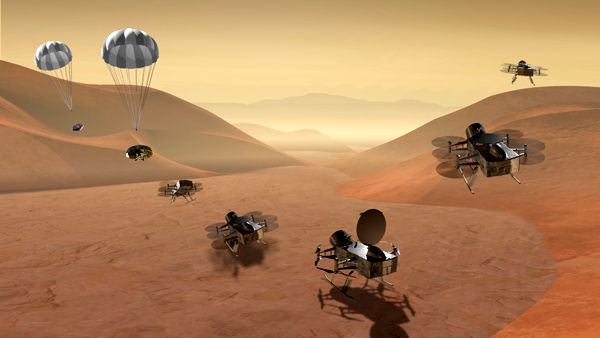
An artist's concept of the Dragonfly drone spacecraft designed to study the surface of Saturn's moon Titan.
NASA

NASA Invests in Concept Development for Missions to Comet, Saturn Moon Titan (Press Release)

NASA has selected two finalist concepts for a robotic mission planned to launch in the mid-2020s: a comet sample return mission and a drone-like rotorcraft that would explore potential landing sites on Saturn’s largest moon, Titan.

The agency announced the concepts Wednesday, following an extensive and competitive peer review process. The concepts were chosen from 12 proposals submitted in April under a New Frontiers program announcement of opportunity.

“This is a giant leap forward in developing our next bold mission of science discovery,” said Thomas Zurbuchen, associate administrator for NASA’s Science Mission Directorate in Washington. “These are tantalizing investigations that seek to answer some of the biggest questions in our solar system today.”

The finalists are:

Comet Astrobiology Exploration Sample Return (CAESAR)

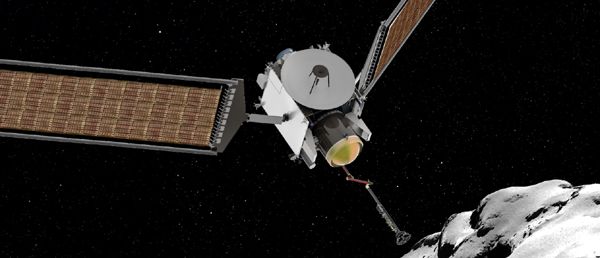
The CAESAR mission seeks to return a sample from 67P/Churyumov-Gerasimenko, a comet that was successfully explored by the European Space Agency’s Rosetta spacecraft, to determine its origin and history. Led by Steve Squyres of Cornell University in Ithaca, New York, CAESAR would be managed by NASA’s Goddard Space Flight Center in Greenbelt, Maryland.

Dragonfly

Dragonfly is a drone-like rotorcraft that would explore the prebiotic chemistry and habitability of dozens of sites on Saturn’s moon Titan, an ocean world in our solar system. Elizabeth Turtle from the Johns Hopkins University Applied Physics Laboratory (APL) in Laurel, Maryland, is the lead investigator, with APL providing project management.

The CAESAR and Dragonfly missions will receive funding through the end of 2018 to further develop and mature their concepts. NASA plans to select one of these investigations in the spring of 2019 to continue on to subsequent mission phases.

The selected mission will be the fourth in NASA’s New Frontiers portfolio, a series of principal investigator-led planetary science investigations that fall under a development cost cap of approximately $850 million. Its predecessors are the New Horizons mission to Pluto and a Kuiper Belt Object known as 2014 MU69, the Juno mission to Jupiter, and OSIRIS-REx, which will rendezvous with and return a sample of the asteroid Bennu.

NASA also announced the selection of two mission concepts that will receive technology development funds to prepare them for future mission competitions.

The concepts selected for technology development are:

Enceladus Life Signatures and Habitability (ELSAH)

The ELSAH mission concept will receive funds to develop cost-effective techniques that limit spacecraft contamination and thereby enable life detection measurements on cost-capped missions. The principal investigator is Chris McKay of NASA’s Ames Research Center in California’s Silicon Valley, and the managing NASA center is Goddard.

Venus In situ Composition Investigations (VICI)

Led by Lori Glaze at Goddard, the VICI mission concept will further develop the Venus Element and Mineralogy Camera to operate under the harsh conditions on Venus. The instrument uses lasers on a lander to measure the mineralogy and elemental composition of rocks on the surface of Venus.

The call for concepts was limited to six mission themes: comet surface sample return, lunar south pole-Aitken Basin sample return, ocean worlds (Titan and/or Enceladus), Saturn probe, Trojan asteroid tour and rendezvous, and Venus in situ explorer.

New Frontiers Program investigations address NASA’s planetary science objectives as described in the 2014 NASA Strategic Plan and the 2014 NASA Science Plan. The program is managed by the Planetary Missions Program Office at NASA’s Marshall Space Flight Center in Huntsville, Alabama, for the agency’s Planetary Science Division in Washington.

Source: NASA.Gov

****

An artist's concept of the CAESAR spacecraft retrieving a sample from the surface of 67P/Churyumov–Gerasimenko...the comet explored by Europe's Rosetta orbiter from August 2014 to September 2016.
NASA

Saturday, October 01, 2016

Rosetta Joins Philae in the History Books...

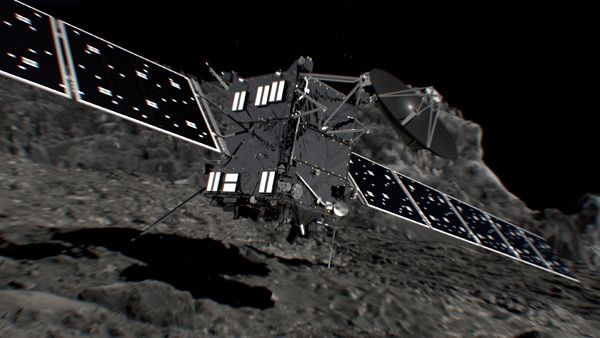
An artist's concept of the Rosetta spacecraft about to crash land onto the surface of Comet 67P/Churyumov–Gerasimenko.
ESA / ATG medialab

Mission Complete: Rosetta’s Journey Ends in Daring Descent to Comet (Press Release - September 30)

ESA’s historic Rosetta mission has concluded as planned, with the controlled impact onto the comet it had been investigating for more than two years.

Confirmation of the end of the mission arrived at ESA’s control centre in Darmstadt, Germany at 11:19 GMT (13:19 CEST) with the loss of Rosetta’s signal upon impact.

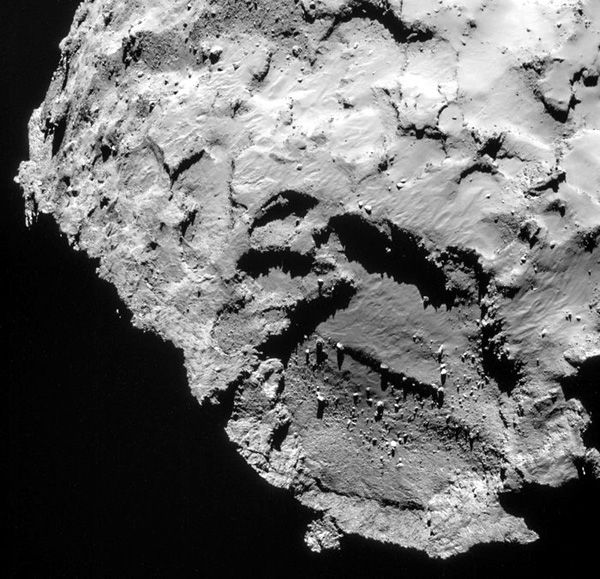
Rosetta carried out its final manoeuvre last night at 20:50 GMT (22:50 CEST), setting it on a collision course with the comet from an altitude of about 19 km. Rosetta had targeted a region on the small lobe of Comet 67P/Churyumov–Gerasimenko, close to a region of active pits in the Ma’at region.

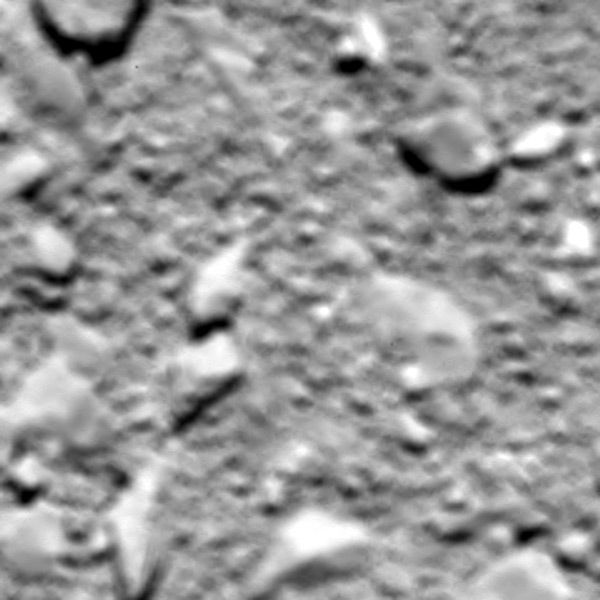
The descent gave Rosetta the opportunity to study the comet’s gas, dust and plasma environment very close to its surface, as well as take very high-resolution images.

Pits are of particular interest because they play an important role in the comet’s activity. They also provide a unique window into its internal building blocks.

The information collected on the descent to this fascinating region was returned to Earth before the impact. It is now no longer possible to communicate with the spacecraft.

“Rosetta has entered the history books once again,” says Johann-Dietrich Wörner, ESA’s Director General. “Today we celebrate the success of a game-changing mission, one that has surpassed all our dreams and expectations, and one that continues ESA’s legacy of ‘firsts’ at comets.”

“Thanks to a huge international, decades-long endeavour, we have achieved our mission to take a world-class science laboratory to a comet to study its evolution over time, something that no other comet-chasing mission has attempted,” notes Alvaro Giménez, ESA’s Director of Science.

“Rosetta was on the drawing board even before ESA’s first deep-space mission, Giotto, had taken the first image of a comet nucleus as it flew past Halley in 1986.

“The mission has spanned entire careers, and the data returned will keep generations of scientist busy for decades to come.”

“As well as being a scientific and technical triumph, the amazing journey of Rosetta and its lander Philae also captured the world’s imagination, engaging new audiences far beyond the science community. It has been exciting to have everyone along for the ride,” adds Mark McCaughrean, ESA’s senior science advisor.

Since launch in 2004, Rosetta is now in its sixth orbit around the Sun. Its nearly 8 billion-kilometre journey included three Earth flybys and one at Mars, and two asteroid encounters.

The craft endured 31 months in deep-space hibernation on the most distant leg of its journey, before waking up in January 2014 and finally arriving at the comet in August 2014.

After becoming the first spacecraft to orbit a comet, and the first to deploy a lander, Philae, in November 2014, Rosetta continued to monitor the comet’s evolution during their closest approach to the Sun and beyond.

“We’ve operated in the harsh environment of the comet for 786 days, made a number of dramatic flybys close to its surface, survived several unexpected outbursts from the comet, and recovered from two spacecraft ‘safe modes’,” says operations manager Sylvain Lodiot.

“The operations in this final phase have challenged us more than ever before, but it’s a fitting end to Rosetta’s incredible adventure to follow its lander down to the comet.”

The decision to end the mission on the surface is a result of Rosetta and the comet heading out beyond the orbit of Jupiter again. Further from the Sun than Rosetta has ever journeyed before, there would be little power to operate the craft.

Mission operators were also faced with an imminent month-long period when the Sun is close to the line-of-sight between Earth and Rosetta, meaning communications with the craft would have become increasingly more difficult.

“With the decision to take Rosetta down to the comet’s surface, we boosted the scientific return of the mission through this last, once-in-a-lifetime operation,” says mission manager Patrick Martin.

“It’s a bittersweet ending, but in the end the mechanics of the Solar System were simply against us: Rosetta’s destiny was set a long time ago. But its superb achievements will now remain for posterity and be used by the next generation of young scientists and engineers around the world.”

While the operational side of the mission has finished today, the science analysis will continue for many years to come.

Many surprising discoveries have already been made during the mission, not least the curious shape of the comet that became apparent during Rosetta’s approach in July and August 2014. Scientists now believe that the comet’s two lobes formed independently, joining in a low-speed collision in the early days of the Solar System.

Long-term monitoring has also shown just how important the comet’s shape is in influencing its seasons, in moving dust across its surface, and in explaining the variations measured in the density and composition of the coma, the comet’s ‘atmosphere’.

Some of the most unexpected and important results are linked to the gases streaming from the comet’s nucleus, including the discovery of molecular oxygen and nitrogen, and water with a different ‘flavour’ to that in Earth’s oceans.

Together, these results point to the comet being born in a very cold region of the protoplanetary nebula when the Solar System was still forming more than 4.5 billion years ago.

While it seems that the impact of comets like Rosetta’s may not have delivered as much of Earth’s water as previously thought, another much anticipated question was whether they could have brought ingredients regarded as crucial for the origin of life.

Rosetta did not disappoint, detecting the amino acid glycine, which is commonly found in proteins, and phosphorus, a key component of DNA and cell membranes. Numerous organic compounds were also detected ­by Rosetta from orbit, and also by Philae in situ on the surface.

Overall, the results delivered by Rosetta so far paint comets as ancient leftovers of early Solar System formation, rather than fragments of collisions between larger bodies later on, giving an unparalleled insight into what the building blocks of the planets may have looked like 4.6 billion years ago.

“Just as the Rosetta Stone after which this mission was named was pivotal in understanding ancient language and history, the vast treasure trove of Rosetta spacecraft data is changing our view on how comets and the Solar System formed,” says project scientist Matt Taylor.

“Inevitably, we now have new mysteries to solve. The comet hasn’t given up all of its secrets yet, and there are sure to be many surprises hidden in this incredible archive. So don’t go anywhere yet – we’re only just beginning.”

Source: European Space Agency

****

Rosetta's final image of 67P/Churyumov–Gerasimenko before the spacecraft crash-landed onto the comet's surface...on September 30, 2016.
ESA / Rosetta / MPS for OSIRIS Team MPS / UPD / LAM / IAA / SSO / INTA / UPM / DASP / IDA

Tuesday, September 06, 2016

Rosetta Finds a Lost Friend...

Images of comet 67P/Churyumov–Gerasimenko and the Philae lander on its surface, as seen by ESA's Rosetta spacecraft on September 2, 2016.
ESA / Rosetta / MPS for OSIRIS Team MPS / UPD / LAM / IAA / SSO / INTA / UPM / DASP / IDA; context: ESA/Rosetta/NavCam

Philae found! (News Release - September 5)

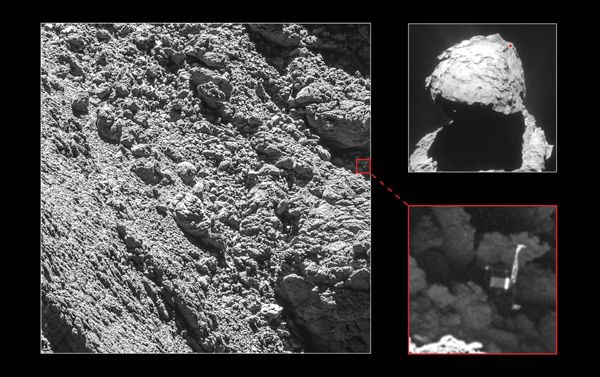
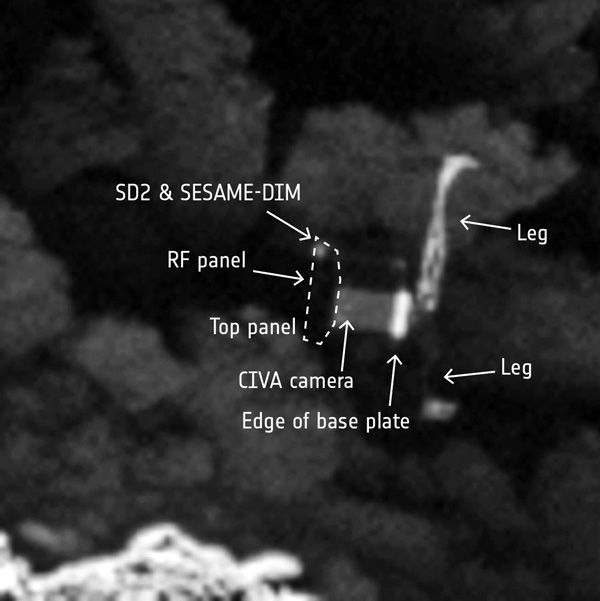
Less than a month before the end of the mission, Rosetta’s high-resolution camera has revealed the Philae lander wedged into a dark crack on Comet 67P/Churyumov–Gerasimenko.

The images were taken on 2 September by the OSIRIS narrow-angle camera as the orbiter came within 2.7 km of the surface and clearly show the main body of the lander, along with two of its three legs.

The images also provide proof of Philae’s orientation, making it clear why establishing communications was so difficult following its landing on 12 November 2014.

“With only a month left of the Rosetta mission, we are so happy to have finally imaged Philae, and to see it in such amazing detail,” says Cecilia Tubiana of the OSIRIS camera team, the first person to see the images when they were downlinked from Rosetta yesterday.

“After months of work, with the focus and the evidence pointing more and more to this lander candidate, I’m very excited and thrilled that we finally have this all-important picture of Philae sitting in Abydos,” says ESA’s Laurence O’Rourke, who has been coordinating the search efforts over the last months at ESA, with the OSIRIS and Lander Science Operations and Navigation Center (SONC, CNES) teams.

Philae was last seen when it first touched down at Agilkia, bounced and then flew for another two hours before ending up at a location later named Abydos, on the comet’s smaller lobe.

After three days, Philae's primary battery was exhausted and the lander went into hibernation, only to wake up again and communicate briefly with Rosetta in June and July 2015 as the comet came closer to the Sun and more power was available.

However, until today, the precise location was not known. Radio ranging data tied its location down to an area spanning a few tens of metres, but a number of potential candidate objects identified in relatively low-resolution images taken from larger distances could not be analysed in detail until recently.

While most candidates could be discarded from analysis of the imagery and other techniques, evidence continued to build towards one particular target, which is now confirmed in images taken unprecedentedly close to the surface of the comet.

At 2.7 km, the resolution of the OSIRIS narrow-angle camera is about 5 cm/pixel, sufficient to reveal characteristic features of Philae’s 1 m-sized body and its legs, as seen in these definitive pictures.

“This remarkable discovery comes at the end of a long, painstaking search,” says Patrick Martin, ESA’s Rosetta Mission Manager. “We were beginning to think that Philae would remain lost forever. It is incredible we have captured this at the final hour.”

“This wonderful news means that we now have the missing ‘ground-truth’ information needed to put Philae’s three days of science into proper context, now that we know where that ground actually is!” says Matt Taylor, ESA’s Rosetta project scientist.

"Now that the lander search is finished we feel ready for Rosetta's landing, and look forward to capturing even closer images of Rosetta's touchdown site,” adds Holger Sierks, principal investigator of the OSIRIS camera.

The discovery comes less than a month before Rosetta descends to the comet’s surface. On 30 September, the orbiter will be sent on a final one-way mission to investigate the comet from close up, including the open pits in the Ma’at region, where it is hoped that critical observations will help to reveal secrets of the body’s interior structure.

Source: European Space Agency

****

An image of the Philae lander on the surface of comet 67P/Churyumov–Gerasimenko, as seen by ESA's Rosetta spacecraft on September 2, 2016.
ESA / Rosetta / MPS for OSIRIS Team MPS / UPD / LAM / IAA / SSO / INTA / UPM / DASP/IDA

Sunday, June 14, 2015

Europe's Comet Lander Emerges From Its Sleep!

Philae floats in the darkness of space after being deployed by the European Space Agency's (ESA) Rosetta orbiter for a 7-hour journey to comet 67P/Churyumov–Gerasimenko's surface, on November 12, 2014.
ESA / Rosetta / MPS for OSIRIS Team MPS / UPD / LAM / IAA / SSO / INTA / UPM / DASP / IDA

Rosetta's Lander Philae Wakes Up From Hibernation (Press Release)

Rosetta's lander Philae has woken up after seven months in hibernation on the surface of Comet 67P/Churyumov-Gerasimenko.

The signals were received at ESA's European Space Operations Centre in Darmstadt at 22:28 CEST on 13 June. More than 300 data packets have been analysed by the teams at the Lander Control Center at the German Aerospace Center (DLR).

"Philae is doing very well: It has an operating temperature of -35ºC and has 24 Watts available," explains DLR Philae Project Manager Dr. Stephan Ulamec. "The lander is ready for operations."

For 85 seconds Philae "spoke" with its team on ground, via Rosetta, in the first contact since going into hibernation in November.

When analysing the status data it became clear that Philae also must have been awake earlier: "We have also received historical data – so far, however, the lander had not been able to contact us earlier."

Now the scientists are waiting for the next contact. There are still more than 8000 data packets in Philae’s mass memory which will give the DLR team information on what happened to the lander in the past few days on Comet 67P/Churyumov-Gerasimenko.

Philae shut down on 15 November 2014 at 1:15 CET after being in operation on the comet for about 60 hours. Since 12 March 2015 the communication unit on orbiter Rosetta was turned on to listen out for the lander.

Source: European Space Agency

****

Comet 67P/Churyumov–Gerasimenko as seen by ESA's Philae spacecraft while it heads in for a landing on the icy celestial body, on November 12, 2014.
ESA / Rosetta / Philae / ROLIS / DLR

Tuesday, January 27, 2015

More Cool Data Sent Back From Rosetta...

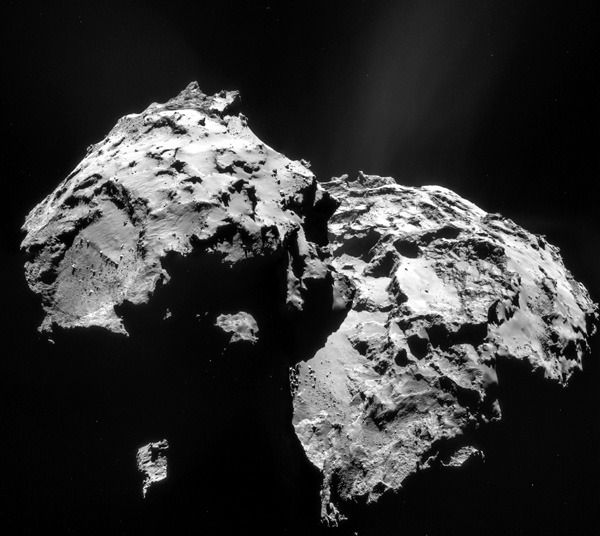
Comet 67P/Churyumov–Gerasimenko as seen by the European Space Agency's (ESA) Rosetta spacecraft...on January 12, 2015.
ESA / Rosetta / NAVCAM – CC BY-SA IGO 3.0

Rosetta Watches Comet Shed Its Dusty Coat (Press Release - January 26)

ESA’s Rosetta mission is providing unique insight into the life cycle of a comet’s dusty surface, watching 67P/Churyumov–Gerasimenko as it sheds the dusty coat it has accumulated over the past four years.

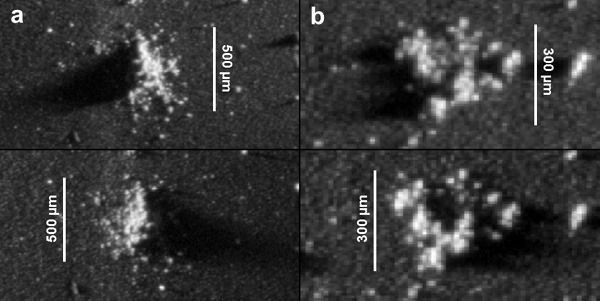
The COmetary Secondary Ion Mass Analyser, or COSIMA, is one of Rosetta’s three dust analysis experiments. It started collecting, imaging and measuring the composition of dust particles shortly after the spacecraft arrived at the comet in August 2014.

Results from the first analysis of its data are reported today in the journal Nature. The study covers August to October, when the comet moved along its orbit between about 535 million kilometres to 450 million kilometres from the Sun. Rosetta spent the most of this time orbiting the comet at distances of 30 km or less.

The scientists looked at the way that many large dust grains broke apart when they were collected on the instrument’s target plate, typically at low speeds of 1–10 m/s. The grains, which were originally at least 0.05 mm across, fragmented or shattered upon collection.

The fact that they broke apart so easily means that the individual parts were not well bound together. Moreover, if they had contained ice, they would not have shattered. Instead, the icy component would have evaporated off the grain shortly after touching the collecting plate, leaving voids in what remained.

By comparison, if a pure water-ice grain had struck the detector, then only a dark patch would have been seen.

The dust particles were found to be rich in sodium, sharing the characteristics of ‘interplanetary dust particles’. These are found in meteor streams originating from comets, including the annual Perseids from Comet 109P/Swift–Tuttle and the Leonids from 55P/Tempel–Tuttle.

“We found that the dust particles released first when the comet started to become active again are ‘fluffy’. They don’t contain ice, but they do contain a lot of sodium. We have found the parent material of interplanetary dust particles,” says lead author Rita Schulz of ESA’s Scientific Support Office.

The scientists believe that the grains detected were stranded on the comet’s surface after its last perihelion passage, when the flow of gas away from the surface had subsided and was no longer sufficient to lift dust grains from the surface.

While the dust was confined to the surface, the gas continued evaporating at a very low level, coming from ever deeper below the surface during the years that the comet travelled furthest from the Sun. Effectively, the comet nucleus was ‘drying out’ on the surface and just below it.

“We believe that these ‘fluffy’ grains collected by Rosetta originated from the dusty layer built up on the comet’s surface since its last close approach to the Sun,” explains Martin Hilchenbach, COSIMA principal investigator at the Max-Planck Institute for Solar System research in Germany.

“This layer is being removed as the activity of the comet is increasing again. We see this layer being removed, and we expect it to evolve into a more ice-rich phase in the coming months.”

The comet is on a 6.5-year circuit around the Sun, and is moving towards its closest approach in August of this year. At that point, Rosetta and the comet will be 186 million kilometres from the Sun, between the orbits of Earth and Mars.

As the comet warms, the outflow of gases is increasing and the grains making up the dry surface layers are being lifted into the inner atmosphere, or coma. Eventually, the incoming solar energy will be high enough to remove all of this old dust, leaving fresher material exposed at the surface.

“In fact, much of the comet’s dust mantle should actually be lost by now, and we will soon be looking at grains with very different properties,” says Rita.

“Rosetta’s dust observations close to the comet nucleus are crucial in helping us to link together what is happening at the very small scale with what we see at much larger scales, as dust is lost into the comet’s coma and tail,” says Matt Taylor, ESA’s Rosetta project scientist.

“For these observations, it really is a case of “watch this space” as we continue to watch in real time how the comet evolves as it approaches the Sun along its orbit over the coming months.”

Source: European Space Agency

****

Dust grain impacts from comet 67P/Churyumov–Gerasimenko...as studied by ESA's Rosetta spacecraft between October 25 - 31, 2014.
ESA / Rosetta / MPS for COSIMA Team MPS / CSNSM / UNIBW / TUORLA / IWF / IAS / ESA / BUW / MPE / LPC2E / LCM / FMI / UTU / LISA / UOFC / vH&S

Thursday, November 27, 2014

Hayabusa2: So Close to Launch...

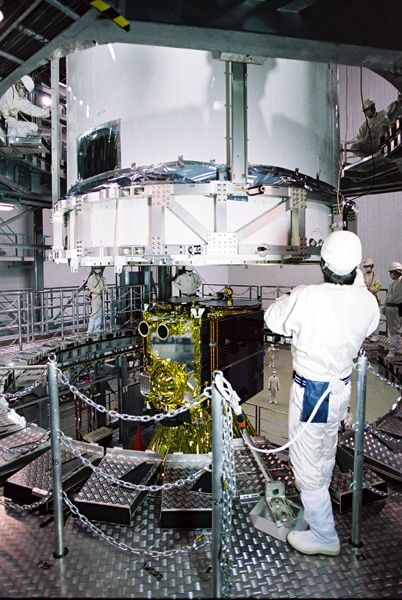
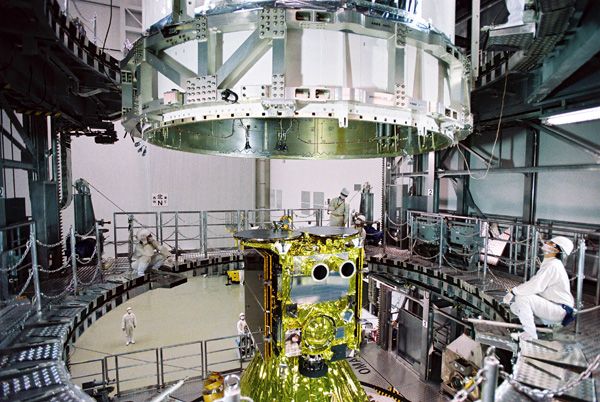
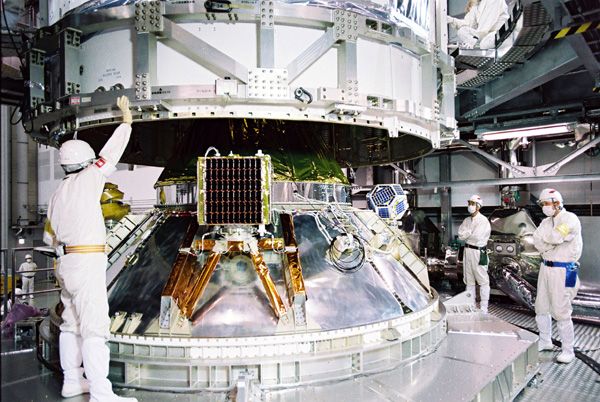
At the Tanegashima Space Center in Japan, JAXA's Hayabusa 2 spacecraft is about to be encapsulated by the payload fairing of its H-IIA launch vehicle...on November 17, 2014.
JAXA

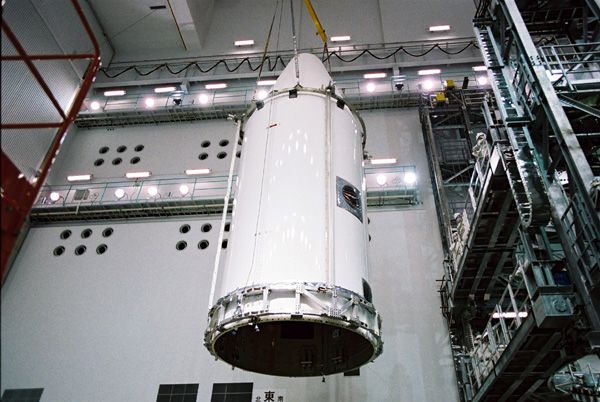
Happy Thanksgiving Day, everyone!!! Just thought I'd share these photos of Japan's Hayabusa 2 spacecraft as it gets prepped for launch at the Tanegashima Space Center in the southernmost part of the country. Hayabusa 2 is set to lift off aboard an H-IIA rocket this Saturday night (which will be Sunday afternoon in Japan), and will arrive at its celestial target—asteroid (162173) 1999 JU3—in July of 2018. Hayabusa 2 will gather samples from the surface of this asteroid before departing in December of 2019 and returning to Earth in December of the following year. Let's cross our fingers that Hayabusa 2 will have a smooth trip to and from 1999 JU3...unlike Hayabusa 1, which miraculously was able to reach Earth after suffering problems pertaining to its propulsion system, reaction wheels and other equipment as it concluded its mission at asteroid Itokawa almost a decade ago. Godspeed, Hayabusa 2... Here's hoping that JAXA (Japan Aerospace Exploration Agency) will enjoy as much success with this endeavor as Europe has with its Rosetta mission, even though it remains to be seen if the Philae lander will ever wake up from hibernation on the surface of comet 67P/Churyumov-Gerasimenko. (Google the full story on that.) Anyways, I'm lookin' forward to grubbin' down on shrimp cocktail during lunch today! Oh, and delicious turkey.

At the Tanegashima Space Center in Japan, the payload fairing of the H-IIA launch vehicle is about to encapsulate JAXA's Hayabusa 2 spacecraft (not visible)...on November 17, 2014.
JAXA

At the Tanegashima Space Center in Japan, JAXA's Hayabusa 2 spacecraft is about to be encapsulated by the payload fairing of its H-IIA launch vehicle...on November 17, 2014.
JAXA

At the Tanegashima Space Center in Japan, JAXA's Hayabusa 2 spacecraft is about to be encapsulated by the payload fairing of its H-IIA launch vehicle...on November 17, 2014.
JAXA

Wednesday, November 12, 2014

Rosetta Update: Fire the Harpoons (or Not)!

Comet 67P/Churyumov–Gerasimenko as seen by the European Space Agency's (ESA) Philae spacecraft while it heads in for a landing on the icy celestial body, on November 12, 2014.
ESA / Rosetta / Philae / ROLIS / DLR

Touchdown! Rosetta’s Philae Probe Lands on Comet (Press Release)

ESA’s Rosetta mission has soft-landed its Philae probe on a comet, the first time in history that such an extraordinary feat has been achieved.

After a tense wait during the seven-hour descent to the surface of Comet 67P/Churyumov–Gerasimenko, the signal confirming the successful touchdown arrived on Earth at 16:03 GMT (17:03 CET).

The confirmation was relayed via the Rosetta orbiter to Earth and picked up simultaneously by ESA’s ground station in Malargüe, Argentina and NASA’s station in Madrid, Spain. The signal was immediately confirmed at ESA’s Space Operations Centre, ESOC, in Darmstadt, and DLR’s Lander Control Centre in Cologne, both in Germany.

The first data from the lander’s instruments were transmitted to the Philae Science, Operations and Navigation Centre at France’s CNES space agency in Toulouse.

“Our ambitious Rosetta mission has secured a place in the history books: not only is it the first to rendezvous with and orbit a comet, but it is now also the first to deliver a lander to a comet’s surface,” noted Jean-Jacques Dordain, ESA’s Director General.

“With Rosetta we are opening a door to the origin of planet Earth and fostering a better understanding of our future. ESA and its Rosetta mission partners have achieved something extraordinary today.”

“After more than 10 years travelling through space, we’re now making the best ever scientific analysis of one of the oldest remnants of our Solar System,” said Alvaro Giménez, ESA’s Director of Science and Robotic Exploration.

“Decades of preparation have paved the way for today’s success, ensuring that Rosetta continues to be a game-changer in cometary science and space exploration.”

“We are extremely relieved to be safely on the surface of the comet, especially given the extra challenges that we faced with the health of the lander,” said Stephan Ulamec, Philae Lander Manager at the DLR German Aerospace Center.

“In the next hours we’ll learn exactly where and how we’ve landed, and we’ll start getting as much science as we can from the surface of this fascinating world.”

Rosetta was launched on 2 March 2004 and travelled 6.4 billion kilometres through the Solar System before arriving at the comet on 6 August 2014.

“Rosetta’s journey has been a continuous operational challenge, requiring an innovative approach, precision and long experience,” said Thomas Reiter, ESA Director of Human Spaceflight and Operations.

“This success is testimony to the outstanding teamwork and the unique knowhow in operating spacecraft acquired at the European Space Agency over the decades.”

The landing site, named Agilkia and located on the head of the bizarre double-lobed object, was chosen just six weeks after arrival based on images and data collected at distances of 30–100 km from the comet. Those first images soon revealed the comet as a world littered with boulders, towering cliffs and daunting precipices and pits, with jets of gas and dust streaming from the surface.

Following a period spent at 10 km to allow further close-up study of the chosen landing site, Rosetta moved onto a more distant trajectory to prepare for Philae’s deployment.

Five critical go/no-go decisions were made last night and early this morning, confirming different stages of readiness ahead of separation, along with a final pre-separation manoeuvre by the orbiter.

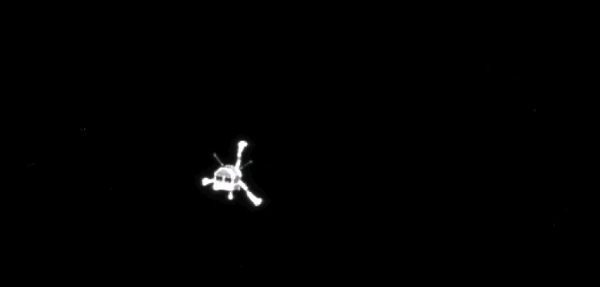
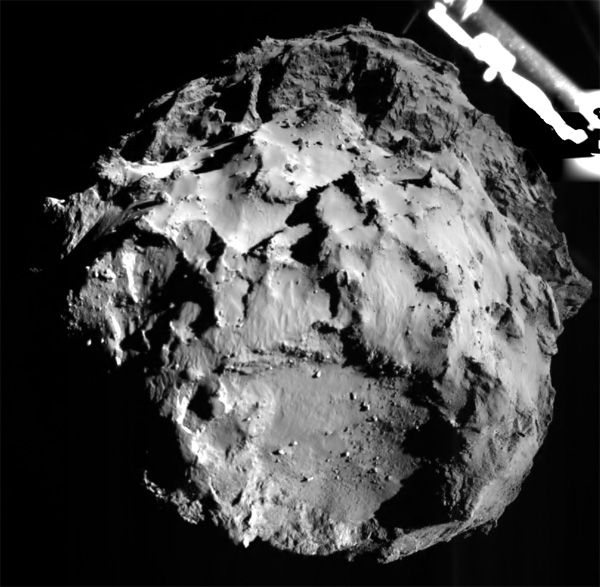
Deployment was confirmed at 09:03 GMT (10:03 CET) at a distance of 22.5km from the centre of the comet. During the seven-hour descent, which was made without propulsion or guidance, Philae took images and recorded information about the comet’s environment.

“One of the greatest uncertainties associated with the delivery of the lander was the position of Rosetta at the time of deployment, which was influenced by the activity of the comet at that specific moment, and which in turn could also have affected the lander’s descent trajectory,” said Sylvain Lodiot, ESA Rosetta Spacecraft Operations Manager.

“Furthermore, we’re performing these operations in an environment that we’ve only just started learning about, 510 million kilometres from Earth.”

Touchdown was planned to take place at a speed of around 1 m/s, with the three-legged landing gear absorbing the impact to prevent rebound, and an ice screw in each foot driving into the surface.

At the same time, two harpoons fired and locked the probe onto the surface.

But during the final health checks of the lander before separation, a problem was detected with the small thruster on top that was designed to counteract the recoil of the harpoons to push the lander down onto the surface. The conditions of landing – including whether or not the thruster performed – along with the exact location of Philae on the comet are being analysed.

The first images from the surface are being downlinked to Earth and should be available within a few hours of touchdown.

Over the next 2.5 days, the lander will conduct its primary science mission, assuming that its main battery remains in good health. An extended science phase using the rechargeable secondary battery may be possible, assuming Sun illumination conditions allow and dust settling on the solar panels does not prevent it. This extended phase could last until March 2015, after which conditions inside the lander are expected to be too hot for it to continue operating.

Science highlights from the primary phase will include a full panoramic view of the landing site, including a section in 3D, high-resolution images of the surface immediately underneath the lander, on-the-spot analysis of the composition of the comet’s surface materials, and a drill that will take samples from a depth of 23 cm and feed them to an onboard laboratory for analysis.

The lander will also measure the electrical and mechanical characteristics of the surface. In addition, low-frequency radio signals will be beamed between Philae and the orbiter through the nucleus to probe the internal structure.

The detailed surface measurements that Philae makes at its landing site will complement and calibrate the extensive remote observations made by the orbiter covering the whole comet.

“Rosetta is trying to answer the very big questions about the history of our Solar System. What were the conditions like at its infancy and how did it evolve? What role did comets play in this evolution? How do comets work?” said Matt Taylor, ESA Rosetta project scientist.

“Today’s successful landing is undoubtedly the cherry on the icing of a 4 km-wide cake, but we’re also looking further ahead and onto the next stage of this ground-breaking mission, as we continue to follow the comet around the Sun for 13 months, watching as its activity changes and its surface evolves.”

While Philae begins its close-up study of the comet, Rosetta must manoeuvre from its post-separation path back into an orbit around the comet, eventually returning to a 20 km orbit on 6 December.

Next year, as the comet grows more active, Rosetta will need to step further back and fly unbound ‘orbits’, but dipping in briefly with daring flybys, some of which will bring it within just 8 km of the comet centre.

The comet will reach its closest distance to the Sun on 13 August 2015 at about 185 million km, roughly between the orbits of Earth and Mars. Rosetta will follow it throughout the remainder of 2015, as they head away from the Sun and activity begins to subside.

“It’s been an extremely long and hard journey to reach today’s once-in-a-lifetime event, but it was absolutely worthwhile. We look forward to the continued success of the great scientific endeavour that is the Rosetta mission as it promises to revolutionise our understanding of comets,” said Fred Jansen, ESA Rosetta mission manager.

Source: European Space Agency

****

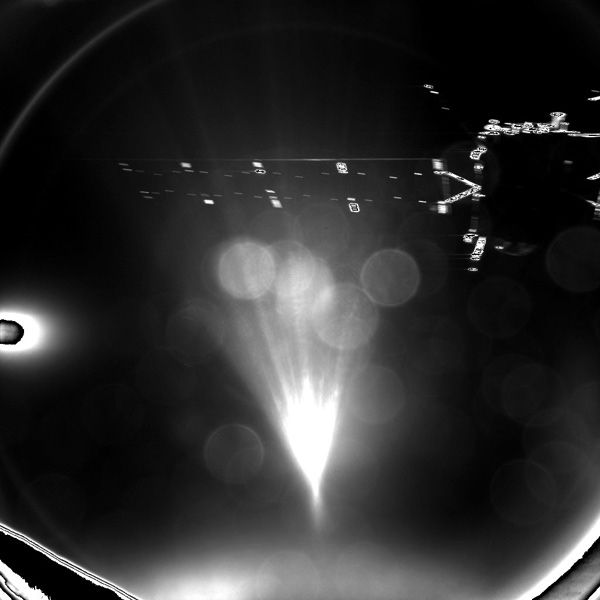
ESA's Rosetta orbiter as seen by Philae after the probe is deployed for a 7-hour journey to comet 67P/Churyumov–Gerasimenko's surface, on November 12, 2014.
ESA / Rosetta / Philae / CIVA

Philae floats in the darkness of space after being deployed by ESA's Rosetta orbiter for a 7-hour journey to comet 67P/Churyumov–Gerasimenko's surface, on November 12, 2014.
ESA / Rosetta / MPS for OSIRIS Team MPS / UPD / LAM / IAA / SSO / INTA / UPM / DASP / IDA

Today's Google doodle honoring Philae's historic landing on comet 67P/Churyumov–Gerasimenko's surface, on November 12, 2014.

Friday, October 17, 2014

Rosetta Update: Philae's Landing Site and a Selfie...

An image of Philae's landing site on Comet 67P/Churyumov–Gerasimenko, known as Site J, as seen by the Rosetta spacecraft on September 21, 2014.
ESA / Rosetta / NAVCAM

ESA Confirms the Primary Landing Site for Rosetta (Press Release - October 15)

ESA has given the green light for its Rosetta mission to deliver its lander, Philae, to the primary site on 67P/Churyumov–Gerasimenko on 12 November, in the first-ever attempt at a soft touchdown on a comet.

Philae’s landing site, currently known as Site J and located on the smaller of the comet’s two ‘lobes’, was confirmed on 14 October following a comprehensive readiness review.

Since the arrival, the mission has been conducting an unprecedented survey and scientific analysis of the comet, a remnant of the early phases of the Solar System’s 4.6 billion-year history.

At the same time, Rosetta has been moving closer to the comet: starting at 100 km on 6 August, it is now just 10 km from the centre of the 4 km-wide body. This allowed a more detailed look at the primary and backup landing sites in order to complete a hazard assessment, including a detailed boulder census.

The decision that the mission is ‘Go’ for Site J also confirms the timeline of events leading up to the landing.

Rosetta will release Philae at 08:35 GMT/09:35 CET on 12 November at a distance of approximately 22.5 km from the centre of the comet. Landing will be about seven hours later at around 15:30 GMT/16:30 CET.

With a one-way signal travel time between Rosetta and Earth on 12 November of 28 minutes 20 seconds, that means that confirmation of separation will arrive on Earth ground stations at 09:03 GMT/10:03 CET and of touchdown at around 16:00 GMT/17:00 CET.

“Now that we know where we are definitely aiming for, we are an important step closer to carrying out this exciting – but high-risk – operation,” says Fred Jansen, ESA’s Rosetta mission manager.

“However, there are still a number of key milestones to complete before we can give the final Go for landing.”

A series of Go/No-Go decisions must be taken before separation, starting on 11 November with a confirmation from the flight dynamics team that Rosetta is on the right trajectory ahead of lander delivery.

Further Go/No-Go decisions will be made during the night of 11–12 November concerning readiness and uplink of commands, culminating in confirmation of the lander readiness for separation.

A short manoeuvre must then take place around two hours before separation. This will set Rosetta on course to release Philae on the right trajectory to land on the comet. The final critical Go/No-Go for separation occurs shortly after this manoeuvre.

After the release of Philae, Rosetta will manoeuvre up and away from the comet, before reorienting itself in order to establish communications with Philae.

“If any of the decisions result in a No-Go, then we will have to abort and revise the timeline accordingly for another attempt, making sure that Rosetta is in a safe position to try again,” says Fred Jansen.

All being well, Rosetta and its lander will begin communications about two hours after separation.

During the seven-hour descent, Philae will take images and conduct science experiments, sampling the dust, gas and plasma environment close to the comet.

It will take a ‘farewell’ image of the Rosetta orbiter shortly after separation, along with a number of images as it approaches the comet surface. It is expected that the first images from this sequence will be received on Earth several hours after separation.

Once safely on the surface, Philae will take a panorama of its surroundings. Again, this is expected back on Earth several hours later.

The first sequence of surface science experiments will begin about an hour after touchdown and will last for 64 hours, constrained by the lander’s primary battery lifetime.

Longer-term study of the comet by Philae will depend on for how long and how well the batteries are able to recharge, which in turn is related to the amount of dust that settles on its solar panels.

In any case, it is expected that by March 2015, as the comet moves closer in its orbit towards the Sun, temperatures inside the lander will have reached levels too high to continue operations, and Philae’s science mission will come to an end.

The Rosetta orbiter’s mission will continue for much longer. It will accompany the comet as it grows in activity until their closest approach to the Sun in August 2015 and then as they head back towards the outer Solar System.

This unprecedented mission will study how a comet evolves and give important insights into the formation of our Solar System, and the origins of water and perhaps even life on Earth.

A detailed operations timeline, including key Go/No-Go decisions leading up to separation, will be available soon.

Source: European Space Agency

****

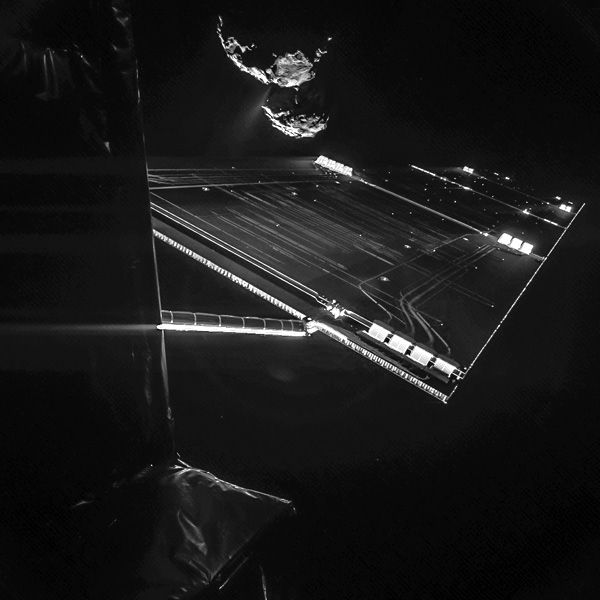
An image that the Philae lander took of Rosetta and one of its twin solar panels just as the spacecraft orbited 16 kilometers (10 miles) above Comet 67P/Churyumov–Gerasimenko...on October 7, 2014.
ESA / Rosetta / Philae / CIVA

Friday, September 26, 2014

Rosetta Update: Philae's Date With Comet 67P Is Now Set...

An image of Philae's landing site on Comet 67P/Churyumov–Gerasimenko, known as Site J, as seen by the Rosetta spacecraft on September 21, 2014.
ESA / Rosetta / NAVCAM

Rosetta to Deploy Lander on 12 November (Press Release)

The European Space Agency’s Rosetta mission will deploy its lander, Philae, to the surface of Comet 67P/Churyumov–Gerasimenko on 12 November.

Philae’s landing site, currently known as Site J, is located on the smaller of the comet’s two ‘lobes’, with a backup site on the larger lobe. The sites were selected just six weeks after Rosetta arrived at the comet on 6 August, following its 10-year journey through the Solar System.

In that time, the Rosetta mission has been conducting an unprecedented scientific analysis of the comet, a remnant of the Solar System’s 4.6 billion-year history. The latest results from Rosetta will be presented on the occasion of the landing, during dedicated press briefings.

The main focus to date has been to survey 67P/Churyumov–Gerasimenko in order to prepare for the first ever attempt to soft-land on a comet.

Site J was chosen unanimously over four other candidate sites as the primary landing site because the majority of terrain within a square kilometre area has slopes of less than 30º relative to the local vertical and because there are relatively few large boulders. The area also receives sufficient daily illumination to recharge Philae and continue surface science operations beyond the initial 64-hour battery-powered phase.

Over the last two weeks, the flight dynamics and operations teams at ESA have been making a detailed analysis of flight trajectories and timings for Rosetta to deliver the lander at the earliest possible opportunity.

Two robust landing scenarios have been identified, one for the primary site and one for the backup. Both anticipate separation and landing on 12 November.

For the primary landing scenario, targeting Site J, Rosetta will release Philae at 08:35 GMT/09:35 CET at a distance of 22.5 km from the centre of the comet, landing about seven hours later. The one-way signal travel time between Rosetta and Earth on 12 November is 28 minutes 20 seconds, meaning that confirmation of the landing will arrive at Earth ground stations at around 16:00 GMT/17:00 CET.

If a decision is made to use the backup Site C, separation will occur at 13:04 GMT/14:04 CET, 12.5 km from the centre of the comet. Landing will occur about four hours later, with confirmation on Earth at around 17:30 GMT/18:30 CET. The timings are subject to uncertainties of several minutes.

Final confirmation of the primary landing site and its landing scenario will be made on 14 October after a formal Lander Operations Readiness Review, which will include the results of additional high-resolution analysis of the landing sites conducted in the meantime. Should the backup site be chosen at this stage, landing can still occur on 12 November.

A competition for the public to name the primary landing site will also be announced during the week of 14 October.

The Rosetta orbiter will continue to study the comet and its environment using its 11 science instruments as they orbit the Sun together. The comet is on an elliptical 6.5-year orbit that takes it from beyond Jupiter at its furthest point, to between the orbits of Mars and Earth at its closest to the Sun. Rosetta will accompany the comet for more than a year as they swing around the Sun and back to the outer Solar System again.

The analyses made by the Rosetta orbiter will be complemented by the in situ measurements performed by Philae’s 10 instruments.

Source: European Space Agency

****

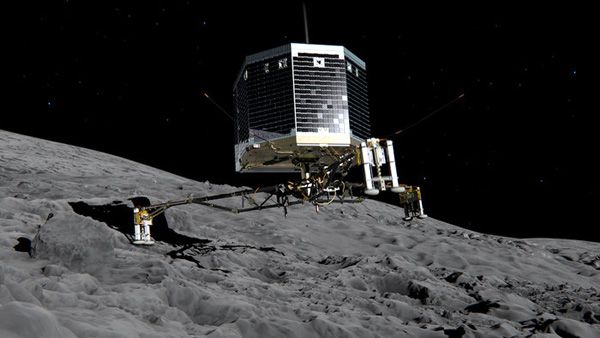
An artist's concept of the Philae lander touching down on the surface of Comet 67P/Churyumov–Gerasimenko.
ESA

Monday, September 15, 2014

Rosetta Update: Finding A Permanent Home for Philae on Comet 67P...

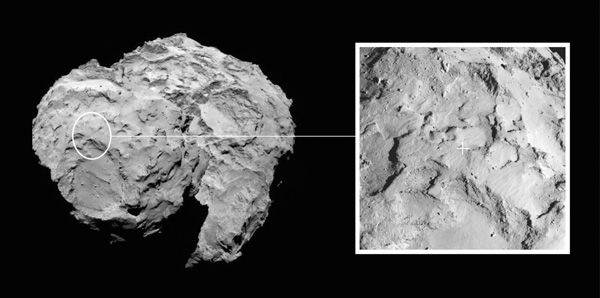
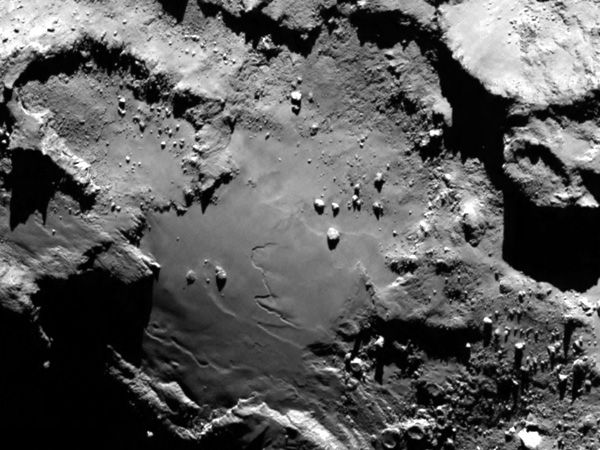
An image showing the primary landing site (Site J) for the Rosetta spacecraft's Philae lander, on comet 67P/Churyumov-Gerasimenko.
ESA / Rosetta / MPS for OSIRIS Team MPS / UPD / LAM / IAA / SSO / INTA / UPM / DASP / IDA

'J' Marks the Spot for Rosetta's Lander (Press Release)

The European Space Agency's Rosetta's lander, Philae, will target Site J, an intriguing region on comet 67P/Churyumov-Gerasimenko that offers unique scientific potential, with hints of activity nearby, and minimum risk to the lander compared to the other candidate sites. The 220-pound (100-kilogram) lander is scheduled to reach the surface on November 11, where it will perform in-depth measurements to characterize the nucleus. Rosetta is an international mission spearheaded by the European Space Agency with support and instruments provided by NASA.

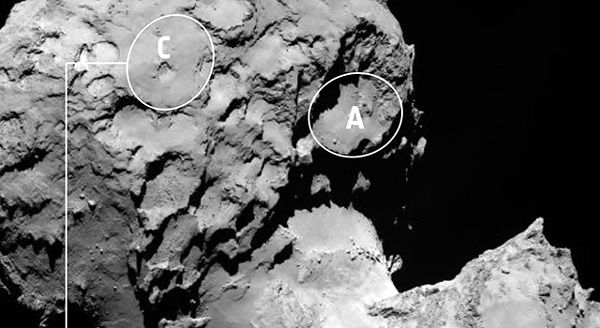
Site J is on the "head" of the comet, an irregular shaped world that is just over 2.5 miles (four kilometers) across at its widest point. The decision to select Site J as the primary site was unanimous. The backup, Site C, is located on the "body" of the comet.

"As we have seen from recent close-up images, the comet is a beautiful but dramatic world - it is scientifically exciting, but its shape makes it operationally challenging," says Stephan Ulamec, Philae Lander Manager at the German Aerospace Center (DLR) in Cologne. "None of the candidate landing sites met all of the operational criteria at the 100-percent level, but Site J is clearly the best solution."

Over the weekend, the Landing Site Selection Group of engineers and scientists from Philae's Science, Operations and Navigation Center at the National Center of Space Studies of France (CNES), the Lander Control Center at DLR, and scientists representing the Philae Lander instruments and ESA's Rosetta team, met at CNES, Toulouse, France, to consider the available data and to choose the primary and backup sites.

A number of critical aspects had to be considered, not least that it had to be possible to identify a safe trajectory for deploying Philae to the surface and that the density of visible hazards in the landing zone should be minimized. Once on the surface, other factors come into play, including the balance of daylight and night-time hours, and the frequency of communications passes with the orbiter.

The descent to the comet is passive and it is only possible to predict that the landing point will be within a "landing ellipse" (typically a few hundred meters) in size. For each of Rosetta's candidate sites, a larger area -- four-tenths of a square mile (one square kilometer) -- was assessed. At Site J the majority of slopes are less than 30-degrees relative to the local vertical, reducing the chances of Philae toppling over during touchdown. Site J also appears to have relatively few boulders, and it receives sufficient daily illumination to recharge Philae and continue science operations on the surface beyond the initial battery-powered phase.

Provisional assessment of the trajectory to Site J found that the descent time of Philae to the surface would be about seven hours, a length that does not compromise the on-comet observations by using up too much of the battery during the descent.

Both Sites B and C were considered as the backup, but C was preferred because of a higher illumination profile and fewer boulders. Sites A and I had seemed attractive during first rounds of discussion, but were dismissed at the second round because they did not satisfy a number of the key criteria.

A detailed operational timeline will now be prepared to determine the precise approach trajectory of Rosetta in order to deliver Philae to Site J. The landing must take place before mid-November, as the comet is predicted to grow more active as it moves closer to the sun.

"There's no time to lose, but now that we're closer to the comet, continued science and mapping operations will help us improve the analysis of the primary and backup landing sites," says ESA Rosetta flight director Andrea Accomazzo from the European Space Operations Centre in Darmstadt, Germany. "Of course, we cannot predict the activity of the comet between now and landing, and on landing day itself. A sudden increase in activity could affect the position of Rosetta in its orbit at the moment of deployment and in turn the exact location where Philae will land, and that's what makes this a risky operation."

All commands for Philae's descent will be uploaded prior to the lander's separation from the Rosetta orbiter. Once deployed from Rosetta, Philae's descent will be autonomous, with the lander taking images and other observations of the comet's environment.

Philae will touch down at the equivalent of walking pace and then use harpoons and ice screws to fix itself onto the comet's surface. It will then make a 360-degree panoramic image of the landing site to help determine where and in what orientation it has landed. The initial science phase will then begin, with other instruments analyzing the plasma and magnetic environment, and the surface and subsurface temperature. The lander will also drill and collect samples from beneath the surface, delivering them to the on-board laboratory for analysis. The interior structure of the comet will also be explored by sending radio waves through the surface toward Rosetta.

"No one has ever attempted to land on a comet before, so it is a real challenge," says Fred Jansen, the ESA Rosetta mission manager from the European Space Research Technology Center, Noordwijk, the Netherlands. "The complicated 'double' structure of the comet has had a considerable impact on the overall risks related to landing, but they are risks worth taking to have the chance of making the first ever soft landing on a comet."

The landing date should be confirmed on September 26 after further trajectory analysis and the final Go/No Go for a landing at the primary site will follow a comprehensive readiness review on October 14.

Launched in March 2004, Rosetta was reactivated in January 2014 after a record 957 days in hibernation. Composed of an orbiter and lander, Rosetta's objectives since arriving at comet 67P/Churyumov-Gerasimenko earlier this month are to study the celestial object up close in unprecedented detail, prepare for landing a probe on the comet's nucleus in November, and track its changes through 2015, as it sweeps past the sun.

Comets are time capsules containing primitive material left over from the epoch when the sun and its planets formed. Rosetta's lander will obtain the first images taken from a comet's surface and will provide comprehensive analysis of the comet's possible primordial composition by drilling into the surface. Rosetta also will be the first spacecraft to witness at close proximity how a comet changes as it is subjected to the increasing intensity of the sun's radiation. Observations will help scientists learn more about the origin and evolution of our solar system and the role comets may have played in seeding Earth with water, and perhaps even life.

Rosetta is an ESA mission with contributions from its member states and NASA. Rosetta's Philae lander is provided by a consortium led by the German Aerospace Center, Cologne; Max Planck Institute for Solar System Research, Gottingen; National Center of Space Studies of France (CNES), Paris; and the Italian Space Agency, Rome. NASA's Jet Propulsion Laboratory in Pasadena, California, a division of the California Institute of Technology, manages the U.S. participation in the Rosetta mission for NASA's Science Mission Directorate in Washington.

Source: Jet Propulsion Laboratory

****

An image showing the backup landing site (Site C) for the Rosetta spacecraft's Philae lander, on comet 67P/Churyumov-Gerasimenko.
ESA / Rosetta / MPS for OSIRIS Team MPS / UPD / LAM / IAA / SSO / INTA / UPM / DASP / IDA

Wednesday, September 10, 2014

Rosetta Update: Even Spacecraft Take Selfies...

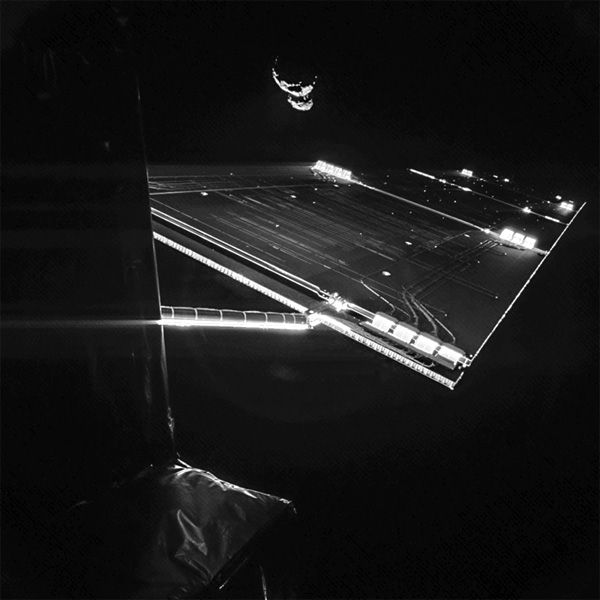
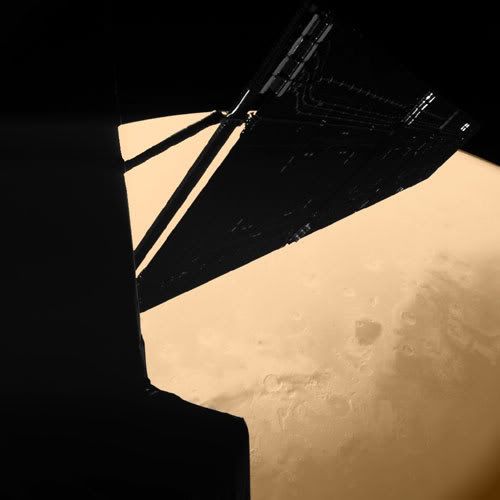
Just thought I'd share this amazing new picture that Europe's Rosetta spacecraft took as it continues to orbit comet 67P/Churyumov–Gerasimenko. This is the second time that the spacecraft took a photo of itself (actually, the images were taken by the Philae lander...which will be deployed by Rosetta and touch down onto the surface of the comet's nucleus sometime in November)...with the first selfie being taken above Mars back in 2007. Amazing stuff.

On September 7, 2014, this image was taken by the Philae lander that's currently attached to the European Space Agency's Rosetta spacecraft. Philae will be deployed by Rosetta and land on comet 67P/Churyumov–Gerasimenko's nucleus in November.
ESA / Rosetta / Philae / CIVA

Wednesday, August 06, 2014

Welcome To Your New Home, Rosetta!

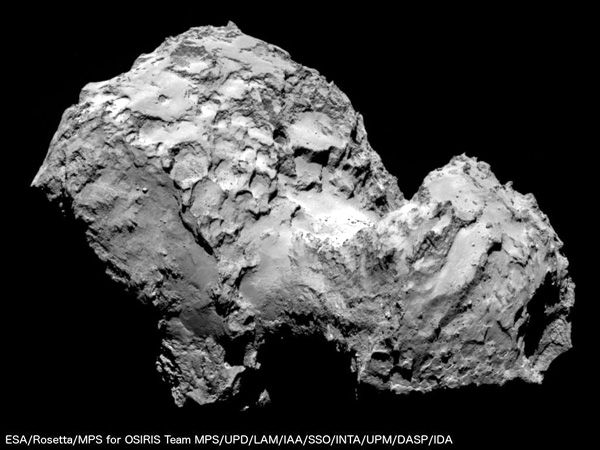
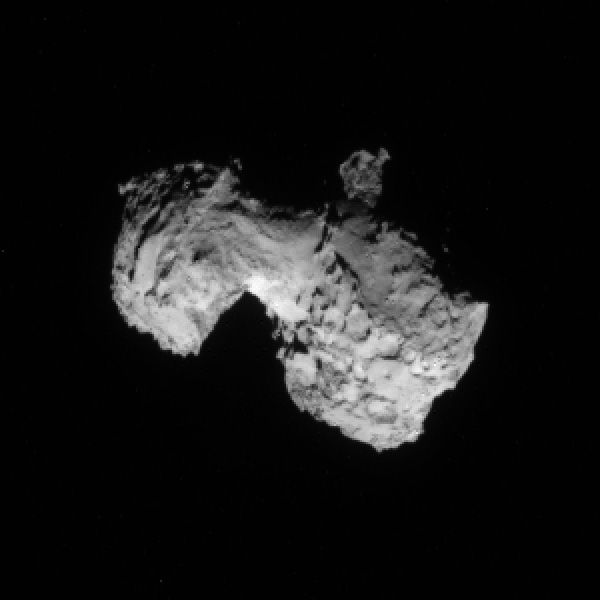
An image of comet 67P/Churyumov-Gerasimenko's nucleus, as seen by ESA's Rosetta spacecraft on August 3, 2014.

Rosetta Arrives at Comet Destination (Press Release)

After a decade-long journey chasing its target, ESA’s Rosetta has today become the first spacecraft to rendezvous with a comet, opening a new chapter in Solar System exploration.

Comet 67P/Churyumov–Gerasimenko and Rosetta now lie 405 million kilometres from Earth, about half way between the orbits of Jupiter and Mars, rushing towards the inner Solar System at nearly 55,000 kilometres per hour.

The comet is in an elliptical 6.5-year orbit that takes it from beyond Jupiter at its furthest point, to between the orbits of Mars and Earth at its closest to the Sun. Rosetta will accompany it for over a year as they swing around the Sun and back out towards Jupiter again.

Comets are considered to be primitive building blocks of the Solar System and may have helped to ‘seed’ Earth with water, perhaps even the ingredients for life. But many fundamental questions about these enigmatic objects remain, and through a comprehensive, in situ study of the comet, Rosetta aims to unlock the secrets within.

The journey to the comet was not straightforward, however. Since its launch in 2004, Rosetta had to make three gravity-assist flybys of Earth and one of Mars to help it on course to its rendezvous with the comet. This complex course also allowed Rosetta to pass by asteroids Šteins and Lutetia, obtaining unprecedented views and scientific data on these two objects.

“After ten years, five months and four days travelling towards our destination, looping around the Sun five times and clocking up 6.4 billion kilometres, we are delighted to announce finally ‘we are here’,” says Jean-Jacques Dordain, ESA’s Director General.

“Europe’s Rosetta is now the first spacecraft in history to rendezvous with a comet, a major highlight in exploring our origins. Discoveries can start.”

Today saw the last of a series of ten rendezvous manoeuvres that began in May to adjust Rosetta’s speed and trajectory gradually to match those of the comet. If any of these manoeuvres had failed, the mission would have been lost, and the spacecraft would simply have flown by the comet.

“Today’s achievement is a result of a huge international endeavour spanning several decades,” says Alvaro Giménez, ESA’s Director of Science and Robotic Exploration.

“We have come an extraordinarily long way since the mission concept was first discussed in the late 1970s and approved in 1993, and now we are ready to open a treasure chest of scientific discovery that is destined to rewrite the textbooks on comets for even more decades to come.”

The comet began to reveal its personality while Rosetta was on its approach. Images taken by the OSIRIS camera between late April and early June showed that its activity was variable. The comet’s ‘coma’ – an extended envelope of gas and dust – became rapidly brighter and then died down again over the course of those six weeks.

In the same period, first measurements from the Microwave Instrument for the Rosetta Orbiter, MIRO, suggested that the comet was emitting water vapour into space at about 300 millilitres per second.

Meanwhile, the Visible and Infrared Thermal Imaging Spectrometer, VIRTIS, measured the comet’s average temperature to be about –70ºC, indicating that the surface is predominantly dark and dusty rather than clean and icy.

Then, stunning images taken from a distance of about 12,000 km began to reveal that the nucleus comprises two distinct segments joined by a ‘neck’, giving it a duck-like appearance. Subsequent images showed more and more detail – the most recent, highest-resolution image was downloaded from the spacecraft earlier today and will be available this afternoon.

“Our first clear views of the comet have given us plenty to think about,” says Matt Taylor, ESA’s Rosetta project scientist.

“Is this double-lobed structure built from two separate comets that came together in the Solar System’s history, or is it one comet that has eroded dramatically and asymmetrically over time? Rosetta, by design, is in the best place to study one of these unique objects.”

Today, Rosetta is just 100 km from the comet’s surface, but it will edge closer still. Over the next six weeks, it will describe two triangular-shaped trajectories in front of the comet, first at a distance of 100 km and then at 50 km.

At the same time, more of the suite of instruments will provide a detailed scientific study of the comet, scrutinising the surface for a target site for the Philae lander.

Eventually, Rosetta will attempt a close, near-circular orbit at 30 km and, depending on the activity of the comet, perhaps come even closer.

“Arriving at the comet is really only just the beginning of an even bigger adventure, with greater challenges still to come as we learn how to operate in this unchartered environment, start to orbit and, eventually, land,” says Sylvain Lodiot, ESA’s Rosetta spacecraft operations manager.

As many as five possible landing sites will be identified by late August, before the primary site is identified in mid-September. The final timeline for the sequence of events for deploying Philae – currently expected for 11 November – will be confirmed by the middle of October.

“Over the next few months, in addition to characterising the comet nucleus and setting the bar for the rest of the mission, we will begin final preparations for another space history first: landing on a comet,” says Matt.

“After landing, Rosetta will continue to accompany the comet until its closest approach to the Sun in August 2015 and beyond, watching its behaviour from close quarters to give us a unique insight and realtime experience of how a comet works as it hurtles around the Sun.”

Source: European Space Agency

****

An image of comet 67P/Churyumov-Gerasimenko's nucleus, as seen by ESA's Rosetta spacecraft on August 6, 2014.
ESA / Rosetta / MPS for OSIRIS Team MPS / UPD / LAM / IAA / SSO / INTA / UPM / DASP / IDA

Friday, August 01, 2014

Europe's Date with a Comet...

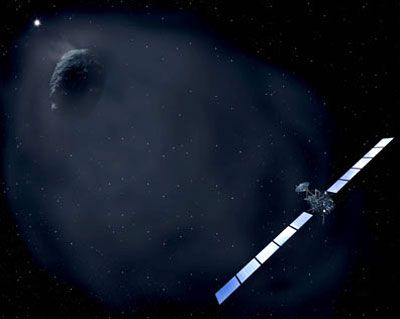
An artist's concept of ESA's Rosetta spacecraft approaching comet 67P/Churyumov-Gerasimenko.
ESA

How Rosetta Arrives at a Comet (Press Release)

After travelling nearly 6.4 billion kilometres through the Solar System, ESA’s Rosetta is closing in on its target. But how does a spacecraft actually arrive at a comet?

The journey began on 2 March 2004 when Rosetta was launched on an Ariane 5 from Europe’s Spaceport in Kourou, French Guiana.

Since then, Rosetta has looped around the Sun five times, picking up speed through three gravity-assist swingbys at Earth and one at Mars, to enter an orbit similar to that of its destination: comet 67P/Churyumov–Gerasimenko.

This icy target is in an elliptical 6.5-year solar circuit that takes it from beyond the orbit of Jupiter at its furthest point, and between the orbits of Mars and Earth at its closest to the Sun.

Rosetta’s goal is to match the pace of the comet – currently some 55 000 km/h – and travel alongside it to within just 1 m/s between them, roughly equivalent to a walking pace.

Since early May, Rosetta’s controllers have been pacing it through a tightly planned series of manoeuvres designed to slow its speed with respect to the comet by about 2800 km/h, or 775 m/s, to ensure its arrival on 6 August.

Flight Dynamics Experts Play Crucial Role

ESA’s experts are playing a crucial role, having worked extensively behind the scenes to develop a series of ten orbit-correction manoeuvres that use Rosetta’s thrusters to match the spacecraft’s speed and direction with that of the comet.

“Our team is responsible for predicting and determining Rosetta’s orbit, and we work with the flight controllers to plan the thruster burns,” says Frank Dreger, Head of Flight Dynamics at ESA’s Space Operations Centre, ESOC, in Darmstadt, Germany.

The burns were carried out every two weeks in May and June and, after a short test, the three subsequent manoeuvres were some of the longest ever performed by an ESA spacecraft – exceeding seven hours.

These first burns dramatically reduced Rosetta’s speed with respect to the comet by 668 m/s of the necessary 775 m/s required by 6 August, when Rosetta will ‘arrive’ at a distance of just 100 km from the comet.

Throughout July, the burns were made on a weekly basis, and will culminate in two short orbit insertion burns set for 3 and 6 August.

Obeying Orbital Mechanics

“If any glitches in space or on ground had delayed the recent burns, orbital mechanics dictate that we’d only have had a matter of a few days to fix the problem, replan the burn and carry it out, otherwise we would have run the risk of missing the comet,” says Trevor Morley, a flight dynamics specialist at ESOC.

The team’s job is far from over once Rosetta arrives. As the pioneering craft draws ever nearer, the physical properties of the comet will become increasingly important for determining Rosetta’s eventual path around it.

“On top of a good physical model of the comet nucleus, we also need a good ‘coma’ model that tells us the density and velocity of particles being emitted from the comet,” says fellow specialist Frank Budnik at ESOC.

“We expect the spacecraft to be affected by the surrounding coma in addition to the comet body’s gravitational pull, and these all play into calculating the orbits and the thruster burns required to keep Rosetta near the comet.”

As the comet moves closer to the Sun during 2015, it will heat up and become more active, throwing out increasing quantities of gas and dust. Combined with the low gravity, this ever-changing activity will make for hugely challenging operations, trying to keep the spacecraft close enough to the comet to do good science, while ensuring that it remains safe.

But first: save the date for 6 August, when Rosetta is set to become the first spacecraft in history to attempt to rendezvous with a comet.

Source: European Space Agency

****

An image of comet 67P/Churyumov-Gerasimenko's nucleus, as seen by ESA's Rosetta spacecraft on August 3, 2014.
ESA / Rosetta / NAVCAM

Saturday, July 05, 2014

Rosetta Update...

An artist's concept of ESA's Rosetta spacecraft approaching comet 67P/Churyumov-Gerasimenko.
ESA

Rosetta’s Comet ‘Sweats’ Two Glasses Of Water A Second (Press Release - June 30)

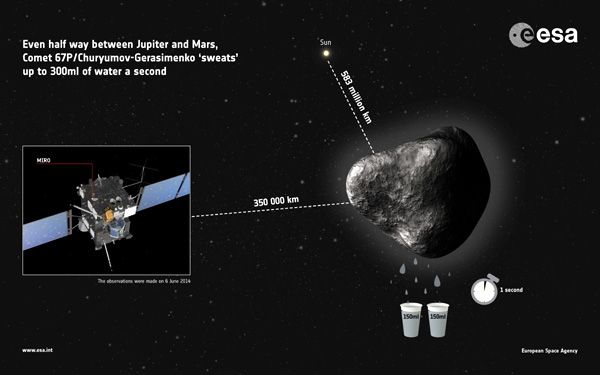
ESA’s Rosetta spacecraft has found that comet 67P/Churyumov–Gerasimenko is releasing the equivalent of two small glasses of water into space every second, even at a cold 583 million kilometres from the Sun.

The first observations of water vapour streaming from the comet were made by the Microwave Instrument for Rosetta Orbiter, or MIRO, on 6 June, when the spacecraft was about 350,000 kilometres from the comet.

Since the initial detection, water vapour has been found every time MIRO has been pointed towards the comet.

“We always knew we would see water vapour outgassing from the comet, but we were surprised at how early we detected it,” says Sam Gulkis, the instrument’s principal investigator at NASA’s Jet Propulsion Laboratory in Pasadena, California, USA.

“At this rate, the comet would fill an Olympic-size swimming pool in about 100 days. But, as it gets closer to the Sun, the gas production rate will increase significantly. With Rosetta, we have an amazing vantage point to observe these changes up close and learn more about exactly why they happen.”

Water is a major volatile component of comets, along with carbon monoxide, methanol and ammonia. MIRO is designed to help determine the abundance of each of these ingredients, in order to understand the nature of the comet’s nucleus, the process of outgassing and where they originate on the surface.

These gases stream away from the nucleus carrying dust, forming the comet’s surrounding ‘coma’. As the comet moves closer to the Sun, its coma will expand and, eventually, pressure from the solar wind will cause some of the material to stream out into a long tail.

Rosetta will be there to watch these developments up close. The comet – and Rosetta – will make its nearest approach to the Sun in August 2015, between the orbits of Earth and Mars.

Determining the changes in production rate of water vapour and other gases as the icy object moves around the Sun is important for comet science. But it is also vital for mission planning, because once Rosetta is closer to the comet, the outflow of gases may alter the craft’s trajectory.

“Our comet is coming out of its deep-space slumber and beginning to put on a show for Rosetta’s science instruments,” says Matt Taylor, ESA’s Rosetta project scientist.

“Rosetta’s engineers will also be using MIRO’s observations to help them plan for future mission events when we are operating close to the comet’s nucleus.”

Today, the spacecraft is within 72,000 km of its destination. Six out of a total of ten rendezvous manoeuvres still need to be carried out to ensure that Rosetta arrives at a distance of just 100 km from the nucleus on 6 August.

Source: European Space Agency

****

An infographic showing how ESA's Rosetta spacecraft detected water vapor being outgassed from comet 67P/Churyumov-Gerasimenko, which Rosetta will begin orbiting early next month (on August 6).
ESA

Monday, January 20, 2014

Rise and Shine, Rosetta!

An artist's concept of ESA's Rosetta spacecraft approaching comet Churyumov-Gerasimenko.
ESA

ESA’s ‘Sleeping Beauty’ Wakes Up From Deep Space Hibernation (Press Release)

It was a fairy-tale ending to a tense chapter in the story of the Rosetta space mission this evening as ESA heard from its distant spacecraft for the first time in 31 months.

Rosetta is chasing down Comet 67P/Churyumov-Gerasimenko, where it will become the first space mission to rendezvous with a comet, the first to attempt a landing on a comet’s surface, and the first to follow a comet as it swings around the Sun.

Since its launch in 2004, Rosetta has made three flybys of Earth and one of Mars to help it on course to its rendezvous with 67P/Churyumov-Gerasimenko, encountering asteroids Steins and Lutetia along the way.

Operating on solar energy alone, Rosetta was placed into a deep space slumber in June 2011 as it cruised out to a distance of nearly 800 million km from the warmth of the Sun, beyond the orbit of Jupiter.

Now, as Rosetta’s orbit has brought it back to within ‘only’ 673 million km from the Sun, there is enough solar energy to power the spacecraft fully again.

Thus today, still about 9 million km from the comet, Rosetta’s pre-programmed internal ‘alarm clock’ woke up the spacecraft. After warming up its key navigation instruments, coming out of a stabilising spin, and aiming its main radio antenna at Earth, Rosetta sent a signal to let mission operators know it had survived the most distant part of its journey.

The signal was received by both NASA’s Goldstone and Canberra ground stations at 18:18 GMT/ 19:18 CET, during the first window of opportunity the spacecraft had to communicate with Earth. It was immediately confirmed in ESA’s space operations centre in Darmstadt and the successful wake-up announced via the @ESA_Rosetta twitter account, which tweeted: “Hello, World!"

“We have our comet-chaser back,” says Alvaro Giménez, ESA’s Director of Science and Robotic Exploration. “With Rosetta, we will take comet exploration to a new level. This incredible mission continues our history of ‘firsts’ at comets, building on the technological and scientific achievements of our first deep space mission Giotto, which returned the first close-up images of a comet nucleus as it flew past Halley in 1986.”

“This was one alarm clock not to hit snooze on, and after a tense day we are absolutely delighted to have our spacecraft awake and back online,” adds Fred Jansen, ESA’s Rosetta mission manager.

Comets are considered the primitive building blocks of the Solar System and likely helped to ‘seed’ Earth with water, perhaps even the ingredients for life. But many fundamental questions about these enigmatic objects remain, and through its comprehensive, in situ study of Comet 67P/Churyumov-Gerasimenko, Rosetta aims to unlock the secrets contained within.

“All other comet missions have been flybys, capturing fleeting moments in the life of these icy treasure chests,” says Matt Taylor, ESA’s Rosetta project scientist. “With Rosetta, we will track the evolution of a comet on a daily basis and for over a year, giving us a unique insight into a comet’s behaviour and ultimately helping us to decipher their role in the formation of the Solar System.”

But first, essential health checks on the spacecraft must be completed. Then the eleven instruments on the orbiter and ten on the lander will be turned on and prepared for studying Comet 67P/Churyumov-Gerasimenko.

“We have a busy few months ahead preparing the spacecraft and its instruments for the operational challenges demanded by a lengthy, close-up study of a comet that, until we get there, we know very little about,” says Andrea Accomazzo, ESA’s Rosetta operations manager.

Rosetta’s first images of 67P/Churyumov-Gerasimenko are expected in May, when the spacecraft is still 2 million km from its target. Towards the end of May, the spacecraft will execute a major manoeuvre to line up for its critical rendezvous with the comet in August.

After rendezvous, Rosetta will start with two months of extensive mapping of the comet’s surface, and will also make important measurements of the comet’s gravity, mass and shape, and assess its gaseous, dust-laden atmosphere, or coma. The orbiter will also probe the plasma environment and analyse how it interacts with the Sun’s outer atmosphere, the solar wind.

Using these data, scientists will choose a landing site for the mission’s 100 kg Philae probe. The landing is currently scheduled for 11 November and will be the first time that a landing on a comet has ever been attempted.

In fact, given the almost negligible gravity of the comet’s 4 km-wide nucleus, Philae will have to use ice screws and harpoons to stop it from rebounding back into space after touchdown.

Among its wide range of scientific measurements, Philae will send back a panorama of its surroundings, as well as very high-resolution pictures of the surface. It will also perform an on-the-spot analysis of the composition of the ices and organic material, including drilling down to 23 cm below the surface and feeding samples to Philae’s on-board laboratory for analysis.

The focus of the mission will then move to the ‘escort’ phase, during which Rosetta will stay alongside the comet as it moves closer to the Sun, monitoring the ever-changing conditions on the surface as the comet warms up and its ices sublimate.

The comet will reach its closest distance to the Sun on 13 August 2015 at about 185 million km, roughly between the orbits of Earth and Mars. Rosetta will follow the comet throughout the remainder of 2015, as it heads away from the Sun and activity begins to subside.

“We will face many challenges this year as we explore the unknown territory of comet 67P/Churyumov-Gerasimenko and I’m sure there will be plenty of surprises, but today we are just extremely happy to be back on speaking terms with our spacecraft,” adds Matt Taylor.

Source: European Space Agency

****

On February 25, 2007, this image was taken by the Philae lander that's currently attached to the European Space Agency's Rosetta spacecraft. Launched on March 2, 2004, Rosetta passed by Mars for a gravitational assist as it heads for comet 67P/Churyumov-Gerasimenko, where it will arrive this coming May. Philae will be dropped onto the comet's nucleus to study it during the 1½ year-long mission.
ESA

Tuesday, June 21, 2011

The Martian moon Phobos, with Jupiter in the background, photographed by the European Space Agency's (ESA) Mars Express orbiter on June 1, 2011.
ESA / DLR / FU Berlin (G. Neukum)

JUST THOUGHT I’D SHARE this cool image of the Martian moon Phobos—with Jupiter in the background—that was taken by the High-Resolution Stereo Camera onboard the European Space Agency’s (ESA) Mars Express orbiter on June 1. Apparently, you have to be at the distance of Mars or obviously within the Asteroid Belt to actually see clouds on Jupiter...or even on Saturn...as was the case when ESA’s other spacecraft, the comet-bound Rosetta probe, caught the ringed planet orbiting far behind asteroid Lutetia last July. For your convenience, I’ve also included that image below.

An image of asteroid Lutetia, with Saturn in the background, that was taken by ESA's Rosetta spacecraft on July 10, 2010.
ESA 2010 MPS for OSIRIS Team MPS / UPD / LAM / IAA / RSSD / INTA / UPM / DASP / IDA