Showing posts with label Artemis. Show all posts

Tuesday, August 25, 2026

A New Radio Dish for Space Exploration Has Emerged in the California Desert...

A snapshot of the new Deep Space Station 23 antenna at NASA's Goldstone Deep Space Communications Complex near Barstow, California.
NASA / JPL - Caltech

New Next-Gen Dish Adds Muscle to NASA’s Deep Space Network (News Release)

Deep Space Station 23 at NASA’s Goldstone facility in the California desert is the latest next-generation antenna to be added by the network’s enhancement project.

NASA’s Deep Space Network facility in California is marking the addition of a brand new 34-meter-wide (114-foot-wide) radio frequency antenna to the agency’s deep space communications and navigation system. The network uses giant dish antennas located at three global facilities to support more than 40 spacecraft exploring the Solar System and interstellar space.

The new Deep Space Station 23 (DSS-23) is located at the Goldstone Deep Space Communications Complex, near Barstow, and is managed by NASA’s Jet Propulsion Laboratory in Southern California.

NASA leadership and personnel as well as dignitaries gathered at the complete DSS-23 antenna for a ceremonial ribbon cutting. It’s the latest to be added as part of the Deep Space Network’s Aperture Enhancement Project, which began in 2009 to upgrade and expand the network by adding six new 34-meter multifrequency beam-waveguide antennas. These versatile dishes can enhance many missions operating over different radio frequencies.

“By expanding the Deep Space Network, we are strengthening the communications foundation NASA needs for the bold missions ahead — from exploring more of the Moon than ever before to peering deeper into the Solar System,” said James Kenyon, associate administrator of the Research and Technology Mission Directorate at NASA Headquarters in Washington. “This new antenna will help us deliver on our national goals for space exploration and push beyond the limits of what once seemed impossible.”

After completing a testing campaign from May through July to demonstrate its capabilities, the new DSS-23 began operations on August 3, tracking NASA’s Chandra X-ray Observatory. Since then, it has been communicating with dozens of missions such as NASA’s Mars Reconnaissance Orbiter, Psyche, Juno, Voyager 1 and other robotic spacecraft in deep space.

“The addition of this next-generation antenna brings us closer to a completely modernized network that embraces advanced technology to ensure NASA’s leadership in deep space communications,” said Dave Gallagher, director of JPL. “After over 60 years of continuous operations supporting consequential missions, these upgrades prime the network for a new era of exploration. The teams that designed, planned and built DSS-23 should be proud.”

Enhanced capabilities

Construction of DSS-23 began in February 2020. After the 133-ton metal reflector framework was placed and bolted atop the antenna’s pedestal in December 2024, engineers installed the panels to the framework that reflect radio frequency signals transmitted to and received from spacecraft. Then came the careful process of calibrating the antenna so that it can work in concert with the rest of the network.

It is the fifth antenna at Goldstone (joining three 34-meter antennas and one 70-meter, or 230-foot, antenna) and the fifth enhancement project antenna to join the network, which includes antennas at the DSN’s Goldstone, Madrid, and Canberra, Australia, complexes. Multifrequency beam waveguide antennas direct signals down to a stable, climate-controlled underground room, rather than housing heavy, sensitive electronic equipment on the moving antenna dish. In addition to offering versatility, this design allows easy access for maintenance and upgrades to the system.

“The biggest challenge wasn’t actually constructing the antenna. It was transforming a complex collection of mechanical, electrical, software, radio frequency, and infrastructure systems into a single, mission-ready asset,” said Germaine Aziz, manager of the Deep Space Network Aperture Enhancement Project at JPL. “Every subsystem must be integrated, calibrated, and verified to operate with extraordinary precision and reliability before it can support NASA’s deep space missions.”

The enhancement project will be complete when a sixth enhancement-project antenna, Deep Space Station 33, comes online at the Canberra facility in 2029, bringing the total number of 34-meter antennas across the network to 13. The 34-meter antennas can be arrayed (combined and operated together) to provide an equivalent communications backup for each facility’s single 70-meter antenna, which, after more than 50 years of near-continuous operation, are getting increasingly costly to maintain and repair.

Managed by Caltech for NASA, JPL manages the agency’s Deep Space Network with the oversight of NASA’s SCaN (Space Communications and Navigation) Program within NASA’s Research and Technology Mission Directorate. More than 100 NASA and non-NASA missions rely on the Deep Space Network and Near Space Network. They include missions that support astronauts aboard the International Space Station and future Artemis missions, monitoring Earth, exploring the Moon, and exploring the Solar System and beyond.

Source: Jet Propulsion Laboratory

Friday, July 31, 2026

Over a Million Virtual Passengers Are Set to Launch Aboard America's Next Great Observatory...

Inside the Payload Hazardous Servicing Facility at NASA’s Kennedy Space Center in Florida, a commemorative plaque carrying a memory card bearing the names of 1,350,144 people is attached to the Nancy Grace Roman Space Telescope...on July 27, 2026.
NASA / Jolearra Tshiteya

NASA’s Roman Telescope to Carry 1.35 Million Names to Deep Space (News Release)

On July 27, technicians at NASA’s Kennedy Space Center in Florida installed a memory card containing 1,350,144 names as part of a commemorative plaque on the Nancy Grace Roman Space Telescope. The names were submitted by people globally, including astronauts from Artemis II and Artemis III. The memory card will travel with the Roman observatory to the Sun-Earth Lagrange point 2, or L2, about one million miles from Earth, where the Sun’s and Earth’s gravity balance out.

Roman is named after Dr. Nancy Grace Roman, NASA’s first chief astronomer and one of the architects of the agency’s modern science program. Roman championed space-based observatories that could study the Universe from above Earth’s hazy atmosphere while making their data broadly available to the scientific community.

NASA and SpaceX are targeting launch for no earlier than 7:26 a.m. EDT on Sunday, August 30 aboard a SpaceX Falcon Heavy rocket from Launch Complex 39A at Kennedy.

Source: NASA.Gov

****

Inside the Payload Hazardous Servicing Facility at NASA’s Kennedy Space Center in Florida, the commemorative plaque carrying a memory card bearing the names of 1,350,144 people is attached to the Nancy Grace Roman Space Telescope...on July 27, 2026.
NASA / Jolearra Tshiteya

Friday, July 17, 2026

Over a Million Names Will Virtually Fly on America's Next Great Observatory!

Inside the Payload Hazardous Servicing Facility at NASA’s Kennedy Space Center in Florida, a memory card carrying the names of 1,350,144 people is attached to a commemorative plaque that will be installed on the Nancy Grace Roman Space Telescope.
NASA / Jolearra Tshiteya

Roman Space Telescope SD Card Abrading and Bonding (Photo Release)

A technician inside the Payload Hazardous Servicing Facility at NASA’s Kennedy Space Center in Florida installs a memory card containing a total of 1,350,144 names as part of a commemorative plaque on the Nancy Grace Roman Space Telescope on Friday, July 17, 2026.

The names, submitted by people from across the globe, including astronauts from NASA’s Artemis II and Artemis III missions, will travel with the Roman observatory to the Sun-Earth Lagrange point 2, or L2, about one million miles from Earth, where the Sun’s and Earth’s gravity balance out.

Roman is named after Dr. Nancy Grace Roman, NASA’s first chief astronomer and one of the architects of the agency’s modern science program.

Source: NASA.Gov

****

Inside the Payload Hazardous Servicing Facility at NASA’s Kennedy Space Center in Florida, the memory card carrying the names of 1,350,144 people is about to be attached to a commemorative plaque that will be installed on the Nancy Grace Roman Space Telescope.
NASA / Jolearra Tshiteya

Inside the Payload Hazardous Servicing Facility at NASA’s Kennedy Space Center in Florida, the memory card carrying the names of 1,350,144 people is being attached to a commemorative plaque that will be installed on the Nancy Grace Roman Space Telescope.
NASA / Jolearra Tshiteya

Inside the Payload Hazardous Servicing Facility at NASA’s Kennedy Space Center in Florida, the memory card carrying the names of 1,350,144 people is attached to a commemorative plaque that will be installed on the Nancy Grace Roman Space Telescope.
NASA / Jolearra Tshiteya

Inside the Payload Hazardous Servicing Facility at NASA’s Kennedy Space Center in Florida, mechanical technician Harry Willems attached the memory card carrying the names of 1,350,144 people to a commemorative plaque that will be installed on the Nancy Grace Roman Space Telescope.
NASA / Jolearra Tshiteya

Inside the Payload Hazardous Servicing Facility at NASA’s Kennedy Space Center in Florida, technicians and engineers from the Jet Propulsion Laboratory in Southern California take a group photo with the Nancy Grace Roman Space Telescope...on July 8, 2026.
NASA / Jolearra Tshiteya

Sunday, June 21, 2026

America's Next Great Observatory Is Now at Kennedy Space Center for Flight Preparations!

With the Nancy Grace Roman Space Telescope aboard, NASA's Pegasus barge arrives at Kennedy Space Center in Florida...on June 21, 2026.
NASA / Amber Jean Notvest

NASA’s Next-Generation Telescope Arrives in Florida Ahead of Launch (News Release)

NASA’s Nancy Grace Roman Space Telescope arrived at the agency’s Kennedy Space Center in Florida on June 21, marking the start of final prelaunch preparations before liftoff later this summer.

After teams completed integration and testing on the observatory at NASA’s Goddard Space Flight Center in Greenbelt, Maryland, they loaded Roman into a protective and environmentally-controlled transportation container and drove it to the port of Baltimore. There, the agency’s Pegasus barge safely transported the nearly 18,000-pound (8,200-kilogram) spacecraft down the coast of the Atlantic Ocean to its new home in Florida at the Payload Hazardous Servicing Facility, which recently completed upgrades to prepare for Roman’s arrival.

Technicians met the telescope at NASA Kennedy’s turn basin wharf and offloaded the trailer carrying the observatory from the barge, where they connected it to a truck that transported Roman to the servicing facility.

When the spacecraft arrives at the facility, technicians will complete initial cleaning outside the building before moving the shipping container into the facility’s airlock. Once in the airlock, they will perform additional cleaning to reduce any remaining contaminants from the trip. The facility’s air filtration system will also scrub the air until the team can safely open the inner door.

Once inside the facility, technicians will unbox the spacecraft, raise it to a vertical position in the airlock, and move it into the clean room.

On Monday, June 22, technicians plan to remove the cover from the transport container and move Roman into the high bay. Later, technicians will use large cranes to move Roman to its work platform - called the Pantheon. During the observatory’s time at the processing facility, technicians will perform several tasks, including testing the six solar panels and inspecting Roman’s insulation and thermal blankets to ensure that the observatory is fully protected and flight ready.

Specially-trained team members will load about 290 gallons of hydrazine fuel into the spacecraft’s tanks.

NASA is targeting launch no earlier than Sunday, August 30, on a SpaceX Falcon Heavy rocket from Launch Complex 39A at Kennedy. This puts Roman eight months ahead of schedule.

After launch, Roman will travel to the second Sun-Earth Lagrange point, or L2. There, it will make observations that give astronomers the chance to study an incredible number of new objects. Roman’s wide field of view and rapid survey capabilities will reveal billions of galaxies, hundreds of thousands of new exoplanets, hundreds of blackholes, and will provide vast volumes of daily data for astronomers to study.

The observatory will also map how common different kinds of planets are in our galaxy and help answer big questions about the Universe, like what’s causing its rapid expansion and what distant worlds and cosmic objects look like in infrared light. In addition to its main instrument, which features a 300-megapixel camera, Roman will demonstrate technology designed to block starlight to directly image exoplanets and planet-forming disks.

Alongside Roman, the Pegasus barge also carried a weather cover for the Artemis III SLS (Space Launch System) core stage. The cover will protect the stage thermal systems while it sits at Launch Complex 39B in its short stack configuration. Because schedules aligned, the barge was able to transport NASA’s next flagship astrophysics mission together with the Artemis hardware, maximizing resources to support missions across the agency during the Golden Age of innovation and exploration.

Source: NASA.Gov

****

Tuesday, December 16, 2025

The Latest Update on Firefly Aerospace's Next Blue Ghost Moon Mission...

A full-scale model of Firefly Aerospace’s Blue Ghost Mission 2 lunar lander awaits transport into a clean room for environmental testing at NASA’s Jet Propulsion Laboratory near Pasadena, CA...in September of this year.
NASA / JPL - Caltech

NASA JPL Shakes Things Up Testing Future Commercial Lunar Spacecraft (News Release)

As Firefly Aerospace prepares to follow its successful soft landing on the Moon, an engineering model for its next lander is being put through its paces.

The same historic facilities that some 50 years ago prepared NASA’s twin Voyager probes for their ongoing interstellar odyssey are helping to ready a towering commercial spacecraft for a journey to the Moon. Launches involve brutal shaking and astonishingly loud noises, and testing in these facilities mimics those conditions to help ensure that mission hardware can survive the ordeal. The latest spacecraft to get this treatment are Firefly Aerospace’s Blue Ghost Mission 2 vehicles, set to launch to the Moon’s far side next year.

The Environmental Test Laboratory at NASA’s Jet Propulsion Laboratory in Southern California is where dozens of robotic spacecraft have been subjected to powerful jolts, extended rattling, high-decibel blasts of sound, and frigid and scorching temperatures, among other trials. Constructed in the 1960s and modernized over the years, the facilities have prepared every NASA spacecraft built or assembled at JPL for the rigors of space, from the Ranger spacecraft of the dawning Space Age to the Perseverance Mars rover to Europa Clipper, currently en route to the Jupiter system.

That legacy, and the decades of accumulated experience of the Environmental Test Laboratory team at JPL, is also supporting industry efforts to return to the Moon as part of NASA’s CLPS (Commercial Lunar Payload Services) initiative and its Artemis campaign, which will bring astronauts back to the lunar surface.

In recent months, a full-scale model of Firefly’s uncrewed Blue Ghost Mission 2 spacecraft was put through its paces by the experts in the lab’s vibration and acoustic testing facilities. Lessons learned with this model, called a structural qualification unit, will be applied to upcoming testing of the spacecraft that will fly to the Moon as early as 2026 through NASA’s CLPS.

“There’s a lot of knowledge gained over the years, passed from one generation of JPL engineers to another, that we bring to bear to support our own missions as well as commercial efforts,” said Michel William, a JPL engineer in the Environmental Test Laboratory who led the testing. “The little details that go into getting these tests right — nobody teaches you that in school, and it’s such a critical piece of space launch.”

Testing just right

The Environmental Test Laboratory team led environmental testing for Firefly’s Blue Ghost Mission 1 lander in 2024, and seeing the spacecraft achieve a soft Moon landing in March was a point of pride for them. Firefly’s next CLPS delivery debuts a dual-spacecraft configuration and hosts multiple international payloads, with the company’s Elytra Dark orbital vehicle stacked below the Blue Ghost lunar lander. Standing 22 feet (6.9 meters) high, the full structure is more than three times as tall as the Mission 1 lander.

This fall, a structural qualification model of the full stack was clamped to a “shaker table” inside a clean room at JPL and repeatedly rattled in three directions while hundreds of sensors monitored the rapid movement. Then, inside a separate acoustic testing chamber, giant horns blared at it from openings built into the room’s 16-inch-thick (41-centimeter-thick) concrete walls. The horns use compressed nitrogen gas to pummel spacecraft with up to 153 decibels, noise loud enough to cause permanent hearing loss in a human.

Each type of test involves several increasingly intense iterations. Between rounds, JPL’s dynamics environment experts analyze the data to compare what the spacecraft experienced to computer model predictions. Sometimes a discrepancy leads to hardware modifications, sometimes a tweak to the computer model. Engineers and technicians are careful to push the hardware, but not too far.

“You can either under-test or over-test, and both are bad,” William said. “If you over-test, you can break your hardware. If you under-test, it can break on the rocket. It’s a fine line.”

Since the model isn’t itself launching to the Moon, Firefly’s recent Environmental Test Laboratory visit didn’t include several types of trials that are generally completed only for flight hardware. A launch pad-bound spacecraft would undergo electromagnetic testing to ensure that signals from its electronic parts don’t interfere with one another. And, in what is probably the most well-known environmental test, flight-bound hardware is baked or chilled at extreme temperatures in a thermal vacuum chamber from which all of the air is sucked out.

The multiple thermal vacuum chamber facilities at JPL include two large historic “space simulators” built within NASA’s first few years of existence: a chamber that’s 10 feet in diameter and another that’s 25 feet across.

Qualifying for launch

The completion of Environmental Test Laboratory testing on Firefly’s structural qualification model helps prove that the spacecraft will survive its ride out of Earth’s atmosphere aboard a SpaceX Falcon 9 rocket. Firefly’s Blue Ghost Mission 2 team is now turning its focus to completing assembly and testing of the flight hardware for launch.

Once at the Moon, the Blue Ghost lander will touch down on the far side, delivering its payloads to the surface. Those include LuSEE-Night, a radio telescope that is a joint effort by NASA, the U.S. Department of Energy, and University of California, Berkeley’s Space Sciences Laboratory. A payload developed at JPL called User Terminal will test a compact, low-cost S-band radio communications system that could enable future far-side missions to talk to each other and to relay orbiters.

Meantime, Firefly’s Elytra Dark orbital vehicle will have deployed into lunar orbit ESA’s (European Space Agency’s) Lunar Pathfinder communications satellite — a payload on which NASA is collaborating. Both vehicles will remain in orbit and able to relay data from the far-side surface back to Earth.

“Firefly’s Blue Ghost Mission 2 will deliver both NASA and international commercial payloads to further prove out technologies for Artemis and help enable a long-term presence on the Moon,” said Ray Allensworth, Firefly’s spacecraft program director. “The extensive spacecraft environmental testing we did at JPL for Mission 1 was a critical step in Firefly’s test campaign for our historic lunar mission. Now we’re collaborating again to support a successful repeat on the Moon that will unlock even more insights for future robotic and human missions.”

Source: Jet Propulsion Laboratory

****

Inside a clean room at NASA's Jet Propulsion Laboratory two months ago, engineers and technicians secure a full-scale model of Firefly Aerospace’s Blue Ghost lunar lander atop the Elytra Dark spacecraft that make up the company’s second delivery to the lunar surface.
NASA / JPL - Caltech

Thursday, November 13, 2025

Blue Origin's Giant Orbital-class Rocket Has Successfully Flown for the Second Time...

A close-up on New Glenn's seven methalox-fueled BE-4 engines as Blue Origin's newest rocket soared into the afternoon sky on its second launch...on November 13, 2025.
Blue Origin

New Glenn Launches NASA’s ESCAPADE, Lands Fully-Reusable Booster (News Release)

Cape Canaveral Space Force Station, Fla. — The New Glenn orbital launch vehicle successfully completed its second mission, deploying NASA’s Escape and Plasma Acceleration and Dynamics Explorers (ESCAPADE) twin spacecraft into the designated loiter orbit, and landing the fully-reusable first stage on Jacklyn in the Atlantic Ocean.

New Glenn’s seven BE-4 engines ignited on Thursday, November 13, 2025, at 3:55:01 PM EST / 20:55:01 UTC from Launch Complex 36 at Cape Canaveral Space Force Station.

“We achieved full mission success today, and I am so proud of the team,” said Dave Limp, CEO, Blue Origin. “It turns out Never Tell Me The Odds had perfect odds—never before in history has a booster this large nailed the landing on the second try. This is just the beginning as we rapidly scale our flight cadence and continue delivering for our customers.”

The ESCAPADE spacecraft will begin their journey to Mars once the planets have returned to the ideal alignment in fall 2026. ESCAPADE will use two identical spacecraft to investigate how the solar wind interacts with Mars’ magnetic environment and how this interaction drives the planet’s atmospheric escape. In addition to deploying the NASA spacecraft, the Viasat HaloNet demonstration onboard New Glenn’s second stage successfully executed the first flight test of Viasat’s telemetry data relay service for NASA’s Communications Services Project.

“Congratulations to Blue Origin, Rocket Lab, UC Berkeley and all of our partners on the successful launch of ESCAPADE," said the acting NASA Administrator, Secretary Sean Duffy. "This heliophysics mission will help reveal how Mars became a desert planet, and how solar eruptions affect the Martian surface. Every launch of New Glenn provides data that will be essential when we launch MK-1 through Artemis.”

New Glenn is foundational to advancing our customers’ critical missions and our own. The vehicle underpins our efforts to establish sustained human presence on the Moon, harness in-space resources, provide multi-mission, multi-orbit mobility through Blue Ring, and establish destinations in low-Earth orbit.

The New Glenn program has several vehicles in production and multiple years of orders. In addition to NASA and Viasat, customers include Amazon’s Project Kuiper, AST SpaceMobile, and several telecommunications providers, among others. The mission marked the vehicle’s second National Security Space Launch (NSSL) certification flight.

Blue Origin is certifying New Glenn with the U.S. Space Force for the NSSL program to meet emerging national security objectives.

"Today was a tremendous achievement for the New Glenn team, opening a new era for Blue Origin and the industry as we look to launch, land, repeat, again and again," said Jordan Charles, Vice President, New Glenn. "We've made significant progress on manufacturing at rate and building ahead of need. Our primary focus remains focused on increasing our cadence and working through our manifest."

Source: Blue Origin

****

Blue Origin's New Glenn rocket successfully sends NASA's twin ESCAPADE spacecraft on a journey to Mars from Launch Complex 36 in Florida...on November 13, 2025.
Blue Origin

Blue Origin's New Glenn rocket successfully sends NASA's twin ESCAPADE spacecraft on a journey to Mars...on November 13, 2025.
Blue Origin

A screenshot of New Glenn's first stage booster, nicknamed 'Never Tell Me The Odds,' sitting on the deck of Blue Origin's drone ship 'Jacklyn' upon the booster's return to Earth...on November 13, 2025.
Blue Origin

New Glenn's first stage booster 'Never Tell Me The Odds' sits on the deck of Blue Origin's drone ship 'Jacklyn' a few hours after the booster returned to Earth...on November 13, 2025.
Blue Origin

New Glenn's first stage booster 'Never Tell Me The Odds' sits on the deck of Blue Origin's drone ship 'Jacklyn' after the booster returned to Earth following a successful launch...on November 13, 2025.
Blue Origin
Blue and Gold, the two spacecraft that make up NASA's ESCAPADE mission, launched to Mars on November 13, 2025.
Rocket Lab

An artist's concept of the Blue and Gold spacecraft, which make up NASA's ESCAPADE mission, flying towards Mars...where the twin spacecraft will actually arrive in September 2027.
Rocket Lab / UC Berkeley

Friday, September 19, 2025

Brought Back from Cancellation, Artemis' Robotic Rover Has Found a New Ride to the Lunar Surface...

An artist's concept of NASA's VIPER rover rolling away from Blue Origin's Blue Moon Mark 1 lander on the lunar surface.
Blue Origin

NASA Selects Blue Origin to Deliver VIPER Rover to Moon’s South Pole (News Release)

As part of the agency’s Artemis campaign, NASA has awarded Blue Origin of Kent, Washington, a CLPS (Commercial Lunar Payload Services) task order with an option to deliver a rover to the Moon’s South Pole region. NASA’s VIPER (Volatiles Investigating Polar Exploration Rover) will search for volatile resources, such as ice, on the lunar surface and collect science data to support future exploration at the Moon and Mars.

“NASA is leading the world in exploring more of the Moon than ever before, and this delivery is just one of many ways we’re leveraging U.S. industry to support a long-term American presence on the lunar surface,” said acting NASA Administrator Sean Duffy. “Our rover will explore the extreme environment of the lunar South Pole, traveling to small, permanently shadowed regions to help inform future landing sites for our astronauts and better understand the Moon’s environment – important insights for sustaining humans over longer missions, as America leads our future in space.”

The CLPS task order has a total potential value of $190 million. This is the second CLPS lunar delivery awarded to Blue Origin. Their first delivery – using their Blue Moon Mark 1 (MK1) robotic lander – is targeted for launch later this year to deliver NASA’s Stereo Cameras for Lunar-Plume Surface Studies and Laser Retroreflective Array payloads to the Moon’s South Pole region.

With this new award, Blue Origin will deliver VIPER to the lunar surface in late 2027, using a second Blue Moon MK1 lander, which is in production. NASA previously canceled the VIPER project and has since explored alternative approaches to achieve the agency’s goals of mapping potential off-planet resources, like water.

“NASA is committed to studying and exploring the Moon, including learning more about water on the lunar surface, to help determine how we can harness local resources for future human exploration,” said Nicky Fox, associate administrator, Science Mission Directorate, NASA Headquarters in Washington. “We’ve been looking for creative, cost-effective approaches to accomplish these exploration goals. This private sector-developed landing capability enables this delivery and focuses our investments accordingly – supporting American leadership in space and ensuring our long-term exploration is robust and affordable.”

The task order, called CS-7, has an award base to design the payload-specific accommodations and to demonstrate how Blue Origin’s flight design will off-load the rover to the lunar surface. There is an option on the contract to deliver and safely deploy the rover to the Moon’s surface. NASA will make the decision to exercise that option after the execution and review of the base task and of Blue Origin’s first flight of the Blue Moon MK1 lander.

This unique approach will reduce the agency’s cost and technical risk. The rover has a targeted science window for its 100-day mission that requires a landing by late 2027.

Blue Origin is responsible for the complete landing mission architecture and will conduct design, analysis and testing of a large lunar lander capable of safely delivering the lunar volatiles science rover to the Moon. Blue Origin will also handle end-to-end payload integration, planning and support, and post-landing payload deployment activities. NASA will conduct rover operations and science planning.

“The search for lunar volatiles plays a key role in NASA’s exploration of the Moon, with important implications for both science and human missions under Artemis,” said Joel Kearns, deputy associate administrator for exploration, Science Mission Directorate, NASA Headquarters. “This delivery could show us where ice is most likely to be found and easiest to access, as a future resource for humans. And by studying these sources of lunar water, we also gain valuable insight into the distribution and origin of volatiles across the Solar System, helping us better understand the processes that have shaped our space environment and how our inner Solar System has evolved.”

Through CLPS, American companies continue to demonstrate leadership in commercial space advancing capabilities and accomplishing NASA’s goal for a commercial lunar economy. NASA’s Ames Research Center in California’s Silicon Valley led the VIPER rover development and will lead its science investigations, and NASA’s Johnson Space Center in Houston provided rover engineering development for Ames.

Source: NASA.Gov

****

NASA's VIPER rover is fully assembled at the Johnson Space Center in Houston, Texas.
NASA

Friday, September 12, 2025

Send Your Name to the Moon Early Next Year!

A selfie that NASA's Orion spacecraft took with the Moon and Earth in the distance during the Artemis 1 mission...on November 28, 2022.
NASA

Launch Your Name Around Moon in 2026 on NASA’s Artemis II Mission (News Release - September 9)

NASA is inviting the public to join the agency’s Artemis II test flight as four astronauts venture around the Moon and back to test systems and hardware needed for deep space exploration. As part of the agency’s “Send Your Name with Artemis II” effort, anyone can claim their spot by signing up before January 21.

Participants will launch their name aboard the Orion spacecraft and SLS (Space Launch System) rocket alongside NASA astronauts Reid Wiseman, Victor Glover, Christina Koch and CSA (Canadian Space Agency) astronaut Jeremy Hansen.

“Artemis II is a key test flight in our effort to return humans to the Moon’s surface and build toward future missions to Mars, and it’s also an opportunity to inspire people across the globe and to give them an opportunity to follow along as we lead the way in human exploration deeper into space,” said Lori Glaze, acting associate administrator, Exploration Systems Development Mission Directorate at NASA Headquarters in Washington.

The collected names will be put on an SD card loaded aboard Orion before launch. In return, participants can download a boarding pass with their name on it as a collectable.

To add your name and receive an English-language boarding pass, visit:

https://go.nasa.gov/artemisnames

To add your name and receive a Spanish-language boarding pass, visit:

https://go.nasa.gov/TuNombreArtemis

As part of a Golden Age of innovation and exploration, the approximately 10-day Artemis II test flight, launching no later than April 2026, is the first crewed flight under NASA’s Artemis campaign. It is another step towards new U.S.-crewed missions on the Moon’s surface that will help the agency prepare to send the first astronauts – Americans – to Mars.

Source: NASA.Gov

****

NASA's Space Launch System rocket lifts off on Artemis 1 from Kennedy Space Center's Launch Complex 39B in Florida...on November 16, 2022.
Brandon Hancock

The deadline to fly your name to the Moon on NASA's Artemis 2 mission is January 21, 2026.
NASA

My 'boarding pass' for NASA's Artemis 2 mission.

Thursday, May 22, 2025

The Second Blue Ghost Lander Will Carry a Wheeled Passenger Built in the Middle East to the Lunar Surface...

An artist's concept of Firefly Aerospace's Blue Ghost lunar lander and the United Arab Emirates' Rashid 2 Rover on the surface of the Moon.
Firefly Aerospace

Firefly Aerospace Adds UAE’s Rashid 2 Rover to Blue Ghost Mission to the Far Side of the Moon (Press Release)

Cedar Park, Texas – Firefly Aerospace, the leader in end-to-end responsive space services, today announced a new agreement with the United Arab Emirates’ Mohammed Bin Rashid Space Centre (MBRSC) to deliver the Emirates Lunar Mission’s Rashid 2 Rover to the far side of the Moon on Firefly’s Blue Ghost lander. The Rashid 2 Rover will join Firefly’s second lunar mission in 2026 in addition to payloads from Australia, the European Space Agency and NASA as part of the Commercial Lunar Payload Services (CLPS) initiative.

“On the heels of Firefly’s flawless Moon landing and operations, our team is looking forward to collaborating with the UAE and further expanding our representation of Artemis Accords nations on this groundbreaking mission to the far side of the Moon,” said Jason Kim, CEO of Firefly Aerospace. “We’re honored to support the international space community with our versatile Blue Ghost lander and Elytra spacecraft that can stack together to provide unique access to both lunar orbit and the lunar surface.”

The Rashid 2 Rover will demonstrate lunar surface mobility on the far side of the Moon and utilize various materials on its wheels to evaluate their durability when exposed to lunar dust. The data collected will help guide the development of future lunar technologies, such as spacesuits, habitats and other critical infrastructure. Utilizing multiple cameras and probes, the rover will also study the Moon’s plasma, geology and thermal conditions in support of future in-situ resource utilization.

“The strategic agreement signed with Firefly Aerospace marks a significant advancement in the UAE’s growing role in shaping the future of lunar exploration,” said H.E. Salem Humaid AlMarri, Director General of MBRSC. “Through the Emirates Lunar Mission’s Rashid 2 Rover, the UAE will become one of the few nations to explore the far side of the Moon. The mission will deliver valuable scientific data on the lunar surface, plasma environment and dust behavior—contributing to global knowledge and supporting future lunar infrastructure development. As we prepare for this historic milestone, we remain dedicated to expanding the UAE’s contributions to humanity’s long-term presence in space.”

During Blue Ghost Mission 2 operations, Firefly’s Elytra vehicle will first deploy the Blue Ghost lander and the European Space Agency’s Lunar Pathfinder satellite in lunar orbit. Blue Ghost will then touch down on the far side of the Moon to deliver the UAE’s Rashid 2 Rover, Australia’s Fleet Space SPIDER payload, and NASA’s LuSEE-Night radio telescope and User Terminal. Elytra will remain in lunar orbit to provide long-haul communications and enable radio frequency calibration services for LuSEE-Night.

The payloads flying on this international mission will advance the growing lunar ecosystem by searching for lunar resources, enhancing surface mobility on the Moon, improving lunar communications, and uncovering new insights about the origins of the Universe.

Firefly has already begun qualifying and assembling flight hardware for Blue Ghost Mission 2, which will follow Firefly’s first lunar mission that completed the first fully-successful commercial Moon landing on March 2 and completed 14 days of surface operations on March 16, marking the longest commercial operations on the Moon to date.

Source: Firefly Aerospace

****

Wednesday, May 07, 2025

The Launch of the Artemis Lunar Rover Remains Up in the Air...

Despite its rover being fully assembled at the Johnson Space Center in Houston, Texas, NASA's VIPER Moon mission was cancelled on July 17, 2024.
NASA

NASA to Explore Additional Methods to Send VIPER to Moon (News Release)

Following an evaluation of partnership proposals to land a water-seeking robot on the lunar surface, NASA is instead opting to explore alternative approaches to deliver its VIPER (Volatiles Investigating Polar Exploration Rover) rover to the Moon.

NASA announced on Wednesday that it is canceling its Lunar Volatiles Science Partnership Announcement for Partnership Proposals solicitation, which sought opportunities to send VIPER to the Moon at no cost to the government.

“We appreciate the efforts of those who proposed to the Lunar Volatiles Science Partnership Announcement for Partnership Proposals call,” said Nicky Fox, associate administrator, Science Mission Directorate at NASA Headquarters in Washington. “We look forward to accomplishing future volatiles science with VIPER as we continue NASA’s Moon to Mars exploration efforts.”

NASA has been investigating how to get the rover to the Moon after the project was canceled in July 2024. The agency will announce a new strategy for VIPER in the future.

The formal proposal cancellation will post on the government procurement site:

https://sam.gov

Source: NASA.Gov

Friday, May 02, 2025

NASA Is Trying to Put a Positive Spin on a Crappy Budget Proposal by a Crappy Administration...

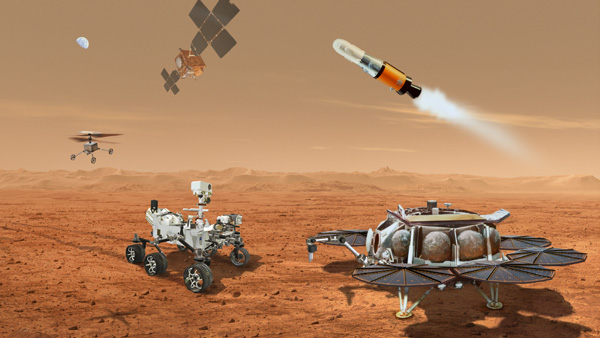
An illustration depicting the joint NASA/ESA Mars Sample Return mission architecture.
NASA / JPL - Caltech

President Trump’s FY26 Budget Revitalizes Human Space Exploration (News Release)

The Trump-Vance Administration released toplines of the President’s budget for Fiscal Year 2026 on Friday. The budget accelerates human space exploration of the Moon and Mars with a fiscally-responsible portfolio of missions.

“This proposal includes investments to simultaneously pursue exploration of the Moon and Mars while still prioritizing critical science and technology research,” said acting NASA Administrator Janet Petro. “I appreciate the President’s continued support for NASA’s mission and look forward to working closely with the administration and Congress to ensure we continue making progress toward achieving the impossible.”

-- Increased commitment to human space exploration in pursuit of exploration of both the Moon and Mars. By allocating more than $7 billion for lunar exploration and introducing $1 billion in new investments for Mars-focused programs, the budget ensures that America’s human space exploration efforts remain unparalleled, innovative and efficient.

-- Refocus science and space technology resources to efficiently execute high priority research. Consistent with the administration’s priority of returning to the Moon before China and putting an American on Mars, the budget will advance priority science and research missions and projects, ending financially unsustainable programs including Mars Sample Return. It emphasizes investments in transformative space technologies while responsibly shifting projects better suited for private sector leadership.

-- Transition the Artemis campaign to a more sustainable, cost-effective approach to lunar exploration. The SLS (Space Launch System) rocket and Orion capsule will be retired after Artemis III, paving the way for more cost-effective, next-generation commercial systems that will support subsequent NASA lunar missions. The budget also ends the Gateway Program, with the opportunity to repurpose already-produced components for use in other missions.

International partners will be invited to join these renewed efforts, expanding opportunities for meaningful collaboration on the Moon and Mars.

-- Continue the process of transitioning the International Space Station to commercial replacements in 2030, focusing onboard research on efforts critical to the exploration of the Moon and Mars. The budget reflects the upcoming transition to a more cost-effective, open commercial approach to human activities in low-Earth orbit by reducing the space station’s crew size and onboard research, preparing for the safe decommissioning of the station and its replacement by commercial space stations.

-- Work to minimize duplication of efforts and most efficiently steward the allocation of American taxpayer dollars. This budget ensures that NASA’s topline enables a financially-sustainable trajectory to complete groundbreaking research and execute the agency’s bold mission.

-- Focus NASA’s resources on its core mission of space exploration. This budget ends climate-focused “green aviation” spending while protecting the development of technologies with air traffic control and other U.S. government and commercial applications, producing savings. This budget will also ensure continued elimination of any funding toward misaligned DEIA initiatives, instead designating that money to missions capable of advancing NASA’s core mission.

NASA will continue to inspire the next generation of explorers through exciting, ambitious space missions that demonstrate American leadership in space. The agency will coordinate closely with its partners to execute these priorities and investments as efficiently and effectively as possible.

Building on the President’s promise to increase efficiency this budget pioneers a focused, innovative and fiscally-responsible path to America’s next great era of human space exploration.

Source: NASA.Gov

****

NASA's Space Launch System rocket lifts off on Artemis 1 from Kennedy Space Center's Launch Complex 39B in Florida...on November 16, 2022.
Brandon Hancock

An artist's concept of NASA's Orion capsule about to dock with the Gateway space station.
NASA


Tuesday, April 08, 2025

The Fourth Nova-C Spacecraft Has a Ride to the Moon...

An artist's concept of a Nova-C lander on the Moon's surface...with lunar data relay satellites orbiting above it.
Intuitive Machines

Intuitive Machines Selects SpaceX to Launch its Fourth Lunar Lander Mission and Lunar Data Relay Satellites (Press Release)

Intuitive Machines, Inc. (Nasdaq: LUNR, LUNRW) (“Intuitive Machines”) (“Company”), a leading space exploration, infrastructure and services company, has recently selected SpaceX’s Falcon 9 rocket to launch its fourth lunar delivery mission (IM-4) from Florida. The IM-4 mission is expected to include the launch of two lunar data relay satellites intended to support NASA’s Near Space Network Services (NSNS) contract.

“Lunar surface delivery and data relay satellites are central to our strategy to commercialize the Moon,” said Intuitive Machines CEO Steve Altemus. “In addition to the contracted NSNS service, the satellites are capable of hosting additional payloads and science sensors to serve commercial industry and other government customers. We plan to deploy the first of five lunar data relay satellites on our third mission, which will introduce our pay-by-the-minute service. The two additional satellites on our fourth mission are intended to scale that service, followed by two additional deployments to complete the constellation and fully support NASA and commercial lunar operations.”

As previously announced, the IM-4 surface delivery mission is currently scheduled for 2027 and is set to carry six NASA Commercial Lunar Payload Services (CLPS) initiative payloads, including a European Space Agency-led drill suite designed to search for water at the lunar South Pole.

NASA has awarded Intuitive Machines multiple task orders under the agency’s NSNS contract for communication and navigation services. The awards call for Intuitive Machines to provide Direct-to-Earth (DTE) services and a lunar data relay constellation to support NASA’s Artemis campaign.

Source: Intuitive Machines

****

A SpaceX Falcon 9 rocket carrying Intuitive Machines' Athena lunar lander and Lunar Outpost's MAPP rover lifts off from Kennedy Space Center's Launch Complex 39A in Florida...on February 26, 2025.
SpaceX

Monday, March 31, 2025

Photos of the Day: Blue Ghost in Mini-Brick Form...

My mini-brick Blue Ghost lunar lander is now protected by an acrylic case at home...on March 30, 2025.
Richard T. Par

Just thought I'd end March by sharing these images of the Blue Ghost mini-brick model that I bought from Firefly Aerospace earlier this month!

As mentioned in this entry from my Human Spaceflight Blog, I planned on ordering the Blue Ghost model online if the actual lander successfully touched down on the Moon over four weeks ago. And successfully touched down Blue Ghost did!

Unlike my LEGO® Artemis 1 rocket and Perseverance Mars rover, as well as my Atom Brick New Glenn rocket, Blue Ghost was relatively quick to build—as it 'only' consisted of 196 pieces. Just like my Artemis 1 rocket and the Percy rover, Blue Ghost is now kept dust-free inside an acrylic case that I bought online.

I initially bought a 4.2"x4.2"x4.2" glass case from a local Michaels store...but Blue Ghost barely fits inside this display. So I went to Amazon and purchased a 5"x5"x5" case, and the mini-brick lander fits perfectly in that one! (The 4.2"x4.2"x4.2" case now holds a LEGO Boba Fett figure and Grogu figurine, which you can see in the very last photo of this entry.)

Astrobotic has a mini-brick version of its Griffin lunar lander, which is scheduled to launch no earlier than this December. Just like with Blue Ghost, I intend on waiting to see the outcome of Griffin Mission One before I decide to buy something to commemorate Astrobotic's next Moon flight. Happy Monday!

The package for the mini-brick Blue Ghost lunar lander...courtesy of Firefly Aerospace.
Richard T. Par

My mini-brick Blue Ghost lunar lander after it was completed on March 15, 2025.
Richard T. Par

My mini-brick Blue Ghost lunar lander after it was completed on March 15, 2025.
Richard T. Par

My mini-brick Blue Ghost lunar lander after it was completed on March 15, 2025.
Richard T. Par

My mini-brick Blue Ghost lunar lander now rests atop my LEGO® Artemis 1 rocket at home...on March 15, 2025.
Richard T. Par

Now enclosed inside a small acrylic case, my mini-brick Blue Ghost lunar lander rests atop my LEGO® Artemis 1 rocket at home...on March 30, 2025.
Richard T. Par

Now enclosed inside a small acrylic case, my mini-brick Blue Ghost lunar lander rests atop my LEGO® Artemis 1 rocket at home...on March 30, 2025.
Richard T. Par

A LEGO® Boba Fett figure and Grogu figurine now rest inside an acrylic case that I originally bought for my mini-brick Blue Ghost lunar lander.
Richard T. Par

Tuesday, March 18, 2025

Photos of the Day: The Last Images Taken by Blue Ghost Before Its Historic Stint on the Lunar Surface Came to an End...

An image of the lunar sunset that was taken by Firefly Aerospace's Blue Ghost lander on the final day of its mission at the Moon's Mare Crisium basin...on March 16, 2025.
Firefly Aerospace

NASA Science Continues After Firefly’s First Moon Mission Concludes (News Release)

After landing on the Moon with NASA science and technology demonstrations on March 2, Firefly Aerospace’s Blue Ghost Mission 1 concluded its mission on March 16. Analysis of data returned to Earth from the NASA instruments continues, benefiting future lunar missions.

As part of NASA’s CLPS (Commercial Lunar Payload Services) initiative and Artemis campaign, Firefly’s Blue Ghost lunar lander delivered 10 NASA science and technology instruments to the Mare Crisium basin on the near side of the Moon. During the mission, Blue Ghost captured several images and videos, including imaging a total solar eclipse and a sunset from the surface of the Moon. The mission lasted for about 14 days, or the equivalent of one lunar day, and multiple hours into the lunar night before coming to an end.

“Firefly’s Blue Ghost Mission 1 marks the longest surface duration commercial mission on the Moon to date, collecting extraordinary science data that will benefit humanity for decades to come,” said Nicky Fox, associate administrator, Science Mission Directorate at NASA Headquarters in Washington. “With NASA’s CLPS initiative, American companies are now at the forefront of an emerging lunar economy that lights the way for the agency’s exploration goals on the Moon and beyond.”

All 10 NASA payloads successfully activated, collected data and performed operations on the Moon. Throughout the mission, Blue Ghost transmitted 119 gigabytes of data back to Earth, including 51 gigabytes of science and technology data. In addition, all payloads were afforded additional opportunities to conduct science and gather more data for analysis, including during the eclipse and lunar sunset.

“Operating on the Moon is complex; carrying 10 payloads, more than has ever flown on a CLPS delivery before, makes the mission that much more impressive,” said Joel Kearns, deputy associate administrator for exploration, Science Mission Directorate, NASA Headquarters. “Teams are eagerly analyzing their data, and we are extremely excited for the expected scientific findings that will be gained from this mission.”

Among other achievements, many of the NASA instruments performed first-of-their-kind science and technology demonstrations, including:

-- The Lunar Instrumentation for Subsurface Thermal Exploration with Rapidity is now the deepest robotic planetary subsurface thermal probe, drilling up to 3 feet and providing a first-of-its kind demonstration of robotic thermal measurements at varying depths.

-- The Lunar GNSS Receiver Experiment acquired and tracked Global Navigation Satellite Systems (GNSS) signals, from satellite networks such as GPS and Galileo, for the first time en route to and on the Moon’s surface. The LuGRE payload’s record-breaking success indicates that GNSS signals could complement other navigation methods and be used to support future Artemis missions. It also acts as a steppingstone to future navigation systems on Mars.

-- The Radiation Tolerant Computer successfully operated in transit through Earth’s Van Allen belts, as well as on the lunar surface into the lunar night, verifying solutions to mitigate radiation effects on computers that could make future missions safer for equipment and more cost effective.

-- The Electrodynamic Dust Shield successfully lifted and removed lunar soil, or regolith, from surfaces using electrodynamic forces, demonstrating a promising solution for dust mitigation on future lunar and interplanetary surface operations.

-- The Lunar Magnetotelluric Sounder successfully deployed five sensors to study the Moon’s interior by measuring electric and magnetic fields. The instrument allows scientists to characterize the interior of the Moon to depths of up to 700 miles, or more than half the distance to the Moon’s center.

-- The Lunar Environment heliospheric X-ray Imager captured a series of X-ray images to study the interaction of the solar wind and Earth’s magnetic field, providing insights into how space weather and other cosmic forces surrounding Earth affect the planet.

-- The Next Generation Lunar Retroreflector successfully reflected and returned laser light from two Lunar Laser Ranging Observatories, returning measurements that allowed scientists to precisely measure the Moon’s shape and distance from Earth, expanding our understanding of the Moon’s inner structure.

-- The Stereo Cameras for Lunar Plume-Surface Studies instrument captured about 9,000 images during the spacecraft’s lunar descent and touchdown on the Moon, providing insights into the effects that engine plumes have on the surface. The payload also operated during the lunar sunset and into the lunar night.

-- The Lunar PlanetVac was deployed on the lander’s surface access arm and successfully collected, transferred and sorted lunar soil using pressurized nitrogen gas, demonstrating a low-cost, low-mass solution for future robotic sample collection.

-- The Regolith Adherence Characterization instrument examined how lunar regolith sticks to a range of materials exposed to the Moon’s environment, which can help test, improve and protect spacecraft, spacesuits and habitats from abrasive lunar dust or regolith.

The data captured will benefit humanity in many ways, providing insights into how space weather and other cosmic forces may impact Earth. Establishing an improved awareness of the lunar environment ahead of future crewed missions will help plan for long-duration surface operations under Artemis.

To date, five vendors have been awarded 11 lunar deliveries under CLPS and are sending more than 50 instruments to various locations on the Moon, including the lunar South Pole and far side.

Source: NASA.Gov

****

Another image of the lunar sunset that was taken by Firefly Aerospace's Blue Ghost lander on the final day of its mission at the Moon's Mare Crisium basin...on March 16, 2025.
Firefly Aerospace

Another image of the lunar sunset that was taken by Firefly Aerospace's Blue Ghost lander on the final day of its mission at the Moon's Mare Crisium basin...on March 16, 2025.
Firefly Aerospace

Another image of the lunar sunset that was taken by Firefly Aerospace's Blue Ghost lander on the final day of its mission at the Moon's Mare Crisium basin...on March 16, 2025.
Firefly Aerospace

Thursday, March 06, 2025

Photos of the Day: Orbital Images of Blue Ghost on the Moon!

An animated GIF showing before-and-after images of Blue Ghost's landing site on the Moon...on March 3, 2025.
NASA / GSFC / Arizona State University

Just thought I'd share these images that NASA's Lunar Reconnaissance Orbiter recently took of Firefly Aerospace's Blue Ghost lander on the Moon's surface!

Blue Ghost successfully touched down near the Mons Latreille region at Mare Crisium on March 2...and continues to hum along as it carries out 10 science experiments for NASA under its Artemis and Commercial Lunar Payload Services programs.

Assuming that everything continues to proceed as planned, Blue Ghost Mission 1 will last till Sunday, March 16.

Another photo that NASA's Lunar Reconnaissance Orbiter took of Firefly Aerospace's Blue Ghost lander at Mare Crisium on the Moon...on March 2, 2025.
NASA / GSFC / Arizona State University

A cropped version of the photo that NASA's Lunar Reconnaissance Orbiter took of Firefly Aerospace's Blue Ghost lander at Mare Crisium on the Moon...on March 2, 2025.
NASA / GSFC / Arizona State University


Tuesday, March 04, 2025

The Latest Update on Blue Ghost...

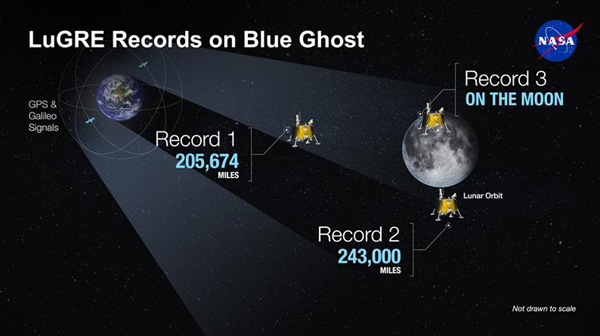
An infographic showing the records achieved by NASA and the Italian Space Agency's LuGRE instrument aboard Firefly Aerospace's Blue Ghost robotic lander during its journey to the lunar surface.
NASA / Dave Ryan

NASA Successfully Acquires GPS Signals on Moon (News Release)

NASA and the Italian Space Agency made history on March 3, when the Lunar GNSS Receiver Experiment (LuGRE) became the first technology demonstration to acquire and track Earth-based navigation signals on the Moon’s surface.

The LuGRE payload’s success in lunar orbit and on the surface indicates that signals from the GNSS (Global Navigation Satellite System) can be received and tracked at the Moon. These results mean that NASA’s Artemis missions, or other exploration missions, could benefit from these signals to accurately and autonomously determine their position, velocity and time. This represents a steppingstone to advanced navigation systems and services for the Moon and Mars.

“On Earth we can use GNSS signals to navigate in everything from smartphones to airplanes,” said Kevin Coggins, deputy associate administrator for NASA’s SCaN (Space Communications and Navigation) Program. “Now, LuGRE shows us that we can successfully acquire and track GNSS signals at the Moon. This is a very exciting discovery for lunar navigation, and we hope to leverage this capability for future missions.”

The road to the historic milestone began on March 2 when Firefly Aerospace’s Blue Ghost lunar lander touched down on the Moon and delivered LuGRE, one of 10 NASA payloads intended to advance lunar science. Soon after landing, LuGRE payload operators at NASA’s Goddard Space Flight Center in Greenbelt, Maryland, began conducting their first science operation on the lunar surface.

With the receiver data flowing in, anticipation mounted. Could a Moon-based mission acquire and track signals from two GNSS constellations, GPS and Galileo, and use those signals for navigation on the lunar surface?

Then, at 2 a.m. EST on March 3, it was official: LuGRE acquired and tracked signals on the lunar surface for the first time ever and achieved a navigation fix — approximately 225,000 miles away from Earth.

Now that Blue Ghost is on the Moon, the mission will operate for 14 days providing NASA and the Italian Space Agency the opportunity to collect data in a near-continuous mode, leading to additional GNSS milestones. In addition to this record-setting achievement, LuGRE is the first Italian Space Agency-developed hardware on the Moon, a milestone for the organization.

The LuGRE payload also broke GNSS records on its journey to the Moon. On January 21, LuGRE surpassed the highest altitude GNSS signal acquisition ever recorded at 209,900 miles from Earth, a record formerly held by NASA’s Magnetospheric Multiscale Mission. Its altitude record continued to climb as LuGRE reached lunar orbit on February 20 — 243,000 miles from Earth.

These achievements mean that missions in cislunar space, the area of space between Earth and the Moon, could also rely on GNSS signals for navigation fixes.

Traditionally, NASA engineers track spacecraft by using a combination of measurements, including onboard sensors and signals from Earth-based tracking stations. The LuGRE payload demonstrates that using GNSS signals for navigation can reduce reliance on human operators because these signals can be picked up and used autonomously by the spacecraft, even as far away as the Moon.

The LuGRE payload is a collaborative effort between NASA’s Goddard Space Flight Center in Greenbelt, Maryland and the Italian Space Agency. Funding and oversight for the LuGRE payload comes from NASA’s SCaN Program office. It was chosen by NASA as one of 10 funded research and technology demonstrations for delivery to the lunar surface by Firefly Aerospace Inc., a flight under the agency’s Commercial Lunar Payload Services initiative.

Source: NASA.Gov

****

Sunrise as seen by Firefly Aerospace's Blue Ghost robotic lander shortly after it touched down on the lunar surface...on March 2, 2025.
Firefly Aerospace

An image of the Lunar PlanetVac arm after it was deployed onto the Moon's surface, and collected its first lunar regolith sample, by Firefly Aerospace's Blue Ghost robotic lander.
Firefly Aerospace