Showing posts with label Lucy. Show all posts

Wednesday, November 19, 2025

New Images Of Our Solar System's Latest Galactic Visitor Have Been Released...

An image of interstellar comet 3I/ATLAS that was taken by NASA's Mars Reconnaissance Orbiter...on October 2, 2025.
NASA / JPL - Caltech / University of Arizona

View Interstellar Comet 3I/ATLAS Through NASA’s Multiple Lenses (News Release)

NASA is in the midst of an unprecedented Solar System-wide observation campaign, turning its spacecraft and space telescopes to follow comet 3I/ATLAS, the third known interstellar object to pass through our Solar System. Twelve NASA assets have captured and processed imagery of the comet since it was first discovered on July 1, and several others will have opportunities to capture more images as the comet continues to pass through our Solar System.

By observing the comet from so many locations, NASA has an opportunity to learn about the ways that 3I/ATLAS differs from our Solar System’s home-grown comets and give scientists a new window into how the compositions of other systems may differ from our own.

Observations from Mars

The closest imagery of the comet was taken by NASA spacecraft at Mars. Earlier this fall, 3I/ATLAS passed by Mars from a distance of 19 million miles, where it was observed by three NASA spacecraft. The Mars Reconnaissance Orbiter (MRO) captured one of the closest images of the comet, while the MAVEN (Mars Atmosphere and Volatile EvolutioN) orbiter obtained ultraviolet images that will help scientists understand the comet’s make-up.

Meanwhile, the Perseverance rover grabbed a faint glimpse from the surface of Mars.

Sun watchers’ view

Some of NASA’s heliophysics missions have the unique ability to observe areas of the sky near the Sun, which allowed them to track comet 3I/ATLAS as it passed behind our Sun as seen from Earth, making observations with ground-based telescopes impossible. NASA’s STEREO (Solar Terrestrial Relations Observatory) captured images from September 11 to October 2, and the ESA (European Space Agency) and NASA mission SOHO (Solar and Heliospheric Observatory) observed the comet from October 15 to 26. Images from NASA’s PUNCH (Polarimeter to Unify the Corona and Heliosphere) mission, which launched earlier this year, reveal the comet’s tail during observations from September 20 to October 3.

Despite previously observing and discovering thousands of comets, this is the first time that NASA’s heliophysics missions have purposefully observed an object originating in another solar system.

Asteroid explorers

NASA’s Psyche and Lucy spacecraft, currently on their respective outbound journeys to study various asteroid targets throughout the Solar System, were able to observe 3I/ATLAS en route. On September 8 and 9, Psyche acquired four observations of the comet over eight hours from a distance of 33 million miles. These images will help scientists refine the comet’s trajectory.

On September 16, Lucy took a series of images from 240 million miles away. Stacking these images together provides detail on the comet’s coma and tail.

The NASA-funded ATLAS (Asteroid Terrestrial-impact Last Alert System) telescope in Chile discovered 3I/ATLAS on July 1. Later that month it was viewed by NASA’s Hubble Space Telescope. In August, both NASA’s James Webb Telescope and SPHEREx (Spectro-Photometer for the History of the Universe, Epoch of Reionization and Ices Explorer) captured imagery.

Comet 3I/ATLAS will fly closest to Earth about Friday, December 19, at 170 million miles, which is almost twice the distance between the Earth and Sun. NASA spacecraft will continue to observe the comet as it makes its journey through the Solar System, passing the orbit of Jupiter in spring 2026.

Source: NASA.Gov

****

A series of images taken of interstellar comet 3I/ATLAS by NASA's Psyche spacecraft...on September 8 and 9, 2025.
NASA / JPL - Caltech / ASU

Monday, April 21, 2025

A Trojan Asteroid-bound Explorer Made Its Latest Celestial Flyby on Easter Sunday...

An animated GIF showing the rotation of asteroid Donaldjohanson...using photos taken by NASA's Lucy spacecraft from 1,000 to 660 miles (1,600 to 1,100 kilometers) away...on April 20, 2025.
NASA / Goddard / SwRI / Johns Hopkins APL

NASA’s Lucy Spacecraft Images Asteroid Donaldjohanson (News Release)

In its second asteroid encounter, NASA’s Lucy spacecraft obtained a close look at a uniquely-shaped fragment of an asteroid that formed about 150 million years ago. The spacecraft has begun returning images that were collected as it flew approximately 600 miles (960 km) from the asteroid Donaldjohanson on April 20, 2025.

The asteroid was previously observed to have large brightness variations over a 10-day period, so some of Lucy team members’ expectations were confirmed when the first images showed what appeared to be an elongated contact binary (an object formed when two smaller bodies collide). However, the team was surprised by the odd shape of the narrow neck connecting the two lobes, which looks like two nested ice cream cones.

“Asteroid Donaldjohanson has strikingly complicated geology,” says Hal Levison, principal investigator for Lucy at Southwest Research Institute, Boulder, Colorado. “As we study the complex structures in detail, they will reveal important information about the building blocks and collisional processes that formed the planets in our Solar System.”

From a preliminary analysis of the first available images collected by the spacecraft's L’LORRI imager, the asteroid appears to be larger than originally estimated, about 5 miles (8 km) long and 2 miles (3.5 km) wide at the widest point. In this first set of high-resolution images returned from the spacecraft, the full asteroid is not visible as the asteroid is larger than the imager’s field of view. It will take up to a week for the team to downlink the remainder of the encounter data from the spacecraft; this dataset will give a more complete picture of the asteroid’s overall shape.

Like Lucy’s first asteroid flyby target, Dinkinesh, Donaldjohanson is not a primary science target of the Lucy mission. As planned, the Dinkinesh flyby was a system’s test for the mission, while this encounter was a full dress rehearsal, in which the team conducted a series of dense observations to maximize data collection. Data collected by Lucy’s other scientific instruments, the L’Ralph color imager and infrared spectrometer and the L’TES thermal infrared spectrometer, will be retrieved and analyzed over the next few weeks.

The Lucy spacecraft will spend most of the remainder of 2025 travelling through the main asteroid belt. Lucy will encounter the mission’s first main target, the Jupiter Trojan asteroid Eurybates, in August 2027.

“These early images of Donaldjohanson are again showing the tremendous capabilities of the Lucy spacecraft as an engine of discovery,” said Tom Statler, program scientist for the Lucy mission at NASA Headquarters in Washington. “The potential to really open a new window into the history of our Solar System when Lucy gets to the Trojan asteroids is immense.”

Source: NASA.Gov

****

An image of asteroid Donaldjohanson that was taken by NASA's Lucy spacecraft from approximately 660 miles (1,100 kilometers) away...on April 20, 2025.
NASA / Goddard / SwRI / Johns Hopkins APL / NOIRLab

Thursday, November 02, 2023

A Small Main Belt Asteroid Has Turned Out to be Two...

Binary asteroid Dinkinesh as seen by NASA's Lucy spacecraft...on November 1, 2023.
NASA / Goddard / SwRI / Johns Hopkins APL / NOIRLab

NASA’s Lucy Spacecraft Discovers 2nd Asteroid During Dinkinesh Flyby (News Release)

On November 1, NASA’s Lucy spacecraft flew by not just its first asteroid, but its first two. The first images returned by Lucy reveal that the small main belt asteroid Dinkinesh is actually a binary pair.

“Dinkinesh really did live up to its name; this is marvelous,” said Hal Levison, referring to the meaning of Dinkinesh in the Amharic language, “marvelous.” Levison is principal investigator for Lucy from the Boulder, Colorado, branch of the San-Antonio-based Southwest Research Institute.

“When Lucy was originally selected for flight, we planned to fly by seven asteroids. With the addition of Dinkinesh, two Trojan moons, and now this satellite, we’ve turned it up to 11.”

In the weeks prior to the spacecraft’s encounter with Dinkinesh, the Lucy team had wondered if Dinkinesh might be a binary system, given how Lucy’s instruments were seeing the asteroid’s brightness changing with time. The first images from the encounter removed all doubt.

Dinkinesh is a close binary. From a preliminary analysis of the first available images, the team estimates that the larger body is approximately 0.5 miles (790 meters) at its widest, while the smaller is about 0.15 miles (220 meters) in size.

This encounter primarily served as an in-flight test of the spacecraft, specifically focusing on testing the system that allows Lucy to autonomously track an asteroid as it flies past at 10,000 mph, referred to as the terminal tracking system.

“This is an awesome series of images. They indicate that the terminal tracking system worked as intended, even when the universe presented us with a more difficult target than we expected,” said Tom Kennedy, guidance and navigation engineer at Lockheed Martin in Littleton, Colorado. “It’s one thing to simulate, test and practice. It’s another thing entirely to see it actually happen.”

While this encounter was carried out as an engineering test, the team’s scientists are excitedly poring over the data to glean insights into the nature of small asteroids.

“We knew this was going to be the smallest main belt asteroid ever seen up close,” said Keith Noll, Lucy project scientist from NASA’s Goddard Space Flight Center in Greenbelt, Maryland. “The fact that it is two makes it even more exciting. In some ways these asteroids look similar to the near-Earth asteroid binary Didymos and Dimorphos that DART saw, but there are some really interesting differences that we will be investigating.”

It will take up to a week for the team to downlink the remainder of the encounter data from the spacecraft. The team will use this data to evaluate the spacecraft’s behavior during the encounter and to prepare for the next close-up look at an asteroid, the main belt asteroid Donaldjohanson, in 2025.

Lucy will then be well-prepared to encounter the mission’s main targets, the Jupiter Trojan asteroids, starting in 2027.

Source: NASA.Gov

****

Sunday, September 24, 2023

OSIRIS-REx Has Successfully Brought a Piece of Bennu Back to Earth!

An aerial view of OSIRIS-REx's sample return capsule and its parachute safely sitting on the dirt in the Utah desert...on September 24, 2023.
NASA / Keegan Barber

NASA’s First Asteroid Sample Has Landed, Now Secure in Clean Room (Press Release)

After years of anticipation and hard work by NASA’s OSIRIS-REx (Origins, Spectral Interpretation, Resource Identification and Security – Regolith Explorer) team, a capsule of rocks and dust collected from asteroid Bennu is finally on Earth. It landed at 8:52 a.m. MDT (10:52 a.m. EDT) on Sunday, in a targeted area of the Department of Defense’s Utah Test and Training Range near Salt Lake City.

Within an hour and a half, the capsule was transported by helicopter to a temporary clean room set up in a hangar on the training range, where it is now connected to a continuous flow of nitrogen.

Getting the sample under a “nitrogen purge,” as scientists call it, was one of the OSIRIS-REx team’s most critical tasks today. Nitrogen is a gas that doesn’t interact with most other chemicals, and a continuous flow of it into the sample container inside the capsule will keep out earthly contaminants to leave the sample pure for scientific analyses.

The returned samples collected from Bennu will help scientists worldwide make discoveries to better understand planet formation and the origin of organics and water that led to life on Earth, as well as benefit all of humanity by learning more about potentially hazardous asteroids.

“Congratulations to the OSIRIS-REx team on a picture-perfect mission – the first American asteroid sample return in history – which will deepen our understanding of the origin of our solar system and its formation. Not to mention, Bennu is a potentially hazardous asteroid, and what we learn from the sample will help us better understand the types of asteroids that could come our way,” said NASA Administrator Bill Nelson. “With OSIRIS-REx, Psyche's launch in a couple of weeks, DART’s one year anniversary, and Lucy’s first asteroid approach in November, Asteroid Autumn is in full swing. These missions prove once again that NASA does big things. Things that inspire us and unite us. Things that show nothing is beyond our reach when we work together.”

The Bennu sample – an estimated 8.8 ounces, or 250 grams – will be transported in its unopened canister by aircraft to NASA’s Johnson Space Center in Houston on Monday, September 25. Curation scientists there will disassemble the canister, extract and weigh the sample, create an inventory of the rocks and dust, and, over time, distribute pieces of Bennu to scientists worldwide.

Today’s delivery of an asteroid sample – a first for the U.S. – went according to plan thanks to the massive effort of hundreds of people who remotely directed the spacecraft’s journey since it launched on September 8, 2016. The team then guided it to arrival at Bennu on December 3, 2018, through the search for a safe sample-collection site between 2019 and 2020, sample collection on October 20, 2020, and during the return trip home starting on May 10, 2021.

“Today marks an extraordinary milestone not just for the OSIRIS-REx team but for science as a whole,” said Dante Lauretta, principal investigator for OSIRIS-REx at the University of Arizona, Tucson. “Successfully delivering samples from Bennu to Earth is a triumph of collaborative ingenuity and a testament to what we can accomplish when we unite with a common purpose. But let’s not forget – while this may feel like the end of an incredible chapter, it’s truly just the beginning of another. We now have the unprecedented opportunity to analyze these samples and delve deeper into the secrets of our solar system."

After traveling billions of miles to Bennu and back, the OSIRIS-REx spacecraft released its sample capsule towards Earth’s atmosphere at 6:42 a.m. EDT (4:42 a.m. MDT). The spacecraft was 63,000 miles (102,000 kilometers) from Earth’s surface at the time – about one-third the distance from Earth to the Moon.

Traveling at 27,650 mph (44,500 kph), the capsule pierced the atmosphere at 10:42 a.m. EDT (8:42 a.m. MDT), off the coast of California at an altitude of about 83 miles (133 kilometers). Within 10 minutes, it landed on the military range.

Along the way, two parachutes successfully deployed to stabilize and slow the capsule down to a gentle 11 mph (18 kph) at touchdown.

“The whole team had butterflies today, but that’s the focused anticipation of a critical event by a well-prepared team,” said Rich Burns, project manager for OSIRIS-REx at NASA’s Goddard Space Flight Center in Greenbelt, Maryland. “For us, this was the World Series, ninth inning, bases-loaded moment, and this team knocked it out of the park.”

Radar, infrared and optical instruments in the air and on the ground tracked the capsule to its landing coordinates inside a 36-mile by 8.5-mile (58-kilometer by 14-kilometer) area on the range. Within several minutes, the recovery team was dispatched to the capsule’s location to inspect and retrieve it.

The team found the capsule in good shape at 9:07 a.m. MDT (11:07 a.m. EDT) and then determined that it was safe to approach. Within 70 minutes, they wrapped it up for safe transport to a temporary clean room on the range, where it remains under continuous supervision and a nitrogen purge.

NASA Goddard provides overall mission management, systems engineering, and the safety and mission assurance for OSIRIS-REx. The University of Arizona, Tucson leads the science team and the mission's science observation planning and data processing.

Lockheed Martin Space in Littleton, Colorado, built the spacecraft and provides flight operations. Goddard and KinetX Aerospace are responsible for navigating the OSIRIS-REx spacecraft.

Curation for OSIRIS-REx, including processing the sample when it arrives on Earth, will take place at NASA Johnson. International partnerships on this mission include the OSIRIS-REx Laser Altimeter instrument from CSA (the Canadian Space Agency) and asteroid sample science collaboration with JAXA’s (the Japan Aerospace Exploration Agency) Hayabusa2 mission.

OSIRIS-REx is the third mission in NASA’s New Frontiers Program, managed by NASA’s Marshall Space Flight Center in Huntsville, Alabama, for the agency’s Science Mission Directorate in Washington.

****

OSIRIS-REx's sample return capsule safely sits on the dirt in the Utah desert after re-entering Earth's atmosphere...on September 24, 2023.
NASA

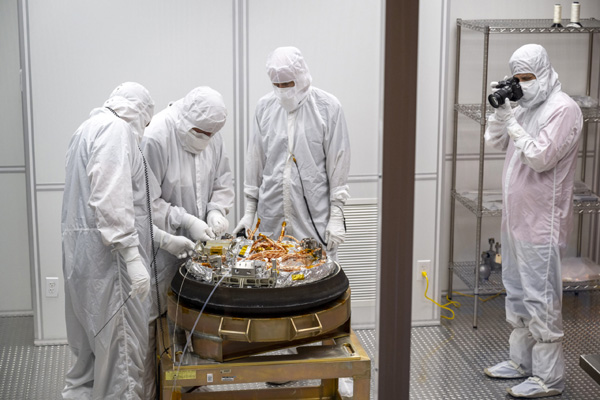
Inside a makeshift clean room at the Utah Test and Training Range, technicians photograph OSIRIS-REx's sample return capsule before they begin disassembling it...on September 24, 2023.
NASA TV

Technicians disassemble OSIRIS-REx's sample return capsule inside a makeshift clean room at the Utah Test and Training Range on September 24, 2023...prior to the capsule being flown to NASA's Johnson Space Center in Houston, Texas, the following day.
NASA / Keegan Barber

Tuesday, April 06, 2021

Lucy Update: The Trojan Asteroid-bound Explorer Continues to Come Together Before Its October 16 Launch...

A technician inspects one of the twin solar panels for NASA's Lucy spacecraft at the Lockheed Martin facility in Denver, Colorado...in January of this year.
Lockheed Martin

NASA’s Lucy Stretches Its Wings in Successful Solar Panel Deployment Test (News Release)

NASA’s Lucy spacecraft has successfully completed thermal vacuum testing of both solar panels, the final step in checking out these critical spacecraft components in preparation for launch this fall. Once the Lucy spacecraft’s solar panels are attached and fully extended, they could cover a five-story building.

Lucy, the 13th mission in NASA’s Discovery Program, requires these large solar panels as it will operate farther from the Sun than any previous solar-powered space mission. During its 12-year tour of the Trojan asteroids, the Lucy spacecraft will operate a record-breaking 530 million miles (853 million km) from the Sun, beyond the orbit of Jupiter.

“The success of Lucy’s final solar array deployment test marked the end of a long road of development. With dedication and excellent attention to detail, the team overcame every obstacle to ready these solar panels,” said Matt Cox, Lockheed Martin’s Lucy program manager, in Littleton, Colorado. “Lucy will travel farther from the Sun than any previous solar-powered Discovery-class mission, and one reason we can do that is the technology in these solar arrays.”

The solar arrays, manufactured by Northrop Grumman in Goleta, California, will be supplying power to the spacecraft and its instruments throughout the 12-year mission. The solar panels need to supply around 500 watts, about equivalent to the energy needed to run a washing machine. Despite this relatively modest need, the solar panels must be large as they need to operate so far from the Sun.

“At about one hour after the spacecraft launches, the solar panels will need to deploy flawlessly in order to assure that we have enough energy to power the spacecraft throughout the mission,” said Principal Investigator Hal Levison of the Southwest Institute in Boulder, Colorado. “These 20 minutes will determine if the rest of the 12-year mission will be a success. Mars landers have their seven minutes of terror, we have this.”

Solar array deployment tests occurred between December 2020 and February 2021 in the 29-foot-by-65-foot (8.8-meter-by-19.8-meter) thermal vacuum chamber at Lockheed Martin Space, where the spacecraft is currently undergoing assembly, launch, and testing operations.

Though when folded up the solar panels are a mere 4 inches (10 cm) thick, once expanded each solar panel has a diameter of nearly 24 feet (7.3 meters). What is more, the solar arrays can’t support their own weight of 170 pounds (77 kg) each in Earth gravity, so a special precision weight offload device is employed inside the chamber for additional support.

“In spite of their complexity and size, the mechanical deployment of the arrays executed flawlessly, said Donya Douglas-Bradshaw, Lucy project manager from NASA’s Goddard Space Flight Center in Greenbelt, Maryland. “The ingenuity and innovation of the team is truly remarkable!”

These key tests bring the spacecraft one step closer to launch readiness. The Lucy spacecraft will be shipped to NASA’s Kennedy Space Center in Florida this summer to ready it for launch when its window opens in the pre-dawn hours of Oct. 16, 2021.

Southwest Research Institute’s Hal Levison and Cathy Olkin are the principal investigator and deputy principal investigator of the Lucy mission. Goddard provides overall mission management, systems engineering and safety and mission assurance. Lockheed Martin Space is building the spacecraft. Lucy is the 13th mission in NASA’s Discovery Program. NASA’s Marshall Space Flight Center in Huntsville, Alabama, manages the Discovery Program for the agency’s Science Mission Directorate in Washington, D.C.

Source: NASA.Gov

****

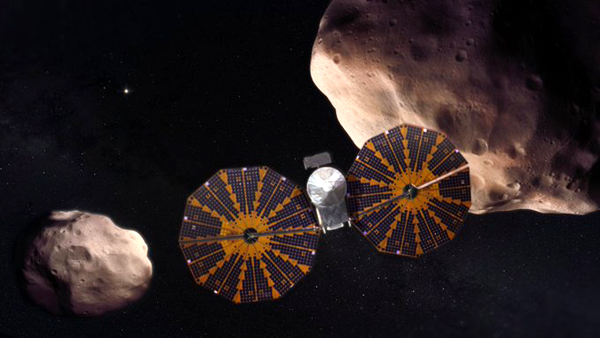
An artist's concept of NASA's Lucy spacecraft venturing past the Trojan asteroid Patroclus and its binary companion Menoetius near Jupiter's orbit.
NASA’s Goddard Space Flight Center / Conceptual Image Lab / Adriana Gutierrez

Friday, March 19, 2021

Photo of the Day: A Trojan Asteroid-bound Explorer Continues to Take Shape in Colorado...

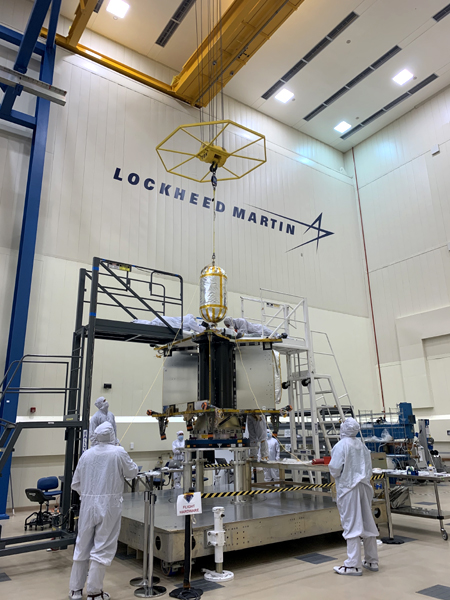
With its high-gain antenna now installed, NASA's Lucy spacecraft is hoisted into the air at the Lockheed Martin facilty in Denver, Colorado...in late 2020.
Lockheed Martin

NASA's Lucy Spacecraft Gets a Lift (News Release - March 18)

Seen here in late 2020 nearly fully assembled, the 13-foot tall (about 4 meters) Lucy spacecraft is lifted back to its dolly as the Lockheed Martin team in Denver, Colorado, continues production. Since Lucy will be exploring deep space hundreds of millions of miles away, the 6.5-foot (about 2 meters) in diameter high-gain antenna will be critical for communications to and from Earth as the spacecraft visits seven different Trojan asteroids and one main belt asteroid. The spacecraft will complete its journey over the course of 12 years, and its many maneuvers will be fueled by the propulsion tanks seen here. Lucy will head to Cape Canaveral Space Force Station this summer for processing ahead of its launch window, which opens Oct. 16, 2021.

Source: NASA.Gov

****

An artist's concept of NASA's Lucy spacecraft venturing past the Trojan asteroid Patroclus and its binary companion Menoetius near Jupiter's orbit.
NASA’s Goddard Space Flight Center / Conceptual Image Lab / Adriana Gutierrez

Wednesday, February 10, 2021

Lucy Update: The Trojan Asteroid-bound Spacecraft Continues to Take Shape in Littleton, Colorado...

An artist's concept of NASA's Lucy spacecraft venturing past the Trojan asteroid Patroclus and its binary companion Menoetius near Jupiter's orbit.
NASA’s Goddard Space Flight Center / Conceptual Image Lab / Adriana Gutierrez

NASA’s First Mission to the Trojan Asteroids Installs its Final Scientific Instrument (News Release - February 9)

With less than a year to launch, NASA’s Lucy mission’s third and final scientific instrument has been integrated onto the spacecraft.

The spacecraft, which will be the first to explore the Trojan asteroids — a population of small bodies that share an orbit with Jupiter — is in the final stages of the assembly process. Just five months ago, at the beginning of the Assembly, Testing and Launch operations (ATLO) process, the components of the Lucy spacecraft were being built all over the country. Today, a nearly assembled spacecraft sits in the high bay in Lockheed Martin Space in Littleton, Colorado.

“A bit over a year and a half ago, I was excited to hold the first small pieces of metal that were destined to travel to the Trojan asteroids,” says Hal Levison, principal investigator from the Southwest Research Institute. “Now there is an actual spacecraft, nearly ready to go. It is incredible.”

The final instrument, L’Ralph, was built by NASA’s Goddard Space Center in Greenbelt, Maryland, and was received at Lockheed Martin on January 21 and integrated onto the spacecraft on January 26. L’Ralph is the most complicated instrument that will fly on Lucy, as it is actually two instruments in one. The Multispectral Visible Imaging Camera (MVIC), will take visible light color images of the Trojan asteroids. The Linear Etalon Imaging Spectral Array (LEISA), will collect infrared spectra of the asteroids. Both of these components will work together to allow Lucy to determine the composition of the Trojan asteroids and provide insight into the early history of our solar system.

The L’Ralph instrument experienced significant COVID-19 related delays, particularly when construction had to be halted when Goddard was placed under stage 4 COVID restrictions in April of last year. However, both the L’Ralph team at Goddard and the ATLO team at Lockheed Martin rose to the challenge and developed a new schedule that allowed everyone to work safely while keeping the spacecraft on track for its originally planned October 16, 2021 launch.

“The L’Ralph team has done an outstanding job to deliver a fantastic instrument,” says Dennis Reuter, L’Ralph instrument principal investigator, from Goddard. “Doing what they did under normal conditions would have been remarkable. Doing it under the actual conditions that had to be dealt with is amazing.”

L’Ralph has been installed on Lucy’s Instrument Pointing Platform. This platform provides the spacecraft significant flexibility during the encounters — the instruments can point at the Trojan asteroids during the high-speed flybys while the high gain antenna remains pointed at Earth — as well as carrying out fine adjustments and out-of-plane pointing to get the best data possible on these elusive objects.

Lucy’s other two scientific instruments, L’TES and L’LORRI, designed and built at Arizona State University, and Johns Hopkins Applied Physics Laboratory, respectively, as well as the two Terminal Tracking Cameras have already been installed on the platform. Now that L’Ralph is installed, the platform itself will be installed onto the spacecraft bus — making Lucy one step closer to being ready for her 12-year-long journey to the Trojans.

“Lucy ATLO has been tremendously successful and having L’Ralph delivered and integrated onto the Instrument Pointing Platform is a great start to the new year,” said Donya Douglas-Bradshaw, mission project manager from Goddard.

Southwest Research Institute’s Hal Levison and Cathy Olkin are the principal investigator and deputy principal investigator of the Lucy Mission. Goddard provides overall mission management, systems engineering and safety and mission assurance. Lockheed Martin Space is building the spacecraft. Lucy is the 13th mission in NASA’s Discovery Program. NASA’s Marshall Space Flight Center in Huntsville, Alabama, manages the Discovery Program for the agency’s Science Mission Directorate in Washington, D.C.

Source: NASA.Gov

****

A close-up of the L’Ralph instrument that was recently installed onto NASA's Lucy spacecraft as it gears up for launch this October.
NASA / Goddard / Barbara Lambert / Desiree Stover

Tuesday, January 05, 2021

Lucy Update: Construction on the Spacecraft Continues to Proceed as It Approaches Launch in October...

An artist's concept of NASA's Lucy spacecraft venturing past the Trojan asteroid Patroclus and its binary companion Menoetius near Jupiter's orbit.
NASA’s Goddard Space Flight Center / Conceptual Image Lab / Adriana Gutierrez

NASA’s First Mission to the Trojan Asteroids Integrates its Second Scientific Instrument (News Release)

NASA’s Lucy mission is one step closer to launch as L’TES, the Lucy Thermal Emission Spectrometer, has been successfully integrated onto the spacecraft.

“Having two of the three instruments integrated onto the spacecraft is an exciting milestone,” said Donya Douglas-Bradshaw, Lucy project manager from NASA’s Goddard Space Flight Center in Greenbelt, Maryland. “The L’TES team is to be commended for their true dedication and determination.”

Lucy will be the first space mission to study the Trojan asteroids, leftover building blocks of the Solar System’s outer planets orbiting the Sun at the distance of Jupiter. The mission takes its name from the fossilized human ancestor (called “Lucy” by her discoverers) whose skeleton provided unique insight into humanity’s evolution. Likewise, the Lucy mission will revolutionize our knowledge of planetary origins and the birth of our solar system more than 4 billion years ago.

L’TES, developed by a team at Arizona State University (ASU), is effectively a remote thermometer. It will measure the far infrared energy emitted by the Trojan asteroids as the Lucy spacecraft flies by an unprecedented seven of these objects during this first ever mission to this population.

The instrument arrived at Lockheed Martin Space on December 13 and was successfully integrated onto the spacecraft on December 16. By measuring the Trojan asteroids’ temperatures, L’TES will provide the team with important information on the material properties of the surfaces. As the spacecraft will not be able to touch down on the asteroids during these high speed encounters, this instrument will allow the team to infer whether the surface material is loose, like sand, or consolidated, like rocks. In addition, L’TES will collect spectral information using thermal infrared observations in the wavelength range from 4 to 50 micrometers.

“The L’TES team has used our experience designing, manufacturing, and operating similar thermal emission spectrometers on other missions such as OSIRIS-REx and the Mars Global Surveyor as we built this instrument,” said Instrument Principal Investigator, Phil Christensen. “Each instrument has its own challenges, but based on our experience we expect L’TES to give us excellent data, as well as likely some surprises, about these enigmatic objects.”

Despite the challenges surrounding the COVID-19 pandemic, Lucy is on schedule to launch in October 2021 as originally planned.

“I am constantly impressed by the agility and flexibility of this team to handle any challenges set before them,” said mission Principal Investigator, Hal Levison of Southwest Research Institute. “Just five years ago this mission was an idea on paper, and now we have many major components of the spacecraft and payload assembled, tested, and ready to go.”

In addition to L’TES, Lucy’s High Gain Antenna, which will enable spacecraft communication with the Earth for navigation and data collection, as well as precise measurement of the masses of the Trojan asteroids, was recently installed. It joined L’LORRI, Lucy’s highest resolution camera, built by the Johns Hopkins Applied Physics Laboratory, which was installed in early November. Lucy’s remaining scientific instrument, L’Ralph, the mission’s color imaging camera and infrared spectrometer, is scheduled to be delivered in early 2021.

Southwest Research Institute’s Hal Levison and Cathy Olkin are the principal investigator and deputy principal investigator of the Lucy Mission. NASA’s Goddard Space Flight Center provides overall mission management, systems engineering and safety and mission assurance. Lockheed Martin Space is building the spacecraft. Lucy is the 13th mission in NASA’s Discovery Program. NASA’s Marshall Space Flight Center in Huntsville, Alabama, manages the Discovery Program for the agency’s Science Mission Directorate in Washington, D.C.

Source: NASA.Gov

****

A close-up of the L’TES (Lucy Thermal Emission Spectrometer) instrument that was recently installed onto NASA's Lucy spacecraft as it gears up for launch this October.
NASA / ASU

Sunday, August 30, 2020

Lucy Update: Construction Officially Begins on the Trojan Asteroid-bound Spacecraft...

At the Lockheed Martin facility in Denver, Colorado, technicians are about to install the oxygen propellant tank inside NASA's Lucy spacecraft.
Lockheed Martin Space

NASA’s Lucy Mission One Step Closer to Exploring the Trojan Asteroids (News Release - August 28)

NASA’s first mission to explore the Trojan asteroids is one step closer to launch. The Discovery Program’s Lucy mission passed a critical milestone and is officially authorized to transition to its next phase.

This major decision was made after a series of independent reviews of the status of the spacecraft, instruments, schedule and budget. The milestone, known as Key Decision Point-D (KDP-D), represents the official transition from the mission’s development stage to delivery of components, testing, assembly and integration leading to launch. During this part of the mission’s life cycle, known as Phase D, the spacecraft bus (the structure that will carry the science instruments) is completed, the instruments are integrated into the spacecraft and tested, and the spacecraft is shipped to NASA's Kennedy Space Center in Florida for integration with the launch vehicle.

“Each phase of the mission is more exciting than the last,” says Lucy Principal Investigator Hal Levison of Southwest Research Institute in Boulder, CO. “While, of course, Lucy still has several years and a few billion miles to go before we reach our real goal – exploring the never-before-seen Trojan asteroids – seeing this spacecraft come together is just incredible.”

Assembly, Testing and Launch Operations (ATLO) began on schedule last week at Lockheed Martin Space in Littleton, Colorado, despite many unforeseen challenges related to the coronavirus pandemic. The schedule was revised to allow for later integration of components that were delayed due to COVID-19 restrictions.

“This team has been truly incredible,” says Lucy Project Manager Donya Douglas-Bradshaw, from NASA’s Goddard Space Flight Center in Greenbelt, Maryland. “Building a spacecraft is never easy, but seeing the team persevere through all of the challenges that they have encountered is inspiring. We now have a spacecraft structure in the Lockheed Martin high bay and a team ready to install the instruments and components.”

The oxidizer tank has already been integrated with the spacecraft, and the instrument integration starts in October. All spacecraft assembly and testing will be completed by the end of July 2021, when the spacecraft will be shipped to Kennedy Space Center in Cape Canaveral, Florida in preparation for the launch window opening on October 16, 2021. After launch, Lucy will have a long cruise phase before it arrives at its first target. Lucy is flying out to the distance of Jupiter to make close fly-bys past a record-breaking number of asteroids, encountering the first of eight targets in April 2025 and the final binary pair of asteroids in March 2033.

The next major milestone is the Mission Operation Review, scheduled in October 2020, which assesses the project's operational readiness and its progress towards launch.

Southwest Research Institute in Boulder, Colorado, is the principal investigator institution for Lucy. NASA Goddard Space Flight Center in Greenbelt, Maryland provides overall mission management, systems engineering, and safety and mission assurance. Lockheed Martin Space near Denver is building the spacecraft and will perform spacecraft flight operations. Instruments will be provided by Goddard, the Johns Hopkins Applied Physics Laboratory in Laurel, Maryland, and Arizona State University.

Source: NASA.Gov

Monday, August 03, 2020

Lucy Update: The Trojan Asteroid-bound Spacecraft Continues to Move Along in Development...

An artist's concept of NASA's Lucy spacecraft venturing past the Trojan asteroid Patroclus and its binary companion Menoetius near Jupiter's orbit.
NASA’s Goddard Space Flight Center / Conceptual Image Lab / Adriana Gutierrez

NASA’s Lucy Mission Passes Critical Mission Milestone (News Release)

Last week marked the completion of a major milestone on the path to spacecraft assembly, test, and launch operations for NASA’s Lucy mission.

The Systems Integration Review ensured segments, components, and subsystems, scientific instrumentation, electrical and communication systems, and navigation systems are on schedule to be integrated into the system. It confirmed that facilities, support personnel, and plans and procedures are on schedule to support integration.

The four-day meeting took place from July 27-30. On July 31, the standing review board briefed the team on the results. Due to Covid-19, the review occurred virtually.

In order to keep the team safe during the pandemic, NASA and the partner institutions delayed construction on some of the instruments and components. The Lucy assembly, test and launch operations (ATLO) team developed a new schedule to allow the team to reorder the assembly and testing timeline to give components and subsystems the flexibility they need and still get the spacecraft ready for an on-schedule launch in October 2021.

"No one anticipated that we would be building a spacecraft under these circumstances," said Lucy Principal Investigator, Hal Levison, "but I once again have been impressed by this team's creativity and resiliency to overcome any challenge placed before them."

Successful completion of this System Integration Review means that the project can proceed with assembling and testing the spacecraft in preparations for launch. The spacecraft is on track to begin ATLO next month at the Lockheed Martin Space Systems facilities in Littleton.

Another upcoming milestone is the Key Decision Point-D (KDP-D), which occurs after the project has completed a series of independent reviews that cover the technical health, schedule and cost of the project. Lucy’s KDP-D is currently scheduled for late August of this year.

Lucy will be the first space mission to study the Trojan asteroids, a population of small bodies orbiting the Sun “leading” and “trailing” Jupiter, at the same distance from the Sun as the gas giant. With flyby encounters past eight different asteroids – one in the Main Asteroid Belt and seven in the Trojan swarms, Lucy will be the first space mission in history to explore so many different destinations in independent orbits around our Sun.

Southwest Research Institute in Boulder, Colorado, is the principal investigator institution for Lucy. NASA Goddard Space Flight Center in Greenbelt, Maryland provides overall mission management, systems engineering, and safety and mission assurance. Lockheed Martin Space Systems in Denver is building the spacecraft.

Source: NASA.Gov

****

Thursday, January 31, 2019

Trojan-bound in 2021: Lucy Gets a Launch Vehicle for Its Trip to Primitive Asteroids Near Jupiter...

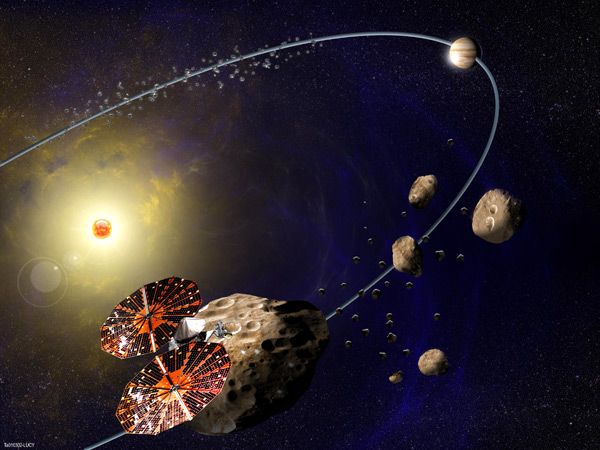
An artist's concept of the Lucy spacecraft exploring Trojan asteroids in Jupiter's orbit.
Southwest Research Institute

NASA Awards Launch Services Contract for Lucy Mission (Press Release)

NASA has selected United Launch Services LLC (ULS) of Centennial, Colorado, to provide launch services for the agency’s first-ever mission to explore Trojan asteroids.

The Lucy mission currently is targeted to launch in October 2021 on an Atlas V 401 rocket from Launch Complex 41 at Cape Canaveral Air Force Station in Florida. With boosts from Earth’s gravity, the spacecraft will embark on a 12-year journey to study primitive asteroids orbiting the Sun in tandem with Jupiter.

The total cost for NASA to launch Lucy is approximately $148.3 million, which includes the launch service and other mission related costs.

NASA’s Launch Services Program at Kennedy Space Center in Florida will manage the ULS launch service. The Lucy spacecraft project is managed at NASA’s Goddard Space Flight Center and the Planetary Mission Program Office at NASA’s Marshall Space Flight Center manages the Mission for the agency’s Science Mission Directorate for the agency’s Science Mission Directorate. Other mission partners include Southwest Research Institute (SwRI) in Boulder, Colorado, Lockheed Martin in Denver, the Johns Hopkins University Applied Physics Laboratory in Laurel, Maryland, and Arizona State University in Tempe.

Source: NASA.Gov

****

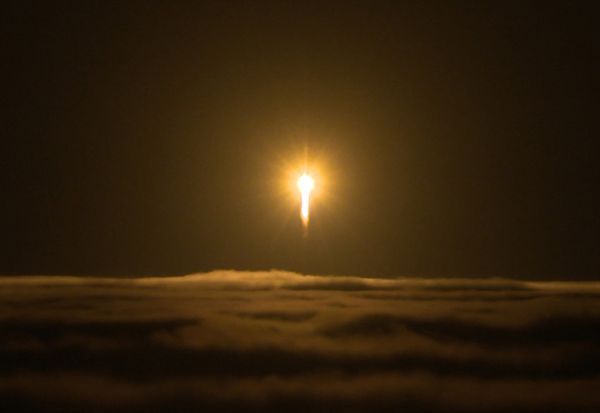
An Atlas V 401 rocket carrying NASA's InSight Mars lander launches from Vandenberg Air Force Base in California...on May 5, 2018.
NASA / Cory Huston

Wednesday, May 24, 2017

Getting Psyched Up Over Psyche's Earlier Launch Date...

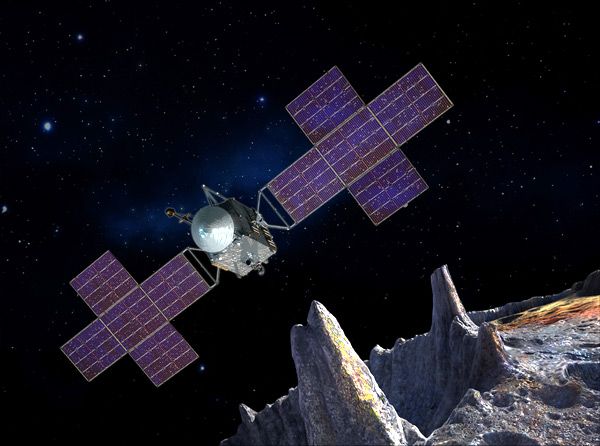
An artist's concept of NASA's Psyche spacecraft studying a metal asteroid with the same name.
NASA / JPL - Caltech / Arizona State Univ. / Space Systems Loral / Peter Rubin

NASA Moves Up Launch of Psyche Mission to a Metal Asteroid (News Release)

Psyche, NASA's Discovery Mission to a unique metal asteroid, has been moved up one year with launch in the summer of 2022, and with a planned arrival at the main belt asteroid in 2026 -- four years earlier than the original timeline.

“We challenged the mission design team to explore if an earlier launch date could provide a more efficient trajectory to the asteroid Psyche, and they came through in a big way,” said Jim Green, director of the Planetary Science Division at NASA Headquarters in Washington. “This will enable us to fulfill our science objectives sooner and at a reduced cost.”

The Discovery program announcement of opportunity had directed teams to propose missions for launch in either 2021 or 2023. The Lucy mission was selected for the first launch opportunity in 2021, and Psyche was to follow in 2023. Shortly after selection in January, NASA gave the direction to the Psyche team to research earlier opportunities.

"The biggest advantage is the excellent trajectory, which gets us there about twice as fast and is more cost effective," said Principal Investigator Lindy Elkins-Tanton of Arizona State University in Tempe. "We are all extremely excited that NASA was able to accommodate this earlier launch date. The world will see this amazing metal world so much sooner."

The revised trajectory is more efficient, as it eliminates the need for an Earth gravity assist, which ultimately shortens the cruise time. In addition, the new trajectory stays farther from the Sun, reducing the amount of heat protection needed for the spacecraft. The trajectory will still include a Mars gravity assist in 2023.

"The change in plans is a great boost for the team and the mission," said Psyche Project Manager Henry Stone at NASA's Jet Propulsion Laboratory, Pasadena, California. "Our mission design team did a fantastic job coming up with this ideal launch opportunity."

The Psyche spacecraft is being built by Space Systems Loral (SSL), Palo Alto, California. In order to support the new mission trajectory, SSL redesigned the solar array system from a four-panel array in a straight row on either side of the spacecraft to a more powerful five-panel x-shaped design, commonly used for missions requiring more capability. Much like a sports car, by combining a relatively small spacecraft body with a very high-power solar array design, the Psyche spacecraft will speed to its destination at a faster pace than is typical for a larger spacecraft.

"By increasing the size of the solar arrays, the spacecraft will have the power it needs to support the higher velocity requirements of the updated mission," said SSL Psyche Program Manager Steve Scott.

The Psyche Mission

Psyche, an asteroid orbiting the Sun between Mars and Jupiter, is made almost entirely of nickel-iron metal. As such, it offers a unique look into the violent collisions that created Earth and the terrestrial planets.

The Psyche Mission was selected for flight earlier this year under NASA's Discovery Program, a series of lower-cost, highly focused robotic space missions that are exploring the solar system.

The scientific goals of the Psyche mission are to understand the building blocks of planet formation and explore firsthand a wholly new and unexplored type of world. The mission team seeks to determine whether Psyche is the core of an early planet, how old it is, whether it formed in similar ways to Earth's core, and what its surface is like. The spacecraft's instrument payload will include magnetometers, multispectral imagers, and a gamma ray and neutron spectrometer.

Source: NASA.Gov

Thursday, January 05, 2017

More Info on the Lucy Mission...

An artist's concept of the Lucy spacecraft exploring Trojan asteroids in Jupiter's orbit.
Southwest Research Institute

Lockheed Martin to Build NASA's Lucy Spacecraft, a Mission to Trojan Asteroids (Press Release)

NASA's Newest Discovery Mission to Study Asteroids Orbiting with Jupiter

DENVER, Jan. 5, 2017 -- Lockheed Martin has been selected to design, build and operate the spacecraft for NASA's Lucy mission. One of NASA's two new Discovery Program missions, Lucy will perform the first reconnaissance of the Jupiter Trojan asteroids orbiting the sun in tandem with the gas giant. The Lucy spacecraft will launch in 2021 to study six of these exciting worlds.

The mission is led by Principal Investigator Dr. Harold Levison of the Southwest Research Institute in Boulder, Colorado. NASA's Goddard Space Flight Center in Greenbelt, Maryland will manage the mission. The program has a development cost cap of about $450 million.

"This is a thrilling mission as the Jupiter Trojan asteroids have never been studied up close," said Guy Beutelschies, director of Interplanetary Systems at Lockheed Martin Space Systems. "The design of the spacecraft draws from the flight-proven OSIRIS-REx spacecraft currently on its way to a near-Earth asteroid. This heritage of spacecraft and mission operations brings known performance, reliability and cost to the mission."

Lucy will study the geology, surface composition and bulk physical properties of these bodies at close range. It's slated to arrive at its first destination, a main belt asteroid, in 2025. From 2027 to 2033, Lucy will explore six Jupiter Trojan asteroids. These asteroids are trapped by Jupiter's gravity in two swarms that share the planet's orbit, one leading and one trailing Jupiter in its 12-year circuit around the sun. The Trojans are thought to be relics of a much earlier era in the history of the solar system, and may have formed far beyond Jupiter's current orbit.

"This is a unique opportunity," said Dr. Levison. "Because the Trojans are remnants of the primordial material that formed the outer planets, they hold vital clues to deciphering the history of the solar system. Lucy, like the human fossil for which it is named, will revolutionize the understanding of our origins."

Lucy is the seventh NASA Discovery Program mission in which Lockheed Martin has participated. Previously, the company developed the Lunar Prospector spacecraft; developed the aeroshell entry system for Mars Pathfinder; developed and operated the spacecraft for both Stardust missions; developed and operated the Genesis spacecraft; developed and operated the two GRAIL spacecraft; and developed and will operate the InSight Mars lander set to launch in May 2018.

NASA's Discovery program class missions are relatively low-cost, their development capped at a specific cost. They are managed for NASA's Planetary Science Division by the Planetary Missions Program Office at Marshall Space Flight Center in Huntsville, Alabama. The missions are designed and led by a principal investigator, who assembles a team of scientists and engineers, to address key science questions about the solar system.

Source: Lockheed Martin

Wednesday, January 04, 2017

Getting 'Psyched' Up for NASA's Two New Interplanetary Missions...

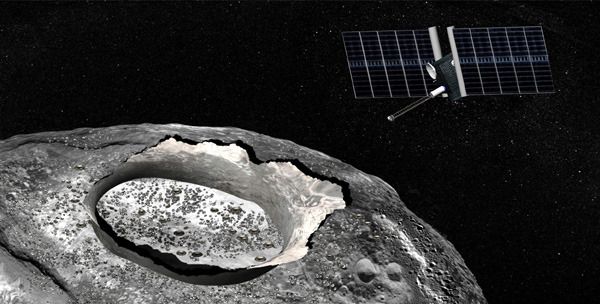
An artist's concept of the Psyche spacecraft orbiting a metallic asteroid named Psyche.
NASA / JPL - Caltech

NASA Selects Two Missions to Explore the Early Solar System (Press Release)

NASA has selected two missions that have the potential to open new windows on one of the earliest eras in the history of our solar system – a time less than 10 million years after the birth of our sun. The missions, known as Lucy and Psyche, were chosen from five finalists and will proceed to mission formulation, with the goal of launching in 2021 and 2023, respectively.

“Lucy will visit a target-rich environment of Jupiter’s mysterious Trojan asteroids, while Psyche will study a unique metal asteroid that’s never been visited before,” said Thomas Zurbuchen, associate administrator for NASA’s Science Mission Directorate in Washington. “This is what Discovery Program missions are all about – boldly going to places we’ve never been to enable groundbreaking science.”

Lucy, a robotic spacecraft, is scheduled to launch in October 2021. It’s slated to arrive at its first destination, a main belt asteroid, in 2025. From 2027 to 2033, Lucy will explore six Jupiter Trojan asteroids. These asteroids are trapped by Jupiter’s gravity in two swarms that share the planet’s orbit, one leading and one trailing Jupiter in its 12-year circuit around the sun. The Trojans are thought to be relics of a much earlier era in the history of the solar system, and may have formed far beyond Jupiter’s current orbit.

“This is a unique opportunity,” said Harold F. Levison, principal investigator of the Lucy mission from the Southwest Research Institute in Boulder, Colorado. “Because the Trojans are remnants of the primordial material that formed the outer planets, they hold vital clues to deciphering the history of the solar system. Lucy, like the human fossil for which it is named, will revolutionize the understanding of our origins.”

Lucy will build on the success of NASA’s New Horizons mission to Pluto and the Kuiper Belt, using newer versions of the RALPH and LORRI science instruments that helped enable the mission’s achievements. Several members of the Lucy mission team also are veterans of the New Horizons mission. Lucy also will build on the success of the OSIRIS-REx mission to asteroid Bennu, with the OTES instrument and several members of the OSIRIS-REx team.

The Psyche mission will explore one of the most intriguing targets in the main asteroid belt – a giant metal asteroid, known as 16 Psyche, about three times farther away from the sun than is the Earth. This asteroid measures about 130 miles (210 kilometers) in diameter and, unlike most other asteroids that are rocky or icy bodies, is thought to be comprised mostly of metallic iron and nickel, similar to Earth’s core. Scientists wonder whether Psyche could be an exposed core of an early planet that could have been as large as Mars, but which lost its rocky outer layers due to a number of violent collisions billions of years ago.

The mission will help scientists understand how planets and other bodies separated into their layers – including cores, mantles and crusts – early in their histories.

“This is an opportunity to explore a new type of world – not one of rock or ice, but of metal,” said Psyche Principal Investigator Lindy Elkins-Tanton of Arizona State University in Tempe. “16 Psyche is the only known object of its kind in the solar system, and this is the only way humans will ever visit a core. We learn about inner space by visiting outer space.”

Psyche, also a robotic mission, is targeted to launch in October of 2023, arriving at the asteroid in 2030, following an Earth gravity assist spacecraft maneuver in 2024 and a Mars flyby in 2025.

In addition to selecting the Lucy and Psyche missions for formulation, the agency will extend funding for the Near Earth Object Camera (NEOCam) project for an additional year. The NEOCam space telescope is designed to survey regions of space closest to Earth’s orbit, where potentially hazardous asteroids may be found.

“These are true missions of discovery that integrate into NASA’s larger strategy of investigating how the solar system formed and evolved,” said NASA’s Planetary Science Director Jim Green. “We’ve explored terrestrial planets, gas giants, and a range of other bodies orbiting the sun. Lucy will observe primitive remnants from farther out in the solar system, while Psyche will directly observe the interior of a planetary body. These additional pieces of the puzzle will help us understand how the sun and its family of planets formed, changed over time, and became places where life could develop and be sustained – and what the future may hold.”

Discovery Program class missions like these are relatively low-cost, their development capped at about $450 million. They are managed for NASA’s Planetary Science Division by the Planetary Missions Program Office at Marshall Space Flight Center in Huntsville, Alabama. The missions are designed and led by a principal investigator, who assembles a team of scientists and engineers, to address key science questions about the solar system.

The Discovery Program portfolio includes 12 prior selections such as the MESSENGER mission to study Mercury, the Dawn mission to explore asteroids Vesta and Ceres, and the InSight Mars lander, scheduled to launch in May 2018.

NASA’s other missions to asteroids began with the NEAR orbiter of asteroid Eros, which arrived in 2000, and continues with Dawn, which orbited Vesta and now is in an extended mission phase at Ceres. The OSIRIS-REx mission, which launched on Sept. 8, 2016, is speeding toward a 2018 rendezvous with the asteroid Bennu, and will deliver a sample back to Earth in 2023. Each mission focuses on a different aspect of asteroid science to give scientists the broader picture of solar system formation and evolution.

Source: NASA.Gov

****

Thursday, October 01, 2015

NASA Seeks to Make New Discoveries with More Discovery-Class Missions...

An artist's concept of the Psyche spacecraft orbiting a metallic asteroid named Psyche.
NASA / JPL - Caltech

NASA Selects Investigations for Future Key Planetary Mission (Press Release - September 30)

NASA has selected five science investigations for refinement during the next year as a first step in choosing one or two missions for flight opportunities as early as 2020. The submitted proposals would study Venus, near-Earth objects and a variety of asteroids.

Each investigation team will receive $3 million to conduct concept design studies and analyses. After a detailed review and evaluation of the concept studies, NASA will make the final selections by September 2016 for continued development leading up to launch. Any selected mission will cost approximately $500 million, not including launch vehicle funding or the cost of post-launch operations.

"The selected investigations have the potential to reveal much about the formation of our solar system and its dynamic processes,” said John Grunsfeld, astronaut and associate administrator for NASA’s Science Mission Directorate in Washington. “Dynamic and exciting missions like these hold promise to unravel the mysteries of our solar system and inspire future generations of explorers. It’s an incredible time for science, and NASA is leading the way.”

NASA's Discovery Program requested proposals for spaceflight investigations in November 2014. A panel of NASA and other scientists and engineers reviewed 27 submissions.

The planetary missions selected to pursue concept design studies are:

Deep Atmosphere Venus Investigation of Noble gases, Chemistry, and Imaging (DAVINCI):
DAVINCI would study the chemical composition of Venus’ atmosphere during a 63-minute descent. It would answer scientific questions that have been considered high priorities for many years, such as whether there are volcanoes active today on the surface of Venus and how the surface interacts with the atmosphere of the planet. Lori Glaze of NASA's Goddard Space Flight Center in Greenbelt, Maryland, is the principal investigator. Goddard would manage the project.

The Venus Emissivity, Radio Science, InSAR, Topography, and Spectroscopy mission (VERITAS):
VERITAS would produce global, high-resolution topography and imaging of Venus’ surface and produce the first maps of deformation and global surface composition. Suzanne Smrekar of NASA’s Jet Propulsion Laboratory (JPL) in Pasadena, California is the principal investigator. JPL would manage the project.

Psyche:
Psyche would explore the origin of planetary cores by studying the metallic asteroid Psyche. This asteroid is likely the survivor of a violent hit-and-run with another object that stripped off the outer, rocky layers of a protoplanet. Linda Elkins-Tanton of Arizona State University in Tempe, Arizona is the principal investigator. JPL would manage the project.

Near Earth Object Camera (NEOCam):
NEOCAM would discover ten times more near-Earth objects than all NEOs discovered to date. It would also begin to characterize them. Amy Mainzer of JPL is the principal investigator, and JPL would manage the project.

Lucy:
Lucy would perform the first reconnaissance of the Jupiter Trojan asteroids, objects thought to hold vital clues to deciphering the history of the solar system. Harold Levison of the Southwest Research Institute in Boulder, Colorado is the principal investigator. Goddard would manage the project.

Created in 1992, the Discovery Program sponsors frequent, cost-capped solar system exploration missions with highly focused scientific goals. The program has funded and developed 12 missions to date, including MESSENGER, Dawn, Stardust, Deep Impact, Genesis and GRAIL, and is currently completing development of InSight. The Planetary Missions Program Office at NASA's Marshall Space Flight Center in Huntsville, Alabama manages the program for the agency's Science Mission Directorate.

Source: NASA.Gov

****

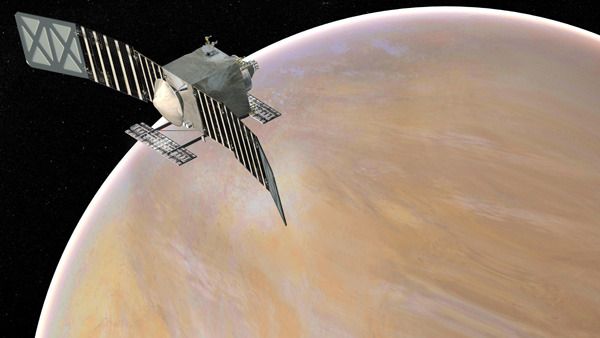
An artist's concept of the VERITAS spacecraft orbiting Venus.
NASA / JPL - Caltech