Sunday, November 25, 2018

Photos of the Day: The Moon on a Clear Autumn Afternoon...

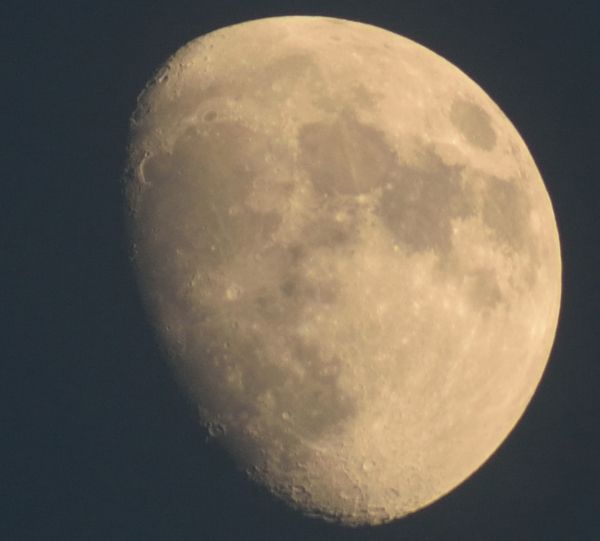
A snapshot of the Moon (in its Waxing Gibbous phase) that I took with my Nikon D3300 DSLR camera...on November 18, 2018.

I would devote this Blog entry to how there's less than 24 hours remaining before NASA's InSight lander touches down on Mars, but I don't wanna jinx it! So here are two pics of the Moon (which was in its Waxing Gibbous phase) that I shot with my Nikon D3300 DSLR camera a week ago today. These photos were taken exactly at this time last Sunday...so that's why I mentioned that this image was shot on a clear autumn afternoon. The shutter speed and aperture setting on my DSLR makes it look like these pics were taken at night (well, at least the photo above implies that), but they weren't. Anyways, that's all. Less than 24 hours remain before NASA's InSight lander touches down on Mars!

Sorry, I couldn't resist.

An airliner flies past the Moon in this snapshot that I took on November 18, 2018.

Saturday, November 24, 2018

T-Minus 2 DAYS Till InSight Arrives on Mars!

At this moment two days from now, NASA's InSight lander will have hopefully touched down on the surface of Mars. Around 12:01 PM, Pacific Standard Time (3:01 PM, Eastern Standard Time) on November 26, which is Cyber Monday, NASA should receive radio confirmation that the 3-legged robotic probe landed at Elysium Planitia...a broad plain located near the equator of the Red Planet. Just like the Phoenix lander a decade ago and the Curiosity rover 6 years ago, I plan to witness this exciting event during a viewing party near downtown Pasadena in California. More details about this on Monday—assuming everything goes as planned and I'm blogging nothing but good news when I get home! Carry on.

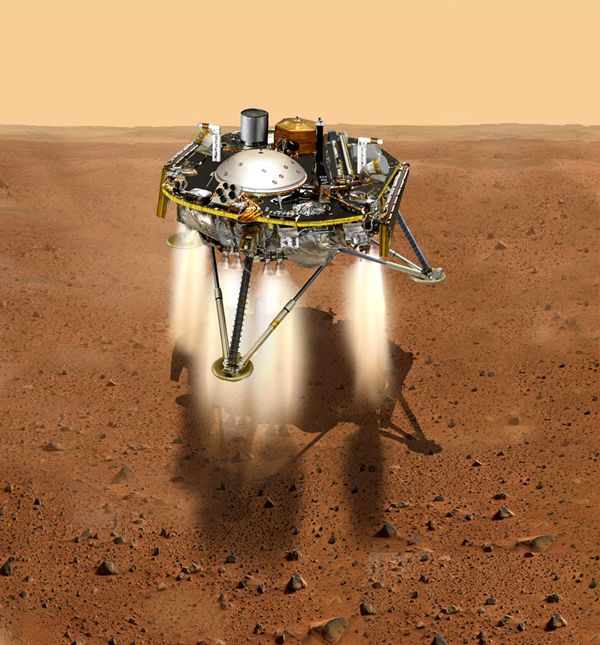
An artist's concept of NASA's InSight Mars lander about to touch down on the surface of the Red Planet.
NASA

Tuesday, November 20, 2018

QueSST Update: Construction Is Set to Begin on NASA's Newest X-Plane...

A composite image depicting the X-59 QueSST aircraft soaring above NASA's Armstrong Flight Research Center at Edwards Air Force Base in California.
Lockheed Martin

NASA’s Quiet Supersonic Technology Project Passes Major Milestone (Press Release - November 19)

NASA has officially committed to a development timeline that will lead to the first flight of its X-59 Quiet Supersonic Technology (QueSST) aircraft in just three years.

This critical milestone comes after a rigorous review, Key Decision Point-C (KDP-C), that confirmed NASA’s continued support of the X-59, in terms of funding, and established an achievable development timeline for NASA’s first piloted, full-size X-plane in more than three decades.

“This aircraft has the potential to transform aviation in the United States and around the world by making faster-than-sound air travel over land possible for everyone,” said NASA Administrator Jim Bridenstine. “We can’t wait to see this bird fly!”

KDP-C commits NASA to the full X-59 development effort through flight-testing in 2021. The cost and schedule commitments outlined in KDP-C align the project with program management best practices that account for potential technical risks and budgetary uncertainty beyond the project’s control.

“This is a monumental milestone for the project,” said Jaiwon Shin, NASA’s associate administrator for aeronautics. “I’m extremely proud of the team for its hard work getting to this point, and we all look forward to watching this aircraft take shape and then take flight.”

The X-59 QueSST is shaped to reduce the loudness of a sonic boom to that of a gentle thump, if it’s heard at all. The supersonic aircraft will be flown above select U.S. communities to measure public perception of the noise – data that will help regulators establish new rules for commercial supersonic air travel over land.

Management of X-59 QueSST development falls under the Low Boom Flight Demonstrator project, part of the Integrated Aviation Systems Program in NASA’s Aeronautics Research Mission Directorate.

****

A snapshot I took of a miniature X-59 model during a 'NASA Social' event at NASA's Armstrong Flight Research Center in California...on May 31, 2016.

Monday, November 19, 2018

NASA Reveals the Landing Site for the Mars 2020 Rover One Week Before the InSight Lander Arrives at the Red Planet!

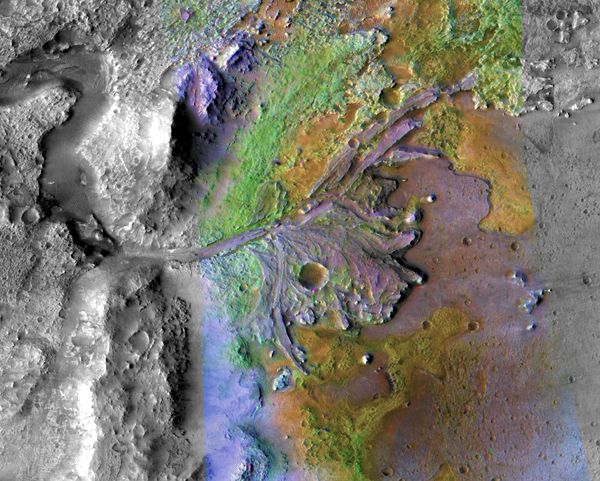
A false-color image of Jezero Crater, the future landing site for the Mars 2020 rover, as seen by NASA's Mars Reconnaissance Orbiter.
NASA / JPL - Caltech / MSSS / JHU - APL

NASA Announces Landing Site for Mars 2020 Rover (Press Release)

NASA has chosen Jezero Crater as the landing site for its upcoming Mars 2020 rover mission after a five year search, during which every available detail of more than 60 candidate locations on the Red Planet was scrutinized and debated by the mission team and the planetary science community.

The rover mission is scheduled to launch in July 2020 as NASA’s next step in exploration of the Red Planet. It will not only seek signs of ancient habitable conditions – and past microbial life -- but the rover also will collect rock and soil samples and store them in a cache on the planet's surface. NASA and ESA (European Space Agency) are studying future mission concepts to retrieve the samples and return them to Earth, so this landing site sets the stage for the next decade of Mars exploration.

“The landing site in Jezero Crater offers geologically rich terrain, with landforms reaching as far back as 3.6 billion years old, that could potentially answer important questions in planetary evolution and astrobiology,” said Thomas Zurbuchen, associate administrator for NASA’s Science Mission Directorate. “Getting samples from this unique area will revolutionize how we think about Mars and its ability to harbor life.”

Jezero Crater is located on the western edge of Isidis Planitia, a giant impact basin just north of the Martian equator. Western Isidis presents some of the oldest and most scientifically interesting landscapes Mars has to offer. Mission scientists believe the 28-mile-wide (45-kilometer) crater, once home to an ancient river delta, could have collected and preserved ancient organic molecules and other potential signs of microbial life from the water and sediments that flowed into the crater billions of years ago.

Jezero Crater’s ancient lake-delta system offers many promising sampling targets of at least five different kinds of rock, including clays and carbonates that have high potential to preserve signatures of past life. In addition, the material carried into the delta from a large watershed may contain a wide variety of minerals from inside and outside the crater.

The geologic diversity that makes Jezero so appealing to Mars 2020 scientists also makes it a challenge for the team’s entry, descent and landing (EDL) engineers. Along with the massive nearby river delta and small crater impacts, the site contains numerous boulders and rocks to the east, cliffs to the west, and depressions filled with aeolian bedforms (wind-derived ripples in sand that could trap a rover) in several locations.

“The Mars community has long coveted the scientific value of sites such as Jezero Crater, and a previous mission contemplated going there, but the challenges with safely landing were considered prohibitive,” said Ken Farley, project scientist for Mars 2020 at NASA’s Jet Propulsion Laboratory. “But what was once out of reach is now conceivable, thanks to the 2020 engineering team and advances in Mars entry, descent and landing technologies.”

When the landing site search began, mission engineers already had refined the landing system such that they were able to reduce the Mars 2020 landing zone to an area 50 percent smaller than that for the landing of NASA’s Curiosity rover at Gale Crater in 2012. This allowed the science community to consider more challenging landing sites. The sites of greatest scientific interest led NASA to add a new capability called Terrain Relative Navigation (TRN). TRN will enable the “sky crane” descent stage, the rocket-powered system that carries the rover down to the surface, to avoid hazardous areas.

The site selection is dependent upon extensive analyses and verification testing of the TRN capability. A final report will be presented to an independent review board and NASA Headquarters in the fall of 2019.

“Nothing has been more difficult in robotic planetary exploration than landing on Mars,” said Zurbuchen. “The Mars 2020 engineering team has done a tremendous amount of work to prepare us for this decision. The team will continue their work to truly understand the TRN system and the risks involved, and we will review the findings independently to reassure we have maximized our chances for success.”

Selecting a landing site this early allows the rover drivers and science operations team to optimize their plans for exploring Jezero Crater once the rover is safely on the ground. Using data from NASA’s fleet of Mars orbiters, they will map the terrain in greater detail and identify regions of interest – places with the most interesting geological features, for example – where Mars 2020 could collect the best science samples.

The Mars 2020 Project at JPL manages rover development for SMD. NASA's Launch Services Program, based at the agency's Kennedy Space Center in Florida, is responsible for launch management. Mars 2020 will launch from Cape Canaveral Air Force Station in Florida.

****

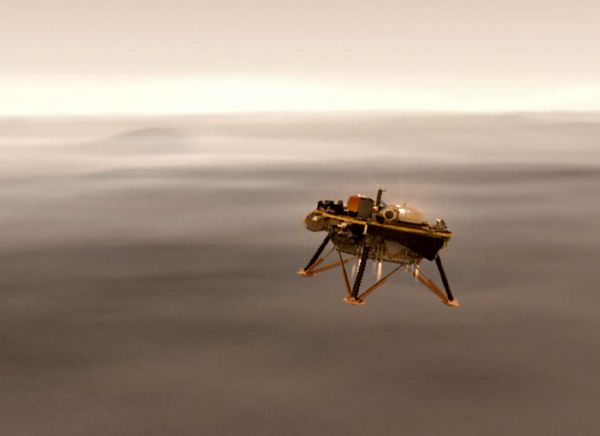
A computer-generated image of NASA's InSight lander about to touch down on Mars.
NASA / JPL - Caltech

Monday, November 12, 2018

Rest In Peace, Stan Lee (1922-2018)...

Stan Lee addresses the crowd at his Comikaze Expo in downtown Los Angeles, on November 2, 2013.

This month marks five years since I saw Stan Lee in person at his Comikaze Expo in Los Angeles. While the Marvel Universe and comic book fandom as a whole won't be the same without the legendary Lee to look up to after he passed away today, this is both a sad and joyous moment. It's a joyous moment because we can forever remember the Marvel visionary as a person whose amazing superhero creations—ranging from Fantastic Four, Iron Man and Spider-Man to Black Panther and The Avengers—are popular icons that millions of fans around the world can continue to be inspired by...both on paper and on the big screen. At 95 years-old, Stan Lee lived a full life that had a positive impact on dreamers around the globe. So I won't end this entry by saying 'Rest In Peace' again, but by exclaiming Excelsior!

Miniature movie maquettes of IRON MAN—one of Stan Lee's iconic comic book creations—on display at his Comikaze Expo in downtown Los Angeles, on November 2, 2013.

Saturday, November 10, 2018

Photo of the Day: An Orange Half-Moon in the Sky...

A snapshot I took of the Waxing Crescent Moon...which was tinted orange by smoke coming from the Woolsey Fire near Malibu, California, on November 10, 2018.

Just thought I'd share this pic (shot with my Nikon D3300 DSLR camera) that I took of tonight's Waxing Crescent Moon...which is tinted orange from all of the smoke coming from the Woolsey Fire still burning near Malibu (about 74 miles from where I live in Pomona), California. The last time I took photos of the Moon, it was back in late January...when it had a crimson hue due to the fact that it was a Super Blue Blood Moon (a.k.a. a Supermoon that was also a Blue Moon which occurred during a lunar eclipse, also called a Blood Moon). Like that winter snapshot, I wish today's image was also taken in less dire circumstances.

My sympathies to those who lost their loved ones and homes during the tragic wildfires currently raging in northern and southern California.

Tuesday, November 06, 2018

America Is Slowly Regaining Its Soul...

Even though the Republicans retained control of the Senate, Russian patsy Donald Trump will STILL be screwed by the House Democrats.

I have to get things ready for work tomorrow, so I'll just leave these images here for your enjoyment. Do your research online, and you'll know why a Democrat-led House of Representatives is good for the United States, and bad for Donald Trump.

Speaking of Trump, looks like he'll have to find another Cox-sucker to do his bidding here in California. Congrats to Gavin Newsom, who will soon become my state's next governor! Carry on.

Can't wait for you to release Trump's tax returns, House Democrats!

Thursday, November 01, 2018

The Sun Has Set on Dawn's Mission...

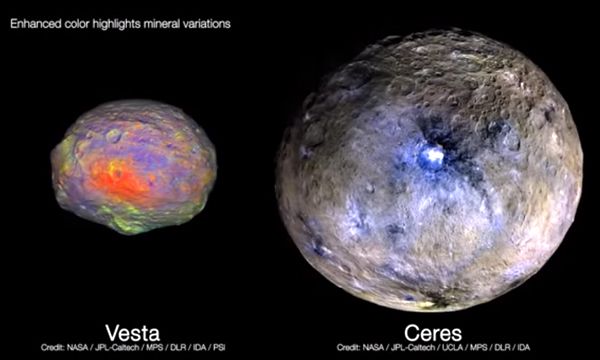
Enhanced color images of asteroid Vesta and dwarf planet Ceres...which were explored by NASA's Dawn spacecraft in 2011 and 2015, respectively.
NASA / JPL - Caltech

NASA’s Dawn Mission to Asteroid Belt Comes to End (Press Release)

NASA’s Dawn spacecraft has gone silent, ending a historic mission that studied time capsules from the solar system’s earliest chapter.

Dawn missed scheduled communications sessions with NASA's Deep Space Network on Wednesday, Oct. 31, and Thursday, Nov. 1. After the flight team eliminated other possible causes for the missed communications, mission managers concluded that the spacecraft finally ran out of hydrazine, the fuel that enables the spacecraft to control its pointing. Dawn can no longer keep its antennae trained on Earth to communicate with mission control or turn its solar panels to the Sun to recharge.

The Dawn spacecraft launched 11 years ago to visit the two largest objects in the main asteroid belt. Currently, it’s in orbit around the dwarf planet Ceres, where it will remain for decades.

“Today, we celebrate the end of our Dawn mission – its incredible technical achievements, the vital science it gave us, and the entire team who enabled the spacecraft to make these discoveries,” said Thomas Zurbuchen, associate administrator of NASA’s Science Mission Directorate in Washington. “The astounding images and data that Dawn collected from Vesta and Ceres are critical to understanding the history and evolution of our solar system.”

Dawn launched in 2007 on a journey that put about 4.3 billion miles (6.9 billion kilometers) on its odometer. Propelled by ion engines, the spacecraft achieved many firsts along the way. In 2011, when Dawn arrived at Vesta, the second largest world in the main asteroid belt, the spacecraft became the first to orbit a body in the region between Mars and Jupiter. In 2015, when Dawn went into orbit around Ceres, a dwarf planet that is also the largest world in the asteroid belt, the mission became the first to visit a dwarf planet and go into orbit around two destinations beyond Earth.

"The fact that my car's license plate frame proclaims, 'My other vehicle is in the main asteroid belt,' shows how much pride I take in Dawn," said Mission Director and Chief Engineer Marc Rayman at NASA's Jet Propulsion Laboratory (JPL). "The demands we put on Dawn were tremendous, but it met the challenge every time. It's hard to say goodbye to this amazing spaceship, but it’s time."

The data Dawn beamed back to Earth from its four science experiments enabled scientists to compare two planet-like worlds that evolved very differently. Among its accomplishments, Dawn showed how important location was to the way objects in the early solar system formed and evolved. Dawn also reinforced the idea that dwarf planets could have hosted oceans over a significant part of their history – and potentially still do.

“In many ways, Dawn’s legacy i­s just beginning,” said Princ­­ipal Investigator Carol Raymond at JPL. “Dawn’s data sets will be deeply mined by scientists working on how planets grow and differentiate, and when and where life could have formed in our solar system. Ceres and Vesta are important to the study of distant planetary systems, too, as they provide a glimpse of the conditions that may exist around young stars.”

Because Ceres has conditions of interest to scientists who study chemistry that leads to the development of life, NASA follows strict planetary protection protocols for the disposal of the Dawn spacecraft. Dawn will remain in orbit for at least 20 years, and engineers have more than 99 percent confidence the orbit will last for at least 50 years.

So, while the mission plan doesn't provide the closure of a final, fiery plunge – the way NASA’s Cassini spacecraft ended last year, for example – at least this is certain: Dawn spent every last drop of hydrazine making science observations of Ceres and radioing them back so we could learn more about the solar system we call home.

The Dawn mission is managed by JPL for NASA's Science Mission Directorate in Washington. Dawn is a project of the directorate's Discovery Program, managed by NASA's Marshall Space Flight Center in Huntsville, Alabama. JPL is responsible for overall Dawn mission science. Northrop Grumman in Dulles, Virginia, designed and built the spacecraft. The German Aerospace Center, Max Planck Institute for Solar System Research, Italian Space Agency and Italian National Astrophysical Institute are international partners on the mission team.

****

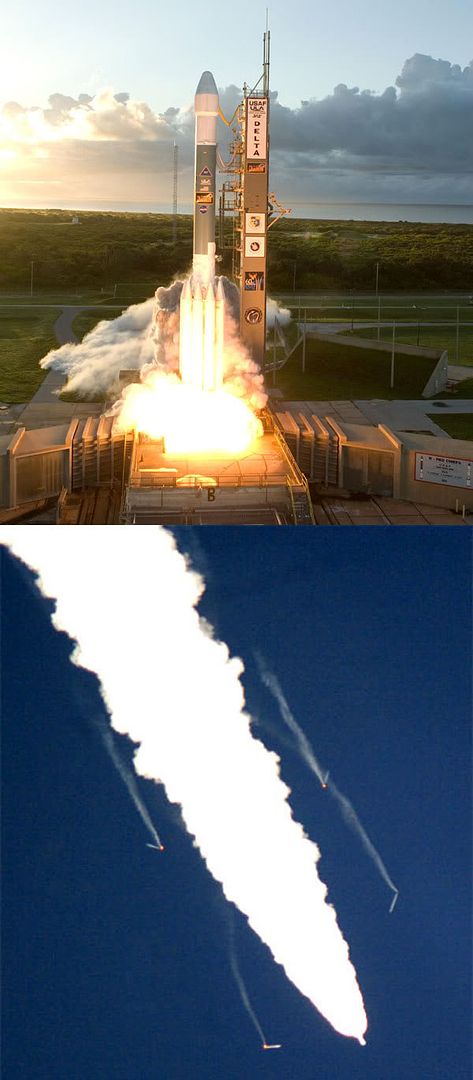
A Delta II rocket carrying the Dawn spacecraft is launched from Cape Canaveral Air Force Station in Florida...on September 27, 2007.
Tony Gray and Robert Murray for NASA / Carleton Bailie for United Launch Alliance

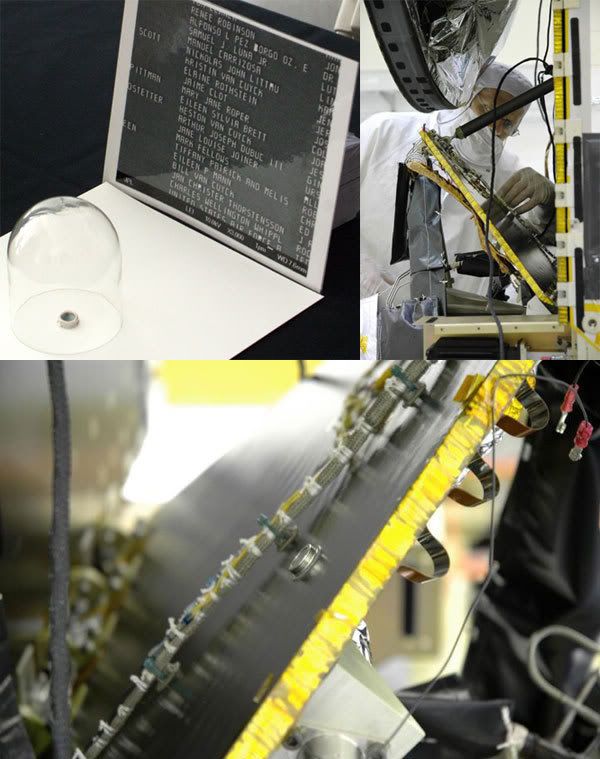
IMAGE 1: A photo taken by me of a microchip on display during the 2007 Open House at NASA's Jet Propulsion Laboratory near Pasadena, California.  IMAGE 2: A technician installs the Dawn microchip onto the spacecraft.  IMAGE 3: The Dawn microchip now secured on the spacecraft.

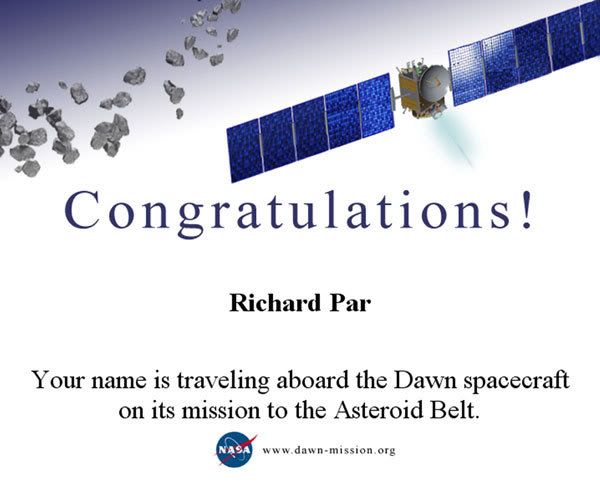
A certificate commemorating my participation in the 'Send Your Name to the Asteroid Belt' project.

Wednesday, October 31, 2018

New Horizons Update: Only Two Months Till the Ultima Thule Flyby!

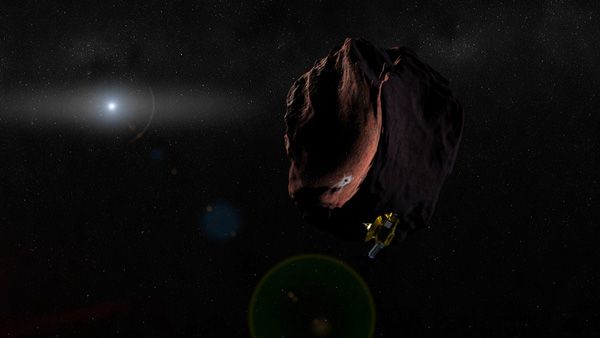
An artist's concept of NASA's New Horizons spacecraft flying past the Kuiper Belt Object nicknamed 'Ultima Thule.'
NASA / Johns Hopkins University Applied Physics Laboratory / Southwest Research Institute

So I just realized that NASA's New Horizons spacecraft makes its closest approach to Kuiper Belt Object (KBO) 2014 MU69—also nicknamed Ultima Thule—exactly two months from today! New Horizons flies past the KBO at 9:33 PM, Pacific Standard Time, on December 31...or 12:33 AM, Eastern Standard Time, on January 1, 2019.

I hope all of you are having a safe and fun Halloween! No trick-or-treaters stopped by my house for candy tonight, fortunately. Of course, trick-or-treaters haven't been stopping by my house for over half a decade now... Thank you, snooty Los Angeles County neighborhood that I live in! That was a compliment.

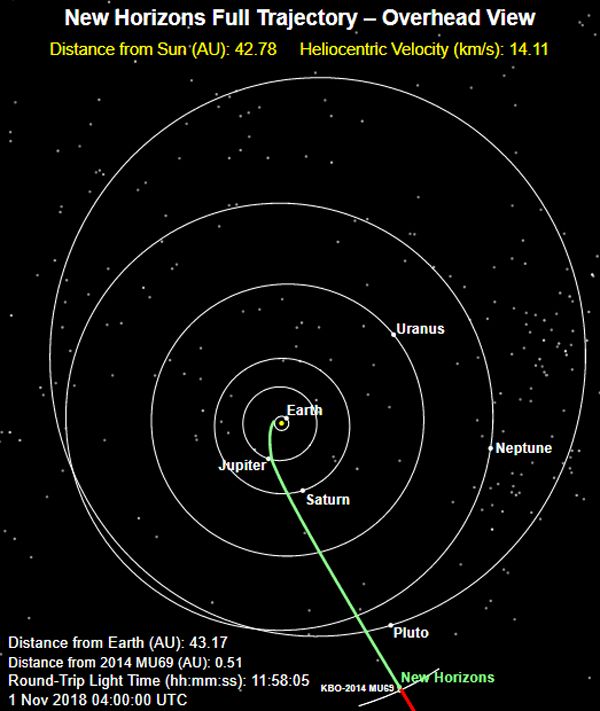
The green line marks the path traveled by the New Horizons spacecraft as of 9:00 PM, Pacific Daylight Time, on October 31, 2018. It is 4 billion miles from Earth.
ABOVE: The green line marks the path traveled by the New Horizons spacecraft as of 9:00 PM,
Pacific Daylight Time, on October 31, 2018. It is 4 billion miles from Earth. Click
here to view the
official webpage showing where New Horizons is in space. (AU stands for Astronomical Units, in case you're wondering.)

Tuesday, October 30, 2018

Farewell, Kepler, and We Thank You...

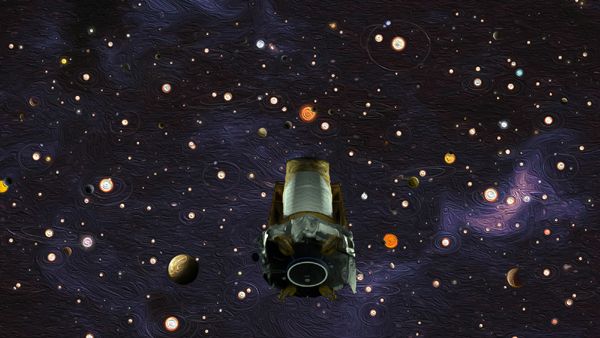
An illustration depicting NASA's Kepler spacecraft and the multitude of exoplanets that it discovered since its mission began in early 2009.
NASA / Wendy Stenzel / Daniel Rutter

NASA Retires Kepler Space Telescope, Passes Planet-Hunting Torch (Press Release)

After nine years in deep space collecting data that indicate our sky to be filled with billions of hidden planets – more planets even than stars – NASA’s Kepler space telescope has run out of fuel needed for further science operations. NASA has decided to retire the spacecraft within its current, safe orbit, away from Earth. Kepler leaves a legacy of more than 2,600 planet discoveries from outside our solar system, many of which could be promising places for life.

"As NASA's first planet-hunting mission, Kepler has wildly exceeded all our expectations and paved the way for our exploration and search for life in the solar system and beyond," said Thomas Zurbuchen, associate administrator of NASA's Science Mission Directorate in Washington. "Not only did it show us how many planets could be out there, it sparked an entirely new and robust field of research that has taken the science community by storm. Its discoveries have shed a new light on our place in the universe, and illuminated the tantalizing mysteries and possibilities among the stars.”

Kepler has opened our eyes to the diversity of planets that exist in our galaxy. The most recent analysis of Kepler’s discoveries concludes that 20 to 50 percent of the stars visible in the night sky are likely to have small, possibly rocky, planets similar in size to Earth, and located within the habitable zone of their parent stars. That means they’re located at distances from their parent stars where liquid water – a vital ingredient to life as we know it – might pool on the planet surface.

The most common size of planet Kepler found doesn’t exist in our solar system – a world between the size of Earth and Neptune – and we have much to learn about these planets. Kepler also found nature often produces jam-packed planetary systems, in some cases with so many planets orbiting close to their parent stars that our own inner solar system looks sparse by comparison.

"When we started conceiving this mission 35 years ago we didn't know of a single planet outside our solar system," said the Kepler mission's founding principal investigator, William Borucki, now retired from NASA’s Ames Research Center in California’s Silicon Valley. "Now that we know planets are everywhere, Kepler has set us on a new course that's full of promise for future generations to explore our galaxy."

Launched on March 6, 2009, the Kepler space telescope combined cutting-edge techniques in measuring stellar brightness with the largest digital camera outfitted for outer space observations at that time. Originally positioned to stare continuously at 150,000 stars in one star-studded patch of the sky in the constellation Cygnus, Kepler took the first survey of planets in our galaxy and became the agency's first mission to detect Earth-size planets in the habitable zones of their stars.

"The Kepler mission was based on a very innovative design. It was an extremely clever approach to doing this kind of science," said Leslie Livesay, director for astronomy and physics at NASA’s Jet Propulsion Laboratory, who served as Kepler project manager during mission development. "There were definitely challenges, but Kepler had an extremely talented team of scientists and engineers who overcame them.”

Four years into the mission, after the primary mission objectives had been met, mechanical failures temporarily halted observations. The mission team was able to devise a fix, switching the spacecraft’s field of view roughly every three months. This enabled an extended mission for the spacecraft, dubbed K2, which lasted as long as the first mission and bumped Kepler's count of surveyed stars up to more than 500,000.

The observation of so many stars has allowed scientists to better understand stellar behaviors and properties, which is critical information in studying the planets that orbit them. New research into stars with Kepler data also is furthering other areas of astronomy, such as the history of our Milky Way galaxy and the beginning stages of exploding stars called supernovae that are used to study how fast the universe is expanding. The data from the extended mission were also made available to the public and science community immediately, allowing discoveries to be made at an incredible pace and setting a high bar for other missions. Scientists are expected to spend a decade or more in search of new discoveries in the treasure trove of data Kepler provided.

"We know the spacecraft's retirement isn't the end of Kepler's discoveries," said Jessie Dotson, Kepler's project scientist at NASA’s Ames Research Center in California’s Silicon Valley. "I'm excited about the diverse discoveries that are yet to come from our data and how future missions will build upon Kepler's results."

Before retiring the spacecraft, scientists pushed Kepler to its full potential, successfully completing multiple observation campaigns and downloading valuable science data even after initial warnings of low fuel. The latest data, from Campaign 19, will complement the data from NASA’s newest planet hunter, the Transiting Exoplanet Survey Satellite, launched in April. TESS builds on Kepler's foundation with fresh batches of data in its search of planets orbiting some 200,000 of the brightest and nearest stars to the Earth, worlds that can later be explored for signs of life by missions, such as NASA’s James Webb Space Telescope.

NASA's Ames Research Center in California's Silicon Valley manages the Kepler and K2 missions for NASA's Science Mission Directorate. NASA's Jet Propulsion Laboratory in Pasadena, California, managed Kepler mission development. Ball Aerospace & Technologies Corporation in Boulder, Colorado, operates the flight system with support from the Laboratory for Atmospheric and Space Physics at the University of Colorado in Boulder.

****
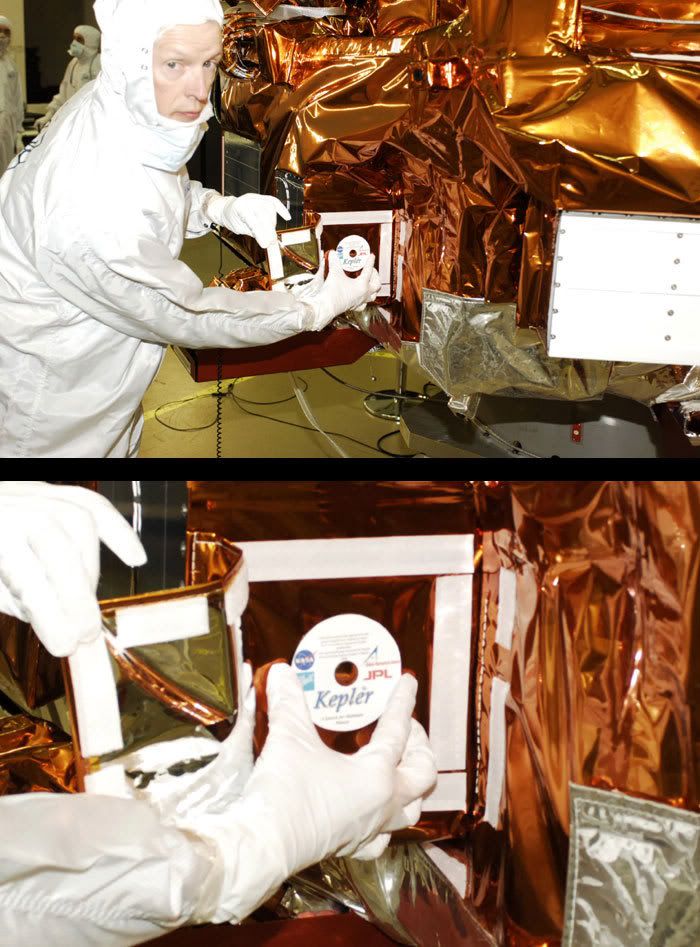
Kepler mission Deputy Principal Investigator Dave Koch points to the 'Name in Space' DVD that is about to be attached to the Kepler spacecraft prior to its launch on March 6, 2009.
Ball Aerospace & Technologies Corp.
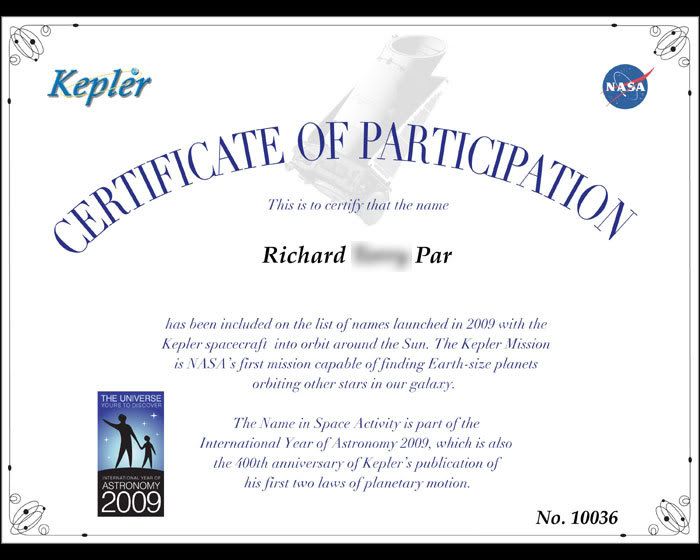
My 'Name in Space' certificate.