Friday, June 30, 2017

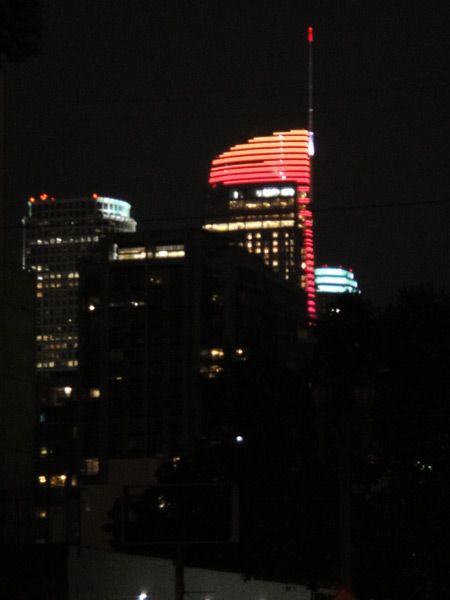
The Wilshire Grand Center...Open for Business!

The rooftop sail of the Wilshire Grand Center is lit up in red, orange and yellow to support Los Angeles' bid for the 2024 Summer Olympic Games...on May 10, 2017.

Just found out online yesterday that America's tallest building west of the Mississippi River, the Wilshire Grand Center, had its grand opening in downtown Los Angeles a week ago (June 23). Finally! I plan on visiting L.A.'s newest skyscraper pretty soon...and take pictures of the L.A. skyline from the top of the tower. And of course, see that spire up-close in person. Happy Friday!

Tuesday, June 27, 2017

Photos of the Day: Snapshots from My New DSLR Camera...

A photo of a black phoebe bird taking off from a tree branch in my backyard...as seen with 500mm super-zoom lens attached to my Nikon D3300 DSLR camera.

Just thought I'd share these pics that I took with my new Nikon D3300 DSLR camera...which I got via UPS delivery two weeks ago today. All of these images have been posted to my iStock.com portfolio. My Nikon D3300 is awesome! Though I haven't had time to drive around and take some really cool photos due to the fact that I spent the last two weeks moving to a new house. Hopefully things will return to normal by next week—and I'll be able to take a road trip to Malibu, Orange County or something to take nice, crisp pics at the beach. I also want to head back to Joshua Tree (photos from my first and only trip to that national park should be on Page 1 of my portfolio linked to above)...but that won't happen anytime soon since it's now 100-plus degrees in the SoCal desert. Friggin' summer...

The spider shown at the very bottom of this entry is about the size of a nickel. Carry on.

A photo of a black phoebe bird as it created a silhouette against the evening Sun...as seen with 500mm super-zoom lens attached to my Nikon D3300 DSLR camera.

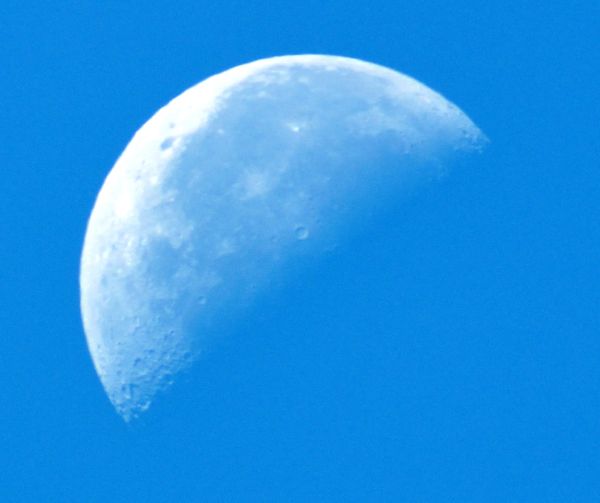
The Half Moon as seen with 500mm super-zoom lens attached to my Nikon D3300 DSLR camera.

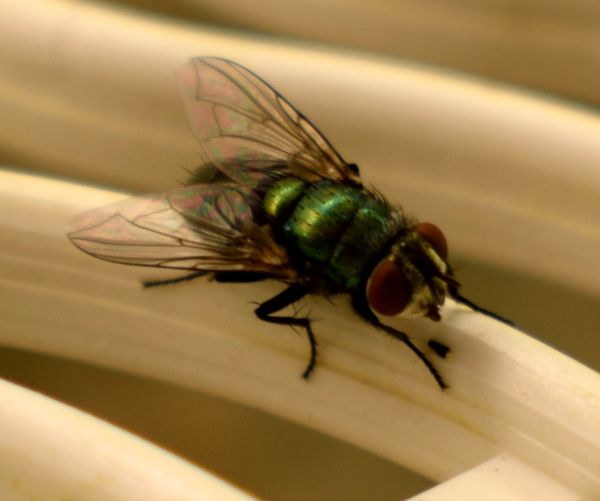
A close-up photo of a housefly resting atop plastic kitchenware at my house...as seen with a macro lens attached to my Nikon D3300 DSLR camera.

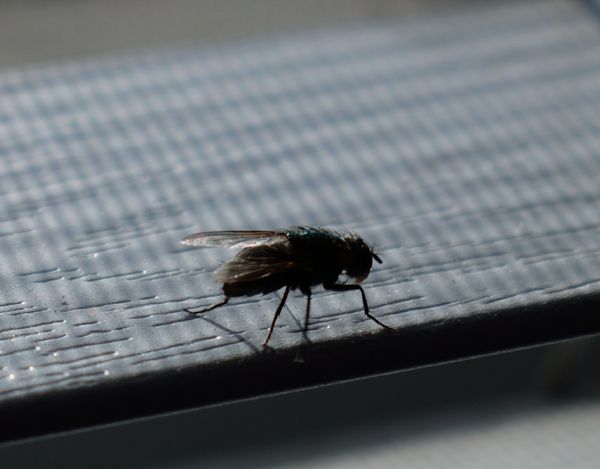
A close-up photo of the housefly resting on a window blind in my bedroom...as seen with a macro lens attached to my Nikon D3300 DSLR camera.

A close-up photo of a spider crawling along the bathroom counter at home...as seen with a macro lens attached to my Nikon D3300 DSLR camera.

Monday, June 26, 2017

NASA Is Making Progress on Quest to Make Commercial Air Travel Supersonic Again...

An artist's concept of NASA's QueSST X-plane soaring high in the sky.
NASA / Lockheed Martin

NASA Completes Milestone Toward Quieter Supersonic X-Plane (Press Release)

NASA has achieved a significant milestone in its effort to make supersonic passenger jet travel over land a real possibility by completing the preliminary design review (PDR) of its Quiet Supersonic Transport or QueSST aircraft design. QueSST is the initial design stage of NASA’s planned Low Boom Flight Demonstration (LBFD) experimental airplane, otherwise known as an X-plane.

Senior experts and engineers from across the agency and the Lockheed Martin Corporation concluded Friday that the QueSST design is capable of fulfilling the LBFD aircraft’s mission objectives, which are to fly at supersonic speeds, but create a soft “thump” instead of the disruptive sonic boom associated with supersonic flight today. The LBFD X-plane will be flown over communities to collect data necessary for regulators to enable supersonic flight over land in the United States and elsewhere in the world.

NASA partnered with lead contractor, Lockheed Martin, in February 2016 for the QueSST preliminary design. Last month, a scale model of the QueSST design completed testing in the 8-by 6-foot supersonic wind tunnel at NASA’s Glenn Research Center in Cleveland.

"Managing a project like this is all about moving from one milestone to the next,” said David Richwine, manager for the preliminary design effort under NASA’s Commercial Supersonic Technology Project. “Our strong partnership with Lockheed Martin helped get us to this point. We’re now one step closer to building an actual X-plane.”

After the success of completing the PDR, NASA’s project team can start the process of soliciting proposals later this year and awarding a contract early next year to build the piloted, single-engine X-plane. The acquisition for the LBFD X-plane contract will be fully open and competitive, with the QueSST preliminary design data being made available to qualified bidders. Flight testing of an LBFD X-plane could begin as early as 2021.

Over the next few months, NASA will work with Lockheed on finalizing the QueSST preliminary design effort. This includes a static inlet performance test and a low-speed wind tunnel test at NASA’s Langley Research Center in Hampton, Va.

Source: NASA.Gov

Sunday, June 25, 2017

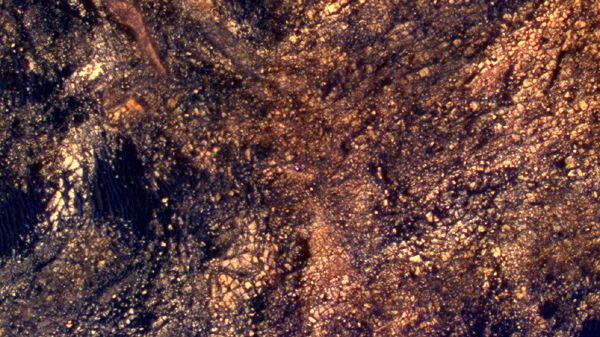
A God's-Eye View of Curiosity Traversing the Red Planet's Landscape...

An image of the Curiosity rover (small blue dot at center) taken by NASA's Mars Reconnaissance Orbiter soaring high above the Red Planet...on June 5, 2017.
NASA / JPL - Caltech / Univ. of Arizona

NASA Mars Orbiter Views Rover Climbing Mount Sharp (News Release - June 20)

Using the most powerful telescope ever sent to Mars, NASA's Mars Reconnaissance Orbiter caught a view of the Curiosity rover this month amid rocky mountainside terrain.

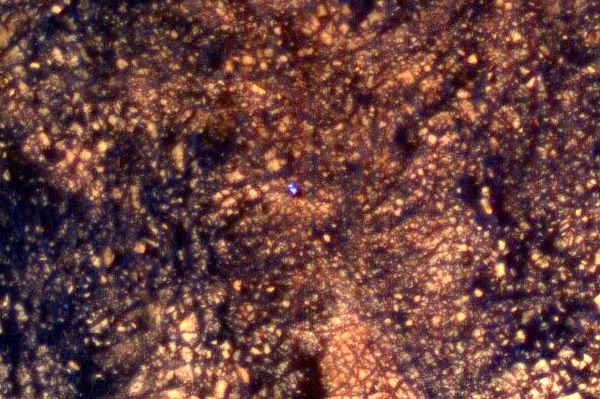
The car-size rover, climbing up lower Mount Sharp toward its next destination, appears as a blue dab against a background of tan rocks and dark sand in the enhanced-color image from the orbiter's High Resolution Imaging Science Experiment (HiRISE) camera. The exaggerated color, showing differences in Mars surface materials, makes Curiosity appear bluer than it really looks.

The image was taken on June 5, 2017, two months before the fifth anniversary of Curiosity's landing near Mount Sharp on Aug. 5 PDT (Aug. 6, 2017, EDT and Universal Time).

When the image was taken, Curiosity was partway between its investigation of active sand dunes lower on Mount Sharp, and "Vera Rubin Ridge," a destination uphill where the rover team intends to examine outcrops where hematite has been identified from Mars orbit.

The rover's location that day is shown at https://mars.nasa.gov/multimedia/images/2017/curiositys-traverse-map-through-sol-1717 as the point labeled 1717. Images taken that day by Curiosity's Mast Camera (Mastcam) are at https://mars.nasa.gov/msl/multimedia/raw/?s=1717&camera=MAST%5F.

HiRISE obtains images of Curiosity a few times each year. The University of Arizona, Tucson, operates HiRISE, which was built by Ball Aerospace & Technologies Corp., Boulder, Colorado. NASA's Jet Propulsion Laboratory, a division of Caltech in Pasadena, California, manages the Mars Reconnaissance Orbiter Project and Mars Science Laboratory Project for NASA's Science Mission Directorate, Washington.

Source: Jet Propulsion Laboratory

****

A cropped image of the Curiosity rover (small blue dot at center) taken by NASA's Mars Reconnaissance Orbiter soaring high above the Red Planet...on June 5, 2017.
NASA / JPL - Caltech / Univ. of Arizona

Friday, June 23, 2017

Back in the Day: Remembering the Pathfinder Mission...

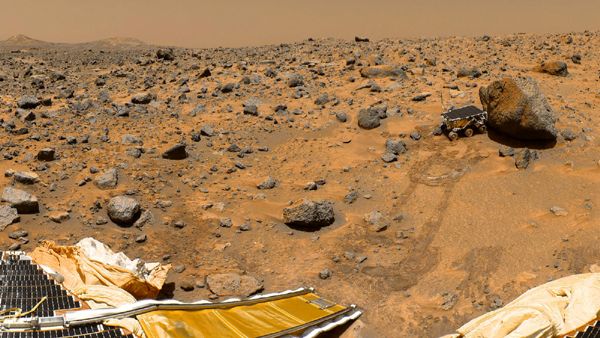
A classic photo of NASA's Sojourner rover studying a large rock near the Mars Pathfinder lander in the summer of 1997.
NASA / JPL

Why No One Under 20 Has Experienced a Day Without NASA at Mars (News Release - June 22)

As the Mars Pathfinder spacecraft approached its destination on July 4, 1997, no NASA mission had successfully reached the Red Planet in more than 20 years.

Even the mission team anxiously awaiting confirmation that the spacecraft survived its innovative, bouncy landing could not anticipate the magnitude of the pivot about to shape the Space Age.

In the 20 years since Pathfinder's touchdown, eight other NASA landers and orbiters have arrived successfully, and not a day has passed without the United States having at least one active robot on Mars or in orbit around Mars.

The momentum propelled by Pathfinder's success is still growing. Five NASA robots and three from other nations are currently examining Mars. The two decades since Pathfinder's landing have taken us about halfway from the first Mars rover to the first astronaut bootprint on Mars, proposed for the 2030s.

"Pathfinder initiated two decades of continuous Mars exploration bringing us to the threshold of sample return and the possibility of humans on the first planet beyond Earth," said Michael Meyer, lead scientist for NASA's Mars Exploration Program at the agency's headquarters in Washington.

Sojourner Rover

Pathfinder's rover, named Sojourner for the civil-rights crusader Sojourner Truth, became the best-known example of the many new technologies developed for the mission. Though Sojourner was only the size of a microwave oven, its six-wheel mobility system and its portable instrument for checking the composition of rocks and soil were the foundation for the expanded size and capabilities of later Mars rovers.

"Without Mars Pathfinder, there could not have been Spirit and Opportunity, and without Spirit and Opportunity, there could not have been Curiosity," Pathfinder Project Scientist Matt Golombek of NASA's Jet Propulsion Laboratory, Pasadena, California, said of the subsequent generations of Mars rovers. JPL is now developing another Mars rover for launch in 2020.

NASA planned Pathfinder primarily as a technology demonstration mission, but it also harvested new knowledge about Mars, from the planet's iron core to its atmosphere, and from its wetter and warmer past to its arid modern climate.

The space agency was shifting from less-frequent, higher-budget missions to a strategy of faster development and lower budgets. Pathfinder succeeded within a real-year, full-mission budget of $264 million, a small fraction of the only previously successful Mars lander missions, the twin Vikings of 1976.

"We needed to invent or re-invent 25 technologies for this mission in less than three years, and we knew that if we blew the cost cap, the mission would be cancelled," said JPL's Brian Muirhead, flight system manager and deputy project manager for Pathfinder. "Everybody who was part of the Mars Pathfinder Project felt we'd done something extraordinary, against the odds."

Crucial new technologies included an advanced onboard computer, the rover and its deployment system, solid-fuel rockets for deceleration, and airbags inflating just before touchdown to cushion the impact of landing. NASA re-used most of the Pathfinder technologies to carry out the Mars Exploration Rover Project, which landed Spirit and Opportunity on Mars in 2004.

Landing Day on Independence Day

"On the morning of July Fourth, 1997, we were in our tiny mission-control area waiting to see the signal that would confirm Pathfinder had survived its atmospheric entry and landing, and that it was transmitting from the surface of Mars," Muirhead said. "We saw that tiny spike in the signal coming through the Deep Space Network, and we knew."

Pathfinder quickly provided the first fresh images from Mars directly available to the public over the still-young World Wide Web. The mission set a web-traffic record at the time with more than 200 million hits from July 4 to July 8, 1997.

The lander and rover operated for three months -- triple the planned mission for the lander and 12 times the rover's planned mission of one week. This longevity enabled Pathfinder to overlap the Sept. 12, 1997, arrival of NASA's Mars Global Surveyor orbiter. That orbiter, in turn, operated at Mars for more than nine years, overlapping with arrivals of two later orbiters -- Mars Odyssey in 2001 and Mars Reconnaissance Orbiter in 2006, which are both still active -- and the 2004 landings of two rovers, one of which -- Opportunity -- is still active. Subsequent successful NASA missions of the post-Pathfinder era have been the Phoenix lander, Curiosity rover and MAVEN orbiter.

Twenty straight years of studying Mars have yielded major advances in understanding active processes on modern Mars, wet environments favorable for life on ancient Mars, and how the planet changed. These two decades of continuous robotic presence have built on the science and engineering gains from NASA's Mars Mariner and Viking missions of the 1960s and '70s.

The advances in understanding Mars during the past two decades have set the stage for even greater advances in the next two decades, particularly in efforts to determine whether life has ever existed on Mars and to put humans on Mars.

Source: Jet Propulsion Laboratory

Thursday, June 22, 2017

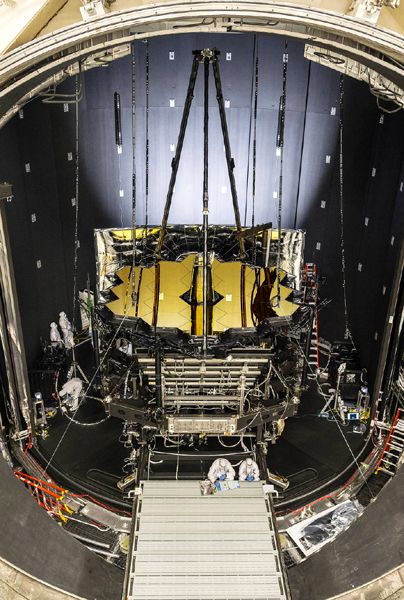
Photos of the Day: Hubble's Successor Will Undergo Thermal Testing This Summer...

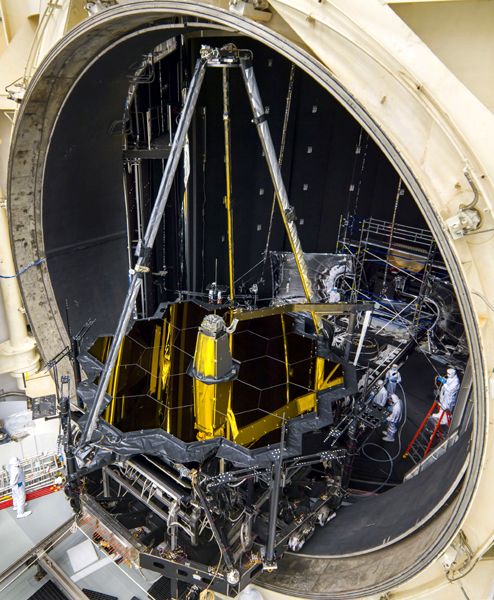
NASA's James Webb Space Telescope is about to be placed inside Chamber A at the Johnson Space Center in Houston, Texas...on June 21, 2017.
NASA / Chris Gunn

NASA's Webb Telescope Gets Freezing Summertime Lodging in Houston (News Release)

NASA’s James Webb Space Telescope was placed in Johnson Space Center’s historic Chamber A on June 20, 2017, to prepare for its final three months of testing in a cryogenic vacuum that mimics temperatures in space.

Engineers will perform the test to prove that the telescope can operate in space at these temperatures. Chamber A will simulate an environment where the telescope will experience extreme cold -- around 37 Kelvin (minus 236 degrees Celsius or minus 393 degrees Fahrenheit).

In space, the telescope must be kept extremely cold, in order to be able to detect the infrared light from very faint, distant objects. To protect the telescope from external sources of light and heat (like the Sun, Earth, and Moon), as well as from heat emitted by the observatory, a five-layer, tennis court-sized sunshield acts like a parasol that provides shade. The sunshield separates the observatory into a warm, sun-facing side (reaching temperatures close to 185 degrees Fahrenheit) and a cold side (400 degrees below zero). The sunshield blocks sunlight from interfering with the sensitive telescope instruments.

The James Webb Space Telescope is the scientific successor to NASA's Hubble Space Telescope. It will be the most powerful space telescope ever built. Webb is an international project led by NASA with its partners, ESA (European Space Agency) and the Canadian Space Agency.

Source: NASA.Gov

****

NASA's James Webb Space Telescope sits inside Chamber A at the Johnson Space Center in Houston, Texas.
NASA / Chris Gunn

Tuesday, June 20, 2017

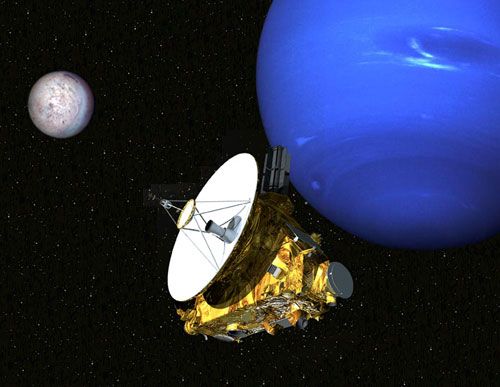
Setting Up Plans to Explore Neptune and Uranus Once More...

A New Horizons-type spacecraft flies past Neptune and its moon Triton, which may be a captured Kuiper Belt Object.
NASA / APL & JPL / R. Par

NASA Completes Study of Future ‘Ice Giant’ Mission Concepts (News Release)

A NASA-led and NASA-sponsored study of potential future missions to the mysterious “ice giant” planets Uranus and Neptune has been released—the first in a series of mission studies NASA will conduct in support of the next Planetary Science Decadal Survey. The results of this and future studies will be used as the Decadal Survey deliberates on NASA’s planetary science priorities from 2022-2032. The study identifies the scientific questions an ice giant mission should address, and discusses various instruments, spacecraft, flight-paths and technologies that could be used.

"This study argues the importance of exploring at least one of these planets and its entire environment, which includes surprisingly dynamic icy moons, rings, and bizarre magnetic fields," said Mark Hofstadter of NASA's Jet Propulsion Laboratory in Pasadena, California, one of the two co-chairs of the science team that produced the report. The European Space Agency (ESA) also participated in the study.
To date, Uranus and Neptune have been visited briefly by one spacecraft, Voyager 2. Voyager rapidly flew by Uranus in 1986 and Neptune in 1989, as part of its grand tour of discovery that previously took it by Jupiter and Saturn.

Said co-chair Amy Simon of NASA's Goddard Space Flight Center in Greenbelt, Maryland, "We do not know how these planets formed and why they and their moons look the way they do. There are fundamental clues as to how our solar system formed and evolved that can only be found by a detailed study of one, or preferably both, of these planets."

A variety of potential mission concepts are discussed in the study, including orbiters, flybys, and probes that would dive into Uranus’ atmosphere to study its composition. A narrow-angle camera would send data back to Earth about the ice giants and their moons. Uranus has 27 known moons, while Neptune has 14.

Collectively, Uranus and Neptune are referred to as ice giant planets. In spite of that name, relatively little solid ice is thought to be in them today, but it is believed there is a massive liquid ocean beneath their clouds, which accounts for about two-thirds of their total mass. This makes them fundamentally different from the gas giant planets, Jupiter and Saturn (which are approximately 85 percent gas by mass), and terrestrial planets like Earth or Mars, which are basically 100 percent rock. It’s not clear how or where ice giant planets form, why their magnetic fields are strangely oriented, and what drives geologic activity on some of their moons. These mysteries make them scientifically important, and this importance is enhanced by the discovery that many planets around other stars appear to be similar to our own ice giants.

It is now up to the next decadal survey to recommend science priorities for NASA for the next decade. NASA will then determine if and when to fly a mission that is responsive to those priorities.

The full study (529 pages), as well as a short summary are available at:

http://www.lpi.usra.edu/icegiants/mission_study

Source: NASA.Gov

Monday, June 19, 2017

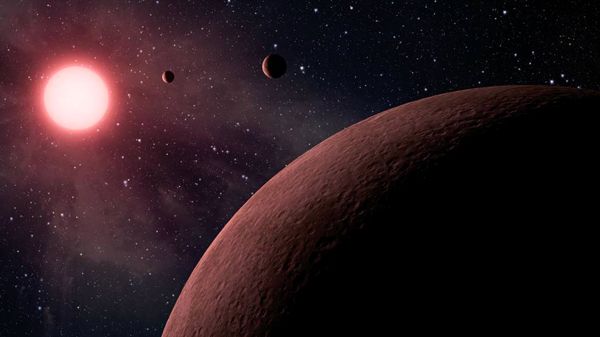
Kepler Update: 10 New Earth-like Exoplanets May Have Been Found...

An artist's concept of three exoplanets orbiting their parent star.
NASA / JPL - Caltech

NASA Releases Kepler Survey Catalog with Hundreds of New Planet Candidates (Press Release)

NASA’s Kepler space telescope team has released a mission catalog of planet candidates that introduces 219 new planet candidates, 10 of which are near-Earth size and orbiting in their star's habitable zone, which is the range of distance from a star where liquid water could pool on the surface of a rocky planet.

This is the most comprehensive and detailed catalog release of candidate exoplanets, which are planets outside our solar system, from Kepler’s first four years of data. It’s also the final catalog from the spacecraft’s view of the patch of sky in the Cygnus constellation.

With the release of this catalog, derived from data publicly available on the NASA Exoplanet Archive, there are now 4,034 planet candidates identified by Kepler. Of which, 2,335 have been verified as exoplanets. Of roughly 50 near-Earth size habitable zone candidates detected by Kepler, more than 30 have been verified.

Additionally, results using Kepler data suggest two distinct size groupings of small planets. Both results have significant implications for the search for life. The final Kepler catalog will serve as the foundation for more study to determine the prevalence and demographics of planets in the galaxy, while the discovery of the two distinct planetary populations shows that about half the planets we know of in the galaxy either have no surface, or lie beneath a deep, crushing atmosphere – an environment unlikely to host life.

The findings were presented at a news conference Monday at NASA's Ames Research Center in California's Silicon Valley.

“The Kepler data set is unique, as it is the only one containing a population of these near Earth-analogs – planets with roughly the same size and orbit as Earth,” said Mario Perez, Kepler program scientist in the Astrophysics Division of NASA’s Science Mission Directorate. “Understanding their frequency in the galaxy will help inform the design of future NASA missions to directly image another Earth.”

The Kepler space telescope hunts for planets by detecting the minuscule drop in a star’s brightness that occurs when a planet crosses in front of it, called a transit.

This is the eighth release of the Kepler candidate catalog, gathered by reprocessing the entire set of data from Kepler’s observations during the first four years of its primary mission. This data will enable scientists to determine what planetary populations – from rocky bodies the size of Earth, to gas giants the size of Jupiter – make up the galaxy’s planetary demographics.

To ensure a lot of planets weren't missed, the team introduced their own simulated planet transit signals into the data set and determined how many were correctly identified as planets. Then, they added data that appear to come from a planet, but were actually false signals, and checked how often the analysis mistook these for planet candidates. This work told them which types of planets were overcounted and which were undercounted by the Kepler team’s data processing methods.

“This carefully-measured catalog is the foundation for directly answering one of astronomy’s most compelling questions – how many planets like our Earth are in the galaxy?” said Susan Thompson, Kepler research scientist for the SETI Institute in Mountain View, California, and lead author of the catalog study.

One research group took advantage of the Kepler data to make precise measurements of thousands of planets, revealing two distinct groups of small planets. The team found a clean division in the sizes of rocky, Earth-size planets and gaseous planets smaller than Neptune. Few planets were found between those groupings.

Using the W. M. Keck Observatory in Hawaii, the group measured the sizes of 1,300 stars in the Kepler field of view to determine the radii of 2,000 Kepler planets with exquisite precision.

“We like to think of this study as classifying planets in the same way that biologists identify new species of animals,” said Benjamin Fulton, doctoral candidate at the University of Hawaii in Manoa, and lead author of the second study. “Finding two distinct groups of exoplanets is like discovering mammals and lizards make up distinct branches of a family tree.”

It seems that nature commonly makes rocky planets up to about 75 percent bigger than Earth. For reasons scientists don't yet understand, about half of those planets take on a small amount of hydrogen and helium that dramatically swells their size, allowing them to "jump the gap" and join the population closer to Neptune’s size.

The Kepler spacecraft continues to make observations in new patches of sky in its extended mission, searching for planets and studying a variety of interesting astronomical objects, from distant star clusters to objects such as the TRAPPIST-1 system of seven Earth-size planets, closer to home.

Ames manages the Kepler missions for NASA’s Science Mission Directorate. NASA's Jet Propulsion Laboratory in Pasadena, California, managed Kepler mission development. Ball Aerospace & Technologies Corporation operates the flight system with support from the Laboratory for Atmospheric and Space Physics at the University of Colorado in Boulder.
Source: NASA.Gov

Thursday, June 15, 2017

Juno Update: Another Beautiful Photo of a Jovian World...

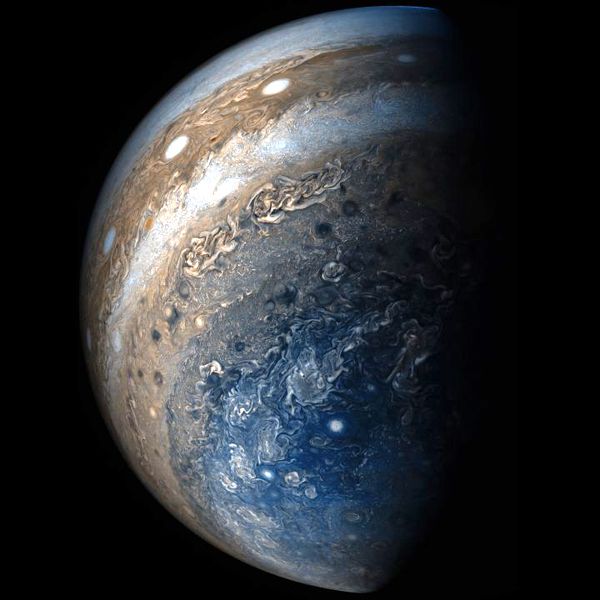
An image of Jupiter that was taken by NASA's Juno spacecraft from a distance of 29,100 miles (46,900 kilometers)...on May 19, 2017.
NASA / JPL - Caltech / SwRI / MSSS / Gerald Eichstädt / Seán Doran

Jupiter's Clouds Of Many Colors (News Release)

NASA’s Juno spacecraft was racing away from Jupiter following its seventh close pass of the planet when JunoCam snapped this image on May 19, 2017, from about 29,100 miles (46,900 kilometers) above the cloud tops. The spacecraft was over 65.9 degrees south latitude, with a lovely view of the south polar region of the planet.

This image was processed to enhance color differences, showing the amazing variety in Jupiter’s stormy atmosphere. The result is a surreal world of vibrant color, clarity and contrast. Four of the white oval storms known as the “String of Pearls” are visible near the top of the image. Interestingly, one orange-colored storm can be seen at the belt-zone boundary, while other storms are more of a cream color.

JunoCam's raw images are available for the public to peruse and process into image products in the image processing gallery.

Source: Juno Mission Website

Wednesday, June 14, 2017

Photo of the Day: Saturn's Biggest Moon As Seen From High Above...

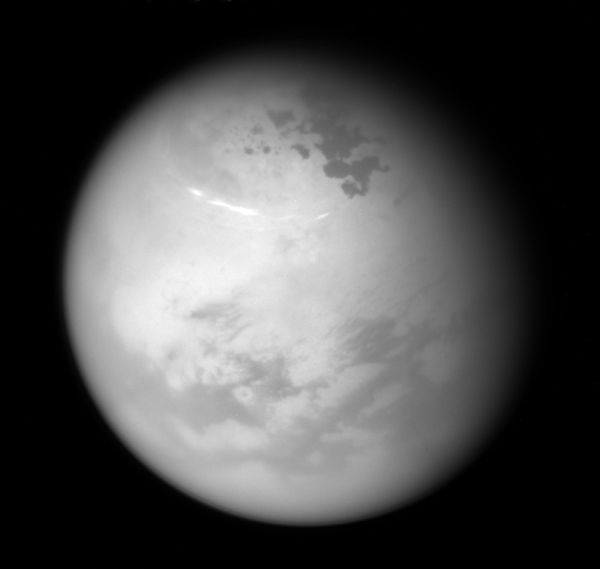
An image of Titan's northern hemisphere...as seen by NASA's Cassini spacecraft from 315,000 miles (507,000 kilometers) away, on June 9, 2017.
NASA / JPL - Caltech / Space Science Institute

Northern Summer on Titan (News Release)

NASA's Cassini spacecraft sees bright methane clouds drifting in the summer skies of Saturn's moon Titan, along with dark hydrocarbon lakes and seas clustered around the north pole.

Compared to earlier in Cassini's mission, most of the surface in the moon's northern high latitudes is now illuminated by the sun. (See here for a view of the northern hemisphere from 2007.) Summer solstice in the Saturn system occurred on May 24, 2017.

The image was taken with the Cassini spacecraft narrow-angle camera on June 9, 2017, using a spectral filter that preferentially admits wavelengths of near-infrared light centered at 938 nanometers. Cassini obtained the view at a distance of about 315,000 miles (507,000 kilometers) from Titan.

The Cassini mission is a cooperative project of NASA, ESA (the European Space Agency) and the Italian Space Agency. The Jet Propulsion Laboratory, a division of Caltech in Pasadena, California, manages the mission for NASA's Science Mission Directorate, Washington. The Cassini orbiter and its two onboard cameras were designed, developed and assembled at JPL. The imaging operations center is based at the Space Science Institute in Boulder, Colorado.

Source: Jet Propulsion Laboratory