Sunday, July 31, 2016

Supergirl, Meet Superman!

Melissa Benoist returns as Kara Danvers, while Tyler Hoechlin will join her as Superman in Season 2 of SUPERGIRL.

Can't wait to see Melissa Benoist kick ass as Supergirl again when the TV series begins Season 2 on the CW Network—the show originally aired on CBS last season—this October! (Supergirl premieres on October 10, to be exact.) However, the jury is out on Tyler Hoechlin (of MTV's Teen Wolf) as the Man of Steel. For starters, what's with that weird smirk on his face? And two, where's the spitcurl? At least Zack (Brian Thomas Smith) humorously sported it when he dressed as Superman to hang out with Penny (Kaley Cuoco) and Co. in a Season 4 episode of The Big Bang Theory... Looks like Hoechlin's portrayal will be more like that of Henry Cavill than those by the late Christopher Reeves and Brandon Routh. Oh well.

Zack (Brian Thomas Smith) is dressed as Superman while Penny (Kaley Cuoco) wears a Wonder Woman costume in a Season 4 episode of THE BIG BANG THEORY.

Saturday, July 30, 2016

Juno Update: Headin' Back Towards Jupiter...

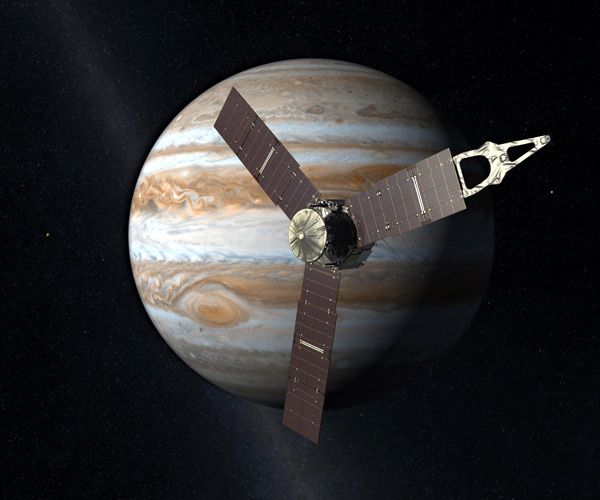
An artist's concept of NASA's Juno spacecraft orbiting Jupiter.
NASA / JPL - Caltech

Five Years Post-Launch, Juno Is at a Turning Point (Press Release - July 29)

Five years after departing Earth, and a month after slipping into orbit around Jupiter, NASA's Juno spacecraft is nearing a turning point. On July 31 at 12:41 p.m. PDT (3:41 p.m. EDT), Juno will reach the farthest point in its orbit of Jupiter for the first time, known as "apojove," 5 million miles (8.1 million kilometers) from the giant planet. After that point, Jupiter's gravitational grip on Juno will cause the spacecraft to begin falling back toward the planet for another pass, this time with its scientific eyes wide open.

The spacecraft is currently executing the first of two long orbits prior to beginning its science mission. Each capture orbit is nearly two months long -- quite the wait for the mission's eager team of scientists -- but it's nothing compared to the long wait the team endured on the trek to Jupiter.

Juno launched on Aug. 5, 2011. The spacecraft took a long, looping path around the inner solar system to set up an Earth flyby, in which our planet's gravity flung the spinning probe onward toward Jupiter.

"For five years we've been focused on getting to Jupiter. Now we're there, and we're concentrating on beginning dozens of flybys of Jupiter to get the science we're after," said Scott Bolton, Juno principal investigator at Southwest Research Institute in San Antonio.

Juno arrived at Jupiter on July 4, firing its main rocket engine as planned for 35 minutes. The flawless maneuver allowed Jupiter's gravity to capture the solar powered spacecraft into the first of two 53.4-day-long orbits, referred to as capture orbits. Following the capture orbits, Juno will fire its engine once more to shorten its orbital period to 14 days and begin its science mission.

But before that happens, on Aug. 27, Juno must finish its first lap around Jupiter, with a finish line that represents the mission's closest pass over the gas giant. During the encounter, Juno will skim past Jupiter at a mere 2,600 miles (4,200 kilometers) above the cloud tops.

Juno's science instruments were turned off during orbit insertion, to simplify spacecraft operations during that critical maneuver. In contrast, all the instruments will be collecting data during the Aug. 27 pass, which serves as a trial run before the mission gets to work collecting the precious data it came for.

"We're in an excellent state of health, with the spacecraft and all the instruments fully checked out and ready for our first up-close look at Jupiter," said Rick Nybakken, Juno project manager at NASA's Jet Propulsion Laboratory, Pasadena, California.

With its powerful suite of science instruments, Juno will probe Jupiter's deep structure, atmospheric circulation and the high-energy physics of its magnetic environment. What Juno finds there will reveal important clues to Jupiter's formation and evolution, along with insights about how our planetary system and others are built.

JPL manages the Juno mission for the principal investigator, Scott Bolton, of Southwest Research Institute in San Antonio. Juno is part of NASA's New Frontiers Program, which is managed at NASA's Marshall Space Flight Center in Huntsville, Alabama, for NASA's Science Mission Directorate. Caltech in Pasadena manages JPL for NASA.

Source: Jet Propulsion Laboratory

Friday, July 29, 2016

A Milestone Is Crossed In America's Effort to Touch the Sun (So to Speak)...

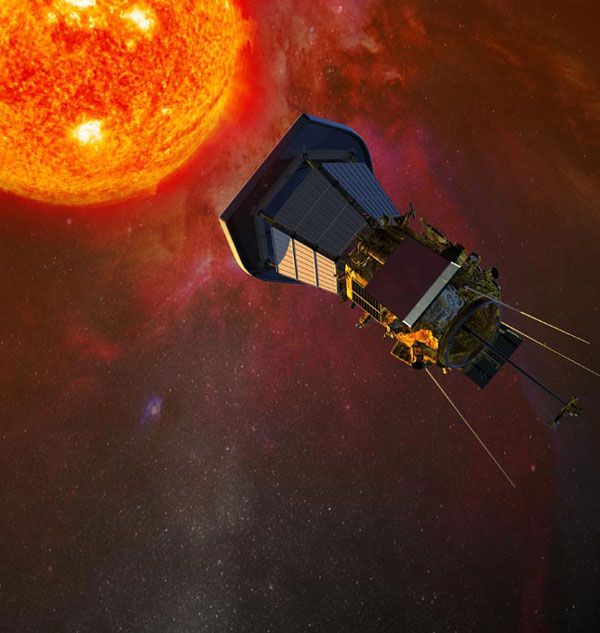
An artist's concept of NASA's Solar Probe Plus spacecraft approaching the sun.
JHU / APL

NASA’s Solar Probe Plus Mission Moves One Step Closer to Launch (News Release)

NASA’s Solar Probe Plus – the first mission that will fly into sun's upper atmosphere and “touch” the sun – has passed a design review, an important milestone leading to its anticipated summer 2018 launch. The successful review means the mission may now transition from formulation and design to final assembly and implementation. The spacecraft, as it appears in the image, currently includes the primary structure and propulsion system. Over the next phase of the mission, engineers at the Johns Hopkins Applied Physics Laboratory in Laurel, Maryland – which manages the mission and is building the spacecraft – will finish assembly and install the rest of the spacecraft systems and science instruments.

Solar Probe Plus is slated to launch during a 20-day window that opens July 31, 2018. The spacecraft will collect data on the mechanisms that heat the corona and accelerate the solar wind, a constant flow of charged particles from the sun. These are two processes with fundamental roles in the complex interconnected system linking the sun and near-Earth space – a system that can drive changes in our space weather and impact our satellites. Solar Probe Plus is part of NASA’s Living With a Star program, an initiative focused on aspects of the sun-Earth system that directly affect human lives and society. The program is managed by NASA’s Goddard Spaceflight Center in Greenbelt, Maryland.

Source: NASA.Gov

****

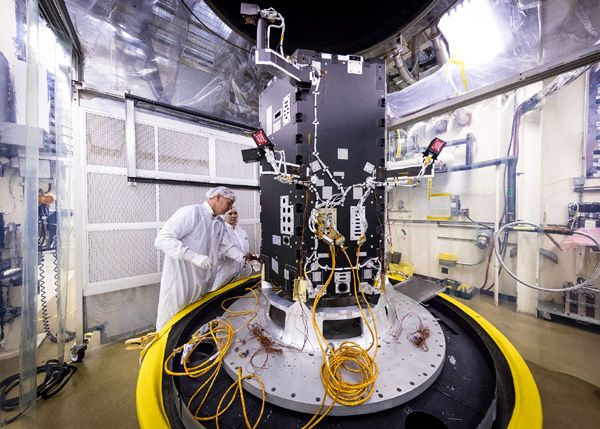
At the Johns Hopkins University Applied Physics Laboratory in Laurel, Maryland, technicians prepare the Solar Probe Plus spacecraft—which is still undergoing construction—for thermal vacuum tests that simulate conditions in space.
NASA / JHUAPL

Monday, July 25, 2016

Photos of the Day #2: Glimpses Of The Sand Fire From Afar...

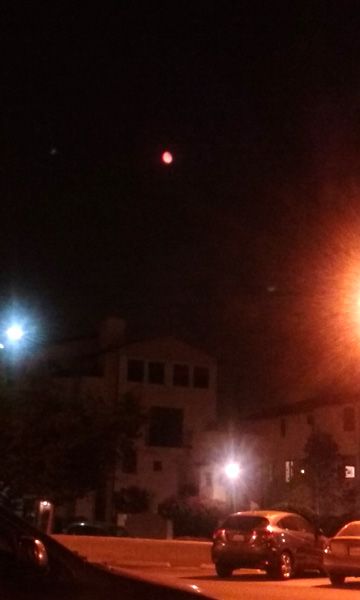
As seen from old town Pasadena, the Moon is tinted red by a cloud of smoke caused by the Sand Fire in Santa Clarita...on July 22, 2016.

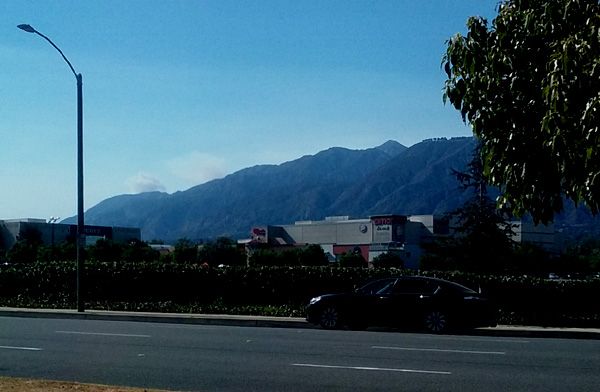
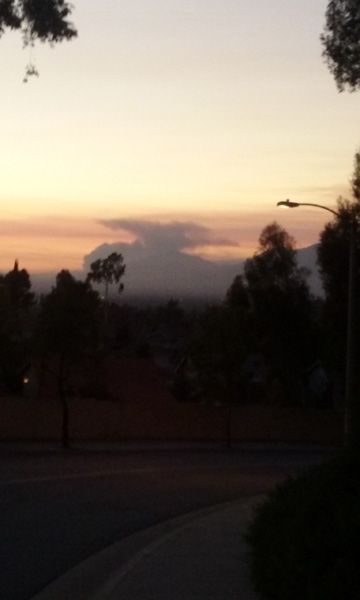
Just thought I'd share these pics that I took of the effects of the wildfire that's currently burning in the Santa Clarita Mountains north of Los Angeles. Known as the Sand Fire, this inferno has been a fascinating sight to see (just don't tell that to someone whose home was either destroyed or endangered by this ever-growing blaze) from 40 to 60 miles away. The photos above and directly below were taken when the fire began last Friday. The Moon is tinted red by the cloud of smoke hanging above old town Pasadena, while the cloud itself was an ominous sight to see from my house in West Covina located 60-plus miles away from the calamity.

The cloud of smoke caused by the Sand Fire is an ominous sight to see from my house in West Covina...on July 22, 2016.

The images shown below were taken yesterday. As seen from the Santa Anita Mall in Arcadia, the Sand Fire no longer leaves a huge cloud of smoke obscuring the skies over much of Southern California, but is still visible above the mountains in which it burns. The final photo below was taken from a street near my house in West Covina as I was heading to work in the evening. That cloud of smoke looks totally ominous...like something from the first (and good) Independence Day movie...

Much props to the firefighters working around the clock to put out this blaze.

A cloud of smoke is visible (towards the left of this image) behind the San Gabriel Mountains near Santa Anita Mall...on July 24, 2016.

The Sand Fire's cloud of smoke as seen from a street in West Covina 60-plus miles away...on July 24, 2016.

Saturday, July 23, 2016

Photo of the Day: About Pokémon Go...

Last week, I stumbled upon this funny pic on Facebook showcasing one landlord's take on the (currently) popular video game. Needless to say, this exemplifies why I've resisted downloading Pokémon Go to my Samsung phone and begin walking into traffic, getting stuck in trees and loitering inside cemeteries just to catch Pikachu and its goofy anime brethren. If I'm gonna nurture my obsession for something old school and geeky, it would be playing the classic Star Wars: X-Wing video game on my laptop for the umpteenth time. That is all.

This person isn't a fan of Pokémon Go.

Friday, July 22, 2016

Video of the Day: Enter Sandman...

So I was driving around for Lyft last weekend (I signed up with the rideshare company earlier this month) when the L.A. station KROQ (or it might have been ALT 98.7) played Metallica's "Enter Sandman" on the radio late at night. All I can say is, I forgot just how freakin' awesome this song is! Check out the music video below to get your heavy metal groove on.

Wednesday, July 20, 2016

(Two Habitable Alien Worlds?) Hubble Does It Again...

An artist's concept of potentially rocky exoplanets TRAPPIST-1b and TRAPPIST-1c orbiting their parent star.
NASA / ESA / STScI / J. de Wit (MIT)

NASA’s Hubble Telescope Makes First Atmospheric Study of Earth-Sized Exoplanets (Press Release)

Using NASA’s Hubble Space Telescope, astronomers have conducted the first search for atmospheres around temperate, Earth-sized planets beyond our solar system and found indications that increase the chances of habitability on two exoplanets.

Specifically, they discovered that the exoplanets TRAPPIST-1b and TRAPPIST-1c, approximately 40 light-years away, are unlikely to have puffy, hydrogen-dominated atmospheres usually found on gaseous worlds.

“The lack of a smothering hydrogen-helium envelope increases the chances for habitability on these planets,” said team member Nikole Lewis of the Space Telescope Science Institute (STScI) in Baltimore. “If they had a significant hydrogen-helium envelope, there is no chance that either one of them could potentially support life because the dense atmosphere would act like a greenhouse.”

Julien de Wit of the Massachusetts Institute of Technology in Cambridge, Massachusetts, led a team of scientists to observe the planets in near-infrared light using Hubble’s Wide Field Camera 3. They used spectroscopy to decode the light and reveal clues to the chemical makeup of an atmosphere. While the content of the atmospheres is unknown and will have to await further observations, the low concentration of hydrogen and helium has scientists excited about the implications.

“These initial Hubble observations are a promising first step in learning more about these nearby worlds, whether they could be rocky like Earth, and whether they could sustain life,” says Geoff Yoder, acting associate administrator for NASA’s Science Mission Directorate in Washington. “This is an exciting time for NASA and exoplanet research.”

The planets orbit a red dwarf star at least 500 million years old, in the constellation of Aquarius. They were discovered in late 2015 through a series of observations by the TRAnsiting Planets and PlanetesImals Small Telescope (TRAPPIST), a Belgian robotic telescope located at ESA’s (European Space Agency’s) La Silla Observatory in Chile.

TRAPPIST-1b completes a circuit around its red dwarf star in 1.5 days and TRAPPIST-1c in 2.4 days. The planets are between 20 and 100 times closer to their star than the Earth is to the sun. Because their star is so much fainter than our sun, researchers think that at least one of the planets, TRAPPIST-1c, may be within the star’s habitable zone, where moderate temperatures could allow for liquid water to pool.

On May 4, astronomers took advantage of a rare simultaneous transit, when both planets crossed the face of their star within minutes of each other, to measure starlight as it filtered through any existing atmosphere. This double-transit, which occurs only every two years, provided a combined signal that offered simultaneous indicators of the atmospheric characters of the planets.

The researchers hope to use Hubble to conduct follow-up observations to search for thinner atmospheres, composed of elements heavier than hydrogen, like those of Earth and Venus.

“With more data, we could perhaps detect methane or see water features in the atmospheres, which would give us estimates of the depth of the atmospheres,” said Hannah Wakeford, the paper’s second author, at NASA’s Goddard Space Flight Center in Greenbelt, Maryland.

Observations from future telescopes, including NASA’s James Webb Space Telescope, will help determine the full composition of these atmospheres and hunt for potential biosignatures, such as carbon dioxide and ozone, in addition to water vapor and methane. Webb also will analyze a planet’s temperature and surface pressure – key factors in assessing its habitability.

“These Earth-sized planets are the first worlds that astronomers can study in detail with current and planned telescopes to determine whether they are suitable for life,” said de Wit. “Hubble has the facility to play the central atmospheric pre-screening role to tell astronomers which of these Earth-sized planets are prime candidates for more detailed study with the Webb telescope.”

The results of the study appear in the July 20 issue of the journal Nature.

The Hubble Space Telescope is a project of international cooperation between NASA and ESA. Goddard manages the telescope and STScI conducts Hubble science operations. STScI is operated for NASA by the Association of Universities for Research in Astronomy in Washington.

****

Tuesday, July 19, 2016

Moving One Step Closer to Developing America's Next Mars Orbiter...

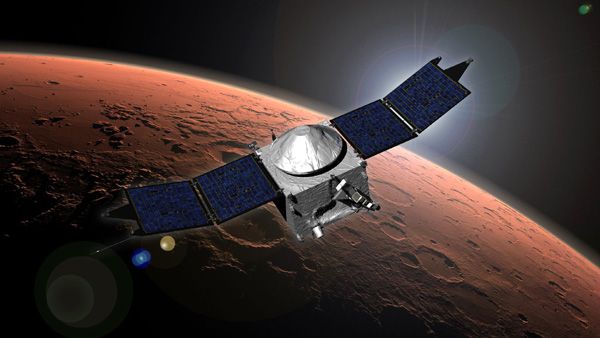
A composite image showing NASA's MAVEN spacecraft in orbit around Mars.
NASA

NASA Selects Five Mars Orbiter Concept Studies (Press Release - July 18)

NASA has selected five U.S. aerospace companies to conduct concept studies for a potential future Mars orbiter mission. Such a mission would continue key capabilities including telecommunications and global high-resolution imaging in support of the agency’s Journey to Mars.

The companies contracted for these four-month studies are: The Boeing Company in Huntington Beach, California; Lockheed Martin Space Systems in Denver; Northrop Grumman Aerospace Systems in Redondo Beach, California; Orbital ATK in Dulles, Virginia; and Space Systems/Loral in Palo Alto, California.

“We’re excited to continue planning for the next decade of Mars exploration,” said Geoffrey Yoder, acting associate administrator for NASA’s Science Mission Directorate in Washington.

The concept studies will address how a potential new Mars orbiter mission could best provide communications, imaging and operational capabilities. They also will assess the possibilities for supporting additional scientific instruments and functionalities, in addition to optical communications. The orbiter concept under study would take advantage of U.S. industry’s technology capacities by using solar electric propulsion to provide flexible launch, mission and orbit capabilities.

The Mars Exploration Program Analysis Group, an organization designed to provide input to NASA from the Mars research science community, published a report six months ago on recommended science objectives for a Mars orbiter. These studies will provide input for assessing the feasibility of addressing these objectives. NASA also is pursuing partnership interest in contributing to this potential mission.

NASA's Jet Propulsion Laboratory (JPL) in Pasadena, California, is managing the concept studies under the direction of the agency’s Mars Exploration Program.

NASA is on an ambitious Journey to Mars that includes sending humans to the Red Planet in the 2030s. The agency’s robotic spacecraft are leading the way, with two active rovers, three active orbiters, the planned launch of the InSight lander in 2018, and development of the Mars 2020 rover.

****

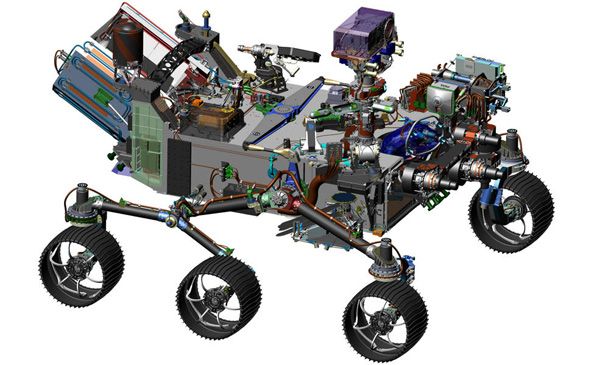
A computer-generated drawing of NASA's Mars 2020 rover.
NASA / JPL - Caltech

Monday, July 18, 2016

Kepler Update: Add 104 More Alien Worlds to Its List of Discoveries...

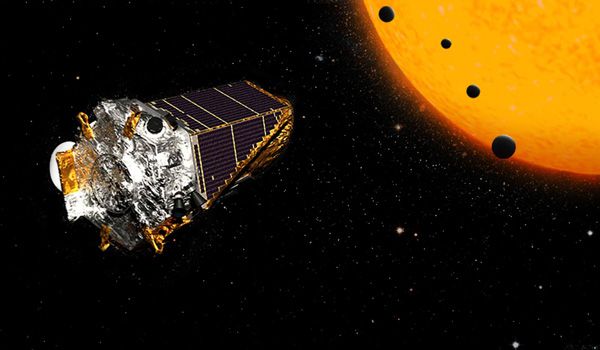
An artist's concept of NASA's Kepler spacecraft observing four rocky exoplanets that orbit the M dwarf star K2-72.
NASA / JPL - Caltech

NASA's Kepler Confirms 100+ Exoplanets During Its K2 Mission (Press Release)

An international team of astronomers has discovered and confirmed a treasure trove of new worlds using NASA's Kepler spacecraft on its K2 mission. Out of 197 initial planet candidates, scientists have confirmed 104 planets outside our solar system. Among the confirmed is a planetary system comprising four promising planets that could be rocky.

These four planets, all between 20 and 50 percent larger than Earth by diameter, are orbiting the M dwarf star K2-72, found 181 light-years away in the direction of the Aquarius constellation. The host star is less than half the size of the sun and less bright. The planets' orbital periods range from five-and-a-half to 24 days, and two of them may experience irradiation levels from their star comparable to those on Earth. Despite their tight orbits -- closer than Mercury's orbit around our sun -- the possibility that life could arise on a planet around such a star cannot be ruled out, according to lead author Ian Crossfield, a Sagan Fellow at the University of Arizona's Lunar and Planetary Laboratory in Tucson.

The researchers achieved this extraordinary "roundup" of exoplanets by combining data with follow-up observations by Earth-based telescopes including the North Gemini telescope and the W. M. Keck Observatory in Hawaii, the Automated Planet Finder of the University of California Observatories, and the Large Binocular Telescope operated by the University of Arizona. The discoveries are published online in the Astrophysical Journal Supplement Series.

Both Kepler and its K2 mission discover new planets by measuring the subtle dip in a star's brightness caused by a planet passing in front of its star. In its initial mission, Kepler surveyed just one patch of sky in the northern hemisphere, determining the frequency of planets whose size and temperature might be similar to Earth orbiting stars similar to our sun. In the spacecraft's extended mission in 2013, it lost its ability to precisely stare at its original target area, but a brilliant fix created a second life for the telescope that is proving scientifically fruitful.

After the fix, Kepler started its K2 mission, which has provided an ecliptic field of view with greater opportunities for Earth-based observatories in both the northern and southern hemispheres. Additionally, the K2 mission is entirely community-driven with all targets proposed by the scientific community.

Because it covers more of the sky, the K2 mission is capable of observing a larger fraction of cooler, smaller, red-dwarf type stars, and because such stars are much more common in the Milky Way than sun-like stars, nearby stars will predominantly be red dwarfs.

"An analogy would be to say that Kepler performed a demographic study, while the K2 mission focuses on the bright and nearby stars with different types of planets," said Crossfield. "The K2 mission allows us to increase the number of small, red stars by a factor of 20, significantly increasing the number of astronomical 'movie stars' that make the best systems for further study."

To validate candidate planets identified by K2, the researchers obtained high-resolution images of the planet-hosting stars as well as high-resolution optical spectroscopy. By dispersing the starlight as through a prism, the spectrographs allowed the researchers to infer the physical properties of a star -- such as mass, radius and temperature -- from which the properties of any planets orbiting it can be inferred.

These observations represent a natural stepping stone from the K2 mission to NASA's other upcoming exoplanet missions, such as the Transiting Exoplanet Survey Satellite and James Webb Space Telescope.

"This bountiful list of validated exoplanets from the K2 mission highlights the fact that the targeted examination of bright stars and nearby stars along the ecliptic is providing many interesting new planets," said Steve Howell, project scientist for the K2 mission at NASA's Ames Research Center in Moffett Field, California. "These targets allow the astronomical community ease of follow-up and characterization, providing a few gems for first study by the James Webb Space Telescope, which could perhaps tell us about the planets' atmospheres."

This work was performed in part under contract with the Jet Propulsion Laboratory funded by NASA through the Sagan Fellowship Program executed by the NASA Exoplanet Science Institute.

NASA Ames manages the Kepler and K2 missions for NASA's Science Mission Directorate. JPL in Pasadena, California, managed Kepler mission development. Ball Aerospace & Technologies Corporation operates the flight system with support from the Laboratory for Atmospheric and Space Physics at the University of Colorado at Boulder.

Source: Jet Propulsion Laboratory

Friday, July 15, 2016

NASA Is One Step Closer to Building Curiosity's Successor...

A computer-generated drawing of NASA's Mars 2020 rover.
NASA / JPL - Caltech

NASA's Next Mars Rover Progresses Toward 2020 Launch (Press Release)

After an extensive review process and passing a major development milestone, NASA is ready to proceed with final design and construction of its next Mars rover, currently targeted to launch in the summer of 2020 and arrive on the Red Planet in February 2021.

The Mars 2020 rover will investigate a region of Mars where the ancient environment may have been favorable for microbial life, probing the Martian rocks for evidence of past life. Throughout its investigation, it will collect samples of soil and rock and cache them on the surface for potential return to Earth by a future mission.

“The Mars 2020 rover is the first step in a potential multi-mission campaign to return carefully selected and sealed samples of Martian rocks and soil to Earth,” said Geoffrey Yoder, acting associate administrator of NASA’s Science Mission Directorate in Washington. “This mission marks a significant milestone in NASA’s Journey to Mars – to determine whether life has ever existed on Mars, and to advance our goal of sending humans to the Red Planet.”

To reduce risk and provide cost savings, the 2020 rover will look much like its six-wheeled, one-ton predecessor, Curiosity, but with an array of new science instruments and enhancements to explore Mars as never before. For example, the rover will conduct the first investigation into the usability and availability of Martian resources, including oxygen, in preparation for human missions.

Mars 2020 will carry an entirely new subsystem to collect and prepare Martian rocks and soil samples that includes a coring drill on its arm and a rack of sample tubes. About 30 of these sample tubes will be deposited at select locations for return on a potential future sample-retrieval mission. In laboratories on Earth, specimens from Mars could be analyzed for evidence of past life on Mars and possible health hazards for future human missions.

Two science instruments mounted on the rover’s robotic arm will be used to search for signs of past life and determine where to collect samples by analyzing the chemical, mineral, physical and organic characteristics of Martian rocks. On the rover’s mast, two science instruments will provide high-resolution imaging and three types of spectroscopy for characterizing rocks and soil from a distance, also helping to determine which rock targets to explore up close.

A suite of sensors on the mast and deck will monitor weather conditions and the dust environment, and a ground-penetrating radar will assess sub-surface geologic structure.

The Mars 2020 rover will use the same sky crane landing system as Curiosity, but will have the ability to land in more challenging terrain with two enhancements, making more rugged sites eligible as safe landing candidates.

"By adding what’s known as range trigger, we can specify where we want the parachute to open, not just at what velocity we want it to open,” said Allen Chen, Mars 2020 entry, descent and landing lead at NASA's Jet Propulsion Laboratory (JPL) in Pasadena, California. "That shrinks our landing area by nearly half."

Terrain-relative navigation on the new rover will use onboard analysis of downward-looking images taken during descent, matching them to a map that indicates zones designated unsafe for landing.

"As it is descending, the spacecraft can tell whether it is headed for one of the unsafe zones and divert to safe ground nearby,” said Chen. "With this capability, we can now consider landing areas with unsafe zones that previously would have disqualified the whole area. Also, we can land closer to a specific science destination, for less driving after landing."

There will be a suite of cameras and a microphone that will capture the never-before-seen or heard imagery and sounds of the entry, descent and landing sequence. Information from the descent cameras and microphone will provide valuable data to assist in planning future Mars landings, and make for thrilling video.

"Nobody has ever seen what a parachute looks like as it is opening in the Martian atmosphere,” said JPL's David Gruel, assistant flight system manager for the Mars 2020 mission. “So this will provide valuable engineering information.”

Microphones have flown on previous missions to Mars, including NASA's Phoenix Mars Lander in 2008, but never have actually been used on the surface of the Red Planet.

"This will be a great opportunity for the public to hear the sounds of Mars for the first time, and it could also provide useful engineering information," said Mars 2020 Deputy Project Manager Matt Wallace of JPL.

Once a mission receives preliminary approval, it must go through four rigorous technical and programmatic reviews – known as Key Decision Points (KDP) — to proceed through the phases of development prior to launch. Phase A involves concept and requirements definition, Phase B is preliminary design and technology development, Phase C is final design and fabrication, and Phase D is system assembly, testing, and launch. Mars 2020 has just passed its KDP-C milestone.

"Since Mars 2020 is leveraging the design and some spare hardware from Curiosity, a significant amount of the mission's heritage components have already been built during Phases A and B,” said George Tahu, Mars 2020 program executive at NASA Headquarters in Washington. "With the KDP to enter Phase C completed, the project is proceeding with final design and construction of the new systems, as well as the rest of the heritage elements for the mission."

The Mars 2020 mission is part of NASA's Mars Exploration Program. Driven by scientific discovery, the program currently includes two active rovers and three NASA spacecraft orbiting Mars. NASA also plans to launch a stationary Mars lander in 2018, InSight, to study the deep interior of Mars.

JPL manages the Mars 2020 project and the Mars Exploration Program for NASA's Science Mission Directorate in Washington.

Source: NASA.Gov