Thursday, June 30, 2016

One of the Seven Wonders of the Modern World Gets an Upgrade...

The COSCO Shipping Panama is the first cargo ship to officially pass through the Panama Canal's new set of locks...on June 26, 2016.
Photo courtesy of ThePanamaCanal - Twitter.com

Just thought I'd end this month by sharing these photos of the Panama Canal after a new set of locks opened at the man-made waterway last Sunday. With construction starting in 2007 and having a total price tag of more than $5.4 billion, this expansion will allow much bigger cargo ships (known as Neo-Panamax vessels...which can carry up to 14,000 containers onboard) to travel through this 102-year-old canal on their way from the Atlantic Ocean to the Pacific, or vice versa. China is planning to start construction soon on a new sea route rivaling the Panama Canal that will run through Nicagarua. But 1.) It will be decades before this 173-mile-long canal finally opens, and 2.) I really don't have much respect for the Chinese (despite the fact that it was a Chinese container ship, the COSCO Shipping Panama, that was the first vessel to officially venture through the new locks last weekend). So major props to the Panamanians for upgrading the engineering marvel that runs through their country!

The Baroque Valetta passes through the Panama Canal's new set of locks during a trial run on June 9, 2016.

The Baroque Valetta passes through the Panama Canal's new set of locks during a trial run on June 9, 2016.

An aerial view of the new set of locks at the Panama Canal.

Wednesday, June 29, 2016

Dawn Update: Signs of a Dwarf Planet's Watery Past?

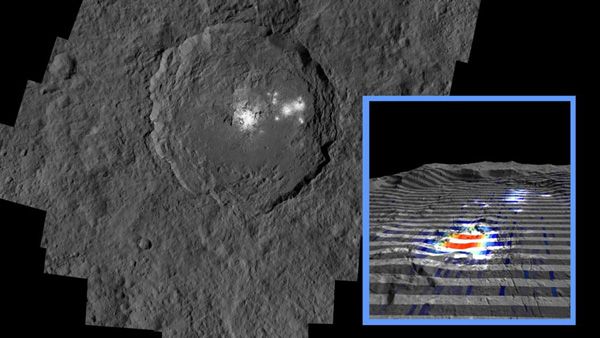
Images of Occator on dwarf Planet Ceres...with bright spots that may have been created through hydrothermal activity visible inside the crater.
NASA / JPL - Caltech / UCLA / MPS / DLR / IDA

Recent Hydrothermal Activity May Explain Ceres' Brightest Area (Press Release)

The brightest area on Ceres, located in the mysterious Occator Crater, has the highest concentration of carbonate minerals ever seen outside Earth, according to a new study from scientists on NASA's Dawn mission. The study, published online in the journal Nature, is one of two new papers about the makeup of Ceres.

"This is the first time we see this kind of material elsewhere in the solar system in such a large amount," said Maria Cristina De Sanctis, lead author and principal investigator of Dawn's visible and infrared mapping spectrometer. De Sanctis is based at the National Institute of Astrophysics, Rome.

At about 80 million years old, Occator is considered a young crater. It is 57 miles (92 kilometers) wide, with a central pit about 6 miles (10 kilometers) wide. A dome structure at the center, covered in highly reflective material, has radial and concentric fractures on and around it.

De Sanctis' study finds that the dominant mineral of this bright area is sodium carbonate, a kind of salt found on Earth in hydrothermal environments. This material appears to have come from inside Ceres, because an impacting asteroid could not have delivered it. The upwelling of this material suggests that temperatures inside Ceres are warmer than previously believed. Impact of an asteroid on Ceres may have helped bring this material up from below, but researchers think an internal process played a role as well.

More intriguingly, the results suggest that liquid water may have existed beneath the surface of Ceres in recent geological time. The salts could be remnants of an ocean, or localized bodies of water, that reached the surface and then froze millions of years ago.

"The minerals we have found at the Occator central bright area require alteration by water," De Sanctis said. "Carbonates support the idea that Ceres had interior hydrothermal activity, which pushed these materials to the surface within Occator."

The spacecraft's visible and infrared mapping spectrometer examines how various wavelengths of sunlight are reflected by the surface of Ceres. This allows scientists to identify minerals that are likely producing those signals. The new results come from the infrared mapping component, which examines Ceres in wavelengths of light too long for the eye to see.

Last year, in a Nature study, De Sanctis' team reported that the surface of Ceres contains ammoniated phyllosilicates, or clays containing ammonia. Because ammonia is abundant in the outer solar system, this finding introduced the idea that Ceres may have formed near the orbit of Neptune and migrated inward. Alternatively, Ceres may have formed closer to its current position between Mars and Jupiter, but with material accumulated from the outer solar system.

The new results also find ammonia-bearing salts -- ammonium chloride and/or ammonium bicarbonate -- in Occator Crater. The carbonate finding further reinforces Ceres' connection with icy worlds in the outer solar system. Ammonia, in addition to sodium carbonate and sodium bicarbonate found at Occator, has been detected in the plumes of Enceladus, an icy moon of Saturn known for its geysers erupting from fissures in its surface. Such materials make Ceres interesting for the study of astrobiology.

"We will need to research whether Ceres' many other bright areas also contain these carbonates," De Sanctis said.

A separate Nature study in 2015 by scientists with the Dawn framing camera team hypothesized that the bright areas contain a different kind of salt: magnesium sulfate. But the new findings suggest sodium carbonate is the more likely constituent.

"It's amazing how much we have been able to learn about Ceres' interior from Dawn's observations of chemical and geophysical properties. We expect more such discoveries as we mine this treasure trove of data," said Carol Raymond, deputy principal investigator for the Dawn mission, based at NASA's Jet Propulsion Laboratory, Pasadena, California.

Dawn science team members have also published a new study about the makeup of the outer layer of Ceres in Nature Geoscience, based on images from Dawn's framing camera. This study, led by Michael Bland of the U.S. Geological Survey, Flagstaff, Arizona, finds that most of Ceres' largest craters are more than 1 mile (2 kilometers) deep relative to surrounding terrain, meaning they have not deformed much over billions of years. These significant depths suggest that Ceres' subsurface is no more than 40 percent ice by volume, and the rest may be a mixture of rock and low-density materials such as salts or chemical compounds called clathrates. The appearance of a few shallow craters suggests that there could be variations in ice and rock content in the subsurface.

Dawn's mission is managed by JPL for NASA's Science Mission Directorate in Washington. Dawn is a project of the directorate's Discovery Program, managed by NASA's Marshall Space Flight Center in Huntsville, Alabama. UCLA is responsible for overall Dawn mission science. Orbital ATK Inc., in Dulles, Virginia, designed and built the spacecraft. The German Aerospace Center, Max Planck Institute for Solar System Research, Italian Space Agency and Italian National Astrophysical Institute are international partners on the mission team.

Source: Jet Propulsion Laboratory

Monday, June 27, 2016

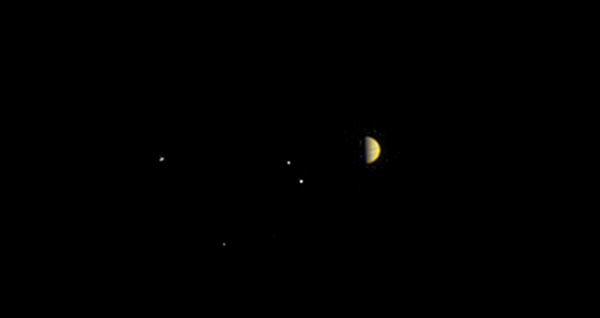
Photo of the Day: A Jovian World (and Its Moons) from 8.6 Million Miles Away...

Jupiter and its four Galilean moons as seen by NASA's Juno spacecraft at a distance of 6.8 million miles (10.9 million kilometers) away...on June 21, 2016.
NASA / JPL - Caltech / SwRI / MSSS

Juno on Jupiter's Doorstep (Press Release)

NASA's Juno spacecraft obtained this color view on June 21, 2016, at a distance of 6.8 million miles (10.9 million kilometers) from Jupiter. Juno will arrive at Jupiter on July 4.

As Juno makes its initial approach, the giant planet's four largest moons -- Io, Europa, Ganymede and Callisto -- are visible, and the alternating light and dark bands of the planet's clouds are just beginning to come into view.

Juno is approaching over Jupiter's north pole, affording the spacecraft a unique perspective on the Jupiter system. Previous missions that imaged Jupiter on approach saw the system from much lower latitudes, closer to the planet's equator.

The scene was captured by the mission's imaging camera, called JunoCam, which is designed to acquire high resolution views of features in Jupiter's atmosphere from very close to the planet.

NASA's Jet Propulsion Laboratory, Pasadena, Calif., manages the Juno mission for the principal investigator, Scott Bolton, of Southwest Research Institute in San Antonio. The Juno mission is part of the New Frontiers Program managed at NASA's Marshall Space Flight Center in Huntsville, Ala. Lockheed Martin Space Systems, Denver, built the spacecraft. JPL is a division of the California Institute of Technology in Pasadena.

Source: NASA.Gov

Saturday, June 25, 2016

Hubble Is Set to Make More Awesome Cosmic Discoveries thru 2021...

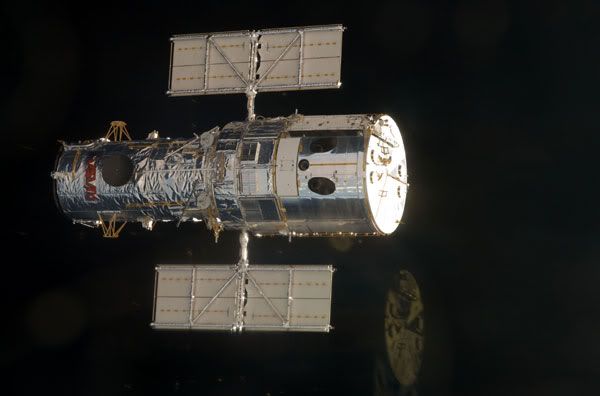
NASA's Hubble Space Telescope before it is docked with the orbiter Atlantis during space shuttle flight STS-125, on May 13, 2009.
NASA

NASA Extends Hubble Space Telescope Science Operations Contract (Press Release - June 23)

NASA is contractually extending science operations for its Hubble Space Telescope an additional five years. The agency awarded a sole source contract extension Thursday to the Association of Universities for Research in Astronomy for continued Hubble science operations support at the Space Telescope Science Institute in Baltimore.

This action will extend the period of performance from July 1 through June 30, 2021. The contract value will increase by approximately $196.3 million for a total contract value of $2.03 billion.

This contract extension covers the work necessary to continue the science program of the Hubble mission by the Space Telescope Science Institute. The support includes the products and services required to execute science system engineering, science ground system development, science operations, science research, grants management and public outreach support for Hubble and data archive support for missions in the Mikulski Archive for Space Telescopes.

After the final space shuttle servicing mission to the telescope in 2009, Hubble is better than ever. Hubble is expected to continue to provide valuable data into the 2020’s, securing its place in history as an outstanding general purpose observatory in areas ranging from our solar system to the distant universe.

In 2018, NASA’s James Webb Space Telescope will be launched into space as the premier observatory of the next decade, serving astronomers worldwide to build on Hubble’s legacy of discoveries and help unlock some of the biggest mysteries of the universe.

****

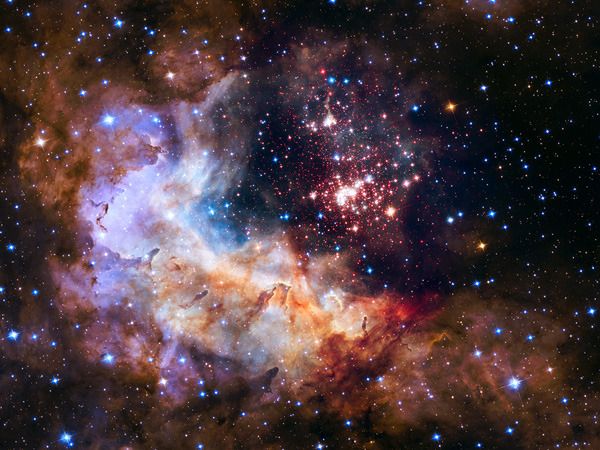
An image of a stellar breeding ground known as Gum 29...taken by NASA's Hubble Space Telescope for the 25th anniversary of its launch aboard space shuttle Discovery.
NASA / ESA

Friday, June 24, 2016

New Horizons Update: A Giant Chasm 3 Billion Miles Away...

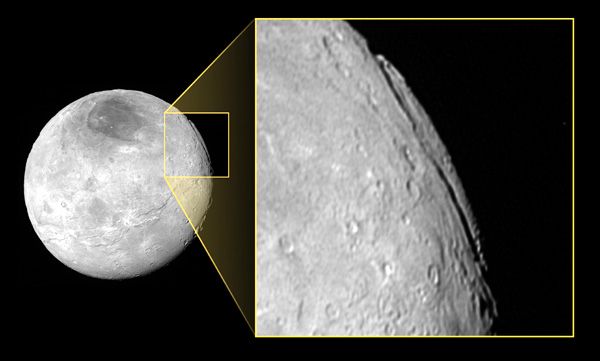
An image of Charon taken by NASA's New Horizons spacecraft on July 14, 2015...with a close-up view of the moon's Argo Chasma canyon.
NASA / JHUAPL / SwRI

A ‘Super Grand Canyon’ on Pluto’s Moon Charon (Press Release - June 23)

Pluto’s largest moon, Charon, is home to an unusual canyon system that’s far longer and deeper than the Grand Canyon.

The inset above magnifies a portion of the eastern limb in the global view of Charon at left, imaged by NASA’s New Horizons spacecraft several hours before its closest approach on July 14, 2015. A deep canyon informally named Argo Chasma is seen grazing the limb. The section of it seen here measures approximately 185 miles (300 kilometers) long. As far as New Horizons scientists can tell, Argo’s total length is approximately 430 miles (700 kilometers) long – for comparison, Arizona’s Grand Canyon is 280 miles (450 kilometers) long.

At this fortuitous viewing angle the canyon is seen edge-on, and at the northern end of the canyon its depth can be easily gauged. Based on this and other images taken around the same time, New Horizons scientists estimate Argo Chasma to be as deep as 5.5 miles (9 kilometers), which is more than five times the depth of the Grand Canyon. There appear to be locations along the canyon’s length where sheer cliffs reaching several miles high occur, and which could potentially rival Verona Rupes on Uranus’ moon Miranda (which is at least 3 miles, or 5 kilometers, high) for the title of tallest known cliff face in the solar system.

The image was obtained by New Horizons’ Long Range Reconnaissance Imager (LORRI) at a resolution of approximately 1.45 miles (2.33 kilometers) per pixel. It was taken at a range of approximately 289,000 miles (466,000 kilometers) from Charon, 9 hours and 22 minutes before New Horizons’ closest approach to Charon on July 14, 2015.

Source: NASA.Gov

Thursday, June 23, 2016

In the Home Stretch: NASA Prepares for Juno's July 4 Arrival at Jupiter...

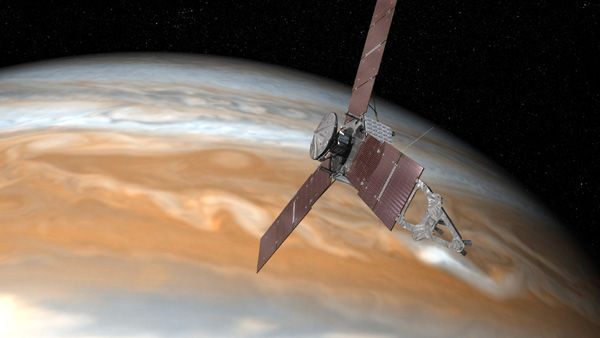
An artist's concept of NASA's Juno spacecraft orbiting Jupiter.
NASA / JPL - Caltech

NASA’s Juno Spacecraft to Risk Jupiter’s Fireworks for Science (Press Release - June 16)

On July 4, NASA will fly a solar-powered spacecraft the size of a basketball court within 2,900 miles (4,667 kilometers) of the cloud tops of our solar system’s largest planet.

As of Thursday, Juno is 18 days and 8.6 million miles (13.8 million kilometers) from Jupiter. On the evening of July 4, Juno will fire its main engine for 35 minutes, placing it into a polar orbit around the gas giant. During the flybys, Juno will probe beneath the obscuring cloud cover of Jupiter and study its auroras to learn more about the planet's origins, structure, atmosphere and magnetosphere.

"At this time last year our New Horizons spacecraft was closing in for humanity’s first close views of Pluto,” said Diane Brown, Juno program executive at NASA Headquarters in Washington. “Now, Juno is poised to go closer to Jupiter than any spacecraft ever before to unlock the mysteries of what lies within.”

A series of 37 planned close approaches during the mission will eclipse the previous record for Jupiter set in 1974 by NASA’s Pioneer 11 spacecraft of 27,000 miles (43,000 kilometers). Getting this close to Jupiter does not come without a price -- one that will be paid each time Juno's orbit carries it toward the swirling tumult of orange, white, red and brown clouds that cover the gas giant.

"We are not looking for trouble, we are looking for data," said Scott Bolton, principal investigator of Juno from the Southwest Research Institute in San Antonio. "Problem is, at Jupiter, looking for the kind of data Juno is looking for, you have to go in the kind of neighborhoods where you could find trouble pretty quick."

The source of potential trouble can be found inside Jupiter itself. Well below the Jovian cloud tops is a layer of hydrogen under such incredible pressure it acts as an electrical conductor. Scientists believe that the combination of this metallic hydrogen along with Jupiter's fast rotation -- one day on Jupiter is only 10 hours long -- generates a powerful magnetic field that surrounds the planet with electrons, protons and ions traveling at nearly the speed of light. The endgame for any spacecraft that enters this doughnut-shaped field of high-energy particles is an encounter with the harshest radiation environment in the solar system.

"Over the life of the mission, Juno will be exposed to the equivalent of over 100 million dental X-rays," said Rick Nybakken, Juno's project manager from NASA's Jet Propulsion Laboratory (JPL) in Pasadena, California. "But, we are ready. We designed an orbit around Jupiter that minimizes exposure to Jupiter’s harsh radiation environment. This orbit allows us to survive long enough to obtain the tantalizing science data that we have traveled so far to get.”

Juno's orbit resembles a flattened oval. Its design is courtesy of the mission's navigators, who came up with a trajectory that approaches Jupiter over its north pole and quickly drops to an altitude below the planet's radiation belts as Juno races toward Jupiter's south pole. Each close flyby of the planet is about one Earth day in duration. Then Juno's orbit will carry the spacecraft below its south pole and away from Jupiter, well beyond the reach of harmful radiation.

While Juno is replete with special radiation-hardened electrical wiring and shielding surrounding its myriad of sensors, the highest profile piece of armor Juno carries is a first-of-its-kind titanium vault, which contains the spacecraft's flight computer and the electronic hearts of many of its science instruments. Weighing in at almost 400 pounds (172 kilograms), the vault will reduce the exposure to radiation by 800 times of that outside of its titanium walls.

Without the vault, Juno’s electronic brain would more than likely fry before the end of the very first flyby of the planet. But, while 400 pounds of titanium can do magical things, it can't do it forever in an extreme radiation environment like that on Jupiter. The quantity and energy of the high-energy particles is just too much. However, Juno’s special orbit allows the radiation dose and the degradation to accumulate slowly, allowing Juno to do a remarkable amount of science for 20 months.

“Over the course of the mission, the highest energy electrons will penetrate the vault, creating a spray of secondary photons and particles,” said Heidi Becker, Juno’s Radiation Monitoring Investigation lead. “The constant bombardment will break the atomic bonds in Juno’s electronics.”

The Juno spacecraft launched Aug. 5, 2011 from Cape Canaveral, Florida. JPL manages the Juno mission for the principal investigator, Scott Bolton, of Southwest Research Institute in San Antonio. Juno is part of NASA's New Frontiers Program, which is managed at NASA's Marshall Space Flight Center in Huntsville, Alabama, for NASA's Science Mission Directorate. Lockheed Martin Space Systems, Denver, built the spacecraft. The California Institute of Technology in Pasadena manages JPL for NASA.

****

Tuesday, June 21, 2016

Image of the Day: Destroy the Relentless!

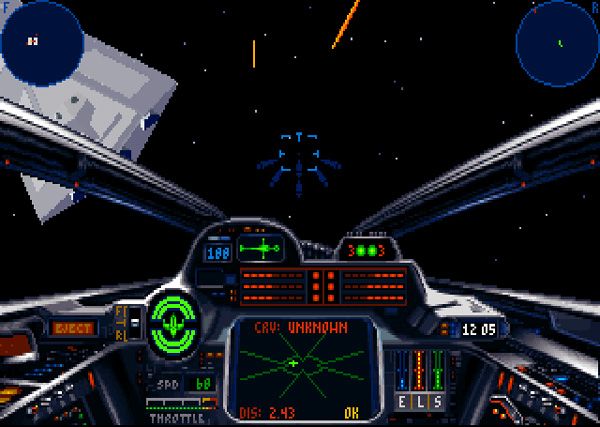
Just thought I'd share this random screenshot that I took when I played the classic Star Wars: X-Wing video game on my laptop last weekend. This image was captured when I was on the mission where I had to use a B-Wing fighter to take out the Star Destroyer Relentless (Tour of Duty 5, Mission 18). Needless to say, this is one of my favorite missions... In fact, I like flying all of the B-Wing sorties where I have to destroy an Imperial capital ship. This involves B-Wing Historical Mission 5 (where I have to neutralize the Imperial frigate Shrike), the Relentless sortie and Tour of Duty 5, Mission 20b (where I have to help eliminate four Imperial frigates—the Fear, Fury, Spite and Hate—that arrive to attack two Calamari Cruisers, the Yali and Maria, on their way to planet Hoth). Needless to say, I'll never get tired of playing X-Wing! Thanks, LucasArts.

A screenshot I took as I attacked the Star Destroyer Relentless (upper left) during Tour of Duty 5, Mission 18 in the STAR WARS: X-WING video game.

Sunday, June 19, 2016

Looks Like the Summer of 2010 Can Now Be Forgotten...

The Cleveland Cavaliers pose for a team photo after defeating the Golden State Warriors, 93-89, in Game 7 to win the NBA Finals...on June 19, 2016.
NBA

Much props to LeBron James for making history by leading the Cleveland Cavaliers to their first franchise championship tonight. Steph Curry and the Golden State Warriors' 73-9 regular season was officially rendered moot as the Cavs became the first NBA team to come back from a 3-1 series deficit to win the Finals. But I'm pretty sure the majority of you reading this watched Game 7, so there's no point in bringing up stats that you already know. LeBron should stand proud... He made up for the debacle that was 2010's The Decision.

Rumor has it that LeBron might possibly go to the Lakers or back to Miami now that he won a major sports title for Cleveland, which hasn't gotten one for 52 years (the last championship being by the Cleveland Browns in 1964...two years before the Super Bowl was created by the NFL). All I can say is, King James going to the Lake Show will make up for (sort of) his boss Dan Gilbert fucking things up for Kobe when the Black Mamba lost his chance to win a 6th ring after Chris Paul's trade to the Lakers was blocked in 2011...courtesy of Gilbert writing a letter to then-NBA commissioner David Stern and having him nix the deal. Bastards. Carry on.

The 1995-'96 Chicago Bulls is still the greatest team in NBA history.

Saturday, June 18, 2016

Kepler Update: Another 'Tatooine' World Has Been Discovered!

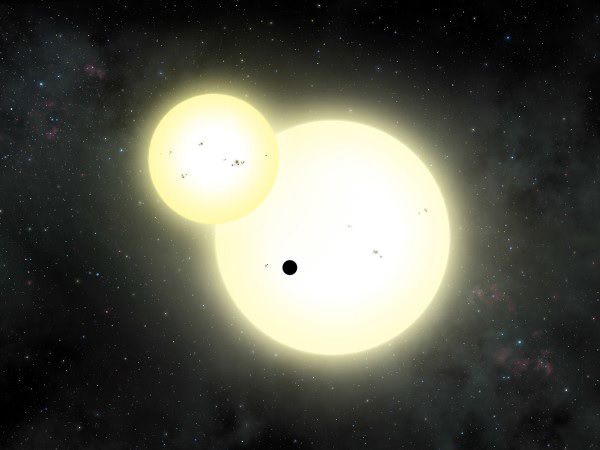
An artist's concept of the exoplanet Kepler-1647b orbiting its two suns.
Lynette Cook

New Planet Is Largest Discovered That Orbits Two Suns (Press Release - June 13)

If you cast your eyes toward the constellation Cygnus, you’ll be looking in the direction of the largest planet yet discovered around a double-star system. It’s too faint to see with the naked eye, but a team led by astronomers from NASA’s Goddard Space Flight Center in Greenbelt, Maryland, and San Diego State University (SDSU) in California, used NASA's Kepler Space Telescope to identify the new planet, Kepler-1647b.

The discovery was announced today in San Diego at a meeting of the American Astronomical Society. The research has been accepted for publication in the Astrophysical Journal with Veselin Kostov, a NASA Goddard postdoctoral fellow, as lead author.

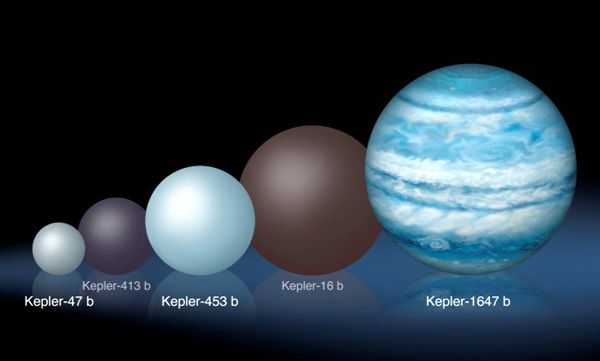
Kepler-1647 is 3,700 light-years away and approximately 4.4 billion years old, roughly the same age as Earth. The stars are similar to the sun, with one slightly larger than our home star and the other slightly smaller. The planet has a mass and radius nearly identical to that of Jupiter, making it the largest transiting circumbinary planet ever found.

Planets that orbit two stars are known as circumbinary planets, or sometimes “Tatooine” planets, after Luke Skywalker’s home world in Star Wars. Using Kepler data, astronomers search for slight dips in brightness that hint a planet might be passing or transiting in front of a star, blocking a tiny amount of the star’s light.

“But finding circumbinary planets is much harder than finding planets around single stars,” said SDSU astronomer William Welsh, one of the paper’s coauthors. “The transits are not regularly spaced in time and they can vary in duration and even depth.”

“It’s a bit curious that this biggest planet took so long to confirm, since it is easier to find big planets than small ones,” said SDSU astronomer Jerome Orosz, a coauthor on the study. “But it is because its orbital period is so long.”

The planet takes 1,107 days – just over three years – to orbit its host stars, the longest period of any confirmed transiting exoplanet found so far. The planet is also much further away from its stars than any other circumbinary planet, breaking with the tendency for circumbinary planets to have close-in orbits. Interestingly, its orbit puts the planet with in the so-called habitable zone–the range of distances from a star where liquid water might pool on the surface of an orbiting planet.

Like Jupiter, however, Kepler-1647b is a gas giant, making the planet unlikely to host life. Yet if the planet has large moons, they could potentially be suitable for life.

“Habitability aside, Kepler-1647b is important because it is the tip of the iceberg of a theoretically predicted population of large, long-period circumbinary planets,” said Welsh.

Once a candidate planet is found, researchers employ advanced computer programs to determine if it really is a planet. It can be a grueling process.

Laurance Doyle, a coauthor on the paper and astronomer at the SETI Institute, noticed a transit back in 2011. But more data and several years of analysis were needed to confirm the transit was indeed caused by a circumbinary planet. A network of amateur astronomers in the Kilodegree Extremely Little Telescope "Follow-Up Network” provided additional observations that helped the researchers estimate the planet’s mass.

Source: NASA.Gov

****

An illustration comparing Kepler-1647b's size to those of other exoplanets discovered by NASA's Kepler spacecraft.
Lynette Cook

Thursday, June 16, 2016

Curiosity Update: Finally Setting Her Sights on Mount Sharp...

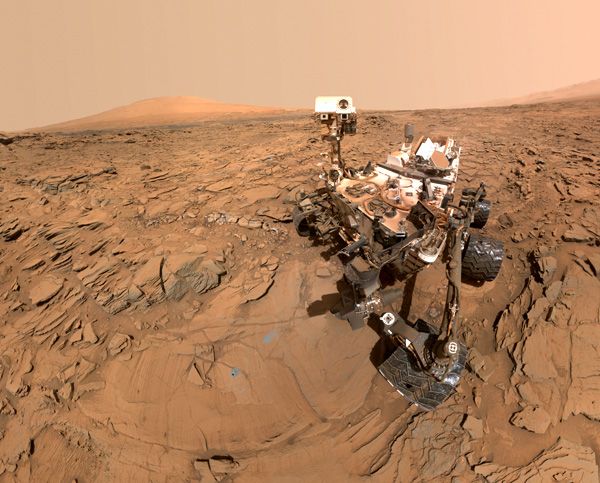
A self-portrait of NASA's Curiosity Mars rover, taken with a camera on her robotic arm on May 11, 2016.
NASA / JPL - Caltech / MSSS

NASA Mars Rover Descends Plateau, Turns Toward Mountain (Press Release - June 13)

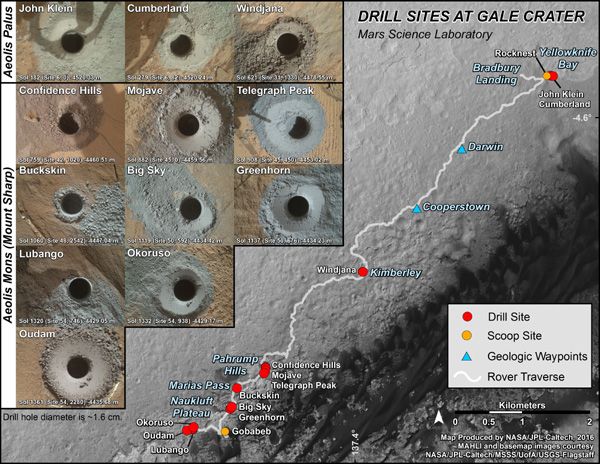
NASA's Curiosity Mars rover has analyzed its 12th drilled sample of Mars. This sample came from mudstone bedrock, which the rover resumed climbing in late May after six months studying other features.

Since the previous time Curiosity drilled into this "Murray formation" layer of lower Mount Sharp, the mission has examined active sand dunes along the rover's route, then crossed a remnant plateau of fractured sandstone that once more extensively covered the Murray formation.

While on the "Naukluft Plateau," the rover examined its 10th and 11th drill targets to repeat an experiment comparing material within and away from pale zones around fractures. From there, Curiosity also took the latest in a series of self-portraits.

"Now that we’ve skirted our way around the dunes and crossed the plateau, we've turned south to climb the mountain head-on," said Curiosity Project Scientist Ashwin Vasavada, of NASA's Jet Propulsion Laboratory, Pasadena, California. "Since landing, we’ve been aiming for this gap in the terrain and this left turn. It’s a great moment for the mission."

Curiosity landed near Mount Sharp in 2012. It reached the base of the mountain in 2014 after successfully finding evidence on the surrounding plains that ancient Martian lakes offered conditions that would have been favorable for microbes if Mars has ever hosted life. Rock layers forming the base of Mount Sharp accumulated as sediment within ancient lakes billions of years ago.

The Murray formation is about one-eighth of a mile (200 meters) thick. So far, Curiosity has examined about one-fifth of its vertical extent.

"The story that the Murray formation is revealing about the habitability of ancient Mars is one of the mission’s surprises," Vasavada said. "It wasn’t obvious from pre-mission data that it formed in long-lived lakes and that its diverse composition would tell us about the chemistry of those lakes and later groundwater."

The latest sample-collection target, "Oudam," was drilled on June 4. On the Naukluft Plateau, Curiosity drilled "Lubango," within a halo of brighter sandstone near a fracture, and "Okoruso," away from a fracture-related halo, for comparison. The mission conducted a similar experiment last year, with two sample targets drilled at another exposure of the fractured sandstone.

This sandstone unit, called the Stimson formation, is interpreted to have resulted from wind that draped a band of sand dunes over lower Mount Sharp. That would have been after the main stack of the mountain's lower layers had formed and partially eroded. Water later moved through fractures in the sandstone. Investigation of the fracture-related halos aims to determine how fluid moved through the fractures and altered surrounding rock.

"We were about to drive off the Naukluft Plateau and leave the Stimson formation forever as we go up Mount Sharp," said Curiosity science-team member Albert Yen of JPL. "A few of us were concerned. The fracture-associated haloes were becoming more prevalent, and we had only one data point. With just one data point, you never know whether it is representative."

As with the similar previous experiment, comparison of Lubango and Okoruso found higher silica and sulfate levels in the sample nearer to the fracture. Multiple episodes of groundwater flow with different chemistry at different times may have both delivered silica and sulfate from elsewhere and leached other ingredients away.

"The big-picture story is that this may be one of the youngest fluid events we're likely to study with Curiosity," Yen said. "You had to lay down the Murray, then cement it, then lay down the Stimson and cement that, then fracture the Stimson, then have fluids moving through the fractures."

On Mount Sharp, Curiosity is investigating how and when the habitable ancient conditions known from the mission's earlier findings evolved into conditions drier and less favorable for life.

Source: NASA.Gov

****

An infographic showing the 14 sites where NASA's Curiosity rover used her drill to collect rock samples since landing on Mars in 2012.
NASA / JPL - Caltech / MSSS