Wednesday, December 31, 2014

The Last Entry for 2014!

In this computer-generated art concept, fireworks fill the sky above the Los Angeles Football Stadium as a Super Bowl game is about to begin.
LosAngelesfootballstadium.com

So last night, I had an amusing dream where I visited the site where the Los Angeles Football Stadium is supposed to be built (near Grand Avenue in the City of Industry). To confirm that it was indeed the stadium being developed at the location, I walked up to a random construction worker and asked him if he was working on the would-be National Football League arena. He said yes, and went on to stating that the stadium cost $500+ trillion (due to construction delays) to build. He was about to say more, but Sir Richard Branson (the Virgin Galactic owner who is not involved with the L.A. Football Stadium in any way, shape, or form in real life; I don't even know if he has ever met Edward P. Roski Jr.—the mastermind behind the arena project and a part-owner of the L.A. Lakers and Kings) motioned to him to get back to work. I waved to Mr. Branson to say 'hi'...but he didn't look amused that I inquired about the stadium, or the fact that I was even there.

In this computer-generated art concept, fireworks fill the sky above the Los Angeles Football Stadium as a Super Bowl game comes to an end.
LosAngelesfootballstadium.com

As the dream went on, more and more people started to show up at the site to watch the construction take place. People were taking photos and whatnot, and were trying to get a good view of the massive pit which would be the site of the football field itself. The construction workers blamed me for the unwanted turnout of onlookers. How did I know this? Well first off, several aerial drones suddenly appeared out of nowhere and flashed their spotlights down towards me. And second, a voice came on the PA system to tell the throng that I was the one responsible for bringing undue attention to the construction project. The dream ended after I took a couple of more glimpses at the massive pit. I then woke up and sighed.

In this computer-generated art concept, spotlights shine high above the Los Angeles Football Stadium during an NFL game.
LosAngelesfootballstadium.com

It would be really cool if the Los Angeles Football Stadium is eventually built (though the NFL has no intention of having a team relocate to L.A. next year)—seeing as how I only live about 7 miles from the site. However, if a football team does move back to the City of Angels, all signs point to Farmers Field in downtown Los Angeles being the stadium where professional players will once again tackle each other and get concussions in their quest to make it to the Super Bowl. That's a shame... What the L.A. metropolis doesn't need is for more traffic to clog the streets in the middle of the city due to another sporting event. L.A. County, on the other hand, can use the attention. Much as how the L.A. Galaxy plays soccer on the outskirts of L.A. in the city of Carson, and the Dodgers play in a ghetto-ass stadium (I'm an Angels fan) atop a measly hill on the outskirts of L.A. as well, our next football team should be able to breath some nice fresh air near the Diamond Bar suburb while its players, you know, tackle each other and get concussions. Have a great 2015, everyone!

In this photograph that I took on 4/24/08, rush hour traffic begins to form on the 57 and 60 freeways.  Beyond them are the hills, nicknamed 'The Boonies', where the Los Angeles Football Stadium would be located if it was built.

Monday, December 29, 2014

Getting Closer to Ceres...

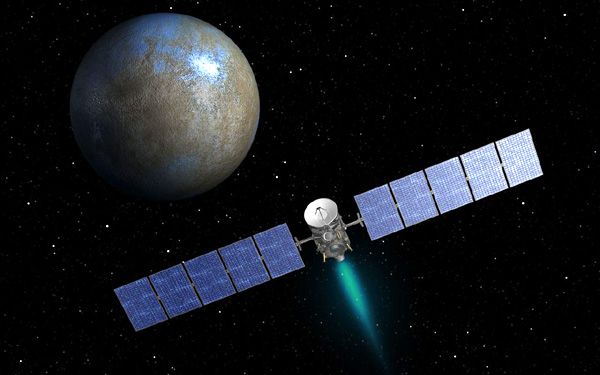
An artist's concept of NASA's Dawn spacecraft approaching the dwarf planet Ceres.
NASA / JPL - Caltech

Dawn Spacecraft Begins Approach to Dwarf Planet Ceres (Press Release)

Dawn has entered its approach phase toward Ceres
• The spacecraft will arrive at Ceres on March 6, 2015

NASA's Dawn spacecraft has entered an approach phase in which it will continue to close in on Ceres, a Texas-sized dwarf planet never before visited by a spacecraft. Dawn launched in 2007 and is scheduled to enter Ceres orbit in March 2015.

Dawn recently emerged from solar conjunction, in which the spacecraft is on the opposite side of the sun, limiting communication with antennas on Earth. Now that Dawn can reliably communicate with Earth again, mission controllers have programmed the maneuvers necessary for the next stage of the rendezvous, which they label the Ceres approach phase. Dawn is currently 400,000 miles (640,000 kilometers) from Ceres, approaching it at around 450 miles per hour (725 kilometers per hour).

The spacecraft's arrival at Ceres will mark the first time that a spacecraft has ever orbited two solar system targets. Dawn previously explored the protoplanet Vesta for 14 months, from 2011 to 2012, capturing detailed images and data about that body.

"Ceres is almost a complete mystery to us," said Christopher Russell, principal investigator for the Dawn mission, based at the University of California, Los Angeles. "Ceres, unlike Vesta, has no meteorites linked to it to help reveal its secrets. All we can predict with confidence is that we will be surprised."

The two planetary bodies are thought to be different in a few important ways. Ceres may have formed later than Vesta, and with a cooler interior. Current evidence suggests that Vesta only retained a small amount of water because it formed earlier, when radioactive material was more abundant, which would have produced more heat. Ceres, in contrast, has a thick ice mantle and may even have an ocean beneath its icy crust.

Ceres, with an average diameter of 590 miles (950 kilometers), is also the largest body in the asteroid belt, the strip of solar system real estate between Mars and Jupiter. By comparison, Vesta has an average diameter of 326 miles (525 kilometers), and is the second most massive body in the belt.

The spacecraft uses ion propulsion to traverse space far more efficiently than if it used chemical propulsion. In an ion propulsion engine, an electrical charge is applied to xenon gas, and charged metal grids accelerate the xenon particles out of the thruster. These particles push back on the thruster as they exit, creating a reaction force that propels the spacecraft. Dawn has now completed five years of accumulated thrust time, far more than any other spacecraft.

"Orbiting both Vesta and Ceres would be truly impossible with conventional propulsion. Thanks to ion propulsion, we're about to make history as the first spaceship ever to orbit two unexplored alien worlds," said Marc Rayman, Dawn's chief engineer and mission director, based at NASA's Jet Propulsion Laboratory in Pasadena, California.

The next couple of months promise continually improving views of Ceres, prior to Dawn's arrival. By the end of January, the spacecraft's images and other data will be the best ever taken of the dwarf planet.

The Dawn mission to Vesta and Ceres is managed by JPL, a division of the California Institute of Technology in Pasadena, for NASA's Science Mission Directorate, Washington. UCLA is responsible for overall Dawn mission science.

Source: Jet Propulsion Laboratory

****

An uncropped image of the dwarf planet Ceres that was taken by NASA's Dawn spacecraft from a distance of 740,000 miles (1.2 million kilometers), on December 1, 2014.
NASA / JPL - Caltech / UCLA / MPS / DLR / IDA

Thursday, December 25, 2014

STAR WARS - X-WING: A General in Red Squadron... :)

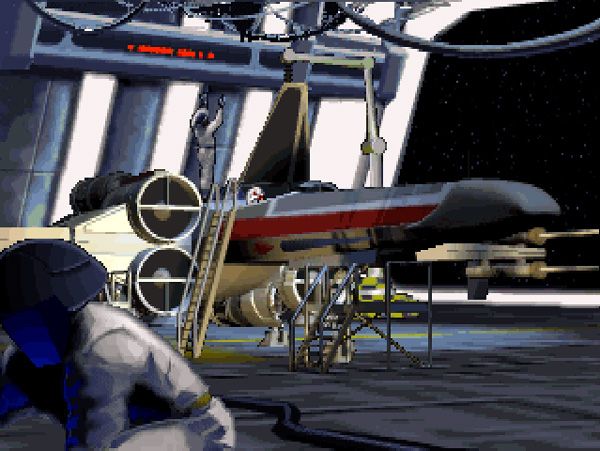
The five yellow pins on the shoulder pad of this uniform denotes the status of 'General' (which I recently attained) in the STAR WARS: X-WING video game.

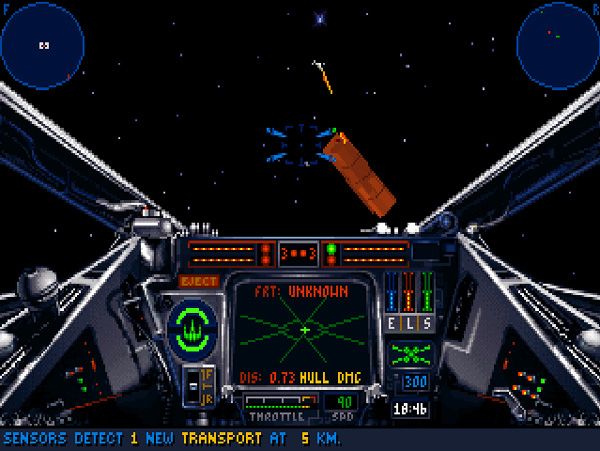
Merry Christmas, everyone!!! Just thought I'd mark the birth of Jeebus by posting this image above to celebrate the fact that I am now a General in the classic Star Wars: X-Wing video game. Even though I completed all of the missions a month ago, and finished as a Lieutenant, I found a way to earn additional points to increase my rank (instead of creating a new pilot account and starting the game from scratch all over again)...not only as a General, but also advancing my skill level to that of Top Ace. I'd fully tell you how I did it—but that would most likely make this Blog entry two paragraphs longer than it needs to be. All I can say is, Tour of Duty (TOD) 1, Mission 1 is the easiest way to accumulate points and get the rank that a player wasn't able to achieve when they completed the video game the first time around. This particular mission consists of destroying unarmed Imperial freighters (TIE Fighters don't show up on scene till all of the freighters are destroyed)...and you just need to play this level over and over; using a temporary profile with which you direct these non-threatening targets to your flight leader, Red One (the pilot account that you want to promote to a higher ranking should be assigned to this role), and watch as he uses his proton torpedoes to destroy the freighters and earn TOD points. (NOTE: Red One will only destroy three out of the five freighters in this sortie before he jumps into hyperspace—which is why you should immediately enter hyperspace as well and re-do the mission. The points that Red One earns on each repeat will be saved...thus increasing his overall TOD score.)

You'll see this cut-scene countless of times if you repeatedly play Tour of Duty 1, Mission 1 to increase your rank in the STAR WARS: X-WING video game.

You need to earn at least 550,000 TOD points to become a General (this rank is denoted by the five yellow pins visible on the uniform's shoulder pad in the pic at the top of this entry) and 65,535 points to attain Top Ace status. I initially finished the game at 77,004 TOD points and about 21,000 points with an Officer status. So basically, I devoted a lot of time towards playing TOD 1, Mission 1 repeatedly to get the highest promotion attainable on X-Wing. That's Star Wars devotion for ya... Happy Holidays, folks!

Watch as Red One attacks Imperial freighters that you direct him to destroy during Tour of Duty 1, Mission 1 in the STAR WARS: X-WING video game.

Thursday, December 18, 2014

Kepler Update: Another World is Discovered...

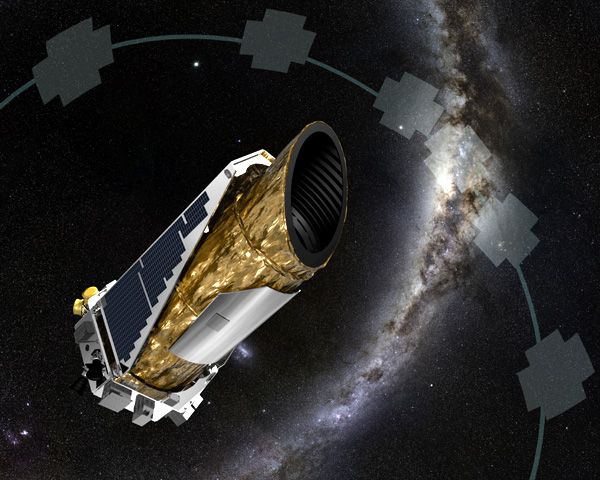
An illustration depicting the operational profile for NASA's Kepler spacecraft on its new mission, known as K2.
NASA Ames / JPL - Caltech / T Pyle

NASA’s Kepler Reborn, Makes First Exoplanet Find of New Mission (Press Release)

NASA's planet-hunting Kepler spacecraft makes a comeback with the discovery of the first exoplanet found using its new mission -- K2.

The discovery was made when astronomers and engineers devised an ingenious way to repurpose Kepler for the K2 mission and continue its search of the cosmos for other worlds.

"Last summer, the possibility of a scientifically productive mission for Kepler after its reaction wheel failure in its extended mission was not part of the conversation," said Paul Hertz, NASA's astrophysics division director at the agency's headquarters in Washington. "Today, thanks to an innovative idea and lots of hard work by the NASA and Ball Aerospace team, Kepler may well deliver the first candidates for follow-up study by the James Webb Space Telescope to characterize the atmospheres of distant worlds and search for signatures of life."

Lead researcher Andrew Vanderburg, a graduate student at the Harvard-Smithsonian Center for Astrophysics in Cambridge, Massachusetts, studied publicly available data collected by the spacecraft during a test of K2 in February 2014. The discovery was confirmed with measurements taken by the HARPS-North spectrograph of the Telescopio Nazionale Galileo in the Canary Islands, which captured the wobble of the star caused by the planet’s gravitational tug as it orbits.

The newly confirmed planet, HIP 116454b, is 2.5 times the diameter of Earth and follows a close, nine-day orbit around a star that is smaller and cooler than our sun, making the planet too hot for life as we know it. HIP 116454b and its star are 180 light-years from Earth, toward the constellation Pisces.

Kepler’s onboard camera detects planets by looking for transits -- when a distant star dims slightly as a planet crosses in front of it. The smaller the planet, the weaker the dimming, so brightness measurements must be exquisitely precise. To enable that precision, the spacecraft must maintain steady pointing. In May 2013, data collection during Kepler's extended prime mission came to an end with the failure of the second of four reaction wheels, which are used to stabilize the spacecraft.

Rather than giving up on the stalwart spacecraft, a team of scientists and engineers crafted a resourceful strategy to use pressure from sunlight as a “virtual reaction wheel” to help control the spacecraft. The resulting K2 mission promises to not only continue Kepler’s planet hunt, but also to expand the search to bright nearby stars that harbor planets that can be studied in detail and better understand their composition. K2 also will introduce new opportunities to observe star clusters, active galaxies and supernovae.

Small planets like HIP 116454b, orbiting nearby bright stars, are a scientific sweet spot for K2 as they are good prospects for follow-up ground studies to obtain mass measurements. Using K2’s size measurements and ground-based mass measurements, astronomers can calculate the density of a planet to determine whether it is likely a rocky, watery or gaseous world.

"The Kepler mission showed us that planets larger in size than Earth and smaller than Neptune are common in the galaxy, yet they are absent in our solar system," said Steve Howell, Kepler/K2 project scientist at NASA's Ames Research Center in Moffett Field, California. "K2 is uniquely positioned to dramatically refine our understanding of these alien worlds and further define the boundary between rocky worlds like Earth and ice giants like Neptune."

Since the K2 mission officially began in May 2014, it has observed more than 35,000 stars and collected data on star clusters, dense star-forming regions, and several planetary objects within our own solar system. It is currently in its third campaign.

The research paper reporting this discovery has been accepted for publication in The Astrophysical Journal.

Ames is responsible for Kepler's mission concept, ground system development, science data analysis and K2 mission operations. NASA's Jet Propulsion Laboratory in Pasadena, California, managed Kepler mission development. Ball Aerospace & Technologies Corp. in Boulder, Colorado, developed the Kepler flight system and supports mission operations with the Laboratory for Atmospheric and Space Physics at the University of Colorado in Boulder. The Space Telescope Science Institute in Baltimore archives, hosts and distributes Kepler science data. Kepler is NASA's 10th Discovery Mission and was funded by the agency's Science Mission Directorate in Washington.

Source: NASA.Gov

****

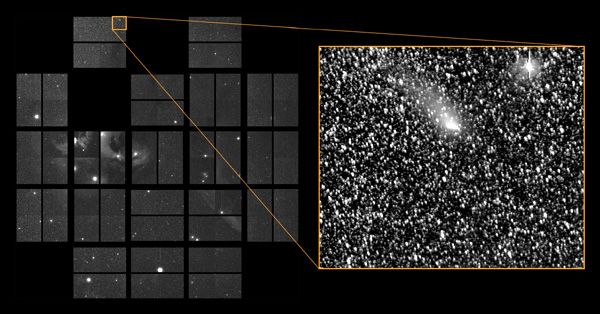
On its way towards Mars, Comet Siding Spring passed through the field of view of NASA's Kepler spacecraft on October 20, 2014.
NASA Ames / W Stenzel; SETI Institute / D Caldwell

Tuesday, December 16, 2014

Martian Flatulence: Curiosity Detects Methane on the Red Planet...

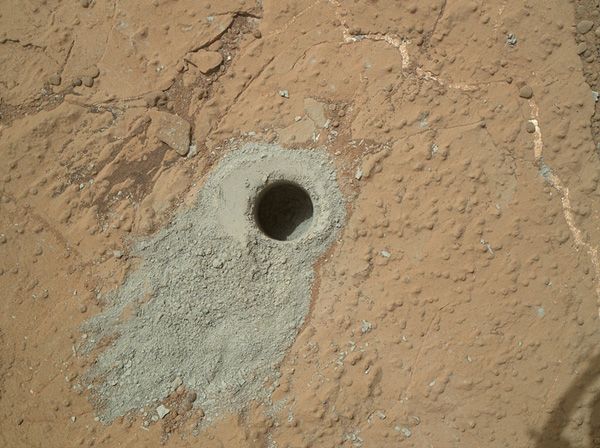
The first conclusive evidence of organic chemicals in material on the Red Planet's surface came from analysis by the Curiosity Mars rover of sample powder from this mudstone target, known as 'Cumberland.'
NASA / JPL - Caltech / MSSS

NASA Rover Finds Active and Ancient Organic Chemistry on Mars (Press Release)

NASA's Mars Curiosity rover has measured a tenfold spike in methane, an organic chemical, in the atmosphere around it and detected other organic molecules in a rock-powder sample collected by the robotic laboratory's drill.

"This temporary increase in methane -- sharply up and then back down -- tells us there must be some relatively localized source," said Sushil Atreya of the University of Michigan, Ann Arbor, a member of the Curiosity rover science team. "There are many possible sources, biological or non-biological, such as interaction of water and rock."

Researchers used Curiosity's onboard Sample Analysis at Mars (SAM) laboratory a dozen times in a 20-month period to sniff methane in the atmosphere. During two of those months, in late 2013 and early 2014, four measurements averaged seven parts per billion. Before and after that, readings averaged only one-tenth that level.

Curiosity also detected different Martian organic chemicals in powder drilled from a rock dubbed Cumberland, the first definitive detection of organics in surface materials of Mars. These Martian organics could either have formed on Mars or been delivered to Mars by meteorites.

Organic molecules, which contain carbon and usually hydrogen, are chemical building blocks of life, although they can exist without the presence of life. Curiosity's findings from analyzing samples of atmosphere and rock powder do not reveal whether Mars has ever harbored living microbes, but the findings do shed light on a chemically active modern Mars and on favorable conditions for life on ancient Mars.

"We will keep working on the puzzles these findings present," said John Grotzinger, Curiosity project scientist of the California Institute of Technology in Pasadena. "Can we learn more about the active chemistry causing such fluctuations in the amount of methane in the atmosphere? Can we choose rock targets where identifiable organics have been preserved?"

Researchers worked many months to determine whether any of the organic material detected in the Cumberland sample was truly Martian. Curiosity's SAM lab detected in several samples some organic carbon compounds that were, in fact, transported from Earth inside the rover. However, extensive testing and analysis yielded confidence in the detection of Martian organics.

Identifying which specific Martian organics are in the rock is complicated by the presence of perchlorate minerals in Martian rocks and soils. When heated inside SAM, the perchlorates alter the structures of the organic compounds, so the identities of the Martian organics in the rock remain uncertain.

"This first confirmation of organic carbon in a rock on Mars holds much promise," said Curiosity Participating Scientist Roger Summons of the Massachusetts Institute of Technology in Cambridge. "Organics are important because they can tell us about the chemical pathways by which they were formed and preserved. In turn, this is informative about Earth-Mars differences and whether or not particular environments represented by Gale Crater sedimentary rocks were more or less favorable for accumulation of organic materials. The challenge now is to find other rocks on Mount Sharp that might have different and more extensive inventories of organic compounds."

Researchers also reported that Curiosity's taste of Martian water, bound into lakebed minerals in the Cumberland rock more than three billion years ago, indicates the planet lost much of its water before that lakebed formed and continued to lose large amounts after.

SAM analyzed hydrogen isotopes from water molecules that had been locked inside a rock sample for billions of years and were freed when SAM heated it, yielding information about the history of Martian water. The ratio of a heavier hydrogen isotope, deuterium, to the most common hydrogen isotope can provide a signature for comparison across different stages of a planet's history.

"It's really interesting that our measurements from Curiosity of gases extracted from ancient rocks can tell us about loss of water from Mars," said Paul Mahaffy, SAM principal investigator of NASA's Goddard Space Flight Center in Greenbelt, Maryland, and lead author of a report published online this week by the journal Science.

The ratio of deuterium to hydrogen has changed because the lighter hydrogen escapes from the upper atmosphere of Mars much more readily than heavier deuterium. In order to go back in time and see how the deuterium-to-hydrogen ratio in Martian water changed over time, researchers can look at the ratio in water in the current atmosphere and water trapped in rocks at different times in the planet's history.

Martian meteorites found on Earth also provide some information, but this record has gaps. No known Martian meteorites are even close to the same age as the rock studied on Mars, which formed about 3.9 billion to 4.6 billion years ago, according to Curiosity's measurements.

The ratio that Curiosity found in the Cumberland sample is about one-half the ratio in water vapor in today's Martian atmosphere, suggesting much of the planet's water loss occurred since that rock formed. However, the measured ratio is about three times higher than the ratio in the original water supply of Mars, based on the assumption that supply had a ratio similar to that measured in Earth's oceans. This suggests much of Mars' original water was lost before the rock formed.

Curiosity is one element of NASA's ongoing Mars research and preparation for a human mission to Mars in the 2030s. Caltech manages the Jet Propulsion Laboratory in Pasadena, California, and JPL manages Curiosity rover science investigations for NASA's Science Mission Directorate in Washington. The SAM investigation is led by Paul Mahaffy of Goddard. Two SAM instruments key in these discoveries are the Quadrupole Mass Spectrometer, developed at Goddard, and the Tunable Laser Spectrometer, developed at JPL.

The results of the Curiosity rover investigation into methane detection and the Martian organics in an ancient rock were discussed at a news briefing Tuesday at the American Geophysical Union's convention in San Francisco. The methane results are described in a paper published online this week in the journal Science by NASA scientist Chris Webster of JPL, and co-authors.

A report on organics detection in the Cumberland rock by NASA scientist Caroline Freissinet, of Goddard, and co-authors, is pending publication.

Source: Jet Propulsion Laboratory

****
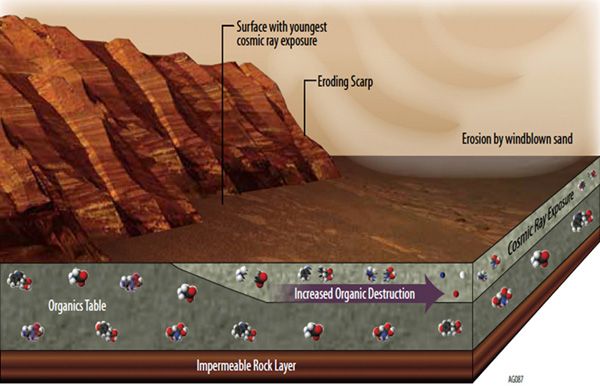
An illustration depicting a few of the reasons why detecting organic chemicals on Mars is difficult.
NASA / JPL - Caltech

Sunday, December 14, 2014

A Milestone for the Black Mamba!

Just one more box needs to be checked off for Kobe Bryant to officially earn his place as Michael Jordan's rightful heir...as the NBA's Greatest Of All Time.
Image courtesy of Bleacher Report - Facebook

Props to Kobe Bryant for surpassing Michael Jordan on the NBA's all-time scoring list tonight! The L.A. Lakers veteran achieved this milestone during today's 100-94 win over the Minnesota Timberwolves...when Bryant made two straight free throws (the second one earning him his 32,293rd point) in the 2nd quarter and the game was briefly halted so that teammates, opposing players and the coaching staff could congratulate KB24 on his achievement. Michael Jordan ended his career (both with the Chicago Bulls and the Washington Wizards) with 32,292 points, while Kobe has now amassed 32,310 points after tonight's victory. All that's left for the Black Mamba to do to cement his place as Jordan's rightful heir as the greatest player in the NBA is to win a 6th championship ring. Sadly, I don't think Bryant will achieve that feat with this current Lakers squad. Despite the fact that he deserves props for making a game-winning 3-pointer against the San Antonio Spurs last Saturday, Nick Young still gets on my nerves. That is all.

One proof that Kobe wanted to emulate His Airness.

The Black Mamba and Air Jordan defend against each other during a Lakers game in Kobe's early years.

Kobe Bryant waves to the Minnesota crowd after making a free throw that helped him surpass Michael Jordan on the NBA's all-time scoring list...on December 14, 2014.
Image courtesy of Bleacher Report - Facebook

Friday, December 12, 2014

The U.S. Navy's New Laser Gun...

The U.S. Navy's Laser Weapon System is deployed aboard the USS Ponce in November of 2014.
U.S. Navy

Just thought I'd share this cool YouTube video showing the U.S. Navy employing the newest piece in its arsenal, called the Laser Weapon System (LaWS), against targets in the Arabian Gulf last month. Firing an invisible 30-kilowatt laser beam that costs less than a dollar per shot, LaWS (which is installed aboard the warship USS Ponce) was able to successfully destroy small (unmanned) boats as well as a flying drone...all with the use of a handheld video game-type controller. The laser beam is invisible for now; pretty soon it will be visible, and in red or green color too. Not only that, but this weapon will be used aboard craft flying on Twin-Ion Engines and capable of soaring through hyperspace. Yes, I'm making a Star Wars reference there... Carry on.

Thursday, December 11, 2014

Well THAT'S A Bummer...

Don't ask me how I found out, but I just discovered that Nancy may already be married. Despite the fact that her Facebook page still lists her as engaged, I saw elsewhere that Nancy is now beyond that. Or...her fiancé/husband/whatever jumped the gun and decided to refer to her as his wife on the site I went to even though their relationship status hasn't changed. Nonetheless, I have to assume that she is finally married unless I want to get myself in hot water and continue to talk to her. If Nancy did officially tie the knot, it annoys me that she would keep the news secret and not post an inkling of it on her Facebook page (heck, there is only one picture of Nancy with her fiancé/husband/whatever in her photos section)...and text me if I want to go hiking and whatnot. Nancy did go to Hawaii last month (for only 4 days); who would've thought that it may have potentially been for her honeymoon and not some random vacation? Just making an assumption here.

All I can say is, it definitely looks like this won't play out like The Office where Jim Halpert won Pam Beasley over after she was in an 8-year-long engagement with another co-worker. Sorry Jim—but in my scenario, Pam finally got hitched to Roy. That is all.

Pam Beasley hangs out at Jim Halpert's desk to chat with him in THE OFFICE.

Monday, December 08, 2014

Curiosity Update: A Cool Discovery About Mount Sharp!

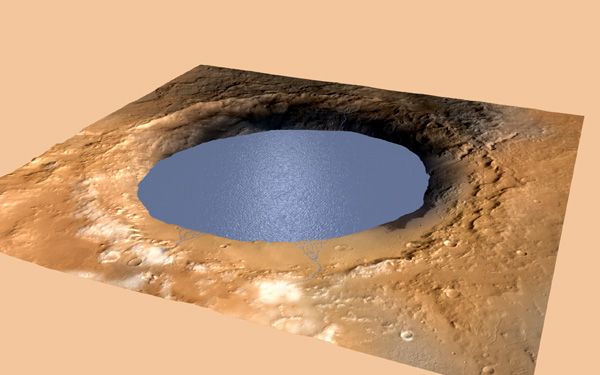
An illustration depicting a lake of water that partially filled Gale Crater, where NASA's Curiosity rover now resides, on Mars.
NASA / JPL - Caltech / ESA / DLR / FU Berlin / MSSS

NASA’s Curiosity Rover Finds Clues to How Water Helped Shape Martian Landscape (Press Release)

Observations by NASA’s Curiosity rover indicate Mars' Mount Sharp was built by sediments deposited in a large lake bed over tens of millions of years.

This interpretation of Curiosity’s finds in Gale Crater suggests ancient Mars maintained a climate that could have produced long-lasting lakes at many locations on the Red Planet.

"If our hypothesis for Mount Sharp holds up, it challenges the notion that warm and wet conditions were transient, local, or only underground on Mars,” said Ashwin Vasavada, Curiosity deputy project scientist at NASA's Jet Propulsion Laboratory in Pasadena. “A more radical explanation is that Mars' ancient, thicker atmosphere raised temperatures above freezing globally, but so far we don't know how the atmosphere did that."

Why this layered mountain sits in a crater has been a challenging question for researchers. Mount Sharp stands about 3 miles (5 kilometers) tall, its lower flanks exposing hundreds of rock layers. The rock layers – alternating between lake, river and wind deposits -- bear witness to the repeated filling and evaporation of a Martian lake much larger and longer-lasting than any previously examined close-up.

"We are making headway in solving the mystery of Mount Sharp," said Curiosity Project Scientist John Grotzinger of the California Institute of Technology in Pasadena, California. "Where there's now a mountain, there may have once been a series of lakes."

Curiosity currently is investigating the lowest sedimentary layers of Mount Sharp, a section of rock 500 feet (150 meters) high dubbed the Murray formation. Rivers carried sand and silt to the lake, depositing the sediments at the mouth of the river to form deltas similar to those found at river mouths on Earth. This cycle occurred over and over again.

"The great thing about a lake that occurs repeatedly, over and over, is that each time it comes back it is another experiment to tell you how the environment works," Grotzinger said. "As Curiosity climbs higher on Mount Sharp, we will have a series of experiments to show patterns in how the atmosphere and the water and the sediments interact. We may see how the chemistry changed in the lakes over time. This is a hypothesis supported by what we have observed so far, providing a framework for testing in the coming year."

After the crater filled to a height of at least a few hundred yards and the sediments hardened into rock, the accumulated layers of sediment were sculpted over time into a mountainous shape by wind erosion that carved away the material between the crater perimeter and what is now the edge of the mountain.

On the 5-mile (8-kilometer) journey from Curiosity’s 2012 landing site to its current work site at the base of Mount Sharp, the rover uncovered clues about the changing shape of the crater floor during the era of lakes.

"We found sedimentary rocks suggestive of small, ancient deltas stacked on top of one another," said Curiosity science team member Sanjeev Gupta of Imperial College in London. "Curiosity crossed a boundary from an environment dominated by rivers to an environment dominated by lakes."

Despite earlier evidence from several Mars missions that pointed to wet environments on ancient Mars, modeling of the ancient climate has yet to identify the conditions that could have produced long periods warm enough for stable water on the surface.

NASA's Mars Science Laboratory Project uses Curiosity to assess ancient, potentially habitable environments and the significant changes the Martian environment has experienced over millions of years. This project is one element of NASA's ongoing Mars research and preparation for a human mission to the planet in the 2030s.

"Knowledge we're gaining about Mars' environmental evolution by deciphering how Mount Sharp formed will also help guide plans for future missions to seek signs of Martian life," said Michael Meyer, lead scientist for NASA's Mars Exploration Program at the agency's headquarters in Washington.

JPL, managed by the California Institute of Technology, built the rover and manages the project for NASA's Science Mission Directorate in Washington.

Source: NASA.Gov

****

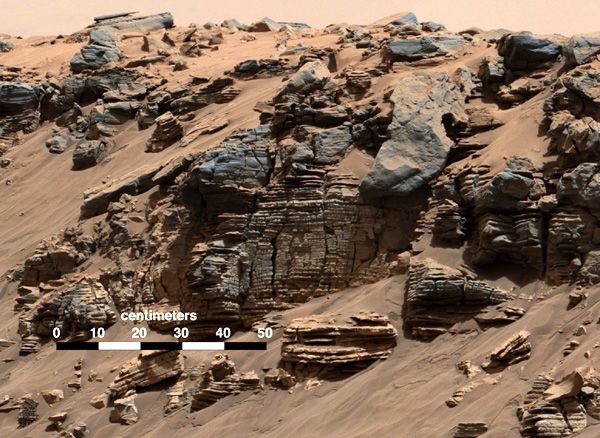
An image of several layered rocks that was taken by NASA's Curiosity Mars rover on August 7, 2014, showing evidence of a sedimentary deposit that possibly came from flowing water entering an ancient lake.
NASA / JPL - Caltech / MSSS
Sunday, December 07, 2014

Another Championship for Los Angeles!

Landon Donovan hoists the MLS Cup trophy after the L.A. Galaxy defeats the New England Revolution, 2-1, at the StubHub Center in Carson, California...on December 7, 2014.
Rick Loomis / Los Angeles Times

Props to the L.A. Galaxy for winning another Major League Soccer title at the StubHub Center in Carson, California tonight! Landon Donovan and company defeated the New England Revolution, 2-1, to claim the Galaxy its fifth MLS Cup in franchise history (and a sixth Cup for Donovan). With today's accolades, Donovan is now retiring from the world of soccer. On the plus side though, the Galaxy's win and the L.A. Kings' Stanley Cup victory about six months ago show that Los Angeles is still the City of Champions! Not bad at all.