Tuesday, November 05, 2013

Kepler Update...

An artist's concept of Kepler-16b orbiting its two parent stars.
NASA / JPL - Caltech / T. Pyle

NASA Kepler Results Usher in a New Era of Astronomy (Press Release - November 4)

Scientists from around the world are gathered this week at NASA's Ames Research Center in Moffett Field, Calif., for the second Kepler Science Conference, where they will discuss the latest findings resulting from the analysis of Kepler Space Telescope data.

Included in these findings is the discovery of 833 new candidate planets, which will be announced today by the Kepler team. Ten of these candidates are less than twice the size of Earth and orbit in their sun's habitable zone, which is defined as the range of distance from a star where the surface temperature of an orbiting planet may be suitable for liquid water.

At this conference two years ago, the Kepler team announced its first confirmed habitable zone planet, Kepler-22b. Since then, four more habitable zone candidates have been confirmed, including two in a single system.

New Kepler data analysis and research also show that most stars in our galaxy have at least one planet. This suggests that the majority of stars in the night sky may be home to planetary systems, perhaps some like our solar system.

"The impact of the Kepler mission results on exoplanet research and stellar astrophysics is illustrated by the attendance of nearly 400 scientists from 30 different countries at the Kepler Science Conference," said William Borucki, Kepler science principal investigator at Ames. "We gather to celebrate and expand our collective success at the opening of a new era of astronomy."

From the first three years of Kepler data, more than 3,500 potential worlds have emerged. Since the last update in January, the number of planet candidates identified by Kepler increased by 29 percent and now totals 3,538. Analysis led by Jason Rowe, research scientist at the SETI Institute in Mountain View, Calif., determined that the largest increase of 78 percent was found in the category of Earth-sized planets, based on observations conducted from May 2009 to March 2012. Rowe's findings support the observed trend that smaller planets are more common.

An independent statistical analysis of nearly all four years of Kepler data suggests that one in five stars like the sun is home to a planet up to twice the size of Earth, orbiting in a temperate environment. A research team led by Erik Petigura, doctoral candidate at University of California, Berkeley, used publicly accessible data from Kepler to derive this result.

Kepler data also fueled another field of astronomy dubbed asteroseismology -- the study of the interior of stars. Scientists examine sound waves generated by the boiling motion beneath the surface of the star. They probe the interior structure of a star just as geologists use seismic waves generated by earthquakes to probe the interior structure of Earth.

"Stars are the building blocks of the galaxy, driving its evolution and providing safe harbors for planets. To study the stars, one truly explores the galaxy and our place within it," said William Chaplin, professor for astrophysics at the University of Birmingham in the United Kingdom. "Kepler has revolutionized asteroseismology by giving us observations of unprecedented quality, duration and continuity for thousands of stars. These are data we could only have dreamt of a few years ago."

Kepler's mission is to determine what percentage of stars like the sun harbor small planets the approximate size and temperature of Earth. For four years, the space telescope simultaneously and continuously monitored the brightness of more than 150,000 stars, recording a measurement every 30 minutes. More than a year of the collected data remains to be fully reviewed and analyzed.

Ames is responsible for the Kepler mission concept, ground system development, mission operations, and science data analysis. NASA's Jet Propulsion Laboratory in Pasadena, Calif., managed Kepler mission development.

Ball Aerospace & Technologies Corp. in Boulder, Colo., developed the Kepler flight system and supports mission operations with the Laboratory for Atmospheric and Space Physics at the University of Colorado in Boulder.

The Space Telescope Science Institute in Baltimore archives, hosts and distributes Kepler science data. Kepler is NASA's 10th Discovery Mission and was funded by the agency's Science Mission Directorate.

Source: NASA.Gov

****
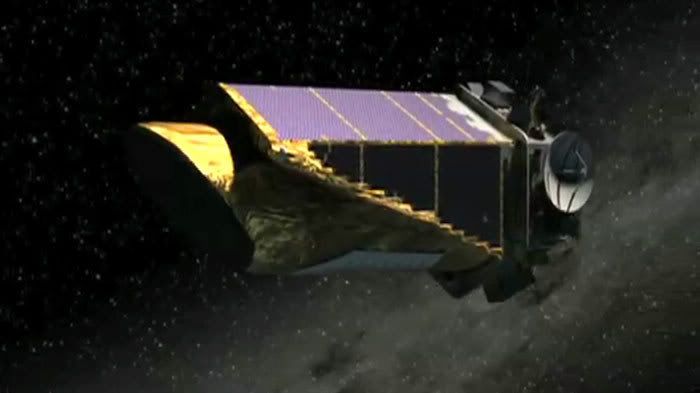
A computer-generated image of the Kepler telescope in space.
NASA

Sunday, November 03, 2013

Stan Lee's Comikaze Expo...

Posing with Alyssa Milano at Stan Lee's Comikaze Expo in downtown Los Angeles, on November 2, 2013.

So yesterday, I drove down to the Los Angeles Convention Center to attend the third annual comic book convention...hosted by none other than Marvel Comics legend Stan Lee himself. Along with Lee, additional celebrities who showed up to Comikaze were Alyssa Milano, "Weird Al" Yankovic, Bruce Campbell, Lou Ferrigno and a few other of their fellow actors. Of course, the only one I met and got an autograph by was Ms. Milano (or Mrs. Bugliari)—but then again, she was the reason why I went to the expo in the first place. Well her, and seeing the costumes and props used in the Iron Man trilogy. Click on this link to view additional pics of this cool film exhibit.

LINK: Click here for more images from Stan Lee's Comikaze Expo

Chillin' at Stan Lee's Comikaze Expo in downtown Los Angeles, on November 2, 2013.

Stan Lee addresses the crowd at his Comikaze Expo in downtown Los Angeles, on November 2, 2013.

Getting an autograph by Alyssa Milano at Stan Lee's Comikaze Expo in downtown Los Angeles, on November 2, 2013.

'Weird Al' Yankovic signs autographs at Stan Lee's Comikaze Expo in downtown Los Angeles, on November 2, 2013.

Chillin' at Stan Lee's Comikaze Expo in downtown Los Angeles, on November 2, 2013.

Two fans dressed up as Spartans from the Xbox video game HALO strike a pose at Stan Lee's Comikaze Expo in downtown Los Angeles, on November 2, 2013.

An IRON MAN maquette on display at Stan Lee's Comikaze Expo in downtown Los Angeles, on November 2, 2013.

Thursday, October 31, 2013

The New Horizons Message Initiative...

The Atlas V rocket carrying NASA's New Horizons spacecraft lifts off from Cape Canaveral Air Force Station in Florida on January 19, 2006.
Photo by Ben Cooper of LaunchPhotography.com

For a little over a month now, a campaign has been underway to collect 10,000-plus signatures on a petition that called for NASA to approve a crowd-sourced message that would be transmitted to the Pluto-bound New Horizons spacecraft as early as 2016. In the wake of recent news heralding Voyager 1's arrival into interstellar space back in August of last year, bringing towards the stars a time capsule known as the Golden Record, the same architect behind the Golden Record is asking the public to support a similar effort to place sounds and images celebrating humanity aboard New Horizons—which will fly past Pluto and its (currently) five moons in July of 2015.

Assuming that NASA officially approves the transmission after the petition receives a sufficient amount of signatures (and the project attains full funding through a planned Kickstarter campaign), the reason why the New Horizons Message Initiative (NHMI) team will have to wait till no earlier than 2016 to upload the transmission to the grand piano-sized probe is because there will be no memory space aboard New Horizons for the message before then. Pluto encounter operations for New Horizons is set to begin in January of 2015 and conclude with closest approach to the dwarf planet on July 14 of that year. However, it may take another full year to download all of the Pluto data to Earth before the mission shifts to New Horizons setting sail for a Kuiper Belt Object (KBO) located much farther out in the solar system. On the plus side though, the NHMI team plans for the message to be at most 100 megabytes in size when it is relayed to the distant probe; New Horizons would still have 99% storage capacity aboard its flight computers to record observations from a KBO flyby.

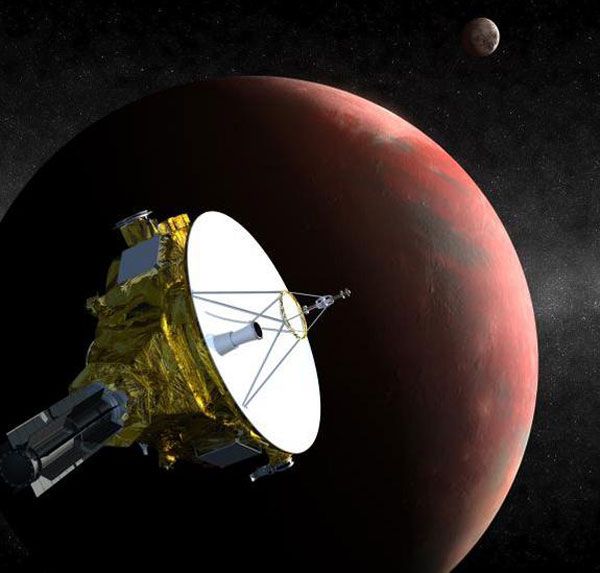
An artist's concept of NASA's New Horizons spacecraft approaching Pluto.
NASA

Apart from the fact that this is a really cool project that should bring more awareness to New Horizons' trailblazing journey, there is a personal reason why I want this campaign to succeed. If you visit a Blog entry that I posted back in September of 2005, you'll see that I didn't take it lightly when I found out that I could've had my name on a DVD (bearing the monikers of 430,000-plus people who knew about this public relations effort before I did) that was placed on New Horizons before its January 2006 launch. The fact that NHMI is giving me (and everyone else who missed out on this unique opportunity) a second chance to leave a personal mark on this deep-space mission is exciting. And that's why I'm talking about it now...and that's why I want you guys to participate in this great project today!

Apart from the crowd-sourced message that should contain some very interesting photos, sounds and (possibly) videos depicting mankind up to these last few years of the early 21st Century, the first 10,000 individuals to sign the petition will have their names uploaded to New Horizons as well. 4,000 folks have already left their mark on NHMI— You should, too!

LINK: Sign the petition to support the New Horizons Message Initiative

Support the NEW HORIZONS MESSAGE INITIATIVE.

NEW HORIZONS Blog Entries Archive:

September 26, 2005
December 19, 2005
January 7, 2006
January 17, 2006
January 19, 2006
April 12, 2006
June 15, 2006
February 27, 2007
October 22, 2007
June 8, 2008
October 23, 2008
March 18, 2011
January 20, 2012
July 13, 2012
January 19, 2013
October 31, 2013

Wednesday, October 30, 2013

Kepler Update...

An artist's concept of the exoplanet Kepler-78b orbiting its parent star.
David A. Aguilar (CfA)

Scientists Discover the First Earth-Sized Rocky Planet (Press Release)

Astronomers have discovered the first Earth-sized planet outside the solar system that has a rocky composition like that of Earth. Kepler-78b whizzes around its host star every 8.5 hours, making it a blazing inferno and not suitable for life as we know it. The results are published in two papers in the journal Nature.

"The news arrived in grand style with the message: 'Kepler-10b has a baby brother,'" said Natalie Batalha, Kepler mission scientist at NASA's Ames Research Center in Moffett Field, Calif. Batalha led the team that discovered Kepler-10b, a larger but also rocky planet identified by the Kepler spacecraft.

"The message expresses the joy of knowing that Kepler's family of exoplanets is growing," Batalha reflects. "It also speaks of progress. The Doppler teams are attaining higher precision, measuring masses of smaller planets at each turn. This bodes well for the broader goal of one day finding evidence of life beyond Earth."

Kepler-78b was discovered using data from NASA’s Kepler space telescope, which for four years simultaneously and continuously monitored more than 150,000 stars looking for telltale dips in their brightness caused by crossing, or transiting, planets.

Two independent research teams then used ground-based telescopes to confirm and characterize Kepler-78b. To determine the planet's mass, the teams employed the radial velocity method to measure how much the gravitation tug of an orbiting planet causes its star to wobble. Kepler, on the other hand, determines the size or radius of a planet by the amount of starlight blocked when it passes in front of its host star.

A handful of planets the size or mass of Earth have been discovered. Kepler-78b is the first to have both a measured mass and size. With both quantities known, scientists can calculate a density and determine what the planet is made of.

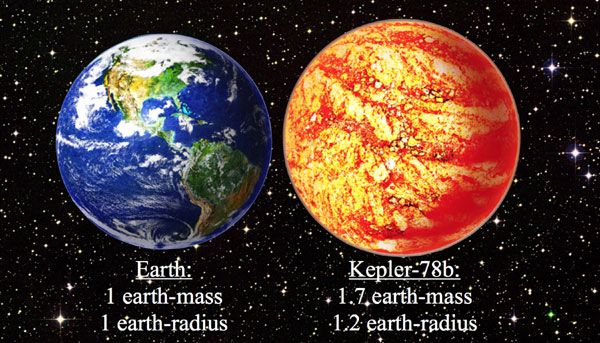
Kepler-78b is 1.2 times the size of Earth and 1.7 times more massive, resulting in a density that is the same as Earth's. This suggests that Kepler-78b is also made primarily of rock and iron. Its star is slightly smaller and less massive than the sun and is located about 400 light-years from Earth in the constellation Cygnus.

One team led by Andrew Howard from the University of Hawaii in Honolulu, made follow-up observations using the W. M. Keck Observatory atop Mauna Kea in Hawaii. More information on their research can be found here.

The other team led by Francesco Pepe from the University of Geneva, Switzerland, did their ground-base work at the Roque de los Muchachos Observatory on La Palma in the Canary Islands. More information on their research can be found here.

This result will be one of many discussed next week at the second Kepler science conference Nov. 4-8 at Ames. More than 400 astrophysicists from Australia, China, Europe, Latin America and the US will convene to present their latest results using publicly accessible data from Kepler. To learn more about the conference, please visit the website.

Source: NASA.Gov

****

An artist's concept comparing the size of Kepler-78b to Earth.
David A. Aguilar (CfA)

Monday, October 28, 2013

MAVEN Will Soon Be Ready For Flight...

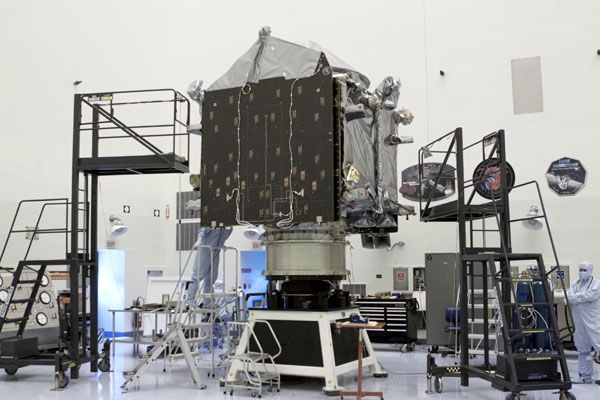
The MAVEN spacecraft is about to undergo a spin test at NASA's Kennedy Space Center in Florida, on October 21, 2013.
NASA / Kim Shiflett

NASA Prepares to Launch First Mission to Explore Martian Atmosphere (Press Release)

A NASA spacecraft that will examine the upper atmosphere of Mars in unprecedented detail is undergoing final preparations for a scheduled 1:28 p.m. EST Monday, Nov. 18 launch from Cape Canaveral Air Force Station in Florida.

The Mars Atmosphere and Volatile Evolution mission (MAVEN) will examine specific processes on Mars that led to the loss of much of its atmosphere. Data and analysis could tell planetary scientists the history of climate change on the Red Planet and provide further information on the history of planetary habitability.

"The MAVEN mission is a significant step toward unraveling the planetary puzzle about Mars' past and present environments," said John Grunsfeld, associate administrator for NASA's Science Mission Directorate in Washington. "The knowledge we gain will build on past and current missions examining Mars and will help inform future missions to send humans to Mars."

The 5,410-pound spacecraft will launch aboard a United Launch Alliance Atlas V 401 rocket on a 10-month journey to Mars. After arriving at Mars in September 2014, MAVEN will settle into its elliptical science orbit.

Over the course of its one-Earth-year primary mission, MAVEN will observe all of Mars' latitudes. Altitudes will range from 93 miles to more than 3,800 miles. During the primary mission, MAVEN will execute five deep dip maneuvers, descending to an altitude of 78 miles. This marks the lower boundary of the planet's upper atmosphere.

"Launch is an important event, but it's only a step along the way to getting the science measurements," said Bruce Jakosky, principal investigator at the University of Colorado, Boulder's Laboratory for Atmospheric and Space Physics (CU/LASP) in Boulder. "We're excited about the science we'll be doing, and are anxious now to get to Mars."

The MAVEN spacecraft will carry three instrument suites. The Particles and Fields Package, provided by the University of California at Berkeley with support from CU/LASP and NASA's Goddard Space Flight Center in Greenbelt, Md., contains six instruments to characterize the solar wind and the ionosphere of Mars. The Remote Sensing Package, built by CU/LASP, will determine global characteristics of the upper atmosphere and ionosphere. The Neutral Gas and Ion Mass Spectrometer, built by Goddard, will measure the composition of Mars’ upper atmosphere.

"When we proposed and were selected to develop MAVEN back in 2008, we set our sights on Nov. 18, 2013, as our first launch opportunity," said Dave Mitchell, MAVEN project manager at Goddard. "Now we are poised to launch on that very day. That's quite an accomplishment by the team."

MAVEN's principal investigator is based at CU/LASP. The university provided science instruments and leads science operations, as well as education and public outreach, for the mission.

Goddard manages the project and provided two of the science instruments for the mission.

Lockheed Martin built the spacecraft and is responsible for mission operations. The University of California at Berkeley's Space Sciences Laboratory provided science instruments for the mission. NASA's Jet Propulsion Laboratory in Pasadena, Calif., provides navigation support, Deep Space Network support, and Electra telecommunications relay hardware and operations.

Source: NASA.Gov

****

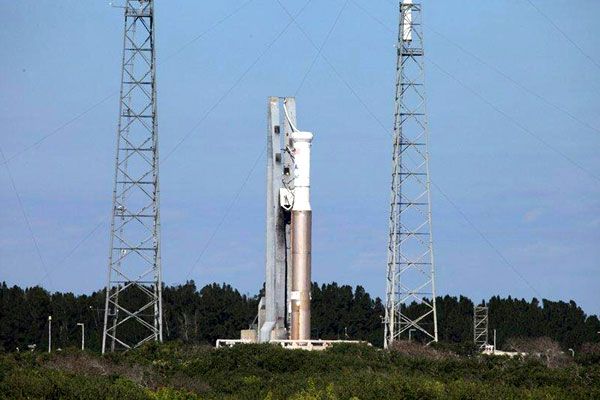
MAVEN's Atlas V launch vehicle is ready for its October 29 Wet Dress Rehearsal at Cape Canaveral Air Force Station in Florida.
NASA / Kim Shiflett

Sunday, October 27, 2013

Sleepy Hollow...

Just thought I'd share this cool animated GIF that was provided to me courtesy of the hit FOX TV show's Facebook page. The next new episode for Sleepy Hollow won't air till Monday, November 4 (due to Game 5 of the World Series being played tomorrow. Red Sox... Cardinals... Don't really care who ends up winning this year's MLB championship), but when it does, I can't wait to see what the Headless Horsemen and his brethren have in store for Lieutenant Abbie Mills and Ichabod Crane. Oh, and in case you don't know yet, Sleepy Hollow has been picked up for a second season. Word.

SLEEPY HOLLOW animated GIF.

Friday, October 25, 2013

Beware of the Tanzanian Lake...

A petrified vulture that was found at Lake Natron in Tanzania.
© Nick Brandt 2013 / Courtesy of Hasted Kraeutler Gallery, NY

These eerie images were posted online weeks ago, but just thought I'd share them on my Blog today. Traveling in Tanzania, a photographer named Nick Brandt stumbled upon the petrified remains of birds and other animals at Lake Natron—which, like the mythical Greek monster Medusa, turned any creature that got near it into stone. The reason for this is because of the chemical makeup of this lethal body of water...which, like California's Mono Lake, has a pH content that makes the water not conducive to drinking or even swimming in. Click on this link to view more pics of unwitting creatures that dared venture to this lake. Just don't read the comments that are posted below that article. Like on YouTube, most of these people are just sooo stupid.

By the way, this phenomenon makes for a very cool sci-fi horror film. If I had Final Draft again [my original CD for the scriptwriting program became unreadable back in 2009 (don't know why)] I'd be working on my own screenplay about it. Have a great day.

A petrified avian that was found at Lake Natron in Tanzania.
© Nick Brandt 2013 / Courtesy of Hasted Kraeutler Gallery, NY

A petrified flamingo that was found at Lake Natron in Tanzania.
© Nick Brandt 2013 / Courtesy of Hasted Kraeutler Gallery, NY

A petrified avian that was found at Lake Natron in Tanzania.
© Nick Brandt 2013 / Courtesy of Hasted Kraeutler Gallery, NY

Wednesday, October 23, 2013

Just How Pathetic Are The L.A. Clippers?

They haven't won one Western Conference championship let alone an NBA title, and this team thinks that it earns the right to hang banners—any kind of banners—along the same rafters at STAPLES Center as the Lakers, Kings and Sparks...all champions at some point in this century. Clearly, this lame move was the work of Boston transplant Doc Rivers, who's trying to prevent Chris Paul, Blake Griffin and company from being reminded that they still play in the House of Kobe and Gasol (plus Dustin Brown and Jonathan Quick for that matter). 'Kay, that's enough hatin' on Clipper Nation for now. Have a great weekend, everyone!

The Los Angeles Clippers are trying to hide the fact that they still play in the House of Lakers.
Evan Gole / Getty Images

Monday, October 21, 2013

Juno Update...

An image of Earth's Moon taken by NASA's Juno spacecraft as it flew past our planet for a gravity assist maneuver to Jupiter, on October 9, 2013.
NASA / JPL - Caltech / Malin Space Science Systems / Adam Hurcewicz

Check out this cool photo of Earth that NASA's Jupiter-bound Juno spacecraft took as it flew within 350 miles of our planet for a gravity assist maneuver on October 9. The image of the Moon above was also taken by Juno, but the pic below is a nice preview of how Jupiter will look once the spacecraft's "JunoCam" begins taking snapshots of the gas giant after Juno arrives there on July 4, 2016. Can't wait for that Independence Day!

An image of Earth taken by NASA's Juno spacecraft as it flew past our planet for a gravity assist maneuver to Jupiter, on October 9, 2013.
NASA / JPL - Caltech / Malin Space Science Systems / Gerald - UnmannedSpaceFlight.com

Saturday, October 19, 2013

Quote of the Day...

"Besides the obvious difference, there was not much distinction between losing a best friend and losing a lover: it was all about intimacy. One moment, you had someone to share your biggest triumphs and fatal flaws with; the next minute, you had to keep them bottled inside. One moment, you'd start to call her to tell her a snippet of news or to vent about your awful day before realizing you did not have that right anymore; the next, you could not remember the digits of her phone number."

-― Jodi Picoult