Monday, October 03, 2022

Another Commercial Company Has Joined Rocket Lab, SpaceX and Virgin Orbit in the Orbital Rocket Club...

Firefly's Alpha rocket is about to lift off from pad SLC-2 at Vandenberg Space Force Base in California...on October 1, 2022.
Firefly Aerospace

Firefly Aerospace Successfully Reaches Orbit and Deploys Customer Payloads with its Alpha Rocket (News Release)

Alpha becomes the first and only orbit-ready US rocket in the 1300kg payload vehicle class

CEDAR PARK, Texas--(BUSINESS WIRE)--Firefly Aerospace, a new space leader in launch, spacecraft and in-space services, announced that its Alpha FLTA002 mission successfully reached orbit and deployed customer payloads, lifting off on October 1 at 12:01 AM PDT from Vandenberg Space Force Base in California.

With the success of this mission, Firefly is now the first company to launch and reach orbit from US soil in only its second attempt. Firefly also becomes the first and only US commercial space company with a rocket ready to take customers to space in the highly desired 1300kg payload lift class.

"With the success of this flight, Firefly has announced to the world there is a new orbital launch vehicle, available today, with a capacity that is pivotal to our commercial and government customers," said Bill Weber, Firefly CEO. "Proving our flight and deployment capabilities on only our second attempt is a testament to the maturity of our technology and the expertise of our team. This is an exciting day at Firefly, and we have many, many more ahead. I could not be more excited for the Firefly team."

Alpha is an all-composite rocket that uses patented tap-off engine cycle technology, which reduces cost and improves efficiency while maintaining the strength and reliability of the rocket. During the mission, Alpha successfully completed all major technical milestones, including a two-burn maneuver, relighting the second stage during its first orbital flight.

“I am so proud of everyone in the company, both past and present, who have shared my dream of starting a launch company that would further revolutionize the space economy,” said Tom Markusic, Firefly Founder and Chief Technology Advisor. “The Firefly team set out to develop the best small launch vehicle in the world. Mission accomplished!”

Building on today’s success, Firefly is completing the Acceptance Testing Protocol (ATP) for its Alpha 3 vehicle in preparation for its upcoming NASA VCLS Demo 2-FB ELaNa 43 launch. In addition, Firefly continues the production of multiple rockets at its Texas manufacturing facilities using all the lessons learned from existing flights and testing. Firefly is scheduled for six Alpha launches to take customer payloads to space in 2023, and 12 more in 2024.

Alpha FLTA002 Mission Details

The flight began with a nominal countdown and lift-off at 12:01 AM PDT and progressed flawlessly through each stage of flight, then inserting into an elliptical transfer orbit, coasting to apogee, and performing a circularization burn with confirmation of final payload deployment at approximately T+1 hour, which is one of the most technically challenging aspects of the mission.

FLTA002 deployed a total of three payloads, including demonstration satellites from NASA TechEdSat-15 in conjunction with San Jose State University (SJSU), Teachers in Space and Libre Space Foundation. These payloads will perform several in-space experiments, including an "exo-brake" to help in the deorbiting of satellites and test the world's first fully-free and open-source telecommunications constellation.

Firefly sends special thanks to SLD-30 for their continued support and partnership and the customers on FLTA002 for their dedication and unwavering confidence in Firefly's technology.

Firefly is a portfolio company of AE Industrial Partners, LP ("AEI"), a private equity firm specializing in aerospace, defense & government services, space, power & utility services, and specialty industrial markets.

Source: Firefly Aerospace

****

A screenshot from infrared launch footage showing Firefly's Alpha rocket heading towards low-Earth orbit from Vandenberg Space Force Base in California...on October 1, 2022.
Vandenberg Space Force Base

TV monitors at Firefly's mission control center showing the Alpha rocket's upper stage booster in low-Earth orbit...following a successful launch from California's Vandenberg Space Force Base on October 1, 2022.
Firefly Aerospace


Saturday, October 01, 2022

Photos of the Day: More Solo Images I took of the F-22 Raptor at the Miramar Air Show...

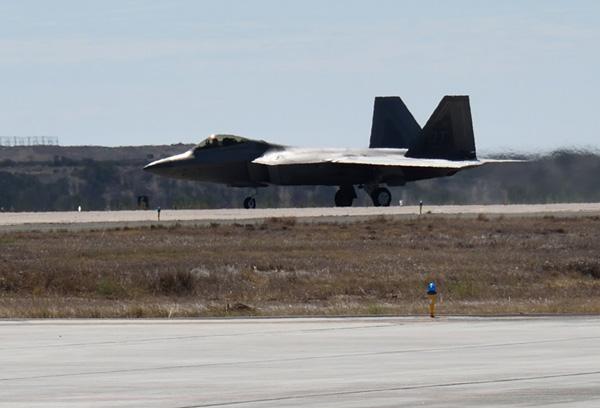
An F-22 Raptor taxis down the runway as the fifth-generation fighter gets ready to begin its aerial demo at the Miramar Air Show in San Diego, CA...on September 24, 2022.
Richard T. Par

Just thought I'd share these additional pics that I took of the F-22 Raptor during its aerial demo at the Miramar Air Show in San Diego, California, one week ago today.

As mentioned in the Blog entry linked above, I took around 600 photos during the Raptor's demo thanks to using 'burst mode' on my Nikon D3300 DSLR camera. This entry is devoted to more snapshots of the stealth jet as it performed on its own during the demonstration; a future post will feature more images of the F-22 performing a U.S. Air Force Heritage Flight with a World War II-era P-51 Mustang at Marine Corps Air Station Miramar.

Happy First Day of October!

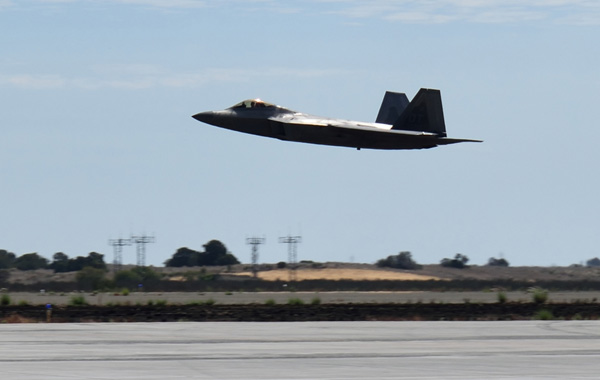
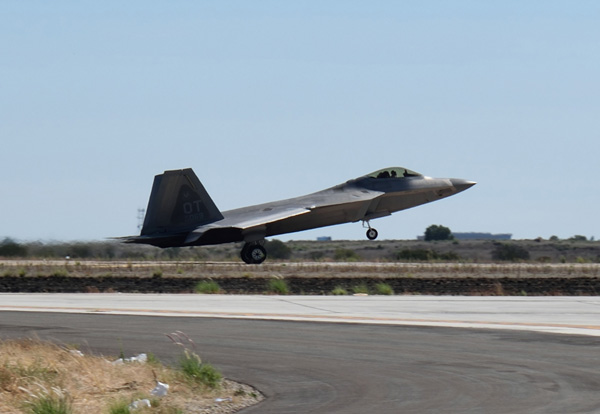
The F-22 Raptor takes off from the runway to begin its demo at the Miramar Air Show in San Diego, CA...on September 24, 2022.
Richard T. Par

The F-22 Raptor climbs toward the sky as it begins its demo at the Miramar Air Show in San Diego, CA...on September 24, 2022.
Richard T. Par

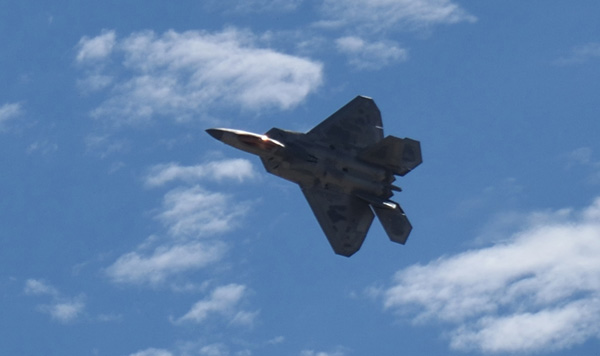
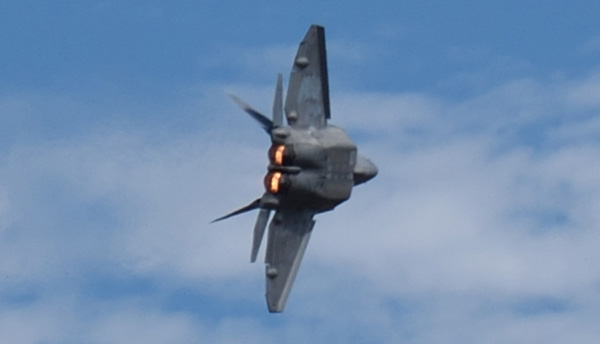
The F-22 Raptor soars through the sky during its demo at the Miramar Air Show in San Diego, CA...on September 24, 2022.
Richard T. Par

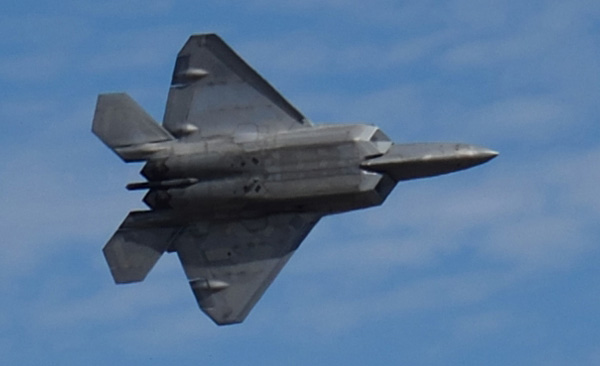
The F-22 Raptor opens its weapons bay doors during its demo at the Miramar Air Show in San Diego, CA...on September 24, 2022.
Richard T. Par

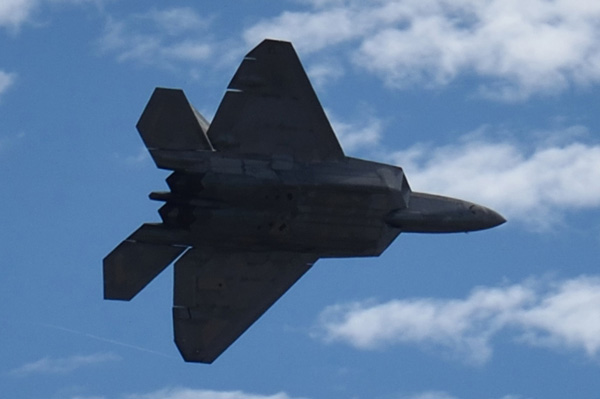
The F-22 Raptor after it closed its weapons bay doors during its demo at the Miramar Air Show in San Diego, CA...on September 24, 2022.
Richard T. Par

The F-22 Raptor continues to soar through the sky during its demo at the Miramar Air Show in San Diego, CA...on September 24, 2022.
Richard T. Par

The F-22 Raptor lights its afterburners during its demo at the Miramar Air Show in San Diego, CA...on September 24, 2022.
Richard T. Par

The F-22 Raptor prepares to land after its demo at the Miramar Air Show in San Diego, CA...on September 24, 2022.
Richard T. Par

The F-22 Raptor taxis down the runway after its demo at the Miramar Air Show in San Diego, CA...on September 24, 2022.
Richard T. Par

Friday, September 30, 2022

DART's Collision with Asteroid Dimorphos Has Been Photographed by Hubble and Its Successor...

An animated GIF showing DART's impact with asteroid moonlet Dimorphos...as seen by the James Webb Space Telescope on September 26, 2022.
NASA, ESA, CSA, Cristina Thomas (Northern Arizona University), Ian Wong (NASA-GSFC); Joseph DePasquale (STScI)

Webb, Hubble Capture Detailed Views of DART Impact (News Release - September 29)

Two of NASA’s Great Observatories, the James Webb Space Telescope and Hubble Space Telescope, have captured views of a unique NASA experiment designed to intentionally smash a spacecraft into a small asteroid in the world’s first-ever in-space test for planetary defense. These observations of NASA’s Double Asteroid Redirection Test (DART) impact mark the first time that Webb and Hubble simultaneously observed the same celestial target.

On September 26, 2022, at 7:14 pm EDT, DART intentionally crashed into Dimorphos, the asteroid moonlet in the double-asteroid system of Didymos. It was the world’s first test of the kinetic impact mitigation technique, using a spacecraft to deflect an asteroid that poses no threat to Earth, and modifying the object’s orbit. DART is a test for defending Earth against potential asteroid or comet hazards.

The coordinated Hubble and Webb observations are more than just an operational milestone for each telescope – there are also key science questions relating to the makeup and history of our solar system that researchers can explore when combining the capabilities of these observatories.

“Webb and Hubble show what we’ve always known to be true at NASA: We learn more when we work together,” said NASA Administrator Bill Nelson. “For the first time, Webb and Hubble have simultaneously captured imagery from the same target in the cosmos: an asteroid that was impacted by a spacecraft after a seven-million-mile journey. All of humanity eagerly awaits the discoveries to come from Webb, Hubble and our ground-based telescopes – about the DART mission and beyond.”

Observations from Webb and Hubble together will allow scientists to gain knowledge about the nature of the surface of Dimorphos, how much material was ejected by the collision and how fast it was ejected. Additionally, Webb and Hubble captured the impact in different wavelengths of light – Webb in infrared and Hubble in visible. Observing the impact across a wide array of wavelengths will reveal the distribution of particle sizes in the expanding dust cloud, helping to determine whether it threw off lots of big chunks or mostly fine dust. Combining this information, along with ground-based telescope observations, will help scientists to understand how effectively a kinetic impact can modify an asteroid’s orbit.

Webb Captures Impact Site Before and After Collision

Webb took one observation of the impact location before the collision took place, then several observations over the next few hours. Images from Webb’s Near-Infrared Camera (NIRCam) show a tight, compact core, with plumes of material appearing as wisps streaming away from the center of where the impact took place.

Observing the impact with Webb presented the flight operations, planning and science teams with unique challenges, because of the asteroid’s speed of travel across the sky. As DART approached its target, the teams performed additional work in the weeks leading up to the impact to enable and test a method of tracking asteroids moving over three times faster than the original speed limit set for Webb.

“I have nothing but tremendous admiration for the Webb Mission Operations folks that made this a reality,” said principal investigator Cristina Thomas of Northern Arizona University in Flagstaff, Arizona. “We have been planning these observations for years, then in detail for weeks, and I’m tremendously happy this has come to fruition.”

Scientists also plan to observe the asteroid system in the coming months using Webb’s Mid-Infrared Instrument (MIRI) and Webb’s Near-Infrared Spectrograph (NIRSpec). Spectroscopic data will provide researchers with insight into the asteroid’s chemical composition.

Webb observed the impact over five hours total and captured 10 images. The data was collected as part of Webb’s Cycle 1 Guaranteed Time Observation Program 1245 led by Heidi Hammel of the Association of Universities for Research in Astronomy (AURA).

Hubble Images Show Movement of Ejecta After Impact

Hubble also captured observations of the binary system ahead of the impact, then again 15 minutes after DART hit the surface of Dimorphos. Images from Hubble’s Wide Field Camera 3 show the impact in visible light. Ejecta from the impact appear as rays stretching out from the body of the asteroid. The bolder, fanned-out spike of ejecta to the left of the asteroid is in the general direction from which DART approached.

Some of the rays appear to be curved slightly, but astronomers need to take a closer look to determine what this could mean. In the Hubble images, astronomers estimate that the brightness of the system increased by three times after impact and saw that brightness hold steady, even eight hours after impact.

Hubble plans to monitor the Didymos-Dimorphos system 10 more times over the next three weeks. These regular, relatively long-term observations as the ejecta cloud expands and fades over time will paint a more complete picture of the cloud’s expansion from the ejection to its disappearance.

“When I saw the data, I was literally speechless, stunned by the amazing detail of the ejecta that Hubble captured,” said Jian-Yang Li of the Planetary Science Institute in Tucson, Arizona, who led the Hubble observations. “I feel lucky to witness this moment and be part of the team that made this happen.”

Hubble captured 45 images in the time immediately before and following DART’s impact with Dimorphos. The Hubble data was collected as part of Cycle 29 General Observers Program 16674.

“This is an unprecedented view of an unprecedented event,” summarized Andy Rivkin, DART investigation team lead of the Johns Hopkins University Applied Physics Laboratory in Laurel, Maryland.

Source: NASA.Gov

****

An animated GIF showing DART's impact with asteroid moonlet Dimorphos...as seen by the Hubble Space Telescope on September 26, 2022.
Science: NASA, ESA, Jian-Yang Li (PSI); animation: Alyssa Pagan (STScI)

Thursday, September 29, 2022

An Ocean World Gets Its First Close-Up in Over 20 Years...

An image segment of Europa's surface that was taken by NASA's Juno spacecraft from an altitude of 219 miles (352 kilometers)...on September 29, 2022.
NASA / JPL - Caltech / SWRI / MSSS

NASA’s Juno Shares First Image From Flyby of Jupiter’s Moon Europa (News Release)

Observations from the spacecraft’s pass of the moon provided the first close-up in over two decades of this ocean world, resulting in remarkable imagery and unique science.

The first picture NASA’s Juno spacecraft took as it flew by Jupiter’s ice-encrusted moon Europa has arrived on Earth. Revealing surface features in a region near the moon’s equator called Annwn Regio, the image was captured during the solar-powered spacecraft’s closest approach, on Thursday, September 29, at 2:36 a.m. PDT (5:36 a.m. EDT), at a distance of about 219 miles (352 kilometers).

This is only the third close pass in history below 310 miles (500 kilometers) altitude and the closest look any spacecraft has provided at Europa since January 3, 2000, when NASA’s Galileo came within 218 miles (351 kilometers) of the surface.

Europa is the sixth-largest moon in the solar system, slightly smaller than Earth’s moon. Scientists think a salty ocean lies below a miles-thick ice shell, sparking questions about potential conditions capable of supporting life underneath Europa’s surface.

This segment of the first image of Europa [above] taken during this flyby by the spacecraft’s JunoCam (a public-engagement camera) zooms in on a swath of Europa’s surface north of the equator. Due to the enhanced contrast between light and shadow seen along the terminator (the nightside boundary), rugged terrain features are easily seen, including tall shadow-casting blocks, while bright and dark ridges and troughs curve across the surface. The oblong pit near the terminator might be a degraded impact crater.

With this additional data about Europa’s geology, Juno’s observations will benefit future missions to the Jovian moon, including the agency’s Europa Clipper. Set to launch in 2024, Europa Clipper will study the moon’s atmosphere, surface and interior, with its main science goal being to determine whether there are places below Europa’s surface that could support life.

As exciting as Juno’s data will be, the spacecraft only had a two-hour window to collect it, racing past the moon with a relative velocity of about 14.7 miles per second (23.6 kilometers per second).

“It’s very early in the process, but by all indications Juno’s flyby of Europa was a great success,” said Scott Bolton, Juno principal investigator from Southwest Research Institute in San Antonio. “This first picture is just a glimpse of the remarkable new science to come from Juno’s entire suite of instruments and sensors that acquired data as we skimmed over the moon’s icy crust.”

During the flyby, the mission collected what will be some of the highest-resolution images of the moon (0.6 miles, or 1 kilometer, per pixel) and obtained valuable data on Europa’s ice shell structure, interior, surface composition and ionosphere, in addition to the moon’s interaction with Jupiter’s magnetosphere.

“The science team will be comparing the full set of images obtained by Juno with images from previous missions, looking to see if Europa’s surface features have changed over the past two decades,” said Candy Hansen, a Juno co-investigator who leads planning for the camera at the Planetary Science Institute in Tucson, Arizona. “The JunoCam images will fill in the current geologic map, replacing existing low-resolution coverage of the area.”

Juno’s close-up views and data from its Microwave Radiometer (MWR) instrument will provide new details on how the structure of Europa’s ice varies beneath its crust. Scientists can use all this information to generate new insights into the moon, including data in the search for regions where liquid water may exist in shallow subsurface pockets.

Building on Juno’s observations and previous missions such as Voyager 2 and Galileo, NASA’s Europa Clipper mission, slated to arrive at Europa in 2030, will study the moon’s atmosphere, surface and interior – with a goal to investigate habitability and better understand its global subsurface ocean, the thickness of its ice crust and search for possible plumes that may be venting subsurface water into space.

The close flyby modified Juno’s trajectory, reducing the time it takes to orbit Jupiter from 43 to 38 days. The flyby also marks the second encounter with a Galilean moon during Juno’s extended mission. The mission explored Ganymede in June 2021 and is scheduled to make close flybys of Io, the most volcanic body in the solar system, in 2023 and 2024.

Source: NASA.Gov

****

An enhanced image of Europa that was taken by NASA's Juno spacecraft on September 29, 2022.

Wednesday, September 28, 2022

RIP, COOLIO (1963-2022)...

Rest In Peace, Coolio.

About an hour ago, I found out that Artis Leon Ivey Jr.—a.k.a. Coolio—passed away...apparently due to cardiac arrest at a friend's house in Los Angeles. My condolences to his family and friends.

Like a lot of other fans of the Monessen, Pennsylvania-born rapper, I'll always remember the song Gangsta's Paradise that Coolio did for the 1995 Michelle Pfeiffer film Dangerous Minds.

Not only is Gangsta's Paradise one of my favorite beats to sing whenever I did karaoke with friends, but this awesome rap song also made me nostalgic for the summer of 1995...when I started sophomore year in high school. I have great memories of 10th grade.

Here's the music video for Gangsta's Paradise. May You Rest In Peace, Coolio.

Tuesday, September 27, 2022

On This Day in 2007: A Journey to Vesta and Ceres Begins from Cape Canaveral in Florida...

A Delta 2 rocket carrying NASA's Dawn spacecraft launches from Cape Canaveral Air Force Station (now Cape Canaveral Space Force Station) in Florida...on September 27, 2007.
NASA

15 Years Ago: Dawn Begins Voyage to Asteroid Vesta and Dwarf Planet Ceres (News Release)

The history-making Dawn mission, part of NASA’s Discovery Program and managed by NASA’s Jet Propulsion Laboratory (JPL) near Pasadena, California, left Earth on September 27, 2007, to study the two largest objects in the asteroid belt, asteroid Vesta and dwarf planet Ceres, providing scientists with an opportunity to learn more about the solar system’s formation.

Dawn used solar electric propulsion for most of its trajectory control, supplemented by a gravity-assist from Mars.

Dawn spent 14 months orbiting Vesta before moving on to orbit Ceres, the first spacecraft to orbit two different celestial bodies. It observed the dwarf planet until October 2018, when it ran out of attitude control fuel. The Dawn mission proved the value of ion propulsion to explore bodies in the solar system.

Managers named the ninth mission in the Discovery Program Dawn because they hoped it would reveal clues about the physical and chemical conditions in the earliest days of the solar system. Its two targets, the asteroid Vesta and the dwarf planet Ceres, the two largest objects in the main asteroid belt between the orbits of Mars and Jupiter, together comprise 45% of the mass in the asteroid belt. They have survived relatively intact from the solar system’s early days yet have remarkably different compositions, providing scientists with an opportunity to learn more about the processes of early planetary formation.

Because chemical engines would have required a prohibitively large amount of fuel to enable Dawn’s dual-target mission to the asteroid belt, the spacecraft relied on solar electric propulsion instead, using an ion propulsion system with 937 pounds of Xenon gas as a fuel source and power from its solar arrays. Between 1998 and 2001, Dawn’s predecessor the Deep Space 1 spacecraft demonstrated the utility of ion propulsion for an interplanetary mission by operating its ion engine for more than 16,000 hours, enabling it to fly by the asteroid Braille and the comet Borrelly.

Dawn lifted off on September 27, 2007, atop a Delta II rocket from Launch Complex 17B at Cape Canaveral Air Force Station, now Cape Canaveral Space Force Station, in Florida.

After insertion into heliocentric orbit, Dawn unfurled its solar arrays, the most powerful flown on an interplanetary mission. For the next 80 days, flight managers checked out Dawn’s systems including its three ion propulsion system thrusters and reaction wheel assemblies used for attitude control.

A long-duration system test of one of the ion thrusters began on November 6 and ended 165 hours later. Flight directors tested each of Dawn’s science instruments and found them in good working order.

With the initial checkout complete, Dawn turned on one of its ion thrusters on December 17, operating it until October 31, 2008, to align the spacecraft for its gravity-assist encounter with Mars.

Dawn carried three instruments to study the geology, elemental and mineral composition, shape, surface topography, geomorphology and tectonic history of Vesta and Ceres. The spacecraft’s orbital characteristics aided in determining the bodies’ masses and gravity fields.

The instruments included:

- A gamma-ray and neutron detector (GRaND).
- A visible and infrared (VIR) mapping spectrometer.
- Two identical framing cameras (FC).

After thrusting nearly continuously for 270 days, Dawn turned its ion engine off and began a coast phase toward its first planetary encounter, a gravity-assist flyby of Mars. On February 18, 2009, Dawn passed within 337 miles of the Red Planet. The close flyby not only increased Dawn’s velocity, it also changed the plane of its orbit, setting it up for its journey to Vesta.

The Mars flyby also provided an opportunity to calibrate Dawn’s instruments. The GRaND instrument collected data that scientists correlated with similar data collected by Mars Odyssey in orbit around Mars. The spacecraft entered a safe mode due to problems with its star trackers, causing some loss of science calibration data, but the event did not impact the gravity-assist flyby itself.

Dawn performed some tests of its thrusters after the flyby and resumed thrusting on June 8, 2009, continuing until arrival at Vesta. Although one of the spacecraft’s four reaction wheel assemblies failed on June 17, 2010, this did not affect operations as the three remaining ones adequately controlled its attitude.

On May 3, 2011, Dawn acquired its first targeting image of Vesta still half a million miles away. As it approached the asteroid, the spacecraft returned progressively higher resolution images. Dawn used its ion thrusters to enter orbit around Vesta on July 16, 2011, the first spacecraft to orbit any main belt object.

During its nearly 14 months at Vesta, Dawn operated in six distinct science orbits to optimize data gathering by its science instruments. The spacecraft returned more than 30,000 images of the asteroid, far more than planned and fully mapping its surface, and much additional science information. It determined that Vesta has an iron-nickel core, its size large enough to allow it to differentiate.

Dawn confirmed Vesta as the parent body of the most numerous type of meteorite found on Earth.

On September 5, 2012, Dawn departed Vesta using its ion engines to begin its two-and-a-half-year journey to its next and final destination, the dwarf planet Ceres, discovered in 1801 and the largest body in the asteroid belt.

Although a second reaction wheel assembly failed just prior to Dawn’s departure from Vesta, flight controllers devised a workaround to maintain the spacecraft’s attitude. The spacecraft’s ion thruster fired continuously – with a short interruption in September 2014 when it entered a safe mode – until it arrived in orbit around Ceres.

Because of the two failed reaction wheel assemblies, Dawn took fewer images during its approach to Ceres than it did for Vesta, but by January 26, 2015, those images exceeded the highest-resolution photographs from the Hubble Space Telescope. Dawn entered orbit around Ceres on March 6, 2015, marking the first time a single spacecraft orbited two different celestial bodies and, coming four months before New Horizons flew by dwarf planet Pluto, the first time a spacecraft observed a dwarf planet.

Dawn completed the first topographic map of Ceres during this initial polar orbit. Over the next three years, Dawn repositioned itself into nine different orbits for different phases of its science mission. Its primary mission ended in June 2016, but managers granted it a one-year extension to continue its exploration of Ceres as the dwarf planet approached its perihelion, or closest distance to the Sun.

Managers extended its mission once again in 2017, and placed it in a relatively stable orbit, ensuring that it would not impact the dwarf planet for at least 20 years and most likely 50 years.

Dawn discovered bright spots on Ceres, such as Cerealia Facula inside the Occator Crater, salty deposits composed mainly of sodium carbonate that made their way to the surface in a slushy brine from within or below the crust. This computer-generated video made from images returned by Dawn simulate a flyover of Cerealia Facula.

On October 31, 2018, Dawn finally ran out of attitude control fuel, ending its highly successful and history-making mission.

Dawn’s legacy encompasses not only the scientific knowledge gained about the solar system’s early days by exploring Vesta and Ceres, but also includes its engineering accomplishments. The spacecraft’s ion propulsion system operated for 51,385 hours (5.9 years), or for about 54% of its time in space, allowing it to enter orbit around the two largest objects in the asteroid belt.

More specifically, Dawn holds the honor as the first and so far only spacecraft to orbit an asteroid and a dwarf planet, and the first to reach a dwarf planet. The more than 100,000 images and other scientific data Dawn beamed back to Earth of its two distinct targets shed much light on the origins of the solar system.

Source: NASA.Gov

****

A natural-color image of asteroid Vesta that was taken by NASA's Dawn spacecraft on July 24, 2011.
NASA

A true-color image of dwarf planet Ceres that was taken by NASA's Dawn spacecraft in May of 2015.
NASA

An image of the Dawn microchip--which contains the names of around 365,000 people who submitted them online between late 2005 and late 2006--after it was attached to the spacecraft during launch preps in the summer of 2007.
NASA

My certificate for the Dawn mission.

Monday, September 26, 2022

DART News: Humanity Has Finally Avenged the Dinosaurs! Sort of...

An image of Dimorphos that was taken by NASA's DART spacecraft 11 seconds before it intentionally rammed into the asteroid moonlet...on September 26, 2022.
NASA / Johns Hopkins APL

NASA’s DART Mission Hits Asteroid in First-Ever Planetary Defense Test (Press Release)

After 10 months flying in space, NASA’s Double Asteroid Redirection Test (DART) – the world’s first planetary defense technology demonstration – successfully impacted its asteroid target on Monday, the agency’s first attempt to move an asteroid in space. Mission control at the Johns Hopkins Applied Physics Laboratory (APL) in Laurel, Maryland, announced the successful impact at 7:14 p.m. EDT.

As a part of NASA’s overall planetary defense strategy, DART’s impact with the asteroid Dimorphos demonstrates a viable mitigation technique for protecting the planet from an Earth-bound asteroid or comet, if one were discovered.

“At its core, DART represents an unprecedented success for planetary defense, but it is also a mission of unity with a real benefit for all humanity,” said NASA Administrator Bill Nelson. “As NASA studies the cosmos and our home planet, we’re also working to protect that home, and this international collaboration turned science fiction into science fact, demonstrating one way to protect Earth.”

DART targeted the asteroid moonlet Dimorphos, a small body just 530 feet (160 meters) in diameter. It orbits a larger, 2,560-foot (780-meter) asteroid called Didymos. Neither asteroid poses a threat to Earth.

The mission’s one-way trip confirmed that NASA can successfully navigate a spacecraft to intentionally collide with an asteroid to deflect it, a technique known as kinetic impact.

The investigation team will now observe Dimorphos using ground-based telescopes to confirm that DART’s impact altered the asteroid’s orbit around Didymos. Researchers expect the impact to shorten Dimorphos’ orbit by about 1%, or roughly 10 minutes; precisely measuring how much the asteroid was deflected is one of the primary purposes of the full-scale test.

“Planetary Defense is a globally unifying effort that affects everyone living on Earth,” said Thomas Zurbuchen, associate administrator for the Science Mission Directorate at NASA Headquarters in Washington. “Now we know we can aim a spacecraft with the precision needed to impact even a small body in space. Just a small change in its speed is all we need to make a significant difference in the path an asteroid travels.”

The spacecraft’s sole instrument, the Didymos Reconnaissance and Asteroid Camera for Optical navigation (DRACO), together with a sophisticated guidance, navigation and control system that works in tandem with Small-body Maneuvering Autonomous Real Time Navigation (SMART Nav) algorithms, enabled DART to identify and distinguish between the two asteroids, targeting the smaller body.

These systems guided the 1,260-pound (570-kilogram) box-shaped spacecraft through the final 56,000 miles (90,000 kilometers) of space into Dimorphos, intentionally crashing into it at roughly 14,000 miles (22,530 kilometers) per hour to slightly slow the asteroid’s orbital speed. DRACO’s final images, obtained by the spacecraft seconds before impact, revealed the surface of Dimorphos in close-up detail.

Fifteen days before impact, DART’s CubeSat companion Light Italian CubeSat for Imaging of Asteroids (LICIACube), provided by the Italian Space Agency, deployed from the spacecraft to capture images of DART’s impact and the asteroid’s resulting cloud of ejected matter. In tandem with the images returned by DRACO, LICIACube’s images are intended to provide a view of the collision’s effects to help researchers better characterize the effectiveness of kinetic impact in deflecting an asteroid. Because LICIACube doesn’t carry a large antenna, images will be downlinked to Earth one by one in the coming weeks.

“DART’s success provides a significant addition to the essential toolbox we must have to protect Earth from a devastating impact by an asteroid,” said Lindley Johnson, NASA’s Planetary Defense Officer. “This demonstrates we are no longer powerless to prevent this type of natural disaster. Coupled with enhanced capabilities to accelerate finding the remaining hazardous asteroid population by our next Planetary Defense mission, the Near-Earth Object (NEO) Surveyor, a DART successor could provide what we need to save the day.”

With the asteroid pair within 7 million miles (11 million kilometers) of Earth, a global team is using dozens of telescopes stationed around the world and in space to observe the asteroid system. Over the coming weeks, they will characterize the ejecta produced and precisely measure Dimorphos’ orbital change to determine how effectively DART deflected the asteroid. The results will help validate and improve scientific computer models critical to predicting the effectiveness of this technique as a reliable method for asteroid deflection.

“This first-of-its-kind mission required incredible preparation and precision, and the team exceeded expectations on all counts,” said APL Director Ralph Semmel. “Beyond the truly exciting success of the technology demonstration, capabilities based on DART could one day be used to change the course of an asteroid to protect our planet and preserve life on Earth as we know it.”

Roughly four years from now, the European Space Agency’s Hera project will conduct detailed surveys of both Dimorphos and Didymos, with a particular focus on the crater left by DART’s collision and a precise measurement of Dimorphos’ mass.

Johns Hopkins APL manages the DART mission for NASA's Planetary Defense Coordination Office as a project of the agency's Planetary Missions Program Office.

****


Sunday, September 25, 2022

Photos of the Day: A Raptor Takes to the Skies in the 2022 Miramar Air Show!

An F-22 Raptor soars through the skies during the Miramar Air Show in San Diego, California...on September 24, 2022.
Richard T. Par

Just thought I'd share these photos that I took at the Miramar Air Show in San Diego, California, yesterday!

I shot over 1,300 pictures with my Nikon D3300 during this event (due to me using 'burst mode' on my DSLR camera)...with more than 600 of those images being of the F-22 Raptor during its aerial demonstration!

My main reason for attending the air show yesterday was to see the Raptor take flight in person (I went to the 2018 Miramar Air Show for this objective, but the F-22 demo team didn't show up when it was scheduled to appear that year), and it didn't disappoint.

I also wanted to see the F-35B Lightning II's hovering demonstration as well, but the traffic from the freeway to the parking lot at Marine Corps Air Station Miramar was so bad when I arrived in the morning that the F-35B was already in the air by the time I parked my car. (I exited the freeway around 10 AM; I didn't get to my parking spot till a little after 11 AM—near the scheduled time the F-35B demo began.)

Oh well. I already saw the F-35B show off its abilities up-close during the 2016 Miramar Air Show as well as the event four years ago. In the meantime, enjoy these pics of the F-22 soaring through the skies alone, as well as with a World War II-era P-51 Mustang in a U.S. Air Force Heritage Flight demonstration. Happy Sunday!

As seen from a parking lot in Marine Corps Air Station Miramar, an F-35B Lightning II conducts a hovering demonstration at the Miramar Air Show...on September 24, 2022.
Richard T. Par

The F-22 Raptor and a World War II-era P-51 Mustang conduct a U.S. Air Force Heritage Flight demonstration at the Miramar Air Show...on September 24, 2022.
Richard T. Par

The F-22 Raptor and P-51 Mustang conduct a U.S. Air Force Heritage Flight demonstration at the Miramar Air Show...on September 24, 2022.
Richard T. Par

The F-22 Raptor lights its twin afterburners during an aerial demonstration at the Miramar Air Show...on September 24, 2022.
Richard T. Par

The F-22 Raptor and P-51 Mustang are about to fly over a grandstand at the Miramar Air Show...on September 24, 2022.
Richard T. Par

Friday, September 23, 2022

Hubble's Successor Captures a Photo of My Favorite Ice Giant and Its Largest Moon...

An image of Neptune and its large moon Triton (upper left) that was taken by NASA's James Webb Space Telescope.
NASA, ESA, CSA, STScI

First and foremost, I would like to point out that this awesome new photo of Neptune and its moon Triton by the James Webb Space Telescope makes me even sadder that NASA didn't select the Trident flyby spacecraft as its next Discovery-class mission last year... Oh well.

****

New Webb Image Captures Clearest View of Neptune’s Rings in Decades (News Release - September 21)

NASA’s James Webb Space Telescope shows off its capabilities closer to home with its first image of Neptune. Not only has Webb captured the clearest view of this distant planet’s rings in more than 30 years, but its cameras reveal the ice giant in a whole new light.

Most striking in Webb’s new image is the crisp view of the planet’s rings – some of which have not been detected since NASA’s Voyager 2 became the first spacecraft to observe Neptune during its flyby in 1989. In addition to several bright, narrow rings, the Webb image clearly shows Neptune’s fainter dust bands.

“It has been three decades since we last saw these faint, dusty rings, and this is the first time we’ve seen them in the infrared,” notes Heidi Hammel, a Neptune system expert and interdisciplinary scientist for Webb. Webb’s extremely stable and precise image quality permits these very faint rings to be detected so close to Neptune.

Neptune has fascinated researchers since its discovery in 1846. Located 30 times farther from the Sun than Earth, Neptune orbits in the remote, dark region of the outer solar system. At that extreme distance, the Sun is so small and faint that high noon on Neptune is similar to a dim twilight on Earth.

This planet is characterized as an ice giant due to the chemical make-up of its interior. Compared to the gas giants, Jupiter and Saturn, Neptune is much richer in elements heavier than hydrogen and helium. This is readily apparent in Neptune’s signature blue appearance in Hubble Space Telescope images at visible wavelengths, caused by small amounts of gaseous methane.

Webb’s Near-Infrared Camera (NIRCam) images objects in the near-infrared range from 0.6 to 5 microns, so Neptune does not appear blue to Webb. In fact, the methane gas so strongly absorbs red and infrared light that the planet is quite dark at these near-infrared wavelengths, except where high-altitude clouds are present. Such methane-ice clouds are prominent as bright streaks and spots, which reflect sunlight before it is absorbed by methane gas. Images from other observatories, including the Hubble Space Telescope and the W.M. Keck Observatory, have recorded these rapidly evolving cloud features over the years.

More subtly, a thin line of brightness circling the planet’s equator could be a visual signature of global atmospheric circulation that powers Neptune’s winds and storms. The atmosphere descends and warms at the equator, and thus glows at infrared wavelengths more than the surrounding, cooler gases.

Neptune’s 164-year orbit means its northern pole, at the top of this image, is just out of view for astronomers, but the Webb images hint at an intriguing brightness in that area. A previously-known vortex at the southern pole is evident in Webb’s view, but for the first time Webb has revealed a continuous band of high-latitude clouds surrounding it.

Webb also captured seven of Neptune’s 14 known moons. Dominating this Webb portrait of Neptune is a very bright point of light sporting the signature diffraction spikes seen in many of Webb’s images, but this is not a star. Rather, this is Neptune’s large and unusual moon, Triton.

Covered in a frozen sheen of condensed nitrogen, Triton reflects an average of 70 percent of the sunlight that hits it. It far outshines Neptune in this image because the planet’s atmosphere is darkened by methane absorption at these near-infrared wavelengths. Triton orbits Neptune in an unusual backward (retrograde) orbit, leading astronomers to speculate that this moon was originally a Kuiper belt object that was gravitationally captured by Neptune. Additional Webb studies of both Triton and Neptune are planned in the coming year.

Source: NASA.Gov

****

What could've been...

The Trident spacecraft could've become real if not for a lousy discovery made at the planet Venus in 2020.
L.M. Prockter et al. LPI / JPL / SwRI

Thursday, September 22, 2022

NASA's Asteroid-Deflection Spacecraft Captures a Composite Image of the Gas Giant and Its Galilean Moons...

A composite image of Jupiter and its four Galilean moons (Ganymede, Europa, Io and Callisto) that was taken by NASA's DART spacecraft.
NASA / JHUAPL

DART Tests Autonomous Navigation System Using Jupiter and Europa (News Release)

After capturing images of one of the brightest stars in Earth’s night sky, the Double Asteroid Redirection Test’s (DART) camera recently set its sights on another eye-catching spectacle: Jupiter and its four largest moons.

As NASA’s DART spacecraft cruises toward its highly-anticipated September 26 encounter with the binary asteroid Didymos, the spacecraft’s imager — the Didymos Reconnaissance and Asteroid Camera for Optical navigation, or DRACO — has snapped thousands of pictures of stars. The pictures give the Johns Hopkins University's Applied Physics Laboratory (JHUAPL) team leading the mission for NASA the data necessary to support ongoing spacecraft testing and rehearsals in preparation for the spacecraft’s kinetic impact into Dimorphos, the moon of Didymos. As the only instrument on DART, DRACO will capture images of Didymos and Dimorphos; it will also support the spacecraft's autonomous guidance system — the Small-body Maneuvering Autonomous Real Time Navigation (SMART Nav) — to guide DART to impact.

On July 1 and August 2 the mission operations team pointed the DRACO imager to Jupiter to test the SMART Nav system. The team used it to detect and target Jupiter’s moon Europa as it emerged from behind Jupiter, similar to how Dimorphos will visually separate from the larger asteroid Didymos in the hours leading up to impact. While the test obviously didn’t involve DART colliding with Jupiter or its moons, it did give the JHUAPL-led SMART Nav team the chance to assess how well the SMART Nav system performs in flight. Before this Jupiter test, SMART Nav testing was done via simulations on the ground.

The SMART Nav team gained valuable experience from the test, including for how the SMART Nav team views data from the spacecraft. “Every time we do one of these tests, we tweak the displays, make them a little bit better and a little bit more responsive to what we will actually be looking for during the real terminal event,” said Peter Ericksen, SMART Nav software engineer at JHUAPL.

The DART spacecraft is designed to operate fully autonomously during the terminal approach, but the SMART Nav team will be monitoring how objects are tracked in the scene, including their intensities, number of pixels, and how consistently they’re being identified. Corrective action using preplanned contingencies will only be taken if there are significant and mission-threatening deviations from expectations. With Jupiter and its moons, the team had a chance to better understand how the intensities and number of pixels of objects might vary as the targets move across the detector.

The image above—taken when DART was approximately 16 million miles (26 million km) from Earth with Jupiter approximately 435 million miles (700 million km) away from the spacecraft—is a cropped composite of a DRACO image centered on Jupiter taken during one of these SMART Nav tests. Two brightness and contrast stretches, made to optimize Jupiter and its moons, respectively, were combined to form this view. From left to right are Ganymede, Jupiter, Europa, Io and Callisto.

“The Jupiter tests gave us the opportunity for DRACO to image something in our own solar system,” said Carolyn Ernst, DRACO instrument scientist at JHUAPL. “The images look fantastic, and we are excited for what DRACO will reveal about Didymos and Dimorphos in the hours and minutes leading up to impact!”

DRACO is a high-resolution camera inspired by the imager on NASA's New Horizons spacecraft that returned the first close-up images of the Pluto system and the Kuiper Belt object Arrokoth.

DART was developed and is managed by JHUAPL for NASA's Planetary Defense Coordination Office. DART is the world's first planetary defense test mission, intentionally executing a kinetic impact into Dimorphos to slightly change its motion in space. While no known asteroid poses a threat to Earth, the DART mission will demonstrate that a spacecraft can autonomously navigate to a kinetic impact on a relatively small target asteroid, and that this is a viable technique to deflect a genuinely dangerous asteroid, if one were ever discovered. DART will reach its target on September 26, 2022.

Source: NASA.Gov