Saturday, November 29, 2014

Photos of the Day: The Dragon Bridge of Da Nang...

A night shot of Vietnam's Dragon Bridge shooting out fire.
Courtesy of Geo.tv

About a year ago, one of my friends, who's Vietnamese, told me about this cool bridge that was recently built above the Han River in the city of Da Nang in Vietnam. At 9 PM every night, this Dragon Bridge would shoot out fire from the arch structure's mouth...creating a nice little spectacle for motorists, pedestrians and cyclists crossing over this 2,185-foot-long structure. I wouldn't mind seeing this bridge [which took about four years (from July of 2009 to March of 2013) to complete at a cost of $88 million (U.S. dollars)] in person—along with the underground tunnels in the jungle that the Viet Cong used to sneak past and/or ambush American and South Vietnamese soldiers more than 40 years ago. Yes, those are opened to tourists as well. How times have changed...

A day shot of the Dragon Bridge in Da Nang, Vietnam.
Courtesy of Dusky's Wonders

A night shot of the Dragon Bridge above the Han River in Da Nang, Vietnam.
Courtesy of Geekologie

A night shot of the Dragon Bridge shooting out fire above the Han River in Da Nang, Vietnam.
Courtesy of VietnamBreakingNews.com

Thursday, November 27, 2014

Hayabusa2: So Close to Launch...

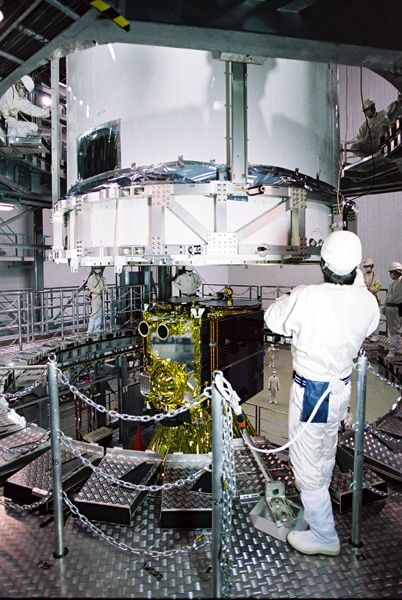
At the Tanegashima Space Center in Japan, JAXA's Hayabusa 2 spacecraft is about to be encapsulated by the payload fairing of its H-IIA launch vehicle...on November 17, 2014.
JAXA

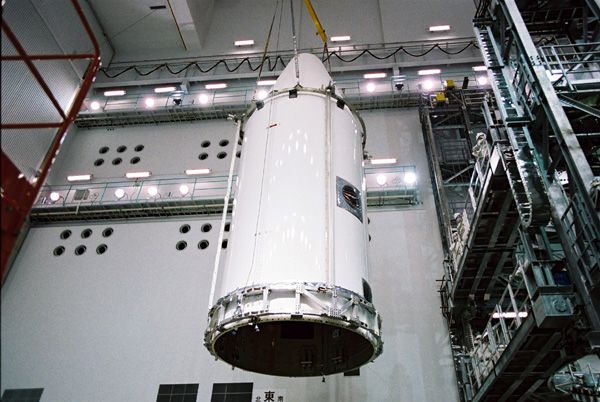
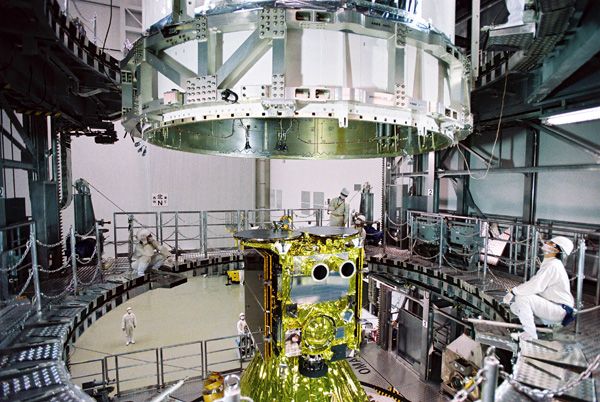
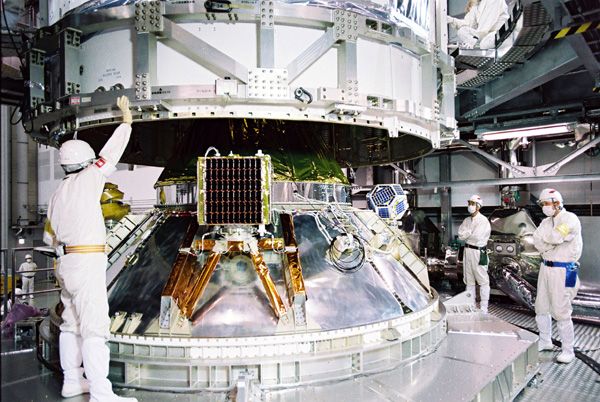
Happy Thanksgiving Day, everyone!!! Just thought I'd share these photos of Japan's Hayabusa 2 spacecraft as it gets prepped for launch at the Tanegashima Space Center in the southernmost part of the country. Hayabusa 2 is set to lift off aboard an H-IIA rocket this Saturday night (which will be Sunday afternoon in Japan), and will arrive at its celestial target—asteroid (162173) 1999 JU3—in July of 2018. Hayabusa 2 will gather samples from the surface of this asteroid before departing in December of 2019 and returning to Earth in December of the following year. Let's cross our fingers that Hayabusa 2 will have a smooth trip to and from 1999 JU3...unlike Hayabusa 1, which miraculously was able to reach Earth after suffering problems pertaining to its propulsion system, reaction wheels and other equipment as it concluded its mission at asteroid Itokawa almost a decade ago. Godspeed, Hayabusa 2... Here's hoping that JAXA (Japan Aerospace Exploration Agency) will enjoy as much success with this endeavor as Europe has with its Rosetta mission, even though it remains to be seen if the Philae lander will ever wake up from hibernation on the surface of comet 67P/Churyumov-Gerasimenko. (Google the full story on that.) Anyways, I'm lookin' forward to grubbin' down on shrimp cocktail during lunch today! Oh, and delicious turkey.

At the Tanegashima Space Center in Japan, the payload fairing of the H-IIA launch vehicle is about to encapsulate JAXA's Hayabusa 2 spacecraft (not visible)...on November 17, 2014.
JAXA

At the Tanegashima Space Center in Japan, JAXA's Hayabusa 2 spacecraft is about to be encapsulated by the payload fairing of its H-IIA launch vehicle...on November 17, 2014.
JAXA

At the Tanegashima Space Center in Japan, JAXA's Hayabusa 2 spacecraft is about to be encapsulated by the payload fairing of its H-IIA launch vehicle...on November 17, 2014.
JAXA

Tuesday, November 25, 2014

X-WING: Mission Completed!

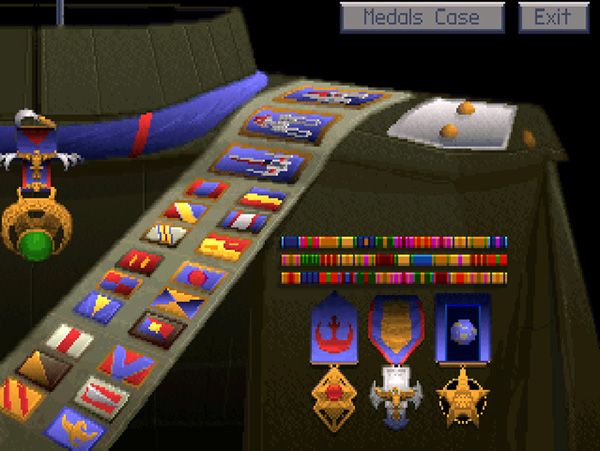
All of the awards that I won for passing Tour of Duties I to III in the STAR WARS: X-WING video game.

Less than a month after I purchased and downloaded it from GOG.com, I finished playing the classic Star Wars: X-Wing video game on my laptop computer. There were a few missions that for some odd reason were harder to complete than the last time I played them more than 15 years ago (namely, the Death Star Trench Run...for both B-Wing Historical Mission 6 and the final sortie in Tour of Duty III), but I found a way to achieve all objectives—thanks to watching video clips on Youtube showing how other X-Wing players flew and passed these missions, hah. The pics above and below show all of the merits that I won for completing this awesome video game, though it appears that there was one more award that I should've won that's missing in the medals case below (which is for all B-Wing Historical and Tour of Duty IV and V missions). Oh well. I also finished the game as a Lieutenant, though the highest ranking I earned was becoming Captain. And I said it before and I'll say it again: Y-Wing starfighters are sooo friggin' slow. Carry on!

All (but one) of the awards that I won for passing Tour of Duties IV and V in the STAR WARS: X-WING video game.

Monday, November 24, 2014

Back on the Trail Again...(in Los Angeles County)

Posing in front of a water tank/cell tower/whatever in Whittier, CA...on November 24, 2014. Nancy took the photo.

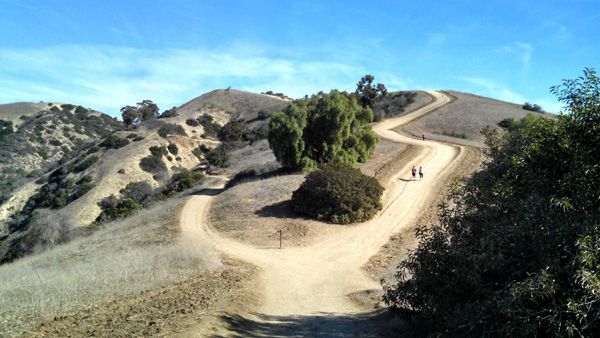
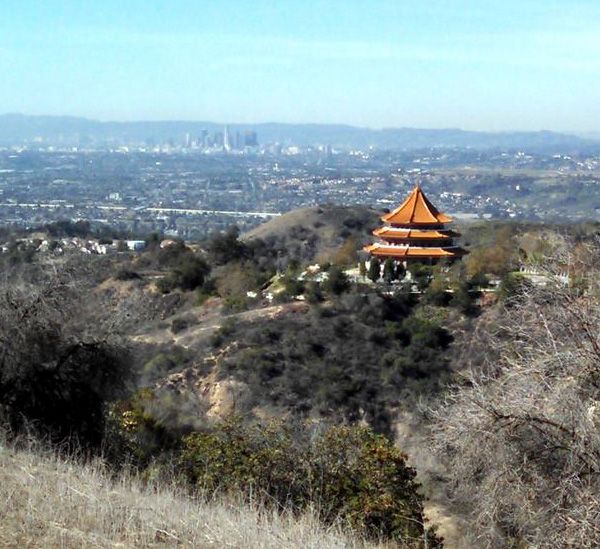
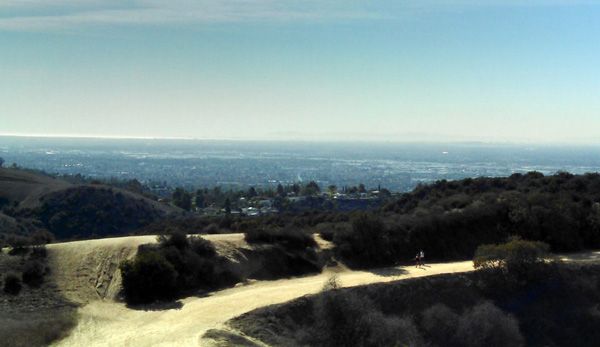
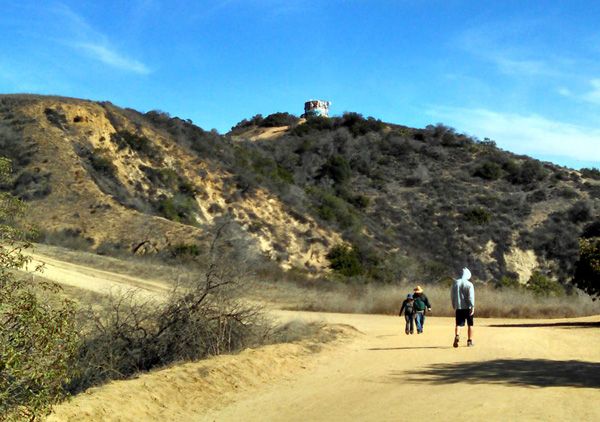
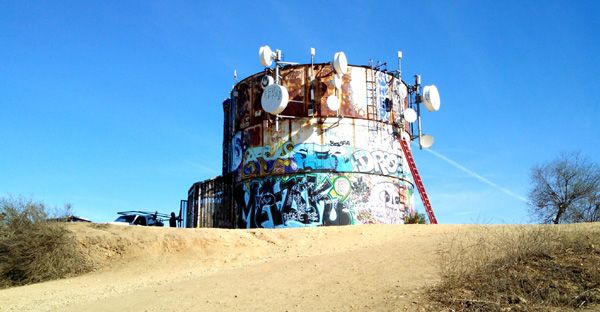
Earlier today, Nancy and I met up in Whittier to go hiking there for the second time in two months (though apparently, I forgot to post a Blog entry about that first trip...oh well). The trail we took this time around was more scenic—with the route taking us up a particular hill that really gave us an awesome glimpse of the Southland, most notably downtown Los Angeles on one side of the path and the distant Pacific Ocean and Catalina Island on the other. This was the longest and most grueling hike that we did yet; Nancy and I were both determined to reach what looked like a dilapidated water tank at the top of a hill at the end of the trail. Don't know if this was an actual water tank or a cell tower disguised as one. Either way, it provided a source of motivation for us to keep walking until there was no longer any trail to hike on. It must've been all that graffiti on the side of the tank/tower that lured us in, I dunno. Today's excursion was fun, though. Tiring, but fun.

A view from the trail Nancy and I used for our hike in Whittier, CA...on November 24, 2014.

Downtown Los Angeles is visible in this view from the trial Nancy and I used for our hike in Whittier, CA...on November 24, 2014.

If you were here in person, you'd be able to see Catalina Island and the Pacific Ocean in the distance. I kid you not.

Up on a hill, the water tank/cell tower/whatever beckons me and Nancy to visit it...on November 24, 2014.

The water tank/cell tower/whatever up-close and personal...on November 24, 2014.

Sunday, November 23, 2014

Photos of the Day: The F-22 and F-35 Stealth Fighters Unite!

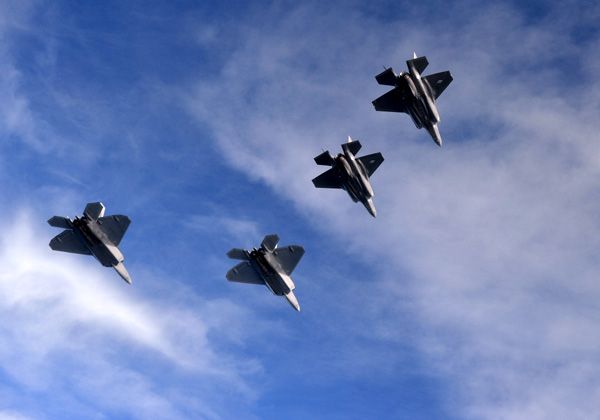
An F-22 Raptor and F-35 Lightning II fly in formation for a training mission.
U.S. Air Force photo

A few days ago, I stumbled upon these cool photos showing the F-22 Raptor and F-35 Lightning II (both built by Lockheed Martin) flying together on training missions. Pretty awesome... The F-35 (specifically the 'B' variant, which will be flown by the U.S. Marine Corps) is set to become operational by late next year, while the Raptor saw it first use in combat two months ago in Syria. The best of American air power is now flying in tandem through the wild blue yonder!

A pair of F-22 Raptors and two F-35 Lightning IIs fly in formation for a training mission.
U.S. Air Force photo / Master Sgt. Shane A. Cuomo

A pair of F-22 Raptors and two F-35 Lightning IIs fly in formation for a training mission.
U.S. Air Force photo / Master Sgt. Shane A. Cuomo

A pair of F-22 Raptors and two F-35 Lightning IIs fly in formation for a training mission.
U.S. Air Force photo / Master Sgt. Shane A. Cuomo

Wednesday, November 19, 2014

Back on the Trail Again...(in Orange County)

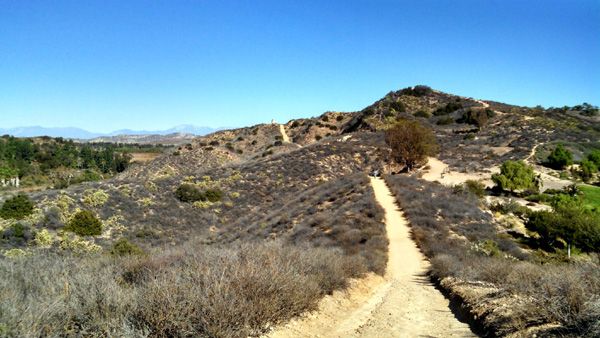
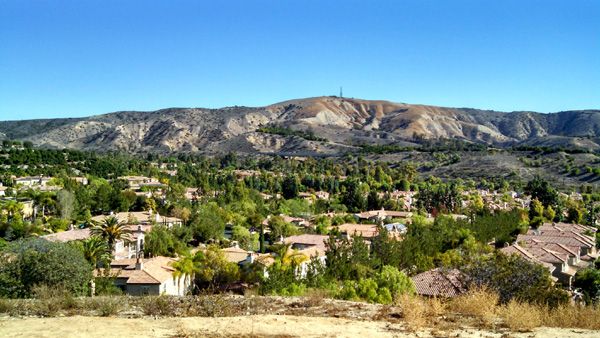
A view from the trail Nancy and I used for our hike in Orange County, CA...on November 17, 2014.

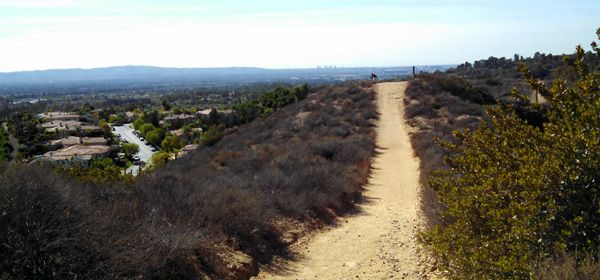
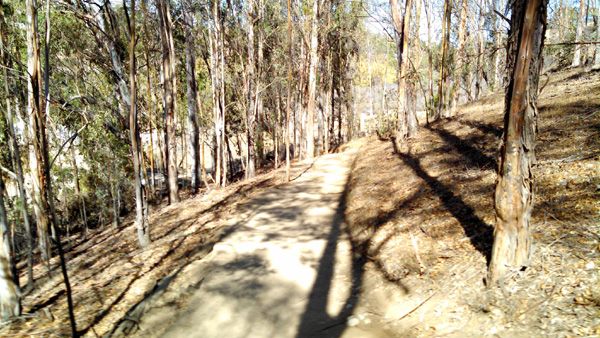
Just thought I'd share these photos that I took during my hike in Tustin, California two days ago. This was the same location I went to (with Nancy) last June. As you can see, Orange County is a really great place to live in—if you have the money to rent an apartment or buy a house there, that is. And you can deal with the crappy commute up to downtown Los Angeles everyday if that's where you work. I wouldn't mind that if I drove a new car (or a used vehicle that's obviously much newer than the one I have now)... I still employ my um, '98 Corolla.

A view from the trail Nancy and I used for our hike in Orange County, CA...on November 17, 2014.

A view from the trail Nancy and I used for our hike in Orange County, CA...on November 17, 2014.

A view from the trail Nancy and I used for our hike in Orange County, CA...on November 17, 2014.

Monday, November 17, 2014

The Next Red Planet Lander: InSight Is Taking Shape!

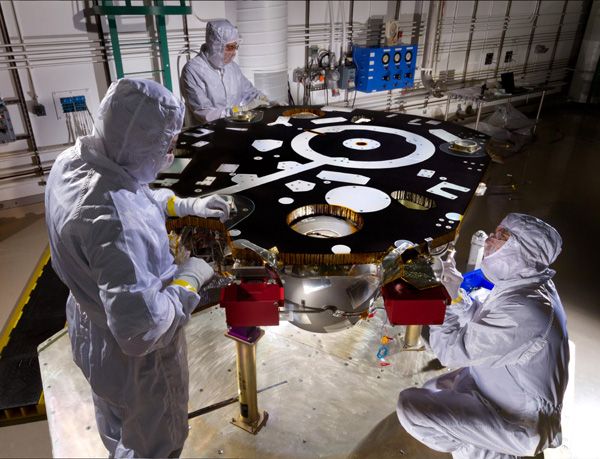
Engineers work on NASA's InSight Mars lander at Lockheed Martin Space Systems in Denver, Colorado...on October 31, 2014.
NASA / JPL - Caltech / Lockheed Martin

Next NASA Mars Mission Reaches Milestone (Press Release)

NASA's InSight mission has begun the assembly, test and launch operations (ATLO) phase of its development, on track for a March 2016 launch to Mars.

The lander, its aeroshell and cruise stage are being assembled by Lockheed Martin Space Systems, Denver.

"Reaching this stage that we call ATLO is a critical milestone," said InSight Project Manager Tom Hoffman at NASA's Jet Propulsion Laboratory, Pasadena, California. "This is a very satisfying point of the mission as we transition from many teams working on their individual elements to integrating these elements into a functioning system. The subsystems are coming from all over the globe, and the ATLO team works to integrate them into the flight vehicle. We will then move rapidly to rigorous testing when the spacecraft has been assembled, and then to the launch preparations."

Over the next six months, technicians at Lockheed Martin will add subsystems such as avionics, power, telecomm, mechanisms, thermal systems and navigation systems onto the spacecraft. The propulsion system was installed earlier this year on the lander's main structure.

"The InSight mission is a mix of tried-and-true and new-and-exciting. The spacecraft has a lot of heritage from Phoenix and even back to the Viking landers, but the science has never been done before at Mars," said Stu Spath, InSight program manager at Lockheed Martin Space Systems. "Physically, InSight looks a lot like the Phoenix lander we built, but most of the electronic components are similar to what is currently flying on the MAVEN spacecraft."

InSight stands for "Interior Exploration using Seismic Investigations, Geodesy and Heat Transport," and it is more than a Mars mission. This NASA Discovery-class mission is a terrestrial planet explorer that will address one of the most fundamental issues of planetary and solar system science: understanding the processes that shaped the rocky planets of the inner solar system (including Earth) more than four billion years ago.

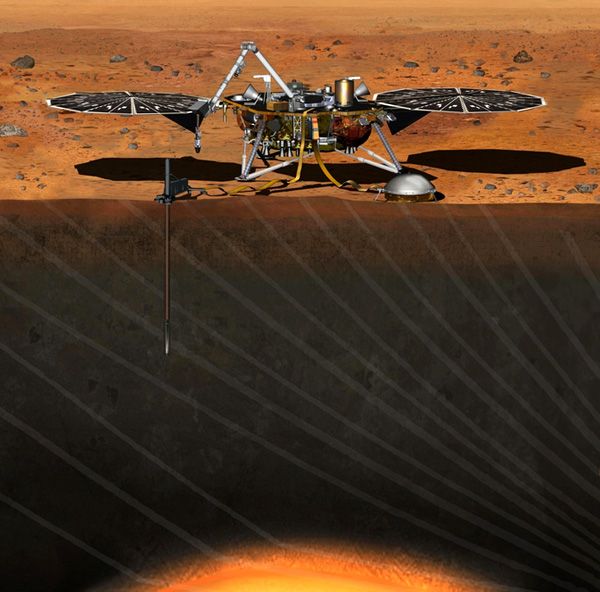
To investigate the planet's interior, the stationary lander will carry a robotic arm that will deploy surface and burrowing instruments contributed by France and Germany. The national space agencies of France and Germany -- Centre National d'Etudes Spatiales (CNES) and Deutsches Zentrum für Luft- und Raumfahrt (DLR), respectively -- are partnering with NASA by providing InSight's two main science instruments.

The Seismic Experiment for Interior Structure (SEIS) will be built by CNES in partnership with DLR and the space agencies of Switzerland and the United Kingdom. It will measure waves of ground motion carried through the interior of the planet, from "marsquakes" and meteor impacts. The Heat Flow and Physical Properties Package, from DLR, will measure heat coming toward the surface from the planet's interior.

Guided by images of the surroundings taken by the lander, InSight's robotic arm will place the seismometer on the surface and then place a protective covering over it to minimize effects of wind and temperature on the sensitive instrument. The arm will also put the heat-flow probe in position to hammer itself into the ground to a depth of 3 to 5 yards, or meters.

Another experiment will use the radio link between InSight and NASA's Deep Space Network antennas on Earth to measure precisely a wobble in Mars' rotation that could reveal whether the planet has a molten or solid core. Wind and temperature sensors from Spain's Centro de Astrobiologia and a pressure sensor will monitor weather at the landing site, and a magnetometer will measure magnetic disturbances caused by the Martian ionosphere.

The InSight mission is led by JPL's Bruce Banerdt. It is part of NASA's Discovery Program of competitively selected, cost-capped missions. Its international science team combines researchers from Austria, Belgium, Canada, France, Germany, Japan, Poland, Spain, Switzerland, the United Kingdom and the United States. JPL, a division of the California Institute of Technology, Pasadena, manages InSight for NASA's Science Mission Directorate, Washington. NASA's Marshall Space Flight Center in Huntsville, Alabama, manages the Discovery Program. Lockheed Martin is building the lander and other parts of the spacecraft near Denver.

Source: Jet Propulsion Laboratory

****

An artist's concept of the InSight lander on the surface of Mars.
NASA / JPL

Friday, November 14, 2014

New Horizons Update: Hibernation Ends in About Three Weeks!

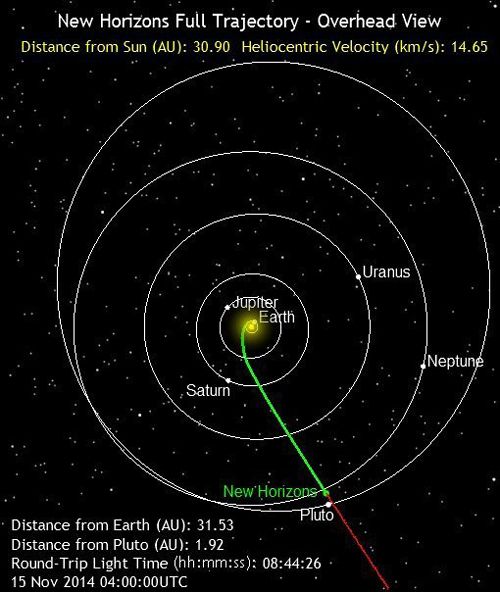
The green line marks the path traveled by the New Horizons spacecraft as of 8:00 PM, Pacific Standard Time, on November 14, 2014.  It is 2.9 billion miles from Earth.
ABOVE: The green line marks the path traveled by the New Horizons spacecraft as of
8:00 PM, Pacific Standard Time, on November 14, 2014. It is 2.9 billion miles from Earth.
Click
here to view the official webpage showing where New Horizons is in space.
(AU stands for Astronomical Units, in case you're wondering.)


New Horizons Set to Wake Up for Pluto Encounter (Press Release - November 13)

NASA’s New Horizons spacecraft comes out of hibernation for the last time on Dec. 6. Between now and then, while the Pluto-bound probe enjoys three more weeks of electronic slumber, work on Earth is well under way to prepare the spacecraft for a six-month encounter with the dwarf planet that begins in January.

“New Horizons is healthy and cruising quietly through deep space – nearly three billion miles from home – but its rest is nearly over,” says Alice Bowman, New Horizons mission operations manager at the Johns Hopkins University Applied Physics Laboratory (APL) in Laurel, Md. “It’s time for New Horizons to wake up, get to work, and start making history.”

Since launching in January 2006, New Horizons has spent 1,873 days in hibernation – about two-thirds of its flight time – spread over 18 separate hibernation periods from mid-2007 to late 2014 that ranged from 36 days to 202 days long.

In hibernation mode much of the spacecraft is unpowered; the onboard flight computer monitors system health and broadcasts a weekly beacon-status tone back to Earth. On average, operators woke New Horizons just over twice each year to check out critical systems, calibrate instruments, gather science data, rehearse Pluto-encounter activities and perform course corrections when necessary.

New Horizons pioneered routine cruise-flight hibernation for NASA. Not only has hibernation reduced wear and tear on the spacecraft’s electronics, it lowered operations costs and freed up NASA Deep Space Network tracking and communication resources for other missions.

Ready to Go

Next month’s wake-up call was preprogrammed into New Horizons’ on-board computer in August, commanding it come out of hibernation at 3 p.m. EST on Dec. 6. About 90 minutes later New Horizons will transmit word to Earth that it’s in “active” mode; those signals, even traveling at light speed, will need four hours and 25 minutes to reach home. Confirmation should reach the mission operations team at APL around 9:30 p.m. EST. At the time New Horizons will be more than 2.9 billion miles from Earth, and just 162 million miles – less than twice the distance between Earth and the sun – from Pluto.

After several days of collecting navigation-tracking data, downloading and analyzing the cruise science and spacecraft housekeeping data stored on New Horizons’ digital recorders, the mission team will begin activities that include conducting final tests on the spacecraft’s science instruments and operating systems, and building and testing the computer-command sequences that will guide New Horizons through its flight to and reconnaissance of the Pluto system. Tops on the mission’s science list are characterizing the global geology and topography of Pluto and its large moon Charon, mapping their surface compositions and temperatures, examining Pluto’s atmospheric composition and structure, studying Pluto’s smaller moons and searching for new moons and rings.

New Horizons’ seven-instrument science payload, developed under direction of Southwest Research Institute, includes advanced imaging infrared and ultraviolet spectrometers, a compact multicolor camera, a high-resolution telescopic camera, two powerful particle spectrometers, a space-dust detector (designed and built by students at the University of Colorado) and two radio science experiments. The entire spacecraft, drawing electricity from a single radioisotope thermoelectric generator, operates on less power than a pair of 100-watt light bulbs.

Distant observations of the Pluto system begin Jan. 15 and will continue until late July 2015; closest approach to Pluto is July 14.

“We’ve worked years to prepare for this moment,” says Mark Holdridge, New Horizons encounter mission manager at APL. “New Horizons might have spent most of its cruise time across nearly three billion miles of space sleeping, but our team has done anything but, conducting a flawless flight past Jupiter just a year after launch, putting the spacecraft through annual workouts, plotting out each step of the Pluto flyby and even practicing the entire Pluto encounter on the spacecraft. We are ready to go.”

“The final hibernation wake up Dec. 6 signifies the end of an historic cruise across the entirety of our planetary system,” added New Horizons Principal Investigator Alan Stern, of the Southwest Research Institute. “We are almost on Pluto’s doorstep!”

The Johns Hopkins Applied Physics Laboratory manages the New Horizons mission for NASA’s Science Mission Directorate. Alan Stern, of the Southwest Research Institute (SwRI) is the principal investigator and leads the mission; SwRI leads the science team, payload operations, and encounter science planning. New Horizons is part of the New Frontiers Program managed by NASA's Marshall Space Flight Center in Huntsville, Ala. APL designed, built and operates the New Horizons spacecraft.

Source: New Horizons Website

****

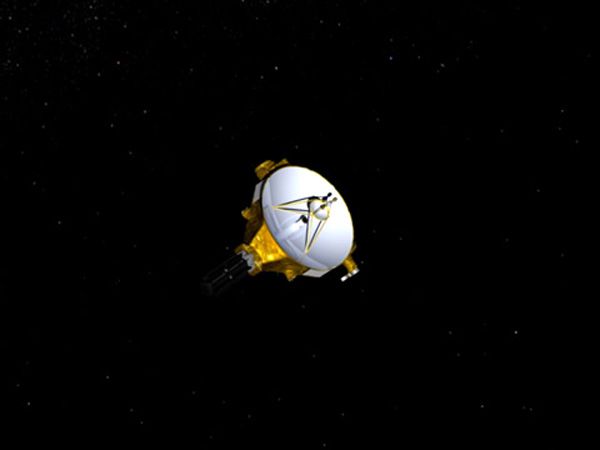
An artist's concept of NASA's New Horizons spacecraft traveling through deep space.
NASA / Johns Hopkins University Applied Physics Laboratory / Southwest Research Institute

Wednesday, November 12, 2014

Rosetta Update: Fire the Harpoons (or Not)!

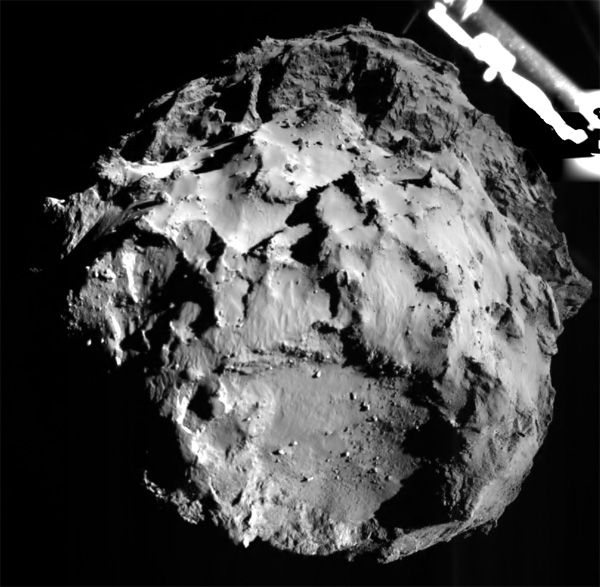
Comet 67P/Churyumov–Gerasimenko as seen by the European Space Agency's (ESA) Philae spacecraft while it heads in for a landing on the icy celestial body, on November 12, 2014.
ESA / Rosetta / Philae / ROLIS / DLR

Touchdown! Rosetta’s Philae Probe Lands on Comet (Press Release)

ESA’s Rosetta mission has soft-landed its Philae probe on a comet, the first time in history that such an extraordinary feat has been achieved.

After a tense wait during the seven-hour descent to the surface of Comet 67P/Churyumov–Gerasimenko, the signal confirming the successful touchdown arrived on Earth at 16:03 GMT (17:03 CET).

The confirmation was relayed via the Rosetta orbiter to Earth and picked up simultaneously by ESA’s ground station in Malargüe, Argentina and NASA’s station in Madrid, Spain. The signal was immediately confirmed at ESA’s Space Operations Centre, ESOC, in Darmstadt, and DLR’s Lander Control Centre in Cologne, both in Germany.

The first data from the lander’s instruments were transmitted to the Philae Science, Operations and Navigation Centre at France’s CNES space agency in Toulouse.

“Our ambitious Rosetta mission has secured a place in the history books: not only is it the first to rendezvous with and orbit a comet, but it is now also the first to deliver a lander to a comet’s surface,” noted Jean-Jacques Dordain, ESA’s Director General.

“With Rosetta we are opening a door to the origin of planet Earth and fostering a better understanding of our future. ESA and its Rosetta mission partners have achieved something extraordinary today.”

“After more than 10 years travelling through space, we’re now making the best ever scientific analysis of one of the oldest remnants of our Solar System,” said Alvaro Giménez, ESA’s Director of Science and Robotic Exploration.

“Decades of preparation have paved the way for today’s success, ensuring that Rosetta continues to be a game-changer in cometary science and space exploration.”

“We are extremely relieved to be safely on the surface of the comet, especially given the extra challenges that we faced with the health of the lander,” said Stephan Ulamec, Philae Lander Manager at the DLR German Aerospace Center.

“In the next hours we’ll learn exactly where and how we’ve landed, and we’ll start getting as much science as we can from the surface of this fascinating world.”

Rosetta was launched on 2 March 2004 and travelled 6.4 billion kilometres through the Solar System before arriving at the comet on 6 August 2014.

“Rosetta’s journey has been a continuous operational challenge, requiring an innovative approach, precision and long experience,” said Thomas Reiter, ESA Director of Human Spaceflight and Operations.

“This success is testimony to the outstanding teamwork and the unique knowhow in operating spacecraft acquired at the European Space Agency over the decades.”

The landing site, named Agilkia and located on the head of the bizarre double-lobed object, was chosen just six weeks after arrival based on images and data collected at distances of 30–100 km from the comet. Those first images soon revealed the comet as a world littered with boulders, towering cliffs and daunting precipices and pits, with jets of gas and dust streaming from the surface.

Following a period spent at 10 km to allow further close-up study of the chosen landing site, Rosetta moved onto a more distant trajectory to prepare for Philae’s deployment.

Five critical go/no-go decisions were made last night and early this morning, confirming different stages of readiness ahead of separation, along with a final pre-separation manoeuvre by the orbiter.

Deployment was confirmed at 09:03 GMT (10:03 CET) at a distance of 22.5km from the centre of the comet. During the seven-hour descent, which was made without propulsion or guidance, Philae took images and recorded information about the comet’s environment.

“One of the greatest uncertainties associated with the delivery of the lander was the position of Rosetta at the time of deployment, which was influenced by the activity of the comet at that specific moment, and which in turn could also have affected the lander’s descent trajectory,” said Sylvain Lodiot, ESA Rosetta Spacecraft Operations Manager.

“Furthermore, we’re performing these operations in an environment that we’ve only just started learning about, 510 million kilometres from Earth.”

Touchdown was planned to take place at a speed of around 1 m/s, with the three-legged landing gear absorbing the impact to prevent rebound, and an ice screw in each foot driving into the surface.

At the same time, two harpoons fired and locked the probe onto the surface.

But during the final health checks of the lander before separation, a problem was detected with the small thruster on top that was designed to counteract the recoil of the harpoons to push the lander down onto the surface. The conditions of landing – including whether or not the thruster performed – along with the exact location of Philae on the comet are being analysed.

The first images from the surface are being downlinked to Earth and should be available within a few hours of touchdown.

Over the next 2.5 days, the lander will conduct its primary science mission, assuming that its main battery remains in good health. An extended science phase using the rechargeable secondary battery may be possible, assuming Sun illumination conditions allow and dust settling on the solar panels does not prevent it. This extended phase could last until March 2015, after which conditions inside the lander are expected to be too hot for it to continue operating.

Science highlights from the primary phase will include a full panoramic view of the landing site, including a section in 3D, high-resolution images of the surface immediately underneath the lander, on-the-spot analysis of the composition of the comet’s surface materials, and a drill that will take samples from a depth of 23 cm and feed them to an onboard laboratory for analysis.

The lander will also measure the electrical and mechanical characteristics of the surface. In addition, low-frequency radio signals will be beamed between Philae and the orbiter through the nucleus to probe the internal structure.

The detailed surface measurements that Philae makes at its landing site will complement and calibrate the extensive remote observations made by the orbiter covering the whole comet.

“Rosetta is trying to answer the very big questions about the history of our Solar System. What were the conditions like at its infancy and how did it evolve? What role did comets play in this evolution? How do comets work?” said Matt Taylor, ESA Rosetta project scientist.

“Today’s successful landing is undoubtedly the cherry on the icing of a 4 km-wide cake, but we’re also looking further ahead and onto the next stage of this ground-breaking mission, as we continue to follow the comet around the Sun for 13 months, watching as its activity changes and its surface evolves.”

While Philae begins its close-up study of the comet, Rosetta must manoeuvre from its post-separation path back into an orbit around the comet, eventually returning to a 20 km orbit on 6 December.

Next year, as the comet grows more active, Rosetta will need to step further back and fly unbound ‘orbits’, but dipping in briefly with daring flybys, some of which will bring it within just 8 km of the comet centre.

The comet will reach its closest distance to the Sun on 13 August 2015 at about 185 million km, roughly between the orbits of Earth and Mars. Rosetta will follow it throughout the remainder of 2015, as they head away from the Sun and activity begins to subside.

“It’s been an extremely long and hard journey to reach today’s once-in-a-lifetime event, but it was absolutely worthwhile. We look forward to the continued success of the great scientific endeavour that is the Rosetta mission as it promises to revolutionise our understanding of comets,” said Fred Jansen, ESA Rosetta mission manager.

Source: European Space Agency

****
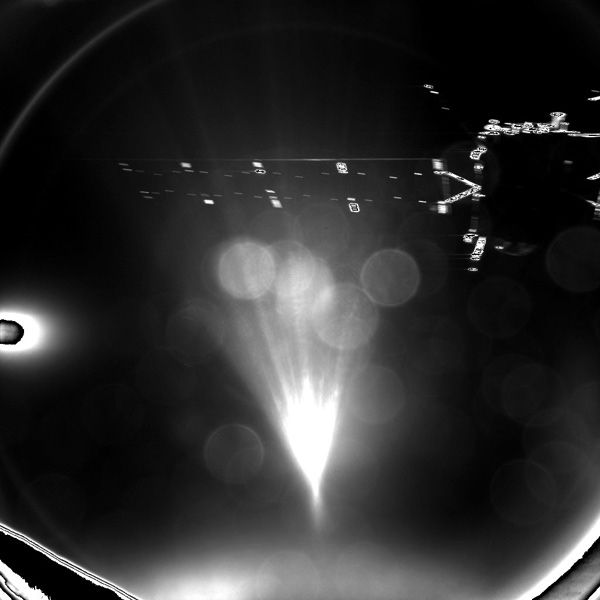
ESA's Rosetta orbiter as seen by Philae after the probe is deployed for a 7-hour journey to comet 67P/Churyumov–Gerasimenko's surface, on November 12, 2014.
ESA / Rosetta / Philae / CIVA

Philae floats in the darkness of space after being deployed by ESA's Rosetta orbiter for a 7-hour journey to comet 67P/Churyumov–Gerasimenko's surface, on November 12, 2014.
ESA / Rosetta / MPS for OSIRIS Team MPS / UPD / LAM / IAA / SSO / INTA / UPM / DASP / IDA

Today's Google doodle honoring Philae's historic landing on comet 67P/Churyumov–Gerasimenko's surface, on November 12, 2014.

Sunday, November 09, 2014

Photos of the Night: Taking the Train in L.A.

A Metro Gold Line train is about to pass over the 101 Freeway in downtown Los Angeles, on February 14, 2014.

I took these two pics after I got off from work last Valentine's Day, but just thought I'd post them here now (they've been taking up space on my laptop since then). The Metro Gold Line is in action as passengers take the train that carries them above the 101 Freeway in downtown Los Angeles. I've never taken this particular Metro line before, but I did use the subway when I checked out space shuttle Endeavour during her move to the California Science Center two years back (I met up with one of my friends in North Hollywood and took the train all the way down to the City of Angels). Fun times.

A Metro Gold Line train is about to pass over the 101 Freeway in downtown Los Angeles, on February 14, 2014.