Friday, January 31, 2014

Jack Bauer Is Coming Back!

24 logo.

But don't take my word for it... Check out this cool banner that is currently the cover photo for 24's Facebook page. Now the big question is: Will I be financially irresponsible like I was in 2010 (when the hit FOX show's final season, Day 8, aired) and not work on the nights the episodes are shown on TV? I have less than four months to think about that—though I think we all know what my decision will end up being...

24: LIVE ANOTHER DAY premieres on FOX on May 5.

Wednesday, January 29, 2014

Image of the Day...

So true... So very, very true. (We'll ignore the fact that I wouldn't have stumbled upon this meme if not for Facebook.)

Facebook, Myspace and other social network sites have taken the fun out of telepathy...if it were real.

Sunday, January 26, 2014

The Stadium Series...

The Anaheim Ducks defeated the Los Angeles Kings, 3-0, at an outdoor hockey rink inside of Dodger Stadium, on January 25, 2014.
AP

The Anaheim Ducks bested the Los Angeles Kings, 3-0, at Dodger Stadium last night. I want either team to reach and win the Stanley Cup Finals this June, so it's all good...

An aerial view of Dodger Stadium, where the Anaheim Ducks defeated the Los Angeles Kings, 3-0, at an outdoor hockey rink on January 25, 2014.
AP

The Anaheim Ducks defeated the Los Angeles Kings, 3-0, at an outdoor hockey rink inside of Dodger Stadium, on January 25, 2014.
AP

The Anaheim Ducks defeated the Los Angeles Kings, 3-0, at an outdoor hockey rink inside of Dodger Stadium, on January 25, 2014.
AP

Saturday, January 25, 2014

Happy Anniversary, Opportunity!

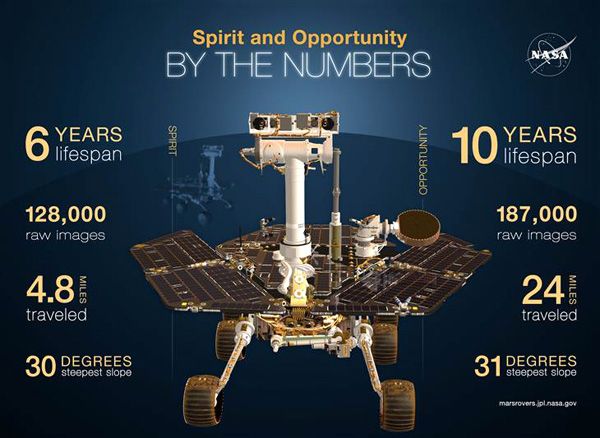
Just thought I'd share this cool infographic comparing the achievements made by the Opportunity (which marks the 10-year anniversary of her Martian landing today) and Spirit (whose mission ended almost three years ago) rovers on Mars. Here's hoping Curiosity will be alive and well when she celebrates this milestone in August of 2022...which would mark a decade since her own triumphant arrival on the Red Planet.

An infographic comparing the achievements made by NASA's Spirit and Opportunity rovers.
NASA / JPL - Caltech

Wednesday, January 22, 2014

Dawn Update (Sort Of)...

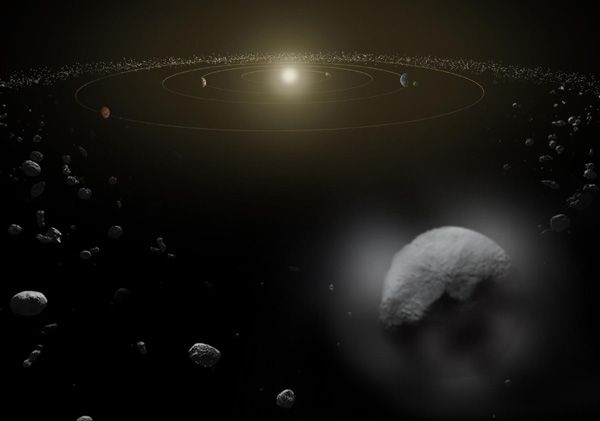
An artist's concept of dwarf planet Ceres in the Main Asteroid Belt...located between the orbits of Mars and Jupiter.
ESA / ATG medialab

Herschel Telescope Detects Water on Dwarf Planet (Press Release)

Scientists using the Herschel space observatory have made the first definitive detection of water vapor on the largest and roundest object in the asteroid belt, Ceres.

Plumes of water vapor are thought to shoot up periodically from Ceres when portions of its icy surface warm slightly. Ceres is classified as a dwarf planet, a solar system body bigger than an asteroid and smaller than a planet.

Herschel is a European Space Agency (ESA) mission with important NASA contributions.

"This is the first time water vapor has been unequivocally detected on Ceres or any other object in the asteroid belt and provides proof that Ceres has an icy surface and an atmosphere," said Michael Küppers of ESA in Spain, lead author of a paper in the journal Nature.

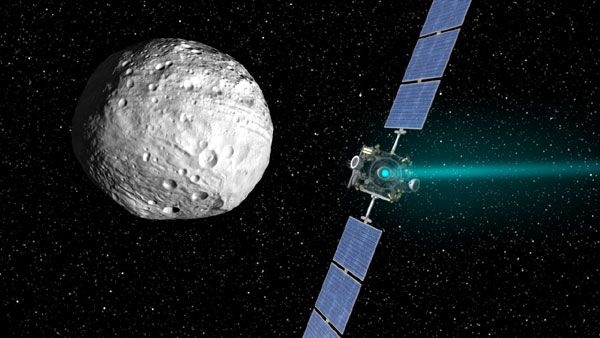
The results come at the right time for NASA's Dawn mission, which is on its way to Ceres now after spending more than a year orbiting the large asteroid Vesta. Dawn is scheduled to arrive at Ceres in the spring of 2015, where it will take the closest look ever at its surface.

"We've got a spacecraft on the way to Ceres, so we don't have to wait long before getting more context on this intriguing result, right from the source itself," said Carol Raymond, the deputy principal investigator for Dawn at NASA's Jet Propulsion Laboratory in Pasadena, Calif. "Dawn will map the geology and chemistry of the surface in high resolution, revealing the processes that drive the outgassing activity."

For the last century, Ceres was known as the largest asteroid in our solar system. But in 2006, the International Astronomical Union, the governing organization responsible for naming planetary objects, reclassified Ceres as a dwarf planet because of its large size. It is roughly 590 miles (950 kilometers) in diameter. When it first was spotted in 1801, astronomers thought it was a planet orbiting between Mars and Jupiter. Later, other cosmic bodies with similar orbits were found, marking the discovery of our solar system's main belt of asteroids.

Scientists believe Ceres contains rock in its interior with a thick mantle of ice that, if melted, would amount to more fresh water than is present on all of Earth. The materials making up Ceres likely date from the first few million years of our solar system's existence and accumulated before the planets formed.

Until now, ice had been theorized to exist on Ceres but had not been detected conclusively. It took Herschel's far-infrared vision to see, finally, a clear spectral signature of the water vapor. But Herschel did not see water vapor every time it looked. While the telescope spied water vapor four different times, on one occasion there was no signature.

Here is what scientists think is happening: when Ceres swings through the part of its orbit that is closer to the sun, a portion of its icy surface becomes warm enough to cause water vapor to escape in plumes at a rate of about 6 kilograms (13 pounds) per second. When Ceres is in the colder part of its orbit, no water escapes.

The strength of the signal also varied over hours, weeks and months, because of the water vapor plumes rotating in and out of Herschel's views as the object spun on its axis. This enabled the scientists to localize the source of water to two darker spots on the surface of Ceres, previously seen by NASA's Hubble Space Telescope and ground-based telescopes. The dark spots might be more likely to outgas because dark material warms faster than light material. When the Dawn spacecraft arrives at Ceres, it will be able to investigate these features.

The results are somewhat unexpected because comets, the icier cousins of asteroids, are known typically to sprout jets and plumes, while objects in the asteroid belt are not.

"The lines are becoming more and more blurred between comets and asteroids," said Seungwon Lee of JPL, who helped with the water vapor models along with Paul von Allmen, also of JPL. "We knew before about main belt asteroids that show comet-like activity, but this is the first detection of water vapor in an asteroid-like object."

The research is part of the Measurements of 11 Asteroids and Comets Using Herschel (MACH-11) program, which used Herschel to look at small bodies that have been or will be visited by spacecraft, including the targets of NASA's previous Deep Impact mission and upcoming Origins Spectral Interpretation Resource Identification Security Regolith Explorer (OSIRIS-Rex). Laurence O' Rourke of the European Space Agency is the principal investigator of the MACH-11 program.

Herschel is a European Space Agency mission, with science instruments provided by consortia of European institutes and with important participation by NASA. While the observatory stopped making science observations in April 2013, after running out of liquid coolant, as expected, scientists continue to analyze its data. NASA's Herschel Project Office is based at JPL. JPL contributed mission-enabling technology for two of Herschel's three science instruments. The NASA Herschel Science Center, part of the Infrared Processing and Analysis Center at the California Institute of Technology in Pasadena, supports the U.S. astronomical community.

Dawn's mission is managed by JPL for NASA's Science Mission Directorate in Washington. Dawn is a project of the directorate's Discovery Program, managed by NASA's Marshall Space Flight Center in Huntsville, Ala. UCLA is responsible for overall Dawn mission science. Orbital Sciences Corp. in Dulles, Va., designed and built the spacecraft. The German Aerospace Center, the Max Planck Institute for Solar System Research, the Italian Space Agency and the Italian National Astrophysical Institute are international partners on the mission team. Caltech manages JPL for NASA.

Source: Jet Propulsion Laboratory

****

A composite image of the Dawn spacecraft departing from asteroid Vesta in September of 2012...beginning its next interplanetary journey to dwarf planet Ceres.
NASA / JPL - Caltech

Tuesday, January 21, 2014

Prepping for Mars 2020...

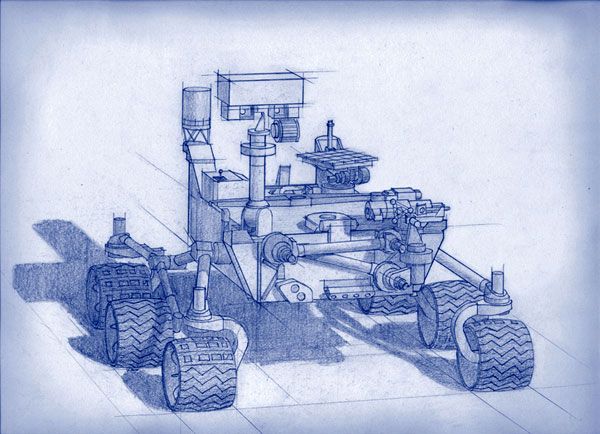
An artist's sketch of NASA's Mars 2020 rover.
NASA / JPL - Caltech

NASA Receives Mars 2020 Rover Instrument Proposals for Evaluation (Press Release)

NASA has received 58 proposals for science and exploration technology instruments to fly aboard the agency's next Mars rover in 2020, twice the usual number submitted for instrument competitions in the recent past, and an indicator of the extraordinary interest in exploration of the Red Planet.

The agency is beginning a thorough review to determine the best combination of science and exploration technology investigations for the mission and anticipates making final selections in the next five months.

"Proposal writing for science missions is extremely difficult and time consuming. We truly appreciate this overwhelming response by the worldwide science and technical community and are humbled by the support and enthusiasm for this unique mission," said John Grunsfeld, NASA's associate administrator for science in Washington. "We fully expect to be able to select an instrument suite that will return exciting science and advance space exploration at Mars."

NASA opened competition for Mars 2020 research proposals in September and closed it January 15. Several NASA facilities, academia, industry, research laboratories and other government agencies submitted proposals. Seventeen proposals came from international partners.

The Mars 2020 mission is designed to accomplish several high-priority planetary science goals and will be an important step toward meeting President Obama's challenge to send humans to Mars in the 2030s. The mission will conduct geological assessments of the rover's landing site, determine the habitability of the environment, search for signs of ancient Martian life, and assess natural resources and hazards for future human explorers.

The science instruments aboard the rover also will enable scientists to identify and select a collection of rock and soil samples that will be stored for potential return to Earth in the future. This will achieve one of the highest-priority objectives recommended by the National Research Council's 2011 Planetary Science Decadal Survey. Analysis of such samples in laboratories here on Earth will help determine whether life existed on Mars and help inform planning for human exploration missions to the planet.

The rover also may help designers of a human expedition understand the hazards posed by Martian dust and demonstrate how to collect carbon dioxide from the atmosphere, which could be a valuable resource for producing oxygen and rocket fuel.

"NASA robotic missions are pioneering a path for human exploration of Mars in the 2030s," said William Gerstenmaier, NASA's associate administrator for human exploration and operations in Washington. "The Mars 2020 rover mission presents new opportunities to learn how future human explorers could use natural resources available on the surface of the Red Planet. An ability to live off the land could reduce costs and engineering challenges posed by Mars exploration."

The instruments developed from the selected proposals will be placed on a rover similar to Curiosity, which has been exploring Mars since 2012. Using a proven landing system and rover chassis design to deliver these new experiments to Mars will ensure mission costs and risks are minimized as much as possible while still delivering a highly capable rover.

The 2020 mission will build on the achievements of Curiosity and other Mars missions, and offer opportunities to deploy new capabilities developed through investments by NASA's Space Technology Program, Human Exploration and Operations Mission Directorate, and contributions from international partners.

"New and more advanced space technologies are essential for future human expeditions to the Red Planet," said Michael Gazarik, NASA's associate administrator for space technology. "These technologies will enable the life support and transportation resources needed for future astronauts to live and work on Mars."

The Mars 2020 rover will join the agency's robust Mars Exploration Program, which includes the Curiosity and Opportunity rovers, the Odyssey and Mars Reconnaissance Orbiter spacecraft currently orbiting Mars, and the MAVEN orbiter, recently sent to study the Martian upper atmosphere. In 2016, a Mars lander mission called InSight will launch to take the first look into the deep interior of Mars. The agency also is participating in the European Space Agency's (ESA's) 2016 and 2018 ExoMars missions, including providing "Electra" telecommunication radios to ESA's 2016 orbiter and a critical element of the premier astrobiology instrument on the 2018 ExoMars rover.

Source: Jet Propulsion Laboratory

****

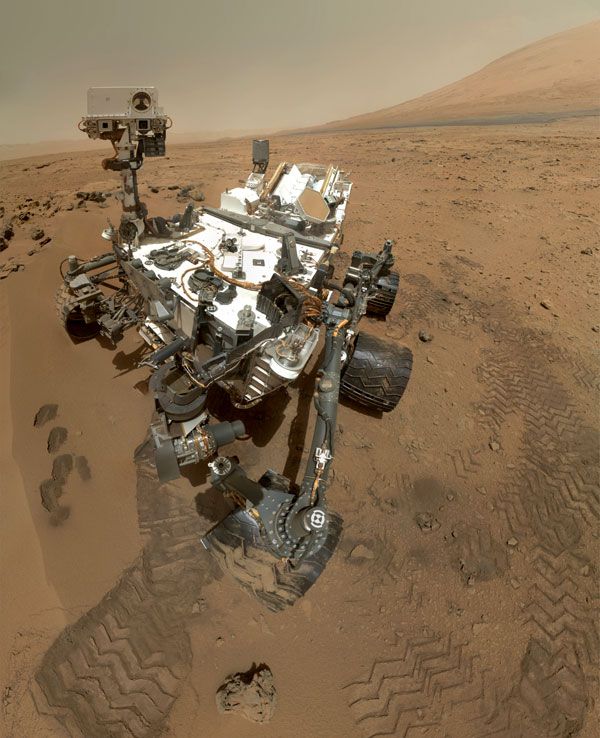
A self-portrait of NASA's Curiosity Mars rover, taken with a camera on her robotic arm on October 31, 2012. Mount Sharp lays in the background.
NASA / JPL - Caltech / MSSS

Monday, January 20, 2014

Rise and Shine, Rosetta!

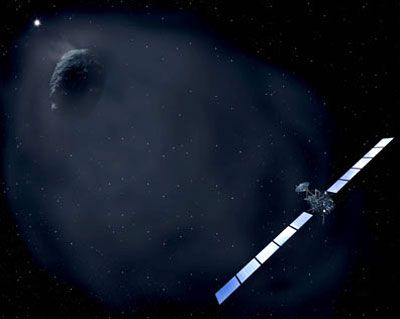
An artist's concept of ESA's Rosetta spacecraft approaching comet Churyumov-Gerasimenko.
ESA

ESA’s ‘Sleeping Beauty’ Wakes Up From Deep Space Hibernation (Press Release)

It was a fairy-tale ending to a tense chapter in the story of the Rosetta space mission this evening as ESA heard from its distant spacecraft for the first time in 31 months.

Rosetta is chasing down Comet 67P/Churyumov-Gerasimenko, where it will become the first space mission to rendezvous with a comet, the first to attempt a landing on a comet’s surface, and the first to follow a comet as it swings around the Sun.

Since its launch in 2004, Rosetta has made three flybys of Earth and one of Mars to help it on course to its rendezvous with 67P/Churyumov-Gerasimenko, encountering asteroids Steins and Lutetia along the way.

Operating on solar energy alone, Rosetta was placed into a deep space slumber in June 2011 as it cruised out to a distance of nearly 800 million km from the warmth of the Sun, beyond the orbit of Jupiter.

Now, as Rosetta’s orbit has brought it back to within ‘only’ 673 million km from the Sun, there is enough solar energy to power the spacecraft fully again.

Thus today, still about 9 million km from the comet, Rosetta’s pre-programmed internal ‘alarm clock’ woke up the spacecraft. After warming up its key navigation instruments, coming out of a stabilising spin, and aiming its main radio antenna at Earth, Rosetta sent a signal to let mission operators know it had survived the most distant part of its journey.

The signal was received by both NASA’s Goldstone and Canberra ground stations at 18:18 GMT/ 19:18 CET, during the first window of opportunity the spacecraft had to communicate with Earth. It was immediately confirmed in ESA’s space operations centre in Darmstadt and the successful wake-up announced via the @ESA_Rosetta twitter account, which tweeted: “Hello, World!"

“We have our comet-chaser back,” says Alvaro Giménez, ESA’s Director of Science and Robotic Exploration. “With Rosetta, we will take comet exploration to a new level. This incredible mission continues our history of ‘firsts’ at comets, building on the technological and scientific achievements of our first deep space mission Giotto, which returned the first close-up images of a comet nucleus as it flew past Halley in 1986.”

“This was one alarm clock not to hit snooze on, and after a tense day we are absolutely delighted to have our spacecraft awake and back online,” adds Fred Jansen, ESA’s Rosetta mission manager.

Comets are considered the primitive building blocks of the Solar System and likely helped to ‘seed’ Earth with water, perhaps even the ingredients for life. But many fundamental questions about these enigmatic objects remain, and through its comprehensive, in situ study of Comet 67P/Churyumov-Gerasimenko, Rosetta aims to unlock the secrets contained within.

“All other comet missions have been flybys, capturing fleeting moments in the life of these icy treasure chests,” says Matt Taylor, ESA’s Rosetta project scientist. “With Rosetta, we will track the evolution of a comet on a daily basis and for over a year, giving us a unique insight into a comet’s behaviour and ultimately helping us to decipher their role in the formation of the Solar System.”

But first, essential health checks on the spacecraft must be completed. Then the eleven instruments on the orbiter and ten on the lander will be turned on and prepared for studying Comet 67P/Churyumov-Gerasimenko.

“We have a busy few months ahead preparing the spacecraft and its instruments for the operational challenges demanded by a lengthy, close-up study of a comet that, until we get there, we know very little about,” says Andrea Accomazzo, ESA’s Rosetta operations manager.

Rosetta’s first images of 67P/Churyumov-Gerasimenko are expected in May, when the spacecraft is still 2 million km from its target. Towards the end of May, the spacecraft will execute a major manoeuvre to line up for its critical rendezvous with the comet in August.

After rendezvous, Rosetta will start with two months of extensive mapping of the comet’s surface, and will also make important measurements of the comet’s gravity, mass and shape, and assess its gaseous, dust-laden atmosphere, or coma. The orbiter will also probe the plasma environment and analyse how it interacts with the Sun’s outer atmosphere, the solar wind.

Using these data, scientists will choose a landing site for the mission’s 100 kg Philae probe. The landing is currently scheduled for 11 November and will be the first time that a landing on a comet has ever been attempted.

In fact, given the almost negligible gravity of the comet’s 4 km-wide nucleus, Philae will have to use ice screws and harpoons to stop it from rebounding back into space after touchdown.

Among its wide range of scientific measurements, Philae will send back a panorama of its surroundings, as well as very high-resolution pictures of the surface. It will also perform an on-the-spot analysis of the composition of the ices and organic material, including drilling down to 23 cm below the surface and feeding samples to Philae’s on-board laboratory for analysis.

The focus of the mission will then move to the ‘escort’ phase, during which Rosetta will stay alongside the comet as it moves closer to the Sun, monitoring the ever-changing conditions on the surface as the comet warms up and its ices sublimate.

The comet will reach its closest distance to the Sun on 13 August 2015 at about 185 million km, roughly between the orbits of Earth and Mars. Rosetta will follow the comet throughout the remainder of 2015, as it heads away from the Sun and activity begins to subside.

“We will face many challenges this year as we explore the unknown territory of comet 67P/Churyumov-Gerasimenko and I’m sure there will be plenty of surprises, but today we are just extremely happy to be back on speaking terms with our spacecraft,” adds Matt Taylor.

Source: European Space Agency

****
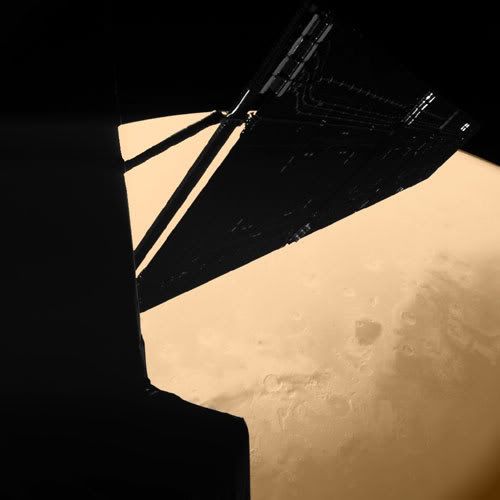
On February 25, 2007, this image was taken by the Philae lander that's currently attached to the European Space Agency's Rosetta spacecraft. Launched on March 2, 2004, Rosetta passed by Mars for a gravitational assist as it heads for comet 67P/Churyumov-Gerasimenko, where it will arrive this coming May. Philae will be dropped onto the comet's nucleus to study it during the 1½ year-long mission.
ESA

Friday, January 17, 2014

Image of the Day...

For all of y'all slackers out there, here's a nice little list that will allow you to turn negative qualities about yourself into positive ones on a job résumé or during an interview. Of course, if folks were proactive enough to already have a résumé jotted down or called in for a job interview, then they wouldn't need this list in the first place. Just sayin'.


Use this list to turn negative qualities about yourself into positive ones to get a job or somethin'.

Wednesday, January 15, 2014

OSIRIS-REx Update...

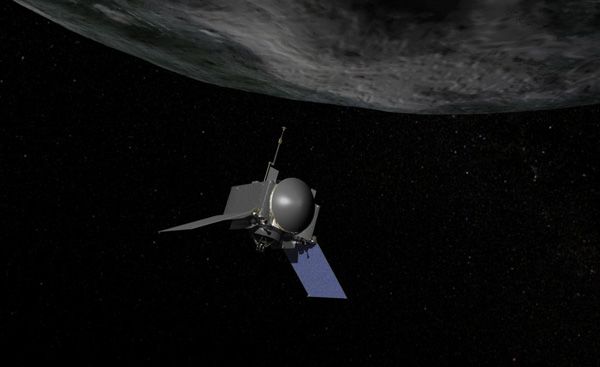
An artist's concept of NASA's OSIRIS-REx spacecraft preparing to take a sample from asteroid Bennu.
NASA / Goddard / Chris Meaney

NASA Invites Public to Send Names on an Asteroid Mission and Beyond (Press Release)

NASA is inviting people around the world to submit their names to be etched on a microchip aboard a spacecraft headed to the asteroid Bennu in 2016.

The "Messages to Bennu!" microchip will travel to the asteroid aboard the agency's Origins-Spectral Interpretation Resource Identification Security Regolith Explorer (OSIRIS-REx) spacecraft. The robotic mission will spend more than two years at the 1,760-foot (500-meter)-wide asteroid. The spacecraft will collect a sample of Bennu's surface and return it to Earth in a sample return capsule.

"We're thrilled to be able to share the OSIRIS-REx adventure with people across the Earth, to Bennu and back," said Dante Lauretta, principal investigator of the OSIRIS-REx mission from the University of Arizona in Tucson. "It's a great opportunity for people to get engaged with the mission early and join us as we prepare for launch."

Those wishing to participate in "Messages to Bennu!" should submit their name online no later than Sept. 30 at:

http://planetary.org/bennu

After a person submits their name, they will be able to download and print a certificate documenting their participation in the OSIRIS-REx mission.

"You'll be part of humankind's exploration of the solar system --How cool is that?" said Bill Nye, chief executive officer of The Planetary Society, the organization collecting and processing the entries.

Participants who "follow" or "like" the mission on Facebook will receive updates on the location of their name in space from launch time until the asteroid samples return to Earth in 2023. Facebook fans also will be kept apprised of mission progress and late-breaking news through regular status updates.

The OSIRIS-REx mission goal is to address basic questions about the composition of the very early solar system, the source of organic materials and water that made life possible on Earth, and to better predict the orbits of asteroids that represent collision threats to the Earth. It will collect a minimum of 2 ounces (60 grams) of surface material.

Once the sample return capsule deploys, the spacecraft will be placed into a long-term solar orbit around the sun, along with the microchip and every name on it.

"It is exciting to consider the possibility that some of the people who register to send their names to Bennu could one day be a part of the team that analyzes the samples from the asteroid 10 years from now," said Jason Dworkin, mission project scientist at NASA's Goddard Space Flight Center, Greenbelt, Md.

This mission will assist the agency in its efforts to identify the population of potentially hazardous near-Earth objects, as well as those suitable for asteroid exploration missions. The asteroid initiative brings together the best of NASA's science, technology and human exploration efforts to achieve President Obama's goal of sending humans to an asteroid by 2025.

NASA's Goddard Space Flight Center in Greenbelt, Md., will provide overall mission management, systems engineering, and safety and mission assurance for OSIRIS-REx. Lockheed Martin Space Systems in Denver will build the spacecraft. OSIRIS-REx is the third mission in NASA's New Frontiers Program. NASA's Marshall Space Flight Center in Huntsville, Ala., manages New Frontiers for the agency's Science Mission Directorate in Washington.

Source: NASA.Gov

****

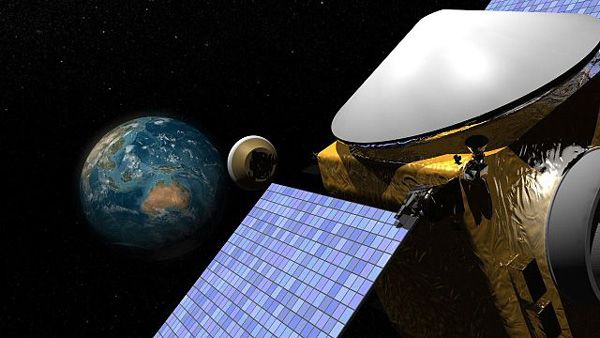
An artist's concept of NASA's OSIRIS-REx spacecraft releasing its Sample Return Capsule for a trip back to Earth.
NASA Goddard Space Flight Center

Monday, January 13, 2014

Quotes of the Day, Part 2...

“It is an absolute human certainty that no one can know his own beauty or perceive a sense of his own worth until it has been reflected back to him in the mirror of another loving, caring human being.”

-― John Joseph Powell, The Secret of Staying in Love


“We smile but I want more. I want her to hug me.”

-― M.J. Hayland


“You know that moment when you hug somebody, when your heart feels warm and high in your chest and tingly? When you feel just for a second like a baby in a womb... that nothing matters? That's how I want you to feel. That's what a girlfriend should do, I think.”

-― Jake Vander Ark, The Accidental Siren


"Millions and millions of years would still not give me half enough time to describe that tiny instant of all eternity when you put your arms around me and I put my arms around you."

-― Jacques Prévert


“Laughing together is as close as you can get to a hug without touching.”

-― Gina Barreca