Friday, November 04, 2022

NASA Reveals How It Will Mitigate Issues That Almost Caused Its Next Asteroid Explorer to be Scrapped...

An artist's concept of NASA's Psyche spacecraft.
NASA / JPL - Caltech / ASU

As Psyche Mission Moves Forward, NASA Responds to Independent Review (News Release)

NASA and the agency’s Jet Propulsion Laboratory (JPL) in Southern California, which leads Psyche, shared a response Friday to the results of an independent review board convened to determine why the mission to study a metal-rich asteroid of the same name missed its planned 2022 launch opportunity.

The mission is moving forward as previously announced, and NASA will incorporate recommendations from the board to ensure its success.

The review board – convened at the request of NASA and JPL – found a significant factor in the delay was an imbalance between the workload and the available workforce at JPL. NASA will work closely with JPL management over the coming months to address the challenges raised in the report. The board will meet again in spring 2023 to assess progress.

For the Psyche mission, the board recommended increasing staffing, establishing open communications and an improved reporting system, as well as strengthening the review system to better highlight what issues might affect mission success.

In response, the Psyche project has added appropriately experienced leaders and project staff throughout the project, including filling the project chief engineer and guidance navigation and control cognizant engineer positions. JPL also formed a team to actively manage the staffing shortage across multiple projects including Psyche.

“We welcome this opportunity to hear the independent review board’s findings and have a chance to address the concerns,” said Thomas Zurbuchen, associate administrator of NASA’s Science Mission Directorate in Washington. “It’s our job to notice issues early – this report is essentially a canary in the coal mine – and address them. Information like this helps us for more than just Psyche, but also for upcoming key missions such as Europa Clipper and Mars Sample Return.”

The independent review board also looked at JPL as a whole. The report made recommendations to address what it called inadequate flight project staffing – in both number of personnel and experience – as well as erosion of line organization technical acumen, and the post-pandemic work environment.

In response, changes to JPL’s organizational reporting structure and reviews are in work, which along with other actions, are designed to increase institutional insight and oversight of missions including Psyche. JPL also is instituting new internal staffing approaches and working with industrial partners to support staffing needs and to redouble efforts to strengthen experienced leadership at all levels.

“I appreciate the thoughtful work of the Psyche independent review board,” said Laurie Leshin, JPL director. “The board members worked diligently over the past several months to help JPL uncover and understand issues related to the delay of the Psyche launch. Their insights are helping JPL and NASA take the steps necessary to ensure success on Psyche and future missions.”

To support JPL’s staffing needs, NASA anticipates delaying the launch of the Venus Emissivity, Radio Science, InSAR, Topography, and Spectroscopy (VERITAS) mission for at least three years. This choice would allow experienced staff at JPL to complete development of strategic flagship missions further along in their development. A delay of VERITAS, a mission in early formulation, would also free up additional resources to enable the continuation of Psyche and positively affect other planetary funding needs.

VERITAS is a JPL-led mission designed to search for water and volcanic activity on Venus. It was selected in 2021 as one of two Venus proposals for the agency’s Discovery Program, a line of low-cost, competitive missions led by a single principal investigator. The mission, with planned contributions from the Italian Space Agency, German Aerospace Center and French Space Agency, was originally expected to launch in December 2027. The mission is now scheduled to launch no earlier than 2031.

For a VERITAS delay, JPL will stand down their management and engineering teams for the mission and release the staff to other projects, while funding will be continued for science team support.

****

Thursday, November 03, 2022

A Major Test Milestone Is Achieved on Peregrine's Path to the Moon...

The OPAL device as seen through a window on the belly of a King Air B200 aircraft.
Dr. Andrew Horchler / Astrobotic

Landing Tech, Terrain Relative Navigation, Validated & Ready for Spaceflight (Press Release)

Pittsburgh, PA – Astrobotic announced today that its terrain relative navigation (TRN) landing suite for lunar landers, Optical Precision Autonomous Landing (OPAL), was fully validated during a week-long terrestrial flight test campaign above the mountains of the northern Mojave Desert in California. The OPAL hardware and flight software was subjected to similar conditions that it will experience during the Peregrine Mission 1 (PM1) lunar landing slated for early 2023.

During the more than 100km terrestrial flight path, the OPAL system repeatedly generated accurate, real-time location estimates by comparing captured images to onboard maps, created in advance from orbital imagery. The accuracy of these location estimates is vital for the TRN landing software to guide a spacecraft safely and precisely to a target landing site on the lunar surface where nothing like GPS is available.

“We are thrilled with the success of this challenging flight test. Our hardware and software captured hundreds of images, detected and matched features in our maps, and successfully produced valid location estimates in flight across the descent trajectories, just as it will at the Moon,” said Dr. Andrew Horchler, Chief Research Scientist at Astrobotic and principal investigator for OPAL.

Throughout this test, OPAL flew aboard a King Air B200 aircraft up to 9km in altitude. The pitch angle and trajectory mimicked Peregrine’s powered descent to the Moon, over a landscape that approximates lunar terrain. During the tests, an Astrobotic engineer rode along to monitor real-time telemetry from OPAL with additional engineers at the test site to analyze and troubleshoot data on the ground.

“This test bolstered our confidence in the accuracy of our OPAL technology. The data obtained in flight suggests that our algorithms have robust functionality even during off-nominal conditions. We see great potential not only in space applications, but also in civil and defense terrestrial GPS-denied applications,” said Horchler.

Lessons learned from this flight test are being implemented into the OPAL system to improve performance for operation during the Astrobotic PM1 mission. OPAL will then be used as part of the precision landing and hazard detection sensor suite for Astrobotic’s Griffin Mission One carrying NASA’s water-hunting VIPER rover to the Moon in late 2024.

Source: Astrobotic

****

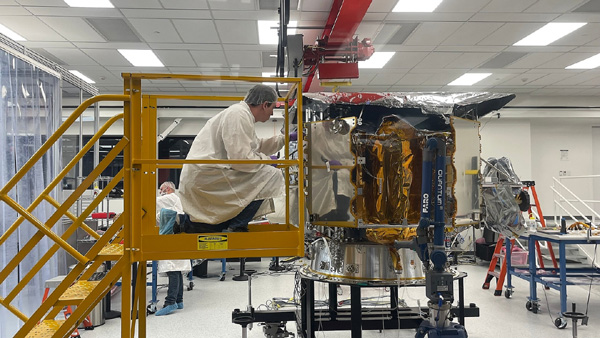
The construction status of Astrobotic's Peregrine lunar lander as of November 3, 2022.
Moonshot Museum

The construction status of Astrobotic's Peregrine lunar lander as of November 3, 2022.
Moonshot Museum

Wednesday, November 02, 2022

InSight Update: The Lander Will Soon Fall Silent on the Martian Surface After a Successful 4-Year Mission...

A selfie that NASA's InSight Mars lander took with its robotic arm on December 6, 2018...10 days after arriving at the Red Planet.
NASA / JPL - Caltech

NASA Prepares to Say ‘Farewell’ to InSight Spacecraft (News Release - November 1)

A closer look at what goes into wrapping up the mission as the spacecraft’s power supply continues to dwindle.

The day is approaching when NASA’s InSight Mars lander will fall silent, ending its history-making mission to reveal secrets of the Red Planet’s interior. The spacecraft’s power generation continues to decline as windblown dust on its solar panels thickens, so the team has taken steps to continue as long as possible with what power remains. The end is expected to come in the next few weeks.

But even as the tightknit 25-to-30-member operations team – a small group compared to other Mars missions – continues to squeeze the most that they can out of InSight (short for Interior Exploration using Seismic Investigations, Geodesy and Heat Transport), they’ve also begun taking steps to wind down the mission.

Here’s a glimpse of what that looks like:

Preserving Data

The most important of the final steps with the InSight mission is storing its trove of data and making it accessible to researchers around the world. The lander data has yielded details about Mars’ interior layers, its liquid core, the surprisingly variable remnants beneath the surface of its mostly-extinct magnetic field, weather on this part of Mars, and lots of quake activity.

InSight’s seismometer, provided by France’s Centre National d’Études Spatiales (CNES), has detected more than 1,300 marsquakes since the lander touched down in November 2018; the largest measuring a magnitude 5. It even recorded quakes from meteoroid impacts. Observing how the seismic waves from those quakes change as they travel through the planet offers an invaluable glimpse into Mars’ interior but also provides a better understanding of how all rocky worlds, including Earth and its Moon, form.

“Finally, we can see Mars as a planet with layers, with different thicknesses, compositions,” said Bruce Banerdt of NASA’s Jet Propulsion Laboratory in Southern California, the mission’s principal investigator. “We’re starting to really tease out the details. Now it’s not just this enigma; it’s actually a living, breathing planet.”

The seismometer readings will join the only other set of extraterrestrial seismic data, from the Apollo lunar missions, in NASA’s Planetary Data System. They will also go into an international archive run by the Incorporated Research Institutions for Seismology, which houses “all the terrestrial seismic network data locations,” said JPL’s Sue Smrekar, InSight’s deputy principal investigator. “Now, we also have one on Mars.”

Smrekar said the data is expected to continue yielding discoveries for decades.

Managing Power

Earlier this summer, the lander had so little remaining power that the mission turned off all of InSight’s other science instruments in order to keep the seismometer running. They even turned off the fault protection system that would otherwise automatically shut down the seismometer if the system detects that the lander’s power generation is dangerously low.

“We were down to less than 20% of the original generating capacity,” said Banerdt. “That means we can’t afford to run the instruments around the clock.”

Recently, after a regional dust storm added to the lander’s dust-covered solar panels, the team decided to turn off the seismometer altogether in order to save power. Now that the storm is over, the seismometer is collecting data again – though the mission expects the lander only has enough power for a few more weeks.

Of the seismometer’s array of sensors, only the most sensitive were still operating, said Liz Barrett, who leads science and instrument operations for the team at JPL, adding, “We’re pushing it to the very end.”

Packing Up Twin

A silent member of the team is ForeSight, the full-size engineering model of InSight in JPL’s In-Situ Instrument Laboratory. Engineers used ForeSight to practice how InSight would place science instruments on the Martian surface with the lander’s robotic arm, test techniques to get the lander’s heat probe into the sticky Martian soil, and develop ways to reduce noise picked up by the seismometer.

ForeSight will be crated and placed in storage. “We’ll be packing it up with loving care,” Banerdt said. “It’s been a great tool, a great companion for us this whole mission.”

Declaring Mission End

NASA will declare the mission over when InSight misses two consecutive communication sessions with the spacecraft orbiting Mars, part of the Mars Relay Network – but only if the cause of the missed communication is the lander itself, said network manager Roy Gladden of JPL. After that, NASA’s Deep Space Network will listen for a time, just in case.

There will be no heroic measures to re-establish contact with InSight. While a mission-saving event – a strong gust of wind, say, that cleans the panels off – isn’t out of the question, it is considered unlikely.

In the meantime, as long as InSight remains in contact, the team will continue gathering data. “We’ll keep making science measurements as long as we can,” Banerdt said. “We’re at Mars’ mercy. Weather on Mars is not rain and snow; weather on Mars is dust and wind.”

Source: Jet Propulsion Laboratory

****

A selfie that NASA's InSight Mars lander took with its robotic arm on April 24, 2022.
NASA / JPL - Caltech

Tuesday, November 01, 2022

Peregrine Update: The Robotic Lander's Ride to the Moon Has Finally Received Its Engines!

Blue Origin's BE-4 Flight Engine #1 is rolled onto the floor at United Launch Alliance's rocket factory in Decatur, Alabama...while BE-4 Flight Engine #2 is already installed on the core stage of the first Vulcan rocket.
Tory Bruno / United Launch Alliance

Blue Origin Completes the Delivery of Flight Engines to ULA for Vulcan’s Initial Launch (News Release - October 31)

Blue Origin completed its delivery of the first BE-4 shipset for United Launch Alliance (ULA), shipping the engines to ULA’s factory in Decatur, Alabama after final acceptance testing.

Each BE-4 engine provides 550,000 pounds of thrust and has completed an extensive development program. This state-of-the-art engine will end reliance on Russian engines and power a new generation of U.S. launch vehicles. Dozens of these engines are now in production to support a large and growing demand for civil, commercial and defense launches.

“We’re excited to see ULA’s Vulcan fly,” said Bob Smith, CEO, Blue Origin. “The BE-4 is a great engine, and we’re proud of Team Blue for achieving this milestone as part of ULA’s team. It’s been a wonderful partnership, and this shipset is the first of many more to come.”

“We are very pleased to receive the first two engines for Vulcan’s inaugural flight,” said Tory Bruno, ULA president and CEO. “Development of this new engine is complete, and the performance of the engine is outstanding. It has been a great team effort working together with our partners at Blue Origin and we can’t wait to see Vulcan fly.”

About Blue Origin’s BE-4 Engine

Blue Origin’s BE-4 is the most powerful liquid natural gas (LNG) fueled, oxygen-rich staged combustion engine made in the U.S., powering the next generation of rocket launch vehicles. The engines are manufactured in Kent, Washington and in Huntsville, Alabama. They are tested in West Texas and at the historic 4670 Test Stand at NASA’s Marshall Space Flight Center in Huntsville.

Source: Blue Origin

****

Construction should soon be wrapping up on the Peregrine lunar lander at Astrobotic's headquarters in Pittsburgh, Pennsylvania.
Astrobotic

Monday, October 31, 2022

Happy Halloween, Everyone! InSight Makes Another Big Discovery Before It Soon Falls Silent Forever...

An image of a Martian meteor crater--which was created by an impact on December 24, 2021, and simultaneously detected by NASA's InSight lander--that was taken by NASA's Mars Reconnaissance Orbiter a few weeks later.
NASA / JPL - Caltech / University of Arizona

NASA's InSight Lander Detects Stunning Meteoroid Impact on Mars (News Release - October 27)

The agency’s lander felt the ground shake during the impact while cameras aboard the Mars Reconnaissance Orbiter spotted the yawning new crater from space.

NASA’s InSight lander recorded a magnitude 4 marsquake last December 24, but scientists learned only later the cause of that quake: a meteoroid strike estimated to be one of the biggest seen on Mars since NASA began exploring the cosmos. What’s more, the meteoroid excavated boulder-size chunks of ice buried closer to the Martian equator than ever found before – a discovery with implications for NASA’s future plans to send astronauts to the Red Planet.

Scientists determined the quake resulted from a meteoroid impact when they looked at before-and-after images from NASA’s Mars Reconnaissance Orbiter (MRO) and spotted a new, yawning crater. Offering a rare opportunity to see how a large impact shook the ground on Mars, the event and its effects are detailed in two papers published Thursday, October 27, in the journal Science.

The meteoroid is estimated to have spanned 16 to 39 feet (5 to 12 meters) – small enough that it would have burned up in Earth’s atmosphere, but not in Mars’ thin atmosphere, which is just 1% as dense as our planet’s. The impact, in a region called Amazonis Planitia, blasted a crater roughly 492 feet (150 meters) across and 70 feet (21 meters) deep. Some of the ejecta thrown by the impact flew as far as 23 miles (37 kilometers) away.

With images and seismic data documenting the event, this is believed to be one of the largest craters ever witnessed forming at any place in the solar system. Many larger craters exist on the Red Planet, but they are significantly older and predate any Mars mission.

“It’s unprecedented to find a fresh impact of this size,” said Ingrid Daubar of Brown University, who leads InSight’s Impact Science Working Group. “It’s an exciting moment in geologic history, and we got to witness it.”

InSight has seen its power drastically decline in recent months due to dust settling on its solar panels. The spacecraft is now expected to shut down within the next six weeks, bringing the mission’s science to an end.

InSight is studying the planet’s crust, mantle and core. Seismic waves are key to the mission and have revealed the size, depth and composition of Mars’ inner layers. Since landing in November 2018, InSight has detected 1,318 marsquakes, including several caused by smaller meteoroid impacts.

But the quake resulting from last December’s impact was the first observed to have surface waves – a kind of seismic wave that ripples along the top of a planet’s crust. The second of the two Science papers related to the big impact describes how scientists use these waves to study the structure of Mars’ crust.

Crater Hunters

In late 2021, InSight scientists reported to the rest of the team they had detected a major marsquake on December 24. The crater was first spotted on February 11, 2022, by scientists working at Malin Space Science Systems (MSSS), which built and operates two cameras aboard MRO. The Context Camera (CTX) provides black-and-white, medium-resolution images, while the Mars Color Imager (MARCI) produces daily maps of the entire planet, allowing scientists to track large-scale weather changes like the recent regional dust storm that further diminished InSight’s solar power.

The impact’s blast zone was visible in MARCI data that allowed the team to pin down a 24-hour period within which the impact occurred. These observations correlated with the seismic epicenter, conclusively demonstrating that a meteoroid impact caused the large December 24 marsquake.

“The image of the impact was unlike any I had seen before, with the massive crater, the exposed ice and the dramatic blast zone preserved in the Martian dust,” said Liliya Posiolova, who leads the Orbital Science and Operations Group at MSSS. “I couldn’t help but imagine what it must have been like to witness the impact, the atmospheric blast and debris ejected miles downrange.”

Establishing the rate at which craters appear on Mars is critical for refining the planet’s geological timeline. On older surfaces, such as those of Mars and our Moon, there are more craters than on Earth; on our planet, the processes of erosion and plate tectonics erase older features from the surface.

New craters also expose materials below the surface. In this case, large chunks of ice scattered by the impact were viewed by MRO’s High-Resolution Imaging Science Experiment (HiRISE) color camera.

Subsurface ice will be a vital resource for astronauts, who could use it for a variety of needs, including drinking water, agriculture and rocket propellant. Buried ice has never been spotted this close to the Martian equator, which, as the warmest part of Mars, is an appealing location for astronauts.

Source: NASA.Gov

****

The flight deck and one of the twin solar panels on NASA's InSight lander are completely covered in dust on Mars...as of Aprl 24, 2022.
NASA / JPL - Caltech

Sunday, October 30, 2022

The Perseverance Rover Is About to Reach a Big Mission Milestone at Jezero Crater...

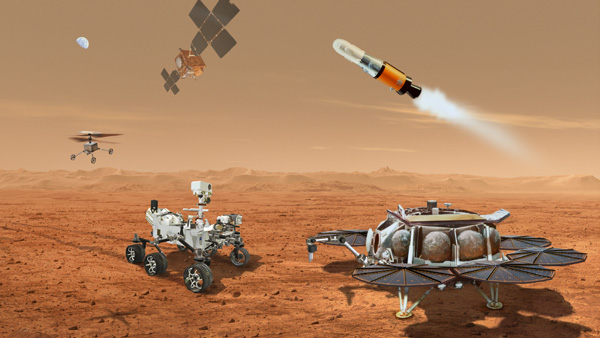
An illustration depicting the joint NASA/ESA Mars Sample Return mission architecture.
NASA / JPL - Caltech

NASA and ESA Agree on Next Steps to Return Mars Samples to Earth (News Release - October 28)

The agency’s Perseverance rover will establish the first sample depot on Mars.

The next step in the unprecedented campaign to return scientifically-selected samples from Mars was made on October 19 with a formal agreement between NASA and its partner ESA (European Space Agency). The two agencies will proceed with the creation of a sample tube depot on Mars. The sample depot, or cache, will be at “Three Forks,” an area located near the base of an ancient river delta in Jezero Crater.

This cache will contain samples from carefully-selected rocks on the surface of Mars – samples that can help tell the story of Jezero Crater’s history and how Mars evolved, and could perhaps even contain signs of ancient life. Scientists believe the cored samples from the delta’s fine-grained sedimentary rocks – deposited in a lake billions of years ago – are the mostly likely to contain indicators of whether microbial life existed when Mars’ climate was much different than what it is today.

“Never before has a scientifically-curated collection of samples from another planet been collected and placed for return to Earth,” said Thomas Zurbuchen, associate administrator for science at NASA Headquarters in Washington. “NASA and ESA have reviewed the proposed site and the Mars samples that will be deployed for this cache as soon as next month. When that first tube is positioned on the surface, it will be a historic moment in space exploration.”

The cache of samples – a duplicate set of the collection that Perseverance will retain on board – is one part of a robust plan to ensure mission success. The Perseverance rover will be the primary means to convey the collected samples to the Mars launch vehicle as part of the campaign. The Three Forks depot will serve as a backup, hosting the duplicate set.

“Choosing the first depot on Mars makes this exploration campaign very real and tangible. Now we have a place to revisit with samples waiting for us there,” said David Parker, ESA director of Human and Robotic Exploration. “That we can implement this plan so early in the campaign is a testament to the skill of the international team of engineers and scientists working on Perseverance and Mars Sample Return. The first depot of Mars samples can be considered a major de-risking step for the Mars Sample Return Campaign.”

The first step in the campaign is already in progress. Since Perseverance landed at Jezero Crater on February 18, 2021, the rover has explored 8.2 miles (13.2 kilometers) of Martian surface and collected 14 rock-core samples during its first two science campaigns. In the course of its first science campaign, the rover explored the crater’s floor – a former lakebed – finding igneous rock, which forms deep underground from magma or during volcanic activity at the surface. The second science campaign has been highlighted by the investigation of sedimentary rocks, formed when particles of various sizes settled in the once-watery environment.

The rover has also collected one atmospheric sample and three witness tubes. Witness tubes contain material that helps identify potential terrestrial contamination in the tubes that may have come from the rover during sampling operations.

“While a significant mission milestone will have taken place once those tubes are dropped, it doesn’t mean Perseverance explorations or sample collection has concluded – not by a long shot,” said Perseverance project scientist Ken Farley of Caltech in Pasadena, California. “Next, we’ll be headed up to the top of the delta to an area that from satellite imagery appears geologically rich, performing science investigations and collecting more rock cores. Mars Sample Return is going to have a lot of great stuff to choose from.”

In another important milestone, the Mars Sample Return Program entered the Preliminary Design and Technology Completion Phase, known as Phase B, on October 1. During this phase, the campaign focuses on completing technology development, engineering prototyping, assessments of software and heritage hardware, and other risk-mitigation activities.

Source: NASA.Gov

****

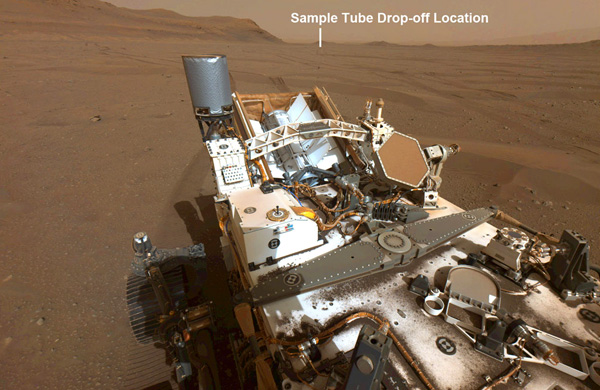
An image showing the location where NASA's Perseverance Mars rover will drop off its first set of samples at Jezero Crater...which can take place as soon as next month.
NASA / JPL - Caltech

Saturday, October 29, 2022

Hubble's Successor Takes Another Snapshot of an Iconic Celestial Region...

A new image of the Pillars of Creation that was taken by NASA's James Webb Space Telescope...using its Mid-Infrared Instrument.
NASA, ESA, CSA, STScI; Joseph DePasquale (STScI), Alyssa Pagan (STScI)

Haunting Portrait: NASA’s Webb Reveals Dust, Structure in Pillars of Creation (News Release - October 28)

This is not an ethereal landscape of time-forgotten tombs. Nor are these soot-tinged fingers reaching out. These pillars, flush with gas and dust, enshroud stars that are slowly forming over many millennia. NASA’s James Webb Space Telescope has snapped this eerie, extremely dusty view of the Pillars of Creation in mid-infrared light – showing us a new view of a familiar landscape.

Why does mid-infrared light set such a somber, chilling mood in Webb’s Mid-Infrared Instrument (MIRI) image? Interstellar dust cloaks the scene. And while mid-infrared light specializes in detailing where dust is, the stars aren’t bright enough at these wavelengths to appear. Instead, these looming, leaden-hued pillars of gas and dust gleam at their edges, hinting at the activity within.

Thousands and thousands of stars have formed in this region. This is made plain when examining Webb’s recent Near-Infrared Camera (NIRCam) image. In MIRI’s view, the majority of the stars appear missing. Why? Many newly-formed stars are no longer surrounded by enough dust to be detected in mid-infrared light. Instead, MIRI observes young stars that have not yet cast off their dusty “cloaks.” These are the crimson orbs toward the fringes of the pillars. In contrast, the blue stars that dot the scene are aging, which means they have shed most of their layers of gas and dust.

Mid-infrared light excels at observing gas and dust in extreme detail. This is also unmistakable throughout the background. The densest areas of dust are the darkest shades of gray. The red region toward the top, which forms an uncanny V, like an owl with outstretched wings, is where the dust is diffuse and cooler. Notice that no background galaxies make an appearance – the interstellar medium in the densest part of the Milky Way’s disk is too swollen with gas and dust to allow their distant light to penetrate.

How vast is this landscape? Trace the topmost pillar, landing on the bright red star jutting out of its lower edge like a broomstick. This star and its dusty shroud are larger than the size of our entire solar system.

This scene was first captured by NASA’s Hubble Space Telescope in 1995 and revisited in 2014, but many other observatories, like NASA’s Spitzer Space Telescope, have also gazed deeply at the Pillars of Creation. With every observation, astronomers gain new information, and through their ongoing research build a deeper understanding of this star-forming region. Each wavelength of light and advanced instrument delivers far more precise counts of the gas, dust, and stars, which inform researchers’ models of how stars form. As a result of the new MIRI image, astronomers now have higher resolution data in mid-infrared light than ever before, and will analyze its far more precise dust measurements to create a more complete three-dimensional landscape of this distant region.

The Pillars of Creation is set within the vast Eagle Nebula, which lies 6,500 light-years away.

Source: NASA.Gov

****


Friday, October 28, 2022

The Launch of America's Next Asteroid Explorer Has Officially Been Rescheduled for Late 2023...

An artist's concept of NASA's Psyche spacecraft.
NASA / JPL - Caltech / ASU

NASA Continues Psyche Asteroid Mission (News Release)

NASA announced Friday the agency decided its Psyche mission will go forward, targeting a launch period opening on October 10, 2023.

Earlier this year, Psyche missed its planned 2022 launch period as a result of mission development problems, leading to an internal review of whether the mission would be able to overcome these issues to successfully launch in 2023.

This continuation/termination review was informed by a project-proposed mission replan and a separate independent review, commissioned in June by NASA and the agency’s Jet Propulsion Laboratory in Southern California, that investigated causes for the delay.

“I appreciate the hard work of the independent review board and the JPL-led team toward mission success,” said Thomas Zurbuchen, associate administrator of NASA’s Science Mission Directorate in Washington. “The lessons learned from Psyche will be implemented across our entire mission portfolio. I am excited about the science insights Psyche will provide during its lifetime and its promise to contribute to our understanding of our own planet’s core.”

The independent review board is still finalizing its report, which, along with NASA’s response, will be shared publicly once complete.

The mission team continues to complete testing of the spacecraft’s flight software in preparation for the 2023 launch date. The new flight profile is similar to the one originally planned for August 2022, using a Mars gravity assist in 2026 to send the spacecraft on its way to the asteroid Psyche. With an October 2023 launch date, the Psyche spacecraft will arrive at the asteroid in August 2029.

“I’m extremely proud of the Psyche team,” said JPL Director Laurie Leshin. “During this review, they have demonstrated significant progress already made toward the future launch date. I am confident in the plan moving forward and excited by the unique and important science this mission will return.”

NASA selected Psyche in 2017 to investigate a previously-unexplored metal-rich asteroid of the same name. It is part of the agency’s Discovery Program, a line of low-cost, competitive missions led by a single principal investigator.

NASA continues to assess options for its Janus mission exploring twin binary asteroid systems, which was originally scheduled to launch on the same SpaceX Falcon Heavy rocket as Psyche. NASA’s Deep Space Optical Communications technology demonstration, testing high-data-rate laser communications, is integrated into the Psyche spacecraft and will continue as planned on the new launch date.

Arizona State University leads the Psyche mission. JPL, which is managed for NASA by Caltech in Pasadena, California, is responsible for the mission’s overall management, system engineering, integration and test, and mission operations. Maxar Technologies in Palo Alto, California, is providing the high-power solar electric propulsion spacecraft chassis. NASA’s Launch Services Program, based at the agency’s Kennedy Space Center in Florida, is managing the launch. Psyche is part of NASA’s Discovery Program, managed by the agency’s Marshall Space Flight Center in Huntsville, Alabama.

Source: NASA.Gov

Thursday, October 27, 2022

On This Day in 2002: The Halos Emerge Victorious in the Fall Classic...

The Anaheim Angels celebrate after winning their first and only World Series title on October 27, 2002.
Wally Skalij / Los Angeles Times

It was 20 years ago today that the Anaheim Angels won the World Series after defeating Barry Bonds and the San Francisco Giants, 4-1, in Game 7 of that year's Fall Classic. This was the Angels' first and only championship in their 42-year history as of 2002...

The Angels would then be purchased by future Trump supporter Arte Moreno in early 2003 and unfortunately change their name to the ridiculous Los Angeles Angels of Anaheim two years after that...

Sell the team, Moreno. Anaheim isn't even located in Los Angeles County.

Thursday, October 20, 2022

Photos of the Day: Snapshots of the MAGTF Demo and Blue Angels at Last Month's Miramar Air Show...

An F-35B Lightning II soars in the air during the Marine Air-Ground Task Force (MAGTF) demo at the Miramar Air Show in San Diego, CA...on September 24, 2022.
Richard T. Par

I'm over two weeks late based on what I mentioned in this Blog entry, but here are images that I took of the Marine Air-Ground Task Force (MAGTF) demo and Blue Angels during last month's Miramar Air Show.

I've been taking snapshots of these two exciting exhibitions ever since I went to the Miramar Air Show for the first time back in 2016, but I never get tired of checking out amazing acrobatic maneuvers by the U.S. Navy's elite aerial demonstration team, as well as regular F/A-18 Hornets, F-35B Lightning IIs, an AH-1 Cobra attack helicopter, V-22 Ospreys and other aircraft simulating a major combat operation in the middle of the airfield at Marine Corps Air Station Miramar.

With these pics now posted, I will now focus my efforts on editing more images from the Aerospace Valley Air Show that occurred five days ago! Happy Thursday.

LINK: Click here for more photos that I took at the 2022 Miramar Air Show

An AH-1 Cobra attack helicopter soars in the air during the MAGTF demo at the Miramar Air Show in San Diego, CA...on September 24, 2022.
Richard T. Par

Two V-22 Ospreys, an AH-1 Cobra, a UH-1 Iroquois and a CH-53 Sea Stallion fly in formation during the MAGTF demo at the Miramar Air Show in San Diego, CA...on September 24, 2022.
Richard T. Par

An F-35B Lightning II breaks formation from its squadron during the MAGTF demo at the Miramar Air Show in San Diego, CA...on September 24, 2022.
Richard T. Par

Explosions erupt behind the Blue Angels on the airfield during the MAGTF demo at the Miramar Air Show...on September 24, 2022.
Richard T. Par

Four of the six Blue Angels fly in formation during their demo at the Miramar Air Show in San Diego, CA...on September 24, 2022.
Richard T. Par

Two of the six Blue Angels are about to fly over one of the grandstands at the Miramar Air Show in San Diego, CA...on September 24, 2022.
Richard T. Par

The four Blue Angels fly in formation during the Miramar Air Show in San Diego, CA...on September 24, 2022.
Richard T. Par

The four Blue Angels fly low over the airfield during their demo at the Miramar Air Show in San Diego, CA...on September 24, 2022.
Richard T. Par

All six Blue Angels break formation during their demo at the Miramar Air Show in San Diego, CA...on September 24, 2022.
Richard T. Par