Tuesday, March 31, 2020

Photo of the Day: Hubble's Successor Unveils Its Giant Eye on the Ground...

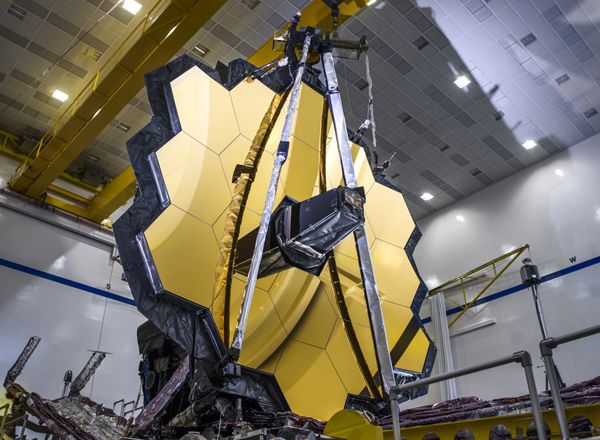
The primary mirror on NASA's James Webb Space Telescope is fully deployed during a ground test at Northrop Grumman in Redondo Beach, California.
NASA / Chris Gunn

NASA’s James Webb Space Telescope Full Mirror Deployment a Success (News Release)

In a recent test, NASA’s James Webb Space Telescope fully deployed its primary mirror into the same configuration it will have when in space.

As Webb progresses towards liftoff in 2021, technicians and engineers have been diligently checking off a long list of final tests the observatory will undergo before being packaged for delivery to French Guiana for launch. Performed in early March, this procedure involved commanding the spacecraft’s internal systems to fully extend and latch Webb’s iconic 21 feet 4-inch (6.5 meter) primary mirror, appearing just like it would after it has been launched to orbit. The observatory is currently in a cleanroom at Northrop Grumman Space Systems in Redondo Beach, California.

The difficulty and complexity of performing tests for Webb has increased significantly, now that the observatory has been fully assembled. Special gravity offsetting equipment was attached to Webb’s mirror to simulate the zero-gravity environment its mechanisms will have to operate in. Tests like these help safeguard mission success by physically demonstrating that the spacecraft is able to move and unfold as intended. The Webb team will deploy the observatory’s primary mirror only once more on the ground, just before preparing it for delivery to the launch site.

A telescope’s sensitivity, or how much detail it can see, is directly related to the size of the mirror that collects light from the objects being observed. A larger surface area collects more light, just like a larger bucket collects more water in a rain shower than a small one. Webb’s mirror is the biggest of its kind that NASA has ever built.

In order to perform groundbreaking science, Webb’s primary mirror needs to be so large that it cannot fit inside any rocket available in its fully extended form. Like the art of origami, Webb is a collection of movable parts employing applied material science that have been specifically designed to fold themselves to a compact formation that is considerably smaller than when the observatory is fully deployed. This allows it to just barely fit within a 16-foot (5-meter) payload fairing, with little room to spare.

“Deploying both wings of the telescope while part of the fully assembled observatory is another significant milestone showing Webb will deploy properly in space. This is a great achievement and an inspiring image for the entire team,” said Lee Feinberg, optical telescope element manager for Webb at NASA’s Goddard Space Flight Center in Greenbelt, Maryland.

The evolving novel coronavirus COVID-19 situation is causing significant impact and disruption globally. Given these circumstances, Webb’s Northrop Grumman team in California has resumed integration and testing work with reduced personnel and shifts until the Deployable Tower Assembly set up in April. The project will then shut down integration and testing operations due to the lack of required NASA onsite personnel related to the COVID-19 situation. The project will reassess over the next couple of weeks and adjust decisions as the situation continues to unfold.

The James Webb Space Telescope will be the world’s premier space science observatory when it launches in 2021. Webb will solve mysteries in our solar system, look beyond to distant worlds around other stars, and probe the mysterious structures and origins of our universe and our place in it. Webb is an international program led by NASA with its partners, ESA (European Space Agency) and the Canadian Space Agency.

Source: NASA.Gov

****

Monday, March 30, 2020

Europe and Japan's Mercury-Bound Spacecraft Will Soon Fly Past a Pandemic-Ravaged Earth...

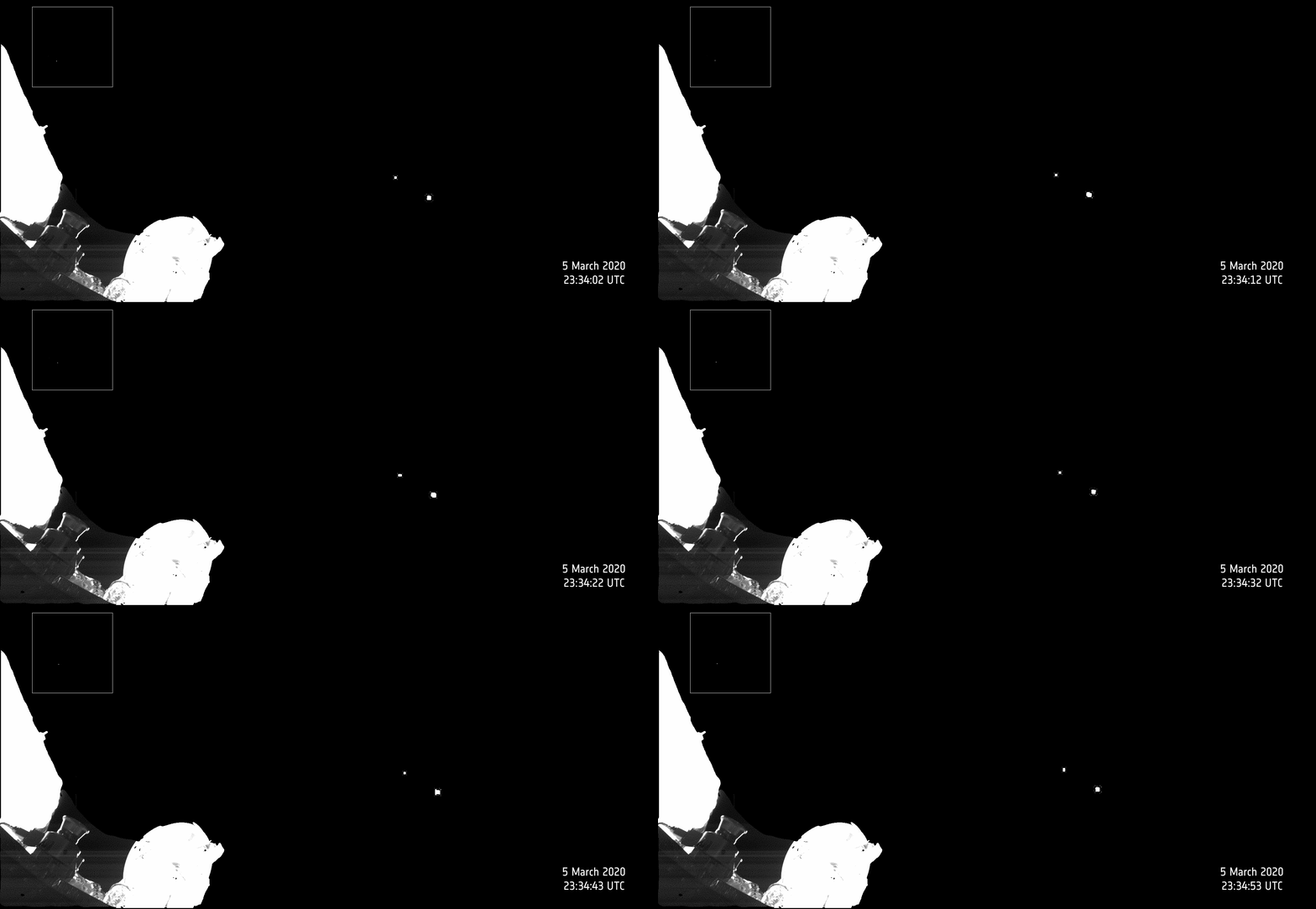
Earth and the Moon as seen from Europe and Japan's BepiColombo spacecraft earlier this month.
ESA / BepiColombo / MTM

ESA to Conduct BepiColombo Flyby Amid Coronavirus Crisis (Press Release)

Controllers at ESA’s mission control centre are preparing for a gravity-assist flyby of the European-Japanese Mercury explorer BepiColombo. The manoeuvre, which will see the mission adjust its trajectory by harnessing Earth’s gravitational pull as it swings past the planet, will be performed amid restrictions ESA has implemented in response to the coronavirus pandemic.

BepiColombo, launched in October 2018, is currently orbiting the Sun at a similar distance as Earth. On 10 April, at about 06:25 am (CEST), the spacecraft will approach Earth at the distance of only 12,700 km, which is less than half the altitude of Europe’s Galileo navigational satellites. The manoeuvre will slow down the BepiColombo spacecraft and bend its trajectory towards the centre of the Solar System, thus tightening its orbit around the Sun.

“This is the last time we will see BepiColombo from Earth,” says Joe Zender, BepiColombo Deputy Project Scientist at ESA. “After that it will head deeper into the inner Solar System.”

Mission scientists plan to use the flyby to test some of the 11 instruments aboard ESA’s Mercury Planetary Orbiter (MPO), one of the European components of the mission, which travels to the innermost planet of the Solar System together with the Mercury Magnetospheric Orbiter (Mio) of the Japan Aerospace Exploration Agency (JAXA). The two science orbiters are stacked on top of the ESA-made Mercury Transfer Module (MTM), with Mio sitting atop hidden behind a protective sunshield. The transfer module obscures the view of some of the MPO instruments, but the scientists expect to be able to obtain data from eight of the 11 science payloads. Mio’s view is mostly blocked by the sunshield, but some of its sensors will also be switched on during the flyby.

The operation, however, will be performed with limited personnel at ESA’s European Space Operations Centre (ESOC) in Darmstadt, Germany, where engineers will have to comply with social distancing rules presently in place all over Europe as a response to the coronavirus pandemic.

“The Earth swing-by is a phase where we need daily contact with the spacecraft,” says Elsa Montagnon, BepiColombo Spacecraft Operations Manager at ESA. “This is something that we cannot postpone. The spacecraft will swing by Earth independently in any case.”

The coronavirus threat forces the team to work with minimal face to face interaction while ensuring all steps in the process are properly covered.

“During the critical two weeks prior to the closest approach, we need to upload safety commands to prepare the spacecraft for unexpected problems,” says Christoph Steiger, BepiColombo Deputy Spacecraft Operations Manager. “For example, we need to prepare the transfer module for the 34 minute-long eclipse when its solar panels will not be exposed to sunlight to prevent battery discharge.”

Operations can still be conducted as planned, he adds, but will require more effort and attention than in a normal situation.

ESA’s BepiColombo Project Scientist Johannes Benkhoff hopes that, despite the challenging circumstances, the science teams will be able to switch on the MPO instruments to test and calibrate them.

“For example, the PHEBUS spectroscope will use the Moon as a calibration target to then produce better data once at Mercury,” says Johannes. “We also want to make some measurements of the solar wind and its interaction with Earth’s magnetic field. The main purpose of having the instruments on at this stage, however, is testing and calibration. If we can use the data for some scientific investigation, it will be a bonus.”

BepiColombo also carries three GoPro-style ‘selfie’ cameras, mounted on the transfer module, that will be taking photographs as the spacecraft approaches Earth. The scientists activated the cameras in early March and took a few snaps of the Earth-Moon system as viewed by BepiColombo from its position hurtling towards the Earth.

“We will see the Earth approaching and getting bigger,” says Joe. “When it reaches the nearest point, we will take a few images, and then we are planning to capture a whole sequence of photographs over several hours looking at the Earth-Moon system as it gets smaller and smaller until we lose it completely.”

Frank Budnik, ESA’s BepiColombo Flight Dynamics manager, adds: “As long as all team members are healthy and the spacecraft continues to perform nominally, everything can proceed as planned.”

The Earth flyby on 10 April is only the first of nine gravity assist manoeuvres awaiting BepiColombo during its 7-year journey to Mercury. In October, the spacecraft will perform the first of two flybys at Venus. The final six orbit-tightening manoeuvres will use the gravity of BepiColombo’s destination, Mercury.

BepiColombo will arrive at Mercury in late 2025. The science mission will commence three months later, after Mio and the MPO separate from the transfer module and enter their respective target orbits. Together, the two orbiters will help scientists shed light on the evolution of Mercury, the least explored of the four rocky planets in the Solar System and the one closest to the Sun.

Learning about Mercury’s composition, the geological processes on its surface and the environment around it will help scientists answer some fundamental questions not only about Mercury, but also about the formation and evolution of the entire Solar System.

Amateur astronomers equipped with small telescopes will be able to observe BepiColombo during the flyby, if located in southern latitudes. Observers in southern Europe might be able to spot the spacecraft briefly. The best view, however, will only be possible from the southern hemisphere.

Source: European Space Agency

Thursday, March 26, 2020

Headin' Back to Mars (Hopefully)!

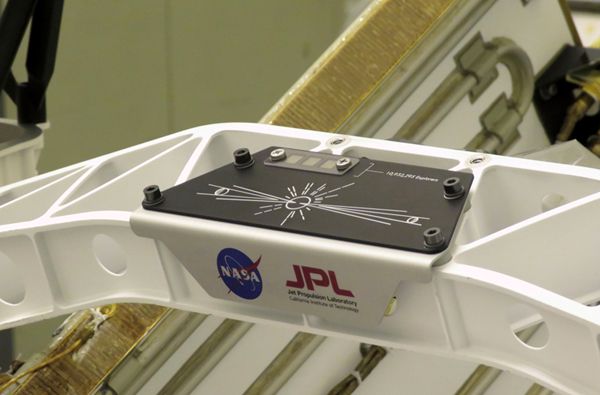
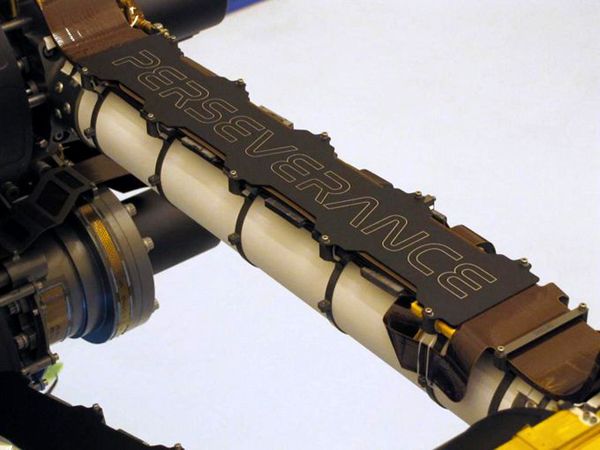
A placard containing three microchips bearing the names of 10.9 million people is attached to the Perseverance Mars rover at NASA's Kennedy Space Center in Florida.
NASA / JPL - Caltech

10.9 Million Names Now Aboard NASA's Perseverance Mars Rover (News Release)

As part of NASA's 'Send Your Name to Mars' campaign, they've been stenciled onto three microchips along with essays from NASA's 'Name the Rover' contest. Next stop: Mars.

NASA's "Send Your Name to Mars" campaign invited people around the world to submit their names to ride aboard the agency's next rover to the Red Planet. Some 10,932,295 people did just that. The names were stenciled by electron beam onto three fingernail-sized silicon chips, along with the essays of the 155 finalists in NASA's "Name the Rover" contest. The chips were then attached to an aluminum plate on NASA's Perseverance Mars rover at Kennedy Space Center in Florida on March 16. Scheduled to launch this summer, Perseverance will land at Jezero Crater on Feb. 18, 2021.

The three chips share space on the anodized plate with a laser-etched graphic depicting Earth and Mars joined by the star that gives light to both. While commemorating the rover that connects the two worlds, the simple illustration also pays tribute to the elegant line art of the plaques aboard the Pioneer spacecraft and golden records carried by Voyagers 1 and 2. Affixed to the center of the rover's aft crossbeam, the plate will be visible to cameras on Perseverance's mast.

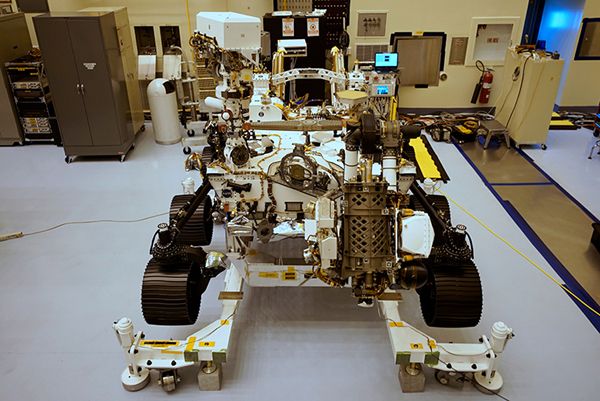
Currently, the coronavirus has not impacted the Mars Perseverance rover launch schedule. The installation was one of numerous recent activities performed by the Perseverance assembly, test and launch operations team. On March 21, the team began reconfiguring the rover so it can ride atop the Atlas V rocket. Steps included stowing the robotic arm, lowering and locking in place the remote sensing mast and high-gain antenna, and retracting its legs and wheels.

The Perseverance rover is a robotic scientist weighing just under 2,300 pounds (1,043 kilograms). It will search for signs of past microbial life, characterize Mars' climate and geology, collect samples for future return to Earth, and help pave the way for human exploration of the Red Planet.

JPL, a division of Caltech in Pasadena, is building and will manage operations of the Mars Perseverance rover for NASA. The agency's Launch Services Program, based at the agency's Kennedy Space Center in Florida, is responsible for launch management. The Mars 2020 project with its Perseverance rover is part of a larger program that includes missions to the Moon as a way to prepare for human exploration of the Red Planet. Charged with returning astronauts to the Moon by 2024, NASA will establish a sustained human presence on and around the Moon by 2028 through NASA's Artemis lunar exploration plans.

Source: Jet Propulsion Laboratory

****

The Perseverance Mars rover undergoes launch processing at NASA's Kennedy Space Center in Florida.
NASA / JPL - Caltech

Wednesday, March 11, 2020

Now That the COVID-19 Outbreak Has Become a Pandemic...

HEALTH TIPS: How to avoid getting the novel coronavirus...

- Wash your hands completely and often. Use soap and water for at least 20 seconds.

- Use an alcohol-based hand sanitizing rub (must have at least 60% alcohol).

- Avoid touching your eyes, nose and mouth with unwashed hands.

- Cover your mouth and nose when you cough or sneeze by coughing/sneezing into a tissue or inside of your elbow.

- Immediately throw away tissues in a trash can after use.

- Keep a safe distance of at least 6 feet between yourself and others. Stay home as much as possible.

- Clean highly touched surfaces thoroughly using soap and water.

- Stay home when you are sick except for getting medical care. Follow your doctor’s instructions.

- Avoid shaking hands.

- Avoid close contact with people who are sick.

- And lastly, DO NOT hoard supplies like toilet paper, gloves and/or face masks from supermarkets and other stores!

Social distance, everyone! And stay safe.

Wearing a face mask and gloves might become very important during this coronavirus pandemic...

Thursday, March 05, 2020

Meet PERSEVERANCE: The Mars 2020 Rover Finally Has An Official Name!

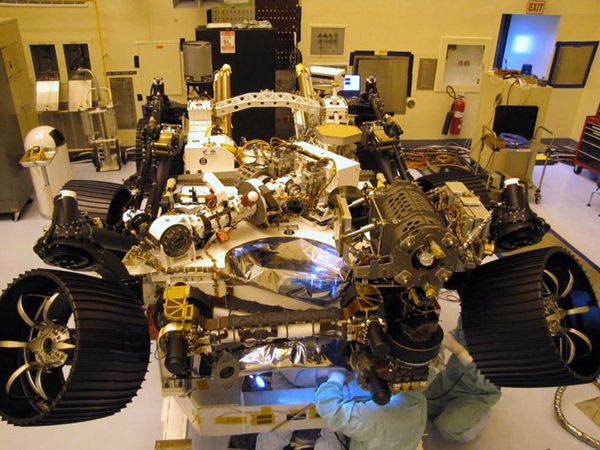
The Perseverance Mars rover undergoes launch processing at NASA's Kennedy Space Center in Florida.
NASA

Virginia Middle School Student Earns Honor of Naming NASA's Next Mars Rover (News Release)

NASA chose seventh-grader from Virginia as winner of the agency's "Name the Rover" essay contest. Alexander Mather's entry for "Perseverance" was voted tops among 28,000 entries.

NASA's next Mars rover has a new name - Perseverance.

The name was announced Thursday by Thomas Zurbuchen, associate administrator of the Science Mission Directorate, during a celebration at Lake Braddock Secondary School in Burke, Virginia. Zurbuchen was at the school to congratulate seventh grader Alexander Mather, who submitted the winning entry to the agency's "Name the Rover" essay contest, which received 28,000 entries from K-12 students from every U.S. state and territory.

"Alex's entry captured the spirit of exploration," said Zurbuchen. "Like every exploration mission before, our rover is going to face challenges, and it's going to make amazing discoveries. It's already surmounted many obstacles to get us to the point where we are today - processing for launch. Alex and his classmates are the Artemis Generation, and they're going to be taking the next steps into space that lead to Mars. That inspiring work will always require perseverance. We can't wait to see that nameplate on Mars."

Perseverance is the latest in a long line of Red Planet rovers to be named by school-age children, from Sojourner in 1997 to the Spirit and Opportunity rovers, which landed on Mars in 2004, to Curiosity, which has been exploring Mars since 2012. In each case, the name was selected following a nationwide contest.

The contest that resulted in Alex's winning entry of Perseverance began Aug. 28, 2019. Nearly 4,700 volunteer judges - educators, professionals and space enthusiasts from around the country - reviewed submissions to help narrow the pool down to 155 semifinalists. Once that group was whittled down to nine finalists, the public had five days to weigh in on their favorites, logging more than 770,000 votes online, with the results submitted to NASA for consideration. The nine finalists also talked with a panel of experts, including Lori Glaze, director of NASA's Planetary Science Division; NASA astronaut Jessica Watkins; rover driver Nick Wiltsie at NASA's Jet Propulsion Laboratory in California; and Clara Ma, who, as a sixth-grade student in 2009, named Curiosity.

Up until two years ago, Mather was more interested in video games than space. That all changed in the summer of 2018, when he visited Space Camp in Alabama. From his first glimpse of a Saturn V - the rocket that launched the Apollo astronauts to the Moon half a century ago - Mather became a bona fide space enthusiast, checking NASA.gov daily, consuming astronaut autobiographies and even 3D-printing flyable model rockets. When the call went out for students to propose a name for NASA's new Mars rover, Mather knew he wanted to contribute.

"This was a chance to help the agency that put humans on the Moon and will soon do it again," said Mather. "This Mars rover will help pave the way for human presence there, and I wanted to try and help in any way I could. Refusal of the challenge was not an option."

Along with forever being associated with the mission, Mather will also receive an invitation to travel with his family to Cape Canaveral Air Force Station in Florida to witness the rover begin its journey when it launches this summer. While Mather has received NASA's grand prize in this competition, NASA also is acknowledging the valuable contributions of the semifinalists whose entries were among the top ones considered.

"They came so far, and their expressive submissions helped make this naming contest the biggest and best in NASA history," said Glaze, who also attended the event Thursday. "So, we decided to send them a little farther - 314 million miles farther. All 155 semifinalists' proposed rover names and essays have been stenciled onto a silicon chip with lines of text smaller than one-thousandth the width of a human hair and will be flown to Mars aboard the rover."

NASA's Perseverance rover is a robotic scientist weighing just under 2,300 pounds (1,043 kilograms). Managed for the agency by JPL, the rover's astrobiology mission includes searching for signs of past microbial life. It also will characterize the planet's climate and geology, and collect samples of Martian rocks and dust for a future Mars Sample Return mission to Earth while paving the way for human exploration of the Red Planet.

"When word went out during the naming event here at JPL, I took a moment to look around the auditorium," said John McNamee, project manager of the Mars 2020 Perseverance rover mission at JPL. "I saw all these dedicated men and women who for years have invested the full measure of their intellect and stamina into the most technologically advanced rover mission in history - and I saw a lot of smiling faces and high-fives. Perseverance? You bet, that is a worthy name that we can be proud of as the first leg of a sample return campaign."

Perseverance currently is undergoing final assembly and checkout at NASA's Kennedy Space Center in Florida. It's targeted to land at Mars' Jezero Crater a little after 3:40 p.m. EST (12:40 p.m. PST) Feb. 18, 2021.

The rover naming contest partnership was part of a Space Act Agreement in educational and public outreach efforts between NASA, Battelle of Columbus, Ohio, and Future Engineers of Burbank, California. Amazon Web Services is an additional prize provider for the Mars 2020 naming contest and will provide Alex and his family a trip to see the launch.

Mars 2020 is part of a larger program that includes missions to the Moon as a way to prepare for human exploration of the Red Planet. Charged with landing the first woman and the next man on the Moon by 2024, NASA will establish a sustained human presence on and around the Moon by 2028 through NASA's Artemis program.

Source: Jet Propulsion Laboratory

****

The nameplate for the Perseverance Mars rover is attached to the spacecraft's robotic arm at NASA's Kennedy Space Center in Florida.
NASA

Friday, February 28, 2020

SpaceX Update: Getting 'Psyched' Up for Another Falcon Heavy Flight!

SpaceX's Falcon Heavy rocket lifts off on its maiden flight from Launch Complex 39A at NASA's Kennedy Space Center in Florida...on February 6, 2018.
SpaceX

NASA Awards Launch Services Contract for the Psyche Mission (Press Release)

NASA has selected SpaceX of Hawthorne, California, to provide launch services for the agency’s Psyche mission. The Psyche mission currently is targeted to launch in July 2022 on a Falcon Heavy rocket from Launch Complex 39A at NASA's Kennedy Space Center in Florida.

The total cost for NASA to launch Psyche and the secondary payloads is approximately $117 million, which includes the launch service and other mission related costs.

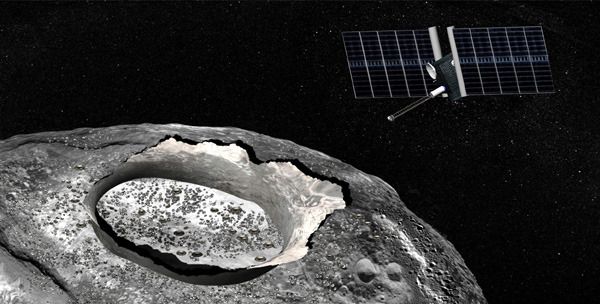
The Psyche mission will journey to a unique metal-rich asteroid, also named Psyche, which orbits the Sun between Mars and Jupiter. The asteroid is considered unique, as it appears to largely be made of the exposed nickel-iron core of an early planet – one of the building blocks of our solar system.

Deep within rocky, terrestrial planets, including Earth, scientists infer the presence of metallic cores, but these lie unreachably far below the planet’s rocky mantles and crusts. Because we cannot see or measure Earth’s core directly, the mission to Psyche offers a unique window into the violent history of collisions and accretion that created terrestrial planets.

The launch of Psyche will include two secondary payloads: Escape and Plasma Acceleration and Dynamics Explorers (EscaPADE), which will study the Martian atmosphere, and Janus, which will study binary asteroids.

NASA’s Launch Services Program at Kennedy Space Center in Florida will manage the SpaceX launch service. The mission is led by Arizona State University. NASA’s Jet Propulsion Laboratory is responsible for the mission’s overall management, system engineering, integration, testing and mission operations. Maxar Technologies is providing a high-power solar electric propulsion spacecraft chassis.

Source: NASA.Gov

****

An artist's concept of the Psyche spacecraft orbiting a metallic asteroid named Psyche.
NASA / JPL - Caltech

Thursday, February 27, 2020

The Mission Is Officially Over for the InSight Mars Lander's Two Fellow Passengers in Deep Space...

An animated GIF showing Mars as the Mars Cube One spacecraft known as 'WALL-E' gets closer to the Red Planet on November 25-26, 2018.
NASA / JPL - Caltech

The MarCO Mission Comes to an End (News Release)

The pair of briefcase-sized satellites made history when they sailed past Mars in November 2018.

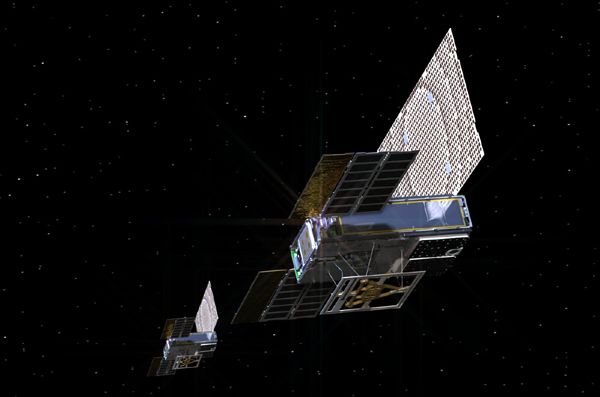
The first CubeSat mission to fly past Mars has been completed. Contact with the twin Mars Cube One spacecraft - known collectively as MarCO - was lost in early January 2019 as the trajectories of the solar-powered CubeSats carried them farther from the Sun. The team reattempted contacting the briefcase-sized pair this past September, when their orbits brought them closer to the Sun again. On Feb. 2, having been unable to detect any signals from them, the team declared the end of the mission.

The two CubeSats made history, not just for flying past Mars but also for relaying data from NASA's InSight lander. Designs derived from MarCO's radio, attitude control system and antenna will be in CubeSats that NASA will launch to the Moon with Artemis I, part of an effort to send humans back to the Moon in preparation for astronaut missions to Mars.

Data collected by each MarCO CubeSat will be published in the coming year, ensuring that future generations of small-satellite engineers can learn from these important pathfinders.

Source: Jet Propulsion Laboratory

****

An artist's concept of the two MarCO CubeSats, 'WALL-E' and 'EVE,' flying through deep space.
NASA / JPL - Caltech

Friday, February 14, 2020

PLEASE Select the 'Trident' Mission, NASA! Thanks!

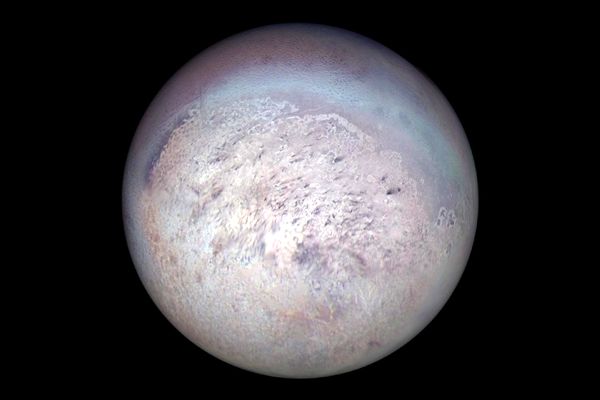
An image of Neptune's moon Triton that was taken by NASA's Voyager 2 spacecraft in August of 1989.
NASA / JPL

NASA Selects Four Possible Missions to Study the Secrets of the Solar System (Press Release - February 13)

Two NASA-JPL proposals are among the selections: Trident would explore Neptune's moon Triton, while Veritas aims to map Venus' surface to determine the planet's geologic history.

NASA has selected four Discovery Program investigations to develop concept studies for new missions. Although they're not official missions yet and some ultimately may not be chosen to move forward, the selections focus on compelling targets and science that are not covered by NASA's active missions or recent selections. Final selections will be made next year.

NASA's Discovery Program invites scientists and engineers to assemble a team to design exciting planetary science missions that deepen what we know about the solar system and our place in it. These missions will provide frequent flight opportunities for focused planetary science investigations. The goal of the program is to address pressing questions in planetary science and increase our understanding of our solar system.

"These selected missions have the potential to transform our understanding of some of the solar system's most active and complex worlds," said Thomas Zurbuchen, associate administrator of NASA's Science Mission Directorate. "Exploring any one of these celestial bodies will help unlock the secrets of how it, and others like it, came to be in the cosmos."

Each of the four nine-month studies will receive $3 million to develop and mature concepts and will conclude with a Concept Study Report. After evaluating the concept studies, NASA will continue development of up to two missions towards flight.

The proposals were chosen based on their potential science value and feasibility of development plans following a competitive peer-review process.

The selected proposals are:

TRIDENT

Trident would explore Triton, a unique and highly active icy moon of Neptune, to understand pathways to habitable worlds at tremendous distances from the Sun. NASA's Voyager 2 mission showed that Triton has active resurfacing - generating the second-youngest surface in the solar system - with the potential for erupting plumes and an atmosphere. Coupled with an ionosphere that can create organic snow and the potential for an interior ocean, Triton is an exciting exploration target to understand how habitable worlds may develop in our solar system and others. Using a single flyby, Trident would map Triton, characterize active processes and determine whether the predicted subsurface ocean exists. Louise Prockter of the Lunar and Planetary Institute/Universities Space Research Association in Houston is the principal investigator. NASA's Jet Propulsion Laboratory in Pasadena, California, would provide project management.

VERITAS (Venus Emissivity, Radio Science, InSAR, Topography, and Spectroscopy)

VERITAS would map Venus' surface to determine the planet's geologic history and understand why Venus developed so differently than the Earth. Orbiting Venus with a synthetic aperture radar, VERITAS charts surface elevations over nearly the entire planet to create three-dimensional reconstructions of topography and confirm whether processes, such as plate tectonics and volcanism, are still active on Venus. VERITAS would also map infrared emissions from the surface to map Venus' geology, which is largely unknown. Suzanne Smrekar of NASA's Jet Propulsion Laboratory in Pasadena, California, is the principal investigator. JPL would provide project management.

DAVINCI+ (Deep Atmosphere Venus Investigation of Noble gases, Chemistry, and Imaging Plus)

DAVINCI+ would analyze Venus' atmosphere to understand how it formed and evolved and determine whether Venus ever had an ocean. DAVINCI+ plunges through Venus' inhospitable atmosphere to precisely measure its composition down to the surface. The instruments are encapsulated within a purpose-built descent sphere to protect them from the intense environment of Venus. The "+" in DAVINCI+ refers to the imaging component of the mission, which includes cameras on the descent sphere and orbiter designed to map surface rock-type. The last U.S.-led, in-situ mission to Venus was in 1978. The results from DAVINCI+ have the potential to reshape our understanding of terrestrial planet formation in our solar system and beyond. James Garvin of NASA's Goddard Space Flight Center in Greenbelt, Maryland, is the principal investigator. Goddard would provide project management.

Io Volcano Observer (IVO)

IVO would explore Jupiter's moon Io to learn how tidal forces shape planetary bodies. Io is heated by the constant crush of Jupiter's gravity and is the most volcanically active body in the solar system. Little is known about Io's specific characteristics, such as whether a magma ocean exists in its interior. Using close-in flybys, IVO would assess how magma is generated and erupted on Io. The mission's results could revolutionize our understanding of the formation and evolution of rocky, terrestrial bodies, as well as icy ocean worlds in our solar system and extrasolar planets across the universe. Alfred McEwen of the University of Arizona in Tucson is the principal investigator. The Johns Hopkins University Applied Physics Laboratory in Laurel, Maryland, would provide project management.

The concepts were chosen from proposals submitted in 2019 under NASA Announcement of Opportunity (AO) NNH19ZDA010O, Discovery Program. The selected investigations will be managed by the Planetary Missions Program Office at NASA's Marshall Space Flight Center in Huntsville, Alabama, as part of the Discovery Program. The Discovery Program conducts space science investigations in the Planetary Science Division of NASA's Science Mission Directorate, guided by NASA's agency priorities and the Decadal Survey process of the National Academy of Sciences.

Established in 1992, NASA's Discovery Program has supported the development and implementation of over 20 missions and instruments. These selections are part of the ninth Discovery Program competition.

Source: Jet Propulsion Laboratory

Thursday, February 13, 2020

New Horizons Update: New Information Revealed About Kuiper Belt Object 'Arrokoth'...

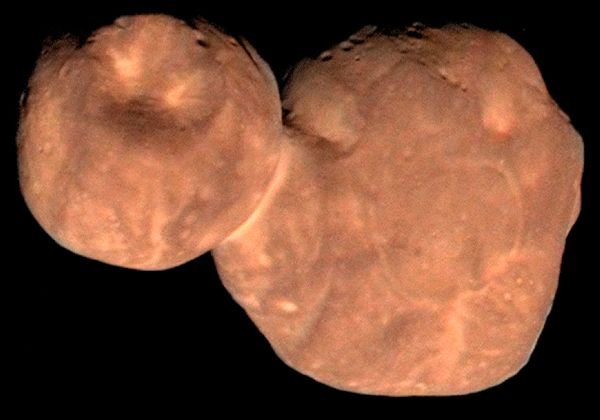
A high-resolution image of the Kuiper Belt object Arrokoth that was taken by NASA's New Horizons spacecraft from 4,109 miles (6,628 kilometers) away...on January 1, 2019.
NASA / Johns Hopkins Applied Physics Laboratory / Southwest Research Institute, National Optical Astronomy Observatory

New Horizons Team Uncovers a Critical Piece of the Planetary Formation Puzzle (News Release)

Data from NASA’s New Horizons mission are providing new insights into how planets and planetesimals – the building blocks of the planets – were formed.

The New Horizons spacecraft flew past the ancient Kuiper Belt object Arrokoth (2014 MU69) on Jan. 1, 2019, providing humankind’s first close-up look at one of the icy remnants of solar system formation in the vast region beyond the orbit of Neptune. Using detailed data on the object’s shape, geology, color and composition – gathered during a record-setting flyby that occurred more than four billion miles from Earth – researchers have apparently answered a longstanding question about planetesimal origins, and therefore made a major advance in understanding how the planets themselves formed.

The team reports those findings in a set of three papers in the journal Science, and at a media briefing Feb. 13 at the annual American Association for the Advancement of Science meeting in Seattle.

“Arrokoth is the most distant, most primitive and most pristine object ever explored by spacecraft, so we knew it would have a unique story to tell,” said New Horizons Principal Investigator Alan Stern, of the Southwest Research Institute in Boulder, Colorado. “It’s teaching us how planetesimals formed, and we believe the result marks a significant advance in understanding overall planetesimal and planet formation.”

The first post-flyby images transmitted from New Horizons last year showed that Arrokoth had two connected lobes, a smooth surface and a uniform composition, indicating it was likely pristine and would provide decisive information on how bodies like it formed. These first results were published in Science last May.

“This is truly an exciting find for what is already a very successful and history-making mission” said Lori Glaze, director of NASA's Planetary Science Division. “The continued discoveries of NASA’s New Horizons spacecraft astound as it reshapes our knowledge and understanding of how planetary bodies form in solar systems across the universe.”

Over the following months, working with more and higher-resolution data as well as sophisticated computer simulations, the mission team assembled a picture of how Arrokoth must have formed. Their analysis indicates that the lobes of this “contact binary” object were once separate bodies that formed close together and at low velocity, orbited each other, and then gently merged to create the 22-mile long object New Horizons observed.

This indicates Arrokoth formed during the gravity-driven collapse of a cloud of solid particles in the primordial solar nebula, rather than by the competing theory of planetesimal formation called hierarchical accretion. Unlike the high-speed collisions between planetesimals in hierarchical accretion, in particle-cloud collapse, particles merge gently, slowly growing larger.

“Just as fossils tell us how species evolved on Earth, planetesimals tell us how planets formed in space,” said William McKinnon, a New Horizons co-investigator from Washington University in St. Louis, and lead author of an Arrokoth formation paper in Science this week. “Arrokoth looks the way it does not because it formed through violent collisions, but in more of an intricate dance, in which its component objects slowly orbited each other before coming together.”

Two other important pieces of evidence support this conclusion. The uniform color and composition of Arrokoth’s surface shows the KBO formed from nearby material, as local cloud collapse models predict, rather than a mishmash of matter from more separated parts of the nebula, as hierarchical models might predict.

The flattened shapes of each of Arrokoth’s lobes, as well as the remarkably close alignment of their poles and equators, also point to a more orderly merger from a collapse cloud. Further still, Arrokoth’s smooth, lightly cratered surface indicates its face has remained well preserved since the end of the planet formation era.

“Arrokoth has the physical features of a body that came together slowly, with ‘local’ materials in the solar nebula,” said Will Grundy, New Horizons composition theme team lead from Lowell Observatory in Flagstaff, Arizona, and the lead author of a second Science paper. “An object like Arrokoth wouldn’t have formed, or look the way it does, in a more chaotic accretion environment.”

The latest Arrokoth reports significantly expand on the May 2019 Science paper, led by Stern. The three new papers are based on 10 times as much data as the first report, and together provide a far more complete picture of Arrokoth’s origin.

“All of the evidence we’ve found points to particle-cloud collapse models, and all but rule out hierarchical accretion for the formation mode of Arrokoth, and by inference, other planetesimals,” Stern said.

New Horizons continues to carry out new observations of additional Kuiper Belt objects it passes in the distance. New Horizons also continues to map the charged-particle radiation and dust environment in the Kuiper Belt. The new KBOs being observed now are too far away to reveal discoveries like those on Arrokoth, but the team can measure aspects such as each object's surface properties and shape. This summer the mission team will begin using large groundbased telescopes to search for new KBOs to study in this way, and even for another flyby target if fuel allows.

The New Horizons spacecraft is now 4.4 billion miles (7.1 billion kilometers) from Earth, operating normally and speeding deeper into the Kuiper Belt at nearly 31,300 miles (50,400 kilometers) per hour.

The Johns Hopkins University Applied Physics Laboratory in Laurel, Maryland, designed, built and operates the New Horizons spacecraft, and manages the mission for NASA's Science Mission Directorate. The Marshall Space Flight Center Planetary Management Office provides the NASA oversight for the New Horizons. Southwest Research Institute, based in San Antonio, directs the mission via Principal Investigator Stern, and leads the science team, payload operations and encounter science planning. New Horizons is part of the New Frontiers Program managed by NASA's Marshall Space Flight Center in Huntsville, Alabama.

Source: NASA.Gov

****

Wednesday, February 12, 2020

America's Next Red Planet Rover Has Arrived at Cape Canaveral in Florida!

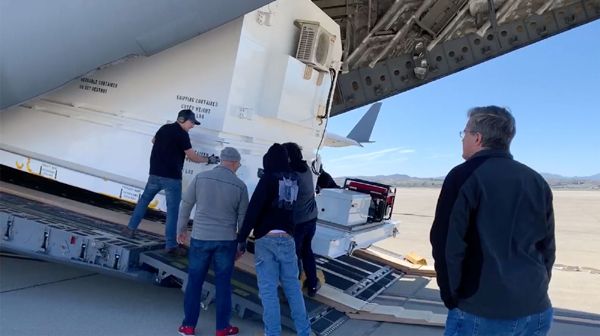
A cargo container carrying NASA's Mars 2020 rover is loaded onto a C-17 aircraft at March Air Reserve Base in Riverside, California for the flight to Cape Canaveral, Florida...on February 11, 2020.
NASA / JPL - Caltech

NASA's Mars 2020 Rover Goes Coast-to-Coast to Prep for Launch (News Release)

The agency's first step in returning rocks from Mars just arrived at Kennedy Space Center. The Mars 2020 team now begins readying for a launch to the Red Planet this July.

NASA's next Mars rover has arrived in Florida to begin final preparations for its launch to the Red Planet this July. An Air Force C-17 Globemaster cargo plane carrying the Mars 2020 rover and descent stage touched down at NASA's Kennedy Space Center at about 3 p.m. EST (12 p.m. PST) today, completing a 2,300-mile (3,700-kilometer) trip that began yesterday at NASA's Jet Propulsion Laboratory near Pasadena, California. The mission's cruise stage and Mars Helicopter will make the trip to Kennedy later this week.

"Our rover has left the only home it has ever known," said John McNamee, Mars 2020 project manager. "The 2020 family here at JPL is a little sad to see it go, but we're even more proud knowing that the next time our rover takes to the skies, it will be headed to Mars."

Assembly, test and launch operations for Mars 2020 began in January 2018. The first piece of hardware that would become part of the rover arrived on the clean room floor of JPL's Spacecraft Assembly Facility's High Bay 1 a few months later.

The rover's aeroshell - its protective covering for the trip to the Red Planet - arrived at Kennedy this past December. Early on Feb. 11, the rover, cruise stage, descent stage and mission support equipment headed in four police-escorted trucks to the U.S. Air Force's March Air Reserve Base, where they were loaded aboard the two waiting C-17s.

Within hours of arriving at the Kennedy Space Center's Launch and Landing Facility, the Mars 2020 spacecraft components will be transported to the same spacecraft processing facility that in 2011 handled NASA's Curiosity rover, which is currently exploring Mars' Gale Crater. In the coming days, the Mars 2020 assembly, test and launch operations team will begin testing the components to assess their health following the cross-country flight.

After months of final assembly and additional testing, Mars 2020 should be enclosed in its aeroshell for the final time in late June. It will be delivered to Cape Canaveral Air Force Station's Launch Complex 41 to be integrated with the United Launch Alliance Atlas V rocket that will hurl it toward Jezero Crater in early July.

Mars 2020 will collect and store rock and soil samples in sealed tubes and will search for signs of past microbial life, characterize the planet's climate and geology, and pave the way for human exploration. Subsequent missions, currently in the planning stages, will return to Jezero Crater, gather the samples collected by Mars 2020 and return them to Earth for the sort of in-depth study that only a full-size lab can provide.

JPL is building and will manage operations of the Mars 2020 rover for NASA. NASA's Launch Services Program, based at the agency's Kennedy Space Center in Florida, is responsible for launch management.

Source: Jet Propulsion Laboratory