Wednesday, February 29, 2012

Eye stye... Not cool.

The Stupidity of the Internet... So three weeks ago, I developed a stye on the upper eyelid of my left eye. I went online to read about how I could treat it, and found out that a warm compress—a.k.a. warm wet washcloth—was the way to take care of the stye. Later that day, I went to the doctor (for reasons that involved other medical conditions I had at the time, or should I say, right now), and even he recommended that warm compress be used. Nice. Or was it?

So for the next couple of days, I’m placing a warm washcloth near my left eye while watching TV and whatnot...despite the fact I wasn't seeing anything substantial happening with that stye. I went back onto the computer to read about other stye treatments, and lo and behold, it turns out there is also a cold compress (or a cold wet washcloth) to treat the stye with. Um, really.

Apparently, for technical reasons I don't feel like Googling so I could type about them here, a cold compress should be utilized before a warm compress to help the affected eyelid become less swollen and make the stye more prone to bursting on its own (thus beginning the healing process). Well— Almost a week went by (after noticing I had a stye) before I found out about cold compresses...so you could pretty much say I got screwed over in not learning about this substitute treatment sooner. I read other articles where people said they alternated between cold and warm compresses when treating their eyes, which annoyed me further. Cold compress, warm compress— Which friggin' one is more effective? Make up your freakin' mind, people.

Despite the fact I devoted three paragraphs to warm and cold compresses, they're not the main reasons why I think the Internet is friggin' lame. The reason why I think the Web blows is because of numerous articles I stumbled upon about how styes need to naturally burst to begin the healing process.

Almost every stye article you'll read online points out that a warm compress needs to be used to help the stye come to a 'head', that is, the stye becomes big enough that it bursts and pus comes flowing out—alleviating the swollen area around the eye and allowing it to become normal again. What none, and I mean none, of these articles will tell you is how to clean your eye once pus comes gushing out of that fractured stye. There was one time where I immediately ceased doing a warm compress because some pus was leaking from my stye. I didn't know how to clean it off my eye, thanks to the Web being useless in this situation, so I stopped doing warm compresses for a day or two.

So there you have it... Two big reasons why I think the Internet is stupid. Conflicting messages about the use of cold and warm compresses...and idiotic articles about how styes need to burst in a pus-filled glory to begin the recovery process—but no explanation about how to clean the eye when this moment happens.

Quite frankly, warm compresses don't do jack for me. This past week, I saw pus gushing down my eye while doing a compress...but that pus came from the crevasse between my eyeball and eyelid, and not from the stye itself—which remains remarkably intact. Wait, did I use the word 'remarkably'? I mean frustratingly intact.

When it comes down to it, warm compress is crap. Cold compress is crap. And letting the stye burst on its own is crap. What isn't crap, or is actually crappier because this treatment is presumably more painful (and expensive), is the fact this stye will disappear the way other unsightly bodily features (like um, sebaceous cysts?) usually get removed: Through a sharp scalpel. Or in the case of this stye, the prick of an ophthalmologist's needle.

Carry on.

Wednesday, February 22, 2012

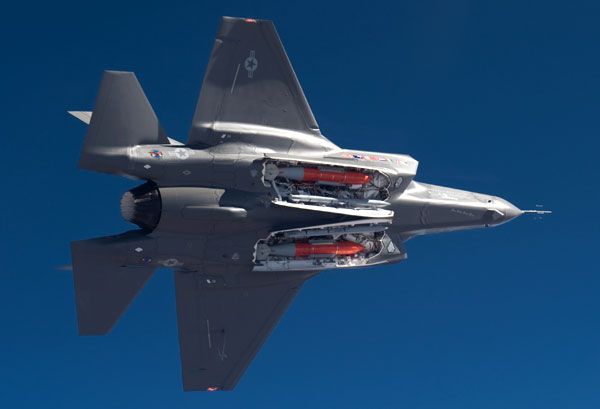
Photos of the Day... The F-35 Lightning II has finally begun flight tests with missiles and other armament aboard. Looking at these photos, I can't fathom who's gonna mess with this bad boy once it becomes combat-ready. [Yes, I know... The good ol' (shady) People's Republic of China.]

An F-35A Lightning II conducts a flight test with bombs and missiles aboard.
Lockheed Martin

An F-35A Lightning II conducts a flight test with air-to-air missiles aboard.
Lockheed Martin / Paul Weatherman

Sunday, February 12, 2012

Sorry for the lack of updates on this Blog... Still recovering from a really crappy case of bronchitis (plus a couple of bites from freakin' dust mites, or I may have broken out in stress-induced hives; don't ask) that I've had for the past two weeks. Just to provide some random comments on recent/kinda recent news events:

- R.I.P. Whitney Houston.

- Congrats to the New York Giants once again!

- What is it with schools—elementary, college or otherwise—recruiting a bunch of sick, vile, should-be-bashed-in-the-head pedophiles for their faculty or sports staff? If the candidate is white, mid-40s to 50s and probably listed himself as single on the application form, best to pass him over. (Though the Penn State douche whose name will not be mentioned here has grandkids.)

There were two to three teachers at my old high school who lost their jobs for the same libido-related behavior while I was a student there almost two decades ago. Wanna know more? Nope? Cool, I'm ending this entry here.

Monday, January 30, 2012

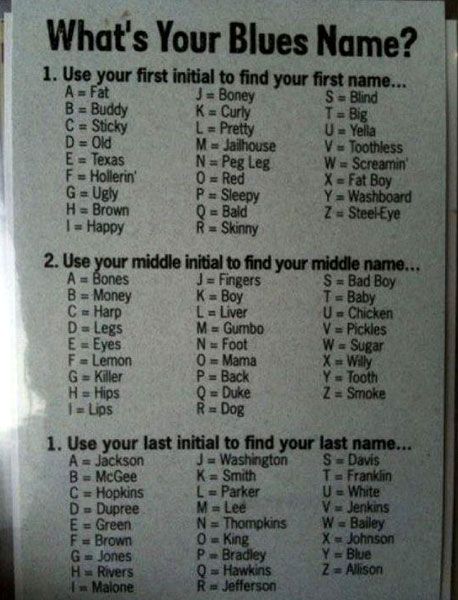
Image of the Day... My blues name would be Skinny Baby Bradley.

What's Your Blues Name?

Saturday, January 28, 2012

The Temple Sagrada Família...which has been in construction since 1882.
Hapless - Trickery.net

Temple Sagrada Família... Two weeks ago, I stumbled upon a book at my local mall that is about this amazing structure, which is located in Barcelona, Spain and has literally been in construction for 130 years. Known officially as the Basílica i Temple Expiatori de la Sagrada Família, this temple is actually a large Roman Catholic church...denoted by UNESCO (United Nations Educational, Scientific and Cultural Organization) as a World Heritage Site, and designated a minor basilica by Pope Benedict XVI in early November of 2010.

An aerial view of the Temple Sagrada Família...which isn't set to be completed till 2026 or 2028.
Photo courtesy of Citronics.net

The Temple Sagrada Família officially began construction in 1882, and isn't set to be completed till 2026 (or possibly 2028)—which is the centennial of the death of Antoni Gaudí, the church's chief architect. Gaudí became involved with the temple's construction in 1883, and devoted the last years of his life to the project till he passed away in 1926. Though work was halted during the Spanish Civil War from 1936 to 1939, construction on the Sagrada Família resumed and finally reached the halfway point in 2010.

A ground-level view of the Temple Sagrada Família...which has currently taken 130 years to construct.
Photo courtesy of Go Car Tours

Despite being more than a decade away from fully opening for worship, the Sagrada Família was consecrated by the Pope on November 7, 2010 in front of a crowd of 6,500 people. An additional 50,000 individuals followed the consecration Mass from outside the temple, with 100 bishops and 300 priests on-hand to offer Holy Communion. Being a fellow Catholic myself, I would definitely be impressed if I visited this basilica in person. To paraphrase architectural critic Paul Goldberger (who said this about the Sagrada Familia), it would be awesome to see in person "the most extraordinary personal interpretation of Gothic architecture since the Middle Ages". Nice... That is all.

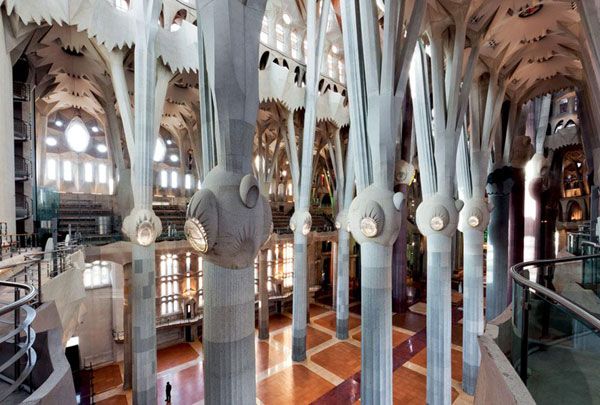
A view of the Temple Sagrada Família's central nave...whose completion allowed Pope Benedict XVI to consecrate the church in November of 2010.
Photo courtesy of Domus - In-finite Architectures

Thursday, January 26, 2012

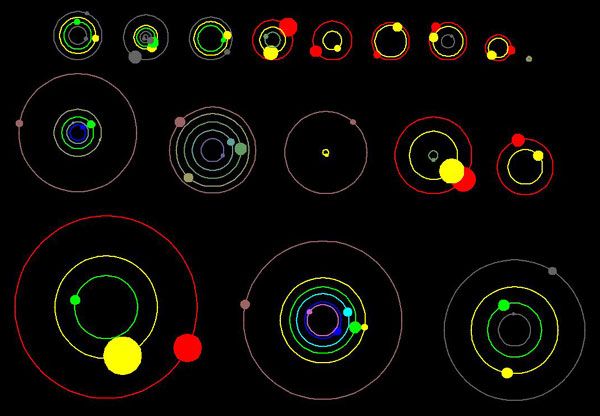
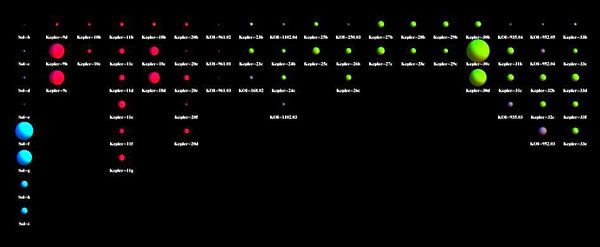
A graphic showing all the solar systems with multiple transiting planets discovered by NASA's Kepler spacecraft.
NASA Ames / Dan Fabrycky, University of California, Santa Cruz

Kepler Update... No words by me can describe today's totally-awesome announcement regarding a multitude of discoveries recently made by the Kepler spacecraft. So check out the NASA press release below...

****

NASA's Kepler Announces 11 New Planetary Systems (Press Release)

NASA's Kepler mission has discovered 11 new planetary systems hosting 26 confirmed planets. These discoveries nearly double the number of verified Kepler planets and triple the number of stars known to have more than one planet that transits, or passes in front of, the star. Such systems will help astronomers better understand how planets form.

The planets orbit close to their host stars and range in size from 1.5 times the radius of Earth to larger than Jupiter. Fifteen are between Earth and Neptune in size. Further observations will be required to determine which are rocky like Earth and which have thick gaseous atmospheres like Neptune. The planets orbit their host star once every six to 143 days. All are closer to their host star than Venus is to our sun.

"Prior to the Kepler mission, we knew of perhaps 500 exoplanets across the whole sky," said Doug Hudgins, Kepler program scientist at NASA Headquarters in Washington. "Now, in just two years staring at a patch of sky not much bigger than your fist, Kepler has discovered more than 60 planets and more than 2,300 planet candidates. This tells us that our galaxy is positively loaded with planets of all sizes and orbits."

Kepler identifies planet candidates by repeatedly measuring the change in brightness of more than 150,000 stars to detect when a planet passes in front of the star. That passage casts a small shadow toward Earth and the Kepler spacecraft.

"Confirming that the small decrease in the star's brightness is due to a planet requires additional observations and time-consuming analysis," said Eric Ford, associate professor of astronomy at the University of Florida and lead author of the paper confirming Kepler-23 and Kepler-24. "We verified these planets using new techniques that dramatically accelerated their discovery."

Each of the newly confirmed planetary systems contains two to five closely spaced transiting planets. In tightly packed planetary systems, the gravitational pull of the planets on each other causes some planets to accelerate and some to decelerate along their orbits. The acceleration causes the orbital period of each planet to change. Kepler detects this effect by measuring the changes, or so-called Transit Timing Variations.

Planetary systems with Transit Timing Variations can be verified without requiring extensive ground-based observations, accelerating confirmation of planet candidates. This detection technique also increases Kepler's ability to confirm planetary systems around fainter and more distant stars.

"By precisely timing when each planet transits its star, Kepler detected the gravitational tug of the planets on each other, clinching the case for 10 of the newly announced planetary systems," said Dan Fabrycky, Hubble Fellow at the University of California, Santa Cruz, and lead author for a paper confirming Kepler-29, 30, 31 and 32.

Five of the systems (Kepler-25, Kepler-27, Kepler-30, Kepler-31 and Kepler-33) contain a pair of planets where the inner planet orbits the star twice during each orbit of the outer planet. Four of the systems (Kepler-23, Kepler-24, Kepler-28 and Kepler-32) contain a pairing where the outer planet circles the star twice for every three times the inner planet orbits its star.

"These configurations help to amplify the gravitational interactions between the planets, similar to how my sons kick their legs on a swing at the right time to go higher," said Jason Steffen, the Brinson postdoctoral fellow at Fermilab Center for Particle Astrophysics in Batavia, Ill., and lead author of a paper confirming Kepler-25, 26, 27 and 28.

Kepler-33, a star that is older and more massive than our sun, had the most planets. The system hosts five planets, ranging in size from 1.5 to 5 times that of Earth. All of the planets are located closer to their star than any planet is to our sun.

The properties of a star provide clues for planet detection. The decrease in the star's brightness and duration of a planet transit combined with the properties of its host star present a recognizable signature. When astronomers detect planet candidates that exhibit similar signatures around the same star, the likelihood of any of these planet candidates being a false positive is very low.

"The approach used to verify the Kepler-33 planets shows the overall reliability is quite high," said Jack Lissauer, planetary scientist at NASA Ames Research Center at Moffett Field, Calif., and lead author of the paper on Kepler-33. "This is a validation by multiplicity."

These discoveries are published in four different papers in the Astrophysical Journal and the Monthly Notices of the Royal Astronomical Society.

Ames Research Center in Moffett Field, Calif., manages Kepler's ground system development, mission operations and science data analysis. NASA's Jet Propulsion Laboratory, Pasadena, Calif., managed the Kepler mission's development.

Ball Aerospace and Technologies Corp. in Boulder, Colo., developed the Kepler flight system and supports mission operations with the Laboratory for Atmospheric and Space Physics at the University of Colorado in Boulder.

The Space Telescope Science Institute in Baltimore archives, hosts and distributes Kepler science data. Kepler is NASA's 10th Discovery Mission and is funded by NASA's Science Mission Directorate at the agency's headquarters in Washington.

Source: Jet Propulsion Laboratory

****

A graphic depicting the multiple planet systems discovered by NASA's Kepler spacecraft since its mission began in 2009.
NASA Ames / Jason Steffen, Fermilab Center for Particle Astrophysics

Tuesday, January 24, 2012

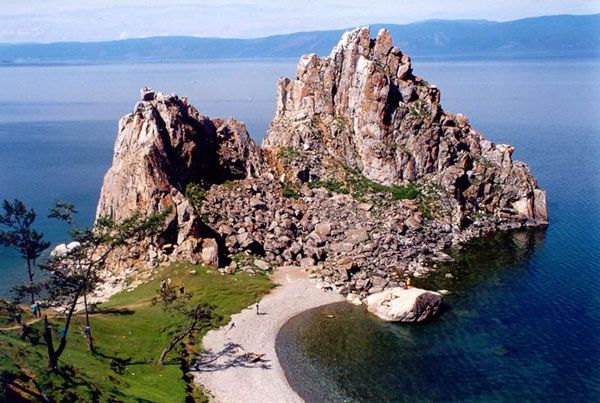
Lake Baikal.
Photo courtesy of World Island Paradise

Lake Baikal... Another cool location that I read about in the National Geographic magazine where I learned about blue holes and the Cave of Crystals last month happens to be the oldest and deepest lake in the world. Known as Lake Baikal, this Russian body of water is 30 million years-old, and has an average depth of 2,442 feet (744.4 meters). At its deepest level, Baikal—which is 395 miles (636 kilometers) long and 49 miles (79 kilometers) wide—reaches a low point of 5,387 feet (1,642 meters)...making this the most voluminous freshwater lake in the world. In fact, Baikal contains about 20% of the world's unfrozen fresh water at the surface.

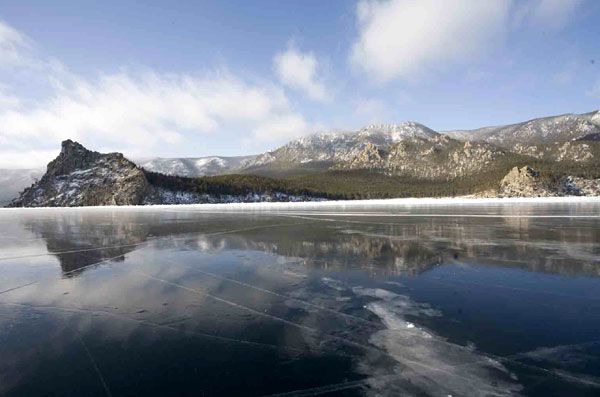
Lake Baikal, frozen.
Photo courtesy of ferrebeekeeper

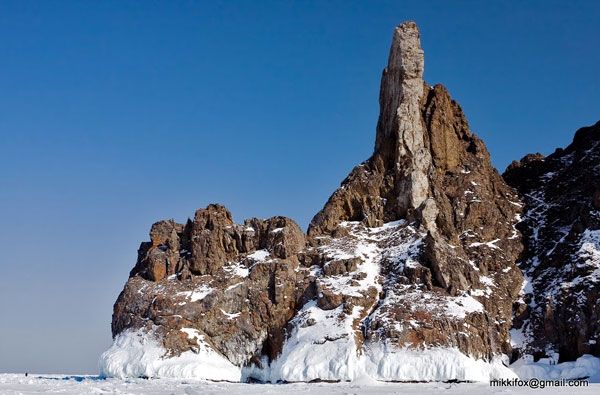
As you can see from three of the four pics posted with this entry, Lake Baikal completely freezes over during the winter. Actually, that's incorrect: Baikal is fully covered by ice five months out of the year. So if you want to go ice fishing, try doing so between January and May. Temperatures throughout this area range from a minimum of −2°F (−19°C) during the winter to a maximum of 57°F (14°C) during the summer.

Lake Baikal, frozen.

In case you want to visit this locale if you ever venture to Russia, Lake Baikal is located south of Siberia...between the Buryat Republic to the southeast and the federal subject of Irkutsk Oblast to the northwest. Lake Baikal was given the nickname "Older sister of Sister Lakes". Its younger sister, Khövsgöl nuur, is the second largest lake by area in the world. Of course, Khövsgöl nuur is located in Mongolia...so have fun dishin' out your passport twice, assuming you don't already live in Central or East Asia, if you want to visit this body of water (at the foot of Mongolia's eastern Sayan Mountains) before or after you check out Lake Baikal near Siberia. Carry on.

Lake Baikal, frozen.

Sunday, January 22, 2012

Photos of the Day... Both of these images were posted by my friends on Facebook yesterday. One pic is a Debbie Downer while the other photo is inspirational. Either way, these images exemplify why we call these creatures our four-legged pals and Man's Best Friend...

A soldier mourns for two dogs lost in combat.

A boy and his dog.

Friday, January 20, 2012

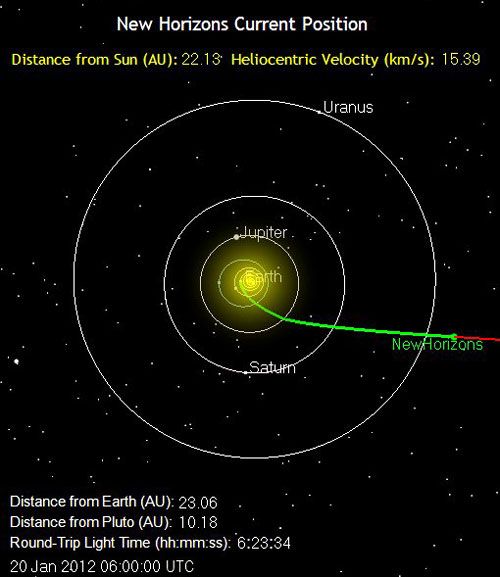
The green line marks the path traveled by the New Horizons spacecraft as of 10:00 PM, Pacific Standard Time, on January 19, 2012.  It is 2.1 billion miles from Earth.
ABOVE: The green line marks the path traveled by the New Horizons spacecraft as of
10:00 PM, Pacific Standard Time, on January 19, 2012. It is 2.1 billion miles from Earth.
Click
here to view the official webpage showing where New Horizons is in space.
(AU stands for Astronomical Units, in case you're wondering.)


New Horizons Update... Yesterday marked the 6-year anniversary since the New Horizons spacecraft was launched from Cape Canaveral Air Force Station in Florida on a 9-year journey to Pluto. This month also marks 3 years before the Pluto encounter phase of the mission officially begins in January of 2015. New Horizons is now in "Late Cruise"...with the last milestone before its final approach to the dwarf planet being New Horizons' crossing of Neptune's orbit on August 25, 2014—exactly 25 years after Voyager 2 made its historic flyby of the gas giant.

New Horizons' closest approach to Pluto will be on July 14, 2015. Can't wait!

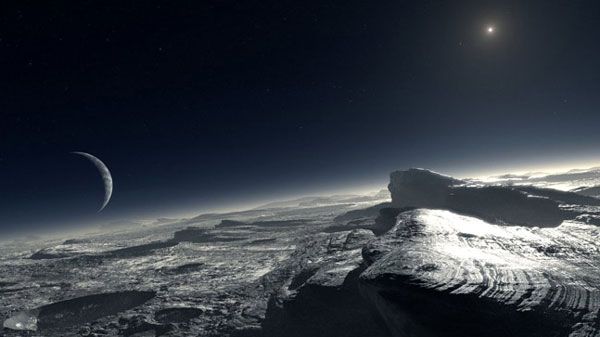
An artist's concept of Pluto's surface.
ESO / L. Calçada

NEW HORIZONS Blog Entries Archive:

September 26, 2005
December 19, 2005
January 7, 2006
January 17, 2006
January 19, 2006
April 12, 2006
June 15, 2006
February 27, 2007
October 22, 2007
June 8, 2008
October 23, 2008
March 18, 2011
January 20, 2012

Wednesday, January 18, 2012

A STAR WARS: THE PHANTOM MENACE marquee at my local AMC theater.

Nerdgasm... In honor of Darth Maul returning to the big screen (in 3-D) next month, just thought I'd post these random Star Wars-related images that I recently took with my camera phone. The Phantom Menace cardboard marquee posted above was on display at the AMC theater inside my local mall, while the two cool LEGO® sets shown below were found at the nearby Toys"R"Us store. Despite the fact I didn't become a Star Wars geek till um, 9th grade, I'm pretty sure I would've bothered my folks into getting the Republic Cruiser and/or Millennium Falcon (which are both almost 2-feet-long, like the Batmobile collectible I also saw at the mall last summer) for me when I was 10 years old...if these items were available 20 years ago. Whether or not they would've relented in buying me these sets is a whole other matter—especially considering the grades I got in elementary school (primarily for math) that time. Carry on.

Republic Cruiser (from THE PHANTOM MENACE) and Millennium Falcon LEGO® sets at the local Toys'R'Us store.