Saturday, December 31, 2011

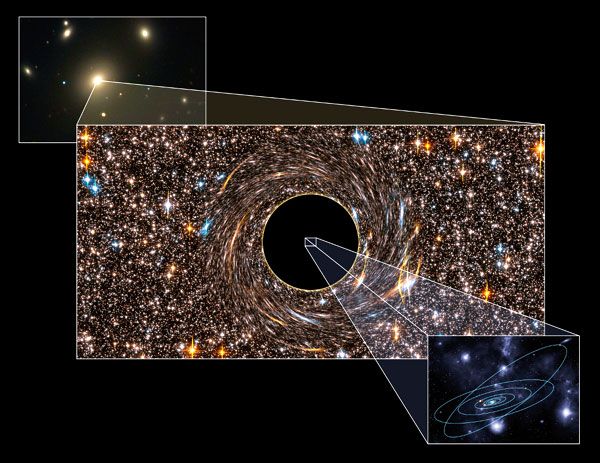
A graphic comparing the size of NGC 3842’s black hole to our own solar system.
Pete Marenfeld

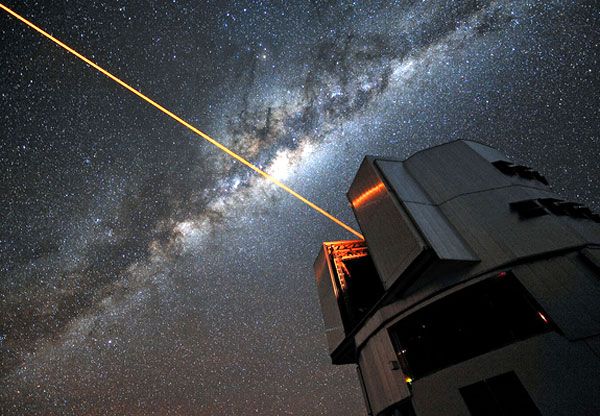
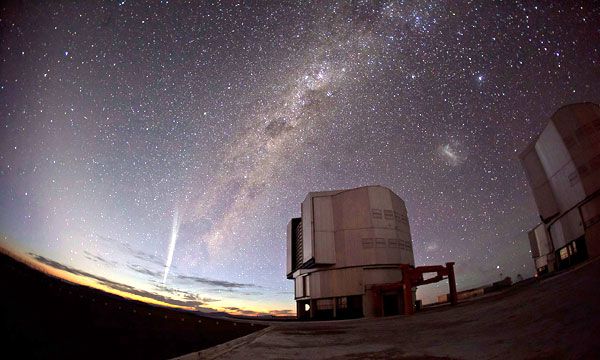
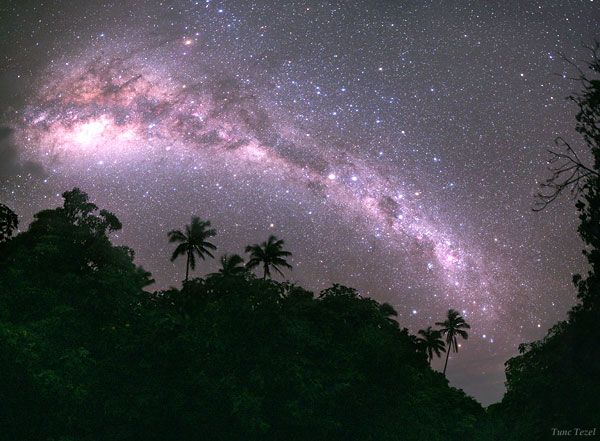
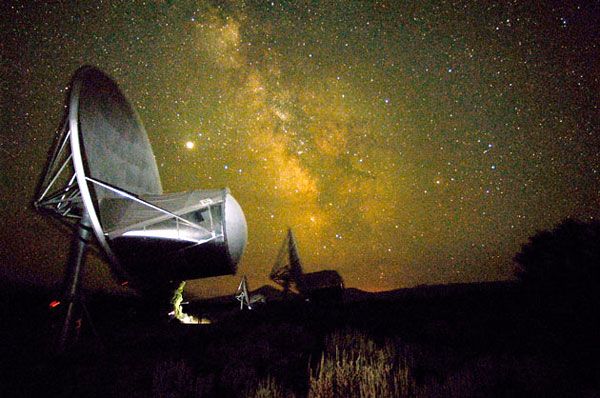
THE FINAL POST OF 2011... Just thought I'd end this year by sharing these cool astronomy-related photos that I found online with y’all. The image above is a neat graphic showing the super-massive black hole at the center of galaxy NGC 3842...and how this black hole compares in size to our own solar system (needless to say, all eight planets plus Pluto would be royally screwed if this mammoth object came headed our way). The pic directly below shows the European Southern Observatory’s (ESO) Very Large Telescope in Chile...with a laser shooting out into the night sky while the Milky Way hangs in the backdrop. The image below this one is of another snapshot of ESO—this time with the recently-discovered Comet Lovejoy; its tail glowing vertically near the horizon. The photo below these ones is of the Milky Way as seen from Mangaia, which is in the southern-most area of the Cook Islands. And the image below that one is of the Allen Telescope Array (again with the Milky Way shining overhead) located 300 miles northeast of San Francisco. Pretty damn awesome. Needless to say, you won’t get these amazing views of our galaxy living in downtown Los Angeles...or even L.A. County, where I currently reside.

Anyways, have a kick-ass 2012, everyone! End of the world and all.

With the Milky Way overhead, a laser shoots out from the Very Large Telescope as part of its adaptive optics system.
ESO / G. Hüdepohl

The Milky Way and Comet Lovejoy are visible in this snapshot of the European Southern Observatory in Chile.
ESO / G. Brammer

The Milky Way shines above Mangaia, which is located in the southern-most part of the Cook Islands.
Tunc Tezel

The Milky Way is visible above the Allen Telescope Array...which is located 300 miles northeast of San Francisco.
SETI.org

Thursday, December 29, 2011

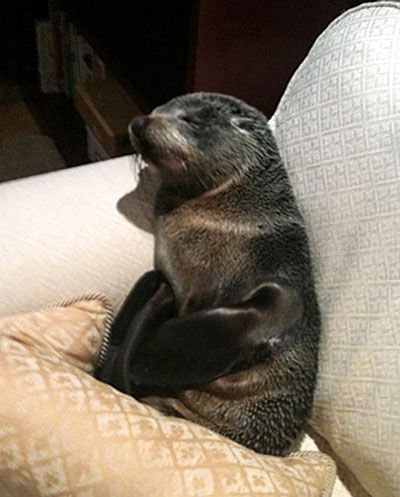
After finding its way into someone's house in New Zealand, a baby fur seal named Lucky takes a nap on the homeowner's couch.
Crown Copyright: Christopher Clark / Department of Conservation Te Papa Atawhai

IF YOU LOVE ANIMALS, check out this feel-good ABC News story about how a baby fur seal named Lucky made its way into someone’s house in New Zealand earlier this month...and if the details are to be believed, got onto the couch to take a nice little nap. Even if the homeowner picked up Lucky and placed it on her furniture for a (very) rare photo op, this is pretty darn adorable. Also, check out the Youtube clip below showing a baby owl being petted by a bystander. I have the sudden urge to watch that 2010 film Legend of the Guardians: The Owls of Ga'Hoole now. Okay no I don’t.

Tuesday, December 27, 2011

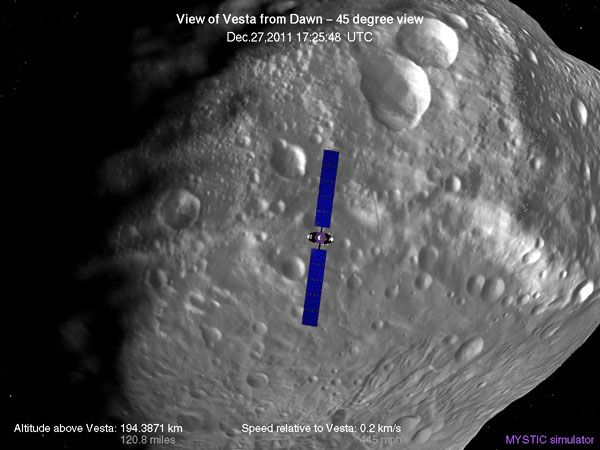
A computer-generated image depicting the Dawn spacecraft's current position above asteroid Vesta.
NASA / JPL - Gregory J. Whiffen

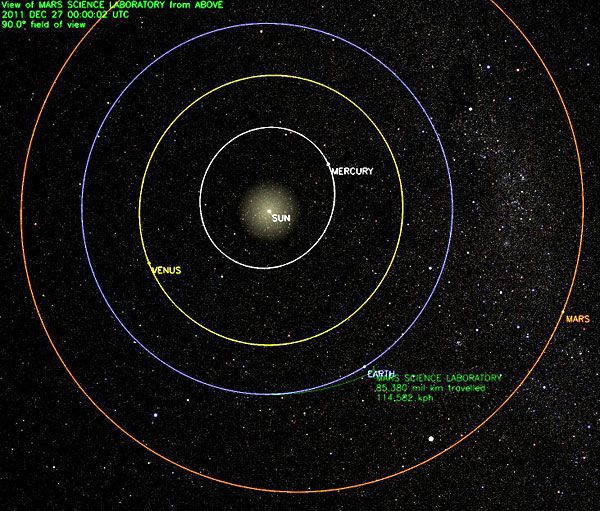
WHERE ARE THEY NOW? Just thought I’d provide this sort-of-brief status update on two intriguing robotic missions flying out in deep space. The Dawn spacecraft is only 121 miles above asteroid Vesta...having entered this very low orbit (also known as a Low Altitude Mapping Orbit, or LAMO, in NASA parlance) around the rocky, 330-mile-in-diameter body on December 12. The Curiosity Mars rover is now 5.5 million miles (8.9 million kilometers) from Earth, and 97.2 million miles (156.3 million kilometers) from the Red Planet...having traveled 53.1 million miles (85.4 million kilometers) through space since its launch on November 26. Curiosity—cocooned inside the Mars Science Laboratory spacecraft—is cruising at a speed of 71,213 mph (114,582 kph). It still has 296.3 million miles (477 million kilometers) to go before arriving at the Red Planet on the night of August 5, 2012 (Pacific Daylight Time).

Just thought I’d share a bunch of random numbers with ya.

A computer-generated image depicting the Curiosity Mars rover's current position out in deep space.
NASA / JPL - Solar System Simulator v4.0

Sunday, December 25, 2011

Construction continues on the 1 World Trade Center in New York City.
Courtesy of Mail Online

MERRY CHRISTMAS, EVERYONE! Despite the fact the 2011-’12 NBA season officially begins today (with the Lakers taking on the Chicago Bulls at STAPLES Center later this afternoon), just thought I would instead focus on showing these great photos of the 1 World Trade Center (1 WTC) as progress continues to be made on it being completed by early 2013. The lights inside the Freedom Tower were given holiday colors, making this topic a bit relevant for today. As of this entry, the building’s steel has risen to the 92nd floor...making the tower 1,146 feet tall. 12 more floors need to be constructed before 1 WTC’s primary framework is finished. After that, only the antenna spire needs to be installed to bring this U.S. skyscraper to a symbolic height of 1,776 feet. Awesome. This may just be an office building we’re talking about here, but I wouldn’t mind traveling back to New York City just to see this post-9/11 symbol of recovery in person. Once it’s completed, that is. Carry on.

Dusk falls upon the 1 World Trade Center and the rest of Manhattan in December of 2011.
Courtesy of Facebook

Above the 1 World Trade Center and the rest of Manhattan, clouds are awash in the glow of city lights at night.
WTCProgress - Twitter.com

A foggy Manhattan...as seen from the 80th floor of 1 World Trade Center.
Courtesy of Mail Online

Friday, December 23, 2011

Bane (Tom Hardy) is Gotham City's newest menace in THE DARK KNIGHT RISES.

THE DARK KNIGHT RISES... Go to my Film Notes section to check out the newest trailer (as well as screenshots from it) for The Dark Knight Rises. If you’re in the mood to dish out 10 bucks for a movie ticket, you can also see the preview in front of Sherlock Holmes: A Game of Shadows at the theater right now. If you’re willing to dish out at least 15 more bucks (unless you movie-hop after watching Sherlock Holmes), you can view the 6-minute opening scene for Christopher Nolan’s final Bat film in front of Mission: Impossible – Ghost Protocol at select IMAX theaters near you. Just a suggestion.

"There's a storm coming, Mr. Wayne... You and your friends better batten down the hatches. 'Cause when it hits, you’re all going to wonder how you ever thought you could live so large and leave so little for the rest of us."

– Selina Kyle (Catwoman) to Bruce Wayne in The Dark Knight Rises

Batman (Christian Bale) gets ready to brawl as Bane approaches in THE DARK KNIGHT RISES.

Tuesday, December 20, 2011

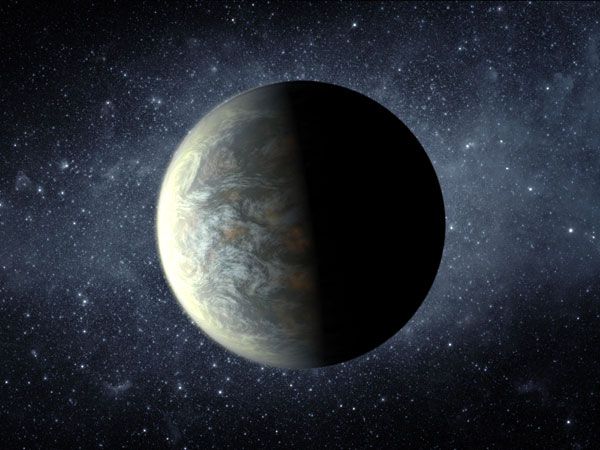
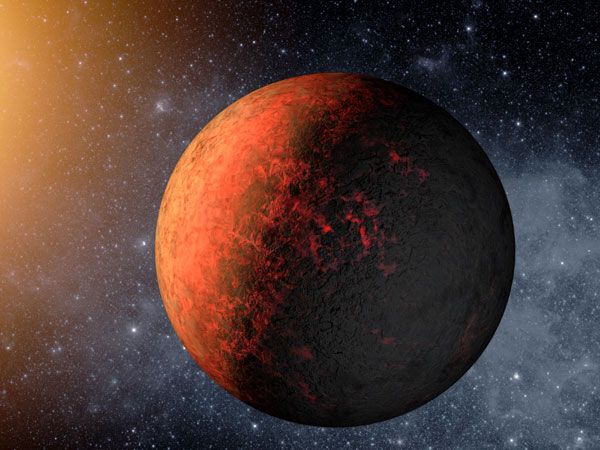
An artist's concept of the exoplanet Kepler-20e.
NASA / Ames / JPL - Caltech

KEPLER Update... This mission is on a roll... NASA should extend it at least three more years.

****

NASA Discovers First Earth-Size Planets Beyond Our Solar System (Press Release)

PASADENA, Calif. -- NASA's Kepler mission has discovered the first Earth-size planets orbiting a sun-like star outside our solar system. The planets, called Kepler-20e and Kepler-20f, are too close to their star to be in the so-called habitable zone where liquid water could exist on a planet's surface, but they are the smallest exoplanets ever confirmed around a star like our sun.

The discovery marks the next important milestone in the ultimate search for planets like Earth. The new planets are thought to be rocky. Kepler-20e is slightly smaller than Venus, measuring 0.87 times the radius of Earth. Kepler-20f is slightly larger than Earth, measuring 1.03 times its radius. Both planets reside in a five-planet system called Kepler-20, approximately 1,000 light-years away in the constellation Lyra.

Kepler-20e orbits its parent star every 6.1 days and Kepler-20f every 19.6 days. These short orbital periods mean very hot, inhospitable worlds. Kepler-20f, at 800 degrees Fahrenheit (427 degrees Celsius), is similar to an average day on the planet Mercury. The surface temperature of Kepler-20e, at more than 1,400 degrees Fahrenheit (760 degrees Celsius), would melt glass.

"The primary goal of the Kepler mission is to find Earth-sized planets in the habitable zone," said Francois Fressin of the Harvard-Smithsonian Center for Astrophysics in Cambridge, Mass., lead author of a new study published in the journal Nature. "This discovery demonstrates for the first time that Earth-size planets exist around other stars, and that we are able to detect them."

The Kepler-20 system includes three other planets that are larger than Earth but smaller than Neptune. Kepler-20b, the closest planet, Kepler-20c, the third planet, and Kepler-20d, the fifth planet, orbit their star every 3.7, 10.9 and 77.6 days, respectively. All five planets have orbits lying roughly within Mercury's orbit in our solar system. The host star belongs to the same G-type class as our sun, although it is slightly smaller and cooler.

The system has an unexpected arrangement. In our solar system, small, rocky worlds orbit close to the sun and large, gaseous worlds orbit farther out. In comparison, the planets of Kepler-20 are organized in alternating size: large, small, large, small and large.

"The Kepler data are showing us some planetary systems have arrangements of planets very different from that seen in our solar system," said Jack Lissauer, planetary scientist and Kepler science team member at NASA's Ames Research Center in Moffett Field, Calif. "The analysis of Kepler data continues to reveal new insights about the diversity of planets and planetary systems within our galaxy."

Scientists are not certain how the system evolved, but they do not think the planets formed in their existing locations. They theorize the planets formed farther from their star and then migrated inward, likely through interactions with the disk of material from which they originated. This allowed the worlds to maintain their regular spacing despite alternating sizes.

The Kepler space telescope detects planets and planet candidates by measuring dips in the brightness of more than 150,000 stars to search for planets crossing in front of, or transiting, their stars. The Kepler science team requires at least three transits to verify a signal as a planet.

The Kepler science team uses ground-based telescopes and the Spitzer Space Telescope to review observations on planet candidates the Kepler spacecraft finds. The star field Kepler observes in the constellations Cygnus and Lyra can be seen only from ground-based observatories in spring through early fall. The data from these other observations help determine which candidates can be validated as planets.

To validate Kepler-20e and Kepler-20f, astronomers used a computer program called Blender, which runs simulations to help rule out other astrophysical phenomena masquerading as a planet.

On Dec. 5, the team announced the discovery of Kepler-22b in the habitable zone of its parent star. It is likely to be too large to have a rocky surface. While Kepler-20e and Kepler-20f are Earth-size, they are too close to their parent star to have liquid water on the surface.

"In the cosmic game of hide and seek, finding planets with just the right size and just the right temperature seems only a matter of time," said Natalie Batalha, Kepler deputy science team lead and professor of astronomy and physics at San Jose State University. "We are on the edge of our seats knowing that Kepler's most anticipated discoveries are still to come."

NASA's Ames Research Center in Moffett Field, Calif., manages Kepler's ground system development, mission operations and science data analysis. JPL managed the Kepler mission's development.

Source: Jet Propulsion Laboratory

****

An artist's concept of the exoplanet Kepler-20f.
NASA / Ames / JPL - Caltech

Monday, December 19, 2011

The last vehicles in a U.S. Army convoy cross the border from Iraq into Kuwait, on December 18, 2011.
Maya Alleruzzo / Associated Press

IMAGES OF THE DAY, Part 3... First Osama bin Laden, then Moammar Gadhafi, and now Kim Jong-il. Oh, and U.S. soldiers are finally out of Iraq. Foreign policy-wise, 2011 is a good year to be an American and other folks who hate terrorists, renegade North African dictators and reclusive Asian despots who constantly spouted inane rhetoric about attacking North America with nukes despite having an interest in The Godfather, Gone with the Wind and other classic U.S. films. So when will gas prices finally fall to at least 2 dollars a gallon now that dictators are dropping like flies (though I'm well aware the Korean peninsula isn't a location where we're getting our oil supply)? And what’s up with Fidel Castro? He didn’t croak yet, did he? Anyways.

Kim Jong-il (1941-2011).

Saturday, December 17, 2011

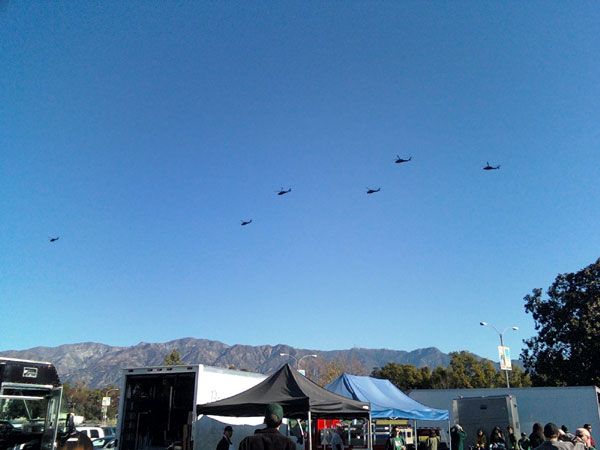
IMAGE OF THE DAY, Part 2... Just felt like sharing this camera phone pic that I took of several U.S. Army Black Hawk helicopters as they flew over the city of Pasadena yesterday. I have no idea where they were headed. Either they were taking part in a military training exercise near the Angeles National Forest, being participants in an action movie or TV show filmed north of Pasadena, or...they’re after a Somali warlord hiding somewhere in La Cañada Flintridge. If you can recall U.S. news events in 1993 (and remember a certain Ridley Scott film that was released in late 2001), you'd know what I was being facetious about. Carry on.

Several U.S. Army Black Hawk helicopters fly over the city of Pasadena, on December 16, 2011.

Wednesday, December 14, 2011

Michael Keaton (as the Dark Knight) and Kim Basinger (as Vicki Vale) in Tim Burton’s 1989 hit film, BATMAN.

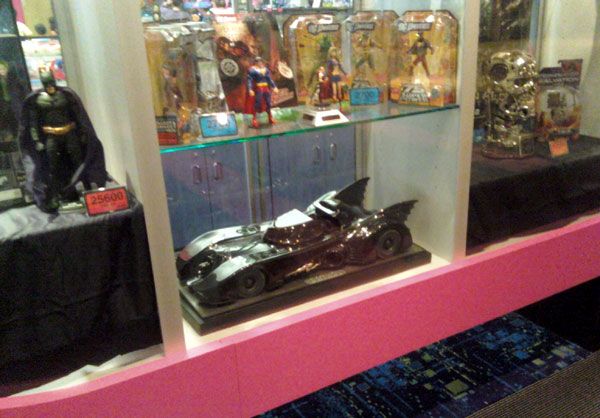
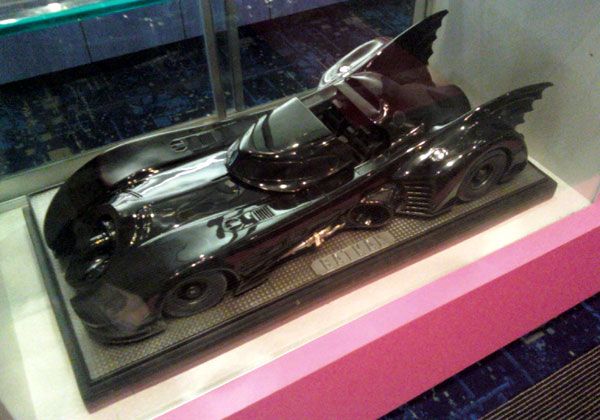
IMAGES OF THE DAY... Just thought I’d post these camera phone pics that I took of a cool Batmobile toy I saw at my local mall this past summer. The toy was on display at an arcade...and you could obtain this 2-foot-long collectible if you compiled a certain amount of tickets (169,000 tickets, to be exact) playing various games at the entertainment center. If it wasn’t for the fact I already have enough stuff cluttering my home, I’d totally try to win this awesome prize. Along with the Tumbler in Christopher Nolan’s film trilogy, the Batmobile in Tim Burton’s two Batman movies is my favorite incarnation of the Dark Knight’s ride. That is all.

A 2-foot-long Batmobile and other cool items on display at my local mall.

The 2-foot-long Batmobile on display at my local mall.

Sunday, December 11, 2011

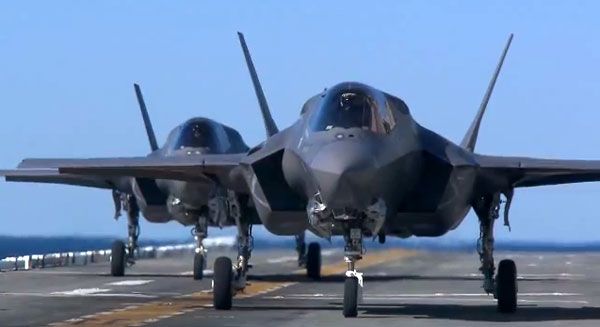
Two F-35B fighter jets prepare to undergo sea-trials aboard the amphibious assault ship USS Wasp, in October of 2011.
Lockheed Martin

VIDEOS OF THE DAY... Just thought I’d share these two cool Youtube clips showing the F-35 Lightning II undergoing a series of tests as it prepares to achieve initial operational capability by the United States and several of its allies’ militaries over the next few years.

- The first video shows the F-35B variant (which will be used by the United Sates Marine Corps) of the Lightning II performing vertical landings on the deck of the amphibious assault ship USS Wasp.

- The second clip shows the F-35C aircraft (which will be operated by the U.S. Navy) being launched by an experimental Electromagnetic Aircraft Launch System (EMALS) at Joint Base McGuire-Dix-Lakehurst in New Jersey.

The EMALS is a high-tech catapult system that will be installed on the USS Gerald R. Ford (currently being assembled in Hampton Roads, Virginia)...which will be the first of a new class of aircraft carriers succeeding Nimitz-class flattops that have been employed by the U.S. Navy for the past 25-plus years. I’m looking forward to seeing an advanced fighter jet like the Lightning II soar into combat from an advanced warship like the Gerald R. Ford...which will join the U.S. naval fleet in 2015. Good stuff.